12
Guyana Chronicle New York Edition Week-ending January 27, 2017
IT'S
A
FAjET
by JAMES SYDNEY
Dr.DiamelIIaie\VlLLIAMS
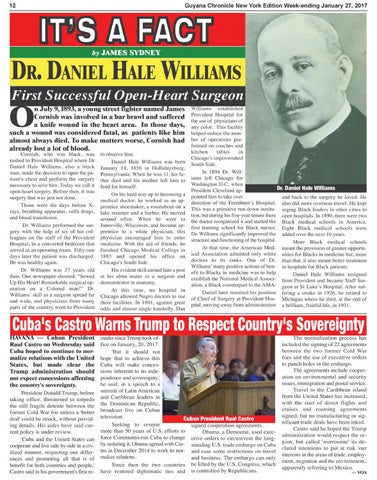
First Successful Open-Heart Surgeon On July 9,1893, a young street fighter named James Cornish was involved in a bar brawl and suffered a knife wound in the heart area. In those days, such a wound was considered fatal, as patients like him almost always died. To make matters worse, Cornish had already lost a lot of blood. Cornish, who was black, was rushed to Provident Hospital where Dr Daniel Hale Williams, also a black man, made the decision to open the patient's chest and perform the surgery necessary to save him. Today we call it open-heart surgery. Before then, it was surgery that was just not done. Those were the days before Xrays, breathing apparatus, sulfa drugs, and blood transfusion. Dr. Williams performed the surgery with the help of six of his colleagues on the staff of the Provident Hospital, in a converted bedroom that served as an operating room. Fifty-one days later the patient was discharged. He was healthy again. Dr. Williams was 37 years old then. One newspaper shouted: "Sewed Up His Heart! Remarkable surgical operation on a Colored man!" Dr. Williams' skill as a surgeon spread far and wide, and physicians from many parts of the country went to Provident
to observe him. Daniel Hale Williams was born January 18, 1856 in Hollidaysburg, Pennsylvania. When he was 11, his father died and his mother left him to fend for himself. On his hard way up to becoming a medical doctor, he worked as an apprentice shoemaker, a roustabout on a lake steamer and a barber. He moved around often. When he went to Janesville, Wisconsin, and became apprentice to a white physician, this physician encouraged him to enter medicine. With the aid of friends, he finished Chicago Medical College in 1883 and opened his office on Chicago's South Side. His evident skill earned him a post at his alma mater as a surgeon and demonstrator in anatomy. At this time, no hospital in Chicago allowed Negro doctors to use their facilities. In 1891, against great odds and almost single handedly, Dan
Williams established Provident Hospital for the use of physicians of . any color. This facility helped reduce the number of operations performed on couches and kitchen tables in Chicago's impoverished South Side.
••v.
*•
> In 1894 Dr. Will*■ iams left Chicago for Washington D.C. when Dr. Daniel Hale Williams President Cleveland appointed him to take over and back to the surgery he loved. He direction of the Freedmen's Hospital. also did more overseas travel. He kept This was a primitive run-down institu- urging Black leaders in other cities to tion, but during his five-year tenure there open hospitals. In 1890, there were two the doctor reorganized it and started the Black medical schools in America. first training school for Black nurses. Eight Black medical schools were Dr. Williams significantly improved the added over the next 10 years. structure and functioning of the hospital. More Black medical schools At that time, the American Medical Association admitted only white doctors to its ranks. One of Dr. Williams' many positive actions of benefit to Blacks in medicine was to help establish the National Medical Association, a Black counterpart to the AMA. Daniel later resumed his position of Chief of Surgery at Provident Hospital, moving away from administration
meant the provision of greater opportunities for Blacks in medicine but, more than that, it also meant better treatment in hospitals for Black patients. Daniel Hale Williams resigned from Provident and became Staff Surgeon at St Luke's Hospital. After suffering a stroke in 1926, he retired to Michigan where he died, at the end of a brilliant, fruitful life, in 1931.
Cuba's Castro Warns Ikump to Respect Country's Sovereignty HAVANA — Cuban President Raul Castro on Wednesday said Cuba hoped to continue to normalize relations with the United States, but made clear the Trump administration should not expect concessions affecting the country's sovereignty. President Donald Trump, before taking office, threatened to torpedo the still fragile detente between the former Cold War foe unless a 'better deal' could be struck, without providing details. His aides have said current policy is under review. 'Cuba and the United States can cooperate and live side by side in a civilized manner, respecting our differences and promoting all that is of benefit for both countries and people,' Castro said in his government's first re-
marks since Trump took office on January, 20, 2017. 'But it should not hope that to achieve this Cuba will make concessions inherent to its independence and sovereignty,' he said, in a speech to a summit of Latin American and Caribbean leaders in the Dominican Republic, broadcast live on Cuban television. Seeking to reverse more than 50 years of U.S. efforts to force Communist-run Cuba to change by isolating it, Obama agreed with Castro in December 2014 to work to normalize relations. Since then the two countries have restored diplomatic ties and
4 §
J!
L4
signed cooperation agreements. Obama, a Democrat, used executive orders to circumvent the longstanding U.S. trade embargo on Cuba and ease some restrictions on travel and business. The embargo can only be lifted by the U.S. Congress, which is controlled by Republicans.
The normalization process has included the signing of 22 agreements between the two former Cold War foes and the use of executive orders to punch holes in the embargo. The agreements include cooperation on environmental and security issues, immigration and postal service. Travel to the Caribbean island from the United States has increased, with the start of direct flights and cruises and roaming agreements signed, but no manufacturing or significant trade deals have been inked. Castro said he hoped the Trump administration would respect the region, but called 'worrisome' its declared intentions to put at risk 'our interests in the areas of trade, employment, migration and the environment,' apparently referring to Mexico. — VGA