
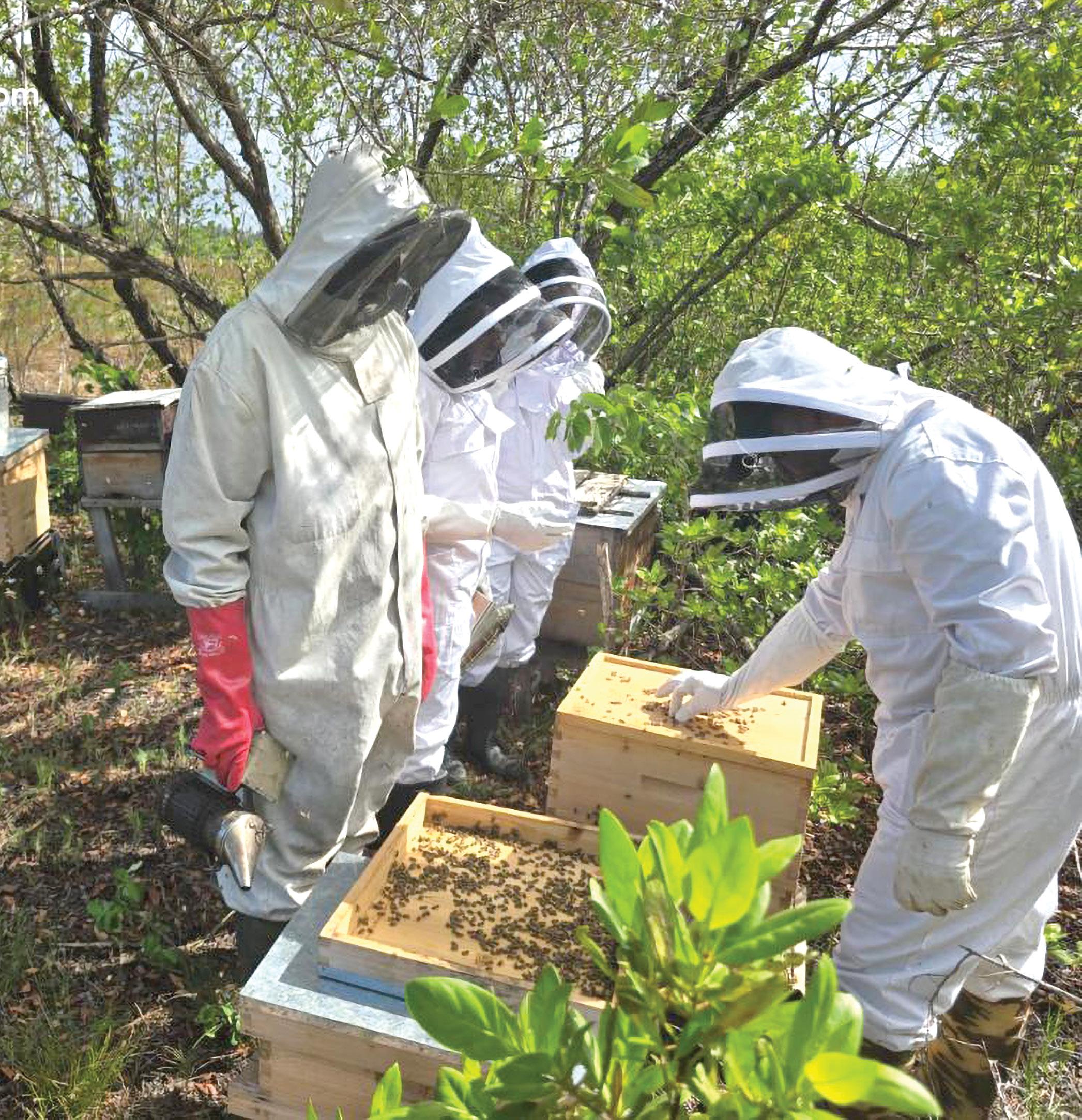
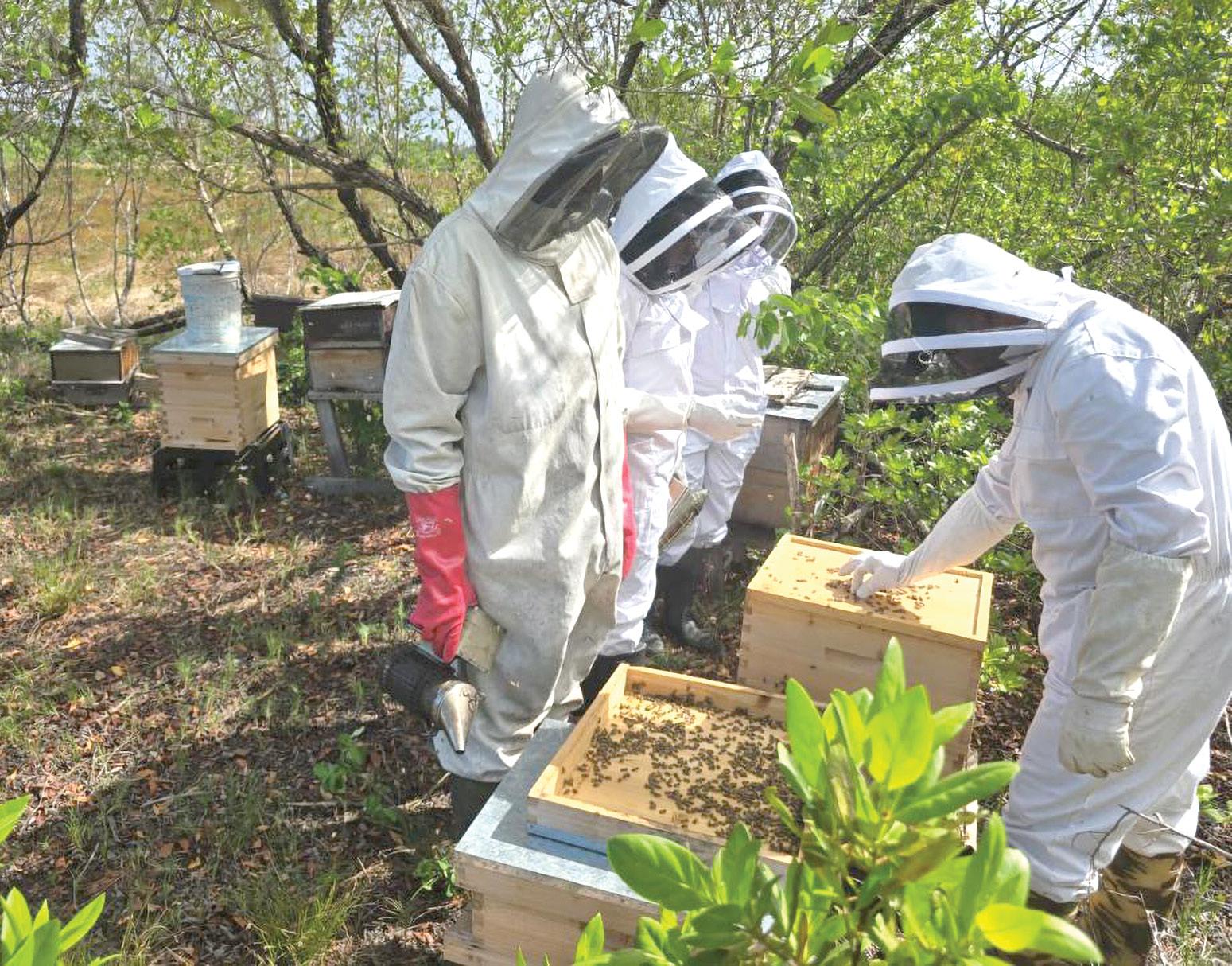
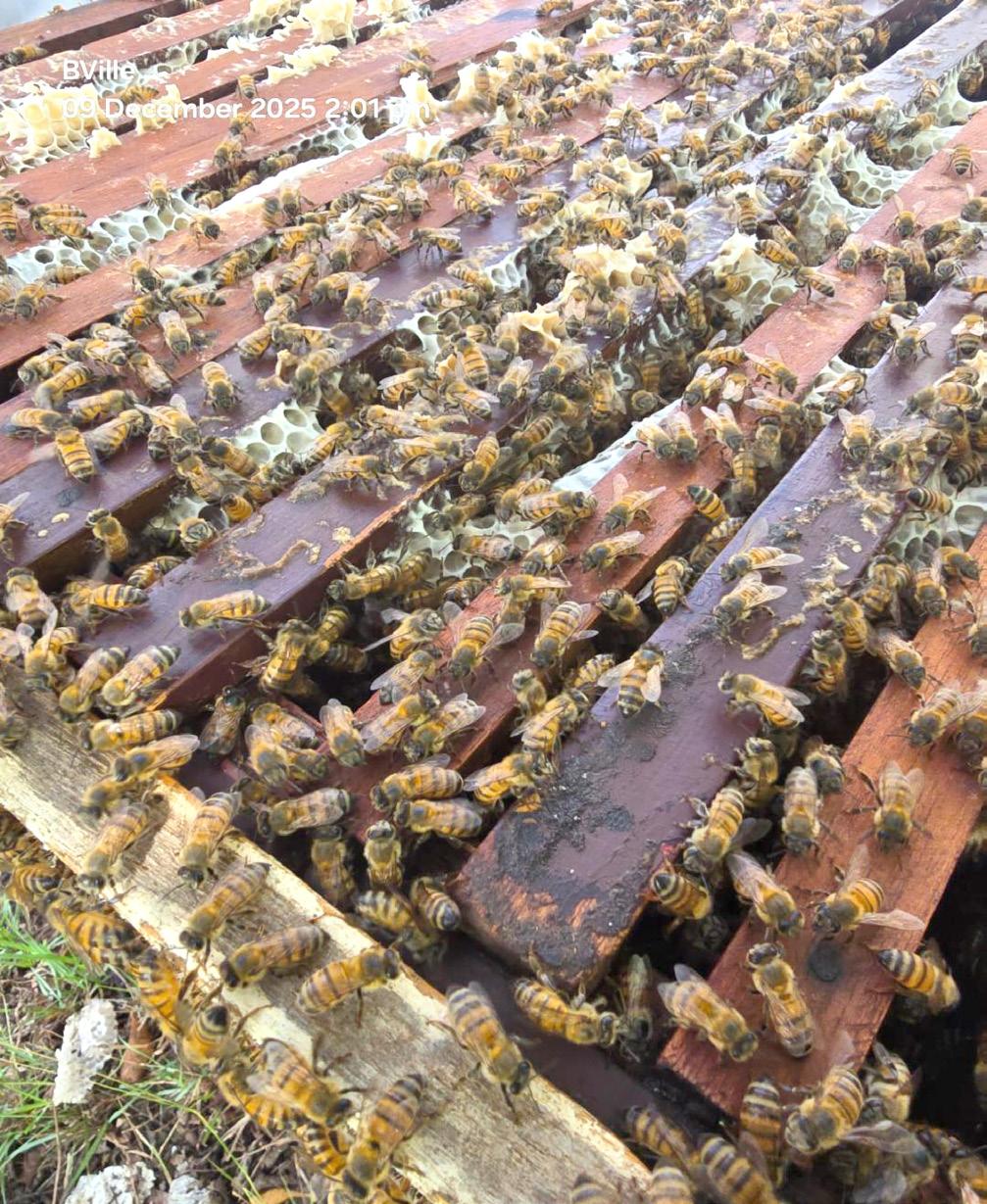
One of many apiaries in Guyana
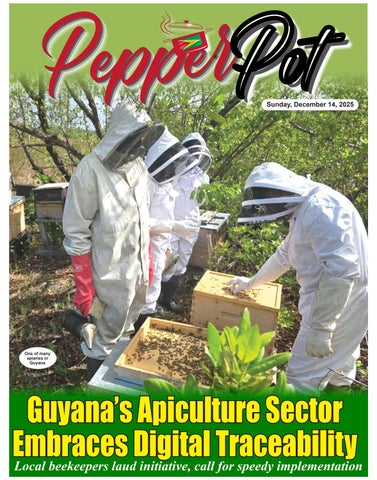
By Michel Outridge
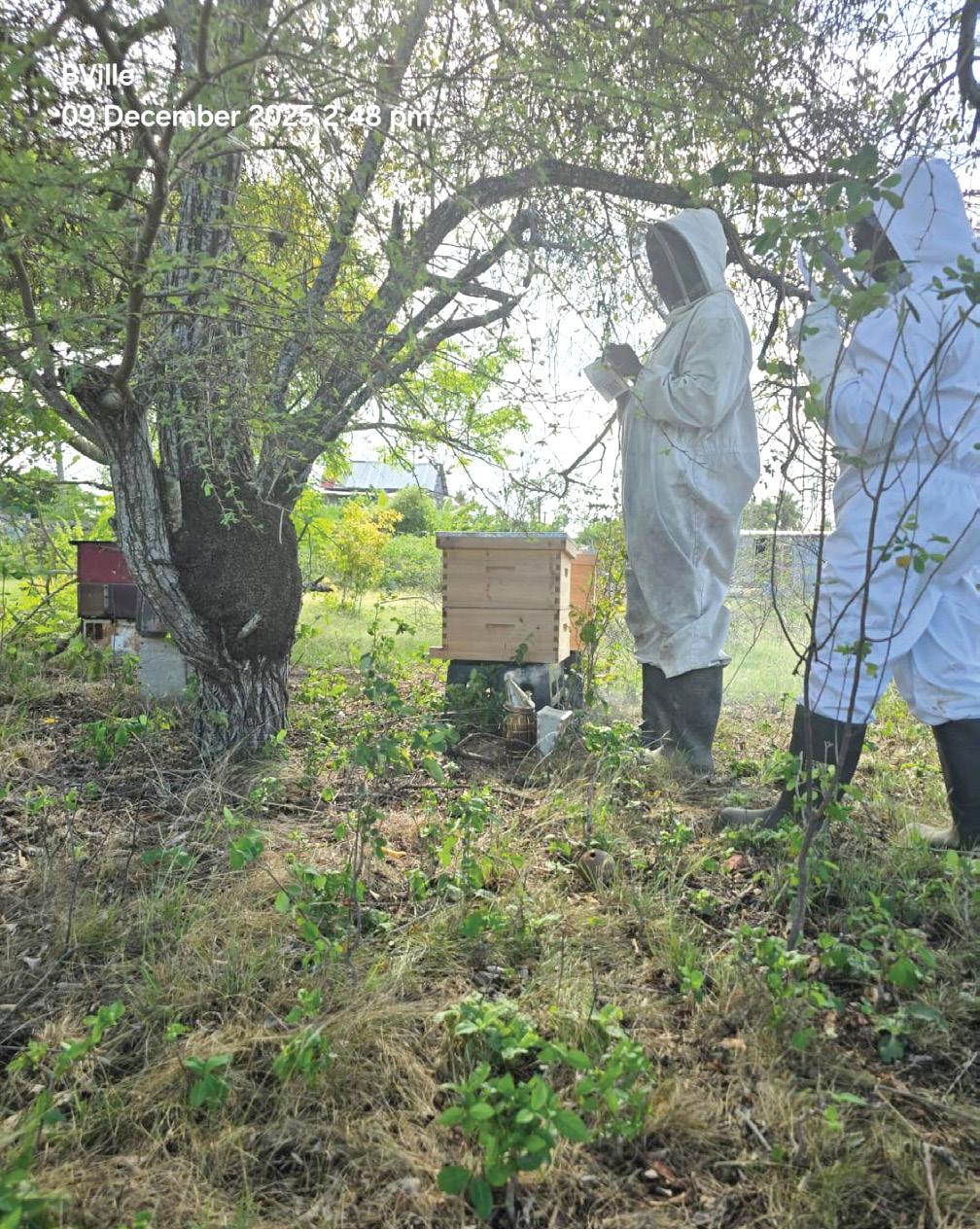
GUYANA’S apiculture sector is undergoing a profound transformation, as the Guyana Food Safety Authority (GFSA), in collaboration with the Guyana Livestock Development Authority (GLDA), is piloting the National Registration and Traceability System (NRTS) across several regions.
This digital “hive-to-consumer” platform introduces a comprehensive framework for registering apiculturists, mapping apiaries with GPS technology, assigning batch numbers, and placing QR codes on honey to allow in-
stant authentication.
Anchored in the Food Safety Act 2019 and guided by Codex Alimentarius, ISO 22000, CARICOM’s CRS 18:2011 Honey Standard, and CAHFSA’s 2022 Honey Trade Guidelines, the programme establishes a strong regulatory and technological foundation aimed at reducing adulteration, modernising honey production, and strengthening Guyana’s food safety infrastructure. While the apiculture sector is the initial focus, the platform is envisaged to eventually extend to all agricultural industries, creating a unified digital traceability framework for Guyana’s food
production systems.
Veteran apiculturist
Horace Sinclair of Golden Harvest Apiary, Sandvoort, West Bank Berbice, strongly endorsed the system, describing it as a “welcome intervention in a sector too often challenged by counterfeit honey.”
Sinclair explained that “the creation of a QR code from hive to consumer is a good move toward eliminating fake honey,” emphasising that it will help ensure that “defaulters take responsibility for the product they put out.” He believes the system provides the credibility and accountability legitimate producers have long need - ed, especially as consumers continue to express concerns about authenticity in the marketplace.

system’s potential to combat counterfeit products.
Fellow beekeeper Shane Fullington, who produces raw, unprocessed “Hive to Bottle” honey, offered equally strong support.
Fullington noted that consumers frequently report being deceived by adulterated honey, stating, “There has been a lot of negative feedback from the consumer level about people getting fake honey on the local market, and this programme will reduce these issues significantly.”
He highlighted the system’s practicality and value: “You can scan the QR code on the beekeeper’s product using your cell phone to see where the hive is, the vegetation type, if the product is authentic, if it is safe for consumption, and whether it has met all the requirements in the food safety standards”.
Fullington added that the system encourages professionalism by ensuring beekeepers maintain hygienic environments and properly document their processes.
Each harvest now receives a unique batch number, making it easier for buyers to trace a bottle of honey “back to the exact origin of the beekeeper”.
Meanwhile, Lyndon Stewart, Vice President of the Guyana Apiculture Society and team leader at Kingdom Apiary, underscored the
Stewart noted, “This initiative to create GPS coordinates for traceability of our honey will assist us in
uine beekeepers will benefit from having a digital identity and verifiable location, something counterfeit sellers lack.
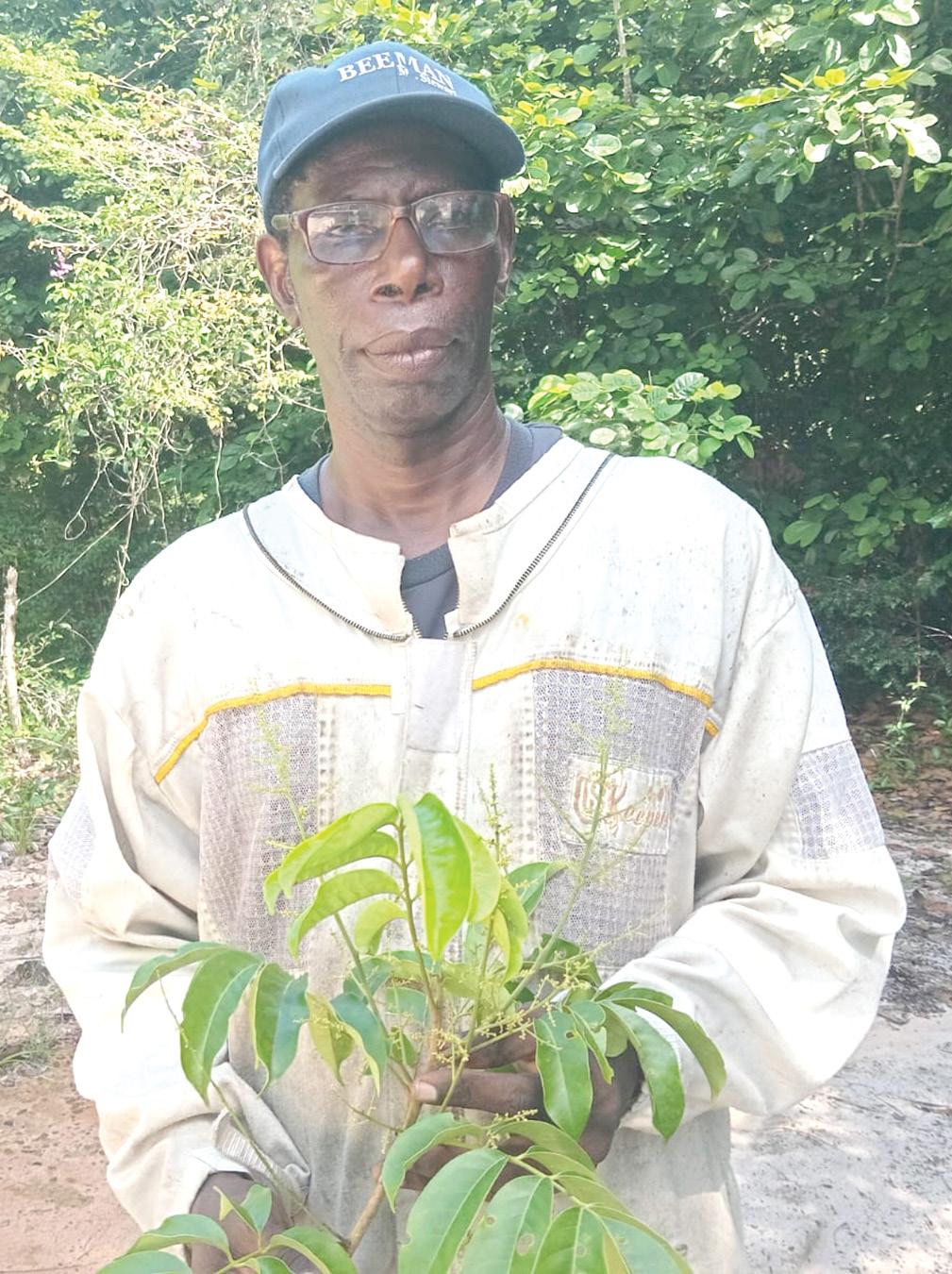
pushing fake honey off the shelf, off the market, and off your tables.”
He added that consumers will finally have evidence-based assurance because “they know it’s going to be good, safe, and fit for human consumption.”
Stewart stressed that gen-
“Persons who are not beekeepers and are selling fake honey would not have any location or digital footprint,” he said, making it clear that unverified sellers will be easily identified once the system becomes national policy.
Stewart also emphasised that the system has unexpected public-safety benefits. In TURN TO PAGE XIV

By Michel Outridge
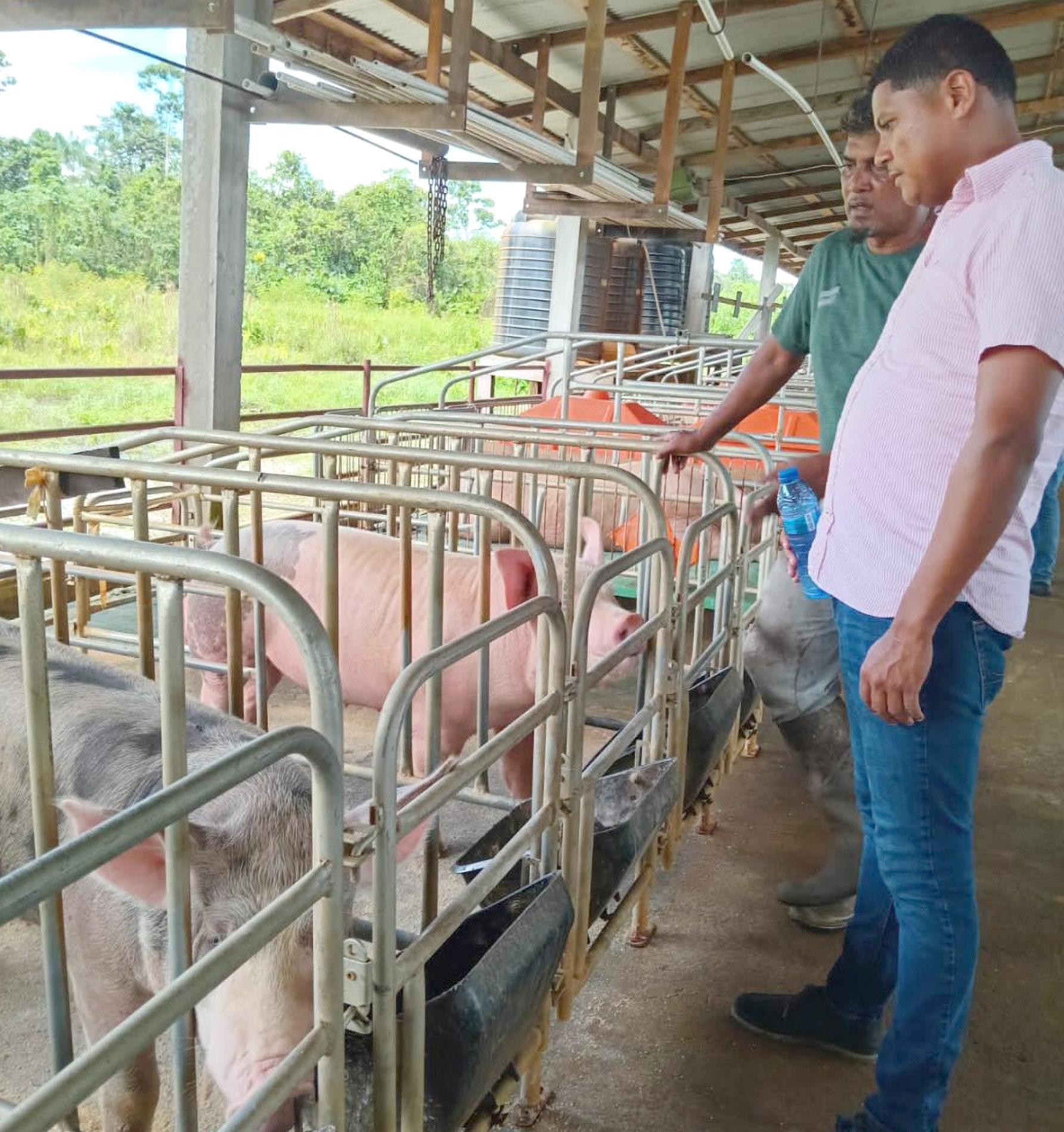
IN Guyana’s agricultural sector, where dedication often goes unnoticed, Rondel Cameron has quietly built a career that is both inspiring and impactful. For the past decade, Cameron has served as the Livestock Extension Officer at the Guyana Livestock Development Authority (GLDA) and Head of its National Swine Unit, guiding farmers, shaping policies, and helping to modernise livestock production across the country.
Cameron’s journey began in Bartica, Region Seven, where he spent his early childhood. At a tender age, he left his hometown to pursue better educational opportunities in Region Three, attending Malgre Tout Primary School on the West Bank Demerara. At the time, he could not understand why he had to leave Bartica, but the move proved pivotal. After excelling at the Common Entrance Examination, he attended West Demerara Secondary School before family circumstances brought him back to Bartica, where he completed his secondary education.
As the youngest of his siblings, Cameron looked up to his older brother, who earned a scholarship to study medicine in Cuba. That achievement sparked his own ambition. Fresh out of secondary school, Cameron applied himself diligently and was awarded a government scholarship to Cuba, where he studied for six years. In 2015, he graduated from the University of Ciego de Ávila with a degree in agronomy engineering.
While in Cuba, Cameron wrestled with the choice between crops and livestock. Ultimately, his passion for livestock won out. He wanted to contribute to Guyana’s agricultural sector in a way that
and adopt modern practices. He has also trained extension staff in collaboration with agencies such as Partners of the Americas, ensuring knowledge is shared across regions. In 2016, he contributed to the introduction of the Topigs 40 breed in Guyana, a milestone in swine production.
directly improved the lives of grassroots farmers, helping them adopt better technologies and management practices. That decision has defined his career.
Returning home at age 24, Cameron joined GLDA in September 2015. Almost immediately, he was entrusted with managing the National Swine Sub-Unit, a responsibility that demanded both technical expertise and leadership. Over the past ten years, he has grown into the role, spearheading initiatives under the National Swine Work Programme and building a reputation as one of the organisation’s top performers.
His achievements are many. He has facilitated capacity-building sessions with farmers across Guyana, helping them improve productivity
More recently, in 2023, he helped develop a Biosecurity Manual for pig farms, a critical tool for safeguarding animal health and food safety. He has also been instrumental in designing model farms to serve as examples for farmers nationwide.
Cameron is known among colleagues and farmers as soft-spoken, well-mannered, and jovial — qualities that make him approachable and trusted. His calm demeanour and cheerful personality have helped him build strong relationships with farmers, extension staff, and peers, ensuring that his technical guidance is received with respect and confidence.
He is very excited to continue contributing towards the development of the swine industry in Guyana, especially as the government, led by President Dr Irfaan Ali, forges ahead with plans to build
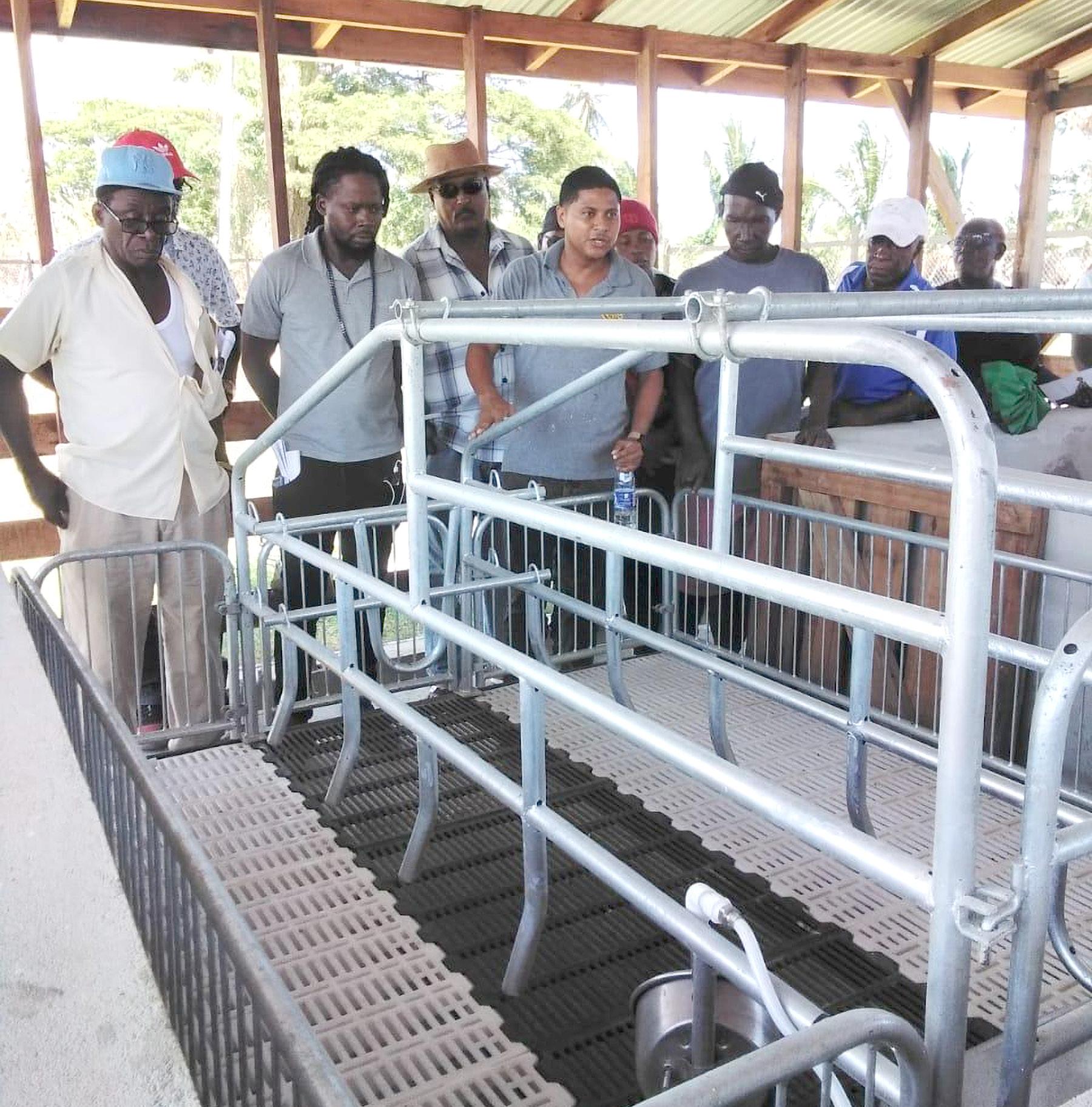
a swine abattoir. This facility will further strengthen the industry’s value chain, ensuring that farmers benefit from modern infrastructure while supporting the CARICOM 25 x 2025+5 Initiative, which aims to reduce the region’s food import bill and promote food security.
Cameron is also urging farmers to embrace GLDA’s artificial insemination as a way to improve animal genetics and reduce operational costs. He believes this technology can transform swine production by enhancing efficiency and competitiveness. He is highly pleased to be working with farmers in remote regions, including Regions Seven and Eight, who are embracing swine production as a sustainable economic livelihood while ensuring their own region’s food security.
Equally important, Cameron is computer-savvy and embraces the evolving technological sphere, recognising that modern agriculture must integrate digital tools to remain competitive. His ability to adapt to new technologies, from data management systems to digital communication platforms, has strengthened his work with farmers and improved the efficiency of the National Swine Unit. For him,
technology is not a challenge but an opportunity to connect, innovate, and build resilience in the livestock sector. Beyond his professional life, Cameron is fluent in both English and Spanish, proficient in Microsoft applications, and enjoys travelling to new destinations. He has developed strong communication skills, creative thinking, and team leadership qualities that serve him well in his work.
At home, he finds joy in gardening, planting, and harvesting crops whenever he gets the chance — a reminder that his love for agriculture extends beyond his office and into his personal life.
Cameron’s story is one of perseverance, vision, and service. From a boy in Bartica who left home for better schooling, to a scholarship student in Cuba, to a national leader in livestock development, his journey reflects the power of education, opportunity, and dedication. Today, he stands as a role model for young Guyanese, proving that with passion and commitment, one can not only build a career but also make a lasting difference in the lives of farmers and communities across the country.
By Michel Outridge
IN the quiet stretches of Guyana’s countryside, a new rhythm is taking hold — one that hums with the industrious buzz of bees. Apiculture, once a modest pursuit, is now flourishing across rural communities, offering farmers not only a source of income but also a sustainable livelihood that complements traditional agriculture.
This rise in beekeeping is part of the Government’s broader vision to create resilient, diversified economies across the nation, ensuring that families in villages from Berbice to Essequibo can thrive in harmony with the land. Importantly, the expansion of apiculture aligns with Guyana’s Low Carbon Development Strategy (LCDS), which emphasises sustainable
practices that protect biodiversity, reduce emissions, and create green economic opportunities.
Among the many stories of transformation is that of Treavon Prass, a young farmer from Number 51 Village, Corentyne, Berbice. Five years ago, Prass had little interest in bees. Today, he manages 15 hives of Africanised bees and has harvested an impressive 20 gallons of
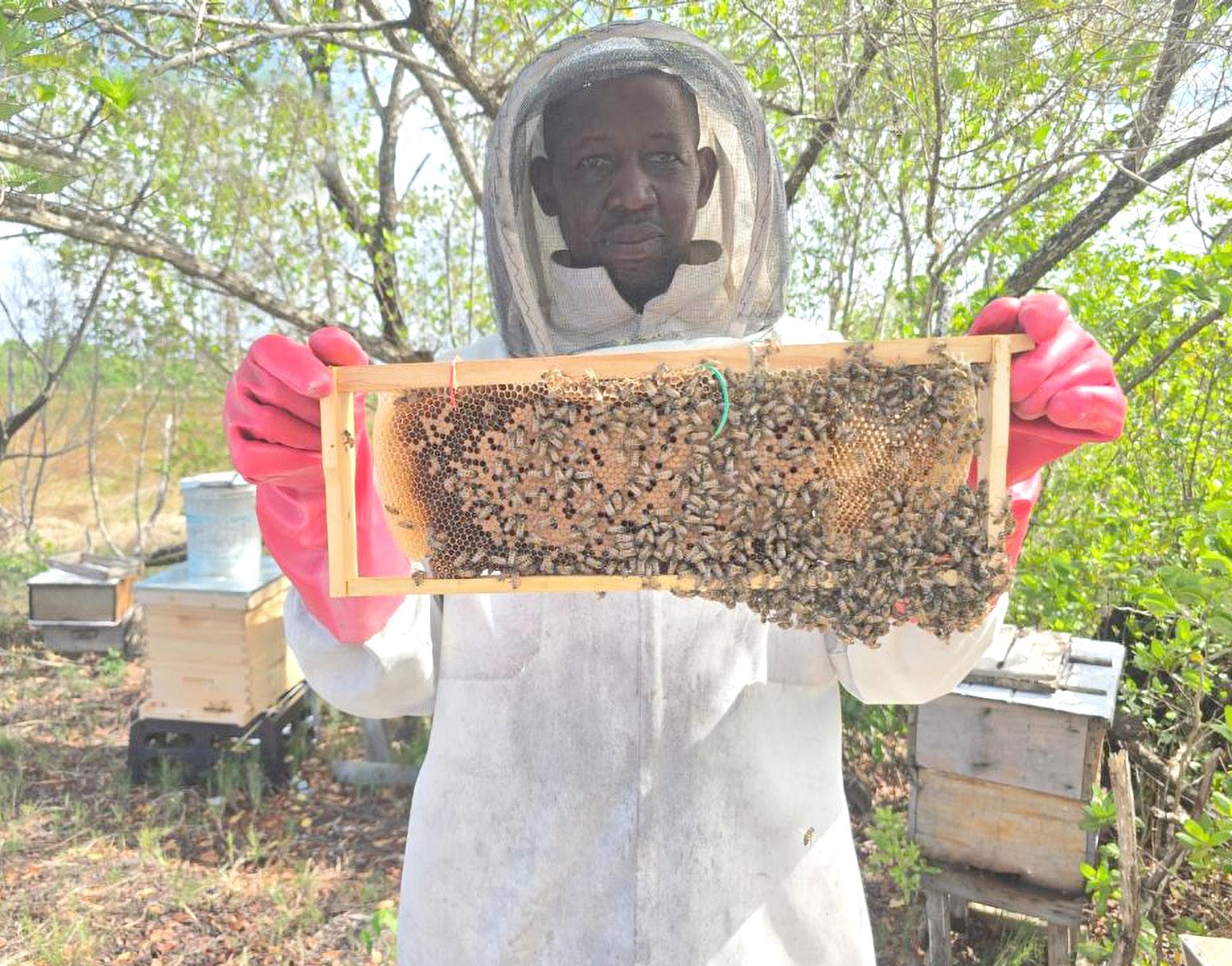
pure honey so far this season. His journey reflects the broader story of apiculture’s rise in Guyana—a blend of tradition, innovation, and community empowerment.
Beekeeping in Guyana is shaped by the cyclical pattern of two main honey flow seasons, traditionally spanning March to May and October to December, when flowering plants produce abundant nectar. However, these periods are highly dependent on rainfall patterns. When the rainy season ends early, as in July or August, trees respond with earlier or extended blossoming periods, sometimes prolonging honey production into January or February. This weather-driven variability influences honey flows across both inland and coastal regions.
The previous year, an
unusually prolonged dry season significantly disrupted production in Sandvoort, East Canjie, and Berbice. Saltwater intrusion into freshwater zones stressed mangrove ecosystems, causing many trees to fail under elevated salinity levels. As a result, honey yields declined markedly until rainfall returned, restoring brackish conditions conducive to mangrove flowering and the recovery of honey production.
Prass explains that location is critical, noting that his ancestral lands along the sea dam provide the ideal environment for his bees to thrive.
“Beekeeping is addictive when you know what you are doing,” he reflects. “It’s not about money alone, but the love of caring for the
TURN TO PAGE VII
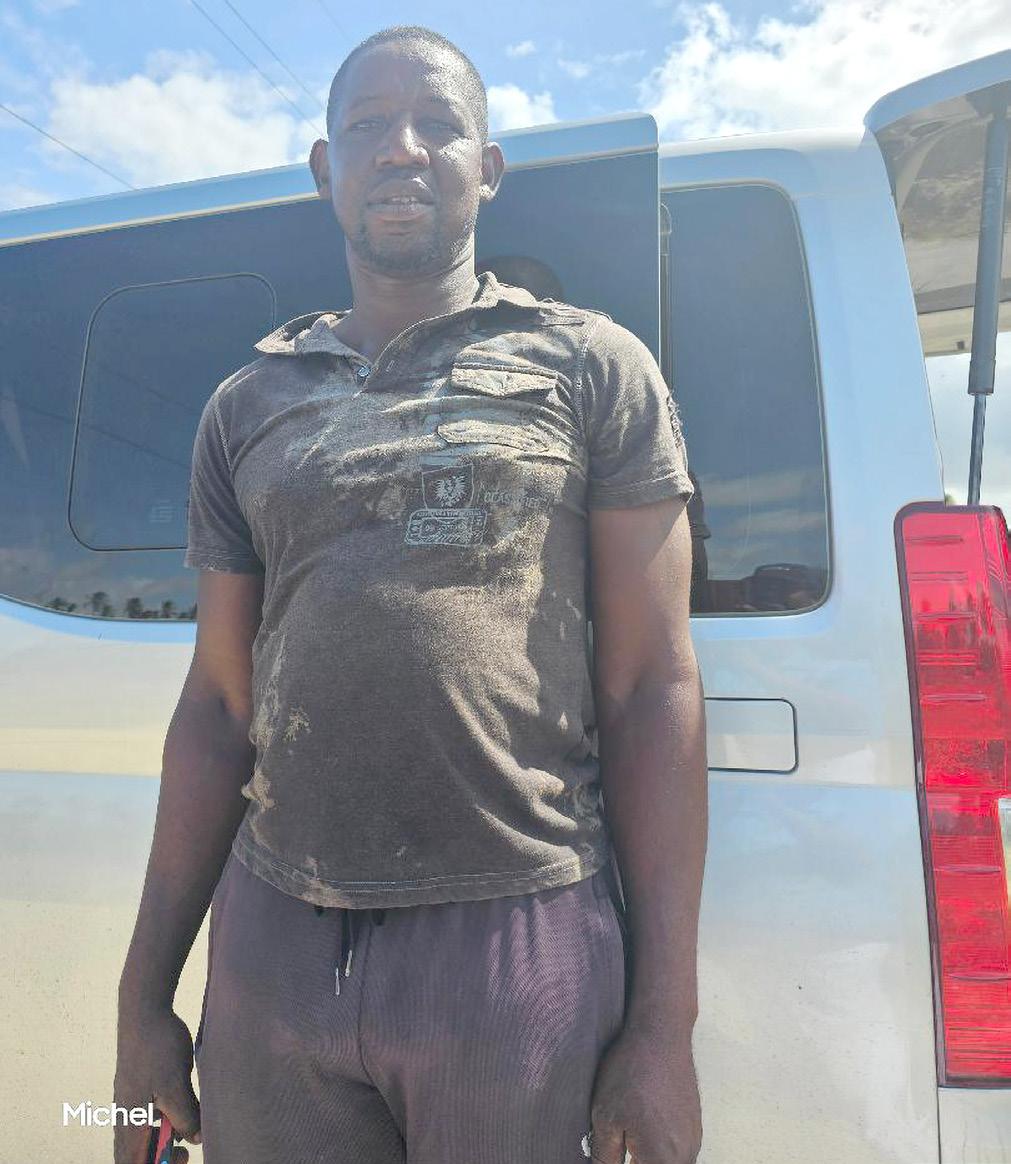
By Michel Outridge
WITH the Christmas season in full swing and Guyanese families preparing their festive menus, including pepperpot, demand for quality meat — especially beef — is rising sharply across the country.
But unlike years past, when the season brought pressure and uncertainty, 66-year-old Region Five cattle farmer Mahendranauth Oodit, also known as Rohan, stands ready and confident. Thanks to improved genetics and better animal husbandry, he is now able to meet the holiday rush with a steady supply of heavier, healthier animals.
These days, at daybreak in Washington Village, West Coast Berbice, Mr Oodit, a respected entrepreneur, begins his familiar walk, perusing the pastures with his workers to conduct thorough checks on his 500 head of cattle. His movements are slow and steady, shaped by decades of experience and a childhood spent trailing his father across the cattle grounds of Weldaad. Farming, for him, has never been just an occupation — it is a
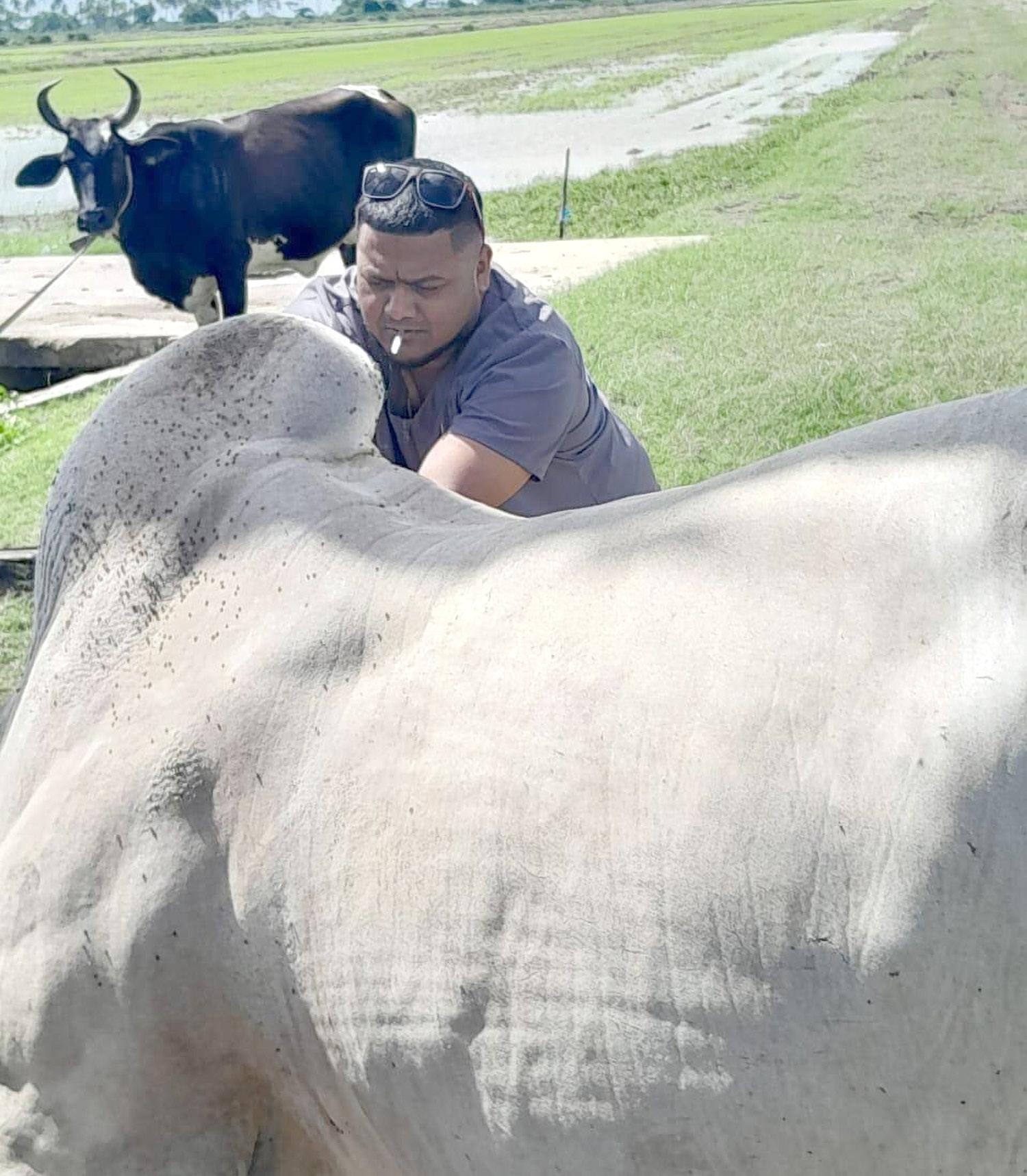
legacy woven through family, land, and tradition. He is a firm believer in meticulous record-keeping, tracking the growth, health, and performance of each head of cattle. For most of his life, Oodit worked with a traditional herd: reliable, hardy animals, but slow to reach market weight. During busy seasons
like Christmas, when beef demand soared, he often struggled to keep up. The animals took time — sometimes too much time — to mature. He managed, but he knew he could do better.
Prior to participating in the Guyana Livestock Development Authority (GLDA) Bull Rotation Programme,
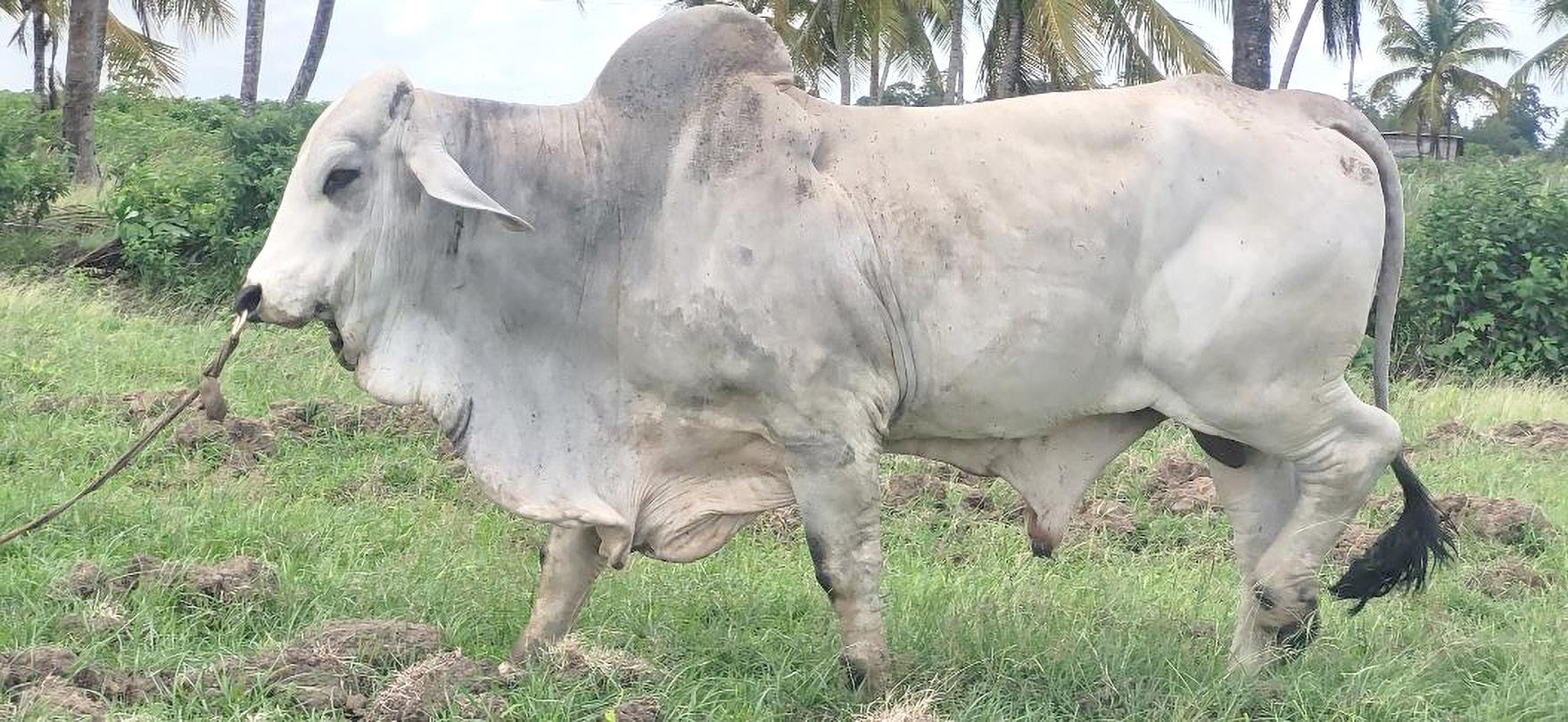
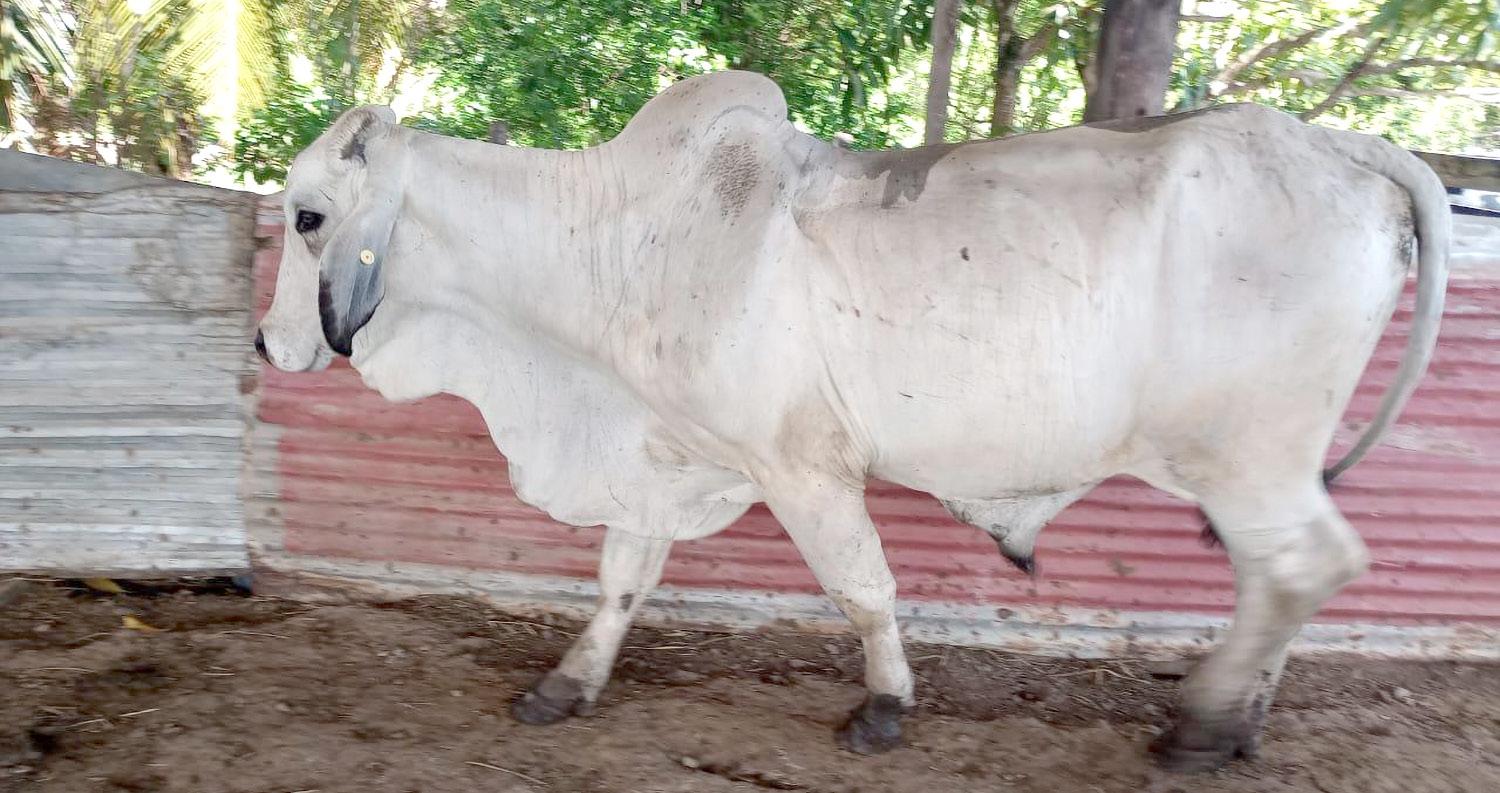
he sourced quality animals from breeders in his region — a breakthrough, he says, that reduced dependency on a single source and helped prevent inbreeding, which can negatively affect the genetics and performance of his herd. That turning point arrived with the GLDA programme. Through the initiative, he received a pedigree Brahman bull—an imposing, high-quality animal known for its strength, adaptability, and rapid growth. The impact was immediate.
“Everything changed,” he recalls. “The calves started growing faster, bigger, and TURN TO PAGE XXIII


DAR ES SALAAM, Tanzania — Celebrating its 18th year, Swahili Fashion Week 2025 once again became a global stage for fashion innovation — and at the centre of it, Guyana-born designer Kerby Young shone brightly once more.
Last year, Young made history as the first Caribbean designer to be featured at this prestigious event. Returning this year with “The Journey,” a collection symbolising his evolution from Guyana to his established presence in Trinidad and Tobago with Kerby Young Designs (KYD), he once again captivated audiences.
While inspired by the vivid colour palette of Santorini, Greece, Young’s collection featured hues of deep Mediterranean blue reminiscent of tranquil waters, crisp whites echoing the iconic Grecian architecture, bright greens evoking lush island foliage, and rich reds symbolising the vibrant flowers nestled among Santorini’s stone houses.
Young also infused the collection with traditional artisan techniques. He incorporated tie-dyeing and fabric manipulation and collaborated with Crochet Peace to add beautifully handcrafted crochet elements to several pieces, making each garment a testament to cultural fusion.
As the models walked to the rhythm of African drums and the soulful voice of Ella Andall and the late Devon Matthews’ “D Journey,” each piece told a story of heritage and modernity. The finale, set to “Lala” by Square One, had the audience clapping along, celebrating not just fashion but a journey of self-belief and resilience.
Half of the collection found new homes in Africa, and upon returning to Trinidad, Young plans to produce more pieces — though some signature designs will remain exclusive to this Tanzanian debut.
“This experience is one I will carry with me forever,” Young shared. “It’s a testament to never giving up on your dreams, and I’m grateful for the warm welcome in Tanzania and the support from my Caribbean and Guyanese roots.”
With a growing social media following and a successful pop-up shop accompanying his showcase, “The Journey” is just the beginning of even greater ventures. Swahili





bees. They give back to you through their honey production.”
He also prides himself on supplying his customers with natural, pure honey. In the absence of a formal traceability system, he has relied on a traditional test to reassure buyers: pouring honey into water. If the honey sinks without spreading, that is an indication of purity. This simple demonstration has built trust with local customers, but Prass welcomes the new National Traceability System, recognising that it will increase market confidence by ensuring that food safety standards are adhered to at every level of the production chain, from the farm to the consumer.
The National Traceability System is a digital platform that registers and monitors all apiculturists and beekeepers
in Guyana. It centralises data on honey production, movement, and distribution, ensuring that all honey products are traceable from hive to market. A key feature is the use of QR codes, which allow consumers to instantly scan and verify the honey’s origin and certification. For farmers, this builds credibility and opens access to premium markets, while for consumers, it guarantees transparency and authenticity.
With technical guidance and support, including startup boxes from the Guyana Livestock Development Authority (GLDA), Prass welcomes the initiative to further strengthen his apiary by adhering to food safety protocols, including monitoring through the traceability system piloted by the Guyana Food Safety Authority
(GFSA) and GLDA. While he acknowledges that his production system is still evolving, he is desirous of more support from both agencies to help him expand and refine his operations. He is particularly grateful for assistance with the design and printing of his labels, which he now understands must be aligned with international standards if his honey is to compete in broader markets.
Prass’s journey is also a family affair. His wife, Nadira Lildgar, has become equally versed in beekeeping, assisting with hive care and honey harvesting. Their partnership underscores the communal nature of apiculture, where families work together to sustain livelihoods and strengthen rural economies.
As Guyana advances its agenda of sustainable development, apiculture offers

a model of how traditional practices can evolve with modern technology. Farmers like Treavon Prass exemplify this transformation — rooted in ancestral land, guided by government support, and propelled by innovation.
With each honey flow season, they are not only harvesting sweetness but also cultivating resilience, trust, and opportunity for rural communities across the nation. In doing so, they are contributing to Guyana’s Low Carbon Development Strategy, proving that livelihoods built on sustainability can be both prosperous and environmentally protective.


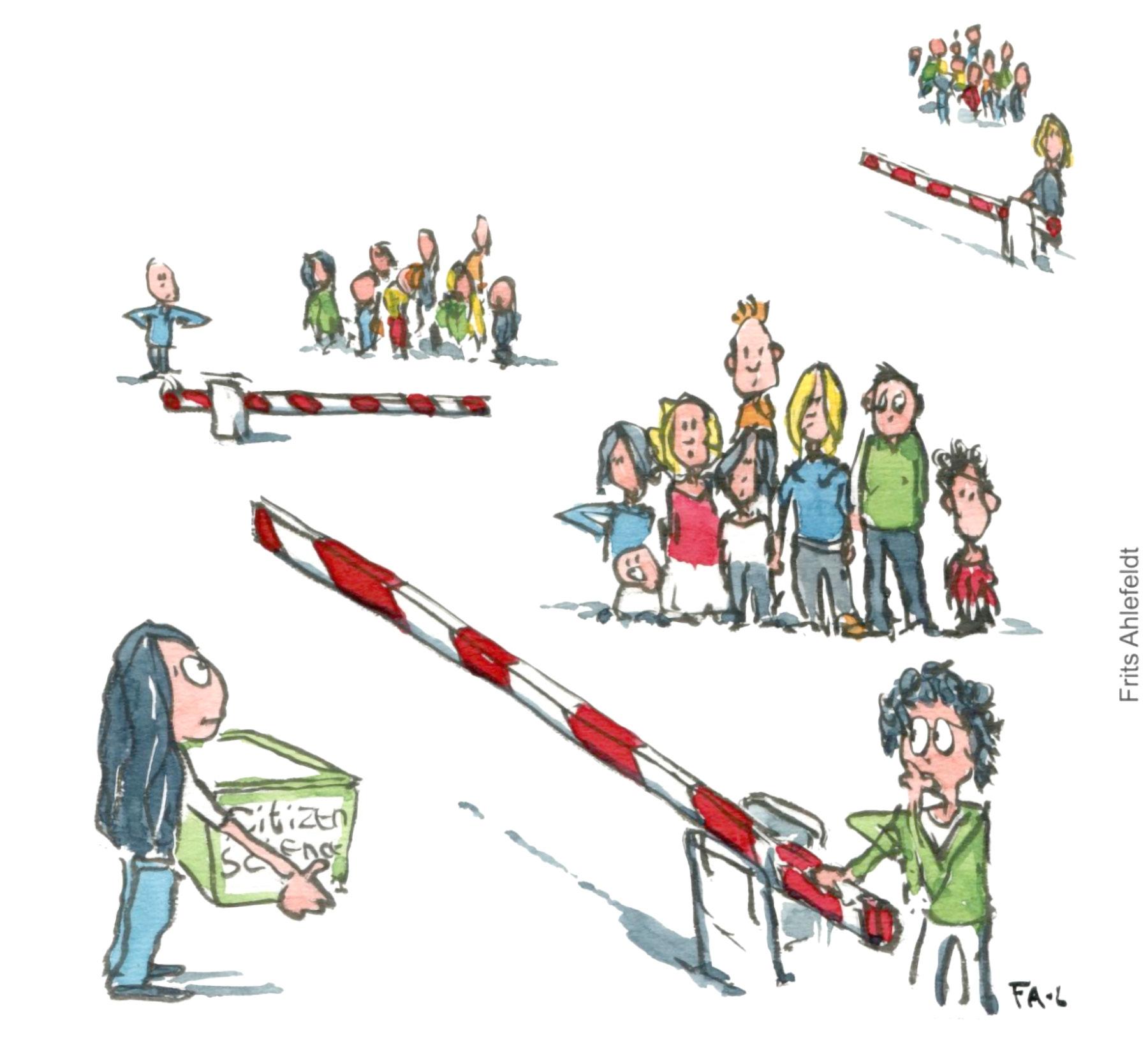
IN every space, especially in the context of developmental work, I often encounter people who assume the role of “protector of standards”. It is usually long-standing volunteers, long-term employees, or managers with years of experience, with a strong position on how things ought to be.
They often view these measures as necessary to uphold the organisation or group’s core values. Unfortunately, somewhere along the link, the act of “protection” or “safeguarding” can become gatekeeping. “Gatekeeping” is not specifically “spelt out” in these spaces. It is not always apparent; rather,
we have to look beyond the surface to see it. It is apparent in the exclusion from certain decision-making processes, the discouragement of participation and engagement, or the deliberate red tape imposed on certain opportunities.
I wanted to specifically highlight this challenge in de-

velopmental spaces because I believe it is now a deterrent to young people joining. We are seeing a decrease in young people’s participation worldwide in these spaces— from community groups, NGOs, church organisations, and even locally-based international organisations. There is often a select few in these spaces that make it particularly difficult for newcomers. We must discuss why these can be detrimental to the growth of developmental or community spaces.
You might be wondering, where did I even get the idea that people are “gatekeeping” in these spaces? Is it just a random topic? No. I personally experienced gatekeeping, especially with generational or age gaps in certain spaces. At the time, I was unable to put a label on it. Eventually, I was able to read more about “gatekeeping” and realised I was not delusional.
I recall being told I was too “green” or “inexperienced” to lend my voice to certain discussions. In fact, the younger you are, the less capable people assume you’d be in these spaces. My age felt like a burden, not a motivator, as a young pro -
fessional. I was not aware of certain opportunities because older staff were deemed more “qualified” to participate in. While this is an example strictly about age gaps, there are many others in which “gatekeepers” simply want to uphold a certain standard of process within a space. I agree that there should be an upkept standard at all times. However, it shouldn’t be at the expense of other people.
“Protecting” standards should not come at the cost of others being discriminated against, oppressed, disengaged, or excluded.
I believe that this culture of “protecting standards” can ultimately lead to stagnation. If things are constant, they cannot evolve into the best version of themselves. As such, these “standards” are not only at a standstill but can also be deemed outdated and inapplicable to the present day. Instead of guarding, I believe there should be room for guiding. If someone has knowledge of how specific processes work, they should be willing to share those ideas while also leaving room for discussion and suggestions. Unfortunately, most “gate -
keepers” tend to keep the knowledge they know about how systems work, the various social networks within a space and other important information to themselves. People should be able to lend their voices to causes or actions without feeling intimidated or discouraged. I detest this sense of “ownership” that managers or experts have over certain spaces. Sometimes, it feels these spaces are also “closed circles” and are only “reserved” for a selected few — when that should not be.
I recall wanting to volunteer in certain spaces, and I immediately felt unwelcome when I inquired further about the process to join the group because it was unclear. I knew then and there that people wanted to “close” their circle off to only those they deemed worthy of being there.
I believe it is vital for us to address “gatekeeping” in developmental spaces to ensure they remain inclusive and accessible. While I mentioned that there won’t be a signpost about “gatekeeping”, there are some general examples you can note to TURN TO PAGE XV

THE budgeting process can seem overwhelming, and some employees may feel it is a waste of time. However, when leaders take the time to develop budgets aligned with their organisation’s mission and values, the budgeting process can unlock value and help the company maximise effectiveness and profitability. What is needed is a way forward.
Budgeting is not a topdown process; it requires input from all members of the organisation. Beginning with the master budget at a high level, Reid examines the supporting budgets that flow into it, such as those for sales, marketing, depreciation and amortisation, and capital expenditures, and he provides a step-by-step process for putting it all together. Each step in the budgeting cycle — from budget preparation to approval, execution, and
evaluation — is explained in easy-to-follow detail.
There are systematic processes for evaluating the performance of employees and managers, including integrated information systems, key performance indicators (KPIs), and auditing and quality controls. By applying repeatable, standardised methods using the right data, leaders will have the tools they need to create a durable pathway to organisational success.
Section A: Strategic direction and budgeting
The budget-preparation process can be lengthy, but it must be done. The input from every leader and department is critical to budget preparation, as it helps produce a more realistic budget. While some leaders may take a topdown approach to preparing their budgets, they must remember that the execution
of the organisation’s budget is not solely dependent on them. Therefore, the involvement of other employees will be essential if the organisation wishes to have a successful year.
The vision and mission for the organisation give it direction and determine what products and services it offers. Organisations often face competition, but when they know the reason they exist and what they plan to accomplish, they will concentrate their energies and resources in the right direction. Competition is often good, as it allows leaders to improve their performance and also the performance of the organisation.
Leaders must prepare a realistic revenue budget. To achieve the revenue budget, the marketing budget must be well coordinated to reach new and existing customers. Therefore, the promotion mix

must be designed to keep customers informed, address their needs, and encourage them to spend their money on the products and services the organisation offers.
Employment and production costs can be significant costs in the overall budget. These costs must be carefully analysed and, where necessary, reduced without compromising quality. The acquisition of an Integrated Information System and advanced technology can
reduce many of the manual tasks and may result in the organisation experiencing increased profits.
Depreciation and amortisation charges will be calculated for existing and new assets. Taxation charges must be computed and paid over in a timely manner. If the organisation borrowed funds for its operation, then finance costs must be included in the budget.
Managing accounts payable, accounts receivable,
inventory, and capital-expenditure budgets is important for the cash-flow budget. Without sufficient funds, leaders will not be able to execute many of the items they have budgeted. Having an effective credit department will assist the organisation in approving credit to reputable customers and in following through with those customers to settle their outstanding balances in accordance with the credit agreement. Acquiring
TURN TO PAGE XVIII


HISTORICALLY, an idea inhabiting a soul found its expression applauded by the tribe’s hierarchy because it first awakened a collective neighbourhood vision — though limited, belonging to a greater usage.
But the expression, whether it is fitting to tell of a time that had lapsed within anyone’s imagination, is subject to hostile and falsified interpretations that may need a new, lively, realistic interpretation, with proof, through the awakening of memories that lay imprisoned but contained probable significant awareness.
Before the science of flight en-
tered our reality, mythical figures inhabited men’s imaginations — and still do. What is remarkable is that we have merged the phenomenon with the present possible; through warfare, paratroopers have, to a point, eclipsed angels in some simple, common conversations.
This dialogue so far envelops the realistic interpretation of income development outside of what systems may be able to interpret, thus creating a vacuum with even the engaged levels of collective management if the brooding sector is guided by an authority system with a fractured hearsay, rather than the practical know-how, towards
engagements on the fertile grounds of a common understanding of the creative movement indicated.
The ancient world, in comparison, through a quick view of their descendant nations, is still in a more active stance than the current school, still disputing itself in a most divisive mode.
In coming to terms with any analogy on an engaged fact-find, one should highlight the need for a new rapport nurturing a new awareness and understanding that would clarify, improve, and project a more informed interpretation of any engagement on the subject of concepts of creativity, nurturing
common ground, void of rapid assumptions that prevent bridges being built where wide gutters filled with suspicions exist.
The creative world in Guyana has, for many years, stood on its own. It did flourish, in the sense that we did things, but not as they should have been done. They did what they had to do, we applauded. For those who stayed here, they just declined; the artists and actors stayed at home.
But some of us fell prey to Guyanese who came home with blown-up options that had one-sided success stories, especially the younger ones who had processed
no clear understanding of a crafted position that they wished to progress from, or what is described as a “mou”; thus, they were dictated to on promises that were populated with imaginary fulfilments, void of any contribution shaped by their own dream-self.
I once managed two young musicians who fell into such a quandary. When they did come to me, “boat bin done gone ah falls.” The facts surrounding all this remain in conversations that must become common knowledge, as everyday as understanding that cashing a cheque requires a valid National I.D. card.

‘I JUST want you for my own, More than you could ever know Make my wish come true All I want for Christmas is you.’
Sarah closed her eyes as the beautiful Christmas song on the car’s radio serenad -
had a few years’ experience as a cook at the Marriott Hotel, and she had a few years’ experience as a server at the Pegasus Hotel. They were a young couple with big dreams, but one late night, three months after their baby was born, he was accosted not far from home by two
with a few heavy bags.
“I need two more, Sis,” he told Sarah, a little apologetically.
She smiled a little, understanding, but hoping he could secure the other passengers, for she had been sitting in the car at the park for almost half an hour. Not long after,

ed her mind. Her baby was asleep on her lap and, looking at her adorable face moments later, she wondered, “What would this Christmas be for us, Isabella? Will a star in the sky twinkle for us so we can feel joy and cheer, or will our path be dark and rough?”
These were questions she had no answers to, but, in her heart, she wished that this Christmas she could have something new and special in her life.
She sighed deeply, no tears left, just an ache in her heart from the tragedy that intruded on her life. She had married her childhood sweetheart from church, and though they were both young, they had good plans for the future. A food business using his culinary skills was the venture they had planned to start with a small loan. He
men on a motorbike, robbed, and fatally shot.
She had screamed when she received the shocking news and had cried so much she came close to a nervous breakdown. But the thought of her baby gave her the strength to hold on. That tragic loss brought drastic changes in her life, and now, being a single mother, she had to give up the rented, comfy two-bedroom house that had been home. She couldn’t afford the rent alone, and now she was going back to her grandmother — the one family she was close to, where there was love and warm comfort in her little home.
A loud voice aroused her from her thoughts, startling the baby in her sleep. It was a passenger; the driver had secured a heavy-set woman
the driver came back with a pleased smile, saying, “This gentleman will pay for both seats so we can go now.”
“Thank goodness,” Sarah said with relief.
She glanced at the gentleman who got in the car beside her, as she made herself and her baby comfortable.
He was young, with a business-casual demeanour, but his face was tense. He glanced at her briefly, said a barely audible “Good morning,” and turned on his laptop. His alluring fragrance compelled her to glance at him again, and she could tell he was a confident, refined man.
As the car pulled out of the park, the driver asked him, “So how did your car break down, man?”
“I’m not sure what happened,” he answered in a
deep, smooth voice. “The mechanics are working on it.”
His phone rang just then, and there was a level of frus-
tration in his voice because he apparently was late for a very important meeting. He did not seem to be having a good day, and a short while
TURN TO PAGE XVII


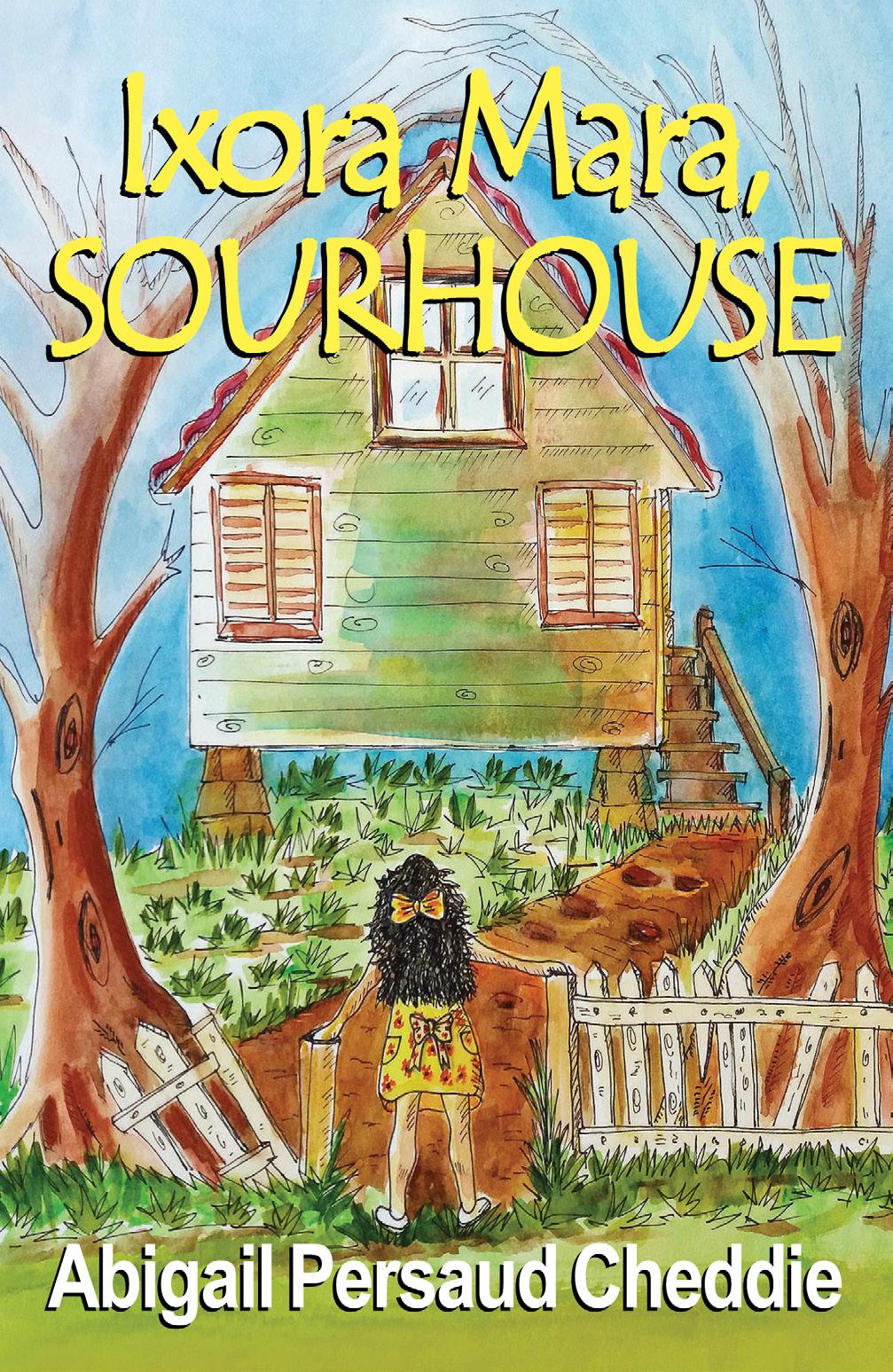
I DIDN’T want to be the sour one. But Ivy said that every village must have its own picklepuss and that I was Peaside Pasture’s because I was better at being sour than anyone else in the village, especially now that old Mr Crapaud – Peaside’s former Resident Sourpuss –had gone away on a plane. It was a role which some other child might have relished, if only for the exaggerated games such a part would allow. Not I. If Ivy thought I was going to fill the vacancy, she was wrong. I was going to be like Peaside’s snazziest soaring star point kite, not
some old lime. She’d see. Everybody in the street would see. Everyone in Peaside Primary would see. Everyone in the country and in the whole world would see.
But the lime had already come to me. The first time it appeared in my body was when Suzie said she’d come to my birthday party but didn’t. That day, the lime burned into my stomach. Then it spun and split, shooting juice through my chest and oesophagus and up into my sinuses. After that, Peaside’s vendors swivelled their heads from me to Ivy and back to me, pointed at me
From
Mara, Sourhouse by Abigail Persaud Cheddie
and asked Mam, “How come dat one so sour?” They made such a regular joke of it that Mam started telling them to mind their own sour business, please and thank you.
“How you mean they own business sour?” Ivy asked one day. We were in the kitchen emptying baskets, my hands itching from the eddo the vendor had chopped in half and begrudgingly added to the scale to top out the three pounds.
“’Cause everybody sour ’bout something,” Mam said. “Don’t let dem fool you. Sour in they heart. Or in they brains. Or sour down to they
lil toe.”
I let an eddo roll back into the basket and looked at Mam’s little toe. I wondered if her nails would glow neon green if her sour ever reached her toes. If your lime juice pulsed through your whole body so that it reached your toes, I surmised, that would be the end of you. For then, all you’d ever be was a big old lime, a Resident Sourpuss. So I resolved to keep my sour thereabouts my stomach and above.
“Oi, pass dat eddo,” Ivy said, elbowing me. I passed the eddo. Ivy handed it to Mam. Mam

stacked it in a bowl on top of the rest and continued her tirade.
“You got to be dead not to have something to be sour about,” she said, “And even then you gon probably still be sour ’cause maybe Saint Peter not lettin’ you in.”
“Letting you in where?” asked Ivy.
“Laurie, what you telling the girls?” said Pap, grinning and getting into the conversation, and ponging the hammer on his thumb.
“Ow, ow,” he said, flicking his hand back and forth.
I watched Pap’s fingernail and imagined its burning pain. I imagined it must feel just like the prickles in my chest when the lime juice started spreading about in my body. The day Suzie said she would come but didn’t.
“Any four or five ah dem could come,” Mam said the week before our birthday.
“You,” she pointed at Ivy, “could bring four or five friends, and you,” she pointed at me “could bring four or five.”
So Ivy invited eight friends. Eight.
Who cares, I thought, there was only Suzie to be invited.
So I snatched my skip -
ping rope, skipped barefoot across the street to Suzie’s house, told her about my party, asked would she come please and she said yes thanks she’d come.
“I gon bring you a gift,” she said from her side of the gate.
I was swinging the rope round and round, and the balls of my bare feet bounced on Suzie’s smooth scrubbed bridge.
“True?”
“True,” she said.
I stopped skipping and tootled over to the gate. Suzie smelled like lemony cream biscuits.
“What’s the gift?” I asked, my heart starting up a racket.
She drew closer to the gap between the two paling staves and raised her forefinger to her lips.
“Shh. Gifts supposed to be secret. Mammy gon carry me shop so I could pick it out and wrap it up.”
“Oh,” I said, feigning just the right amount of nonchalance and smoothing out the skipping rope. “Well, awright then. Eleven o’clock, you hear? Remember to don’t forget.”
I started hopping again, TURN TO PAGE XX

OUR parents’ ambition to keep us sexually ignorant only seemed to end when fourteen- or fifteen-yearolds got pregnant or impregnated someone, or so it seemed to me growing up in 1980s Guyana. They wanted to keep us innocent, but this innocence deprived us of what we needed to know about our sexual feelings and of the freedom to talk about sex. Our parents’ attitude silenced us. Perhaps they meant to teach us later when we were past adolescence. But we never had that talk with them — not a single word. They raised us to be innocent, which is to say, to be ignorant and naïve. This ignorance lasted longer for those who were securely ensconced in churches that preached sex as something nasty and the body as a sacred temple spoiled by fornication. Shame and guilt attend our normal sexual desires — the desire to touch and kiss. It was assumed that we would learn more about how we felt from books. Not so. We learned nothing about sex from the Young Adult (YA) Caribbean novels we read. Sex was a glaring omission when compared to American YA fiction of the time.
We learned about the sweet relief of self-pleasure from popular American YA fiction such as Robert Cormier’s The Chocolate War (1973) and books by Judy Blume, and later, for another generation, from the explicit candour of Adam Rapp’s 33 Snowfish (2003), Laurie Halse Anderson’s Speak (2011), and Sherman Alexie’s The Absolutely True Diary of a Part-Time Indian (2009). Even as far back as 1951, J.D. Salinger, in his now-classic novel The Catcher in the Rye (1951), dealt more honestly with youthful sexuality than anything published by a Caribbean author at the time.
A strange and unnecessary bashfulness prevailed in our literature. This was especially glaring when compared
to the treatment of other themes like politics, religion, or colonialism. The absence of sex and sexuality in Caribbean literature reflected our actual lives in troubling ways — ways that did not take into consideration the wide-ranging experiences of young adults. This was evident in other canonical YA Caribbean novels such as The Year in San Fernando (1965) by Michael Anthony and Crick Crack Monkey (1970) by Merle Hodge. YA fiction, often referred to as coming-of-age fiction, makes up a large part of the corpus of Caribbean novels written since 1950. It is, by most accounts, a work of the imagination that features a young protagonist between the ages of 12 and 21. Francis in Michael Anthony’s The Year in San Fernando and Hector Bradshaw in Jan Carew’s Wild Coast (1958) fit the bill; so do Tee in Merle Hodge’s Crick Crack Monkey and Lula in Oonya Kempadoo’s Buxton Spice (1999).
Several adult novels feature prominent young adult protagonists. These include Corentyne Thunder (1941) and Shadows Move Among Them (1951) by Edgar Mittelholzer, The Schoolmaster (1968) by Earl Lovelace, and The Games Were Coming (1963) by Michael Anthony. George Lamming’s In the Castle of My Skin (1953), Selvon’s A Brighter Sun (1953) and its sequel Turn Again Tiger (1959), and Jan Carew’s Black Midas (1958) also come to mind. In these adult books, too, there is a reticence to engage with the subject of adolescent sexuality.
Black Midas, Shadows Move Among Them, and Corentyne Thunder are rare exceptions. In these three novels, sex is discussed in ways not always proper or acceptable. There is whoring and incest, but the sex is never explicit — it happens 1off-page primarily — but the discussion of it is sufficiently frank.
In high school in Guyana, we read an abridged version of Black Midas with the “naughty bits” expunged. Often, even when youth sexuality was dealt with in the original novels, the schools removed it.
These coming-of-age novels are distinct from other kinds of books written for youngsters. The natural disaster novels by Andrew Salkey — Drought, Hurricane, Earthquake, for example — are children’s books, as is C. Everard Palmer’s broad oeuvre, which includes A Cow Called Boy and My Father, Sun-Sun Johnson. These children’s books do not transcend the consciousness of primary school children and thus are not part of the representative corpus of what constitutes Young Adult fiction.
Most YA Caribbean novels are written in the first person, through a particularly narrow and inquisitive gaze. What that character sees, the reader sees. It is quite ironic, then, that the lead characters in The Year in San Fernando and Crick Crack Monkey are ultra-sensitive to everything around them except their bodies. Their gaze is outward, replete with an adult perspective that often erases genuine adolescent concerns.
They are examples of the wonderful ventriloquism of adult authors imitating youngsters but not truly thinking or feeling like one. Young adult novels are mostly written by adults.
In Crick Crack Monkey, Tee’s gaze is fine, detailed, and exacting — attentive to speech patterns and milieu — but almost unaware of her body, similar to Francis in The Year in San Fernando. As a twelve-year-old, I found Francis strangely aloof, not like anyone I knew — almost like a shadow, animated by others, deprived of private intimacy and honest self-examination. This is true for Christopher in Geoffrey Drayton’s eponymous novel TURN TO PAGE XVI

recent months, several serious incidents have occurred when construction workers unknowingly disturbed wild colonies.
“Unconsciously, those contractors did not know bees were residing in that remote area,” he explained, noting that at this time of year, “most beehives are filled with honey, and any disturbance, the bees are going to defend their hives.”
Stewart believes that with improved digital mapping, contractors can invite
beekeepers to inspect areas before clearing vegetation, reducing the risk of attacks and saving lives.
The NRTS is supported by a strong legal and policy framework led by the Food Safety Act 2019, which mandates registration, traceability, record-keeping, and inspections.
Section 43 requires all food establishments — including apiaries — to be formally registered, while Section 59 obligates producers to maintain full traceabil-
ity through documented “one step forward, one step back” records.
The National Food Safety Policy further promotes data-driven, risk-based, ICT-enabled oversight. Regionally and internationally, the system aligns with CARICOM’s CRS 18:2011 honey standard, CAHFSA’s trade guidelines, and Codex Alimentarius principles, ensuring Guyana’s honey industry meets global requirements for purity, hygiene, authenticity, and export readiness.
Importantly, this system will complement the current surveillance and laboratory testing being conducted by the GLDA, strengthening the authority’s ability to detect adulteration, verify product quality, and support science-based decision-making. Collectively, these frameworks place Guyana among regional leaders in modern agricultural traceability.
The initiative aligns strongly with the PPP/C Government’s digital transformation agenda under President

Dr Mohamed Irfaan Ali.
The Administration has prioritised building a modern, technology-driven economy by expanding ICT infrastructure, digitising government services, strengthening data systems, and integrating smart technologies across agriculture.
The NRTS directly reflects the President’s mandate for a digital state by replacing manual, paper-based record-keeping with real-time digital monitoring, geo-referenced mapping, and smartphone-enabled QR code authentication.
It complements broader efforts to modernise value chains, strengthen data-driven planning, and integrate ICT into every stage of food production.
By embedding the honey industry within a national digital traceability framework, the initiative demonstrates how technology can modernise rural livelihoods while improving transparency and competitiveness.
The traceability system is expected to significantly increase Guyana’s honey trade at local, regional, and international levels.
Locally, supermarkets, processors, and speciality retailers will have greater confidence in sourcing honey that is fully documented and verifiably authentic, opening new domestic market opportunities for registered beekeepers.
Regionally, the system supports compliance with CARICOM’s sanitary certification and traceability standards, enabling Guyana to expand intra-regional trade and reduce barriers linked to food safety concerns.
Internationally, as global markets such as the EU, UK, and North America tighten requirements for traceability, batch origin, purity testing,
and residue monitoring, the NRTS positions Guyana to meet these criteria and compete for niche markets that value rainforest honey and ethically sourced products.
Equally significant is the system’s impact on consumer confidence. Traceability is now one of the strongest drivers of trust in global food systems.
With QR-enabled transparency, consumers can verify exactly where their honey comes from, how it was harvested, and whether it meets food safety standards.
This level of openness discourages adulteration and strengthens Guyanese honey’s national brand. When buyers can view the beekeeper’s ID, the apiary location, batch information, and safety certification with a simple scan, they gain assurance that the product is genuine—an advantage that enhances the sector’s competitive edge.
As the apiculture sector continues to expand — supporting livelihoods, biodiversity, and national food security — the NRTS is reshaping how honey is produced, verified, and traded in Guyana.
Consumers benefit from certainty; producers benefit from legitimacy and expanded markets; regulators benefit from data-driven oversight; and the national economy benefits from an ICT-enabled agricultural transition aligned with the government’s digital agenda.
Beekeepers like Sinclair, Fullington, and Stewart agree that the system protects consumers, strengthens the industry, and safeguards bees.
Their unified endorsement signals that Guyana’s honey value chain is entering a new era defined by transparency, innovation, public trust, and global competitiveness.

IN an era when the boundaries of the earth had not yet been determined, one could change the direction of the world simply by being curious and passionate. The idea of being an explorer or an inventor was not a figment of fantasy, but a very real path that some people chose to take. Today, we study the names of these curious people in our history books, and we encounter the fruits of their work in our daily lives; we marvel at their feats and their courage.
While we appreciate their innovations and discoveries, it seems we have stopped believing in the importance of the paths they would have taken to reach those creations. Today, the idea of wanting to be an “innovator” or an “explorer” has become akin to the absurd ambitions of an imaginative child.
Many years ago, an Italian explorer set out to discover a part of the world he had not yet seen. Around six months into his trip, he came across a sight that pushed the limits of his understanding of the world.
He saw three mermaids near what is now the Dominican Republic. Strangely, it was not the sight of mermaids themselves that struck the
explorer with surprise, but the unexpected appearance of the creatures.
He wrote in his journal that “they are not so beautiful as they are painted, though to some extent they have the form of a human face.”
Of course, today we know that Christopher Columbus simply mistook manatees for mermaids, as he had never seen the creatures before.
This rather amusing story has become the hallmark of how incomplete perceptions and myths can easily become a part of reality if so perpetuated. However, more importantly, the story also depicts something that is scarcely possible in today’s saturated world. It represents the possibility of seeing something no one else in the world has seen before — the chance to be the first to experience something in history, and then share its magnificence with everyone else.
Although being part of a new generation may mean that we might not be the first to do many things, it also means that we have a clear guide on how to navigate life. It is much easier for us to find the way to a destination we desire, often requiring nothing more than hard work and perseverance.
For instance, if someone
‘Protectors’ of
recognise it. Most times your ideas are dismissed before they’re even heard. You’d probably hear, “You’re too new, that’s not how we do things here”. I personally believe there’s a better way to explain standard procedures. Often, decision-making is done in small circles in closed doors. Even if the consequences of these decisions only affect you, you may not be invited to the table to speak on it when the decision is made. You might also notice that information is often withheld. Sometimes, the rules will change—what goes for one does not go
for all. Or, certain opportunities, even invitations, are not shared equally. Even if specific ideas no longer serve the group’s best interests, “gatekeepers” will still cling to them. They will refuse suggestions of better ideas simply because it did not come from them—simply because it came from you. Personally, the most important thing to consider in this discussion is whether these actions create or restrict access. If “protecting” the qualities and integrity of these spaces come at the cost of putting other people down, then I urge the “protectors”
who had never seen manatees were to encounter them today, they would most likely be able to identify the animals using the knowledge they have gained through their education and through the internet.
They may not experience the thrill of having potentially seen a mythical creature, but they would certainly experience the joy of seeing an interesting animal that they had previously only learnt about.
As humankind evolves, it is only natural for our expectations and possibilities to evolve alongside it. It might not be a feasible career choice to sail in search of mythical creatures or new lands, but we can still innovate and discover in so many impactful ways. There are so many new fields, such as science and technology, that have opened doors to accommodate our creativity and visionary outlooks.
We can often become enthralled by the idea of doing something that has never been done before. In fact, it seems to be in our nature to seek paths that help us identify ourselves as being different from others. However, being different is not just about doing unique things; it is about developing a unique perspective on the
FROM PAGE VIII
of standards to reconsider their approach. The world is changing and developmental or community spaces must adapt accordingly. I can understand that people are often afraid of the word, “change”. Change can be good, because what if these systems change for the better, with newcomers and a diverse workforce? Innovation is not a threat, criticism is not always personal, diversity should not be limited to paper, and opportunities should not be restricted—I am advocating for us to collectively do better.
world. It is about observing the evolution of possibilities and learning to single out the paths that can lead to new outcomes and solutions.
Yearning to be part of the
past, when we could have been innovators or explorers, is an enchanting notion.
Unfortunately, this blinds us to the possibilities we have right in front
of us. We can do so many great things, just as the extraordinary people of the past did. We only need to be creative enough to imagine that we can do so!

Christopher (1959) as well, whose agency lies not in self-examination but in self-reflection: he looks, he
sees, he observes. His story is not so much about him as about those seen through his eyes — his parents, Gip
his nanny, and some of the villagers. The result is that, as readers, we are not interested in Christopher so much as we
are in what he notices. The children in these novels are observant of their environment and the people

around them, but are unaware of their own physicality — their budding breasts, for instance, their changing odours, or nocturnal emissions. This creates a dissonance in the texts due to authors using characters as vehicles for their ideas without allowing them to be sufficiently real.
Francis is possibly the most observant child in Caribbean literature. His observation of the adult world is granular. Adult behaviour is rendered with real feeling and authenticity — but not his sexual feelings. On this, he is vague and strange. A blurb from the cover of the Caribbean Writer Series (CWS) edition of The Year in San Fernando reads:
“As the sugar ripens and the seasons change, Francis’s loneliness gives way to awakening sexual interest and growing self-confidence.”
There is no solid evidence of sexual awakening in the book beyond the epidermal. Francis says this about girls:
“...girls were there to be liked. Some of them were very beautiful. Some of them with the long plaits. And with the nice shy smiles. I liked girls.” (p. 60)
On another occasion he says:
“As the weeks passed, I saw Julia quite often, though at first I could hardly look her in the face. She was so charming and pretty that I could not help but like her.” (p. 48)
Sexual interest cannot be apprehended in these platitudes, and Francis has nothing else to say about girls.
These feelings for a girl, though authentic, hardly constitute sexual awakening. In Guyana, we read The Year in San Fernando at the same age as Francis in the book — around twelve — and we thought him to be a chupidy bai, partly because he seemed so much more unaware than us, especially in relation to sex and our changing physicality, which we discussed in great detail with each other.
When we were thirteen and read one of Michael Anthony’s other books, Green Days by the River, we saw ourselves in Shell and Rosalie. These were characters with sexual and romantic longing. They felt more and wanted to do more — like us. But they never did. The bodies of these characters are foreign to them, except for their eyes. They see all. Their
sense of observation is keen and particular, but it hardly ever turns inward upon their sexuality.
This is less so in Ian McDonald’s The Hummingbird Tree, but not by much. At twelve or thirteen, it is unlikely that these characters had not contemplated their bodies in a sexual way. They would have noticed themselves — seen and felt the obvious changes.
They are too naïve to be real. Too often, in most of these adolescent novels, the authors turn away from the moment when the reality of sex is possible, becoming inexplicit and using metaphor as fig leaves for the fly. This runs counter to the fidelity they had previously lavished on describing cane fields, rivers, and the bright patois of the various settings, creating a kind of incongruity in the texts.
This is not always so. There are some wonderfully realised young adult characters who transcend the sexlessness of those mentioned so far. Young adults in adult novels are handled differently.
The young lovers Pedro and Christiana in Earl Lovelace’s The Schoolmaster come to mind, as do Tiger in A Brighter Sun and Katree in Corentyne Thunder. Here, though, what prevails is the allegorical adolescent, whose presence in the text is a stand-in for some greater purpose — mainly to represent and personify an idea. The protagonist of In the Castle of My Skin is one such example. We can discern political and societal change through his eyes, but we do not see him as a teen in any real sense.
He is there to suggest colonial experience or politics or whatever, but he is not wholly there for himself; he is estranged from our reality as an actual teen. This creates dissonance in the text between the lived realities of the protagonist and the ideas he represents. The authorial impetus prioritises representation over the actual life of the youth. The attention to ideas subsumes character reality and agency. There is not enough balance, not enough attention paid to something as salient as sex, which is difficult to justify, given that it is often what adolescents think about most. TO BE CONTINUED..
was well until the woman in the front seat changed the radio to a station with explicit lyrics. It was not Sarah’s kind of music, and after a while she asked politely, “Can you please change that?”
The woman gave her a cross look. “What do you want to hear, girl? Gospel?”
“Not really, just softer music.”
The woman grumbled but changed the channel, and the young man looked at Sarah and smiled slightly.
The warm feeling she felt from that look surprised her, but before she could dwell on it, Isabella, now in a playful mood, reached out her little hands to the stranger, laughing and bouncing on Sarah’s lap.
“Isabella,” Sarah said sternly, in a low tone, “Quiet down.”
“Let her be,” the young man said patiently. “It’s better she’s playing and not crying.”
Sarah relaxed her hold a little and, in a flash, Isabella launched herself and clapped down on the man’s laptop.
“Oh my goodness!” Sarah exclaimed. “I’m so sorry.”
The woman from the front turned and laughed, “She probably wants to Google something.”
The young man said nothing, closed his laptop, and lay back in his seat with a resigned sigh. It was a good while after that that Isabella fell asleep again, and Sarah closed her eyes too, drifting off a little.
She was suddenly jolted out of her sleep by the screeching of brakes and a sudden impact as something hit the car. The baby almost fell out of her arms; the young man steadied her and they braced themselves as the car spun out of control, the woman in front screaming in horror, as the driver tried to keep control with the steering wheel until he miraculously brought the car to a stop.
“Oh my God!” Sarah cried, scared and trembling.
“Are you and the baby okay?” the young man asked.
“I–I don’t know,” she answered in a choked voice, and held onto his arm as he helped her out of the car.
He turned to assist the woman in front, who was close to a panic attack, and asked the shaken, distraught driver, “What was that, man?”
The driver shook his head, unable to talk, and pointed to a minibus and another car involved in the accident.
“It’s always speeding and overtaking,” the young businessman stated.
He surveyed the scene from where he was standing and asked himself, “What the heck saved us?”
A curious crowd gathered as the police and ambulance arrived at the scene. The heavy-set woman was taken to the hospital, and the young man spoke to an associate on the phone, “This is really a bad day; send someone to pick me up.”
He looked at Sarah standing there and asked, “How are you going home?”
“I don’t know,” she replied, an uncertain look on her face. “I’ll probably get a bus.”
He noted she was still shaken and said, reaching to take Isabella, “Here, let me help you with her, and when my ride gets here, I’ll give you a lift home.”
“Thank you,” Sarah said with deep gratitude. “Umm, I don’t even know your name.”
“Raj.”
“And I’m Sarah.”
Isabella made no fuss as the stranger held her while they waited on his ride.
The ride that came for him was a luxury vehicle, and it was the first time Sarah had ridden in such posh comfort.
She looked at Raj, his amiable personality igniting that warmth again within her, and she asked silently, somewhat perplexed, “What’s happening?”
She reached the village where her grandmother lived, a small community, and she asked him to put her off on the main road.
“Are you sure you don’t want me to take you to your home?”
“No, no, it’s not far in. I could walk, thank you.”
She walked down the potholed street, three corners away to her grandmother’s house. Her arms were tired with the baby and the bags, but it was like coming home, and a joyous feeling filled her heart. Her grandmother’s eyes lit up when she saw her, and the old lady helped her, tears of happiness in her eyes.
“It is so great seeing you and my great-granddaughter.”
That night, after Sarah had put Isabella to bed, she sat down to talk with her grandmother. The old lady asked, with a worried look on her face, “How are you doing, my child?”
She smiled to hide the pain that was still in her heart. “I’m fine, Grandma. I’ve come back home to you
and this Christmas will be wonderful for us with what little we have until I go back to work.”
Her grandmother, a wise woman, knew she was still hurting from her shocking loss and said, “It’s God’s will, my child. Maybe your accident was fated to happen and maybe something new would find its way to you.”
As she lay in bed that night, her grandmother’s
words replayed in her mind and Sarah thought of that new feeling within her when she looked at Raj. She got up and, opening the door, looked up at the sky, saying silently, “I don’t understand what’s happening, but we are from such different worlds, I’ll probably never see him again.”
But she had made a wish, and one never knows what miracles Christmas can bring.


assets will increase efficiency and enable the organisation to compete.
Leaders must carefully manage inventory and accounts receivable so as to minimise impairment and write-off costs. These two non-cash expenses can erode an organisation’s profit. Before inventories become obsolete, leaders can arrange for items to be sold at reduced prices so as to recover some money.
Every effort must be exercised to get customers to settle their balances in a timely manner.
Every organisation needs a budget to guide its future direction. However, the planned activities must be evaluated. There must be a system to capture and evaluate the performance of leaders and their departments. Their performances must be evaluated regularly, so that appropriate actions can be taken to enable the organisation to fulfil its plan.
Many leaders have embraced the need for an Integrated Information System that will provide them with accurate, timely information. The reports from the Integrated Information System will give leaders the opportunity to evaluate their performance against the budget for the same period.
One example of an internal report is the monthly management accounts, which allow leaders to evaluate their performance on a monthly basis. The management accounts must be supported by commentary. During meetings with leaders, the management accounts may be discussed, and leaders will be required to provide responses to their fellow colleagues.
To make meetings effective, leaders must plan and
FROM PAGE IX
set an agenda. To manage the meeting time, leaders must submit written reports in advance and provide a verbal summary during the meeting.
The organisation’s performance can be evaluated using several reports. These reports are generated internally but will be used to provide external parties with an understanding of the organisation’s overall performance for a specific period.
The owner and Board of Directors are expected to evaluate the performance of leaders and provide them with feedback. Their feedback is intended to help the organisation meet its mission.
Each leader must take responsibility for their department and Strategic Business Unit, as the performance of these units will affect the organisation’s overall performance. Whenever more resources are needed to help leaders improve, those resources must be provided in a timely manner. Leaders whose performance is below the budget will need support and guidance.
If they fail to meet their target, then training can be an initial tool to help them. Leaders whose performance is above the budget must be acknowledged and rewarded. The organisation needs leaders who are ethical in delivering their duties. The success of the organisation is not dependent on a single leader, but on the positive contributions of all leaders.
For more information about Geary Reid and his books, please use these contact details:
Amazon: http://www.amazon.com/author/gearyreid Website: www.reidnlearn. com Facebook: Reid n Learn
Email: info@reidnlearn. com
Mobile: +592-645-2240



thinking about Suzie wrapping shiny paper over something.
“I not gon forget.” She crossed her heart. “Mam said come in time for lunch.”
Food was a burden to Suzie. So in haste, I added “And ice cream.”
“Yellow one?” she asked, sticking her nose between the staves.
I nodded vigorously.
She grinned, and the setting sunlight bounced off the red crystal heart-shaped pendant swaying about the neckline of her sunflower print t-shirt. I turned around and skipped home.
From Suzie’s side of the street, I studied our long low veranda which Pap would soon decorate with the streamers he was hiding in the brown paper bag behind the yam crate. He’d gone to Georgetown and returned with a bag of things that he sprawled on the kitchen table to show Mam. Ivy and I took turns spying at the things through the crack in our bedroom wall. When we rested our eyes close to the wall and stayed steady at the precise angle, we could catch glimpses of the kitchen table. Eventually, we pooled what we’d seen.
Pap had bought party games
and red and yellow paper streamers, green paper plates, blue paper cups and a multi-coloured glittery banner that said Happy Birthday. He didn’t know about colour schemes then, Pap. Besides, it was the early nineties in Peaside Pasture. Nobody bothered about colour schemes. Everyone knows about them now though, colour schemes and décor themes, what with all the tasteful sophisticated ones hammered all over the internet – spring palettes, fall visions, winter wonderlands and whatnot. But I’ve had over twenty birthdays since then and Pap still goes on making the house shamelessly kaleidoscopic every birthday’s eve. Even though he has an iPad now that Ivy’s brought him from abroad and even though he knows better because he can just type things into a search bar and get all the answers.
Yes, Pap would decorate the whole veranda, I thought, while I skipped on our bridge and counted my rope rotations. I was almost up to a hundred rotations. I looked back to see if Suzie was still peering through the staves but she had vanished.
When she arrives on my bridge
on my birthday, I thought, she’ll gasp at the streamers tacked around the veranda. I spun the rope faster over my head. Eighty-seven, eighty-eight, eighty-nine, I counted. I imagined pinning the cloth tail, which Ganee Gwenny had stitched with dress scraps, to the pink disproportionate donkey which Pappo Harro had drawn in chalk on the ply board by the gate. We’d pin the tail. We’d sip fizzy drinks. We’d play chequers and Suzie’d be mesmerised by the yellow marbles as always.
My feet tangled in the rope. Just when I was up to ninety-seven rotations too. I sucked my teeth, flung the rope over my head and started afresh. One, two … six, seven. Mam would light the seven candles on the cake, and Ivy and I would blow them out together and make separate wishes. Suzie would stand beside me and Ivy’s eight friends beside her, while Uncle Warbin fiddled with his instant Polaroid camera that somebody from ’merica had left for him because they had two, and he’d say, “Smile big. Smile with teeth.”
Again, I tripped over the rope. Our city cousins Lennard and An-
nie-Lou would come and Uncle Raffie would be forced to dilly-dally, waiting to drive them home, and Mam would wrap a huge slice of cake for Uncle Raffie’s wife who usually sent two presents when everyone else brought one, but who’d said oh goodness gracious that she was allergic to the countryside and the smell of cow dung. Never mind we had no cows.
I skipped faster and jumped higher, getting close to the hearty sky. Mam would wrap parcels of cake too for Junior’s mother and his grampappy, and fill her best bowls to the brim with curry and rice. Then she’d tie everything into a bundle and settle it on Junior’s head while he held it steady with his elbows sticking out as he waddled down the back street where they had no electricity and where he could stub his toe on bricks and send the food pitching into a pothole, as had happened once or twice. Junior’s mother might send us a gift too.
Even Small Spokes, the toddler who lived down the street and who Mam babysat on the half days that his mother went to work, he too would come. After all, it was the babysitting money, the small
change, which Mam saved for months that had bought all the party things.
Yes, all of that would happen when my birthday came.
I stopped swinging the rope, stood on tippy toes and filled my lungs with sky. The sun had set and across the street, neighbours flicked the lights on in their houses. Suzie was already at her bedroom window flashing her torchlight, outlining a smiley face on the glass with the light beam. Hers was the only glass window in her house. She shaped a circle clockwise, then added two quick flashes for the eyes and a curve from left to right for the mouth.
I hurried inside to borrow Pap’s torch so I could reply with my own light-up smiley face.
“Come here lemme see if dis dress fit you,” Mam called. She had stuffed Ivy in a dress with frills and was wrestling with the zipper.
“Jus’ now,” I said, looking under the kitchen sink for Pap’s torchlight.
“Come now.”
“Mam, I jus’ have to flash Suzie a—”
“Now.”
TO BE CONTINUED..



healthier.”
Within months, his herd began showing traits he had never seen before: superior weight gain, better feed conversion, and earlier maturity. Instead of waiting extended periods for slow-growing bulls to finish, he now routinely markets 50 to 75 bulls each year, each topping 500 pounds by age two. Faster growth brought faster turnover — and that meant higher income.
“For a farmer, when your animals grow faster, your whole life improves,” he says.
He also lauds the excellent extension services offered by the GLDA, noting how their support has strengthened his herd management practices.
This transformation coincided with major developments across Region Five — long hailed as Guyana’s livestock capital. With continued government investment in genetics, extension support, and infrastructure, the region is rapidly modernising.
Among the most significant upgrades is the national abattoir at Onverwagt, West Coast Berbice, a state-ofthe-art facility designed to enhance hygiene, traceability, and meat safety.
For decades, farmers grappled with challenges ranging from backyard slaughtering to cattle rustling and inconsistent meat quality. The new abattoir changes everything.
“When you can take your animals to a certified abattoir, everything becomes easier,” Oodit explains. “You can meet orders, meet cuts, and meet standards.”
With improved genetics on the farm and certified processing at the abattoir, farmers like Oodit can now supply premium cuts — ten-
FROM PAGE V
derloin, steaks, roasts — that once required imports. And because his animals are grass-fed, pasture-raised, and slaughtered under sanitary, traceable conditions, he can negotiate premium prices from butchers, supermarkets, and bulk buyers who now prioritise quality and food safety.
The abattoir also offers protection — deterring theft, ensuring humane slaughter, and guaranteeing consistent standards for consumers.
With regional export discussions underway under CARICOM’s food security agenda, farmers increasingly understand the value of these systems.
This Christmas, Oodit faces the season not with worry, but with readiness. His genetically improved herd, strengthened by years of careful husbandry and guided by GLDA’s extension services, allows him to meet large festive orders with confidence.
The unpredictability that once defined the season has given way to stability and pride.
Still, he remains grounded. He is completing a new mini-corral to improve cattle handling and preparing to introduce the Beefmaster breed through the GLDA Artificial Insemination (AI) programme — another step in advancing his herd.
Oodit’s journey is proof of what can happen when tradition meets innovation.
Through one remarkable Brahman bull, modern breeding technology, regional sourcing, and strong government support, he has reshaped not just his herd, but his entire livelihood — standing today at the forefront of Guyana’s evolving livestock industry, ready for Christmas and beyond.
















Welcome, dear reading friend. Please recognise that constant use of effective study and learning habits boosts how you organise, understand, and retain information, also master your classroom workload and assessments. To move forward, adopt these smart skills: mnemonics, which aid the retention of lists of information; effective reading techniques, which aid text understanding and concentration; and effective note-taking for proper re-
vision and storing of information. Very soon, see your education advancing with smarter study, not harder. Be wise. Love you.
Correct parts of speech

December 14th, 2025
enhance writing.
Note: Grammatically correct structures are enhancers to writing. [Though it is true that some grammatically correct structures do not make sense, we will not travel along that pathway today.]
The point here is that if you have something to say, you should state it clearly to make sense to your reader, especially your examiner. Look at what is said in the three areas below.
First: Tense Sequence and Other Tense Uses
1. Suit the tense of dependent clauses and of verbal phrases to the time expressed by the verb in the main clause.
Examples:
i) We sold the cottage that we had built. (not ‘we built’) ii) I planned to go (not ‘have gone’) to the 1991 reunion. (At the time planned, the reunion had not taken place.)
iii) Having hurried (not ‘Hurrying’) home, I ate lunch. (The hurrying preceded the eating.)
2. When an indirect discourse follows a past tense, use the auxiliaries ‘could,’ ‘should,’ and ‘might,’ not ‘can,’ ‘shall,’ ‘will’, and ‘may’.
Example: John declared that he would (not ‘will’) help us.
3. Express in present tense the verb in a noun clause that states a generally accepted truth or a fact that is true for all time. Example: Sherry forgot that light travels faster than sound.
4. Keep in the same tense any verbs that are parallel in use. Example: The inmate slipped past the guards and made (not ‘make’) a swift getaway.
Look at the agreement of subject and verb in the following sentences. Notice that the verbs of interest are in single lifted commas for you to see them faster. Check the verb against its subject in each sentence. You and your study partners are to discuss what each sentence says.
1. No one ‘knows’ exactly the population of Finland.
2. I ‘have used’ enough fat in this doughnut recipe.
3. A long line of young people ‘was waiting’ at the appointed location.
Was it a vision, or waking dream? Fled is that music:Do I wake or sleep?
JOHN KEATS (1795-1821) “Ode to a Nightingale”
(‘Line’ is the subject; the singular ‘was’ is needed.)
4. I ‘shall meet’ the problem boldly.
5. Half of the property ‘belongs’ to the new wife.
6. Half of the turkeys ‘belong’ to his first son.
7. Some of the cake ‘has been eaten’.
8. Simon, as well as his brothers, ‘is’ here. (Simon is the subject; the singular ‘is’ is needed. If the singular verb sounds awkward to you, recast the sentence: Simon is here, as are his brothers.).
Third: Word and Phrase Substitution
Read this familiar passage and then answer questions 1) and 2) below it.
Aristotle, the Greek PHILOSOPHER, summed up the four chief qualities of money some 2,000 years ago. It must be lasting and easy to recognise, to divide, and to carry about. In other words, it must be “durable, distinct, divisible and portable.” When we think of money today, we PICTURE it either as round, flat pieces of metal which we call coins, or as printed notes. But there are still parts of the world today where coins and notes are of no use. They will buy nothing, and a traveller might starve if he had none of the particular local ‘money’ to exchange for food.
Among isolated peoples, who are not often reached by traders from outside, COMMERCE usually means barter. There is a direct exchange of goods. For this kind of simple trading, money is not needed, but there is often some thing that everyone wants, and everybody can use. These things – salt, shells or METALS – are still used as money in out-of-theway parts of the world today.
1) Work with the words in block letters and give for each, another word or phrase of similar meaning, which
may be used to replace each word.
2) Explain concisely the meaning of the following phrases, which are also taken from the passage above.
a) In other words
b) where coins and notes are of no use
c) traders from outside d) out-of-the-way parts of the world today
THE PASSAGE
Making sense of the passage
Read the following extract carefully, and then answer items 1-4 of what is compared/contrasted.
At Camp Earth last summer, I made two close friends. All of us enjoy acting, and we met working on the camp play. Other than acting, Doug and Jamal have different interests. Jamal, who is thirteen, is athletic and musical. Jamal hopes to be on a U.S. Olympic team someday. Doug, on the other hand, has no tremendous interest in sport. His idea of fun is participating on the school’s debating team and working on humanitarian projects. Although they are different, I cherish my friendship with each.
1. What is one similarity between Jamal, Doug, and the author?
(A) They share a love of team sport.
(B) They have been friends for a long time.
(C) They hope to become writers.
(D) They share an interest in acting.
2. A difference between Jamal and Doug is
(A) Jamal loves sport; Doug does not.
(B) Doug is the narrator’s friend, but Jamal is not.
(C) Doug is a talented actor, while Jamal gives weak performances.
(D) Jamal has applied for the TURN TO PAGE XXXIX

YOU may be wondering why manufacturers make hard toothbrushes when dentists do not recommend them. The answer is that hard-bristle toothbrushes are for cleaning dentures and bridges, not natural teeth.
One way for you to evaluate which brush is best for you and whether you require prophylactic cleaning by your dental professional is to run your tongue over your teeth after brushing. If the surface of the teeth does not feel smooth and clean, you may either not be brushing correctly, or you need to change your toothbrush.
Toothbrushes are no longer effective if the ends of some of the bristles do not point straight up. As soon as the bristles start to curve outwards, it’s time to get rid of that brush. The recommended toothbrush to buy is a rectangular-shaped soft nylon one without fancy curves and tufts. The best one is one with a small head and soft bristles. These bristles should all be the same height and have round ends.
When brushing, it is recommended that you generally use the Rule of Thoroughness. This rule states that every natural tooth in your mouth must be sanitised for 1 minute every 24 hours. To put it simply, if, for example, you have a total of twenty teeth in your mouth, you should brush, floss, and scrape your tongue for a total of twenty minutes each day. So, obviously, if you have that time, you only need to do that once a day.
If you brush more than once a day, it’s a good idea to have two toothbrushes. By alternating, the bristles have

FROM PAGE XXXVIII
Summer Olympics, though Doug has not.
3. According to the passage (A) the narrator does not have much in common with either of the boys.
time to dry out and become firm again for reuse. There are rechargeable battery-operated toothbrushes which are not expensive. I personally find them very effective and have been using that type for many years. The built-in timers indicate how long you have been brushing, etc.
Brushing with toothpaste that combines a very mild abrasive and a safe detergent is the most effective way to clean teeth. Stick with popular brands and avoid those you are hearing about for the first time. I do not recommend whitening toothpaste. They contain bleaching agents and harsh abrasives. If you want to whiten your teeth, let a professional do it. The function of dental floss is to clean the side surfaces of teeth that the toothbrush cannot reach. Dentists call these the proximal surfaces, meaning the sides next to each other.
The floss is stretched taut between the fingers, which are placed inside and outside of the teeth. The floss is then gently slipped between two teeth. Excessive pressure that snaps the floss through the contact points of the teeth can injure the gum tissue, so it is important to ease the floss through rather than force it.
The floss should then be worked three or four times up and down in a scraping motion against the front and back tooth surfaces without rubbing against the gum as it passes from side to side. The floss should not be pulled back and forth like a shoeshine cloth. This “sawing” action can wear grooves into the roots. Bear in mind that flossing helps prevent bad breath and tooth decay.
(B) the narrator has qualities in common with the boys.
(C) the narrator has much in common with Jamal.
(D) the narrator has nothing in common with Doug.
4. Which pair is most similar?
(A) Doug and Jamal
(B) Doug and narrator
(C) Jamal and narrator
(D) not enough information