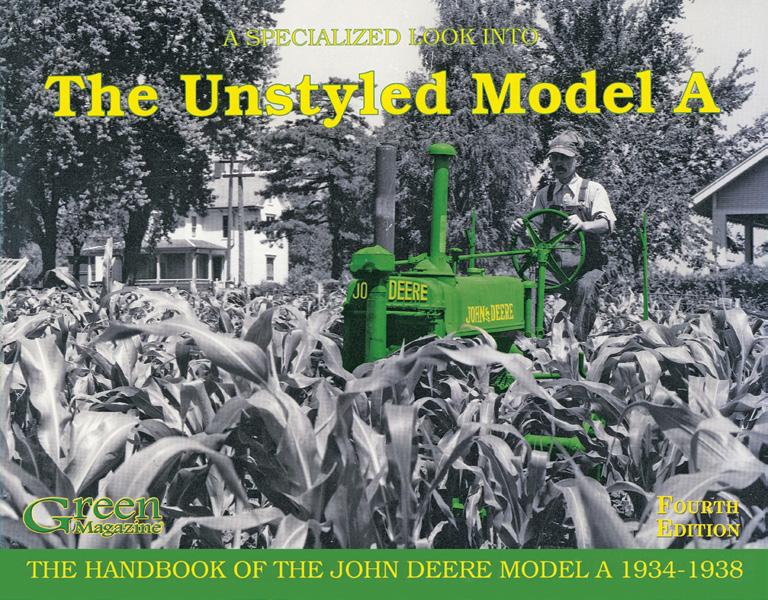
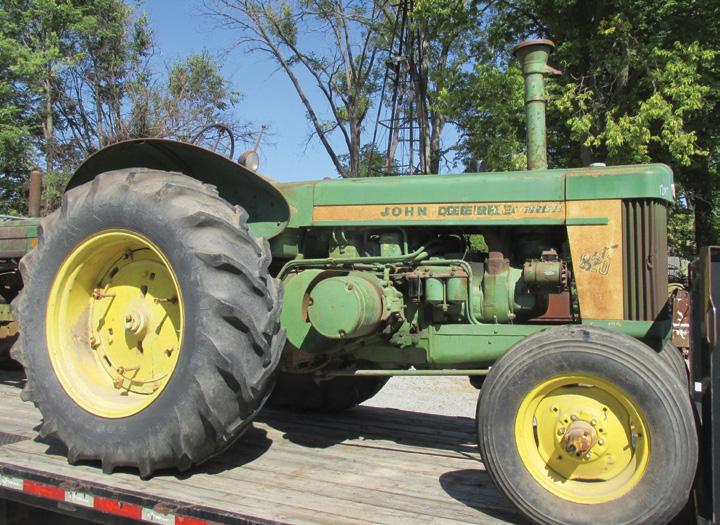
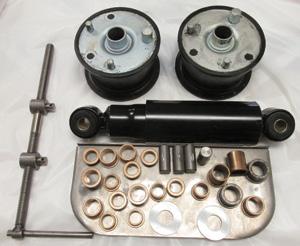
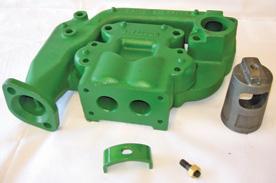
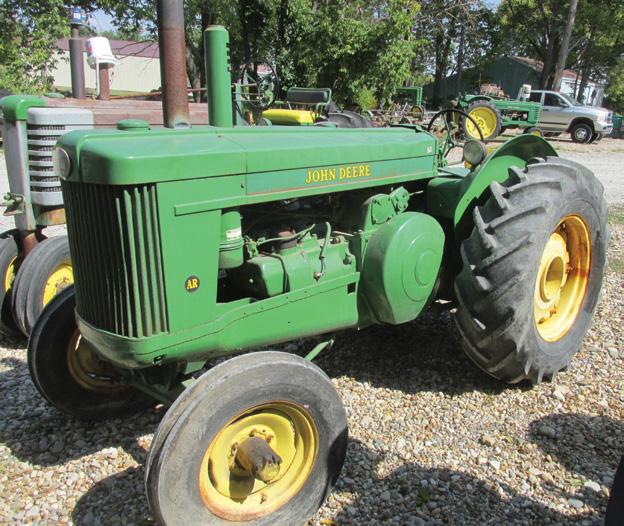
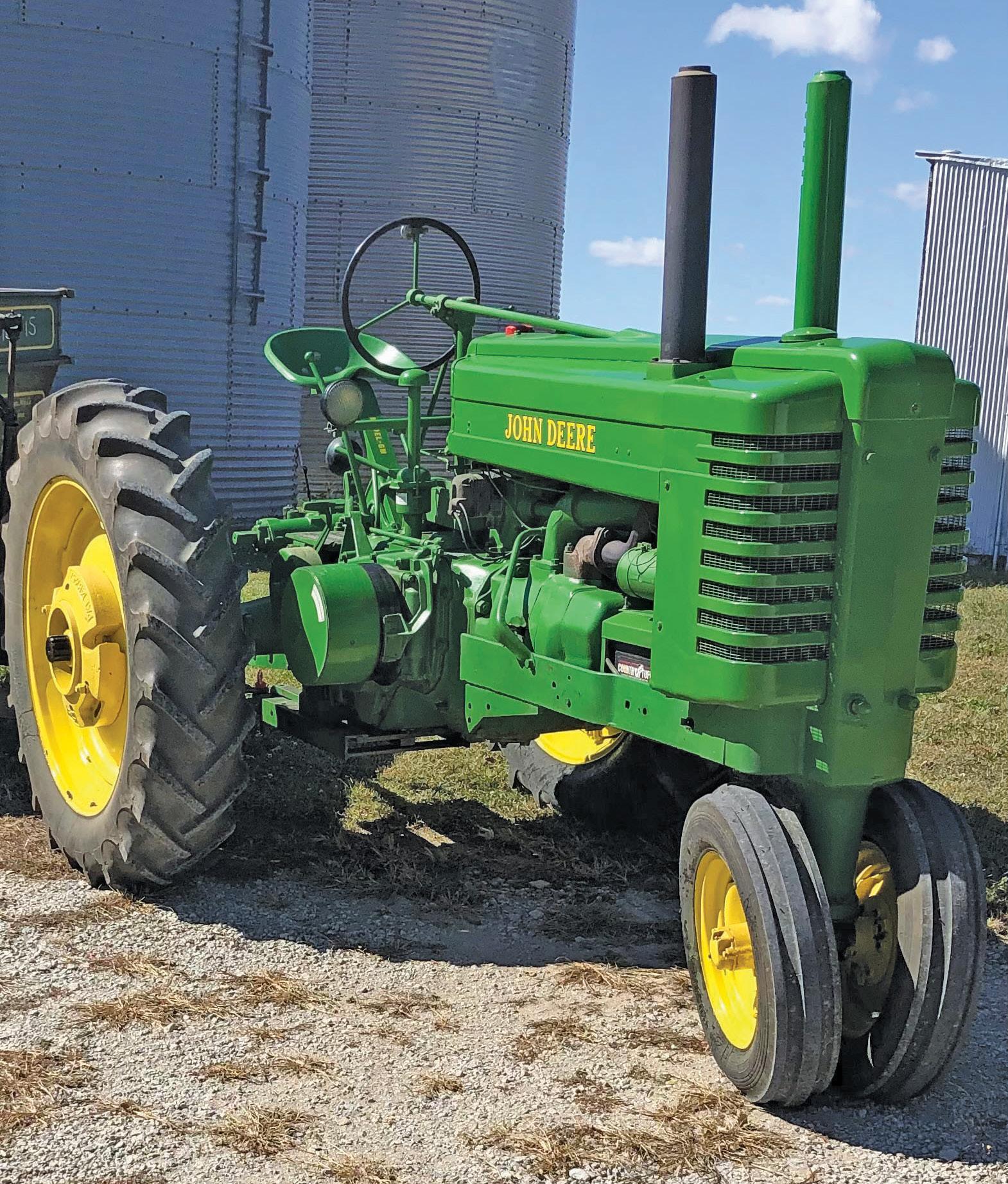
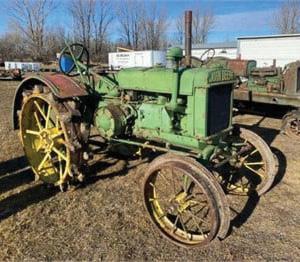
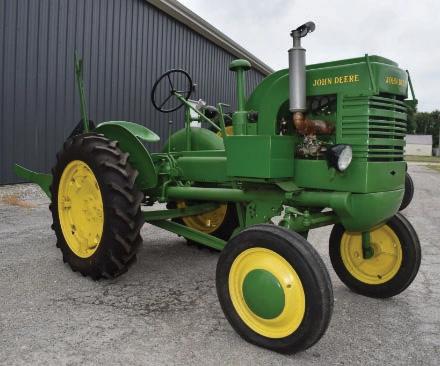
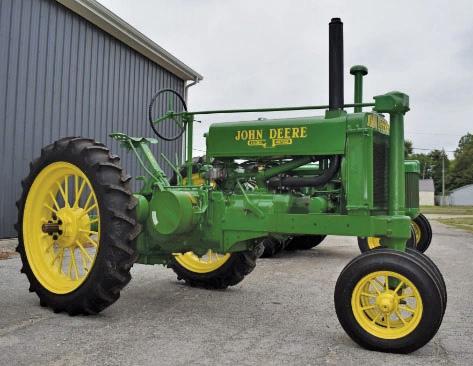
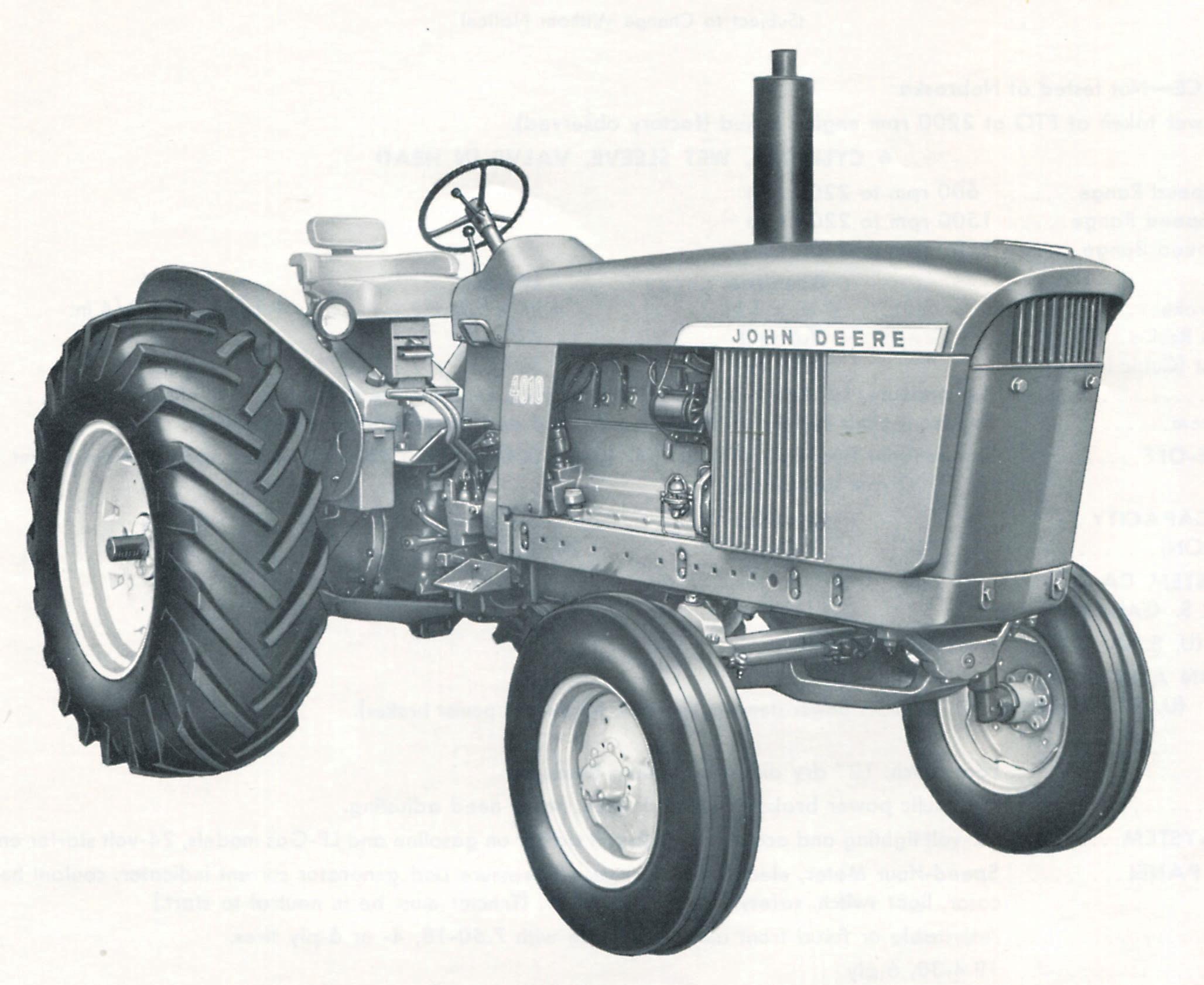
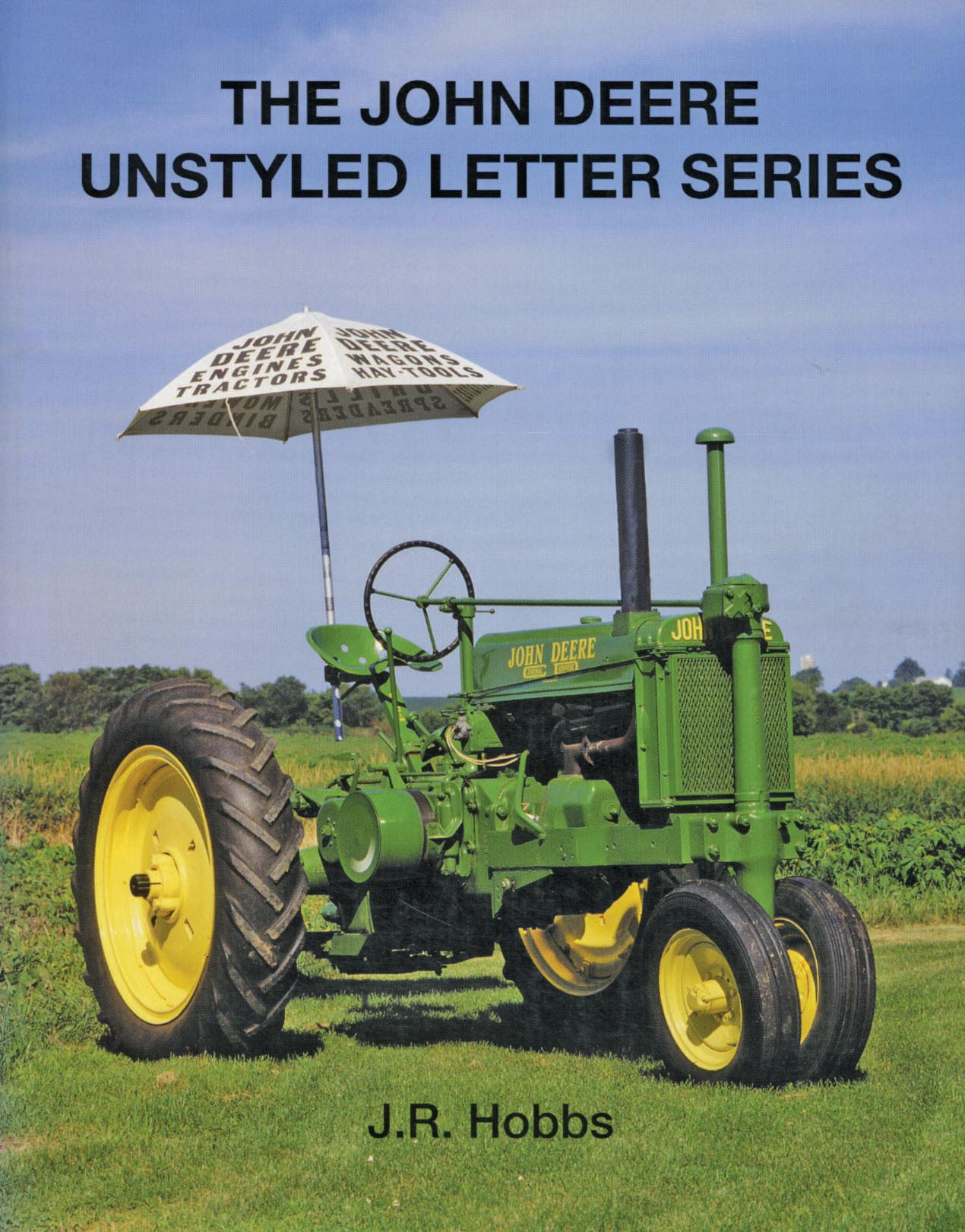
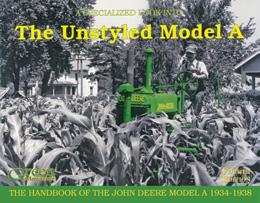
Now in its fourth printing with 15 more pages, this is the handbook of the John Deere model “A,” 1934-1938. A book that should be on the “must read” list of any unstyled “A” owner. There is probably no other book on the market that goes into so much detail on a single model of tractor. Shows illustrations of nearly every change made in the parts that make up the unstyled “A.” 95 pages, 11x8-1/2 inches, soft cover.
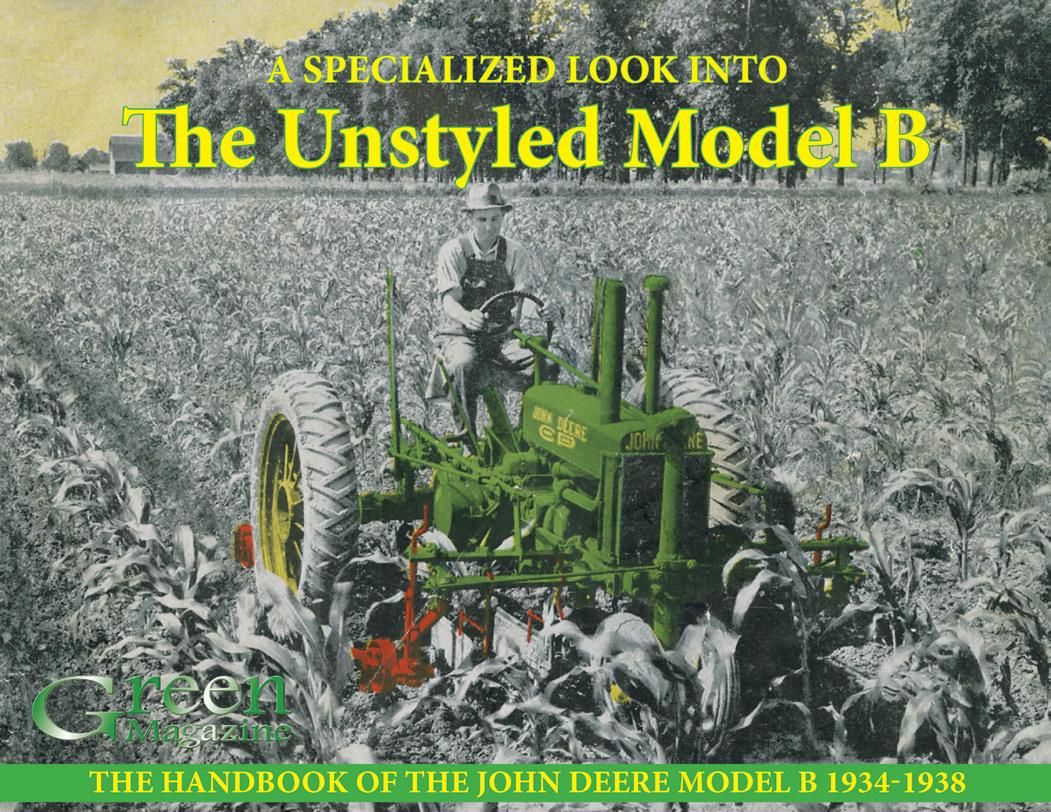
Both books include history, specifications, serial numbers, original prices and much more A Specialized Look Into
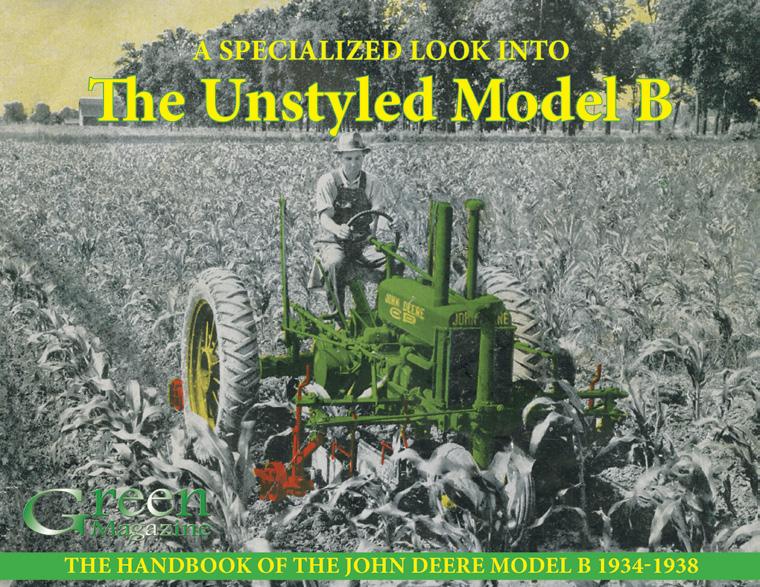
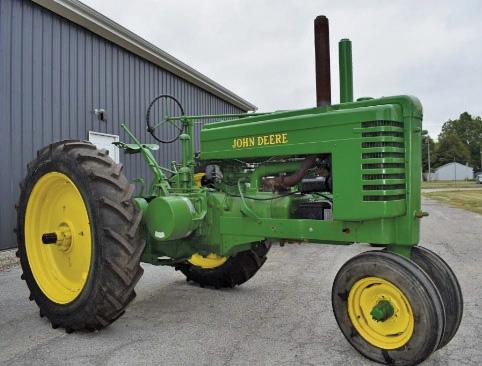
The Handbook of the John Deere Model B 1934-1938
The same types of information as available in the book above, except now about the model “B,” written and compiled by a panel of experts who have spent decades collecting and restoring the unstyled version of Deere’s most popular tractor. This book shows nearly every change made in the parts that make up the unstyled “B.” 84 pages, 11”x8 ½”, soft cover, over 200 photos - most in color.
“GREEN MAGAZINE®” (ISSN 0883-5462) is published monthly and released 12 times a year on or about the first of each month for $39.95 per year (Canada: $59.95 per year; Foreign: $69.95 per year) by Hain Publishing, Inc., 2652 Davey Road, Bee, NE 68314-9132. Periodicals postage paid at Bee, NE and additional mailing offices.
We had to resend quite a few December issues last month, which is not entirely unusual with all the Christmas mail, but the most surprising was one particular calendar that didn’t get delivered. After it was ordered, we delivered it to the post office in Seward, Nebraska, to begin its journey to Milford, Nebraska. The two are in the same county and about ten miles apart, both approximately ten miles west of Lincoln. The calendar went to Lincoln, Omaha, and then to Birmingham, Alabama. It found its way somewhat closer to Kansas City, and then Olathe, Kansas. From there, it headed back east to Georgia, then back to Olathe and eventually North Platte, Nebraska, which is way west on the other end of the state. As of this writing, it is still touring the U.S.
Many of you have been following along with my “Unrestoration” articles. I’m beginning to think that in many cases, painting a tractor is easier than un-painting one. Trying to get in and remove paint from every nook and cranny that a spray gun can reach is a lot of work. Almost ten years ago, I wrote an article about painting my 4430 and warned that if you look at it too closely, you might find a couple of spots I missed. In the case of this “D,” you might find a place where I didn’t remove the shiny green paint. I have been using both a sand
blaster and a paint stripper. Sandblasting is fast at taking the surface down to bare metal, which in this case isn’t necessarily always good, and will get into some of the aforementioned nooks and crannies. However, I don’t exactly like using it in areas where it could get sand into critical parts. Paint stripper works pretty well, as long as you can get to the area with a scraper or steel brush after applying. I was using a product called “Aircraft Stripper,” which worked well, but when weather forced a move indoors, I found that the fumes from it were overpowering. So, I have recently been using a less noxious product that works about 80 percent as well to use while indoors. I see that my sand blaster says that it is capable of using crushed walnut shells. I might try that on some spots. I would be less worried about getting particles in critical areas. The downside is that they are atrociously expensive.
I hope that many of you are planning to attend the Gathering of the Green next month. It has been four long years since the last one, and about six months since the last tractor shows in the north. It will be good to see some old and new friends again. Please stop by the Green Magazine booth and say hello.
See you next month.
Give the Green Magazine office staff and your postman a break!
Please don’t call about delivery of your Green Magazine until after the 20th of the month. Although Green Magazine is always mailed by the 1st of the month, delivery date can vary from month to month.
Missing an issue? We mail every issue by the first of the month. Please contact your post office if you suspect a problem with delivery. We will not replace missed issues three or more months past original mail date (four or more months for foreign subscribers) free of charge.
U.S. subscribers: If it is on or after the 20th of the month and you haven’t received your issue, call us for a replacement.
Canadian subscribers: Due to postage costs, we are forced to ask for a $2 postage fee (U.S. funds, please) for re-sending issues that do not arrive by the end of the published month OR we can add an issue onto your subscription for the missed issue.
First Class/Airmail delivery: Call for rates for First Class in the U.S. or Airmail to foreign countries.
Foreign subscribers: We will add an issue onto your subscription OR for a $7 airmail postage fee (U.S. funds), we will resend the missed issue two months after publication date.
Notice: If your address label shows an expiration date of “2/26” above your name, this is your last issue. Renew immediately for continuous service. If your address label reads “3/26,” you have one more issue on your subscription.
Renewal notice: We send postcards to let you know your subscription is about to expire (or has expired). We NEVER call to ask if you would like to renew your subscription. If you
receive such a call, it is most likely from another publication—NOT Green Magazine® for John Deere enthusiasts.
Address Changes: Please send or call with notification of an address change as soon as you know what your new address will be. Periodical mail cannot be forwarded. Green Magazine will not replace issues missed due to late notice of address change. Those missed issues will have to be bought at back issue price. See the back issue listing and prices elsewhere in this issue.
Looking for your photos and stories! Accepted material is subject to such revision as to meet the requirements of this publication. Payment will be made at our current rate within 90 days of publication to current subscribers. Submission of manuscript implies that the material is original and in no way an infringement upon the rights of others. Please send good, clear photographs. If you would like these returned, send us a stamped return envelope to help us get them back to you.
Free Issue Offer: It seems you, our subscribers, are our best form of advertising! More people find out about this publication by “word of mouth” than other forms of advertising. So if you're enjoying Green Magazine®, why not spread the word? Telling others about it can pay benefits. When you tell a friend about Green Magazine® and they subscribe, make sure they tell us who let them know about it. When they do, you will get an issue added to your subscription. These must be new subscribers, not renewals.
This photo (right) was taken east of Madison, Nebraska in 1992. This is my grandpa Jim Hastreiter’s 4020 LP, 1967 model. He bought it as an original diesel, narrow front, cab-less tractor. He had converted to wide front and added a Hiniker cab. The conversion to LP from diesel was complicated but he had kept the original engine block and added a few things to the engine to make more horsepower. A few things he did was add higher compression pistons and shave the head. He put on an M&W oil pan for a capacity of three gallons of engine oil. He added a secondary LP tank and a dual air intake. He converted the oil bath air filter to a dry filter and built a dual manifold to run dual exhaust. He plumbed in a second hydraulic box and swapped the original hydraulic pump with a pump out of a 8630 to make more flow. To this day, that 4020 is still in the Hastreiter family.
Levi Stoffel
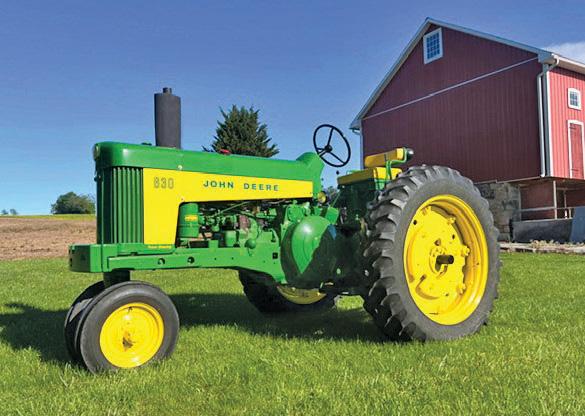
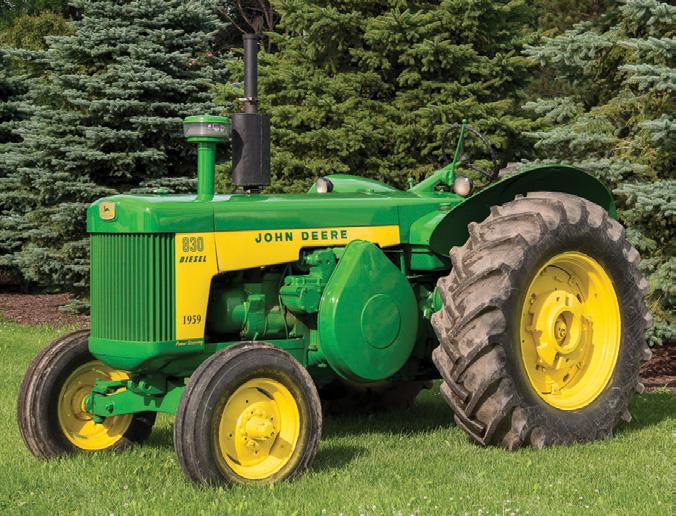
This 1959 John Deere 630 (right) was purchased by my grandfather in 1960 with just a few hours on it with the intent to pull a two bottom plow with a three-point hitch and, from that point, it became the main tillage tractor in that time.
In later years, it had many duties that included pulling a 4R corn planter, running a 2R mounted corn picker and being the baling tractor.
The tractor now has 8,400 hours and has been on the same farm for 66 years in Manheim, Pennsylvania and is now owned by my father, Glenn Sauder.
The tractor was completely restored in 2023 and is mostly retired from seasonal use, but still does some light duty chores like raking hay, and periodically powering a PTO grain auger.
Duane Sauder
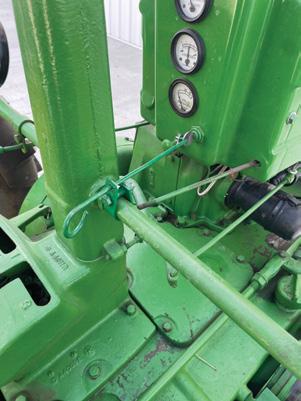
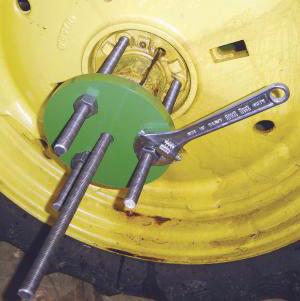
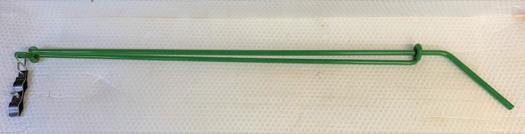
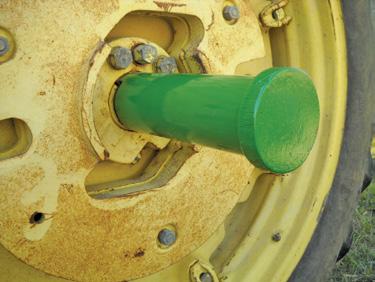
Key extension. rear wheel puller - Dave Haala
Wiring Harnesses - Cables - Switches
We build restoration quality wiring harnesses to fit these John Deere models and their variations:
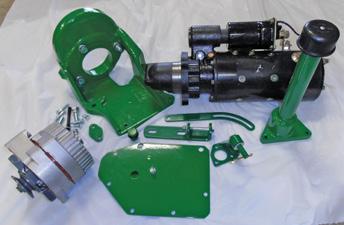
We also carry: Starters, Regulators, Generators, Alternators, Relays, Coils, Lights, Alternator Brackets, Pulleys
We make alternator
PARTS TRACTORS
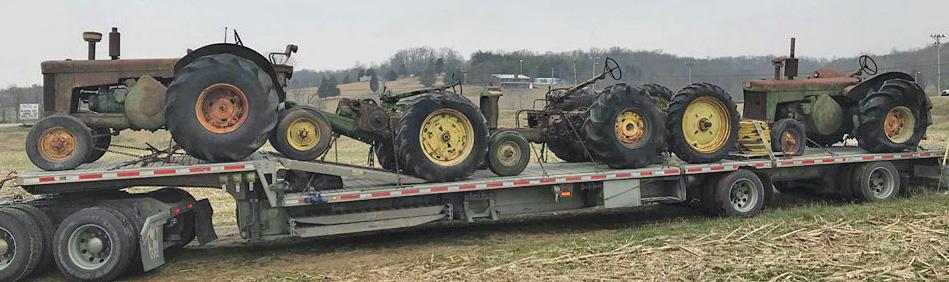
820, styled AR, 720D, 2010G, late A, 530, 720D pony start, 50, 1020G, LA ES, 50 w/801 hitch, G, uns A, 730G, 5020, uns G, 430T, 2510G, 730 LP, 2010D, 530, late 520, ’39 B, BN, 40U, ’53 AO, ’41 H, ‘46 A, late A’s, ‘46 B, late Bs, slant dash B, uns B, sty D, G, uns L, M, MT, R, 40T, 40U, 40W, 70D std., 70G, 420U, 420W, 440 w/reverser and PS, 440 gas, early & late 50s, early 60, 60 w/power block, 620, 620 LP, 630, 70G, 720G, 720 LP, 720D pony, 730D, 730G, 820, 1010, 2010, 2010D, 2010RU, 2020, 3010D, 3020, 4020D. Most of these tractors are parted out & on the shelf—ready for quick shipment!
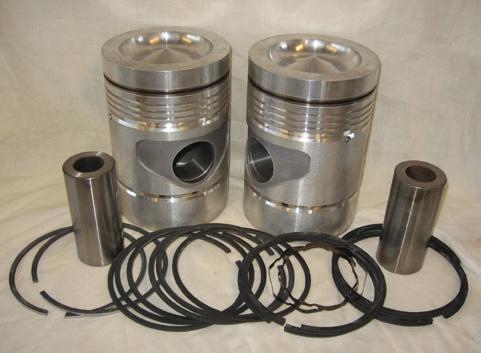
Oversize pistons available again for many two cylinder tractors
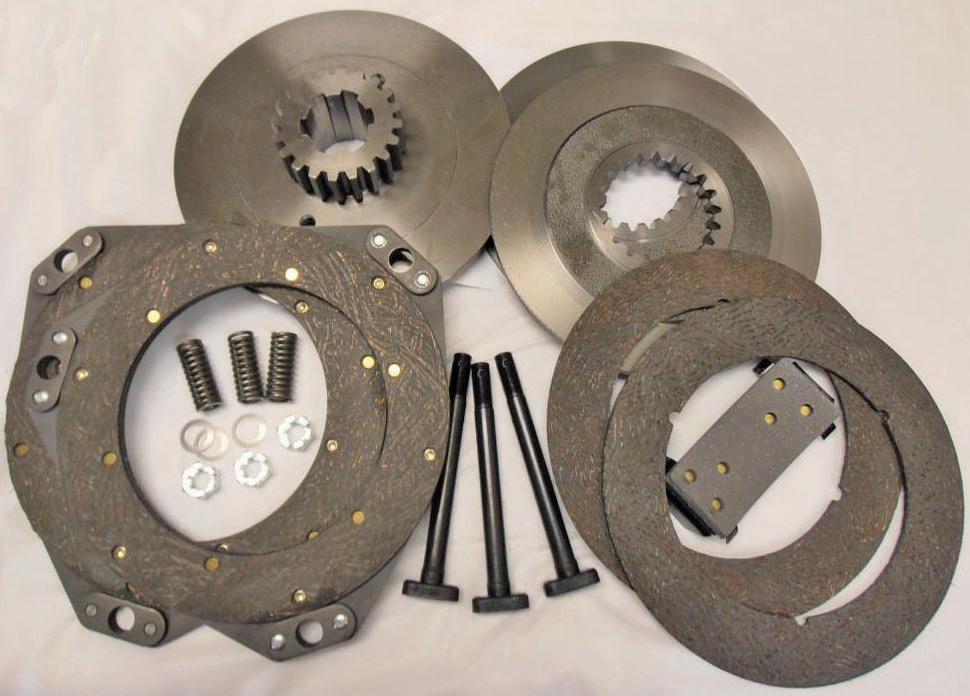
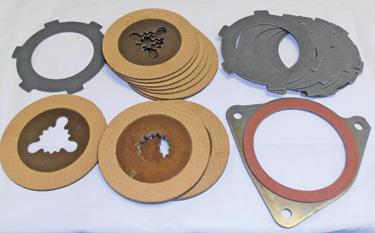
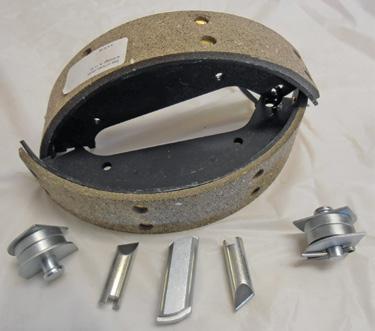
Brake rebuild parts
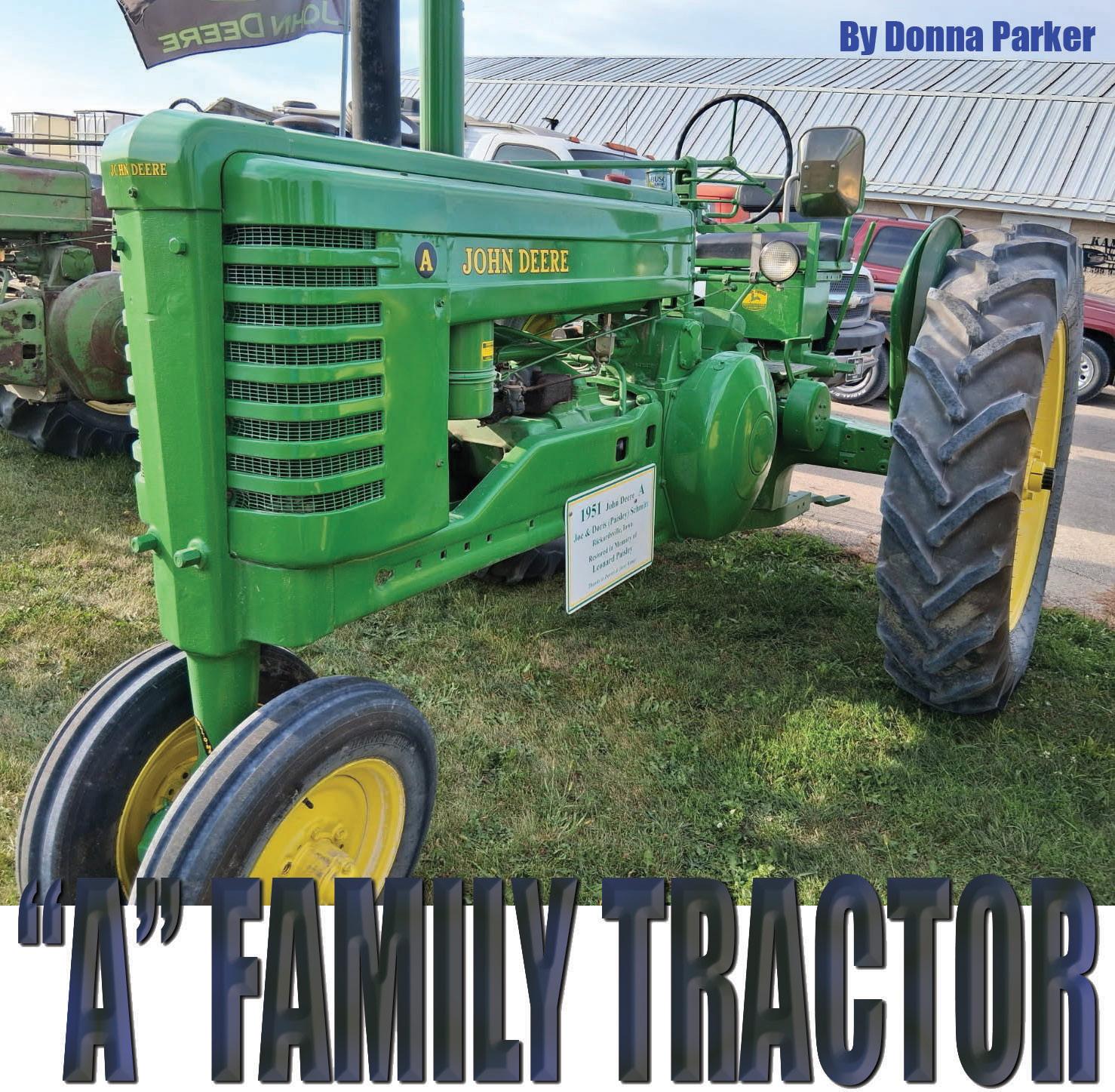
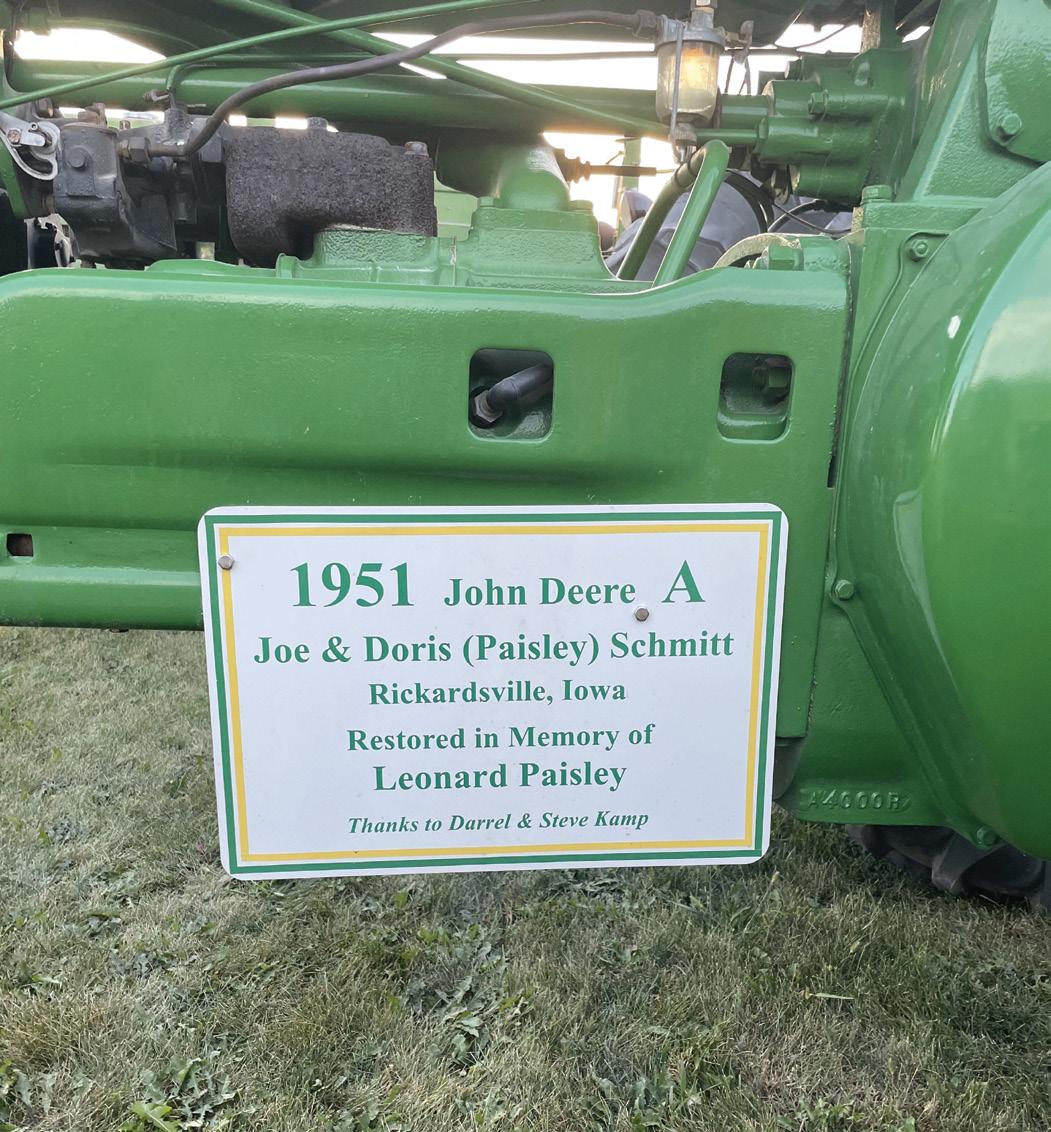
Married October 19, 1963, Joe and Doris Paisley Schmitt have known each other nearly their whole lives. Doris is one of three sisters and Joe is one of 11 children, all raised on farm ground in the Holy Cross, Iowa area, although they both claim citizenship in the tiny town of Rickardsville, Iowa, population 200 plus a few. They added to the population, having four sons: Loren, Kurt, Jeff, and Brian. Doris’s dad, Leonard Paisley, needed help with the equipment, crops, and animals on the Paisley farm that has been in the family since 1846. Two short years later, Doris’s mom passed away and soon thereafter, Doris’ dad decided to sell the farm to Joe and Doris.
Along with the sale of the farm came the ownership of
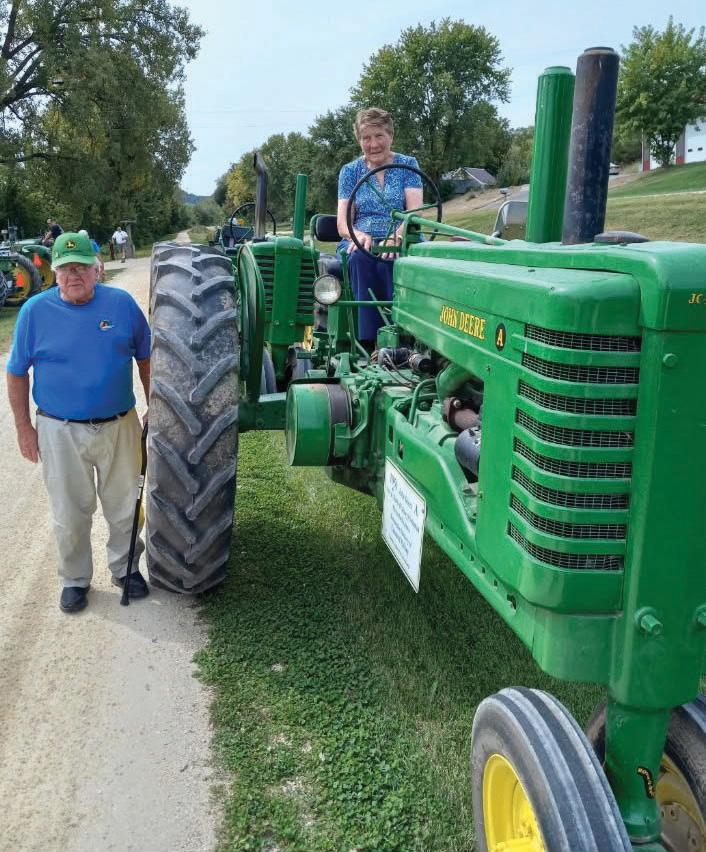
several classic tractors, the oldest being a 1951 John Deere “A” that was bought new by Leonard. They still have the canceled check to show the transaction. A 1941 tractor was also traded in to make the 1951 model “A” tractor his. Doris did field work with the “A” as a youngster, plowing, disking, raking hay, and all the things a tractor was used for in the 1950s. She remembers cultivating all their corn with it when she was 12 or 13 years old.
This tractor, now a 74 year old beauty, has resided its entire working life on the Paisley/Schmitt farm, only leaving it briefly for a restoration in nearby Farley, Iowa. The “A” sat under cover in the machine shed for an estimated 10 years and would not run when it was retrieved.
It had to be rolled down the hill to load it on the trailer. Restoration was completed by Steve Kamp (mechanical) and father Darrel Kamp (body work and paint). Being able to bring the tractor back to life and looking like its former self was a big job and one Joe and Doris oversaw to fully honor the memory of Doris’ dad.
The other classic tractors that came with the farm purchase deal were a 1954 John Deere 50, a 1967 model 3020 and a 1967 4020. These were all purchased new by Leonard Paisley and have been kept in the family so they are considered one-owners as well.
These older tractors have been used for parades and on tractor drives with neighbors. An occasion that Joe and Doris have enjoyed several times is the “Tractorcade” put on by WMT Radio, a multi-day tractor driving event each summer that unites tractor enthusiasts and includes more than 300 tractors of all makes and colors.
Joe and Doris are not the traditional tractor collectors, going to shows and looking to add to their collection. They are glad to own these pieces of history that helped their farm to grow and progress with the times. They honor these older tractors by no longer using them on the farm and saving them for special occasions such as parades and tractor drives. This makes these tractors semiretired, which is a coincidence because that’s how Joe and Doris describe themselves, as semi-retired.
They enjoy the farm lifestyle and want to stay on the farm as long as they are able and can contribute their part. That seems to describe their tractors as well.
Joe and Doris’ son, Kurt, with his wife, Joyce, and their son, Austin, and his wife, Shelly, are the farmers in the family these days, but still accept help from Joe and Doris as long as they are able. The farm has kept up with the times and has newer tractors to do the work. This past year, Joe did the combining and Doris took charge of keeping the dairy barn clean. She uses a skid loader to get the job done.
When asked what their favorite tractors are, while they like the old tractors, they appreciate the comfort of the more modern tractors. Joe noted his favorite is the 4455 because of its all-around good use. It’s easy to drive and has the right amount of power. Doris declared two favorite tractors, a 4755 and a 4440. She worked most with a 4755, using it with the mixer wagon.
Joe and Doris Schmitt’s family has grown from their four sons to 13 grandchildren and 12 great grandchildren. Joe and Doris still live on the farm and want to stay there as long as they can. They look forward to more memories on the farm that has been in Doris’ family coming up on 180 years.
DECALS
Our vinyl computer cut decals are a Licensed Product of Deere & Company.
• For John Deere tractors & equipment!
• Looks like silk screening.
• Pressure sensitive die cut vinyl.
• No film between the letters...they are on pre-spaced application tape.
REPRODUCED PARTS
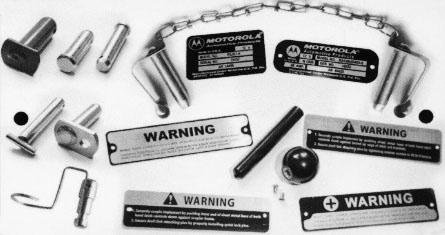
• Nameplate for 1010 thru 7520, stamped, raised letters, like original.
• Medallions for styled AR through 830, including industrial tractors. Also medallions for steering wheels, power steering and non power steering.
• Correct size medallion: 320, 420, 520 USA made.
• D306R D manifold gasket.
• F55R early G head gasket.
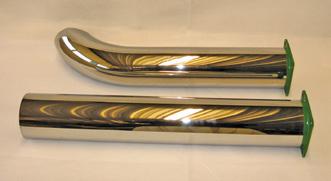
• Air stacks for A, AR, AOs & B, BR & G unstyled tractors; also styled A, B, G, R, 80, 820.
• Air stack adaptors for 620-630 & 720-730.
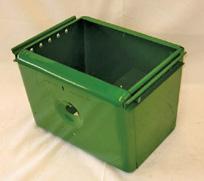
• Tool boxes.
• New valves and guides: GP, D, G, A, B.
• Replacement upper and lower water pipe for 2 cyls.
• BO Lindeman side plates and fenders.
• PTO shields & castings 520-730.
• PTO shields H-70
• GP dust shields for brakes and muffler parts.
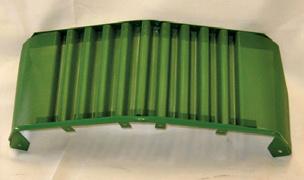
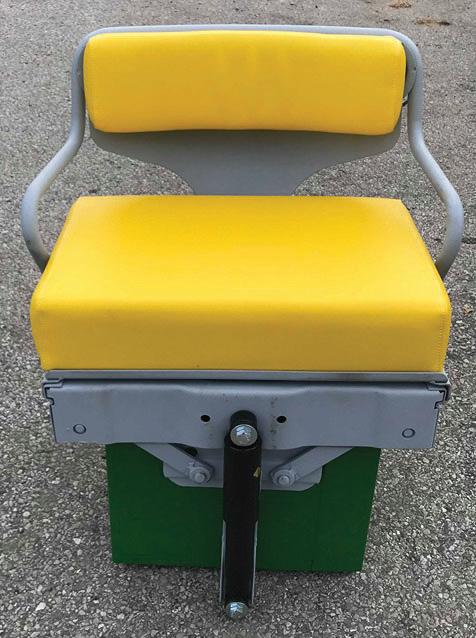
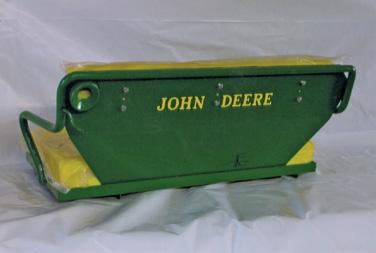
• Grill screens, back and seat cushions, arm rest.
• New radiator cores for John Deere and other tractors that use bolt up type radiators.
• Wire hose clamps for unstyled A, B, G, 50-630 & 80-830.
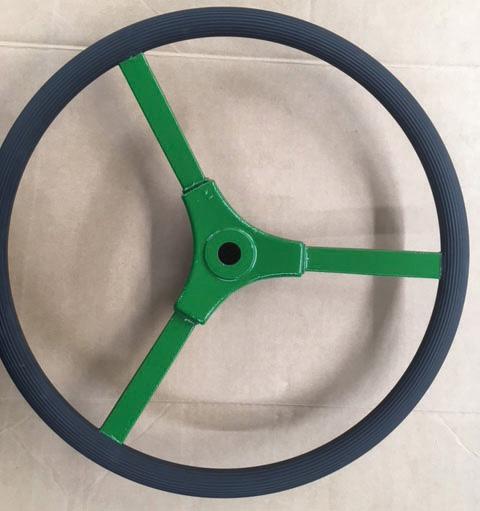
• Reproduction steering wheels A-830 and New Gen.
• Early D & GP fuel tanks, while supplies last.
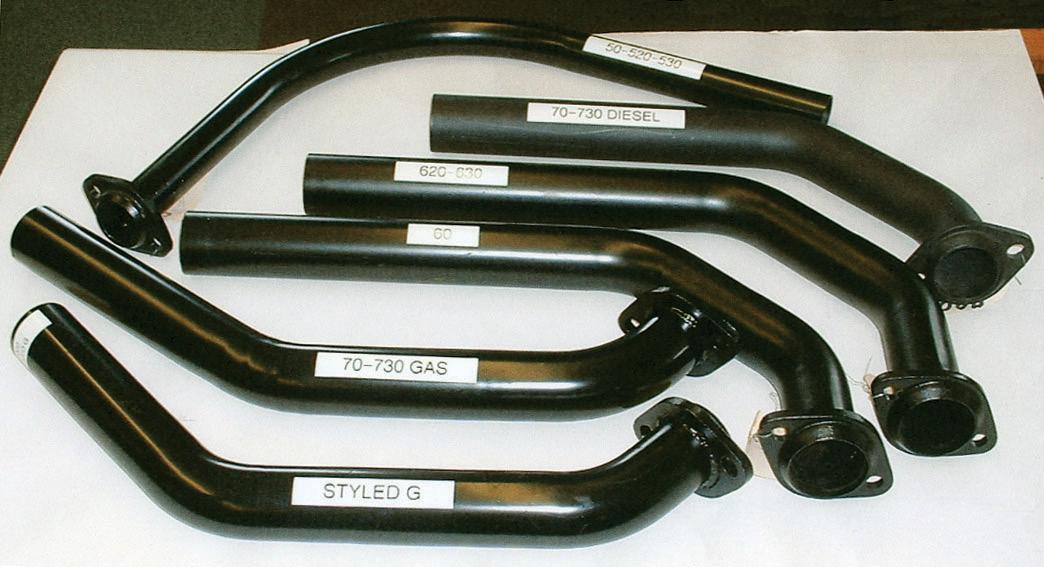
These exhaust pipes are made with smooth mandrel bends like the originals
MADE IN USA
We make styled and unstyled A, B, G, GP Top Steer and 50 through 730D.
4 MUFFLERS
D, AO, AOS, BR, BO A, AR, B, G Styled and Unstyled 50 through 730D
50 through 530 horizontal, 60, 620 Orchard Made in USA
Restoration Quality
4 AR28048, AR28049 NAMEPLATE
Stamped, polished aluminum like originals Fits 1010 through early 7020
4 T10551 NAMEPLATE
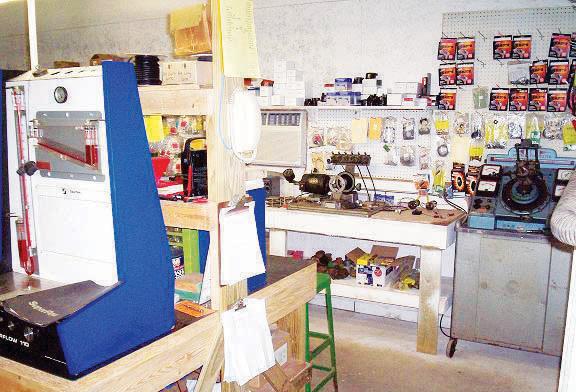
• We bore and sleeve JD 2 cylinder blocks.
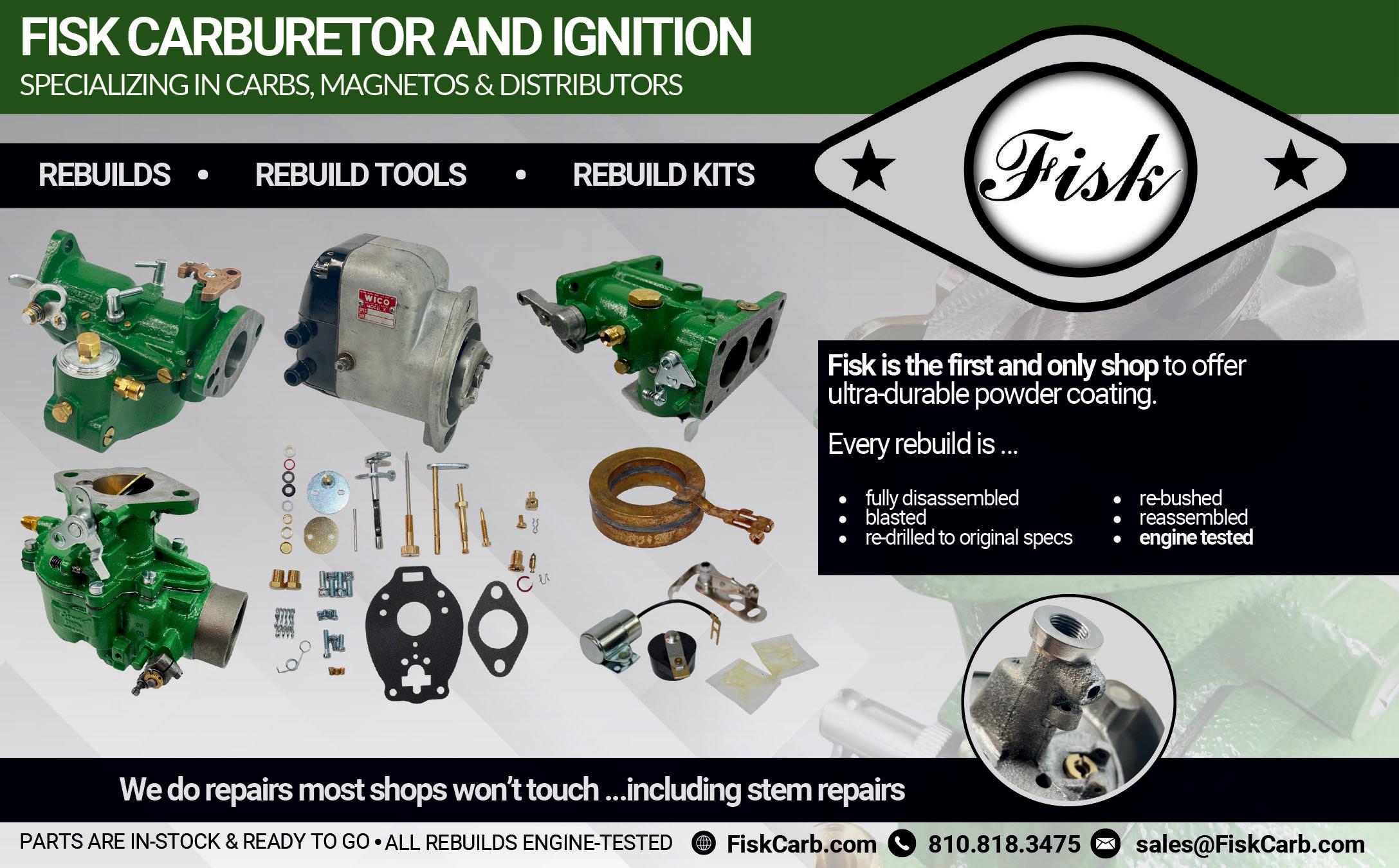
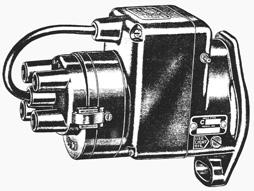
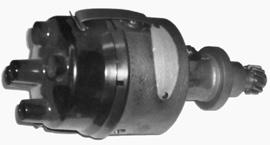
• We carry new parts for Wico mags, also for pony motors.
• Rebuilt mags and carbs for sale.
Like original, stamped polished aluminum with raised lettters, flat black background Each 3-3/8” x 27-3/4” • $140.00 per set plus S/H
4 HYDRAULIC OUTLET PLUG
AF3001R, steel w/chain - 2 cylinder AR52623, plastic w/chain - New Gen
4 AR45915 RAIN CAP Fits 3020-4020 side console models
4 CHROME STACKS
Double walled, straight or curved 4 “ NEW” BATTERY TRAY For 4000 model with brackets
Competitive Pricing and Quality
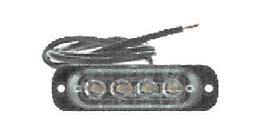
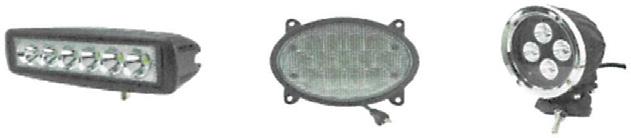
UPGRADE your tractor, skid loader or combine to LED lighting • Call for more information on these lights!
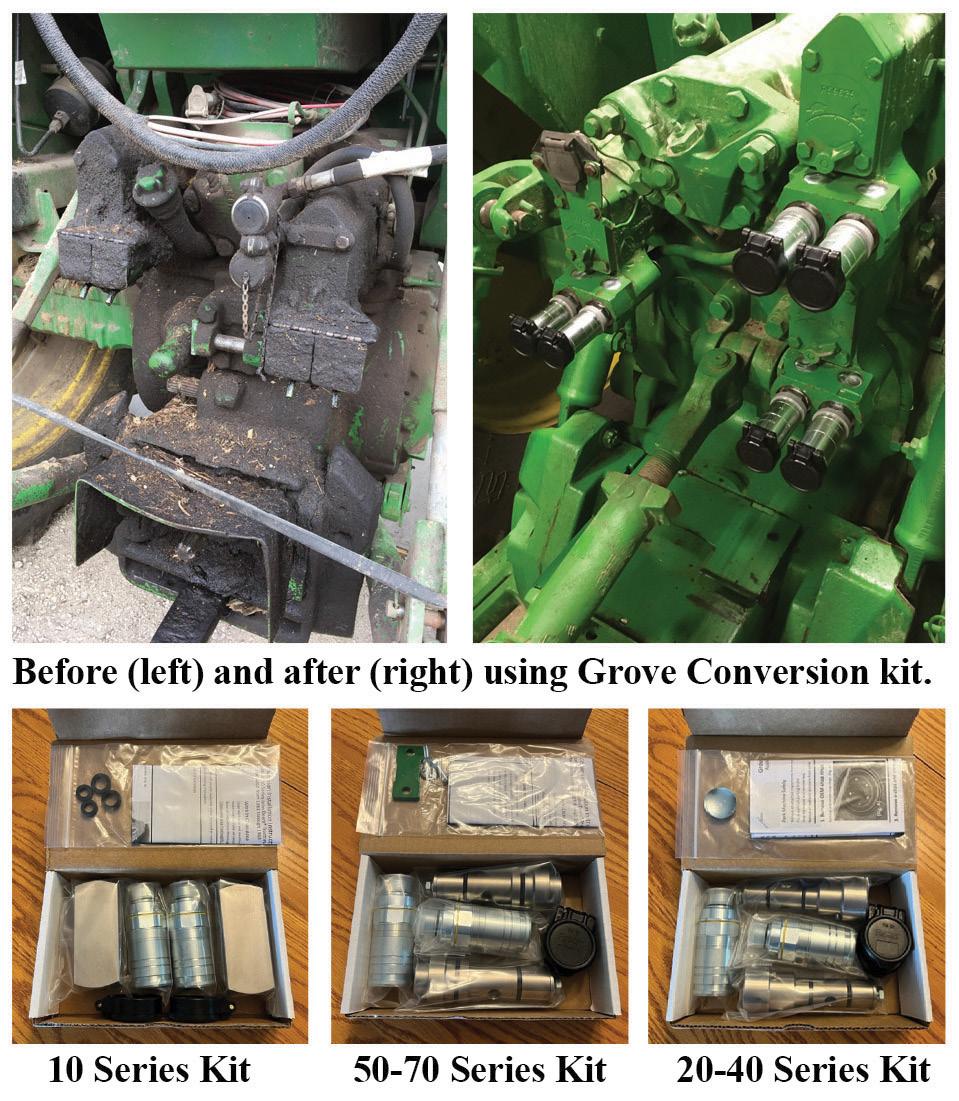
Scott Grove cleaned up leaky hydraulic valves on his older Deere tractors with a simple insert. The long-standing problem is one the company has yet to fix. Grove says it forces him and other owners of Deere tractors to replace O-rings on a regular basis, only to have the mess return. Grove’s fix eliminated the mess and the need to replace parts. With the Grove Conversion kit:
• Convert to ISO with easy push-pull connection
• Couplers connect under residual pressure with breakaway feature
Rebuilt in our facility Wapsi Innovations
• Kits available for 10 through 70 series JD tractors manufactured from 1961 through 1996
• Inserts are made in the USA. This product is protected under US Patent 10,760,725 B2 and other patents pending.
Installation consists of stripping the OEM outlets down to the block, removing the barrels and O-rings, and replacing them with the inserts. Grove then adds the aftermarket ISO coupler that threads into the insert. Installation instructions can be found on the Wapsi website.
Kits for 10 series are priced at $315, kits for 20-40 series are priced at $329, and kits for 50-70 series are priced at $355. Also watch the website for more additions coming soon. Grove suggests checking with local Deere dealers & local repair shops or Wapsi Innovations directly.
DON’T BE FOOLED BY THE “COPYCAT” version! Purchase “THE ORIGINAL” GROVE CONVERSION. We 100% guarantee our product from leaking or your money
It took me about six months, but one day I finally realized that my 1933 tractor, serial number 116001, has a seat assembly from a later tractor. Up to serial number 116487, model “D” tractors had suspension consisting of a large leaf spring. Maybe these were prone to breaking, which could have resulted in embarrassment at best, and severe or deadly injury at worst. In the mid-1934 model year, the seat was changed to a much more substantial channel iron with a coil spring assembly at the bottom for shock absorption. I should add that it is not beyond the realm of possibility that the tractor left the fac-
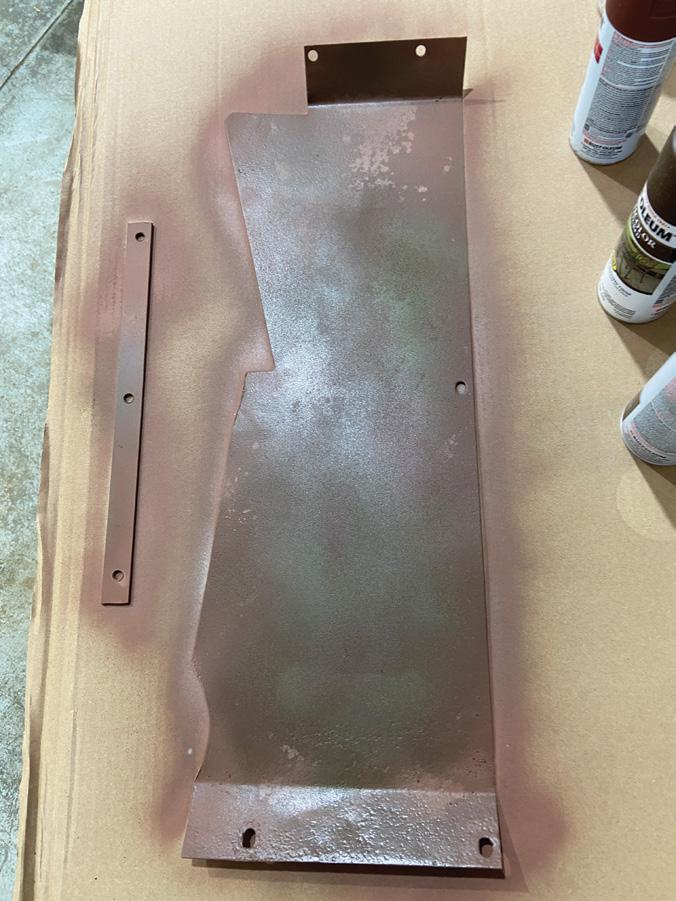
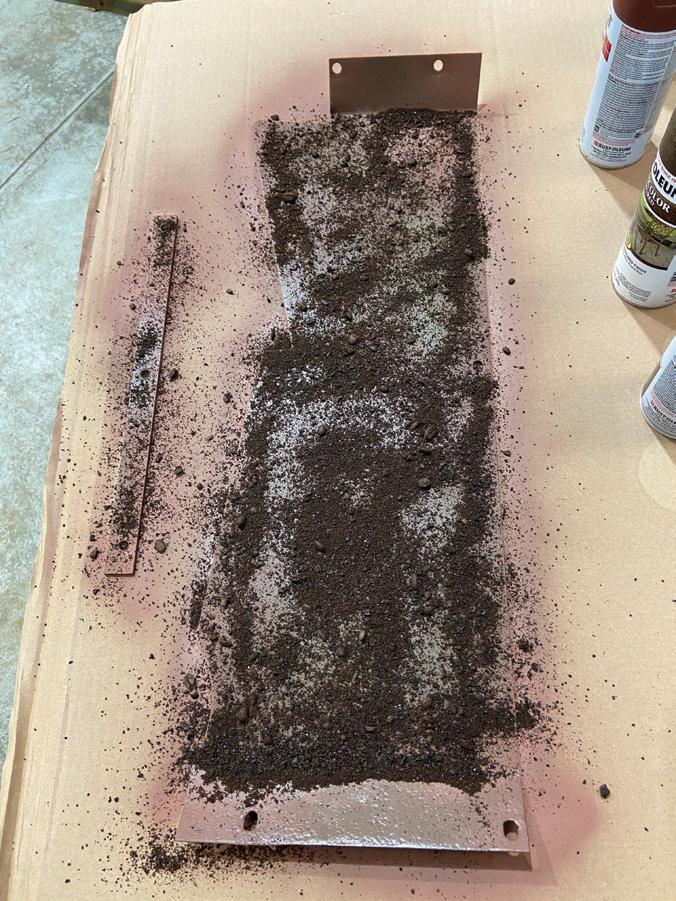
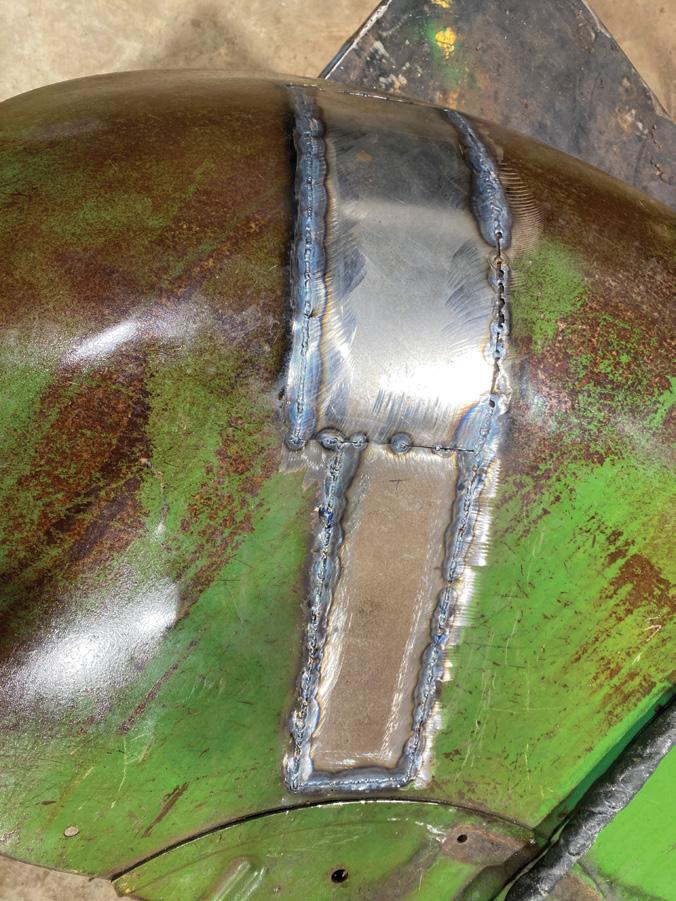
Panel painted with red oxide primer and some miscellaneous brown I found on the shelf. The little guy on the left fits inside the fender.
tory with this seat assembly. Weird things happened, and the parts book isn’t always correct. I ran a photo of the “timing gear spacer” in the January issue. I have considered replacing it with an original-style or an umbrella bracket that serves the same purpose, but I’ve grown to like this unique element and might keep it.
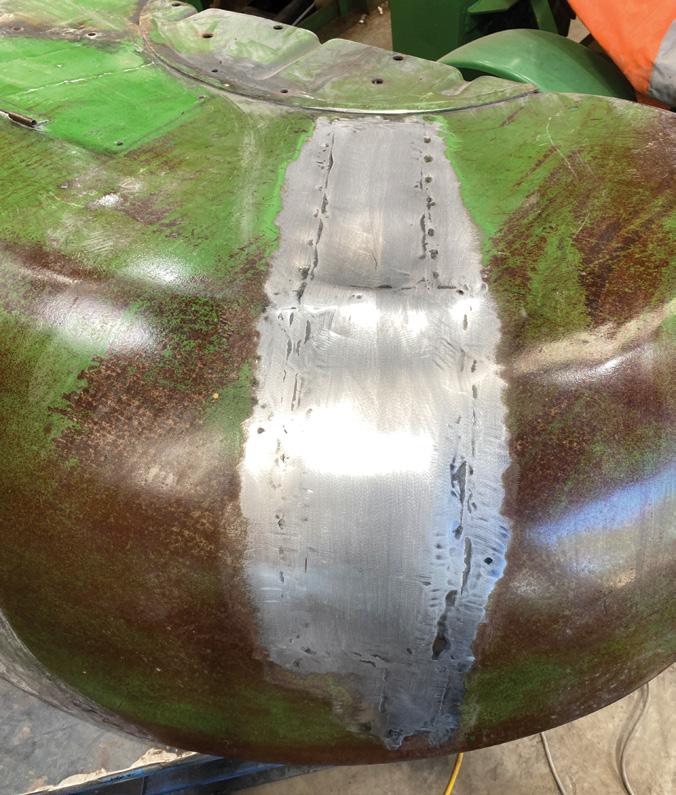
Last month, I wrote that I would show you a new way of adding patina to a previously painted tractor, so here we go. We are going to try this on the right-side dust shield, which is the piece that fits between the fender and the main case (part number D1818R), if you’re keeping track at home. After I removed it from the tractor, I gave it a quick once-over with a random
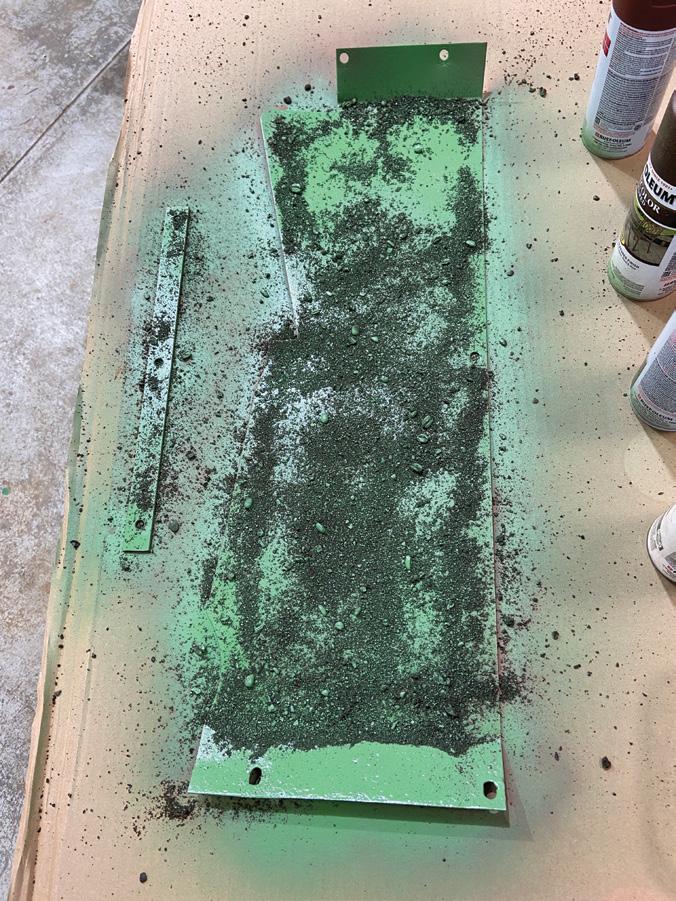
Coffee grounds and sand were sprinkled randomly.
orbital sander, then wiped it down with wax and grease remover. You could take this down to bare metal if you really wanted to, but it’s too cold outside to sandblast, and I’m too impatient to apply paint stripper and scrape. The first thing we are going to do is paint the panel with red oxide primer. Don’t use gray primer; you’ll find out why later. While we’re at it, let’s spray a few spots of brown over the red, because…well, why not? Let this dry for a day or so.
In the meantime, start collecting coffee grounds. For this small panel, we’ll use about a cup, which I removed from used K-Cups. To this, add about a third cup of sand. I didn’t have any regular sand readily available, so I added some from my
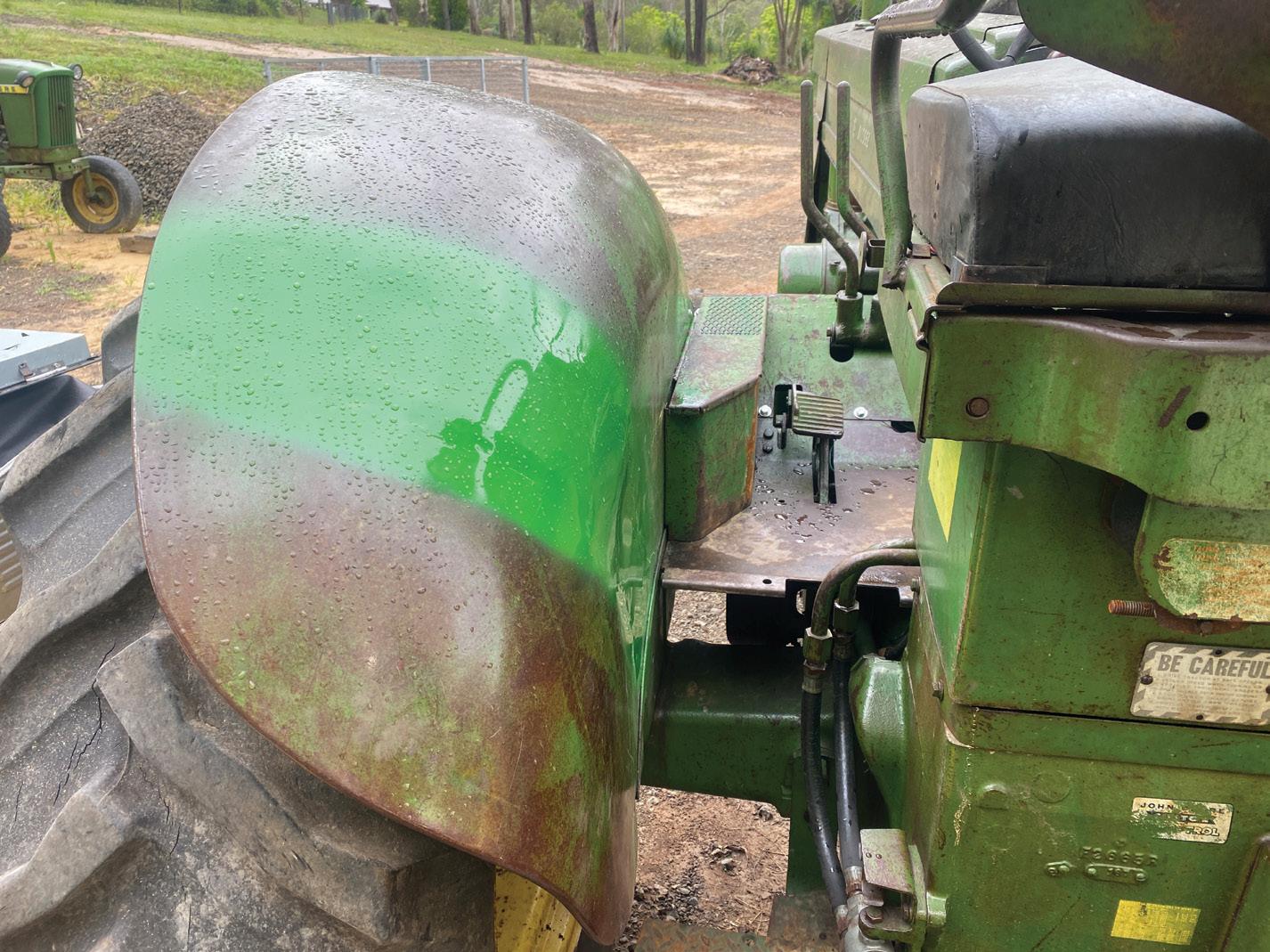
The whole mess was sprayed with “Leafy Green.”
sandblaster. Mix the two together with just enough water to hold them together, but not so much that water will seep out. Now comes the fun part: sprinkle, throw, or glob it onto the panel in spots that you think would most likely have been worn or rusty. In this case, I will focus on the middle, where the driver might have rested his foot.
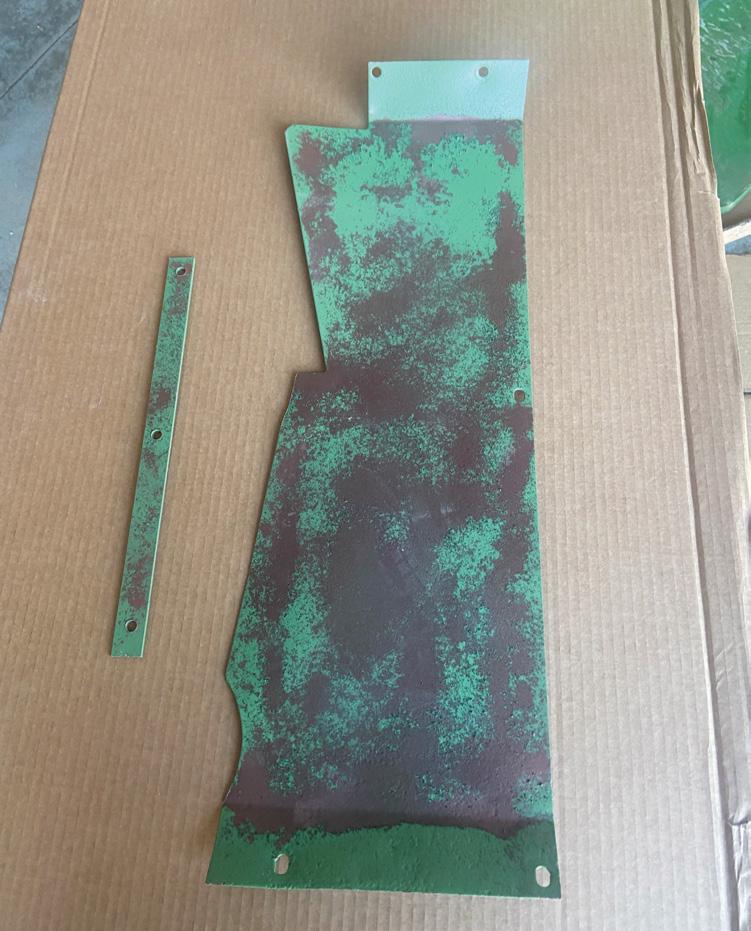
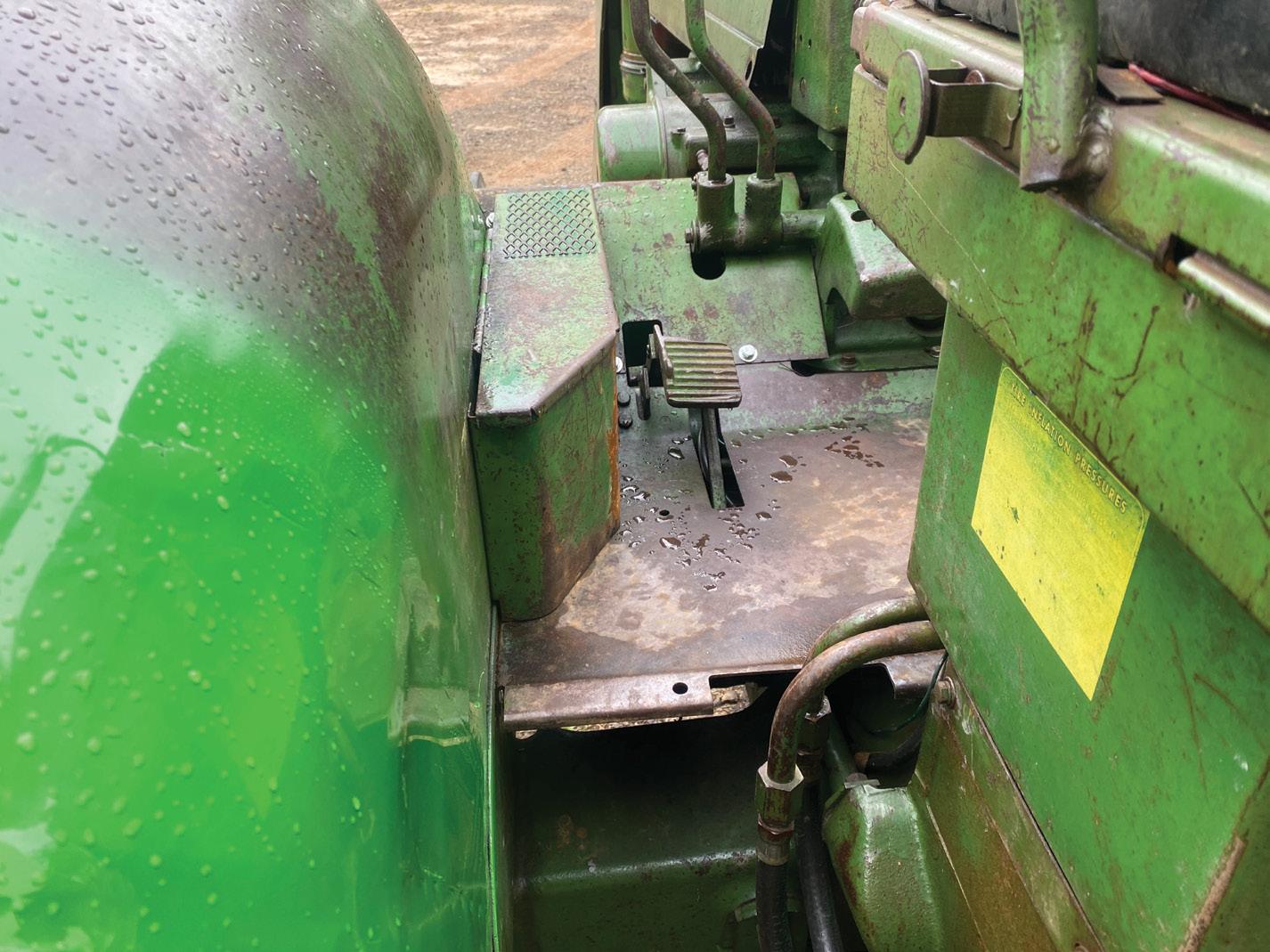
Now we will paint the panel in a color that looks like 90-yearold John Deere green. I chose a color that closely matched some of my older unrestored tractors called “Leafy Green.” The coffee grounds are doing two things. First and most apparent, they are blocking the green paint in an irregular pattern, both physically and chemically, because coffee beans contain a small amount of oil that keeps the paint from adhering to the metal. After a day or so of drying, take it outside, wipe off the coffee/sand mixture, and see what you have. If you don’t like it, you can easily start the process over again, this time using more or fewer coffee grounds, or in a different pattern. The water you add serves two purposes: first, it helps hold the material on any surface that is not exactly horizontal, and second, it keeps the air from the spray can from blowing it away. I
wouldn’t want to try to do an entire tractor this way, but it works well for a few small panels.
A couple of paragraphs ago, I wrote that you should first paint the panel with red oxide primer. Okay, I admit I discovered this process online, and the authors were adding fauxtina to a 1960s’ pickup, which would likely have had iron-oxide primer beneath the paint. If you are performing this process on an old tractor, you might instead use any paint color that looks to you like a
rusty old tractor. On the shelves of your local farm or hardware store, you will see a variety of colors, with names like cinnamon, caramel, or russet, that might be what you have in mind.
The dust cap at the top of the spindle couldn’t be tightened any further.
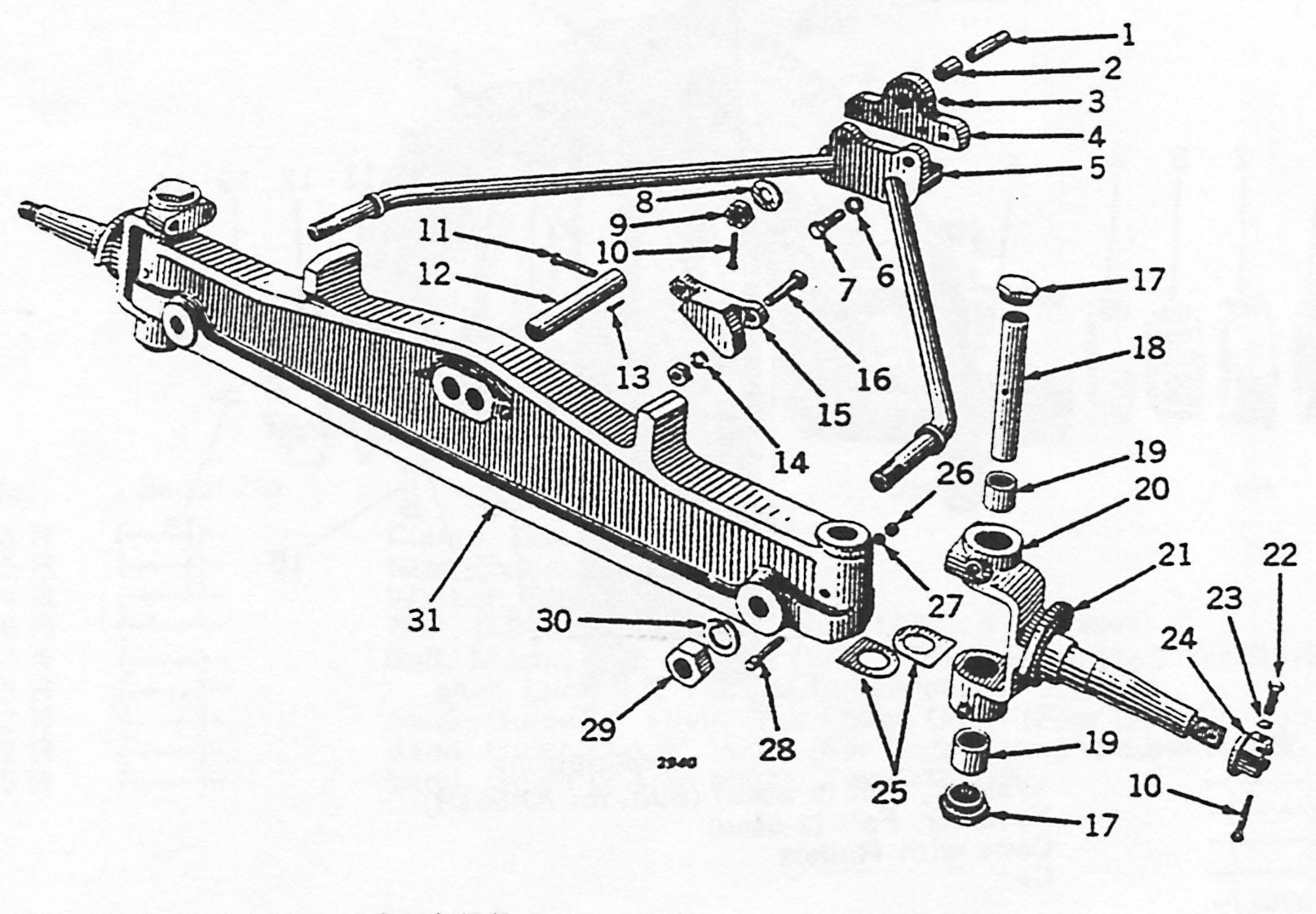
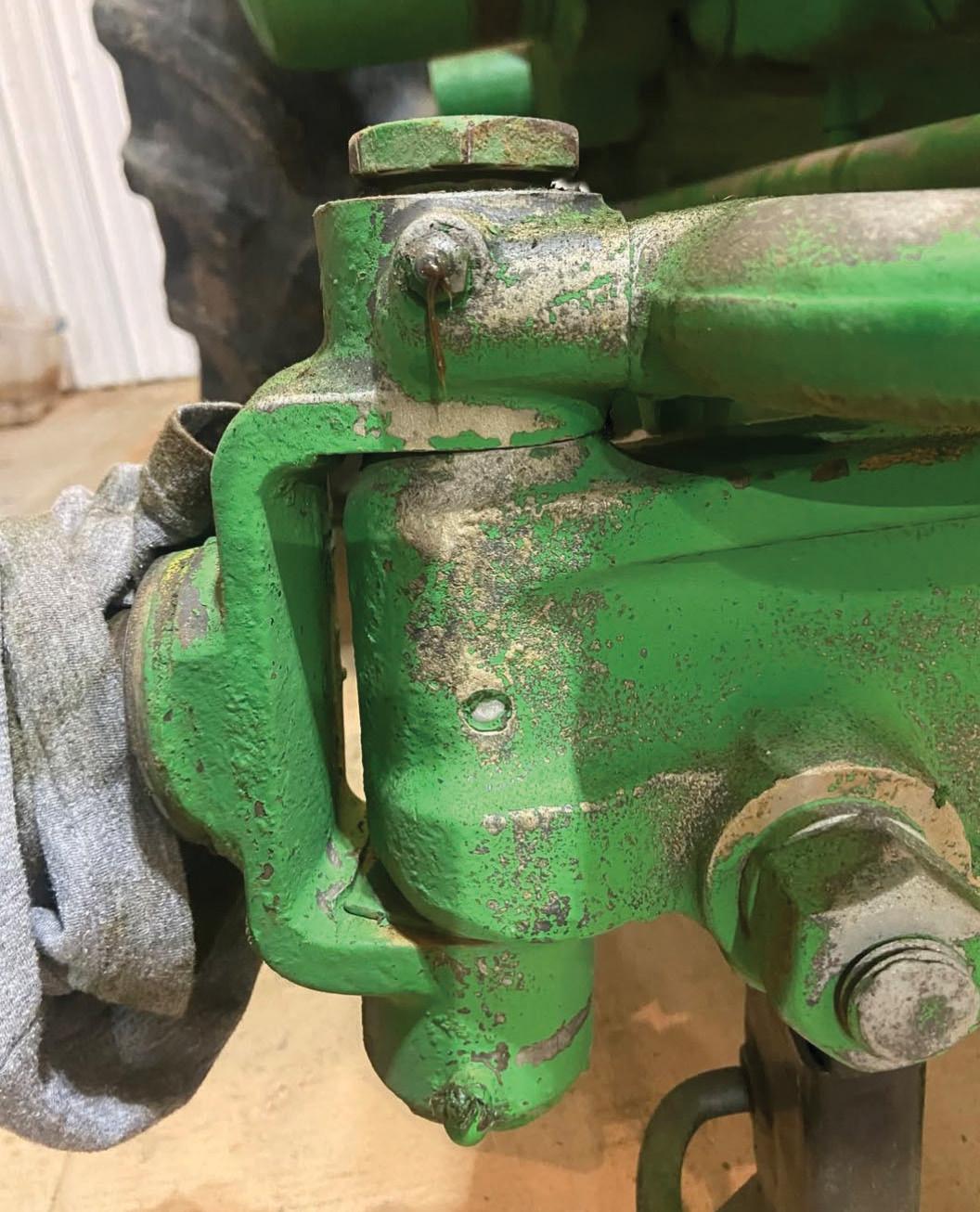
One day, I noticed that the top dust cap (17) on the right front spindle was not screwed in as far as it should be. I tried tightening it with as much force as I dared, but couldn’t move it any farther. After some investigation, I found that the tapered bolt (28) that holds the main pin in place had broken off, allowing the pin (18) to migrate upward. I drove the pin out and cleaned everything up, including the bottom dust cap, which was packed with dirt. I think that the last person to grease these spindles probably could remember the big celebration they had when Prohibition ended. The bushings (19) didn’t look to be very worn, but the bottom of the spin was rusty and pitted. Since this made everything a bit loose, I shimmed it up with some brass shim stock. We will see how that works out. I made a new tapered bolt (28) from a standard 5/16ths inch bolt.
Here’s the result after cleaning.
Tractor Parts We Fabricate
Weight Bracket 5010, 5020, 6030: AR58358, Pr $460
Step w/Pads
5010, 5020, 6030 - AR40914, $165
Hwy.
Detwiler Tractor Parts
QUALITY NEW & USED PARTS
Exhaust Pipes • U.S. Made Radiator Cores • Front Weights
Engine Parts • Manifolds • Mufflers • Airstacks
Battery Boxes • Fenders & Hoods • PTO Shields
Steering Wheels • Flywheels • Grill Screens
Clutch Parts • Grill Guards for D & GP • Airstacks - D & GP
ReRimming FactoRy Round & R
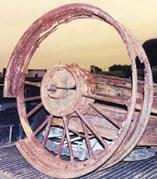
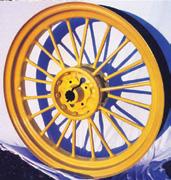
Flat Spoke WheelS F • Any brand tractor We can rebuild cutoffs back to steel
High quality / very accurate reproductions
We can also replace damaged spokes • The only source of original style rear rims
Rear wheels can be custom sized for pullers • Will also rerim cutoffs front and rear
Text 715-613-1520 • Email patdetwiler@gmail.com or call numbers listed
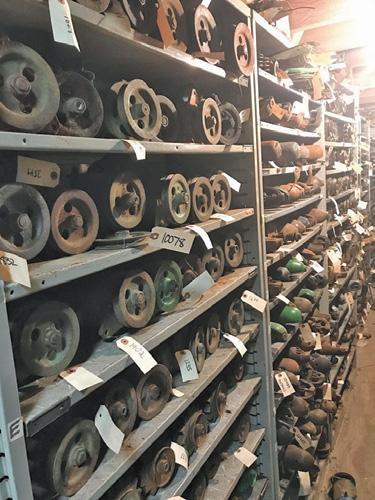
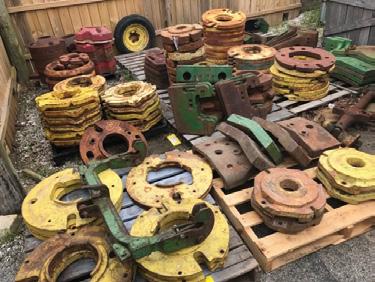
• Used parts include: weights, 3-pts., toplinks, dual hydraulics, float ride seats, clutch parts, hubs, transmission gears, sheet metal, tires and rims, 720-730 ES parts, all-fuel manifolds, brake parts, square and round tube WFEs, heads, blocks and PTO parts.
• New parts include: manifolds, battery boxes, carburetor kits, air stacks, mufflers, grill screens, radiator cores, lights and overhaul kits.
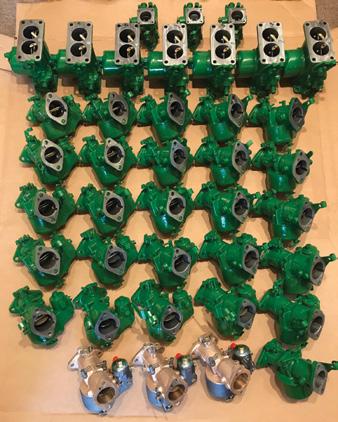
• Rebuilt parts include: Taper-Loc flywheels, electric start conversion kits, float ride seats, starters, carburetors, cleaned and lined gas tanks. Also have crack checked heads and blocks.
Lind Bros Tractor and Parts, LLC
Allis-Chalmers was the first major American tractor manufacturer to add a turbocharger to the engine on its tractors. Their D-19 tractor produced 66 horsepower with a boosted 262 cubic-inch diesel engine, making it their most powerful row crop tractor when it was released in 1961. Other manufacturers saw the success of this combination and followed suit, either building engines to incorporate turbos or simply plumbing one into the engines they were already using. It was a relatively quick and easy way to add horsepower to a tractor without a significant increase in cost and with effectively no change to the tractor’s size and weight. In a time when customers were clamoring for more power from their tractors, this was a very welcome advancement.
Deere and Company stayed away from turbochargers for a while. They had only recently released an entirely new lineup of tractors, and the new engines in them were state of the art and producing power in line with other manufacturers. These engines were upgraded for the 20 series New Generation tractors to make more power than before. International Harvester added a turbo to the 806’s engine in 1965, creating the 110-horsepower 1206, which was the most powerful row crop tractor for a time. Allis-Chalmers also powered past the
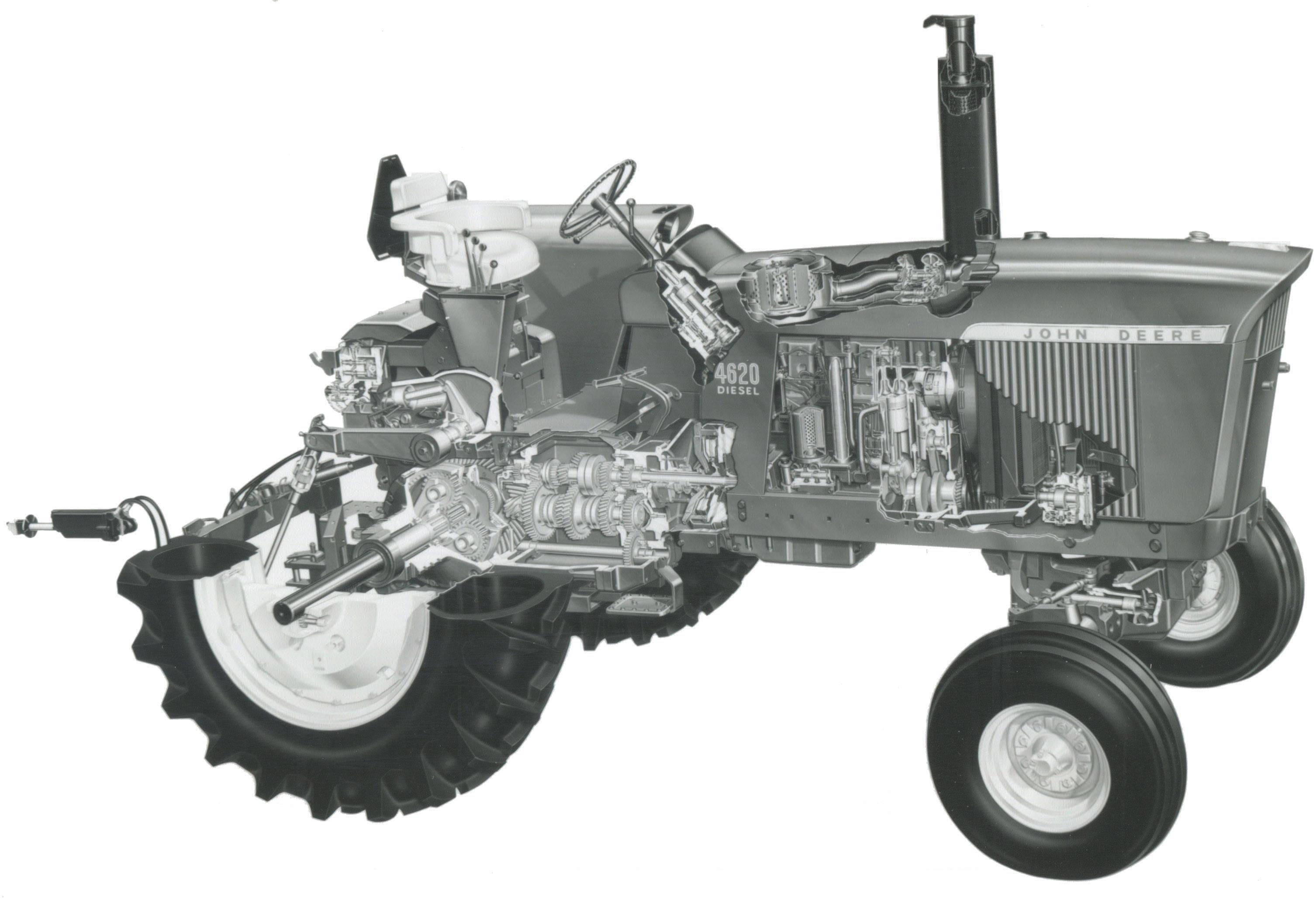
The inner workings of the 4620.
4010 with their D-21. Deere created a row crop version of the 5020 that put 132 horsepower into row crop farming, but the tractor was a compromise for its heavy weight and large size, and was not practical on many row crop farms. If Deere wanted to stay at the head of the pack with a “true” row crop tractor, they were going to have to embrace the turbo.
What better engine could there possibly be for Deere to first install a turbo on than the 404 diesel? It was the company’s best engine at the time, powering the 4020 tractor, and is still considered to be one of the best the company ever made. Deere trusted the engine’s durability and believed that it would stand up to the increased power without a problem. Surely the company’s engineers were aware that aftermarket turbo kits were already available to farmers who wanted to add one to their tractors, and the majority of these engines stood up to the extra power without a problem. Deere did more than just add a turbo to the 404 engine; they also improved the cooling and lubrication systems in it and strengthened a few of the parts that were going to take on more stress with the higher power.
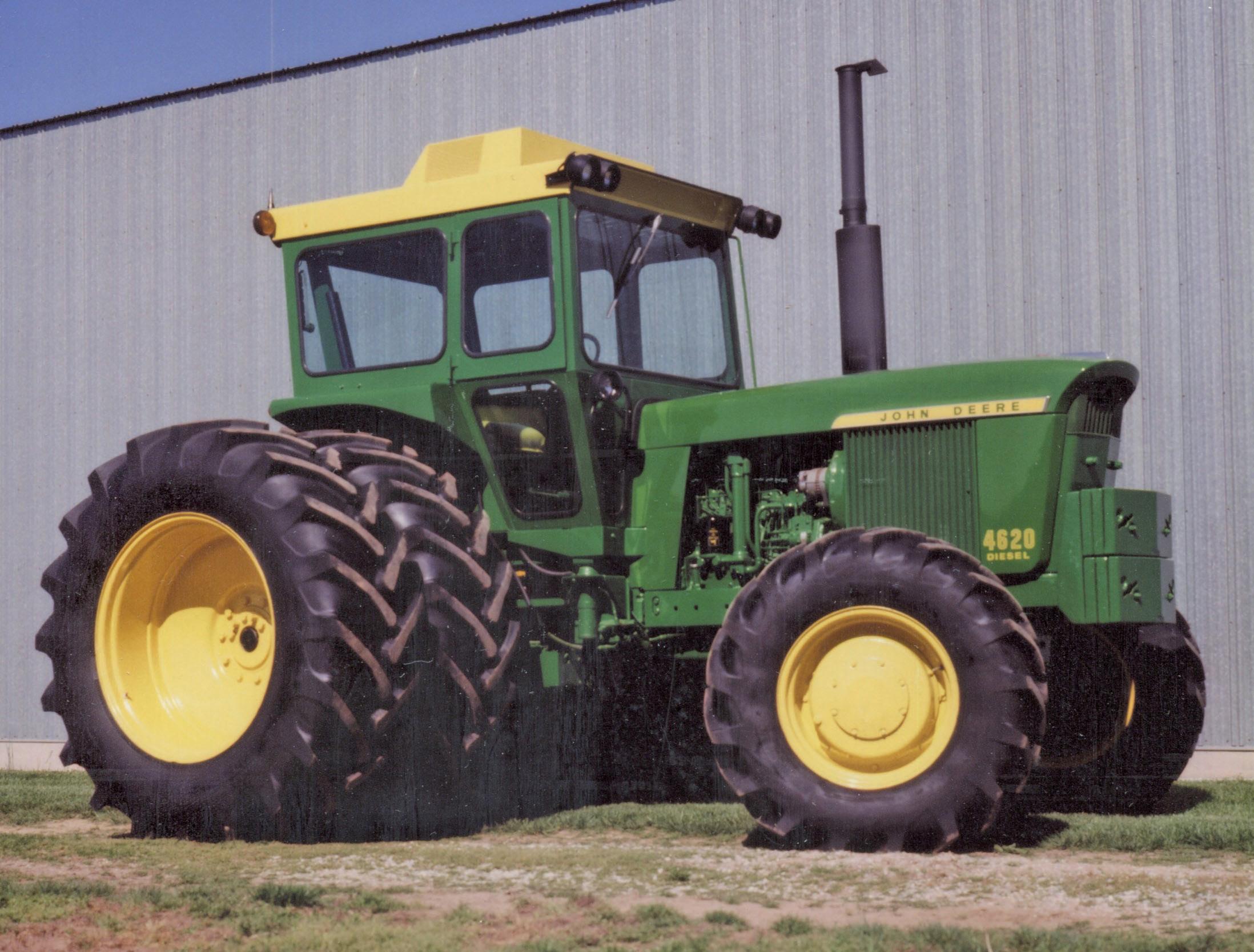
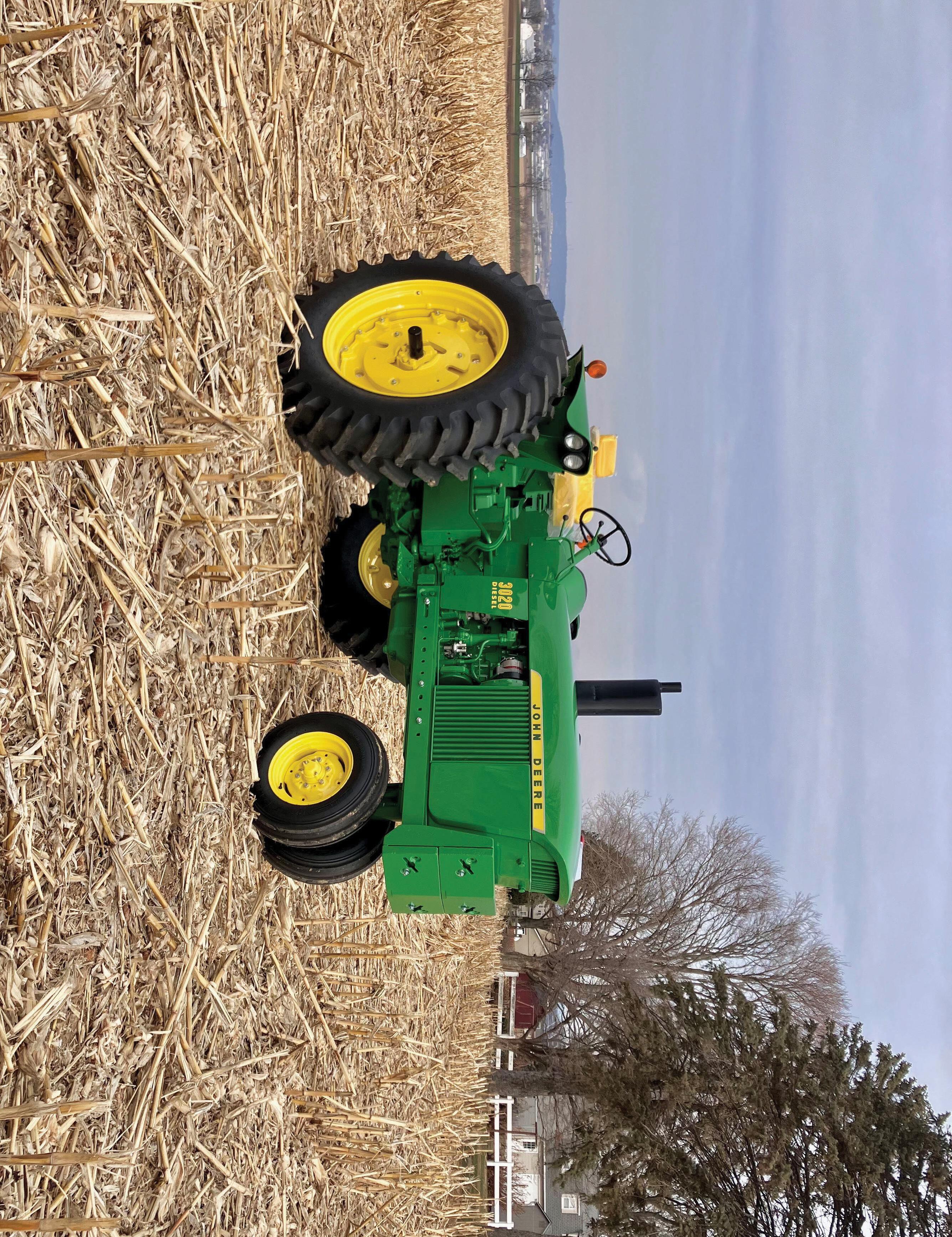
Deere’s first turbocharged tractor was the model 4520. The 4520 was released in 1969 and was a 120 horsepower machine. In most ways, it was a stronger version of the 4020. The mass that Deere added to the 4520 was not insignificant, though, and the tractor weighed about two tons more than the 4020. Still, that made it two tons lighter than the 5020, and the chassis on the 4520 was much more appropriate for row crop work.
Unfortunately, the 4520 had one (sometimes fatal) flaw. A new air cleaner system had been engineered for the tractor because the turbocharged engine required more airflow. This new system tended to plug up quickly when field conditions were dusty or kicked up a lot of debris. The air filters on these tractors were not quick or easy to service, and were too often neglected, causing the engine to work with poor airflow. The engine overheated as a result, and engine damage was the next consequence. Tales of ruined engines and tractors made useless began to spread, and sales of the 4520 plummeted, despite Deere’s remedies for the issue. It was decided that Deere would need to replace
A 4620 and “BWA” disk covering big acres in the early 1970s.
the 4520 with a new model of tractor. The power class that the 4520 was in was popular. Deere wanted to be sure to have a tractor in it that had a good reputation. While Deere could have made a couple of quick changes to the 4520 to stop the issues that people were having with it and put a different model number on it, they decided to take the opportunity to make several improvements to the machine, giving them a better tractor to sell. Farmers who owned a 4520 had already reported to Deere what they thought could be changed or improved to make a better tractor, so the company had an idea of ways to make the tractor something that customers would be excited about.
The first thing that Deere did was to add an inter-
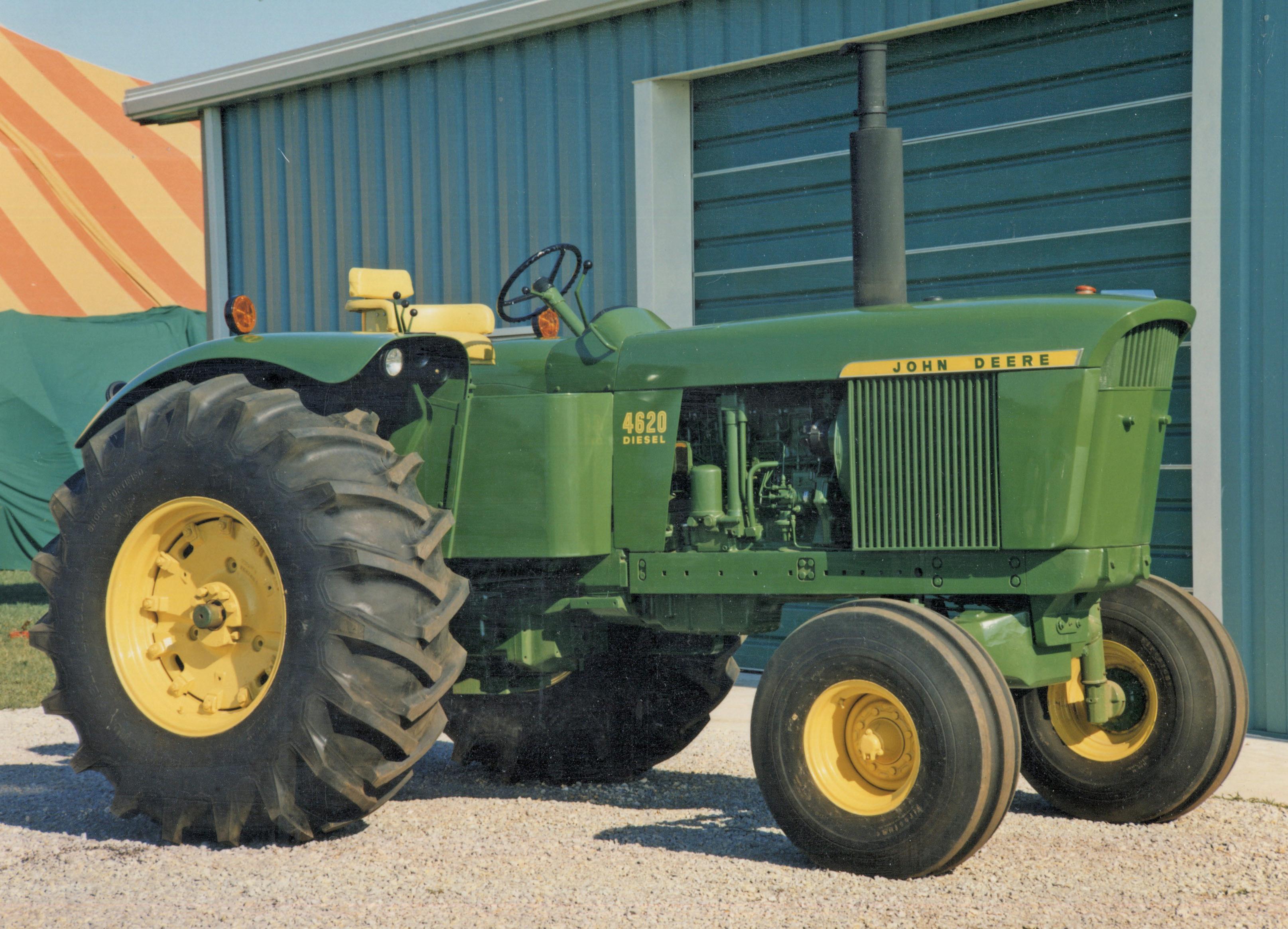
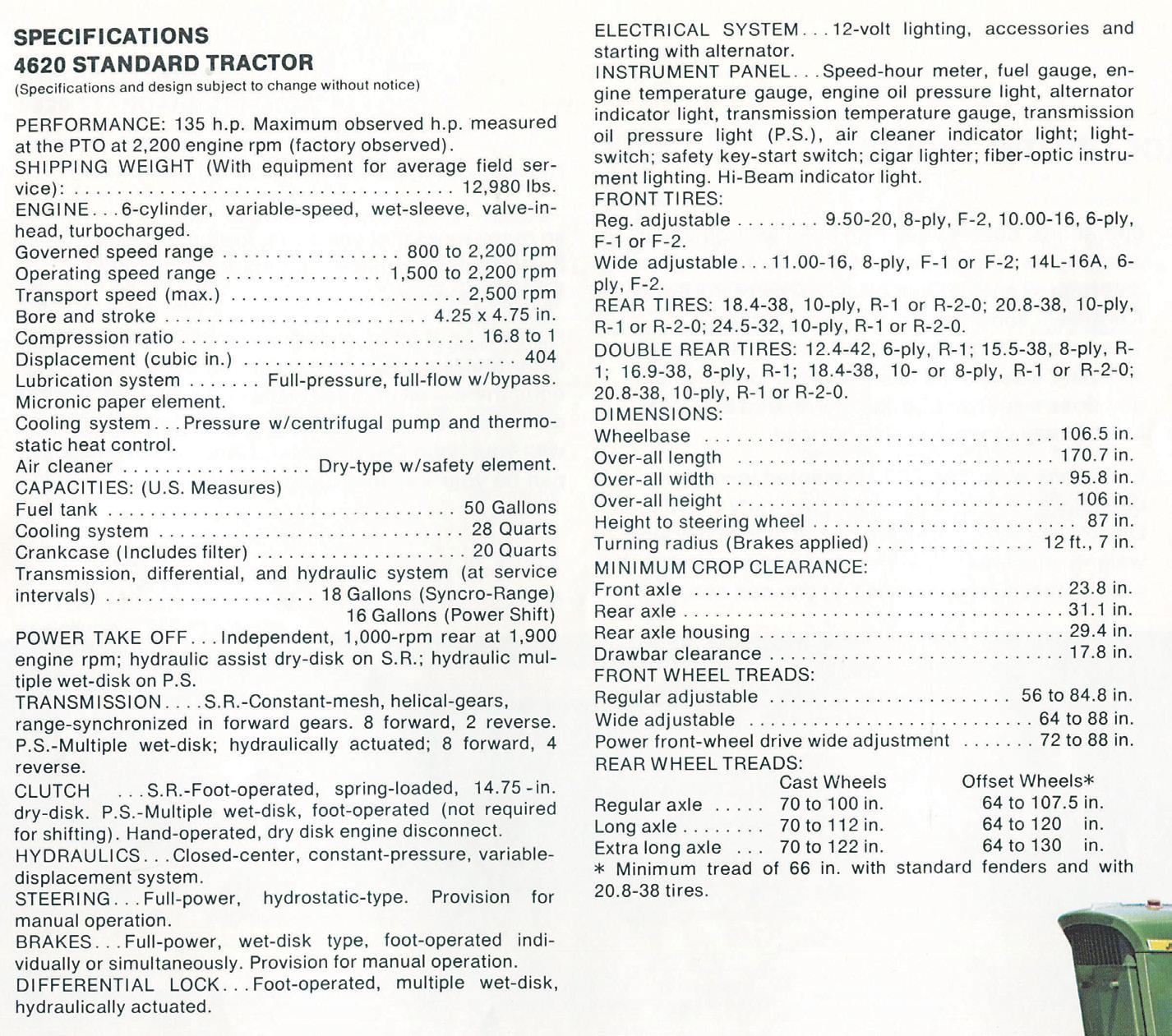
bocharged and intercooled, was able to produce 135 horsepower. The new row crop tractor would now have almost as much power as the 5020. With this engine and the problems with the 4520 solved, Deere now had the new 4620. The tractor was powerful and reliable, and in a lot of ways, it was what Deere had wanted the 4520 to be. It was released in late 1970.
Deere’s advertising for the 4620 said that it featured “Dynamic Power Reserve.” This was not exactly a tangible part of the tractor; it was more of a concept likely dreamed up by the advertising division. “Dynamic Power Reserve” was the idea that the 4620 had the power to run your older implements faster than ever before. Deere liked to sell the 4620 with the idea that a
cooler to the engine. Intercoolers cool the air that has been compressed by the turbo before it enters the engine. Cooler air is denser than warm air, which allows it to carry a greater charge into the cylinder, offering more power. An additional benefit of the intercooler is that it helps the engine to run cooler, since the air entering the engine is cooler.
This latest version of the 404 engine, now tur-
farmer would not have to purchase any new equipment to use with it. He could increase his productivity simply by increasing his speed through the field with the more powerful 4620 at the front.
A few features came standard on the 4620, including row crop fenders, a 1000 RPM PTO, and a single hydraulic remote. A Roll-Gard cab, Roll-Gard with a canopy, and a Roll-Gard bar were optional. For farm-
Here’s a 4620 equipped as a standard.
ers who worked in small grain country, Deere offered standard-type fenders with operator dust shields. The downside to these was that the tractor could not be outfitted with a cab. Weather-Shields and Weather-Shield cabs were still available for these.
There were many other options available to the 4620. They included outlets for up to three remote cylinders, a Category II three-point hitch or Quik-Coupler, hydraulically actuated Power Differential Lock, and a Power Weight-Transfer hitch. Power Front-Wheel Drive was an option for the 4620, but was purchased by very few customers. This system had a hydraulic motor in the front wheels. A switch on the dash turned the system on to one of two settings. The first was a full power mode for maximum traction and pull. The second setting was a lowtorque mode that helped the tractor to turn in loose soil or to keep the front end in line on a side hill. Those tractors that did have this equipped were shipped with a high capacity hydraulic pump.
Deere offered the 4620 with either a regular adjustable front axle with 9.50-20 or 10.00-16 inch tires or
a wide adjustable front axle with 11.00-16 or 14L16A tires. Both a regular and a long rear axle were available. The long axle had a potential tread width ranging from 60 to 120 inches, depending on the tires on the tractor. For single rear tires, Deere offered 18.4-38, 20.8-38, and 24.5-32-inch tires. Rear duals were available in 12.4-42, 15.5-38, 16.9-38, 18.4-38, or 20.8-38 inches. Several wheel options to fit these tires were also available, most in both regular and offset versions.
The Syncro-Range was standard equipment on the 4620, but a farmer could upgrade to a Power Shift. This transmission would sap a bit of power from the machine, but it was easy to use and made speed changes easy, which could be very helpful when doing certain tasks. Deere also offered weight packages for the front and the rear, a coolant heater, an intake air stack, a horn, and more for the tractor.
Deere produced the 4620 for just two years, ending in 1972. At that time, the Generation II tractors were
Front wheel assist and a Hinson cab make this a top-of-the-line 4620.
ready to begin production, and they offered several improvements that would make the 4620 out of date. Deere produced just shy of 7,000 model 4620s during its production run. This was not a lot of units, but it was built for a comparatively small market. Most of the row crop farms at the time did not need the power and capacity of the 4620. The 4020 and 4320 were more in the sweet spot of power versus price. The 4620 was there for the largest farms and to compete with the big offerings from other manufacturers. It has also been hypothesized that Deere was using the 4620 in part to test the turbocharged and intercooled engine and to see what they could learn from it in preparation for the engines that would power Generation II.
Farmers who purchased and used a 4620 were happy with their machine. Most will tell you that the tractor did what they hoped it would. It put more power down in the field than any of their tractors had before. A few claim that the 4620 was a bit underpowered for its size. Deere, it seems, built the machine to be stout and reliable. The company would prefer a customer wish their tractor had more power than wish that it had been built more robustly.
The “Dynamic Power Reserve” of the 4620 was a good concept, allowing farmers to run their old implements faster through the field. The only problem with that was that it stopped at drawn equipment. The 4620 did not have a 540 RPM PTO. Deere was afraid that the big power of the tractor would tear apart the light machinery built for smaller tractors of the previous decade. More than a few farmers who were otherwise interested in the machine opted not to buy a 4620 because they would not have been able to run some of their equipment with it.
The 4620 is now more than 50 years old and has become a favorite of collectors who like the more modern machines. The fact that they shared a great amount of what made the 4020 such a great tractor makes
them popular, and those who can handle the extra weight of the tractor on their trailer get to have the fun of playing with its extra power. The 4620 is also a rarer cousin of that tractor, making it appeal to those who prefer the hard to find. At the same time, a 4620 is still a tough old tractor, and most have the capacity to put a lot more acres behind them. These tractors are ready to do whatever you ask for a long, long time.
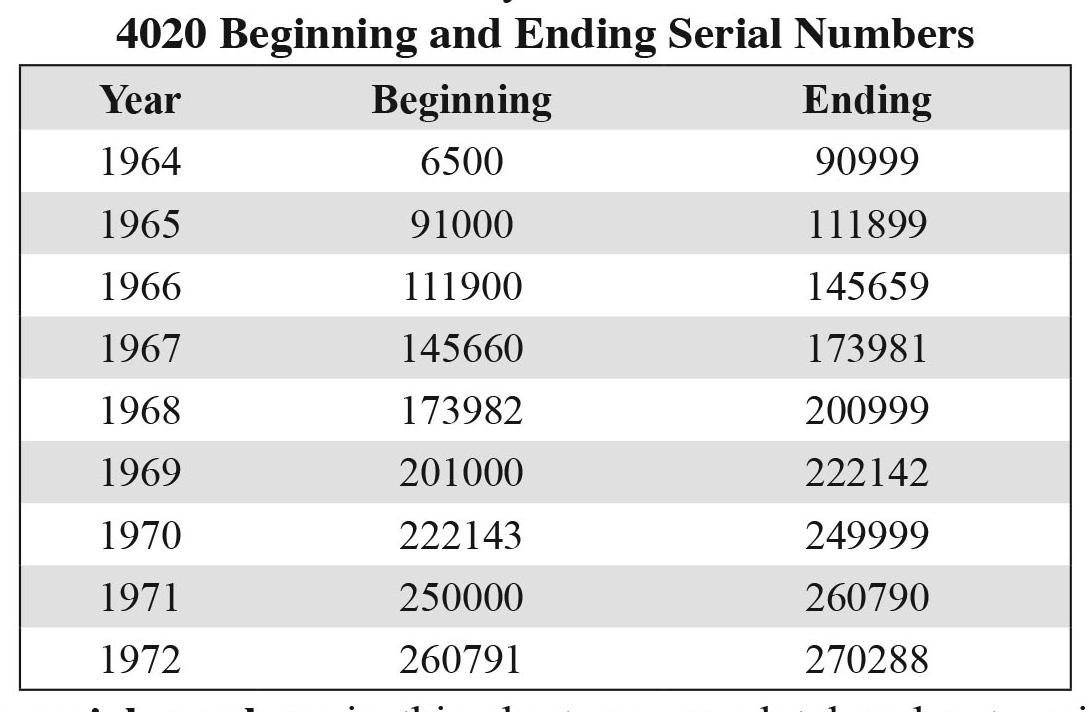
4620 Beginning and Ending Serial Numbers
4620 Production Numbers
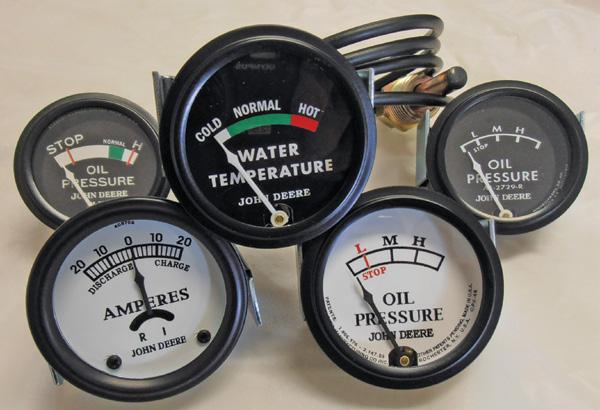
Oil,
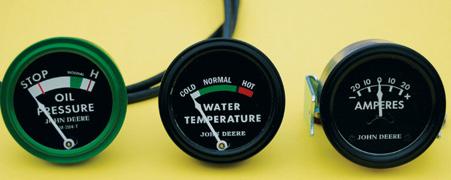
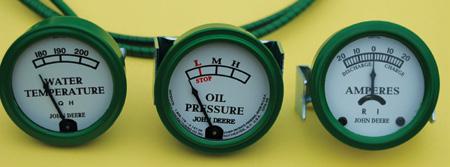
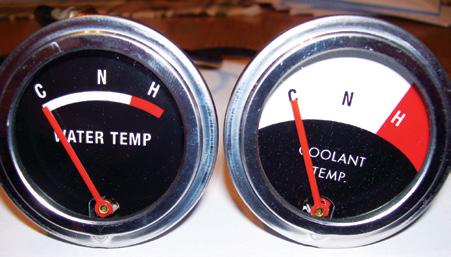
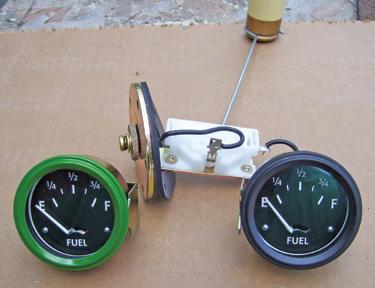
amp and temperature GAUGES
with white or black faces for most 2-cylinder models for the unstyled to the 30 series, Waterloo and Dubuque built models Made in the USA
EverGreen Restoration
Gauge prices:
$70 for oil/amp
• All gauges have real glass
• On hand, ready for shipping
• Painted, ready to install
• Gauges come with mounting clamp and hardware
• Faces made by Jorde Decals and have all details of the original gauges
• All gauges are calibrated
EverGreen Restoration
Jerry Trcka W7619 Walnut Dr Spooner, WI 54801 Cell 715-520-7876
tractorgauges@yahoo.com www.evergreengauges.com
$90 - $100 for temp, depending on length of the lead
diesel, console, Power Shift, 4,300 actual hours, original paint
all types of signs and memorabila
Also available:
• ’72 JD 3020 LP Power Shift, believe 1 of 3 ’72s
• JD 4030D, fenders, narrow front
• JD 4020 Meade Cummins conversion
• JD 4520 Kinze Detroit conversion
• JD 3020 LP console, Syncro JD 3020
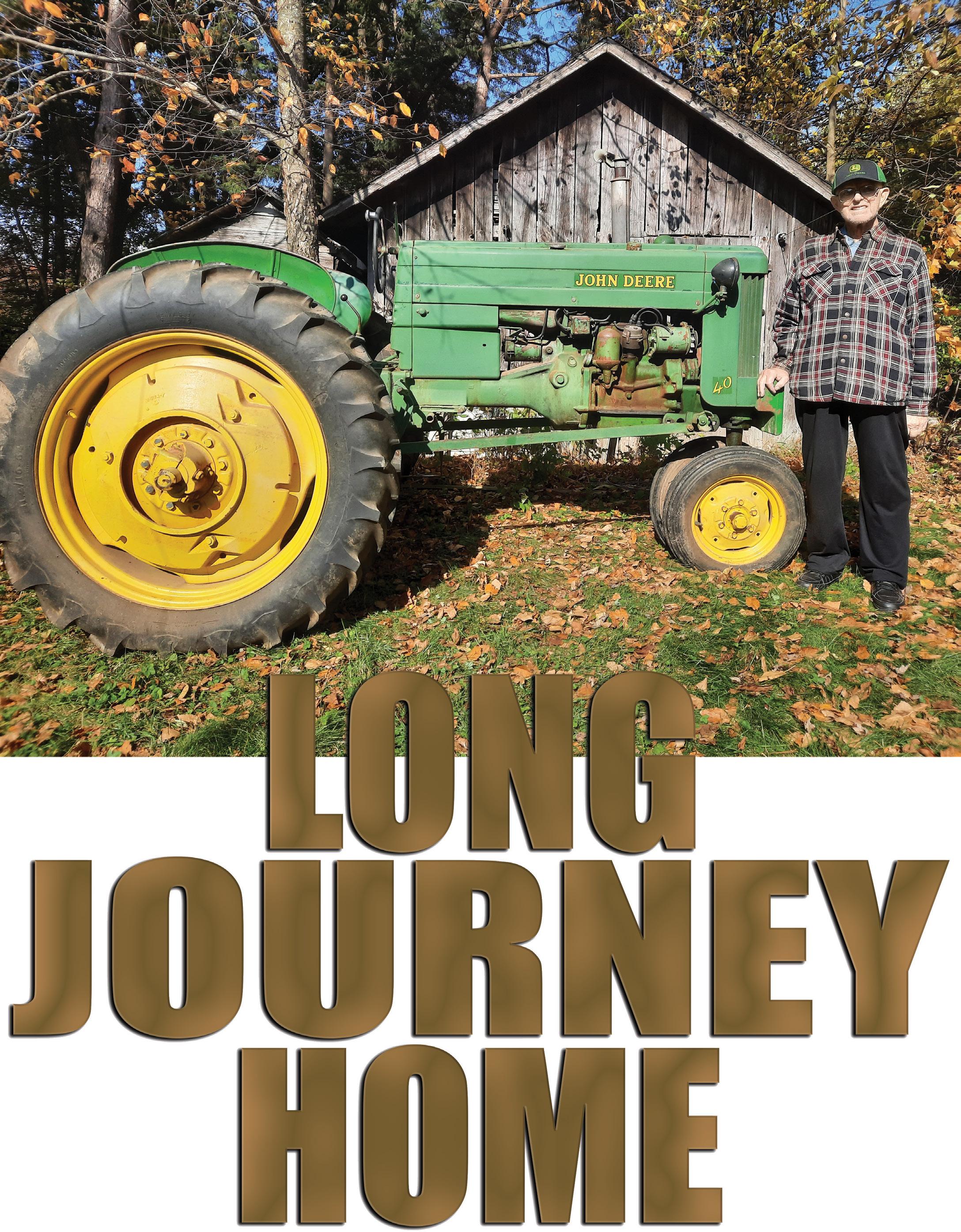
Back on July 18, 2017, I happened to be searching through posts on Craigslist, just to see what I could find, when I ran across an ad showing a John Deere 40 for sale. It immediately caught my eye.
Years ago, my dad, Andrew Bargender, and my maternal grandpa, Walter Wilde, did farm work together, and I helped out when I got old enough in the 1960s. We each shared equipment to get the work done on both farms, especially when it was time to chop corn in the fall to make silage for the dairy cows.
We would drive our late styled John Deere “A” and our Papec 32 chopper, along with our late styled John Deere “B” and Papec belt-driven blower, about 10 miles from our farm south of Edgar, Wisconsin to my grandparents’ farm north of Rib Falls. Grandpa Wilde used his John Deere 40 tricycle to pull and unload the wagons of chopped corn. To chop corn on our farm, Grandpa Wilde would bring his 40 to help us unload the wagons. To save time, my grandpa would drive the front wheels of his 40 up a ramp into the bed of his early 1950s’ Chevy pickup truck, and after securing the front wheels with blocks and chains, he would tow the tractor over to our farm this way.
Grandpa Wilde had bought the 40, a 1953 model, back when it was new, and had it customized for his
farm. He added an umbrella bracket to the back of the seat so he could shade himself from the sun. My grandpa painted a tackle box in John Deere green and yellow to match, too, which he fixed to the back of the tractor, near the base of the seat, for tool storage from farm to field. He also installed brackets for a John Deere No. 45 loader to the rear axles along with extra John Deere braces from the front to the back of the tractor so that lifting a heavy load wouldn’t break the tractor in half. One final unique addition? A horn from a 1940s’ Chevy truck that could be heard after pressing a button on the side of the tractor hood.
I had good memories of working alongside my grandpa, and as he got older, I shared with him that I was interested in having his 40 one day. However, he had already promised it to one of my first cousins, Marlene Teske, since she was also his grandchild, and she and her husband Wayne had helped a lot on his farm as well. Wayne had also done some work on the tractor since he was a mechan-
Grandpa Wilde and Uncle Duane on the 40.
ic. As the years passed, both my grandparents went to a nursing home, and their farm equipment was eventually divided up among the relatives. We were able to buy Grandpa’s No. 45 loader and John Deere 594 side rake, which are still in good condition and are used from time to time today, but I still hoped to own a 40 one day.
After seeing the post on Craigslist, I talked to my wife, Sally, about it. Even though I still wished I had my grandpa’s tractor, my wife and I decided to go see if we would like to buy this tractor anyway because we might never find another John Deere 40 for sale so close to home. So we called the guy, talked to him about the tractor, and set a date to go look at it. Within a few days, we drove up to the north side of Merrill, Wisconsin to see what condition the tractor was in.
When we got there, the guy brought out the tractor. He was a landscaper and had bought the tractor about two years earlier for his business, and the tractor was still in pretty good condition. At first glance, I could see that the tires were still pretty new and didn’t have much wear and tear. The rims were still nice and yellow, and the John Deere green paint job looked pretty good yet. It did need some work on the clutch and PTO, but I knew a guy who could fix that.
at it already, we eventually left that day after telling the landscaper we still wanted to think about it.
I went home and thought about it, and eventually I told my wife, “Maybe we should buy it anyway because we’re never going to find Grandpa Wilde’s exact tractor.” We called the seller again and told him we would buy it, and we set up a date to come and get it. While talking with him, I asked him who he had bought it from, and he mentioned my first cousin’s name—Marlene and her husband Wayne had sold it to him. I didn’t say anything at that point to the seller or how I was related to the previous owner, but I knew then that I had actually found my grandpa’s tractor.
When the day came to pick up the tractor, we drove up, paid for it, and loaded it. That’s when I revealed the background of the tractor to the seller. He was surprised to hear my story and happy that the trac-
I took a closer look, and that’s when I noticed the umbrella bracket and the painted tackle box behind the seat, the brackets for a manure loader, the extra braces from front to back, and the button for the horn. I said to Sally, “If you put them side by side, you wouldn’t be able to tell the difference between my grandpa’s tractor and this tractor.”
tor was going back into the family that had originally owned it.
So, I took a closer look, and that’s when I noticed the umbrella bracket and the painted tackle box behind the seat, the brackets for a manure loader, the extra braces from front to back, and the button for the horn. I said to Sally, “If you put them side by side, you wouldn’t be able to tell the difference between my grandpa’s tractor and this tractor.”
Before getting too ahead of myself, my wife and I talked to the landscaper about what price he wanted for it. And we did kind of settle on a price, but I still wasn’t sure if I should buy it because I had my heart set on owning my grandpa’s tractor. Even though the seller told us that a few other people had come to look
On the way home, my wife and I drove past Grandpa Wilde’s old farm. It felt good that we had found his tractor again, all because I happened to see it posted on Craigslist that day. My wife likes to point out that the day I found the tractor online, July 18th, is also my birthday, and I was born in 1953 as well, so the tractor is even the same age as I am. Now that we have the tractor back in the family again, I love telling this story. Marlene and her husband, as well as several of my cousins, were glad to hear about it, too. After many years and some great luck, my grandpa’s tractor made its journey back to one of the farms it first called home.
Submitted by, Gerard Bargender and family
Books just for kids!
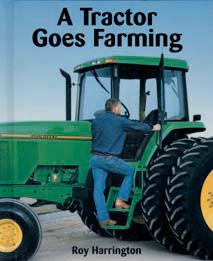
A Tractor Goes Farming
Book: A Tractor Goes Farming
Author Roy Harrington (co-author of John Deere Tractors & Equipment, Vol. 2) has put together a book that places the child in the driver’s seat of a variety of tractor makes and models. Short sentences that kids will be able to read alone or with help and full color photos to please everyone. 32 pages, 7 x 8-1/2, hardbound.
AS6T - $10.95 U.S. • $16.95 Canada /Foreign
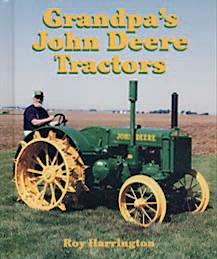
Grandpa’s John Deere Tractors
Book: Grandpa’s John Deere Tractors
This book for kids tells the history of Deere and Company starting with John Deere and his steel plow. Then in 48 pages with 50 color photos, it talks about how farming and JD tractors have changed. Best for kids 5 to 10 years. 7 x 8-1/2, hardbound, written by Roy Harrington.
AS8K - $13.95 U.S. • $19.95 Canada/Foreign
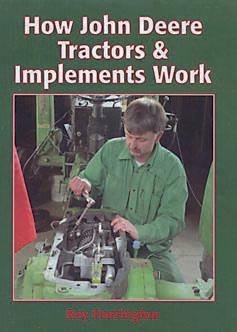
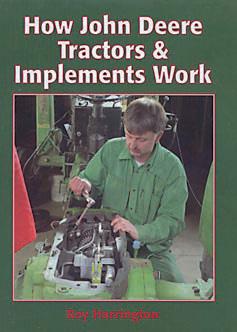
How John Deere Tractors and Implements Work
Kids are always asking questions, especially about big machines. This book will give kids the answers they crave as they step into the field with impressive John Deere tractors and implements. Ages 8 to adult. 8-1/2 x 11, hardbound, 48 pages.
Book: How John Deere Tractors and Implements Work
AS9H - $14.95 U.S. • $21.95 Canada/Foreign
Enduro Team Deere
After Deere developed their all-new state of the art cross country Liquidator race machine for the winter of 1976, they were going to need drivers to compete with it. Deere had a cadre of factory supported racers from the previous years’ efforts to choose from, plus a field of promising independents to consider supporting. Instead of just offering promising racers factory backing as they had done in years past, Deere went all in to create an allout factory cross country race team. And they called it “Enduro Team Deere” or ETD for short.
It was well documented that Deere felt that cross country racing most reflected how snowmobiles were used in the field and that the harsh punishment the machines were put through were excellent torture tests for future consumer model development. Additionally, successes in racing against the established brands would demonstrate the quality and durability of Deere’s machine to potential
customers. That’s the old “win on Sunday/sell on Monday” mantra at work. Fortunately, Deere had been experiencing increasing levels of success in racing leading up the winter of 1976, so they decided to up their game, not just with a dedicated machine, but a dedicated team.
A factory backed racer in the ’70s might get a snowmobile from a given manufacturer. The top racers may even get support cash or contingency money for placing well. Factory race teams could often travel and lodge together at races. Deere decided to take it a few steps further and have their factory team train, eat, sleep, practice, live together and wrench on their machines under one roof for the duration of the racing season. RJ Carlson hired a prominent high school football coach, Al Anderson of Balsom Lake, to whip the group of drivers and mechanics into a cohesive and competitive team.
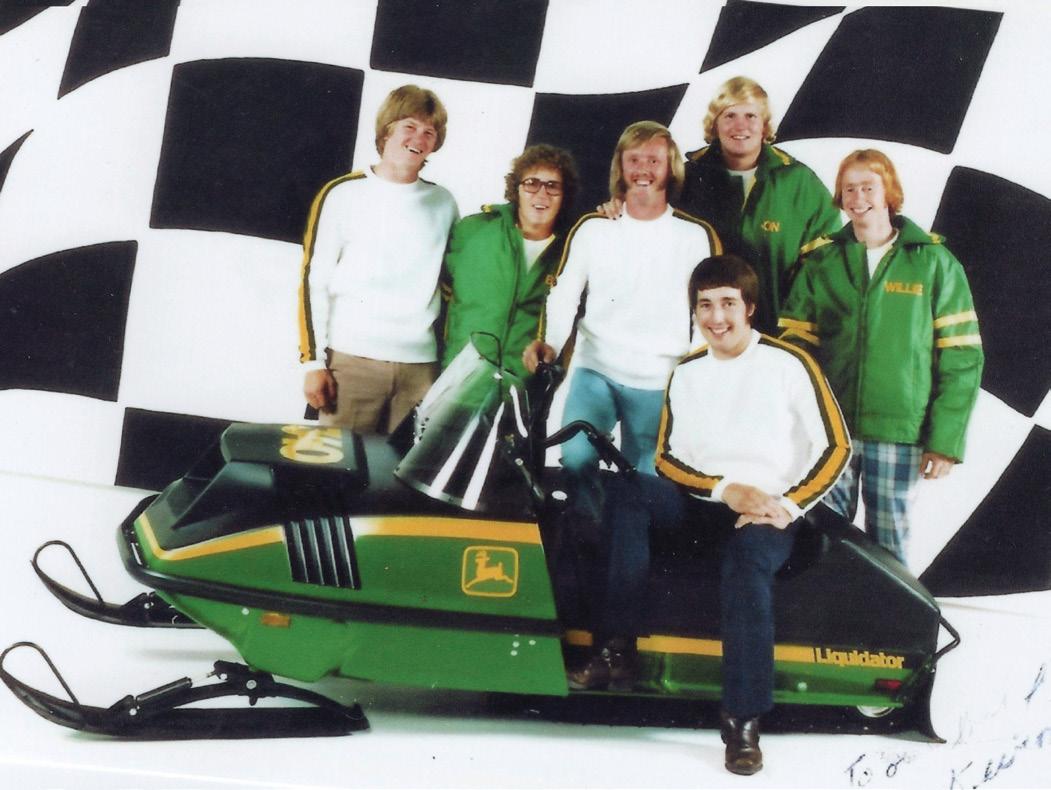
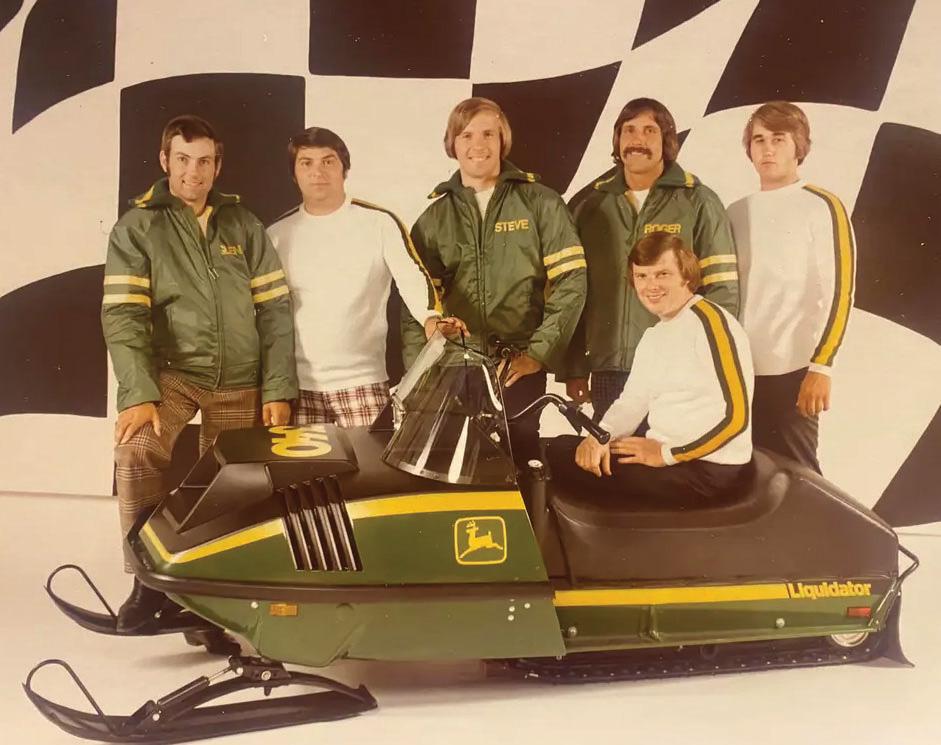
A central location from the planned races was chosen, ending up at the Faucet House of Breezy Point, Minnesota. Deere carefully selected drivers for their flagship factory race team for ‘76, from left: Craig Knudsen, Bob Enns, Ron Reimer, John Carlson, Willie Anseeuw; Brian Nelson seated on the Liquidator.
Roger Ebert and Tom Otte can be seen in this Branch Team photo standing on the upper right.
According to Lenard and Teal’s John Deere Snowmobiles book and a story often repeated by the late Jon Carlson, his father RJ Carlson didn’t want “professional drivers” but wanted young, upcoming racers, preferably independent racers or ones that raced for Deere dealers. Factory supported racers from the previous years were included in the pool of potential candidates for the new team. For the main factory team, six drivers and six mechanics were selected with Al Anderson as the team coach and race director. Additionally, there were also branch teams like Team Minneapolis and Enduro Team Canada but only the main factory team lived and worked out of Breezy Point. For example, Tom Otte and Roger Ebert raced for the Minneapolis Branch Team in ’76, although both were called up to ETD’s main team a year later.
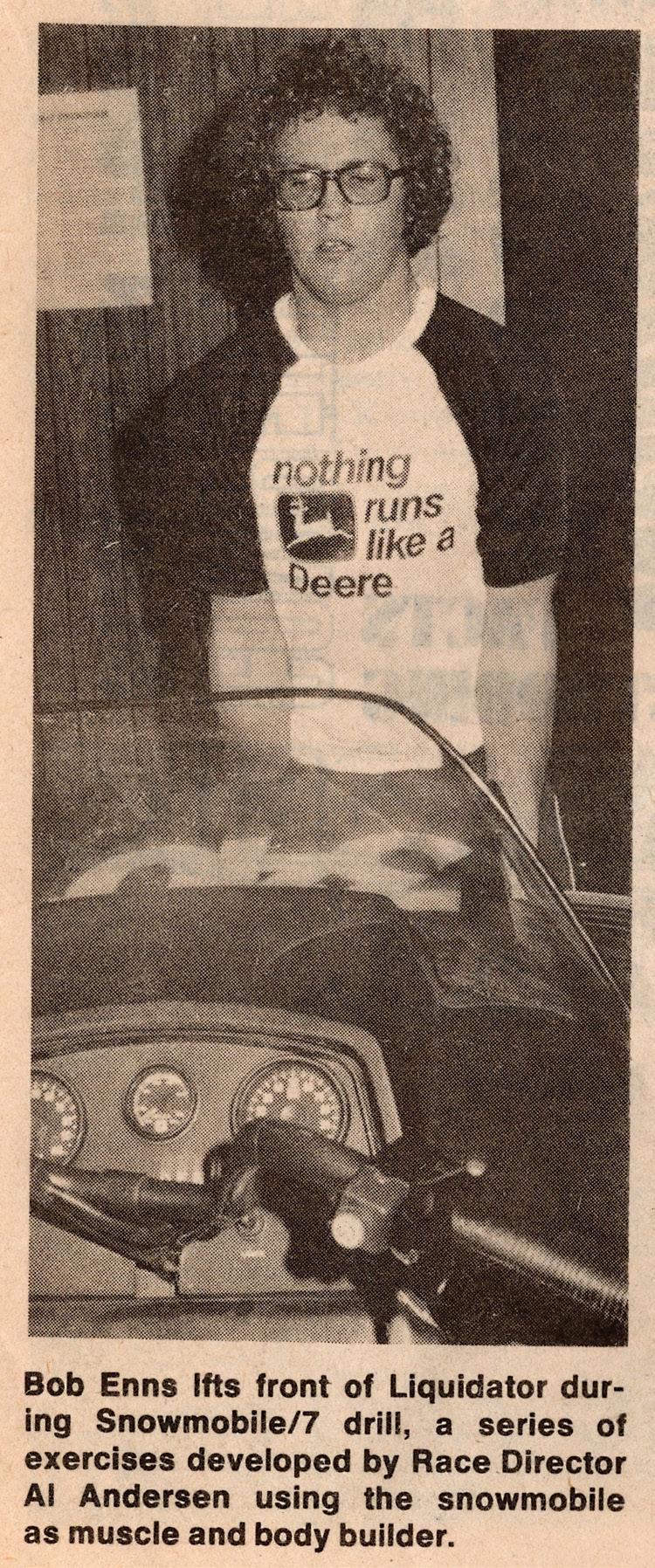
Coach Al quickly developed a training schedule for the racer including meal time, workouts, team meetings, practice rides, etc. Coach also developed what was called the “Sled 7” exercise program that Deere was quite public about. This included seven exercises that involved the drivers working with their Liquidators such as lifting the back and front of the sled, tipping the sled side to side, and squeezing the throttle a number of times while holding the back of the machine off the ground. Deere even published the “S7” in the snowmobiling handbooks
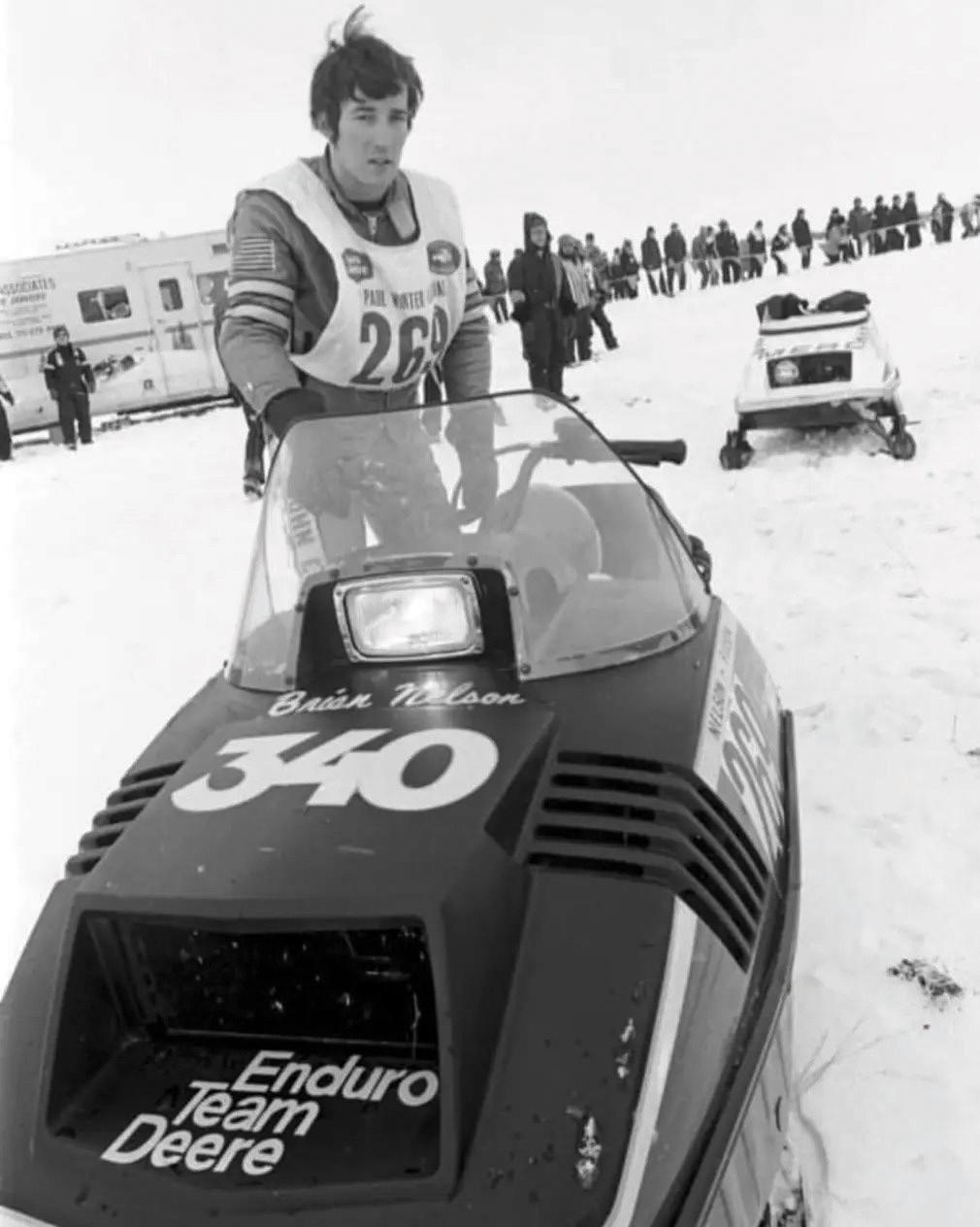
This iconic image was taken of Brian Nelson at the Winnipeg to St. Paul I-500. Brian’s win is still popular with Deere sled collectors 50 years later.
published in the ’80s as a general fitness guide for recreational snowmobilers.
ETD was housed at the 11 room Fawcett House where the conference room was converted into a workshop for the sleds and mechanics. The team had their own cook and workout room for health and fitness conditioning. The drivers selected to start training at Breezy Point in October of 1975 included: Jon Carlson, Ron Reimer, Craig Knudsen, Willie Anseeuw, Bob Enns and Brian Nelson. Mechanics included Doug Oster, Doug Hough, Joel Hultquist, Phil Simon, Larry Swanson and Hubert Fixsen.
With all this training, conditioning and preparation, how were the results? Well, mixed at first. The team had some mechanical issues to overcome in preseason and even in-season testing and racing. Liquidators were scoring cylinders and eating pistons by the handful. But the big, heavy sleds were fast when they stayed together, winning several oval race classes at Brants Lodge races in last November in Alaska. Doug Hough won a race in West Yellowstone, showing the potential of the new machine, but something had to be done about the piston scuffing.
According to Leonard and Teal’s book, Horicon engineers were able to reproduce the scoring problem in the
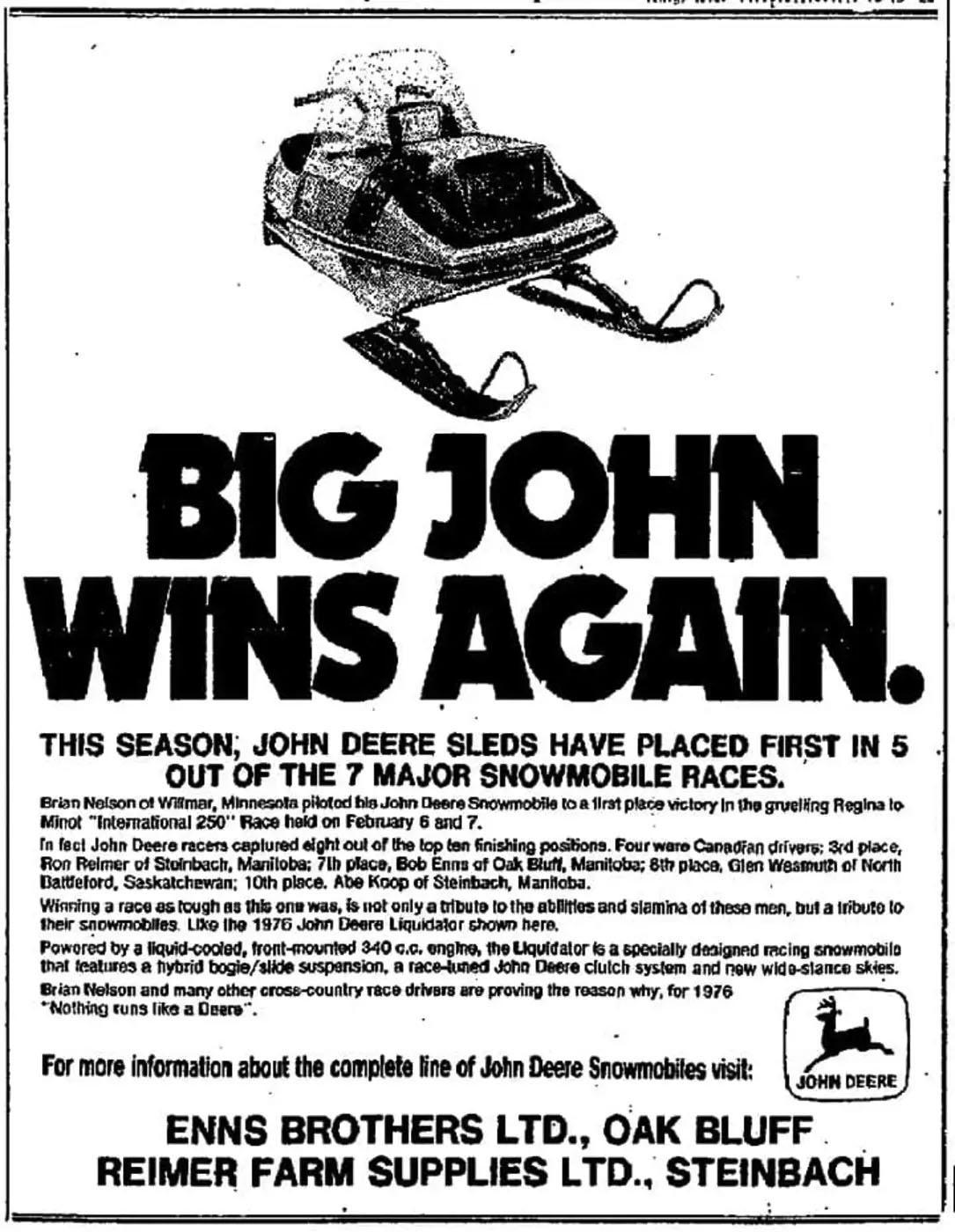
Deere invested heavily in both ETD and the Liquidator, so they advertised their wins in full page ads like this one.
Snow-covered Liquidators were easy to spot even under cover due to the large squared off front ends that housed the front mounted radiators.
labs. “Horicon tested engines 24 hours a day to determine the optimum piston shape” as the results that Deere found were different than what Kioritz had seen back in Japan. Due to race rules, any updated parts had to be in dealers’ hands by December 31st, in time for the Winnipeg to St. Paul I-500. Unfortunately, the only way to get updated parts to the dealer in time was to hand file 600 sets, or 1,200 pistons, by the end of December. However, Horicon pulled off this small miracle, guided by their engine expert, Lee Hardesty. ETD was able to run updated pistons in the Balsom Lake race on December 28th, 1975 and every race after.
Deere even had a hand in organizing a cross-country race associa-
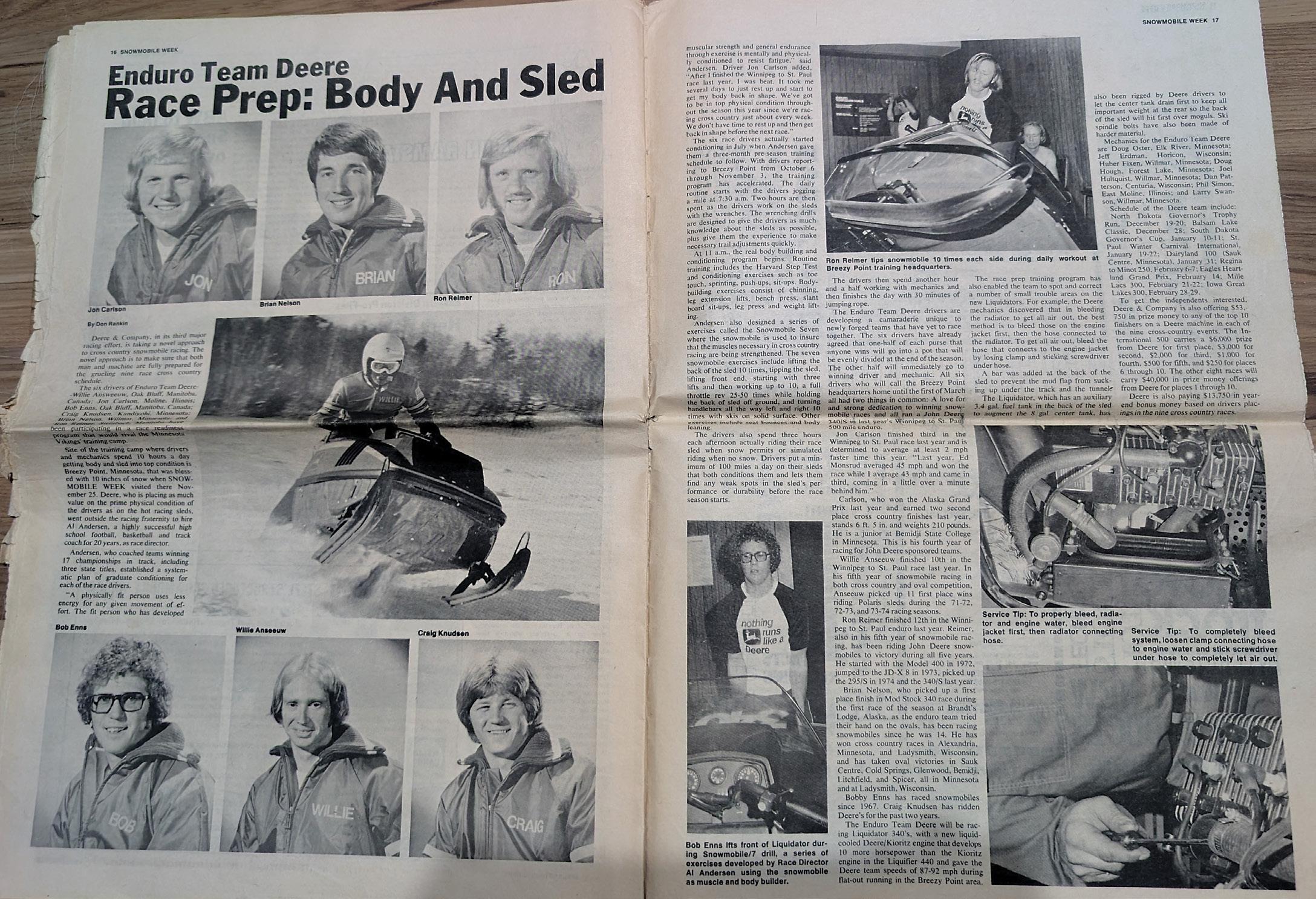
Snowmobile Week ran a two-page story on Enduro Team Deere and the Liquidator in the December 13th, 1975 issue. Deere’s efforts were getting noticed in the industry and in the press.
This close up of the Snowmobile Week article shows Bob Enns performing the “Front End Lift” of the sled 7 exercises to help the drivers get used to working the size and heft of the Liquidator.
Your author has a passion for collecting, restoring and occasionally racing Liquidators. It was very motivational to have several ETD members send me text messages the morning of the 125-mile vintage class of the I-500 back in 2019. I was glad to be able to text back, “I finished in second place” as Brian Nelson himself was running the USXC circuit at the time.
tion to help organize and formalize the racing circuit. RJ Carslon had directed Al Anderson and Don Schuberg to contact the race director of individual races Deere had been participating in, along with other major snowmobile manufacturers to help form the ICCSF: International Cross Country Snowmobile Federation.
Enduro Team Deere officially lasted two racing seasons and the ICCSF lasted into the 1980s. ETD racers set records and got John Deere taken seriously as a competitor and builder of competitive machines. Brian Nelson winning the Winnipeg to St. Paul I-500 in January of 1976 is still the only non-current snowmobile manufacturer to have won that race. As for how racing the Liquidator went for the main factory team, branch teams and independents, well, we are out of time for this month. Stay tuned for more as we celebrate “50 Years of the Liquidator!”
Joe Rainville is from Fort Worth, Texas. To contact him, send an email: joerainville@hotmail.com
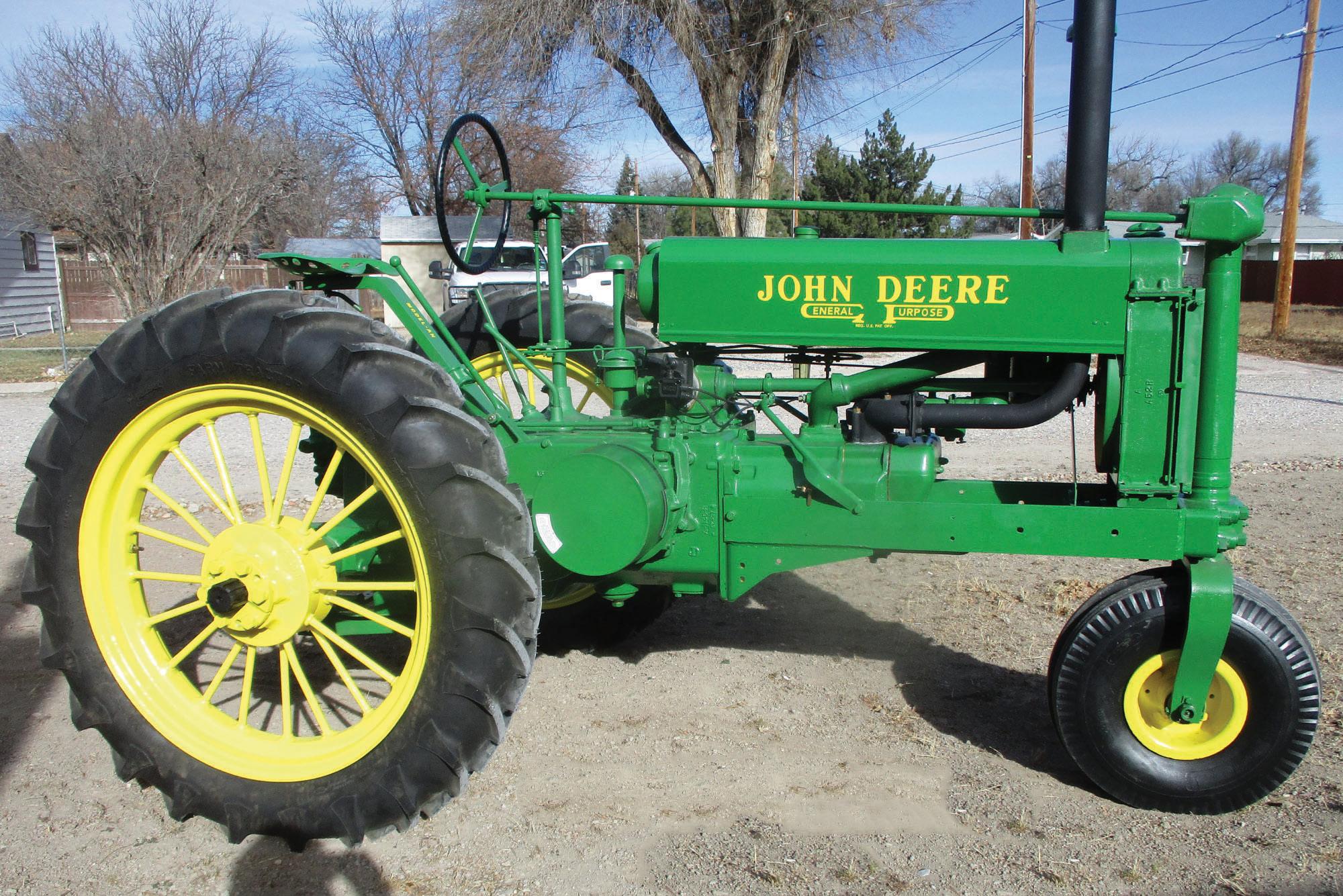
Right: Steve Park restored this 1937 “AN” after a total teardown.
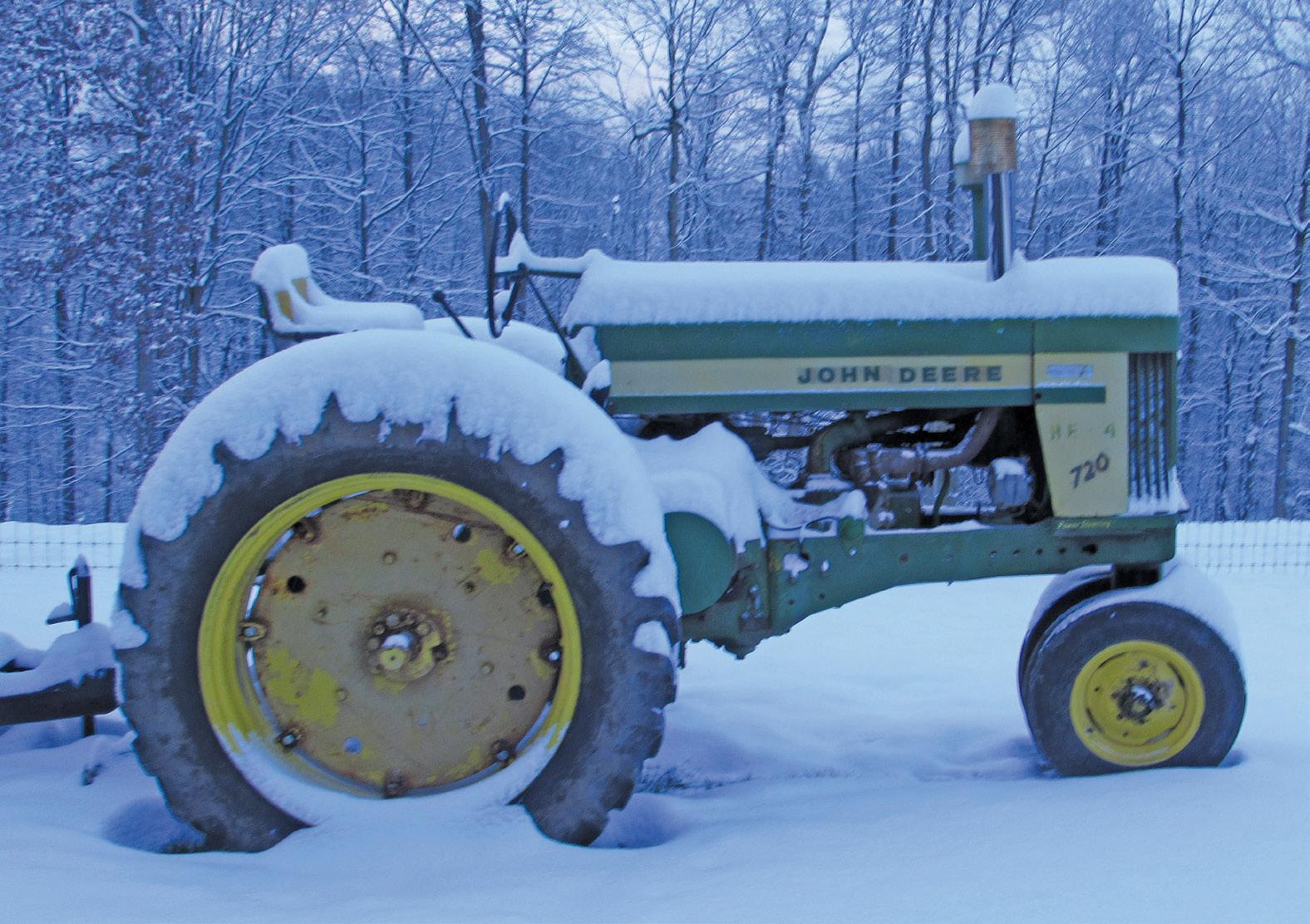
Willis Mast’s 1958 model 720 sits in the first snow of the year, December 2nd, 2025, near Millersburg, Ohio.
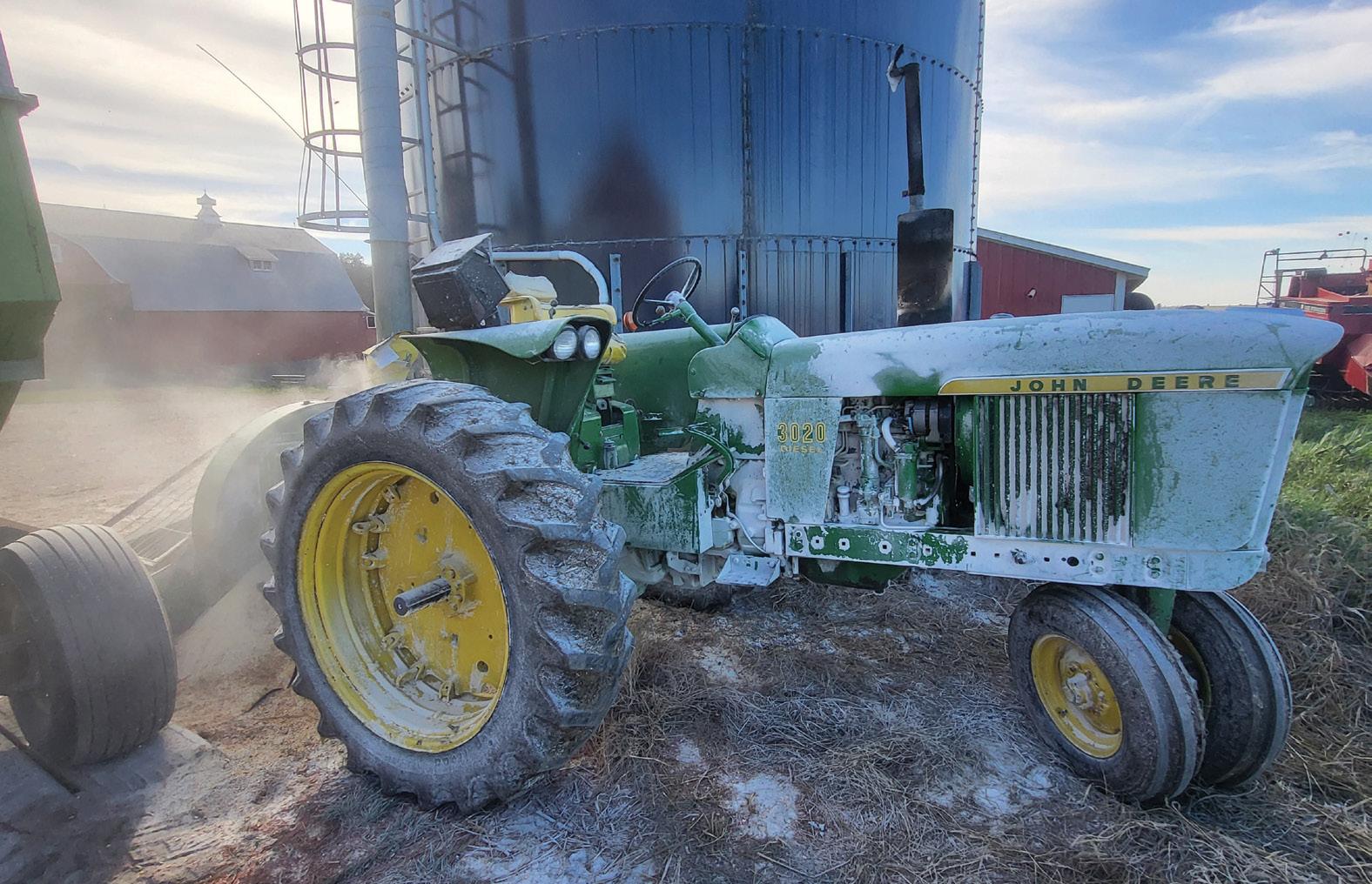
Right: 3020 in its work clothes, blowing shelled corn into the Harvestore with the wind from the back. Dan Goedken of Petersburg, Iowa sent this photo.
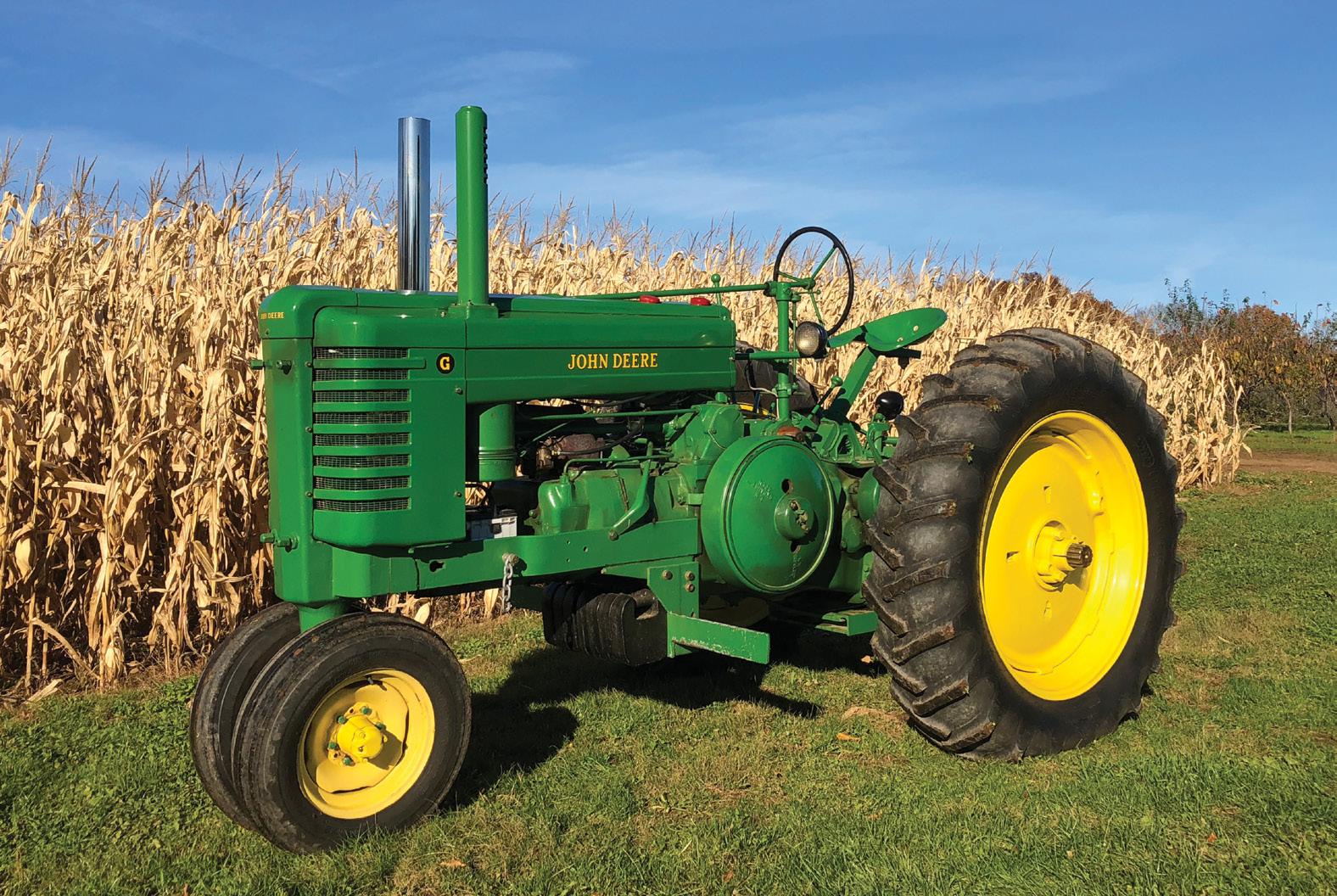
Don Buessing of Baileyville, Kansas owns this 1946 “GM” that was built and shipped May 24th, 1946, and sent to the experimental farm and sold from there on August 21, 1946.
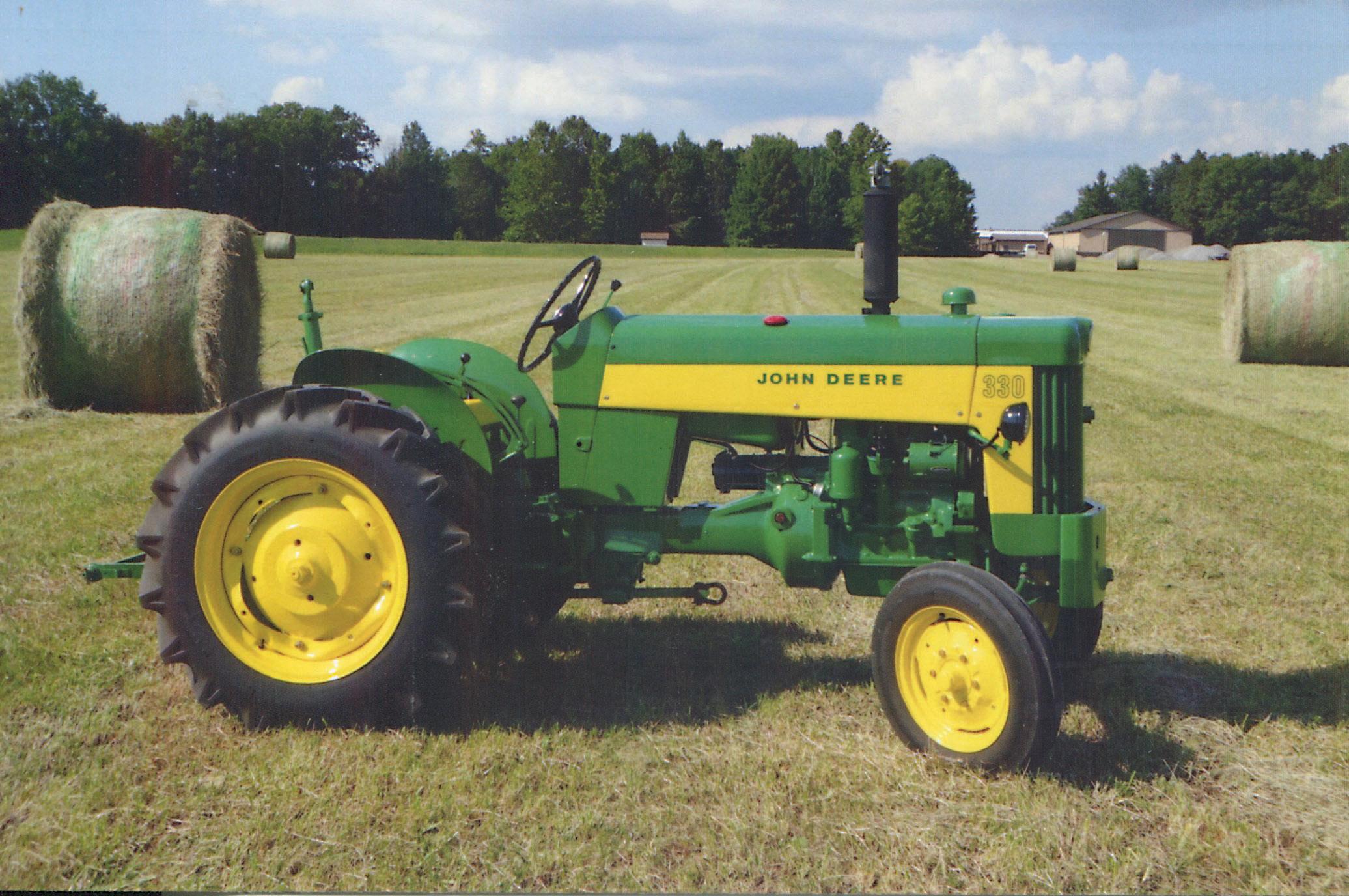
330 utility.
Left: James Monde of Milford, Connecticut owns this 1947 “GM.”
Left: James Grant of Bonnie, Illinois, owns this
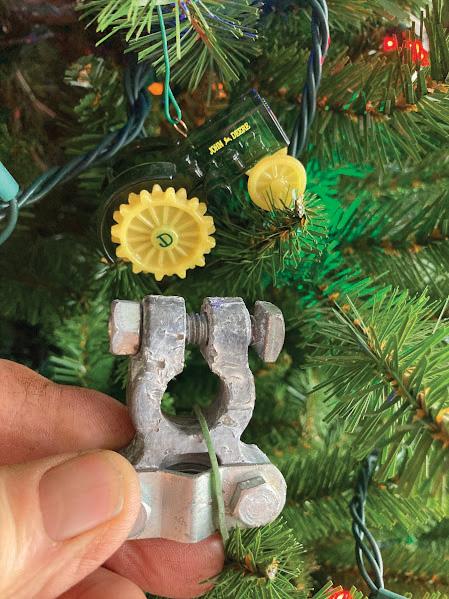
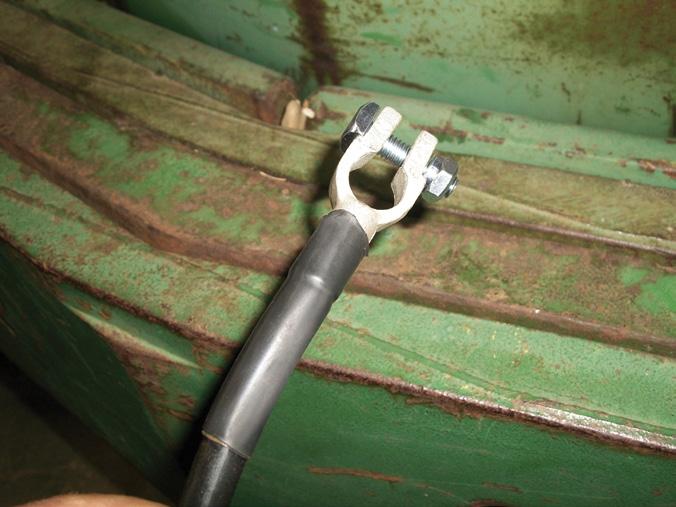
One thing that the cold of winter brings with it to a tractor shop is battery cable issues. It always amazes me how a customer can drop off his or her tractor for some sort of service work, and when I go to start it up at say the next day, all that I get is a slight grunt from the starter and then the sound of sizzling bacon from the battery cable or the ground strap, followed by a sulfur like smell. Sure enough, I’ve been “snuckered” by the “bad cable blues,” and before I can get the tractor into the warmth of the shop to do the necessary repair work, something has to be done with the faulty battery cable ends before the tractor will even start up. In all of my days, I cannot understand how the tractor made it this far, and then the next attempted start with my finger on the start button the cable end gives out. When this previously happened, it used to bother me a lot more than it does now because before I even locate the battery, I am quite sure that I am going to see one of these (Photo 1). It’s one of those two dollar universal “clamp-o-matic” cable ends that have invaded many old tractors and have “petered” out instead of working as they should. I have found that the best thing to do with one of these is to use it for a Christ-
mas tree ornament. At least there it doesn’t have to do anything. But as for me it is time to get “loaded”… no, not that, but rather time to repair the cable end with a loaded battery terminal end.
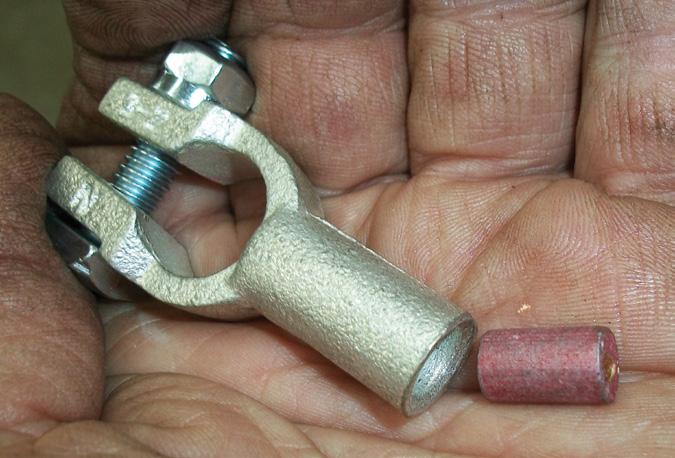
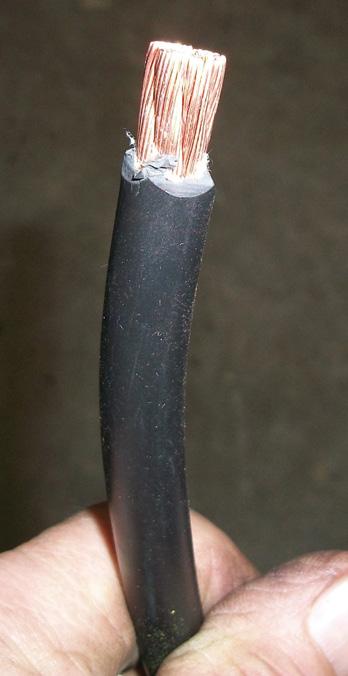
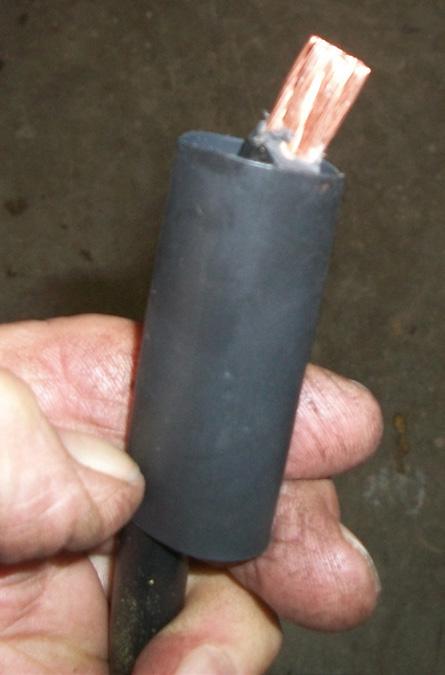
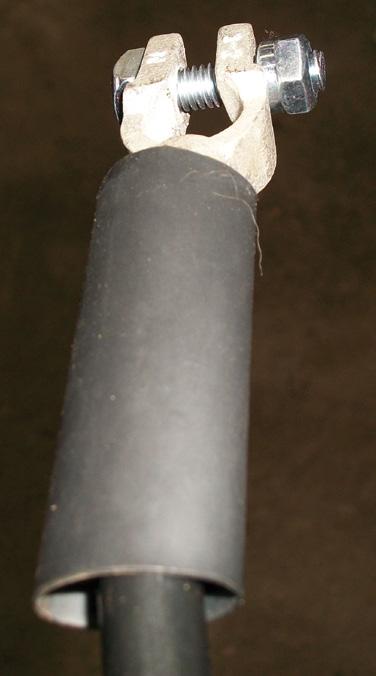
Loaded battery terminals are accompanied by a solder pellet and flux (Photo 2). To do a perfect soldering job, simply strip the cable end (Photo 3) and then slide a three-inch piece of shrink
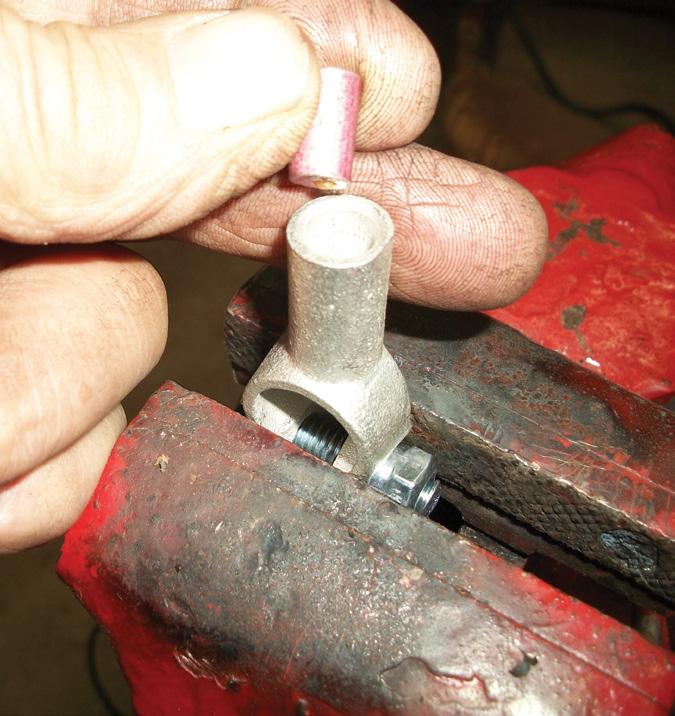
tube on the cable far enough away from the heat of the cable clamp (Photo 4). Insert the pellet in the
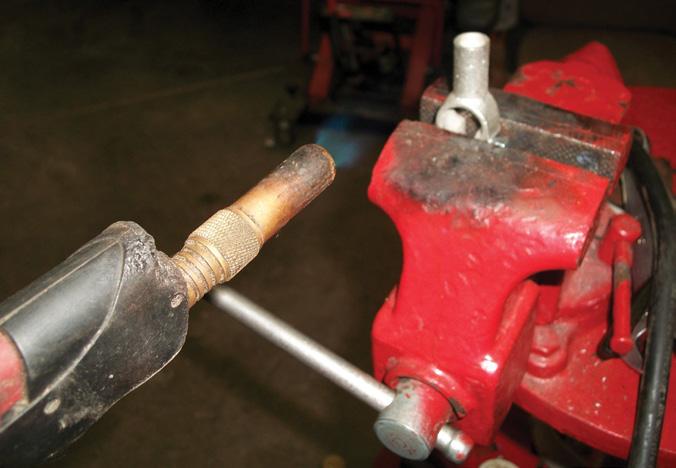
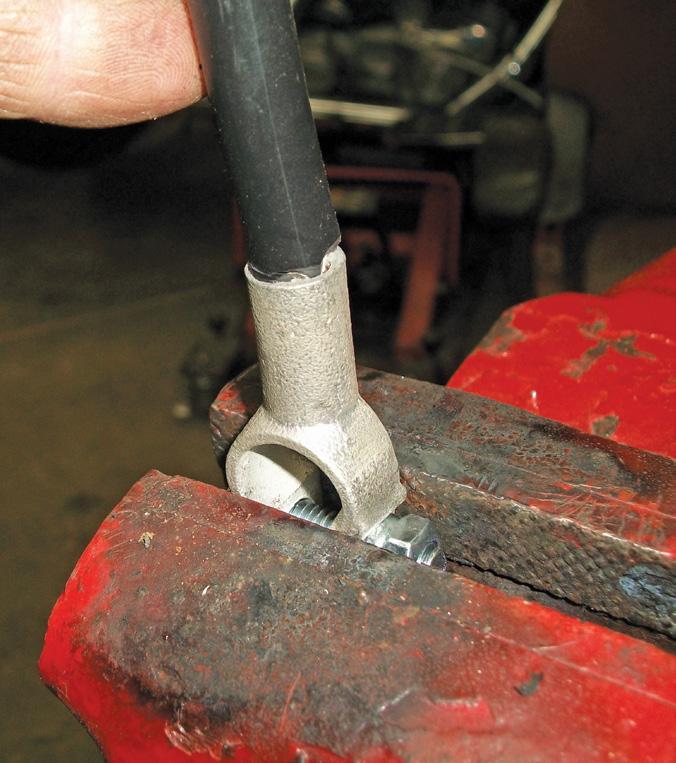
cable clamp (Photo 5), heat the terminal in an upright position (Photo 6) until the solder pellet melts and then slowly insert the cable end into the terminal (Photo 7). I mentioned slowly to avoid the now hot molten solder flux from spewing out at you as the cable is inserted. You will need to hold the cable end into the terminal for approximately 30 seconds as the flux solidifies onto the cable and the terminal. This procedure, when done correctly, will provide a very complete
Photo 1
Photo 2
Photo 4 Photo 3
Photo 5 • Photo 6
connection between the cable end and the clamp or an eyelet, whichever is used. After the clamp cools down a bit, slide the heat shrink tubing over the soldered in cable (Photo 8), and heat it up using a hot air heat gun. And there you have it (Photo 9): a battery
cable end that works and will last with no voltage drop through it. Say goodbye to those pesky clamp-o-matics; they make a way better tree ornament. On to the next shop hot topic on this COLD winter day—that is… getting spark out of a E 4 A magneto. There is no need to mention what model tractor they are off of; we just need to speak about their lack of spark to fire the engine. Notice that I said “their” because I am dealing with two of them. The one that came installed on that old tractor and another shiny new rebuilt one that came uninstalled in a box when the tractor was brought to me. It just needed to be bolted on
and the engine should fire right up and ride off into the sunset. But not so fast; the new rebuilt magneto did not have any spark either. Which brings me to the heart of this subject matter—where do you start with a situation such as this? Well, it was obvious to an even nearly deaf mechanic like me when hand cranking the tractor’s engine that there was no “clicking” sound coming from the installed magneto. This is a universal trait of any magneto when the impulse is working. Without it, there will be no spark at startup crank speed. So, let’s not even mess with that old rusty dirty magneto and instead get the new shiny rebuilt one out of the box, and give IT a test spin on the bench. The impulse on this one works, BUT no spark is visible from any terminal or from the coil outlet spring. After a short bout of crabbing to myself as to who rebuilt this thing, I did what any ancient mechanic would do—dismantle it to locate the points and see how they look and how they are gapped. Magnetos demand a smaller point gap than ignition distributors…usually between .012 and .014 with .013 being the “sweet spot.” Battery distributors commonly run a .020 or .022 point gap, the difference being that the magneto relies on current flow from its rotor magnet as its primary current, while a battery distributor gets it from the battery. The magneto’s smaller point gap allows a split second more time for the coil to saturate current from the magnet. This should paint a picture as to why a magneto’s point gap, and the point’s contact surface is so important—which brings me to the meat of this potato subject.
Now there is likely no one out there who hasn’t had a point file between their fingers and you have gone after the contact between the breaker point arm and its stationary breaker point. In a lot of cases, that is all it takes, and with the point gap reset on the high cam lobe, the magneto comes
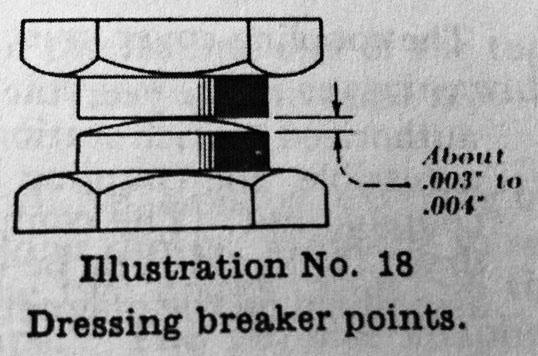
back to life. But it’s what I read in the old reproduced repair manual for this tractor regarding magneto breaker points that caught my attention. We had to purchase a reproduced shop repair manual for this old model for me to get enlightened on a few things, and while reading about the mag’s breaker points, I ran across this paragraph. It stated the usual except that the point’s ground or stationary point should be carefully filed to round it about .004 (Photo 10), and then the point gap set.
Now doesn’t that beat all? So all of this scraping back and forth between the two contacts, making them both flat, is NOT the way to go. If the lower point has a slight taper, I could now see where it would contact better and make good contact longer. However, this minor procedure will require removing the points to accurately get this accomplished rather than filing them while installed.
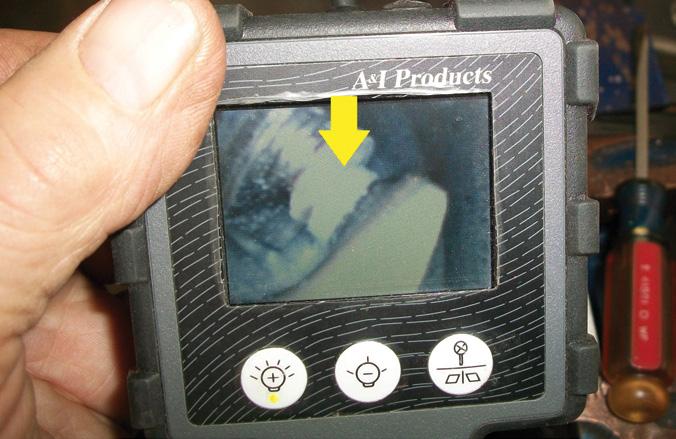
So let’s go back to the two “no spark” magnetos and have a look. The first one is the new rebuilt that has no spark. Here is a picture of what the points looked like through the eyes of an A&I camera (Photo 11). Pretty bad—yes? Not only that but the gap on the high cam lobe was ZERO. Now what the no spark do you expect? This
Photo 7 • 8, at right
Photo 9
Photo 10
Photo 11
magneto has never been installed since it was purchased as a rebuilt unit. Let’s back up the magneto train a bit here and remove the points and give them a nice shiny new surface with the stationary point tapered as the prior illustration showed. Set the gap at exactly .013, put the whole mess back together and give it a test spin. Well, we now have a nice blue spark at all four spark plug terminals.
This story ends well from this point forward; your conclusion is up to you. Speaking of a POINT, I just would not be me if I did not bellyache about something, so here goes—my latest rant. My point files were getting on in age so to speak. I purchased them a few years ago from NAPA for just under $6 for the pair. Since I still had the carton that they came in (Photo 12; the carton on the left in the photo) with the NAPA number on the carton, I thought that I would just swing by the store and put it on the counter for a replacement and save the time required searching for it, right? Wrong. I was told that the part number on the package was discontinued and that there was now a NEW number for it. The good news, bad news was “not in stock at the store” but we can have what you need in a day or two. My reply was to “go for it.” In a few days, I returned to pick up my point files and this is what I got
(the carton on the right in Photo 12). It NOW comes as a one-file package from “Carlyl cignfile” with the new improved and updated price for this one file at $11.50. I guess that we now need to call this “file-flation.”
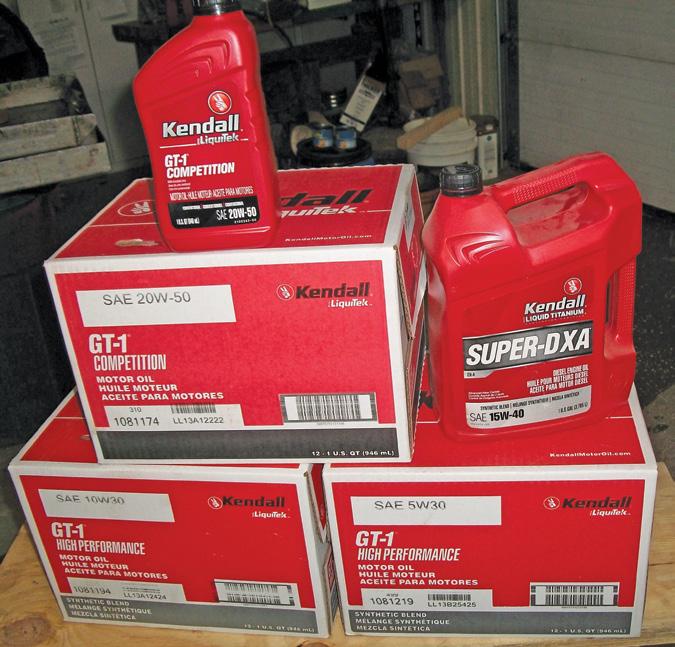
And while I am on this rant, some of my replacement Kendall engine oil supply has arrived (Photo 13). The current price for 5W30 is $5.01 per quart plus a five percent sales tax. 10W40 and 10W30 comes in at $4.62/quart plus tax, and 20W50 is at $5.33/quart plus tax. A “compliance fee” of $10 was added on to the total. As of yet, I have no clue what it is or why I was charged to “comply”…to what?
And of course, there is that three percent surcharge if paid by credit card…I wrote a check; I paid the bill upon delivery and inquired about a 55-gallon refill drum of trans-hydraulic fluid, but that will have to wait until another day. For now, there are income and property taxes to be paid, and I am in search of a money tree.
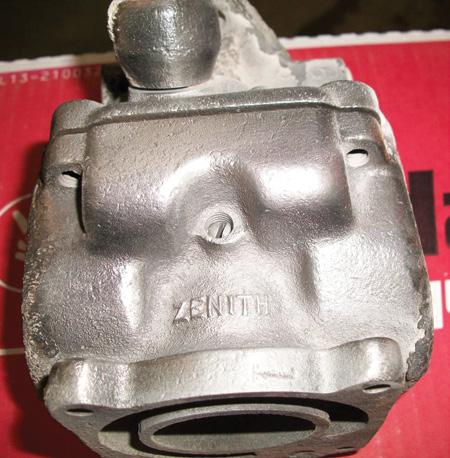
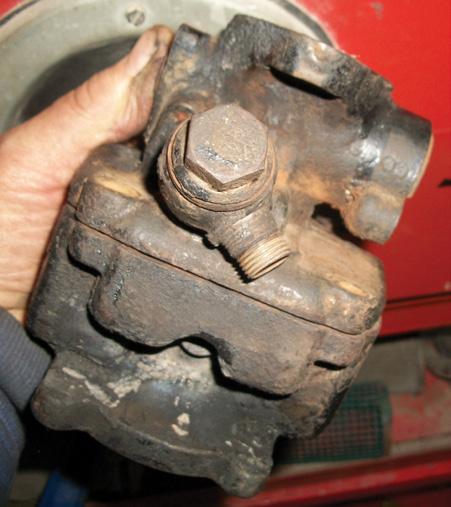
And for the final segment of this totally useful or useless article is a product that I have discovered to aid in my carburetor restorations. In addition to these magneto issues for this vintage tractor that I spoke of earlier, I also became involved with this old carburetor (Photo 14). It had several coats of thick paint covering up the rust on its castings. Everything had been petrified
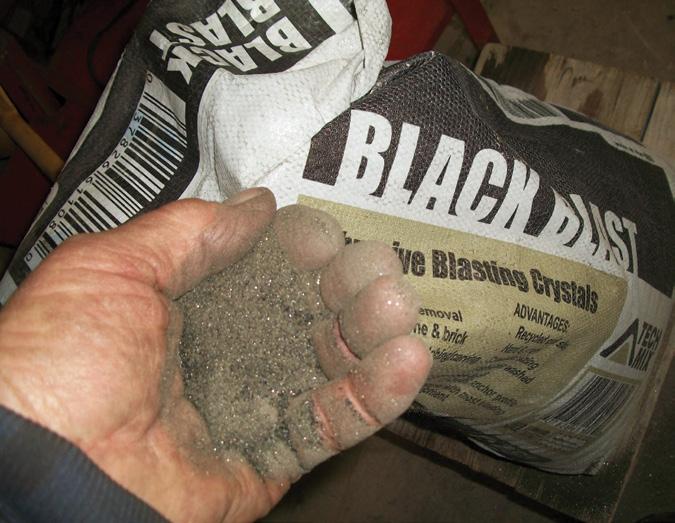
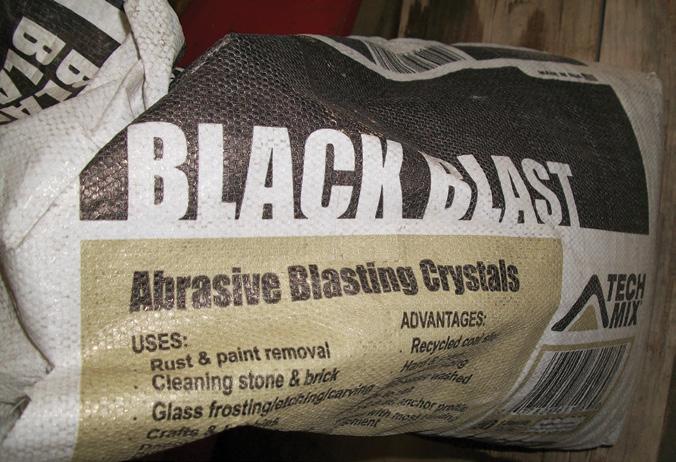
over time and it wasn’t responding to cleanup in the usual manner using the siliconebased material in my blast cabinet. A little birdie told me to go to our local Menard’s store and to look for this item way in the back outdoor section, a product called “Black Blast” (Photo 15). It is a very fine media (Photo 16) and the cost of the bag was $11. I brought a bag home and loaded up my small blast cabinet and got at that crusty rusty old carburetor. Here is how it turned out (Photo 17). I must say that I am pleased with the outcome. Doing a good job with any carburetor in this condition takes a lot of time and patience, more than one can imagine especially getting everything apart without any damage. A basic repair kit was available with the throttle shaft. I was surprised that this old carburetor has an economizer feature in it that must be dealt with in order for it to operate and adjust as it should. This tractor owner’s request for me was that I “just make it run right.” Boy, did that statement get stretched out before he got his tractor back.
I truly hope that you have enjoyed and smiled a bit at all of these tractor “issues.” Until we meet again, may God bless, and happy trails.
This column is written by Ron and Jo Anne O’Neill.
Photo 13
Photo 12
Photo 14, above right • 15, below
Photo 16 • 17, below right
I normally have a good memory, but I think as I have grown older, some things have naturally been forgotten. I also believe that, like everyone, older people have had more events and experiences, so the sheer amount of data also contributes to the loss. At least, that thought comforts me. I recently ran across a large envelope that contained pictures of a model “D” on steel that I have no recollection of ever seeing or having. Take a look.
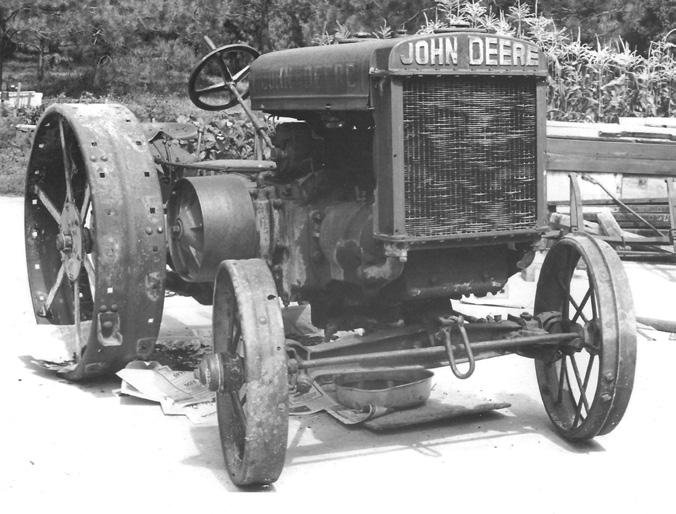
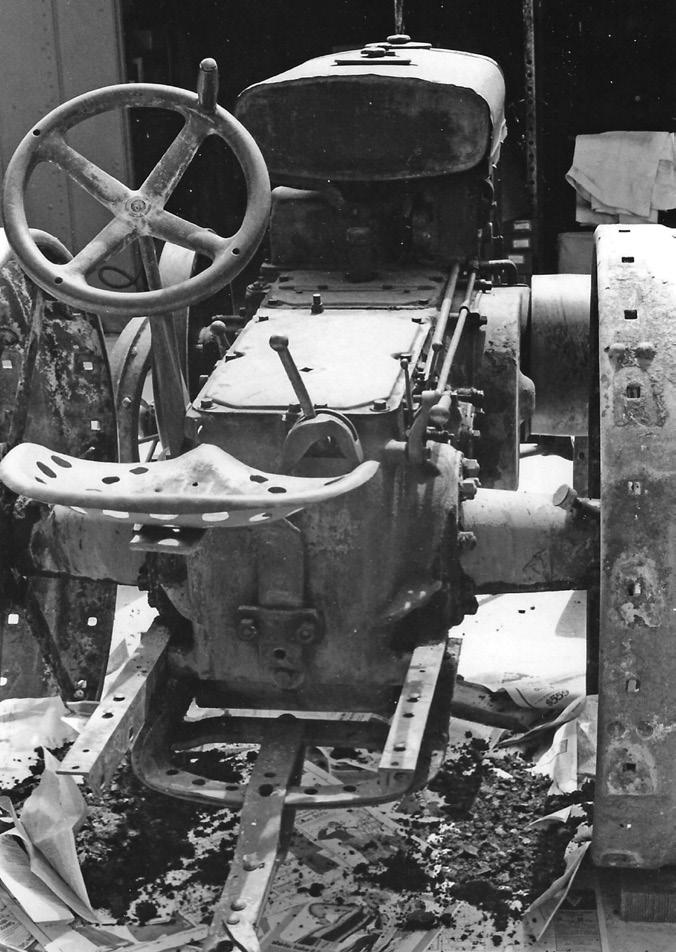
Here it is, a nice early model “D” on steel wheels (Photo 1). As I have
said before, the model “D” was my favorite John Deere tractor. So much so that I had more than 80 model “D” tractors in the collection. They ran the range from Spoker “Ds” to late styled models and some were nice and some were not so nice. Like I always said, there is nothing that can not be fixed if you throw enough time and money at it. So, I like “Ds.” First thing I notice on this “D” is the early rear wheels, the non-slotted steering wheel and the Splitdorf magneto. The air cleaner is also off or missing. It appears some-
one was working on this as there is a drain pan and newspapers with dirt and grease on them under the tractor. You do remember newspapers, don’t you? I do. I also notice the worn guide band holes on the right front wheel. The lug bolt holes on the rear wheels look to be in great shape though. The ghost John Deere stencil on the hood is timeless. The bent bolt attaching the clevis to the front axle is a testament to the use it has seen.
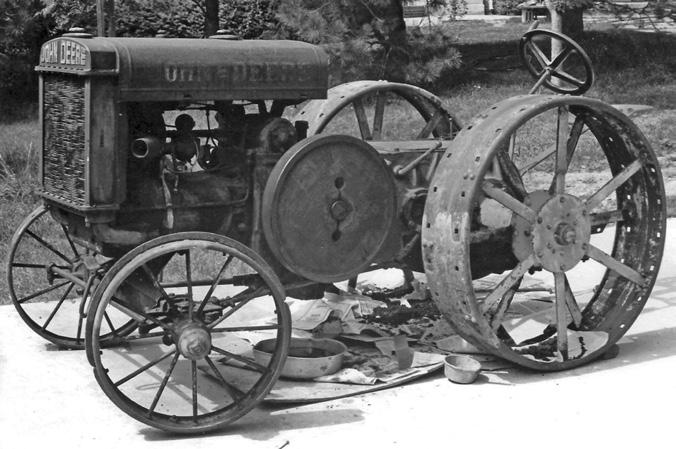
Photo 2 is a great side shot. I can see the early Schebler carburetor
and also the keyed crankshaft and flywheel, so this is a fairly early “D.” The water injector is visible, as are the fuel caps and it has the early manifold.
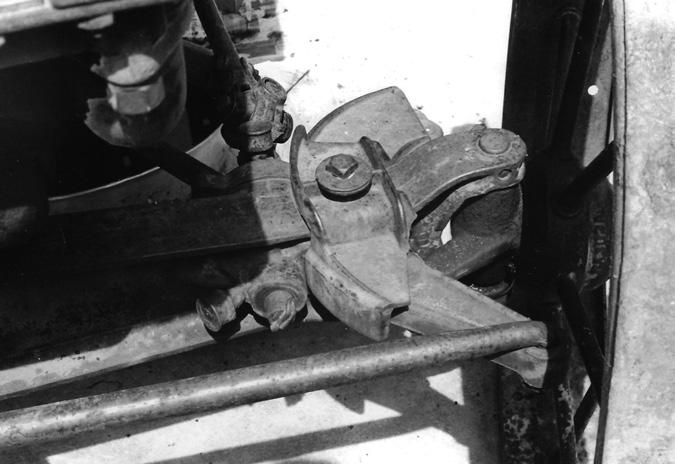
One thing I appreciated about this “D” was that it still had the early steering gear in place. I cannot remember how many of my early “Ds” had the steering gear farmerized or even outright replaced with some refugee from a farm truck or other machine. If one of my early “Ds” did still have the worm gear and sector, they were usually extremely worn and never, and I emphasize the word never, was
the steering guard in place on top of the axle. The one or two I had that did still have the guard, of that one was cracked in half while one, and just one, still had an intact guard. I took this good guard off and used it as a pattern to have new ones cast which I used and also sold to others in need of one for their model “D.”
The other thing that, to me at least, is unusual to find on early “Ds” is that this one still has grease cups in place (Photo 3). Ninety-nine percent of the time the grease cups were removed,
and grease fittings were installed. Why not? Grease fittings were superior to grease cups and were far easier to use and anything that makes greasing a machine easier is something you most definitely want to use. We all know of farm machines that have suffered due to lack of maintenance. My 1927 Corn Borer model “D” was maybe the most original model “D” I ever had as it had all of the original equipment and even had grease cups on the steering as well as the fan shaft. Like with classic cars, over the years I grew to appreciate a tractor, any brand, which
Photo 1
Photo 2
Photo 3
was still original and unmodified. The other thing is I can almost make out is the HA casting number on that front wheel. My eyes are not what they used to be and using the computer to make it larger almost helped but not enough. Oh well, my knowledge of HA wheel numbers is also not what it used to be. Funny how when you do not use something for 20 years, the details start to get fuzzy.
Photo 4 is a better shot of the Splitdorf magneto, and the straight cup style petcock can be seen. The D91R cast fuel bowl can be seen under the
tank as can the original fuel valve. I used an original D91R cast fuel bowl and had some cast so I would have them when I needed them. News flash—I never had the time to work on the majority of my tractors, so I never needed them. The vintage parts business consumed me and all of my time. The original wooden spark plug wire holders can be seen, and this old “D” is sporting a Montgomery Wards Supreme Quality spark plug! For some reason, a nut is missing from the block to case studs, likely due to the removal of the air cleaner? I like the hood clips too and that the advance on the magneto is still connected.
The Schebler carburetor and water injector can be seen in Photo 5. The
water injector control rod is unhooked, as many were. Most early “Ds” had the injector completely removed when antifreeze began to be used. Locating a water injector for a “D” can be a bit difficult to find but they are out there. The model “GP” also used a water injector, but it was different. Of course it is. I think it was Jack Chandler of Magneeders used to reproduce an entire water injector for both the “D” and the “GP”? I am not certain. Jack passed in 2014, and I do not know who, if anyone, is reproducing the injector today. I talked to Jack once in a while and he was a good guy, in my opinion. I used to reproduce almost every part for these early Schebler carburetors as well as the other early “D” carbs and the parts for the Ensign carburetors on the “GP” tractors. There are others making these parts today and doing an excellent job at it. It makes it so much easier when you can get a needed part to get that old “D” or “GP” going.
The throttle and magneto controls are shown here (Photo 6). We can also see that the original D937R notched transmission cover washers are still in place. You can definitely see the heavy nuts on the axle to case studs.
Photo 7 is a great side shot of the engine. Everything is pretty much as it should be with a few tweaks on the fuel lines. The small tank fuel outlet
is visible, and a better shot of the fuel valve is shown. It also looks as if the manifold is not broken as so many were. Another good thing for this model “D”—no cracks or welds on top of the block!
A rear shot in Photo 8. The spinner knob looks a bit off to me on the steering wheel, many were replaced with a section of pipe. I also took an original spinner knob and had them recast, sold a few, then promptly lost the rest, never to be seen again. Note
the grease cap on the axle. Take a look at that drawbar hole though. It is pretty well worn! This old tractor has spent some time in the field that is for sure. Someone was getting after scraping the grease off if we are to judge from the piles underneath the tractor. I looked for the decal on the back of the fuel tank but was unable to see anything. Time has done its work on that one.
Overall, this is a nice original tractor. I would guess it to be an early 1927 going from the rear wheels, the carburetor, and the keyed crankshaft. I might be wrong, but I would bet I am very close, although as I said the passing years and lack of use have softened my sleuthing skills somewhat. What is driving me nuts is where did I get this packet of pictures? Did someone give it to me? Did I buy the pictures? The tractor?
Photo 4
Photo 5
Photo 6 • Photo 7
Photo 8
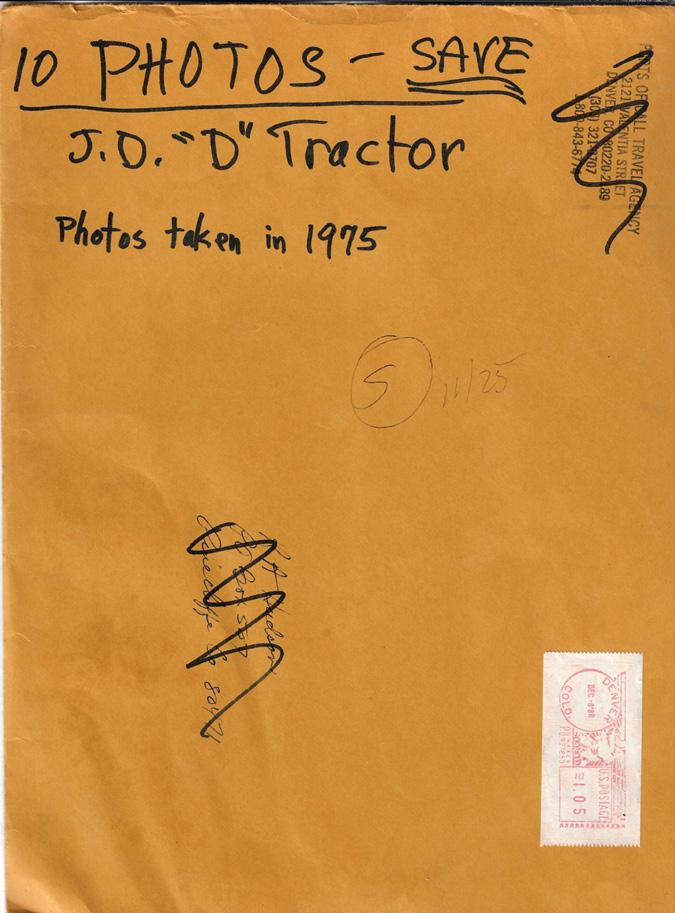
Photo 9 is the envelope they are in. The writing says the photos were taken in 1975 while the postmark is from December of 1988. However, it was not mailed to me; it was mailed to R.A. Hudson of Pinecliffe, Colorado. Pinecliffe is north and west of Franktown and Denver and is around 70 miles away. I do not remember ever getting a model “D” from Pinecliffe so the best I can figure is that maybe Mr. Hudson came by Franktown and gave me the pictures. I am just not sure. I wish I had made more notes back in the day but then, we all do. The origin of these pictures will remain another mystery lost to the mists of time, I guess.
Now we are going to change it up a bit and look at a few things I was involved with the past few weeks. I am selling things, so I am always looking
at this or that and I have a few pictures of recent items to share with you.
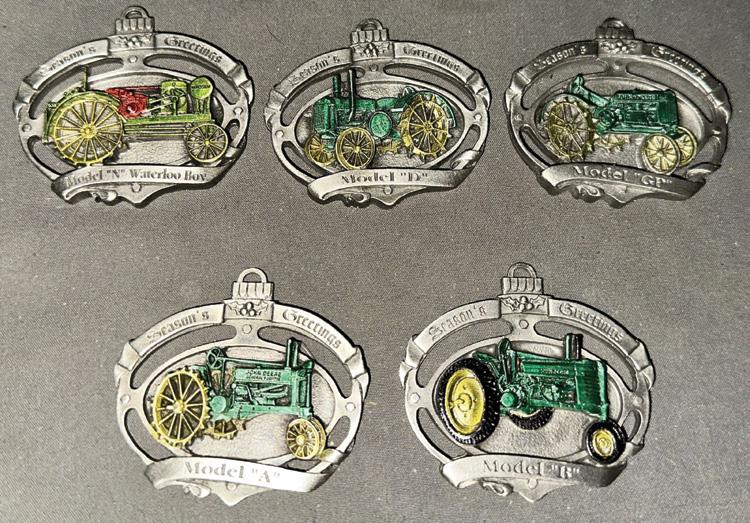
As I write this, it is December but by the time this is published Christmas will be long over. This is a set of painted pewter John Deere tractor ornaments (Photo 10). The ornaments were produced by the Cary Francis Group, who lost their contract with Deere in the early 2000s so this is from around that time frame. The backs had information on the tractor on the front, and the set was a limited edition, so this was set number 214 of 2,500 produced although, in my experience, I doubt 2,500 were ever made as sales were relatively weak, I was told.
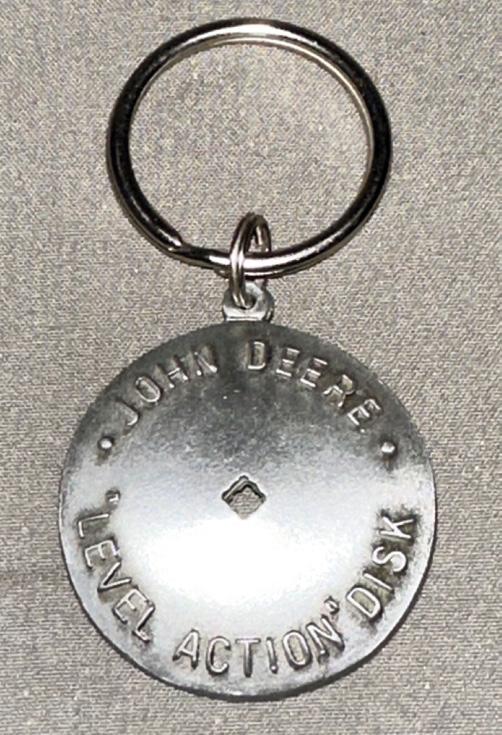
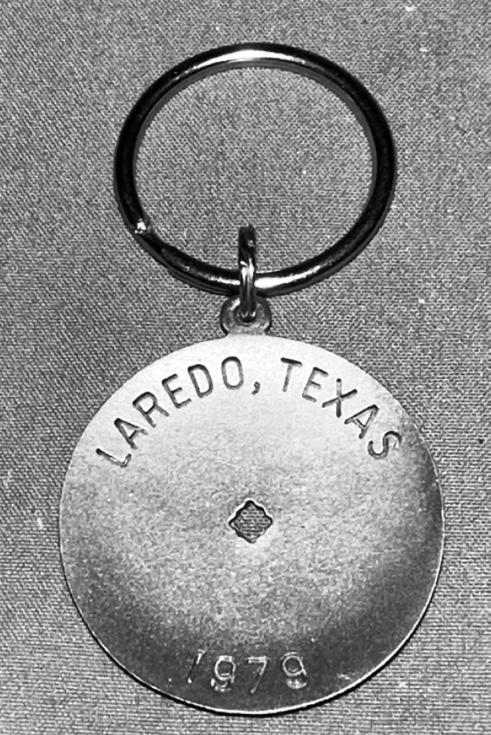
Photo 11 is of a small John Deere Level Action disk key chain. I had not seen this one before until I took it out. It is from 1979 and Laredo, Texas. I am not sure if there was a Deere meeting there or from a dealer or what. Anyway, it is a neat, unusual item (Photo 12).
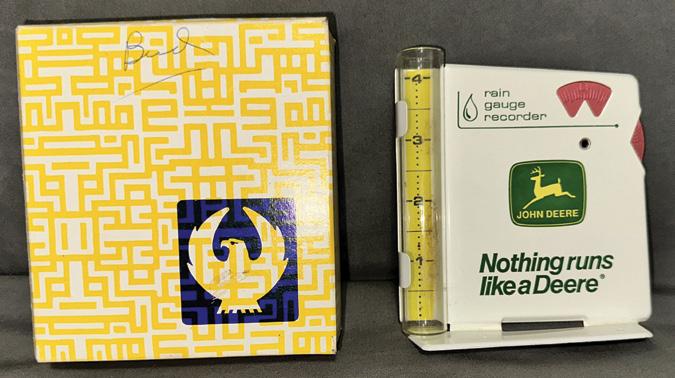
This is a new rain gauge still in the box (Photo 13). It has the old two legged deer logo in green and yellow and the “Nothing Runs Like A Deere”
logo. If you look closely, you can see that the name “Bud” is written in pencil on it. When I listed it to sell it, I wrote that it looked like Bud missed out. Since his name was on the box, I assumed it was meant to be his, but he fooled around and now it was mine. And now it is headed to a new owner. This is a combine clearance gauge (Photo 14). I am not sure, but I think there are four or five versions of this gauge. I believe this is an early one due to the green display card it is mounted on. It has John Deere cast in it and is another fun, unusual collectible.
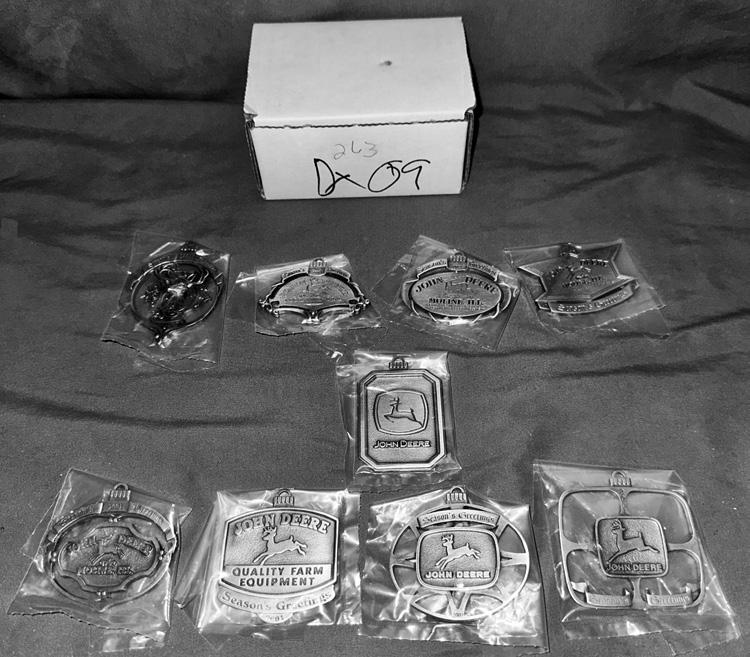
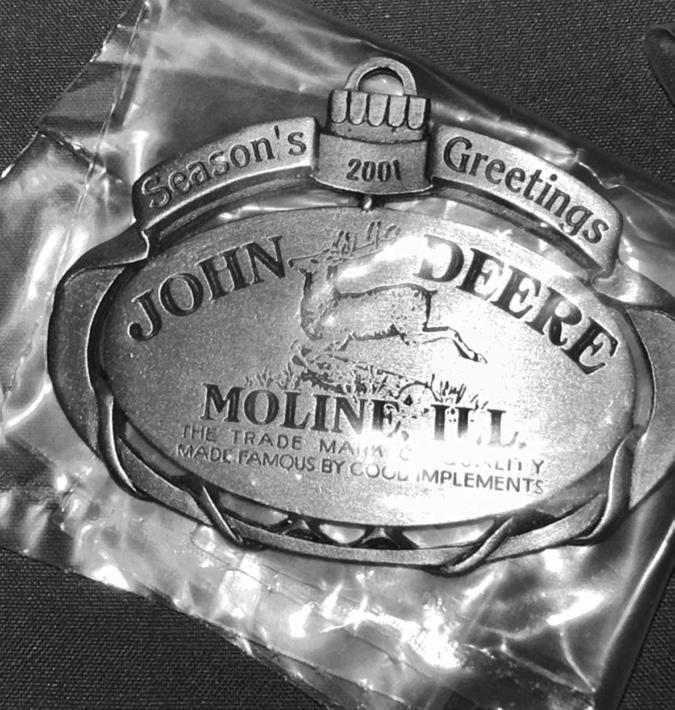
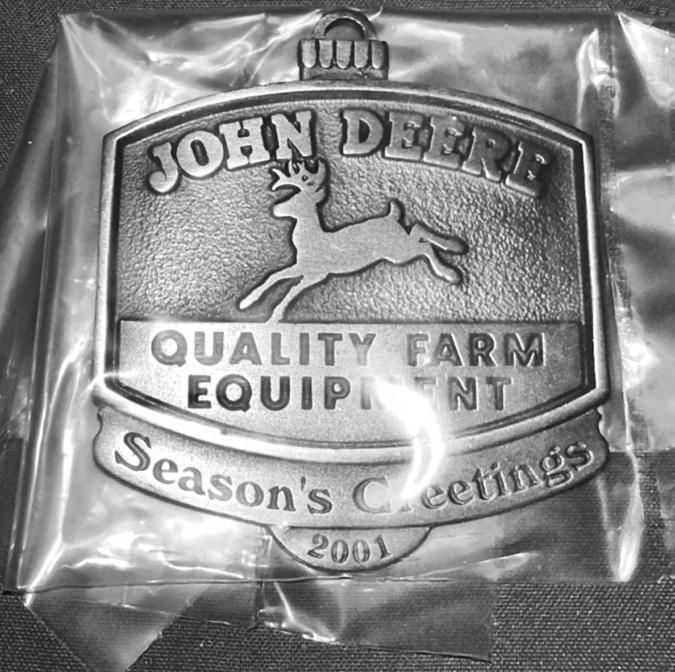
Photo 15 is another limitededition Christmas ornament set. It is set DX09 and consists of nine different ornaments featuring vintage logos from John Deere’s past. They are pewter, highly detailed and date from 2001.
Photo 9
Photo 10
Photo 11
Photo 12
Photo 14
Photo 15
Photo 13
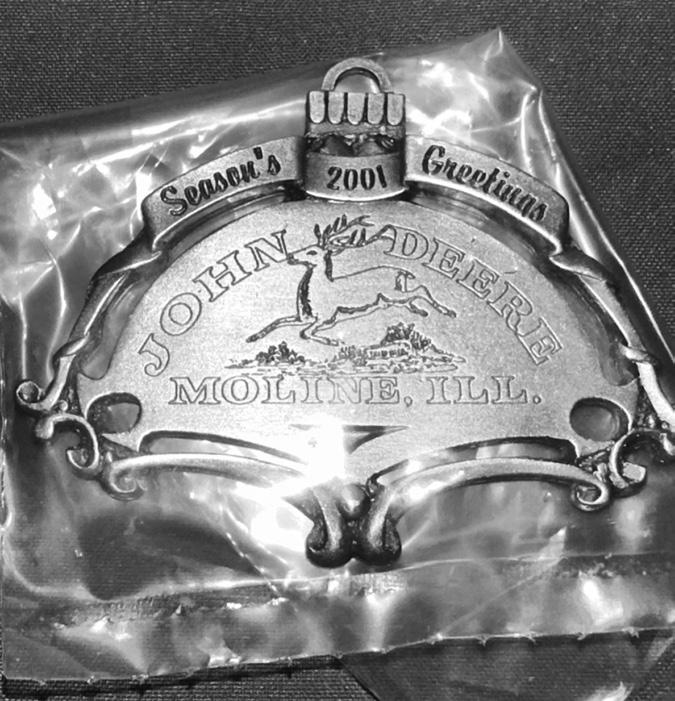
This is a close-up of the 1876 logo ornament (Photo 16).
Photo 17 is the 1912 logo.
Photo 18 is the 1950 logo. The backs of each ornament had information on the logo on the other side and also the serial number was stamped on each one.
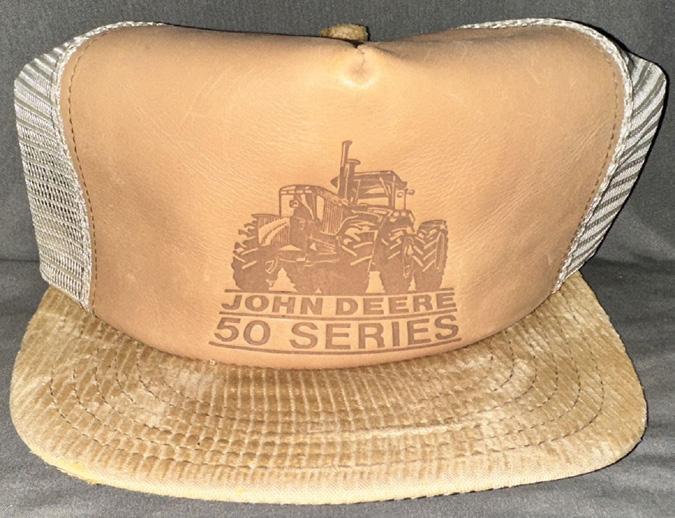
Photo 19 is one of my all-time favorite John Deere hats. It was put out by Deere to announce the new 50 series row crop tractors that were introduced in 1983. What is unique about this hat is that the front panel is leather and the bill is tan corduroy. It made for a nice looking hat and I sold quite a few when they came out.
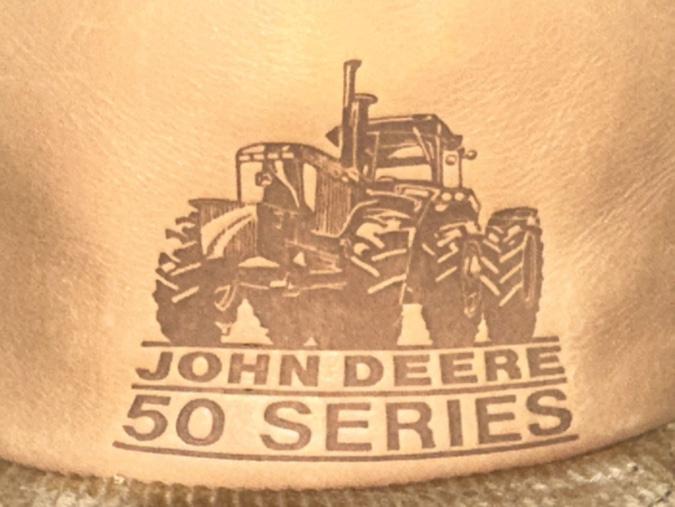
Photo 20 is the final picture this time and it is a close-up of the front panel with the graphics of a 50 series MFWD row crop tractor stamped into the leather. It still looks good over 40 years later, I think.
I was always a sucker for an early model “D” on steel. That is why these pictures interested me so much. The early “D” was Deere’s first real all Deere production tractor and it is also the model that was built the longest. There were many changes and
upgrades in the model “D” over the years it was produced and that is why they are such good tractors to study. The early “Ds” had numerous changes in the wheels, fenders, carburetors, magnetos and even the engine. The bonus on the “D” in the pictures is that it was relatively unmolested and in the same condition as when it had stopped being used. That is why so many original items still remained, and it was fun inspecting the pictures and seeing what could be seen. I will still wonder where I got those pictures and where that tractor ended up.
The other items are just fun. More evidence of the tremendous variety of things Deere has produced over the years. It is an endless and enjoyable search when collecting John Deere. You can never begin to have it all and no matter how extensive your collection is, there is always a new item or two turning up that can be added. I hope you enjoyed taking a look with me. Until next time!
Write Greg Stephen at The Old Tractor Company, Box 89, Franktown, CO 80116; phone 231-846-8243 or email deeredr@hotmail.com
Photo 20
Photo 17 • Photo 18, below
Photo
by
Natalie Hain
Hope everyone was able to celebrate a joyous holiday season and have been enjoying the New Year of 2026! During the holiday, I was able to watch my favorite Christmas movie, “A Christmas to Remember,” starring Jason Robards and Eva Marie Saint. It was made in 1978 and I can remember watching it as a farm and tractor loving teenager. The story begins as the school band is playing and an announcer is bragging up what is inside this big tent. They are unveiling the John Deere 8640!
A farmer jumps up in the cab to go for a ride and then it goes back to a flashback when he was young, growing up on a dairy farm with his grandfather (Jason Robards) and grandmother (Eva Marie Saint). When he was young, he got sent to live with Grandma and Grandpa, in Minnesota, because his mom and dad in Philadelphia didn’t have enough money to raise him. It was set during the Great Depression. They don’t get off to a great start. The grandpa gets him up early to milk cows, by hand. In one scene, the grandpa chases the boy around the yard with a steel wheeled “GP” John Deere. Now maybe you see why I like this show.
In the climax of the movie, the grandpa and Rusty (the grandson) start the “GP” late at night during a snowstorm to bring their melodeon (organ) to the church for Christmas morning to surprise the grandmother. They hang lanterns on the “GP” and
head cross country with the organ on a stoneboat…I will stop with the story line there, just in case you haven’t seen it and you want to watch a great show, “A Christmas to Remember.”
I must admit when I begin researching auctions I personally look at two-cylinders because that is where my main interest lies, but I did stumble across a couple of Gen II tractors among several others. These first couple of tractors were sold by Ted Everett Auctioneers of Monrovia, Indiana. The first tractor was one I have always had a desire to own, but have not. When I was growing up farming
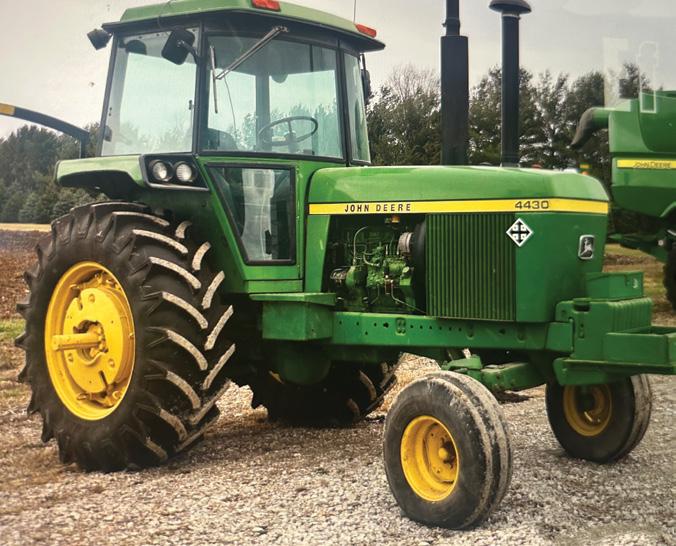
with two cylinder tractors we had neighbors with 4010s and 4020s, but when the 4430s came out, they were impressive to me. The first tractor I will report on is a 1977 John Deere 4430 with cab. It has a Quad-Range transmission and new tires. The serial number is 076080R. With what I would call low hours for a 4430 (6,048), the 4430 sold for $25,500.
Next, we step up to a 4440. Serial
number H056303RW makes it a 1982 model. The 4440 is equipped with 11x16 four-rib front tires and 18.4x38 Firestones with duals, 10-bolt. It also has six weights and a Quad-Range transmission. With just over 5,000 hours, it brought in a nice selling bid of $41,500.
McMullen Auctioneers in Thief River Falls, Minnesota had a 1928 “GP” John Deere come up for sale at a recent auction. I’ve always had a soft spot for “GPs;” I just think they are kind of neat, although I have never really
been around one. This one is on full steel and looks to be complete. The serial number is 201236. I thought for a stuck unit, it did well getting a bid of $3,550!
Another sale brought several two cylinders to the auction block. This was the Antique Tractor, John Deere Toy and Memorabilia Sale conducted by Whalen Realty and Auction, Ltd. of Wauseon, Ohio. Let’s start “small” with a 1942 model “LA” tractor. It
featured electric start, lights, pulley, and a one bottom plow. It was completely rebuilt three years ago and was advertised as “parade ready!” SOLD for $3,800.
The next two cylinder I found was a 1936 model “A” with F&H round spoke wheels and 11.2-36 Firestones, round spoke fronts with new 5.00-15 BKT tires. The tractor was rebuilt in 2024 with a new radiator, new steering
wheel and radiator screen with canvas. The cylinder head and carb were also rebuilt. This fine looking “A” fetched a bid of $4,100.
Another two cylinder from the letter series that is quite a tractor to me was a 1942 model “GM,” serial number 13026. The tractor was converted to 12 volts and the head was rebuilt. Of course it has the pan seat and big
PTO. Okay, I’ll repeat it again…I love the “Gs!” Sporting 13.6-38 rears, this tractor saw the gavel drop at a bid of $3,900!
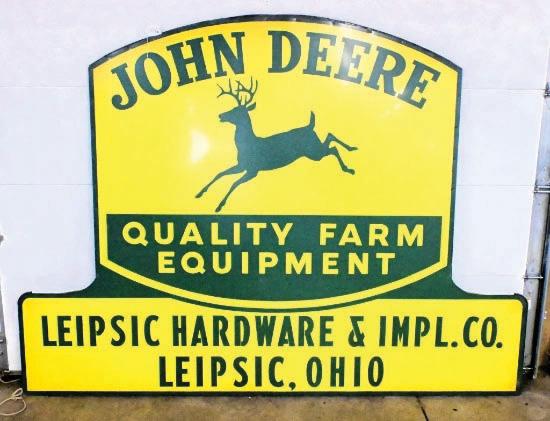
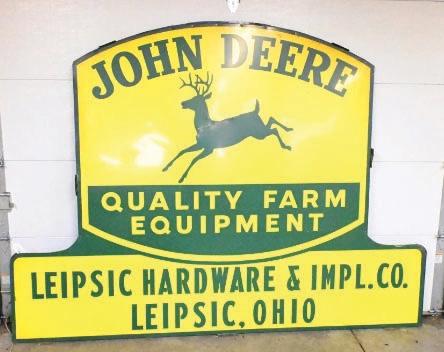
These last three tractors were all consigned by Al Leibengood. I’ll have to add another cool piece of history sold at this sale were two all original signs produced by Grace Sign Co. in
St. Louis. Hold on to your hats, these two signs recently separated for the first time in 2025. They measured 96 inches wide by 71 inches; they sold for $20,000 each!
There was one more tractor I’ll mention from Whalen Realty and Auction sale that is an 80 John Deere. The serial number on this 80 is 8002265, making it a 1956 model. This 80 has single hydraulics, PTO, power steering, and 12 wheel weights (four outside and two inside on each wheel), like new 18.4 by 34 rears and very good
7.50-18 fronts. This fun looking 80 sold for $8,000!
Talking about this 80 was my segway into several 20 and 30 series two cylinders I will finish up with. The next tractors are from Restoration Tractor Sales in Lancaster, Pennsylvania. They hold regular auctions of restored and project tractors. They offered up a couple of 720 John Deere diesel tractors, first a 1956 model, serial number 7207176. The big motor was advertised
as running excellent and the pony motor works. The tractor sits on 15.5-38 rubber and has original paint. This one reached a bid of $8,000.
The next one is a 1958 model with a serial number of 7226269. It has a factory wide front, power steering, three-point with toplink, excellent
15.5-38 rubber, and both engines in excellent running condition. This 720 diesel sold for $6,750.
Moving up to the 30 series is a cute little 1959 model 430. This one, serial number 145031, is a good runner with three-point and front slab
weights. The 12.4-24 tires are advertised as “decent.” If you wanted a 430, you would have had to outdo the leading bidder who gave $7,210 for this tractor!
The Keith Baker Trust &The Late Keith Baker sale by Wheeler Auctions and Real Estate, in Shelbina, Missouri, gave us three more nice 30 series two bangers. With a serial number of 6312052, this 1959 630 wide front tractor with three-point, frame weights, and advertised with the motor free (I assume not running at the moment) still commanded a selling bid of $6,900.
Stepping up the ladder to a 1959 730, serial number 7311961, which is a diesel, pony start with Norden wide front and three-point hitch. This one went to a new home for a bid of $4,250.
Lastly at this sale I grabbed another 730 diesel, pony start tractor. This one is a 1960 model with an
aftermarket wide front, three-point, and front weights. This 730 sold for a top bid of $4,400.
Whew! Time to finish with a couple of 830 tractors! First, from Brad Neuhart Auctioneers in Milan, Michigan, this 830 bears serial number 8301045. The tractor was pull started and had an oil leak at the filter cover. This tractor came from an estate and is believed to be a “Rice Special.” It does have Rice and Cane tires but can not be verified at the time of the sale if it
is truly a “Rice Special.” If you were in the market for an 830, this one was what I would call a good buy, selling for just $4,650.
The last tractor to mention this month is another 830, this one coming from Restoration Tractor Sales in Lancaster, Pennsylvania. This electric start 830 has serial number 8303313. It is advertised as exceptionally nice and straight all original tractor in good running and driving condition. If you wanted to bring this 830 home, you would have beat the winning bid of $14,500.
That is all for now! Thanks to Paul Fischer for the heads up on the Whalen Realty Auction and as always, if you see an interesting auction in your area, please let me know—I appreciate it! Hope 2026 is treating you well, and of course happy auctioning!
Email Eric W. Mickelson at mickelsonauctions@gmail.com
It looks as if no one in our viewing audience has a No. 21 or 22 cable lift attachment on a chisel plow. Probably not a big surprise, since in the era these were built, there weren’t many tractors capable of pulling a chisel so large that it needed wings.
I have always tried to keep searches about John Deere-branded equipment, and not allied items, but sometimes it’s tempting to do otherwise, to show you some of the strange things that appeared in Deere catalogs. Take, for instance, the ATECO Car Straightener. What is a car straightener? I’m glad you asked. It’s a device that attaches to a John Deere Rotoboom to straighten train car ends damaged from switching and humping, which is apparently railroad talk.
What I am going to search for next is something that someone out there should have, though only 98 of them were built. I had one a few years back, and sometimes wish I still had it, though I’m not sure what I would do with it other than watch it gather dust and worry about keeping the tires and batteries in good condition. It’s a 4010 gas standard. They sold new for about $4,500, not a bad price, but came at a time when bigacreage guys were turning toward diesels, as their production of 11,370 shows. Even the LP 4010 standard sold eight times as many, at 792, no doubt because propane was cheap and readily available, particularly in oil-producing areas of the country. Do you have a 4010 gas standard? If so, be the first to send us a photo of it and yourself, and we will add one year to your subscription.
It could also be used to lift a car when repairing the trucks. I’m not going to make this the next search because the chances of anyone actually having one are slim to none, but I thought that I would include a couple of photos to show you what I am talking about.
Send in your entries for “Do you have one?” See page 4 for Green
addresses
G’day, mates!
As I write this month’s article on January 1st, it is hard to believe that 2025 is in the books. It was a good year for us, with a lot of successes. My work as training instructor for our John Deere dealer group went very well, with a lot of praise from service technicians and their supervisors. The highlight for me was a service technician who said he learned more from me in one week than he did through four years of his apprenticeship. Now, that does not say much for our apprentice program here, but I am happy I was able to teach him a lot of usable information.
The takeaway shop in our town of Kooralbyn is going well. Janis and her partners analyzed the sales from the first two months and adjusted the menu at the beginning of December. Some items were selling sparsely, so they were deleted. Other items that were often requested have been added. I am not working as much at the shop now that Janis returned from her trip to Canada in October. When needed, I still make pizzas and wash dishes.
We are still dealing with our share of breakdowns, as any shop or farm sees. I had purchased a soft ice cream machine, which was a mistake. It was not a common brand name machine that was bought used at a decent price. When we finally got it up and running, it would not make anything
frozen. A repairman came out and saw that the circuit board had issues. We were able to rewire it to get it working, but after three days, the plastic augers that make the ice cream broke and would not spin with the inner steel driveshaft. The parts are hard to find, so the decision was made to remove it. It is probably destined for the scrap heap. I can salvage the motor and gear box. The shop also came with a large commercial two door upright freezer that has had its share of moments when it decides not to freeze food items. The final straw was December 30th, when it stopped freezing again. The repairman diagnosed that one of the two compressor units had failed and the repair was going to be expensive. It was removed and another chest style freezer that we had was put in its place.
Christmas 2025 was a great time of year for our family. It is hot at Christmas, which we have become
Turkey finished on the BBQ.
accustomed to. We carried on our tradition of making a Canadian style Christmas dinner. This included a turkey that was cooked on the barbecue rotisserie. Janis made her signature sweet potato casserole, mashed potatoes, dressing and vegetables. She also made a pumpkin pie for us to enjoy as pumpkin pie is not a common dessert in Australia. The Aussies love pumpkin, but it is a different type of pumpkin. The pumpkin Aussies love is referred to as a Kent or Jap pumpkin. Google said that the Kent pumpkin is called a “kabocha squash” in North America. This type of pumpkin is served roasted in wedges or served pureed as a soup. Our children, Maris and Kyle, were home Christmas day with their partners to share in the festivities. On New Year’s Eve, Janis and I worked at the takeaway shop selling pizzas and fish and chips until our regular 7 p.m. closing time.
I decided to take the two weeks off work that wrap around Christmas and New Year’s Day. Several projects have been worked on. The first order of business was to purchase three batteries for tractors I have here. The 1010, 2010 and 1020 are running tractors, but not if there is no battery in them or the battery does not take a charge. As a fellow tractor collector said one time, you need to have shares in a battery company to keep things going. The three batteries were purchased
and installed. All three tractors now start easily with the key. The charging systems are working as well, so that is a bonus.
As I have mentioned, the 2250 loader tractor needs a new clutch and it is on the priority list for early 2026. On the back of the 2250, I had a handy three-point hitch carryall that I use to move items from the shop to my storage area as well as take our garbage bins up the driveway to the street. I decided why not use the 1020 to do this task as it was doing nothing. This has really worked out well. I really enjoy the 1020, as it resembles the 1120 I grew up on in Ontario. Sadly, it has manual steering, but with a steering wheel spinner installed, it does steer very easily while driving forward or reverse. The spinner really improves the steering action, especially on a manual steering tractor. I have been contacted by a friend with a wrecked John Deere 1040 tractor that has the power steering tower. I might purchase that steering unit to install it, but with the spinner on the steering wheel, the steering effort is incredibly improved from trying to hand steer the wheel. I was able to spend some time on my John Deere 720 diesel standard I imported from Canada in 2023. The
Cranking engine bent choke lever on left, broken and bent throttle lever on right.
cranking engine starts reliably since I replaced the ignition coils when I was in Canada preparing the tractors to ship to Australia. It starts, but the throttle did not work at all so I could only apply choke to slow the engine down while warming it up to start the diesel engine. The little fuel tank seemed to always be empty due to some old and leaky components. I had refurbished the generator last year, and it did “motor” when I bench tested it. The charging system still did not charge the battery, so I needed to investigate further.
The fender repair that Kyle performed on my 720 was sanded and painted green. Yes, it does not match the original paint of the rest of the tractor. The paint is better than rust and I had no choice but to repair the severely rusted fender. In a perfect world, I would match the green tint of the original paint and get a small amount mixed up. I mounted the fender on the axle. The platform extension piece that runs from the shift quadrant to the fender had also been removed. After some searching, I found it in a box of parts in the shop. This platform
Below: Fuel shutoff disassembled.
extension had been bent and twisted years before. It looked like someone tried to remove or install it with the fender on. After a short think through, I realized that the platform extension needed to go on BEFORE the fender
Amp gauge shows charge and fuel shows one-half tank after repairs.
Below: F on generator grounded to frame while tractor is running.
Carb removed from cranking engine.
720 fender with severe rust issues.
was installed, so off came the fender. I was able to straighten the platform extension back to its original shape.
Before I proceeded reinstalling the extension, I decided to drain the cranking engine transmission oil as the drain and fill ports are right until that platform extension location. The oil was drained and flushed as it had a watery look to it. The platform extension was installed, and then I reinstalled the fender. The final touch was to reinstall the toolbox and hinged lid that bolt to the platform and fender. It looked good with everything reinstalled.
I drained the rest of the fluids
Below:
from the 720 tractor. The engine oil had been changed after I bought the tractor in the 2010, but the transmission, PTO and hydraulic oils had not. The transmission and PTO oil came out with the look and consistency of butterscotch pudding, due to water mixed with the old oil. Both compartments were flushed before refilling the oil. As the operator’s manual says, drain the oil and then refill with a flushing agent. I filled the transmission with new diesel fuel, using the quantity listed in the manual. The left rear wheel was jacked up as per the manual. After I started the diesel engine, I applied the right brake for safety and I engaged the transmission. The manual says to run it in low gear for a short time to throw around the flushing agent. I engaged it in all the gears including reverse for a short time each. The left wheel spun while lifted off the ground. The tractor was lowered and the flushing agent drained out. I purchased all new sealing washers for the drain plugs on the tractor. The old drain plugs sealing washers looked like they were from 1958 and they were as flat as a piece of tin. New 80W90 gear oil was poured into the transmission up to the
level plug. I flushed the PTO housing twice and refilled it with HyGard oil. The manual says to use 10W30, which is the same viscosity as the HyGard. After all the fluids were changed, I went at the cranking engine issues. The carburetor and shut off valve assembly were removed, disassembled and cleaned. The carb had been apart after I purchased it in 2010. I remembered that the original cork style float was still in the bowl when I bought it, and the float was replaced with the current John Deere one. I did not need to change the float or needle and seat now. A new gasket set was used to reassemble the carburetor. I used a new Viton rubber seal kit for the fuel shut off valve as well. The fuel line fitting onto the shutoff tap was just a copper line with the rubber hose clamped on. I brazed a brass barb fitting to a new piece of copper line. The barb fitting is a much better seal to the rubber hose than the straight copper line. I had a new sediment bowl assembly here for the tank that is the same as the 110 lawn mowers use. The only difference to the original 720 sediment bowl was the new bowl had a shutoff tap. The new bowl was installed as well as a new
720 fender—rust cut out, new patches welded in.
Patches sanded.
Fender installed with repaired section painted.
piece of 5/16ths inch rubber fuel line. The throttle and choke levers for the cranking engine were tackled next. Looking at the throttle lever, it appeared to be bent at a 30 degree angle. This did not allow the lever to operate the governor arm to idle the engine at start up. After a bit of thought, I worked out how to remove the levers. There are attaching bolts that are exposed by the throttle lever mount. These bolts thread into swivels that the choke and throttle levers pivot on. Once I had the levers removed, it was easy to see what was wrong with the throttle lever. There is a one-quarter inch hole in the lever that the swivel pivots on. The throttle lever was broken on one side at the hole and allowed to bend at an angle. I straightened the lever and welded up the crack and hole that was worn and
redrilled the hole back to spec.
The choke lever was not broken but slightly bent, which I straightened. I needed to tighten up the swivel for the throttle lever as this tension helps to hold the throttle in the locked position on the dash. A thin washer was added to take up the slop. The levers were reinstalled, and then the exposed bolts are used to adjust the idle speed, and the travel length of both levers. I now have the levers set so that they travel the full distance of their slots in the dash. The cranking engine started easily and the throttle now works perfectly! I needed to open the load needle one-half turn as the engine would bog down when the throttle was set to run.
The charging system was tested next. I figured that the voltage regulator was the issue. As luck would have
it, the Tractor Doctor article in the December 2025 Green Magazine came at the right time. Ron discussed voltage regulators and charging systems. He showed how to test the charging system by bypassing the voltage regulator. I followed his directions and connected a jumper wire from the “F” terminal on the generator to the frame of the generator while the engine was running. The amp gauge was charging at 15 amps while this wire was connected. Without the wire connected, the amp gauge would not move in either direction. I had a new voltage regulator here, so installed it and polarized the generator. Now, when I started the tractor, the amp gauge is in negative while cranking, and 15 amps positive while running! The fuel gauge and sending unit that had been replaced in 2010 appeared to not be working either. While the engine was running, the gauge did bounce at the empty mark. I put a measuring stick in the fuel tank, and it showed one-half inch of fuel. I put 20 liters of diesel in the fuel tank and started the tractor. The gauge now showed one-half full! It is working, so make sure you check your fuel level before assuming the gauge is not working! I will fill the tank one-half full and remove the sender to adjust the float to measure correctly, but that will be another day.
That’s all for this month. Stay tuned for model “B” restoration project action, as I just started to disassemble the engine yesterday. I hope everyone is enjoying their winter in the Northern Hemisphere, something I do not miss! Until next time, cheers, mates! Contact Ken Nicklas by email at kenanicklas@gmail.com
Toolbox and platform extension installed.
When I was born, I’m sure the doctor infused the iconic John Deere green and yellow paint into my bloodstream.
My earliest recollection of the farm, at about three years old, was hearing that we were getting a “new” John Deere model “A” tractor. Dad had purchased the “A” from the John Deere shop in Milroy, Minnesota. The tractor was getting new hydraulics and a new paint job before it came to our farm. Dad reminded us boys that the tractor was not new. It was going to look new, with a fresh green and yellow paint job. The wait for the “A” was insufferable to me. I couldn’t wait to see our new tractor.
Before the new John Deere arrived, however, we visited my grandparents in Lindsay, Nebraska. On the way, as we were driving through Wayne, Nebraska (my namesake), I saw an unstyled “B” John Deere painted red! I was incredulous! It was plain undignified! Sacrilegious! How could anybody paint a John Deere red? Even my all-knowing Dad couldn’t provide me with a satisfactory answer as to why anyone would paint a John Deere red.
Our 1941 John Deere “A,” which we later just dubbed “The A,” arrived on our farm in 1951. I can still remember how great it looked and the smell of the new paint. Dad was impressed since it came with a high compression head and a power lift that would also raise the fourrow cultivator and front end loader.
It did not have a starter or lights. Those options were simply “not needed.”
The “A” was our big tractor. We also had a John Deere “B” for the smaller chores, but “The A” was used for the field work, plowing, discing, corn planting, and we
lem. How to move his cherished combine about 200 miles to the new farm? In order to haul it by truck, it would have to be disassembled and that would also necessitate a truck hauling permit. The hauling permit would require an inordinate amount of paperwork and time to fill out.
When I was born, I’m sure the doctor infused the iconic John Deere green and yellow paint into my bloodstream.
even had a two-row mounted corn picker. It seemed that the “A” was always busy. I can remember in the fall, Dad plowing with a 2-16 plow for three weeks on end, and the “A” chuckling along in the fields from early in the morning to late in the evening as the sun was setting.
As time went on, Dad got inventive and wired lights on the “A,” generator and all. The only thing that disturbed my senses was the “off-color” orange battery box mounted on the steering column, which didn’t match the green and yellow John Deere colors.
My folks eventually bought a dairy farm in central Minnesota. To cover the farm down payment, Dad sold all his large equipment: the four-row corn planter, cultivator, and the two-row mounted corn picker. He could not, however, part with his recently purchased six-foot combine.
Now that brought up a prob-
Dad was not up to that tomfoolery. I got up for school one fall morning and asked Mom where Dad was. Her answer astounded me. “He’s driving the combine to the new farm with the ‘A’.” And sure enough, Dad towed the lefthanded combine to the new farm “up north.” The drive took him a day and a half, and he made it. Over 70 years later, the neighbors still talk about that feat.
As I grew older, Dad let me start plowing at 10 years old with the “A.” Man, I felt like I had arrived. Not sure the furrows were straight, but the fields were plowed. Then on to discing and other field work as I got older.
Dad eventually bought a new baler powered by the power take off (PTO) from the “A.” The baler was one of the few in our neighborhood. So, the “A” had a new chore: we custom-baled hay for the neighbors, pulling a hay rack behind the baler
to load the bales. The “A” took on the new chores well.
However, the “A” did not have live power, and the neighbors were accustomed to raking large hay windrows for hay loaders. The windrows were too large for the baler to handle. No problem. I got good at pulling the clutch, shifting the transmission into neutral, and then quickly pushing in the clutch without letting the baler stall or plug. Dad was very particular about crunching any gears, so performing this task in the beginning was tricky. This had to be done often. It was a feat that I soon perfected.
wizard who could invent or fix anything. He had a large family of cute girls and a highly organized and heated shop. Dad and Mr. Kasper went to overhaul the engine and cure other ills that had befallen the “A.”
On a frigid January morning in northern Minnesota, on the way home from the creamery, Dad asked me if I wanted to clean parts for the “A.” I couldn’t wait to get to work with Mr. Kasper and Dad, which meant that, “I arrived.”
When I walked into Mr. Kasper’s nicely warm, heated shop, to my amazement, I saw the “A”
parts I didn’t recognize—all greasy and dirty, of course, waiting to be cleaned.
I was assigned to washing parts in the corner of the shop. There was a 30-gallon barrel cut in half longwise, filled with diesel fuel, and large enough to hold the tractor parts. I was in hog heaven. The parts were filthy. Mr. Kasper gave me explicit instructions on how to clean parts according to his German specifications. Believe me, he expected nothing short of perfection.
Late that afternoon, Dad asked me if I wanted to “clean parts” or go home to do the outside farm chores. Knowing it was 20 degrees below zero outside, the answer was, “I’ll clean parts, Dad.” So off went Dad.
We overhaul all our own farm equipment. Taking it “into town,” meaning the John Deere shop, cost money, don’t you know? So, one January when I was about nine years old, Dad took the tractor to Mr. Kasper, the neighborhood
standing in front of me…or what resembled the “A.” It looked like the carcass of a fully carved turkey after a Thanksgiving feast. There were John Deere parts all over the shop. Hood, engine covers, engine block, head, pistons, and
About that time, Mr. Kasper pulled up a chair, tools, and started disassembling the mains on the flywheel side of the tractor. I couldn’t believe it. First, how could any more parts come off this thing, and second, how was he ever going to get it back together?
Being an inquisitive nineyear-old, I stopped cleaning parts and asked, “Mr. Kasper, do you know how to put this thing back together?” The question was only halfway out of my mouth when I realized that it wasn’t the right question to ask the neighborhood wizard.
Mr. Kasper did not answer right away. He methodically took the tools in his hands, put them on the floor, in three distinct movements, then turned in his chair toward me and said emphatically, “You don’t take them apart if you don’t know how to put them together.” My meek response was, “Yes, Mr. Kasper,” as I quickly went back to cleaning parts. Continued next month
Submitted by, Wayne Beierman Eagan, MN
PAUL’S ROD & BEARING
Paul's Rod & Bearing
Specializing in JD babbitt bearings
Let us repour your rod & mains for models A, B, D, G, H, L & LA Ph. 816-587-4747
6212 N.W. Bell Road Parkville, MO 64152
For Sale
1938 John Deere A, SN 467659, VG condition, new rear tires. VG 148 JD loader with new cutting edge loader, hardly used. Ph. 845-361-2480. NY
Used John Deere two-cylinder tractor parts. Wide variety. Also, some New Generation parts. 30 years’ experience. Call or text Darwin Gingerich, 620-386-0071. KS
Rates: 50¢ per word, minimum charge
$5 classifieds limited to 200 words ($100)
Photos: $40 per photo 2-1/4 inches wide or $20 per photo 1-1/4 inches wide
Discounts: 10% off for any ad running in three issues. No material changes allowed; payment must accompany ad
claSSiFied & diSplay ad inFo
•Green Magazine is mailed about the first of each month.
•Only John Deere items will be advertised.
•Positioning of ads is at publisher’s discretion.
•Green Magazine will not print any ads which it considers to be:
•offensive or proven to be dishonest;
•from competing publications or organizations
Phone 402-643-6269
Email: info@greenmagazine.com
Website: www.greenmagazine.com
Mailing address: Green Magazine, PO Box 95, Bee, NE 68314-0095
REMEMBER
If you move—call, write or e-mail Green Magazine with your new address four weeks prior to your move
If your magazine has an outdated address, the U.S. Postal Service may not deliver it to you. An outdated address also means we will not resend a missed issue to you free of charge. Ph. 402-643-6269
1971 4320, no cab, 18.4x38 tires. Wide front, two hydraulics, PTO, 3-point, decent sheet metal, good paint, new starter, rear main seal, transmission seal, clutch, load bar seals, rebuilt injection pump, good running, and a nice tractor. $18,000. Ph. 308-641-4955. NE
John Deere plows, No. 52 2x12 on steel, $350. No. 52 2x14 on steel, $275. No. 44, 2x14 slat moldboard on cut-downs, need rims, $200. Ph. 630-918-4545. IL
diSplay ad RateS
Full page: 7-1/4” x 9-1/2”
$800
Includes full color • Limit 800 words
Half page: 7-1/4” x 4-1/2”
$450 Includes full color • Limit 400 words
Quarter page: 3-1/2” x 4-1/2” ... $250 Includes full color • Limit 200 words
Business card: 2” x 3-1/2” $125 Includes full color • Limit 100 words
2 column inch: 1/12th pg. ............. $85
Includes full color • Limit 40 words
Bordered ads: per column inch $30
Full color, add $25 per photo
Limit 20 words per column inch
301-A with loader, roll bar and canopy. Gas, painted industrial yellow, perfect tin and fenders, excellent tires, front 9.5Lx15, three rib, rear 16.9x24. All gauges, 3-point, and PTO work right. Can send pictures. $7400. Ph. 402-651-4730. MO
Three plows: JD F-145, 4x14s; JD 310, 3x16s, two bottom horse drawn plow, choice for $400. JD grain moisture tester, $100. Ph. 402-741-2799. NE
Payment
• All ads are to be paid in advance. Ads sent without payment and needing to be billed will be assessed a $4.00 service charge.
• Classified ads will be taken over the phone, if accompanied by a credit card payment. We are not responsible for errors in ads taken over the phone or for illegible ads received in mail. Display ads will not be taken over the phone.
• We do not send checking copies or tearsheets. Send $6.00 extra for a copy of the issue in which your ad appears.
Discounts
1) 10% discount - for any ad running in three consecutive issues. No material changes allowed. Payment for entire ad run should accompany ad.
2) 5% discount for camera ready - ad must be typeset, clear and at the proper size.
3) 5% cash discount - payment in full by check, without being billed.
Word limits
When preparing display ads, please take note of the word limits. We can place only so many words into a given area and still make a readable ad. If ads exceed word limits, advertiser will be billed for extra space.
• Two Cylinder diesels—our speCialTy
• CompleTe Two Cylinder diesel
• Fuel injeCTion repair and CalibraTion
• Cylinder bloCk boring up To 8”
We also have good sources for aftermarket products for two cylinder John Deeres including Taper-Lock flywheels, engine parts, grilles, battery boxes, manifolds, mufflers, pony motor ignition parts, etc.
• 2 cyl. & later JD air cleaner conversions, Lindeman through 430C trunion bushings • 70-830 diesel piston kits in stock, STD, .045, .090, .125 os
Renaissance Tractor
25 ft. trailer, 7200 axles, near new tires and three spares, Warren winch, equalizer hitch, sides snap off if not needed, $6500. Ph. 417-425-3202. MO B2X
New Generation seat extended brackets, 4 inches longer than stock, not painted, 4 piece set, $125. ALSO: Axle wedge removal tool, 530-4620, three sizes, $270 each. Brett, 402429-5311. NE L3X
John Deere 450 crawler good condition, 25k OBO. Call for more info. Ph. 574-542-4430. IN
Recovering original tractor steering wheels for 14, 15 and 17” three spoke flat or round wheels, $95; 19” four spoke wheels, $110. Please send your core or call for information. EverGreen Restoration, W7619 Walnut Dr., Spooner, WI 54801. Ph. 715-520-7876. Made in USA. WI L3X
1960 JD 730 gas. Professionally restored, museum quality, 4750 hours on original tachometer, complete 3-pt, $20,000. Call Glenn, 612-704-6683. MN
Fender grommets – part #R44619 and #R44621, left and right side for JD 4520, 4620, 5020, 6030 with roll bar and fenders. $149.95 per set plus freight. Ph. 712252-0423. IA L3X
Two Baker multi-valves, will work on A, B, G, 50, 60, 70 tractors. Phone calls only. Ph. 515-851-8740. IA
Barn find 1941 B, electric start, same family 84 years. Has cultivator frame with planter units. Repainted l year ago, straight metal. New front tires, runs and drives. $2200. Ph. 217-502-4504. IL
SERVICE INSTRUCTION CARDS. Reproduced sets of 3 for 3010 RC and RC utility; 4010 RC and standard. $45 postpaid. Green Iron Farms, 1320 Hwy. 92, Keota, IA 52248. Ph. 319-560-9508, tesieren@gmail.com. B6X-ALT
Taper-Loc F3570R flywheel for 720-730 new. Also, F1913R Taper-Loc flywheel for 70-720 new. We can also rebuild your original. Shipping available. Ph. 717-4459465. PA A3X
420T, 420W, 40W. All need TLC, priced to sell. Call 270-965-2495, if no answer, leave message and I’ll call you back. KY L3X
Parts for 520 John Deere tractor. Good hood, good tires and rims. The engine is stuck. Ph. 605-352-9788. SD B2X
Two Cylinder Diesel Fuel Systems - Stock & Modified
• Bendix 13.5mm Barrels & Plungers • Bosch & Bendix Injector Tips • New with Increased Flow
• Injector Springs • Needle & Guides
• Many Obsolete Parts 970-554-2108
hendrichfarmtractors.com
1947 JD D, partially restored, good mechanical and cosmetic condition, PTO, tires good, painted, runs well, gauges not hooked up, $7000. Ph. 719-469-2333. CO
We have parts for your 45 combine! www.45combineparts.com. Ph. 417-2592520. MO A6X
THREE PIECE FRONT WEIGHTS for JD 520-730. Good reproduction. U.S. made. $1000. Also numbers 4, 5 and 6 are available, $350 each. Detwiler Tractor Parts, Spencer, WI. Call 715-659-4174, 715-6594252 or 715-659-4525 (office) 9-5 M-F. B6X
New and used parts for JD two cylinder tractors and crawlers and some NOS parts. Models A, B, D, G, H, LA, M, 40, 50, 60, 70, 70D, 440, 520, 620, 720D, 530, 630, 730, etc. A&L Parts, 315-536-0543. NY C12X
1958 JD 720 gas, SN 7220357, Roll-O-Matic front, rebuilt carb, electronic ignition, resealed steering pump, older restoration, located close to Orchard, Iowa. Ph. 641982-4203. IA B3X
New Generation fuel gauges for 10 and early 20 series tractors, negative or positive ground, comes with new fuel tank sending unit, $160 for set. All our New Generation gauges fit in dash without modifications to the clamp bracket. Also have temperature and pressure gauges for same tractors. EverGreen Restoration, 715-520-7876; www. evergreengauges.com. WI L3X
Parting out A, B, G, H, 50, 60, 70, 520-820, 530-730, 2510, 3010, 4010, 3020 and 4020. John Brawner, ph. 270-799-1883. KY. L6X
1935 unstyled John Deere brass tag A, SN 414469, good running condition, $3500. Ph. 740-248-6717. OH L3X
’41 B, hand crank, nice original paint tractor. Late B, about a ’51, rear tires excellent, split pedestal. 70 JD propane, square tube wide front, excellent rear tires, all have excellent tin work and are restorable. Call Larry Frederick, 308-520-7416. NE L3X
Berry Cam Service: For your 2, 4 and 6 cylinder camshafts, stock or antique pullers. Ph. 320-395-2377. Location: 2466 Gabler Ave SE, Buffalo, MN 55313. G12X
Many magnetos and carburetors ready to go! Many makes and models. We will also fix yours! Just call EZ Tractor Shop, ask for Eldon, phone 785-332-5482. KS L3X
Cylinder head for 3010-20 diesel, $800; rebuilt balancer for 3010-20, $1200; hydraulic pump off 3010D, $400,crankshaft for late 4020 gas, $400; Schwarz front axle off 3010, $600. Ph. 641-228-4282. Ionia, IA 50645. A4X
New and used John Deere small square baler parts. Knotter rebuilding service. Our free catalog makes it easy to figure out what your baler needs. Call Finger Lakes Equipment, 585-526-6705. NY C12X
Electric starter kit for 70/720/730. Includes 12 volt starter, bracket, alternator and brackets, engine cover, breather standpipe, plug and caps for water ports, $1325. Kit for 80/820/830, $1395. Battery box now available. Free shipping. Also battery cable kit now available. Ph. 717-445-9465. PAA3X
PARTS AND DECKS for older Deeres. 110, 140, 200s, 300s, 400s and over 150 lawn tractors for sale. Ph. 219-942-2242, website: tractorsalesandparts.com. IN B6X
JD 80, new rubber, restored, $16,500. JD 2010, gas, narrow front, 3-pt, restored, $5000. JD 730, gas, narrow front, new rubber, $7500. Ph. 262-210-1052. WI B3X
New, used & reproduction
Crawler parts: Lavoy Wilcox
Steering clutch parts, brake bands, bearings, final drive gears, engine kits, carb kits, radiators, fans, water pumps, battery sheet metal, seat cushions, gauges, light switches and more www.jdcrawlers.com
Lavoy Wilcox • Horace, ND
Phone 701-361-1006 • 8-5 CST No Sunday Calls
Carr’s Repair: JD R and 730/830D overbore piston kits. Ph. 807-487-2548. International Falls, MN. No Sunday calls. Website: www. carrsrepairvintageparts.com (L3X)
Reproduced aluminum WARNING PLATES for 3-pt. Quick Hitches. Motorola alternator and amp regulator plates, 35-5572 amp. Hydraulic cylinder stop pins with chains, spring steel clip, like original, three sizes – 3/8,” 7/16” and ½.” Ph. 712-6608447 cell. IA B3X
WIRING HARNESSES, battery cables and spark plug wires made to order for restoration or repair. Covering models from the 1930s to the 1980s. Electrical parts including: switches, regulators, lights, relays, alternators. Wiring harness repair/ rebuild service. Worldwide shipping. See our display ad in this issue. Call or email for a free catalog. Agri-Services, 13899 North Road, Alden, NY 14004. Ph. Website: www. wiringharnesses.com. Email: agriserv@ rochester.rr.com. A3X
Have lots of model R and model D parts. And some other models as well, all John Deere. Call Dale. Ph 785-821-2600. KS L3X
“H” GOV BEARINGS Fits H, R, 80, 820/830: $45.00 plus S/H SHEET METAL BOLT SETS
Early styled tractors (pan seated models) A, B hand start • A, B long hood • G, GM & H $35.00 plus S/H
John Reed Antique Tractor Parts
RADIATOR BOLT SETS
Unstyled tractors: $45.00
Styled A, B, G and H + 50, 60 & 70: $40.00 520-up: $30.00 • plus S/H
We specialize in JD model H tractor parts— new, used and reproduction THOUSANDS of model H parts!
Buddy seat! For 20 and 30 series two cylinders. Will fit float ride seat or bat box. Looks like the original buddy seat! $495 plus S/H, includes cushions. Ph. 260-901-3076. Callaway Restorations, IN. H3X
Scott’s Tractor Restoration, 14025 Haumesser Road, Shabbona, IL 60550. We offer complete restoration and mechanical repair on all makes and models of tractors. Showroom quality. Ph. 815-762-0851, website: www.scottstractorrestoration.com or email: twocylindersh@aol.com. A12X
FOR SALE: Hubs for taper-lock JD flywheels. Also new old stock JD tractors and machinery bearings and high-speed gears for tractor rides. Ph. 701-942-3102. ND L3X
1950 styled AR, many unstyled G parts. 70 diesel just fresh in! Parting out: 70 gas burner, 630, good tin; styled G, also H. Parts for unstyled A, B, GP, D. Styled A, B, D, G, 50, 60, 520 and 620. Some R parts. Call Larry Frederick, 308-520-7416. NE L6X
1938 model D, new block with .045 oversized pistons and new rings, excellent running shape, new old stock correct 1938 radiator screen with shutters. Call for details. Ph. 785-821-2600. KS L3X
Fuel gauges for John Deere 2 cylinders with original face. Six or 12 volt positive and negative ground comes with new fuel tank sending unit. $135 for the set. See our ¼ page display ad for other gauges. EverGreen Restoration, 715-520-7876; www.evergreengauges.com WI A3X
ELECTRIC STARTER KIT for R, includes 12 volt starter, bracket with battery box, breather, water manifold, water pipe. Alternator with top and bottom brackets, mounting hardware and battery cables. $1625. Free shipping. Ph. 717-445-9465. PA A3X
1965 JD 110 lawn tractor, 38” mower, 42” front blade, 80 dump cart, slab weight, original wheel weights, complete restoration, make offer. Ph. 419-825-3333. OH B3X
Automatic release brake locks for two cylinders. Kit to put tachometer on 60 or A. Parts: 420W, 50 and 630 RC; 520-630 LP and A-730: air stacks, 3-points. Hose and breakaway kits for dual hydraulics 520-730; also Behlen overdrives, round spokes and lugs. 800/801 hitches and parts. Aftermarket parts. Heavy duty RollO-Matic for 4010. 820, 825 rollover plows and plow parts. Marlin Smith, Pine Valley Farm Equipment. Ph. 712-579-9922. IAA3X
Currently parting out styled and unstyled A, AR, styled and unstyled B, styled and unstyled D, G,H, R, 40, 50, 60, 70 gas, 80, 420, 620, 720, 820, 840, 1010, 2010, 3010, 4010, 3020, 4020 and 2030. Countryside Tractor, 618-731-6625. IL B3X
ADVERTISING DEADLINES
for upcoming issues of Green Magazine®
March 2026 issue:
February 1, 2026 - display ads due February 5, 2026 - classified ads due
April 2026 issue:
March 1, 2026 - display ads due March 5, 2026 - classified ads due
FOR MORE
New parts for L, LA and LI. Bases, propeller shaft guards and shield assemblies. Leave message and phone number, will call you back. Ron Brungart, cell 570-6604573. PA A3X
OEM JD tractor weights and brackets for New Gen tractors. Also give us a call for all your New Gen tractor parts needs. Martin Repair, 574-862-3910. IN L3X
420W LP, restored, new rubber, weights, Expo type tractor, $9500. Ph. 217-5024504. IL
New and used JD two cylinder parts. Specializing in H, M, MT, 40, 420, 430, GP, 800 and 801 3-points and parts. Also: See my eBay store for specials and NOS parts. Some NOS parts, many reproduction parts. Dave Cook Tractor Parts, 715-373-2092. Morning calls are BEST. WI B6X
DUBUQUE TRACTOR PARTS - top links, hood bolts, wheel bolts, front and rear, PTO shields, tie rods. Ph. 217-502-4504, email shinola@royell.org IL L6X
Canopies for JD 3020, 4020, etc. Powder coated yellow. $1135. Quantity discounts. Ships truck freight. Nelson Horning, 585526-6705. NY C12X
Large inventory of good used two cylinder parts. Call for parts needed - casting numbers and/or parts numbers appreciated when you call. Detwiler Tractor Parts, Spencer, WI. Ph. 715-659-4174 or 715-6594252 weekdays 9-5. I3X
Rare! JD/Kinze/Cummins 4850 2WD repower, loaded with options, low hours. JD 3010 LP utility, one of 32, easy restore, low hours. Ph. 515-351-0562. Call, text or leave message. IA. A3X
1964 3020 diesel, Power Shift, no cab, wide front, two hydraulics, 3-point, PTO, 15.5x38 tires. Good sheet metal, good paint, runs good, and shifts good. $9000. Ph. 308-6414955. NE
More classified ads on the following page—Toys, Books, Manuals & Videos plus Wanted and Announcements.
Toys, Books, Manuals & Videos
TRACTOR MANUALS AND LITERATURE, large selection, ag, industrial, L&G. Jim Robinett, 5141 Kimball Road, Ontario, OR 97914. Ph. 206-713-3441, email: tractrmnul@aol.com. OR C12X
The Corn Picker book: 804 pages/over 1500 pictures, all brands. Corn Cribs book: 330 pages/over 1200 illustrations. NOW ALSO in hardcover! COMING SOON: Corn Choppers: Field Corn Forage Harvesters. Website: www.CornPickerBook.com or send email: mrcornpicker@aol.com or call Corn Picker Bob at 815-761-3709. IL L4X
Wanted & Announcements
Wanted: I need the outside steel rim for a JD 2520; tires are 15.5x38.” Ph. 712-330-4896. IA
Wanted: 1949 - 1953 JD styled AR wanted, complete and not with a stuck engine. Ph. 316-204-7059. KS B3X
Wanted: 1969 to 1972 4020, propane or diesel, Power Shift. Ph. 620-923-3364. KS A3X
To place an ad in Green Magazine, call 402-643-6269, email info@GreenMagazine.com or go to website GreenMagazine.com
Hey, snowbirds
Unstyled Model A
The Handbook of the John Deere Model A 1934-1938 Fourth Edition • By Wes Malcolm Published by Green Magazine® • Printed in the USA
Now in its fourth printing with 15 more pages, this is the handbook of the John Deere model “A,” 1934-1938. A book that should be on the “must read” list of any unstyled “A” owner. There is probably no other book on the market that goes into so much detail on a single model of tractor. Shows illustrations of nearly every change made in the parts that make up the unstyled “A.” 95 pages, 11x8-1/2 inches, soft cover.
GM7A: $39.95
The Handbook of the John Deere Model B 1934-1938 For years now, thousands of you have relied on the Specialized Look into the Model A book written by Wes Malcolm and published by Green Magazine. Now we offer the same types of information, except about the model “B,” written and compiled by a panel of experts who have spent decades collecting and restoring the unstyled version of Deere’s most popular tractor. This book shows nearly every change made in the parts that make up the unstyled “B.” It also has history, specifications, serial numbers, original prices and much, much more.
The John Deere Hi-Crop Book
This book provides serial number lists for models A, G, 60, 70, 620, 720, 430, 630, 730, 2010, 2510, 4010, 2520, 3020 and 4020.
Book: The John Deere Hi-Crop Book
Verify Hi-Crop serial numbers, build dates and shipping locations in a pocket-sized book that’s easy to carry anywhere. Production summaries of two cylinder Hi-Crop tractors provided, as well as Hi-Crop totals by state—and more.
$26.95 Canada/Foreign (all other countries • US funds only, please)
Available ONLY from Green Magazine • PO Box 95, Bee, NE 68314-0095
Phone 402-643-6269 • Email info@greenmagazine.com
Website for online orders: www.greenmagazine.com
PLEASE give the Green Magazine office staff and your postman a break! Please don’t call about delivery of your Green Magazine until AFTER the 20th of the month. Although Green Magazine is always mailed by the 1st of the month, delivery date can vary from month to month.
2-Cylinder Plus Tractor Salvage, 36
Agri-Services, 8
A&L Parts, 36
Book: A Specialized Look Into The Unstyled Model A, 67
Book: A Specialized Look Into The Unstyled Model B, 67
Book: A Tractor Goes Farming, 29
Book bundle: Green Magazine, 2
Book: Grandpa’s John Deere Tractors, 29
Book: How John Deere Tractors and Implements Work, 29
Book: Mr. Thinker’s John Deere Almanac, Fourth Edition, 74
Book: The Green Experience, 19
Book: The John Deere Hi-Crop Book, 68
Book: The John Deere Unstyled Letter Series, 66
Brillman Company, 69
Burrey Carburetor Repair, 19
Central Fuel Injection Service, 29
Countryside Tractor, 14
Crawler parts: Lavoy Wilcox, 63
Decals: QuipCal.com, 62
Dennis Polk, 25
Detwiler Tractor Parts, 18
Dillner's Tractors, 63
EverGreen Restoration, 25
Fabricated parts - Dave Haala, 18
Fisk Carburetor and Ignition, 7 Garry Power, 62
GreenLight Products, 14
Green Magazine back issues, 71
Green Magazine Bookstore, 70
GreenMagazine.com, 13
Iron Bull Mfg., 19
John Reed Antique Tractor Parts, 63
Jorde’s Decals, 36
Key extension. rear wheel pullerDave Haala, 8
K&K Antique Tractors, 12
L and LA parts - Ron Brungart, 65
Lind Bros Tractor and Parts, 18
Martin Parts & Repair, 9
Martin Repair, 15
McDonald Carb & Ignition, 29
M&D Reproduction Parts, 62
Miller Tire, 8
Obsolete parts - The Old Tractor Company, 36
Paul's Rod & Bearing, 60
Plow parts - Tyler Buchheit, 15
Renaissance Tractor, 61
Robert’s Carburetor, 13
Scenic View Engine, 15
Show: Classic Green Reunion 2027, 37
Show: Gathering of the Green, 37
Steiner Tractor Parts, 75
TP Tools & Equipment, 3
Wapsi Innovations, 14
A Specialized Look Into The Unstyled Model B: The Handbook of the John Deere Model B 1934-1938 This book should be on the “must read” list of any unstyled “B” owner. Offers the same type of info as the unstyled “A” book (at right). Written by experts who have collected and restored the unstyled version of Deere’s most popular tractor, 84 pages, 11x8-1/2,” soft cover. GM8B - $39.95 US, $47.95 C, $52.95 F
Bookstore
The place to go for accurate and informative books
A Specialized Look Into The Unstyled Model A: The Handbook of the John Deere A 1934-1938 Now in its fourth printing, no other book goes into so much detail on a single model of tractor. Shows illustrations of nearly every change made in the parts that make up the unstyled “A.”
Written by Wes Malcolm, 95 pages, 11x81/2,” soft cover. GM7A - $39.95 US, $47.95 C, $52.95 F
THE GREEN EXPERIENCE
The John Deere Unstyled Letter Series Covers the JD unstyled GP, D, B, A, L, G, AR, AO, AI, BO, BR, BI, BO Lindeman, DI, 62, Y, W, AOS, Waterloo Boys and predecessors. Production numbers, year/SN breaks, original prices, matched working equipment, magnetos, carbs, wheels, history. 8-1/2 x 11,” soft cover, 160 pages. GM10: $24.00 US/C, $31.00 F NOW ON SALE! $18.00 US, $30.00 C/F
Articles first seen in Green Magazine 1984-2000
Mr. Thinker’s John Deere Almanac, Fourth Edition All the same info found in earlier editions plus now Dan Brotzman’s New Gen and Gen II SN guide. For all models built from 1918 to 1972: history, SN/year breaks, accurate production numbers (no 820 three cylinder, 1020, 1520, 2020), notes on some significant changes, charts on tractor fluid capacities, cubic inches, compression ratios, torque specs, list of plow beam numbers. Info on proper colors of mufflers, axles, horse drawn equipment, fuels/lubricants, E/W stationary engines, L&G tractors. Chart on heights, weights and top speeds; SN/year charts for models 45 through 105 combines; tractor/loader application chart; SN/year charts for all tractors built from 1973 to 1990; and production numbers for models 4030 and 4230. 8-1/2”x5-1/2,” soft cover, black/white. MRT4 - $19.95 US, $28.00 C, $36.00 F
Approximately 96 pages of the best articles taken from Green Magazine’s first 15 years. Every member of the family will enjoy this book of restorations gone awry, trips that didn’t go as planned, cherished memories and sometimes profound situations. Not a technical or historical book, but a book about the lives and experiences of those who enjoy John Deere tractors. 11”x8-1/2,” about 96 pages, soft cover. GREX - $20.00 US, $30.00 Canada, $40.00 Foreign
The John Deere Hi-Crop Book This book provides serial number lists for JD models A, G, 60, 70, 620, 720, 430, 630, 730, 2010, 2510, 4010, 2520, 3020 and 4020. Verify Hi-Crop serial numbers, build dates and shipping locations in a pocket-sized book that’s easy to carry anywhere. Production summaries of two cylinder Hi-Crop tractors provided, as well as Hi-Crop totals by state and more. 72 pages, 5.5 x 8.5,” paperback, limited quantity. Order GMHC - $19.95 US, $26.95 C/F
A Tractor Goes Farming Author Roy Harrington (co-author of John Deere Tractors & Equipment, Vol. 2) has put together a book that places the child in the driver's seat of a variety of tractor makes and models. Short sentences that kids will be able to read alone or with help and full color photos to please everyone. 32 pages, 7 x 8-1/2, hardbound. AS6T - $10.95 US, $16.95 C/F
Grandpa’s John Deere Tractors This book for kids tells the history of Deere and Company starting with John Deere and his steel plow. Then in 48 pages with 50 color photos, it talks about how farming and JD tractors have changed. Best for kids 5 to 10 years. 7 x 8-1/2, hardbound, written by Roy Harrington. AS8K - $13.95 US, $19.95 C/F
How John Deere Tractors and Implements
Work Kids are always asking questions, especially about big machines. This book will give kids the answers they crave as they step into the field with impressive John Deere tractors and implements. Ages 8 to adult. 8-1/2 x 11, hardbound, 48 pages.
AS9H - $14.95 US, $21.95 C/F
Mr. Thinker,
I have a 1937 model “A,” serial number 465406. After having the serial number researched a few years ago, it says it was equipped with special equipment: aa65. I have tried to research, and I’ve had no luck finding out what special equipment: aa65 consists of. Do you have an idea what it is?
J.C., Tennessee
Yes, it indicates 5.50x16 four-ply front and 9.00x36 six-ply rear rubber tires with solid rear rims. MT
Mr. Thinker,
I recently bought a model “B” slant dash; however, it has no serial number. Can you tell me what years these tractors were made, and is there a separate manual for them?
J.L., Nebraska
Answers to Mr. Thinker are provided by a variety of “experts.”
Mail a question to Mr. Thinker/Green Magazine PO Box 95 • Bee, NE 68314 Email: info@greenmagazine.com
Ain’t it funny how so many tractors built during or around the war years are missing their serial number tags? Makes you wonder, doesn’t it? Serial numbers for these tractors range from 60000 to 96000, placing them in the 1939 and 1940 model-year era. With the introduction of the six-speed transmission for the 1941 model year, the dash was changed to a flat configuration to allow room for the new shift quadrant. Parts catalog PC330 and operator’s manual OMR2005 cover these tractors. MT
Mr. Thinker,
Pictured here is my Uncle John on a John Deere “H” that we used to have on our farm. I do not have a serial
number to be able to determine what year it is. Can you tell me what year it is by looking at this picture?
E.T., Pennsylvania
The lack of clarity of the picture doesn’t help, but it doesn’t appear to have the “tall shifter quadrant,” unique to the ’39 production (model) year. And assuming that when the picture was taken, this tractor was still new enough that it retained all the stuff assembled to it from the factory, such as the muffler extension (began with serial number 8471) and the larger flywheel (began with serial number 9151), it means that if it was a ’39, it would be a very, very late ’39. However, the top of a ’39 tall shifter quadrant is higher than the top of the cast body holding the seat support channel, and although the perspective of the picture isn’t the best, it looks as if that cast body is the highest thing in the area, with the exception of the gear shift lever and the Power Lift lever. That Power Lift lever seen in the picture is the early style, which points upward at a distinct angle. That lever, (AH714R, casting number H610R) was replaced with AH925R, casting number 876R) when the Power Lift was introduced around October 1940, which was about the beginning of the second quarter of the 1941 production year and Mr. Thinker suspects that new Power Shift lever was used from about that time forward, regardless if a Power Lift was supplied or not. That late Power Lift lever was essentially flat, not bent upward, which was necessary for clearance under the Power Lift reservoir, but it required the operator to bend down much more to move the lever. So all this would imply that the tractor is probably between serial number 10000 and roughly serial number 23000, which would place it in the 1940 to early 1941 production year. Mr. Thinker is curious about what appears to be oil stains on the grill—not sure where that would have come from. MT
Dear Mr. Thinker,
I recently resurrected this John Deere corn sheller from its deplorable situation in a neighbor’s woods. I got it working and would like to paint it. I would like to know what decals it had and what color the decals were. It has galvanized sides and has a bucket holder
and my dad has one that is all green and has a tray. What is the difference between the two?
E.B., Illinois
The 1B corn sheller was introduced in 1936 and remained in the lineup for three decades. In 1966, sales reports indicated that 86 units had been sold, most of them exported. In the early years, a primary for the 1B was farmers shelling open-pollinated corn for seed. In the last years, seed corn companies used them to shell a few ears for test plots or cross breeding. The differences
between your sheller and your Dad’s are that yours has the bucket attachment and his has the feed table. It would be interesting to know what type of sheet metal Dad’s has under the paint. It might be galvanized, and it might not. These machines were built during two different wars, and sometimes factories used whatever they could get. As you can see from the photos, some are clearly galvanized and some are painted. Mr. Thinker would guess that the decals on the painted surfaces were yellow, and on the galvanized surfaces, they were black. MT
Dear Mr. Thinker,
I have been told that Deere built a few 420 series tractors in 1959 before changing them to the 430 series. If this is true, can you give me the beginning and ending serial numbers?
B.J., North Dakota
A handful of 430 tractors were built but not shipped before the absolute end of 420 production. The changeover from the 420 to 430 occurred in late July, early August of 1958, during the usual shutdown for vacation and inventory. The 430s that started being built in August were considered 1959 models, whereas the 420s that immediately preceded them were considered 1958, so file what you were told under fake news. So, since we are talking about the changeover from the 420s to the 430s, Mr. Thinker is including a photo of a 420T that was clearly retouched into a 430 for a 1950s Deere catalog. MT
Mr. Thinker,
I have a 1936 “B” with a two-blade fan. Is this factory, or unusual?
B.M., Minnesota
Mr. Thinker has seen no evidence that model “B” tractors were ever equipped with a two-blade fan. If you examine your tractor very closely, you might find evidence that it once had four blades. Perhaps one blade broke off, and the owner removed the other to balance it. As long as you weren’t working the tractor too hard, two blades was probably sufficient to keep things reasonably cool. MT
Darnell Martin of New Holland, Pennsylvania sent this photo of a 1972 John Deere 3020 diesel Power Shift restored for a customer. The tractor is a 1972, but the customer wanted dual headlights in the fenders so he added the second set of headlights.