
HEALTH
Shaun Gorringe Head of Operations
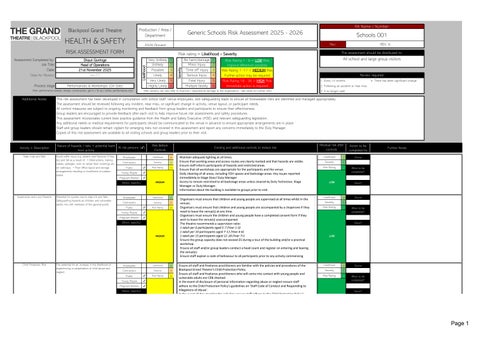
This risk assessment has been developed in consultation with school staff, venue employees, and safeguarding leads to ensure all foreseeable risks are identified and managed appropriately.
The assessment should be reviewed following any incident, near miss, or significant change in activity, venue layout, or participant needs.
All control measures are subject to ongoing monitoring and feedback from group leaders and participants to ensure their effectiveness.
Group leaders are encouraged to provide feedback after each visit to help improve future risk assessments and safety procedures.
This assessment incorporates current best practice guidance from the Health and Safety Executive (HSE) and relevant safeguarding legislation.
Any additional needs or medical requirements for participants should be communicated to the venue in advance to ensure appropriate arrangements are in place.
Staff and group leaders should remain vigilant for emerging risks not covered in this assessment and report any concerns immediately to the Duty Manager.
Copies of this risk assessment are available to all visiting schools and group leaders prior to their visit.
Maintain adequate lighting at all times.
Ensure that working areas and access routes are clearly marked and that hazards are visible.
Ensure staff inform participants of hazards and restricted areas.
Ensure that all workshops are appropriate for the participants and the venue.
Daily cleaning of all areas, including FOH spaces and backstage areas. Any issues reported immediately to Stage Door/ Duty Manager
Access to remain restricted to all backstage areas unless cleared by Duty Technician, Stage Manager or Duty Manager.
Information about the building is available to groups prior to visit.
Organisers must ensure that children and young people are supervised at all times whilst in the venues.
Organisers must ensure that children and young people are accompanied by a chaperone if they need to leave the venue(s) at any time.
Organisers must ensure the children and young people have a completed consent form if they wish to leave the venue(s) unaccompanied.
The theatre recommends a supervision ratio:
1 adult per 6 participants aged 5-7 (Year 1-3)
1 adult per 10 participants aged 7-11 (Year 4-6)
1 adult per 15 participants aged 12-18 (Year 7+)
Ensure the group capacity does not exceed 35 during a tour of the building and/or a practical workshop.
Ensure all staff and/or group leaders conduct a head count and register on entering and leaving the venue(s)
Ensure staff explain a code of behaviour to all participants prior to any activity commencing
Ensure all staff and freelance practitioners are familiar with the policies and procedures of the Blackpool Grand Theatre’s Child Protection Policy.
Ensure all staff and freelance practitioners who will come into contact with young people and vulnerable adults are CRB checked.
In the event of disclosure of personal information regarding abuse or neglect ensure staff adhere to the Child Protection Policy’s guidelines on ‘Staff Code of Conduct and Responding to Allegations of Abuse’.
In the event of documenting the activities ensure staff adhere to the Child Protection Policy’s
Allegations of Abuse’.
In the event of documenting the activities ensure staff adhere to the Child Protection Policy’s guidelines on ‘Use of Photography and Video Material and Text’.
Ensure that male and female toilet facilities are available and that staff verbally inform participants of their location.
Ensure employees are fully aware of staff members in the building who are fully trained and qualified in first aid at work.
Ensure staff are able to contact qualified staff directly
Ensure staff log all incidents in the Incident Book at Stage Door.
Prior to any performance a pre-show briefing takes place and any first aiders on duty are pointed out to the whole team.
Suitable and sufficient signage is in place around the premises detailing who is a first aider and how they may be contacted.
Should a member of a visiting group require first aid every effort must be made to ensure that a chaperone, from the visiting group, accompanies theatre employees when performing first aid – unless in a major incident when this is not practical
FOH Staff to assist person going onto and off stage.
Should a member of a visiting group require first aid every effort must be made to ensure that a chaperone, from the visiting group, accompanies theatre employees when performing first aid – unless in a major incident when this is not practical.
Stage manager to ensure person going on stage are kept away from the edge
FOH staff have torches throughout the shift
Pre performance checks of all FoH and auditorium areas – any issues are reported to Stage Door/ Duty Manager
Should a member of a visiting group require first aid every effort must be made to ensure that a chaperone, from the visiting group, accompanies theatre employees when performing first aid – unless in a major incident when this is not practical
CCTV covers much of the main auditorium and infra-red cameras are in use.
Theatre employees are advised of theatre Safeguarding Policy.
Pre performance checks of all FoH and auditorium areas – any issues are reported to Stage Door/ Duty Manager
Should a member of a visiting group require first aid every effort must be made to ensure that a chaperone, from the visiting group, accompanies theatre employees when performing first aid – unless in a major incident when this is not practical
CCTV covers much of the main auditorium and infra-red cameras are in use.
Theatre employees are advised of theatre Safeguarding Policy.
Children, young people or vulnerable adults must be supervised by group leaders at all times.
Staff trained to ask patrons to keep any items including coats off balcony ledges to stop possibility of items falling down.
Staff sat in auditorium during performance to watch over the audience.
Staff trained to ensure that patrons remain in their seats during the performance
Drinks taken into the auditorium are requested to be decanted into plastic cups to minimise risk of heavy falling objects
First Aid Kits are available throughout the premises and sufficient levels of staff trained in their use.
Gallery level has railings to minimise risk of objects falling.
Box office Team to inform ticket bookers of any shows specific content that may cause concern
Stage door and Duty Manager procedures ensure checks are in place to ensure all relevant lighting switched on for a performance and when light outside is dark
lighting switched on for a performance and when light outside is dark
ice-packs on premises to deal with injuries
First Aid Kits are available throughout the premises and sufficient levels of staff trained in their use.
FOH staff fully trained in evacuation procedures.
Fire extinguishers provided in key locations in building – FOH staff trained in use of fire
The theatre’s fire evacuation plan and show stop procedures are written, communicated and rehearsed periodically with all employees understanding their role in the event of an emergency.
Key staff members have radios and can communicate with each other.
All management are aware of the procedures and follow them.
Fire evacuation routes are all checked prior to each performance.
Rooms which are used for participatory work by the creative learning team are checked prior to any event taking place and any emergency exit routes are checked prior to any event commencing.
Exit corridors and staircases walked each day by Duty Manager to remove any trip hazards and obstructions to walkways.
FOH staff fully trained in evacuation procedures.
Evacuation chairs provided to assist disabled pupils out of building
FOH staff fully trained in use of evacuation chairs – staff receive regular training in use of evac chairs
Usher stationed inside the auditorium throughout the visit.
Each level has a box containing equipment for cleaning up body spills.
Sick bags available if requested.
All biohazard waste is disposed of through incineration – biohazard bin located under stage in cleaners’ store room.
Daily cleaning of all areas, including backstage, the space and the studio. goggles and gloves to be worn when cleaning body spills.
When using equipment such as scissors in workshops provided by the Grand Theatre attendees are instructed as to the safe use of such items.
All equipment is suitable for use in the setting, inspected regularly and records maintained.
Staff monitor audience when on the premises and monitor for any problems as they arise.
School/ group staff should supervise their attendees whenever they use the lifts.
First aid available if necessary.
Grand Theatre employees are trained in safeguarding and counter terrorism.
Regular security updates provided to all employees.
All fire exits and escape routes are checked and secured throughout business trading hours.
Staff trained in evacuation procedures and on hand to manage an emergency.
Staff are first said trained and on hand to assist.
Additional security measures are implemented in accordance with national security threat level.
Group leaders must supervise their own party at all times.
First aid provision on site including defibrillator and PaCT Kit provided by Blackpool Council.
All backstage areas are governed by access controls and signage in place to deter unauthorised access.
Staff are told to challenge any unknown persons backstage.
CCTV in operation and monitored throughout the day/ when building is occupied.
Designated drop-off zones, staff supervision at arrival/departure, clear instructions to schools/parents.
Clear