Power shapes our choices, our institutions, and the societies we build, yet it rarely operates in simple or transparent ways. Principle, meanwhile, is what we claim guides us, whether that is our ethics, our values, or our sense of what ought to be. This edition of The Thinker brings these two forces into conversation, not to offer tidy answers, but to assess the tensions that emerge when ideals meet reality.
Across this issue, we will explore how power is justified, how it is resisted, and how individuals and communities navigate the space between influence and integrity. Some essays look at the philosophical foundations of authority; others consider the moral decisions that reveal what principles actually look like in practice Together, they show that thinking seriously about power is inseparable from thinking seriously about responsibility
We hope this edition encourages you to question assumptions, revisit familiar debates, and consider how both power and principle operate in your own life and in the world around you.
Happy reading, Serena, Safia, Amandine, Maddie, and Lara
01. The Nature of Power
“Power does not corrupt. Fear corrupts... perhaps the fear of a loss of power. ”
- John Steinbeck
Does
power have a shadow that comes at moral cost?
By Leila Corcoran, Y10
Power has always carried an atmosphere of inevitability, consisting of the sense that to shape the world, one must first learn to command it. It creates history, strengthens countries, and enforces order, yet beneath its brilliance lies something darker. Every act of control, however noble in intent, casts a shadow; a subtle distortion of motive, a quiet narrowing of empathy. Those who hold power rarely set out to lose their principles, but the very act of exerting authority begins to test them. The tragedy of power is not only that it corrupts, but that it does so almost invisibly; through small justifications, every “just this once ” , and softened truths which are the gradual surrender of conscience. Over time, these bends in behaviours become habits. In the end, the question is not whether power changes us, but how much of ourselves it demands in return.
Many pursue power with noble intentions of justice, order, or integrity for the world. Yet history and literature alike reveal how easily these ideals become corrupted once authority is attained. The exercise of power often demands moral compromise, as individuals begin to justify actions that contradict their original values. Shakespeare’s Macbeth offers a timeless illustration of this truth. Macbeth begins as a valiant warrior, celebrated for his loyalty to King Duncan, but the pursuit and maintenance of power consume him. After murdering Duncan, guilt and paranoia drive Macbeth to commit further atrocities in a desperate attempt to secure his position. In seeking control, he instead becomes enslaved by fear, revealing power ’ s shadow and its ability to corrupt intention and erode morality, ultimately leading to his downfall. The same is seen in today’s modern world, where many leaders continue to convince themselves that control is moral because it preserves order, protects people or fulfills the ‘word of god’ Although in some cases it can be, in other cases it can lead to dictatorship or mass oppression Even today’s powerful leaders can twist reality inside their own minds so they can justify their actions This demonstrates the first moral cost of power: the corruption of intention.
Human nature means that we crave power. It is not unnatural. It is not uncommon. However, it can be argued that the more control one holds, the further one drifts from empathy and accountability. This is proven by psychological research done that has extensively explored the concept of the “empathy gap ” . This study refers to the tendency for people in powerful positions to underestimate the influence of their own emotions on decisions they make, or ideas they form. This eventually leads to people in positions of power having a lack of empathy for others that have differing emotional states to their own, because they may make decisions that affect others badly due to the unconscious bias that their emotions have on that decision Relating the “empathy gap ” back to having power, when a leader is making a decision that will impact others, they may struggle to fully comprehend other people’s personal situations and emotional states, especially if those individuals are feeling heightened emotions such as stress or anger. This can cause people in positions of power to potentially make underwhelming or even ‘ wrong ’ decisions in the given situation for the people it affects. For example, a manager may put in a new policy which intends to improve results or efficiency of a given business without fully considering how it might affect morale or stress levels. Additionally, the “dual judgement model” shows that one of the ways that humans make judgements on others, is through this strategy. This entails the individual thinking about what they would do in the given situation that someone else is facing, and
then adjusting these assumptions based on the differences they perceive between that person or group of people, with themselves. This often leads to large empathy gaps as this is not the most reliable method Types of models or studies such as these prove that although leaders don’t set out with the goal of lacking empathy, it may end up becoming that way, without even realising so, and thus could lead to a lack of morality and invisible ethical decay, as they get used to this way of decision making; and so start to push the boundaries to see how much they can get away with. Overall, having power means having that gap in emotional states and understanding with others, which causes the gradual moral shift toward a more significant moral cost that comes with power, proving the second cost of having power: the loss of perspective.
Now the most dangerous stage of power begins. Once perspective is lost, principle begins to follow. What starts as blindness slowly turns into justification. When power, instead of serving its purpose, starts to protect itself Preserving control and authority over something requires moral, and principle flexibility, including the slow bending of values Leaders manage to convince themselves that, given a situation needs it, they have no choice but to do something ethically challenging for the greater good or to save something; that if they do something “just this once ” they won’t ever do something like it again. This is a slippery slope that many promise themselves never to fall down in the beginning, then end up rewriting the definition of ‘good’ to make sure they don’t think they have crossed that line, as well as to suit their future goals. The fear of losing the power that they once craved replaces the original purpose that once justified having that power This isn’t just demonstrated in politics or literature, but also in personal relations For example, a person who chooses to manipulate their friend for ‘their own good’ is justifying a debatably immoral action by morphing the reason into something beneficial, rather than admitting that they shouldn’t be doing the action either way. Further evidence of this being done in real life is shown after the United States justified extraordinary measures after the September 11 attacks, including mass surveillance, indefinite detention, and the use of torture at sites like Guantánamo Bay, all in the name of national security. The defense of liberty and human rights that were supposedly meant to define American democracy were now compromised and corrupted, demonstrating the gradual slip and decline of original moral values due to the gain of power. Plato’s idea of The Ring of Gyges tells the story of a shepherd who comes across a ring that he finds can make him invisible. When he realises that he can do anything he wants without consequences binding him to being moral, he murders the king and takes the throne. This tale shows us that even a just person may become corrupt if given the ability to act without accountability A person with power may have the ability to get around accountability measures that are put into place, resulting in making large-scale decisions that affect many and justify them, even if the justification has stemmed from convincing themselves that they are doing the right thing, which makes it very tempting and difficult to refuse giving into moral corruption as a leader.
By the time principle has been transformed into performance, power ’ s shadow has diminished the might that first gave it purpose or meaning. However, the awareness of that shadow and the refusal to accept moral corruption, is the only path back to integrity Power can be used in many good ways to help, support and better communities and the world, as long as we are aware of its moral intensity Being an ethical leader does not mean trying to remove the shadow of moral cost, but being aware of the responsibility that comes with being in a position of power to not give in to the temptation or mistake control for virtue.
Perhaps the true test of power is not how brightly it shines, but the control over how powerful the shadow gets.
Is power, when unaccountable, ever truly ethical?
By Nicole Zabelina, Y9
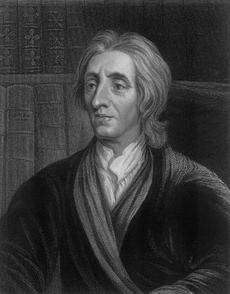
This question has been a long-standing philosophical debate with no simple, exact answer, and is greatly dependent on which approach the individual takes - one more focused on rules and consequences, or one based on the character of the person wielding power. Firstly, John Locke’s theory on separation of powers is built on the thought that accountability is needed for legitimate governance. He argued that it was a “temptation for human frailty” for the same people to have both legislative (law-making) and executive (law-enforcing) power, as they could exempt themselves from the laws they had created. Locke’s core belief was that this separation was essential to prevent tyranny and establish a fair system where those who make and execute the laws cannot exempt themselves from obedience He also believed in the Rule of Law and emphasised that all people must operate under the law, including those in power.
Moreover, in his moral and political philosophy, Immanuel Kant argues that moral requirements are unconditional demands of reason that apply to all rational beings, and that all people in a civil society have to answer to the universal laws to ensure that their right to equal freedom can coexist with the freedom of everyone else. This can be seen in the political sphere through the idea of a social contract based on “ pure reason ” .
These two figures base their theories on the rules and consequences of unethical unaccountable power, showing us that without structure and accountability, our society and social systems can very easily become unethical and lead to actions that put moral requirements at risk These observations make sense and there have been many examples of unaccountable power leading to terrible outcomes These include, The Roman Empire (emperors such as Nero and Caligula became notorious for their violence and cruelty, leading to rules of oppression), Nazi Germany under Adolf Hitler (Hitler, through the manipulation of democracy during a period of instability, gained total power, leading to the Holocaust and other atrocities) and Military Dictatorships (in modern history, military dictatorships have seized power through coups and committed human rights abuses). Having said this, Locke’s and Kant’s views on power could be considered narrow, as they do not take into account certain exceptions to their statements. For example, in highly specialised fields, an expert might have decision-making power that is largely unaccountable in the immediate moment, because only they possess the necessary knowledge. In those situations, there has to be trust in the expert that they will act in the best interests of others and use their expertise to make an ethical decision. In general, if an individual is elected or appointed by the majority to be in a position of power, then surely the people should trust them and that their actions will be ethical and justifiable
A philosopher that supports this argument is Thomas Hobbes, who said that to avoid a state of constant conflict and instability people must put their trust into an unaccountable individual who will decide on every social and political issue In his opinion, if we attempt to make the unaccountable individual accountable to the people, it would undermine said individual, leading back to chaos
Friedrich Nietzsche has a very different concept of power, one that explores the “will to power ” (a central concept in his philosophy that is a drive found in all living things to exert their strength and overcome resistance). He also rejected the concept of human accountability, considering it to be a “fateful error ” and something used to punish individuals. Instead, Nietzsche asks us to embrace personal responsibility: the responsibility to build one ’ s own values, overcome personal limitations and live a life of authenticity, separate from other people. This approach is very different to the two main arguments stated before - whether unaccountable power is ethical or unethical. Instead, it furthers thinking and develops ideas of personal power and that we are our own person and should live an original life, full of our own values and beliefs.
Overall, I believe that unaccountable power is unethical and more often than not, it leads to circumstances where an individual abuses the power, destroys morals and does not comply with the laws put down by accountable power Accountable power is more just and ethically right - all people have to answer for their actions and nobody is superior enough that they are exempt from answering to all moral codes. Everyone has to abide by the same rules and laws as everybody else.
To what extent is modern authority sustained by principle rather than force?
By Janai Anand, Y11
Many assume that power exists primarily through force after observing leaders asserting control through threats, punishment, and hierarchy In authoritarian regimes or other rigid systems, coercion can result in compliance temporarily, but in reality, power is far more nuanced than this. Modern authority often persists not only due to compulsion, but because people willingly participate in hierarchies, as they are influenced by widely accepted beliefs or comforted by the stability that this structure offers.
While pressure can be effective in certain contexts, modern authority typically relies on influence. This is illustrated in the work of Michael Foucault, who differentiated between sovereign power, which was common in pre-modern monarchical societies and relied on force, and disciplinary power. This form of power shapes individuals into ‘docile bodies’, which can be ‘subjected, used, transformed, and improved’ so that they are productive and able to be controlled. A more specific example is the ‘Panopticon’, a theoretical prison which features a central tower from which guards can see prisoners in surrounding cells, but the prisoners cannot tell if or when they are being watched This forces them to restrain themselves and behave as if they are always under surveillance If this is extended to wider society, individuals often mirror this behaviour by adhering to rules without explicit supervision, which suggests that power is more effective when it is self-enforced.
The concept of ‘principle’ is a cornerstone of the topic of disciplinary power. This term is defined as ‘ a fundamental truth or proposition that serves as the foundation for a system of belief or behaviour’, in this case, the hierarchy. Principles can take multiple forms, including unwritten social norms, religious, and political ideologies. To put this into context, a widely acknowledged principle is that of seniority, where, in workplaces, employees who have served the longest are seen as more deserving of a higher rank. Similarly, in many religions, spiritual authority is accepted as a legitimate form of authority, and therefore believers may obey figures such as priests for this reason. Through principle, authority is not a system of control; instead, it is one that individuals respect of their own accord, as principles form a considerable part of their own morals
Authority is also sustained due to the tendency of the human condition to seek structure. Hierarchies and rules provide stability and predictability in a world of uncertainty. Even when individuals are free to resist, the comfort that rules provide can make authority figures and hierarchies seem more legitimate. Existentialist philosophers like Jean-Paul Sartre argued that humans are ‘condemned to be free’. He realised that without a God or an authority figure governing humans on the way of life, humans can choose their identity as a whole, and coined the term ‘radical freedom’ to describe this concept. However, Sartre saw this radical freedom as a burden, as humans are accountable for all of their choices, and this is a significant responsibility. Consequently, many individuals may elect to accept external structures that do the task defining their purpose for them, even if that is at the cost of their own autonomy.
Furthermore, modern authority is strengthened by cultural reinforcement Power is not solely maintained through the government, but through societal and cultural norms Social
media, education, and pop culture indirectly define what is considered normal and morally permissible, which can sometimes paint hierarchy in a more appealing light. Antonio Gramsci, through his notion of cultural hegemony, argued that the ruling class maintains power by winning the ‘spontaneous consent’ of the masses Hegemony works by presenting the values as ‘ common sense ’ or ‘the only plausible way to uphold society’, so that this idea is ingrained in people’s minds and they are forced to accept the status quo For example, education, particularly in subjects such as history, may present certain hierarchies as normal, or social media, including algorithms and likes, may reinforce norms surrounding the essentiality of social validation and status.
Ultimately, modern authority highlights the complexity of power, revealing that it is supported not just by force, but also numerous factors like principles, human nature, and culture. By ingraining itself within society, power gives individuals a sense of autonomy and control while simultaneously maintaining an orderly and law abiding environment. As a result of this, most modern obedience is not imposed from external forces, but it comes from within humanity.
Power and the Soul: Havel, Dostoevsky, and the Ethics of Refusal
By Gaby Cates, LVI
Power is usually imagined as something external: the ability to compel, to rule, to enforce Principle, by contrast, seems much more fragile, becoming a matter of conscience, easily crushed by force or fear. Yet the history that stands behind modern thought dismantles and blurs these distinctions. From Dostoevsky’s tormented novels to Václav Havel’s political essays, we get a different idea of power, not as domination, but as fidelity to truth. There is, between the two authors, an understanding that real authority begins not in command, but in refusal.
When Havel wrote The Power of the Powerless in 1978, he described a society built on collective preference. In the Czechoslovak socialist state, ideology was not only believed but performed. A greengrocer hung a sign in his shop window stating ‘Workers of the world, unite!’ not from conviction but because failing to do so might draw suspicion. Havel’s insight was to see that this performance, repeated by millions, sustained the regime more effectively than any police force Power, he argued, depends as much on obedience to the lie as on fear of punishment The act of resistance, then, begins with a quiet refusal When the greengrocer decides not to display the sign, he breaks no law, but he shatters the shadowy illusion on which the system rests. Havel calls this ‘living in truth’, the phrase itself being deceptively simple. It means aligning one ’ s actions with reality, even when reality is dangerous to acknowledge. The power of the powerless lies in that alignment; truth, once embodied and emboldened, exposes falsehood without the need for imperial imposition. Just a century earlier, Dostoevsky had already traced the moral psychology that makes such falsehood possible. In Notes from Underground, his unnamed narrator prides himself on his total freedom, obeying no law, acknowledging no principle, answering to no God. Yet his rebellion, meant to affirm autonomy, collapses into self-contempt. Freedom without honesty, Dostoevsky suggests, is not liberation but decay the will turned inward, gnawing at itself. The Underground Man’s paralysis is the mirror image of Havel’s greengrocer; both are trapped by systems of deceit, one public, one private.
In The Brothers Karamazov, Dostoevsky developed this theme into a parable of power Ivan Karamazov’s ‘Legend of the Grand Inquisitor’ imagines Christ returning to earth, only to be arrested by the Church. The Inquisitor explains that humanity cannot bear real freedom; they prefer to surrender conscience in exchange for security. The speech is chilling precisely because it is reasonable. It anticipates the logic of every modern tyranny: that people will trade truth for comfort, responsibility for order. Dostoevsky saw, long before Havel lived it, how oppression begins not with force but with the willingness to be deceived.
For both writers, conscience is not a private luxury but a political force Havel’s dissidents, like Dostoevsky’s saints and sinners, insist that freedom begins in the soul To ‘live in truth ' is to reject the seduction of conformity, to refuse to let one ’ s moral life be outsourced to
ideology or authority. It is, essentially, a demand to remain human. But neither writer mistook this for heroism. Havel knew that truth-telling could be wearying, even isolating; he himself spent years in prison for it Dostoevsky’s characters suffer from their own lucidity they know too much, see too clearly Conscience offers no guarantee of peace The Underground Man’s misery, Ivan’s fever, Alyosha’s compassion, Havel’s dissident melancholy all testify that to live according to principle is to live under pressure Still, this kind of integrity possesses a compelling contagion. One person ’ s refusal makes it harder for others to keep pretending. Havel observed that totalitarian systems collapse not through coups but through a gradual awakening of conscience an erosion of the lie’s credibility. The same could be said of Dostoevsky’s moral universe, where the faintest act of goodness has disproportionate force. Both men believed that the strength of a society depends less on its rulers than on the spiritual condition of its citizens. Today, the compulsion to conform operates through subtler means. Few are forced to display political slogans; we perform them voluntarily. The greengrocer now has a digital shopfront, his window replaced by a screen. The pressure to belong, to signal belief, to live within the convenient half-truth, has not vanished it has changed form. We live, as Havel warned, in systems that reward obedience to unreality. It is easier to imagine that conscience ceases to matter in such conditions, yet Havel and Dostoevsky suggest the opposite: that the private act of refusal, the decision not to join in the lie, still carries moral weight Their work belongs to an unfashionable tradition one that treats the human soul as the first and last site of politics. The health of that interior world determines the fate of the external one.
Dostoevsky wrote, in The Brothers Karamazov, that ‘ man is broad, too broad; I would narrow him.’ It was his way of acknowledging that human nature contains both tyranny and transcendence. Havel, echoing that sentiment in secular terms, spoke of the need for ‘antipolitical politics’, giving us a politics grounded not in ideology, but in humility, responsibility, and truth. Between them runs a shared conviction: that principle is not the opposite of power, but its moral foundation. The ‘Power of the Powerless’, then, is the strength to remain answerable to one ’ s own conscience when everything around encourages surrender. It is a small power, often invisible, but it endures when other forms of power decay. To live in truth is not to win, but to stay human in a world that makes that increasingly difficult And in that endurance lies the only kind of authority that cannot be taken away
The nature of power: Is power intrinsic to human nature, or a construct imposed by society?
By Victoria Young, LVI
Power has long occupied a central position in philosophical inquiry, being essential in understanding relationships, the structure of societies and human nature itself. But what can we define as the nature of power? Is it an intrinsic aspect of humanity, an impulse we are allured to? Or is it a construct, imposed on us by society to constrain the inevitable and force order upon us. And if all power was removed, what would remain?
To understand the nature of power, we must initially consider whether or not power is intrinsic to human nature. The argument that it is begins with the observation, or more so the assumption that humans display an early and persistent desire to exert influence over our environment, ourselves and others. So, if this is fact, then what is it about the intoxicating allure of power that makes us desperate to wield it? Through the lens of Friederic Nietzsche, the answer lies not in simply gaining control, but in our own freedom. His concept of the ‘will to power ’ suggests an impulse that does not need to be understood as inherently negative, but rather represents power as a strive for freedom rather than domination The concept of the ‘will to power' can be best understood as an irrational force, found in all individuals, that can be channeled toward different ends. Nietzsche describes one particular form of the ‘will to power ’ as ‘self overcoming’, where it is harnessed towards agency and self improvement. While we may think that the appeal of power rests in its ability to allow a gain of control, Nietzsche advocates for the notion of the real appeal of power: autonomy.
Nevertheless, power is inherently relational. To possess it must involve a gap in authority so that you may hold it over someone or something else. This introduces complexity to the concept of power, raising the question of whether the desire for power is made up of a primal urge to dominate and control others, or if it is a manifestation of the necessity of autonomy. A psychological study was conducted in Columbia University in 2016 to satisfy the question of whether influence or autonomy would best quench people’s thirst for power, and its outcome indicated that individuals motivated by power actually do seek control over their personal lives rather than subjugation of others Power, then, functions not as an instrument of tyranny but rather a natural human longing for autonomy which is outwardly mediated.
Alternatively, power can be conceptualised as a construct imposed by society to sustain order; a necessary framework to prevent anarchy and moral disintegration. But if society is so fragile that we cannot exist without power and authority, then what happens when these frameworks are removed? William Golding's ‘Lord of the Flies’ powerfully illustrates this tension in his book, acting as a direct counter narrative to R. M. Ballantyne’s ‘The Coral Island’. While Ballantyne presents an overly romanticised view of civilisation, Golding rejects his ideas, presenting authority and power as fragile constructs vital to restrict humanity's latent capability for violence. On his fictional island, external authority collapses, and the boys’ inevitable regression into savagery implies his views surrounding the necessity of fabricated power structures
Karl E. Weick, whose ideas lie somewhere in the middle of both sides, suggested that power is one possible outcome of how people react to uncertainty, rather than a fixed resource. He emphasised the crucial role that language and culture plays in the process of individual and collective sensemaking People utilise vocabulary available to them to construct meaning, and although he stresses that there is ultimately no correspondence between words and the world, in the sense of power, words which are socially constructed influence and shape understanding and sensemaking of reality. The significance in this is that words and cultures morph perception in ways which privilege certain interpretations, while obscuring others. Consequently, there is a relation formed between power and communication, where communication is utilised to obtain power, and power is distributed through communication. From Weick’s perspective, power is created between individuals through processes of sensemaking and execution, rather than being fixed structures.
Michel Foucault, a French philosopher in the 20th century, had a distinct theory about power, which operated on a different level from other theories. Power, for Foucault, was something which cannot be held or owned by individuals, but rather produced and exercised through social interactions. Foucault challenges the notion that power is wielded by people or groups, instead claiming that ‘ power is everywhere’ He uses the term ‘power/knowledge’ to show that what we accept as truth is created through power relations, and in turn, reinforces them. Being one of the few philosophers who recognised power as necessary and productive, he said:
“We must cease once and for all to describe the effects of power in negative terms: it ‘excludes’, it ‘ represses ’ , it ‘ censors ’ , it ‘abstracts’, it ‘masks’, it ‘conceals’. In fact power produces; it produces reality; it produces domains of objects and rituals of truth. The individual and the knowledge that may be gained of him belong to this production.”
So how can power best be understood? We can indeed, as several thinkers do, view it exclusively as either an intrinsic aspect of humanity, or at the other end of the spectrum, as a socially imposed construct. Or we could, as Weick does, instead understand power as that liminal space in between, something which is harnessed through collective sensemaking. But perhaps the most enticing perspective is that of Foucault, whose thoughts led him to the conclusion that power acts independently and radically isolated from either of these realms, available universally for us to seize and use to our advantage.
02. Politics of Principle
“Is it better to be loved or feared?”
Niccolo Machiavelli, The Prince
The tension between societal power and moral principles in Pride and Prejudice
By Ananya Padhi, Y10
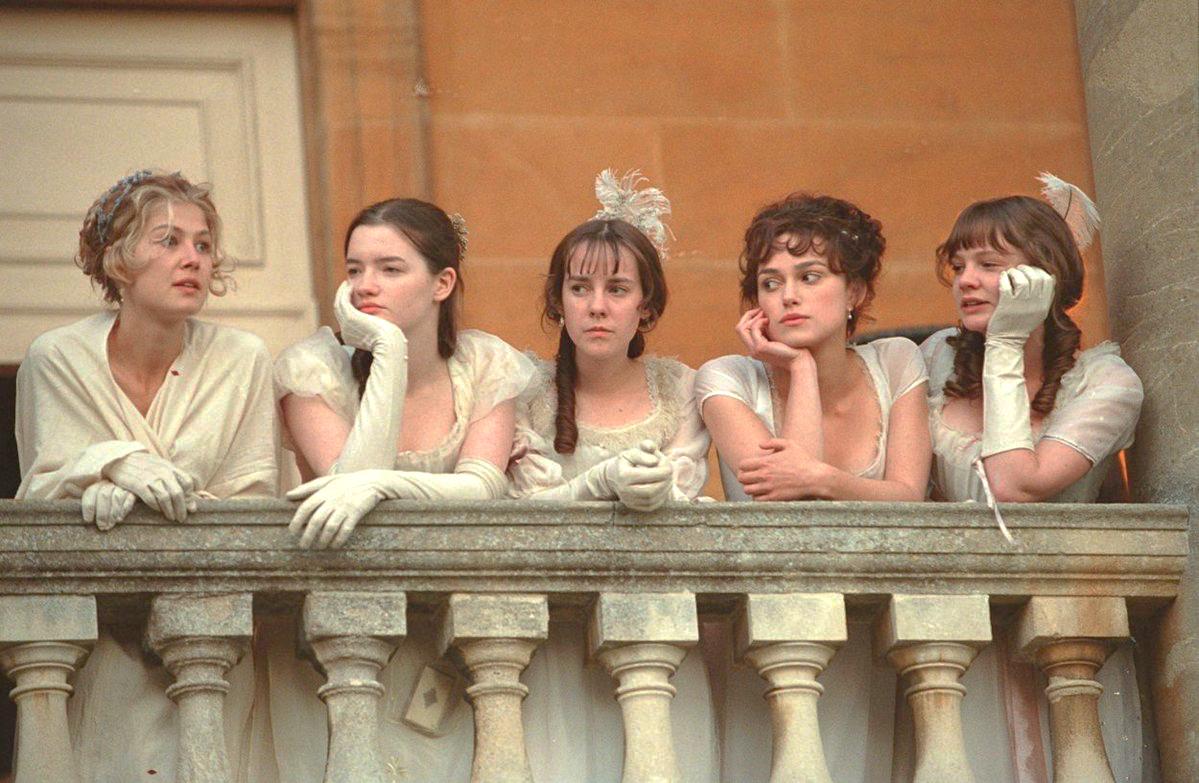
Pride and Prejudice is a literary masterpiece in terms of its plot and characters but also due to its evident critique of societal power, wealth, social standing and gender Austen presents societal power as a potentially corrupting force for a character, creating undeniable tension between this power and moral principle especially through the characters’ familial, platonic and romantic decisions. Austen then utilises the tension to explore moral compromises preceding the growth in societal power for a character, championing integrity and the value of staying true to oneself over growth in societal power.
Elizabeth is the perfect embodiment of these moral principles, especially in regards to her prioritisation of her autonomy. This is highlighted when rejects both Mr Collin’s proposal an Darcy’s first proposal. At the time f woman, the only way to gain societ power was to marry or inherit their father’s wealth and since Elizabeth family was poor, she was expected marry Collins to gain this power an stature not only for herself, but for family as well. However her refusal so emphasises her integrity and resistance to societal pressures that dictate a woman ’ s choice. She chooses not to marry Mr Collins for her own happiness and refuses Darcy’s first proposal after he insults her family and explains his love for her alongside his disdain for her social standing. Elizabeth tries to protect her sister by the refusal of Darcy’s proposal as she accuses Darcy of trying to keep her sister, Jane, and Darcy’s friend, Mr Bingley, apart romantically. By prioritising self respect over social advancement, Elizabeth becomes Austen’s vehicle for challenging the societal norms at the time of publication
In contrast to Elizabeth’s moral independence, Mr Collins is a symbol of this very societal greed, proposing to Elizabeth only so he could have a ‘respectable’ wife One could also argue that another motivation for his proposal was simply to make his inheritance of the Bennett’s mansion smoother by marrying their daughter. When proposing to Elizabeth, he lists his ‘ reasons for marrying’ and how he believes ‘it a right thing for every clergyman in easy circumstances’ to get married. This emphasises Collin’s mechanical and self important approach to marriage, he sees marriage as a duty rather than an emotional connection and perhaps Austen writes this in order to reflect how marriage at the time was often seen as a social or moral obligation rather than a romantic preference. Collins also has an undeniable obsession with social standing and patronage depicted through the boasting of his own patron, Lady Catherine De Bourgh and the defining of his own self worth through the Lady’s status. Collins is described as never speaking of her ‘but with the uttermost respect’ and
blatantly flattering her. He talks often about Lady Catherine’s ‘condescension’, especially bragging to Elizabeth about how Catherine’s great attentions to ‘Mrs Jenkinson are a proof’ of this condescension The idea of ‘condescension’ reflects the growing ideas at the time of class superiority and is used by Austen to critique how characters like Mr Collins compromise their self worth and deeply grovel for the rich and powerful Through the entirety of Elizabeth’s stay with Mr Collins, it is evident that Lady Catherine is a figure of micromanagement and arrogance as a result of her societal power and she uses this to manipulate a greedy yet naive Mr Collins into adopting a servant-like role. It is clear that Lady Catherine has been corrupted by this tantalising societal power herself.
Mr Collins eventually does get married in Pride and Prejudice, to Elizabeth’s friend, Charlotte. Charlotte was in desperate need of a stable income and household as she was drowning in societal pressures and the burden of still relying on her parents at twenty seven years old. At the time, being a twenty seven year old woman probably meant you were married and maybe even had children. Charlotte’s diversion from the social norms pushed her towards marrying Mr Collins, the only man whom she had received a marriage proposal from. She was so hasty and desperate, she took the first man who would take her, disregarding her own self worth and opinions about Mr Collins in the process Charlotte was also a fairly easy going and intelligent girl and so Austen uses Charlotte as a symbol of innocence and naivety suggesting how easy it is to succumb to societal norms and reject one ’ s own moral principles in the process, especially gender associated pressure, in order to gain societal power. Together, Collins and Charlotte exemplify the destructive influence of societal power on morality and principles.
However, Austen emphasises that change from greed brought on by societal power can be traded in for improved moral values through her depiction of Mr Darcy. At the beginning of the novel, Mr Darcy is described as being ‘ the proudest, most disagreeable man in the world’ by Elizabeth, based on Darcy’s pride and cold demeanour at the ball. Elizabeth’s annoyance is also partly fuelled by Darcy’s initial insult of her, how Elizabeth is ‘tolerable, but not handsome enough’ to tempt him. Elizabeth creates this hasty impression of Darcy in her mind and Austen uses this impression to explore how prejudice and social arrogance can cloud judgment Mr Darcy goes through a revolutionary character development, learning not to humiliate or judge people like Elizabeth for their class and become a more modest person himself He also saves Elizabeth’s sister Lydia from elopement with a ill meaning man with no monetary gain for himself, he just does it to make Elizbeth happy. It can be argued that he only prioritised moral principles over societal power for love, his love for Elizabeth, and this idea can be furthered as his change truly began after Elizabeth rejected his first proposal. However, one has to start the change in mindset for a reason and love is a fairly noble cause to prioritise moral principles for. We don’t actually have an insight into Elizabeth and Darcy’s marriage but one can hope that he doesn’t revert back to his old ways. By displaying Darcy’s journey as one of valuing societal power to eventually prioritising moral principles, Austen emphasises that change is possible with hard work and resilience as well as hinting at how tension b t i t l d l i i l di l d ding on the intent of the a
The Moral Ambiguity of Foreign Intervention: Balancing Principle and Power
By Chloe Crowther, Y10
In modern society, power and principle are deeply entangled in politics, with the actions of states often scrutinized for being motivated by power and greed rather than moral purity This delicate balance between the moral duty to intervene and to refrain from engagement is particularly visible in the area of foreign intervention; the question no longer becomes simply whether to act morally, but rather how morality can be exploited to justify the exercise or restraint of power.
The principle of sovereignty is one that has existed between foreign powers since 1648, and remains a cornerstone of the UN that has brought together its member states- states have supreme political authority over their domestic affairs, into which other states should not intervene. Naturally, in this line of thought, intervention appears to undermine political legitimacy. However, recent military interventions and the establishment of various human rights documents such as the Convention on the Prevention and Punishment of the Crime of Genocide (1948) has eroded this view of state sovereignty, calling into question what should be prioritised: the independence of nations or the protection of civilians? How can the perpetrators of a genocide be brought to justice when the state itself is the actor? This avenue of subverting state sovereignty has been augmented by the globally recognized norm of the Responsibility to Protect (R2P), which shifted the focus of debate from the right to intervene, to the duty of a state to protect. It represents a philosophical shift towards global moral obligation, inspired by ideas of universal human worth seen in the Universal Declaration of Human Rights. This framework places responsibility for the protection of citizens not only on the state, but also on the international community to intervene diplomatically, and finally militarily if necessary. Although R2P has the potential to alleviate suffering through military intervention, it can enable states to exercise their power over other nations with impunity, as in the case of the Libyan crisis, under the guise of R2P.
States often use humanitarian crises as a pretext to legitimize military action that may align with their own interests A recent example is the intervention in Libya in 2011, where, as a part of the Arab Spring, Libyan civilians rose up against their authoritarian leader, Muammar al-Quaddafi This escalated into armed conflict, and when concerns over attacks on civilians arose, the UNSC adopted a solution authorising “all necessary measures ” to protect the Libyan civilians. This triggered a coalition led by Western powers such as NATO to begin military operations, which led to the eventual overthrow of Gaddafi later that year, beyond their mandate. However, critics viewed the humanitarian crisis as a veil for Western geopolitical interests, given that many other states with more severe humanitarian crises, eg. Syria, were undisturbed, while oil-rich Libya was subjected to intervention. Additionally, after the intervention, Libya was left unstable, with the power vacuum leading to rival militias taking control, suggesting that there was insufficient planning for the safety of civilians, with the predominant goal appearing to be regime change. Many also suggest that in cases such as this, intervention leads to further civilian harm, as the lack of neutrality of the aid given can upend power balances in a civil war, leading to prolonged conflict. Intervention can therefore prolong suffering, especially when disturbing the balance of power in a state without a pathway to stability The question then becomes whether foreign intervention ever truly prevents harm
However, the opposite approach can have even more devastating effects. The 1994 Rwandan Genocide is a clear example of the consequences when intervention is needed but fails to occur Over the course of 100 days, it is estimated between 500,000 to 800,000 Rwandans were killed, mainly from the Tutsi ethnic minority Reports of increased tensions between ethnic groups and the buildup of militia groups reached foreign powers early in the conflict, but little was done. Major powers were hesitant to invest resources in a conflict with no strategic interest to them; Rwanda had low economic importance and there was little media coverage of the genocide. This tragedy embodies the words of Edward Burke:
“The only thing necessary for the triumph of evil is for good men to do nothing.”
This inaction, despite preserving the sovereignty of Rwanda, had devastating consequences, raising the question- does a state bear a duty to act beyond its borders when mass atrocities unfold, even if doing so requires sacrifice? This dilemma reflects the deeper philosophical tension between the communitarian belief of prioritizing one ’ s own citizens, with the cosmopolitan principle that moral worth transcends borders and moral obligations should be applied universally
Foreign intervention therefore exists in a moral paradox The moral principle behind intervention will always be clouded by other motives, always containing a modicum of self-interest. Power cannot be removed from decisions of intervention. The difficulty exists in ensuring that it remains disciplined by principle rather than disguised by it. Only then can foreign intervention aspire to protect rather than exploit, and uphold the values it claims to defend.
The Totalitarianism of Moral Purity in the Handmaid’s Tale
By Yasmin Elam Nasser, Y10
In Margaret Atwood’s ‘The Handmaid’s Tale’, totalitarianism is not portrayed by chaos, greed or ambition like one would expect Instead, it is represented through virtue and moral principle.
In this article, I will be exploring the use of moral purity and principle in the creation of the totalitarian regime, the Republic of Gilead, in the Handmaid’s Tale. The dystopian Republic of Gilead rises from the ashes of pre-existing social collapse, promising a purified moral order to a raw vulnerable population, that emphasises the importance of piety, chastity, fertility, obedience Its slogans are scriptural, its rituals sacred, and its crimes righteous. So how and when does it become a classic example of a totalitarian regime? Beneath this language of salvation and devotion lies a system of domination so complete and controlling that it no longer needs to justify itself, hiding behind the pretence of morality. Atwood’s dystopia exposes the paradox of moral purity: that the pursuit of absolute goodness, when made principle and law, becomes indistinguishable from evil.
The Totalitarianism of Moral Purity:
A totalitarian regime is seen as a political system in which those in power have complete control and do not allow anyone to oppose them, according to the Cambridge dictionary. Hannah Arendt described totalitarianism as the ‘despotism of an idea’; this is when ideology replaces thought and a single moral or political idea is allowed to explain everything, leaving no room for doubt On the other hand, I would define moral purity as an uncompromising extreme commitment to what one believes is good or right However, Atwood creates a totalitarian regime built on moral purity as she makes moral ideals instruments of control, where those in power justify their actions and oppressions through alleged ‘virtue’: morality and piety become the basis of domination. Gilead is built on a world of moral superficiality. It is a society ruled not by a person, but by a principle: that moral purity can redeem the world of their prior sins. The Handmaids, the Commanders, the Marthas, the Aunts and the Wives all live under the tyranny of an absolute idea that can never be questioned, only obeyed.
The Rise of Gilead:
But, the question is, how did society reach such a large extent of moral confusion, that they justify cruelty and violence with moral principles in the Republic of Gilead? The appeal of moral purity and order must begin in fear and isolation, stemming from a vulnerable population Atwood’s pre-Gilead America is a world of environmental ruin and moral anxiety
with fertility collapsing, violence, and political corruption. The new regime promises clarity, safety and order creating a world divided cleanly into the pure and impure. Nietzsche might call this a morality of resentment: the weak and fearful reasserting control by moralising what they cannot dominate Gilead’s leaders sanctify their envy of freedom by condemning it as sin The Wives sanctify their envy of the Handmaid’s fertility by punishing them in the name of virtue. The Aunts sanctify their envy of women who once had power and choice by condemning other women ’ s freedom as a sin. The complexity of life becomes unbearable and purity offers relief through its simplicity, creating a system Nietzsche would refer to as ‘slave morality’. To obey is to be safe.
Purity morphs into violence:
This appeal derived from simplicity is at the heart of Gilead’s power Its citizens submit not because they are coerced, but because they are convinced Rituals like the Ceremony are not seen as violations of the moral order but its fulfillment Each act of punishment or control is justified by scripture and ritual, turning cruelty into a sign of righteousness. The Handmaids greet each other with the pious ‘Blessed be the fruit’: they are not only forced to perform virtue but to inhabit its language. Atwood shows how tyranny can colonise not just bodies, but words and minds. In Gilead, ‘Unwoman’ designates impurity so absolute that it erases identity itself. The word becomes an execution. This mirrors Hannah Arendt’s philosophy, as the first step toward indisputable and complete influence is the control of language, for language sets the limits and basis of what can be thought.
The Internalization of Totalitarianism:
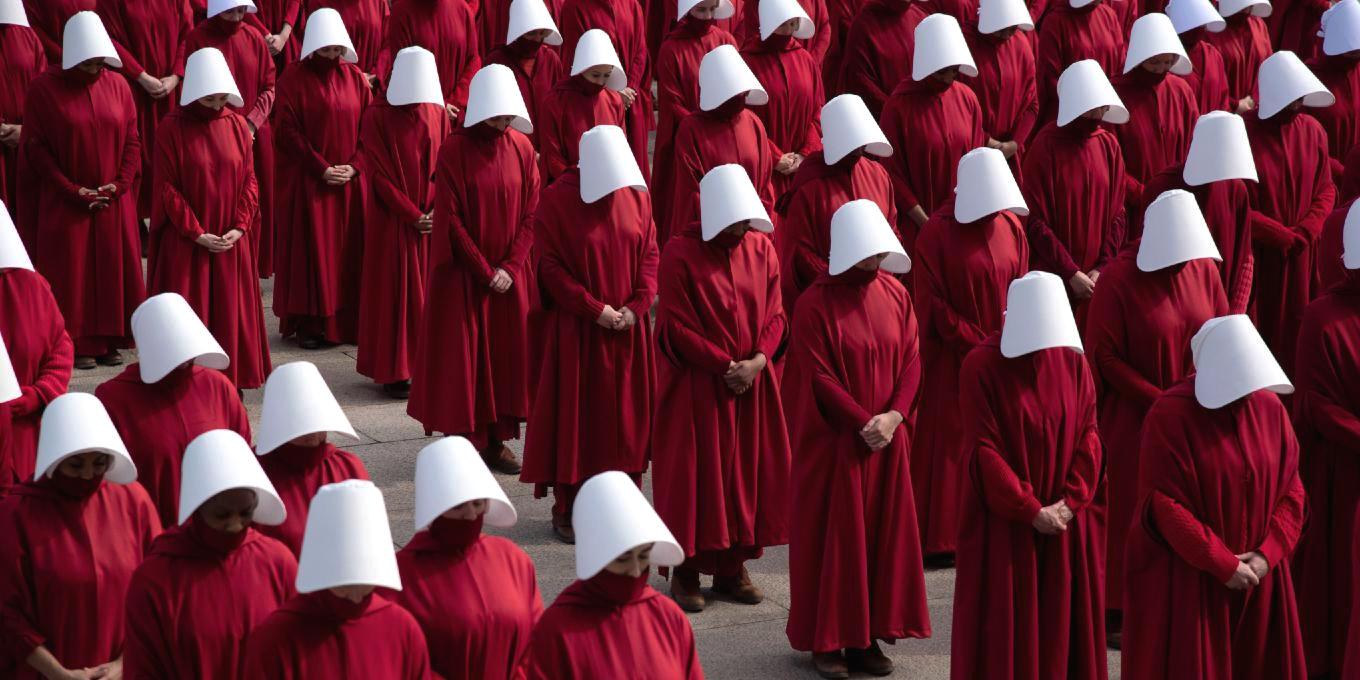
Even Offred, Atwood’s narrator, feels the pull of Gilead’s order Amid terror and forced submission, she sometimes longs for the very world that confines her Totalitarianism succeeds when its subjects internalize its principles, policing themselves in the name of virtue. Duty, stripped of reason and compassion, becomes a mechanism of control rather than a guide to morality. The Handmaids’ red uniforms, designed to erase individuality, also offer belonging, showing how rules can take root in both mind and body. What begins as obedience for survival gradually becomes obedience as faith, and fear transforms into conformity, fueled by a desire for safety and order. In this way, ordinary people, Aunts, Wives, and even the Handmaids themselves, participate in oppression without malice, performing cruelty simply because it is required and sanctioned, echoing Arendt’s notion of the banality of evil The people are convinced by the regime and the principles it follows, not only physically, but also psychologically, as it fully consumes and
controls them. This allows for the complete exploitation of the people by the regime, as they now have full control of them. Atwood’s narrative shows that tyranny does not arise from amorality but from morality made absolute, a principle that becomes both the justification and the instrument of oppression
The Instability of Absolute Principle:
Yet, even in a position where everyone believes in and accepts the oppression and violence they are subjected to everyday, Gilead soon realises that absolute and universal moral purity is inherently unstable and unachievable. Gilead must constantly invent new impurities to punish, resulting in the instability of its laws and rituals. Resistance and rebellion inevitably emerges; secret brothels (Jezebel’s), illicit reading rooms (The Commander’s Study), and hidden desires and resistance groups (the Mayday resistance network) all work beneath the surface, revealing the impossibility of absolute virtue. When principle is made absolute, it eventually negates itself. The regime’s obsession with perfection generates moral corruption on a very large scale, which we can imagine ultimately leads to its downfall, even though the novel ends in ambiguity
Gilead’s journey is somewhat complete: from societal fear and moral panic, and through the appeal of simplicity and order, to the internalization of obedience, and finally to the instability of absolute principle. The tyranny of moral purity has taken root not just in laws and rituals, but in minds and bodies. Atwood creates a world where order, obedience, and virtue, once moral principles, have become instruments of oppression. The system that promised salvation lives on in suffering, hypocrisy, and moral decay, a stark illustration of how the pursuit of absolute goodness can transform into tyranny.
03. Justice & Inequality
“Injustice anywhere is a threat to justice everywhere.”
- Martin Luther King Jr.
The faith of the fallen under colonial conquest.
By Lexi Murphy, Y11
Colonialism has reshaped and redefined the cultures and traditions of virtually every nation in the world throughout history: destroying, creating, and replacing religions in different ways. Religion, for the coloniser, served not just as a faith or way of life but acted as a sword to enforce doctrine and as a moral shield justifying their actions. For the colonised, religion became more than just a whispered history but a form of rebellion, a weapon of unity and resistance against the invaders. Under colonial rule, devotion was never simply worship; it was war.
Syncretism is the blending of different faiths into a single religious practice Spanish colonisation of Cuba led to the merging of Catholicism with African religions creating new syncretic faiths such as “Santería” (formalised in the late 19th century) and other practices like “palo monte” and “abakua”. Santería emerged during the transatlantic slave trade between the 16th and 19th centuries. Cuba required a vast enslaved labour force after Spanish colonisation decimated the indigenous population, so around a million enslaved Africans with diverse religious traditions primarily from Yoruba (a west African ethnic group) were brought to Cuba. To preserve their beliefs and culture they had to hide their deities“orishas” - as Catholic saints in churches. “Santería” combined elements of Yoruba culture and Catholicism. For example having a spiritual double who guides you from your head ties with the concept of “guardian angels” and the “protector spirits”. Born from secrecy and resistance, Santería became a testament to cultural survival when Spain had banned African religions and forced conversion to Catholicism It bred a lasting legacy of African identity within Cuban culture as Spain failed to achieve total religious control
Yet syncretism could also serve as a deliberate instrument of domination - a tool to disguise colonial power and gradually erase indigenous culture. Halloween for instance evolved from strategic religious syncretism. The ancient festival of Samhain was celebrated by the celts marking the new year but was strategically replaced by the pope Gregory IV, moving All Saints’ Day to the same date (in 835) to redirect ideas of spirituality to Christian ideology They morphed symbols of the dead and customs such as bonfires to fit the Christian narrative and erase Celtic tradition. Similarly when Rome conquered Greece, it absorbed Greek mythology. Rome equated Grecian Gods and stories with their own in a cultural rebranding. They placed Greek gods into their own categories, Ares for example became Marsreimagined as a disciplined and strategic god rather than a chaotic one. This allowed the Roman Empire to benefit from the long legacies of Greek art and philosophy, and prestige, facilitating easier integration into the empire with less rebellion.
However this strategy diluted the Roman identity and many did not take to this path believing it blasphemous to merge their gods with Romanic gods.
Spanish Colonisers in North America viewed the indigenous religions as “demonic” and sought to completely eradicate them and their power structures under the guise of “divine duty”. Destruction of sacred sites and idols, and the enforced indoctrination through forced baptism and reeducation, bans on languages and ceremonies and control over marriage resulted in countless tribal cultures being dismantled and the transmission of ancestral knowledge being forcibly severed. This campaign began in 1769 in San Diego and expanded throughout the Americas until 1833, largely erasing many Californian tribal religions. England attempted a similar total eradication of Hinduism in India, deeming it “barbaric” but it was impossible to control the large population or decentralised sects and its deep integration into daily life. Following widespread resistance and mass protest, Britain adopted a policy of so-called “religious neutrality".
The moral implications of religious imposition under colonialism remain deeply complex. Does one have a duty to expand God’s empire, or does the violence of colonisation betray the essence of religion? “No kingdom has shed more blood than the kingdom of Christ” captures the tragic irony of a religion of peace spread through conquest. Voltaire’s assertion - “I may not agree with what you say, but I will fight to the death for your right to say it” - underscores the fundamental right to individual belief, and religious tolerance as a cornerstone of a humane society.
To what extent does the spread of language represent the power of a nation?
By Anoushka Arul, Y10
Originally the purpose of language was to facilitate communication between human beings so as to protect themselves, reproduce and maintain the human race Today, language is now a source of culture, self-expression and can be used not only to communicate with other people but also with modern-day technology. English became the established lingua Franca in the academic world after the 1940s, before which French and Germany were equally used, until the end of the 20th century where it had become the dominant world language in all communication. A major factor that allowed for the spread of the English language was the massive reach of the British Empire through colonisation and forced usage of the English language as well as the World Wars which allowed English to gain further prominence through the emergence of the United States and the writing of the Treaty Of Versailles in both French and English. The knowledge that both of these key factors were caused by the power that England held over other countries and the violent manners in which they came about leads one to question the correlation between language and power.
On the one hand, language increases power through accessibility, cultural dominance, political control and social mobility All of the top universities worldwide require a basic proficiency in the English Language and fail to offer a wide variety of non-language oriented courses in other languages such as Mandarin which has roughly 1.1 billion worldwide speakers and is considered to be the ‘language of the future’ due to China’s growing economic power and rising political presence. Through requiring knowledge in one major language as opposed to the other, these institutions assert a superiority of the English Language and decrease opportunity for those who don’t speak English, thus removing opportunities to gain knowledge. This could lead to a constant struggle for other major languages to become the lingua franca due to none of the most educated people speaking it and spreading that language. Just under 50% of all online content is in English as opposed to only 19% of the world’s population that speaks the language, showcasing the disproportionate amount of technology and resources accessible to these English speakers.
This perpetrates the idea that the English language holds the most power as people are constantly surrounded by videos, articles and media in it Furthermore, English proficiency grants one an advantage when immigrating into certain countries with points-based systems, regardless of whether your career requires you to use the language.
However language does not necessarily create power but instead reflects it. Great Britain became dominant because of their empire and the resources they had to utilise for colonisation. Through the enforcement of military forces unto colonies to solely speak in English, the language spread due to human instinct of survival, not due to linguistic superiority. Furthermore, in recent years non-English media has spread not only throughout other continents but within Europe. The chokehold both K-Pop and C-Dramas have on English speakers and non-English speakers alike demonstrates this language barrier breaking down because of advanced technology and an increase in cultural appreciation. With the global rise in Mandarin speakers, it is made evident that language spread often follows economic growth demonstrating this power reflection Through the population increase in China, their economy has grown and is now seen as a major world market leading
to an increase in global speakers who understand the value of communication with this power.
In conclusion, the rise in power and the spread of a language make up somewhat of a vicious circle Through population increases leading to economic growth in a particular nation, more people will learn a language to interact with that country, boosting the power of a nation as it is able to interact with more countries. In turn, this growth in communication may lead to a growth in the other language as more travel will take place between the two places. If more travel occurs, cultural appreciation increases and the economy is boosted. Thus there is more economic growth leading to more globalisation and eventually a rise in speakers in a language and so power increases and so does the reach of a language
Does the culture of high finance inherently select for, or manufacture a specific moral psychology?
By Liza Myshkina, LVI
We often picture the engines of high finance, as abstract, impersonal forces; flickering digits on a terminal, the rise and fall of the market indices, the cold calculus of billion dollar deals. But these systems are run by people, which invites the question: what does a life spent at the levers of immense financial power do to a person ’ s moral compass? Does the rarefied world of hedge funds, investment banking, and private equity simply attract a certain type of individual, or does it actively forge one, systemically bending principle to the service of power?
While an external perspective (such as my own) can never fully capture the lived reality, to observe the trading floor or the boardroom is to witness an environment with a singular, unforgiving metric of success: profit. This isn’t a side effect, or a wishful bonus; it’s the very purpose. In such an ecosystem, the principles that guide everyday morality- compassion, loyalty, justice- are often reframed as ‘inefficiencies’ or ‘sentimental liabilities’ The system, therefore performs a powerful act of selection It attracts and promotes those for whom this recalibration is not a struggle, but a feature Individuals with highly competitive traits, to an extent emotionally detached and capable of extreme compartmentalisation, aren’t just welcomed; they are seeked out, scrambled for and unimaginably rewarded.
This is where the ancient philosophical tension becomes palpable. The Greek Sophist Thyrasymachus, in ‘Plato’s Republic’, famously argued that ‘justice is nothing other than the advantage of the stronger’. In the modern high-rise towers of global finance, we can potentially see a real-world enactment of this creed. The notable power to move markets, restructure markets, make or break national economies, can create a perception that the rules which govern ordinary society’s life are mere suggestions. The principle becomes the ‘principal of maximisation’, where agents seek to achieve the most profit possible, and the power to do so becomes its own justification. This is power operating not in spite of principle, but with a principle entirely of its own making, one that justifies its own might. Yet the more unsettling, and arguably more pervasive possibility is that of manufacture, where the system reveals its true transformative power. Even the most principled individual can be reshaped by their environment through a process of intense socialisation and radically aligned incentive structures.
Using the widespread example of an investment bank, its environment embodies what philosopher Foucault referred to as a ‘technology of the self’- a set of practices and pressures that subtly train an individual to monitor and and govern their own behaviour in alignment with the system’s goals This framework pushes a perpetual self-audit, where moral
considerations are filtered through the ones of systemic utility- one ’ s moral questions are not answered on their own terms, but are instead translated and judged based on a criterion of ‘does this help or hurt the bottom line?’ Take any young idealistic graduate there and they are immediately immersed in a totalising culture with its own language and lexicon, its own rituals, and its own unequivocal definition of ‘winning’ Performance is measured in quarterly returns, bonuses tied directly to deals closed or trades won, social worth quantified in the one number on a payslip.
The system’s acumen lies in its ability to reframe moral dilemmas. The newest analyst who ponders the ethics of a leveraged buyout that will lead to mass layoffs is not told they are wrong to care, but instead steered, by a senior colleague, by a training module, by the sheer suffocating culture of the place, to focus on the ‘shareholder value’ being created, the ‘market efficiency’ being achieved, or the ‘creative destruction’ that is a necessary part of capitalism The former moral problem is intricately translated into a strategic or economic one Repeated exposure to this reframing, coupled with immense financial and social reward for compliance, acts like water dripping on stone, gradually eroding one ’ s initial principles. The system doesn’t need to create monsters; it just needs to efficiently silence the inner saint by making its voice seem irrelevant, impractical.
This manufacturing process can be noticed in specific, celebrated concepts, such as the idea of ‘fiduciary duty’, involving an obligation for one party to act in the best interest of the other, or in its purest form, loyalty. However within the culture of high finance, it’s often narrowly interpreted as the duty to maximise returns for shareholders above all else, acting as a poignant moral alibi. It’s a decision that harms the environment, exploits workers, or destabilises a community and is justified not as a personal moral failing, but as the rigorous execution of a professional, legal duty; the principle is weaponised to serve a specific form of power However, this is not necessarily an archetypal narrative of antagonists conspiring in secrecy, it is a more insidious and universal drama about the corrosion of character. The financial system’s power lies not just in its capital, but in its ability to redefine the very terms of moral psychology. Concepts such as ‘responsibility’ are manipulated from a duty to employees or communities to a fiduciary duty to capital, ‘ courage ’ is redefined as the audacity to pursue profit despite social cost, and ‘prudence’ is painted as timidity, a failure to seize opportunity. In this light, principle is not just subsumed by power; it is co-opted and re-engineered to serve it.
So, the question stands- Can this power ever be guided by a more humane set of principles? The architecture of the system suggests it’s a Herculean task, requiring conscious, counter-cultural force. We see glimmers of this within the rise of ESG- Environmental, Social, and Governance investing, which attempts to build ethical guardrails directly into financial models Yet, even this is often co-opted, being set as a ‘risk management’ strategy rather than a genuine moral commitment For true change, individuals and institutions
would need to champion a new metric of success, one measuring returns not just in currency, but in sustainability, equity and social good. My own view leans towards a more cynical prognosis- the system is too powerful to be fundamentally altered by ethical appeals Yet such cynicism is precisely the point In recognising the power of it, it makes me ponder- does this make me a critic, or a prime candidate? Someone who isn’t outraged, but intellectually fascinated, as well as willing to oblige?
In conclusion, the world of high finance stands as a stark, modern arena for humanity’s oldest philosophical wrestling match. It demonstrates that power is not just a force one wields, but an environment one inhabits, an environment with its own gravity, its own language and its own rewards. This environment is intricately designed to both select for, as well as meticulously manufacture, a moral psychology in its own image. The real, enduring question, then, is not merely about the morality of the people in this industry, but about the principles we, as a society, are willing to empower and the kinds of psychological worlds we are willing to build.
04. Resistance & Responsibility
“The philosophers have only interpreted the world in various ways. The point, however, is to change it.”
-Karl Marx
To what extent is autonomy necessary to act ethically?
By Izzy De Burca, UVI
Nowadays there are so many potential restrictions and influences on our actions It can be hard to say that any of our actions are truly autonomous But if we aren’t in control of our actions how can we be held accountable for them? Similarly if we do good deeds but didn’t choose to do them ourselves can these really be classed as ethically ‘good’ actions? Here we are questioning whether autonomy in the form of free choice and intent is central to ethical actions. To answer this question I will explore some interpretations of how to act in an ethical way and consider whether autonomy is necessary to do good.
A Kantian approach says that an action can only be morally good if it stems from autonomy. For Kant everything is based on the fact that human beings are rational creatures. To be able to act freely and autonomously, we must act according to our reason; this is because we are able to resist our desires and not let them sway us from making rational choices Kant argues that to make the most ethical choice we must try and follow the Good Will and we cannot be influenced by our desires. To act on our good will, we must follow our duty to act morally by respecting others. It is our duty to see the value in other humans and their lives and treat them accordingly. To avoid being influenced, we must use our reason. However, to act rationally, we must also have autonomy and the freedom to choose and think for ourselves how to best follow the Good Will. So, to act morally we must act rationally, and to act rationally we have to be free to do so
However, there are many critiques of Kant’s approach that emphasises autonomy. He argues that we must disregard our emotions and desires and act solely according to our reason. However, people can often feel that their emotions are in control of their lives and choices. How can we easily ignore something that has such an influence on the way we experience the world around us? In addition to saying that by acting on your emotions you are not acting autonomously, surely you can actively choose to have certain desires and emotions, such as having a dream or a goal you want to achieve. If this goal was to motivate you to act morally towards others then should that be discounted as a non-moral act that was not autonomous?
Utilitarianism prioritises the importance of the outcome of actions and argues that autonomy is not always necessary to achieve the ideal outcome. To a utilitarian, the priority when making ethical choices is to maximise the happiness it will produce We discern what the maximum happiness is by calculating it There are a variety of ‘measurements’ we can take to determine the size of the happiness produced by a single action We can look at the number
of people who will be happy, or the duration of the happiness. But no matter the way we measure the result of the action, the intention or reason for doing the action is never taken into account This is due to the teleological nature of the theory, only determining whether an action is ethical based on the result Therefore, whether or not the action was autonomous does not have an effect on its morality This means that you could be forced to do an action against your will and if it still produced the greatest happiness then it would be considered ethical. For a Utilitarian an ethical action may be autonomous but making the choice yourself is not necessary for the action to be moral.
This inevitably raises some questions. What if I didn’t set out to create the greatest happiness for the greatest number? If I didn’t intend to do good, but rather, harm, and coincidentally ended up making some people happy, can this still be deemed a good action? Utilitarianism is also based on trying to predict what the outcome of actions will be. However, it is impossible to know whether an action will have the consequences you intend. If the outcome is uncertain, then how can we base the morality of the action on a result that may not happen? Surely it would be better to determine the morality of an action based on choices and decisions that have actively been taken as opposed to potential outcomes.
Overall, I believe that autonomy is necessary to act ethically There are those who may argue that it is hard to truly act autonomously In our modern society it is hard to make a decision without taking into account the context in which one has to act. Since this is the case, people argue that one can never make a truly autonomous action as there will always be external influences. However, I think there has been a misinterpretation of autonomy. Autonomy can still exist when we make choices while taking into account our specific circumstances. This version of autonomy actively interprets external information to act in a way which best suits our good intentions. Our circumstances may drive our actions, but our choice is still made within these confines. This drives ethical actions.
The Appeal of Autonomy - Examining the Past and Present of Anarchism
By Vittoria Di Rienzo, LVI
Anarchy, as a concept and ideology, has been the shadow of human society for thousands of years, even before some of the earliest recorded civilisations Its definition has been debated by philosophers and scholars across all disciplines, but they are yet to come up with the same conclusion. The average person will see the distinctive, encircled letter A graffitied onto a pavement and avert their eyes for fear of being associated with such a symbol. Instinctively we, as members of a centralised and modernised society, link the word anarchy with chaos, violence and societal collapse, and in many ways this is not far from the truth. But what did anarchism mean to people before the Gilded Age (c.1870, U.S.), which is widely considered the birth of its violent reputation? Was there a time in which people lived in harmony, without rulers or hierarchies? What did these societies look like, and most importantly, what changed?
To define anarchism in a single phrase seems rudimentary, due to its complexity as an ideological theory However, for convenience we ’ re going to use the ‘by the book’ definition, in which anarchy is explained most directly by what it excludes Derived from the Ancient Greek word αναρχία (anarchia), with ‘ αν meaning ‘without’ and ‘αρχία’ meaning ‘ruler’, anarchy essentially means a society where there is an absence of rulers to make decisions. In the past, there have been instances of societies functioning, sometimes for hundreds of years, in such decentralised conditions.
Turning back the clock to the year 930, the Icelandic Commonwealth, also known as the Icelandic Free State, was an example of a stateless political system that focused on liberty and individual responsibility. The Icelandic Commonwealth (c. 930-1262, before an alliance with the Norwegian King) had a distinctive judicial system called the Goðorð System, under which the goðar (chieftains) would protect the interests of their followers in return for their armed support during disputes. These goðar made up the Althing - the national assembly of Iceland - which met only two weeks per year to propose laws and settle disputes. Presently, some scholars consider it one of the earliest parliamentary institutions in history. However, there were a number of ways in which this system was, in practice, a privately controlled one. Firstly, even when the Althing met to call out a public offence that had occurred, it was left up to the injured parties themselves to enforce the punishment arising from the trial. Secondly, despite the fact that the goðar formed the legislative power of the Althing, the governing power of these chieftains was not something geographically bound: any free man could choose to support a chieftain from any Icelandic region, and could switch his alliance at any time. Their control was heavily reliant on the support of farmers: without it, their office would be practically worthless. Essentially, the relationship between people and chieftains was a voluntary one, with a free choice to lead and to follow, and no centralised governing body controlling the population or enforcing laws
Around the collapse of the Icelandic Commonwealth, the Iroquois Confederacy came into being in northeast North America, what is now considered central and western New York State It was a confederacy of Indigenous Americans formed between 1142-1660, at a time of perennial war between five key indigenous tribes These tribes agreed to create a system in which choices were made at a local level; consensus-driven decisions were used to bring the tribes together, whilst still retaining their individual authorities. There was a Grand Council of Five Nations made up of members chosen in a hereditary manner for their clan’s wisdom. This Council did not implement laws or policies for its people, but it simply ensured that there was a unanimity of votes before any public act was carried out. The confederacy used a system of double supermajority, under which a 75% positive male vote and a 75% positive ratification of mothers were needed to make a treaty binding. Mothers in this society, from all five tribes, also had the ability to veto declarations of war. This emphasis on the people and voices of different tribes, without an emperor, king, or effective governing body, turned the society into a successful decentralised federation - an early example of the appeal and potential of anarchism.
A final, more contemporary example of anarchist society was Revolutionary Catalonia 1936-37, during the Spanish Civil War At this time, although the Generalitat the Catalunya remained the recognised government of the autonomous region, trade unions influenced by anarchist, syndicalist and communist groups became de facto in command of the economic and military forces in the area. In 1936, sectors of the Catalonian economy became characterised by workers’ self-management. Enterprises with more than 100 workers were collectivised. These included railways, power companies, mines, mills, factories, theatres, newspapers and hotels. There was a strong emphasis on workers’ responsible management and a rejection of bureaucracy, linking anarchism closely with the workers’ struggle. Catalonia became a functioning anarchist society for 10 months. However, during the May Days of 1937, clashes between anarchist socialists and those who supported centralised power allowed the Republican State and Catalonian government to reassert their control, ending the Catalonian anarchist experiment
In the 1006 years between 930 and 1936, something evidently changed in humanity’s definition of anarchy. The contemporary example of anarchist Catalonia centred around violence and rebellion. So when did humans begin seeing decentralisation as a source of chaos and bloodshed?
Many find the answer to this in the 1886 landscape of Chicago, Illinois. Chicago in the late 19th century was a city experiencing massive population growth and an industrial boom, fuelled by an immigrant working class that worked too much and was paid too little. This divided social context led to a pivotal moment in anarchist history: the 1886 Haymarket Bombing. As class divisions in the urban area increased and industrialisation persisted, workers began striking for 8-hour working days in early May 1886, but received a brutal response when police opened fire on them, killing at least two workers As a result, anarchist labourers distributed leaflets calling for a rally on 4 May in Haymarket Square against police
violence. During the rally, a bomb was thrown at the police forces present, killing a policeman and causing the peaceful protest to rapidly spiral into chaos. Eight anarchists were charged with throwing the bomb, sparking an international wave of panic and intensifying anti-immigrant sentiments From this moment, anarchy and terrorism became indistinguishable in the eyes of centralised societies
These repeated calls for a removal of central authority, then, beg the question of whether anarchy is a condition innately desired by humanity. In his book ‘The ABC of The Revolutionary Anarchist’ (1932), Nestor Makhno states that “the nature of man is anarchist: it kicks against anything tending to make it a prisoner”. Perhaps this descent of anarchism into violence helps to shift the question of whether we could achieve a decentralised society, to whether we should. Do we trust people to govern themselves? Who decides what’s right in a leaderless society? And, perhaps most importantly, would we be able to control a world modelled around people rather than power?
Could a world without central authority embody justice, or would it dissolve into chaos?
By Luis Escobar, LVI
The structure of our society is such that central authority is held by the government, the UN, the Supreme Court and other groups. It is through this system that we strive for justice and maintain order. However, there is controversy as to how our world might look if central authority did not exist: while some claim that we would live in a state of anarchy and conflict, others argue that we would finally achieve true justice, equality and harmony. This is a debate which can help us to understand what role, if any, central authority ought to play in our current society.
Jean-Jaques Rousseau’s view was that mankind is fundamentally good. He believed that people are endowed with innate virtue and are innocent, happy and free in their natural state. Their innocence was corrupted when people began to take land and call it their property, because they made unjust laws in order to protect their property Through this process societies emerged and brought about the shift from virtue, innocence and freedom to vice, injustice and enslavement. The alternative proposed by Rousseau was a society free from central authority, run instead by all citizens. He modelled this solution on classical republican ideas of democracy and imagined the citizens operating as a unit, creating laws according to the general will. The freedom to participate in the legislative process would result in justice and equality and promote a feeling of belonging in society, according to Rousseau.
It is unclear from Rousseau’s work what humanity’s “natural goodness” might be, as he states that morality is not a natural feature of human life This means that whatever sense it is in that human beings are good by nature, it is not in the moral sense However we interpret Rousseau’s central claim about human nature, it is clear that his argument is fallible. If human beings are good and free, how do they ever start building societies that are corrupting? Rousseau appears to forget that ‘society’, which he blames for the downfall of humanity’s virtue, is made of human beings. Thus, a more logical claim would be that human beings corrupt society, rather than being corrupted by society. Therefore the core of human nature cannot consist of goodness alone. For this reason, I am sceptical that a world without central authority would be as harmonious as Rousseau imagined.
Thomas Hobbes had an alternative theory as to what a world without central authority would look like. He said life would be “solitary, poor, nasty, brutish, and short” and people would be in perpetual conflict. Hobbes’s view comes from the assumption that without laws, everyone has the right to do whatever they judge to be necessary for the preservation of their own life; this is their “right of nature” Because virtually any action could hypothetically be required for survival, the right of nature becomes a right to anything, or a right “to all things” It is the
conflict of each person ’ s right to all things which leads to the state of “ war of every man against every man ” that Hobbes imagines.
One criticism that could be made here is that Hobbes is excessively pessimistic about human nature, because we have moral intuitions The concept of natural law expresses the idea that there are moral truths which are universally applicable and inherent in human nature This would suggest that we could be moral in the absence of laws or central authority.
Although John Locke did not give a thorough and comprehensive account of natural law, he believed it to include the right to freely pursue harmless activities and to enforce natural law through punishment, as well as the duty to preserve oneself and others, which correlates to a right not to be harmed by others. Each person is born with these rights (as they are given by God) and can learn about them through reason, meaning that a world without central authority might be relatively peaceful. However, there is no guarantee that people would follow the law of nature, so true peace would be unlikely But could there be justice? Locke highlights that people might become judges in their own cases They might exercise their natural rights, such as the right to enforce natural law through punishment, in a biased or vindictive way, which could lead to conflict and injustice.
I find Locke’s vision of a world without central authority more convincing than that of Rousseau or Hobbes. Locke recognises that while human nature is not inherently selfish, people are unlikely to find justice and harmony in the absence of central authority. However, I do not believe in God-given natural rights found through reason and I acknowledge the issues with moral absolutism. For this reason, I would argue that we would not be able to hold individuals responsible for their actions without central authority to determine which actions are punishable and by what means; therefore, justice would be impossible. A set of laws which are perfectly moral might be impossible to achieve, but by striving to improve them as a democratic society, we can come closer to achieving true justice
04. The Future of Power
“The intolerable -Ursula K. Le Guin
To what extent should we trust AI: Human Tool or Human Threat?
By Victoria Ciampolini Manley, Y11
Artificial intelligence has become one of the most revolutionary yet contentious technologies of recent years Large language models such as ChatGPT are becoming integrated in all areas of life - from schools to the workplace - and proficiency in using AI is being considered a very valuable and sought-after skill in a rapidly evolving digital world. As a result, we are compelled to question and evaluate the benefits and drawbacks of AI; to what extent is it to our advantage to use AI?
As AI adapts and becomes more sophisticated, its use in the creative arts has sparked controversy about its proper place and use. Artificial intelligence can be used to aid artists, particularly new artists who seek to explore various avenues of art, in generating ideas, overcoming creative blocks, and accelerating tasks such as editing or drafting However, this “efficiency” is not absolute as AI-generated outputs often need to be closely looked over as automated systems frequently make errors which may offset time savings created by AI. Additionally, while generative AI can produce content very quickly, sometimes driving online engagement with brands and economic gain, it also risks diminishing demand, and consequently job opportunities, for human artists which can negatively impact the economy. AI can be improved accessibility by those with certain disabilities to express themselves through voice synthesis, image generation, and adaptive interfaces. Yet its use raises questions about the authorship and ownership of the art: when a machine generates art, who is truly the artist - the programmer, the user, or the algorithm?
Furthermore, as AI models are trained on vast datasets of existing art, there is a risk of homogenisation which could eventually cause the value of all art including human-made to decrease. Moreover, as the data sets of art often include copyrighted works, legal questions can be raised about intellectual property as well as moral questions as artists whose work is scraped into training datasets often receive no credit or compensation. Although imitation and inspiration have always existed in art with many artists having similar styles or sampling parts of other art, the scale and opacity of AI training data amplify ethical and legal concerns.
Finally, art has always been a reflection of human struggle, belief, and identity. Therefore, as artificial intelligence models are inherently machines and thus lack the lived experience and intention that give human art emotional resonance, we are forced to question the authenticity and meaning of the art produced. Overall, AI can be used in the creative fields in many positive ways, enhancing creativity, accessibility, and productivity. However, due to its drawbacks, many believe that AI should only be used to complement and elevate human creativity, not replace or generate it
AI has become increasingly embedded in government functions, particularly in surveillance and policing. China, for instance, is a demonstrative example of how AI can be used to create a comprehensive surveillance state as confirmed by foundations such as the Henry Jackson Society and VOA News In January of 2025, the Canadian cybersecurity firm Feroot Security discovered a code embedded in DeepSeek’s (DeepSeek is a Chinese AI company that develops large language models and a chatbot similar to ChatGPT) login process that shared the information of its users with the Chinese state company China Mobile. This is a method of monitoring the information of not only the Chinese public but all who use the chatbot, posing a grave risk to privacy which has become increasingly relevant with the soaring use of AI in day-to-day life. Furthermore, the Chinese government has been heavily investing in the implementation of AI-driven biometric data capturing, face recognition, and surveillance technology. Through the use of millions of AI enabled cameras, as well as smart helmets on police, drones (sometimes disguised as birds) and mandatory government apps such as the National Anti-Fraud Center App, which can track users ’ location and access phone data that can then be analysed by AI, the government has been able to monitor all aspects of an individual's public life. This advanced technology may be considered useful for predictive policing in which AI algorithms analyse the collected data to predict potential threats and flag harmful or suspicious behaviour so authorities can intervene before a possible crime occurs However, its potential to be incredibly violating far outweighs its positive uses This surveillance can not only be used for racial profiling, and to track opponents of the state, but gravely infringes upon the right to privacy which is considered a human right by many international agreements such as the Universal Declaration of Human Rights which China participated in drafting. Therefore, while the use of AI in governments and for surveillance is theoretically helpful, if unregulated or not held to moral standards by a non-governmental agency, it is a significant violation of human rights.
The use of AI in work and school has been increasingly popular and with it comes many advantages and complications. As with its use in the creative arts, AI can be used to enhance efficiency in mundane tasks. For instance, in a workplace setting, aside from its potential to reduce wasted time and thus increase productivity, AI can be used to check and adapt writing, such as presentations and emails, to various tones suited to different occasions. This can be incredibly beneficial to improving professional client or students-teacher relations However, many argue that it should not be used to generate unedited writing as AI is known to “hallucinate”, fabricating false statistics, studies, and facts in order to be more persuasive to its user. Therefore, unedited and unchecked AI-generated writing can be very misleading, damaging trust between students/teachers and clients/companies as well as potentially influencing the general public into making harmful and uniformed decisions if the AI-generated information is shared with the public.
Additionally, the overuse of AI in day-to-day life can possibly result in a mental degradation. The mechanism known as “cognitive offloading”, by which one reduces the mental effort of a task by outsourcing cognitive demands to external tools - in this case AI, can deteriorate mental faculties and potentially cause what the National Institutes of Health refer to as “cognitive atrophy”. This phenomenon is defined by the NIH as the “decline in core cognitive skills, such as critical thinking, analytical acumen, and creativity, induced by the interactive and personalized nature of AI Chatbot interactions The concept draws parallels with the 'use it or lose it' brain development principle (Shors et al , 2012), positing that excessive dependence on AICs without concurrent cultivation of fundamental cognitive skills may lead
to underutilization and subsequent loss of cognitive abilities”. However, these negative outcomes are mainly associated with overuse or misuse of AI as a replacement for mental activities rather than a supplement or tool to aid, not replace, your thinking Finally, there is a lot of controversy around the environmental impacts of AI with many fear-mongering phrases such as “AI uses 10 times more energy than a google search” being commonly used However, the figures of energy usage per ChatGPT prompt vary greatly from 0 3 - 2 9Wh and there are many articles which produce opposing figures, thereby leading to a potentially inconclusive environmental impact*; instead it is perhaps worth focusing on lesser contested forms of environmental damage. For instance, according to the United Nations Environment Programme, it takes 3781L of water to make a singular pair of jeans. Overall, AI in the workplace or in education can be very helpful but excessive use can be detrimental to your cognitive health, potentially the environment, and professional and public relationships.
In summary, artificial intelligence is transforming nearly every aspect of human life, from art and education, to government and daily work. Although it has undeniable benefits in efficiency, accessibility, and data analysis, these are overshadowed by concerns over privacy, authenticity, and the impacts of overreliance. To ensure that AI supplements our lives rather than eventually undermines them, we must educate and, in the case of politics restrict, ourselves and others on responsible, ethical and critical use of artificial intelligence
*If you care to read further articles on the environmental impact of AI, you could read the following:
Surveillance, Sovereignty, and the Soul: Is there a Future
for Freedom?
By Hannah Corcoran, UVI
In a world that seems increasingly influenced by invisible systems of control, the future of our freedom looks uncertain. Modern surveillance technology monitors not only our movements, but our habits, preferences and even personal emotion, storing data that is inherently private. Sovereignty, which we once saw restrained by clear borders and recognised leaders, is dissolving, now being deeply intertwined with global networks, multinational corporations and technology’s algorithms. At the center of it all, is the struggling soul, whose autonomy is challenged by these intrusive forces of analysis and prediction This raises a pressing question: with the constant development of technology, is there a future for freedom? If so, what does it look like?
Surveillance poses a severe challenge to our assumed individual freedom. While we are used to the bounds of traditional power, rules and their enforcers, the concept of surveillance which emerged in the 19th century instead acts silently and out of sight. Jeremy Bentham’s Panopticon thought experiment conceptualised a prison consisting of a guard in a central tower surrounded by prison cells. The basis of this experiment was to create an environment in which the prisoners were uncertain as to whether/when they were being monitored or not. This experiment led to the theory of panopticism, later developed by Michel Foucault, which describes how individuals internalise surveillance and self-police their own behaviour out of fear of being observed The wider implications of this apply to our current reality Modern life is policed by various technologies, ranging from facial recognition CCTV systems to predictive policing software, seems to increasingly resemble a digital panopticon. Despite the purpose of such surveillance being public safety, there is an inevitable impact on human behaviour. The fear of digital footprints and internet surveillance causes people to self-regulate their behaviour out of conformity to societal rules and regulations. Surveillance doesn’t just track our behaviour, it changes it.
This is further complicated by the complexity of modern day sovereignty. Traditionally, authority over territory and political decisions has been contained within borders, and other nation states did not interfere in domestic matters, as per 17th century Westphalian sovereignty. Each state had exclusive and visible power within their borders. However, in today's digital age, sovereignty no longer lies in the hands of these geographical borders, but in those of transnational corporations, such as Google and Meta, whose market caps rival that of the top 10 largest economies Their ability to manipulate discourse, control data flow, and influence politics, plants them firmly as new figures of authority Such companies manage the algorithms, feeding us endless flows of content which significantly influence our human behaviour This results in high levels of power and influence, managed by non-democratic, unregulated corporations.
To clarify this position, one must define what is meant by freedom. Political philosopher Isaiah Berlin distinguished between negative freedom and positive freedom. Negative freedom is freedom from interference, hence being left alone. Positive freedom is the active
freedom to achieve one's will and make meaningful choices authentic to us. Surveillance encroaches on both. It invades privacy, limiting our negative freedom, and subtly shapes and influences our aims and actions, inhibiting true positive freedom The development of these modern technologies seems to be inhibiting true self-expression and our free will
The question of whether or not we maintain authenticity under constant watch has been of psychological interest for a while. In the realm of philosophy, we begin to question what this means for the soul itself. Jean-Paul Sartre argued that individuals possess absolute freedom, and while society may impose constraints, it cannot inhibit free will. In a similar way, Victor Frankl insisted that the freedom to choose one ’ s interaction with the world is untouchable, an idea developed during his time imprisoned in a Nazi concentration camp Both suggest though society may appear to be restrictive, freedom is an existential truth While we may not be in control of external events, we do have the freedom to decide our behaviour.
Turning to the future, the prevalence of surveillance will likely continue to grow, becoming more embedded in daily life all the while becoming less and less visible. Thus, a more optimistic and comforting view sees modern resist conformity and ensure we make decisions consciousl
Hannah Arendt’s (a 20th century political theorist) philoso as the capacity for public action and opinion-formation wit remain highly critical of technology’s potential to facilitate totalitarianism and mass manipulation Further, the risks of globally distributed power should be addressed and clear responsibility should be taken. Organisations such as the United Nations and national governments have been used to regulate transnational corporations to date, providing a patchwork of national laws and international norms. Perhaps the development of a unified glob
So i Wel vels of priv we acce hen the answ exis dim r us to enjo com