NATO SUMMIT 2018
NATO
SUMMIT 2018
Strengthening Deterrence and Defence while Projecting Stability
AN OFFICIAL PUBLICATION OF
THIS PUBLICATION IS SUPPORTED BY NATO’S PUBLIC DIPLOMACY DIVISION
Atlantic Treaty Association Association du Traité Atlantique
OPERATIONAL EXCELLENCE IN THE INFORMATION DOMAIN
We solve our customers’ most complex challenges through smart, future-focused technology and services, ingenuity and deep mission-knowledge. By combining innovative commercial technology, tailored solutions and best practices, we enable operational excellence in the information domain — anytime, anywhere and for any mission.
Analytics | Cybersecurity | IT Infrastructure
gdit.com
A DIPLOMAT. EXCEPT WHEN IT COMES TO PERFORMANCE.
Sheer Driving Pleasure
THE BMW 5 SERIES.
Environmental information (RD 19/03/04): www.bmw.be
2.1-7.8 L/100 KM • 47-176 G/KM CO2
Jean-Michel Martin West Boulevard Industriel 125 1070 Brussels Tel. 02 521 17 17 www.jmmartin.bmw.be
BMW Brussels Branch of BMW Belux Chaussée de Louvain 864 1140 Brussels Tel. 02 730 49 11 www.bmwbrussels.be
Jean-Michel Martin East Rue François Desmedt 96 1150 Brussels Tel. 02 772 08 20 www.jmmartin.bmw.be
Ginion Waterloo Chaussée de Bruxelles 54 1410 Waterloo Tel. 02 352 03 30 www.ginion.bmw.be
Ginion Overijse Brusselsesteenweg 403 3090 Overijse Tel. 02 687 91 40 www.ginion.bmw.be
Davo Tongeren bvba Maastrichtersteenweg 529 Exit 32 - E313 3700 Tongeren Tel. 012 23 71 55 www.davo.bmw.be
Bilia-Emond Arlon Route de Bastogne 394 6700 Arlon Tel. 063 23 05 60 www.bilia-emond.bmw.be
Louyet Mons Rue des Sandrinettes 48 7033 Mons-Cuesmes Tel. 065 40 02 00 www.louyet.bmw.be
As a diplomat, you can also visit the BMW Brand Store for more information about our special services and conditions. BMW Brand Store Brussels • Chaussée de Waterloo 23-24 • 1000 Brussels • Tel. 02 641 57 11 • www.bmwbrandstore.be
BMD1800585 - Diplomatic Sales Ad NATO 210x297_BEUK.indd 1
18/06/18 14:48
NATO
SUMMIT 2018
Strengthening Deterrence and Defence while Projecting Stability
Co-Editors Fabrizio W Luciolli, Simon Michell Editorial Director Barry Davies Art Director J-P Stanway Managing Director Andrew Howard
Printed by Pensord Front cover image: interior of the NATO headquarters in Brussels (Photo: NATO)
Published by
An official publication of
Chantry House, Suite 10a High Street, Billericay, Essex CM12 9BQ United Kingdom Tel: +44 (0) 1277 655100
Atlantic Treaty Association Association du Traité Atlantique
Atlantic Treaty Association Club Prince Albert Rue des Petits Carmes, 20-24 B-1000 Bruxelles Tel: +32 2 502 31 60 Email: info@atahq.org Web: www.atahq.org
This publication is supported by NATO’s Public Diplomacy Division © 2018. The entire contents of this publication are protected by copyright. All rights reserved. No part of this publication may be reproduced, stored in a retrieval system, or transmitted in any form or by any means: electronic, mechanical, photocopying, recording or otherwise, without the prior permission of the publisher. The views and opinions expressed by independent authors and contributors in this publication are provided in the writers’ personal capacities and are their sole responsibility. Their publication does not imply that they represent the views or opinions of NATO, the Atlantic Treaty Association or Global Media Partners and must neither be regarded as constituting advice on any matter whatsoever, nor be interpreted as such. The reproduction of advertisements in this publication does not in any way imply endorsement by NATO, the Atlantic Treaty Association or Global Media Partners of products or services referred to therein.
NATO SUMMIT 2018 – BRUSSELS
5
Contents FOREWORDS
15
Jens Stoltenberg
18
Fabrizio W Luciolli
Secretary General, NATO
26
Simon Michell
Co-Editor, NATO Summit 2018: Strengthening Deterrence and Defence while Projecting Stability
President, Atlantic Treaty Association
OPEN DOOR POLICY INTRODUCTIONS
20
27
Federica Mogherini
High Representative of the European Union for Foreign Affairs and Security Policy; Vice President of the European Commission
Zoran Zaev
Prime Minister, Former Yugoslav Republic of Macedonia*
STRENGTHENING DETERRENCE AND DEFENCE
21 24
25
Kay Bailey Hutchison
U.S. Ambassador to NATO
Camille Grand
Assistant Secretary General for Defence Investment, NATO
30
31
The EU-NATO Strategic Partnership: the Way Forward Ioan Mircea Pascu, Vice President of the European Parliament
Elena Poptodorova
Vice President, Atlantic Treaty Association
General Tod D Wolters
Commander of U.S. Air Forces in Europe, U.S. Air Forces Africa and Allied Air Command
33
35
Global threats
NATO Deputy Assistant Secretary General Dr Jamie Shea talks about the issues and challenges facing the Alliance
NATO and ATA in the Black Sea Region
Alex Serban, Founder, Euro Atlantic Council of Romania; Senior Fellow, Atlantic Council of the US; Former Vice President, Atlantic Treaty Association
37
Growing Security Concerns in the Aegean
Admiral Evangelos Apostolakis HN, Chief of Hellenic National Defence General Staff
AMMAR SAFARJALANI/XINHUA NEWS AGENCY/PA IMAGES
NATO SUMMIT 2018 – BRUSSELS
6
* Turkey recognises the Republic of Macedonia with its constitutional name
PROTECTOR
MULTI-ROLE SINGLE SOLUTION PROTECTOR will operate in non-segregated civilian and international airspace.
It has been designed to the same stringent airworthiness requirements as manned aircraft and will be certified by the UK Military Aviation Authority (MAA). With a flight endurance of over 40 hours and a payload capacity (sensors and weapons) of 2,155 kg (4,750 lb) PROTECTOR provides a flexible multi-role capability. The world’s first certifiable remotely piloted aircraft system, PROTECTOR will be controlled remotely over satellite communications including taxiing and initiating automatic take-off and landing. This feature reduces the need for deployed flight crews at forward operating bases, only requiring a light footprint of personnel and equipment to service the aircraft.
ga-asi.com ©2018 GENERAL ATOMICS AERONAUTICAL SYSTEMS, INC.
1806_GA-ASI_NATO Summit_(Jul).indd 1
Leading The Situational Awareness Revolution
7/2/2018 9:21:33 AM
CONTENTS
48
Making Peace Possible: NATO’s Engagement in Afghanistan
Cornelius Zimmermann, NATO Senior Civilian Representative in Afghanistan
50 52
54
Kosovo: KFOR XXII
Major General Salvatore Cuoci, COM KFOR
NATO and the Fight against Terrorism Dr Juliette W Bird, Head, Counter Terrorism, NATO Emerging Security Challenges Division
NATO Strategic Direction South Hub
Brigadier General Roberto Angius, Italian Army, NSD-S HUB Director
MARCOM/NATO
39
The Growing Threat from Disinformation and Hybrid Warfare Chris Donnelly, Director, The Institute for Statecraft
42
THE CYBER DOMAIN
56
Women, Peace and Security
Professor Dr Aliki Mitsakos, MD, PhD, Founder and Dean, The International Center for Leading Studies; Secretary General, Greek Association for Atlantic & European Cooperation
58
Digital Endeavour
Kevin Scheid, General Manager of the NATO Communications and Information Agency (NCIA), talks about the ‘Digital Endeavour’ and the role that cybersecurity will play in this radical transformation
Threat evolution
Simon Michell highlights how the use of cyber weapons by non-state actors in Ukraine serves as a showcase for the cyber threat evolution that faces every nation
DETERRENCE AND DIALOGUE
44
Rejuvenating NATO’s Dual-Track Approach
Professor Luca Ratti, Associate Professor in History of International Relations, University Roma Tre
PROJECTING STABILITY
46
NATO and Ukraine – a Mutually Beneficial Partnership
Barbora Maronkova, Director, NATO Information and Documentation Centre in Kyiv, Ukraine
NATO SUMMIT 2018 – BRUSSELS
8
CCDCOE/NATO
Predator B
SURPASSING 5 MILLION FLIGHT HOURS
Predator
Gray Eagle
SkyGuardian
Avenger
ga-asi.com ©2018 GENERAL ATOMICS AERONAUTICAL SYSTEMS, INC.
1806_GA-ASI_NATO Summit_(Jul).indd 2
Leading The Situational Awareness Revolution
7/2/2018 9:21:44 AM
Military infrastructure protection Maritime search and rescue operations Sea control and maritime power projection Unconventional warfare and land operations V.I.P. protection and escort
integrasolutions.it
Counter terrorism and emergencies management
We design and develop high technology solutions able to cover the defense, protection and security needs of Governments, Institutions and Armed Forces, citizens and communities in any scenario of intervention: air, sea, land and cyberspace RAVENNA Italy ASTIM.IT
CONTENTS
62
65
Developing capabilities
How embracing new cyber capabilities will further safeguard the Alliance against the thousands of cyber incidents that it deals with on a daily basis
Taking a partnership approach
How NATO’s cyber partnerships are growing and developing into one of the key global cyber defence capabilities Followed by a partner perspective from Merle Maigre, Director of the Cooperative Cyber Defence Centre of Excellence, Tallinn, Estonia
NATO
75
Mark Daly reveals how Alliance territory is defended against attack from the air by an integrated network of systems that monitors the skies and, when necessary, plans and executes a response to the threat
MILITARY INFRASTRUCTURE AND CAPABILITIES
68
70
Supporting NATO
Alan Dron talks to the Head of NATO’s Support and Procurement Agency, Peter Dohmen, to find out his priorities for the future and assess the scope of the agency’s responsibilities
77
NATO Adaptation: a new command structure
Mike Bryant highlights the changes that have been agreed to the NATO Command Structure to ensure that it is fit for purpose
72
Enhancing land, sea and air capabilities
Airborne ground surveillance
Saving lives after natural disasters, helping to track down terrorist cells and keeping an eye on enemy forces are some of the key roles in line for the Alliance Ground Surveillance system. Jim Winchester offers an update on the programme
79
Pooled Air Mobility – SALIS and SAC
82
NATO Ballistic Missile Defence
84
From Noble Jump to Brilliant Sword
Simon Michell highlights the military capability of the NATO forward presence in the Baltics and Black Sea region to explain its purpose and relevance
ROB KUNZIG/NATO
NATO Air Command and Control System
All NATO nations need to airlift troops and supplies, but only a few can afford strategic transport aircraft. The Airbus A400M is filling the requirement for several nations, but for others the solution is to pool resources
Once fully active, NATO’s Ballistic Missile Defence shield will stretch from Greenland to the Azores, covering roughly 10 million square kilometres of airspace
Plans are already in progress for the Alliance to deploy the NATO Reaction Force to Norway as part of Trident Juncture, its largest military exercise in a decade. Chris Aaron explains its significance
NATO SUMMIT 2018 – BRUSSELS
11
Atlantic Treaty Association Association du Traité Atlantique
1954
PROMOTING TRANSATLANTIC VALUES SINCE 1954
WE PROMOTE TRANSATLANTIC VALUES
Atlantic Treaty Association Association du Traité Atlantique
18 June 1954
YOUTH ATLANTIC TREATY ASSOCIATION
November 1996
4 April 1949
9 November 1989
Washington Treaty
Fall of the Berlin Wall
38
NATIONAL CHAPTERS ACROSS AND BEYOND NATO
NATO & ATA member countries
ATA non-NATO member countries
www.atahq.org
+500 ACTIVITIES PER YEAR THROUGHOUT OUR NETWORK
CONFERENCES
EDUCATION & TRAINING
PUBLIC SPEECHES
STUDY VISITS
POLICY MAKERS
INTERNATIONAL SECURITY EXPERTS
STUDENTS
ECONOMIC ACTORS
+6000 PEOPLE INVOLVED IN OUR ACTIVITIES
Ensuring Cyber Security
Leonardo ensures networks and data security for customers worldwide. Advanced security solutions and pro-active intelligence provide partners - including NATO, numerous MoDs and major Critical Infrastructures - with the highest levels of protection from emerging cyber threats. Inspired by the vision, curiosity and creativity of the great master inventor Leonardo is designing the technology of tomorrow.
leonardocompany.com Helicopters | Aeronautics | Electronics, Defence & Security Systems | Space
NATO_Cyber.indd 1
27/06/18 12:49
FOREWORD
Jens Stoltenberg — Secretary General, NATO
F
or almost 70 years, the nations of the NATO Alliance have stood together in defence of democracy, individual liberty and the rule of law. Every Ally is pledged to protect the citizens and territories of the whole Alliance – all for one and one for all. NATO is the most successful Alliance in history because it continually adapts to change. In recent years, with a more assertive Russia, turmoil in the Middle East and global challenges such as proliferation and cyber attacks, the world has become more unstable and less predictable. NATO has responded to these challenges with the biggest increase in our collective defence in a generation. Since 2014, we have tripled the size of the NATO Response Force, deployed four battle groups to the east of our Alliance, conducted more and larger exercises and increased the speed of our decision making. At the same time, we remain open to dialogue with Russia. NATO has also strengthened its efforts to fight terrorism, bolstering our Resolute Support Mission in Afghanistan and doing more to train partner forces in North Africa and the Middle East. At the Brussels Summit, we will take the decisions needed for the next phase of NATO’s adaptation. We will further increase our readiness and our ability to reinforce our troops if needed, ensuring we have the right forces and equipment in the right places at the right time. We will agree a major update of the NATO Command Structure, including two new commands to ensure our forces can move quickly across the Atlantic
NATO SUMMIT 2018 – BRUSSELS
15
NATO FW01 STOLTENBERG.indd 15
14/08/2018 10:22
FOREWORD
Not only are NATO nations increasing their financial investment in defence, they are also bolstering the Alliance’s territorial security with activities like the enhanced forward presence in Estonia, Latvia, Lithuania and Poland (PHOTO: NATO)
and within Europe. Our strengthened defences will extend into cyberspace, with more resilient networks and the ability to draw on Allies’ national cyber capabilities in NATO missions and operations. When our neighbours are more stable, we are more secure. So, at this Summit we will take further steps to project stability beyond our borders. We will confirm our enduring commitment to Afghanistan, with our Resolute Support Mission strengthened to 16,000 troops, and funding for the Afghan forces extended beyond 2020. We will launch a training mission in Iraq, to prevent the re-emergence of ISIS or any other international terrorist group. We will also step up our support for Jordan and Tunisia, with tailored packages of support. At a time of greater insecurity, Allies need to invest more and better in defence. In 2014, Allies pledged to stop the cuts to their defence budgets, increase defence spending, and move towards investing 2% of GDP in defence within a decade. Since then, we have seen four consecutive years of increased defence spending by European Allies and Canada, amounting to an additional US$87 billion spent on defence. In 2017 alone, 25 Allies spent more in real terms than they did the year before. A majority of Allies have now outlined plans to reach spending 2% of GDP on defence by 2024. Allies are investing in major new capabilities, spending an additional US$18 billion on major equipment since 2014. Allies are contributing more to operations and missions, including thousands of troops for our increased presence in the east of the Alliance. At this Summit, we will take stock of our progress so far in terms of cash, capabilities and commitments and decide what more we need to do. Our security does not come for free, and we are committed to investing more in our defence. Also vital to our security are our relationships with our partners around the world. None more so than our unique and essential partnership with the European Union. NATO and the EU work together in dealing with Russia, on countering hybrid threats, and in areas like cyber defence and maritime security. We also complement each other’s efforts in supporting our partners to the east and the south. The European Union’s efforts on defence are an important part of transatlantic burden sharing. NATO is committed to a vision of a Europe whole, free and at peace. At this Summit, we will assess our support for the countries that wish to join the Alliance, and take decisions to bring them closer. Our world is changing and NATO is changing with it. What does not change is the deep transatlantic bond that unites Europe and North America and has been the bedrock of our shared security for so long. This Brussels Summit will reconfirm our unity, our resolve and our strength. As we look forward to the 70th anniversary of the Alliance in 2019, NATO remains the essential provider of security for its one billion citizens. The NATO Alliance is a pillar of stability in an uncertain world.
NATO SUMMIT 2018 – BRUSSELS
16
Looking forward We’re collaborating with our partners to create tomorrow’s most advanced combat air system today. It’s about breakthrough technologies working seamlessly together to keep our customers a step ahead. Staying ahead where it counts.
baesystems.com Copyright © 2018 BAE Systems Image © Crown Copyright
FOREWORD
Fabrizio W Luciolli — President, Atlantic Treaty Association
S
ince 1954, the Atlantic Treaty Association (ATA) has promoted Atlantic values across generations and the civil societies of the NATO and Partner countries. With an average of 500 initiatives annually taking place in its 38 member nations, ATA is translating security needs into concrete actions and cooperative security programmes. Among the wide range of communication activities, a traditional commitment is the present ATA official publication accompanying and outlining the agenda of the NATO Summits. In this respect, the 2018 edition assumes a special relevance as the Brussels Summit represents another milestone in NATO’s continuous adaptation to the evolving security environment. While Collective Defence, Crisis Management and Cooperative Security remain NATO’s core tasks, as stated by the 2010 NATO Strategic Concept, in recent years the European security landscape has changed dramatically. The Arab uprisings of 2011 and the illegal Russian annexation of Crimea in 2014 obliged NATO to cope with all tasks simultaneously, and to adopt a 360-degree approach able to Deter and Defend in the East while Projecting Stability to the South. Moreover, the Russian nuclear posture, the Skripal case and the risk of CBNR proliferation, together with the potential threat of new forms of terrorism, are also of major concern. In addition, the new cyber operational domain, energy security, climate change and migrations are testifying the different nature of today’s threats and challenges, often originating with unprecedented speed and challenging the Alliance’s decision-making process. Likewise, a new Hybrid Warfare is eluding the application of Article 5 of the North Atlantic Treaty, whilst the vicious use of disinformation and false news attempts to weaken the cohesion of the Western societies and their free democratic processes. In this context, NATO’s political consultation is essential to maintain the Atlantic solidarity, which could be affected by different security perceptions among NATO Member States and across the Atlantic, as the Alliance is called to act in three different continents, from the Baltic to Iraq and to Afghanistan. Therefore, Allied solidarity and the Transatlantic Bond need to be strengthened by fairer burden-sharing, in line with the commitment adopted at the 2014 Wales Summit, requiring Member States to devote 2% of GDP to defence expenditures, with a significant portion on major new equipment and related research and development. In this framework, the strategic partnership with the European Union acquires paramount relevance to assure a coherent development of military capabilities and cutting-edge technologies, as well as the military mobility of NATO forces across Europe. In fact, in the present insecurity environment, Readiness is key to deterring, as well as preventing, a crisis. The Brussels Summit Initiative on the so-called Four Thirties recalls the number of the mechanised battalions, air squadrons and combat vessels that must be deployable within 30 days to respond or to anticipate a crisis. To this end, NATO is adapting its Command Structure by establishing two new Commands that will ensure NATO forces can move quickly across the Atlantic and within Europe. Furthermore, 30 also represents the number of future Alliance members, as the historic agreement between Athens and Skopje on the name issue paves the way for an invitation to the Government in Skopje to begin accession talks. Notwithstanding the transatlantic debate between Allied Democracies and the competition of their free markets, the agenda of the Brussels Summit testifies the enduring Unity and Resolve of NATO members in
NATO SUMMIT 2018 – BRUSSELS
18
FOREWORD
NATO’s new headquarters in Brussels will welcome leaders of its Member States for the 2018 summit (PHOTO: NATO)
addressing the wider challenges of the present complex insecurity environment by a 360-degree approach. Unity and Resolve is essential to steadily improve the NATO dual-track approach towards the Russian new assertiveness, open to a meaningful dialogue and based on a strong deterrence and defence posture. Likewise, Allied solidarity is also key to project stability and to tackle in a more ambitious way the security challenges originating from the Mediterranean, which will be addressed by the new NATO Strategic Direction South Hub. Looking at the forthcoming 70th anniversary of the Atlantic Alliance, ATA is ready to complement the NATO 360-degree approach by adding a further degree of action aimed at communicating to the public opinions and the successor generations the enduring NATO’s values and role. This represents a natural task for ATA and its youth component (YATA), which will strengthen the vital link between the Alliance and the civil societies of the member countries, promoting a dialogue as transparent as the new crystal NATO headquarters hosting the Brussels Summit.
NATO SUMMIT 2018 – BRUSSELS
19
INTRODUCTION
Federica Mogherini — High Representative of the European Union for Foreign Affairs and Security Policy; Vice President of the European Commission
PHOTO: EUROPEAN UNION
T
hese have been two intense years for cooperation between the European Union (EU) and NATO. After the historic Joint Declaration signed in Warsaw, our partnership is now closer than ever. We have moved forward on all 74 actions we identified for close collaboration. The more we work together, the more we realise we are complementary and we need one another. The list of our new fields of cooperation is long. A total of 20 of our common actions relate to hybrid threats, where our exchanges now happen on a daily basis. Last year, our parallel and coordinated exercises were also based on a hybrid scenario, and the same will happen this year. Beyond hybrid, our naval operations in the Mediterranean – Sophia and Sea Guardian – are sharing information as well as logistical support. The first ever EU-NATO staff-to-staff dialogue on counter-terrorism took place just weeks ago. And we have intensified our coordination on strengthening the capacities of our partners – particularly in Bosnia and Herzegovina, Moldova and Tunisia, but also in Georgia and Jordan. In Ukraine, we are working together on issues such as strategic communications, training and security sector reform. The clearest example is probably military mobility. Today, more than ever, rapid response has become an essential requirement for our security. Getting our assets where they are needed, and doing so swiftly, is a something we need to ensure at all times. This requires work on physical infrastructure around Europe, but also to remove legal and bureaucratic obstacles. From the EU perspective, we have - in line with the competences - identified a series of operational measures to overcome these barriers. In addition, the new long-term EU budget proposed by the European Commission foresees an investment of €6.5 billion in this field. And we have taken action on military mobility in the framework of the Permanent Structured Cooperation that 25 of our Member States have launched on defence issues. This work is happening in constant coordination with NATO. Experts from NATO have been associated with our consultations, and NATO has shared its parameters for transport infrastructure. There is no better example of how a stronger EU in the field of defence also makes NATO stronger. EU and NATO are different organisations. The EU is not a military alliance, and we do not intend to become one. NATO and the EU do different things: complementarity is in the nature of our partnership. At the same time, increased cooperation inside the EU on defence issues can also strengthen the capabilities of our Member States – 22 of which are also NATO Allies. Through cooperation at the EU level, European countries are taking greater responsibility for their own security. Not only do we share 22 members, the EU and NATO also face similar challenges and we have converging security interests. Almost 95% of citizens of the EU live in NATO countries. Protecting our people is the first of our shared interests. In these two years, we have realised that greater cooperation between our two organisations can only advance our shared interests. It is a clear win-win situation. It is time to make our partnership even stronger and closer, at the upcoming NATO Summit in Brussels and beyond.
NATO SUMMIT 2018 – BRUSSELS
20
INTRODUCTION
Kay Bailey Hutchison — U.S. Ambassador to NATO
U.S. MISSION TO NATO
W
hen the North Atlantic Treaty Organization was founded in 1949, it was the first peacetime military alliance the United States entered into outside the Western hemisphere. At its founding, US President Harry S Truman summarised NATO’s purpose as “…a shield against aggression and the fear of aggression – a bulwark which will permit us to get on with the real business of government and society, the business of achieving a fuller and happier life for all our citizens.” The Alliance was born out of Cold War concerns as 12 western democracies came together in common defence against a Communist threat. Through our mutual commitment for our shared security and defence of our values, the transatlantic bond between North America and Europe secured the peace and allowed prosperity and stability to return in the wake of World War II. While the modern security environment has vastly changed over these seven decades, President Truman’s description of NATO’s ultimate mission remains true. Today, NATO is stronger, more resilient and better aligned to confront whatever challenges arise against the, now 29, Allies. NATO’s response after September 11, 2001, reaffirmed the essence of the Alliance, enshrined in Article Five of the North Atlantic Treaty, that “an armed attack against one…shall be considered an attack against them all…”. At the Brussels Summit in July 2018, leaders of the NATO Member States will consider how to position the Alliance to confront quickly and effectively any threats from state adversaries and non-state terrorist groups. These decisions – including commitments to enhance military mobility, reform our command structure, and quicken our decision-making processes – are examples of NATO’s long history of adaptability. While this ability to adapt is the source of NATO’s longevity, our ultimate strength lies in our unity. It is our shared commitment to each other’s security and to the defence of our values that binds us together and fuels our collective action. The result of these efforts will ensure NATO has the right forces, in the right place, at the right time to deliver security for our citizens. A critical element of a strong, resilient and adaptable alliance rests with the ability of Allies to properly resource their own national defence. As NATO leaders recognised in 2014, “our overall security and defence depend both on how much we spend and how we spend it”. For the benefits of the transatlantic bond to expand to future generations, we must have the political will to act across a variety of political and military spheres. The policy decisions are not easy or simple, but they are necessary to ensure the Alliance that underwrites the transatlantic bond has the necessary tools. It is in this spirit that the United States stands shoulder to shoulder with our Allies to ensure NATO is as strong and vibrant today, as it was when it was founded.
NATO SUMMIT 2018 – BRUSSELS
21
We protect what’s most important Global agencies and organizations working to protect citizens and critical assets require solutions built for readiness, resilience, and response. At Leidos, we’re harnessing the power of innovative IT and leading-edge cybersecurity to provide superior performance and protection across domains. Our defense and intelligence systems and services are helping customers around the world solve some of today’s most complex and dynamic challenges.
leidos.com ©Leidos. All rights reserved.
INDUSTRY PERSPECTIVE
Roger Krone Chief Executive Officer, Leidos What is Leidos’ relationship with NATO? Leidos has a long-standing, strategic partnership with NATO, serving as a trusted provider since the 1990s, executing contracts in support of European missile defence. We’re proud to help bring NATO into the 21st century and have designed and built the IT infrastructure at the new NATO headquarters (HQ) through the Active Network Infrastructure (ANWI) project. Leidos has a 50-year legacy, and as a $10 billion company delivering global solutions in information technology, engineering and science, we bring a valued perspective to the challenges facing NATO, its Member States and other defence organisations.
What are some key takeaways from the ANWI project? We signed the ANWI contract in August 2013, achieving Full Operating Capability (FOC) in March 2018. Now, Member States and staff are benefiting from their new HQ and its mission-designed IT infrastructure. This project presented unique challenges including building delays, major technological innovation, an increasing cyber-threat landscape and numerous contractual changes to address evolving requirements throughout the life of the contract. This required Leidos and our international partners to be innovative, adaptive and flexible while closely collaborating with NATO. We helped NATO reduce costs and bring modern commercial practices to their IT infrastructure in a secure way. In today’s increasingly digital and information-driven world, IT infrastructure is complex and no longer just a mission support function – recognising this reality, NATO and Leidos worked together to deliver a secure IT infrastructure.
Could you expand on Leidos’ involvement in the NATO Ballistic Missile Defense (BMD) domain? Leidos has been working with NATO on its approach to BMD for more than 20 years. Our support began in the 1990s with
architecture performance studies as part of cooperative efforts between NATO and what is now the U.S. Missile Defense Agency. Leidos successfully led the Active Layered Theatre Ballistic Missile Defence (ALTBMD) Feasibility Study and a series of follow-on studies. Now, we’re leading the ongoing BMD System Engineering and Integration (SE&I) Project, which addresses the SE&I lifecycle for NATO BMD battle management command and control (C2) for defence of deployed forces and NATO territory. As part of this work, the Leidos Team designed, developed, deployed and continues to operate the NATO BMD Integration Test Bed. I’m proud of our role in helping NATO achieve an Initial Operational Capability for NATO BMD in time for the 2016 NATO Summit. It’s incredible to see the NATO BMD programme continuing on the path of FOC with successful exercises like Steadfast Amour, Steadfast Alliance and Formidable Shield.
What investments is Leidos making to anticipate future customer needs? Leidos is investing in emerging capabilities that will provide our customers with mission advantages in autonomy, C2, IT modernisation, cybersecurity and complex global logistics. We recognise that national security will increasingly rely on autonomy to execute previously unthinkable missions. Automated systems will play integrated roles in all domains, and Leidos is leading this development, having already created a highly automated unmanned vessel for the U.S. Navy, capable of operating on the open seas for months at a time over thousands of nautical miles. As the evolution of modern warfare increases the speed of events in theatre, the C2 systems we develop and the speed at which we deploy them must also evolve. Leidos is developing next-generation C2 systems and security solutions, leveraging our agile software development processes. Leidos is working with myriad agencies and organisations to ensure they stay ahead of today and tomorrow’s cyber threats while modernising IT infrastructure and service delivery to improve capabilities and deliver further efficiencies. We’re working to equip the warfighter with new intuitive and effective technologies to navigate the domain with confidence. We help the U.S. Department of Homeland Security operate a centre responsible for detecting and responding to cyber intrusions on their networks; we’re also modernising and supporting a global U.S. Department of Defense network with more than three million users. As a recognised leader in modernszing complex global logistics and supply chains, Leidos has developed comprehensive approaches to optimizing global supply chains. One example is the Logistics Commodities & Services Transformation (LCST) programme, which is transforming the United Kingdom’s defence supply chain by automating processes, and deploying state-of-the-art technology and data analytics that bring real-time visibility and reporting to logistics decision-making. Across all missions, Leidos is focused on the future. We’re looking forward to continuing our support to NATO so that the Alliance can continue to effectively meet missions in an increasingly complex and changing threat landscape.
NATO SUMMIT 2018 – BRUSSELS
23
INTRODUCTION
Camille Grand — Assistant Secretary General for Defence Investment, NATO
PHOTO: NATO
I
n a year from now, NATO will celebrate its 70th anniversary. The longevity and success of the Alliance is based on the simple principle of credibility. On the political level this means credibility that Allies have the will to honor the stipulations of the Washington Treaty with Article 5 at its core. On the practical level, it means credibility that NATO has the right set of forces and capabilities at its disposal to effectively safeguard Allied territories and populations. This duality of political determination and physical means also reflects the essence of NATO’s strengthened deterrence and defence posture. As one of its most visible components of this, the enhanced Forward Presence of four multinational combat-ready battlegroups relies not only on Allies’ intent, but also on their ability to deploy, sustain, and – if required – effectively reinforce the four battle groups. The same rationale applies for most other activities NATO pursues, including those associated with projecting stability beyond the Alliance’s borders. Creating and maintaining these required capabilities constitutes a complex task. Proficiency in specific areas can atrophy quickly and rebuilding them takes time and a significant amount of effort and money. This is one of the lessons NATO had to learn when re-emphasising again high-end warfare capabilities after two decades of primarily focusing on demanding, but more limited counterinsurgency and crisis management operations. Sufficient and predictable funding for defence constitutes a key ingredient to ensure that the Alliance has, at any given time, access to the capabilities it requires to meet its level of ambition. On this resource issue, Allies have successfully reversed the past downward spiral of declining defence budgets through the Defence Investment Pledge. The initial data points confirm that the Alliance is on the right track since 2014 and we can see that all Allies have stopped their cuts and are investing more. Not only do we see that Allies are spending 2% of their GDP on defence, but a majority have plans to do so by 2024. It will now be important to maintain this positive trajectory toward the two percent defence spending goal as a share of Allies’ GDP. At the same time, the influx of newly available defence resources creates a different set of practical questions as Allies try to determine how to most effectively and efficiently allocate additional funds. NATO has to play a critical role in this context by helping Allies make the most informed decisions. It is uniquely positioned to do this due to its visibility across the activities of all 29 Allies. Through the NATO Defence Planning Process, NATO possesses an analytical rigorous and sound tool for determining the specific capabilities should Allies prioritise in their investment decisions. The Defence Planning Priorities, as well as prioritised targets for individual Allies, capture the capability areas, which each Ally should first and foremost focus on. Close coordination between NATO and the European Union is required so that nations with memberships in both organisations receive coherent requests with regard to the capabilities needed. Equally important than the “what” is the “how”. How should Allies develop and deliver capabilities so that they provide the most operational benefits and the best value for taxpayers’ money? In this area NATO has been steadily expanding its advisory role for helping Allies identify and, most importantly, implement effective and innovative solutions for fielding capabilities. Efforts such as the Alliance Future Surveillance and Control initiative to replace the AWACS capability or a more systematic effort to develop multinational approaches for buying, managing and storing high-value precision munitions constitute just two examples in this regard. Through these functions NATO ensures that it will maintain its credibility as an organisation long beyond its 70th anniversary.
NATO SUMMIT 2018 – BRUSSELS
24
INTRODUCTION
Elena Poptodorova — Vice President, Atlantic Treaty Association
PHOTO: VENI MARKOVSKI
T
he 2018 NATO Summit convenes at a time when the relevance, the viability and the unity of the Alliance need to be reconfirmed. The 29 Member States assemble for the first full-length summit since Warsaw in 2016 and the first one to be held in the new NATO headquarters in Brussels. NATO Secretary General Stoltenberg has laid out the following summit goals: further strengthen the transatlantic bond, build on NATO’s work with partner nations to fight terrorism, strengthen NATO’s Black Sea presence, and step up efforts against cyber attacks and hybrid threats. We face the most unpredictable security environment since the fall of the Berlin Wall – international terrorism, proliferation of weapons of mass destruction, cyber attacks, hybrid threats and, of course, a more assertive Russia. These are our common challenges and it is in our common strategic interest to face them together. Following the Warsaw Summit of 2016, a number of disagreements have surfaced on the transatlantic scene. Burden-sharing is definitely one of the sensitive issues. This Summit, though, is about more than burden-sharing. Rather than bleating on about defence spending, NATO must celebrate the good work it has done so far. NATO has carried out hard deterrence work on its Eastern edge; it has proven its ability to deploy fast; European and Canadian spending has increased to $87 billion; the US contribution and engagement have also gone up; regardless of recent disagreements, defence ties between North America and Europe have grown even closer. It is under these circumstances that the 29 Heads of State and Government meet in Brussels on 11 and 12 July to discuss and decide on how to create a more agile, ready and deployable NATO. Rather than opting for publicity for its own sake, the Summit should go into the hard work to be done – the Alliance maintenance. Maintenance work goes through a number of practical matters like, of course, burden-sharing, but also deterrence and defence, new command structures, missions and operations, deeper NATO-EU cooperation, the Western Balkans and the Black Sea neighbourhood. A meaningful sign in the right direction would be an invitation to the Former Yugoslav Republic of Macedonia to join NATO. The Summit is called upon to uphold the bedrock values of the Washington Treaty – democracy, individual liberty and the rule of law. Any impression of lack of solidarity and cohesiveness, of unity and sense of purpose would backfire and subvert these core values. The main message should be that the Alliance is alive and well and doing its work in projecting stability to its members and beyond. This is the message that should go out to the broad public of the Trans-Atlantic community and to the world. The Atlantic Treaty Association (ATA), NATO’s civil society arm with its 37 national chapters, is an obvious and efficient vehicle of dissemination. The #WeAreNATO campaign conducted in all Member States on the way to the Alliance’s 70th anniversary in 2019 needs good news from this Summit to spread around.
NATO SUMMIT 2018 – BRUSSELS
25
INTRODUCTION
Simon Michell — Co-Editor, NATO Summit 2018: Strengthening Deterrence and Defence while Projecting Stability
The collective defence of all
T
his year’s NATO Summit is being held in a brand-new and fully occupied eco-friendly headquarters – a symbolic event that ushers in a new era for the Alliance, which will celebrate its 70th anniversary in 2019. This year, however, the 2018 NATO Summit attendees will have a lot to consider and debate. NATO has responded to a new geopolitical environment in which a resurgent Russia is probing and testing the Alliance around its outer edges. Significant NATO troop movements have been bedding down in the Baltics in the north and around the Black Sea in southern Europe. There can be no misunderstanding NATO’s intention to protect all its members. The threats, however, are changing; the ‘Hybrid’ warfare being prosecuted in eastern Ukraine foreshadows the shape of things to come. As well as posting sentinels on the outer extremes of Alliance territory, a more technologically savvy guard must also be kept in the cyberspace that surrounds Europe and North America. Fake news and cyber attacks designed to destabilise western democracies are very much in evidence, from the USA to the UK, Germany and Hungary, to name but a few of the countries that have had their general elections targeted. As NATO comes to terms with a technologically challenging future, it is also standing firm in a more conventional manner in peacekeeping missions in Afghanistan and Kosovo. Capacity-building efforts continue in Iraq and the Mediterranean Dialogue countries, in particular. There is no doubt that the Alliance is busier than ever. NATO’s smart defence programme also continues to procure and establish state-of-the-art unparalleled military capabilities in the form of the AGS airborne surveillance system, the ACCS airborne command and control network and, of course, a NATO-wide ballistic missile defence shield. Recent events in the Middle East underline the importance of these activities. But, just as infrastructure modernisation is important, so is the business of practising the actual means to defend the territory on land, at sea and in the air. In 2018, there has been no let-up in NATO exercises. With these in mind, congratulations must go to the NATO Cyber Team that won the largest live-fire cyber exercise, Locked Shields, in April. On behalf of the Atlantic Treaty Association, once again, I would like to thank all those in NATO who have given up their time to offer us an insight into their activities. In particular, I would like to thank Jamie Shea, Deputy Assistant Secretary General for Emerging Security Challenges, who revealed the background behind some of the threats he has to deal with. Likewise, thanks also must go to the Heads of the NATO Support and Procurement Agency and the NATO Communications and Information Agency, Peter Dohmen and Kevin Scheid respectively, for allowing us to speak to them about their day-to-day activities. I hope you enjoy this publication and that it fulfils its remit to inform and educate.
NATO SUMMIT 2018 – BRUSSELS
26
OPEN DOOR POLICY
Zoran Zaev — Prime Minister, Former Yugoslav Republic of Macedonia*
PHOTO: ZOONAR GMBH/ALAMY
S
ince our independence in 1991, our country has come a long way. After numerous tribulations and challenges, both in terms of security and politics, we stand strong in 2018 prepared for a full membership in NATO, as a credible and trustworthy partner. We have worked hard in the past period. Our government is dedicated to fostering interethnic cohesion by creating “One society for all”, as our commitment states. We want to ensure all of our citizens are equal in front of the law and have an equal opportunity for a dignified and prosperous life, regardless of their ethnic or religious background. Only by creating a society that takes care of all of its citizens can we claim to have finally moved from a turbulent, unstable region, to a region of opportunities for Europe’s stability. The need to mend past quarrels doesn’t end at the borders of our country. We signed an agreement on good-neighbourly relations with Bulgaria, putting an end to a decade of damaging political statements on both sides. Ever since, trade between the two countries has increased by 11.5% and we have, once again, a true friend and ally in our corner. A year ago, we made a promise to do our best and try to reach an agreement with Greece over the name issue. Our consensus was not easy, but it was necessary. With the steps envisioned in the agreement signed by myself and Prime Minister Tsipras, we lead our countries into a new era of cooperation and trade. For Macedonia, it means an invitation to join NATO as its 30th member, and getting recognition for our past, present and future efforts in being a stabilising factor in the region and beyond. Our dedication to NATO is exemplified by the decisive policies we have implemented so far. We have increased the budget for defence by 15% and the salaries of our army personnel by 10%, thus getting closer to the NATO-envisioned goal of 2% of GDP expenditure on defence. We increased our participation in the NATO mission in Afghanistan by 20%, as well as our engagement in the UNIFIL mission to Lebanon. We will finish our Strategic Defence Review by the end of June, as our roadmap for resolving the longstanding issues in the army and modernising our overall defence capabilities. In the past year, we also developed a National Strategy on Countering Violent Extremism (2018-22) and a National Strategy on the fight against terrorism (2018-22). Through the work of the office of the National Coordinator on combating violent extremism and fighting terrorism, we have proven to be an effective partner in reducing these transnational threats and contributing to the regional stability. When thinking of the stability of our country, as well as our neighbours, we can’t be ignorant of the external influences that aim to destabilise our democracies and societies. In view of these occurrences, our government has taken a clear and unwavering position to see Macedonia as part of NATO and the European Union as soon as possible. These are not empty words. Our policies will continue to focus on the hard work needed to strengthen the institutions and regain the trust of the citizens. Apart from the internal reforms we have adopted to anchor our country firmly on the path of EuroAtlantic integration, I have to mention the long-reaching impact the developments in our country will have on the region. Our transparency in front of the citizens, our fight against corruption, our dedication to the rule of law, and our friendly outreach to all of our neighbours are examples for other societies, stakeholders and governments. We strongly believe that the path we are walking right now will have long-term effects on the stability of the entire region. For the well-being of our country and for the well-being of our neighbours, we will continue our efforts until we become full members of NATO.
* Turkey recognises the Republic of Macedonia with its constitutional name
NATO SUMMIT 2018 – BRUSSELS
27
INDUSTRY PERSPECTIVE
GA-ASI’s MQ-9B SkyGuardian™: developed to become the most advanced RPAS in the world MQ-9B SkyGuardian™ is the latest technological advancement from General Atomics Aeronautical Systems, Inc. (GA-ASI). The Remotely Piloted Aircraft System (RPAS) will become the world’s most advanced unmanned system when it is delivered to the Royal Air Force (RAF) as the PROTECTOR RG Mk1 in the early 2020s. The RAF has operated RPAS for 10% of its existence, with 2017 marking 10 years of partnership with GA-ASI and the MQ-9 Reaper® delivering more than 100,000 hours of operational missions. MQ-9 will continue to support RAF operations until they are replaced by PROTECTOR. “PROTECTOR will be a step change for us in terms of capability,” said RAF Group Captain Lyndon Jones. “The new aircraft will offer greater range and endurance, greater weapon capabilities and will be certified to fly in UK airspace.”
Airworthiness certification GA-ASI President Dave Alexander (centre) and CEO Linden Blue (right) hosted a group of international dignitaries when they unveiled MQ-9B SkyGuardian at the GA-ASI test facility in Gray Butte, California in January 2017
SkyGuardian was first conceived as a development programme by GA-ASI using Internal Research and Development (IRAD) funding. One of the driving principles was to deliver a RPAS that would become the first unmanned system to achieve airworthiness approval to fly in civilian airspace. “We took a clean-sheet approach to the design of SkyGuardian,” said Linden Blue, CEO, GA-ASI. “In order to achieve our objective of developing an
NATO SUMMIT 2018 – BRUSSELS
28
aircraft certified to fly in civil airspace, the airframe had to conform to strict requirements, many of which are the same as traditional passenger aircraft.” SkyGuardian’s airframe is designed to meet lightning strike, damage-tolerance and turbulenceinduced stress requirements specified by the NATO airworthiness standards (STANAG-4671). The aircraft is ready to be fitted with an integrated Detect and Avoid (DAA) system that features an anticollision radar system. The DAA system that GA-ASI has developed for the aircraft is comprised of an air-to-air radar, Traffic Collision Avoidance System (TCAS), Automatic Dependent Surveillance-Broadcast (ADS-B), and the ability to blend that surveillance onboard in support of alerting and providing maneuvering guidance for the pilot in the Ground Control Station (GCS). DAA has gone through considerable initial testing on MQ-9 aircraft being operated by NASA and the U.S. Department of Homeland Security (DHS)/Customs and Border Protection (CBP) as well as the GA-ASI MQ-9B development aircraft.
Multi-mission flexibility SkyGuardian is a multi-mission aircraft with nine hardpoints to provide unmatched configurability to meet a wide array of mission requirements. In 2017, the MQ-9B development aircraft set a new endurance record for GA-ASI aircraft when it flew for more than 48 consecutive hours with a clean airframe. This unprecedented level of endurance enables MQ-9B to provide persistent Intelligence, Surveillance and Reconnaissance (ISR) at a significantly lower cost than is possible when the aircraft operates with an onboard crew. In basic ISR configuration, the SkyGuardian will have a high-definition Electro-optical/Infrared (EO/IR) sensor and GA-ASI’s Lynx® Multi-mode Radar. This configuration provides highly detailed intelligence from a significant standoff range. Other advanced technologies, such as change detection, allow the exploitation of raw data to meet a variety of military requirements, and are particularly applicable to the changing nature of the future battlefield. SkyGuardian is being designed for a focused military purpose and was created for use in
INDUSTRY PERSPECTIVE
operational theatres, leveraging GA-ASI’s Predator family legacy of more than five million flight hours, 90% of which have been flown in combat. The U.S. Air Force, U.S. Army, UAE, France, Italy, the United Kingdom, and others are currently flying the Predator series in theatre.
Maritime features SkyGuardian has an optional maritime radar that has been fielded on U.S. DHS’s MQ-9 aircraft, though this is not currently a part of the UK programme. This maritime kit can host a variety of radars, including those manufactured by Raytheon or Leonardo, providing long-range surveillance, coastal surveillance, small target detection, and search and rescue operations. Further aiding maritime surveillance, SkyGuardian can be fitted with an Automatic Identification System (AIS) transponder to provide positive identification of vessels. The new RPA can also be configured for Signals Intelligence (SIGINT) missions. Payloads can include Electronic Support Measures (ESM), Radar Warning Receivers (RWR), and a variety of SIGINT packages. The aircraft also will be capable of using the Link-16 military tactical data exchange network. GA-ASI is developing an Anti-submarine Warfare (ASW) capability. In 2017, the company demonstrated remote detection and tracking of submerged contacts using an MQ-9.
History of performance GA-ASI has delivered more than 800 aircraft and more than 300 GCS. Every second of every day, over 69 GA-ASI aircraft are flying in support of a variety of missions. Interoperability with other NATO assets and its multi-mission capability makes the MQ-9 a valued asset in a variety of scenarios – from environmental protection and maritime domain awareness to search and rescue and military surveillance. Perhaps most significantly for the RAF, it is being developed to fly in civil airspace, which will enable unrivalled aid to the civilian authorities, including humanitarian assistance and disaster relief, border protection and security, coastal survey and protection, search and rescue and even monitoring flood defenses that are notable uses in the UK. “We worked with GA-ASI right from the outset to be able to meet all of the stringent UK laws and regulations that surround certification,” said Group Captain Jones. “I know lots of countries are watching us do this. Those countries know that when the UK’s stringent regulations are met, then it will meet the requirements from anywhere else in the world.” With more important steps to be taken and achievements to be completed, the RAF and GA-ASI look forward to fielding PROTECTOR RG Mk1.
The Royal Air Force will replace its Reapers with the ‘certifiable’ MQ-9B Protector RG Mk1 nextgeneration RPAS
NATO SUMMIT 2018 – BRUSSELS
29
STRENGTHENING DETERRENCE AND DEFENCE
General Tod D Wolters — Commander of U.S. Air Forces in Europe, U.S. Air Forces Africa and Allied Air Command
Air Power and NATO: a 360-degree Approach to European Security
T
he men and women of the U.S. Air Forces in Europe, Air Forces Africa and Allied Air Command conduct and enable Multi-Domain Operations around the world. Our efforts in Europe prioritise four main objectives: deliver combat ready forces, provide robust basing access, enhance joint interoperability and improve partner capabilities. Achieving success of these objectives is paramount in the dynamic security reality of 2018. Shared security requires a wide view of both challenges and opportunities in the region. Together with our NATO Allies, we posture to “act and respond”, as well as seize every opportunity to strengthen our relationships via mutual interests. Through a 360-degree approach, we can best consider the regional complexity, the importance of our NATO membership and the necessity for continued interoperability of our joint forces. We maintain a razor-sharp focus on the region from North to South, and East to West. In the North, we participate in NATO Air Policing, which provides air superiority and enhanced posture with our Allies. This ready posture, along with ballistic missile defense, extends westward, connecting to the Atlantic and abutting critically defended assets of U.S. Northern Command. In the South, we deter and contain violent extremist organisations (VEOs) in Africa, which is intimately linked with the migrant and refugee challenges facing Europe. These challenges extend to the Southeastern flank of NATO, where the war in Syria impacts border security, especially in Turkey, to whom we provide sustained support. In general, competitors test the region through attempts to expand influence. To counter these indirect actions and enhance our readiness, we maintain a robust training and exercise schedule with NATO, including U.S. rotational bomber forces and fifth-generation assets, such as U.S. F-22s, that complement NATO fourth-generation and F-35 Strike Fighters already in theatre. The principle of collective defence is at the very heart of our relationship with NATO. It remains the unique and enduring principle that guides us forward in operations, exercises and training. Our relationship with NATO has never been stronger. The momentum of our interoperability creates the platform upon which we train and stand ready to deliver awesome combat power. To increase our readiness posture, training and exercises are the bedrock of what we do. Collectively, we conduct realistic exercises such as Steadfast Noon, Steadfast Cobalt and Saber Guardian and participate in operational engagements, all while maintaining a ready, relevant and flexible command and control network. This enables our lethality, responsiveness and resiliency in the face of a dynamic global security environment. An evolving security situation requires precise focus and dedication. It is critical today, more than ever, that we foster an integrated response to security challenges. As we look to the future, we will continue to join forces with NATO to defend the sovereign skies of the Alliance, deter aggression in the region and seize opportunities to enhance our strong relationship and build new partnerships. Our alliance with NATO is absolutely essential; by combining our efforts, we produce a power projection on the global stage that cannot be beat.
NATO SUMMIT 2018 – BRUSSELS
30
STRENGTHENING DETERRENCE AND DEFENCE
The EU-NATO Strategic Partnership: the Way Forward — Ioan Mircea Pascu, Vice President of the European Parliament
T
he European Union (EU) is taking far-reaching steps to implement the new paradigm set forth in the European Union Global Strategy (2016) by enhancing its security and defence, most prominently through the establishment of Permanent Structured Cooperation (PESCO) and the European Defence Fund (EDF). A stronger, strategically autonomous European Union (EU) in the field of security and defence inevitably means a stronger NATO, too. NATO remains, for its members, the cornerstone of European and transatlantic security. And NATO’s own actions on reinforcement, readiness and military mobility to consolidate its deterrence and defence posture, as well as its efforts in crisis management and counter-terrorism, are equally strengthening our security as Europeans. In a severely deteriorated security environment, in which security threats, conventional and hybrid, coming mainly from the East and South, have
become even less predictable, neither the EU nor NATO are fully equipped to tackle them alone. Since the illegal annexation of Crimea in 2014, the proliferation of conventional and hybrid threats and the intertwining of internal and external challenges have brought the EU and NATO closer together. Furthermore, after the signing of the first Joint EU-NATO Declaration (July 2016), there has been substantial progress in advancing the EU-NATO partnership. The two organisations are now working together on successfully implementing a set of 74 common actions. While NATO is a military alliance and the EU is not, we must work in complementarity, avoiding duplication and in full respect for each other’s decisionmaking autonomy to counter common security challenges, defend our shared values in pursuit of security and peace as well as ensure fair burden sharing. My recently adopted report on EU-NATO
relations calls for the continuation and amplification of the cooperation between our two organisations from the staff-tostaff level to the highest political level. We believe that time is of the essence in further strengthening the EU-NATO strategic partnership. Several priorities are to be highlighted here.
Removing obstacles Advancing our cooperation on military mobility is crucial. Removing all obstacles to the smooth mobility of our forces and equipment across Europe and across the Atlantic, as well as consolidating relevant infrastructure, is critical to bolstering our deterrence and defence. Existing infrastructure and logistics on the WestEast axis should be complemented with necessary infrastructure and logistics running north to south, which would confer the necessary coherence on the Eastern Flank. Close coordination of EU and NATO processes on capability
NATO SUMMIT 2018 – BRUSSELS
31
STRENGTHENING DETERRENCE AND DEFENCE
A Joint Declaration between NATO and the European Union was signed on 8 July 2016 by Donald Tusk (President of the European Council), Jens Stoltenberg (NATO Secretary General) and Jean-Claude Juncker (President of the European Commission) (PHOTO: NATO)
development, also including, where appropriate, non-EU NATO Member States, is fundamental for transatlantic burden sharing and to our joint ability to act promptly and efficiently to counter the full spectrum of rapidly changing, complex security threats we are faced with. Capabilities developed in the EU framework should be made available in the NATO, United Nations or other frameworks, as required. We must ensure shared situational awareness on hybrid, cyber and terrorism threats as the basis of our common work together. Policy coordination and common standards in assessing these threats are a prerequisite, as more efficient information sharing between our two organisations and between their Member States. Both the EU and NATO are concerned by Russia’s more assertive military behaviour, by political manipulation and cyber attacks. The EU has reacted to Russian interference in European internal affairs violating
NATO SUMMIT 2018 – BRUSSELS
32
international law and norms and our common strategic approach needs to be reinforced. Further operational cooperation and joint efforts in building partner capacities and resilience is essential for our ability to project durable stability in our neighbourhood.
be differences of opinion between allies on trade and commercial issues, EUNATO cooperation should attempt not only to manage these differences, but should equally insulate the commercial and security dimensions of transatlantic relations in order to continue to strengthen our cooperation. The EU-
While NATO is a military alliance and the EU is not, we must work in complementarity A stronger EU-NATO relationship also means a reaffirmation of our transatlantic partnership, which has kept peace and security for so long and has underscored the rules-based international order. The history, the values, the interests we share run deep and there is no better time to reaffirm the relevance of the transatlantic bond. While there may
NATO partnership must also ensure a solid security relationship with the United Kingdom after Brexit. At the Brussels Summit, we must seize upon this good momentum in EU-NATO relations. We look forward to a new EU-NATO Joint Declaration as an important step in strengthening our strategic partnership.
STRENGTHENING DETERRENCE AND DEFENCE
Global threats — Fake news, cyber intrusions, Russian aggression, assassination plots and the ongoing struggle with ISIS are just a few of the things that keep NATO’s Dr Jamie Shea awake at night. Christina Mackenzie reveals all
T
he days when NATO’s main threats were tanks, missiles and soldiers are long gone. The Alliance now has to consider many multi-faceted challenges. “Security today is analysing how events affect each other, and NATO is becoming aware that we need a ‘whole of society’ approach,” says Dr Jamie Shea, Deputy Assistant Secretary General for Emerging Security Challenges. He cites the March 2018 chemical attack on a former Russian spy and his daughter in Salisbury, south-west
England. “For that event we worked with the police, the military, the economic actors, laboratories, intelligence, diplomats and doctors.” NATO is thus taking an interest in fields that may, at first, seem outside its remit, in order to find solutions for these emerging security challenges. The two newest are what Shea describes as the “weaponisation of everything” and the degree to which new technologies will impact the military tomorrow. “Who’d have thought Facebook, for example, could have a dark side and
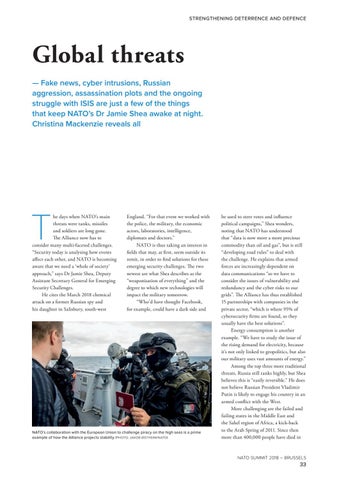
NATO’s collaboration with the European Union to challenge piracy on the high seas is a prime example of how the Alliance projects stability (PHOTO: JAKOB ØSTHEIM/NATO)
be used to steer votes and influence political campaigns,” Shea wonders, noting that NATO has understood that “data is now more a more precious commodity than oil and gas”, but is still “developing road rules” to deal with the challenge. He explains that armed forces are increasingly dependent on data communications “so we have to consider the issues of vulnerability and redundancy and the cyber risks to our grids”. The Alliance has thus established 15 partnerships with companies in the private sector, “which is where 95% of cybersecurity firms are found, so they usually have the best solutions”. Energy consumption is another example. “We have to study the issue of the rising demand for electricity, because it’s not only linked to geopolitics, but also our military uses vast amounts of energy.” Among the top three more traditional threats, Russia still ranks highly, but Shea believes this is “easily reversible.” He does not believe Russian President Vladimir Putin is likely to engage his country in an armed conflict with the West. More challenging are the failed and failing states in the Middle East and the Sahel region of Africa, a kick-back to the Arab Spring of 2011. Since then more than 400,000 people have died in
NATO SUMMIT 2018 – BRUSSELS
33
STRENGTHENING DETERRENCE AND DEFENCE
The conflict in Syria is far from being resolved and is a breeding ground for a range of future problems that may yet further destabilise the region (PHOTO: AMMAR SAFARJALANI/XINHUA NEWS AGENCY/PA IMAGES)
conflicts in the region – the largest loss of life since the Second World War. Some 40,000 foreign fighters, including 5,000-6,000 from European Union countries, are involved. More than 14.5 million people have fled the region and it will cost half-a-trillion dollars to set these countries back on their feet. Shea holds that, even if the selfproclaimed Islamic State has been defeated, the conflict in Syria is not over “because it’s not one conflict, but lots of smaller ones – the opposition to Syrian President Bashar al-Assad; the Kurds; the war of influence between Iran and Israel – so we’re no nearer to an end.” Africa is the third big challenge. According to United Nations ‘medium scenario’ projections, the population on the continent will more than double to 2.5 billion in 2050. For Shea, this means 25 million young North Africans
NATO SUMMIT 2018 – BRUSSELS
34
arriving on the labour market, where there will be no jobs for them. Climate change is another problem with a big geopolitical footprint. In the Sahel, the climate is changing at twice the global rate. Creeping desertification and intensifying droughts are straining natural resources, impacting crops and leading to conflict between communities: fertile ground for terrorist groups such as Boko Haram. So, in this asymmetric configuration, does NATO have a role to play at all? Shea argues that it does, but stresses that the Alliance can only be effective in partnerships, notably with the European Union, the African Union and local players. “We need legitimacy on the ground and must be invited into a country by its government.” The commitment is then long-term “and requires sustainability and adaptation
to local culture”. NATO military instructors, he recounts, learned that lesson when teaching Afghan soldiers to dismantle improvised explosive devices. “The soldiers were much more at ease using sniffer dogs and good, old-fashioned sapper techniques than with high-tech tools, so that’s what the instructors went with. We must adapt the technology to the users.” NATO’s way forward is to work with local security forces, customs officials and police, so that the locals become responsible for their country’s security. “We saw how well this worked when we joined with the European Union in the Atalanta anti-piracy programme. We not only put guards on the ships, but worked with Somali officials to freeze the pirates’ cash supply, prosecute them, and find them proper jobs!” A ‘whole of society’ approach.
STRENGTHENING DETERRENCE AND DEFENCE
NATO and ATA in the Black Sea Region — Alex Serban, Founder, Euro Atlantic Council of Romania; Senior Fellow, Atlantic Council of the US; Former Vice President, Atlantic Treaty Association
T
his year, for its 64th General Assembly the Atlantic Treaty Association (ATA) will meet in Bucharest, focusing discussions on unity among partners and mutual responsibilities in the transatlantic area. At the July NATO 2018 Summit in Brussels, the political and military leaders of the Alliance will focus on advancing
the Wales and Warsaw summit priorities. In addition, they will be focusing on building transatlantic solidarity, advancing NATO-EU relations, deterrence and defence capability building – while engaging in
meaningful dialogue with Russia – and fair burden sharing. The ATA’s 2018 General Assembly could not be more relevant, focusing not only on analysing the decisions and conclusions of the NATO 2018 Summit, but on forward-looking actions for its members, as well as NATO and Allied governments, delivering projects, ideas and impactful initiatives to address its audiences: successor generations, civil society, academia and universities, mass media and opinion shapers, the business community and those who are not yet convinced of our values and institutions. With NATO and its members under severe strain from economic and social tremors – both younger and older democracies – from immigration and terrorism impacting our democratic
Romania is committed to contributing to NATO’s efforts to promote stability and security (PHOTO: NATO)
NATO SUMMIT 2018 – BRUSSELS
35
STRENGTHENING DETERRENCE AND DEFENCE
life, from asymmetric threats to unconventional ‘weaponising’ of technology, media, cyber and digital space, today, more than ever, ATA’s role should become an active and relevant one. Our organisation has always offered a space for ideas, where the disagreements are left outside and the discussions are based on the core values of the organisation: individual liberty, democracy, human rights and the rule of law to achieve sustainable peace and security. But, with the recent evolutions and disagreements registered at the level of the G7 summit in Quebec, as well as divergent views on trade, environment, nuclear proliferation, the members of NATO and ATA need to find common ground for the sustainability of all efforts registered so far for future effective collective defence and to take concrete steps ahead.
Black Sea security Among NATO’s many strategic maritime regions and priorities - the Nordic, the Baltic, the Adriatic and the Mediterranean – is also the Black Sea. Most recently, discussions on the topic of security challenges in the region have come from the Romanian Defence and Foreign Affairs ministers, focusing on how Romania and NATO Allies could contribute to better security conditions for the neighbouring countries. Increasing its security perspective in the region, how should NATO answer to the existing security challenges considering these are often interconnected? Generically, NATO mapped a specific set of sensitive topics for the Black Sea region, stemming from Russian military buildup, aggression and A2/AD measures, all aimed at eroding democratic institutions, leveraging “frozen” conflicts, weakening the lines of allied cooperation and undermining energy security and supply. For centuries, the Black Sea region has been an intersection of trade routes and empires, of cultures and military interests in the region, an area marked both by long periods of peace and stability, but also by strategic and political interests, and by wars and conflicts. From a NATO perspective, the Black
NATO SUMMIT 2018 – BRUSSELS
36
For centuries, the Black Sea region has been an intersection of trade routes and empires, of cultures and military interests in the region
Sea region represents the intersection of the Alliance’s Eastern and Southern flanks with the Balkans, which in turn acts as a pivotal actor for the Southern Caucuses, the Eastern Mediterranean and the broader Middle East. Russia sees these elements as well and is positioned to advance its agenda across all directions. Recent years have witnessed Georgia and Crimea become milestones that marked a shift in the defence policy around the Black Sea. Being aware of its strategic regional role, Romania has committed itself as an active contributor to NATO’s efforts in promoting stability and security, providing troops and equipment to the implementation of the Enhanced Forward Presence, both in Poland and in the Black Sea region. Also, Romania is hosting NATO’s Multinational
Division South-East Headquarters (NATO HQ MND-SE). In addition, Romania has increased its defence budget to 2% of GDP in 2017 and is working closely with its regional neighbors (Bulgaria, Moldova, Ukraine and Georgia) in strengthening cooperation. From Brussels to Bucharest, NATO and ATA will see an Allied member prepared to contribute to a forward looking and prepared Alliance, recalling the Bucharest NATO Summit 10 years ago, even as it prepares to assume the 2019 EU Presidency. All of this, in the year when Romania’s centennial looks back at a historical moment when Europe was challenged by threats and dangers that led to two World Wars and a Cold one. Learning from our past is paramount, but working towards our future is our duty.
NATO’s naval presence in the Black Sea has been reinforced (PHOTO: CPO FRAN C. VALVERDE/NATO)
STRENGTHENING DETERRENCE AND DEFENCE
Growing Security Concerns in the Aegean — Admiral Evangelos Apostolakis HN, Chief of Hellenic National Defence General Staff
T
he Aegean Sea area, at the crossroads of the sea lines between the Black Sea, Gibraltar and the Suez Canal and where three continents with different cultures and religions meet, has been a region of great strategic importance for thousands of years. In the past decade, the upgrade of Eastern Mediterranean to an energy hub has set new standards for the area. For Greece, the Aegean Sea consists of a unique environment with a complex of thousands of islands, surrounded by hundreds of thousands square kilometres of sea. In this demanding geographic area the Hellenic Armed Forces perform successfully their primary mission of safeguarding Greece’s national sovereignty, against any contentions and claims, always in the framework of International Law and the principle of good neighbourly relations. The Aegean lies in the broad area of the Alliance’s Southern Flank, where one of the major challenges of our times is the
flow of economic migrants and refugees. Surrounded by a region of instability generated mostly by the Syria and Libya crisis, Greece is the country most affected by the influx of people seeking entry into Europe.
Adaptation and cooperation Coping with the illegal migration flows has been a tenacious effort that has absorbed a great amount of Greece’s resources. NATO wisely demonstrated its reflexes of adaptation to that emerging challenge and initiated the Aegean Activity, via patrols of Standing NATO Maritime Group Two. This activity has multiple benefits. Firstly, it contributes to the disruption of the routes used by smugglers and for illegal migration. Secondly, it is tangible proof of the cooperation with European Union (EU), as NATO units in Aegean are working side by side with the EU’s border agency Frontex. Moreover, through this activity we have proved that NATO is an Alliance with a visible footprint, which
The Aegean Sea is a vital region for Greece, with numerous islands that have an extended area of territorial waters
can effectively return the taxpayers’ investment. Overall, we fully recognise the invaluable role of NATO’s naval force in the Aegean as a strategic deterrent factor. Another alarming issue in the aforementioned situation is how irregular migration interconnects with terrorism. A number of terrorist attacks conducted on European soil have been attributed to individuals that have used the migration flows from North Africa and the Middle East. Due to escalating Daesh losses in Syria, Iraq and Libya, we can expect a considerable amount of foreign fighters to use the migration routes, in order to return to their home countries. The returnees have the ability to change the security dynamic of their country by bringing greater skills, experience, and even ambition, and I address that, as a most probable “hybrid threat” for the Alliance. The containment of the illegal crossings has reached a significant downward trend since the start of the activity, but has not been eliminated. Since all relevant studies suggest that Europe will continue facing challenges of illegal migration, due to the nexus between demography growth and poor security governance in Africa, it is obvious that the Aegean Sea will be affected proportionally.
NATO SUMMIT 2018 – BRUSSELS
37
STRENGTHENING DETERRENCE AND DEFENCE
Constant patrols by NATO’s Standing Maritime Group 2 have helped disrupt the migration routes used by both refugees and terrorists (PHOTO: GBR N LPHOT PAUL HALL/CROWN COPYRIGHT VIA MARCOM NATO)
In this respect, we can easily argue that NATO’s maritime presence in the Aegean should not only be maintained, but also expanded, so that the Aegean Activity achieves its full potential. Firstly, the patrol areas should be stretched to include all affected areas. Next, flight operations should be initiated, in order to support the activity in a more cost- effective way. In summary, the Aegean Sea is a vital region for Greece, with numerous islands that have an extended area of territorial waters, where Hellenic armed forces are continuously present. Needless to say, I express my appreciation for NATO’s Aegean Activity, and I thank all of my colleagues who are contributing with their personnel and vessels. The activity exhibits the coherence and solidarity of our Alliance and should be seen as an “assurance measure” against the hybrid threat that is hiding in the migrant flows.
NATO SUMMIT 2018 – BRUSSELS
38
Standing NATO Maritime Group 2 – up to June 2018 Commander SNMG2 Commodore Mike Utley, Royal Navy
HMS Duncan – Flagship Royal Navy D37 – Type 45-class Air-Defence Destroyer
FGS Bayern German Navy F217 Brandenburg-class Frigate
ALS Butrinti
TCG Karaburun Turkish Navy P-1201 - Tuzla-class Patrol Boat
HS Kalypso Hellenic Navy
Albanian Naval Force
M64 – Osprey-class Coastal
P134 – Damen Stan 4207 patrol boat
Minehunter
HS Polemistis
HS Grigoropoulos
Hellenic Navy
Hellenic Navy
P-61 – HSY-55 Gunboat Class
P70 Fast Attack Craft Roussen-class
STRENGTHENING DETERRENCE AND DEFENCE
The Growing Threat from Disinformation and Hybrid Warfare — Chris Donnelly, Director, The Institute for Statecraft
F
or the past 70 years or so, most people in Europe have been living in a secure, rules-based system that has encouraged the popular perception that safety and stability are normal and permanent. The end of the Cold War a generation ago reinforced this belief and justified a trend
in government spending across Europe that cut defence spending in favour of spending on health, education and social security. Today, most European countries spend about two-thirds of their national income on this, leaving only one-third for spending on everything else, including defence, foreign affairs, national
infrastructure etc. This ‘peacetime’ mentality and spending pattern has been reinforced by ‘peacetime’ procedures, rules and regulations across society. Unfortunately, this state of affairs is now being challenged. A new paradigm of conflict is replacing the 19th and 20th century paradigm that has not only conditioned our (Western) thinking about peace, war and competition in international relationships, but has shaped all our national and international institutions for dealing with these phenomena. In this new paradigm, the clear distinction that most people have Police special forces arrive following the 2015 terrorist attack on the Bataclan concert hall in Paris. Western expectations of stability and predictability are being replaced by instability and unpredictability (PHOTO: SHOOTPIX/ABACA/PA IMAGES)
NATO SUMMIT 2018 – BRUSSELS
39
STRENGTHENING DETERRENCE AND DEFENCE
been able to draw in the past between war and peace – their expectation of stability and a degree of predictability in life – is being replaced by a volatile unpredictability, a permanent state of instability in which war and peace become ever more difficult to disentangle. The biggest challenge this paradigm shift brings to our way of thinking, to our national institutions, and to our long-established practices and procedures, is the speed and depth of change that globalisation brings with it. If we can understand that, in societal terms, one of the defining features of any war is that it precipitates change, then to all intents and purposes the world is at war, because we are living through a period of change more widespread, rapid and profound than any we have experienced during the last two centuries outside a world war. Moreover, this change has been sustained longer than any world war of the past two centuries, and it is still increasing. However, because this is not a shooting war like 1939-45, we in ‘Western’ countries have not adopted the ‘wartime mentality’ essential to cope with the instability that drastic change inevitably brings. We have also, quite naturally, selected our leaders for their abilities to shine in this ‘peacetime’ environment. But ‘wartime’ rates of change need a different form of leadership, just as they need different procedures and new ways of thinking. We are facing a new reality. So, if we consider what qualities and characteristics we need in those whom we
Mobile roadblocks, such as this at the Christmas market in Osnabrueck, Germany, have become a fact of life where large gatherings are expected (PHOTO: FRISO GENTSCH/DPA/PA IMAGES)
states, sub-state actors, big corporations, ethnic or religious groups, and so on – are constantly striving with each other in a “war of all against all” where everything is a weapon. The Western rules-based system, which most Westerners take for granted and have come to believe should become universal, is now under attack from countries and organisations that wish to replace our system with theirs. In truth, not only are we at war, but few
In truth, not only are we at war, but few in European societies understand this reality select for leadership today, in a period of rapid and profound change, in all sorts of institutions, the conclusion is that we need to look for people who have abilities that suit a wartime environment rather than a peacetime one. But what is war today? The “classic” understanding of conflict being between two distinct players or groups of players is giving way to a world of Darwinian competition where all the players – nation
NATO SUMMIT 2018 – BRUSSELS
40
in European societies understand this reality because the weapons in this war are not, in the main, ‘kinetic’, ie they do not go ‘bang’. These weapons are more insidious – information, energy, cyber, economics, investment, corruption, dirty tricks etc – but they are lethal nonetheless. But, the target they are seeking to destroy is not life and property, it is our democratic institutions and our faith in our political processes. It is nothing less
than the Western value system that we so complacently take for granted. This ‘Hybrid Warfare’ in which, like it or not, we are all now engaged, and of which the most obvious current manifestations are disinformation and malign influence, is not a crisis that faces us; it is a strategic challenge, and from several directions simultaneously. We cannot deal with this by using the crisis-management tools we have relied on to solve our problems for the past quarter-century. This needs us to develop a strategic response. What makes it so dangerous is our collective failure to realise we are under focused and concerted attack; that there is a mind and intent behind the disparate assaults that seeks, successfully, to exploit the vulnerabilities of our system. It is this that makes hybrid warfare so dangerous. If the institutions of the West have been slow to react to this new reality, not so a lot of the West’s competitors. Countries in what we condescendingly call the developing world – such as Russia and China; sub-state actors such as Al Qaeda or Islamic State – have all learned more rapidly than we have about how to
STRENGTHENING DETERRENCE AND DEFENCE
Armed men, believed to be Russian soldiers, stand guard at a naval base in Crimea. Russia’s ability to adapt a wartime mentality has placed the country at an advantage over the peacetime mentality of the West (PHOTO: SHEMETAS ARVIDAS/ZUMA PRESS/PA IMAGES)
cope with today’s instability, complexity and rapid change. These countries and organisations want to set up their own alternative world system to rival ours, and they are actively attacking us to do just that. We are today in a constant, existential competition with these and all other actors in the global ecosystem, be they nation states, sub-state groups or big corporations. Our success in this competition will be guaranteed only if we learn to cope with change as they have and, like them, think and plan on a long-term basis. The truth we must face up to is that the speed of global change has outpaced all our national and international institutions. They are now becoming obsolescent. NATO, the European Union, our national armies, even our
NGOs are no exceptions. They all now need to react and adapt fast enough to remain fit for purpose if they are to give their members and citizens what they need to feel secure. This inability to recognise the problem we have and to acknowledge its cause, ie our inability to adapt our institutions because they have become so entrenched and inflexible, is paralysing our social, economic and political system and making us ever more vulnerable. Professor Leon Megginson, interpreting Darwin in societal terms (and in a quotation often attributed to Darwin himself), put it most succinctly: “It is not the strongest of the species that survives... It is the one that is most adaptable to change”. In wartime, or at a time of rapid change, we must have a clearly
articulated, long-term strategic vision and clear objective. Simply put, we need to know where we want to go in the world; what our interests are; what values do we want to protect. Without that, short-term thinking can lead us astray. “Tactics without strategy is just the noise before defeat”, to quote Sun Tzu. Strategy is not ‘having a big, detailed plan’. Strategy is being able to adapt and react, to take advantage of a situation. Adaptation, change, flexibility, these are the key to surviving and winning. Today, we must look at our own organisation, ATA, and ask ourselves, what is our strategy? How do WE need to adapt so that we can survive and succeed in this new, difficult and dangerous world? It is hard to pose the question, but even harder to answer it.
NATO SUMMIT 2018 – BRUSSELS
41
STRENGTHENING DETERRENCE AND DEFENCE
Women, Peace and Security — Professor Dr Aliki Mitsakos, MD, PhD, Founder and Dean, The International Center for Leading Studies; Secretary General, Greek Association for Atlantic & European Cooperation
T
his text comes a few days after my father, a Hellenic Navy Admiral, was honoured as one of the surviving World War II Veterans by the Hellenic National Defence General Staff and the Ministry of Defence for their contribution to Freedom and Peace. It has been the last War fought by conventional means, with men and women contributing from their different posts and traditional duties, men fighting, women supporting in the rear, keeping the societal network.
NATO SUMMIT 2018 – BRUSSELS
42
This was also the War that led to the creation of the North Atlantic Alliance, and it was my father, who having served in the NATO Supreme Command Standing Group in Washington, D.C., introduced us to what NATO stands from a very young age. The Security Agenda has changed radically since. The new and complex threats in the 21st century highlight the
need for new approaches, the necessity of synergies and closer cooperation at all levels. Threats are becoming more varied and more international, as well as increasingly cross-border and crosssectorial, with ambiguity presented in the actors, methods, environments. The wider context that shapes war and conflict today requires us to redefine conflict, violence, other forms of asymmetrical hazards, and the methods we face these phenomena that no longer fit the categories of our past thinking.
A new narrative The security sector can no longer just focus on projecting power and removing direct threats. Power projections no longer assure more security, they may actually bring less. Security needs a new narrative, focusing on a more holistic approach and incorporating wider talent pools. People throughout the world express their loss of faith and trust in
Spanish Navy Radar operators are briefed during an anti-submarine exercise in Norway (PHOTO: FRA N WO CHRISTIAN VALVERDE/NATO)
STRENGTHENING DETERRENCE AND DEFENCE
their governments, the international community and systems of governance that they feel excluded from, contributing to a strong and ongoing sense of injustice. More pragmatic and more impactful policies are needed for effectiveness, ultimately leading to more public trust. Governments and international actors are called upon to undergo a seismic shift and recognise women and young people as “the missing peace” or the “missing security link”. Addressing diversity within the security sector, in terms of increasing effectiveness, would enable societies to tackle security more comprehensively, as people bring different sets of competences, expertise and background. Diversity denotes that half of the world’s population be involved in decisionmaking, leveraging the diversity of ideas to commonly held assumptions with regard to youth, the role of gender and masculinities. As of January 2017, only 18.3% of government ministers were women, but the most commonly held portfolio by women ministers is environment, natural resources, and energy, followed by social sectors, such as social affairs, education and the family. Even there, stereotypes prevail.
Changing minds We need to change minds. Many political, military and security leaders around the world still see gender equality as a soft issue that can be put off for a later date. Too often women, and youth, remain on the sidelines of key discussions, negotiations and decision-making in foreign policy and economics – sectors closely associated with security. Perhaps, most importantly, a deeper resistance to change and a reluctance to share power is also at play. Would it be accidental that Shakti, one of the most important goddesses in the Hindu pantheon, is considered the divine cosmic energy that represents feminine energy and the dynamic forces that move through the universe, responsible for creation, and can also be an agent of change, manifested to destroy demonic forces and restore balance? As the 2015 Global Study on UNSCR 1325 found, there is a “consistent,
striking disparity between policy commitments to gender equality and women’s empowerment, and the financial allocations to achieve them”. Unequal access to and distribution of social, economic and ecological resources results in injustice, which in turn has direct and indirect links to the causes and consequences of violence and conflict, all of which are gendered. Privatisation of basic services, in many countries, has had a huge impact on the affordability of services for women, especially in health, jobs and education, deterring inclusivity. Recent continuing emphasis on feminist political economy includes a focus on ‘moving the money’ from war to peace in terms of global spending, identifying and engaging with the daily realities and gendered impacts of financing for post-conflict reconstruction and peacebuilding.
Leaders of change It will take more than money or government action to empower women and strengthen the foundation for inclusive security, though. The perception of women only as victims and lacking aptitude must be challenged and replaced with recognition of women as active agents and leaders of change. The evidence in quantitative analyses performed prove it. Women know the economic and security vulnerabilities at the local levels, and they understand the crises and conditions that provoked the conflict in the first place. If they are left out of the peace process, that valuable knowledge is also excluded. Data has shown that when they are empowered, protected, trusted and invested in, there are benefits for all of us, strengthening deterrence and defense processes. The security landscape presents a number of barriers to women’s participation today that must be addressed, to include: 1. the broader end-point dilemma. If the goal is only to end violence, then women, rarely the belligerents, are not considered legitimate participants. If the goal is to build peace, however, it makes sense to gain more diverse inputs from the rest of
the society who will be affected by these decisions; 2. the different security needs and priorities challenge the dominant understanding of peace and security in the international system, which remains mostly focused on State Security rather than Human Security; 3. international organisations, such as the United Nations, that have made commitments to women’s participation in peacemaking, often have less power to influence the structure of a peace process in today’s changing mediation landscape. Once women are allowed to participate however, they need to be well prepared, especially if their presence is challenged. Education is the key to the emancipation and empowerment for all and, foremost, interdisciplinary education, beyond the formal curricula, to include development of soft skills. Quality participation is more important than quantity, and reaching an agreement is only the first step on a long and arduous road toward rebuilding trust.
Shifting narratives NATO, a major security provider, with the mission of ensuring peace and freedom in Europe, and further beyond as recently has evolved, must shift narratives and mentality on security, disregarding the conventional masculinity default. Gender equality and women’s empowerment is vital for any attempt to stability through sustainable development. The Missing Peace index must relay beyond the existence of guns. To strengthen Deterrence and Defence while projecting Stability, power politics must be controlled, the public thought of, credible selection processes employed, and the focus on deterrence of instability factors. There is a risk we take by not actively involving all our population to establish a sustainable security environment in the human context. This risk must be eliminated.
NATO SUMMIT 2018 – BRUSSELS
43
DETERRENCE AND DIALOGUE
Rejuvenating NATO’s Dual-Track Approach — Professor Luca Ratti, Associate Professor in History of International Relations, University Roma Tre
A
t both its 2016 Warsaw and 2017 Brussels summits, the Alliance made it clear that NATO rightfully privileges a strategy of ‘defence and dialogue’ over a logic of ‘defence or dialogue’ with Russia. Today, the dynamics faced by the Alliance in the imminence of the 70th anniversary of its establishment place NATO at a critical juncture.
Some 50 years ago, as the 20th anniversary of the North Atlantic Treaty approached in 1969, the USSR’s development of a formidable nuclear arsenal and France’s withdrawal from the integrated military structure triggered a major political and military shift in the Alliance’s strategy. The twin pillars of the Alliance’s strategic reform in the late 1960s were the ‘Report on the Future
Tasks of the Alliance’ – more commonly known as the ‘Harmel Report’ – and the new doctrine of ‘flexible response’. Although there are some fundamental differences between now and then, the forthcoming 50th anniversary of this major strategic adaptation and the approaching 70th anniversary of the North Atlantic Treaty provide a major opportunity to reflect on NATO’s policy towards Russia and, eventually, set relations between the Alliance and Moscow on the path toward partnership. In the late 1960s, in the aftermath of a sustained Soviet military build-up and following France’s decision to withdraw from the integrated military structure, the Alliance reviewed its policy towards the Soviet threat, embracing a new strategic concept and abandoning the nuclear doctrine of massive retaliation. While the Allies had endeavoured to engage the Kremlin since the early days of East-West détente, the adoption of these measures institutionalised a twin-track policy of NATO needs to bolster its defensive posture in order to prosecute its dual-track approach with Russia (PHOTO: NATO)
NATO SUMMIT 2018 – BRUSSELS
44
DETERRENCE AND DIALOGUE
Following the Harmel Report, the Alliance adopted a strategy of flexible response over massive retaliation (PHOTO: INTERFOTO/ALAMY)
deterrence and dialogue, which remained an axiom of NATO’s strategy until the Cold War’s end. There are some important similarities between now and Harmel’s days. The Soviet Union then claimed to represent an alternative form of modernity to the Western political and institutional model, while the West was faced with the consequences of decolonisation and the emergence of the Global South. Today, in a rapidly changing international system, the Russian Federation remains, in terms of history, institutions and values, closer to the West than any other international and transnational agencies. Despite the persistence of important strategic disputes, this closeness makes it compelling for the allies to rediscover Harmel’s message: Russia might not be willing to join the Euro-Atlantic structures in their current institutional form. However, the resumption of a cooperative dialogue should be a priority for both sides in order to avoid the risk of becoming entangled in a spiralling ‘security dilemma’ and the shadow of a New Iron Curtain – from Narva to Mariupol – which would benefit none.
The Alliance needs to deal with the challenge posed by Moscow’s attempt to regain strategic advantage over NATO and undermine transatlantic cohesion and security, by reinforcing its defence posture. For this reason, it must remain committed to a coherent and integrated approach to the defence of its Eastern flank, underpinned by an effective command structure, reinforced maritime posture, strong air defence, and a viable reinforcement strategy. Increasing readiness and responsiveness of NATO’s forces and military mobility across of Alliance’s territory is essential for deterrence and defence.
Proactive engagement However, the Allies also need to supplement their reinforced defences with a strategy of proactive engagement with Russia in order to promote the stabilisation of the increasingly volatile European security architecture and of its periphery. This objective can be achieved through a periodic, focused and meaningful political dialogue with Moscow on the basis of reciprocity, on the condition that the Russian
Federation returns to fully respecting international law and obligations. In the current strategic scenario, rejuvenating Harmel’s message can provide the Alliance with a successful example and a model in order to overcome this protracted standoff with Moscow and the prospect of renewed tension in Europe. At a time of increasing global uncertainty and unpredictability, the Alliance needs to bolster its defensive posture. However, the allies should also strive for genuine engagement with Moscow. A comprehensive and successful reengagement with Russia would revitalise the Alliance, counter Moscow’s propaganda, and contribute to the stabilisation of Europe and the Mediterranean with positive effects also on NATO’s Southern flank. Ultimately, it might also reinvigorate NATO’s relationship with the United Nations and reinforce its claim to retain a premier role in the Euro-Atlantic region and beyond it, at a time of increased transatlantic turbulence, political and commercial tension, and modest economic recovery in the West.
NATO SUMMIT 2018 – BRUSSELS
45
PROJECTING STABILITY
NATO and Ukraine – a Mutually Beneficial Partnership — Barbora Maronkova, Director, NATO Information and Documentation Centre in Kyiv, Ukraine
N
ATO and Ukraine share a long partnership stretching back to the early 1990s. Ukraine was one of the first former Soviet Republics to join the North Atlantic Cooperation Council in 1991 and, later, the Partnership for Peace programme in 1994. In 1997, NATO signed a Charter on a Distinctive Partnership with Ukraine as the basis for strengthened cooperation. The Charter established the NATOUkraine Commission (NUC) and led to the opening of the NATO Information and Documentation Centre in Kyiv. Ukraine has been an active contributor to almost all of NATO’s missions and operations in the past 25 years – including in Bosnia and Herzegovina (IFOR and SFOR), Kosovo (KFOR), Afghanistan (ISAF and Resolute Support Mission), the Mediterranean Sea (Operation Active Endeavour) and off the Coast of Somalia (counter-piracy operation Ocean Shield).
NATO SUMMIT 2018 – BRUSSELS
46
Ukraine has also benefited from a large number of support programmes and trust funds and been one of the most active partners in the Science for Peace Programme, which fosters cooperation across the scientific community in Allied and partner countries. At the NATO Summit in Prague in 2002, Ukrainian President Leonid Kuchma announced Ukraine’s aspiration to become a member of NATO. At the Bucharest Summit in 2008, NATO Allies agreed that Ukraine and Georgia will become members of NATO and that the Membership Action Plan will be the next step on their path to NATO membership. In 2009, through the NUC, the NATO Allies signed a further declaration with Ukraine to underpin the country’s efforts to implement important reforms through the Annual National Programme as part of its pursuit of its Euro-Atlantic aspirations. The change of leadership in Kyiv in 2010 brought a temporary halt to these ambitions. Not only did President
Yanukovich back-pedal on Ukrainian NATO membership ambitions, he also oversaw amendments to Ukrainian law declaring ‘non-bloc status’ for the country. The events of early 2014 brought important changes in Ukraine, resulting, in turn, in the reorientation of the country’s foreign and security policy objectives. The Maidan Revolution – or ‘Revolution of Dignity’ – demonstrated a strong desire for more democracy, a more pro-Western orientation and more accountability of the Ukrainian political leadership towards its citizens.
Dual-track policy The illegal and illegitimate annexation of Crimea by the Russian Federation in March 2014 and its support to separatists in eastern Ukraine, has brought an open conflict posing a major threat to EuroAtlantic security. Russia’s behaviour in Ukraine has also had direct consequences for its relations with NATO. As a result
PROJECTING STABILITY
Ukraine’s Minister of Defence, General Stepan Poltorak, met with NATO Secretary General Jens Stoltenberg in Brussels on 7 June 2018 (PHOTO: NATO)
of Russia’s aggressive actions in Ukraine, NATO has adopted a dualtrack policy. This policy – which remains in place – is based on deterrence and defence, on the one hand, and maintenance of meaningful political dialogue on the other. Specifically, the Atlantic Alliance has suspended all forms of practical cooperation with Russia. At the same time, it has kept channels of political dialogue open, including through the NATO-Russia Council, which remains an important forum. NATO and Russia also maintain open military-to-military lines of communications. The dialogue between NATO and Russia contributes to more predictable relations and enhanced mutual security.
A new era of relations In the aftermath of the events of 2014, NATO-Ukrainian relations entered a new era. NATO Allies provide political support to Ukraine and its territorial integrity and sovereignty and do not recognise the illegal and illegitimate annexation of Crimea. NATO has also stepped up its practical support to Ukraine through various support
programmes to Ukrainian defence and security forces and institutions. At the Warsaw Summit in 2016, Allies and Ukraine endorsed the Comprehensive Assistance Package, which brings together all the various strands of NATO’s support to Ukraine. These include eight Trust funds, to which Allies have pledged up to €40 million in areas such as logistics, cyber defence, medical rehabilitation, countering improvised explosive devices and others.
New, larger entity In 2016, two NATO offices – the NATO Information and Documentation Centre and NATO Liaison office – merged into one bigger entity called the NATO Representation in Ukraine. This better reflects NATO’s increased role in Ukraine. Today, the Representation comprises over 50 personnel from NATO’s International Staff and International Military Staff, as well as advisors and programme managers from Allied countries and local staff. Existing initiatives, such as the Building Integrity programme, the Professional Development Programme, and programmes managed by the NATO
Support and Procurement Agency (NSPA), have also grown in size and scope. They work to strengthen the Ukrainian institutions through, for example, a dedicated programme for members of Ukraine’s defence and security sector institutions, as well as civil servants. The NSPA continues its important work to safely dispose of nuclear waste and small arms and ammunition.
Bilateral assistance In addition, several NATO Allies have set up bilateral training missions in Ukraine, such as the United Kingdom’s ‘Orbital’ and Canada’s ‘Unifier’. Lithuania and Poland created with its Ukrainian counterparts a joint brigade. Individual Allies also provide bilateral assistance to Ukraine in various areas including humanitarian, medical, military equipment. NATO’s key priority for Ukraine is to support comprehensive reform in the security and defence sector, which is vital for Ukraine’s democratic development and its ability to defend itself. NATO recognises that Ukrainian security is key to the Euro-Atlantic security as a whole.
NATO SUMMIT 2018 – BRUSSELS
47
PROJECTING STABILITY
Making Peace Possible: NATO’s Engagement in Afghanistan — Cornelius Zimmermann, NATO Senior Civilian Representative in Afghanistan
O
ver the three days of the holy festival of Eid in June, Afghanistan witnessed an unmatched period of ceasefire. Extraordinary scenes were played out across the country, and for the entire world to see. Taliban embracing members of the Afghan Security Forces in the streets, many of them armed with nothing more than flags, riding on motorbikes through the streets of Kabul. These unparalleled scenes were captured in photographs and selfies taken by Taliban fighters, government troops and members of the public alike caught up in the moment, and then posted on social media. When the Taliban leadership declared not to extend the ceasefire, their rank and file seemed to only grudgingly accept this decision. It was a profound moment for Afghanistan. It gave the population a taste for peace, which many of the younger Afghan generation have not seen in their lifetime. It showed the craving of the Afghan people for peace, and put a spotlight on the possibilities in this country.
NATO SUMMIT 2018 – BRUSSELS
48
Afghan President Ashraf Ghani has offered peace talks to the Taliban (PHOTO: DOD PHOTO/ALAMY)
NATO, through its sustained support to Afghanistan, contributes to creating the conditions for such moves towards peace. We have always said that the Taliban need to understand that they can never win on the battlefield. This message is reinforced by the Afghan
Security Forces’ successes and our continued Train, Advise, Assist mission. And, while the means of NATO’s engagement have changed over the years, the end has always remained the same: projecting stability in order never to let Afghanistan become a safe haven
PROJECTING STABILITY
NATO’s Train, Advise and Assist mission in action in Afghanistan (PHOTO: RESOLUTE SUPPORT MEDIA/NATO)
for terrorists. NATO and the Afghan Government have a mutual commitment to ensure long-term security and stability. The stability the Alliance projects into Afghanistan projects back into our own territories, be it by eradicating terrorist sanctuaries, or by giving young Afghans good reasons to remain in and rebuild their country, rather than seeking refuge abroad.
Progress made Resolute Support, with its Train, Advise, and Assist mission, is the most prominent element of NATO’s engagement in Afghanistan. Our continued military effort to help further strengthen the capabilities of the Afghan forces is successful. Progress has been made by the Afghan security forces, and the development of the Afghan Special Forces and Air Force stands out in particular. The ceasefire indicates that the Taliban may be starting to realise that a negotiated settlement is the only way to end this conflict. The progress achieved by the Resolute Support Mission is underwritten by the two other strands of NATO’s
engagement. NATO continues to financially support the Afghan National Defense and Security Forces, including through the Afghan National Army Trust Fund. Such support is necessary, as Afghanistan is moving towards, but still some years away from, taking full responsibility for the financial sustainment of the Afghan National Defense and Security Forces. Also, NATO’s Enduring Partnership offers a long-term framework for politicalmilitary dialogue between the Alliance and Afghanistan. However, military engagement alone will not solve the Afghan conflict. A negotiated, political solution is necessary, and, as we saw in June, it is also possible. NATO has clearly recognised this. Our military effort is thus embedded in a comprehensive, conditions-based approach, which aims to help move towards a political solution of the Afghan conflict. In April this year, NATO Foreign Ministers clearly noted their full support for a negotiated political settlement that would end violence, cut ties to terrorism and respect human rights. President Ashraf Ghani has
been taking bold steps in offering the Taliban unconditional peace talks and initiating the ceasefire and in driving forward regional cooperation, particularly with Pakistan. The Alliance’s presence and role is not determined by a time frame, but is dependent on the conditions on the ground. NATO is willing to see contested issues surrounding the international community’s future role in Afghanistan being addressed in an Afghan-led and Afghan-owned peace process. At the same time, we also convey to our Afghan partners that the Alliance’s conditions-based approach cannot be a one-way street. The Alliance’s expectations towards our Afghan partners have been clearly spelt out and continue to be communicated to them. This includes the Afghan government’s commitment to holding fair, timely and inclusive parliamentary and presidential elections in 2018 and 2019, and commitments on the promotion of good governance and human rights. NATO’s support for our Afghan partners in reaching an Afghan-led and Afghan-owned peace remains steadfast.
NATO SUMMIT 2018 – BRUSSELS
49
PROJECTING STABILITY
Kosovo: KFOR XXII — Major General Salvatore Cuoci, COM KFOR
K
FOR is a success story for NATO, the longest-running operation with more than 4,000 troops on the ground belonging to 28 nations, Allies and partners. KFOR, according to its mandate, contributes to ensure a safe and secure environment (SASE) as well as freedom of movement (FOM) for all the citizens in Kosovo, regardless of their ethnicity. For 19 years, KFOR has been making Kosovo a safer place and it has contributed to the progressive normalisation of the region. KFOR monitors anything that could affect the security situation, which is assessed to be calm and stable, but consistently vulnerable due to the fragility of many factors, such as: the challenging relationship with Serbia; the ambition of visa liberalisation for Kosovo citizens; the fight against corruption and organised crime; a difficult economic situation; the hesitant establishment of the Association/Community of Serb majority Municipalities (A/CSM); the critical management and improvement of energy sources; environmental degradation; the strong rhetoric and the use of symbols that saturate the communication in the region.
NATO SUMMIT 2018 – BRUSSELS
50
A marketplace in Kosovo highlights the successful efforts of KFOR in delivering stability and security for all (PHOTO: GIANNIS PAPANIKOS/SHUTTERSTOCK)
Within KFOR’s task of capacitybuilding, one of the major issues we are dealing with is the process for the transition of the Kosovo Security Force (KSF) to transform it into an armed force. KFOR supports all the Institutions and Security Organisations in Kosovo and, in particular, supports the development and the improvement of KSF capabilities under its current mandate. Referring to the transformation, NATO and International
partners are very clear that it should happen only through constitutional procedures, but Institutions in Kosovo (IiK) are also pushing to get it through as part of the normal legal process and this could become the next challenge for NATO’s future in Kosovo. In addition, IiK have also to face political instability due to the weakness of the ruling coalition that is impeding its efforts to achieve tangible results.
PROJECTING STABILITY
KFOR troops practise crowd and riot control techniques in November 2017 (PHOTO: KFOR/NATO)
Within this framework, KFOR is ready to act as the third security responder, being the Kosovo Police (KP) and European Union Rule of Law Mission in Kosovo (EULEX), respectively the first and second responder. Although Rule of Law is not part of KFOR mandate, we are closely monitoring any development related to the work of the Specialist Prosecutor and the Specialist Chamber, bearing in mind that the delivery of indictments could cause events that will affect SASE and FOM. Furthermore, considering that in recent years all countries have experienced the threat of religious extremism and radicalisation, no place in the world is nowadays totally immune from terrorism. Local institutions are placing much attention on efforts to combat this phenomenon and KFOR is fully aware in order to manage any occurrence that could endanger the SASE. Also, KFOR fully supports the EU-facilitated dialogue between Belgrade and Pristina to enhance regional stability and security through the implementation of the existing agreements and the implementation of
For 19 years, KFOR has been making Kosovo a safer place and it has contributed to the progressive normalisation of the region
shared solutions that should bring to the normalisation of bilateral relations.
Close cooperation KFOR is working in close cooperation with all the countries bordering its Area of Responsibility to support dialogue and mutual military understanding to enhance the security situation in the Western Balkans. The KFOR Commander regularly meets the Chiefs of Defence and Ministries of Defence of all the Nations around Kosovo in order to keep a strong cooperation in support of the stability and security in the region that contributes to the stability and security in Europe. In June 2017, we welcomed Montenegro into the NATO family and KFOR is looking forward to receiving Montenegro’s contribution to the
operation. Regional contributions to the KFOR mission help to consolidate stability and security in the Balkans. Recent developments in FYROM are a very positive sign that promises to produce yet another regional partner and a valuable contributor to the KFOR mission. At the same time, the Kosovo Force maintains excellent relations with Serbia. Indeed, KFOR and Serbian Armed Forces cooperate as partners across the Administrative Boundary Line (ABL), keeping it secure. We count on everyone in the region to show moderation, and KFOR, through its “Enduring Commitment”, continues to support the development of a stable, multiethnic and peaceful Kosovo and it is performing its mission to ensure a better future, with special regard to the youth in Kosovo.
NATO SUMMIT 2018 – BRUSSELS
51
PROJECTING STABILITY
NATO and the Fight against Terrorism — Dr Juliette W Bird, Head, Counter Terrorism, NATO Emerging Security Challenges Division
T
oday, the fear of terrorism touches all nations and all parts of society. From local extremism to international ideology, the reasons given for political violence are many and varied, but all exploit open societies and hard-won individual liberties. Tackling terrorism has become an important element of domestic security for Allied nations and,
NATO SUMMIT 2018 – BRUSSELS
52
to be most effective, must be coupled with a parallel external approach to reduce future threats. Counter-terrorism is made up of a range of actions and considerations. Only a few are purely military, but many are ound in the activities where military and civilian capabilities come together.
As a political-military Alliance, NATO is uniquely placed to act at this civilian/ military interface. In Afghanistan, as the result of NATO’s first and only use of Article 5 in response to the attacks of 9/11, NATO’s biggest operation provides Training, Advice and Assistance through the Resolute Support Mission. As a member of the Global Coalition to Defeat ISIS, NATO supports the biggest current international counter-terrorism effort. NATO also works directly to build partner capacity in Iraq and plans to launch a new training mission at the 2018 Summit. When the Alliance contributes to partners’ security capacity and crisis-management ability through
An Afghan soldier from the ANA 215th Corps undergoes room-clearance drills overseen by a US military trainer from Task Force Forge (PHOTO: KAY MAGDALENA NISSEN/NATO)
PROJECTING STABILITY
British Tornado jets have played a key role in counter-Daesh operations in the Middle East (PHOTO: NICK ANSELL/PA WIRE/PA IMAGES)
operations, it has considerable counterterrorism impact as part of the wider stabilisation agenda. NATO’s tools and capabilities can also be put to good use to support Allies directly, to reduce potential safe havens for terrorists and to reinforce our partners’ abilities to defend themselves against terrorism. Since the adoption of a Counter Terrorism policy in 2012 Allies have returned several times to the challenge of optimising what NATO does.
Increasing concern The involvement of our Heads of State and Government bears witness to the level of concern attached to this threat. Last year, NATO leaders agreed an ambitious set of actions that tap into the full range of Alliance strengths, from intelligence to force protection measures and from exercises to political engagement with new international counter-terrorism partners. Foreign and Defence ministers have refined our efforts throughout the year, adding new focus areas and ensuring the closest of links with other, mutually reinforcing work streams, including on Projecting Stability and NATO’s Framework for the South.Allies are well aware of the unique
contribution that NATO can make to international counter-terrorism efforts through its engagement with partners, both individual partner nations and wider groupings, including international organisations. As an example, the Defence and Related Security Capacity Building Initiative has brought increased focus and intensity to cooperation with several countries at the front line of the fight with terrorism, specifically Iraq and Jordan. Preparative work with Tunisia has shown here, too, NATO might usefully support counter-terrorism relevant capacities. Such issues include resilience to potential chemical, biological and radiological attacks, to manage crises in a coherent cross-governmental fashion, an improved border-management approach, implementation of best practices in dealing with improvised explosive devices (IED) – from an overarching policy down to the technicalities of IED disposal. Many of these issues are handled by both military and civilian services, so NATO and Allies’ wider assistance to partners’ defence and security sectors is also important. At the NATO summit, fighting terrorism will remain an important concern for the Alliance. As the Global Coalition to Defeat ISIS enters
a new, post-Caliphate era, with an increased focus on capacity-building, the repercussions of the conflicts in Iraq and Syria pose problems that demand a cross governmental response, including through civilian and military cooperation. Terrorists are increasingly using, or misusing, off-the-shelf technologies such as drones. The moral barrier to the use of chemical and biological agents appears lower. As part of the international response, Allies have committed extra resources to Afghanistan, and are preparing a dedicated mission for Iraq. NATO works to strengthen other partners’ abilities against the threat of terrorism and deconflicts these efforts with those of other international organisations. NATO’s long-term work to defeat asymmetric threats – be this through standoff detection of explosives or a concerted approach to hostile drones – is also an important pillar of the Alliance’s counter-terrorism role. Such efforts, boosted by improvements to NATO’s own internal military and civilian structures, should ensure that NATO retains a unique ability to contribute to the international community’s fight against terrorism.
NATO SUMMIT 2018 – BRUSSELS
53
PROJECTING STABILITY
NATO Strategic Direction South Hub — Brigadier General Roberto Angius, Italian Army, NSD-S HUB Director
F
or nearly 70 years, the most successful alliance in history has developed strategies and relationships to deter mass war and ensure collective defence. As NATO continues to adapt the way it deters a resurgent Russia, new challenges and unconventional threats continue to arise
NATO SUMMIT 2018 – BRUSSELS
54
from NATO’s South. A combination of political instability, lack of economic opportunity, rapid population growth, environmental degradation, radicalisation
and criminal activity in many of the countries to its South has created an environment that poses a real threat to NATO members. Terrorism and migration, in unprecedented numbers, are having a real impact on European countries and are a major concern to Europeans and their political leadership. The NATO Strategic Direction South Hub (aka ‘the Hub’) is the Alliance’s response to the changing security environment in the South.
Better informed The Hub’s remit is to make NATO better informed about the multiple security challenges emanating from the South, so
Romanian Army Colonel Florin Liuta; Brigadier General Roberto Angius, Italian Army, NSD-S HUB Director; General Curtis M Scaparrotti, Supreme Allied Commander Europe (SACEUR); and Admiral James Foggo, Allied Joint Force Command Naples Commander (PHOTO: NATO)
PROJECTING STABILITY
that it is better placed to respond to them Its overall goal is to identify challenges and opportunities by providing actionable recommendations to optimise NATO efforts concerning the South. It is not another think tank and it is not an intelligence organisation. It comprises of a multinational group of NATO military and civilian personnel, based at Joint Forces Command Naples, that works in a new way (for the Alliance) to seek to better understand the problems. The Hub has three separate, but linked, activities which combine to enable it to achieve its goal.
Optimising activity Firstly, it seeks to optimise NATO activity within the region. Numerous NATO organisations have been conducting activity with partner nations in the South, in addition to multiple bilateral activities that take place. To date, there has been little visibility or coordination of these activities, with the result that some opportunities are missed or some partner nations don’t have the capacity to participate fully in the training activities on offer. If the Hub can contribute to more effective and efficient training activity with partner nations, then we will start to see an improvement in the
The inauguration of the NATO Strategic Direction South Hub (PHOTO: NATO)
organisations, prioritising regional ones, to improve our understanding of the issues. It participates in workshops and conferences, builds networks and is engaging with multiple organisations. Of course, all of this takes time and it
Solving many of the problems emanating from the South is a huge challenge that goes far beyond security security capabilities of these partner countries. Information is the key to success here and Hub staff is engaging with multiple NATO entities to ensure that they build a picture of all activity that is planned. Secondly, the Hub seeks to build relationships with other organisations operating in the region. In addition to the conventional military-to-military relationships that NATO has been conducting for many years, the Hub is cultivating links with non-governmental organisations, academic institutions, think tanks and international
has only been operating for 10 months, but it is heading in the right direction. NATO, represented by the Hub, needs to have a presence and to be recognised as an organisation which can be part of the solution to the multiple challenges being experienced by the people living in the countries to the South.
Building understanding Thirdly, and finally, the Hub has a horizon-scanning capability. With a small group of specialists, it is starting to build its understanding of the countries of the South and the drivers
of insecurity and instability. Never again should NATO be surprised by an event that takes place in the South, as it was with the so-called ‘Arab Spring’. This requires continuous innovation and adaption of new technology as it emerges, particularly in the world of social media. Although the Hub is new, its mission fits in well with Article 2 of the 1949 treaty that created NATO, which states: “The parties will contribute toward the further development of peaceful and friendly international relations by strengthening their free institutions, by bringing a better understanding of the principles upon which these institutions are founded and by promoting conditions of stability and well-being.” Solving many of the problems emanating from the South is a huge challenge for the international community that goes far beyond security. However, creating the Hub is, for NATO, a step in the right direction. It has already started to engage with a range of stakeholders and is seeking to build long-term relationships based on openness, trust and sharing of knowledge and ideas.
NATO SUMMIT 2018 – BRUSSELS
55
THE CYBER DOMAIN
Digital Endeavour — Kevin Scheid, General Manager of the NATO Communications and Information Agency (NCIA), tells Simon Michell about the ‘Digital Endeavour’ and the role that cybersecurity will play in this radical transformation
T
he raison d’être of the NATO Communications and Information Agency is – according to Kevin Scheid, the organisation’s General Manager – rooted in articles four and five of NATO’s founding Washington Treaty. These two critical parts of the baseline international agreement that created the world’s largest and most successful military Alliance cover consultation and collective defence. Responding to them requires ensuring that the Alliance can communicate with itself across all the Member States at all levels – from the static military commands and the mobile deployed bases to individual end users on their phones, laptops and tablets. “We help the Member States communicate so they can work together in smart ways. And, when there is a
need for collective defence on a major operation, we are right there with the deployed forces to make sure the troops can collaborate effectively, that they can visualise the battlespace and that they can make the optimal use of the information they gather to help them make the best possible decisions,” says Scheid.
Long history The Agency has come a long way from its origins in 1955, when its predecessor, the SHAPE Air Defence Technical Centre, was established. “Nowadays, we implement very complex software intensive programmes for a range of Alliance projects, including command and control for Airborne Ground Surveillance (AGS), Ballistic Missile Defence (BMD) and, of course, air defence as part of the Air Command and Control System (ACCS),” he explains.
In addition, his 3,000 military and civilian staff are also engaged in a Digital Transformation that will see NATO acquire an IT infrastructure on a par with that of the most modern international corporations. The transformation includes a large-scale IT Modernisation (ITM) programme to update the way the military commands communicate, as well as the implementation of the IT infrastructure for the new NATO headquarters (HQ) that was officially opened in 2017. “These two huge activities are projecting the Alliance into a new era of mobility and collaboration. It includes the very latest in video-teleconferencing and virtual meeting rooms. It introduces more connected devices, such as phones that are integrated with laptops that are also integrated with tablets, which themselves are integrated with desktops. All these
Kevin Scheid and the NCIA are masterminding a Digital Endeavour that will see NATO’s IT infrastructure enter a new era (PHOTO: NATO)
NATO SUMMIT 2018 – BRUSSELS
56
THE CYBER DOMAIN
NATO’s DIGITAL ENDEAVOUR
Global Communications
In the future, the information gathered by NATO will be stored in ‘Big Data’ lakes so that AI and machine-learning techniques can make better use of it (PHOTO: NORTHROP-GRUMMAN VIA NATO)
new end-user devices that are the norm in today’s business community are new to NATO,” reveals Scheid. The NCI Agency General Manager is keen to underline that this transformation is so fundamental and far-reaching that it should not be seen as a single activity with a start and end date. Rather, it is something that will continue for decades. This is why Scheid prefers the term Digital Endeavour over Digital Transformation. The Digital Endeavour, he explains is a technological pathway
NCIA’s team of experts narrowly edge the French team out of the top spot after three days of a gruelling and exhausting struggle against a malevolent cyber aggressor. Kevin Scheid is delighted with the result: “I could not be more proud of our cyber team. They have demonstrated the technical expertise that resides within NATO’s technology agency,” he says. He is not just proud of the cyber team, he also acknowledges that the overall success of NCIA is firmly based on the efforts of the men and women in the Agency. “They
“We help the Member States communicate so they can work together in smart ways” that ensures NATO has a highly effective and technically advanced military/civilian workforce, and that it has access to resilient infrastructure that is both mobile and able to communicate globally. All of that needs to be secure, which is why NCIA puts so much emphasis on cybersecurity.
Winning team NCIA is a very effective cybersecurity organisation. In fact, on 27 March 2018, the NATO Blue Team, led by the NCI Agency, won the world’s largest live-fire cyber exercise, Locked Shields. The competition, hosted by the NATO Cooperative Cyber Defence Centre of Excellence in Tallinn, Estonia, saw
work very hard, and they do a great job. We have a lot of talent in the Agency.” Talent, however, is getting harder to tap into, especially in IT. To counteract the scarcity of IT professionals, NCIA is trying to open up its competitive procurement process. Scheid is helping NATO policymakers establish a process for not-for-profit (NFP) R&D organisations to be able to bid for NCIA contracts. “This is all part of our effort to expand the ecosystem, which goes beyond the NFPs into academia,” he explains. “We may not have the money that Google and Microsoft have to lavish on their projects, but we do have a very compelling mission – the safety and security of almost a billion people.”
Highly Effective MIL/CIV/CTR Workspace
Agile Governance
Resilient Static/Deployed Infrastructure
COTS & NATO Tailored Applications
Strong Cyber Security
Physical/Digital Workplace
Big Data
NATO SUMMIT 2018 – BRUSSELS
57
THE CYBER DOMAIN
Threat evolution — Simon Michell highlights how the use of cyber weapons by non-state actors in Ukraine serves as a showcase for the cyber threat evolution that faces every nation
W
hen masked and unbadged troops stormed the Supreme Council in Simferopol and a raft of other strategic sites in February 2014 to assist in the annexation of the Crimea, the seeds were sown for yet another undeclared and unattributable cyber war. This campaign exhibited similar characteristics to cyber attacks on Estonia in 2007, Georgia in 2008, and Kyrgyzstan and Kazakhstan in 2009, but with added ferocity and on a far larger scale. In this online conflict, however, the attacks are becoming bidirectional as each side attempts to assault the other across cyberspace using a toolbox of weapons including, but not limited to: distributed denial-of-service (DDoS) attacks drive-by downloads, malware viruses, phishing emails, phone hacks, ransomware, watering holes and the invention and promulgation of fake news. Although it is difficult to assess the players in this war (they use colourful pseudonyms and guard their anonymity), one side is trying to destabilise Ukraine’s state networks and structures, while the other is trying to unmask the perpetrators of the cyberwarfare and military attacks.
NATO SUMMIT 2018 – BRUSSELS
58
Even before the annexation, a flow of malware attacks designed to achieve the key aims of a cyber campaign – cyber espionage and cyber sabotage – has streamed through cyberspace to destabilise Ukraine, physically, politically and psychologically. A clear aim is to influence the Ukrainian government to allow separatists to break away from the country and deter Ukraine from aligning itself too closely with the West.
Chronology of a cyber war — 2014 DDoS attacks took down official government websites using automated networks of computers (botnets) in order to overwhelm them. Other attacks penetrated databases to suck out information (names, usernames, passwords and personal details) that could be used later. The servers of the 2014 presidential election commission were penetrated in a failed attempt to announce the incorrect winner.
— 2015 On 23 December, 80,000 customers of the Prykarpattyaoblenergo power company were deprived of electricity for six hours. The cause was
the BlackEnergy 3 virus, which had been introduced by the notorious Sandworm Team. US cyber security firm iSIGHT, revealed that, having analysed the cyber trail, they had, “linked Sandworm Team to the incident, principally based on BlackEnergy 3, the malware that has become their calling card”.
— 2016 Attacks against Ukraine became significantly more virulent in 2016. The electricity grid in Kiev was hit by a new type of virus, designed specifically to demobilise, and perhaps even destroy, utility grids. The malware that blacked out 20% of Kiev has been dubbed CrashOverride and is thought to have also been developed by the Sandworm Team. Previous malware attacks hit the railway network, government ministries and a Ukrainian pension fund. The level of sustained onslaught against Ukraine was slammed by the country’s president, Petro Poroshenko. Reuters reported that Poroshenko confirmed more than 6,500 cyber attacks had hit Ukraine during November and December that year.
INDUSTRY PERSPECTIVE
we keep a close eye on innovation and have an R&D initiative to identify and embed lessons learned. Our position within the NATO cybersecurity environment affords us a very good enterprise-wide view. We use this overview as activities such as NATO’s IT Modernisation (ITM) and the Network Communications Infrastructure (NCI) projects are fundamentally changing the way in which the Alliance works. We, as the cyber defence ‘Mission Partner’, need to consider how changes to the enterprise could be reflected in the cyber defence profile because, as the threat surface is modified, the attack vectors change. We need to constantly refresh our understanding of them. Recently, we extended our cyber protection to additional sites within NATO and, as part of that activity, we were able to deploy cyber security in a slightly different way, allowing more information to be seen.
Nik Beecher Vice President of Security and Information Systems, Leonardo NATO is a very important and valued customer of Leonardo, and cyber security is one of many capabilities we deliver to the Alliance and its Member States. NATO understands that securing networks is a never-ending journey in a very dynamic environment, and it is necessary to keep the protection updated as threats change and the networks evolve. Leonardo supports this approach and, since 2014, the company has been NATO’s cyber defence ‘Mission Partner’, providing cybersecurity to the wider Alliance networks across more than 68 sites in 29 Member States. As a prime contractor, we are part of an extensive and diverse team delivering cybersecurity to NATO through the NCI Agency. This team includes very large vendor companies, such as Cisco and HP, as well as some smaller SMEs supplying specialist items that are integrated within a number of services that Leonardo delivers to NATO. Having been selected as the NATO Cyber Computer Incident Response Capability (NCIRC) provider, we started delivery in 2012 and achieved Full Operational Capability (FOC) in 2015. We continue to work with the NCI Agency to ensure that the standards of cyber defence are constantly increased throughout the Alliance. Cybersecurity is a constant cycle of updating software and the rules to maintain awareness of the threats to ensure your solution is evolving to match them. Consequently,
The Cloud ITM brings in the Cloud and we are working with the teams involved to make sure that we are providing the right level of protection and appreciate how the information flows, so that it is protected at the most appropriate locations within the network. Due to the size of NATO, we need to understand risk management, and one of the developments is the greater use of risk automation tools. These will likely be implemented to detect alerts and work out which elements within the network(s) are likely to be impacted and then take steps to protect them. The Cloud also introduces other advanced concepts and technologies. For example, Leonardo is looking into artificial intelligence engines that will be able to introduce machine learning in order to reveal otherwise-invisible patterns within the network to improve the cyber defence situational awareness. This work has been beneficial to both parties. In helping NATO protect its data and networks, we have also been able to improve our cyber security expertise and knowledge so that we can offer a complete package of cyber protection, consultation and training to both governments and industry. Cybersecurity is a growing capability within the company. We have been working for many years with the British and Italian Governments, increasing the protection of their Public Sectors against cyber threats, and we recently began activities on secure digital transformation of energy providers, and critical infrastructures in general, working with Ansaldo Energia and with other companies in the consulting and technological areas.
NATO SUMMIT 2018 – BRUSSELS
59
THE CYBER DOMAIN
As masked troops undertook the annexation of Crimea, cyber attacks attempted to destabilise Ukrainian government ministries (PHOTO: GENYA SAVILOV/AFP/GETTY IMAGES)
Attacks are becoming bidirectional as each side attempts to assault the other across cyberspace using a toolbox of weapons — 2017 Having demonstrated that Ukraine’s government and critical national infrastructure were vulnerable, 2017 saw a massive attack on the financial system. The Petya ransomware attack of 2016 that infected numerous nations worldwide was used to cloak a more targeted attack on Ukraine’s commercial enterprises and government departments. Whereas Petya was a classic ‘data ransom’ campaign designed to extort money to enable people to regain access to the data on their computers, NotPetya distributed software updates from an
NATO SUMMIT 2018 – BRUSSELS
60
existing Ukrainian accountancy website containing the virus. However, instead of denying access to computer files, NotPetya was designed to destroy them. A multitude of commercial activities was impacted in Ukraine and in many other countries with links to it. In February 2018, the BBC reported the estimated cost to companies at more than $1.2 billion. In an effort to publicise, deter and unmask those involved in these and conventional attacks in Eastern Ukraine
and the Donbas region, a clandestine group known as the Ukrainian Cyber Alliance (UCA) has begun to mobilise its own army of cyber warriors. Groups such as FancyFlame, ruh8 and Trinity have hacked into phones, websites and other data repositories in their own WikiLeaks-type campaign to publish evidence and identities of the warring factions. The escalation in the Ukrainian cyber war highlights the threat to every nation and shows how attack capabilities have improved in speed and scale. The threat is not just that the cyber techniques are becoming more powerful and dangerous, but that, unlike a conventional precision attack, these assaults are more akin to biological warfare or radiation. They cannot necessarily be contained and their spread is arbitrary.
Are you sure your mobile communication is secure?
Play it safe with Secusmart – and follow in the footsteps of 20 governments worldwide.
Your protective shield against electronic eavesdropping www.secusmart.com
SEC 16.065 AZ Nato summit publication_210x297_e_06.06.indd 1
06.06.16 12:01
THE CYBER DOMAIN
Developing capabilities — A modification in NATO’s cyber policy was signalled by the Secretary General in November 2017. Simon Michell explains how embracing new cyber capabilities will further safeguard the Alliance against the thousands of cyber incidents that it deals with on a daily basis
L
ate last year, there was a subtle, yet highly significant, shift in NATO’s cyber policy and military doctrine. The Alliance’s original cyber policy of 2008 (revised in 2011) laid down the framework of NATO’s cyber posture and what it wanted to achieve in the cyber domain. Not surprisingly, this was a strategy based upon collective defence that saw the consequent establishment of structures
NATO SUMMIT 2018 – BRUSSELS
62
and capabilities to safeguard all of the Member States from cyber attack. However, after a Defence Ministers’ meeting on 8 November 2017, NATO Secretary General Jens Stoltenberg announced, “We must be just as effective in the cyber domain as we are on land, at sea and in the air, with real-time understanding of the threats we face and the ability to respond however and whenever we choose.”
He also revealed that the Defence Ministers had agreed to create a new Cyber Operations Centre (COC) as part of the adapted NATO Command Structure that is being established. “This will strengthen NATO’s cyber defences and help integrate cyber into NATO planning and operations at all levels,” he explained. Three months later, on 14 February 2018, NATO Defence Ministers agreed to set up the new COC at the Alliance’s SHAPE headquarters in Mons, Belgium. The establishment of the COC will bring NATO cyber capabilities more closely into line with some of the more advanced Member States that, according to the Secretary General, “have been Teams representing NATO and several Member States participated in Locked Shields 2018, a live-fire cyber defence exercise organised by NATO’s Cooperative Cyber Defence Centre of Excellence (PHOTO: CCDCOE)
THE CYBER DOMAIN
using cyber capabilities against ISIS in Iraq and Syria”. In fact, he confirmed that they had been employing these new weapons, “in a very effective way”. No further details were given, as such, but one of NATO’s founding Member States, the United Kingdom, went on record in June 2017 to say that its forces have been using cyber weapons against Daesh in Iraq and Raqqa, Syria, as part of their Operation Shader campaign within the overall US-led Operation Inherent Resolve. The UK’s Secretary of State for Defence at the time, Sir Michael Fallon, said, “I can confirm that we are now using offensive cyber routinely in the war against Daesh, not only in Iraq, but also in Raqqa and other towns on the Euphrates; offensive cyber that is already beginning to have a major effect on degrading Daesh’s capabilities.” Franklin D Kramer, Fellow of the Atlantic Council’s Brent Scowcroft Center on International Security, points out the significance of the COC and the shift in policy. “The value of the Cyber Operations Centre is that it will integrate the cyber capabilities with all of the rest of NATO’s military capabilities,” he explained, before pointing out that it is vital for NATO’s security to have all the capabilities of the Alliance able to work in synchronisation. This does not mean that NATO will have its own inventory of offensive
The establishment of the Cyber Operations Centre in Mons, Belgium was announced by NATO Secretary General Jens Stoltenberg on 8 November 2017 (PHOTO: NATO)
Mature capability When the COC arrives in SHAPE it will share its home with the NATO Cyber Incident Response Capability (NCIRC), run by NATO Communications and
NATO has developed some of its own defensive cyber tools, which it employs via a fairly extensive and growing cyber defence capability in two key cities cyber weaponry. Just as the NATO Member States retain ownership of their tanks, ships and planes, they would also own their respective cyber armouries. That said, NATO has, in fact, developed some of its own defensive cyber tools, which it employs via a fairly extensive and growing cyber defence capability in two key cities – Mons in Belgium and Estonia’s capital, Tallinn.
Information (NCI) Agency. This mature capability is responsible for defending NATO static headquarters and mobile sites (68 sites in 29 countries) and includes a Cyber Threat Assessment Cell and Cyber Rapid Reaction Teams. It was the NCIRC that oversaw the development of the Malware Information Sharing Platform, funded through NATO’s Smart
Defence process and now in frequent and effective use. Tallinn is home to the NATOaccredited Cooperative Cyber Defence Centre of Excellence (CCDCOE) and the Cyber Test Range that is being upgraded thanks to a contract awarded to blockchain specialists Guardtime. NATO’s key cyber exercises (Cyber Coalition, Locked Shields and Cross Swords) are planned and executed by the CCDCOE using the cyber test range. The CCDCOE had its remit expanded in February 2018 when it was chosen to coordinate cyber education and training with NATO. Cyber security will, of course, feature heavily in this year’s summit in Belgium, as it seems NATO Member States are recognising that the advanced and persistent threat it faces from a relatively small, but incredibly active, group of countries needs to be faced down using the most appropriate and proportionate cyber response.
NATO SUMMIT 2018 – BRUSSELS
63
INDUSTRY PERSPECTIVE
demonstrated an innovative approach that minimised operational disruption and maximised business continuity throughout the implementation and migration process. This is possible thanks to our considerable experience in IT modernization and cloud migration, our next-generation capabilities and our robust partner ecosystem. At GDIT, we understand the financial challenges our customers face. We help drive down costs by continuously testing and evaluating technology in our innovation labs and delivering the most efficient and effective solutions.
How will ITM increase Alliance-wide cybersecurity? The ITM programme brings the NATO user community together as an enterprise and, because of that, IT security can be applied centrally. This centralisation will enhance NATO’s ability to monitor unusual behaviour, eliminate ‘back door’ vulnerabilities and make updates in real-time to counter threats as they evolve. It will also allow NATO a holistic view across the entire enterprise and rapidly introduce next-generation technologies.
What impact does NATO’s expansion of ISR infrastructure have on IT and its security?
Bernie Guerry Chief Operating Officer, GDIT How does GDIT approach the delivery of IT support services? GDIT is committed to delivering IT and mission support services that enhance the effectiveness of warfighters and the security of the Alliance. We do this by listening to our customers’ needs and truly understanding their mission requirements. We also leverage our employees’ unmatched domain expertise to deliver innovative services that improve mission performance and allow our customers to achieve operational excellence in the information domain.
What role does GDIT play in NATO’s IT Modernization (ITM) programme? We are proud to have been selected to deliver the most significant modernization to NATO’s technical infrastructure in decades. GDIT will implement a modern, private cloud-based infrastructure, support the design and implementation of the ITM solution, introduce automation management processes and migrate data, applications and users to the new capability. Overall, the ITM programme will improve network resilience and operational agility, while simultaneously reducing costs and strengthening the Alliance’s cyber posture.
Why was GDIT chosen to deliver ITM? Under the NATO acquisition processes, GDIT was evaluated to be the best-value provider over the full lifecycle. In doing so, we
NATO SUMMIT 2018 – BRUSSELS
64
NATO’s acquisition of its own ISR capability, coupled with five Global Hawk assets coming online, will have an exponential impact on network bandwidth. ISR-related data typically places significant strain on enterprise IT and drives up compute, storage and communications demand and resource needs. The ITM design architecture is scalable and will allow NATO to accommodate this demand, and store and disseminate imagery across the enterprise.
What other cybersecurity capabilities does GDIT offer governments and large organisations? GDIT provides a complete stack of cybersecurity solutions and customisable computer network defence (CND) operations, to include monitoring and analysis services and standardised, managed security service offerings. We have a long and distinguished history of operating global incident response and security operations centres, as well as providing all-source intelligence fusion support. We are also a critical partner in training warfighters in computer network and cyber operations. Our focus is on transforming legacy, procedural-based operations to a CND operating model that leverages automated response actions based on certain defensive functions. Because of that, we are helping lead the transition from rule-based detection to a more data-centric approach. The net result is that we can help our customers harden their cybersecurity defence posture and improve workflow across architectures, while significantly decreasing costs.
THE CYBER DOMAIN
Taking a partnership approach — Partnering is vital for the Alliance to keep up with the extraordinary speed of the cyber threat evolution. Simon Michell explains how NATO’s cyber partnerships are growing and developing into one of the key global cyber defence capabilities
A
ccording to Ambassador Sorin Ducaru, former NATO Assistant Secretary General and first Head of NATO’s Emerging Security Challenges Division, the big inflexion point on NATO cyber came in 2014 at the Wales Summit, when the Enhanced Policy on Cyber Defence (EPCD) was adopted. This had two significant consequences: firstly, it introduced the possibility of invoking Article 5 as a result of a cyber attack, by linking cyber with collective defence; secondly, it established the ‘Partnership Network’ with states, international organisations, academia and – perhaps most importantly – industry. Within months of the Wales Summit, the NATO Industry Cyber
Partnership (NICP) was launched at the annual NATO Information Assurance Symposium (NIAS). Now over three years old, this partnership has gone on to leverage existing structures and includes NATO entities, national Computer Emergency Response Teams (CERTs) and NATO Member States’ industry representatives. The new initiative has helped the Alliance advance its cyber capabilities rapidly. As NATO Deputy Secretary General Rose Gottemoeller pointed out at the last NIAS event in October 2017, “Cyber defence is a team sport. That is why NATO works closely with
partner countries, other international organisations, and of course with you, with industry.” She also highlighted tangible successes resulting from this partnership: “Working with industry, we have developed a Malware Information Sharing Platform, a tool to exchange technical information in real time, and, believe me, it has already come in handy.”
Benefits of partnership In an interview with Vago Muradian of Defense & Aerospace Report in June 2017, Sorin Ducaru expanded on the benefits of the NICP, explaining that the industry partnership is proving invaluable in three
Speaking at NIAS 2017, NATO Deputy Secretary General Rose Gottemoeller declared that cyber defence is a team sport, requiring partnership between the Alliance and industry (PHOTO: NATO)
NATO SUMMIT 2018 – BRUSSELS
65
THE CYBER DOMAIN
Marking an historic milestone, NATO and the European Union signed a Technical Arrangement on cyber on 10 February 2016 (PHOTO: NATO)
key areas: information exchange, skills training/education and technological innovation. In terms of information exchange, Mr Ducaru explained that NATO had “performed well over the three years since the launch of the cyber industry partnership”. He highlighted how direct engagement with industry at policy level helps NATO get threat assessments from industry “from the horse’s mouth”. This, he explained, helps NATO evolve cyber policy and acts as a guide to developing partnership agreements between key industry representatives and NATO organisations, such as the NCI Agency. Furthermore, he said that, “From NATO’s point of view it is important to have access to a bigger pool of data than the one that we get from our own system through our sensors.”
Developing skills In terms of training, Mr Ducaru was equally upbeat, citing the importance of connectivity with industry in developing skills – training, education and exercises. Offering the example of industry participating in the last two editions of NATO’s flagship cyber exercise, Cyber
NATO SUMMIT 2018 – BRUSSELS
66
Coalition, he revealed that “exercises are tremendously important for our cognitive development”. However, the area that Mr Ducaru thinks still needs progress is innovation. In this area he stressed that NATO needed to immerse itself ever deeper in order to generate “fresh ideas”.
NATO-EU partnership Without doubt, one of the most significant international cyber agreements was signed in February 2016 by NATO Cyber Security Chief Ian West and the Head of the European Union’s Cyber Emergency Response Team (CERTEU), Freddy Dezeure. This far-reaching Technical Arrangement facilitates technical information sharing between NATO Computer Incident Response Capability (NCIRC) to improve cyber incident prevention and response in the two multinational organisations and to share best practices. The significance of this pact is that it extends information-sharing for both organisations beyond their own member countries and builds on the partnerships that the NATO-accredited Cooperative Cyber Defence Centre of Excellence
NATO partnerships are also beneficial to non-member nations that are struggling to cope with cyber onslaughts (CCDCOE) in Estonia is cementing with other non-member nations, such as Japan, which joined the Centre in January 2018. In cyber defence, scale is important. NATO partnerships are also beneficial to non-member nations that are struggling to cope with cyber onslaughts, the most obvious at the moment being Ukraine. As well as adopting the EPCD at the 2014 Wales Summit, the Allies also agreed to set up a series of Trust Funds to help Ukraine defend itself against aggression. One of these funds, which is dedicated to cyber, has helped establish a cyber incident management centre and is providing cyber skills.
PARTNER PERSPECTIVE
How did the competition build on earlier exercises? Locked Shields is designed on the basis of the experiences of previous years and the evolving threat landscape. While the performance of Blue Teams is becoming better each year, the exercise addresses areas that have proved to be most challenging for Blue Teams in recent years, such as: – protecting unfamiliar specialised systems; – writing good situation reports under serious time pressure; – detecting and mitigating attacks in large and complex IT environments; – well-coordinated teamwork.
How do activities like this help NATO Member States to defend against cyber threats?
Merle Maigre Director of the Cooperative Cyber Defence Centre of Excellence, Tallinn, Estonia What is Locked Shields? Locked Shields, organised by the Cooperative Cyber Defence Centre of Excellence (CCDCOE) since 2010, is the largest and most complex international live-fire cyber defence exercise in the world. The annual real-time network defence exercise is a unique opportunity for national cyber defenders to practise protection of national IT systems and critical infrastructure under the intense pressure of a severe cyber attack. The exercise involves around 4,000 virtualised systems and more than 2,500 attacks altogether. In addition to keeping up complex IT systems, the Blue Teams must be effective in reporting incidents, executing strategic decisions and solving forensic, legal and media challenges. To stay abreast of market developments, Locked Shields focuses on realistic and cutting-edge technologies, scenarios, networks and attack methods.
Who participated in this year’s event? Altogether, more than 1,000 cyber experts from 30 nations participated in the Locked Shields exercise in 2018. This included both the training audience and multinational organising team, which is responsible for designing, planning and executing the exercise. Altogether, 22 Blue Teams, including 20 nations and teams from NATO and the EU, practised defence of complex IT networks in the event of a large-scale cyber attack.
The exercise provides an unprecedented occasion for nations to challenge themselves in a safe environment, while being aggressively challenged by a world-class team of penetration testers. The exercise also enables civilian and military experts to work side by side and get hands-on experience with the various interdependencies in the cyber domain.
What were the key lessons learned in 2018? This year, the exercise involved critical infrastructure that our entire modern lifestyle depends upon – power supply, clean water and emergency communications. The exercise trains the teams in how to protect unfamiliar environments and how best to make the right decisions with incomplete information, as computer emergency specialists often have to in real-life situations. The systems running our critical infrastructure are in constant development, and therefore we have to test and drill our resilience and defence on a regular basis. Our cyber defenders will never be completely ready; they will always have to keep learning and practise cooperation with Allies on a regular basis. In addition, the exercise serves as a valuable platform for senior decision-makers to practise the coordination required to address complex cyber incidents, both internally and internationally. In the strategic game of Locked Shields, Blue Teams had to determine at what level the information should be shared, who has the authority to make a decision and give guidelines, and what are the potential legal implications. Teams coordinated in a complex and dynamic environment and addressed key issues necessary to endure intense cyber attack. Overall, the exercise was a success. I congratulate all the teams for participating, and, of course, the NATO team for winning.
NATO SUMMIT 2018 – BRUSSELS
67
MILITARY INFRASTRUCTURE AND CAPABILITIES
Supporting NATO — Alan Dron talks to the Head of NATO’s Support and Procurement Agency, Peter Dohmen, to find out his priorities for the future and assess the scope of the agency’s responsibilities
The organisation has also established an Acquisition and Planning Development Office (APDO), whose role is to scan the horizon for future initiatives that could bring advantages to the agency, so it can anticipate future projects and also identify multinational solutions where nations can band together on individual programmes. “As soon as there’s a new requirement, these guys will start discussing this with the customer and will define the project plans, milestones and other factors in the procurement. When a project team is established for this he role of the NATO Support particular acquisition, APDO will hand and Procurement Agency over responsibilities for it.” NSPA (NSPA) is steadily increasing in NSPA also acts as a single point corporate importance. In 2010, NSPA’s of contact for anyone who may have support turnover was €1 billion. Today, questions about an acquisition project, Real Life Support its purchases amount to more while simultaneously further and APOD than four times that figure. developing its internal processes services Contracts placed by the and tools for acquisition. Infra Management of agency can be substantial. Some idea of the scale Deployable C17 fleet Support to NATO assets It is responsible, for of NSPA’s activities comes management operations and Exerciese example, for the purchase in Dohmen’s comment of aircraft for the that, at the height of Contingency Life Cycle Planning Alliance’s Multinational NATO’s involvement in Disposal Management Multi-Role TankerAfghanistan, the NSPA Fuel Storage and Transport Fleet (MMF), was handling more than Transportation which has expanded 3,500 contracts in that Acquisition from its original two country to support troops Services Stock aircraft operated on based there. This support In-Service Exchange Support behalf of the Netherlands came in forms such as the and Luxembourg to eight, provision of deployable GPSS following the 2017 decision of camps, food and water, waste Random Germany and Norway to join water and power supplies. Brokerage the pooling arrangement. It also handled a wide range of construction and engineering services; Expanded role indeed, almost all the buildings at Kabul Other examples of acquisitions by NSPA International Airport were built under include Dingo 4x4 armoured vehicles in-service support when those items NSPA supervision. The agency was also for Luxembourg and unmanned aerial are delivered and, eventually, disposal, responsible for the provision of air traffic vehicles. The agency’s procurement dismantling and demilitarisation when control services at all of Afghanistan’s role has expanded in recent years into they are no longer required. “The idea airports except Bagram airbase, which what General Manager Peter Dohmen is that, from cradle to grave, we deliver was wholly manned by US personnel. describes as “full life-cycle management”, services to NATO entities, NATO With the current changing geoincorporating not only acquisition, but nations and partners of NATO,” he says. political situation, NSPA’s focus is
T
Customers
NATO SUMMIT 2018 – BRUSSELS
68
MILITARY INFRASTRUCTURE AND CAPABILITIES
On 29 May, NSPA General Manager Peter Dohmen signed the construction contract for the Alliance Ground Surveillance Civil Works Project at Sigonella (PHOTO: NATO)
switching back to Europe, but its experience of providing support services and equipment in places like Afghanistan over the past 15 years has been invaluable, says Dohmen. “As NATO is now planning again for the European theatre, this experience is relevant. We are already engaged at a similar level in the Baltic states, mainly with fuel and transport. I expect that if NATO starts planning for follow-on forces there will be a need for contract support. I am a strong believer that a future logistic system will be based on a mix of military and commercial support.” One of NSPA’s constituent parts is the Central European Pipeline System Programme (CEPS), which this year marked 60 years since its inception at the height of the Cold War. From starting points at Marseilles, Le Havre,
Antwerp and Rotterdam, fuel – mainly for military jets – is pumped across half the continent in a network of pipelines, connecting both military airfields and civilian airports such as Amsterdam Schiphol and Brussels Zaventem. The equivalent of 1,000
provided by three pooled Boeing C-17 strategic transports based at Papa, Hungary. NAM remains open to the possibility of using other types of aircraft, as the C-17 is now out of production. NSPA’s priorities for the near future are very clear, says Dohmen. “One, customer satisfaction. If we don’t perform, our customers will not come to us. We want to be a reliable, wellperforming agency. Two, the future
“I am a strong believer that a future logistic system will be based on a mix of military and commercial support” road-tanker loads passes through the pipelines every day and the system has a storage capacity of 1.2 million sq m. Also, under NSPA’s control is the NATO Airlift Management Programme (NAM), under which member nations pay for a certain number of flying hours
development of our capability in support of operations and exercises. And, finally, three, the future development of the acquisition role of this agency. That will be a more evolutionary approach, getting more engaged in acquisition programmes.”
NATO SUMMIT 2018 – BRUSSELS
69
MILITARY INFRASTRUCTURE AND CAPABILITIES
NATO Adaptation: a new command structure — Mike Bryant highlights the changes that have been agreed to the NATO Command Structure to ensure that it is fit for purpose
I
n early November 2017, NATO Defence Ministers met to discuss a number of issues and to agree a pathway forward on resolving them. The assembled Ministers concurred that there was a need to respond to
recent fluctuations in Europe’s security environment by introducing an improved NATO Command Structure (NCS). The need for new commands to facilitate the improved movement of troops, both across the Atlantic and
within Europe, was agreed. “We need a command structure which can make sure that we have the right forces, in the right place, with the right equipment at the right time,” NATO Secretary General Jens Stoltenberg told a press conference held alongside the meeting on 8 November. That outline design of a new command structure was reinforced by NATO’s highest military authority, the Military Committee, which met in mid January 2018 at NATO Headquarters in Brussels. On 16 January, the first day of
General Curtis M Scaparrotti (Supreme Allied Commander Europe), General Petr Pavel (Chairman of the NATO Military Committee) and General Denis Mercier (Supreme Allied Commander Transformation) at the Military Committee Chiefs of Defence session on 16-17 January 2018 (PHOTO: NATO)
NATO SUMMIT 2018 – BRUSSELS
70
MILITARY INFRASTRUCTURE AND CAPABILITIES
A meeting of the North Atlantic Council – Defence Ministers’ session (PHOTO: NATO)
the Chiefs of Defence (CHODs) session, attention was turned to – among other things – plans for the NCS. As a result of the discussions, a recommendation was adopted on a proposal intended to deliver a structure that meets the requirement for effective command and control across NATO’s core tasks “in the face of current and future security challenges”. The Chiefs of Defence also provided guidance for the additional work that should be undertaken for the implementation phase of the NCS, once political consensus on the issue has been reached. The following month, the Secretary General confirmed that the Alliance intended to establish two new commands: one for the Atlantic theatre, and a support command for military mobility within Europe. On 14 February, Ministers confirmed their intention to modernise the NCS, with a greater focus being placed on maritime security, logistics and military mobility, and cyber defence. Ministers agreed to establish a new Joint Force Command for the Atlantic, to help protect sea lines of communication between North America and Europe, as well as a new support command for logistics, reinforcement and military mobility. They also agreed that, in June this year,
ACT and ACO form the bulk of the NCS, the function of which is, first and foremost, to address threats and – should deterrence fail – react to an armed attack NATO Defence Ministers would decide on the required timelines, locations and increased staff levels associated with the proposed improvements. The top-level aim of NATO’s Allied Command Operations (ACO) is to maintain the integrity of Alliance territory, safeguard freedom of the seas and economic lifelines and preserve or restore the security of its members. Responsible for the planning and execution of all Alliance operations, ACO consists of a small number of permanently established headquarters, each with a specific role. It exercises command and control of both static and
deployable headquarters, as well as joint and combined forces across the full range of the Alliance’s military operations, missions, operations and tasks. ACO operates at three overlapping levels: strategic, operational and tactical. Supreme Allied Commander Europe – or SACEUR – has overall command of operations at the strategic level and exercises his responsibilities from Supreme Headquarters Allied Powers Europe (SHAPE), based in Mons, Belgium. ACO is one of two Strategic Commands at the head of NATO’s military command structure. The other is Allied Command Transformation (ACT), which is responsible for the overall transformation of NATO, including its military structure, forces, capabilities and doctrine. ACT is headed by the Supreme Allied Commander Transformation (SACT), who is based in the United States in Norfolk, Virginia. SACT is responsible to NATO’s Military Committee for the transformation and development of the Alliance to ensure it is capable of meeting the challenges of today and tomorrow. The Military Committee is the senior military authority in NATO and comes under the overall political authority of the North Atlantic Council (NAC).
Critical role Together, ACT and ACO form the bulk of the NCS, the function of which is, first and foremost, to address threats and – should deterrence fail – react to an armed attack against the territory of any of the NATO Member States. Ultimately, the NCS plays a critical role in preserving the Alliance’s cohesion and solidarity, maintaining and strengthening the vital transatlantic link and promoting the principle of equitable sharing among Allies of the roles, risks and responsibilities, as well as the benefits of collective defence. The changes now being firmed up will represent an important improvement to the NCS, to create a “fit-for-purpose, robust and agile NCS capable of responding to any threat from any direction”.
NATO SUMMIT 2018 – BRUSSELS
71
MILITARY INFRASTRUCTURE AND CAPABILITIES
Enhancing land, sea and air capabilities — Simon Michell highlights the military capability of the NATO forward presence in the Baltics and Black Sea region to explain its purpose and relevance
T
he forward presence in the Baltics and Black Sea region, consisting of troops, fighter jets and warships, is a tangible and unmistakable sign of NATO’s unwavering commitment to protect the territory and populations of its Member States, particularly those on the eastern and southern edges. On land, the enhanced forward presence (eFP) in Poland and the Baltic States of Estonia, Latvia and Lithuania consists of four multinational battlegroups led by Canada, Germany, the United Kingdom and the United States. These predominantly army formations have been assembled and deployed as a deterrent force located at the forward edge of NATO territory to send a clear signal that the Alliance will protect the Baltic states and Poland from any military incursion by Russia. The battlegroups are carefully constructed infantry units built around a headquarters and containing a mixture of specialities that enable them to operate autonomously. Each battlegroup is made up of 1,000-1,400 troops based around a highly mobile mechanised infantry regiment,
NATO SUMMIT 2018 – BRUSSELS
72
Welsh Guards in front of a Warrior infantry fighting vehicle as part of the UK-led Estonian battlegroup (PHOTO: NATO)
equipped with both wheeled and tracked armoured vehicles. In addition, the UK-led battlegroup in Estonia is complemented by main battle tanks. Each battlegroup’s autonomy is delivered via a range of complementary specialist teams, able to provide
dedicated roles including air defence, reconnaissance, artillery and engineering tasks. Logisticians are deployed alongside the battlegroups to ensure that everything they require gets delivered and maintained. In light of the potential
MILITARY INFRASTRUCTURE AND CAPABILITIES
Type-45 Destroyer HMS Duncan patrols the Black Sea in 2018 as part of SNMG2 (PHOTO: RN L PHOT PAUL HALL/CROWN COPYRIGHT)
adversary, they are also accompanied by CBRN (chemical, biological, radiological and nuclear) teams.
Tailored Forward Presence The tailored forward presence in Romania is based around the Romanianled multinational brigade, which was created after NATO agreed to transform Romania’s 2nd ‘Rovine’ Infantry Brigade into a multinational brigade commanded from the newly established Multinational Division South East in Craiova. This six-battalion structure of up to 4,000 troops, boosted by 15 NATO partner forces, complements additional NATO military presence in Romania, most notably the Aegis Ashore ballistic missile defence site at Deveselu, as well as 900 US troops that are also stationed in Romania. NATO is also increasing its maritime activity in the Black Sea by bolstering existing naval patrols, increasing visits by NATO warships to NATO naval ports in Bulgaria and Romania and nonNATO ports in Georgia, and ramping up maritime exercises with Standing NATO Maritime Group 2 (SNMG2) and Standing NATO Mine Countermeasures
Group 2 (SNMCMG2). These standing maritime groups are typically (but not always) comprised of an air-defence destroyer and a number of frigates for anti-surface and anti-submarine warfare, as well as smaller armed patrol boats. The mine-hunter groups are typically equipped with the most modern minecountermeasures and survey vessels available from across the Alliance naval capability.
Air Patrols BAP and SAP In April 2017, Royal Air Force (RAF) Typhoon jets flew to Romania’s Mihail Kogalniceanu Airbase, near the Black Sea port of Constanta, to begin preparations for the Southern Air Patrol (SAP) aimed at deterring Russian aircraft incursions into NATO airspace in the region. After an initial five-month tour, the RAF Typhoons were replaced with Royal Canadian Air Force CF-118 Hornets. This operation mirrors the 14-year Baltic Air Patrol (BAP) mission that began in April 2004. Ever since then, NATO has been rotating fighter aircraft into the Estonian and Lithuanian airbases in Ämari and Šiauliai every four months, to protect the integrity of
Alliance airspace. So far, in 2018, French Mirage 2000-5s have transited to Ämari and Portuguese F-16s and Spanish Typhoons to Šiauliai to undertake Quick Reaction Alert (QRA) sorties for the three states (Estonia, Latvia and Lithuania) as they are unable to support an indigenous QRA capability. Other aircraft that have deployed to the Baltics include Czech JAS 39C Gripens, Spanish E/F-18 Hornets and US Air Force F-15 Eagles. These all represent varying degrees of fourthgeneration to 4.5-generation fighter technology and are a match for the Russian intruders, many of which are relatively old Tu-95 long-range bombers, with the occasional more advanced Su-27 fighter making an appearance. However, when the F-35 starts replacing the front-line fighters of a group of NATO nations (Belgium, Canada, Denmark, Italy, Netherlands, Norway, Turkey, the UK and the US), the introduction of a fifth-generation low-observable fast jet, especially if armed with the Meteor air-to-air missile, will be a significant capability enhancement that will not go unnoticed by the Russian military planners.
NATO SUMMIT 2018 – BRUSSELS
73
PROMISES PROMISESKEPT. KEPT.
L3T.COM L3T.COM ELECTRONIC ELECTRONIC SYSTEMS SYSTEMS AEROSPACE AEROSPACE SYSTEMS SYSTEMS COMMUNICATION COMMUNICATION SYSTEMS SYSTEMS SENSOR SENSOR SYSTEMS SYSTEMS
MISSION MISSION INTEGRATION INTEGRATION
MILITARY INFRASTRUCTURE AND CAPABILITIES
NATO Air Command and Control System — Mark Daly reveals how Alliance territory is defended against attack from the air by an integrated network of systems that monitors the skies and, when necessary, plans and executes a response to the threat
O
ften referred to as NATO’s first Smart Defence programme, the ACCS (Air Command and Control System) is designed to protect the entire European Alliance territory from surprise attack by enemy aircraft and missiles, as well as the possibility of terrorist attack via commercial air traffic. Having launched the system back in 1999, the
Alliance is continuing to enhance and expand ACCS by integrating the core functions of military aircraft control with air traffic control (ATC), command and control (C2) and airspace surveillance. Once fully operational ACCS will offer overarching interoperability of Alliance air power across an area from Norway to Turkey, as well as provide a capability to deploy outside the NATO area to
The Patriot interceptor missile has been integrated into the ACCS as part of its ballistic missile defence capability (PHOTO: RAYTHEON)
deliver an integrated defence against ballistic missile threats. The system so far encompasses the networking of 300 sensors with 17 control positions located above and below ground at sites across the NATO area. All air operations covering defence, attack and support are handled by the ACCS, which can cover planning and tasking, control of missions, surveillance and identification, control of surface-to-air missiles and management of airspace. At its head is the NATO Air Command Headquarters at Ramstein, backed by two supporting Combined Air Operations Centres (CAOC) at Uedem in Germany for the north and Torrejon in Spain for the southern area. Development and testing of core software was the first phase of ACCS, and this was completed by 2014. Validation of the network was handled at four European sites: Glons in Belgium, Lyon Mont Verdun in France; at Uedem, and Poggio Renatico in Italy. It was at Poggio Renatico that part of ACCS was first declared operational, being used to handle Italy’s Quick Reaction Alert against intruding air threats in 2015. The ACCS has since been rolled out (or ‘replicated’, in NATO terminology) at: Stará Boleslav, Czech Republic; Karup, Denmark; CinqMars-la-Pile, France; Larissa, Greece; Veszprém, Hungary; Nieuw-Milligen, the Netherlands; Soerreisa, Norway; Krakow, Poland; Monsanto, Portugal; and Eskisehir, Turkey. At the heart of ACCS is a common database, enabling access across the network for all users having security entitlement. At each location is a combined Air Control Centre,
NATO SUMMIT 2018 – BRUSSELS
75
MILITARY INFRASTRUCTURE AND CAPABILITIES
Recognised Air Picture Production Centre and Sensor Fusion post (ARS). Enlargement of the system is planned, with locations in 11 other countries, using a more compact version based on personal computer workstations; this is known as ACCS Software Based Entity. The ACCS has also provided NATO with a capability to deploy its command and control for tactical operations out-ofarea. In this case it is packaged in shelters and containers, comprising work stations, satellite terminals and radios, together with supporting vehicles. This deployable unit is based at Poggio Renatico and can be delivered by air, land or sea to any operating location. Full operating capability was announced in 2016. Capability packages are being applied to update and enhance ACCS, which has advanced by using spiral development philosophy, where improvements are introduced in increments. An example is the contract announced in August 2017 for incorporation of a higher-level Mode-5 Identification Friend or Foe IFF System into ACCS which will enable faster
NATO SUMMIT 2018 – BRUSSELS
76
and clearer situational awareness for system operators. IFF is the system based on transponders that enable friendly aircraft to illuminate themselves on radar displays.
Missile defence NATO launched a programme for defence against ballistic missile attack in 2004, and Theatre Ballistic Missile Defence (TBMD) has increasingly become a major role of the ACCS. TBMD in Europe uses many of the same weapons, sensors and systems networked by the core architecture of ACCS for all air operations. It specifically uses national assets such as interceptor missiles, including Aster and Patriot and the Aegis and Shared Early Warning systems. An interim missile defence capability was established by 2013 and this has been expanded. TBMD was tested in the NATO Steadfast Alliance exercise in April 2016 and was, afterwards, declared ready for operational use. It is being further developed to eventually cover more than 10 million sq km of airspace, protecting
Intruders into NATO airspace will be met by an immediate Quick Reaction Alert response executed by the ACCS system (PHOTO: NATO)
both population centres and NATOdeployed forces against ballistic missile threats at ranges up to 3,000km. The NATO Communications and Information (NCI) Agency supports and maintains the system through the main contractor – the ThalesRaytheonSystems (TRS) joint venture, which is a partnership between Raytheon of the US and European company Thales, alongside hundreds of sub-contractors engaged across Europe. ACCS has been described by defence analysts as the most comprehensive and complex of NATO’s programmes, interconnecting 40 different types of radar through 160 standard interfaces, links and data types, with around 3,000 physical interfaces. It has required more than 14 million lines of computer code and its operational tools span 200 commercial, off-the-shelf components. It will continue to be introduced into the 2020s, with continual upgrades.
MILITARY INFRASTRUCTURE AND CAPABILITIES
Airborne ground surveillance — Saving lives after natural disasters, helping to track down terrorist cells and keeping an eye on enemy forces are some of the key roles in line for the Alliance Ground Surveillance system. Jim Winchester offers an update on the programme
T
he Alliance Ground Surveillance (AGS) system will be the first NATO-owned and operated Intelligence, Surveillance and Reconnaissance (ISR) system and will give a massive boost in Alliance ISR capability when it comes on stream in 2019. The role of AGS is to provide NATO command authorities down to brigade level with
real-time, continuous information about friendly, neutral and opposing ground forces and to support targeting. The AGS Core system is being acquired by 15 Member States (Bulgaria, Czech Republic, Denmark, Estonia, Germany, Italy, Latvia, Lithuania,
Luxembourg, Norway, Poland, Romania, Slovakia, Slovenia and the United States). All members are contributing financially to the establishment of the main operating base and communications and life-cycle support of the AGS fleet. The United Kingdom and France will make their Sentinel (manned) and Heron TP (unmanned) systems available as national contributions in kind. The AGS Core will be supplemented by these and other national airborne stand-off ground surveillance systems from NATO countries, thus forming a system of systems. Responsible for acquiring the core capability on behalf of the partner countries is the NATO Alliance Ground
The Alliance Ground Surveillance system will help NATO protect troops and civilians on the ground, as well as contribute to humanitarian operations (PHOTO: NORTHROP GRUMMAN VIA NATO)
NATO SUMMIT 2018 – BRUSSELS
77
MILITARY INFRASTRUCTURE AND CAPABILITIES
Surveillance Management Organisation (NAGSMO) and its executive body, the NATO Alliance Ground Surveillance Management Agency (NAGSMA) in Brussels, which is responsible for the procurement of the NATO AGS capability until it has reached Full Operational Capability. AGS consists of three main parts. The Air Segment comprises five Northrop Grumman Global Hawk unmanned aerial vehicles (UAVs), with the Ground Segment comprising associated fixed and mobile ground stations. A Support Segment includes pilot and crew trainers, simulators and initial spares. The Global Hawk is a high-altitude, long-endurance UAV. It is the largest UAV in military service, with a wingspan of 39.8m (130ft 7in), greater than that of an Airbus A320 or Boeing 737 airliner. It offers up to 32 hours’ flight endurance, or 24 hours at 2,222km (1,200nm) from base.
Operation centre NATO’s aircraft are based on the RQ-4B Global Hawk Block 40, the latest iteration of the series first flown in 2013, and will be designated RQ-4D in the USAF system. All five RQ-4Ds had been completed at Palmdale, California, by October 2017. However, currently under construction, the NATO AGS Operation Centre (NAOC) at the AGS Main Operating Base (MOB) in Sigonella, Italy, will host mission support, training, maintenance and logistics functions, all owned by NATO. Approximately 600 personnel will form peacetime establishment of the NATO AGS Force, with the largest single group being imagery analysts within the ISR field. The spectrum of AGS operations includes force protection, airfield and base security, humanitarian relief protection, border surveillance, maritime surveillance and damage assessment. Flying at up to 18,288m (60,000ft), AGS can detect and track moving objects, and with its MPRTIP (Multi-Platform Radar Technology Insertion Program) active electronically scanned array (AESA) radar, provide radar imagery of areas of interest on the ground and at sea at up to 370km (220nm) distance, complementing NATO AWACS capability.
NATO SUMMIT 2018 – BRUSSELS
78
Images of the situation on the ground will provide commanders a better impression of what is happening across a range of missions, including disaster relief (PHOTO: RELEASED BY US SOUTHERN COMMAND VIA NORTHROP GRUMMAN)
Authorisation to proceed with AGS was given in 2012, and a procurement contract was signed at NATO’s Chicago Summit in July that year. This was valued at €1.2 billion and covers all five UAVs and the ground stations to fly them all
Approximately 600 personnel will form peacetime establishment of the NATO Alliance Ground Surveillance Force simultaneously. Additionally, there are mobile and transportable ground stations that can be deployed to support AGS out-of-area deployments. The Mobile General Ground Stations (MGGS) are made by Airbus Defence and Space in Germany. The first MGGS truck
was delivered to Sigonella for integration in May 2015. The MGGS itself is a containerised unit that is operated and deployed by a six-person crew. Transportable General Ground Stations (TGGS) are built by Leonardo in Italy, who are also developing and delivering the Logistics Information System (ALIS) for AGS, including the supply of spare parts and operator training. Other parts of the AGS Ground Segment are being made by various member nations. Slovak company Konštrukta-Defence has delivered the Mobile General Communication Component, while Danish group Terma will deliver and install an automated target recognition and identification system, to assist the operators in the control room in interpreting Synthetic Aperture Radar radar data. Further subcontractors are in Bulgaria, Romania and other partner countries. The ongoing acquisition phase will be followed by the operations and support phase, once the Global Hawks fly to Sigonella. This had been expected in early 2018, but will now take place in 2019.
MILITARY INFRASTRUCTURE AND CAPABILITIES
Pooled Air Mobility – SALIS and SAC — All NATO nations need to airlift troops and supplies, but only a few can afford strategic transport aircraft. The Airbus A400M is filling the requirement for several nations, but for others the solution is to pool resources and share airlifters. Jim Winchester reports
T
wo agreements are in place to provide NATO’s heavy airlift capability: the Strategic Airlift Capability (SAC) and the Strategic Airlift Interim Solution (SALIS). Beginning in 2008, the multinational Strategic Airlift Capability (SAC) supported by a NATO Airlift
Management Agency (NAMA), procured three Boeing C-17 Globemaster III aircraft and established operations at Pápa in Hungary in support of a newly established Heavy Airlift Wing (HAW). The C-17s arrived in the second half of 2009, and
soon flew their first operational missions, supporting KFOR forces in Kosovo and troops in Afghanistan. Managed by the NATO Support Agency (NSPA), the SAC user group currently comprises 10 NATO nations: Bulgaria, Estonia, Hungary, Lithuania, the Netherlands, Norway, Poland, Slovenia, Romania and the United States, as well as Partnership for Peace (PfP) nations Finland and Sweden. Since 2009, HAW has supported exercises and deployments across Europe, as well as operations further afield – these include relief efforts after the 2010 Haiti earthquake, the 2010 Pakistan floods and the 2017 Caribbean hurricanes, and, since 2013, stabilisation operations in Mali. Increasingly, the Member States require the capability to perform airdrops, and the HAW is able to support single-ship paratroop drops and can drop Container Delivery System (CDS) bundles and heavy equipment.
NATO operates three C-17 strategic transport aircraft from the Pápa Air Base in Hungary (PHOTO: NATO)
NATO SUMMIT 2018 – BRUSSELS
79
MILITARY INFRASTRUCTURE AND CAPABILITIES
The NH90 was designed and produced by NHIndustries for NATO and export (PHOTO: NHI)
SAC infrastructure improvements SAC continues to develop and evolve. In November 2016, a 20,000 sq m hangar complex was opened at Pápa, designed to support SAC operations for the next 30 years. In June 2017, SAC took delivery of a spare C-17 engine, one of only 50 such spares located worldwide. SAC C-17s are part of a ‘virtual fleet’, where parts and personnel can be obtained from other C-17 operators worldwide when needed. This has contributed to much-reduced maintenance costs and mission readiness rates of up to 94 per cent. A full-motion flight simulator, called a Weapons Systems Trainer, has been ordered for delivery in July 2021. Currently, SAC crews travel to the UK or US for simulator training.
SALIS What was the Strategic Airlift Interim Solution, introduced to cover airlift shortfalls arising from delays in the A400M programme, was renamed the Strategic Airlift International Solution (SALIS) in 2017. It was established to address the ongoing shortage of airlift for outsized cargo, involving the giant
NATO SUMMIT 2018 – BRUSSELS
80
Antonov An-124 ‘Condor’. While the C-17 can carry 77 tonnes of oversized cargo for 4,500 km, the An-124 can lift 120 tonnes the same distance and carry outsized loads. SALIS involves 10 NATO nations: Belgium, the Czech Republic, France, Germany, Hungary, Luxembourg, Norway, Poland, Slovakia and Slovenia. The current SALIS contracts, managed by the NSPA in Capellen, Luxembourg, are providing the 10 nations with assured access to up to six An-124 during a crisis: two within 72 hours’ notice; two more on six days’ notice and another two on nine days’ notice. Furthermore, two An124 are operated on part-time charter, providing strategic airlift capabilities for routine national missions. The aircraft are currently operated by subsidiaries of Ukraine’s Antonov Airlines (Antonov SALIS GmbH) and Russia’s Volga-Dnepr (Ruslan SALIS GmbH). Ruslan SALIS announced in April 2018 that Volga Dnepr would not be able to provide An-124 capabilities post 2018 and therefore it would not be able to extend the current contract, which will terminate at the end of 2018. However, Antonov Airlines has indicated that it will stay committed and is able to provide
sufficient airlift capability for NATO’s strategic airlift operations. Negotiations between NSPA and Antonov SALIS are currently well on the way to deal with the situation, and to get a new SALIS contract in place after 2018.
Helicopters In rotorcraft, European NATO countries are looking to pool resources to develop next-generation vertical lift capabilities for service entry by the early 2030s. Accordingly, NATO set up an Industrial Advisory Group in 2016 to study Next Generational Rotorcraft Capability (NGRC). Several new technologies are in or approaching service, such as tiltrotors and compound helicopters. The challenge is that, although NATO Member States expect them to provide a “step change” in range, speed, endurance and payload capabilities, in order to make best use of investments, any future rotorcraft should ideally be interoperable with legacy fleets. The NGRC study will therefore look at ways of pooling resources to develop the greatest capability for the best value for money and inform the requirements that will be issued in the next few years.
When you absolutely have to get there
NOW Enemy aircraft in restricted airspace:
‘SCRAMBLE’ The EJ200 engine provides so much thrust that it can get the Typhoon from ‘brakes off ‘ to 40,000 feet in under 90 secs. When it matters most, the EJ200 delivers. The engine‘s advanced technology delivers pure power that can be relied on time and again. Want to make sure your next mission is a success? Choose the EJ200. The EJ200 and EUROJET: Making the difference when it counts most Visit us at www.eurojet.de
MILITARY INFRASTRUCTURE AND CAPABILITIES
NATO Ballistic Missile Defence — Once fully active, NATO’s Ballistic Missile Defence shield will stretch from Greenland to the Azores, covering roughly 10 million square kilometres of airspace. David Winchester reports
A
s a core element of the Alliance’s increasingly unified Air Command and Control System (ACCS), tactical control and oversight for all aspects of air policing, including Ballistic Missile Defence (BMD) resources, are centred at Allied Air Command in Ramstein, Germany. These resources include an ever-widening array of early-warning satellites; sea- and land-based radar systems, and anti-missile missile batteries at bases located throughout Europe. Airborne threat detection is monitored at Ramstein on a 24/7 basis by the Ballistic Missile Defence Operation Cell. In the event of a hostile launch, flawless detection, monitoring and response to missiles fired at any NATO Member State from outside the Euro-Atlantic area would need to be accomplished in a matter of minutes. The need for seamless interoperability between land-, air-, sea- and space-based sensors and interceptor systems – in what has very rapidly become the world’s largest and most sophisticated multilayered defence system of its kind – is clearly of paramount importance. Since the 2010 Lisbon Summit, where the Alliance formally committed to developing a territory-wide BMD system, remarkable progress has been
NATO SUMMIT 2018 – BRUSSELS
82
made in providing full coverage and protection for all NATO European civilian populations – as well as homebased and deployed forces – against the increasing threat posed by the global proliferation of ballistic missiles. As a key factor of the NATO Integrated Air and Missile Defence (NIAMD), the NATO Integrated Air and Missile Defence System (NATINAMDS) is
through Allied Air Command at Ramstein, and critical information would then be transmitted to all appropriate command centres, sensors and weapons systems. Long-range detection capabilities – such as those provided by the American AN/TPY 2 and AN/SPY 1, or the Dutch Navy’s SMART-L radar systems – would then track the missiles and forward
Remarkable progress has been made in providing full coverage and protection for all NATO European civilian populations responsible for detecting, tracking, identifying and monitoring any potentially hostile aircraft, UAVs or ballistic missiles and, if necessary, intercepting them using surface-, ship- or airborne weapons systems.
Heat-detecting satellites Early warning of incoming missiles would be provided by heat-detecting infrared satellites. These would then transmit information to ground stations for analysis. Following threat confirmation, ongoing analysis and response planning would be coordinated
information to all command and control (C2) systems for intercept option analysis. Upper-layer intercept capability is currently mainly the responsibility of the US Navy’s Aegis-equipped ships, with the Aegis system capable of simultaneously tracking as many as 100 airborne objects. Lower-level missile interception could be accomplished by Patriot missile systems operated by Germany, the Netherlands or the USA, or by SAMP/T batteries of the French or Italian militaries. The Euro-Atlantic BMD network may also eventually be bolstered by US Terminal High Altitude Area Defense
MILITARY INFRASTRUCTURE AND CAPABILITIES
NATO Ballistic Missile Defence Architecture as of 2017 Protecting NATO’s Populations, Territory, and Forces
Aegis Ashore “Sensor, Shooter” Deveselu, Romania 2016 Satellite provides early warning for NATO BMD
Aegis Ashore Redzikowo “Sensor, Shooter” Poland – 2018
NATO Command Center 4 US Aegis BMD-capable Ships “Sensor, Shooter”
BMD Tracking Radar “Sensor”
Ramstein, Germany
Rota, Spain
Kurecik, Turkey
Patriot / SAMP-T
Sea-based Radar
Land-based Radar
Ship Force Protection
IMAGE: NATO
(THAAD) land-based interceptors, capable of hitting short-, medium- and intermediate-range ballistic missiles. Within the US Department of Defense’s European Phased Adaptive Approach (EPAA) programme, which is specific to Washington’s long-term BMD expansion and integration policy, American military resources in Europe presently include a radar installation at Kürecik, Turkey, as well as four Aegisequipped destroyers with SM-3 Block 1B interceptors operating out of the US Navy base at Rota, Spain. Moreover, since 2016, the Deveselu Air Base in Romania has hosted the Aegis Ashore SM-3 defensive missile battery system, which is nearly identical to current ship-based systems. In March, however, the US Department of Defense announced that the second Aegis Ashore site, being developed at the
joint forces base in Redzikowo, Poland (set to include a SPY-1 radar system and SM-3 Block IIA interceptor missiles), would be delayed until at least 2020, due to slow construction progress.
Rapid deployment The Deployable Air Command and Control Centre (DACCC) has been developed to answer the demand for NATO air assets to be quickly and fully deployable, wherever in the world they may be needed. Consisting of personnel from the Deployable Air Control Centre, RAP Production Centre/Sensor Fusion Post (DARS) and the Deployable Air Operations Centre (DAOC), the DACCC provides NATO with a unique force projection capability that is deployable, sustainable and configurable for air operations, anywhere.
The DACCC includes 10 shipping containers, 360 tonnes of support equipment, seven antenna systems and a multinational team of controllers responsible for air missions that may involve fighter aircraft or surface-to-air missiles. As part of exercise Ramstein Dust II-17 last September, elements of the DACCC deployed more than 2,000km from their headquarters at Poggio Renatico Air Force Base in Italy for deployment and readiness exercises in Estonia, Latvia, Lithuania and Poland. These were held under the tactical command of Combined Air Operations Centre (CAOC) Uedem, Germany, which is responsible for NATO air policing across northern Europe. The successful trial deployment was yet another step closer to the end goal of assured NATO BMD.
NATO SUMMIT 2018 – BRUSSELS
83
MILITARY INFRASTRUCTURE AND CAPABILITIES
From Noble Jump to Brilliant Sword — Plans are already in progress for the Alliance to deploy the NATO Reaction Force to Norway as part of Trident Juncture, its largest military exercise in a decade. Chris Aaron explains its significance and outlines NATO’s military exercise
N
ATO military exercises have three main functions: to evaluate how multinational staffs and units operate together; to develop and test new capabilities; and to demonstrate NATO’s military strength and readiness. In other words, they have operational, tactical and strategic/geopolitical usefulness. To ensure that NATO forces can cope with all potential threats on land, at sea and in the air, the Alliance exercise programme spans a six-year cycle, with the general focus of each exercise agreed years in advance. Closer to the date of each exercise, a month-long planning period specifies the details of each training opportunity. Given the range of Article 5, crisis response and civil disaster relief and humanitarian missions for which NATO prepares, and the variety of exercises – from Live Fire Field Exercises to Command Post scenarios and workshop seminars – the matrix of pre-planning, exercises and lesson-learning has become increasingly complex. Large-scale field exercises, understandably, draw the most attention and, in June 2017, around 4,000
NATO SUMMIT 2018 – BRUSSELS
84
More than 13,000 troops from 13 countries practised territorial defence in Estonia, including anti-tank and mortar live-fire drills (PHOTO: ROB KUNZIG/NATO)
troops and hundreds of vehicles from 10 Member States took part in ‘Noble Jump II’, designed to practise deployment of NATO’s Very High Readiness Joint Task Force (VJTF), in this case to Romania. This was, in part, a logistics exercise, evaluating NATO’s ability to transit components of the VJTF
through Greece and Bulgaria to staging locations in Romania, and then on to front-line positions. Joint Force Command Naples (JFCNP) led the overall exercise, while Headquarters Multinational Division South-East (HQ MND-SE) in Bucharest executed the Reception, Staging and Onward
MILITARY INFRASTRUCTURE AND CAPABILITIES
Noble Jump II tested how effectively NATO could deploy its Very High Readiness Joint Task Force (VJTF) (PHOTO: NATO)
Movement (RSOM), and the reverse RSOM, of incoming VJTF elements. During the exercise, Greece provided Host Nation Support (HNS) to units from Albania (149 troops, 19 vehicles), Spain (227 troops, 105 vehicles) and the United Kingdom (274 troops, 241 vehicles) as they moved through the country to Romania. Such transitcountry support includes, for example, provision of airport and seaport facilities, force protection, communications and medical services. Once deployed in Romania, at the Cincu training area, the VJTF elements carried out a series of exercises involving movement to contact with the enemy and air assault operations, among others. In addition to the improvement of interoperability between national elements, the exercise provided a test of VJTF’s command and control, strategic communications and ISTAR (intelligence, surveillance, target acquisition and reconnaissance) performance. Exercises are also used to prepare and certify units, so that they can participate in the NATO Reaction Force (NRF). For example, Spain is providing
the Special Operations Component Command (SOCC) for NRF 18, and Exercise Brilliant Sword 2017 was used as a Special Operations Forces Headquarters and Units Evaluation (SOFEVAL). The Command Post exercise, carried out at Spain’s Joint Special Operations Command training ground in Menorca, validated the organisation, interoperability and readiness of the HQ, and tested component capabilities by exercising NRF missions and tasks.
Baltic exercises Throughout 2018, several major exercises are focused on the Baltic region, reflecting concern over the past few years about the security of Latvia, Estonia and Lithuania. These include Hedgehog 18, BALTOPS, Ramstein Alloy, BALTOPS, Saber Strike, Summer Shield, Trident Juncture, and Cyber Coalition. Trident Juncture, NATO’s largest exercise in 2018, will involve the deployment of the NRF to east and central Norway. US Navy Admiral James Foggo, commander of JFC Naples, explains, “It is very important for NATO to show that it is ready to
defend and deter in any geographic part of the Alliance. And so, we will bring 35,000 soldiers, sailors, airmen and marines, over 60 ships and about 130 aircraft into the exercise.” The exercise will also be used by Norway to evaluate the ‘Total Defence’ concept it has been putting in place over recent years, and after the Field Exercise in October, a follow-up Command Post exercise will be carried out in Naples to certify JFC Naples and subordinate commands for the role of NRF 19. A rather different exercise will be administered from Estonia in November, when NATO will hold Cyber Coalition 2018 – one of the biggest cyber defence exercises in the world. Fresh from NATO’s success during the April cyber defence exercise, Locked Shields, where a NATO team of 30 cyber defenders defeated an intense range of attacks on communications networks, Cyber Coalition 18 will bring hundreds of participants together, physically and virtually, to further develop NATO’s capabilities in this increasingly important dimension of potential conflict.
NATO SUMMIT 2018 – BRUSSELS
85
SOMEWHERE.
airbus.com
14043_AIR_A400M_297x420_RAF_AirPower_1.0.indd 1
WE MAKE IT
FLY
The A400M is the most modern airlifter in the world offering game changing capabilities for military airlift. It delivers heavy
and
outsize
loads
almost
anywhere, thanks to its ability to fly far, fast and high, and land on short and unpaved airstrips. And its unique versatility means it can carry out a range of missions – be it strategic lift, tactical delivery or air refueling. Versatility. We make it fly.
26/06/2018 14:35
NATO’S PARTNER FOR COLLECTIVE DEFENCE •
•
• • •
• • • • • • •
• • •
•
•
•
• •
• • • •
• • • •
• • • •
•
•
• As NATO’s trusted partner ThalesRaytheonSystems provides Europe’s first-ever Integrated Air and Ballistic Missile Defence Command and Control System. ThalesRaytheonSystems’ unique international experience working in concert with an industrial network from NATO 15 Nations, make it the most reliable partner to lead NATO’s evolving Air C2 efforts and to expand BMD programme to include all European territory.
PubThalesRaytheonSystem_DefenseMattersA4_Exe.indd 1
19/06/2018 15:01