Milling News
What do you need?
Gustavo Sosa
I sit here wondering what is it that my clients need the most. I am always mumbling and complaining, a la Walter Matthau, about the lack of innovation in grain storage and processing. The systems look far from perfect, and still all companies manufacture almost identical products.
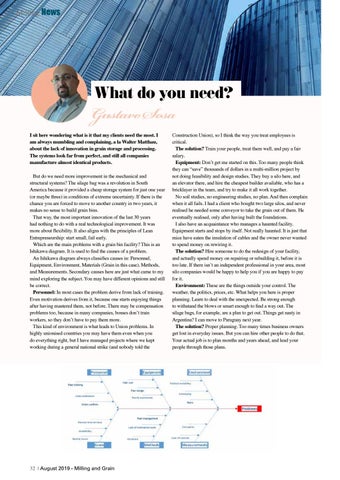
But do we need more improvement in the mechanical and structural systems? The silage bag was a revolution in South America because it provided a cheap storage system for just one year (or maybe three) in conditions of extreme uncertainty. If there is the chance you are forced to move to another country in two years, it makes no sense to build grain bins. That way, the most important innovation of the last 30 years had nothing to do with a real technological improvement. It was more about flexibility. It also aligns with the principles of Lean Entrepreneurship: start small, fail early. Which are the main problems with a grain bin facility? This is an Ishikawa diagram. It is used to find the causes of a problem. An Ishikawa diagram always classifies causes in: Personnel, Equipment, Environment, Materials (Grain in this case), Methods, and Measurements. Secondary causes here are just what came to my mind exploring the subject. You may have different opinions and still be correct. Personnel: In most cases the problem derive from lack of training. Even motivation derives from it, because one starts enjoying things after having mastered them, not before. There may be compensation problems too, because in many companies, bosses don’t train workers, so they don’t have to pay them more. This kind of environment is what leads to Union problems. In highly unionised countries you may have them even when you do everything right, but I have managed projects where we kept working during a general national strike (and nobody told the
32 | August 2019 - Milling and Grain
Construction Union), so I think the way you treat employees is critical. The solution? Train your people, treat them well, and pay a fair salary. Equipment: Don’t get me started on this. Too many people think they can “save” thousands of dollars in a multi-million project by not doing feasibility and design studies. They buy a silo here, and an elevator there, and hire the cheapest builder available, who has a bricklayer in the team, and try to make it all work together. No soil studies, no engineering studies, no plan. And then complain when it all fails. I had a client who bought two large silos, and never realised he needed some conveyor to take the grain out of them. He eventually realised, only after having built the foundations. I also have an acquaintance who manages a haunted facility. Equipment starts and stops by itself. Not really haunted. It is just that mice have eaten the insulation of cables and the owner never wanted to spend money on rewiring it. The solution? Hire someone to do the redesign of your facility, and actually spend money on repairing or rebuilding it, before it is too late. If there isn’t an independent professional in your area, most silo companies would be happy to help you if you are happy to pay for it. Environment: These are the things outside your control. The weather, the politics, prices, etc. What helps you here is proper planning. Learn to deal with the unexpected. Be strong enough to withstand the blows or smart enough to find a way out. The silage bags, for example, are a plan to get out. Things get nasty in Argentina? I can move to Paraguay next year. The solution? Proper planning. Too many times business owners get lost in everyday issues. But you can hire other people to do that. Your actual job is to plan months and years ahead, and lead your people through those plans.