STORAGE
F
Figure1
Figure2
Figure 3
Figure 4
Figure 5
The six guidelines you need to specify a bulk bag filler
E
by David Boger, Vice President, Global Business Development & Marketing, Flexicon Corporation
xponential growth in the use of bulk bags has spawned an entire manufacturing segment dedicated to producing specialised equipment that not only fills and discharges bulk bags, but offers various degrees of automation and integrates filling and unloading operations with upstream and downstream equipment. As the number of equipment options increases, so should the ability of the ‘specifier’ to evaluate stand-alone equipment and integrated systems against current and anticipated needs. Here I address the ‘filler’ half of the bulk bag handling equation, offering the six most important parameters to consider when satisfying any individual bulk bag filling requirement with top efficiency and cost effectiveness.
1: Anticipate maximum capacity
The difficult but critical question: How many bulk bags will you need to fill per week during the useful life of your next bulk bag filler? With a few exceptions, buying a more costly filler with higher capacity than you now need will be less costly than replacing a filler you outgrow, unless that filler can be retrofitted with performance enhancements at a later date. Capacity requirements run the gamut, from one bag per week to 20 bags per hour. Where your volume falls should, in part, influence your decision to specify a manual, semi-automated or fully automated machine. Generally speaking, the more manual the filling operation, the more output is subject to variation. When gauging the capacity and payback of manual equipment against automated equipment, you need to determine the average pace at which operators can attach, detach and cinch bag spouts, remove filled bags, load 86 | June 2017 - Milling and Grain
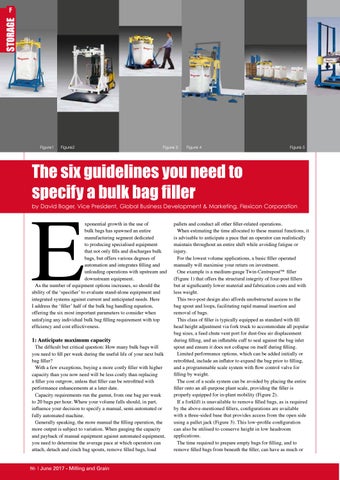
pallets and conduct all other filler-related operations. When estimating the time allocated to these manual functions, it is advisable to anticipate a pace that an operator can realistically maintain throughout an entire shift while avoiding fatigue or injury. For the lowest volume applications, a basic filler operated manually will maximise your return on investment. One example is a medium-gauge Twin-Centrepost™ filler (Figure 1) that offers the structural integrity of four-post fillers but at significantly lower material and fabrication costs and with less weight. This two-post design also affords unobstructed access to the bag spout and loops, facilitating rapid manual insertion and removal of bags. This class of filler is typically equipped as standard with fill head height adjustment via fork truck to accommodate all popular bag sizes, a feed chute vent port for dust-free air displacement during filling, and an inflatable cuff to seal against the bag inlet spout and ensure it does not collapse on itself during filling. Limited performance options, which can be added initially or retrofitted, include an inflator to expand the bag prior to filling, and a programmable scale system with flow control valve for filling by weight. The cost of a scale system can be avoided by placing the entire filler onto an all-purpose plant scale, providing the filler is properly equipped for in-plant mobility (Figure 2). If a forklift is unavailable to remove filled bags, as is required by the above-mentioned fillers, configurations are available with a three-sided base that provides access from the open side using a pallet jack (Figure 3). This low-profile configuration can also be utilised to conserve height in low headroom applications. The time required to prepare empty bags for filling, and to remove filled bags from beneath the filler, can have as much or