GEORGETOWN
BUSINESS Georgetown University McDonough School of Business
NO PLACE LIKE
Alumni face rewards and challenges when they return to the family business
HOME
Technology for the Future of Education How Asking for a Favor Can Seal the Deal SPRING 2016
PHIL HUMNICKY
SPRING2016 F E A T U R E S
Family Affair Georgetown graduates reveal the rewards and challenges of joining the family business.
14
SCOTT SLUSHER
BY MELANIE D.G. KAPLAN
20
26
The Connected Classroom
Favor Pitch
Georgetown McDonough uses innovative teaching solutions to take online learning beyond the digital lecture.
Researchers at Georgetown McDonough uncover a surprising negotiation tactic that can significantly increase the odds of sealing a deal.
BY HEATHER BOERNER
BY BOB WOODS
ON THE COVER: April Bonds (MBA ‘13). Photo by Scott Slusher
Georgetown University McDonough School of Business
Spring 2016 •
1
D E P A R T M E N T S
3 From the Dean How we make connections 4 Hilltop Highlights Examining the socially responsible business model, recognizing new faculty chairs, and more updates from across campus
31 Alumni News & Notes Momentum 32
36
Stay connected with Georgetown graduates
GRARY LANDSMAN
Show and Tell 32 Ruslan Petrychka (MBA ’14) provides objective news coverage in the Ukraine Game Changer 34 Christy Keswick (B ’97) helps give sporting equipment to disadvantaged children Joy Ride 36 Ed Moreland (EMBA ’15) gets behind the wheel at HarleyDavidson Events 38 The latest alumni happenings
4
40 TPlayakethe5 faculty member global
30
match game
GEORGETOWN McDONOUGH SOCIAL
GEORGETOWN
BUSINESS Dean David A. Thomas
Editor Lauren Pauer
Project Manager Connie Otto
Associate Dean and Chief Marketing Officer Chris M. Kormis
Contributing Editor Susan Webb
Production Artist Brenda Waugh
Managing Editor Chris Blose
Contributors Heather Boerner Christopher Brandon Melanie D.G. Kaplan Jennifer Lubell Rebecca Scherr Bob Woods
Assistant Dean for Communications Teresa Mannix
Art Director Jeffrey Kibler
Design and Production
Photo Editor Sara Elder Copy Editor Tara Kawar
2•
Spring 2016
Georgetown Business welcomes inquiries, opinions, and comments from its readers.
Please send an email to GeorgetownBusiness@ georgetown.edu. Alumni should send address changes to addup@georgetown.edu or contact alumni records at (202) 687-1994.
Follow us on Twitter: @msbgu Like us on Facebook: Georgetown McDonough School of Business
Follow us on Instagram: georgetownmcdonough
Join us on LinkedIn: Georgetown University McDonough School of Business Alumni
msb.georgetown.edu
FROM THE DEAN
Dean David A. Thomas spoke to members of the Georgetown Alumni Club of India in Mumbai, where he traveled to visit with business leaders and friends of the McDonough School of Business.
Making Connections As we prepared to send this issue of Georgetown Business to the Georgetown McDonough family, I recognized a common theme. Much of what we cover, both in the magazine you hold in your hands and in the business world more broadly, is about interaction and relationships. That is certainly true for the alumni in our cover story, “Family Affair” (p. 14). The allure of the family business called them back home, whether home was a sprawling cattle ranch in Texas, a major media player in the United Kingdom, or a food and beverage product company with offices across the globe. In each case, these graduates have learned the unique style of interaction required for working with the people they know and love — a style that comes with both rich opportunities and challenges. Our academic researchers focus on interaction and relationships, too. Take the one-on-one dialogue between a seller and buyer, for example. This relationship has existed since the beginning of marketplaces, but there always is room for improvement. In “Favor Pitch” (p. 26), Simon Blanchard, Kurt Carlson, and others explore how something as simple as asking for a favor can shift the dynamic of that particular relationship. “The Connected Classroom” (p. 20) is about a very different type of interaction, but one that is especially critical as we build future models of business education. How much classroom time do high-level global students desire? How can we mix traditional methods of teaching with the freedom and flexibility that new technology provides? We’re exploring these questions — with impressive results. And in the end, the Georgetown McDonough family and the relationships that are part of it will be stronger than ever.
David A. Thomas Dean and William R. Berkley Chair @ProfThomas
Georgetown University McDonough School of Business
Spring 2016 •
3
HILLTOP H I G H L I G H T S
+
Tk
POTUS
SCHOLARLY LESSONS ON LEADERSHIP
+
CHAMP
DOMINIQUE DAWES VISITS GEORGETOWN
Business with a Purpose Employees of Abahizi Dushygikirane Ltd., or ADC, the supplier of Kate Spade & Company’s on purpose label, outside the factory in Masoro, Rwanda.
4•
Spring 2016
Professors Study New Business Model Championed by Kate Spade & Co. In a small village in Masoro, Rwanda, more than 150 women make handbags and jewelry that end up on the shelves of one of the biggest names in fashion, Kate Spade & Company. The bangles, inset with handwoven beading in vibrant colors, bear inscriptions: courage, dream, limitless, inspire. The artisans in Masoro are employees of Abahizi Dushygikirane Corporation, or ADC, the supplier of Kate Spade & Company’s on purpose label, which launched in May 2014. Georgetown McDonough Professors Catherine Tinsley and Edward Soule are studying this socially responsible business model and its impact on the employees and their community. They have visited the village twice, in February and last summer. “The hook for me is when corporate leaders use their business to make long-lasting impacts in nontraditional ways,” Soule said. “We can play a role by using our academic perch to say to the world, ‘Here’s what worked, and here’s how it might work in marginalized communities around the world.’” Tinsley, professor of management, and Soule, associate professor of ethics, together with Melanne Verveer, msb.georgetown.edu
PHOTOS COURTESY OF KATE SPADE & COMPANY; CUPCAKE RUTHBLACK/THINKSTOCK
10 YEARS
MILESTONE FOR MBA EVENING PROGRAM
NEWS •HILLTOP HIGHLIGHTS
Georgetown University McDonough School of Business
Global Reach
Ambassador of Panama Visits with Global Business Fellows Program Students
Catherine Tinsley (second from left) talks with villagers in Masoro, Rwanda.
The Global Business Fellows attended a reception hosted at the Panama Embassy January 27. Students enjoyed meeting with Ambassador Emanuel Gonzales-Revilla, who spoke about the geopolitics of the Panama Canal and the economic outlook for his country. The Global Business Fellows Program is a new and innovative joint program for undergraduates offered by Georgetown’s McDonough School of Business and Walsh School of Foreign Service that combines fundamental business principles with coursework in international affairs, economics, and languages. The interdisciplinary
BRITTANY MAUPIN
executive director of the Georgetown Institute for Women, Peace, and Security, are researching the sustainability, scalability, and feasibility of replicating the ADC business model. They will share their findings with Kate Spade & Company and issue a research report this summer. “From what Kate Spade & Company learns from this experience, we hope to come up with a model that other companies could implement in the future,” Soule said. Unlike other socially responsible ventures, the operation in Rwanda is a supplier for, rather than a subsidiary of, Kate Spade & Company. ADC is a worker-owned, for-profit social enterprise that’s majority female. “We have a fundamental belief that women are agents of change in their communities,” said Sydney Price, senior vice president, corporate social responsibility, at Kate Spade & Company. “We think a fully integrated manufacturing partnership has the most long-term impact for women and their community.” Empowering women is at the core of on purpose. If the initiative succeeds, it will be an important alternative to the standard global supply chain model. “Kate Spade & Company isn’t just placing an order,” said Tinsley, who also leads the Georgetown University Women’s Leadership Institute. “They are building the capacities of the company, everything from management expertise to production technology. The objective is to create a competitive supplier that can assume a place in the supply chains of many fashion brands.” In addition to visiting Masoro, Tinsley and Soule have interviewed Kate Spade & Company employees in the United States — from the CEO in New York to a store manager in Georgetown — to understand the company’s goals and motivations and document the effect this initiative is having on the company’s culture. “We are finding enthusiastic support throughout the organization,” Soule said. “People relish the opportunity to make a difference in the lives of people who haven’t caught many breaks in life.”
Ambassador Emanuel Gonzales-Revilla with Stephen Yin (F ’17).
ADC employee applies her craft to the on purpose label.
curriculum enables students to analyze and solve challenges that impact business and public policy on a global scale. Students from both schools participate in core courses in business, economics, and international affairs, as well as the capstone Global Business Experience course. Students also interact with economic leaders and public policy decision-makers in Washington, D.C. This reception with the Panamanian Embassy is just one example of the co-curricular programming for program. ON THE WEB
FOR MORE ABOUT THE GLOBAL BUSINESS FELLOWS PROGRAM, VISIT MSB.GEORGETOWN. EDU/PROGRAMS/UNDERGRADUATE/ GLOBAL/GBF.
Spring 2016 •
5
NEWS •HILLTOP HIGHLIGHTS
The Only-in-DC Experience
MBA Launches Certificate in Nonmarket Strategy In January, Georgetown McDonough launched an MBA Certificate in Nonmarket Strategy with an inaugural cohort of 42 Full-time MBA students. The new certificate program is designed to bring rigor and a managerial perspective to exploring the nexus of business, economics, and public policy. Students will take a 12-credit sequence of integrated MBA core and elective courses to reinforce their understanding of and extend their exposure to the business challenges and opportunities “Nonmarket in the nonmarket environstrategy is, for ment from the perspective me, an exciting of the firm. new dimension Coursework began with the premiere of one of three new of the business MBA elective courses, all of world to which draw on the strengths of explore. I think the Georgetown McDonough it represents faculty, the MBA core curan increasingly riculum, and the resources of Washington, D.C. important The Nonmarket Environfacet of firm ment in D.C. blends classroom interaction.” instruction with attendance at —Joshua DeSonier “only-in-D.C.” events featuring (MBA ’17) opportunities for students to interact directly with business leaders, government officials, policymakers, members of interest groups and industry alliances, activists, and the media. The other new elective courses are The Miracle of Markets? and Strategies Beyond the Market. “Nonmarket strategy is, for me, an exciting new dimension of the business world to explore. I think it represents an increasingly important facet of firm interaction,” said Joshua DeSonier (MBA ‘17). “A specialization in nonmarket strategy feels like the cutting edge of firm strategy, and I want to be a part of it.” ON THE WEB
Since the Georgetown Entrepreneurship Initiative launched in 2009
25
Companies founded by alumni entrepreneurs
$25 million
Funding secured by alumni entrepreneurs
Published Works
Undergraduate Program Debuts Research Journal For four years, undergraduate business students have had the opportunity to conduct research with McDonough faculty as part of the Summer Undergraduate Research Fellowship program. Students present their projects in a fall symposium, but thanks to a new publication, their research will now reach a broader audience. In April, the Undergraduate Program launched the McDonough Undergraduate Research Journal (MURJ). By publishing student scholarly work in diverse business areas, the journal aims to contribute to the broader university intellectual community. The journal also allows students to hone their writing skills by reviewing, editing, and publishing articles under faculty guidance. The inaugural edition featured articles on topics such as China’s 1993 currency devaluation, the changing climate of marketing black hair care, and the benefits of the internationalization of universities.
GET MORE INFORMATION ABOUT THE CERTIFICATE IN NONMARKET STRATEGY AT MSB.GEORGETOWN.EDU/NMS.
6•
Spring 2016
msb.georgetown.edu
NEWS •HILLTOP HIGHLIGHTS
A Roadmap for Success: Transforming Advanced Illness Care in America By Bill Novelli and Tom Koutsoumpas with Boe Workman, Editor Public debate largely has been focused on end-of-life care, which is about the last six months of life. For those living with serious, progressive conditions, advanced illness care can extend for a number of years. A Roadmap for Success: Transforming Advanced Illness Care in America serves as a field guide for transformation in the United States by outlining the current landscape of advanced illness care and identifying action steps for achieving high-quality advanced illness care. In short, Roadmap shows how to make sure people with advanced illness get the quality care they deserve.
10 Candles and Counting MBA Evening Program Celebrates 10 Years Just a decade ago, the first class of Evening MBA students set foot on campus to begin their studies at Georgetown McDonough. These pioneering students would spend the next three years working with faculty to shape what has become one of the top MBAs in the country for working professionals. In February, alumni, students, faculty, and staff gathered to celebrate the milestone in the program’s history, as well as the recent ranking Paul Randazzo, Elizabeth Stanko, and Mark Wooters of the by Bloomberg Businessweek inaugural class of 2008. naming Georgetown’s Evening Stanko, shared how the alumni network she MBA 4th in the nation and 1st in the region. helped develop has been invaluable. Prashant Malaviya, senior associate dean “I remember going to full-time program for MBA programs, shared what he feels are activities and reaching out to everyone to the most important factors leading to the create the network that we all wanted,” she program’s success — the faculty who set out said. “To see the network we have built, not to create a part-time program that could just within the Evening Program but with compete on a national level with other fullthe Full-time MBA and Executive MBA, has time programs, the alumni who helped shape been tremendous.” the program and demonstrated its powerful The MBA program also announced that the impact on their careers, and the vibrancy, school will be growing the MBA Program this camaraderie, and electricity in the classroom year and that it has launched a new program experience not often found in other MBAs to recommend prospective students. The that draws from Washington, D.C.’s already Refer-a-Hoya Program asks the Georgetown well-educated population. MBA network to help the school recruit even “At the heart of our success is that the Evestronger classes for both the full-time and evening MBA was launched with a bold promise ning programs. Referred prospective students that our evening students would receive the exact same education as our full-time students,” will receive an informal interview, a reduction in the application fee, and priority interview Malaviya said. consideration. Recommended applicants Paul Randazzo, one of three members of the who already have applied will receive priority inaugural class of 2008 in attendance, reflected interview consideration. on the impact of this promise made by the program’s founders. “We were given access to the same curricuON lum and professors — and that was important to THE WEB us. That was the primary reason why most of us jumped at the opportunity,” he said. “It’s no surprise the program has made leaps and bounds in TO REFER A PROSPECTIVE MBA STUDENT OR RECOMMEND AN APPLICANT WHO HAS the quality of students and in the rankings.” APPLIED, VISIT MSB.GEORGETOWN.EDU/ Another member of the first class, Elizabeth REFERAHOYA.
Georgetown University McDonough School of Business
Spring 2016 •
RAFAEL SUANES
FACULTY BOOKSHELF
7
NEWS •HILLTOP HIGHLIGHTS
New Faculty Chairs Support Research Endowments Enable University to Retain Leading Academics
8•
Spring 2016
New Faculty Chairs and Professorships William R. Berkley Chair David A. Thomas Beyer Family Term Associate Professor Debora Thompson
PHIL HUMNICKY
Robert J. and Elizabeth Flanagan Family Term Associate Professor Jason Brennan Atara Kaufman Professor of the Practice in Real Estate Matthew Cypher Lapeyre Family Term Associate Professor of Business Administration Volodymyr Babich Heinz Christian Prechter Executive in Residence Douglas Holladay Michael G. and Robin Psaros Chair in Business Administration Rebecca Hamilton
PHIL HUMNICKY
In February and March, Georgetown McDonough celebrated three faculty members who were formally installed to faculty chairs and term professorships — a prestigious recognition of their current research as well as their research potential. Rebecca Hamilton, professor of marketing, was named the Michael G. and Robin Psaros Chair in Business Administration; and Victor Jose, associate professor of operations and Victor Jose, Bill and Karen Sonneborn, Dean David A. Thomas, information management, and Jason Schloetzer. and Jason Schloetzer, associate professor of accounting, were named William and Karen Sonneborn Term Associate Professors. The installation ceremonies also served as recognition of the generous donors who endowed their new positions as part of Georgetown University’s current capital campaign. “Endowed faculty chairs and term professorships create the freedom for professors to do extraordinary things,” said Dean David A. Dean David A. Thomas, Rebecca Hamilton, Michael and Robin Thomas. These appointPsaros, and President John J. DeGioia. ments help the school attract and retain top academics, he added, by allowing professors to be ambitious with their faculty and academic excellence research agendas without tradifund. The business school has 20 tional financial constraints and endowed faculty positions, 10 of to include current students in the which have been created in the curcreation of that research. rent campaign. Efforts are underway The university’s For Generations to support five additional chairs and to Come campaign ends June 30, and professorships, including chairs to Georgetown McDonough’s largest honor teaching legends George R. priority is meeting the goal for its Houston and William G. Droms.
William and Karen Sonneborn Term Associate Professors Victor Jose Jason Schloetzer Robert and Lauren Steers Chair in Real Estate W. Edward Walter
ON THE WEB
TO SUPPORT GEORGETOWN MCDONOUGH CHAIRS AND PROFESSORSHIPS, VISIT MSB. GEORGETOWN.EDU/GIVING OR CONTACT MATILDA CARPENTER, SENIOR DIRECTOR OF DEVELOPMENT, AT (202) 687-3930 OR MSBGIVING@GEORGETOWN.EDU.
msb.georgetown.edu
NEWS •HILLTOP HIGHLIGHTS
The Power of Problem Solving
HIGH MARKS
#19
New Index Predicts Consumer Spending
FOR MORE INFORMATION ABOUT THE PROBLEM-DRIVEN CONSUMPTION INDEX, VISIT BIT.LY/CONSUMERPROBLEMS.
Georgetown University McDonough School of Business
#4
MBA Evening Program: No. 4 (Bloomberg Businessweek)
Paul Almeida, Brooks Holton, and Michael O’Leary with former President George H.W. Bush and First Lady Barbara Bush.
#17
Building Strategic Partnerships
Undergraduate Business Program: No. 17 (Bloomberg Businessweek)
Professors Focus on Former Presidents’ Leadership Skills Georgetown McDonough Professors Paul Almeida, Brooks Holtom, and Michael O’Leary are working with four U.S. Presidential Centers to lead scholarly lessons on leadership. The centers reached out to Almeida, who also is senior associate dean for executive education, and O’Leary about leading the academic design of the Presidential Leadership Scholars (PLS) program, which focuses on four leadership skill areas -- vision and communication, decision-making, persuasion and influence, and coalition-building – that correlate to the strengths of Presidents Lyndon Johnson, George H.W. Bush, Bill Clinton, and George W. Bush. Almeida and Holtom recently drew from their scholarly research on strategic partnerships to teach 60 Presidential Scholars at the George H.W. Bush Presidential Center. The former president and first lady attended the module that included sessions taught by members of the president’s administration and focused on the development of effective alliances.
*Since December 2015
$90,684
Average post-graduation salary for the Master of Science in Finance Class of 2015
3DFOTO/THINKSTOCK
ON THE WEB
Full-time MBA Program: No. 19 in the United States (Financial Times) CHANDLER ARDEN
U.S. consumers account for approximately 70 percent of the national economy, making their spending habits critical to understanding economic growth. Two researchers at Georgetown’s McDonough School of Business have developed a new, effective way to predict consumer spending based on the idea that consumers often know the problems they plan to solve before they know which product or service they will use to solve those problems. The Problem-Driven Consumption Index (PDCI) is derived from results of a monthly survey that asks consumers what problems they plan to spend money solving in the near future. This survey, called the Consumer Problem Survey, tracks the quantity of, severity of, and types of problems that consumers plan to solve in nine major categories, including health care, home and housing, and transportation. By measuring and tracking the problems and their predicted spending on these problems, the survey goes beyond measuring just confidence or sentiment and provides new insights into when and where consumers will spend money in the retail market. The index is research-based and proven. Kurt Carlson, professor of marketing, and Chris Hydock, assistant research professor, have collected more than two years of data that has accurately predicted consumer spending. “The key to the effectiveness of the PDCI as a leading indicator lies in its upstream focus on intention to solve problems,” Carlson said. “This allows us to identify likely movements of money into the market for a wide range of problem solutions and, in many cases, make this identification before the consumer knows exactly what product or service they will buy to solve their problem.”
Spring 2016 •
9
NEWS •HILLTOP HIGHLIGHTS
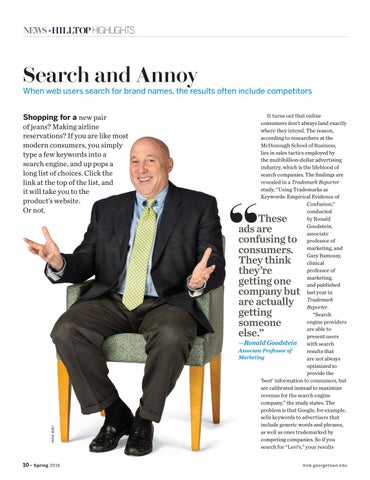
Search and Annoy
When web users search for brand names, the results often include competitors
DRAKE SOREY
Shopping for a new pair of jeans? Making airline reservations? If you are like most modern consumers, you simply type a few keywords into a search engine, and up pops a long list of choices. Click the link at the top of the list, and it will take you to the product’s website. Or not.
10 •
Spring 2016
It turns out that online consumers don’t always land exactly where they intend. The reason, according to researchers at the McDonough School of Business, lies in sales tactics employed by the multibillion-dollar advertising industry, which is the lifeblood of search companies. The findings are revealed in a Trademark Reporter study, “Using Trademarks as Keywords: Empirical Evidence of Confusion,” conducted by Ronald Goodstein, associate professor of marketing, and Gary Bamossy, clinical professor of marketing, and published last year in Trademark Reporter. “Search engine providers are able to present users —Ronald Goodstein with search Associate Professor of results that Marketing are not always optimized to provide the ‘best’ information to consumers, but are calibrated instead to maximize revenue for the search engine company,” the study states. The problem is that Google, for example, sells keywords to advertisers that include generic words and phrases, as well as ones trademarked by competing companies. So if you search for “Levi’s,” your results
“
These ads are confusing to consumers. They think they’re getting one company but are actually getting someone else.”
msb.georgetown.edu
NEWS •HILLTOP HIGHLIGHTS
Georgetown University McDonough School of Business
Seed Money
Leonsis Family Supports Georgetown Student Entrepreneurs through New Prize Georgetown University students with entrepreneurial ambitions will have a new source of support, thanks to Ted Leonsis (C ’77), a longtime entrepreneur, investor, and founder and CEO of Monumental Sports & Entertainment, his wife, Lynn, and their children Zach (MBA ’15) and Elle (C ’14), who have pledged $1 million toward a prize. Starting in fall 2016, the Leonsis Family Entrepreneurship Prize will honor and provide financial support to Georgetown students and recent alumni who have launched or are preparing to launch new business ventures that address problems in the world. “For many younger entrepreneurs, the initial barrier is financial,” said Ted Leonsis, who also serves as the chair of the Georgetown Entrepreneurship Initiative’s newly established advisory board. “My family and I want to help Georgetown men and women overcome that challenge by providing funds to students who are committed to addressing local, national, and global societal issues.” Current Georgetown undergraduate and graduate students, as well as Georgetown alumni within six months of graduation, will be eligible to win the prize and may be nominated as individuals or as teams. Georgetown’s Entrepreneurs-in-Residence will provide valuable mentorship to the Leonsis prize finalists as they develop and pursue their ventures. Recipients of the prize will be selected through a rigorous nomination, application, and review process in both the fall and the spring semesters. Each year, a pool of up to $100,000 in awards will be distributed to student and alumni entrepreneurs.
COURTESY OF MONUMENTAL SPORTS & ENTERTAINMENT
might begin with ads for competitors such as Wrangler and Lee. “These ads are confusing to consumers,” Goodstein says. “They think they’re getting one company but are actually getting someone else.” Goodstein’s research found that when people type a specific brand name into a search engine, 75 percent of them are looking for that particular product. “The fact is that you’re not allowed to confuse consumers,” he says, referring to long-established Federal Trade Commission regulations and court rulings. According to trademark law, Google and other search engines are in the wrong, the study purports, because they make money selling branded names to advertisers who don’t own them. The search companies cause even more harm by diluting the brand equity that companies have invested in to build. “To display other brands in search engine results … hurts both the sales and equity of the trademark owner,” the study says. The search companies argue that they’re simply providing more information, which is good for the consumer, and have no vested interest in the consumer’s purchase decision. Goodstein says his empirical research proves otherwise. The search companies get paid for click-throughs and purchases, “so they actually do have a vested interest,” he says. Goodstein decided to dive into this controversial issue while participating as an expert witness in a lawsuit brought by an airline against a search company. “There’s been a debate in the marketing area about this for a long time, and the courts aren’t sure how to rule because it’s new to them,” he says, noting that most cases, including the one he participated in, are dismissed or settled out of court without establishing a legal precedent. “It’s still determined on a case-by-case basis.” The search companies have altered the way they display “sponsored ads” on search results, yet Goodstein suggests that the changes aren’t enough and continue to confuse consumers. In the meantime, owners of trademarked brands can do little to avoid harm beyond filing a lawsuit. “They have to decide, though, if it’s worth going to court over this,” he says. “The search engines have deeper pockets than they do.” — Bob Woods
“The Leonsis family’s gift underscores Ted, Lynn, Zach, and Elle’s commitment to promising young entrepreneurs at Georgetown,” said Jeff Reid, founding director of the Georgetown Entrepreneurship Initiative at the McDonough School of Business. Ted Leonsis has launched several companies in his career, including one which later merged with AOL. He owns the NHL’s Washington Capitals, the WNBA’s Washington Mystics, the NBA’s Washington Wizards, and D.C.’s Verizon Center. He has served as a member of Georgetown’s board of directors and is a loyal supporter of numerous university programs. Elle (C ’14), a digital journalist with SnagFilms and its ViewLift unit, graduated from Georgetown with a bachelor’s in English and a minor in film and media studies. Zach (MBA ’15), vice president and general manager of Monumental Sports Network, also will serve on the Entrepreneurship Initiative’s advisory board. Lynn is co-founder and president of the Leonsis Foundation, which creates opportunities for children that enable them to reach their highest potential. Spring 2016 •
11
NEWS •HILLTOP HIGHLIGHTS
INFLUENCERS
“
The thing about innovation is that you have to be making people uncomfortable. I say this to my senior team — if we start finishing each other’s sentences, that’s really bad. I want you to provoke me.” —Ann Sarnoff (B ’83),
12 •
Spring 2016
LESLIE KOSSOFF
2
KWONG SHING LUI
1
BROOKE SLEZAK
JASON PENTECOST
President of BBC Worldwide North America, speaking at an event hosted by the Stanton Distinguished Leaders Series and the Women’s Leadership Institute.
3
msb.georgetown.edu
10
RAFAEL SUANES
9
RAFAEL SUANES
5
QUIERRA WELLS
4
PHIL HUMNICKY
NEWS •HILLTOP HIGHLIGHTS
1. Joseph Sitt, founder, president, and CEO of Thor Equities, discussed global real estate at a New York event sponsored by the Steers Center for Global Real Estate and the Wall Street Alliance. 2. Dominique Dawes, three-time Olympic gymnast and first AfricanAmerican gymnast to win a gold medal, shared keys to success and happiness at the Diversity Dialogue Conference hosted by the Georgetown Aspiring Minority Business Leaders and Entrepreneurs (GAMBLE) and the McDonough Undergraduate Program Office.
11
12
JESUS RODRIGUEZ
8
QUIERRA WELLS
7
QUIERRA WELLS
6
RAFAEL SUANES
RAFAEL SUANES
3. Chris Lowney, author of Heroic Leadership, talked about the importance of Jesuit ideals in the business world at a Stanton Distinguished Leaders Series event. 4. Marriott President and CEO Arne Sorenson shared trends in the hospitality industry and discussed Marriott International’s growth as part of the Stanton Distinguished Leaders Series. 5. John Vitalo, CEO and executive director of Atlas Mara, talked about investing in and expanding business across Africa at the school’s inaugural Africa Business Conference. 6. Four leaders of the fast casual dining industry — Burton Heiss, CEO of Nando’s Peri-Peri USA; Michael Lastoria, CEO and co-founder of &pizza; Brett Schulman, CEO of Cava Grill; and Casey Patten, co-owner of Taylor Gourmet — discussed the evolution of the D.C. food scene at a panel event.
7. Deborah Harmon, co-founder and CEO of Artemis Real Estate Partners, talked about the real estate industry as part of the McBride Lecture Series. 8. With Global Business Initiative director Ricardo Ernst, Mark Del Rosso, COO of Audi of America, and Ajaz Ahmed, CEO of AKQA, discussed building luxury brands at the Global Luxury Summit. 9. U.S. Secretary of Energy Ernest Moniz called for clean energy innovation at the Climate and Clean Energy Investment Forum, co-hosted by the Global Social Enterprise Initiative and Georgetown Environment Initiative with the U.S. State Department and Google. 10. Carlos Ghosn, chairman and CEO of the Nissan-Renault Alliance, discussed disruptive leadership in the global auto industry as part of the Paul Hill Lecture Series hosted by the Georgetown Entrepreneurship Initiative. 11. Andres Kiger, vice president of Latin America marketing, Converse Inc. discussed “Building Iconic Brands in the Age of Real Time” as part of the Stanton Distinguished Leaders Series. 12. Carly Fiorina, former Hewlett-Packard CEO and Republican presidential candidate, shared her experiences on the campaign trail as part of the Georgetown Institute for Politics and Public Service’s “Reflections on Running” series, which was co-sponsored by McDonough’s Business, Society, and Public Policy Initiative. Spring 2016 •
13
FAMILY AFFAIR
14 •
Spring 2016
msb.georgetown.edu
By Melanie D.G. Kaplan
Whether business takes place in a barn or a boardroom, when it involves your family, it gets personal. For some recent Georgetown McDonough graduates, the decision to join their family business has yielded true benefits — for them as well as future generations.
>>
Georgetown University McDonough School of Business
Spring 2016 •
15
SCOTT SLUSHER
Y
Georgetown graduates reveal the rewards and challenges of joining the family business.
About 35 percent of Fortune 500 companies are family controlled, according to seasoned entrepreneur and adjunct professor Melissa Bradley (B ’89), and they represent the full spectrum of American companies from small businesses to major corporations, the largest of which is Wal-Mart. The Small Business Administration reports that family businesses (there were 5.5 million in 2011) make up 64 percent of U.S. gross domestic product, generate 62 percent of the country’s employment, and account for 78 percent of all new job creation. Technology, longer life spans, and new types of family structures have altered attitudes toward family business and created new opportunities for younger generations. But Bradley says the fundamental keys to making family businesses work remain unchanged: clear vision, solid strategic plan, succession planning, strong decision-making and governance, and performance management. Here’s how three alumni make it work.
16 •
Spring 2016
“
When we walk into that office, we are work colleagues. But when we go into the house for lunch, we very seldom talk about business. It’s the one chance we have to be a family and not a family business.” —April Bonds (MBA ’13)
SCOTT SLUSHER
P.R. Bonds established Bonds Ranch in 1933. Today, his son Pete Bonds runs the ranch with his daughters April and Missy.
Farmer’s Market
April Bonds (MBA ’13) was the black sheep of her family. While growing up on a family farm in Saginaw, Texas, her two sisters intended to become ranchers, but Bonds wanted to be as from that world as possible. She begrudged getting up at 4 a.m. to brand cattle during spring break while her friends were going to Disney World. So Bonds left the country. She studied abroad in Argentina. She learned to speak Spanish in Costa Rica. She even spent four years in Cabo San Lucas, Mexico, working as a wedding and event coordinator. “I would have bet someone $1 million that I was never coming back to the ranch,” she says. That all changed when Bonds enrolled in business school and began to understand the value she could bring back to the family ranch. In each class, professors — including Arthur Dong and Elaine Romanelli — were fascinated with her background and asked her to relate business lessons to the ranch. She completed a risk management tutorial with Finance Professor Rohan Williamson, which led her to realize that her sister and father were addressing only half the risks. “If someone at the ranch wasn’t good at these things or able to dedicate time to them, it would be detrimental,” Bonds says. Among her concerns: government relations, marketing, consumer education, social media, and human resources. “The professors really opened my eyes,” she says. She returned to Bonds Ranch after graduation — anticipating msb.georgetown.edu
it would be a temporary job — and is still there today, serving as the ranch’s operations and markets strategist and consultant. The tasks she resented as a child now fill her with pride. The family business has grown considerably since Bonds’ grandfather purchased the ranch, a 400-head cattle operation, in 1933. Her father expanded and diversified the business and eventually acquired three other ranches. Today, the company is one of the largest cattle operations in the United States, operating in 26 Texas counties, eight states, and Canada. Bonds says one benefit of working with her family is getting to know her father and sister in ways she never would have otherwise. They learned how to communicate and to appreciate the skills each individual brings to the business. “We know we each bring a certain value,” she says. “We each contribute something different.” A big learning moment occurred in 2014 when Bonds’ father was hospitalized for two months. Bonds says it forced the family to identify responsibilities and to develop a backup plan. They established a chain of command so that business decisions could be made. Bonds says her decision to return the ranch was met with some trepidation by its employees. “They remembered me as a teenager who didn’t want to be out there. It took three years to earn their respect.” She also struggled with getting reacquainted to the farm’s layout, but Bonds says working through those challenges has been incredibly rewarding. “When we’re out there working the cattle, there’s a lot of pride knowing that this is mine.”
“
We’ve got to be a growing and profitable company, but I want to keep the values of our family, which is such an important part of our community.” —Michael Thomson (MBA ’13)
Media Player
When Michael Thomson (MBA ’13) was a child, he knew his father worked in the publishing business because he would bring home the comics from work three weeks early. But the young Thomson knew little about the family business beyond where his dad hid the funnies (in the study). Today, his father is chairman of DC Thomson, a private, $400 million, family-run international media group, operating a global consumer business that includes one of the leading publishing houses in the United Kingdom. Michael is finance director of brightsolid, the smallest of the group’s four subsidiary companies. Thomson began his career at PricewaterhouseCoopers in Edinburgh but always kept the family business — started by his great-great uncle in 1905 — in the back of his mind. While he was at McDonough, the print industry was undergoing radical changes, and his family’s business was facing losses for the first time in its 100-year history. Thomson vacillated between working with his family and continuing his career elsewhere; if he joined the business,
From left: CEO Richard Higgs, Lord Provost George Adam, and Michael Thomson (MBA ’13) at the official opening of brightsolid in Aberdeen, Scotland.
Georgetown University McDonough School of Business
Spring 2016 •
17
Liquid Asset
Brightsolid maintains offices and data centers in Dundee, Aberdeen, Edinburgh, and London.
he thought, what skills could he contribute? Eventually, he decided to make the leap. “When I came back to DC Thomson, there were a few frantic conversations like, ‘Where will he add most value?’” Thomson says. The timing was right — brightsolid, which offers IT solutions to customers, had branched off from another division and left a financial director opening. DC Thomson employs 1,500 people, including 10 family members. Today, the challenge is to advance a traditional, family company without losing what Thomson calls the family spirit. “We’ve got to be a growing and profitable company, but I want to keep the values of our family, which is such an important part of our community,” he says. “How do we take the business forward in a way that we keep the raison d’etre of what we’re trying to do?” Thomson says the family sometimes disagrees on the level of risk to take. “My brother’s very keen to keep the business moving quickly, but old habits die hard with my father and the risk-averse board.” The key to reaching consensus, he says, is to remove emotion from the equation and remember that these are business decisions. Making long-term choices that affect his parents, brother, wife, and children motivates Thomson daily. If he sticks with the business for 40 years, he says, he will need to assess the decisions he makes today – whether he created a mess or a success. “I had a good upbringing, and that’s largely because of the family business,” he says. “It would be unfair of me not to be able to put in as much as I’ve taken out.” 18 •
Spring 2016
When Tarick Gamay (B ’07) was growing up in Wisconsin, he heard stories about the projects his father was working on. “He’d come home talking so fast, so excited,” Gamay says. Gamay’s father was a food chemist who developed, among other products, the technology to make fat-free cheese. “He would come up with crazy innovations that you wouldn’t think possible,” he says. Those innovations allowed Gamay’s father to start two companies, Gamay Foods and DreamPak. Gamay has held various positions within the family business, and today, he is vice president of retail and contract manufacturing for DreamPak, which develops and manufactures liquid concentrates for a variety of beverage applications, such as coffee creamers and water enhancers. The company is based in Alexandria, Virginia, and employs 50 people, including Gamay’s brother (in Wisconsin) and sister (in Europe). Business has been challenging. “We’ve gone through some really hard times as a family business, and I wonder how we’ve made it past those struggles,” Gamay says. A turning point came —Tarick Gamay (B ’07) when he and his father met with a professor who taught Gamay’s twin brother. “He said we needed to make rules and boundaries. We’re still doing that.” One of the boundaries Gamay talks most about is learning to
“
At first, I saw it as taking the easy way out. Now, I realize that it’s not what you start out with, it’s what you build.”
msb.georgetown.edu
Making It Work
The Gamay family owns two manufacturing companies, Gamay Foods and DreamPak.
separate work and home life. “At work, we treat each other with professionalism and expect the same,” he says. But the family leaves work at the office. “Don’t talk about business at home or on the weekends.” Gamay has helped run DreamPak for nearly a decade, but he says it took time to shift his thinking about what it means to work in a familyowned business. “At first, I saw it as taking the easy way out,” he says. Along the way, he learned that the bar is set higher for family members, and he strives to both succeed and earn employees’ respect. “Now, I realize that it’s not what you start out with, it’s what you build.” As the company grows, Gamay says one of the challenges it faces is adding leadership outside the family. “In the last year, we completely changed the company, hiring a lot of new people and starting to put a board of directors in place,” he says. The family is learning how to appreciate outsiders’ perspectives. “It’s a shift in mentality.” Most of all, Gamay enjoys looking
to the future. “I have two kids,” he says. “I want this company to be something they and my nieces and nephews can take over and be part of one day.” GB
Georgetown University McDonough School of Business
Before you sign on with your family business, McDonough adjunct professor Melissa Bradley recommends assessing your interests. She suggests finding a mentor, asking questions to understand your role and position, and setting boundaries for personal and professional interaction. You may face a family feud if you make careless decisions doing business with siblings and spouses. Alumni who have learned important lessons share advice. 1. Define areas of responsibility. Identify who is in charge of certain jobs and who serves as backup when that person is unable to fulfill their responsibilities. April Bonds suggests establishing a chain of command so everyone knows where the buck stops and why. 2. Align your strategy and values. If your family business is well-known in a community, like DC Thomson is, be aware of how business decisions are seen from the outside, Michael Thomson says. “Think about how to move the business forward without disrupting your core values.” 3. Set aside time to be a family. “When we walk into that office, we are work colleagues,” Bonds says. “But when we go into the house for lunch, we very seldom talk about business. It’s the one chance we have to be a family and not a family business.” 4. Write up the deal. While nobody likes to think about signing a business contract with their beloved, if you have ownership in the company, your family members may want to know you are willing to protect the business they worked hard to build.
Tarick Gamay (B ’07), at left, with his family.
Spring 2016 •
19
20 •
Spring 2016
msb.georgetown.edu
THE
CONNECTED
CLASSROOM Georgetown McDonough uses innovative teaching solutions to take online learning beyond the digital lecture. By Heather Boerner
HUGH KRETSCHMER
Just before 8 a.m., Ana Duarte-Silva Barry (MSF ’17) sat down at her home office in Phnom Penh, Cambodia, with a cup of coffee and her computer to begin her weekly coursework. With a click of the mouse, her face was broadcast 8,956 miles away to a classroom in Washington, D.C., where she participated in a discussion about corporate financial policies.
>>
Georgetown University McDonough School of Business
Spring 2016 •
21
You could call this the Georgetown McDonough Master of Science in Finance (MSF) for a new age — a course comprising online instruction, topped off by a weekly discussion between students located around the world. “I did not expect to have such a close relationship with my classmates when I thought of taking an online class,” Duarte-Silva Barry says. “That turned out to be completely wrong. You don’t even have to be in D.C. to be part of the MSF team.” You also could call this the future of business education. The MSF blended classroom, a combination of remote and on-site students, is the business school’s first foray into technologically enhanced education, but it is unlikely to be the last. Georgetown McDonough plans to apply the MSF program’s experience to other disciplines within the school. “It would be crazy to assume that the way we teach entrepreneurship today is going to be the same way we’ve always taught it — and that’s probably the case for any business topic,” says Jeff Reid, founding director of the Georgetown Entrepreneurship Initiative and a member of the Georgetown Future(s) of the University Initiative, which is re-envisioning how courses will be taught in a decade. “The way our students learn is changing, and we need to be willing to change right along with it. For a school like Georgetown, with such rich traditions, it would be easy to rest on its laurels. Instead, this university is looking to the future.”
HUGH KRETSCHMER
Digital Strategy
22 •
Spring 2016
David A. Thomas, dean and William R. Berkley Chair of Georgetown McDonough, has made expanding technology-enhanced learning one of the school’s goals for the next five years. “There’s no question that msb.georgetown.edu
technology is being used to reshape the educational landscape at every level — from elementary school to high school to post secondary and graduate school,” he says. “It struck me as irresponsible of us to sit on the sidelines.” He appointed Paul Almeida, senior associate dean for executive education and professor of strategy, to lead the school’s digital strategy and to map its future of educational technology. The pair recently visited other colleges to see how they apply technology to students’ educations, though Georgetown McDonough has no intention of following the pack. Thomas compared the online experience to the buildings on campus. Those buildings are majestic, providing students with a world-class experience in bricks and mortar. “That’s what we need to do online,” he says. “Provide a premier online educational experience.” The school already is well on its way. Reid’s entrepreneurship program, StartupHoyas, allows students to apply to participate in pitch competitions by posting video to Facebook. In a course Reid taught last semester, students showed they were following their chosen industries by tweeting industry news and information. And lecture videos for the Starting Startups That Matter course are available for anyone in the world to watch free online. Such examples are far from what people think of when they imagine online learning. These are no MOOCs, so-called massive open online courses, which make education available to an unlimited number of students, sometimes at the expense of quality and specificity. “Most colleges are looking at technology as a way to get more
“
We’re increasing the quality of the education with technology. We’re doing what we do with more flexibility, which allows students to climb the ladder in their careers without leaving those careers.”
—Paul Almeida
Professor of Strategy and Senior Associate Dean for Executive Education
Georgetown University McDonough School of Business
PHIL HUMNICKY
Let It Snow
Technology can keep students learning, even when campus is closed. Take snow days, for instance. Snowstorms or other natural events that preclude students from gathering on campus are no longer enough to stop classes. In July 2014, the university instituted a campus-wide plan for instructional continuity — technological approaches that allow classes to continue when campus is inaccessible. New options include sending emails, posting lectures, uploading handouts to virtual teaching platforms like Blackboard, and posting narrated slide decks on Echo360. Additionally, professors are encouraged to conduct live classes using a conferencing app called Zoom that can accommodate more than 200 simultaneous users. Jeff Reid, founding director of the Georgetown Entrepreneurship Initiative, experienced this firsthand about a year before the campus-wide policy went into effect. In 2013, a snowstorm closed the school — a potentially big problem for an entrepreneurship program that offers one-week bootcamps. But this time, the weather didn’t shut down his class. Students, who were assigned to do market research among the target demographics for their respective startups, skipped class and headed to snowed-in airports and malls to talk to potential customers. After compiling their research, the teams jumped on Google Hangouts with Reid and his co-instructor to debrief and receive feedback. “I learned a lot from that experience,” Reid says. “And I haven’t had a class snowed out since then.”
Spring 2016 •
23
“ students involved more cheaply,” Almeida says. “We’re not doing that. We’re increasing the quality of the education with technology. It’s a totally different objective than a MOOC. We’re doing what we do with more flexibility, which allows students to climb the ladder in their careers without leaving those careers. And it enhances learning and student satisfaction.”
Flipping the Classroom
When McDonough leadership announced that the school would pilot an online MSF degree program, finance professor and director of the MSF program Allan Eberhart had his doubts. Eberhart believed online classes meant comprehensive, 90-minute lectures uploaded to the web that would be hard to follow for all but the most dedicated students. “When I saw how much you could do,” Eberhart says, “that’s when I became convinced we could use technology to improve the quality of education, as well as its flexibility.” He agreed to lead the development of the program. The technology had grown since the days of online bulletin boards and platforms where students upload papers. The program would embrace a fully integrated teaching strategy that required faculty to dissect the curriculum and start over with a reimagined learning experience in mind. Eberhart and his colleagues found themselves in a video studio, standing in front of a green screen recording five- to 10-minute videos on the core concepts from the assigned readings. Then they worked with graphic designers to create illustrations that further explained the concepts. Add in a digital white board and transcripts of the entire presentation, searchable by keyword so students can revisit the parts that warrant further investigation, and you have more precise and elaborate instruction than students would get in person. “It is completely unlike watching someone teach in a classroom,” Eberhart says. “There’s a very personal connection between student and teacher.” After students digest the presentations and do the reading, they gather in real time to discuss case studies at a specific time each week with all the other students in the class, no matter where they are located. 24 •
Spring 2016
Allan Eberhart, professor of finance and director of the MSF program, teaches in a blended classroom that combines inperson and online interaction.
I did not expect to have such a close relationship with my classmates when I thought of taking an online class. That turned out to be completely wrong. You don’t even have to be in D.C. to be part of the MSF team.” —Ana Duarte-Silva Barry (MSF ’17)
msb.georgetown.edu
Looking Ahead
An immersive educational experience like the MSF program allows students to bring the self-directed, asynchronous parts of the coursework with them to discussions. They do not just rehash what the reading told them. They get right to the meat of it. This is exactly what Armineh Ghazarian (MSF ’17) loves about the program. She attends in person, but she calls the experience seamless. Using the technology, she does the reading, watches the series of presentations, and gets the crux of important lessons right away. “Instead of professors outlining what we read, the professor presentations have the air of, ‘Concentrate on this,’” she says. When students meet for real-time discussion, the class goes beyond theory. It applies the learning. “I really like the way Professor Eberhart designed the program, because he’s not teaching us as if we’re students,” she says. “The way he’s teaching us, it’s as if you’re a manager, you own your own company, and what are you going to do.” Duarte-Silva Barry believes the remote setup is an advantage because conversations often lend themselves to discussion of how business is done in different parts of the world. Never did she feel like a lesser student for being in Cambodia. When she moved to Washington, D.C., partway through the program and started attending classes in person, she saw that she was treated the same whether she was on campus or abroad. To her, this diversity is a valuable feature. “The fact that Georgetown University McDonough School of Business
“
It is completely unlike watching someone teach in a classroom. There’s a very personal connection between student and teacher.” —Allan Eberhart
Professor of Finance and Director of the Master of Science in Finance Program
the technology is so seamless and you can pull people in from different countries and different parts of the United States, in different careers, adds to the discussion,” she says. “And it does so in a way that I don’t think we’d get if everyone had to pick up and relocate, sit together in D.C., and hit pause on their careers. It eliminates that self-selection bias.” Flipping the classroom is likely to show up in more programs at McDonough as the school’s leaders apply what they’ve learned from MSF to other programs. Ghazarian, who also received her bachelor’s degree from Georgetown, believes the experience provides the same quality and interaction she saw in her face-to-face undergraduate courses. “The whole point is to create managers to go out and do good in the world,” she says, “and then to come back and say, ‘I got my education from Georgetown.’ ” GB
HUGH KRETSCHMER
Using a platform called MSF Live, Eberhart can view every student on an 80-inch screen — he can see their faces, their reactions, and, through a “hand raised” button, their questions. It resembles the opening credits of the “Brady Bunch,” with each student occupying one square. When the course began, all students logged in remotely and the program’s faculty had to learn to conduct class in a studio rather than a classroom. When the courses became blended, with some students on-site at Georgetown McDonough and some logging in remotely, he could still see all the students on the screen and was able to include every student in the conversation. The program morphed into something unlike any other MSF in the world. “I think the way we teach in our MSF program is the way that we eventually will teach in all of our programs,” Eberhart says. “That’s why we don’t think of MSF as ‘online,’ but instead as ‘technology intensive.’ Eventually, this this term will fade away, too. All programs will be technology-intensive, and we will have shown the way with our MSF program.”
Spring 2016 •
25
P
Favor
Pitch Georgetown McDonough researchers uncover a surprising negotiation tactic
MARC ROSENTHAL
By Bob Woods
The last time you purchased a car, you may have heard this sales pitch: “What do I have to do to put you in this baby today?” A cliché in the used-car world, yet it could apply to a number of purchasing situations where negotiating the price is a delicate dance between seller and buyer. But what if there was something simple a seller could do to persuade a buyer to tango?
>>
Georgetown University McDonough School of Business
Spring 2016 •
27
That is the question a pair of marketing professors at Georgetown University’s McDonough School of Business posed in a recent research project. The results, presented in their report, “The Favor Request Effect: Requesting a Favor from Consumers to Seal the Deal,” was published in the April issue of the Journal of Consumer Research.
than the second. This study suggests the opposite. “We find that sellers who add a favor request to a price discount are 40 to 50 percent more likely to close the sale than sellers who do not ask for a favor,” Blanchard says.
The Favor Request
The Art of the Deal
28 •
Spring 2016
To explain this counterintuitive phenomenon, the researchers looked at the nature of price negotiations in several consumer settings, including art, antiques, electronics, and furniture. “Consumers in general seem to be under the assumption that it’s ‘us versus them,’” Blanchard says. They may not believe that a discount serves their best interest. Instead, they may think the seller is the one getting the upper hand and dig their heels in deeper, even to the point of refusing a great deal. The first step in breaking that competitive stalemate, the researchers surmised, could be the enticing push and pull of reciprocity — “I’ll do something for you if you do
WESTEND61/GETTY IMAGES
In the report, Simon Blanchard and Kurt Carlson, along with Jamie Hyodo, a doctoral candidate in marketing at Penn State, maintain that requesting a favor from a buyer who has been offered a discounted price can significantly increase the odds of sealing the deal. The tactic works, their research reveals, because it creates a reciprocal interaction, where both parties walk away satisfied with the outcome. What they call the “favor request effect” might level one of the most common, and too-often contentious, playing fields in the game of everyday life. “What’s new in our study,” Blanchard says, “is that by asking for the favor, even though it doesn’t have to be verified, the seller is switching the way the consumer sees the interaction. It changes from something that’s competitive to something that’s more reciprocal or cooperation oriented.” The researchers offer two scenarios to illustrate their technique: 1) The prospective buyer of a $100 painting asks if the seller will drop the price. The seller reduces the price to $80, leaving the buyer to ponder the final offer. 2) In a similar scenario, the seller reduces the price of the painting to $80. While the buyer ponders the new offer, the seller says it would be nice if the buyer considered doing a favor, such as writing a positive review online of the gallery or recommending it to a friend. Conventional wisdom, Blanchard says, backed up by extensive research on reciprocity, suggests that to get somebody to do you a favor, defined as compliance, you have to do something first — the old tit for tat. “But that tends not to work very well,” he contends, therefore the first scenario should yield more deals
msb.georgetown.edu
The Real World something for me” — where the benefits are viewed as mutual. Yet they wanted to go a step further, Blanchard says. “We wondered if it’s always necessary for the buyer to offer a favor first so that the seller responds in kind. Our original hypothesis was that if favors are so prevalent in our lives, just mentioning favors might change the perceived nature of the interaction and lead to a mutually beneficial deal.” By eliminating the contentious back and forth, the consumer is not only satisfied with the price, but believes the seller has gone as low as possible. In other words, the deal struck is a genuine win-win.
Pulling It Off
To demonstrate the favor request effect, the researchers conducted a series of five experiments. In addition to showing that the pairing of a price discount with a favor request increases the probability that the consumer will accept the deal, the results also outlined conditions under which the effect occurs. Surprisingly, Blanchard reports, “we found that there needs to be some level of uncertainty that the discount is good or bad.” For instance, if the seller’s discount is big, the favor request becomes pointless, because consumers usually accept such deals. “We found that 10 to 30 percent discounts work best,” he says, “so it actually tends to be more effective when the discount is fairly moderate.” On the other hand, if the discount is small, the buyer might think that the seller is pulling his leg and turn it down. The nature of the favor request matters, too. The favor should be appropriate, even if the consumer does not need to follow through. For example, the owner of a furniture store may ask a consumer to send a photo of the buyer sitting on the new sofa to post on the store’s Facebook page. “But let’s say you’re buying a pair of designer jeans,” Blanchard says. “It’s creepy to ask for a photo of you in them, even though you don’t have to do it.” The study did not explore favor requests across different cultures, where negotiating and reciprocity might vary from country to country. “It might be that the way to change the —Simon Blanchard nature of the [buyer-seller] interaction is slightly different,” Assistant Professor of Blanchard says, “and that favors might not work the same Marketing way in certain cultures.” Beyond that, Blanchard wants to continue researching how to best present, negotiate, and close deals. “Maybe there are other ways to change how consumers see their interactions with salespeople, ways for the seller to present information that suggests it’s not ‘you versus me’ all the time.” He cites prevalent instances, such as new and used car sales and real estate transactions. In the meantime, Blanchard envisions the favor request effect becoming another tool in the salesperson’s arsenal, though he also hopes that consumers recognize the tactic when employed on them. The technique can still produce a desirable, mutually beneficial result, but at least the consumer knowingly goes along. “I’ve taught my girlfriend a couple of these techniques,” Blanchard admits. “She uses them on me sometimes, and they still work.” GB
“
We find that sellers who add a favor request to a price discount are 40 to 50 percent more likely to close the sale than sellers who do not ask for a favor.”
Georgetown University McDonough School of Business
Assistant Professor of Marketing Simon Blanchard believes there are practical implications for the favor request, including this real estate scenario. A real estate broker who represents the seller is faced with an uneasy prospective buyer. On behalf of the seller, the broker offers a price reduction and pairs it with a request for a letter from the buyer promising to take special care of the garden, an important feature to the current homeowners. This favor request sends a strong signal to the buyer that the seller has reached the lowest possible price. Plus, the seller’s willingness to go this far on price should be seen as one bookend in a reciprocal interaction, where the other bookend would be to accept the price and write the letter. Negotiating a real estate deal is more complex than knocking $20 off the price of a $100 painting, but the favor request can still be an effective selling tool. “When it comes down to actually closing the deal,” Blanchard suggests, “I don’t think the magnitude of the purchase would be a big factor. It would work similarly.”
Spring 2016 •
29
GLOBETROTTER
Barcelona The innovative Global Business Experience (GBE), launched in 2013 with support from Joseph (B ’93) and Abigail Baratta (SFS ’96), gives juniors and seniors the opportunity to participate in an international consulting project. Three cohorts of students have traveled to Spain, France, and Belgium to present their consulting projects to senior executives at multinational firms. Erik Alfieri (B ’17) and Ashley Schammel (B ’17), who traveled to Barcelona this spring as part of the GBE taught by Professor Ricardo Ernst, share their perspectives about the trip. What was the focus of your trip to Barcelona? Erik: We had been studying the confectionery and chocolate industry over the semester, and we were there to explore this industry’s operations in Spain. Through our relationship with the ESADE Business School, we were able to visit local sites of six global market leaders like Lindt, Mars, and Haribo. The capstone of this trip was to provide recommendations we had developed from researching challenges in the industry to industry leaders. Ashley: We landed in Barcelona and didn’t waste a moment. The days leading up to our presentations were filled with lectures and site visits designed to further our understanding of the industry, the teams’ respective companies, the economic and political landscape in Barcelona, and how to execute global strategies effectively. What were you able to apply from your coursework to your consulting project? Ashley: All of the concepts covered in the classroom were brought to life by the global residency. The project, carried out by teams of four to five students, assessed a company’s current position within the confectionery industry and then proposed strategies that exploit both immediate and long-term goals. Erik and I were on the Nestlé team. Our 30 •
Spring 2016
The Nestlé Team: (Erik Alfieri (B ’17), Candace Ting (B ’16), Ashley Schammel (B ’17), Misty Li (B ’17), and Drew DiPrinzio (B ’17).
What did you gain or learn from the experience? Ashley: The site visits to Lindt and Mars provided a taste – both figuratively and literally – of how two similar yet different competitive players operate on cultural and product levels. Hearing about the companies’ strategies provided insight that all groups incorporated into their final presentations. Additionally, a marketing workshop led by an amazing ESADE professor followed by a tour, history lesson, and candy making workshop at the Chocolate Museum provided a tangible connection to the inner workings and supply chain of the industry. Erik: You can only expand your perspective so much by being in a classroom. That’s what this trip aimed to do – to take us out of our comfort zones and broaden our perspectives of business beyond what we see through an American lens. The Undergraduate Program stresses experiential learning and the importance of traveling if you want to understand global business. I studied Spanish culture and their consumer preferences, but I didn’t really understand or relate as well to what I was learning until this trip. What were your overall feelings about the experience? Ashley: The experiential learning opportunity provides elements that no other course can provide but are essential for Georgetown University to effectively educate students to have a global mindset. Such elements include client interaction, an immersive experience, the opportunity to navigate tangible challenges in a globalized economy, and a demand for professionalism beyond traditional expectations. Erik: Georgetown is unique in its commitment to global education. I know of no other school or program that offers its students the experience to engage in this type of a project at a global level. Having a strong partner like strategy professor Xavier Mir from ESADE to help us understand the market and guide our research, whether by Skype throughout the semester or on the ground in Barcelona, made all of the difference. msb.georgetown.edu
GLOBE DNY59/GETTY IMAGES
Getting a Taste of Global Business in
proposed strategies for Nestlé aimed to improve declining sales by capitalizing on the growing premium chocolate industry and emerging market opportunities. Erik: While people want to feel they are part of a global market and share a similar experience with others around the world, they still have unique preferences that are defined by cultural differences and influences. We think of Kit Kat as just one product, but the company makes green tea and rose blossom flavored chocolates among many others for the Japanese markets to maximize potential for the product.
ALUMNI
NEWS NOTES
“
A lot of people wear Harley gear and jeans to work. Even the CEO wears jeans.” —Ed Moreland (EMBA ’15)
GARY LANDSMAN
READ the full story on page 36.
Georgetown University McDonough School of Business
Spring 2016 •
31
ALUMNI NEWS NOTES MOMENTUM The McDonough School of Business Alumni and External Relations team is here to enhance your experience as an alumnus and continually add value to your life both professionally and personally. As alumni, you have access to a huge global network of Georgetown graduates across schools and programs, and we are committed to helping you make connections whenever and wherever you need or want. In the last issue of Georgetown Business, we told you about our enhanced tools to help you stay connected and maximize relationships with other alumni. We are interested to hear how these online platforms and communities — the Georgetown University Career Network, McDonough MBA Career Conversations, and the Hoya Gateway — are working for you. If you have yet to try out these tools, we encourage you take a look and become acquainted with them. There are a myriad of ways to utilize these tools, for example: • Make “inside” connections, whether you are seeking new and exciting opportunities to further your career or contacts in other companies that might have synergies with your business. • Looking for talented people to join your company? Through our tools you can find and recruit new undergraduate and MBA graduates or seasoned professionals with a strong educational foundation. • There often is great satisfaction in giving back by lending a hand up to future business leaders. Our alumni network creates opportunities for alumni to mentor and share career advice with new graduates and students. • Alumni tell us that the relationships they had while at Georgetown were some of the most important in their lifetime. These networks help you maintain close ties with your classmates, as well as reach out to those ahead of and behind you. All of these networks are accessible through a single portal: msb.georgetown.edu/alumni/networks. We look forward to hearing about your experiences. Send me note about your connections and successful networking engagements at justine.schaffner@georgetown.edu. Hoya Saxa!
Show and Tell When a wave of protests known as Euromaidan erupted in Ukraine in 2013, it altered the course of Ruslan Petrychka’s career. Petrychka (MBA ’14) was an Evening Program student at the McDonough School of Business with his sights set on becoming a business executive at a top-rated news agency. PROFILE
Justine Schaffner Assistant Dean, Alumni and External Relations Georgetown University McDonough School of Business Alumni
32 •
Spring 2016
msb.georgetown.edu
ALUMNI NEWS NOTES But events in Ukraine started to escalate. Ukrainian security forces cracked down on protestors, leading to broad civil unrest. Ultimately, the protestors ousted Ukraine’s pro-Russian government and replaced it with a pro-Western one, causing ongoing conflicts with Russia. Petrychka put his business aspirations aside to continue his career as a journalist. He had been living in the United States since 2006 and was working at Voice of America (VOA) as a news anchor, editor, and producer for a show broadcast in Ukraine. He decided to stay at VOA to be the face and voice of an independent news agency during a time of great unrest for his country. “Suddenly, Ukraine became topic number one, and my job here became very active and interesting,” he says. Petrychka’s show, “ChasTime,” airs daily except for Saturdays and provides Ukrainians with objective coverage of world events — and an exclusive window into U.S. politics and culture. He and his team know Ruslan the country’s Petrychka market inside (MBA ’14) and out: what delivers information independent people get or news to don’t get, what Ukrainians.
they watch, and how they think. It “serves as a bridge between different nations that exist in different informational bubbles,” he says. The show initially featured only Ukrainian news, and VOA was one of the few news channels in Ukraine that wasn’t under the influence of government officials. “We wanted to be the voice that gave people a different perspective so that they could see our newscast and newscasts from other sources and decide what is true and what is not.” Over time, the show evolved to include segments about the United States and other countries. “We try to analyze what happens in the United States, how the news is reported, and then we make editorial decisions to make this information understandable to Ukrainians,” Petrychka says. “Ukrainians are eager to learn more about life, politics, and the economy in the United States, and I am privileged to be in a position to provide them with this information.” On the show, Petrychka interviews politicians, economics professors, businessmen, doctors, and other experts about issues Ukrainians might find useful. In one interview that was shared widely online and across Ukrainian news agencies and television channels, Petrychka interviewed Samantha Power, the U.S. ambassador to the United Nations. The interview took place moments after Power had a heated discussion with Russia’s representative on the U.N. Security Council. “She argued that Russia illegally annexed Crimea and basically destroyed every counterargument of her opponent,” Petrychka says. “She passionately explained what the U.S. position was regarding Crimea, why Russian steps were illegal, and what steps the Obama administration would take in this situation.” Power became an instant celebrity in Ukraine. “She gave the Ukrainians hope that they were not left alone in the fight with their much more powerful neighbor and renewed their trust in international order and rule of law,” Petrychka says. Petrychka believes “Chas-Time” has helped Ukraine advance toward becoming an Democratic nation. “It is very important to recognize the moment when opportunities to lead and influence arise,” he says. “I am happy my career has taken this turn, putting me in the position to reach even higher goals.” — Jennifer Lubell
Georgetown University McDonough School of Business
UNDERGRADUATE
1975
Paul Maloof joined his son,
Alex, for the 240th U.S. Marine Corps Ball in Crystal City, Virginia, in November. Paul was in the USMC from 1968 to 1970 and was deployed to Vietnam for 12 months. Alex recently finished his eight years in the USMC in January and previously was deployed twice to Afghanistan. Paul is a partner in the law firm of Redmon, Peyton & Braswell LLP, located in Alexandria, Virginia.
1978 Paul Dougherty Jr. was honored for his pro bono service by the Public Counsel’s Federal Pro Se Clinic with the 2015 Public Counsel Pro Bono Award. He was recognized for his dedicated presence at the clinic in the Downtown Los Angeles Courthouse and the numerous unrepresented individuals he has helped to educate and navigate the federal judicial system. Paul is a partner at national law firm Wilson Elser.
Spring 2016 •
33
ALUMNI NEWS NOTES Game Changer
On the weekends, Christy Keswick (B ’97) can be found on the sidelines cheering for her 5-year-old son’s basketball team. But during the week, she takes center court. Keswick is chief operating officer of a nonprofit organization called Good Sports that provides sporting equipment and apparel to disadvantaged children. “Growing up, I played sports, and now I’m going through it with [my son’s] generation,”
PROFILE
34 •
Spring 2016
Keswick says. “It’s eyeopening. It just reiterates what I do because he gets so much out of it.” During her first job out of college, Keswick worked as a marketing analyst for a consulting firm. She had the opportunity to strategize, but she often felt something
was missing. She realized she wanted to execute business plans. At the consulting firm, she met Melissa Harper, the woman with whom she’d start Good Sports and who would become its chief executive officer. The Good Sports idea came into play about 12 years ago when Keswick, Harper, and a group of their friends in the Boston area discussed cleaning out their garages and giving sports equipment to
kids who would use it. As they began to put together their playbook, their research showed that the decline of youth sports across the United States could be a longterm problem, robbing children of the health and emotional benefits of sports, as well as the relationships and skills that are formed on and off the field. One of the biggest roadblocks: the lack of equipment. Determined to build this budding nonprofit
like a business, Keswick hauled equipment in her car, stored it in her garage, and brought bats and balls directly to kids. “We got the handson experience of giving these kids the tools to play, and it was critical for us to see that and the impact,” she says. “What I get to see now is the aggregate.” Since Good Sports began, it has reached nearly 3 million children, and in 2015 alone Good Sports impacted Christy Keswick (B ’97) knows how important sports are to kids.
msb.georgetown.edu
ALUMNI NEWS NOTES 1 million of them. Today, the Boston, Massachusetts-based organization has 15 employees, and it partners with national corporations, sporting goods manufacturers, foundations, sports teams, athletes, and, most recently, ESPN. This year, Good Sports is opening an office in New York. Keswick has learned to focus on what will make the biggest impact on the long-term growth of Good Sports. “That means I have to say ‘no’ to a lot of things,” she says. She still finds time to get involved elsewhere. Keswick sits on several boards in Boston, including Zoo New England, and accepts some speaking engagements on topics such as women’s issues, leadership, sports, and nonprofits. The biggest message she wants to share: “If there isn’t an element of philanthropy that you can personally get involved with [in your job], you can help move forward someone else’s mission.” — Rebecca Scherr
1982
1999
Robert Creighton has
Jim Suprenant has been named partner at William Blair, a Chicagobased global investment banking and asset management firm.
been named managing partner at Farrell Fritz, a New York law firm. Previously he was a partner at the firm.
1998 Marisa Edmund has been appointed executive vice president, global sales and marketing, for Edmund Optics. She’s shown above with her father, Robert Edmund (B ’70), at the SPIE Prism Awards for Photonics Innovation in 2015.
2000 Karina Rajpal (B ’00, MBA ’05), Ankur Mittal (MBA ’05), and Neha Sachar Mittal co-founded Kidologoy, India’s first and leading designer kidswear brand with distribution in stores around the world.
2001 Justin Kontul
has been promoted to partner at Reed Smith LLP in the firm’s Pittsburgh office. He is a member of the firm’s Financial Industry Group. Michael Medici has been
Kate Eberle Walker is CEO of The Princeton Review. She previously served as the company’s CFO and has 15 years of experience advising, acquiring, and investing in education companies.
Georgetown University McDonough School of Business
promoted to managing director at Summit Partners, a leading global growth equity firm, where he focuses on the technology sector.
2003 Vinoda Basnayake is chair of the board of directors at DC Vote,
which works to secure voting rights, local autonomy, and statehood for the District of Columbia. He also is of counsel at Nelson Mullins Riley & Scarborough LLP’s D.C. office, and a principal and co-founder of Vindara & Co., a lifestyle and entertainment company in the District.
2005 John Ghirardelli and his
wife, Katherine (C ’05), welcomed a happy and healthy daughter, Emma Marie Ghirardelli, on Aug. 13, 2015. Emma was born at Brigham and Women’s Hospital in Boston, weighing 8 lbs. 1 oz. and measuring 19.5 inches. Johnny and Katherine have been busy settling into life as a family of three and are excited to introduce her to the Georgetown University community and Hoya family.
2009 Laurie Banitch is vice president of strategic planning for the Borderplex Alliance, a nonprofit dedicated to economic development and prosperity in the Ciudad Juárez, El Paso, and southern New Mexico region. The alliance is leading the implementation of a binational strategic plan to spur growth in targeted industries and compete as a region in the global economy.
2013 Jeff Stefanis was named to Forbes magazine’s 2016 30 Under 30 list in the manufacturing and industry category. Jeff is co-founder and CEO of Riide.
MBA
1994 Christopher Hewitt has been named an Ohio Super Lawyer for 2016 at Tucker Ellis LLP.
1998 Charles Hallab (MBA/ JD ’98) is a partner at Mayer Brown, where he chairs the firm’s Middle East practice. Previously he served as chair of Baker & McKenzie’s
Spring 2016 •
35
ALUMNI NEWS NOTES PROFILE
2000 Kathleen Parnell is vice
president of finance at Redwood Credit Union, where she manages the accounting and finance teams. Kathy lives in Santa Rosa, California, and has two daughters, Brooke, 4, and Paige, 2 1/2.
Eduardo Bocock, a former analyst with the New York Federal Reserve Bank, is pursuing a new business developing custom food trucks — the kind you see outside your office selling falafel and Korean BBQ. His journey on the way to starting East Coast Custom Coaches in Manassas, Virginia, was featured in the Washington Post this spring.
2005 Karina Rajpal (B ’00, MBA ’05), Ankur Mittal, and Neha Sachar Mittal co-founded Kidologoy, India’s first and leading designer kidswear brand with distribution in stores around the world.
36 •
Spring 2016
Joy Ride When Ed Moreland (EMBA ’15) reflects on his childhood in Wisconsin, one of his fondest memories is riding mini-bikes around the cornfields. As he zoomed along dirt roads past towering stalks of corn, little did he know he was on a path that would one day lead him to working for the world’s most iconic motorcycle brand, Harley-Davidson. As Harley-Davidson’s director of government affairs, Moreland serves as the primary interface between the company and government officials. He manages a team that works closely with others from regulatory affairs, compliance, and legal to address myriad issues, among them tariffs and non-tariff barriers to international trade. Prior to working at HarleyDavidson, he spent 13 years heading government relations for the American Motorcyclist Association. “I am truly fortunate to count myself among a handful of people in Washington, D.C., who has a job ideally suited to them,” Moreland says. “The opportunity to pair two things I love, politics and motorcycling, is the perfect combination.” Moreland comes from a motorcycle family where riding was actually encouraged as a kid. Even as a child, he understood the Harley-Davidson brand. “I always wanted to ride a Harley,” he says. “I had uncles who rode them, and as a result, I thought that Harleys epitomized cool.” Harley-Davidson is in more than 90 countries, though its bikes continue to be made in the United States. Its engines are built in Milwaukee, and it operates major manufacturing plants in Kansas City, Missouri, and York, Pennsylvania. Moreland says his education at Georgetown was immediately
applicable to his work. “Georgetown brought into focus the intersection of government and business. In addition to the academic exercises, among the most rewarding parts of the program was the opportunity to learn from the assembled talents of others in my cohort.” Many of Harley-Davidson’s employees are, like Moreland, motorcycle riders themselves, and its corporate headquarters on Milwaukee’s Juneau Avenue features a famous “motorcycles only” parking area. “We fulfill dreams of personal freedom. What other company can say that?” Employees often ride together, which Moreland says reduces stress, and motorcycle jackets are a common sight around the office. “Most of us wear Harley gear and jeans to work,” Moreland says. “Even the CEO.” Moreland’s work in the industry has given him the opportunity to ride motorcycles all over the world. “I’m fortunate,” he says. “I’ve gotten to ride in places as far-flung as China and Brazil.” In India, he experienced one of his most memorable — and startling — rides. As he was following another rider (another Georgetown alum), a large monkey ran across the street between them and tried to grab the back of the motorcycle in front of him. “The monkey didn’t get him,” he says, “but it was close.” — Christopher Brandon
GARY LANDSMAN
corporate and securities practice in Washington, D.C., and head of the firm’s Middle East and international joint venture practices for North America.
msb.georgetown.edu
ALUMNI NEWS NOTES 2011 BlueCart, founded by Konstantin Zvereff and Jag Bansal, was named to the 2016 Poets & Quants Top 100 MBA Startups list. BlueCart is a free ordering platform that connects restaurants and suppliers.
2013 Aquicore, founded by Logan Soya, was named to the 2016 Poets & Quants Top 100 MBA Startups list. Aquicore offers energy analytics and automation solutions for commercial real estate.
Ed Moreland (EMBA ’15) found the ideal job that combines two lifelong interests.
Georgetown University McDonough School of Business
EXECUTIVE DEGREE
EMBA 2003 David Chavern
is president and CEO of the Newspaper Association of America. Previously he served as president of the U.S. Chamber of Commerce’s Center for Advanced Technology and Innovation.
EMBA 2006 Scott Frohman is the
new director of federal sales at SAS. Previously he served as the enterprise federal sales manager for defense and intelligence at Google.
2014
EML 2006
Aurimas Sabulis is the
D.C. Mayor Muriel Bowser appointed Archana Vemulapalli for the city’s chief technology officer position. Previously Archana served as CTO of the facilities management company Pristine Environments.
co-founder of Tagazu, a video-tagging platform that allows video content creators to add clickable and movable hotspots within a video. He also is the founder and managing director of Intus Windows, a manufacturer and distributor of energyefficient commercial window systems.
EMBA 2011
as the Charles R. Fazio Volunteer of the Year for 2015. With more than 10 years of volunteer service to the alumni community, Sean was president of the Georgetown Club of Metropolitan Washington, D.C., from 2011–15. He is serving his seventh year on the GUAA Board of Governors and is the class chair for the undergraduate class of 1997.
EMBA 2013 Herb Carmen, a former Navy pilot, is a defense acquisitions analyst for the consulting firm Booz Allen Hamilton. In the fall, he was featured in Money magazine, where he shared how he earned his MBA on active duty as he prepared to transition to a civilian career after 24 years of service.
CIM 2014 Johnny Victor Toma
was promoted to deputy director of finance and administration from senior financial manager at the Georgetown University Medical Center.
The Georgetown University Alumni Association (GUAA) named Sean Redmond (F ’97, G ’00, EMBA ’11) Spring 2016 •
37
ALUMNI NEWS NOTES Global Alumni Receptions Alumni Receptions in Dubai and Mumbai Dean David A. Thomas traveled to Dubai and Mumbai in late February to meet with alumni, business leaders, and friends of the McDonough School of Business. At a reception with the Alumni Club of India, Dean Thomas was presented with gifts from its leadership, including Vice President Gauri Kitchlu Nayar (C ’04), Treasurer Swapnil Kothari (L ’95), and President Utkarsh Morarka (B ’01). A reception with Ajay (P ’18) and Simone Arora (P ’18) in Mumbai. John (B ’90, P ’19) and Julie Vitalo (B ’90) were gracious hosts at an alumni reception in Dubai.
Alumni Holiday Celebrations Executive Education Holiday Party in D.C.
Georgetown McDonough’s New York alumni rang in the holiday season with a celebration at the Chester in Midtown. The party, hosted by the New York Ambassadors, featured appetizers, McDonough memorabilia, an open bar, and great company.
Students, faculty, alumni, and staff gathered at Leo’s on campus for the annual Executive Education holiday party.
DRAKE SOREY
New York Holiday Party
38 •
Spring 2016
msb.georgetown.edu
ALUMNI NEWS NOTES
PHIL HUMNICKY
Rome was the backdrop for Georgetown’s John Carroll Weekend, April 14–17, 2016. Alumni and friends, including members of McDonough’s Board of Advisors, Parents Advisory Council, and Global Business Initiative Advisory Board gathered for social, cultural, and intellectual events. Professor Catherine Tinsley and House Democratic Leader Nancy Pelosi led a session on the opportunities and challenges for women in leadership, one of four featuring McDonough faculty.
PHIL HUMNICKY
John Carroll Weekend
The Business, Society, and Public Policy Initiative hosted an alumni reception and discussion with Ann M. Veneman, former executive director of the United Nations Children’s Fund (UNICEF) and former U.S. Secretary of Agriculture.
MBA Evening Program Celebrates 10 Years In February, alumni, students, faculty, and staff celebrated the 10th anniversary of the MBA Evening Program’s start, as well as the Bloomberg Businessweek ranking naming the program 4th in the nation. For more, see our story on page 7.
PHOTOS BRUCE COOK
London
San Francisco Alumni and current MBA students gathered in January to hear Doug Knopper (MBA ’85), co-founder and co-CEO of FreeWheel Media, and network with colleagues. The reception also featured a short performance by actor and comedian Johnno Wilson (C ’07).
ON THE WEB
RAFAEL SUANES
JESSICA MILBERG
Georgetown University McDonough School of Business
FIND UPCOMING ALUMNI BREAKFAST SERIES EVENTS AT MSB.GEORGETOWN.EDU/ ALUMNI/EVENTS.
Spring 2016 •
39
TAKE 5 Faculty Member Global Match Game Take a walking tour of faculty offices at the McDonough School of Business and you will discover a wonderland of interesting global artifacts, each with a story connected to the faculty member’s research, students, or world experience. These are just a few. Can you guess in whose office each item was found?
1
1. MooseBooties
These handmade baby booties are the product of MooseBooties, co-founded by undergraduate student Felix Backhaus (B ’16), a marketing and international business major. Backhaus was a student of this professor of international business and trade.
2. Hand-Picked Cotton 2
This professor procured this raw cotton in her research following the production of a t-shirt from farm to factory to market, culminating in an account of how free trade and protection impacts the global economy.
3. WWII CARE Photo
This photo depicts the delivery of the original CARE Package and hangs on the wall of this McDonough professor and former executive of CARE. Founded in 1945, CARE was launched when 22 American organizations came together to rush lifesaving food and supplies to survivors of World War II. 3
4.
U.N. High Commissioner for Refugees (UNHCR) - Nike Soccer Ball
Made of recycled sneakers, these soccer balls were provided to kids in refugee camps in exchange for attendance in school. These special soccer balls cannot be bought on the market. This was a gift to a professor, known for his research in corporate social responsibility and managerial ethics, by a student who went on to work at Nike Corporation.
GARY LANDSMAN
4
40 •
Spring 2016
5. Ganesha
Ganesha is the Lord of Good Fortune who provides prosperity, fortune and success. Variations of Ganesha can convey many different meanings, but he often is honored at the start of any new venture. He was a gift to this professor by colleagues at the Indian Institute of Management Lucknow, where Georgetown has held global residencies and joint sessions between students, as well as conducted case studies. 5
1. Michael Czinkota 2. Pietra Rivoli 3. Bill Novelli 4. Ed Soule 5. Stanley Nollen
msb.georgetown.edu
“
Honor Two Teaching Legends
George Houston created a distinctive experience for his students and was an excellent accounting professor. More importantly, he was a mentor who invested in each student’s success. George became a lifelong friend and truly represented the best of Georgetown.”
“
Bill Droms is one of a kind. I am beyond grateful for the positive impact he has had on both my career and my life — he has been a terrific teacher, mentor, and friend.” Jay Jacobs (MBA ’98) President, PIMCO
George R. Houston William G. Droms Chair
George R. Houston (B ’61, H ’82) 30 Years of Service
Mark Casella (B ’80) Partner, PwC
Chair
William G. Droms 42 Years of Service
Professor of Accounting, 1964–1994
Professor of Finance, 1973–2015
Managing Director, Georgetown University Endowment, 1992–1994
Senior Associate Dean and Faculty Chair, 1998–99
Senior Vice President, Financial Affairs, 1990–1994 Vice President, Financial Affairs, 1974–1990 Georgetown University Treasurer, 1970–1974
Associate Dean for Faculty and Faculty Chair, 1987–1989; 1992–1994 Associate Dean for Graduate Programs, Founding Director of MBA Program, 1979–1981 Assistant Dean, 1978–1979
Please consider supporting these two endowed faculty chairs. With their establishment, the legacy of Professor Houston and Professor Droms will continue to transform young lives and prepare tomorrow’s global leaders. To make your gift, contact Matilda Carpenter Senior Director of Development (202) 687-3930 Matilda.Carpenter@georgetown.edu
GEORGETOWN
BUSINESS
B
Georgetown University McDonough School of Business Office of Marketing and Communications 211 Rafik B. Hariri Building 37th and O Streets, NW Washington, DC 20057
Reunite on the Hilltop!
Georgetown McDonough Graduate Alumni Reunion
Sept. 30–Oct. 2, 2016 msb.georgetown.edu/alumni