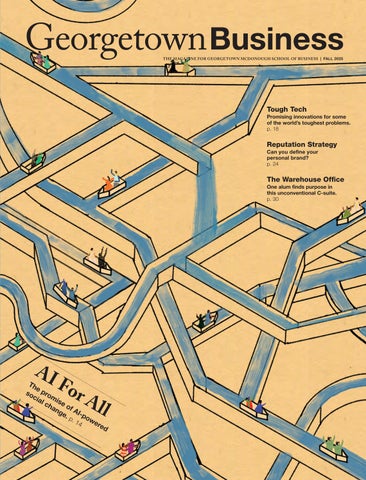
Georgetown Business THE MAGAZINE FOR GEORGETOWN MCDONOUGH SCHOOL OF BUSINESS | FALL 2025
Tough Tech Promising innovations for some of the world’s toughest problems. p. 18
Reputation Strategy Can you define your personal brand? p. 24
The Warehouse Office One alum finds purpose in this unconventional C-suite. p. 30
AI
Fo r
Th e so pro cia mi l c se ha o ng f AI -p e. ow p .1
4
Al
l
ere
d
“ Sports inspire a shared passion that transcends the game itself, creating moments of connection that can bridge divides and shape identities.”
2
georgetown business FALL 2025
PHOTOGRAPH: ARTIST’S NAME
Insights
Shaping the Game
The playbook for educating the next generation of sports business leaders at Georgetown McDonough.
Today’s sports industry is more complex and influential than
Where do ethics and societal impact fit in?
ever. It’s a fast-growing, multifaceted global enterprise that
As one of the most visible stages in the world, sports
serves as a platform for broader societal issues and draws in
also serve as a platform for broader economic and
millions of spectators from around the world. As the business
societal issues. From athlete pay and sports gambling to
of sports continues to evolve, there is a growing need for
climate impacts, geopolitical tensions, player representa-
sharp, strategic thinkers who can take their passion for the
tion, and health concerns, these discussions play out in
game and lead the business of sports into the future.
public view. The human dimension of sports — its ability
According to Paul Almeida, dean and William R. Berkley
to unite communities, encourage dialogue, and model
Chair, McDonough students are ready to meet that moment.
fair competition — forces leaders to balance profitability with integrity, competition with compassion, and tradition
What makes the sports industry unique?
with innovation.
There is no other industry in the world with the power to bring people together, unite nations, and rally supporters
How is McDonough preparing students to lead in
quite like sports. Sports inspire a shared passion that tran-
this space?
scends the game itself, creating moments of connection
There is no better school to evaluate the complexity
that can bridge divides and shape identities. As a result,
of global business than Georgetown — and sports is
sports is an incredibly impactful and influential sector of
no exception. Many of our alumni already work at the
the economy.
highest levels as team owners, league executives, policy leaders, and entrepreneurs who are shaping the game
How do you see the evolution of sports as a business?
across the world. So, we have the connections. We
Beneath the fan base is a complex, fast-growing global
also bring a values-based approach to business issues,
marketplace. Franchise valuations have skyrocketed,
challenging our students to see sports as a platform for
private equity investments are growing, and international
change. Finally, through our interdisciplinary expertise,
ownership is increasingly common. We now see booming
we explore the intersection of sports and other fields
sectors like sports gambling, smart stadiums, and
such as sustainability, AI and technology, and health.
tech-driven fan engagement. Sports intersect with every
The result is an education that blends passion with the
sector — from finance to technology to marketing and more
energy, global context, and Jesuit mindset necessary to
— making it a relevant career path for any professional.
transform sports business for years to come.
PHOTOGRAPH: GEORGETOWN UNIVERSITY / PHIL HUMNICKY
georgetown business FALL 2025 1
Contents FALL 2025
Cheryl Contee, founder of Attentive.ly, shares her thoughts on capitalism in the age of AI. FEATURE | 18
Launch Pad How Rhett Smith helps The Engine incubate solutions to the world’s toughest problems.
FEATURE | 24
The Power of Me Jennifer Dalton on the importance of personal brand. Spoiler alert: it’s a must.
COVER STORY | 14 >
“ This isn’t a choice. AI will be in everything, everywhere. Hoping that somehow AI is going to go away is not really a smart strategy.”
2
georgetown business FALL 2025
PHOTOGRAPH: ARTIST’S NAME
08
PATHS | 06
Landing the Interview: Aging Well Beyond Business: Full Circle Six Degrees: Redefining Futures Pitch Deck: AI: Handle with Care
Georgetown Business Dean, William R. Berkley Chair Paul Almeida Associate Dean, Chief Marketing and Communications Officer Teresa Mannix Senior Director of Communications and Marketing Samantha Krause Editor Martha Barrette Holland
INNOVATIONS | 10
Buying / Selling: Green Havens Making the Case: The Real Deal The Edge: All Fizzled Out Pitch Deck: Recharging the Motor Market
10
Creative Direction 2communiqué Editorial Direction Dog Ear Creative Staff Writers Téa Anderson Jessica Marr Guadalupe Ramirez Brian Rea Georgetown Business welcomes inquiries, opinions, and comments from its readers. Please send an email to GeorgetownBusiness@ georgetown.edu.
30
CONNECTIONS | 30
My Shot: A Master Plan My First Job: Human Tech Pivot: From the Cockpit My Feed: Communicate to Lead Class Notes
04 36
COVER ILLUSTRATION: RYAN PELTIER
Assistant Dean for Alumni Relations and Corporate Partnerships Sara Solin Martinez
| BRIEFINGS | FROM THE MANAGEMENT
Send alumni address changes to addup@georgetown.edu or contact alumni records at (202) 687-1994. Follow us on X @msbgu @MSBalumni Like us on Facebook Georgetown McDonough School of Business Follow us on Instagram @georgetownmcdonough Join us on LinkedIn Georgetown University McDonough School of Business Alumni
georgetown business FALL 2025 3
Briefings HIGHLIGHTS AND KEY TAKEAWAYS
PATRICIA GRANT ON:
Finding Your HOME The Undergraduate Programs launched the HOME Program — a signature four-year personal and professional development experience designed to empower students to engage in meaningful exploration of self and identity throughout their college journey. Rooted in reflection, community, and purpose, the program’s philosophy is grounded in the idea that a meaningful life leads to deep personal and societal value. HOME represents four phases of the program — Horizon, Odyssey, Meridian, and Empyrean — which build upon each other over the course of four years to form a framework for students’ self-awareness, values, and contributions to society.
MiM to MBA Graduates of the STEM-designated M.S. in Management (MiM) program can now transfer credits from their degree to pursue the Full-time or Flex MBA, offering a new pathway to earn two degrees from McDonough in an accelerated timeframe. The MiM to MBA Pathway is designed for MiM alumni who have gained three to five years of professional experience and are seeking an opportunity to complement their master’s education for career advancement, leadership development, or specialization in key fields or sectors.
4
georgetown business FALL 2025
Business Analytics — In-Person and Online The top-ranked M.S. in Business Analytics (MSBA) program is now available in a full-time, in-person format in Washington, D.C. Expanding upon the success of the part-time, online MSBA, the new immersive, on-campus program is designed for recent graduates and early-career professionals who want to accelerate their careers in data-driven business leadership. Additionally, students who begin the full-time program have the flexibility to transition to the online program if their plans change.
PHOTOGRAPHY: ARTIGA PHOTOGRAPHY; GEORGETOWN UNIVERSITY | ILLUSTRATION: CAJSA HOLGERSSON
“Periods of volatility are when real opportunities emerge.”
—JONATHAN GRAY, PRESIDENT AND CHIEF OPERATING OFFICER OF BLACKSTONE, DURING THE STEERS CENTER FOR GLOBAL REAL ASSETS’ LUMINARIES SERIES
Checkmate Bringing together the “chess masters” of the professional world, Cynthia Groves, adviser to the Kosoy Women in Business program at Georgetown McDonough and a coach in leadership and career planning, has published a compilation of their experiences, lessons, and advice in her new book, Mastering the Corporate Chess Game: Strategies for Advancing Your Career, to give aspiring professionals a playbook for launching a successful career in business. “Every workplace operates on a set of unwritten norms that shape its internal culture,” said Groves. “This book provides invaluable insight for navigating common career pitfalls with confidence.” Mastering the Corporate Chess Game, set to release on Nov. 3, 2025, features chapters from notable leaders — including six Georgetown alumni and three from McDonough — as well as a foreword by Norah O’Donnell (C’95, G’03). To support the advancement of current and future Georgetown students, all proceeds from the book will be donated to McDonough programs.
ILLUSTRATION: ISTOCK/MUHARREM HUNER
Shaping the Future of Retail Through a collaborative effort with the National Retail Federation and the NRF Foundation, Georgetown McDonough has launched the NRF Business of Retail Initiative to combine academic excellence with industry expertise. The initiative aims to develop the next generation of retail visionaries, creating opportunities for students to engage with leading retailers, gain real-world experience, and shape the future of the retail industry. The initiative endows the National Retail Federation Chair in Retail Studies, the National Retail Federation Summit, two National Retail Federation MBA Fellows, and research grants. With NRF’s retail advocacy, events, resources, and expertise, the NRF Business of Retail Initiative will produce cross-disciplinary research and connect students with the industry that impacts consumers every day. georgetown business FALL 2025 5
Paths OUR PEOPLE AND THEIR PURSUITS
THE INTERVIEWER
Isabella DeLeo (C’26), Economics and Psychology and Strategic Initiatives Intern with the McDonough Center for Business and Public Policy
LANDING THE INTERVIEW
Aging Well
As president and CEO of the National Council on Aging, Ramsey Alwin talks to Isabella DeLeo about purpose-driven leadership. Ramsey Alwin (EML’19), president and CEO of the National Council on Aging (NCOA), shares with Isabella DeLeo (C’26) how Georgetown’s Executive Master’s in Leadership program helps guide her mission to ensure all Americans can age with dignity, security, and purpose. How has Georgetown enhanced or impacted your career? It was an incredible experience with curated educational activities that gave me more than just tools: it gave me perspective and space to reflect and examine how I was engaging in the issues, the leadership approach I naturally default to, and to be intentional about the leadership approach I wanted to advance in the future. Courses on organizational change, ethical decision-making, and adaptive leadership helped me navigate some of the challenges I was experiencing working full-time. Those tools helped inform my strategy and leadership approach in many crossorganizational collaborations — bringing more confidence and creativity to my leadership to inspire, empower, and serve those I was working with. What are your goals for the National Council on Aging? Our mission is to ensure all age well in America, and that every older adult has the resources they need to age with dignity, security, and purpose. We’re on a mission to improve the lives of 40 million older adults by 2030, and we take that mission very seriously with a rigorous set of metrics around the health and economic well-being of older adults. Over 11,000 people are turning 65 every day this year, and what’s incredible is they’re likely to live another two or three decades. This is an amazing gift, but it’s not equally shared. The quality of health and life of those years varies and largely depends on factors out of their control, even their zip code. Our mission at NCOA is to elevate aging and aging well as
6
georgetown business FALL 2025
PHOTOGRAPHS: GEORGETOWN UNIVERSITY/RAFAEL SUANES
a right — not a privilege — and to help build out the programs, services, and policies that ensure everyone has access to the support they need.
THE INTERVIEWEE
Ramsey Alwin (EML’19), President and CEO of the National Council on Aging
What challenges have you faced, and how were you able to overcome them? Organizationally, the challenge is this first age wave of boomers: we’ve known about this demographic trend for decades, but we haven’t really prepared for it. Over 70 million boomers are living two and three more decades than their parents. But our policies, programs, and services aren’t necessarily built for that increased longevity. As we look to the future, we have over 90 million millennials who are highly likely to live to be 100. It’s an amazing illustration of medical and technological breakthroughs, but so much of our policy was built back in the 1950s and 60s. We haven’t modernized, strengthened, or expanded the types of services and support needed to age well. We learn that every day in our interactions with older adults and community-based organizations — they’re falling short in navigating multiple health conditions, chronic conditions, and not getting access to preventative and wellness services that could get in front of that. They worked hard and played by the rules, but they’re coming up short in old age because Social Security was never intended to be their sole source of income. We work every day to help older adults who want and need to get trained and placed in jobs to do so. We help those who are coming up short enroll in programs to help with food, medicine, and other basic needs. We work with community-based organizations to help individuals enroll in evidence-based health promotion programs that address their chronic conditions and gain access to community-based resources. The biggest challenge is the ability to gain access to those programs not funded at scale to be available in every community. Do you have any advice for young alumni looking to lead a large organization? When you know your “why” and make it your North Star, everything falls into place. You’ll find you’re engaging with other professionals who also know their “why,” and that can open up doors and opportunities. You’ll have the resilience when it doesn’t go right to lead through uncertainty because you’re focused on a higher purpose. Surround yourself with a vast network who can be thoughtful advisors and speak candidly about where your growing edges might be. In the workforce, surround yourself with a team that complements you to make sure you’re aware of your own strengths and weaknesses because no one benefits from an echo chamber.
georgetown business FALL 2025 7
Paths
Bruno Mejean (B’73) says mentoring young professionals in the energy transition space is his way of serving the greater common good.
BEYOND BUSINESS
Full Circle Bruno Mejean is ensuring others have the support he lacked as an international student — while mentoring startups tackling the planet’s biggest challenges. waiter, lifeguard, and French teacher are a few of the job titles Bruno Mejean (B’73) held while balancing his studies as a full-time undergraduate student at Georgetown. “It was challenging, but somehow I managed,” Mejean recalled. Originally from Morocco, Mejean applied only to Georgetown and finished his degree in two and a half years. After a successful career in trade and project finance, Mejean sought ways to make a meaningful difference for future generations. Mejean and his wife established the Bruno J. Mejean and Martina Hund-Mejean Endowed International
8
georgetown business FALL 2025
Scholarship Fund to support international students enrolling in undergraduate programs at Georgetown McDonough. It is the largest dedicated gift to international undergraduate scholarship in Georgetown’s history. “I remembered that it wasn’t that simple to get assistance as an international student,” he said. “I wanted to make sure this scholarship would be available for students who couldn’t afford to come here.” Mejean also mentors climate tech startups with Cleantech Open, the world’s largest accelerator in the sector; is a board member of the High Atlas Foundation, which supports sustainable
agriculture in Morocco; and recently worked with two Georgetown interns at Kasava Engineering, a Ukraine-based cleantech startup. To Mejean, his interest in mentoring young professionals in the energy transition space is his way of serving the greater good. “With all of the problems we’re facing with climate change, I’m doing my small part in that effort, knowing that in this current environment it’s not that simple,” he said. “But some of these inventions that I see, some of these startups are going to change things because of the improvements in efficiencies that even pertain to traditional solutions.” Over the coming years, Mejean plans to nurture and expand the scholarship program at Georgetown to help smooth the path for more international undergraduate students who wish to follow in his footsteps. An active member of the alumni network, Mejean encourages fellow Hoyas to find ways to give back to the university. “That’s something I wish I had done more of,” he said. “I’m catching up with that, but I would urge other alumni to give back to the university and reengage, if they are not already. There are many different ways one can do that.” Looking back to his beginnings, Mejean advises international students to be curious, take advantage of the available resources and opportunities, and, above all, work hard. “There’s no secret to success — it’s working hard, not being slack about what needs to be done, and going above and beyond the required,” he said. “That’s been my recipe for professional success, and there’s no shortcut.”
— BRIAN REA
PHOTOGRAPH: TODD FRANCE
CAREER UP
Before Georgetown ever appeared on my resume, I worked alongside senior AOL leaders who inspired my decision to pursue an MBA at Georgetown. Ted Leonsis (C’77) & Glenn Eisen (B’87, MBA’91)
Before the start of the program, at a welcome party for incoming MBAs in Washington, D.C., I met… Thomas Jeppesen (MBA’05) & Neil Moloney (MBA’05)
Through Georgetown’s international buddy system, I supported the transition from Russia to the United States for…
After graduation, I joined Booz Allen as a senior consultant where I worked on an USAID project in Armenia with Julie Cline Fernandez (MBA’03)
I was a peer advisor to support international students with resume reviews, interview preparation, and networking strategies at the McDonough Career Center. There, I worked alongside my future colleague at Booz Allen Mary Ann Melkonian (B’01, MBA’08)
Alex Gilev (MBA’05)
I spent 12 years at Booz Allen. As I rose through the leadership ranks, I was nudged toward entrepreneurship by Thomas Jeppesen & Alex Gilev
They backed their encouragement with financial support and guidance. As I built Avyance with my friend and business partner, Sarah Jeppesen, I utilized several Georgetown courses… Strategy with Dean Paul Almeida, Operations with Ricardo Ernst, Statistics with Bardia Kamrad, and Organizational Behavior with Catherine Tinsley
Over the years, I have hired several Georgetown graduates including… Dominique Khan (SCS’19) & Elizabeth Kuebler (B’10)
AI: Handle with Care ai is becoming part of how we learn, work, and make decisions. Its prevalence makes it even more important to be thoughtful about its use. Not every tool is neutral, and not every output is reliable. Responsible use means approaching AI with intention, curiosity, and care. Whether you are exploring a new idea, building a business, or shaping policy, these practices can help: LEAD WITH PURPOSE: Know how to use AI well, and when. It can help organize information or speed up tasks, but it should not replace human insight. STAY AWARE: Many tools are open-
source or non-transparent about their data. Evaluate where information comes from and how it’s shaped.
USE YOUR VALUES: Let your ethics and
judgment guide how you apply AI in your work. Remember, AI should support our thinking, not replace it.
—ASHA NOOR, ASSOCIATE DIRECTOR, MCDONOUGH CAREER CENTER
SIX DEGREES
REDEFINING FUTURES As the founding partner and president of Avyance — an award-winning womenowned management consulting firm — Tatiana Jeromskaia (MBA’05) built her career on the power of Georgetown connections. Mentors opened doors, classmates became investors, and professors reshaped her path — channeling her skills and knowledge into a business that helps organizations harness technology, embrace change, and redefine the future of work.
ILLUSTRATION: CHRIS GASH
georgetown business FALL 2025 9
Innovations GROUNDBREAKING BUSINESS
BUYING AND SELLING
Green Havens
As the global trade of eco-friendly products grows, new research shows companies aren’t chasing pollution havens—they’re seeking stricter environmental standards to back up their green claims.
T
here has been a rise in the global trade of “green products” which are designed to reduce negative impacts on the environment by generating less pollution in production, reducing pollution through their use, or helping to clean up damage to the environment. A common example is electric vehicles, as opposed to the traditional gas-powered. But while they may promote environmental sustainability, not every green product represents an entirely green life cycle or implies no risk of pollution in the value chain. Heather Berry, dean’s professor of strategy and international business, and Jasmina Chauvin, assistant professor of strategy, ethics, economics, and public policy, examined the relevance of the pollution haven effect — where companies shift their production to countries with weaker environmental standards to save money — in the decision-making process for sourcing green products. Using trade data from 2002 to 2019 that covered global imports and exports for more than 5,000 different products, they found that green products are more likely to be sourced from countries with stricter environmental rules.
10
georgetown business FALL 2025
Here, Berry discusses how the growing popularity of green products is changing the conversation about the role of environmental standards in global trade.
active and engaged civil society, helps hold firms accountable in their global sourcing and represents a response to the challenge of pollution havens.
BUYING
Strict environmental rules hurt a country’s ability to export Prior research on the pollution haven hypothesis has suggested that higher environmental standards hurt domestic exporters and lead to more offshoring of pollution-intensive industries. While this idea may generally explain the decision-making process behind the production location of traditional products, it holds less true for green products. Because green products represent less than 15% of all traded goods, their overall share in global sourcing is still relatively low. But their contribution to traded products is likely to grow as more countries adopt pollution reduction targets. Between 2002 to 2019, the top producers of green products were China, France, Germany, Italy, Japan, Mexico, the Netherlands, South Korea, the United Kingdom, and the United States, with China showing the highest growth.
The production of green products represents the future Firms seek out green havens in their sourcing of green products, especially for consumer-facing products and when sourcing into countries with high customer engagement in environmentalism and a greater presence of nongovernmental organizations (NGOs). This aligns with prior research that suggests consumers expect a firm’s green claims about their products to be backed by sustainable sourcing practices rather than “greenwashing.” Holding companies accountable to their claims can be difficult when products involve components that have been sourced from multiple countries. However, there are NGOs and watchdog groups that help consumers become more knowledgeable about the environmental impact of firm operations. A greater demand for green products, as well as a more
SELLING
— BRIAN REA
ILLUSTRATION: OLGA ALEKSANDROVA
PHOTOGRAPH: ARTIST’S NAME
georgetown business FALL 2025 11
Innovations
MAKING THE CASE
The Real Deal How classroom lessons translate into real market strategy. when beenish haleem (gra’24) and Linus Billings (GRA’24) were handed the brokerage memo for a distressed two-building office complex in Northern Virginia, they knew they weren’t just solving a classroom problem — they were stepping into the mindset of realworld investors. The assignment, part of McDonough’s M.S. in Global Real Assets (GRA) program, challenged students to evaluate an actual property on the market, apply investment principles, and present a strategy grounded in the realities of a shifting office market. The buildings — 2001 and 2003 Edmund Halley Drive — were part of a commercial clinic led by Matthew Cypher, director of the Steers Center for Global Real Assets and academic director for GRA. The assignment: assess the opportunity, model a five-to-10-year financial projection, and determine whether to hold, renovate, or reposition the asset. With occupancies of 30% and 55% respectively, the project required rigor and creativity.
12
georgetown business FALL 2025
Haleem, who joined the GRA program after working for a UAE-based real estate fund while completing her undergraduate degree in London, brought a strong analytical lens and a desire to deepen her understanding of U.S. markets. “What drew me to Georgetown was how hands-on it is compared to the traditional academic approach in the United Kingdom,” she explained. “We were using the same tools and facing the same challenges you’d encounter on the job.” Billings, a D.C. native, added vital local insight. His knowledge, along with Haleem’s research on tenancy in and around the Dulles Toll Road — with many defense and tech firms — helped the team gauge which businesses were likely to remain and which might exit. Together, they underwrote multiple scenarios using Argus Enterprise, a professional-grade real estate software platform introduced in the clinic. The tool allowed them to account for tenant improvements, leasing commissions, capital costs, and varying market
absorption timelines with precision. Their business approach leaned toward a value-driven acquisition: a once-prime asset now priced below replacement cost, located near Reston Town Center and along the newly completed Silver Line Metro extension. Yet, they remained cautious. “We assumed heavy concessions and longer downtimes,” said Haleem. “We had to reflect the weakness in the suburban Northern Virginia office market.” The project culminated in a full investment memo with an 11.8% unleveraged internal rate of return, yet the value of the experience extended far beyond the final numbers. “This was the first time we underwrote multiple assets as a portfolio,” said Billings. “It made us think not just about the building, but about strategy, investor goals, and risk tolerance.” Lessons learned? “Don’t get distracted by sales language used in the offering memorandum,” Haleem reflected. “Strip it back to the fundamentals: Is this a good investment or not?” Billings agreed, emphasizing the importance of differentiating real competitive advantages from surface-level features. The final twist: the property was ultimately acquired by Bernstein Management Corporation, led by John Lynch (MBA’19), whose approach — anchored in portfolio scale and longterm vision — differed from theirs. “That was one of the most valuable parts of this practicum,” Billings noted. “Seeing how different investors interpret the same asset.” From Reston to the real world, this case gave them more than a grade — it gave them a framework for decisionmaking in a changing market.
— MARTHA BARRETTE HOLLAND
THE EDGE
All Fizzled Out Can a soda tax really change the way consumers purchase sugary drinks — and more importantly, does it last? A short-lived soda tax offered a rare opportunity to observe what happens when government policy attempts to nudge everyday choices. What unfolded sheds light on how pricing may (or may not) influence behavior across different households. A new study dives into this natural experiment, raising deeper questions about the long-term power of public health interventions — and who they actually reach. Anita Rao, Beyer Family Associate Professor of Marketing, shares more about these findings in the study “How Do Tax Policies Impact Health-Relevant Purchasing?
PITCH DECK
Recharging the Motor Market
Evidence from a Temporary Soda Tax.” You recently studied the impact of tax policies on the consumption of sugary drinks, specifically soda. What were your findings? We started from the premise that soda taxes have been proposed and used as a tool to encourage healthier consumer behavior, and we wanted to understand whether their effects are temporary or long-lasting. We studied the case of Cook County, Illinois, where a soda tax was introduced and later repealed. Using household-level purchase data, we observed a reduction in sugar-sweetened beverage consumption during the period the tax was in effect, on average per household. However, this decrease contrasted with strategic stockpiling by the general population before the tax was implemented — something we had not expected. Additionally, purchases largely returned to previous levels once the tax was repealed, resulting in a net-zero impact on the general population of consumers. Another significant finding was that for diabetic households, the tax led to an initial decline among diabetic households prior to the tax, a large decline during the tax, and a sustained decline post-tax. It was as if it served as a reminder or a nudge to change behavior and adopt healthier habits. What makes a policy or a change strategy truly transformative? The most relevant factor is context and whether consumers genuinely want that change. For example, in Berkeley, California, residents voted in favor of the tax, unlike in Chicago, Illinois, where there was pressure to repeal it. The way consumers perceive the tax — whether they see it as something helpful or harmful — is key. Context and what consumers demand are very important.
ILLUSTRATION: ALEX NABAUM
rory brogan (mba’22) arrived at Georgetown McDonough determined to learn the language of entrepreneurship. With a background in electrical engineering from SMU, he had long envisioned a better way to design electric motors — without relying on rare earth materials that are costly, environmentally harmful, and largely controlled by overseas markets. At McDonough, through the Venture Fellows program and with mentorship from Jeff Reid, professor of the practice and founding director of Georgetown Entrepreneurship, Brogan transformed that vision into Torev Motors. Based in Arlington, Virginia, Torev is pioneering high-performance, rare earth-free electric motors for automotive and defense applications. Its patented technology replaces permanent magnets with electromagnets, delivering stronger performance, cost savings, and more secure supply chains. Since its inception, the company has secured Small Business Innovation Research funding from the U.S. Army. With commercial and defense partners taking notice, Torev Motors is proving how Georgetown’s entrepreneurial ecosystem empowers bold ideas with the potential to reshape industries. georgetown business FALL 2025 13
Caption here Ceri soluptam quiae sim int, cor minumquat rate endi totaepro
HED_FEATURE dek_HNeue_97blackcond_14/16 BYLINE FEATURE ART CREDIT FEATURE
14
georgetown business FALL 2025
PHOTOGRAPH: ARTIST’S NAME
BY APRIL WHITE | PHOTOGRAPHY BY TIMOTHY ARCHIBALD
AI
A pioneer in missiondriven tech, Cheryl Contee explores the promise of AI, the power of diverse founders, and the possibilities of a more sustainable capitalism.
FOR
ALL
georgetown business FALL 2025 15
Cheryl Contee (EMBA’04) got her start in tech because, she says, “I hate washing dishes.” As a scholarship student in her undergrad years at Yale, she was required to hold an oncampus job. The bestpaying position available was working in the kitchens; the second best-paying position was on the computer help desk. Contee became the first person of color in the IT role and one of only four women on the 28-person team—a situation that would be dismayingly common as she parlayed that early experience into a career in missiondriven technology. Contee went on to cofound the social listening startup Attentive.ly and the digital agency Do Big Things and, more recently, the artificial intelligence startup Change Agent AI. She also works as a senior advisor with PosterChild.ai. But she never wanted to succeed on her own: Contee also co-founded The Impact Seat Foundation to support other underrepresented startup founders. We talked to the serial entrepreneur, author, and advocate about the promise of AI-powered social change and the future of capitalism.
16
georgetown business FALL 2025
How is The Impact Seat Foundation making that possible? I founded The Impact Seat Foundation with Barbara Clarke, an iconic impact investor who is one of the largest individual investors in womenled tech startups in America, to encourage investment in historically excluded entrepreneurs. Our message is that investors are missing out on an important opportunity. All the studies show that diverse-led firms are more innovative, more productive, more capital efficient — in part because they have to be — and more profitable in general and exit at higher multiples. If you are sincere that making money is your highest Tell us about your experience in the
priority, which is what a lot of venture capitalists
startup world.
say, you’re sleeping on a whole set of amazing
I fully realized it when I was first fundraising
entrepreneurs who are in many ways more likely
for Attentive.ly. It didn’t even occur to us that
to see success, if they are fully capitalized.
most of our peers were white dudes. Raising money was a very different thing for them. Much
How has AI adoption differed from previ-
later I became a senior advisor at Astia, one of
ous technology advances you’ve seen?
the original angel networks and venture funds
I just released a new book called AI for Non-
that focuses on female entrepreneurs. They
profits, which is a practical and tactical field
crunched the numbers and put out a report that
guide for the nonprofit leader who is ready to roll
showed it took, on average, seven introductions
up their sleeves and adopt AI — ethically and
for white female startup founders, and it took
responsibly. It’s been a delightful surprise to see
50 investor introductions to get a Black female
it become a popular bestseller in big categories
entrepreneur funded. Fundraising is hard for
like Business and Finance, AI and Office Auto-
everyone, but America is asking Black women
mation. We have a chapter in the book called
to put in 10 times the effort. I didn’t know those
“How to Sell AI Upstream and Downstream in
statistics going in. But at some point, my busi-
Your Organization.” But we had originally named
ness intuition kicked in: “You are just going to
that chapter “Selling AI Upstream.” That was
have to knock on more doors and crawl across
what happened with social media: younger and
more glass to get there.”
mid-level team members were trying hard to get senior team members to understand that “hey,
And you did. In 2016, Attentive.ly was
Facebook seems like it is going to be a thing.”
acquired by Blackbaud, making it the
But we heard in talking to many nonprofit lead-
first tech startup with a Black woman
ers that they were on board with AI adoption.
founder to be acquired by a NASDAQ-
It is their teams that are pushing back; there’s
listed company.
a lot of fear out there that AI is going to take
We didn’t realize it was going to be a first until
jobs. You do occasionally hear nonprofit leaders
we got there. And then it just occurred to us,
say things like, “oh we aren’t going to use AI
“Hey, we may have made some history here.”
in this organization for ethical or environmental
It was a huge deal. My goal has always been to
reasons.” My response is: This isn’t a choice. AI
open doors for others, and so it felt like a lot of
will be in everything, everywhere. Hoping that
responsibility to then help others walk through
somehow AI is going to go away is not really a
that door too.
smart strategy.
ing, essentially, AI is like hot sauce. You want to think really carefully about where you are going to put it in your organization or your casserole. Zooming out, the big takeaway is that people are concerned that AI is going to automate everything and take humans away from each other and productive work. I see the opposite. There are so many ways in which AI can alleviate pain points, can automate the most repetitive, time-consuming, and tedious work, and free people up not only to be more creative but to actually communicate more with each other. Why do you believe mission-driven organizations need a generative AI option that is different from what’s currently available? We founded Change Agent AI as an alternative What are the biggest AI opportunities
been around for some time now on the back-
to the big Large Language Models (LLMs) like
for nonprofits?
end. It’s how your Amazon packages find you
Anthropic, OpenAI, Gemini, and Google. If you
There are so many organizations I’ve worked
so fast and how Netflix knows that you’re into
want to make sure you are using AI as ethically
with over the years that send out these email
British murder mysteries.
as possible, you want to make sure your data
blasts and people email back, but no one
Then in 2022 with ChatGPT, all of a
is mostly contained with an LLM that you can
checks that mailbox. No one is talking to those
sudden those tools were at the fingertips of
control, one that is trained on diverse photos,
supporters. Imagine how much more money and
everyday people. It was exciting to jump into
videos, and language with positive values.
support they could bring in if they were actually
learning about what’s possible and where this
able to have the capacity to talk to each and
is heading. This is such an important time for
What do you see for the future of tech
every one of those people. AI can free up your
leaders to start understanding how to adopt AI
and entrepreneurship?
staff to have active listening conversations with
in their organizations so they can be a part of
When I was in Georgetown’s Executive MBA
donors and supporters — or with customers, for
shaping how these tools are created. We don’t
program in 2004, there were only two out of
for-profit companies. I often describe generative
talk a lot about the fact that our new book AI
about 50 of us who worked at nonprofits and
AI as a super smart intern. In an ideal world, AI
for Nonprofits is co-authored by a Latino man
even the concept of mission-driven companies
has the potential to free up more energy and
and a Black woman, but I think both Darian
was still young. Now there are so many students
time for people to do the work they love most.
Rodriguez Heyman and I understand it’s
and professors who understand that regenera-
important we show that all kinds of people are
tive capitalism and sustainable capitalism really
— and can be — experts in this field.
are the future. Finding a way to have innovation,
Why have you turned your attention to the AI sector?
productization, and commercialization that
When you look across my career, the ribbon
What were some of the lessons you
doesn’t hurt people or the planet—that is the
that runs through everything is the question of
learned writing AI for Nonprofits?
future. Seeing people embrace that is exciting
how new technologies can aid social innovation
The book is thick and meaty, with insights from
for me as someone who tends to be sometimes
that’s positive for everyone. So, AI is something
57 contributors. One of my favorite quotes is
a little ahead of the curve. That can be lonely
I’ve been clocking for a long time. AI has actually
from [nonprofit data strategist] Nick Hamlin say-
sometimes! GB
georgetown business FALL 2025 17
Rhett Smith helps The Engine incubate solutions to the world’s toughest problems
BY DAN MORRELL
AUNCH PA
How
PHOTOGRAPHY BY JARED LEEDS
PHOTOGRAPH: ARTIST’S NAME
PHOTOGRAPH: ARTIST’S NAME
georgetown business FALL 2025 19
O ONE OF RHETT SMITH’S (MBA’17) favorite things to do while giving tours of the office of The Engine, a nonprofit incubator and accelerator built by MIT where he works as vice president of operations, is to walk visitors through the first-floor lab space. On one side, a startup named Mantel, which is developing technology to pull CO2 out of the atmosphere, is blasting 25-foot-tall furnaces at 800 degrees Celsius; on the other side, Atlantic Quantum is operating computers at a necessarily frigid temp of absolute zero. “So it’s about a 10,000-degree Fahrenheit difference and just about 30 feet apart,” says Smith. “It’s wild.” It’s a unique contrast that belies the organization’s distinctive approach. “We support technologies somewhere at the intersection of scientific breakthroughs and engineering breakthroughs that are trying to solve or tackle the world’s toughest challenges,” says Smith. The shorthand label for the kind of companies The Engine supports is “tough tech.” “We’re industry agnostic — we care more about the wider impact that these companies want to create.” The Engine’s 150,000-square-foot Cambridge, Massachusetts, building’s combination of wet labs and engineering prototyping spaces — filled with 3D printers, laser cutters, welding machines, and mills — makes it one of the few places in the world where these tough tech startups can go from plan to product. “It’s the convergence of those two things under one roof that makes us very unique,” Smith says. Whatever The
20
georgetown business FALL 2025
PHOTOGRAPH: ARTIST’S NAME
The Engine’s 150,000square-foot Cambridge, Massachusetts, building’s combination of wet labs and engineering prototyping spaces — filled with 3D printers, laser cutters, welding machines, and mills — makes it one of the few places in the world where these tough tech startups can go from plan to product.
PHOTOGRAPH: ARTIST’S NAME
Engine can’t provide teams, they will try to find for them. “We’ve done a lot of work in this ecosystem, so we have a ton of relationships with other facilities in the area that have very technical, very expensive equipment — and we can get any team in there for pretty reasonable rates.” The organization’s facilities and approach are rare for a reason, says Smith. “It is a tough business model,” he says with a laugh. “The teams we work with are in some of the most expensive industries you could try to break into. We are trying to make it less capitalintensive by building out these very technical lab spaces.” Smith’s path to tough tech was decidedly nonlinear. An economics major at Sewanee | The University of the South, who didn’t take to finance, he did an about-face and became a director at a summer camp after graduation. He earned his MBA at Georgetown in part to help bridge his hard skills of operations and finance with his passion for mission-driven work. After his MBA, he ran operations at a Boston charter school — managing everything from budgeting to bus schedules. Long interested in impact, he was drawn to The Engine’s mission. “We have all these challenges in the world. You can pick up the paper any day and you’re going to read about one of them,” says Smith. Climate change, poverty, public health, resource inequality — the list is endless, he says. “And it’s not always clear how you make an impact. So when I came here and saw these companies that are actually trying georgetown business FALL 2025 21
to tackle the world’s toughest challenges, I thought, ‘Oh, I see a role where I can have a large-scale impact on the world.’” One of the two major functions of The Engine, Smith says, is helping founders develop their ideas, providing them with the kind of programming necessary to help them turn their ideas into real businesses. There’s a bootcamp, for instance, that helps founders build a business model, says Smith, “and actually answer the question: Is entrepreneurship what I want to pursue right now? Or should I go take that job at SpaceX?” The other is running the incubator — and that’s Smith’s charge. “Everything that happens in our space — with all of the 113-plus teams in residency here — rolls up to me,” he says. Startups rotate through The Engine every few years. What distinguishes the successful ones is usually the people rather than the technology, Smith says. “You can have the most promising idea in the world — something that people will throw a lot of money at. And that’s great, but if you actually don’t have the team and the leadership and the culture to support it long-term, it won’t scale or go anywhere.” Smith loves the human aspect of the work. He’s in the office daily, meeting with the teams, touching base with the founders, and keeping the pulse of the organization. “Every day is very different, and that’s what I enjoy,” he says. “I also feel incredibly grateful that I get to do really exciting work — and work that has a mission that I can really relate to. I can see the impact every day.”
22
georgetown business FALL 2025
“YOU CAN HAVE THE MOST PROMISING IDEA IN THE WORLD— SOMETHING THAT PEOPLE WILL THROW A LOT OF MONEY AT… BUT IF YOU DON’T HAVE THE TEAM AND THE LEADERSHIP AND THE CULTURE TO SUPPORT IT LONG-TERM, IT WON’T SCALE OR GO ANYWHERE.”
Hanging Tough
A look at some of The Engine’s radical residents FORM ENERGY
ATLANTIC QUANTUM
A spinout from MIT, Form Energy is devel-
Atlantic Quantum is a perfect example of the
oping long-duration battery storage to make
kind of innovation that can only happen at The
renewable energy scalable — an innovation
Engine, says Smith. The startup is looking to
that could transform the grid. “The biggest gap
accelerate the quantum computing revolution
for renewables has always been storage,” says
— with a focus on scalability and speed — but
Smith. “If you don’t have direct access to wind
its work comes with incredible energy demands.
or solar or some other energy source, how
FORAY BIOSCIENCE
“If they were going to go build this company
are you actually getting that to the grid?” Form
What if you could grow building
elsewhere, they would’ve had to take on about
Energy has already built a 550,000-square-foot
materials in a lab instead of cutting
50 times more space than they actually needed,
manufacturing plant in West Virginia (on the
down trees? That’s the vision
because they needed so much power,” says
site of a former tin mill) and is potentially poised
behind Foray Bioscience, which
Smith. “So they were going to get caught up in a
to become a market leader. “Battery storage
is creating lab-grown, tree-free
situation where they didn’t have the capital to do
has been a bottleneck in the energy sector for
cellulose materials as a sustainable
this project and they couldn’t afford the real es-
over a decade,” Smith says. “Form has actually
alternative to wood. The result is
tate to even start it,” says Smith. At The Engine,
developed technology that takes existing battery
cheaper, scalable, and significantly
Atlantic Quantum operates in about 800 square
storage technologies on from the scale of hours
less carbon-intensive — with
feet of the 150,000 square foot building and yet
GB to days. And that level of magnitude is of storage
potential applications in everything
it uses 30% of the building’s power. The compa-
going to be a game-changer for the industry.”
from packaging to interiors. “Foray
ny is using that energy to power three quantum
can create materials at industry
computers, with a goal of getting to 12. “At
scale in labs, at 10x the efficien-
that point, they want to start selling them,” says
cy of growing, and at fractions
Smith. “And the power of quantum computing in
of the cost,” says Smith. Which
the AI revolution is just being tapped.”
immediately solves one of the biggest hurdles teams can face: Finding a market for their product. “It’s not about just saying ‘stop cutting down trees,’” Smith says. “It’s about offering the market something better — cheaper, more scalable, and more sustainable. That’s a no-brainer.”
SUBLIME SYSTEMS Concrete production alone is thought to be responsible for about 8% of global CO2 emissions. Sublime developed a new way to make cement using an electrochemical process that emits far less carbon while also offering a stronger product. Microsoft recently purchased 623,000 tons of Sublime’s product, signaling wider interest. “Cement is not sexy. It’s not an industry that anyone’s ever going to talk about. But if you can eliminate that negative effect, you have made a huge impact on the climate while offering something that is just as effective — if not better — at a cheaper price,” says Smith. Sublime is currently building out a facility in Western Massachusetts, where it hopes to eventually pump out 30,000 tons of cement per year. “It’s not our only focus to make Massachusetts a hub and prove that you can actually manufacture here, but that is a great byproduct of a lot of the work we do,” says Smith. GB
georgetown business FALL 2025 23
THE POWER OF
PHOTOGRAPH: ARTIST’S NAME
People follow
LEADERS,
not logos
Jennifer Dalton on the importance of personal brand. Spoiler alert: it’s a must.
BY MAUREEN HARMON ILLUSTRATION BY SAM ISLAND
JENNIFER DALTON (B’99, EMBA’12) grew up thinking about brand and reputation. Her parents were businessowners, and Dalton knew early on what a company brand encompassed. Certainly branding in the traditional sense — logos, messaging, corporate identities. But later, in her Executive MBA classrooms, she started to notice something more personal at stake. Her classmates weren’t just trying to figure out their future career plans, they were asking existential questions: Who am I? What’s my story? Why would anyone want to follow me? Today, Dalton helps executives, entrepreneurs, and teams answer those questions through her company BrandMirror. But her clients aren’t limited to entities and startups. Dalton urges anyone looking to build their career to focus on “personal branding” — not as a buzzword, but as a practical strategy for career growth and leadership. “People follow leaders, not logos,” Dalton says. “Your personal brand is the story of your reputation and the promises you keep when others work with you.” georgetown business FALL 2025 25
The term “personal brand” first became popular in 1997, when management guru Tom Peters coined the term in a Fast Company article “The Brand Called You.” Peters wrote “It’s time for me — and you — to take a lesson from the big brands, a lesson that’s true for anyone who’s interested in what it takes to stand out and prosper in the new world of work.” In today’s always-on, hyperconnected world, the stakes are even higher. According to Dalton, 40% of millennials say they check out a CEO’s personal brand before deciding to work at a company. “They want to know who I am working for and do I trust the direction and leadership of this company?” Recruiters admit that a candidate’s online presence is often considered as an extension of their resumes. In truth, social platforms blur the lines between personal and professional: chances are, you already have a personal brand — whether or not you’ve built it intentionally. Dalton puts it simply: “If you want to be seen, you’ve got to be consistent. Think of your personal brand like a heartbeat.”
Step 1: Define Your Core Expertise The first step in building a personal brand is identifying what you bring to the table. Dalton asks her clients to narrow down their top three areas of expertise — not just based on their job title, but across their entire life journey. Those things can be examples from your work life, but they might also be from nonprofit work, volunteer work, or personal interests. “It’s not your job title, it’s your values, perspective, expertise, experience. How do you tell the story of your reputation?” Roughly 15% of Dalton’s Executive MBA class were transitioning out of the military, for example. That experience helped shape them — and should play a role in how they market themselves later. Maybe you’ve led nonprofit initiatives, mentored others, or developed niche technical skills. “Not
DALTON ORGANIZES the ongoing work of branding into three verbs: build, protect, and leverage. Build by continuing to create content, publish ideas, and showcase expertise. Protect by safeguarding your intellectual property — especially in a world of AI and content replication. Leverage by getting visible: pitch yourself for podcasts, volunteer for panels, or collaborate on projects. It can be a tough road for those who like to hide behind our resumes — the idea of branding and marketing yourself might feel awkward, but that’s when Dalton suggests you call in your peers. But in the end, Dalton insists, your personal brand isn’t a glossy veneer — it’s the sum of your choices, values, and follow-through. It’s how you show up, day after day, for the audiences who matter most in your professional world—and that is just the start. Like any good brand, a personal brand is never finished; it evolves as you do. “Your brand is alive,” says Dalton. “The question isn’t whether or not you have one — it’s whether or not you’re shaping it.”
26
georgetown business FALL 2025
everybody is good at everything,” Dalton says. “You need to be able to say: here’s where I add value, and here’s what people can expect when they work with me.”
Step 2: Plan Your Way Forward Once you’ve defined your expertise, the next
presence yet, it really takes at least three to six
step is proving it.
months to build enough evidence to be more
What would proof points look like for me? Dalton begins to ask: “What have you written about? Who have you spoken to? What proj-
executives, that time frame can double. “Telepathy is not a strategy,” Dalton says. In other words, you can’t expect people to
you want to go, what evidence is missing?”
just know what you’re good at. You have to
er, maybe you need more published articles. If you want to move into public speaking, you’ll need video clips. She also talks with her clients about a rep-
Want to take the first steps in creating your personal brand? Dalton offers some tips.
visible.” For CEOs and high-ranking c-suite
ects show your skills? Then, based on where If you want to be known as a thought lead-
EXPERT ADVICE
show them. What does that look like, brass tacks? Say I’d like to be a speaker at a writers conference. My roadmap might include actionable steps like publish three LinkedIn
utation roadmap — what is it you want to be
articles to my profile, appear on two podcasts,
doing in 12 to 24 months? Then, Dalton says,
and network with conference organizers six
we devise a strategy to get there. “A lot of
months in advance.
times people will ask me, well, how long does
“The key is consistency,” Dalton says. “A
it take to build a personal brand?” says Dalton.
single LinkedIn post won’t make you a thought
“Even if you’re head’s down in your work and
leader. Just like your heart beats regularly,
you really haven’t built an online or LinkedIn
your brand has to show up regularly.”
■ LinkedIn is a great place to get started. Not only do you need a presence to tout your resume, but the professional space is ideal to post content relative to your field. ■ Write down three things you would like to be known for professionally. That’s the raw material of your brand. ■ Make a list of your top three audiences. Write down what you want each group to know about you — and why it should matter to them.
georgetown business FALL 2025 27
THE CEO CONNECTION Personal branding isn’t just for job seekers or freelancers. For CEOs, it can shape the entire company. Dalton has worked with leaders across industries, helping them align their visibility with business goals. “Sometimes a CEO needs to be extremely visible, like Tim Cook at Apple. Other times, in high-security industries, visibility may be limited,” she explains. “The key is being intentional: what role should your brand play in advancing the company?” The same goes for succession planning. “I work with a lot of family-owned businesses where the parents are passing it on to the kids. That can be a big challenge because oftentimes personalities are different. Perception of leadership style is different. So in succession planning personal brand is critical.” Dalton emphasizes preparing the personal brands of successors to minimize turbulence.
28
georgetown business FALL 2025
Step 3: Know Your Audience Here’s where most people are surprised, says Dal-
and interactions will help. And you can always
ton. 90% of personal branding isn’t about you. It’s
ask professional peers or friends (part of your
about your audience. “Who needs to know you
audience) what strengths they see in you. “You
exist?” she asks. “And why should they care?”
should never do your own personal brand by
Your audience could be potential employers,
yourself for a lot of reasons,” says Dalton, “but
clients, collaborators, or even peers in your
mainly because no one likes thinking about who
field. Each group may need to see you in a
they are in a vacuum.”
slightly different way.
Once you identify core audiences, it’s time
When asked about her own brand, she
to put yourself out there. But, of course, there
doesn’t hesitate. “My expertise is strategy,
are pitfalls. Dalton points out the two she sees
clarity, and structure,” she says. “I love helping
most often: inconsistency and clients who
clients see themselves more clearly and get
confuse branding with bragging, offering no
excited about their own value.”
value in their content. So letting people know
Interestingly, Dalton notes that younger
you got a promotion is grand, but better might
generations, who tend to be more comfortable
be to couch that good news in a post that offers
sharing online, are already immersed in branding,
viewers something more. In my case, as a writer,
sometimes without realizing it. But intention
that might be to share my good news while
matters. Personal branding to Dalton, is not
posting my latest article on personal branding for
optional. “Whether you’re shaping it or not, you
Georgetown Business. Ask yourself this question
already have a brand,” she says. But, is it the
says Dalton: What does consistency and credi-
one you want? An audit of your online presence
bility look like for me and for my audience?
BUILD YOUR BRAND ACTION PLAN MONTH 1: DEFINE AND PLAN ■ Identify your top three areas of expertise. ■ Audit your existing “evidence” and identify gaps. ■ Write a simple bio that reflects your value.
MONTH 2: CREATE AND SHARE ■ Publish one article or post per week. ■ Share an example of your work on LinkedIn. ■ Reach out to one audience group with value (advice, insight, collaboration).
Step 4: What’s Your Special Sauce? Defining your expertise is one thing. But Dalton emphasizes the importance of designing your brand in a way that makes you stand out. She breaks it down into three levels: Functional (what you literally do for a living — your skills and services); differentiation (what makes you unique — what’s your “special sauce?”); emotional (how people feel after interacting with you). “A really good brand connects emotionally as well as functionally,” she says. Think Patagonia,
MONTH 3: LEVERAGE AND PROTECT ■ Pitch yourself for a podcast or panel. ■ Add a speaking clip or article to your media kit. ■ Protect your IP by clearly branding your content.
which sells outdoor wear but also delivers a sense of purpose. Or Chick-fil-A, whose service experience is so consistent that you always know what to expect. For individuals, differentiation could be your leadership approach or even your sense of humor. GB
georgetown business FALL 2025 29
Connections NEWS FROM THE GEORGETOWN NETWORK
MY SHOT
A Master Plan
Trey Davis left a high-profile marketing role to lead Community Forklift, a nonprofit turning salvaged materials into second chances for people, projects, and the planet.
W
hen trey davis (MBA’07) left his position as vice president of marketing at the Urban Land Institute (ULI), it wasn’t for prestige or promotion. It was for a warehouse full of salvaged materials — and a mission he couldn’t ignore. Now executive director of Community Forklift, Davis leads a nonprofit reuse center in Edmonston, Maryland, that turns the D.C. region’s construction waste stream into a powerful community resource. Since taking the role, he’s not only embraced the grit of nonprofit leadership but also reshaped its direction — driven by a desire to build, to serve, and to take the shot that felt most true. “I could’ve stayed comfortable at a larger organization like ULI, but I wanted my work to have a more direct impact in the community,” said Davis. Davis didn’t jump blindly. A few months before considering new opportunities, he took a two-week sabbatical at the Penland School of Craft in North Carolina, where he built a wooden canoe by hand. That period of reflection — and sawdust — helped clarify his next move. One that would
30
georgetown business FALL 2025
include a smaller organization with a hands-on element, allowing him to connect people with building/making. When the opportunity at Community Forklift opened, he called a mentor to discuss the leap to the role of executive director. “She told me they weren’t looking for perfect,” he recalls. “They were looking for someone who cared.” Since joining Community Forklift, Davis has made bold moves. The organization secured federal funding to modernize operations, digitize inventory, and grow its green jobs workforce. He revitalized its summer First Fridays events — live music and local food trucks in the warehouse parking lot — and is launching a capital campaign to secure a permanent location where it can further expand its impact. A new HR resource and enhanced volunteer efforts are strengthening internal culture, too. But the real impact is on the ground. In 2024 alone, Community Forklift diverted over 227,000 items from the landfill, including 1,279 appliances, 11,683 pieces of furniture, and 58 tons of metal. Its Home Essentials Program provided $78,217 worth of materials to 195 low-income households, delivering refrigerators, furniture, and other essentials — often via a newly purchased
electric van for clients without access to transportation. One Anne Arundel County resident, who received a working refrigerator after months without one, told the team, “I was so thankful I went home and cried.” Community Forklift’s Community Building Blocks program supported 78 grassroots partners with free materials in 2024 — benefiting over 80,000 people in projects ranging from outdoor classrooms to nonprofit cafés. For Davis, a longtime DIYer, this work is deeply personal. His own home is filled with Community Forklift finds — from a blue 1960s toilet to period light fixtures and a room divider he painted and repurposed to use as his wedding backdrop. “Reuse is about creativity, history, and care,” he says. “People don’t just come here to shop. They come here to imagine.” And for Davis, it’s about more than materials. It’s about taking the shot — even if it means stepping out of comfort, into a warehouse, and back into purpose. “Sometimes,” he says, “the safest bet is the one that aligns with who you really are.” —martha barrette holland
PHOTOGRAPH: NOAH WILLMAN
Trey Davis, executive director of Community Forklift, leads a nonprofit reuse center in Edmonston, Maryland, that turns the D.C. region’s construction waste stream into a powerful community resource.
PHOTOGRAPH: ARTIST’S NAME
georgetown business FALL 2025 31
Connections
Class Notes BSBA
2001
Tom Chepucavage is leading 1968
Zenthos Energy, a New Mexico-
Gerry McGowan (B’68, L’74) threw
based startup developing
out the first pitch at the Detroit
next-generation aluminum-based
Tigers-Washington Nats game at
battery technology that eliminates
Nationals Park, on July 3, 2025.
lithium, cobalt, and rare earths.
The ball did go over the plate.
Zenthos recently announced a Memorandum of Understanding
1985
(MOU) with Rocket Lab, marking
Mark Shinderman is pleased to
a major step toward deploying its
announce that after 36 years of
rechargeable battery systems in
practicing law, he has left the
aerospace and high-performance
bar to join FTI Consulting as a
applications. The company con-
senior managing director in corpo-
tinues to grow, with multiple pilot
rate finance.
projects underway and a focus on resilient, domestically sourced
1990
energy storage solutions for grid,
Greg Durst joined Kirkland & Ellis
defense, and space sectors.
as senior director of global fund partnerships.
2007
1991
as a senior managing director in
Maria Hurd, CPA, RPA (B’91) was
its Private Capital Advisory group,
recognized by Forbes as one of
based in New York.
Michael Addeo joined Evercore
America’s Best-in-State CPAs. She is the lead of the Employee
2010
Benefit Plan Audit practice group
Katherine DeStefano recently
at Belfink, Lyons & Shuman, P.A.,
joined the V Foundation for
a top 300 certified public account-
Cancer Research as its first
ing and consulting firm headquar-
general counsel and chief human
tered in Delaware.”
resources officer.
“ Working alongside Georgetown graduates at AOL — Ted Leonsis (C’77, P’14, ’15) and Glenn Eisen (B’87, P’25) — opened my eyes to the kind of talent that came out of Georgetown. They were business-savvy and deeply engaged with the community. I knew, ‘If I’m going to get an MBA, it has to be from a place like that.’ Georgetown quickly went to the top of my list.” —TATIANA JEROMSKAIA (MBA’05), IN HER INTERVIEW FOR SIX DEGREES ON PAGE 09
32
georgetown business FALL 2025
Sairah Ijaz’s time at HUD spanned six roles, each built on the belief that people matter as much as IT systems.
MY FIRST JOB
Human Tech Tech is more than data and systems — it’s ultimately about the people it serves. understanding the small ‘p’ politics in the office and being a people-first leader are qualities that Sairah Ijaz (MSBA’24) picked up on her first job. As an IT specialist for the Social Security Administration, Ijaz gleaned insights from more experienced colleagues and learned from their expertise. In turn, she offered new ideas that established her credibility and built a foundation for long-term sustainable change in each of her successive roles. From her time at the Government Accountability Office to a pivot to the private sector and back, Ijaz has had a 20-year career as a federal government employee. Most recently, she served
as the chief information and chief AI officer at the Department of Housing and Urban Development (HUD). Her time at HUD spanned six roles, each built on the belief that people matter as much as IT systems, and she was intentional about building relationships in the tech industry when that wasn’t the norm. She regularly looked for growth opportunities to push her personal and professional skills. “I was willing to try new things, learn something new, and go out of the box from what I was comfortable with. That really helped me learn which way to go,” she says. “Attitude matters more than your experience.” While at HUD, she enrolled in the
M.S. in Business Analytics program, where courses on the psychology of big data, ethics in AI, and change management reinforced that technology must serve society. Ijaz applied this lesson at work by fostering collaboration that boosted staff trust in management by 20%, according to survey results. The program’s emphasis on community highlighted another lesson: networking is a career multiplier. “There are different avenues you can go in a career,” Ijaz notes. She believes genuine conversations and asking for advice — not directly asking for a job — is what creates the most meaningful opportunities. —jessica marr georgetown business FALL 2025 33
Connections
MBA 2003
Jon Josephs joined Evercore
as a senior managing director in the Industrial Investment Banking group, focused on capital goods and large-cap diversified companies, based in New York.
MY FEED
Communicate to Lead: Passion, Intention, and Impact
2010
Kerby Houff was promoted to
Ivy Cohen (MBA’86) has taken an unconventional career path spanning leadership in the corporate
chief executive officer at Acquis,
and nonprofit arenas, as an entrepreneur, and as a public policy advocate in our nation’s capital. Since
where he previously served as
founding Ivy Cohen Corporate Communications in 2001, she has guided executives and organizations
president.
in shaping big ideas and delivering outsized results. She is also a contributing author to the forthcoming book Mastering the Corporate Chess Game, edited by Cynthia Groves and published by Georgetown
MSF
University Press.
2020
Joseph Nawn is now leading the
BOOKS
Audit Department as the director
Team of Rivals by Doris Kearns Goodwin Inspiration for problem-solving and coalition-building with those with whom we disagree.
for internal audit, for the mid-sized start-up Cable Insurance Company based in Fort Lauderdale, Florida. Nawn has previously had extensive experience in the realm of audit through his time as a captain in the U.S. Army as well as an associate director at UBS. Cable Insurance Company continues to grow at a rapid pace, and he looks forward to building out the Internal Audit Department even more to ensure it keeps pace with the strategic growth of the company.
Walking in the Wind by John Lewis I believe it is more important to be effective than to be right. John Lewis’ life reminds us that leadership is about opening possibilities and making an impact. He transformed obstacles into opportunities, leaving a legacy that continues to embody the power of Good Trouble. What to Do When Things Go Wrong by Frank Supovitz A behind-the-scenes view of producing major sporting events, with practical lessons for preventing and managing crises. I was honored to contribute my perspective on communications before and during disasters. MUSIC
We invite all alumni to share updates with the McDonough community by emailing us at GeorgetownBusiness@ georgetown.edu.
34
georgetown business FALL 2025
My Spotify Workout Playlist A mix of classics and pop powerhouses — John Fogerty, Tina Turner, Pitbull, Queen — that keep me energized and focused.
After 10 years in the Navy as an F/A 18 pilot, and another six in the Navy Reserves, Andy Christopher moved from the military to a career in finance.
PIVOT
From the Cockpit A former fighter pilot finds purpose in financial planning while keeping one foot in the air. andy christopher (MSF’18) caught the aviation bug at a young age. His uncle, a pilot in the U.S. Navy, took him on a Tiger Cruise — a voyage for family and friends of service members — from Florida to Virginia. Following in his uncle’s footsteps, Christopher later went on to serve 10 years in the Navy as an F/A-18 pilot and has been in the Navy Reserves for the past six years. Toward the end of his time in active duty, Christopher began to wonder if a career in the Navy aligned with his personal life — he was recently married
and starting a family. Unsure what he wanted to do, he discovered the Master of Science in Finance (MSF) program at Georgetown McDonough and decided to apply. “I knew it would be a good idea to use that experience at Georgetown in the MSF program and leverage the connections I made there to help inform my next career move,” he said. After graduating from the MSF program, Christopher got a job in wealth management before moving to PwC as a manager for mergers and
acquisitions deals advisory. Currently, he is the lead planner at Leading Edge Financial Planning. Christopher credits experiences in the MSF program — the Global Consulting Project, summer clinics, and networking opportunities — with giving him the knowledge and confidence to make the pivot from the military to finance. “In the Navy, you get a lot of responsibility and leadership roles which, of course, employers are all looking for,” he said. “But finance in particular is hard to pivot into without having that experience level.” Christopher often turned to his peers in the MSF cohort for insights into launching his finance career. “The military and government are very different than the corporate environment in terms of how they operate,” he said. “You’re missing out on those reps and sets, if you will, to really find what you like.” After graduation, Christopher stayed involved with the MSF program by serving as a career coach and executivein-residence for the program’s Summer Clinics. Though Christopher professionally pivoted into finance, his passion for aviation lives on, serving as a contract instructor pilot for Lockheed Martin. Looking back on his career transition, Christopher advises others who are considering a pivot to leverage their network, ask questions, and think about what they enjoy doing. He also encourages fellow veterans to not feel like they’re behind as they transition into a new career. “You’re not a failure because you’ve made changes and pivots, because that’s a learning experience,” he said. “You’re just finding what you like and what you enjoy, and that’s totally okay.” —BRIAN REA
georgetown business FALL 2025 35
From the Management
QUESTION
What is value-based care? “ Value-based care (VBC) shifts healthcare reimbursement from volume (quantity) to outcomes (quality). Unlike the traditional feefor-service model, which rewards the quantity of procedures, VBC ties payments to quality metrics such as patient recovery, reduced readmissions, and preventive care. A central component of the Affordable Care Act, VBC incentivizes providers to improve patient health and reduce unnecessary costs — ultimately aligning clinical care with long-term value for both patients and the healthcare system.” —SANDEEP DAHIYA CRNKOVICH FAMILY BUSINESS OF HEALTH CHAIR, PROFESSOR OF FINANCE, AND DIRECTOR OF THE BUSINESS OF HEALTH INITIATIVE
36
georgetown business FALL 2025
ILLUSTRATION: CAJSA HOLGERSSON
Mark Your Calendars Upcoming Alumni Events
2025 EmpowerHER New York City Brunch Saturday, Nov. 22, 2025 11:30 a.m.–1:30 p.m.
2026 John Carroll Weekend Puerto Rico April 16–19, 2026 Georgetown New York Golf Outing Tuesday, May 5, 2026 10:30 a.m.– 8:30 p.m. Georgetown Reunion The Hilltop May 29–31, 2026
Georgetown University McDonough School of Business Office of Marketing and Communications 211 Rafik B. Hariri Building 37th and O Streets, NW Washington, DC 20057
Where Capital Meets the Capitol: Psaros Center for Financial Markets and Policy
500 regularly hosted attendees at the annual Financial Markets Quality (FMQ) Conference, which brings together policymakers, market participants, and scholars to discuss how to best address today’s critical issues that will shape tomorrow’s financial markets.
39
Psaros FinPolicy Scholars have
participated in the FinPolicy Trek, an immersive experience that takes Georgetown undergraduates behind the scenes of financial markets and policymaking in Washington, D.C., and New York City.
8
research papers from The Decrypting Crypto explainer series covering blockchain technology, central banking digital currencies, cryptocurrency, decentralized finance, digital asset exchanges, illicit finance, smart contracts, and tokenization.
$2,500
19
12
whitepapers published so far in 2025 related to digital assets, banking, the U.S. and global economy, and investing.
Psaros student assistants and
awarded at the annual Undergraduate Stock Pitch Competition, for the winning presentation as they showcase their entrepreneurial and research-based investment capabilities to a panel of industry judges.
7
3 distinguished fellows
24
joined the center in 2025: Rostin Behnam (C’00), former chair of the U.S. Commodity Futures Trading Commission; Lael Brainard, former director of the White House National Economic Council of the United States, former vice chair of the Federal Reserve Board, and former undersecretary of the U.S. Department of the Treasury; and Patrick McHenry, former congressman and chair of the House Financial Services Committee.
8 research assistants
contribute to ongoing programming and thought leadership throughout the year.
keynote speakers, 14 panelists, and 7 moderators hosted by FMQ 2025 to discuss technology and transformation in financial markets.
faculty associates from the College of Arts & Sciences, Law Center, McCourt School of Public Policy, and McDonough School of Business for the Psaros Center to draw expertise from.