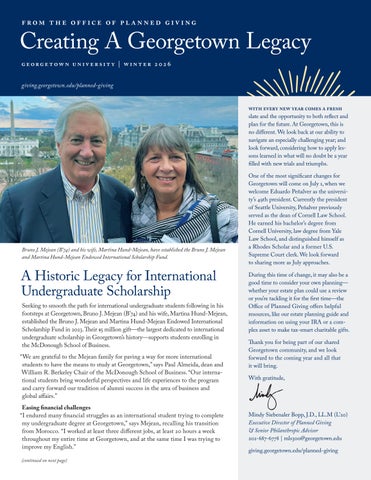
Bruno J. Mejean (B’74) and his wife, Martina Hund-Mejean, have established the Bruno J. Mejean and Martina Hund-Mejean Endowed International Scholarship Fund.
A Historic Legacy for International Undergraduate Scholarship
Seeking to smooth the path for international undergraduate students following in his footsteps at Georgetown, Bruno J. Mejean (B’74) and his wife, Martina Hund-Mejean, established the Bruno J. Mejean and Martina Hund-Mejean Endowed International Scholarship Fund in 2023. Their $5 million gift—the largest dedicated to international undergraduate scholarship in Georgetown’s history—supports students enrolling in the McDonough School of Business.
“We are grateful to the Mejean family for paving a way for more international students to have the means to study at Georgetown,” says Paul Almeida, dean and William R. Berkeley Chair of the McDonough School of Business. “Our international students bring wonderful perspectives and life experiences to the program and carry forward our tradition of alumni success in the area of business and global affairs.”
Easing financial challenges
“I endured many financial struggles as an international student trying to complete my undergraduate degree at Georgetown,” says Mejean, recalling his transition from Morocco. “I worked at least three different jobs, at least 20 hours a week throughout my entire time at Georgetown, and at the same time I was trying to improve my English.”
(continued on next page)
With every new year comes a fresh slate and the opportunity to both reflect and plan for the future. At Georgetown, this is no different. We look back at our ability to navigate an especially challenging year; and look forward, considering how to apply lessons learned in what will no doubt be a year filled with new trials and triumphs.
One of the most significant changes for Georgetown will come on July 1, when we welcome Eduardo Peñalver as the university’s 49th president. Currently the president of Seattle University, Peñalver previously served as the dean of Cornell Law School. He earned his bachelor’s degree from Cornell University, law degree from Yale Law School, and distinguished himself as a Rhodes Scholar and a former U.S. Supreme Court clerk. We look forward to sharing more as July approaches.
During this time of change, it may also be a good time to consider your own planning— whether your estate plan could use a review or you’re tackling it for the first time—the Office of Planned Giving offers helpful resources, like our estate planning guide and information on using your IRA or a complex asset to make tax-smart charitable gifts.
Thank you for being part of our shared Georgetown community, and we look forward to the coming year and all that it will bring.
With gratitude,
Mindy
Siebenaler Bopp,
J.D., LL.M
(L’20) Executive Director of Planned Giving & Senior Philanthropic Advisor
202-687-6778 | mls300@georgetown.edu
giving.georgetown.edu/planned-giving
Bruno J. Mejean (B’74) and Martina Hund-Mejean—(continued
from page 1)
After a distinguished career in trade and project finance, Mejean is now the founder and managing partner of BJM International, a firm that specializes in arranging debt and equity for infrastructure and energy projects. He also mentors climate tech start-ups with Cleantech Open, the largest incubator/accelerator in the sector in the U.S.; invests in some of these start-up companies; and serves as a board member of the High Atlas Foundation, a U.S.-Moroccan foundation that supports sustainable agriculture in Morocco and is currently planting two million organic fruit trees a year for the benefit of local farmers.
He hopes that this scholarship, funded in part by a bequest in the couple’s estate plan, will be a catalyst for more international students to apply to Georgetown.
Mejean recalls that during his undergraduate years “international students had limited access to scholarships,” adding, “now that I am in a position to give back, my wife Martina and I want to make sure that we contribute something that will benefit both Georgetown and its international students.”
A destination for international business students
Ranked as a top three undergraduate business program, Georgetown McDonough continues to be a sought-after destination for international students who are seeking a Jesuit-based, globally oriented business education.
The fund provides scholarships to international undergraduate students enrolling in the business school, specifically those who are residents of Morocco or countries that are part of the European Union.
“It is difficult for international students to secure enough grants and scholarships. These forms of funding are not typically covered by
universities. That’s why this scholarship and its focus is so important,” says Mejean, who, despite working every day, still needed financial aid from a number of sources during his student years.
A global approach to business
Thanks to this new scholarship fund, more international students have the opportunity to experience the business school’s mission of preparing them to become the “best in the world, and best for the world.”
“Georgetown was the only university that I applied to as an undergraduate,” says Mejean. “I happened to be in DC with a relative who worked at Georgetown and thought that this would be a great place to be a student.”
With a foundation built upon its location and deep connections in the global capital city of Washington, DC, Georgetown McDonough fosters a truly global experience for students through the international community it attracts and a variety of experiential programs that send students abroad. Nearly twothirds of McDonough undergraduates have a global educational experience during their time at Georgetown.
More than two decades ago, McDonough cemented its place as a leader in global business education by creating the concept of the global business consulting project. In recent years, McDonough has developed interdisciplinary programs with the School of Foreign Service to more deliberately draw the connections among business, international relations, and policy.
“Georgetown opened so many doors with respect to my career,” shares Mejean. “I am very grateful to the undergraduate employment services from Georgetown. Beyond these resources, I am still good friends with many of my old classmates.”
Dates to Remember
April 16–19, 2026
John Carroll Weekend
May 29–31, 2026
Undergraduate Reunion
October 2–4, 2026
Georgetown Law Reunion
November 6–8, 2026
Georgetown Medical & Dental Reunion
Investing in Future Leaders: Supporting Undergraduate Business Priorities
Every business school teaches students about markets, efficiency, and profitability. But at Georgetown McDonough, we go one step further. Rooted in the Jesuit tradition of service to the common good, we bring together exceptional scholars and students to examine the forces shaping our global economy by educating principled leaders who strive to be not only the best in the world, but the best for the world.
Our mission begins with our students. These future leaders help drive McDonough’s distinctive curriculum, which integrates rigorous business fundamentals with experiential learning and faculty-driven research. This holistic approach ensures that graduates leave Georgetown with the insight, adaptability, and sense of purpose required to confront the most significant challenges facing business and society today. Our students’ ambition, combined with our Jesuit values, form the foundation of everything we accomplish.
Through experiential global learning, hands-on seminars, and personalized career development, Georgetown McDonough offers a transformative undergraduate education. Philanthropic support is essential to ensuring that every student, regardless of financial circumstance, can access these opportunities and fully benefit from what makes Georgetown exceptional.
“Imagine a world led by Georgetown alumni who are inspired by our Jesuit mission to continuously save humanity; who understand complex issues facing mankind; and who have the tools, expertise, and relationships to solve them.” —Paul Almeida, dean and William R. Berkley Chair
Your support helps make this vision possible. Thank you for investing in the next generation of global leaders and expanding the reach and impact of a Georgetown McDonough education.
McCourt Announces School’s First Undergraduate Scholarship
Georgetown’s McCourt School of Public Policy recently announced the establishment of the Joan Dougherty Endowed Scholarship Fund, created to honor the memory and legacy of Joan Dougherty (C’77). The scholarship is the first dedicated to undergraduates in the McCourt School’s Joint Program in Public Policy.
“We’re touched by Joan’s generosity and her desire to help educate the next generation of public policy leaders,” said Carole Roan Gresenz, Dean of the McCourt School of Public Policy. “This scholarship will play an important role as our public policy undergraduate program continues to grow in the years ahead.”
The Joint Program in Public Policy (JPPP) is the first collaboration between Georgetown’s College of Arts & Sciences and McCourt School of Public Policy. JPPP students spend their junior and senior years studying at the McCourt School on Georgetown’s Capitol Campus.
About Joan Dougherty (C’77)—Joan arrived at Georgetown from Queens, New York, where she discovered not only academ-
ic opportunity but also lifelong friendships and transformative experiences. Her junior year abroad in Switzerland became what she fondly remembered as “one of the most magical years” of her life, reflecting the global perspective that would shape her career and worldview.
After graduating, Dougherty pursued a Master of Arts in Public and Urban Policy from the New School, launching a distinguished career in municipal analysis with prestigious institutions including Moody’s and Wachovia Bank. Throughout her professional life, she remained committed to public policy work that served the greater good, finding deep fulfillment in contributing to the welfare of communities and society.
A proud New Yorker at heart, Dougherty was passionate about travel, history, and genealogy, tracing her Irish roots with the same analytical precision she brought to her professional work. Though never one to seek the spotlight, she overcame significant obstacles with grace and determination, always maintaining her love of life and commitment to meaningful work.
Tax and IRA QCD Changes for 2026
• Increased IRA QCD Limit—The cap for IRA QCD gifts has increased to $111,000 for 2026; and donors can now use up to $55,000 of a QCD for a one-time charitable gift annuity.
• New Charitable Deduction for Non-Itemizers —Starting in 2026, donors who do not itemize are eligible for a new charitable deduction of $1,000 (individual)/$2,000 (joint filers).
• New Charitable Floor on Deductions for Itemizers—As part of the federal government’s new tax legislation, individuals who itemize are only able to deduct charitable contributions that exceed 0.5% of their Adjusted Gross Income (AGI). This means that the first 0.5% of AGI donated each year will no longer be deductible. For example, an individual with an AGI of $200,000 who donates $2,000 to charity in 2026 would only be able to deduct $1,000, as the first $1,000 (0.5% of $200,000) is below the new non-deductible charitable floor.
Planned Gifts that Make an Impact
Bequests and Beneficiary Designations
By including a gift to Georgetown as part of your legacy, you are continuing a tradition of educating young people to act in the service of others. Below are two impactful ways to support Georgetown that may also have significant tax benefits.
Bequest in a Will or Trust
Creating a revocable bequest gift in your will or trust helps to ensure the future of the university while providing flexibility in case your circumstances change in the future. Bequests can be designated to a school or program at Georgetown you feel passionately about, or can be left unrestricted and put to use where needed most.
Beneficiary Designation on a Retirement Account
Another simple way to leave a legacy is by naming Georgetown as the beneficiary of a retirement account, life insurance policy, or brokerage account. Leaving a retirement account to an individual may decrease the gift by as much as 70% after deducting income taxes. Due to Georgetown’s nonprofit status, we can realize the full value of gifts from retirement accounts, allowing you to leave other assets to loved ones while avoiding tax and maximizing your impact to a school or program that is meaningful to you.
New Year, New IRA QCD Opportunities
If you are 701/2 and older, you can now direct up to $111,000 to Georgetown from an IRA using a Qualified Charitable Distribution (QCD). This option can avoid income tax and count toward any Required Minimum Distribution (applicable if you are 73+) with the added benefit of supporting a Georgetown school or program that is meaningful to you. Learn how to make your IRA QCD gift at https://g.town/ira-qcd.
Take Advantage of Higher Interest Rates (for now) with a CGA Individuals who are 701/2 and older can use up to $55,000 from an IRA to fund a new charitable gift annuity (CGA). CGAs pay you (and/or a spouse) income for life while also leaving a gift for Georgetown in the future. Higher interest rates make CGAs even more attractive due to the increased payout rates (based on the age of the beneficiary). The current rate at age 70 is 6.3%, and 8.1% at age 80. With more interest rate cuts coming, now may be a good time to lock in a higher payout CGA.
CGAs can also be created outside the IRA option using cash or appreciated securities of $10,000 or more, which may provide added tax benefits like avoiding capital gains tax. If you are interested in learning more about a CGA for Georgetown, or to request a customized CGA illustration, please contact the Office of Planned Giving at 800-347-8067 or plannedgiving@georgetown.edu.
Creating Your Legacy is a helpful resource as you begin the estate planning process. Scan the QR code, return the response card, or visit giving.georgetown.edu/planned-giving to request a copy.