the first 20 years
100
GEIST
95
75
100
A Retrospective
95
75
25
25
5
5
0
0
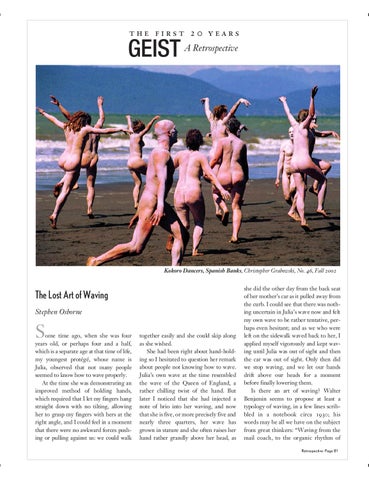
Kokoro Dancers, Spanish Banks, Christopher Grabowski, No. 46, Fall 2002
The Lost Art of Waving Stephen Osborne
S
100
95
75
25
5
ome time ago, when she was four years old, or perhaps four and a half, which is a separate age at that time of life, my youngest protégé, whose name is Julia, observed that not many people seemed to know how to wave properly. At the time she was demonstrating an improved method of holding hands, which required that I let my fingers hang straight down with no tilting, allowing her to grasp my fingers with hers at the right angle, and I could feel in a moment that there were no awkward forces pushing or pulling against us: we could walk
together easily and she could skip along as she wished. She had been right about hand-holding so I hesitated to question her remark about people not knowing how to wave. Julia’s own wave at the time resembled the wave of the Queen of England, a rather chilling twist of the hand. But later I noticed that she had injected a note of brio into her waving, and now that she is five, or more precisely five and nearly three quarters, her wave has grown in stature and she often raises her hand rather grandly above her head, as
she did the other day from the back seat of her mother’s car as it pulled away from the curb. I could see that there was nothing uncertain in Julia’s wave now and felt my own wave to be rather tentative, perhaps even hesitant; and as we who were left on the sidewalk waved back to her, I applied myself vigorously and kept waving until Julia was out of sight and then the car was out of sight. Only then did we stop waving, and we let our hands drift above our heads for a moment before finally lowering them. Is there an art of waving? Walter Benjamin seems to propose at least a typology of waving, in a few lines scribbled in a notebook circa 1930; his words may be all we have on the subject from great thinkers: “Waving from the mail coach, to the organic rhythm of
100
95
75
25
5
Retrospective · Page 81 0
0
100
100
THE FIRST 20 YEARS
95
75
25
5
0
95
the trotting horses. The senseless, desperate, cutting wave from the departing train. Waving has gone astray in the railroad station. On the other hand, the wave to strangers passing by on a moving train. This above all with children, who are waving to angels when they wave to the noiseless, unknown, never-returning people. (Of course, they are also saluting the passing train.)” Who waves at trains today? Or at ships departing? Is waving at a cruise ship really waving, or are we merely enacting a role as seen in movies? (Are passengers leaving on a cruise ship not already on their way back?) At the airport no one waves; instead we embrace at the departure gate, forced to accept an unhappy substitute in the hug, a brief unprotracted moment, already a memory of parting. Once we watched and waved and watched more as our sight of the beloved diminished in the distance: eventually they were no more to be seen and so we turned back into the present and away
from the past, where they had been earlier in the day: we were melancholy, even nostalgic. Certain species of waving will always be with us, of course: the pope waves, the queen waves, tyrants wave, clowns wave, mayors and prime ministers wave. Blondin waves to the Prince of Wales from his rope across Niagara. Beauty queens wave and so do their maids in waiting and their runners-up. And then ships in passing, ferries, cruise ships, yachts: passengers wave to each other across the water. People living in the country wave to each other from their cars and their pickup trucks. Waving lends gravity and duration to the vanishing world, especially in glimpses of private farewells carried out in public spaces such as train stations and bus depots, but only weakly in airports, where the exchange of waves so meaningful in prior ages cannot be known or seen or even remembered by those too young to have known waving as some of us can still recall waving to each other on a darkened snowy evening, perhaps on the
Collectible Geist (continued from front cover)
100
95
75
25
The walls in the new office were ten feet high; editors senior and junior had to cover them in Bisque White Latex and nail track lighting to the ceiling before they could edit another word. For five full years, the scenic view beloved of the tourist bureau lay beyond a broken window in the bathroom: mountains, the sea, cruise ships, freighters, seaplanes, helicopters buzzing around. During a 3-Day Novel weekend, three junior editors trapped themselves in the stairwell between locked doors; rescue came too late for them to finish their novels. The publisher’s uncle, an angry octogenarian offended by his nephew’s editorial proclivities, threatened to “come out to the coast and knock his block off.” So far it hasn’t happened. In the summer of 2010, Geist holed up in single room on Howe Street awaiting yet newer premises; the Back Issue Collection (minus copies of No. 8) went into storage in a basement room broken open by villains who smashed a hole in the wall and took nothing away but a single copy of No. 77 that had been lying on top of a filing cabinet. When Geist won Western Magazine of the Year for the first time in 2002, free hair products had been distributed at the banquet tables by the sponsors. For months the editors had much better hair. This retrospective is offered as a token of a collaboration between writers and readers, artists and editors, that may have only begun. Geist is the emanation of an imagined country inhabited by all of you, and all of us. —The Editors. (Notes on contributors to the retrospective can be found at geist.com.)
5
wooden platform at Sioux Lookout on a night of blizzard and cutting wind and nothing before us but the certainty of never seeing each other again, never being seen by each other again, although only to be separated for days or weeks at most but who could believe that, and the snow was hurting our faces and the big lamp was glaring and we had mittens on and scarves and the whistle was blowing. We embraced heavily in our awkward clothing; a clanging and the clash of iron and the screech of metal wheels: leaning out from the vestibule between cars, waving into the night and the blizzard for as long as we could, as the train pulled us apart, into the future, into the past. All was equally blank and without you, but was it an escape as well, a species of respite, even hope? The long and painful wailing of the whistle in the night, a lonely minor chord, D-sharp minor to be precise, on an air horn invented by Robert Swanson, the great whistle maker, at his whistle farm in a distant mountain valley. (Swanson was a composer of farewells: it was he who gave the minor chord to Canadian trains, the major chord to American trains. Might there be a doctrine of farewells?) That was waving then, we want to say: those were the great days of waving, but how certain can we be? (Is this what Benjamin implies when he says that waving went astray in the railroad station?) Not long ago my protégé Julia began slipping into epileptic seizures, which went on for many weeks. During the seizures she would retreat for long moments to a distant place; we could see her leaving us and we would wave to her slowly, and she would wave back slowly, tracing a gesture in the air, and the wave would linger until the seizure had passed and we were together again. Who is it, we want to remember, who waves at angels, when they wave to the noiseless, unknown, never-returning people? No. 46, Fall 2002 (excerpt)
75
25
5
0
100
95
75
25
5
Page 82 · Retrospective 0
0
Hamam, Slovakia 1994, Ruth Kaplan, No. 48, Spring 2003
Sweet Badass Dude Miriam Toews
I
t’s fall now. Liam has a new pair of And One basketball shoes that are half baby blue suede, half white leather. And one size bigger than his last ones. He’s reading The Diary of Anne Frank in L.A. (language arts)
and studying integers in math. He and his friends are trying to plan a trip to Minneapolis in October to see the Vikings. It would be his birthday present—he’s turning fourteen at the end of October.
This summer we went to L.A. (Los Angeles) and while we were there, Liam insisted that we go to Venice Beach: specifically to the Venice Beach basketball courts. They’re famous, he told us; movies are shot there, some of the Lakers play there once in a while, we have to go there. We’d be fools not to go there. We can’t not go there. Plus, he said, Jonathan Richman sings about Venice Beach. This summer he Retrospective · Page 83
100
100
THE FIRST 20 YEARS
95
75
25
5
0
95
started loving the music of Jonathan Richman. We drove all day through the sequoias to see the big one, General Sherman, the biggest living thing in the world, but he said he didn’t care, he’d rather sit in the van and sing along to “I, Jonathan” one more time. So we went to Venice Beach. At first we strolled along the boardwalk looking at different stuff, eating ice cream, talking, laughing, the usual. Then, suddenly, there were the courts right in front of us. And you could feel this tension come over Liam, the way a dog gets when it sees a cat or a squirrel and just stops and stares and you know something’s going to happen. The happy, easy feeling of strolling along a boardwalk in the sunshine was gone; it was as if we’d entered another zone or something. And Liam says, Oh man, oh man, there they are. His voice gets lower and his body kind of slumps around the shoulders to indicate that he’s one badass killer dude,
unfortunately with an ice cream cone in his hand and with his mom and little sister standing next to him, and he says, in this low voice, Uh, I’ll be over there, and jerks his head toward the courts, and starts walking away using the new L.A. killer dude walk that he’s been practising. Can I have your ice cream? Jess yells after him, which at this moment is for him like being shot in the back with an AK-47, but because he’s such a sweet badass dude, he slowly turns around and holds out his cone to her, then heads for the courts. Naturally the rest of us can’t follow him. We know this. So we go and sit far away from the courts, on a wooden bench, and we watch. We can barely see him, he’s about an inch tall, but we can see enough to know, sort of, what’s going on. He goes and sits on some bleachers between the main court and one of the three other lesser courts. He’s smart enough to know that he’s not going to get to play on the main court. There’s a full game happening
Gentle Maidens Rise Forgotten verses of the national anthem, found in the 1967 Canadian Centennial edition of the Gideon Bible. O CANADA O Canada! Where pines and maples grow, Great prairies spread and lordly rivers flow. How dear to us thy broad domain, From East to Western sea, Thou land of hope for all who toil, Thou True North strong and free! 100
95
75
O Canada! Beneath thy shining skies May stalwart sons and gentle maidens rise; To keep thee steadfast thro’ the years From East to Western sea, Our Fatherland, our Motherland, Our True North strong and free!
25
there already and these guys are really fucking good, and much older than Liam. But on the court beside the main one there are some other guys playing three on three. These are the guys Liam’s watching. Maybe he thinks he will get to sub in one of these games. But he just sits there, he doesn’t make a move. He’s waiting. And it’s really hot outside, and finally Jess says she wants to go to the beach, so Calvin takes her and I stay on the bench reading and watching Liam from time to time. He’s still not moving, not playing, not doing anything but watching from the sidelines. Then Calvin and Jess come back from the beach and Calvin sits down on the bench to watch, and Jess and I go back to the beach. We’re there for a while, splashing around, digging in the sand, collecting seashells. Eventually we go back to the bench to find out what’s going on. Nothing, says Calvin. He’s still sitting there. And I think to myself, he’s not going to do it. Liam gets up and walks over to one of the guys playing three on three. He says something and the other guy says something, and then Liam goes back and sits down. Shit! I say, they’re not going to let him play. But Liam doesn’t leave the bleachers. He sits there. The only difference is that now he’s taken off his baseball cap. Behind us is the spot where those guys lift weights and swing from metal hoops and stuff, Muscle Beach, and Calvin and Jess and I turn to watch them for a few minutes. Then we turn back to look at Liam, and right then he makes his move. He gets up off the bleachers, walks over to the same guy as before, they say a few things, and then the guy sits back down where Liam was and Liam starts to play! He’s playing. He’s playing basketball at the Venice Beach Basketball Courts in Los Angeles, California, U.S.A. His dream has come true. No. 44, Summer 2001 (excerpt)
75
25
5
0
100
95
75
25
5
5
Page 84 · Retrospective 0
0
100
100
RETROSPECTIVE
95
75
95
Let Go
75
bill bissett 25
25
5
5
0
0
From radiant danse uv being: a poetic portrait of bill bissett, published by Nightwood Editions. No. 62, Fall 2006
Her Nine New York Selves Sina Queyras
S
100
95
75
25
5
he is walking under Macy’s big screen where the children of Belsen are being carried out on stretchers. We have come to, we are so, some of us, she thinks, turned around. The children hang in the balance like shekels. She pauses, fishing in her bag while bodyguards frisk. Overhead the red streaks of a Target ad and she thinks of that kettle, that kettle, the designer one, she meant to buy it on the weekend. She had been in the diner on Sixth, the one that Isaac Mizrahi frequents (BLT no mayo). She hadn’t seen him, but had been scowled at (deliciously) by Fran Lebowitz. Men in camouflage, men in suits, there is an orange alert today and she has lost her lipstick. Off to a cocktail party in Gramercy Square, but not without lipstick, into Macy’s, to the MAC counter for Miss Dish, or is it MAC Red? They are always changing the name of her shade. Everything overstocked, she cannot sell or save—but there is no tax this week to celebrate the Grand Old Party doing its dirty in town. Please, she
thinks, adjust your dial, tune out and tune in, the moment is a frieze of scent and cashmere and the most delicious lips in the world, all here, smiling and lipstick is not political . . . She is not convincing herself, cool as a bottle of spring water in Chelsea on a Saturday afternoon before she heads back down to her loft in the Meatpacking District next to Julianna’s. Or is it uptown to a tiny but perfect apartment where she lives with her lawyer husband and they take dancing lessons with a little old man, wiry as a yogi, who kids with Liza, who winks at you too, as you both wrap your knees. Everything is luscious Hudson Valley greens and Tiffany blues in rooms the colour of Arctic char, that latte waiting for you around the corner when you tire of your own company (rarely . . .). But at that moment she remembers that she lives in Brooklyn and needs print cartridges from Target, not a kettle, and will probably buy some street meat from the vendor on Atlantic, where lithe tattooed boys in white tees sneak out
with DVDs, and oops, no, she is still at the border waiting for paperwork, about to take a job at a state college in New Jersey, a small one no one has ever heard of at which she will be of little use and make no mark, but think of Williams as she drives through to the city for her weekly culture fix. Or she is that person who eagerly attends poetry readings at the Ear Inn (where a basset hound paddles past her), and over the beer, her ear, over the bear, her ear, strains to hear something off of Spring Street, something a little more Soho, more like the Grand, where she sits of an afternoon working on a screenplay, modest, with a role for Björk—a feature art-avant-garde sort of MoMA thing, abstract, but still completely commercially viable with multiple soundtracks depending on the cinema you see the movie in . . . Or now, jerking herself into the street, not exactly into oncoming traffic but surfing a sea of New York taxis riding the afternoon tide down Fifth Avenue bustling with so many versions of herself she feels them mingling with other versions of other people, small, compact projectors flashing through the streets, endless reels of selves and selves and selves and selves and selves . . . No. 72, Spring 2009
100
95
75
25
5
Retrospective · Page 85 0
0
100
100
THE FIRST 20 YEARS
95
75
25
5
0
100
95
75
25
5
95
Day in Court Mary Vallis
I
n Santa Maria, California, the Best Value Inn on East Main was run by a woman with pink hair named Michelle and her boyfriend, whose name I forget, who always wore a Jack Daniels T-shirt and a baseball cap turned backwards. A cat named Dusty lived in the lobby and often sat on the counter next to the shrivelled apples offered to guests for breakfast. The room smelled like stale smoke. That is where I lived in 2005, during the summer I almost met Michael Jackson. Every single hotel room in the city was booked by the time the jurors began their deliberations on whether Jackson was a child molester, and I lost the room I’d had during the trial, but Michelle at the Best Value took me in. This was a controversial decision because I am a journalist and Michelle is a Michael Jackson fan, and many of the fans who had quit their jobs and moved to Santa Maria from Germany and Tennessee to support “Michael” during the trial were staying at the Best Value Inn. The fans hated journalists. Michelle charged reporters $US59 a night. Michael Jackson fans, I later found out, paid $US37 a night and lived four to a room, and even then, she sometimes let their payments slide. After I moved in, she told me that a man calling himself Majestik Magnificent, who claimed he was at one time Michael Jackson’s personal magician, was staying down the hall. The man in the room next to mine was a writer for Rolling Stone. He smoked outside my window every night. I never saw him talk to anyone. The televisions in the small rooms were only a few inches from the ends of the beds, which was ideal. This way, fans Page 86 · Retrospective
0
who did not win the daily 6 a.m. “lottery” for courtroom seats could go back to bed and watch television reports about the trial taking place four blocks away. This way, they did not have to sit against the chain-link fence that separated the
public from the court all day. Majestik Magnificent, however, spent every day standing around the parking lot in a tailored black suit and talked to any member of the media who made eye contact. Magnificent was a stocky black man who described himself as an “activist for truth.” When he was not at the courthouse, he hung out on the balcony outside his room talking on a cellphone. One morning, before the jurors arrived at the courthouse to continue deliberating on whether Michael Jackson was a child molester, Majestik Magnificent knocked on my door at the Best Value Inn. He helped me move my suitcase so we could pull two padded chairs out from the small table where I wrote newspaper stories on my laptop. We sat with our knees touching as he told me about the time long ago when he was friends with Michael Jackson, because Jackson loved magic and wanted to learn tricks. He said he had known Jackson for twenty-two years. Magnificent had driven to Santa Maria
from Las Vegas, where he said he had a new career running a limousine service. At one point during our conversation, he sang “Billie Jean” a cappella and told me that Jackson had done the same for him when he was writing the song. Magnificent said that Jackson told him it was going to be a song about a woman who claimed a man was the father of her child, but that the man was not her lover. He said he told Jackson the song would not fly. Remembering this, Magnificent laughed and laughed. The smell of Majestik Magnificent’s cologne filled the motel room, which was hot because it was summer and California. Magnificent insisted that the Michael Jackson he knew was not a child molester. I asked him if he could make his friend’s troubles disappear. I know his exact answer because I recorded it with a tape machine. “I do magic,” he said. “Only my heavenly father performs miracles.” He winked. No. 61, Summer 2006 (excerpt)
75
25
5
0
The Other James Buchanan Christopher Geisel
F
or thirty-eight years, all I knew about my daddy was his last name: Buchanan, same as mine, and that was all right with me until Mama died. The station gave me three days for bereavement, exactly how long it took me to find an envelope of uncashed cheques in a box of her odds and ends. That’s when I found out my daddy’s first name: James, same as mine. The last cheque was from 1988, the year I graduated from The Comp, Lloydminster Comprehensive Secondary. The address was over on the
illustration: from exquisite dino corp, by jo cook, wesley mulvin, owen plummer, terry plummer
100
95
75
25
5
0
100
100
95
95
75
75
25
25
5
5
0
0
Bang Bua Thong near Bangkok, Brent Lewin, Cover, No. 69, Summer 2008
100
95
75
25
5
Saskatchewan side of town, a street named Fall Creek that spelled farm country. I found him in the phone book and sipped whiskey until the end of Leno. I called him. He didn’t sound surprised when I told him Mama was dead. He agreed to meet me at Maggie’s at 7:00 the following evening for proper introductions. The restaurant was only half-full when I stepped inside at a quarter to. I ordered a Blue and drank it before my watch said 6:59. The TV over the bar had scores from a Saskatoon station. The clock in the corner of the screen read 8:01, Saskatchewan time. I asked the waitress if a man had been in here about an hour before, but of
course I couldn’t describe him. A working man, I thought. Or a businessman. A cowboy hat, I was sure, though I couldn’t say why. Sweat ran down my back when she gave me a smile reserved for drunks, children and the insane, and she promised to ask around. A different waitress brought me a beer, and I drank it all before 7:20, when my daddy walked in. He was windburnt and lean, with lines around his mouth like knife cuts. His shirt was the cleanest pressed denim I’d ever seen and he apologized when he shook my hand. “Hope you didn’t think I’d come on Central Time,” he said. My laugh came out louder than I’d meant it to. “Wouldn’t that have been funny,” I said. “It sure would have,” he
said, and we laughed again when the waitress came by and we found out my daddy and I drink the same beer. It was no great thing, really, since everybody drinks either Blue or Canadian around Lloyd, but it felt like proof of something. I looked at the mirror over the bar and saw a thinner-cheeked version of myself and forgot all about the eighteen slips of paper in an envelope in my pocket. But then I drank a few more beers and asked him why she never took the money. “Your mother, God bless her, always was a stubborn woman,” he said, and winked. I sipped my beer and just like that, I could tell we were in for a hard time. No. 72, Spring 2009, winner of the Short Long-Distance Writing Contest
100
95
75
25
5
Retrospective · Page 87 0
0
100
100
95
95
75
75
25
25
5
5
0
0
The Argument, Jessica Eaton, No. 55, Winter 2004
Saint Baby Jesus Credit Union Billeb Nickerson
A
100
95
75
25
t the laundromat on Rue St.-Viateur the proprietor looks like Elvis or at least someone who would have looked like Elvis if Elvis hadn’t OD’ed on deepfried peanut butter and banana sandwiches. He turns to me and says “chaud ou froid." I tell him “One hot, two cold and soup” and he passes me a small yogurt container filled with detergent and two sheets of fabric softener. I put the fabric softener into my bag and later mistook it for Kleenex on the bus to Ottawa. The walls in one corner of the laundromat are covered by an Elvis collage and a display of newspaper clippings about Jacques Villeneuve. The other
5
walls are crammed with community bulletins, ads for bilingual psychics, travel posters advertising an unnamed tropical destination, and notices in three languages warning customers not to overload the machines. My clothes spin around the washers and I wonder about the punishments for overloading: my mother would make the culprits eat laundromat soap and my father would send them into the backyard to pile wood. By the time my wash cycle finishes I feel as if my life has somehow been saved. In a story in the Gazette the government agency that okays the names of newborn babies in Quebec rules that a
couple from Montreal may not name their child “Ivory.” An agency spokesperson claims that when the child grows older, classmates will tease her for being named after a bar of soap. In appealing the decision, the mother says her child’s name came to her in a dream and not from a bar of soap. The article mentions another couple first denied, then given permission to name their child C’est-unAnge (“It’s An Angel”). I am reminded of these two babies when I pass La Caisse Populaire St. Enfant Jésus—The Saint Baby Jesus Credit Union. What would have happened to the world if Mary had decided to name Jesus “Ivory” or “C’est-un-Ange”? Would God have stopped her or just let things take their course? No. 30, Summer 1998 (excerpt)
100
95
75
25
5
Page 88 · Retrospective 0
0
RETROSPECTIVE
100
100
95
75
25
5
0
95
Jumper Stephen Gauer
O
ne night I drove to Lions Gate Bridge over Burrard Inlet in Vancouver, to research a short story I was writing about a lonely, suicidal widower. I wanted to see what my character would see standing at the railing, late at night, in the middle of the bridge, as he got ready to jump. I got in my car around midnight and drove downtown, through Stanley Park and across the bridge. Just past the bridge, I parked near a small building on the side of the road and walked back toward the bridge. As I passed the building, I looked in and saw a small office with a woman sitting at a desk. I kept walking. It only took about five minutes to reach
the middle of the bridge. It was a warm night, with a light wind blowing up the inlet from the southeast. Some groups of young people walked by on the other side, heading north toward West Vancouver. When I got to the middle of the bridge, I stopped. The freshly painted green railing had some graffiti on it. I took out my notebook and wrote it down: “Fragments in time . . . still forever.” I stood right next to the railing; the top rail came up to my chest. I stood on the lower part of the railing and leaned over the edge. There was no netting or any kind of device to thwart jumpers. When I leaned all the way over, I could see straight down into the black
100
95
75
25
The Toronto Portraits, Andrew Danson Danushevsky, No. 61, Summer 2006
water below. It would be very easy to jump if that’s what you wanted to do. I stepped down from the railing and looked up at the lights. They were mounted on the tops of big lampposts as thick as a man’s head. If you stood on the top rail, you could hold on to one to steady yourself. I was looking out over the water, still facing the railing, when a voice behind me said, “Sir, would you please step away from the railing?” I turned around. A police officer was walking toward me. Behind him, a police car was parked in the wrong lane, facing south, with a flasher on. Traffic in both directions had stopped. I was surprised and a little scared. My heart started to pound and my throat went very dry. Police make me nervous at the best of times. This was not the best of times. The officer asked me again to step away from the railing. I did so. “Sir, what are you doing here?” he asked me. As soon as I spoke I knew my answer would sound absurd. “I’m a writer,” I said. “I’m researching a story about a man who jumps off the bridge.” The officer’s expression didn’t change. His face hadn’t had any expression to begin with. He had light reddish hair and a heavy moustache. A gun hung from his hip. I felt disoriented, almost lightheaded, as though I were slightly stoned or moving inside a dream. For a brief moment I felt that I was my character, that I was in fact not just researching the story but actually living the story. The sensation sent a jolt of fear through my body. I wanted to sit down. I wanted the officer to go away. “Sir, I’d like you to get into the car so I can drive you off the bridge,” said the officer. I nodded and got into the car. The back seat was very cramped. No. 52, Spring 2004 (excerpt)
5
75
25
5
0
100
95
75
25
5
Retrospective · Page 89 0
0
THE FIRST 20 YEARS
100
100
95
75
95
It’s 8:23 in New York
75
Charles Bernstein 25
5
0
100
95
75
25
5
25
W
Page 90 · Retrospective 0
5
hat I can’t describe is how beautiful the day is in New York; clear skies, visibility all the way to the other side of wherever you think you are looking. Or looking away. After the long and strange Odyssey back from La Guardia airport this morning, I went to a jammed upper west side coffee shop. A family was eating, deciding, loudly, whether to get the chicken or tuna salad; the mother expressed great disappointment that there was no skim milk. The coffee shop was packed and the mother said, “Well, it’s OK, at least we’re not in a rush right now and after all the restaurant probably has more people now than they are used to handling.” Outside, two guys with workboots and cellphones strapped to their waists yelled toward the coffee shop, “I can’t believe these fucking people are sitting in a café when the city is being blown up.” I can’t imagine Manhattan without those two towers looming over the south end. As I was walking across the 59th Street bridge I couldn’t stop thinking of that Simon and Garfunkel song named after the bridge, “Feelin’ Groovy” (“Life, I love you . . . all is . . .”). It was hard not to feel like it was a movie, and one with an unbelievable plot at that. All the airports closed; the Pentagon bombed; four commercial jets hijacked on suicide missions. The bridge was overflowing with people streaming out of Manhattan, a line as wide as the bridge and as long as Manhattan itself. If you looked out to the left, there was a big plume of smoke over downtown Manhattan. You couldn’t see that the Towers were not there. And it didn’t seem possible that this had happened either.
0
Even with all the people streaming out, and the small clutch of us walking back to the island. The FDR drive below us was empty, with just the occasional emergency vehicle. The UN Secretariat building looked naked, vulnerable. Why wouldn’t a plane smash into that while we walked across the East River. The skies unnaturally clear of airplanes, though every once in a while you hear the ominous swoop of a jet overhead, presumably military. Once in Manhattan, the entrance to the bridge was mobbed. But walking west, people were quietly hanging out on street corners. Most of the avenues were cleared of traffic, except for the sirens on an ambulance or fire truck racing downtown. While the phones are not working very well (so much of NYC communication is streamed through the World Trade Center), the email is working fine. There are notes of disbelief and worry from people from all over, especially Europe. My friends Misko and Dubravka from Beograd write and I remember their emails when their city was under fire. And various friends we had just seen on our recent trip. As I was walking home, about half a
photo: christopher grabowski
mile from our apartment, I stopped by the storefront hair salon of Andrew, who lives upstairs in our building. I had been trying for a couple of hours to get Susan on the phone, to see if she had picked up Felix at school. But neither the cell nor land phones were working. Andrew said Susan and Felix had just walked by and were heading home. He said he was going to stay open just because he thought people would want to have him there, standing in front of his shop. At about 6, Felix, Susan and I walked down to the Hudson. I wanted to see New Jersey, to see the George Washington Bridge. The sun gleamed on the water. The bridge was calm. Folks were bicycling and rollerblading. The scene was almost serene; just five miles from the Trade Center. Uncanny is the word. What I can’t describe is the reality; the panic; the horror. I keep turning on the TV to hear what I can’t take in and what I already know. Over and over. I don’t find the coverage comforting but addictive. This could not have happened. This hasn’t happened. This is happening. It’s 8:23 in New York. September 11, 2001 / No. 42, Fall 2001
100
95
75
25
5
0
100
RETROSPECTIVE
100
95
95
75
75
25
25
5
5
0
0
100
100
95
95
75
75
25
25
No. 60, Spring 2006 5
5
Retrospective 路 Page 91 0
0
THE FIRST 20 YEARS
100
100
95
75
25
5
0
100
95
75
25
5
95
Writing the Nation Daniel Francis
P
robably the most famous line Pierre Berton never wrote was the definition of a Canadian as someone who can make love in a canoe. The line is attributed to Berton in the Oxford Dictionary of Quotations, as well as Colombo’s Canadian Quotations, but it turns out, at least according to Brian McKillop’s new biography of Berton, that the legendary British Columbia newspaperwoman Ma Murray may well have said it first. If Berton did not write the canoe quip, it was just about the only thing that he didn’t write. McKillop’s book, Pierre Berton: A Biography (McClelland & Stewart), makes clear that Berton was prolific to the point of incontinence. At one point during the 1960s, he was writing a daily newspaper column for the Toronto Star, starring in his own television interview show, appearing weekly as a panelist on the quiz show Front Page Challenge and daily on radio with a brief opinion piece, as well as producing a book a year. The most astonishing example of his productivity? He wrote the first draft of his railway history, The National Dream, in a month, the time it takes most authors to organize their thoughts. When the CBC turned his railway books into a historical docudrama, Berton himself was the presenter. He once had three books on the bestseller list at the same time, and periodically he dropped by Rideau Hall to pick up another Governor General’s Award. Just reading about his output left me exhausted, not to mention green with envy. To be honest, until I read McKillop’s book I had never taken Berton very seriously. I considered him faintly embar-
rassing, in the way that fathers are often embarrassing to their sons. The billowy side whiskers, the floral bow tie, the absurd safari jacket he wore to host the television series, the corny repartee on Front Page Challenge: these were the affectations of a self-satisfied old fogey. Or so it seemed. What McKillop’s biography reveals is the activist side of Berton’s career. For example, his 1951 coverage of the Korean War for Maclean’s was remarkably critical for the time. When he returned from the battle zone, instead of cheerleading for the troops, Berton wrote an article that questioned the whole basis of the war. “Can you win a war in this tragic year of 1951 as you win a prize fight, by brute force in the fifteenth round?” he asked. His take on Korea reads very much as if he were writing today about Afghanistan. In 1963 Maclean’s dropped his column, ostensibly because of his views on teenage sex (he did not condemn it), but McKillop thinks the firing had as much to do with Berton’s then-controversial views on public medicine (he supported it). Whatever the reason, Berton would not pull his punches to save his job. Later he co-founded the nationalist Committee for an Independent Canada, a group of media and academic heavyweights who despaired at the country’s dependence on American capital and American culture, and he was a charter member and longtime supporter of the Writers’ Union of Canada. In other words, Berton was a passionate guy who was unafraid to put his opinions into practice. He used his celebrity—and McKillop argues that he was “Canada’s first modern celebrity”—in the best way, in support of
causes in which he believed. (He also used it to bed the girls, but that’s another story.) Berton’s reputation as a “popular historian” rests on his fine history of the Klondike gold rush, the railway books and a shelf full of other histories of varying quality. He was not a deep thinker or a particularly fine stylist, but he was an energetic spinner of tales, and it was his ability to create memorable characters and weave them into robust, romantic stories that won him so many readers. No. 72, Spring 2009 (excerpt)
75
25
5
0
Off the Rails Marjorie Doyle
A
friend once told me that the first night after she left home, she set her alarm, woke up and took a shower at 4:00 in the morning. She did it because she could, with no one to comment, complain or ask why. When I left home after third-year university, my first act was to turn on the stereo, turn up the stereo, and let those riffs and quarter notes roam free. But first there was a limbo, a halfway stop, introduced by my brothers. I see myself entering the squatty hall of their pad, a wary convent girl affecting nonchalance as suspicious foreign scents came out to greet me; even the incense was unidentifiable, mixed as it was with curry and pot. My brothers showed me around. In the kitchen, tofu this, soya that and gangling white worms sprouting in gauze-topped jars. Dope, I thought, but the stuff turned up on my salad plate, introduced as mung bean sprouts. I followed one brother and his girlfriend tentatively as they parted
100
95
75
25
5
Page 92 · Retrospective 0
0
100
100
95
95
75
75
25
25
5
5
0
0
Memory in Belgrade, Goran Basaric, No. 72, Spring 2009
100
95
75
25
5
strings of hanging beads and passed through to the living room. I tried to avert my eyes from the double mattress on the floor and became chatty in a nervous kind of way, covering up my horror and the strong sense that Mom wouldn’t want me here, my brothers are off the rails. What had happened to the seminarians who’d come home for Christmas and ask me, with a solicitude beyond their years, how glee club was coming along? To the brothers who’d sit on the piano bench next to me and play the other girl’s part so I could practise my duet of “Angels We Have Heard on High”? “Listen to this,” one brother said now, easing a record out of its sleeve and onto the turntable, and in that moment life tilted a little. Joan Baez sang of sweet Sir Galahad coming in through the window at night, her clear, lyrical voice roaming easily around the story she was telling. Weren’t there only two kinds of music, classical and junk? We listened to one album after another: Pete Seeger, Bob Dylan, Leonard Cohen. I had never listened to a record with anyone before. “I’ve looked at life from both sides now”—Joni Mitchell’s sweet lilt filled the room. My
other brother picked up a bass guitar and started playing along on Carole King’s unsentimental “It’s Too Late.” I sipped what I thought was liquid marijuana (I had never seen tea leaves or a tea ball before) and began the slow drift into a warm new place. I left that day with Bob Dylan’s John Wesley Harding under my arm and a copy of Small Is Beautiful in my jacket pocket. The brothers, my rescue team, had grabbed me from the slippery slide of going to my grave a Holy Heart girl, a teacher in a parochial elementary school, driving kids around in a station wagon. Still, I kept one foot on the mother track. Then my mother went to Labrador. I sailed out through the St. John’s Narrows with her, then pleaded ill, got off at the first port and hopped into my brothers’ waiting van. Home alone. And while she took her trip, I took mine: that first memorable days-long psychedelic adventure of all-night television with Joey Smallwood and Fidel Castro, Pink Floyd, the Virgin Mary and my father’s soul all appearing and disappearing. The event culminated on Signal Hill with me pouring my stoned crazy self into the hard bore of my flute, shivering in the cool dawn, all for my
brother’s Super 8 movie camera. Where did the music come from? It was not the Handel sonata I was working on, nor the Bach suite. The music came from some unknown interior zone. By that time I was living upstairs in the tiny room I inherited when the last of the brothers moved on. Downstairs, the hi-fi sat in the living room like a steamer trunk on legs, spilling out the Mitch Miller Singers or the soundtrack of The Music Man. Upstairs was for serious listening. Here was the latest gear: a true sound system with components, wires crawling high and low, speakers positioned to produce perfect stereo. My mother, who had remodelled an old home in a glamorous way, had unwittingly provided a perfect environment for the teenage lifestyle: a balcony off this second-storey bedroom allowed for enhanced listening without fear of a peculiar sweet-smelling smoke drifting down the stairs. After a short stint in that room, I got my own place and the listening room grew. An entire house was open to jazz, blues, rock, folk and classical. Country and western came later, in the love-pain package. No. 59, Winter 2005
100
95
75
25
5
Retrospective · Page 93 0
0
100
THE FIRST 20 YEARS
95
75
100
95
Lost Memories
75
Kazuyoshi Ehara 25
5
25
Only loved ones remember what an Alzheimer’s patient has lost. Yoshikazu Ehara is my grandfather. Eight years ago, when he was eighty, he was diagnosed with Alzheimer’s disease. No.62, Fall 2006
0
5
0
Yoshikazu Ehara looks out the window of a senior daycare centre in Nanguo, Japan.
100
100
95
95
75
75
25
5
Yoshikazu claps his hands in bed after placing neckties around himself during the night.
“I have to go,” says Yoshikazu when he wants to leave. Nobody knows why or where he wants to go.
25
5
Page 94 · Retrospective 0
0
RETROSPECTIVE
100
100
95
75
95
City Still Breathing: Listening to the Weakerthans Paul Tough
25
5
0
100
95
75
25
T
he bar downstairs at Wellington’s on Albert Street in Winnipeg wears its history on the walls. It has a sunken dance floor surrounded by glowing purple neon tubes from the club’s disco days. The fake spiderwebs draped over the wrought-iron chandelier near the bar are from when it was a goth place. Before that, twenty years ago, Wellington’s was where local punk bands played; there are probably still some holes in the walls from back then. On the February night I visited, Winnipeg was in the middle of a mild spell, only a few degrees below zero outside; T-shirt weather for Winnipeg. I was sitting at a square black table with a square black ashtray on top of it, watching a band go through their sound check. Behind me the bartenders were setting up, unloading cases of beer and jamming quick-pour nozzles into bottles of whisky and rum. There were four people on stage, four white men in their late twenties and early thirties playing electric guitar and bass and drums. The shortest and skinniest one was standing in the middle, in front of a microphone, a guitar strapped around his neck. He was wearing a black T-shirt and jeans rolled up at the bottom in a single wide fold, like a farmer. His hair was dyed blond, or at least part of it was, and he had a smile on his face that sometimes seemed confident and sometimes seemed nervous. His name, I knew from reading the back of the CD, was John K. Samson, and the band was called the Weakerthans. At the back of the room the sound guy adjusted some knobs and the band launched into a song called “Left and leaving.” It starts with a finger-picked guitar and a single voice singing:
My city’s still breathing (but barely, it’s true) through buildings gone missing like teeth. Back in my tiny apartment in New York City, those lyrics are written in ballpoint pen on a scrap of yellow lined paper and stuck to the side of my refrigerator with a souvenir magnet of the World Trade Center. When I wrote them down and magneted them up last fall, it was because they felt to me as though they were about New York during its season of loss, though even then I knew that they were not; they were
about Winnipeg. Every Weakerthans song is about Winnipeg. Winnipeg matters to me because my sister lives there. As I have moved from city to city and job to job over the last decade, she has stayed put, a minister and a homeowner, drilling roots down into the permafrost. Listening to the Weakerthans in my apartment last winter, I found myself wanting to visit. Now I wasn’t certain, sitting at my table watching the band warm up, whether I was in Winnipeg because of the Weakerthans, or whether I cared about the Weakerthans because I care about Winnipeg. But I knew I was trying to figure something out about home: what it means to love or hate where you live, how to write about a place, how to claim a home with words. Toward the end of my Winnipeg trip, I came across this passage in a book by Joan Didion:
75
25
5
0
Apiary of Underclothes Gillian Jerome After the beer parlour, we set off for the islands drinking whiskey from Tupperware cups. We jimmied the radio for baseball—Expos were up. I didn’t know what day it was, or the year. Finally, I thought, a good-sized man, and held the wheel. Strands of silence floated up between us like duck shit in the lake water. It happened right when the days held ’til ten o’clock. Fireflies. June Bugs. Every few miles we stuck our heads into the slipstream to whet our eyeballs. Both of us taken with the lights flickering on the dash. We felt ghosts hovering over the scab of last year’s abominable fires. Have you heard so and so’s having a baby? Well no. Well yes. I hummed my favourite Bo Diddleys, rattled off some names of local birds. Jays scooped it finally. When the car stopped furs of dandelions flew around us & we hastened like they did into that broom. No. 70, Fall 2008
5
100
95
75
25
5
Retrospective · Page 95 0
0
100
100
95
95
75
75
25
25
5
5
0
0
Winnipeg, Invisible City, John Paskievich, No. 66, Fall 2007
100
95
75
25
5
Certain places seem to exist mainly because someone has written about them. Kilimanjaro belongs to Ernest Hemingway. Oxford, Mississippi, belongs to William Faulkner, and one hot July week in Oxford I was moved to spend an afternoon walking the graveyard looking for his stone, a kind of courtesy call on the owner of the property. A place belongs forever to whoever claims it hardest, remembers it most obsessively, wrenches it from itself, shapes it, renders it, loves it so radically that he remakes it in his own image. Reading that, I wondered if my visit to Wellington’s was a courtesy call, too, though the owner of this property is still
alive: in fact, John Samson is only twenty-nine. When the sound check was over, I introduced myself and asked if he had a moment to talk about Winnipeg and the Weakerthans and he said, all right, let me just get a light. We found a table in a back room that looked as though it dated from yet another Wellington’s incarnation: it had mirrors and purple neon lights just like the dance floor, but all along the walls, up high near the ceiling, there were vaguely erotic drawings of cartoon cats with large breasts, wearing space suits. I first heard the Weakerthans in the fall of 1999, when Dave Bidini, the Toronto author and musician, gave me a copy of Fallow, their first CD. But I didn’t get excited about them until last year, after
my friend Craig put “Left and leaving” on a CD he burned and sent me. I think the song meant something similar to Craig, a Canadian living in London, and to me, a Canadian living then in San Francisco and now in New York: it’s about the pull of home, and its equivalent push: about leaving and coming back and deciding to stay away. I listened to it over and over. It felt familiar, falling in love with the Weakerthans, although they are a band that almost no one I know has ever heard of, a band that measures its record sales in tens of thousands, not millions, a band from Winnipeg. No. 45, Spring 2002 (excerpt)
100
95
75
25
5
Page 96 · Retrospective 0
0
RETROSPECTIVE
100
100
95
75
25
5
0
100
95
75
25
5
95
My Lovely Bathtub Edith Iglauer
T
oday is my last dip for the season in my lovely outdoor bathtub. I lie against the cream-coloured porcelain, a blue foamy scalloped pillow supporting my head and shoulders, in a sheltered and very private corner of my deck. Through the trees I can see the long empty floats jutting out from the rocky shore of the adjoining property, an American yacht club outpost. In summer the floats are crammed with luxury vessels, but now only one lone sailboat is tied up at the farthest float. Beyond, I can barely make out the small boats and green-roofed boathouses at the floats of my other neighbours. The sun is creeping over the trees in a sky of particular early-morning heavenly blue. Beyond the railings of my deck I am partially encircled by a green wall of the handsome tall firs and junipers that make this North Pacific coast one of the most beautiful places on earth. A pair of eagles fly back and forth on the firs’ highest branches. Far below me, at the end of my small dock, just visible from my recumbent position, a blue heron stands first on one, then the other, of his incredibly long legs. I snuggle down into the hot water to warm up my shoulders. Steam rises in a cloud around my head, and I lift my chin to the brisk autumn air above it. Could anything be better? “I have always dreamed of having a bathtub outside, on the deck right under my bedroom window,” I said one day to my friend Frank. “One of those big old cast-iron tubs that hold in the heat and sit on legs, with plenty of room inside.” It was a wistful, innocent remark. Not long after, Frank’s son drove up in a huge six-wheeled blue monster of a dump truck, and I found a big old
cast-iron tub had been deposited in centre spot on my nice neat deck. Four beat-up iron legs rattled around at the bottom of its scarred and scratched interior. I said, “What in the world will I do with that?” And Frank said, “But you told me that you had always dreamed of having a bathtub on this deck.” “Well, I did,” I said, avoiding even a second glance at the wretched object. “I guess I didn’t mean it. Where did you get it?” “Someone caretaking a logging camp saw it, and offered to bring it down to me.”
I
love my deck; it is full of flowering bushes and plants: an arrangement of psychedelic-coloured tuberous begonias at the entrance, then tubs of red, pink, white and orange rose bushes, white and pink geraniums and fuchsias in hanging pots, planters of mixed petunias, pansies, snapdragons and other bright flowers, and a long box of herbs at waist height that I don’t have to bend to harvest. That tub stood out, a disreputable sore thumb right in the middle of the deck. It must have spent years outside in the bush up-coast; it was full of yellowed spots and black bruises, inside and out, and it leaned to one side on its dismembered ovoid base, presenting a painful view of the four chipped and rusty black legs inside. It was an embarrassment, but I felt paralyzed. I certainly couldn’t ask Frank to get rid of it when he had gone to so much trouble to get it. It sat there until my two favourite contractors, Don and Rex, came to build a new room. They are somewhat proprietary about my deck because they rebuilt it, adding a few fancy touches, like the
raised planters, on their own. “What’s that thing doing here?” they asked. “I’m not quite sure,” I said. “Maybe you can move it into a corner where nobody can see it.” The phone rang, and I went in the house to answer. When I came out, the tub was sitting in a secluded corner, on its legs. It looked a little better. Along came my friend Lois, to paint the new room. “What’s that thing doing here?” she said. “It was an idea I had, just an idea, and the next thing I knew, Frank put this old wreck on my deck,” I said. “I’d get rid of it, but I can’t. It would hurt his feelings.” “A little paint would help,” Lois said. “Why don’t you let me see what I can do?” The next day she was back with a colour chart. I had three choices in Epoxy enamel: white, grey and cream. We agreed that the cream colour just matched my outside window frames. “I’ve got a little gold-leaf paint left
75
25
5
0
No Pringles
100
95
75
25
No. 57, Summer 2005
5
Retrospective · Page 97 0
0
THE FIRST 20 YEARS
100
100
95
75
25
5
0
100
95
75
25
95
over from another job,” Lois said. “Would you mind if I used it on the legs?” She walked around the tub, her paintbrush at her lips, looking thoughtful. “What about a cream-coloured porcelain interior, and regular blue paint with flecks of green and turquoise on the outside?” she said. “My goodness!” I exclaimed. “Can you do all that?” Frank arrived, with a set of chrome taps. “I had a hard time locating faucets to fit. It’s a very old tub,” he said. “Now I’m going to connect the tub to your hot water tank, so you’d better tell me exactly where you want it to stand. I think this corner under your window is just the place for it. Get in.” So I climbed in with my clothes on and sat down. We aren’t exactly spring chickens, although we think we are, so I was a bit concerned when Frank picked up the front end of the tub, a bit too casually for a man who had just celebrated his eightieth birthday. He moved it around from left to right, and right to left, until I had the perfect view, looking out over the deck rail to the open water, and far beyond, to the alligator-shaped misty black mass of Texada Island. Frank departed for the basement. I heard a lot of clanking and hammering, and some swearing. He returned, sweaty and covered with dust, beaming. “Turn on the faucets,” he said. I stepped over to the tub and looked at him. He nodded. “Go ahead!” he said. I turned both taps halfway on, and a little cloud of steam rose up. The water was toasty warm. “I can’t believe it,” I said. “Well, what did you think would happen?” Frank asked. “I thought I would have to fill it with hot water from my tea kettle,” I said. I took a trip back East, and when I returned, there was my beautiful tub, smooth creamy gleaming porcelain interior, speckled ocean-blue body, standing
on its elegant gold legs. There was only one tiny flaw: chrome faucets on a gold-legged bathtub. After Lois presented me with a brass tray that bridged the front end of the tub, to hold soap, washrags, books and a cup of tea, those taps were even more of a misfit. Frank and I went to town, faucets in hand, and visited a brass-plating company. We explained the problem to the man at the front desk: the taps had to match the legs. He smiled. “I really think you should consider gold-plating,” he said. “It wears better than brass and won’t discolour. It’s only fifty dollars more.” I turned to Frank. The tub is his favourite resting place too, although he prefers bathing under the stars. “Go for it!” he said. So I did.
T
hat was seven months ago, and I spent the summer soaking and reading in my perfect tub in its perfect corner paradise. In the spring I had had a nasty fall that left me with a bruised back. Elegance, warm water, and what my children call The Correct Karma cured it. It’s time now to gather up all the green plants surrounding my glorious tub and bring them indoors. Time to wrap a soft bag covering around the gold faucets, and put the bright blue tarp over the tub to protect it from the board cut to fit over the top. And time to say farewell, just for the winter, to bathing in splendour. When the tulip and daffodil bulbs begin to show their green shoots in my planters, I will go out on the deck every morning in my nightie to see if the weather is warm enough to turn on the outdoor taps again and jump in. I’m thinking: perhaps I should make a solarium around my perfect bathtub. It’s a long time until spring. No. 30, Winter 1998
5
Salvatore Difalco
I
was out on Rat Lake, spinning the canoe around solo, listening to Tangerine Dream on the headphones. I stopped paddling near some reeds and smoked a pipeful of hashish. The hashish went to my head and I lost my bearings, even though Rat Lake isn’t that big. I found myself in the middle of the lake paddling in circles. Tangerine Dream grew annoying in my ears so I yanked off the headphones. Then a wind gusted and large waves tossed the canoe from side to side. I strained my groin muscles trying to keep my balance but the waves threw me over. I am not as good a swimmer as I like to believe and with the hashish lungs I quickly grew winded. I struggled to get to the canoe, which bobbed a good distance away from me. My life jacket kept me from going under but I took a beating from the waves. Suddenly the wind dropped and the lake grew tranquil
again. I dog-paddled over to the canoe, exhausted, sucking wind and water, and had a hell of a time righting it. Too tired to get myself into the canoe, I rested. A passing motorboat filled with gawking young males towed me in to the dock of the cottage where my girlfriend and I were staying. When I got there I didn’t tell her what had happened though she wondered about my appearance. Later, when she was dumping me, she brought up that day and confessed that she knew I’d been towed in by those boys, and how it said everything about me. No. 61, Summer 2006 (excerpt)
25
5
0
100
95
75
25
5
Page 98 · Retrospective 0
Rat Lake
75
illustration: from exquisite dino corp
0
RETROSPECTIVE
100
100
95
95
75
75
25
25
5
5
0
0
Stay As You Are: Non-Sequitur Theatre, Brad Yung, No. 39, Winter 2000
Cross-Canada Phrasebook-in-Progress An early version of a collection of regional Canadian expressions that began in 1993 as the Toronto-Vancouver dictionary and took on a life of its own.
100
95
75
25
toronto
vancouver
cape breton
dundurn, sk
beauties Canadian content cold (-5°) corner store cottage down East gotchee pull lumberjack raincoat roadhouse shelling out six-pack Tbe Star stip mall stripper tocque
tiny marbles Ontario-based cold (5°) Chinese grocery cabin the Maritimes gaunch pull logger rain gear pub trick or treating half sack Tbe Sun mall or plaza peeler tocque
pee-wees Ontario-based cold (-20°) dairy bungalow the mainland — pulp cutter sysco suit tavern trick or treating just a few Tbe Post mall exotic dancer tuque
babies That’s us, eh? cold (-40°) Petro-Donna’s shack the old country wedgie in the bush what the hell is that? bar Halloweening six in a bag the paper Petro-Donna’s shoe modeller tocque
5
100
95
75
25
5
Retrospective · Page 99 0
0
100
95
95
75
75
25
25
5
5
0
0
HAIDA MANGA
100
100
100
95
95
75
75
25
25
A Lousy Tale, Michael Nicoll Yahgulanaas, No. 55, Winter 2004 (excerpt) 5
5
Page 100 路 Retrospective 0
0
RETROSPECTIVE
100
95
75
25
5
0
100
95
75
25
100
Maxine
Haiku Night in Canada
Tom Walmsley
During the NHL-playoff-free days of 2005, we invited readers to write through the pain by creating examples of the hockey haiku, a Canadian literary form that Geist has nurtured since 1997. No. 60, Spring 2006
I
want to tell a funny story about my sister but I have no funny stories. My sister laughed when an old woman fell down on a bus. The boy across the street hit my sister and I punched him and knocked him off his bicycle and I used a hockey stick on another boy for the same reason. That made her laugh. My sister and I laughed when Old Yeller died. We laughed at Mary-Ellen. MaryEllen lived on our street and had red hair and she accused me of stealing at her birthday party and slapped my face and I was chased from the party. Later, all the kids threw rocks at us: at me and my sister. My sister hit Mary-Ellen in the head with a rock and knocked her down. We gathered all the stones the kids had thrown at us and chased them back into their houses. Maxine smashed a window. Maxine. My sister’s name was Maxine. We soaked and washed and wrung out ten thousand heavy white diapers of the four other kids. Our brothers and sisters. We fed them their bottles and spooned the drooling food back into their mouths. We stayed home on weekends to babysit and when we both quit school and left home our youngest brother was two. I think by then Maxine knew she would have children and I knew I would have none. She made fudge, she made brownies, she made cookies of every kind after the kids had gone to bed and when we knew our parents were hours away. We ate and watched TV with the lights out. Sometimes we pressed together under a thick blanket with our knees up, biting on sugar. We checked on the kids, we cleaned up the kitchen, we rinsed out the final diaper before bedtime. We decided someday to marry each other.
95
75
She lay in the field with boys. In the early nights of winter she lay in the snow and I lay a few feet away touching Linda with my friends. There was a third girl, surrounded by other boys. Linda had breasts and pubic hair. I took her home and undressed her and Maxine hid around a corner watching me touch her. That happened only once. All the other cold nights we lay in the field. I was one of the boys with my hands in Linda’s clothes and the other boys lay with her friend. I don’t know who held Maxine in the snow those nights. It wasn’t me. She was caught stealing money from the Red Cross fund at school and I was chased from a store and grabbed when I tried to take a hunting knife. A couple of years later, we both went to court. She had been driving a car down the main street, her eyes barely above the steering wheel, and I was arrested for breaking into someplace to steal something. It pleased us both, I think; and for the same reason: now we could finally understand why our parents were so unhappy. Maxine fed peaches to a deer in Algonquin Park. I don’t remember this, but I have seen the photograph. She is wearing a striped shirt and she is quite chubby and her face looks oriental. The deer is leaning down, licking at the peach in her hand. Maxine slashed her arms with razor blades. She cut neat, parallel lines into her forearms. She did it once, twice, many times. She had them, I think, always: thin white lines written on her tan. They seemed to have been inflicted carefully and with thought—deep, even scars delivered by a cold hand. This I remember. I don’t remember deer, park or peaches. No. 16, Winter 1995 (excerpt)
25
5
0
1 s t pr i z e cross-check lifts a tooth clear of its casing. Pollock spits red from the bench. —Rob “Left” Winger, Ottawa
2 n d Pr i z e puck. the one dark thing that tears across the gaze, its edge; our watchful eye. —Matt Robinson, Fredericton
3 r d Pr i z e Gorgeous butterfly Breaks away from his cocoon Gracing the whole world —Michael Cross, Tancook Island NS
honourable mentions Phil Esposito, in 1972: “we’re in a war, man.” —Rob “Left” Winger, Ottawa my son at five skates badly wants to play the game what’s five hundred bucks? —J. A. McDougall, Calgary The bathroom door jams On her hockey bag again The damned thing lives there —Jon Stewart, Vancouver
100
95
6 a.m. practice, Dad in the bleachers sipping Tim’s, they are tied too tight. —Derek Dunn, Ottawa
75
25
5
5
Retrospective · Page 101 0
0
THE FIRST 20 YEARS
100
100
95
75
25
5
0
95
Credibility Gap Elen Ghulam
I
t must be wonderful to have credibility. I wouldn’t know, because I don’t have it—people just don’t believe what I tell them, especially when it comes to world politics. It started when I was young, maybe thirteen. My family was on summer holiday in the Czech Republic, where we went almost every year. As usual I was hanging out with Tomash, the kid next door. He told me that when he grew up he would travel to the U.S. or anywhere in the West and become rich. I told him that not everybody living in the West was rich, that I had seen homeless peo-
ple living on the streets of Paris and prostitutes working in Madrid, that some people in the U.S. are so poor they have to eat out of a garbage dump. He shook his head. “I don’t believe you,” he said. “You are just saying that.” I swore to him that I had seen these things with my own eyes. “How come they never talk about such things on Voice of America?” he asked me. “You are making it up.” Tomash and I had been friends throughout our childhood. We had spent many summers climbing trees, playing hide-and-seek and sharing meals; you would think he would
0n Photography D.M. Fraser
A
100
95
75
25
ny of the available moments can stand for all of them. We photographed ourselves, each other, everywhere; I sift through the pictures and behold the proof: yes, we were there, and there, and there. The landmarks are dim and fuzzy in the background, but we are clear. Our faces are grave, our posture studied; our backs are always toward the objects of wonder. Uncanny how we resemble ourselves, how the settings, too, are so precisely what they are. Uncannny how improbable it seems, now, that any of this actually happened. The photographs are a fiction, the projection of a wish. It is an intricate process, possibly occult, this imprinting of the unreal on chemical paper. It would be cheating to say how we do it. People ask, How was it when you were there? We reply, It was exactly how it was. What is essential is not to aggrandize anything. What is irresistible is the desire to aggrandize everything. The buildings were whiter than light, the sky shone in the air, flawless bodies danced through the lime trees. Superlatives sang wherever we went. You, who were not there, will not comprehend this. You will scan the photographs, you will smile indulgently at our folly, but you will not see what we saw. Nor will we see it again, now. No. 1, Fall 1990
5
believe me rather than a propaganda radio station. Many years later, during a conversation with a dear friend in Canada, we got onto the subject of socialism. My friend declared that socialism would solve all of the world’s problems. I told him about my experiences in the Czech Republic, about how everybody hated the socialist regime. He himself had visited the Czech Republic a few years earlier, he said. The streets were clean, he saw no homeless people or prostitutes, people had free health care and everybody he asked said that they loved the socialists. Of course people had told him they loved the regime, I said; they were afraid they would be thrown in jail. You didn’t see prostitutes on the streets, but it did go on. And health care might be free, but you had to pay doctors and nurses a fortune in bribes if you wanted decent service. “When my grandfather got sick,” I told my friend, “we had to bribe everybody who came near him.” To a tourist, things looked just fine, even great. But the people who lived there saw a different picture. My friend shook his head and informed me that I had allowed my brain to be corrupted by capitalist and imperialist propaganda. Immigrants always end up meeting other immigrants, and they always have the nostalgia discussion. Everybody goes on and on about how perfect things were back home and how much everything sucks in Canada. I had such a nostalgia talk with a friend who is originally from Egypt. He started with the standard nostalgia stuff: food tasted better back home, people were warmer and kinder there. Then he went right to the “Canadian society is sick and depraved because of all the homosexuals” argument. I commented that there must be just as many homosexuals in Egypt, and he was deeply offended. He had lived in Egypt for more than twenty years, he said, and in all that time he had not encountered any homosexuals—never.
75
25
5
0
100
95
75
25
5
Page 102 · Retrospective 0
0
RETROSPECTIVE
100
100
95
95
75
75
25
25
5
5
0
0
Cremator, Brian Howell, No. 47, Winter 2002
100
95
75
25
Not even once. He was certain that there were no homosexuals in Egypt. I pointed out that homosexuals have lived in every culture throughout human history and that the only reason he had never seen any in the Middle East was because they dared not be open about it. I listed all the famous Arab people in our history who were probably gay. My friend shook his head. No
way could there be any homosexuals in the Middle East, certainly not in Egypt, because of our superior religion of Islam, which protects us from the depravity that has infected Canada. He told me that I had been led astray by western Christian media, which were bent on discrediting Islam. In fact, we Muslims do such a good job of discrediting ourselves with our own
idiocy that others don’t have to do it for us, but I didn’t say so. I had already offended his national pride by suggesting that some of his countrymen were gay, and I had just enjoyed the delicious seafood dish he had made for dinner. It would be rude to insult him any further after eating the food he had prepared. No. 56, Spring 2005 (excerpt)
5
100
95
75
25
5
Retrospective · Page 103 0
0
THE FIRST 20 YEARS
100
100
95
75
95
Beyond Recall Mary Meigs
25
5
0
Mary Meigs, Book Launch, Mandelbrot
M
100
95
75
25
y greatest difficulty at eighty-five is to think coherent thoughts. I want to think about old age and instead my blurry eyes are drawn away from this paper by the movement of spring leaves, yellow-green, outside the window. They have been tossed by the wind for days and have grown into darker green summer leaves that fill the red spaces of the brick wall behind. Today a flock of little white birds has settled near the top of the Dolgo apple tree in a horizontal ripple; they will be the blossoms that Sylvie predicted. The scrutiny of them deflects my thoughts from old age. Is old age the ideal way to finish living? Monique Bosco in l’Attrape-Rêves speaks of “the only winter that counts, the long and rigorous winter of old age.” I am pampered by sensitive women with generous hearts, who are artists, gardeners, inspired cooks, can listen without sighs of impatience to my croaky hesitant voice as I try
5
to recall something or describe someone. To me my speech sounds as if I were a little drunk. I have trouble hearing properly both with and without my hearing-aid. We should all have been seriously preparing for old age. Our bodies are in the process of choosing our death without telling us how it will happen. But like my mother and older brother, I had a stroke and learned a new vocabulary of therapy and hospital life and medication. We learned in therapy classes how not to fall down and how to make it harder to forget. But falling down ambushes us, finds a new method for tipping us over that we haven’t prepared for. As for forgetfulness, like an invisible, colourless, weightless gas, it may steal on us without warning, but the memory can’t be bullied or coaxed back. What gladness I feel when a memory returns, unforgettably clear. It may bring back something trivial or the reality of a dear friend and the life
of our friendship. Sometimes it stays for weeks; sometimes, capriciously, it vanishes in the next minute. We are encouraged now to prolong life as long as possible with hip and knee replacements, pacemakers, an array of medications. Some of us get a kind of negative pleasure from the number and severity of our ordeals. In the animal world, death is sometimes programmed so that the new generation can take over. Salmon turn a glorious red and become part of the great food chain; cicadas that have just emerged from seventeen years underground, transformed now into nymphs, swarm on tree trunks and set up a deafening mating song. In the din the females somehow choose the best singers; they mate and lay their eggs in the bark of trees. How tragic human death seems compared to the cicadas’ ode to joy and celebration of a new life, to the salmon’s radiant colour and leaping dance up rapids before they die. Sometimes human beings, too, celebrate the passage from life to death. My brother Wister’s four children, when he was dying, gathered around him and sang the songs that they had always sung together. In the beautiful little world around me, this house and its garden moving in the wind, with my pleasant schedule and lovable friends, a heavy curtain sometimes seems to fall in me. The invisible particles that make decisions have been consulting again. “Let’s try blocking dreams. Let’s prevent an idea from becoming intelligible.” My dreams continue, but by the next day only fragments remain. They are images of a diminished creative state where even ten years ago I often heard real birdsong, the thrilling song of a scarlet tanager, for instance, and saw him on a tree top. Bluebirds, eagles, exotic birds I had never seen in life, acted as symbols of joy and I woke from these dreams feeling happy. Now only fragments remain from dreams full of strangers, unfamiliar cities and landscapes. No. 54, Fall 2004 (excerpt)
75
25
5
0
100
95
75
25
5
Page 104 · Retrospective 0
0
RETROSPECTIVE
100
100
95
75
25
5
0
100
95
75
25
95
Bird in the Willow David Albahari
Y
esterday, when I looked through my kitchen window, I saw a strange-looking bird sitting on a branch of the willow tree in our backyard. I went to my study to get the camera, but by the time I got back to the window the bird was gone. I closed my eyes and tried to visualize it, then I found a book on birds in Alberta, but that bird was not in it. I went outside, walked around the tree, and looked all over for a feather. If I find a feather, I thought, I can reconstruct the whole bird. But there was no feather, no bird droppings, nothing. That bird was gone for good, and although it was small, the emptiness I suddenly felt inside me was huge. So I sat under the willow tree thinking that there was no better place in the world to feel sad. Willows, I thought, are symbols of sadness and their hanging branches are like the long hair of maidens crying above deep water. There’s no water in our backyard, just our old concrete garage. A long time ago the willow tree was planted too close to the garage and now it’s pushing against one of the corners. The main trunk has already grown around that corner, and from a certain angle it looks like the willow is devouring the garage. The willow has six trunks. It is too big, we were told by the arbor care people, and it should be cut down or trimmed down to two trunks. When we moved into this house, the tree had ten trunks. In the last five years we have had four of them cut: two were growing too close to the roof of our house, and the other two threatened to fall onto telephone and hydro lines. That means, I thought under the willow, that it’s losing one trunk each year. In six years, I thought, there will be no trunks left; only
I closed my eyes again but the image of the bird had completely disappeared from my memory. Soon, I thought under the willow tree, nothing would remain of that bird. No history, I thought, would record its flight and the way it had landed on a branch of the willow tree in our backyard. No history would record the sadness I felt when I realized that the bird had gone, although that’s what this world is made of, and it doesn’t matter whether you see it as fiction or nonfiction, as an invented story or a real account. There’s always something that’s not included, something that remains, and that small thing is what all stories are about, including this one, if this one is a story at all. No. 70, Fall 2008
a huge stump will remain. And I pictured myself sitting there, and I remembered Shel Silverstein’s book The Giving Tree, the saddest book in the world, and I felt like crying a little, but I told myself that I shouldn’t cry because our neighbours could see me, and I never, ever cry in front of neighbours. My mother always thought that men should not cry; only weak men cry, she would say, and weak men are not men anyway. On the other hand, the Four Seasons had a hit song many years ago, “Big Girls Don’t Cry.” So, who does cry? Small girls and weak men? My mother didn’t cry; she was tougher than many men, my father included. As for him, his eyes would fill with tears every time he heard From Gone But Not Forgotten: Tales of the Disapan unpleasant weather forecast. I pearing Grain Elevators by Elizabeth McLachlan. am somewhere between them, No. 53, Summer 2004 and if there is a gene for crying, I inherited half of it from each of them. In other words, I am neither strong enough nor weak enough, just like a willow. Willows are dangerous, the arbor care men told us, because their branches and trunks break easily, so when strong winds blow outside, we shouldn’t stand under them. But there was no wind the day I saw that bird; there was only that terrible feeling of emptiness and loss when it disappeared, as if the world were out of balance. It is strange, isn’t it, that such a small event, apparently unrelated to us, has so much influence over our beings, touching us somewhere deep inside and perhaps changing us forever.
75
25
5
0
Collapse
5
100
95
75
25
5
Retrospective · Page 105 0
0
THE FIRST 20 YEARS
100
95
75
100
95
The Burning Desert
75
Evelyn Lau 25
5
0
100
95
75
25
25
T
he day your obituary ran in the paper, I lay buried in bed as if stuck in sand at the edge of the shore where the tide brings in seaweed and washed glass and skeleton-white shells— wave after wave of muscle pain, the mist of sweat on skin, the weird bliss of temperature. It was flu season, the bare branches outside carrying their burdens of snow, the sky a scratched and burning silver. We had seen you just months ago, swimming in your suit, radiation and pneumonia shaving you down to college weight— you looked forward to buying a new wardrobe, to the twenty more years the doctor had given you. I hope more, I said, thinking how brief twenty years sounded, gone in a shrug, gone while we looked the other way— so little more time with us, among the living. Two months later, you were gone. The warmth of your embrace in the lit doorway, the beach we walked with the shadow of the black dog leaping for the ball you threw, streaking past the park and the rocky point, through the summer days we loved and could not make stay. The fever sloshed me in its wine-drenched bed, rocked me into seasickness— the bitter wrack of hair, the fishy reek of skin, the aching pebbles of my eyes held open to your face on the funeral page. You had travelled to the border, the purgatory between day and planetary night, locked in a coma, wrapped and penetrated with tubes that brought sustenance and carried away waste. You lay in this border state for days, then slowly made your way back to us like a thirsty traveller with tales of the golden desert,
5
5
your face burnt, rasping your name. If only we had said something, offered water, begged you to stay. A Cup of Cobalt Glass The white star-shaped building is still there. The waxy plants by the doorway, surviving cigarette butts, candy wrappers, anything we throw their way. It’s been months since you’ve been gone— soon it will be years, and in decades you will be a handful of photographs in a fading family album, your great-granddaughter perhaps saying, Depression runs in our family— see, this was my great-grandfather, he killed himself. Nothing left of what you made but a cup of cobalt glass, blown from your mouth, the rose one broken long ago. I think of taking the elevator to the third floor, finding you again in the amber hallway, standing in your sneakers like a boy— the frown lines between your eyes those final years, like the tracks of a hunted animal. Instead I stay in the lobby, stare at my reflection in the speckled mirror, imagine disappearing, the mirror reflecting back a lake of mercury light. Turn then to meet your partner Nadine for lunch, her green eyes across the table glazed with what they saw that morning she found you in the hotel in Halifax. The entire meal you drift between us, huge and unspoken. The mountains beyond the window frozen blue seas tilting at the sky. Then without a word she touches my hand, and in that gesture of grace you are alive again— in this new year, this one more day without you, one more day lost in this world, where there are still days I see your face around a corner, across the street, and rush toward some startled stranger. No. 73, Summer 2009
0
100
95
75
25
5
Page 106 · Retrospective 0
0
100
100
95
95
75
75
25
25
5
5
0
0
Burin Highway, Manfred Buchheit. From Mapping a Sense of Place: The Photographs of Manfred Buchheit, 1972–1995, an exhibition curated by Bruce Johnson for the Art Gallery of Newfoundland and Labrador. No. 48, Spring 2003
Jogging with Joyce Steven Heighton
I
100
95
75
25
5
want to talk boxing with Joyce Carol Oates. As anyone who has read her On Boxing will know, she is an aficionado, hugely knowledgeable. I have just completed a two-year stint of boxing undertaken to research three scenes in the otherwise non-boxing novel I am about to launch. Oates is willing, even keen, to tell her own boxing stories (she has not practised pugilism herself but has met and talked to many professionals in the course of writing her book) to someone more or less familiar with the names and careers. She is, no surprise, a riveting raconteur, though with an unusual style. Her delivery is both deadpan and intense. Some of her stories are amusing, but she never laughs or even smiles as she unfolds them. She is not warm or familiar, but neither is she
cold or condescending. Now and then her husband quietly interjects a small narrative addition or factual correction. While telling her stories she manages to eat a large meal—and with graphic appetite. Gnocchi, I think. A journalist friend had warned me that during the dinner she might be working on her next book: “She might be at it during the reading, too— yours, if not her own.” This journalist swears—he’s not the kind to exaggerate or invent—that when he interviewed her a year before, she continued touch typing on her laptop keyboard while he posed his questions. After each question she would pause for a moment, look up at him through the great globes of her spectacles, deliver a brief and wholly coherent response, then tip her gaze back down to
the screen and work on while he scratched a few notes and asked his next question. The enigma of her creative metabolism is not about to be solved, not at this table. She is about to deepen it. She is revealing that her daily routine, which sounded impossible before, is even denser and busier than it seemed. We’ve been talking about the rare level of fitness you see in champion boxers, and now she admits that she has been doing roadwork of her own for some years. But how much do you run? I ask. Aren’t you too busy to do much running? About nine miles a day, she says. No qualifying tone here; no facial inflection. Jesus, I say. It’s a little less when I’m on a book tour. You haven’t run yet today, her husband says. No. I miss it when I miss a day. I get jumpy. Greg Gatenby says, Steve! Why don’t
100
95
75
25
5
Retrospective · Page 107 0
0
THE FIRST 20 YEARS
100
100
95
75
25
5
0
100
95
75
25
5
95
you take Joyce here for a little run before the reading! He chuckles and checks his watch, then adds, I’m kidding, of course. Could you, though? Oates asks, checking her own tiny watch, on her frail-looking wrist. Could we run a little? Well, I begin. Is there a path along the lake? her husband asks. I would think there must be a path of some description. We’ve just twenty minutes till the reading, Gatenby says, beginning to look nervous. It’s a good way across those parking lots, I say. We could run a bit along the pier, then up across the parking lots. That would be something, Joyce, her husband says. I’d like that, Oates says, deadpan, pushing back her chair, standing and placing her napkin on the table beside her emptied plate. Let’s leave the men here to talk, and go for a run. Have her there in fifteen minutes, Steve! Oates picks up a sort of black leather satchel with a handle like a briefcase. She is wearing, if I remember right, brown flats, black or brown slacks, a dark dress jacket. This ensemble accentuates her thinness. I lead her out a side door in the glassed west wall. Immediately she starts to run, as if she has been coiling up energy throughout the meal, champing to spring free. She runs with quick, clipped steps, her body upright and angular, the arm holding her satchel stretched long and straight and unmoving at her side. I run a few strides to pull even, clumping along in combat boots, awkward with my novel tucked under my arm. This way, I say, and we run a few hundred yards along the glittering lake, then cut north through the parking lot toward the reading venue. Toronto reminds her of Chicago, she says. She doesn’t look to either side as she runs. She doesn’t say anything else. That same short, scissoring gait, the sound of her mildly accelerated breathing. I’ve become a silent guide, a sort of invisible chaperone. I am jogging with Joyce Carol Oates. No. 61, Summer 2006 (excerpt) Page 108 · Retrospective
0
How I (Finally) Met Leonard Cohen Ann Diamond
I
75
25
5
shared a three-room, $42-a-month unheated cold-water flat in Montreal with my new friend Charlotte, recently back from a year at the Sorbonne. Or rather, Charlotte and I paid the rent, and her boyfriend David slept over. In Paris, they had been tear-gassed in a minor uprising, and the experience had radicalized them. David was twenty-three, a handsome young Leon Trotsky whose main occupation was filling our heads with political theories and attempting to convert the neighbours to the revolutionary struggle, when he wasn’t fighting with Charlotte in the kitchen, where they shared a creaking cot. On that October night in 1970, I was in a state of emergency. I had gone out searching for the minor poet who had rejected me. I believed we could sort things out and I wanted a word with him about all that had happened since our night together. Normally on a Friday, he could be found at the Bistro, a well-known hangout for intellectuals and artists, journalists and drunks. Leonard Cohen also drank at the Bistro in those days, and a few years earlier, Pierre Trudeau had been a regular. I was testing the power of coincidence. If the poet and I were meant to meet, he would appear. And if not? Something would fill the gap. As often happens in James Joyce stories, just before the epiphany, it began to pour rain. Having walked without an umbrella several kilometres from my flat near Parc Lafontaine to the steps of the
Museum of Fine Arts, I was deep downtown, soaking wet. In my drenched jeans and worn-out sandals, with my long stringy hair glued to my head, I arrived at the corner of Bishop and Sherbrooke. And sure enough. A little black Volkswagen beetle stood paused at a red light. At the wheel was a handsome man with an illustrious nose and a full head of dark hair. Next to him in the front seat sat a stunning dark-haired woman, elegantly dressed and made up. She stared blankly ahead, but the man’s eyes watched me from the space between his windshield wipers. His window was rolled down. Nothing between us but warm, wet air. I squinted through the rain to get a better look at the face I recognized from television, book jackets, newspapers. Reaching the sidewalk, I turned around and called: “I know who you are!” “And I know who you are!” he shot back. For a moment I believed him. “Why?” An impossible question. I should have said, “Who?” He might have obliged with a ready answer I could repeat later in the bar. “Leonard Cohen called me a—Drowned mermaid. Travelling lady of the night. Some useful phrase that would anchor the lost wreck of a young woman. Instead, the light changed to green. The man behind the wheel smiled grimly, shook his head and stepped on the gas. No. 72, Spring 2009 (excerpt)
illustration: leonard cohen, montreal visitor #2, 2007, pigment print on paper.
0
100
95
75
25
5
0
RETROSPECTIVE
100
100
95
75
95
Melaika
75
25
25
5
5
0
0
100
100
95
95
75
75
25
25
5
From “Extended Moments,” Anne Grant, No. 59, Winter 2005
5
Retrospective · Page 109 0
0
100
100
95
95
75
75
25
25
5
5
0
0
City Life, David Campion, No. 40, Spring 2001
Media Studies Norbert Ruebsaat
A
100
95
75
25
5
CRANKY
student told the Media and Communications Studies class that his grandfather was a cranky man who, when he watched television, commented continuously about the clothes, jewellery and cosmetics worn by people on the screen. His grandfather could never be quiet while watching TV, he said, and so it was hard work to watch TV with him. But when his grandfather listened to the radio, he shut up completely. He paid close attention to what people said and never
uttered a word in response to the voices that came from the radio. The man said his cranky grandfather considered television to be a two-way communication, whereas radio was one-way. His grandfather heard radio voices as monologues and found it easy to be quiet in their presence, whereas when the television was on, there seemed to be other people in the room and he could not help speaking with them. When the television people failed to respond, the grandfather had no alterna-
tive but to speak to family members about the strangers in his living room. Look at those people, the way their lips are painted, how their hair is coloured, how they walk, the cranky grandfather would say. The cranky grandfather’s habit of speaking whenever the television was on was painful to the man, who was a filmmaker and didn’t like it when his grandfather provided another soundtrack for a film he was trying to watch and learn from. He wanted to watch the films, not listen to his grandfather, and he had moved all the way from India to Canada so that he could watch movies on television without hearing his cranky grandfather’s voice. No. 60, Spring 2006
100
95
75
25
5
Page 110 · Retrospective 0
0
RETROSPECTIVE
100
100
95
75
25
5
0
100
95
75
25
95
Adventures in the Nib Trade George Fetherling
I
n 1884, the fountain pen, with its self-sustaining ink-bag or reservoir, the work of L.E. Waterman of New York, made the hand-dipped pen obsolescent. The date seems perfect if you think about it: fountain-pen technology must of course be contemporary with the elevator, the typewriter and the telephone, rather than with, say, the radio, the wristwatch and the internal combustion engine of the succeeding generation. Naturally there were those who rebelled against it. Throughout the 1880s, Walt Whitman continued writing not only with a steel nib that he refreshed every few moments from the ink bottle on his desk but with a steel nib he had stuck into a turkey quill, thus keeping open a link to a much earlier age. After Waterman, the next colossal figure in the stylus industry was George S. Parker, the founder of the Janesville, Wisconsin, company that bears his name. He was a kind of promotional genius, a person from whom publicity issued as naturally and as smoothly as blue-black ink from the gold-wing nib of, let us say, to give another firm its due, a hand-engraved Montblanc Meisterstück. The earliest of Parker’s famous PR coups was to see that one of his products was used to sign the treaty that ended the Spanish-American War of 1898. The agreement was signed in Paris. That treaties should be signed there had long seemed appropriate. From that day forward, however, diplomatic etiquette required that the deed be done with fountain pens specifically. This idea lasted slightly longer than the demand that signatories wear striped trousers and claw-hammer coats. In fact, it appears to have gone on in some form until the
1980s, when President Ronald Reagan, in a downward revision of standards perhaps unbecoming a deeply committed conservative such as himself, made felt-tip pens acceptable for official documents signed by America’s chief executives. The story is told of George Parker beating his way back and forth across central China looking for a particular resin known, in the parlance of the nib trade, as “mandarin yellow.” The search gave rise to a book he wrote entitled The Mysterious Yangtze and, far more significantly, to his line of Big
Yellow pens. The Parker Duofold, however, became his best-known product. In fact it became ubiquitous, what people in those days might have called the four-door sedan of writing tools. Like most entrepreneurs who introduce innovative products that catch on, Parker was at some pains to go beyond his initial success. So it was that in the 1930s he unveiled the Parker 51. It was with a Parker 51 that General Douglas MacArthur accepted the Japanese surrender ending the Second World War. This was not only another significant PR victory for the Parker people but also an ominous indication of what lay ahead, for the fountain pen was one of those things that would never be the same in the new postwar world. No. 70, Fall 2008 (excerpt)
75
25
5
0
When I Was Born Florence Grandview
W
hen I was born, my father was forty-four years old. When I was fifteen, I was watching a cheesy thriller on TV and Dad was sleeping on the sofa in another room. The actress in the movie said, “Help me. Somebody help me.” Dad called out, “Where are you?” The actress said, “Can’t you hear me? It’s getting deeper.” “All right, hold on a moment, I’m on my way,” said Dad. He got up and reeled into the living room. I had that darn smirk on my face. No, hold it a moment. Not a darn smirk; a dung-eating grin.
5
100
95
75
25
5
Retrospective · Page 111 0
0
THE FIRST 20 YEARS
100
95
75
25
5
0
95
Reading Wittgenstein
25
I
5
was reading Wittgenstein when all three were killed on the viaduct.
When the phone rang I was alone in a small room. There is a bill I cannot pay. Even when my eyes burn I do not turn off the television. I am also reading Wittgenstein. Blue light fills my mind and in walks Ludwig Wittgenstein. Wittgenstein, how to contemplate their death and intertwine Ludwig Wittgenstein? And now I’m driving or phoning. At least always driving and planning on driving and turning towards the viaduct, and reaching for the phone and cocking it between my ear and shoulder and looking and changing lanes, getting across and moving towards an exit. And I use my horn on these poor sods who can get out of the way of nothing. O Nothing, and my poor dead Ludwig Wittgenstein.
Parowax Cookies From Fat-Back & Molasses: A Collection of Favourite Old Recipes from Newfoundland & Labrador ( Jesperson Press, 1974). No. 39, Winter 2000 1/2 block Parowax 1 pkg. chocolate chips 1/2 cup peanut butter 1 cup icing sugar 5 cups corn flakes
100
95
25
75
Brad Cran
A picture shrine and flowers on three of the four corners at the intersection by my house.
75
100
Melt Parowax and chocolate chips together. Add peanut butter and icing sugar. Stir in corn flakes. Drop on cookie sheet or wax paper to cool. Rice Krispies may be used in place of corn flakes.
5
I’m thinking about driving into Ludwig Wittgenstein and through his beautiful mind and I shall paint the walls in primary colours and as my car disappears it will be clear that I fly on—gentle through the fields of Ludwig Wittgenstein.
0
Dear Wittgenstein, kiss me home and tell me how to make sense of the viaduct, the lotus field and the flicker of blue in my small room. I love you, my idea of Ludwig Wittgenstein. People like ants disassemble the viaduct. There is a song being composed on guitar. There is a photograph in the newspaper and the headline reads “family killed on the viaduct.” I’m driving through the city and towards their hometown. North towards the trees and light. In my mind there is a motif I’m trying to remember involving the relationship between nature and the thoughts of Ludwig Wittgenstein but all I remember is that it was as beautiful as rain, or the idea of rain, as one drives through the snapping of epiphany brought by Wittgenstein. The song will be sung, and jingle through the minds of mourners, public and private. For this death, I will be both, driving towards their hometown and also in the grocery line publicly staring at their portrait in the paper. I will gather butter and olives. Cream for my skin. I will smell the fire roasted pepper and I will taste cheese from the goat. At home I will recycle the paper. I will move to the living room and reread my notes on Ludwig Wittgenstein. I will sing the song and make sense of the viaduct. I will take gin in a plastic cup. No. 63, Winter 2006
100
95
75
25
5
Page 112 · Retrospective 0
0
RETROSPECTIVE
100
100
95
75
25
5
0
100
95
75
25
95
Saviour Rhonda Waterfall
A
fter the funeral, on the beach with a bottle of peach schnapps, Nelson decides that if he marries Tallulah everything will be all right. Tallulah, who spends most of her time in his English 11 class with a lock of honey-coloured hair twirled around her right index finger and her face turned to the window. Yes, only Tallulah can help me, he thinks. I’ll buy a home, move from my beer-stained bachelor pad, toss out my collection of Spiderman comics. Tallulah. Yes, Tallulah. Doubt clouds his thoughts. Her age, fifteen maybe. His age, thirty-six. He slumps to the gravel. I’m going to die alone, he bawls, and then descends into a dead sleep. There is beach grass clinging to Nelson’s suit when he rushes into class. Sand grates in his shoes. The students are silent. He takes a book off his desk, opens it and sees that he has a dictionary in his hands. He tells his students to write a review of their favourite TV show. In the washroom he rests his forehead against the tile wall and empties his stomach into the sink. For the rest of the class he sits at his desk and pretends to mark papers. The bell rings. Students get up and leave and new students trundle in. Tallulah drops her textbooks on her desk and falls into her seat. Her face turns toward the window. An outstretched finger dips into the drape of hair framing her face and pulls out a thick lock. She swirls it three times around her finger. Mr. Coup, are you staring at me? Nelson clears his throat, grabs a textbook off his desk and asks if anyone would like to speak to what they believe the overriding theme is in The Handmaid’s Tale. Tallulah turns back to the window. Her sandalled foot swings back and forth. On
each inward sweep her heel taps the leg of her chair. When the bell rings, students snap their books shut and rush for the door. Tallulah slides her books off the edge of her desk and catches them in the crook of her arm. Her yellow skirt swishes behind her. Nelson puts his hand out and calls her name but then doesn’t. He runs to the door. There is the flash of yellow down the hall. He follows her out onto the soc-
cer field. Tallulah sits cross- legged on the grass and makes daisy chains. Tallulah, Nelson says. He gets down on his knees. Tallulah glances past Nelson’s shoulder at the school; her fingers thread daisy stem through daisy stem. Two boys kick a soccer ball back and forth at the other end of the field. Are you okay, Mr. Coup? Tallulah hands him a wilted daisy. Tallulah, he says, and takes her hand. Would you marry me? She narrows her eyes and starts to stand up, but Nelson pulls her down. For a moment she pushes against his grasp but then she relents. Mr. Coup, you smell bad. I slept on the beach, he says. No. 60, Spring 2006 (excerpt)
75
25
5
0
Lesbian Ranger
100
95
75
Lesbian National Park Rangers, Shawna Dempsey and Lorri Millan. From In a Queer Country: Gay and Lesbian Studies in the Canadian Context. No. 43, Spring 2001
5
25
5
Retrospective · Page 113 0
0
THE FIRST 20 YEARS
100
100
95
75
25
5
0
95
75
Nancy Drew Knows It’s Hard Faith Moosang
25
N
5
monly and mistakenly assumed that their activities are surreptitious, guarded, well concealed. Nothing is further from the truth. Beware the man running with a sack, or throwing bombs.
ancy Drew knows it’s hard to live and she wants to help. Nancy has been 18 years old for 79 years. In that time she has solved 56 mysteries, bringing down 15 conglomerates, 11 syndicates, 10 gangs, one nature cult and a panoply of unaffiliated creeps. These are perps—bad to the bone—and you can defeat them. Some tips, inspired by Nancy Drew: Recognizing perps. The higher up a perp is in the echelons of organized crime, the darker the clothes. Hats are always pulled low, coats dark, suits ill-fitting. If your perp runs with the crowd that likes to wear disguises, watch out for added facial hair and the overwhelming propensity to dress in the costume of other cultures. Appearance of perps. Watch out for people who have broken nails or whiny voices, who are crafty, dour, glum, shifty-eyed,
Nancy wrote a large SOS backwards on the pane strident, smirking, quarrelsome, clumsy, nervous, leering, haggard, scarred, balding or are in their fifties. Behaviour of perps. You can easily identify perps simply by watching them. It is com-
0
Perp-catching tools. A purse that is co-ordinated with her knit separates is de rigueur for Nancy. However, the purse not only pulls together the whole outfit, it also carries the essentials of good sleuthing. In it, you will find ID, change for important phone calls, a flashlight, quizzing glass, matches, a handkerchief (which you can breathe through if, for example, a ceiling falls on you), a vial of perfume for sterilizing things or reviving unconscious people, and a burlap bag. As well, you will find a wig and glasses, for hastily changing your appearance, and lipstick for writing help messages. No. 73, Summer 2009 (excerpt)
O Rose Ian Chunn “The Sick Rose,” by William Blake, passed through several European languages and back to English, and then through Tagalog, Hungarian and Finnish.
100
95
75
25
i. O Rose, thou art sick! The invisible worm That flies in the night, In the howling storm, Has found out thy bed Of crimson joy And his dark secret love Does thy life destroy.
5
ii. Or Rose, with patience of the art miles! The invisibile worm that flies in the night, in the storm of the outcry, The joy has uncovered the bed thy carmesí, and its secret dark love gives of return thy destroys of the life. iii. discharge assort bearing thanksgiving common
kuru idea szet awful! unexamined fillet as against it, accomplish eve bicycle spell boisterously lift, against it inhibit against it batter outside jaunt also kip if? appeal condescend and black undercover against it chastisement point Gipfelpunkt broad typewriter at the align also grocer’s against it hitch condition article. No. 50, Fall 2003
100
95
75
25
5
Page 114 · Retrospective 0
0
RETROSPECTIVE
100
100
95
75
25
5
0
100
95
75
25
95
The Coincidence Problem Stephen Osborne
I
was walking north down Commercial Drive when I began to think about a friend I hadn’t seen for some months. I crossed Grandview Highway as the Skytrain passed overhead, and there was the friend I had been thinking about standing at the corner with his wife, and he was looking at me in some surprise, for, as it turned out, he and his wife had been talking about me in the same moment that I had been thinking of him, and so we congratulated ourselves on having arrived at the corner of Commercial Drive and Grandview Highway at just the right moment for these facts to be revealed to us. None of us referred to our meeting as a coincidence, which is what it was, of course. Coincidence is a word too easily distrusted, a label employed by grown-ups to dismiss the marvellous: “only a coincidence” is what grown-ups say, thereby limiting the real world to non-coincidence only, for a world that includes coincidence is complicated and weird, and, like the world of quantum physics, entangled in our own perceptions. A few months ago I met with some new friends from out of town in the bar of the Sylvia Hotel and in the course of the evening I recounted several anecdotes about an old mentor of mine who had been an art critic and was once the director of the VAG. We noticed that the music playing on the sound system had become morose and rather dirge-like, and when we asked the bartender why, he made a lame joke about funerals and drinking. I came home late and picked up a magazine from the stack of reading matter in the bathroom and it fell open at a poem written in memory of my old mentor, the same man I had just
been telling my friends about in the bar at the Sylvia, and I understood at that moment that my old mentor was no longer alive. In 1972 my old mentor gave me his 1958 Pontiac in return for a small favour that I had done him; I drove the Pontiac for six months before selling it for a dollar in the Cecil Hotel beer parlour when I didn’t need it any more. The Cecil I should say, was a literary beer parlour at that time. That summer I used to go to the Hastings Park racetrack with my brother to place bets on the advice of an astrologer who had worked out a way of predicting winners based on the positions of the planets and the timing of the starting gun. It took a few weeks to adapt to his system, and when we were ready and had chosen our day, the astrologer, whom I had befriended during a graveyard shift at David Ingram’s tax preparation company, calculated
that the first race, if it started on time, would bring in horses 6 and 3, which, as I recall, were controlled by Mars and Mercury, and after that the following races would come in according to the pattern that he wrote down in the margins of the horoscope. My brother and I set out in the Pontiac with our astrological charts and my girlfriend, who became unpleasantly negative as we drove along Hastings Street; eventually I had to pull over across from the Waldorf Hotel and ask her to get out of the car. She had no money so I gave her cab fare from our supply of gambling cash. The astrologer had told us that everything depended on our being there for the first race. A few blocks from the track the Pontiac ran out of gas and we had to push it into a gas station and pour a few gallons into the tank; we got into the parking lot at the track but it was full, so we had to drive onto the street to park, and then run back through the parking lot to the gate to pay the entrance fee. We were within a few feet of the betting window when the bell rang, and the first race went off before we could place our bets. Mars and
75
25
5
0
This Kill-a-Whale Thing Inquiries made of a tourist liaison officer in B.C. and collected by Darren Barefoot. Are there any dogsled rental outlets around here? Can I have a list of all the asparagus farms in Saanich? How much do your totem poles grow every year? Are those Canadian numbers? (Referring to a clock witb Roman numerals) I’m calling about this Kill-a-Whale thing. What do you do with them after you kill them? What is the exact distance between Victoria and the Three-Valley Gap Ranch in Revelstoke? How many dollars are in a fund? (On being quoted a price in Canadian funds) Are there parking meters in Canada? Is it possible to enter Canada while intoxicated? Does this flag come in any other colours? No. 22, Summer 96
5
100
95
75
25
5
Retrospective · Page 115 0
0
THE FIRST 20 YEARS
100
100
95
95
75
75
25
25
5
5
0
0
True Funnies, Eve Corbel, No. 48, Spring 2003
100
95
75
25
Mercury came in, back to back, just as they were supposed to do. We could see then that the astrologer’s system worked, but we didn’t understand that it might not work for us; we followed up the result of the first race as the astrologer had directed us, and broke even in the second and third races. The fourth race was a big one, the astrologer had warned us, and Mars and Mercury would play a part in it. My brother took our money to the wicket to bet on 6 and 3 both ways. I looked out at the track
5
as the horses came up to the post; among them was a white stallion, a rare sight at the races, and it carried the number 4 on its back: four was the number of the moon, which according to the astrologer always played a role in the fourth race. It was also an extreme long shot. I looked out to the east where the moon, nearly full, could be seen hanging in a blue sky. I said to myself: white horse, white moon, 4 in the fourth race, and then I said: it’s only coincidence, and manfully, rationally, I resisted the impulse to call
my brother back (I was the eldest, and perhaps the more addicted to the unbending lever of logic). The white stallion won the race handily, separated from the pack by 6 and 3, who seemed to be running interference for it, and my brother and I failed to win several hundred dollars. Thirty years later, I read in a layman’s book on quantum mechanics that what we experience of the world is not the world at all, but only our interaction with the world. Number 47, Winter 2002
100
95
75
25
5
Page 116 · Retrospective 0
0
RETROSPECTIVE
100
100
95
95
75
75
25
25
5
5
0
0
Where Does Publishing Come From?
F
100
95
75
25
5
rank White has lived in Madeira Park since 1949. Before that he ran a logging operation on Nelson Island. Frank helped his son Howard get into publishing in the early seventies, when he hauled an old Mann printing press on a flatbed truck up the coast from Vancouver. The press weighed five tons but the elevator in the building it was in was rated for a ton and a half, so when the elevator operator refused to take it down, Frank persuaded Howard to run the elevator instead, because at that time—or so the story goes—Howard didn’t weigh as much as Frank. When they got up to Madeira Park, there was no way to lower the press off the truck, so Frank cranked up the backhoe and dug a ditch four feet deep from the road back to the double doors of the big shed where the pnblishing was going to happen. Then he backed the truck in along the ditch and they winched the press straight off the truck into the middle of the shed, where it still sits today. Filling in the ditch took no time at all, and that was the beginning of Harbour Publishing Ltd. —Mandelbrot, No. 5, Winter 1991
100
G
95
eist is a literary magazine of ideas and culture made in Canada. It has appeared four times a year since 1990. Subscriptions are an inexpensive way to entertain yourself and to impress your friends. A subscription to Geist makes a perfect gift for people who love to read. Call or write today: email: editor@geist.com phone: 1-888-geist-eh web: geist.com
75
25
5
Retrospective · Page 117 0
0