
Live
By Cole Johnson Staff Writer
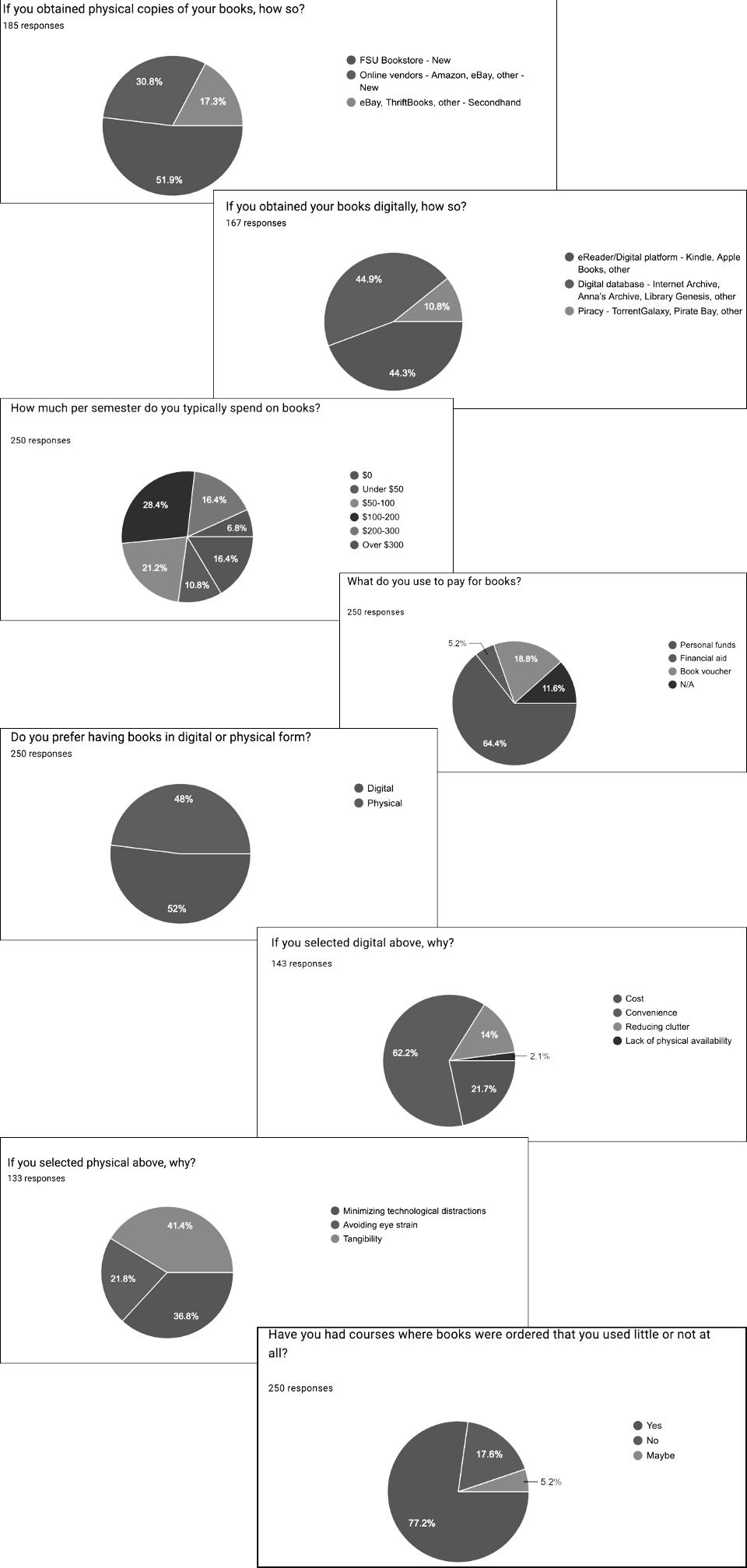
In an unscientific survey by The Gatepost of 250 students, 38.5% of the students who bought books from the FSU bookstore said they experienced difficulty acquiring their books for Fall 2025.
The survey was conducted between Nov. 25 and Dec. 11. Students were asked how many books they purchased for the semester, how much they spent on books, and how they acquired their books, among other topics.
Robert Totino, vice president of Finance, Technology and Administration, said this figure was unexpected. “I was surprised - not in a good way - to see so many students having to have difficulty there.”
In July of 2025, after a decades-long relationship with bookstore vendor Follett, Framingham State began five-year contracts with eCampus.com
to provide books and academic materials, as well as University Gear Shop (UGS) for merchandise.
Totino, who oversees the bookstore operation, said he worked with the Dean of Students Office and the Office of Marketing & Communications to alert students of the new system over the summer.
“We tried to get at least two or three campus emails out to the students … but no matter how many times you try to communicate, communicate, communicate, [problems can occur] on any level,” he said.
According to Totino, eCampus.com manages the portal where students place orders for books, and their “brick-andmortar” partner, UGS, receives those orders.
Phil Catalogna, assistant manager of the bookstore, said he knew there would be some difficulties with the new model.
“It was our first semester with the new system,” he said.
“So there were a lot of learning curves and hiccups along the way, but I think this semester has been much smoother compared to last.”
Bookstore difficulties
Of the complaints regarding the bookstore, the most common was slow delivery times. Over half of the students who encountered problems buying from the bookstore cited issues with slow delivery or packages not arriving.
“One of my books that I rented never arrived, so I have no book to return,” one survey respondent said.
Catalogna said there could be multiple reasons for delays.
“Some of the professors did not order the books on time, so they didn’t have them at the warehouse for the kids to order yet,” he said. “Some of them would just delay due to volume - more kids ordered the books than they thought.”
“Sometimes, things get lost in the mail, too,” he added. “We
do our best to get that rectified as quickly as possible, though.”
Another recurring complaint was technological issues with the bookstore website.
Psychology major Anjanique Santos said a system error caused her class to purchase unnecessary materials.
“One of my classes said that we needed eight books, but the FSU bookstore had a glitch in their system, and we apparently didn’t need any of the books for that class. [It] led to a long issue with returning the books,” she said.
Several students had concerns about incorrect labeling on the website.
Sophomore English major Roman Sisson said books and their corresponding reading guides often have identical titles on the bookstore site. “So you accidentally buy a guide to reading the book instead of the thing you actually wanted.”
By Francisco Omar Fernandez Rodriguez Arts & Features Editor
By Sarah Daponde Asst. Arts & Features Editor
The Division of Diversity, Inclusion and Community Engagement (DICE) hosted the third annual MLK Commemoration Lecture and Beacon Awards on Jan. 29.
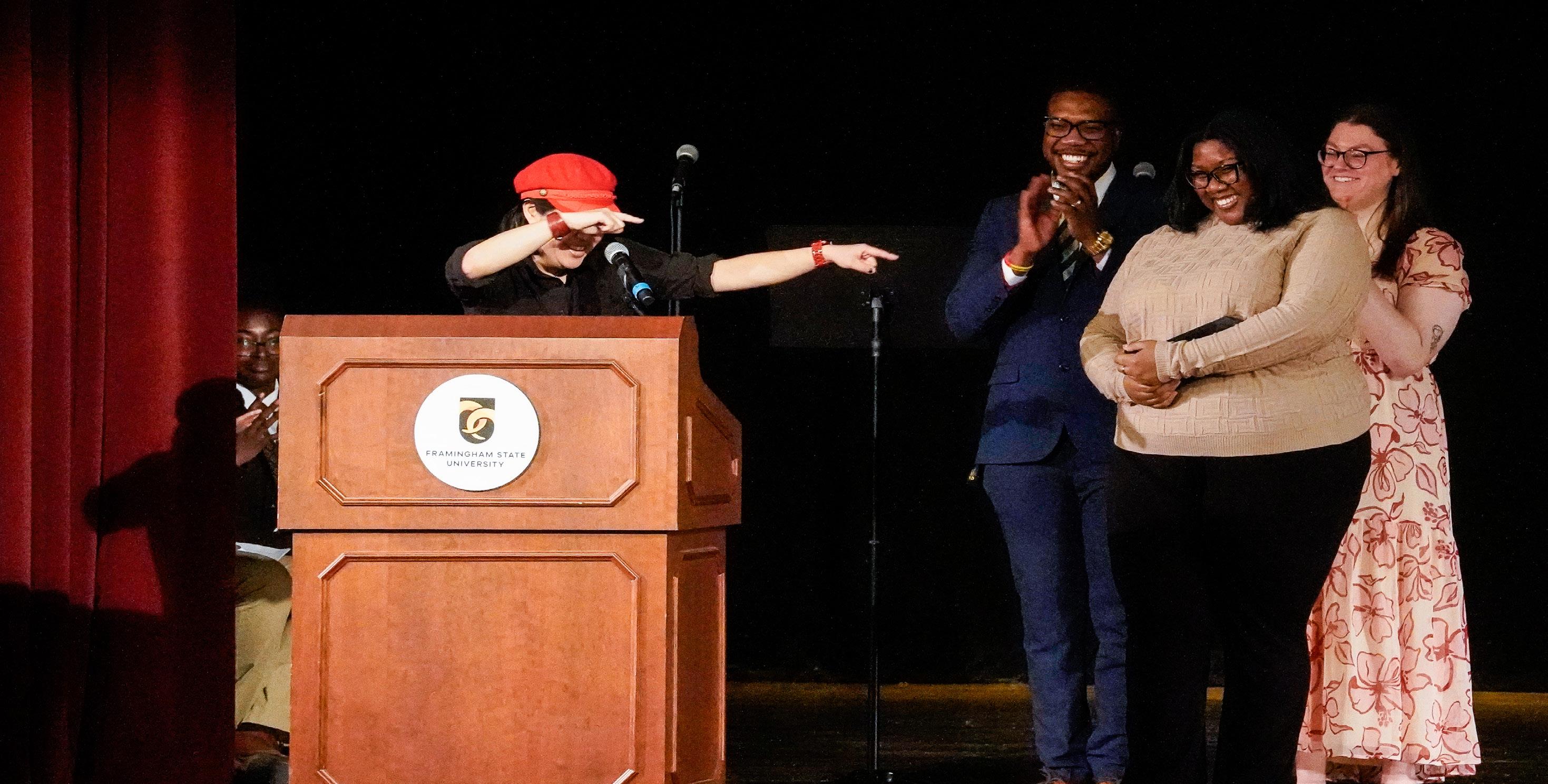
Four recipients were chosen out of nine nominees for the Beacon Awards. Jerome Burke, director of the CIE, and the Beacon Awards Committee announced the winners.
“The Beacon Awards are given to members of the FSU com-
munity who have gone above and beyond their responsibilities to make noteworthy contributions to help advance inclusive excellence at FSU,” said Burke.
The Beacon Award winners are senior Laila Jenkins, president of the Black Student Union; Andrew Frimpong, community resource officer; Ishara Mills-Henry, associate professor of biochemistry, chemistry, and food science; and Cara Pina, associate professor of biology. Jenkins said, “Sometimes you have to be your own support system and that has to be enough. You can’t ever let yourself give up.”
Pina said, “Equity and inclusion on our campus are really important to me. … One of the reasons I work at Framingham State is because I’m really passionate about ensuring that our first-gen students, our students of color, our low-income students - all of whom didn’t always get a chance to go to college - have a great college experience.”
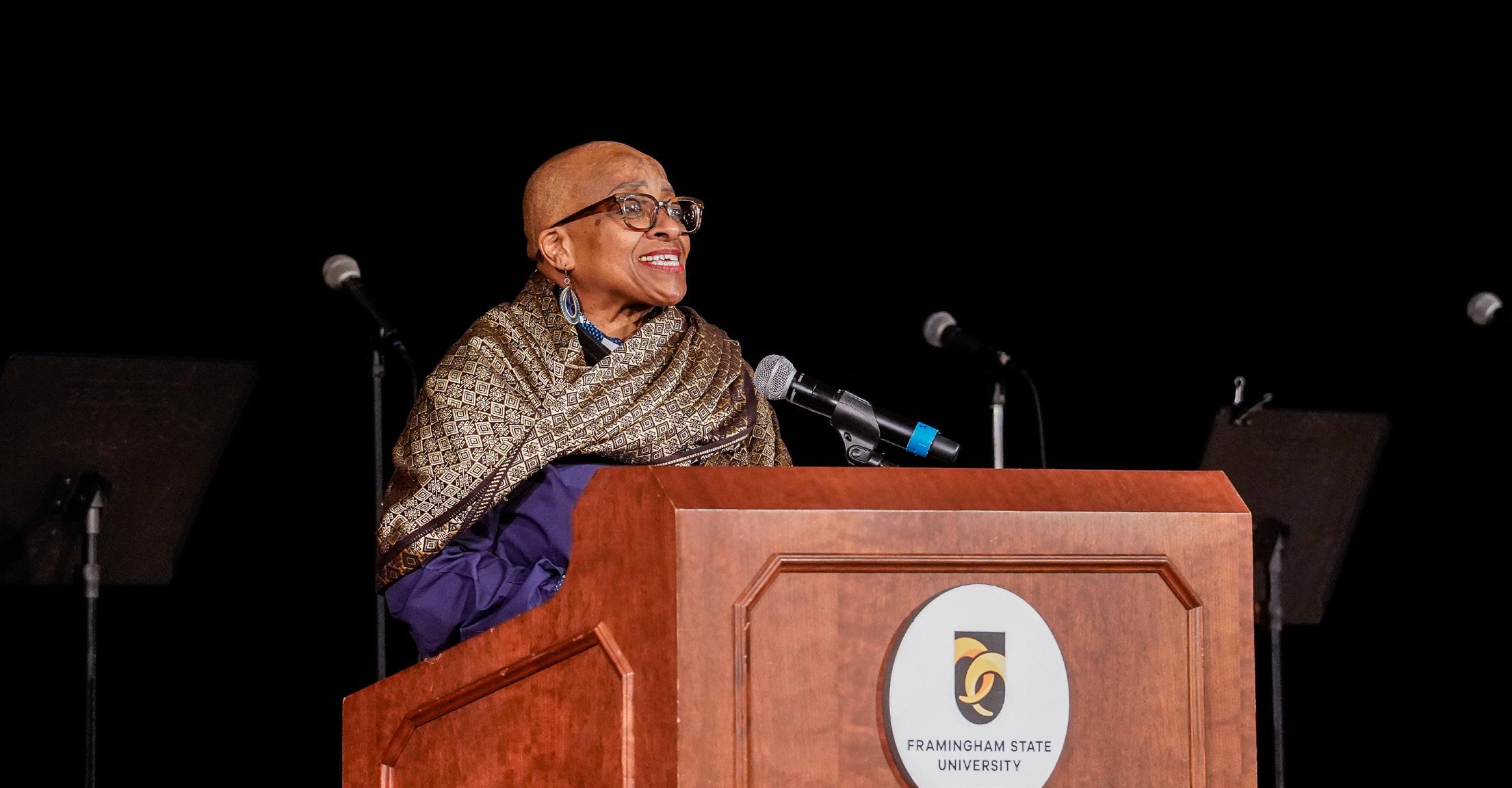
This year the keynote speaker was the Rev. Nontombi Tutu, daughter of the late South African Archbishop Desmond Tutu.
Adrien Gobin / THE GATEPOST
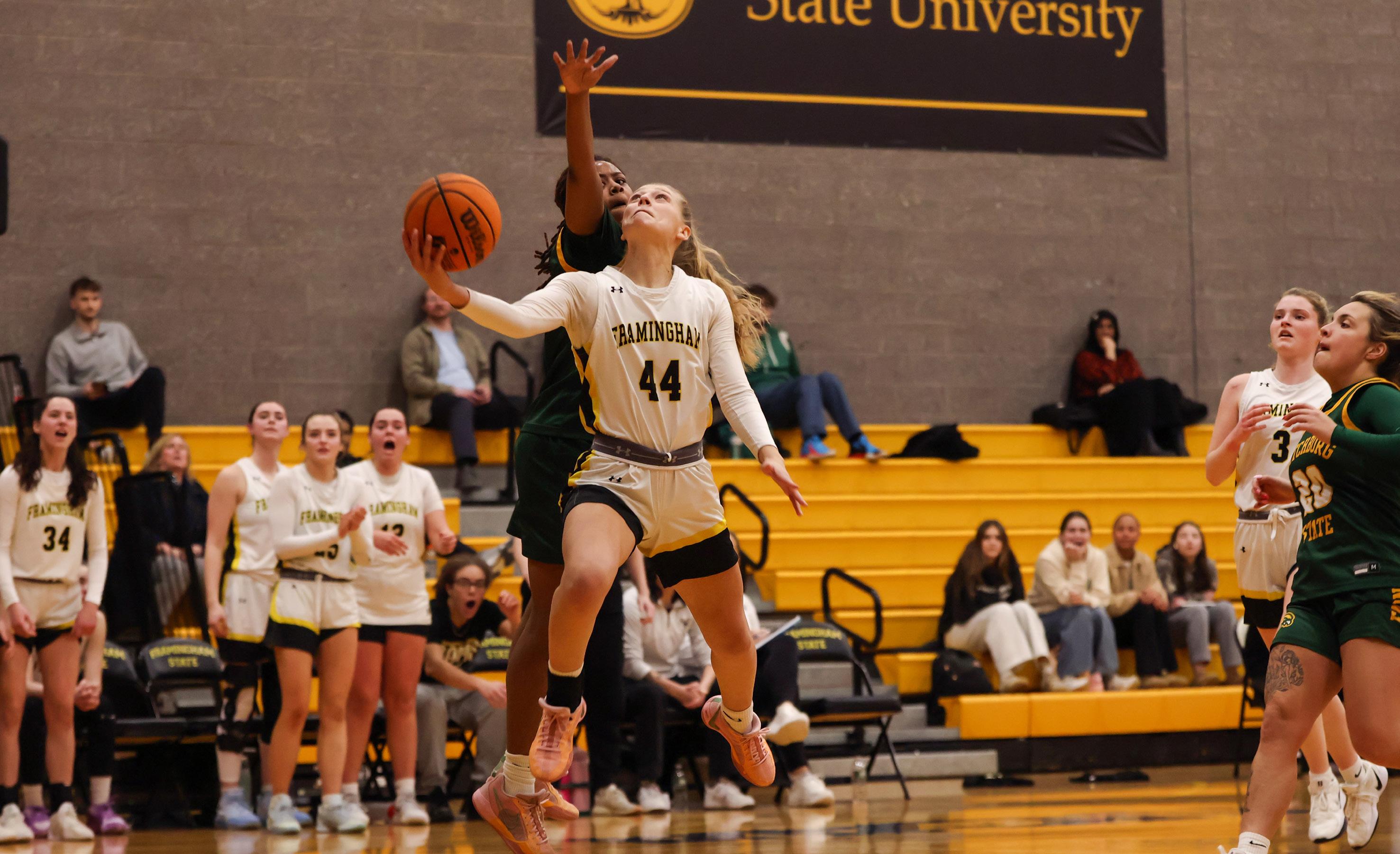
Sophomore Hailey Ring (center) going up for a shot while teammates cheer her on against Fitchburg State on Feb. 6.
E ditorial Board
Editor-in-Chief
Sophia Oppedisano
Associate Editors
Adrien Gobin
Dylan Pichnarcik
Multimedia Editor
Antonio Machado
News Editor
Bella Grimaldi
Interim Asst. News Editor
Avery Slavin
Opinions Editor
Izayah Morgan
Sports Editor
Izabela Gage
Asst. Sports Editor
Taylor Kimmell
Arts & Features Editors
Francisco Omar Fernandez Rodriguez
Owen Glancy
Asst. Arts & Features Editors
Sarah Daponde
Photos & Design Editor
Alexis Schlesinger
Interim Asst.
Photos & Design Editors
Christy Howland
Onyx Lovely
Illustrations Editors
Marcus Falcão
Staff Illustrators
Rileigh Kelley
Staff Writers
Zaynab Ahmed
Jesse Burchill
Kristel Erguiza
Julien Fernandez
Paul Harrington
Cole Johnson
Dan Lima
Kate Norrish
Wenchell Pierre
Nathan Piette
Andrew Ramirez
Kennedy Thompson
Staff Photographer
Dylan Sibley
Advisor
Desmond McCarthy
Asst. Advisor
Elizabeth Banks
Graduate Advising Asst.
Emma Lyons



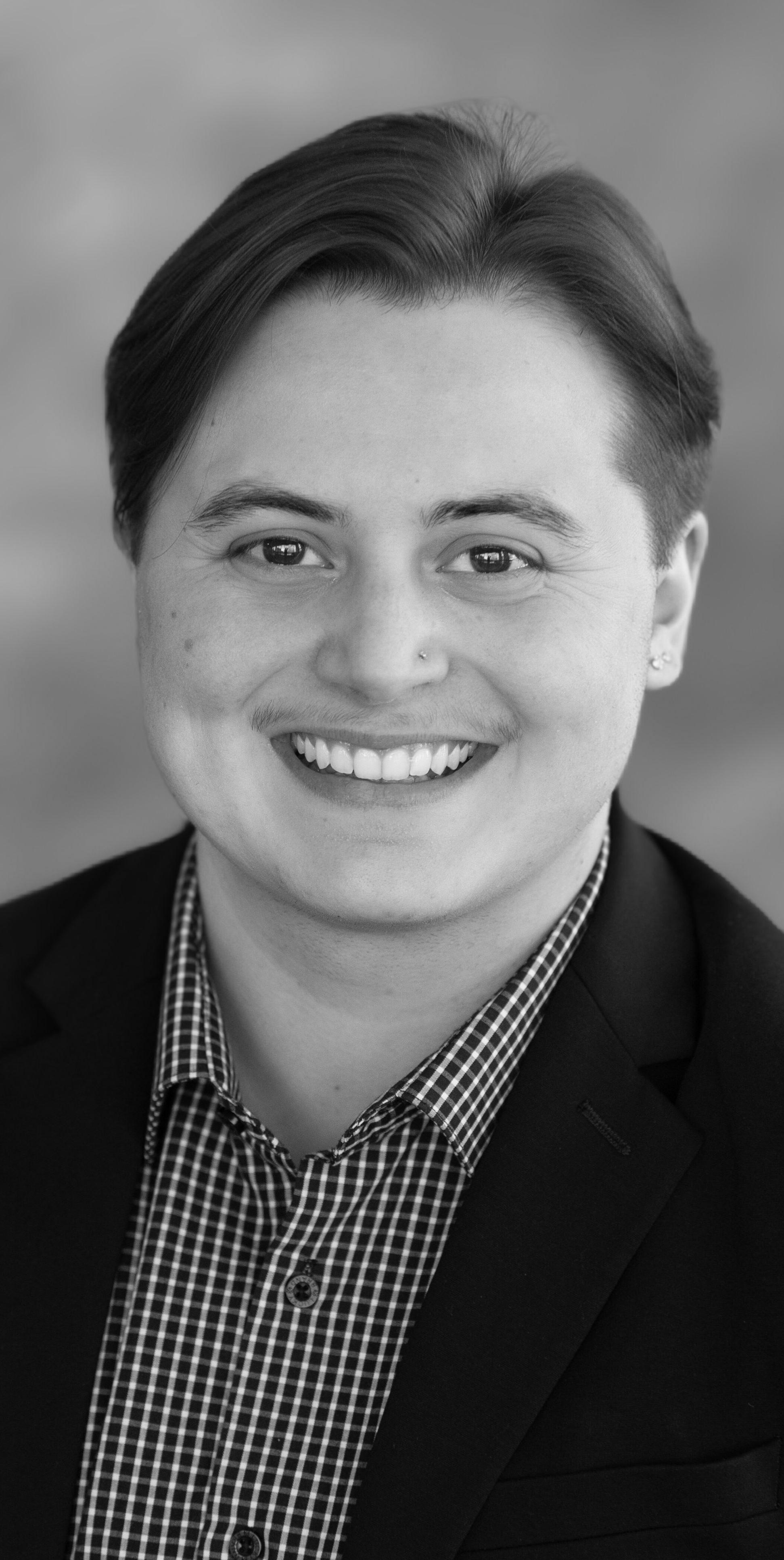
Gatepost Interview Liv Beverlie Admissions
By Avery Slavin Interim Asst. News Editor
What is your academic and professional background?
I actually attended FSU as an undergrad student. I graduated in 2021 from the criminology program and I minored in political science. Once I graduated, I went into more of the social work field, working in a few different group homes and what not. But, I knew that I always wanted to pursue higher education. A couple years after graduating, in July of 2023, I saw that there was an opening for an admissions counselor at FSU. I was like, “Huh, that sounds like it could really be a fun role for me.” I really loved my time at FSU, so I couldn’t think of a better way to go out and share what I loved about it with everyone else. I applied for the role and that was that. I got hired in July of 2023 and I’ve been an admissions counselor since then. This is my first career in higher education, but I’ve really, really enjoyed it thus far. I think it’s just a really great place to work at. I loved my time as a student, so it’s definitely made my job that much better.
What do you like most about your role at FSU?
I think it’s the opportunities I get to connect with students. Part of my role is going out and traveling to high schools meeting with juniors and seniors who are thinking about college and getting ready to apply. That’s my favorite part of the job. Getting to chat with them, getting to know what they’re interested in, and getting to kind of advise them through the process as someone who went through it not that long ago. I try to think of all the things that would have been helpful for me in terms of talking about college and knowing what’s out there. And with us having so many first-generation students at FSU, I think that’s such an important thing. It’s really what fills my cup at the end of the day - helping students access public higher education.
What are some of your favorite hobbies?
Ooh, hobbies. I like to play guitar. I’ve been doing that since COVID-19. That was my COVID-19 quarantine project that I started. I also like baking a lot. I’m gluten free, so since then, I’ve been trying to really get a hang of baking because it’s very different. I love making cookies. I love making breads - that type of stuff. I do like playing video games a lot, probably more than I should play


Counselor
video games, but I’m really into that. I have a Nintendo Switch. I have my Xbox, so I really just enjoy that type of stuff, too.
What advice would you give to students?
I would say keep your mind open to exploring things. Don’t not do something just because you think someone might judge you a certain way or anything like that. I have always been someone who says try new things if you have the opportunity to. Why not? You never know what doors could open for you. I think college is such a great time to explore what it is that you’re passionate about and what it is you’re interested in. Take advantage of all the opportunities you can. Don’t just

stay in your dorm room and do nothing! Go to class, get involved, meet new people. You have such a limited time doing this, unfortunately. I know some people wish college lasted forever because these are the fun years and what not. But, make sure that you’re trying new things and you’re keeping your mind open. Who knows, like I said, what doors that might open for you? That’s my best piece of advice.
Courtesy of Liv Beverlie
SGA reviews club activity proposals
By Bella Grimaldi News Editor
SGA reviewed allocation proposals from three clubs for events or trips planned for the Spring semester and voted on the addition of three new senators at their Feb. 3 meeting.
The Psychology Club, Aspiring Health Professionals, and Brother 2 Brother (B2B) submitted their proposals to the SGA Finance Committee for additional funds to cover the costs of events or trips that their budget does not.
chology Club, said that wouldn’t be possible because only about three members drive and the club’s advisors would also need to attend.
The club’s proposal included funds for a bus for 25 people.
SGA passed the request for the proposed funds 15-0-1.
The Aspiring Health Professionals submitted a proposal for an overnight trip taking place on March 6-8.
Aspiring Health Professionals President Leena Elbayoumi said the club was asking for $4,324.05 to cover the trip expenses. Of that allocation,
0-1.
According to President César Matos, this vote allows B2B to resubmit a proposal to the Finance Committee.
After the votes on the proposals concluded, there was $43,424.31 left in the SATF, according to Bùi.
SGA moved on to review the addition of three new senators.
The three prospective senators looking to be added were Yoojin Wollaber, Lenora Jones, and Jonathan Sundberg.
Before voting on the addition of Wollaber, Jones, and Sundberg, the candidates gave short
I’m excited to join and be part of this community,” she said.
The vote to appoint the new senators passed unanimously and Wollaber, Sundberg, and Jones were sworn in by Matos.
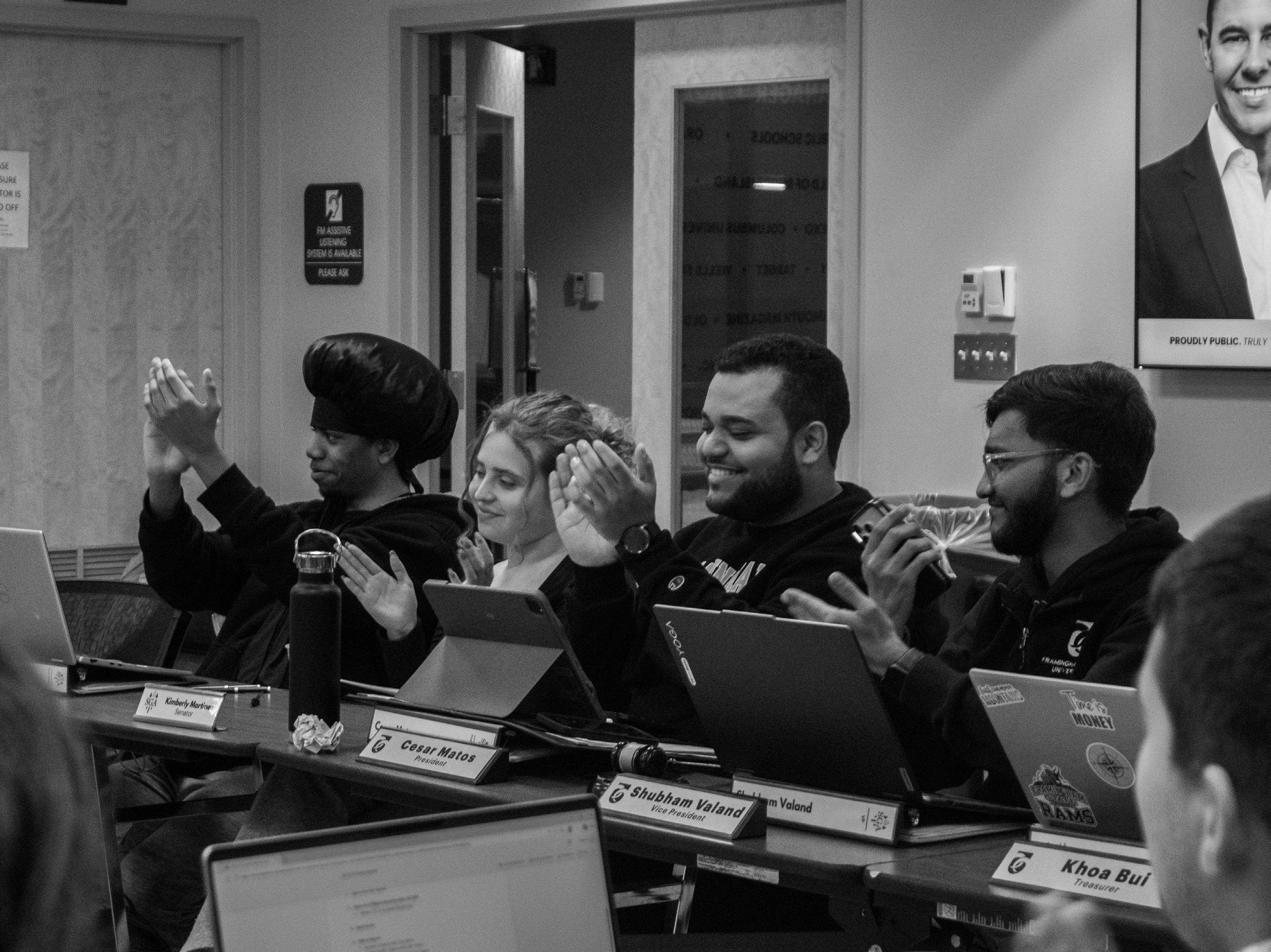
During committee reports, SGA Vice President Shubham Valand said as part of the Student Affairs Committee, he and Matos are working on changing the SGA bylaws and the language of funding requests, as well as reviewing the constitution of Videography Club.
Bùi said the Finance Committee approved a funds proposal from the ASL Club last week.
Each club’s budget and the additional funds they submitted proposals for comes out of the Student Activities Trust Fund (SATF) and must be approved by SGA.
According to SATF Treasurer Khoa Bùi, there was $49,048.36 in the SATF before the proposals were voted on.
Katherine Barrientos, Psychology Club publicist, said the club was asking for $1,300 to go on a day trip to the Museum of Science.
“We want to go to the Museum of Science because we went last year and a lot of our members enjoyed going. I think it’s a great way for us to all bond together,” she said.
Bùi said the Psychology Club’s starting SATF budget is $400.
Senator Julia Carvalho asked if it were possible for the club members to arrange to carpool in order to save funds.
Senator Kimberly Martinez, who is the treasurer of the Psy-
$491.05 of the proposed funds went to transportation, $3,617 were allocated to housing costs, and $216 went toward travel staff.
The vote to approve the proposal from the Aspiring Health Professionals passed unanimously.
B2B submitted a proposal for funds to help cover the costs of the Her Brunch held at the Warren Center in April.
The requested funds would cover the cost of security, decorations, and a DJ, according to Raul Perez Santana, B2B events coordinator.
Alix Ayoub, SGA events coordinator, said this year, SGA would not be contributing any of their budget to the Her Brunch event.
SGA moved to strike the B2B proposal from the agenda because the amount of funds the club needed from the SATF was unclear. The motion passed 15-
speeches on why they want to join SGA.
Sundberg said he wanted to join SGA because last time he was at school he did not participate in anything outside of classes.
“I want to join student government because I want to do something meaningful and put myself out there. … I want to make a change. I feel like I have some knowledge I can bring to the table,” he said.
Wollaber said she is joining because she believes there is a lack of diversity at the University for Asian Americans and Pacific Islanders.
She said, “There’s nothing happening for Lunar New Year coming up and it’s on the 17th.”
Wollaber added she was influenced to join by Ayoub.
Jones said her friends in SGA told her she should join.
“I’m already in student leadership. I’m an RA in Towers and
Senator Nathan Piette said the safety and security ad hoc committee is planning a safety walk for the spring semester.
Matos said this safety walk will occur before the Daylight Savings time change.
Piette said the data from the Fall Safety Walk was organized and sent to Matos, Meg Nowak Borrego, vice president of Student Affairs, and Ryan Hacker, associate vice president of Facilities and Capital Projects.
According to Valand, SGA does not currently have a secretary because Ling Zhang had to step down due to scheduling conflicts.
[ Editor’s Note: Nathan Piette is a Staff Writer for The Gatepost. ]
Alexis Schlesinger / THE GATEPOST
(Left) Grant Alleyne, Kimberly Martinez, César Matos, and Shubham Valand celebrating at SGA meeting on Feb. 3.
Continued from Page 1
Catalogna said students can use a chat feature on the eCampus website to report any difficulties, and can also email them with any questions or concerns.
According to Provost Kristen Porter-Utley, students can voice complaints about the bookstore to faculty.
“Probably the best thing for students to do is to talk to their faculty members and ask their faculty members to talk to their chairs,” she said. “[Faculty] don’t sit well with things that are going wrong for students. … They generally let us know about it.”
Totino said he would relay the major student complaints to eCampus.
Book usage
Seventy-seven percent of survey respondents said they had taken courses where books were ordered that were used “little or not at all.”
Porter-Utley said this statistic was “really disappointing.
“Somewhere in the 20-30% range is what I would expect,” she said.
Lorretta Holloway, vice president of Student Success, said she was skeptical of this number.
She said students can have different expectations for what constitutes using a textbook, especially based on their experiences in high school.
“There are still districts where people don’t have books for them to take home,” she said.
“They’re literally going over the stuff in the book [in class], as opposed to having people read, do an assignment, and then come in to talk about what’s in the book - and not talk about it as in going over it, but using it,” she said.
“If I’m not used to that kind of learning or interaction or relationship to text, then I’m going to think that I didn’t use the book,” she said.
Holloway said this was not always the case, however.
“I’ve had students who have said to me, ‘I don’t even have to do this stuff, because everything is in the PowerPoint, and all we do is read the PowerPoint … and so I don’t even have to go to class,’” she said. “That’s not the student’s fault.”
One survey respondent said, “Almost every time I buy a book for class, it is either never used, or used so little that a breakdown of what it’s about would be more than sufficient. Paying $100 for something we use for a week is ridiculous.”
Another survey respondent said, “If the course is not really going over the textbook, [and] the teacher just uses it for their own personal slides, then we shouldn’t be required to buy it.”
For many respondents, this issue compounded with another common obstacle.
Expenses and payment
The greatest percentage of students, 28.4%, said they typically pay between $100-200 for books in a semester. Twenty-one percent said they spend $50-100 on books. Sixteen percent said they spend between $200-300.
Another 16.4% of students said they typically paid nothing for their books. Seven percent of students said they paid upwards of $300.
Porter-Utley said, “The amount students spend on text-
books to me didn’t seem very surprising. I think it’s always all been a lot. So, I’ve never been satisfied with the amount of money that students spend on textbooks.”
To pay for their books, 64.4% of students said they used personal funds. Nineteen percent and 5.2% said they used book vouchers and financial aid, respectively.
Holloway said these numbers surprised her, and made her wonder whether the options of book vouchers and financial aid were being communicated enough to students.
She said the high percentage may be in part due to how students sometimes conflate financial aid and personal funds.
“I do know some students, when they think about financial aid, it’s not any money that they’re getting to buy supplies. It’s the money that’s automatically transferred to a bill,” she said.
She added the binary nature of the survey question didn’t make it clear whether students used multiple methods to pay for books.
“If I’ve got a book voucher for $500, and one of my books is a third of that amount, then I probably am going to have to pay out of pocket,” she said. “So what’s the proportion?”
In combination with textbooks that were used infrequently, students expressed frustration with book prices.
Studio Art major Makenzie Coutu said textbooks were a significant financial burden for her.
“I only had to read half of each book I spent $200 on in total,” she said. “I understand the need to buy entire novels, but other types of text should be unnecessary for me to spend so much money on. I can barely pay my tuition, even with all of my scholarships, as is.”
Another survey respondent said, “Some folks financially struggle but don’t receive book vouchers, so their friends that do have leftover book voucher funds will buy books for them. I’ve done this before.”
Holloway said faculty sometimes aren’t aware of the expense of books for students.
“Sometimes, faculty don’t know what things cost, because generally you get a sample copy when you order a certain number of books. And you get an update if it’s a new edition, and when you’re getting a sample copy, you don’t see what that costs.”
Porter-Utley said there are some initiatives that could positively impact affordability.
“There are faculty members who are being paid to develop their own textbooks for classes, which come at a much, much lower price,” she said. “I think more and more faculty members with more success are doing that now to help address the cost of books.”
“Some faculty don’t require books,” she added. Of the survey respondents, 26% said they did not purchase any books for the semester.
“I think that is a trend that is increasing at a lot of our institutions because faculty realize the cost of resources, but there are some disciplines which stay married to textbooks, and expensive ones,” she said.
Digital vs. physical
The survey showed a narrow
preference for digital books among students, with 52% of survey respondents saying they preferred digital books, and 48% saying they preferred physical books.
Sixty-seven percent of students said they acquired course books digitally for the fall semester.
Of the students who preferred digital copies, 62.2% said they preferred them due to convenience. Twenty-one percent said they picked them due to cost.
eReaders accounted for 44.3% of digital book acquisitions. The remaining 55.7% of survey respondents said they acquired books in a way that incurred no cost, with 44.9% using digital archive websites, and 10.8% using piracy.
A survey respondent said, “I like physical books more, but due to cost, I’m forced to go online.”
Another survey respondent said, “Unfortunately, piracy is extremely easy and free, so the only thing the University could do is make the textbooks cheaper. It is very hard to compete with having all your textbooks free to download with one Google search, especially when the alternative is paying over $100 for books you can’t Ctrl + F in.”
Seventy-four percent of survey respondents said they obtained physical copies of their books. Of these survey respondents, 41.4% preferred physical books for their tangibility.
Porter-Utley said this surprised her. “I hear that a lot from folks who are my generation, that they really like just the feel of having a paper textbook, but [this] really surprised me.”
Holloway was similarly interested.
“There’s this kind of expectation that everybody wants everything online,” she said. “Some people learn in a very tactile way that online doesn’t work [for].”
Another 36.8% of survey respondents said they preferred physical books to help minimize technological distractions.
Totino said, “I was happy to see that there’s a good mix of students who use both platforms - both the hard copy and the online periodical.”
Holloway said the introduction of online materials has improved the efficiency of research and citations.
“A lot of the texts are better now, because they have different kinds of clear citations,” she said. “But in the olden days, you’d get books that had no page numbers, and people would be like, ‘How am I supposed to tell you what page it’s on?’
“The technology has definitely improved,” Holloway added. “But the movement towards trying to do more things online is because of cost.”
The future of textbooks and the bookstore
By far, the most common suggestion in the survey was to make books more affordable and accessible for the University by transitioning to using online books. Many suggested professors should post textbooks digitally for students to access.
Earth System Science major Hudson Maher said, “I have had several professors choose to use only free textbooks and give out the links to find them. This should be the norm.”
One survey respondent said, “I just think since professors tend to reuse the same books, they should just be able to find a digital version and put it on Canvas. Completely reduces a lot of problems.”
Other survey respondents argued the University should include books with tuition.
Psychology major Abrianna Ouellette said, “We already pay thousands of dollars for the class. The book should be included.”
A survey respondent said FSU should “have professors provide books through their classes and attach the charge to that of tuition. Or lower the prices of the books; I should not be paying hundreds of dollars in one semester for books that I might not even use.”
Another survey respondent echoed this sentiment. “To ask kids who are paying thousands already to pay an extra $200+ every semester for books that aren’t always used very consistently is crazy.”
Another survey respondent said they weren’t optimistic about the University’s ability to adapt.
“People in my classes found links to free versions of the textbooks. I know the University just wants our money, so they don’t care,” they said. “If they did, it would be nice if they could jot down those kinds of links and send them out to students as alternatives when they can’t afford to spend hundreds on a textbook with pages missing and the cover destroyed.”
Some survey respondents advocated for more recycling of books.
Maher said, “I know we have students who buy books and then return them - why not have the used books be accessible for free or for much cheaper?
“I have also seen textbooks in the free bins by the fashion labs,” he added. “Students are already willing to give up their books. Just put up a shelf for them and maybe a sign-out sheet.”
One survey respondent said the University should “allow us to return books for full price back, especially if we barely use them.”
Some survey respondents were frustrated by the lack of physical books on campus, expressing a desire to bring back a location to buy and sell physical books.
According to Porter-Utley, the terms of the University’s contract would not allow for this. “The deal was that we would not have a physical footprint on our campuses for a bookstore.”
Totino said, “I don’t see that happening, but it doesn’t mean we can’t ask.”
Catalogna said, “There’s really no way for us to keep books on the shelves here at the store. It’s all done through eCampus offsite.”
According to Totino, the Campus Store will eventually be moved to the McCarthy Center as part of the Campus Master Plan, but he estimated the development to be “one to two years away.”
OP/ED
THE GATEPOST EDITORIAL
Turn up the volume at commencement
Framingham State is just under 100 days away from celebrating the Class of 2026 at the spring Undergraduate Commencement Ceremony.
Days are crossed off calendars, credits are meticulously counted, and each assignment submitted brings seniors that much closer to graduation.
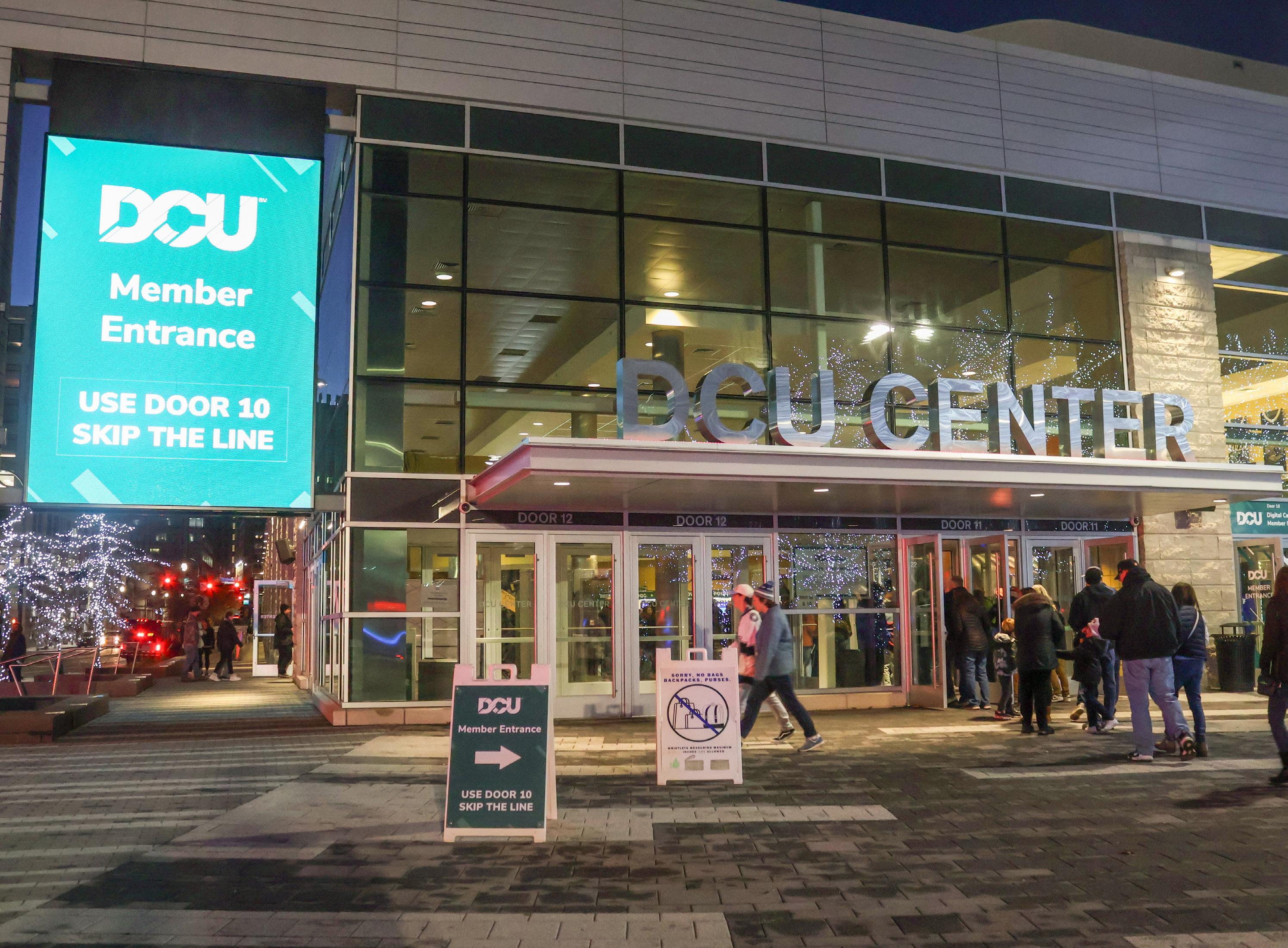
The Undergraduate Commencement Ceremony has been held at the DCU Center in Worcester since 2018, after students voted to move commencement from the Framingham Town Green to the DCU Center.
The scale of the arena allows students to bring as many family members as they would like without the need for tickets, making it a great, low-stress option for graduates and their families.
While the most common complaints about holding commencement at the DCU Center are the distance from Framingham and the sporadic parking situation, a new complaint came up after audio issues ruined the pomp and circumstance of the day at the 2025 Undergraduate Commencement Ceremony.
Students on The Gatepost Editorial Board who gathered at commencement to watch 12 colleagues walk the stage and receive their diplomas at the DCU Center witnessed the frustration and sadness of graduates, their families, and faculty as they were unable to hear most of the ceremony.
Faculty and students yelled toward the stage that they weren’t able to hear portions of Latoyia Edwards’ commencement speech, and she stopped multiple times to allow an opportunity for the issue to be corrected.
A 2025 graduate told The Gatepost they were able to hear most of student commencement speaker Jeremy McDonald’s speech, but Edwards and President Nancy Niemi were completely inaudible.
The graduate shared that the most frustrating aspect of the ceremony was being completely unable to hear Niemi’s final speech in which she conferred the degrees for the Class of 2025 and told them it was time to move their tassels.
The only prompts the graduates could hear were shouts and sporadic, confused clapping from the audience.
There is no excuse for this moment to have turned into a heartbreaking disappointment because of a completely preventable issue.
The Gatepost interviewed a student employee who worked with Framingham State’s Audio/Visual team at the Commence-
ment Ceremony.
The student, who requested anonymity, said the DCU Center had recently installed a new audio system and certain speakers were not functioning properly, specifically the ones above the graduates and faculty.
The student employee said the audio issues were not the fault of the Framingham State A/V team because they did not have control of the equipment.
The Framingham State A/V team notified the DCU A/V team of the issue several times, but DCU staff did not rectify the issue.
This is completely unacceptable.
The DCU Center hosts commencement ceremonies for other universities, including the College of the Holy Cross, Worcester Polytechnic Institute, and Clark University, according to these institutions’ websites.
This is an event that should have been well prepared for and A/V systems should have been thoroughly tested and in working order well before the morning of commencement.
Instead, not only was the ceremony chaotic, but Framingham State’s A/V team was forced to shoulder the crowd’s frustrations over malfunctioning equipment over which they had no control.
The embarrassment of this ordeal belongs solely to the DCU Center.
The Class of 2025 deserved better.
The Gatepost Editorial Board is calling on University administrators and Campus Events to have the necessary discussions with DCU Center employees before it is too late to ensure an issue like this does not occur at this year’s Undergraduate Commencement Ceremony.
On a day that should have fulfilled every undergraduate student’s expectations after a rigorous and incredible college career, we witnessed a ceremony riddled with audio malfunctions that unfortunately spoiled the experience for graduates, their families, and faculty.
Framingham State and the DCU Center commit to hosting a ceremony that is worthy of the prestige of achieving an undergraduate degree from our institution.
You don’t want to hear from us next year about this!
Adrien Gobin /
The myth of the “good Negro” must end
By Izayah Morgan Opinions Editor
Black History Month turns 100 years old this year, the term being coined by Dr. Carter G. Woodson, the second Black person to get a Ph.D. from Harvard. Often, I find the only time Black history is showcased is when it is highlighted that we were previously in chains or when it’s “our” history month.
Oftentimes ignored, except for the beginning of the month or highlighting only the tragic points in Black history, our history is confined to a point in time when we were treated as less than human and discounts the beautiful history of innovation, revolution, and curiosity of Black people.
In every aspect - whether it be slavery; Jim Crow; biases in the justice, housing, and health systems; or the microaggressions one can experience in everyday life - somehow Black people still find a way to rise.
But not without the everlasting pressures of white society, which frames every form that Blackness takes as problematic except for a few the white majority deems acceptable.
A caricature of a hyper-unproblematic Black individual is one of these exceptions - often referred to as the “good Negro.” The unproblematic version of what was thought of at the time as the subhuman race - whatever that means. The “good Negro” is most often associated with Black men.
The remnants of this thinking wormed their way into my childhood.
As a younger individual, I was told that if you want a real job, you have to have your hair “clean” and short. If you want
to work in sales and be successful, you must have an accent that doesn’t sound too “offensive” to white people. You have to make sure you’re not wearing anything “unprofessional” because then nobody will take
their friends and give birth to children who would be thrown away or sold.
So they proceeded to play into the “good Negro” caricature in order to appease people who didn’t like them to save

you seriously in a meeting.
I heard from the Black women in my life that I couldn’t be too loud and aggravated when white people brought up an issue they had, even though I’m just showing my passion.
Often, Black women are told they are too masculine to date and they must be more “feminine” or “submissive” to fit the caricature white people have in their minds.
So, the fact they are worried about how I am presenting myself speaks volumes to their character.
This still subjugates them to the “good Negro” myth. Oftentimes, Black women would be raped by slave masters and
themselves and their children.
This left a scar on the women of previous generations, so when they raised kids, they unconsciously passed this real fear and danger down to them. This is called generational trauma, something we experience from Black folks who are often trying to protect us from the larger white society.
People often think that trauma and playing into the “good Negro” myth is something you can grow out of after childhood, but it is necessary to recognize the root of the problem or it will never leave you.
Even throughout my college career, I have been told that I need to tone down what I say,
An apple a day keeps Armageddon away
By Nathan Piette Staff Writer
Across the world, floods, droughts, and rising food prices are reminding us that the way we grow food is tied to the health of the planet.
Regenerative agriculture, the farming that rebuilds soil instead of wearing it out, offers a hopeful path forward at a moment when communities are searching for practical climate action. While many climate debates feel abstract, farmers are already testing real solutions in their fields.
Regenerative agriculture should become an international and local priority because it restores damaged soil, protects farmers’ health, and helps fight climate change at the same time. The life’s work of North Dakota farmer Gabe Brown shows that growing food in partnership with nature is both possible and profitable.
Healthy soil is the foundation of every meal, yet decades of heavy plowing and chemical use have left too much farmland depleted and lifeless. Regenerative farmers reverse this damage by planting cover crops, refusing to till up the ground, and rotating livestock systematically so that the ground is never bare.
On Brown’s ranch in North Dakota, he has shown how powerful these practices can be. He said in his documentary “Common Ground,” that regenera-
tive agriculture is “bringing the ecosystem back into function so it can function in a way where it truly can sustain healthy life in the form of plants, animals, and then eventually people.”
Within a few seasons, his fields held more water, produced stronger crops, and needed far less fertilizer, inspiring others around the world. Since he switched away from conventional farming that tills and releases carbon into the atmosphere, he has found a second career as an international advocate for regenerative agriculture as the solution to climate change.
International programs echo what Brown discovered on his own land. The global “4 per 1000” initiative is supported by 833 partner organizations across 108 different countries. Their efforts emphasize that increasing soil carbon can help cool the planet and improve food security by scaling up regenerative practices.
Regenerative agriculture is also a public-health issue. Conventional farming often depends on large amounts of synthetic pesticides and fertilizers that can drift into water and air. Many rural families worry about what long-term exposure means for their bodies.
Brown’s personal journey away from chemical-intensive farming was driven in part by the health consequences he witnessed. He has said that transitioning to soil-focused
or that I need to dress properly in order to impress the “right people.” Or that students are not showing up in professional wear to class, aka wearing bonnets, durags, and slides. I have even been questioned about where I’m going when I work in that building.
That “good Negro” myth prevails all throughout our lived experience. If you were just a “good Negro,” you wouldn’t deal with those prejudices.
The first is that somehow being more palatable to people who dislike you because of factors you can’t control means somehow you will be treated better by them. In reality, the whole reason they mold you to be this way is because they don’t like the authentic version of you.
Second, to the dominant, white-centered society, all Negros are still Negros. No matter how “unproblematic” you are, eventually you’ll become an authentic version of yourselfthat doesn’t fit inside the box whiteness has placed you inand that’s what they fear.
People are always trying to separate Black liberation and Black oppression. It denies the complexity of our history and current existence, and that’s why the “good Negro” myth exists and why it must die.
Black history does not require you to fit in a mold that white society deems acceptable. Because you are never acceptable to them, only tolerable to the point where you don’t become a problem for them.
Don’t feed the system the version of you that’s more palatable for them to digest. Be the problem - not the “good Negro.”
methods improved conditions on his own land and has encouraged others to reduce reliance on synthetic inputs. In his documentary, Brown said he and his doctor attribute his ALS diagnosis to his use of these synthetic inputs. By cutting chemical use, regenerative farms reduce these everyday risks.
The benefits reach beyond individual farmers. Healthier soils filter water naturally, lowering the cost of cleaning drinking supplies. Diverse fields also support bees, birds, and other wildlife that rural economies depend on.
Farming methods that protect the people who grow our food should be seen as common sense, not a radical experiment.
Unlike many high-tech climate fixes, regenerative agriculture can begin tomorrow with tools farmers already own. Soil rich in organic matter acts like a giant sponge that pulls carbon out of the air and stores it underground while also holding more moisture during droughts.
Global initiatives are building momentum. The “100 Million Farmers Initiative” and the “Food Action Alliance” are channeling investment to help producers adopt carbon-sequestering practices.
Organizations like “Regeneration International” promote regenerative food, farming, and land-use as a way to draw down excess atmospheric carbon di-
oxide and improve soils worldwide. These efforts show that the idea is not limited to small organic gardens. It is becoming a worldwide movement that links climate policy, food security, and rural jobs.
Regenerative agriculture offers a rare triple win. It lowers emissions, makes safer food systems, and strengthens farm economies.
Critics argue that regenerative methods cannot feed a growing population or that yields may drop during the transition years. Those concerns deserve attention. Changing practices does require training and sometimes short-term risk, and not every farm will look the same.
Yet studies from universities and from Brown’s ranch show that once soil health improves, yields often match or exceed conventional systems while costs fall. The real risk is staying with a model that is already degrading land and worsening climate disasters.
When Brown began experimenting on his worn-out North Dakota fields, he was simply trying to save his family farm. Today, his work points toward a larger lesson - the climate crisis will not be solved only in laboratories or conference halls, but in the living soil beneath our feet.

Campus Conversations
“Who is someone you see on campus who brightens your day?”
By Adrien Gobin and Dylan Pichnarcik, Assoicate Editors
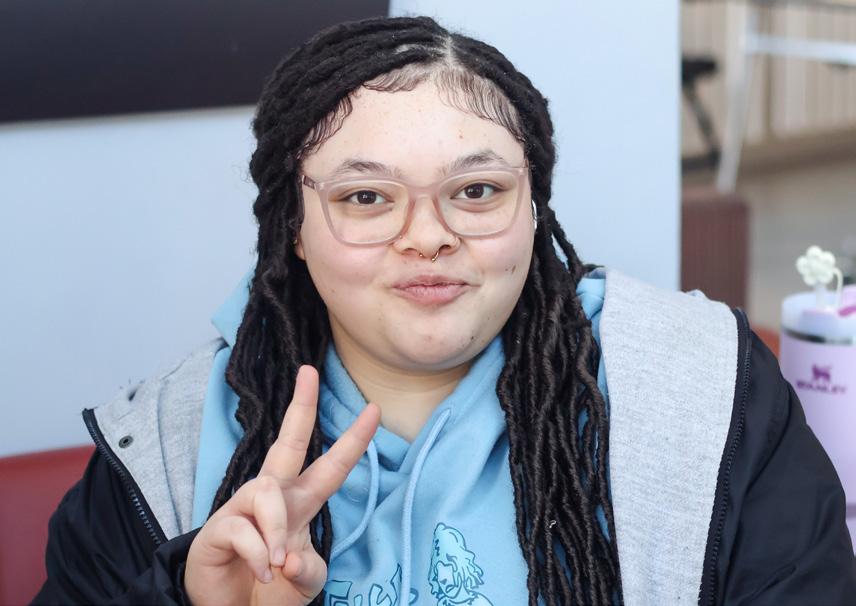
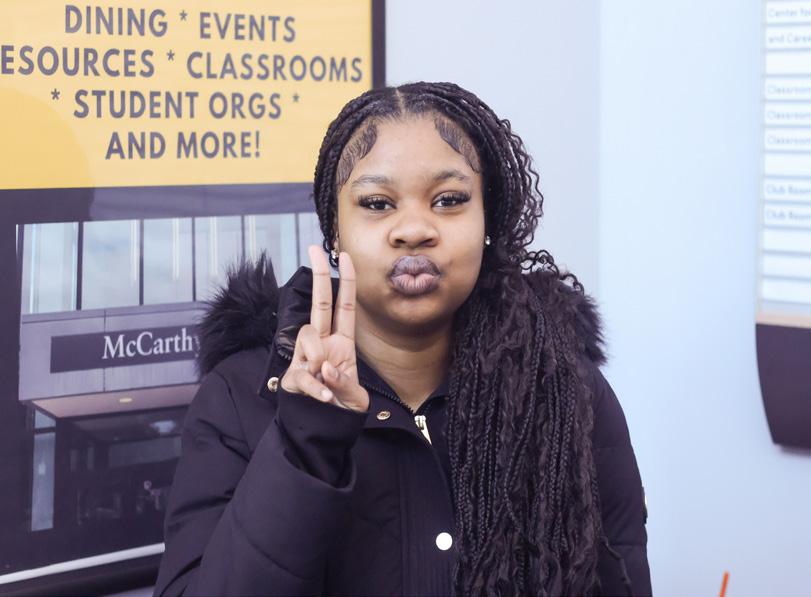
“Cece Gonzalez brightens my day because she’s so beautiful.”
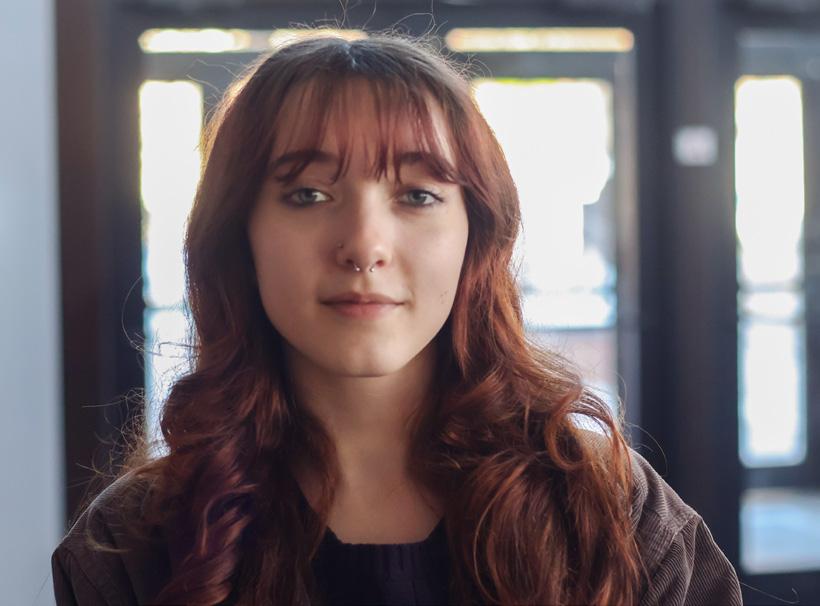
“Nancy, the
worker. She’s always so nice, and I love hearing her say, “Hello” - makes me very happy.”
-Amelia MacDonald, sophomore
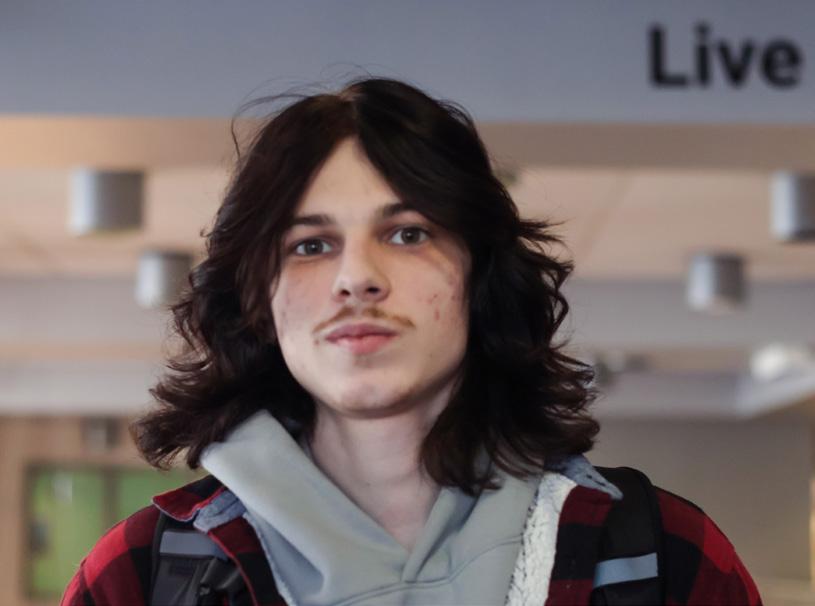
“The Dining Hall staff because they are very nice people. They feed us. Some people aren’t very nice to them - we leave messes. I think they deserve some love.”
-Alex Stremmenos,
junior
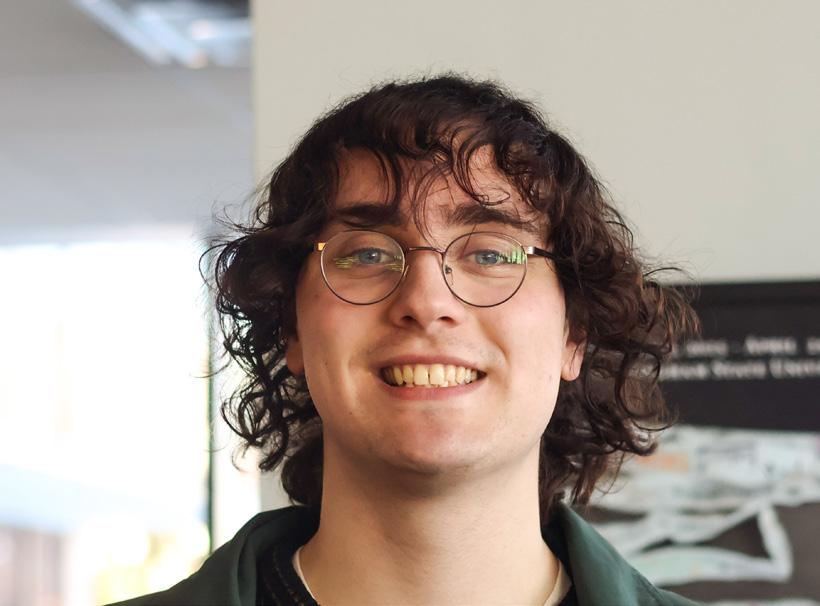
“I love Dr. Bell in the chemistry department. He’s just a silly guy, and he always makes me smile. He’s not my professor anymore, but I miss him greatly. Whenever I see him in the halls, it’s always a good day.”
-Erina Operach, sophomore
Dining Hall
Rainna Christie, sophomore
“Rainna Christie, because her presence just brightens my day.”
-Ariyanah Castor, sophomore
“My girlfriend Eliana because she keeps me company.”
-Julien Safar, freshman
Men’s basketball secures win over Westfield
of the game, quickly followed by
After a final successful foulcluded, and the clock ran out as WSU missed their final 3-point attempt, ending the match with a score of 77-66 for Framingham. Washington said he hopesed team in the MASCAC, “shows teams across the MASCAC that we can compete with anyone in
“We have confidence in each other, we trust our preparation, and we believe that if we play the right way for 40 minutes, we can beat any team we line up against. This win wasn’t about proving something for one night - it was about showing who we are as a
Washington said that in the face of Westfield’s great defense and cohesive style of play, the Rams came away with the win because they “stayed together through adversity and not letting one mistake turn into multiple mistakes. Westfield is known for punishing teams mentally and physically, and I think we did a great job of recognizing that and staying within ourselves instead
After dropping a few matcheston said Framingham intends torecting small but influential mistakes and prioritizing the matches in the immediate future rather than dwelling on gamesple: play hard, execute, and win the game in front of us. If we do that consistently, the standings
ence matchup Feb. 4, sealingful overtime period and bringing their overall record to 12-8 and
As FSU’s season winds down,cused on taking things game by
Washington said, “Our main goal is to go ‘1-0’ for the next six games. We can’t control the future, but we can control how we prepare and how we compete each night. Taking it one game at
He said the Rams want to “put ourselves in a position to earnfully host playoff games at our home court in front of the best
FSU will host the Salem State -

Adrien Gobin / THE GATEPOST
Women’s basketball improves MASCAC standing
By Taylor Kimmell Asst. Sports Editor
The Framingham State Rams’ recent victory against their Jan. 31 opponent, the Westfield State Owls, improved their standing in the MASCAC conference.
With this 80-75 win, their record in the conference stands at 6-2, and their overall record at 10-9.
The Owls came out hot in the first quarter, scoring on a layup in the first 10 seconds.
A little over a minute later, sophomore Faith Greene evened the score with her own layup.
Despite another two points on a jump shot by Greene, WSU pulled ahead 7-4, scoring on a jump shot and a 3-pointer.
A jump shot, a layup, and a free throw by Greene earned the Rams the lead for the first time in the match.
Shortly after, Westfield tied the game 9-9 with a layup.
A 3-point jump shot by senior Kiara Cerruti allowed the Rams to reclaim the lead, which they held onto for the remainder of the first quarter, courtesy of free throws by sophomore Jacqueline Schels and freshman Zaria Anderson and a layup by Captain Kelsey Yelle, a senior.
With another layup and two 3-pointers by the Owls, the first quarter ended with a close score of 18-17.
The Rams came out strong in the second quarter, with Captain Abigail Martin, a senior, scoring on a layup just 16 seconds in.
Twenty seconds later, Anderson added to the board with a
3-point jump shot. Schels followed with another 3-pointer 30 seconds later.
On their next possession, the Owls broke through with a 3-pointer, and, in the following minute, scored on a jump shot to add another 3 points to the board.
With one more 3-pointer, Westfield tied the game at 26, but junior Ava Mckeon sank a free throw to gain back the advantage for FSU.
After a few scoreless possessions from both teams, WSU fouled Greene, who netted both of her foul shots.
As the half came to a close, Westfield scored points on two free throws, while Anderson scored on a 3-pointer.
Westfield quickly tied the match in the opening moments of the second half with two layups.
Despite another successful FSU free throw, the Owls took the lead with a 3-point jump shot.
A layup from Greene tied the match once again, and a second regained the lead for FSU.
Two minutes later, WSU broke through with a layup and a 3-pointer, reclaiming the lead 40-37.
After a minute of struggle, Greene and Schels each contributed a layup for another lead change.
Layups from Yelle and Greene, a 3-pointer from Anderson, and a jump shot from Yelle offset the Owls’ points for the remainder of the quarter, bringing the score to 52-50 Rams.
Early action in the fourth
quarter allowed WSU to obtain the lead, but baskets from Greene and Yelle regained FSU’s advantage.
After a successful free throw by the Owls, Martin brought in more points with a layup, followed by another less than a minute later.
A layup and a free throw by Greene and a layup by the Owls brought the score to 63-58, and another layup from Yelle in the following minute increased FSU’s lead.
With 4:30 left, both teams worked to score - WSU scored on two free throws and a jump shot, while Greene scored two free throws and Schels scored a 3-pointer.
The last 3 minutes of the match saw increased action from both teams.
WSU scored on a layup, which they followed a minute later with a 3-pointer.
On the Rams’ next possession, Schels scored on a 3-pointer, and Yelle scored on a free throw seconds later.
Within the final minute, Westfield racked up fouls, allowing shots from Yelle, Schels, and Greene.
Though WSU scored on three layups, one a buzzer beater, it was not enough to overcome Framingham’s lead, and the match concluded in favor of the Rams 80-75.
Due to her success in recent matches - putting up 13 points against Anna Maria, 17 points against Bridgewater, and a whopping 30 points against Westfield - Greene earned the title of MAS-
CAC Player of the Week Feb. 2. Framingham handed the Fitchburg State Falcons a devastating 86-34 loss Feb. 4, bringing their own conference record to 7-2 and their overall record to 11-9.
The Rams will host the Salem State Vikings for a conference matchup Feb. 7.
Schels said coming into the last few matches of the season, she wants the team to really come together, and hopes “we can start peaking just in time for the post season and make a good run we can be proud of.”
Stats sourced from fsurams.com and MASCAC.com
CONNECT WITH TAYLOR KIMMELL tkimmell@student.framingham.edu
Women’s ice hockey falls to Rivier University
By Izabela Gage Sports Editor
The Framingham State Rams were overcome by the Rivier University Raiders 5-2 in a conference matchup Jan. 31.
This loss brings their conference record to 2-6 and their overall record to 2-14-1.
Sophomore goaltender Lila Chamoun made the first save of the game only 38 seconds in.
The Rams didn’t let the Raiders hold possession of the puck for long, as freshman Alexis Brown attempted to net the puck less than a minute later, but it was saved by Rivier’s goaltender, Taylor Bruno.
The Rams were aggressive following three shots by the Raiders, with freshmen Molly Murphy, Kristina Jones, and Katie Creath trying to find the back of the net, but they could not break the Raiders’ defense.
Freshman Rylee Bogren was consistent in front of the net with four back-to-back shots in just 23 seconds, all of which were saved by Bruno.
Rivier took control offensively with three shots before pushing past Chamoun’s pads with a rebound shot to score the first goal of the game.
Framingham didn’t let this faze them, though, as sophomore Finley Hogan took a shot on goal 16 seconds later that was wide. Brown and Creath were also determined to find a gap in Bruno’s defense, but both shots were unsuccessful.
The Raiders answered with three shots of their own, but Chamoun held strong in net.
Freshman Sophie Brien, sophomore Sarah Lewis, and Murphy each tried to break through Bruno’s wall of defense, but were unable to tie the score.
The Raiders’ offense tallied five shots on goal in the next minute, but Chamoun saved two, while sophomore Lily Wilson and Creath each blocked one, and the last deflected off the pipe.
The period ended with two more shots on goal by the Rams, but both were stopped by Rivier’s defense.
Less than 30 seconds into the second period, Lewis broke the stalemate and tied the score 1-1.
The Rams received a minor penalty, and the Raiders took five shots on goal before breaking through Chamoun’s defense to take the lead 2-1.
Both teams worked to find the back of the net, with Framingham taking five shots on goal and Rivier taking 12, none of which could make it past the goal line.
Murphy then tied the score at the 15-minute mark.
The remainder of the second period was scoreless for the Rams and the Raiders, with the teams tallying four and six shots, respectively.
Rivier reclaimed the lead 3-2 only 34 seconds into the third period.
The Rams could only manage one shot on goal before the Raiders found the back of the net once again.
Framingham subbed in sophomore goaltender Brigid Milligan, who stopped Rivier’s next shot less than 2 minutes later.
The Raiders, unfortunately, broke through Milligan’s defense, scoring their last goal of the game to bring the score to 5-2.
For the remainder of the period, both teams fought for possession of the puck, tallying 16 shots each, none of which could make it past the goal line, and the game ended in favor of Rivier 5-2.
Lewis said, “We knew they were going to be a strong team, but that if we battled hard, we could play them tight, which we did for the majority of the game.”
She said throughout this sea-
son, the team has worked on efficient puck movement and prioritizing moving to get open for each other, which has led to more offensive success.
She said this hard work “allowed us to create scoring chances and also stop most of Rivier’s chances.”
Chamoun saved 36 of the 40 shots she faced, and Milligan saved nine of the 10 she faced.
Milligan said, “Lila did the majority of the heavy lifting against them. She is amazing when it comes to staying focused in net.
“Communication with our defense is crucial to doing well in the net. Lila and I hold each other accountable and just focus on the present rather than dwelling on the past or the future,” she added.
The Rams travel to Worcester State to face the Lancers in another conference matchup Feb. 6.
Milligan said the freshmen have been a “wonderful addition to the team.”
She added, “We all know there’s a job to get done, and it takes all of us. Accountability is a big part of our team, and we are just focused on building a team culture where you won’t be afraid to make a mistake, and if you do, you have 22 other girls in your corner supporting you and helping you learn and grow.”
Stats sourced from fsurams.com and MASCAC.com
CONNECT WITH IZABELA GAGE igage@student.framingham.edu
Adrien Gobin / THE GATEPOST
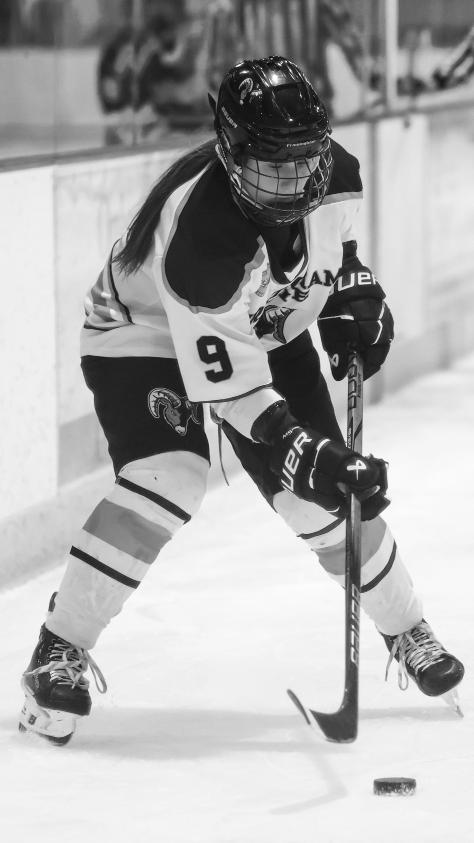
Alexis Brown skating with the puck in loss against Albertus Magnus on Dec. 6.
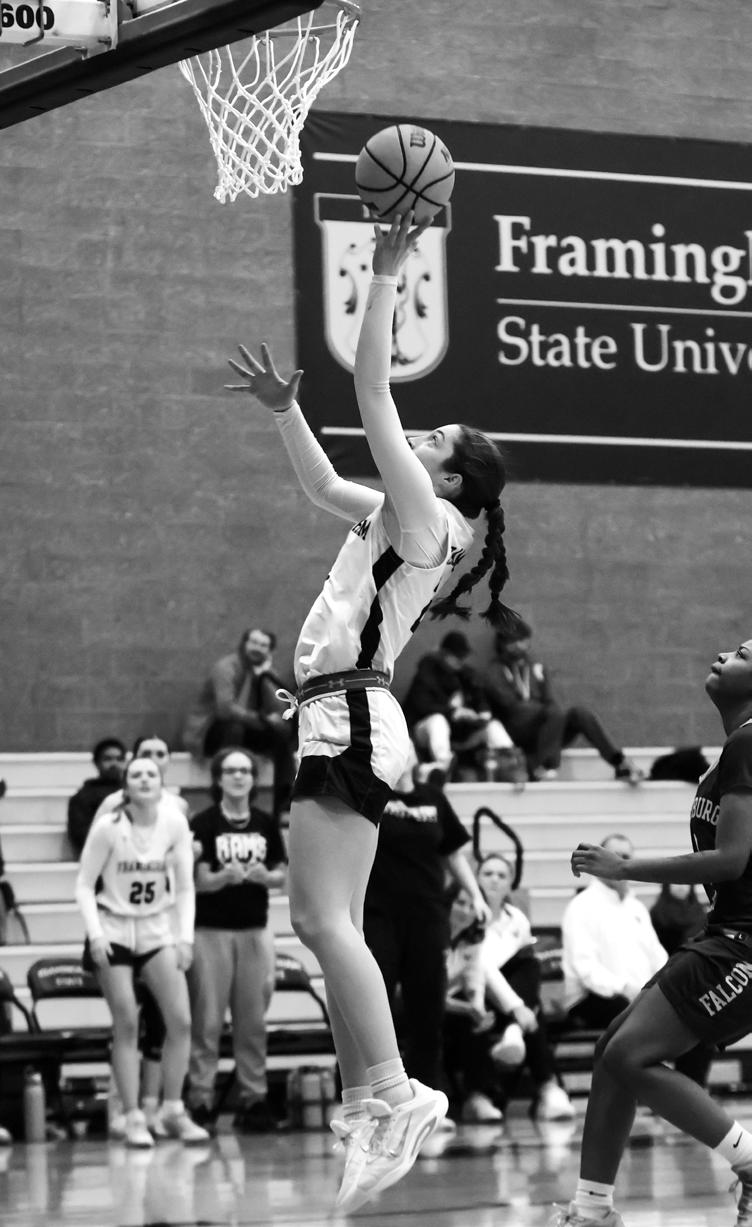
Adrien Gobin / THE GATEPOST (Front) Shaelagh Green going for a layup in win against Fitchburg St. on Feb. 4.
The roadmap of U.S. Education ARTS & FEATURES
History being preserved by Colleen Previte, University Archivist
By Dylan Pichnarcik Associate Editor
Walking across Framingham State’s historic campus and seeing the large brickstone buildings of May, Peirce, Horace Mann, and Crocker halls can invoke the question for passersby: if these walls could talk, what would they say?
One librarian, Colleen Previte of the Henry Whittemore Library, is giving FSU its voice and preserving its longstanding history as the birthplace of public education with every periodical, artifact, and painting she archives for future generations.
Previte, the University’s archivist and special collections librarian, has been working at FSU since 2004 and has assisted in the archiving and research of anything related to FSU, dating back to its 1839 establishment in Lexington.
Previte holds a bachelor’s degree in Business Administration from Worcester State University and a master’s of Library and Information Studies from the University of Rhode Island. She said she found the job at FSU and applied with the intention of moving to Framingham, as her husband lived in the city.
She added that when searching for a career, she “really had to soul-search to figure out what I wanted to do for a living - I wanted to keep and preserve something. So I feel like I have a greater purpose of preserving things for future generations, which includes students and anyone else.”
Previte said the University Archives and Special Collections are made up of an estimated 2,000 printed materials spanning multiple specialized collections.
Among the categories of printed materials in the Special Collections, many are the namesakes of notable figures in the history of FSU, including the Christa Corrigan McAuliffe Collection, the Ruth Graves Wakefield Collection, and the Martin F. O’Conner Collection.
McAuliffe Collection, she was able to meet notable people and contribute to the accounts of McAuliffe’s life.
“I’ve got to meet astronauts. I was able to meet Barbara Morgan, who was Christa McAuliffe’s stand-in or alternate if Christa got sick. She came around, and I got to meet her. So I was really excited for that,” she said.
Previte added she has also been interviewed by WCVB Channel 5’s Chronicle in regard to Challenger’s past anniversaries.
Among the other items in the special collections is The Dial, the University’s yearbook, which was printed from 1915 to 2005. The archives now hold virtually every issue, including a long-missing 1917 volume that was later recovered via eBay.
“I don’t know if it was because of the war or anything, but 1917 was the hardest to find. We didn’t have it for a good portion of my career here, and then I found it on eBay, so
Previte said students may not expect her role to be exciting. However, through the University’s stewardship of the
we purchased it, and it was a great addition to complete the collection,” Previte said. Additionally, the special
collections hold every copy of another student publication dating back to its first issue in 1932 - a weekly student newspaper featuring campus news, opinions, sports coverage, features, and reviews entirely run by a group of students in their McCarthy Center Office. Sources say they are always looking for new members!
Among the other specialized collections, the archives feature a faculty collection - books by and about FSU’s faculty, an alumni collection, books by and about alumni, and a general education collection that outlines the history of the U.S. education system - along with a plethora of FSU-related artifacts and ephemera.
Within the Special Collection Reading Room sits a globe, which, according to Previte, once sat in the office of FSU’s first principal, Cyrus Peirce.
Previte said this globe, along with another, was the technology of the day and was likely used for lessons.
In addition to the globes that once belonged to Peirce, the collection also holds Peirce’s personal Bible and journal, which are currently on display in a case just outside of the Special Collections Reading Room.
Peirce, the first principal, is known for coining the University’s motto, “Live to the Truth.”
An early rendition of this phrase is written in the journal of one of Peirce’s pupils, Mary Swift, according to Previte.
Swift’s journal remarks that Peirce would end each lecture with the phrase “Live to truth.” This journal is also held in the special collections.
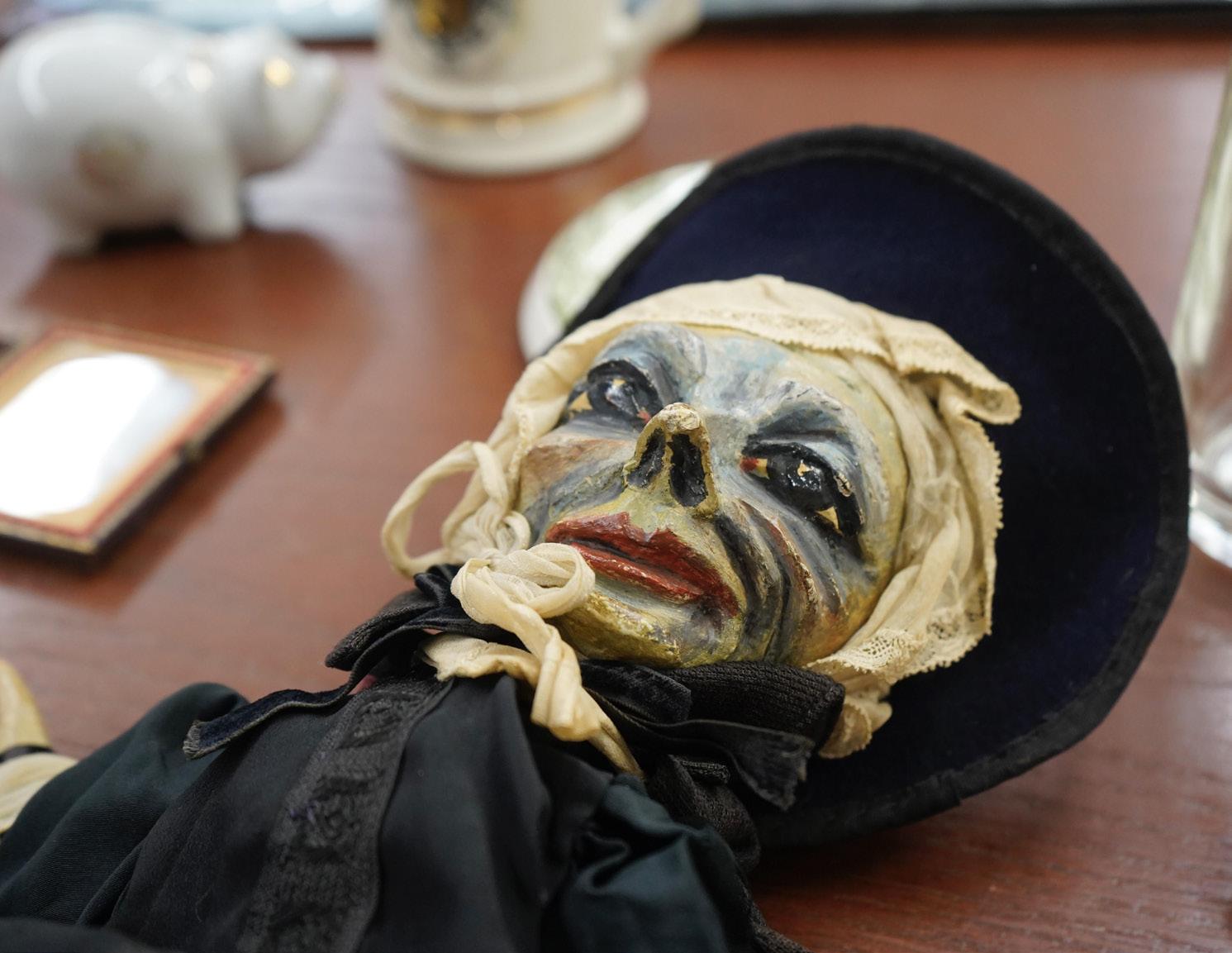
Other FSU ephemera includes class rings from the early 1900s, commemorative plates and cups, paintings, campus maps, and the previous, and slightly creepy iterations of Sam the Ram.
The collection also features
historic photographs, including original daguerreotypes of Ellen Hyde, Class of 1862, who was the second female principal of FSU.
Daguerreotypes are photographs taken by an early photographic process employing an iodine-sensitized silvered plate and mercury vapour.
Like the eerie Sam the Ram costumes, the collection features a set of marionettes and puppets based on fairy-tale characters, including the mother of Snow White and The Witch from Hansel and Gretel.
The puppets were created by alumna and faculty member Louise Kingman, class of 1917. While at FSU, she taught speech, drama, and physical education, including tennis and golf. She also shot films depicting campus life during the 1930s and 1940s, according to Previte.
The University Archives and Special Collections are available to be viewed online at the Whittemore Library’s website, and the reading room can be visited Monday through Friday from 8 a.m. to 4 p.m. or by appointment.
Previte said she often gets visitors who are seeking information about FSU or education in the United States.
“Our collections are basically related to Framingham State,” she said. “We get alums, sometimes we have friends or family of alums that want to learn more about their ancestors. We’ve had scholars come and do research on normal schools and education.” She added, “I feel like I have a greater purpose of preserving things for future generations so that others can continue their research or work, or say, ‘Oh, they did this back then, that’s really cool.”
CONNECT WITH DYLAN PICHNARCIK dpichnarcik@student.framingham.edu
Dylan Pichnarcik / THE GATEPOST
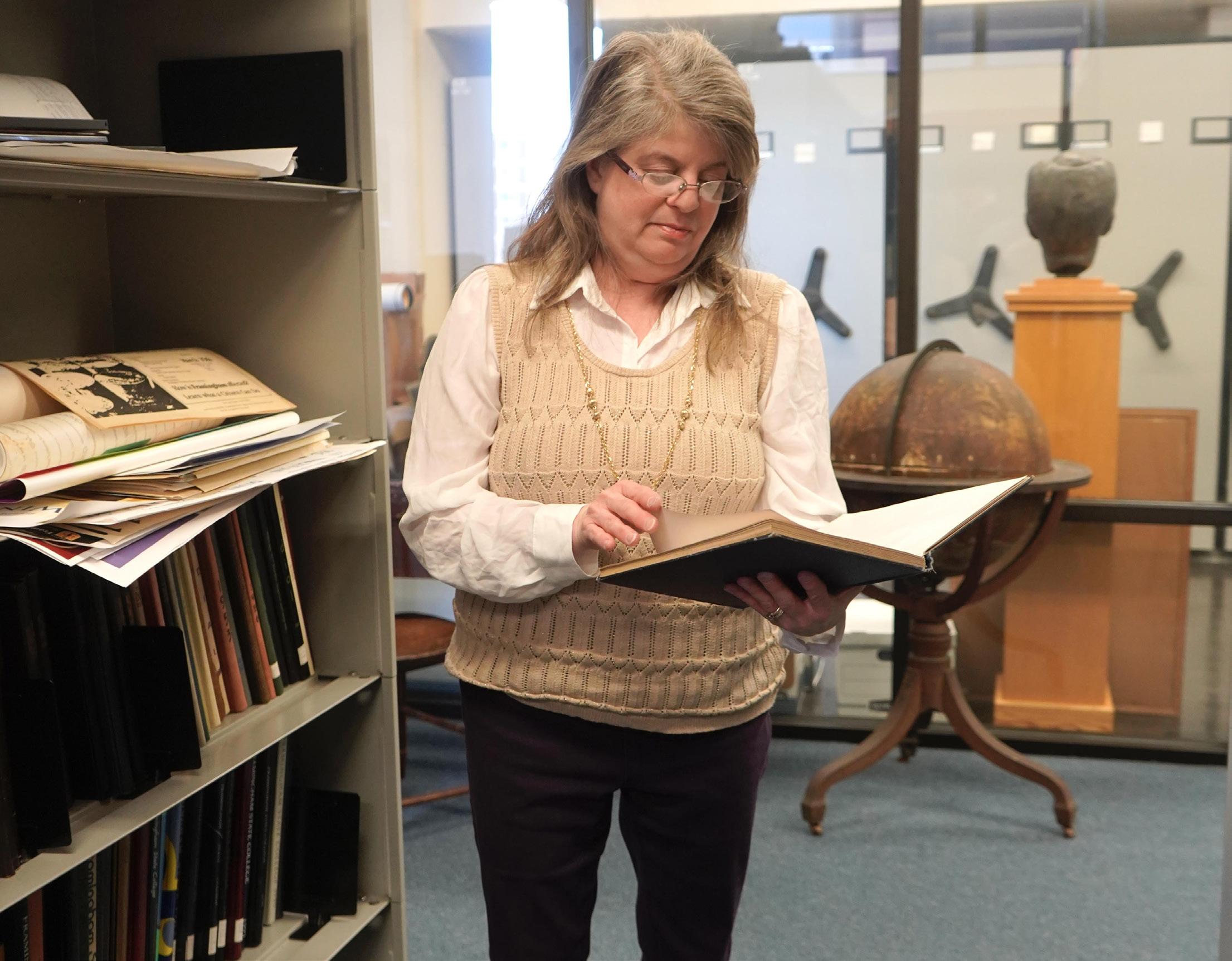
Colleen Previte flips through a copy of The Dial in the University Archives
Dylan Pichnarcik / THE GATEPOST
A puppet from the University’s Special Collections.
Beacon awards
Continued from Page 1
Tutu said she was given the theme “Unfinished Business for Higher Education” and decided that it’s impossible to focus solely on that “because higher education is an integral part of all of society.”
Part of the problem in our society is “our attempt to create silos, create areas that work on their own toward their own goal, and then we are surprised when our society is fractured,” Tutu said.
She said it’s impossible to build a fair and just society while staying in boxes, and that everything is connected.
“If we are talking about unfinished business, let’s talk about the unfinished business of a just world,” Tutu said.
While growing up in Apartheid, her parents would have students from the University of Fort Hare over for social events, she said.
But these events usually ended up having political discussions, she added.
“I met students who were 12, 13 years older than me, who were thinking about what they wanted our country to be,” Tutu said.
While she couldn’t understand a lot of the discussion, she thought it sounded empowering, she said.
Tutu said being in higher education means “paying attention to life. It means paying attention to who is in the room and who isn’t. It means paying attention to how politics determines our access to education, to healthcare, to everything.”
Simply being a student or professor in higher education is already a privileged position and is an opportunity to meet people who are different from us, she said.
She’s gotten several responses to her past presentations where someone argued that they don’t see the difference between various people, that they just see humans, she said.
“Why would we want to make ourselves all the same?”
person would be feeding the flowers,” she said.
Higher education is meant to expose people to new ideas and perspectives, she said.
It is supposed to encourage students to imagine a better world, she added.
“Young people on college campuses have historically made it clear that they recognize their time, their responsibility to be a part of moving our world forward in terms of human rights and justice,” Tutu said.
She said it was students who led the movements against the Vietnam War and Apartheid.
And today, it is “students who are the most vocal about the horrors that we have seen in Gaza and the West Bank,” Tutu said.
It is the responsibility of institutions to encourage students to question the way the world is, she said.
“Sometimes that questioning makes us uncomfortable, because we are a part of the power structure,” Tutu said.
She shared a story about an experience she had at another university, where there was a student movement against Israel. The students wanted to divest from companies supporting Israel, she said.
During the conversation at
said they understood that but knew their school could be doing better, to which Tutu gave a standing ovation, she said.
“We can build bridges that will make us think about different ways of funding scholarships, that will make us think of different ways of making an impact on the lives of disadvantaged students here while not being a part of a genocide there. That, I think, is the unfinished business of higher ed,” Tutu said.
When she was growing up, she was told that Apartheid couldn’t end because the West supported it, she said.
But support against Apartheid came from college campuses forced to divest by students, she said.
Tutu said she speaks as a Black immigrant who carries her U.S. passport to prove her citizenship.
“I grew up in Apartheid South Africa when Black people had to carry passports. I never imagined that in my 60s, in the US of A, I would be carrying a passcard,” Tutu said.
It is important for someone to not stop at just imagining a better world but to also do the work needed to make change, she said.
“We are the ones we have been waiting for. There is no
places, new communities, to get new eyes on a problem, to get new thoughts on how to deal with what we are facing, because clearly, the eyes and ears and hearts that we have used so far have not dealt with the problem,” Tutu said.
Tutu said she dreams of a world where her daughters can walk anywhere at any time without fear, of a world where her son can call her without warning and she doesn’t start worrying that he got arrested, and of a world where children aren’t left trapped in cars or taken by immigration officials. She said while growing up, she had to take her report card around her neighborhood to either get money and candy for good grades or lectures for bad grades.
One time she complained to her grandmother about working so hard in school when the system they lived in wouldn’t let them get good jobs anyway, she said.
“And my grandmother always used to say in response, ‘This is not the end of the story. What you are preparing yourself for is not today. It is for the day that we are working for,’” Tutu said.
Tutu asked.
She shared a story about how her mother plants different flowers in her garden and takes meticulous care of them.
If someone tried to say they didn’t see any difference, “that
that university, one of their administrators said they wouldn’t “be able to offer scholarships in the same way” if they divested from those companies, she said.
A student at that university
one. There is no one coming to save us but ourselves,” Tutu said.
She said in times of crisis, the wise seek out help in the unknown.
“They reach out into new
Alexis Schlesinger / THE GATEPOST
The Rev. Nontombi Tutu speaking at the Beacon Awards on Jan. 29.
(Left) Jen Lin, Jerome Burke Laila Jenkins, and Emma Laurie at the Beacon Awards on Jan. 29.
The Challenger series
Reflecting on the ’80s and the life of Christa McAuliffe
By Sarah Daponde Asst. Arts & Features Editor
The Christa McAuliffe Center hosted “The Challenger Disaster and its Historical Context” on Feb. 4 over Zoom.
This was the second event in the three-part Challenger series honoring the 40th anniversary of the accident.
The series aims to spark conversations on the key moments of FSU alum Christa McAuliffe’s life, examine the historic context of the 1980s, and reflect on lessons learned from the tragedy.
Irene Porro, director of The McAuliffe Center, introduced the guest speakers for the event - Jennifer Levasseur, space history curator of the National Air and Space Museum, and Jon Huibregtse, professor emeritus of history at Framingham State University.
Huibregtse began the event by giving a brief overview of significant cultural and political “snapshots” of the 1980s.
The first snapshot he discussed was the American economy.
He said the decade was prosperous for upper- and middle-class Americans. However, because the United States lost approximately 2 million manufacturing jobs during the 1980s, it was a difficult time for blue-collar workers.
The second snapshot Huibregtse shared was of the Cold War.
“The Cold War loomed large
over the nation, but we had lived with it for so long - many of us our entire lives - that we didn’t give it really much thought anymore,” Huibregtse added.
The third snapshot he discussed was of the AIDS epidemic.
The CDC first reported on cases of HIV/AIDS in 1981, but President Ronald Reagan did not give a major speech on the illness until 1987, by which time Huibregtse said AIDS activism was in full swing.
Lastly, Huibregtse shared a snapshot from sports during this decade, including the Celtics entering the NBA finals five times during the 1980s with their “Hall of Fame Trio” - Larry Bird, Kevin McHale, and Robert Parrish.
Levasseur led the second half of the discussion.
“I’ve been the spatial curator here at the National Air and Space Museum for the last five and a half years, but my story, like most people my age, goes back much farther than that in terms of the Challenger,” said Levasseur.
Levasseur said, as a child growing up near Toledo, Ohio, home of astronaut and U.S. Sen. John Glenn, she was always very aware of the space program, especially after the Challenger.
“I was like many students sitting in front of a television, the morning of Jan. 28, 1986, watching all of this on television,” she added.
She said she was excited to go to school that morning and see a teacher launch into space. Even though the launch had been delayed several times already, Levasseur said she remembered thinking, “today is going to be the day.
“It wasn’t something just in my memory - it was in the memory of an entire generation of school children,” Levasseur added.
In addition to McAuliffe, the other crew members on board the Challenger were Commander Francis Scobee, Pilot Michael Smith, Mission Specialists Judith Resnik, Ronald McNair, Ellison S. Onizuka, and Payload Specialist Gregory B. Jarvis.
“These individuals, and as a group, represent a really unique moment in time - in 1978, NASA had selected a new group of astronauts,” she said.
She said NASA wanted to put different people in space, not only in terms of their profession, but also in terms of backgrounds, gender, and ethnicity. Prior to 1981, all missions included only pilots, and only white men.
The Challenger crew included the first Asian American, the first Jewish American, one of the first three African Americans, and two of the first six women to become astronauts.
McAuliffe was selected to join the crew from the “Teacher in Space” project. Barbara Morgan was the runnerup to McAuliffe and did end up trav-
Another age, another war in Hyrule
By Francisco Omar Fernandez Rodriguez Arts & Features Editor
When I heard that a new “Hyrule Warriors” game was being made, I was really excited. I actually love the gameplay in this series, even if it just seems like button mashing at first.
“Hyrule Warriors: Age of Imprisonment” (AOI) is the prequel to “The Legend of Zelda: Tears of the Kingdom” (TOTK).
It is not to be confused with “Hyrule Warriors: Age of Calamity” (AOC), the non-canon spinoff prequel to “The Legend of Zelda: Breath of the Wild” (BOTW).
AOI shares many similarities with AOC, such as their titles, gameplay, locations, and how they even both introduce ancient robot characters that are crucial to saving the world. As such, it’s only natural to compare the two from time to time.
AOI takes place during the era of Hyrule’s founding. Princess Zelda appears from the distant future - or TOTK’s present day - and stays with the royal fam ily as she tries to figure out how to get home.
Rauru is the founding King of Hyrule and the story follows his battles against the Demon King Ganondorf in the Impris oning War, following the lore TOTK set up.
But in order to keep the story fresh, many new char acters were added. In fact, the majority of the cast are new characters.
able though. “Hyrule Warriors” always have a large cast of playable characters, one of the several stark contrasts from the mainline “The Legend of Zelda” series. Part of the reason AOC did as well as it did was because it relied on the fan-favorite characters from BOTW.
But AOI’s status as a canon prequel instead of a spinoff meant almost all of TOTK’s cast couldn’t be included without severely changing the original story. Even the Sages, who are important characters to the plot, were never given names or even faces in TOTK.
While AOI definitely succeeds in making an original story that loosely fits into the canon, I think it would’ve been better otherwise.
The story feels almost as absurd as AOC at times, and that game took a tragedy and gave it an “everyone survives and lives happily ever after”
most powerful out of the castThe Mysterious Construct.
The Mysterious Construct is a robot designed for battle by the ancient Zonai. It also looks and fights a lot like Link, for reasons that are explained late in the story.
Link is canonically a very strong and capable fighter, and the Mysterious Construct is no different.
It also has the ability to fly, and when it takes off the gameplay switches to shooting down enemies across Hyrule’s skies. It feels like AOC’s Divine Beast battles, but adjusted to incorporate TOTK’s sky islands and Depths.
But while it’s great gameplay-wise, the Mysterious Construct hurts the overall story. It gets so much screentime that it weakens Zelda’s story.
With Link not in the game, I expected AOI to give Zelda a meaningful story that builds up to the sacrifice she makes in TOTK’s flashbacks. Instead, she’s essentially sidelined by the new guy.

This was somewhat unavoid-
Here, a new character is shoehorned into the plot and is easily the
eling to space after the Challenger accident, she added.
Levasseur said the disaster happened only 73 seconds into the launch of the Challenger space shuttle.
“And most of us, as third-graders, had absolutely no idea what just happened,” Levasseur said. “Our teachers, likewise, did not know what was happening. They couldn’t explain it to us.”
She said the losses of both the Challenger and Columbia space shuttles were due to overlooked issues, including concerns with the rocket boosters and heat shields.
Levasseur said there were hundreds of thousands of people helping with the orbiter from around the country and she said they were all deeply affected by the loss of the Challenger.
“When you talk to astronauts, that’s who they talk about. They really are members of the family,” she added. “The orbiter is almost like a child of theirs.”
Admittedly, this version of Zelda has already grown during her first journey in BOTW, but instead of growing more or at least taking the lead it feels like she’s just a supporting character.
Even the game’s finale focuses significantly more on the Mysterious Construct than Zelda and Rauru, detracting from both of their stories.
It reminds me of “The Legend of Zelda: Echoes of Wisdom,” a game where Zelda is the main character and Link is captured. In that game, Zelda
CONNECT WITH SARAH DAPONDE sdaponde@student.framingham.edu
is given the ability to magically fight and even look more like Link for limited periods of time, and it’s expected that the player uses this for boss fights especially.
It’s like Nintendo can’t let a Zelda game not focus on Link in some crucial way, even though there have been several Zelda games where Zelda herself is barely a character, if she’s even present.
I didn’t like the “Swordfighter form” then, and I don’t like the Mysterious Construct now. Let Zelda actually stand on her own, a feat that hasn’t happened since… the CDI games in 1993? Yikes.
Overall, the game is pretty fun, though I just don’t like the story. But it was certainly a choice to put a prequel of a Switch game only on the Switch 2.

Marcus Falcão / THE GATEPOST
Music’s Biggest Disappointment - The GRAMMYS
By Antonio Machado Multimedia Editor
Every year, hundreds of artists gather together to witness tears, political advocacy, terrible speeches, terrible performances, and absolute world-shattering performances on music’s self-proclaimed biggest night, The GRAMMYS.
The 68th Annual GRAMMY Awards were no different.
The show opened with a jumpscare - Bruno Mars and ROSÉ immediately took the stage to perform their hit song “APT.”
Trevor Noah took the stage to announce this year would be his last time hosting after six consecutive ceremonies, and we will all mourn his milquetoast humor, which he thankfully ditched for this night.
Alongside a terrible running joke begging Bad Bunny to perform live, he snuck in a few jabs at President Donald Trump and Nicki Minaj - which seemed like the only times anybody in attendance or at home laughed at what he said.
But nobody watches The GRAMMYS for the host. People tune in to raise pitchforks when their favorite musician doesn’t win an award and be hypercritical of every performance and speech.
The beautiful thing about the four-hour ceremony is not that roughly over an hour of that run time is allocated to ads, but rather that only nine of the 95 categories are presented during the main broadcast. The rest are meekly handed out at the non-televised pre-show.
However, to make up for this, they allow the artists to do anything they want for their performances.
Sabrina Carpenter easily had the best performance of the night. The rising star performed the entirety of “Manchild,” which was up for “Best Pop Solo” alongside both “Record” and “Song of the Year,” and she absolutely killed it.
Tyler, The Creator kept up his streak of having the most captivating performances at The GRAMMYS, which somehow always contain pyrotechnics, insane hairstyles, and

By Antonio Machado Multimedia Editor
The GRAMMYS are a collection of some of the world’s brightest, most talented artists, and while the focus of the night is typically on their performances on stage, their performances on the red carpet are where their creativity can really shine.
Sabrina Carpenter
Up for six awards on her seventh album, the pop princess decided to show out and guarantee herself the best dressed award for the night. Beaded flowers hugged her figure and
someone dying.
A major moment of this year was the back-to-back performances by all the artists nominated for “Best New Artist.”
Addison Rae demonstrated that charisma, uniqueness, nerve, and talent aren’t everything you need to be an amazing live performer - you also need good breath control.
A few breathy missed notes aside, Addison was easily the most captivating and polished of the New Artist nominees, which sucks because she was the first, and it all went immediately downhill.
KATSEYE was single-handedly the reason why The GRAMMYS were down in viewership by 6%, according to an article by Variety. Making music that sounds like AI-generat ed versions of what 12-yearold Ameri cans think K-pop songs sound like is one thing - performing those songs on the most prestigious stage for a musician is another.
tle to a T.
Sombr pleaded for the audience to engage with him during his performance to absolutely no avail, but he tried, and that’s what matters. Nobody expected an artist whose target audience is 14 year olds vaguely learning what heartbreak is following their breakups with their middle school loves to engage an audience of serious artists, but it can’t have felt good regardless.
The great thing about this year was that since all the nominees for this category were so underwhelming, Olivia Dean’s perfectly digestible beige mom elevator music easily took home “Best New Artist.”
The GRAMMYS are so special because they allow artists full creative control over their performances with some

The Marias were on stage. That’s about it.
Lola Young attempted an acoustic cover of “Messy.” Some will argue the messy singing was emotional, but they would lose that argument. But she somehow took home “Best Pop Solo,” so turning a song into a Twitter laughingstock has its benefits.
Leon Thomas III reminded us why “Victorious” was a successful show - an incredibly talented cast. However, he, who has written music for various artists including but not limited to Ariana Grande, SZA, and Drake, should probably not have been nominated for “new” artist.
Alex Warren performed “Ordinary” and exemplified the ti-
descended into cascading ruffles on her custom Valentino gown. Coupled with a sheer capelet and her pretty face, Sabrina easily won the carpet.
Teyana Taylor
Styled by herself, the newly Oscar-nominated singer and actress commanded the red carpet in a beautiful Tom Ford sequined cutout cedar gown that beautifully wrapped and highlighted her figure. Adorned by Tiffany & Co. jewels, she dazzled the carpet and blinded anybody watching with her beauty.
Gesaffelstein
The French producer and EDM artist walked away with not only his first-ever GRAMMY win for his work with Lady Gaga but also the attention of the media. Wearing his signature high-gloss face mask and gloves, he somehow managed to make a double-breasted tuxedo look scary yet high fashion.
Chappell Roan
After spending much of the last few months hidden away, Chappell showed up and showed out… a lot of skin!
Those exceptions do not include Justin Bieber coming out on stage wearing nothing except crusty boxers and a freshly done hair transplant to serve vocals and face.
Lady Gaga also notably took the creative opportunity to deliver some fierce demonic camera work on a rock version of “Abracadabra.” A very welcome followup to Jelly Roll’s acceptance speech wherein he basically said “Jesus” on repeat until everyone felt uncomfortable and he got off stage.
Despite the interesting speeches, the winners for the night were primarily expected with a few outliers.
Prior to this year’s GRAMMYS, Bruno Mars had won every single one of his GRAMMY Award nominations since 2014, so his surprise and ensuing anger at the inadequacy of ROSÉ’s “APT,” which lost every single award it was up for, was palpable - and it tasted great.
Sabrina Carpenter joined the likes of Ariana Grande and Bil-
Prosthetic nipple covers and rings attached Roan’s custom sheer Mugler gown. Decorat ed with intricate fake tattoos, Chappell caused another huge red carpet stir with her signa ture maroon gown.
Lady Gaga
Mother Monster had all eyes on her when she flew onto the red carpet with a custom black feathered gown by Matières Fé cales. The beautiful high-neck dress highlighted her signature bleached eyebrow and hair. This red carpet, however, was not Mother ‘s standout mo ment of the night. Her feathers followed her into her perfor mance, where she wore archi val Alexander McQueen. The black and red bodice perfect ly highlighted the eye-shaped headpiece.
Honorable Mention: Jamie Foxx let me not forget my big hat
lie Eilish as artists who went home empty-handed despite being one of the most nominated artists of their respective years and having arguably the most successful albums of the nominees.
Big ‘Brina should keep her hopes high, however. Billie Eilish earned herself a “here, damn” award for a song released two years ago - seemingly because of the outrage caused during last year’s ceremony when she went home empty-handed - so all Sabrina has to do is make “House Tour” a single and expect to sweep in 2027.
After the pee break (Reba’s performance), Lauryn Hill led an “In Memoriam” tribute to the late D’Angelo alongside a plethora of other amazing artists. It was an absolutely stellar performance for an even bigger star, and it’s a shame it didn’t get its own performance slot because every had already fallen asleep by the time Reba was done.
Cher very Lola Youngily took the stage to receive her “Lifetime Achievement Award.” She had clearly not rehearsed nor been instructed, and frankly, she deserved more screentime, as she was barely given any time to properly receive her award before being asked to present “Record of the Year,” which deservingly went to Kendrick Lamar and SZA.
After being tormented the entire night by Trevor Noah, Bad Bunny walked away with “Album of the Year” and a beautiful speech condemning the presence of ICE in America.
The 2026 Grammys went just as usual - sometimes, they’re too messy, and then they’re too f**king clean.

CONNECT WITH ANTONIO MACHADO amachado4@student.framingham.edu

You’ll see red in ‘Iron Lung’
By Jesse Burchill Staff Writer
Released on Jan. 30, Iron Lung is a science fiction horror movie directed by, written by, and starring Mark Fischbach, who many may know as the YouTuber Markiplier.
Based on the 2022 video game of the same name, the movie is set in a future where humanity has colonized outer space. However, all stars and planets in the known universe suddenly disappear in the “Quiet Rapture,” and much of humanity is lost in the process, leaving only moons and space stations.
As part of the survivors’ ef fort to find answers and ways to survive, a convict named Simon (Fischbach) is sent to a moon to investigate an ocean that is composed entirely of blood.
Things get worse from there for Simon, with hallu cinations and copious amounts of blood.
Prior to making the film, Mark had created and acted in the YouTube series “A Heist With Markiplier,” “Who Killed Markiplier?” and “In Space With Markiplier,” as well as the podcast “The Edge of Sleep” and its television adaptation. In these series, the story is told across multiple episodes and Mark acts across a variety of locations with multiple other actors.
of the film, all the while being stuck inside a submarine with his only connection to the outside world being a radio and a porthole.
He’s a one-man show, and proves that he can carry a twohour movie almost completely by himself. As Simon’s situation gets worse and
$3 million. The effort Mark and company put into the film is palpable in every frame.
However, there were some moments - during hallucinations, flashbacks, the playback of an audio log, and towards the end - where I had trouble understanding what was being said. Another moment toward the end noticeably used a bit of shaky cam, and that made it difficult to discern what was

a gamut of emotions unmatched in his YouTube career.
There’s a period of time before the especially creepy stuff happens where Simon is exploring the blood ocean and the inner workings of the ship. I’ve seen the pacing here be called “boring,” but in the theater, I saw it more as “slow-burn.” Simon is learning how the ship works and how to use the controls, and it felt like we were in the sub learning
ity and hallucination that gets worse as time goes on, and almost nothing is given about the true nature of the blood ocean - everything is brought together perfectly to create a claustrophobic cosmic horror story unlike any other I’ve ever seen.
Furthermore, the film famously used 80,000 gallons of fake blood, breaking a record in the process, and it got its money’s worth in the third act. The resulting effect is appropriately disgusting when Simon is swamped and completely submerged by it.
In the end, “Iron Lung” is fascinating, riveting, and confusing at the same time, resulting in one of the weirdest movies I’ve ever seen (and definitely in a good way). I’ve been a fan of Markiplier since I was in middle school, and it was an awesome experience to see him make his debut on the big screen.
Here, Mark is the only actor on-screen for the majority
The film’s production is also an achievement in and of itself. This movie was Mark’s passion project three years in the making, with no help from mainstream film studios, relying mainly on word-of-mouth, and made on a budget of less than
The performances of the cast during this period are also engaging enough to prevent detachment during the viewing experience, and it does a good job of setting up an atmosphere of isolation.
But when the scary stuff kicks in, it really kicks in.
There’s a blur between real-
Rating: A A bloody enjoyable indie film
CONNECT WITH JESSE BURCHILL jcelardo@student.framingham.edu

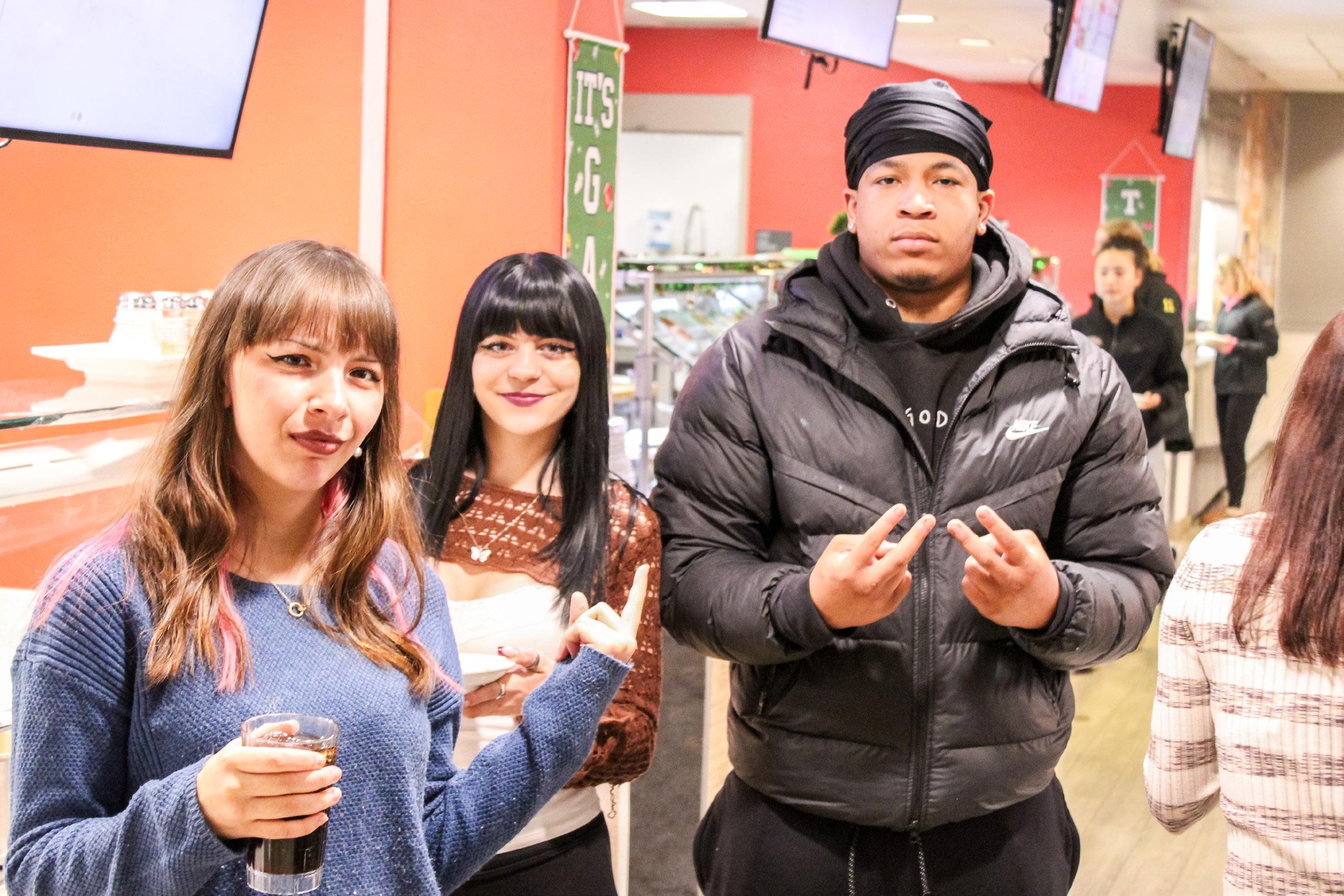
“Supper” Bowl