
Framingham State calls back-to-back snow days
By Bella Grimaldi News Editor
Framingham State called two snow days this week, canceling classes and shutting down campus on Monday, Jan. 26, and Tuesday, Jan. 27.
Students were notified on Friday, Jan. 23, by FSU Alert of the Monday snow day. The Tuesday cancellation alert was sent to the FSU community on Monday evening.
According to the National Weather Service, Framingham received 18.5 inches of snowfall as of Tuesday, Jan. 27.
According to FSUPD Deputy Chief Martin Laughlin, the decision for the snow days was made by the “snow team” made up of several members across campus offices including himself; Robert Totino, vice president of Finance, Technology and Ad-
By Dylan Pichnarcik Associate Editor
Framingham State faculty and librarians are required under federal law to update all digitally accessible content to adhere to ADA laws by April 24, according to Steven Courchesne, Director of Academic Technology and Instructional Design.
On April 24, 2025, the Department of Justice updated the requirements of Title II of the Americans with Disabilities Act, which requires “state and local governments to make sure that their services, programs, and activities are accessible to people with disabilities.”
“Title II applies to all services, programs, or activities of state and local governments, from adoption services to zoning regulation. This includes the
ministration; Dan Magazu, executive director of Marketing & Communications; Ryan Hacker, associate vice president of Facilities and Capital Projects; and Meg Nowak Borrego, vice president of Student Affairs.
According to Totino, the members of the snow team met on Jan. 23 to discuss closing on Monday and on the afternoon of Jan. 26 to discuss calling a snow day on Tuesday.
Totino said, “We have a few external, independent, third-party groups we work with, like the bookstore and Sodexo for dining services, so Michael Newmark [Dining Services general manager] was on the call last Friday as well in case we had to shut down, which we did.”
Kim Galvani, coordinator of Transportation Services, said she was in the meeting to pro-
services, programs, and activities that state and local governments offer online and through mobile apps,” according to the Department of Justice’s Civil Rights Division website.
The initiative to bring all Canvas, SharePoint, syllabi, and digitally accessed material into adherence with ADA laws was announced at the fall All University Meeting on Dec. 20 by Courchesne.
Faculty members and departments on campus will have until April 24, 2026 to bring all digitally accessed material into compliance with ADA laws and Web Content Accessibility Guidelines (WCAG).
The guidelines are requirements established by the Department of Justice to help web designers and individuals create digital content that adheres to ADA guidelines and is
vide information about if the shuttle could run in inclement weather.
She said the RAM Tram does not run on snow days because it is difficult for the shuttles to get in and out of the parking lots and the snow raises safety concerns for the drivers and passengers of the shuttle.
Laughlin said, “We discuss the potential storm, or the incoming storm itself. And then at that time, we come up with a decision like, ‘When should we let students know in a fair amount of time?’”
According to Totino, after this group discusses the decision to call a snow day, he brings their recommendation to President Nancy Niemi and Provost Kristen Porter-Utley.
Niemi said, “The decision ultimately rests with me and a small team of people.”
easily accessible, according to Courchesne.
Courchesne said accessibility initiatives are not new to campus. “It’s something that my office - the Education Technology Office - has promoted and supported for many years when we provide training to faculty who teach online.”
Courchesne said his office has supported faculty in the past with creating digitally accessible courses through workshops that outline general accessibility, and accessibility within platforms such as Canvas and word processing software, and will continue to do so.
He said accessibility updates are something the University has handled before, citing a 2018 complaint against the University’s website
She said she hopes the decision to cancel shows “that we care deeply about everyone’s safety.”
Totino said, “We hope it communicates that their best interest and safety was taken into consideration.”
Following the alerts, Nowak Borrego sent emails notifying students about updated parking guidelines, which were in effect during the storm, which resources and centers were open and available, and the extension of the spring semester add/ drop period to Jan. 29.
Niemi said it’s not unprecedented for the add/drop period to be moved back since it is a date decided by Framingham State, not the state or federal body.
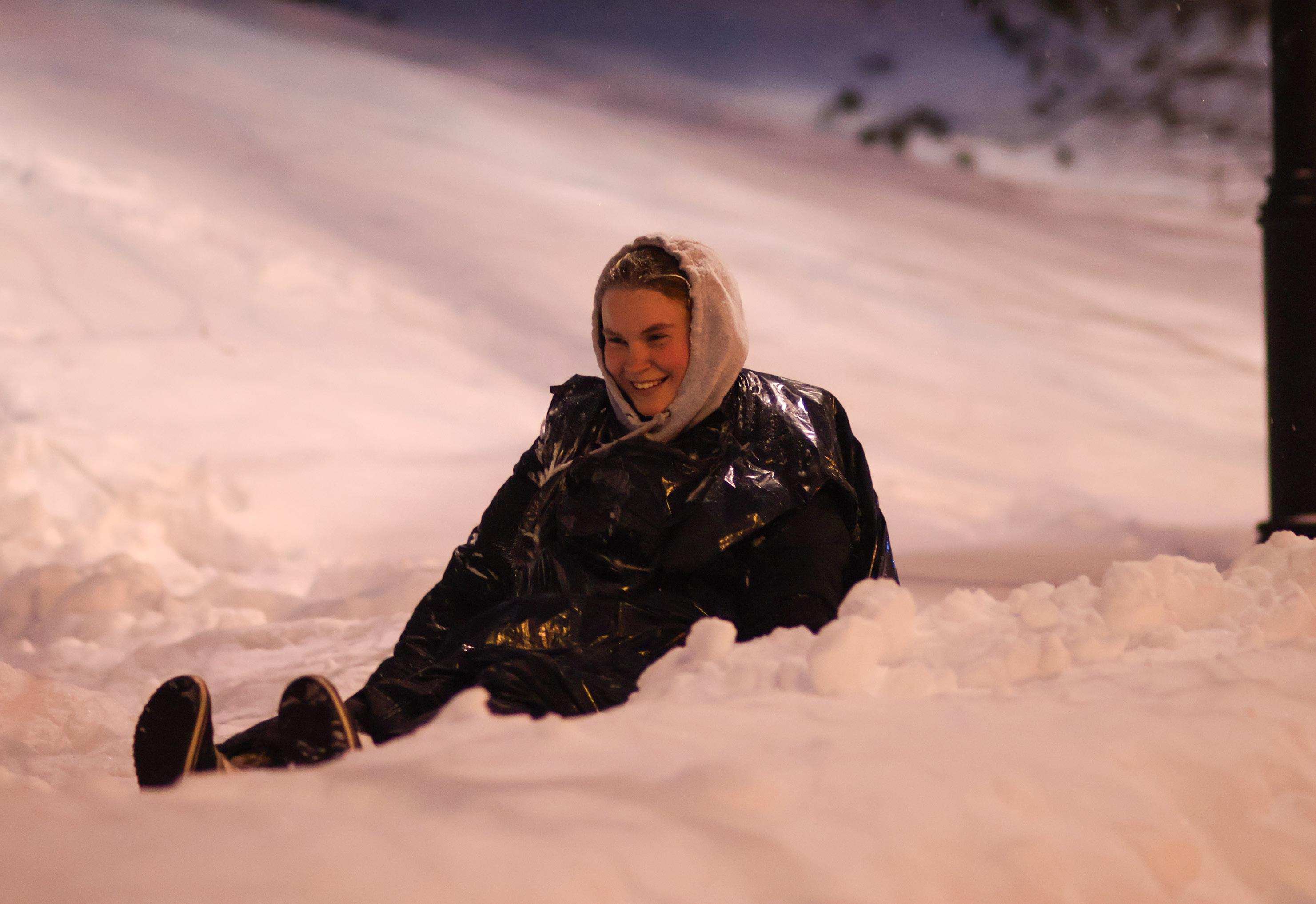
Adrien Gobin / THE GATEPOST
Junior Tarynn Smith sitting in the snow after sledding down to the Maynard Road Parking lot on Monday, Jan. 26.
E ditorial Board
Editor-in-Chief
Sophia Oppedisano
Associate Editors
Adrien Gobin
Dylan Pichnarcik
Multimedia Editor
Antonio Machado
News Editor
Bella Grimaldi
Opinions Editor
Izayah Morgan
Sports Editor
Izabela Gage
Asst. Sports Editor
Taylor Kimmell
Arts & Features Editors
Francisco Omar Fernandez Rodriguez
Owen Glancy
Asst. Arts & Features Editors
Sarah Daponde
Photos & Design Editor
Alexis Schlesinger
Illustrations Editors
Marcus Falcão
Staff Illustrators
Rileigh Kelley
Staff Writers
Zaynab Ahmed
Jesse Burchill
Kristel Erguiza
Julien Fernandez
Paul Harrington
Cole Johnson
Dan Lima
Kate Norrish
Wenchell Pierre
Andrew Ramirez
Avery Slavin
Kennedy Thompson
Staff Photographers
Christy Howland
Onyx Lovely
Advisor
Desmond McCarthy
Asst. Advisor
Elizabeth Banks
Graduate Advising Asst.
Emma Lyons



Gatepost Interview Sarah Hooke
Interim Dean of
Henry Whittemore Library
By Avery Slavin Staff Writer
What is your academic and professional background?
I got a bachelor’s degree in anthropology, which isn’t that easy to find a job in. Then, I got a master’s degree in library science, and then I went back to school and got a law degree, so I have a J.D. as well. So, those being my academic fortes, I have had jobs in both areas. I was an associate dean or the director of law school libraries for many years. I worked around different parts of the United States - I was in Massachusetts. Then I was in San Francisco for a while. I was in Miami and then I came back to Northeastern University here in Boston. I had an excellent job for a while. I was a legislative council aide to committees of the main legislature and my specialty was business subjects and business, like worker’s comp and labor law and things like that. I was the attorney for the senators and the representatives who are on the committee who heard the bills that came in. So, I was a nonpartisan council, which meant I wasn’t a Democrat. I wasn’t a Republican. I was the lawyer. I was the aide to give them unbiased, nonpolitical advice about what the law is like now and what this bill wanted to do to it. I also worked for the Massachusetts State Agency that used to regulate cable television back when it was more regulated. Then, I was an attorney with John Hancock and I did John Hancock’s insurance. So, those were the major law areas that I worked in - not going to court particularly, but other areas you could do with that degree.
What drew you to Framingham State?
I retired a couple years ago. I tried not working for a couple years and I really didn’t like it, so I was very lucky when I saw the job ad to be interim dean here for Framingham State. I thought, “That’s wonderful. I really miss being in libraries.” I like academic libraries. I like dealing with students. I used to teach a lot when I was doing my other jobs. I did actual teaching, too, as well as library administration, so I was very happy when this came up. It’s mainly like, “Oh, this is a wonderful job. I get to be in libraries again.” I’ve been active in libraries. My mother was a librarian, and I used to work in her high school library when I was in high school myself, so I’ve been in libraries for years. I love books and reading and everything. The other connection I had here, or kind of connection, I guess you’d say, is my son and daughter attended Framingham State. My daugh-


ter was in a graduate program in dietetics and nutrition. So, I got somewhat familiar with some of the people or the buildings from coming with them, so I had some familiarity with it anyway. So, that’s what drew me here. I wanted to get back in libraries again.
What are your favorite hobbies?
Well, probably not surprising - reading. I read a lot. Then I have these, I guess you could say, special interests, but I like astrology. I just took a course in it recently because it was always just me reading things to try to get more into what all these different things are and how they work together. So I like that. I like plants. I have an apartment so I can’t have a garden, but I can at least have plants. I used to garden a lot. I like birds. Bird watching, nature, that kind of thing. Those are probably the biggest ones. My daughter was pointing out to me yesterday that I liked color, and I thought, “Well, it’s true.” Like, how do paints mix and things like that. So, just colors. I’m not an artist, but it’s of interest.
What advice would you give to students at Framingham State?
My first advice is to stick with it and finish. I know it’s really hard at times, either financially or because you feel like, “Oh, I don’t know. I don’t know what the job market is like. I don’t really know if this is the thing for me


or not.” But, I know a fair number don’t finish. I say that partly because my son didn’t finish. He said, “Well, I just don’t know. I don’t know what I want to do.” Once you have your degree, it will lead you on to a lot of things rather than shutting things off from you. If you don’t have the basic degree, a lot of jobs are so, “You can’t interview with us. You can’t do this.” It probably shouldn’t be that rigid, but it kind of is. My main advice is take advantage of the help here. What I love about this campus is the amount of interest that the school itself and the professors take in the students’ welfare. They really want to help and teach. When you go to a really huge university, you can get lost with a lot of the professors who are so driven in their research, and that’s not the biggest interest here. And don’t think you’re bothering the professor or any of the offices. You’re not. It’s what we want to do, and it’s not a bother to us. A lot of times, there are things available to students that they might not even ask about because they don’t know how, but keep asking. Ask for help because you all deserve it.
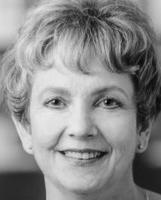
Courtesy of Sarah Hooke
Honoring the 40th anniversary of the Challenger disaster
By Sophia Oppedisano Editor-in-Chief
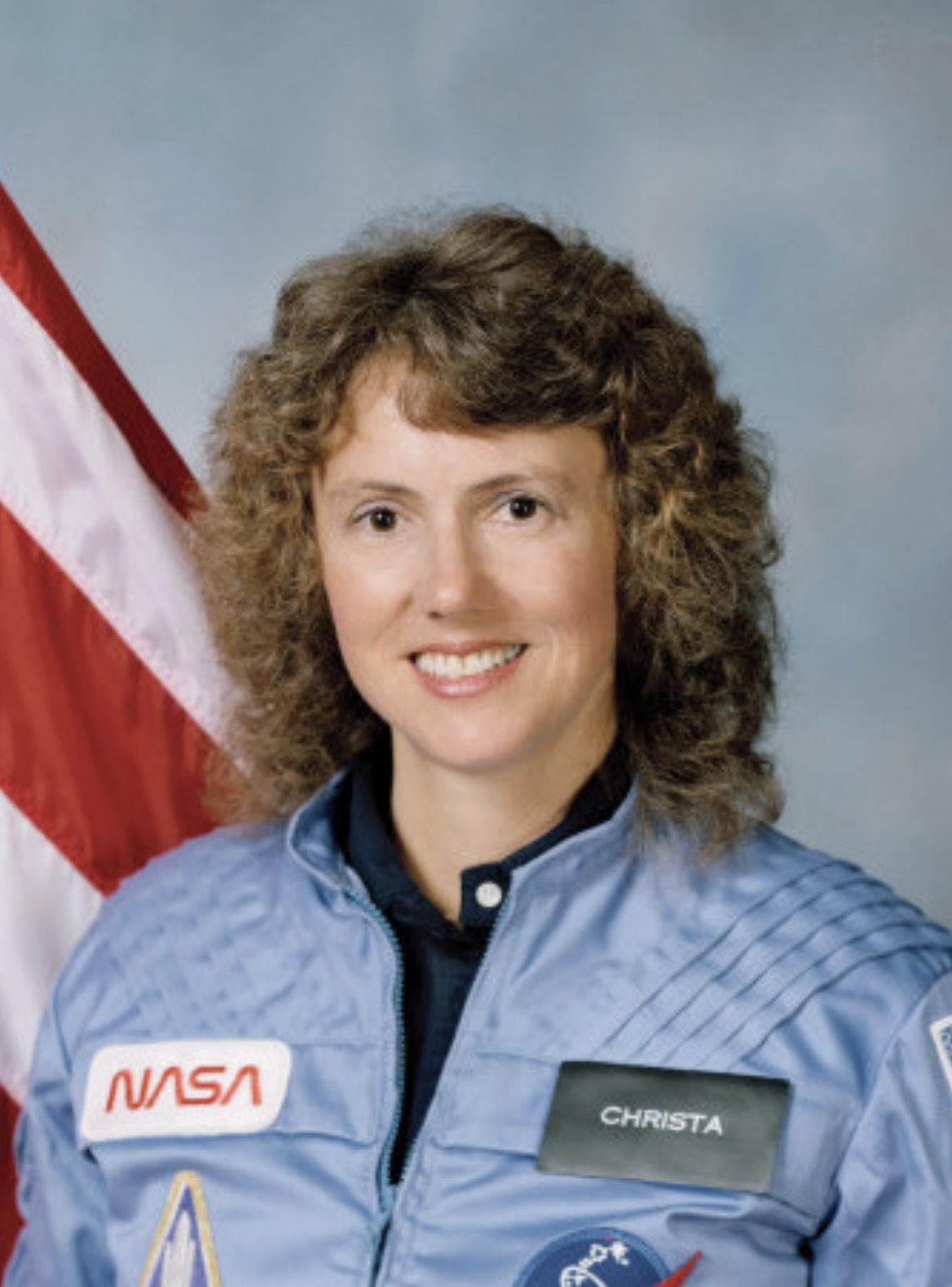
The lives of astronaut and Framingham State alumna Christa Corrigan McAuliffe and her fellow crewmates were honored by the University to mark the 40th anniversary of the Space Shuttle Challenger disaster on Jan. 28.
The Christa Corrigan McAuliffe Center for Integrated Science Learning held a moment of silence for the campus community to come together and remember the lives of McAuliffe and her fellow crewmates, Francis “Dick” Scobee, Michael Smith, Judith Resnik, Ellison Onizuka, Ronald McNair, Gregory Jarvis on Jan. 28.
McAuliffe, Class of ’70, grew up in Framingham and graduated from Framingham State College with a degree in history before moving on to get her master’s degree in education from Bowie State University.
She was selected as the primary candidate for the NASA Teacher in Space program in 1985 and served as a payload specialist for the Challenger mission, becoming the first civilian and teacher in space, according to NASA.gov.
Challenger exploded only 73 seconds after liftoff, tragically killing all seven crew members.
McAuliffe’s legacy at Framingham State endures through the McAuliffe Center and its service to the greater MetroWest community as a hub for STEM education.
In a statement sent to the campus community, Irene Porro, director of the McAuliffe Center, wrote, “At Framingham State and at the McAuliffe Center, we strive every day to honor Christa’s legacy by igniting wonder, expanding access to knowledge, and inspiring the next generation to explore and ask bold questions.”
The McAuliffe Center is hosting events over the next week for the campus community to continue celebrating the legacy of the Challenger crew.
The Concert for Challenger will be held on Jan. 31 at 3 p.m. in the planetarium. Students can purchase discounted tickets with the code FSU20.
The Challenger Series: The Challenger Disaster and its Historical Context, will be held over Zoom on Feb. 4 at 5 p.m.
CONNECT WITH SOPHIA OPPEDISANO soppedisano@student.framingham.edu
Board of Trustees approves $486 million Campus Master Plan
By Sophia Oppedisano Editor-in-Chief
The Board of Trustees unanimously approved a new Campus Master Plan (CMP), which will cost $486 million, at its first meeting of the semester on Jan. 28.
The University’s previous CMP was completed in 2012 and was updated until 2022, according to Robert Totino, vice president of Finance, Technology, and Administration.
Totino said he “engaged with” the Division of Capital Asset Management and Maintenance (DCAMM) in September 2024 to begin work on a new, 10-year CMP.
A 10-year CMP “is what is required by the state if we’re looking to get any funding for any projects that might be included in the plan. It has to be current,” he said.
Totino added the “why” of the project is to “Identify and reaffirm our facilities investments [and] make sure they’re aligned with, of course, the University’s mission and strategic plan.”
An FSU Steering Committee, comprised of faculty, staff, and Trustee Dennis Giombetti, was formed in December 2024 and began working on the project, Totino said. Students also participated in the plan and various focus groups throughout 2025, “which was so critical,” he added.
Totino said he received the final report for the CMP in December 2025 and presented “11 recommendations that were tucked into the Campus Master Plan” to the Board.
The most “prominent” rec-
Police Logs
Monday Jan. 26
7:30 Motor Vehicle Accident/Crash, Towers Hill
ommendation is the proposed relocation or renovation of the Henry Whittemore Library, Totino said.
The Whittemore Library, currently located in the easternmost area of campus on Larned Beach, would be relocated to State Street, where Foster Hall and the Framingham State University Early Childhood Center are currently situated.
Foster Hall and the Early Childhood Center would be demolished, and a new “more optimally sized” 65,000 square foot Library Learning Commons would be built, Totino said.
Whether the Whittemore Library is relocated or renovated, the project will cost approximately $90 million, he added.
Other “highlights” of the CMP include “providing an identity” to the College of Business in Crocker Hall as well as the College of Education and Social and Behavioral Sciences in O’Connor Hall, Totino said.
He noted the overall decrease in enrollment allows the “possibility to repurpose a certain number of classrooms” and “auxiliary spaces.
“We have roughly 60 classrooms. The thought was that we could potentially repurpose 20 of them into departmental living rooms, where you can convert a classroom into an area where faculty and students could congregate and meet offline, discuss various topics, and have other types of meetings,” Totino added.
The repurposed classrooms could be converted back into classrooms if enrollment were to begin increasing, he said.
The CMP also includes the
Tuesday, Jan. 27 8:23 Elevator Entrapment Corinne Hall Towers
continued “adoption of environmentally conscious practices, including decarbonization,” which could be achieved by 2030 and finalized by 2050, according to Totino’s presentation.
Each project laid out in the CMP will “stand alone” and go through its own “multi-step process” over the next “10-plus years,” Totino said.
Trustee Claire Ramsbottom asked which project would be prioritized first and how that would be decided.
Totino said there are specific projects “we hope to do within year zero to year five, years six to 10, and then 10 plus and so multiple variables will depend on which projects we tackle on that timeline.”
Totino said he has had discussions with President Nancy Niemi to come up with a list of projects “we want to tackle,
Wednesday, Jan. 29 10:52 Larceny State Property, Dwight Hall
maybe in years one to three,” and passed on the list to the facilities team.
Totino added DCAMM and the Massachusetts Board of Higher Education are the next “state bodies” that will “hopefully move in the same direction on approval.”
Each time the Board convenes, a student is recognized as the student in the spotlight.
At this meeting, Sarah Flavin, a student in the Master’s of Human Resources program was presented by Master of Human Resources Professor Robert Awkward who will graduate from FSU in 2027.
Currently, Flavin is a human resource director at Cambridge Mobile Telematics.
CONNECT WITH SOPHIA OPPEDISANO soppedisano@student.framingham.edu
Wednesday, Jan. 29 12:21
K9 Community Outreach, McCarthy Center
Gatepost Archives
Christa Corrigan McAuliffe.
Gatepost Archives
Claire Ramsbottom speaking at a meeting of the Board of Trustees.
Digital accessibility
from Page 1
through the Massachusetts Office of Civil Rights.
The complaint resulted in mitigation efforts by the University to correct the website and make it more accessible. The corrections were later made, and the complaint was closed by the Office of Civil Rights.
“When it comes to the responsibility that faculty have and that staff have, because we’re thinking about making not just our course content accessible, but also anything that’s on the website or anything that’s in our SharePoint site - really, accessibility is meant to serve all people who are participants or users of the different platforms. So, beneficiaries of our accessibility work can also be the staff and faculty who themselves have particular accessibility needs,” Courchesne said.
According to Courchesne, required updates will include using proper document preparation tools, creating easily accessible video content, and updating images to include alt text.
He said when the ADA Guidelines officially go into effect on April 24, all documents must be machine-readable, which allows accessibility tools to process a document and present it to an individual who is visually impaired in an effective format.
Courchesne said practices when creating documents in Word, Google Docs, or another word processing software must be updated by faculty members to ensure all content is “machine readable.”
This includes using proper document structure tools, including flagging headers and other content through the document editor toolbar.
Courchesne said this will allow machine readers and assistive technology to properly read documents. Users will also have to ensure files are accepted by optical character recognition (OCR) software.
OCR software formats a document to be machine-readable and allows people to highlight text within a document and provide accessibility software compatibility, according to Courchesne.
The Henry Whittemore Library has the capability of converting files to meet OCR requirements, and Courchesne encourages members of the faculty and staff to utilize the service offered at the library.
Abelard Newell, emerging technologies and digital services librarian at the Whittemore Library, said the library has completed this task in the past and is working to create policies for faculty members utilizing the library as a resource.
He said he believes the April 24 deadline is a challenge, “but I think the thing that we’re working on is prioritizing the people’s needs first and making sure that our materials are going to be accessible first and foremost on where they’re most needed. So things like websites, things like documents, although those are usually machine-readable, in cases where they aren’t, we want to have policies for it.”
He added, “Our services have always been focused on trying to serve people despite the obvious limitations of the building, over which we don’t have
a lot of control. We’ve always been really focused on trying to address everybody’s needs here, and we’re glad that [the Education Technology Office] is pushing for the official policies and direction.”
Courchesne said a way to check if a file is formatted correctly for OCR is to see if text within a document is highlightable. If it is not, the document cannot be read by assistive technology.
He said many files are already readable by OCR software; however, older PDFs, primary sources, and any handwritten materials will need to be updated.
Documents will also need to be coded properly by using the official document heading tabs within a word processing software toolbar, he added.
Courchesne said for a person who is not visually impaired, navigating a document, they “can see the headings, and you can look down and say, ‘OK, this is the section of the document that’s relevant to whatever my purpose is right now.”
However, when it comes to someone who is visually impaired, “They can’t use visual means of navigation to be able to interpret or find, and decide what they want to focus on,” Courchesne said.
He added, “The alternative, if that doesn’t happen, is that the person needs to simply sit and listen to the entire thing read to them from beginning to end. So it makes it very tedious for an individual who doesn’t have sight to be able to navigate a document that has not been coded for headings.”
Courchesne said any content, including photographs and video, will also need to be updated to include captioning.
For video content, he said this can be done through the creation of a transcription, but “the better way is to actually include the closed captions, because then, you’re connecting the content of the video that’s visual to what is being said in an audio sense.”
He said this would also include describing any visual elements of a video.
When watching a video, Courchesne said any imagery associated with the audio elements’ descriptions should be included to “reinforce and enhance what they’re saying out loud. Then, you want the text that you capture for the person who can’t hear to be connected to the visuals as well.”
He also encouraged limiting unnecessary visual elements within a document to make it easier for those who use assistive technology to navigate it.
“Often, we can really just discard those images in terms of making them accessible by marking them as decorative so that they can skip over things that are not important,” he said.
Photography Professor Robert Alter said providing captioning for images is going to be difficult for the courses he teaches, including the practice of photography and the history of photography.
Alter said he is still unsure of how to provide captioning for images within his classes.
He said a major part of the practice of photography is individual interpretation of photographs, and he does not think it’s possible to provide effective captioning.
“The whole reason that we take photographs is because it’s different from writing something in words, right? If you could describe a photograph, you wouldn’t need to make it. So how can I do that? I don’t know. I can say, ‘Here’s a picture of a streetcar in New Orleans with people sitting and looking out the window,’ but that doesn’t convey anything about the emotional content of that photograph,” Alter said.
“I think there’s a major question there about how you convey something that can’t be conveyed in words,” he added.
Like Alter, Biochemistry, Chemistry, and Food Science Department Chair Sheli Waetzig said a major part of her instruction is conducted through specialized software and images that cannot easily be updated.
She said updating all digitally accessed material is going to be a difficult task for faculty members to undertake before the April 24 deadline.
She said the problem with updating accessibility in the STEM field “is that you are running into specialized software, which can do things like show chemical or mathematical equations. There are [scientific] structures that need to be drawn. … And so the difficulty there is that not all these hyper-specific programs have those accessibility features built in. So what then are we going to use in order to make things accessible?” she asked.
Waetzig also questioned what is appropriate in terms of captioning images and how she is expected to go about creating effective captions without providing students with answers to questions surrounding the images.
Waetzig said she has made accommodations for specific students in the past, but is unsure of how to universally implement accessibility changes in all of her courses.
Additionally, Waetzig said the American Chemical Society has held meetings nationally to discuss combating this issue and providing resources to educators in the field.
Waetzig said she “would be surprised” if most faculty on campus believed they had a reasonable amount of time to complete digital accessibility updates prior to the deadline.
Accessibility requirements are also being updated by Christian Steinmetz, marketing manager for the Office of Marketing & Communications.
He said he has already been working to ensure the official social media accounts for the University, including @framinghamstateu, are digitally accessible for all users.
“My understanding is that the new law doesn’t necessarily apply to social media. That said, our social media platforms are still a representation of the University, and they are aligned with our mission and values to make sure that our content is accessible for everybody,” Steinmetz said.
He said he also plans to form a social media committee in the spring with representatives from all University accounts to discuss updating channels to be digitally accessible.
Steinmetz said his team will continue to work on providing captions for all video content and images posted, but they
“would not be able to go back and make all of the old content on social media accessible.
“That’s unsustainable with such a huge backlog of content,” he added.
In the spring semester, the Massachusetts State College Association entered into impact bargaining with the nine state universities’ Council of Presidents, according to MSCA Framingham Chapter President Benjamin Alberti, professor of anthropology.
According to Alberti, impact bargaining is a negotiation between university administrators and the faculty union to discuss the consequences and difficulties that come from a management decision.
Alberti said the updated requirements are not explicitly outlined as a requirement for faculty to undertake in the union’s contract.
The MSCA contract outlines a requirement of a 37.5-hour work week throughout the semester.
“Obviously, the institution wants to get it done. The reason the faculty were extremely stressed out, many of them, when this came out, was because it was presented to them, or they interpreted how it was presented to them by Steve and the [ETO] Office and by the Provost and so forth, as something you must do. ‘This is what we must do by the deadline,’ Alberti said.
He added, “The faculty’s overwhelming response has been shock and worry. And the shock and the worry is because of the amount of work that will be required to meet the new requirements of faculty, especially if everything is required of us by April 24th.”
Alberti said the MSCA insisted on a bargaining process to determine which part of the faculty’s professional roles they would not be doing in order to work on updating their content to be accessible.
He said the deadline is “not the institution’s fault.”
But, “We have to make sure that the way that it gets done is fair and does not put an undue burden on faculty. … The impact bargaining will be aiming toward making sure that work will be done there, which means we’re not doing work elsewhere, and will not negatively impact us as we go forward.”
Alberti said he believes communication between the faculty and the administration should have been clearer and would have lessened the panic faculty felt when it was originally announced.
“Rather than just sticking to the hard line that this must get done, if they can recognize the reality that this won’t get done, and that if they stick to that hard deadline, the faculty will just not upload materials to Canvas other than their syllabus. Students are going to suffer terribly because they won’t have the materials accessible to them - to anyone - not just people who need the additional accessibility options, which I agree with. And we’ll have an awful situation,” he said.
Additionally, faculty members and librarians are not required to complete any training on compliance.
Digital accessibility
Continued from Page 4
Nor are they required to complete any updates to instructional or library materials.
“We can participate in professional development related to accessibility, and we can begin updating our digital materials. We can serve on planning committees and so forth. So, the key point is that we can’t be required to do those things, but we can certainly do them in our own capacities as faculty and librarians, but it has to be voluntary while bargaining is underway,” he said.
Provost Kristen Porter-Utley said the April 24 deadline is “daunting.” However, the workload of faculty members will be on a case-by-case basis, as different courses will require different levels of updating.
She said faculty should be working to slowly make progress toward the goal before the deadline, which will make the workload significantly less.
“If every single person did something associated with their professional workspace or with some aspect of their courses,
Snow days
Continued from Page 1
She said the decision was “in consultation with the provost, as the chief academic officer, and the registrar. Not unlike closing the school for a snow day - the decision, I think, ultimately rests with me, but it’s always in consultation with the people who know best.”
Totino said the discussion to push back the add/drop date was held in a meeting attended by himself, Niemi, Porter-Utley, Nowak Borrego, and Lorretta Holloway, vice president of Student Success.
The FSU Alert for Tuesday’s snow day indicated the cancellation was due to storm cleanup.
Hacker said the decision to close campus for the second snow day was based mostly on safety concerns for students living on-campus and commuting.
He said one of the main concerns was having parking lots cleared and safe for students to use.
He added a large majority of the decision to close campus is based upon commuter student safety.
He said it was difficult for Facilities’ snow removal efforts to keep up with the snow due to the nature of the snowstorm in Framingham.
“We have a dedicated snow crew of staff members - they’re on-call staff, so they’re called in once the snow starts and will work until the snow is clear,” said Hacker.
According to Hacker, this year, the snow crew is made up of 12 members, “and they take care of everything from plowing to salting, sanding, and snow blowing.”
He said in addition to the snow crew, there are 39 maintainers on staff who helped clear the snow by shoveling and snowblowing.
According to Totino, some members of the Facilities’ snow removal team worked 28 hours straight.
Hacker said, “We know that in the winters, we’re going to have overtime costs, and so we budget for that going into bud-
if everybody did that, it would show significant progress for the institution, right? And the idea is, ‘Yes, this is the law.’ They’re saying we must comply, but that’s not the reason we should be doing this. … The main reason why we need to do this is for our students. And it’s for students who need the materials in an accessible format and those who don’t, but who would benefit,” she said.
She said until the April 24 deadline, faculty members should be making an effort to update their digital materials, and the April deadline is a target for being fully in compliance.
After that deadline, a student is within their rights to report the University to the Office of Civil Rights if something is not digitally accessible.
She said if a complaint is filed against the University, internally, Administrators will work to correct the inaccessible material for the student.
“We’re serious about it. People are working to become more accessible. And when they find
get season.”
Hacker said Facilities assisted students whose cars were snowed in at Maple and Union parking lots.
He said he was at Maple Lot with other staff members helping students get their cars out of the snow. “We had two snowblowers down there. … We helped get a few cars unstuck. We jumped a few batteries that were dead. We like to support our students.”
Hacker added he wasn’t at Union Lot, but Facilities provided assistance to students parked there and sent additional shovels there.
“There was less activity at Union Lot yesterday just due to the fact residents had to move their cars back to Maynard Lot from Maple Lot,” said Hacker.
On Jan. 29, an email from Residence Life was sent to students stating cars parked in Union Lot have to be moved to Salem End Lot between noon and midnight on Jan. 30, so facilities can clear the snow there on Jan. 31.
Cars are allowed to remain at Salem End until Feb. 1 at 8 p.m.
The shuttle service is available to students at Union Lot on Jan. 30 for the moving window. The shuttle will not be stopping at Union Lot on Jan. 31.
According to Mike Miles, campus restaurant supervisor, as an essential employee, it was difficult for him to commute to work.
He added because classes were cancelled, there were a lot of students coming down to the Dining Commons to hang out with friends.
Sophomore Madi Carlson said she had an “enjoyable snow day” because it gave her time to catch up on work, meet new people and go sledding using trash bags.
She added she believes it was a smart decision by the University to call a snow day because “there would have been no way for classes to run with the state campus was in from the storm.”
Carlson said, “I had a car on campus, which was a very interesting, fun, and aggravating experience all at the same time.
“When they told us to move
a flaw, they bring it to our attention and allow us to fix it,” she said.
Dean of Student Success LaDonna Bridges said she and her staff in the Center for Academic Success and Achievement (CASA) work with students who identify themselves as needing accessibility options within their courses.
She said CASA provides students who ask for it with disability services and do not adhere to the April 24 deadline. “We have to do it right awayright away - there is no future deadline,” Bridges said.
She added, “We have to ensure that all [content] gets converted into a readable format. But then the spirit of the law is that everything that you’re putting out there should be accessible.”
Bridges said she believes faculty members are finding it difficult to “retrofit” previously made content. A “good faith effort” of creating new content that is accessible, along with updating major documents like syllabi, will show the efforts of
the University as a whole. She added, “If you’re doing a new syllabus, just make sure it’s accessible, right? If you’re updating your syllabus, make sure that it’s accessible. There are reading materials that are going to take a little bit more effort. If a faculty member uses something that they pulled from their graduate education years ago, we would probably not be able to clean up that image. “I think that we have to remember that with this kind of work, it’s the intention that you have to meet this. There is no way everything in our learning management system is going to be accessible, but you have to demonstrate that you hear what they’re saying, that you do abide by the spirit of the law, and you are trying to keep moving things along, to be more accessible,” Bridges said.
our cars back, it would have been more helpful if they allowed us more time along with more resources to get our cars out,” she said.
Carlson said getting cars out of the snow at Maple Lot created a community amongst students because they were “making jokes and laughing about the situation.”
Freshman Sarah Bashore said she had never experienced snow as an out-of-state student from the West Coast, and her friends taught her how to go sledding.
She said she enjoyed the time off from class to spend with friends and catch up on homework.
Bashore added she thinks the conditions of the sidewalks and road would have made it hard to get to classes if the University didn’t cancel classes.
“They took into account campus safety and that is all I can ask of them as a current student,” she said.
Sophomore Xander Forward said he had a car on campus over the weekend and leaving his car in the Maple Lot wasn’t “too much of a hassle.”
He said most people moving their car from the Maple Lot back to the Maynard Lot took 15-20 minutes because they were barricaded in by snow.
“Without assistance from some of the workers, I would have spent more than 30 minutes just getting my car out due to the plows packing so much snow behind my car,” said Forward.
He added he wished the school had handled the parking
lot situation better and had better upkeep of the hills on State Street during the storm.
Sophomore Brynn Danley said the University was “very timely in making sure that all walkways and roads were plowed.”
She said the timeliness made it easy for her to be able to access the Dining Commons.
Danley said she hopes the University will improve the parking situation for future snow days.
“Overall, I think there could have been more time given when it comes to moving cars to allow the snow to dissipate a little before having to transport our cars,” she said.
Junior Diego Abzun Urrutia said he thinks the snow made campus more beautiful and he was happy he got to experience the snow days.
He added he was happy students who don’t experience snow in their hometowns had the snow days to go sledding or build a snowman.
He said getting around campus on the snow days was difficult for him because he uses a wheelchair.
Abzun Urrutia said he hopes the University makes sure the sidewalks are cleared better so students have a safer path to the buildings they need to access.
He added, “I’m not going to complain because the school is doing its best to clean up spaces around campus.”
Adrien Gobin / THE GATEPOST
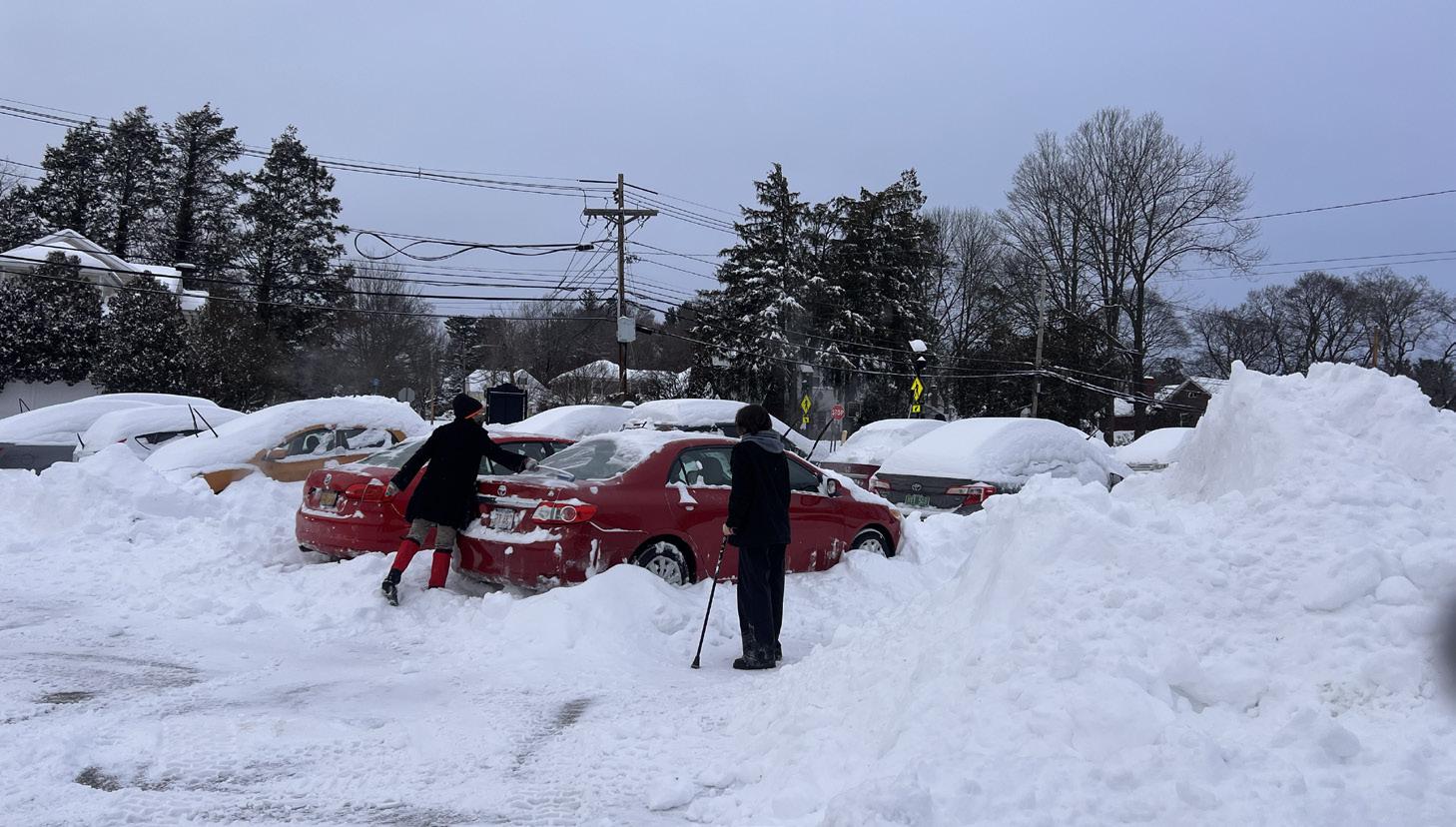
Students clearing snow off their vehicles in the Maple Lot.
OP/ED
THE GATEPOST EDITORIAL
Essential workers are essential for a reason
For students who have grown up in the New England area, heavy snow falls and snow days are not unfamiliar experiences.
However, 18.5 inches of snow can make life on a college campus very challenging.
On a college campus, a snowstorm comes with many issues for students to consider, including where to park, when to go eat, class and activity cancellations, safety walking around campus, and whether they remembered to pack a snow brush.
Essential personnel work incredibly hard in these conditions to mitigate these issues for students and show up on campus to ensure they are safe and comfortable.
The Dean of Students Office made the campus community aware of the cancellation of class and activities as well as adjusted parking guidelines on Jan. 23, three days prior to the snow day on Jan. 26. The advance notice gave students plenty of time to prepare for the weekend.
The additional snow day on Jan. 27 was incredibly valuable to the University’s large population of commuter students. With over 20 inches of snow falling on some Massachusetts towns, there was no safe way for commuter students and faculty to get to campus.
In order to keep us safe, there were many departments working tirelessly during the storm. Framingham State Police Department officers were continually patrolling, Sodexo employees continued to cook hot meals for students, and the Facilities’ snow crew worked throughout the entirety of the snow storm to keep walkways clear.
In addition to the snow, the temperatures dipped as low as -1
degree Fahrenheit as maintainers were still out shoveling and plowing.
Facilities kept the residence halls and academic buildings heated and clean so students could be comfortable and return to their classrooms on Wednesday without issue.
The support from Facilities continued after the storm as members of the Facilities team and Ryan Hacker, associate vice president for the Office of Facilities and Capital Planning, personally helped students shovel their cars out in the Maple Lot.
Much of the work essential workers perform for the University goes unnoticed by the campus community, but our school would not be functional without it.
These workers don’t get enough thanks throughout the year, and storms like this highlight all of their contributions to the community.
Without this work undertaken behind the scenes, our campus would not have been able to open at all this week. The Gatepost Editorial Board cannot thank all of the members of the campus community who helped us through the storm enough.
It is important to acknowledge the help FSUPD, Dining Services staff, maintainers, and the snow removal crew provide when storms like this hit.
However, it is even more important to thank them for doing the day-to-day work we tend to overlook.
When you see these staff members around campus, take a second to say hello and thank them for all the hard work they do.
Essential workers are essential for a reason.
Adrien Gobin / THE GATEPOST
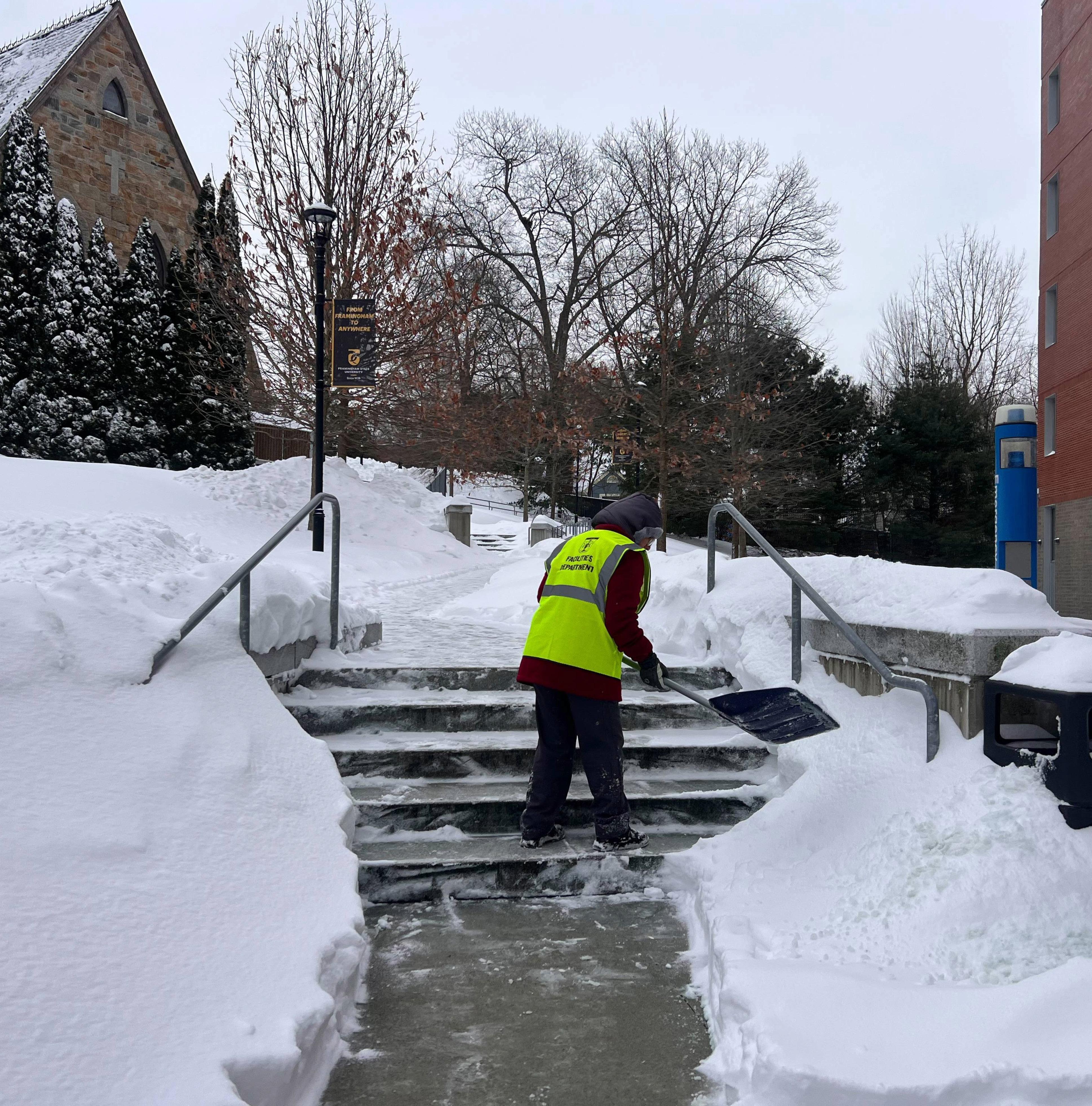
Essential worker shoveling snow outside West Hall on Jan. 26.
Does AI belong at FSU?
By Izayah Morgan Opinions Editor
Throughout modern history, new technology has created a polarization between the people who support it and people who don’t.
Whether it was the creation of the calculator or the invention of the internet, we feared these devices would compromise our creativity or make us lazy. But both technologies failed to replace mathematicians and engineers. However, they created new jobs to maintain and improve upon these technologies.
AI is, without a doubt, a revolutionary invention, and people are divided on its benefits and shortcomings. The technology uses massive amounts of water, and data centers are often constructed in underserved cities, which triggers controversy.
AI also presents many positives as well, with advancements in business and the healthcare and financial industries. It results in sped-up medical diagnoses, improved security enhancement, and around the clock virtual care - all of which potentially reduce human error.
New technologies have always had a deep influence on how we teach. AI has not created a new breed of academic dishonesty, but created new tools for people who were already going to take advantage of the system. People who want to cheat will find a way to circumvent rules and regulations, and if it’s by using AI tools, they’ll do it.
However, these challenges tend to drown out any conversation of the potential benefits AI may have to students, whether it is helping them when tutoring is not available
or automating mundane tasks so educators and administrators can focus on what matters, which is supporting and educating students.
One of the downsides of the American education system is that we put an emphasis on memorization and regurgitation through mandated tests for grades that may determine our future, rather than learning and connecting with what we have previously studied.
This creates a dangerous system in which you either fail and set your life back or cheat this one time and stay on track. Once you open that door to academic dishonesty, it gets easier to justify it.
Additionally, from a student’s perspective, there seems to be no consistent policies dictating whether a class allows AI use. It largely seems to be up to professors to regulate. In part, I am glad as they can extend their autonomy even more into their class environments, which are more and more limited due to state mandates.
However, it seems the educational debate is whether you can use AI or not, which doesn’t help as students will just use AI tools secretly and the software used to detect AI often gives false positive flags. This turns into a game of policing AI use rather than actually engaging and educating about how to use it properly.
On the other hand, we can’t use AI to solve every problem in the classroom as this is the antithesis of what we want to strive for in education, which is free thought.
Some people believe AI is making us lazy, some believe it is the future, some really have no opinion at all, and some are afraid to take a stand due to

how highly polarized the debate has become.
AI is a tool used by people with a range of intentionsfrom good to bad. Technologies are tools, and depending on who holds the power to access them, they can widen or narrow the gap between people with privilege and already disenfranchised individuals. Coming from an underserved community myself, I can say without a doubt that new technologies have allowed me to close that gap.
If we are going to allow AI tools, then there needs to be a coherent standard in place so students maintain academic integrity and transparency with
their instructors.
This technology is likely going nowhere as tech just doesn’t disappear. But we can create rules and guidelines, which can guide students and ensure bad actors are regulated properly.
I hope Framingham State University and other educational institutions in Massachusetts can respond accordingly. Massachusetts is the number one state for education for a reason. We don’t run from things we don’t understand. We learn about them and educate ourselves.
Defining intelligence with the help of Sherlock Holmes
By Kate Norrish Staff Writer
It is not hard to find people talking about misreadings of Sherlock Holmes as a character. He never says “elementary, my dear Watson,” in the original books, is not romantically involved with Irene Adler, and is not, contrary to many, many portrayals of the character, an inhumanly intelligent figure.
I first read Sir Arthur Conan Doyle’s “Adventures of Sherlock Holmes” as a 13-year-old. During this time, I was a recent physical abuse survivor at the hands of a teacher and was in a school for autistic students where, amongst other things, I was told that my suicidal ideations were an over reaction, given a class lesson on how to perform “correct” facial expressions, and regularly heard lines from classmates like “I deserve to be dead,” and “we’re all stupid.”
Upon reading “A Study in Scarlet,” both my first “Sherlock Holmes” story and the first book in the series, I immediately viewed it as a celebration of different kinds of brains. I showed it to my friends at school, and they also began to view the books as a therapeutic resource. Because of that, I
have always found adaptations to be uncomfortable.
In many of them, such as “Sherlock,” and the 2009 film, he is a rude, selfish person who the other characters put up with because he is a genius. In reality, that is the polar opposite of what the books are thematically saying.
This rhetoric also pushes the narrative that people should be permitted to get away with hurting other people because they are perceived to be smarter than the general populace, and doing so is engaging in a belief that has been long used to justify bigotry against a variety of marginalized groups.
In the books, it is also notable that Sherlock Holmes’ famous deduction powers are shown as a learned skill that he has honed through an obsessive amount of research and self training. In fact, Watson becomes better at these skills throughout the books, to the point where late in the series, he begins to point out details that Holmes has overlooked. It is an inside joke between Holmes and Watson that Watson inflates his abilities by not writing about unsolved cases. In general, I feel him being a “genius” is an exaggeration. I rarely see this acknowl-
edged in adaptations, despite Sherlock Holmes being the Guiness World Record holder for most adapted fictional character.
It is also notable that at no point in the books is Sherlock Holmes explicitly shown to live well independently. He needs help preparing food, understanding personal safety, and conceptualizing when he needs to eat and sleep. During the few times he lives without assistance, he ends up accidentally harming himself due to his inability to perform basic life skills.
However, that is frequently overlooked by readers because he is intelligent, which I often wonder what that indicates about how we see neurodivergent and other disabled people who need lifelong living assistance. Similarly, John Locke once labeled Isaac Newton as an “idiot” due to the fact that his mental illnesses made him unable to care for himself, according to an article by Western University Professor Louis Charland.
All of us need to understand that intelligence is far from the most important virtue that a human being can have. If Sherlock Holmes was just smart, and not focused and compassionate,
and even if he didn’t need elements of assisted living, then he would not have provided me and my friends with so much comfort.
Our society has propagandized many people into believing that intelligence is the best human virtue, something which is at the core of Sherlock Holmes’ inner conflict in the books. He describes himself as “A brain. The rest is an appendix.” However, that is not truewhen Watson begins including that belief in his work, he begins to leak inappropriate details, such as Holmes famously being addicted to multiple narcotics.
I define intelligence as a wide range of natural talents that we have condensed into one word. It’s the same thing as when you find classes in your major easy but struggle with a certain GenEd class.
It’s just called being good at some things and not at others.
If you disagree with my definition of being smart, or can’t relate to it, allow me to share a common sentiment amongst the neurodiverse community. I bet many of you have never heard this before - there is nothing wrong with being unintelligent.
Campus Conversations
“What was most inconvenient about the snowstorm?”
By Sophia Oppedisano, Editor-in-Chief and Izayah Morgan, Opinions
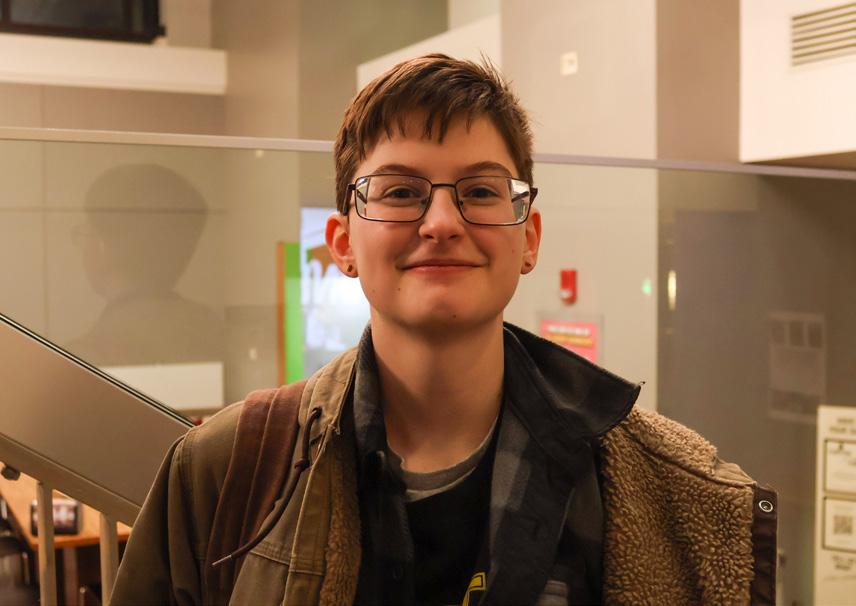
“The sidewalks near Towers were not plowed very well, and it was very hard to navigate.”
- Maeve Reilly, freshman
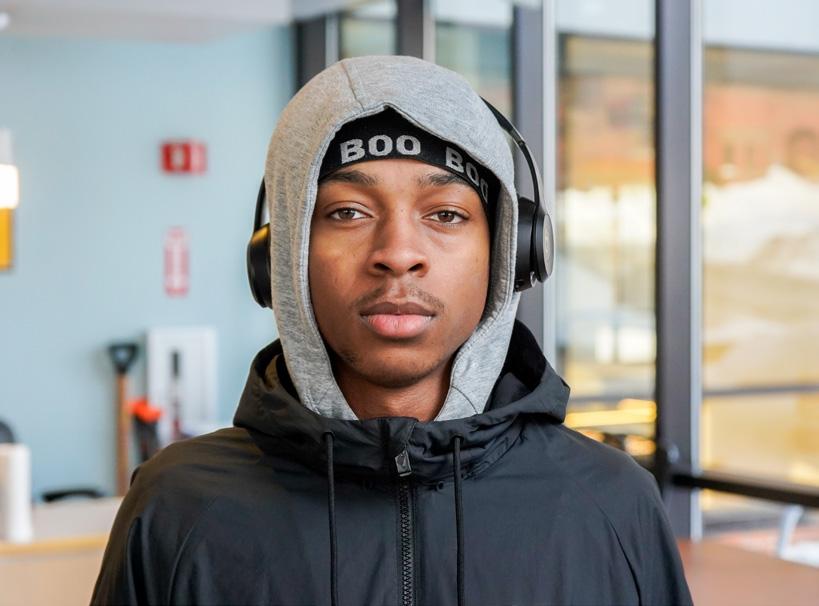
“The most inconvenient part of the snowstorm was having to leave to come to the dining hall.”
- Tahkel Thomas-Stephens, freshman
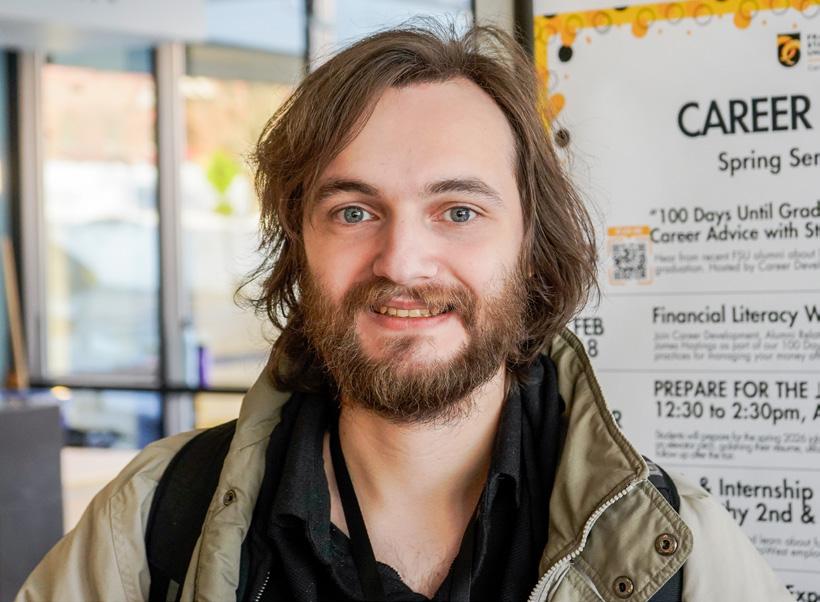
“Losing
my ID and having to wait outside to get in.”
- Evan Biletch, sophomore
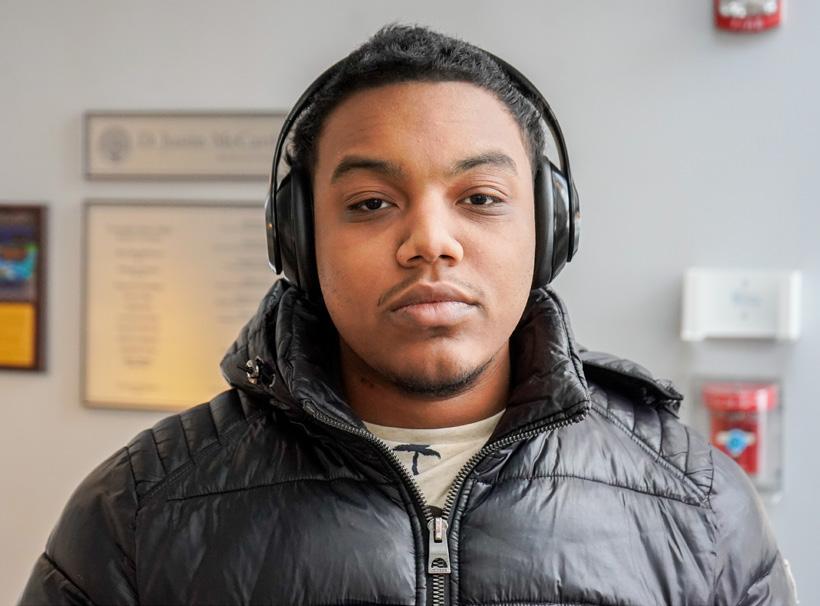
“Having to come to the dining hall, and it’s a blizzard outside!”
- Lendy Arias-Gomez, freshman
Editor
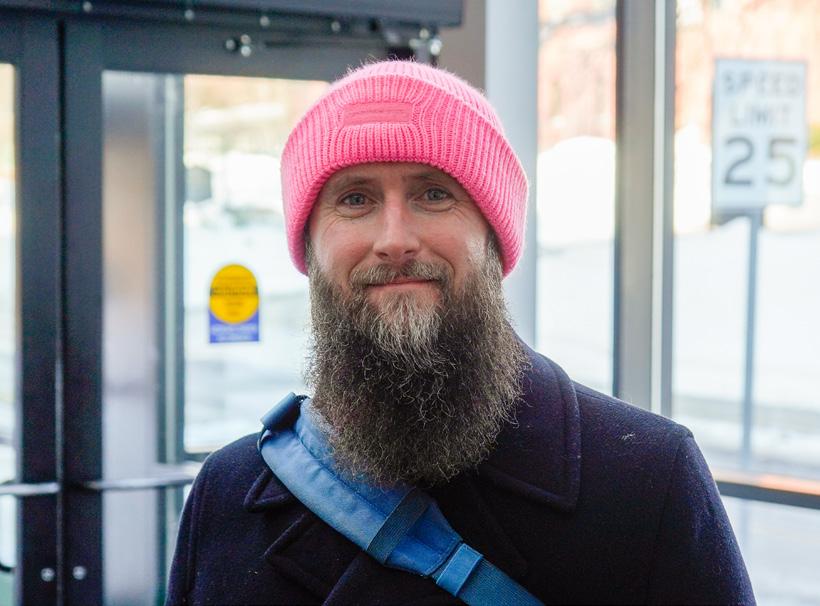
“It
wasn’t inconvenient - it was a snowstorm!”
- William Healey, philosophy professor
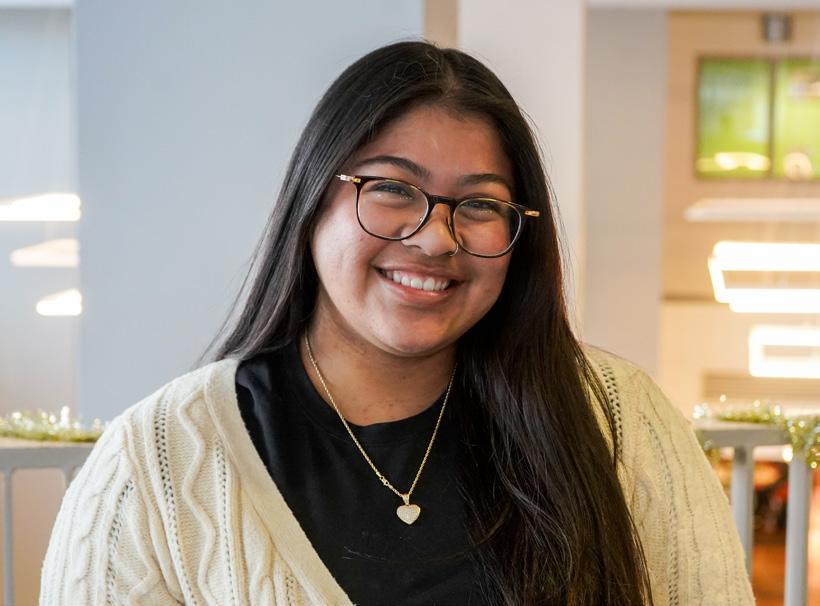
“I was with my dog, Stella. So really, nothing was inconvenient! I ate a lot of food and watched a lot of movies.”
- Jas Lemus, residence director
SPORTS
Women’s ice hockey annihilates Anna Maria
By Izabela Gage Sports Editor
The Framingham State women’s ice hockey team defeated the Anna Maria College Amcats 7-4 on the road Jan. 24.
This win brings their conference record to 2-5 and their overall record to 2-13-1.
The Amcats took the first shot on goal a minute into the game, but sophomore Amy Tansek blocked it.
After about a minute and a half of both teams fighting for the puck, sophomore Alyssa Tansek tried to find the back of the net, but her attempt was stopped by Anna Maria’s goaltender Emma Brewer.
The Rams received a minor penalty, putting the Amcats on the power play.
Sophomore goaltender Lila Chamoun stopped four shots, and sophomore Finley Hogan blocked one during the Rams’ penalty kill.
With the game back to even strength, sophomore Petra Cernicek tried to slap shot the puck past Brewer’s pads, but was blocked by Anna Maria’s Ceilia Nolan.
Alyssa Tansek went for the rebound shot only 10 seconds later, but it was saved by Brewer.
The Amcats put the first point on the scoreboard just over 6 minutes into the first period, but the Rams did not let it go unanswered.
Sophomore Sarah Lewis won the following faceoff before taking a shot on goal, which was unfortunately wide.
The Rams kept the puck in their offensive zone, though, and Hogan netted the first goal for Framingham unassisted.
Freshman Sophie Brien tried to keep the momentum and took a shot on goal, but it was blocked by Anna Maria’s Tessa Henry.
The Amcats gained control of the puck and brought it into the Rams’ defensive zone, where Chamoun made another two saves.
With fewer than 9 minutes remaining in the period, freshman Alexis Brown broke through Anna Maria’s defense and found the back of the net to give Framingham a 1-point lead.
The Rams stayed assertive, with freshmen Molly Murphy and Rylee Bogren both taking shots on goal, but neither was successful.
The Amcats tried to break through Chamoun’s defense, but she saved two shots.
Framingham brought the puck back to their offensive zone, and over the next 2 minutes, Cernicek and Murphy both took shots on net, both of which were wide.
Brien followed with an attempt to get the puck past the goal line, but Henry blocked her shot once again.
Chamoun made another three saves once AMC took back control of the puck, but FSU didn’t let up.
Cernicek attempted to slip the puck past Brewer’s pads, but couldn’t get it through. She followed with a rebound try that was also turned aside. As the
puck lingered in front of the net, sophomore Jamie Webster made a final push to tap it over the goal line, but Brewer held firm.
The first period ended with the Rams in the lead 2-1.
Brien took the first shot on goal only 10 seconds into the second period, but it was saved by Brewer.
Following a wide shot by the Amcats, the Rams took the puck down the ice, where Bogren tried to send the puck into the net twice, but both shots were saved.
The puck stayed in Anna Maria’s defensive zone, and Lewis attempted to earn another point for Framingham, but was unsuccessful.
After the next faceoff was won by the Rams, Murphy took a quick shot on net and put the third point on the board for FSU.
The Amcats did not let that faze them, and Chamoun saved two shots, and Alyssa Tansek blocked another, but Anna Maria eventually found the back of the net 3 minutes later.
Framingham won the next faceoff, and Cernicek tried to extend their lead, but was stopped by Brewer.
The Amcats hoped to score another point and took two more shots on goal, but the Rams’ defense remained aggressive, with freshman Katie Creath and Webster blocking their shots.
Only 13 seconds later, Webster netted the puck to put Framingham in the lead 4-2.
The Rams kept momentum in their favor, and 29 seconds later, Brown broke through Brewer’s defense and brought the score to 5-2.
Framingham won the next faceoff, and Murphy and Hogan took back-to-back shots on Anna Maria’s subbed-in goaltender Alyse Mutti.
The Amcats regained possession of the puck and tried to find a gap in Chamoun’s pads with three shots in the following minute, but Chamoun did not let the puck past the goal line.
Each team took three shots on goal in the next 4 minutes, but both defenses held firm, and no goals were scored.
The game was 4-on-4 following minor penalties for both teams, and after another three saves by Chamoun, Amy Tansek widened the gap to 6-2, assisted by freshman Ella Conway.
In the next 4 minutes, the Rams tried to net the puck five times, but all were stopped by Mutti.
Chamoun stopped another four shots by the Amcats, while freshman Kristina Jones and Brien blocked one each.
The Rams took the puck into their offensive zone once again, where Lewis took two shots on goal, and Creath took one.
The second period ended with a power play goal by Anna Maria to bring the score to 6-3.
The Amcats tried to carry the momentum into the third period, and they took the first shot on goal, but it went wide.
Brown tried to find the back of the net after Framingham won the next faceoff, but was stopped by Anna Maria’s defense.
Each team fought for control of the puck, with both teams taking two shots on goal, before the Rams took over offensively.
Lewis tried to slap shot the puck past Mutti, and sophomore Lily Wilson went for the rebound, but couldn’t find the net.
Brien made a wide shot toward the net, and 10 seconds later, she sent the puck toward Mutti, but was unable to break through her defense.
The Amcats tallied five more shots on goal in the next 2 minutes, with two being stopped by Chamoun, two being wide, and the last being blocked by Murphy.
Framingham took three of their own, but Anna Maria responded with another two shots before they scored short-handed to close the gap to 6-4.
The Amcats tried to find the back of the net, but two of their
attempts were saved by Chamoun, and their third was just wide.
Hogan, Bogren, Cernicek, and Amy Tansek all took a shot each on goal, but could not break through Mutti’s defense.
Anna Maria took another three shots on goal, the first being saved by Chamoun, the second being blocked by Amy Tansek, and the last being wide of the net.
With less than a minute and a half remaining, Wilson scored on an empty net to secure the 7-4 lead for Framingham.
The Amcats attempted to score in the last minute of the game with two shots on goal, but Chamoun ended strongly to keep the Rams’ victory 7-4.
Chamoun saved 37 shots of the 41 she faced in the victory.
She said, “The biggest thing for me is staying focused on the puck. I trust my defensemen to cover other threats, which allows me to have confidence and be aggressive when challenging the shooter.”
Wilson said tallying her first goal of the season “just makes me want to keep getting more and more. We are getting towards the end of the season, so right now we’re all focused on getting as many wins in the conference.”
Murphy said, “We kept the pressure on them the whole game and were very aggressive. The defense did an amazing job breaking pucks out. … We fell short-handed a couple of times in the third period, but we had trust in our penalty killers and just tried to play smart hockey from there to secure a win.”
This conference win breaks their eight-game losing streak.
Chamoun said, “Breaking the streak with a win where we scored so many goals is huge for our confidence. We know what we’re capable of, and that game really showed us. It gives us a lot of faith going into these next few games.”
The Rams travel to Rivier University to face the Raiders in another conference matchup Jan. 31.
Murphy said their main focus for the last half of the season is “winning more games. We have been progressing more as the season has gone on, and we show up to practice every day and work with each other to get better every day.
“As a second-year team that is still growing, we know it’s not going to be easy, but we know that it’s important to stick with each other,” she added.
Chamoun said, “Obviously, we have some games where we struggle, but we don’t dwell on it. We learn from every game whether it’s a good thing or a bad thing. Building consistency, trusting each other, and working hard every day is our focus, and we look to keep that going into the end of this season and into the next.”
Stats sourced from fsurams.com and MASCAC.com
CONNECT WITH IZABELA GAGE igage@student.framingham.edu
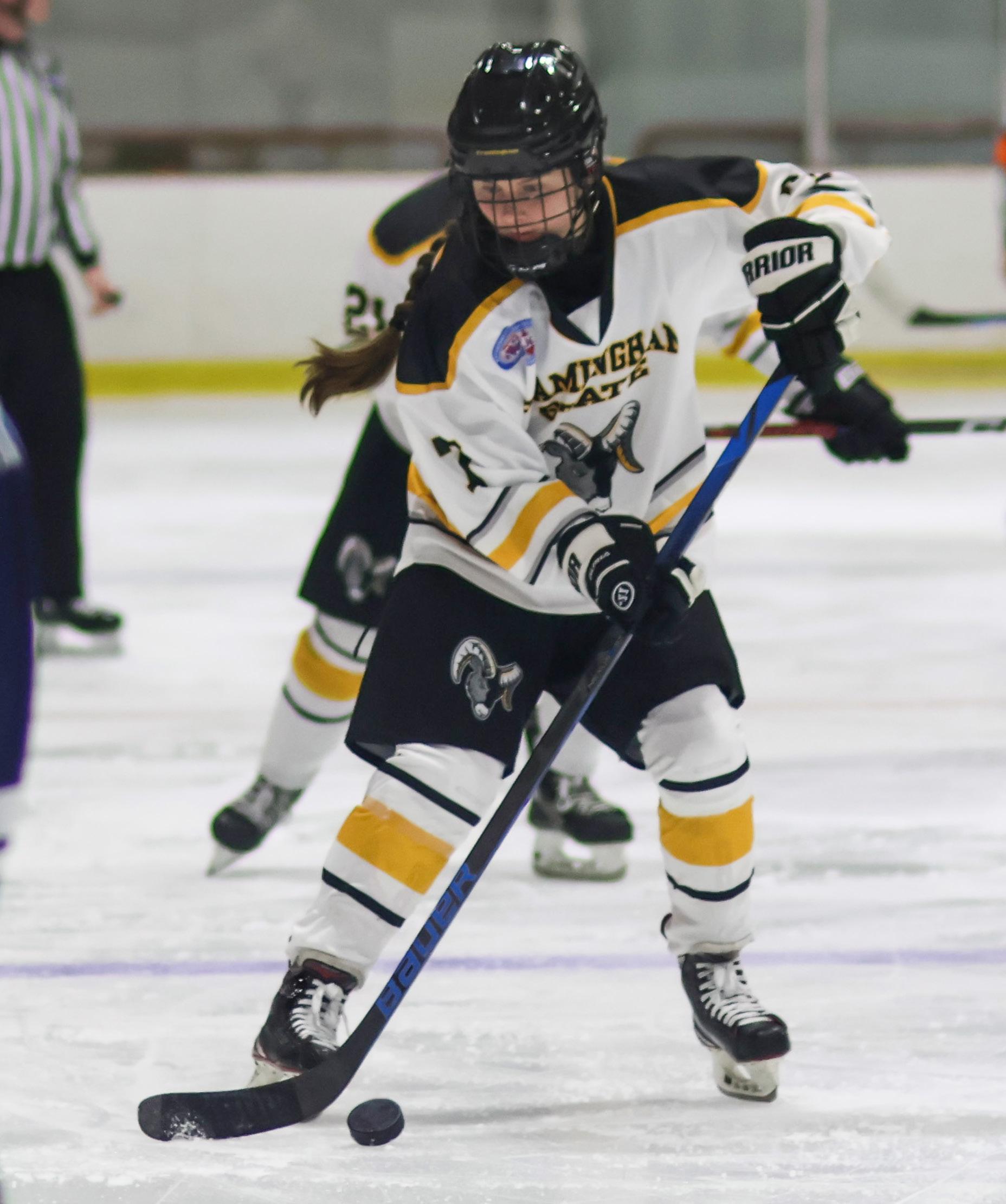
Adrien Gobin / THE GATEPOST
Kaelyn Thompson skating with the puck in loss against Albertus Magnus College on Dec. 6.
Men’s ice hockey triumphs over Rivier University
By Avery Slavin Staff Writer
The Framingham State Rams were victorious over the Rivier Raiders in a conference matchup Jan. 24.
This brings their overall record to 5-11 and their conference record to 2-4.
Assistant captain Scott Bugarin, a junior, won the initial faceoff, but Rivier took the first shot of the game, though it was too wide to make it in the net.
After another wide shot from Rivier, senior goaltender Owen Swanbon was able to save the next two goal attempts from the Raiders.
Sophomore Zacharias Pappas and senior Luke Yubeta took the opportunity to shoot the puck, but were unable to put points on the board for the Rams.
Rivier sent the puck straight to Swanbon, who didn’t let up on his defense and saved it.
Bugarin fired back with a shot of his own, but it was saved by Rivier’s goaltender, Mason Meyer.
Freshman Jeremy Zecher gained possession of the puck and sent it toward Meyer, but couldn’t get past his pads.
Just seconds later, freshman Jonas Oesterle tried again to get the first point of the game, but was unsuccessful.
The Rams upped their efforts and started getting more aggressive on offense, not allowing the Raiders to get a shot in for an en-
tire 2 minutes.
Shots from Yubeta, Bugarin, junior Brent Scott, seniors Sam Larkin, Jerry Duckett, and Captain Jake Barcelou were all strong, but unsuccessful.
When Rivier finally gained possession of the puck, they were able to fire two shots toward Swanbon, who saved them with ease.
Swanbon saved two more shots from Rivier before the Rams got their first power play.
Framingham sent a steady stream of shots toward Rivier’s defense, but all seven were unable to reach the back of the net.
After the power play, Duckett attempted to finish the first period with a goal, but the puck went just outside of the net.
Within the first 30 seconds of the second period, Larkin slapped the puck toward the Raiders’ defense, but still couldn’t put the first point on the board.
With help from Yubeta and freshman Grig Kaagan, Zecher was then able to score the first goal of the game.
Riding this momentum, Framingham stayed aggressive on offense. Bugarin won the faceoff following the goal, and the Rams didn’t let the Raiders get the puck near the net.
After trading possession of the puck for the next few minutes, a power play began in favor of the Rams.
After three unsuccessful shots in a row from Framingham, Larkin was able to slap the puck
past Meyer’s defense, scoring the Rams’ second goal.
Larkin sent the puck toward the net with the intention of beginning the last period with a third point, but Meyer didn’t allow it.
The Raiders matched Framingham’s aggressive energy and were able to score the first point for Rivier.
The Rams weren’t shaken and made three goal attempts during their next power play, none of which got past Meyer.
Due to a roughing penalty on Framingham, Rivier was able to take advantage of their following power play, firing four shots toward the net, but none of them got far enough to earn them a point.
The Raiders didn’t stop there and kept playing assertively, but not strongly enough to get their next three shots past Swanbon.
Although the next power play was in favor of Rivier, Zecher broke Meyer’s defense and scored an unassisted goal.
Swanbon kept the puck away from the back of the net three times in a row before the Raiders got their final power play, when they scored their second and last point.
The final period ended with a score of 3-2 in favor of the Rams.
Most recently, the Rams fell to the Anna Maria Amcats on home ice Jan. 29, bringing their overall record to 5-12 and their conference record to 2-5.
Framingham will host the Westfield State Owls in a conference matchup Jan. 31.
Stats sourced from fsurams.com and MASCAC.com
Swanbon said, “We knew Rivier was going to be desperate and come at us hard, especially when they scored early in the third period, but we didn’t panic. We stuck to our structure, trusted each other, and stayed disciplined defensively. Our ability to do that in a close game was huge in securing the win.”
CONNECT WITH AVERY SLAVIN aslavin1@student.framingham.edu
Women’s basketball soars past Anna Maria
By Taylor Kimmell Asst. Sports Editor
Effective defensive play and strong offensive drives powered the Framingham State Rams past the Anna Maria Amcats 8054 in a non-conference matchup Jan. 28.
This win improves FSU’s overall record to 9-9. Their conference record stands at 5-2.
Senior Kiara Cerruti kickstarted the action with a jump shot, followed closely by layups from sophomores Faith Greene and Jacqueline Schels.
Schels scored once again a minute later, netting a 3-point jump shot.
Anna Maria continued to
struggle against the Rams’ defense, and after their fifth turnover, watched Framingham net the ball for another 3 points.
In the following minute, Cerruti made a steal, passing to Captain Abigail Martin, a senior, who sent the ball to Schels for another jump shot.
On their next possession, the Amcats missed a jump shot, and junior Ava Mckeon got the rebound, advancing the ball down the court for Schels to score 2 more points on a layup.
With 5:29 left in the first quarter, Anna Maria’s offense finally broke through with a layup, though they already faced a sizable point deficit of 16-2.
Greene made a layup on the Rams’ next possession, and the Amcats added 2 more points to their score on the following play.
Green capitalized on Framingham’s next two possessions, bringing in 4 more points.
Anna Maria put up 4 more points during the final 2 minutes of the quarter, while Schels and Cerruti tallied a collective 5 points for the Rams.
Greene opened play in the second quarter with a layup, increasing the Rams’ lead to 29-9. On the same possession, Greene sank a foul shot.
The next 5 minutes saw baskets from both teams, with the Amcats scoring 9 points while the Rams brought in only 4.
Cerruti, Schels, and freshman Evi Higgins scored for the Rams as the half came to an end. Anna Maria scored once more on a layup.
Shortly after, Anna Maria battled back, scoring their first 3-pointer of the match.
Cerruti was a driving force on the Rams’ next two possessions, scoring on a layup and a 3-pointer.
The teams traded baskets for the next 3 minutes, with the Amcats scoring on a 3-point jumpshot and three free throws while FSU added points to the board with a jump shot by Schels and a 3-pointer by sophomore Bridget Trainor, bringing the score to 5028 - the Rams still holding onto a significant lead.
After five uneventful possessions from both teams, the Rams were able to score when the Amcats fouled freshman Zaria Anderson, allowing her to sink a shot from the free-throw line.
Schels and Cerruti kept up the action for FSU for the remainder of the quarter, tallying 11 points.
The fourth and final quarter saw rampant action from both sides. A layup from the Amcats started off the final 10-minute stretch, closely followed by a layup by Cerruti.
After Anna Maria scored on three free throws and a jump shot, sophomore Haleigh Cyrus scored on a layup to bring the score to 71-49, with the score still in favor of the Rams.
With 3:40 to go, sophomore Shaelagh Green netted the ball on a layup. The next two plays resulted in a 3-pointer from each side, with FSU’s coming from Higgins.
Fouled by the Amcats, Green was able to score on two free throws, increasing the Rams’ lead.
Green scored once again for Framingham when, with 1:15 left in the match, she sent up a layup.
The Amcats put up 2 more points before the buzzer sounded, but as the clock hit zero, the Rams secured the victory 80-54.
Schels said the team can attribute their win to “playing together as a team and using our defense to fuel our offense.”
Martin said the team played to their strengths during the match, tackling the challenge as a team.
She said FSU “truly came out strong in the first couple of minutes in the first quarter, which helped with creating the flow for the rest of the game. We have worked so hard this season and we have been focusing on our team atmosphere to carry us through the next couple of weeks,” she added.
Schels agreed the team has worked to improve their chemistry since the start of the season.
She said the team has really “come together. I hope we can start peaking just in time for the post season and hope to make a good run we can be proud of.”
As the team progresses into the conference-heavy portion of their season, Martin said the Rams are setting standards for themselves and the program. She said, “We are just taking it one game at a time. League play can get pretty crazy, but we all take the time to put in the work on and off the court.”
The Rams will take on the Westfield State Owls in a conference matchup on the road Jan. 31.
Stats sourced from fsurams.com and MASCAC.com
CONNECT WITH TAYLOR KIMMELL tkimmell@student.framingham.edu
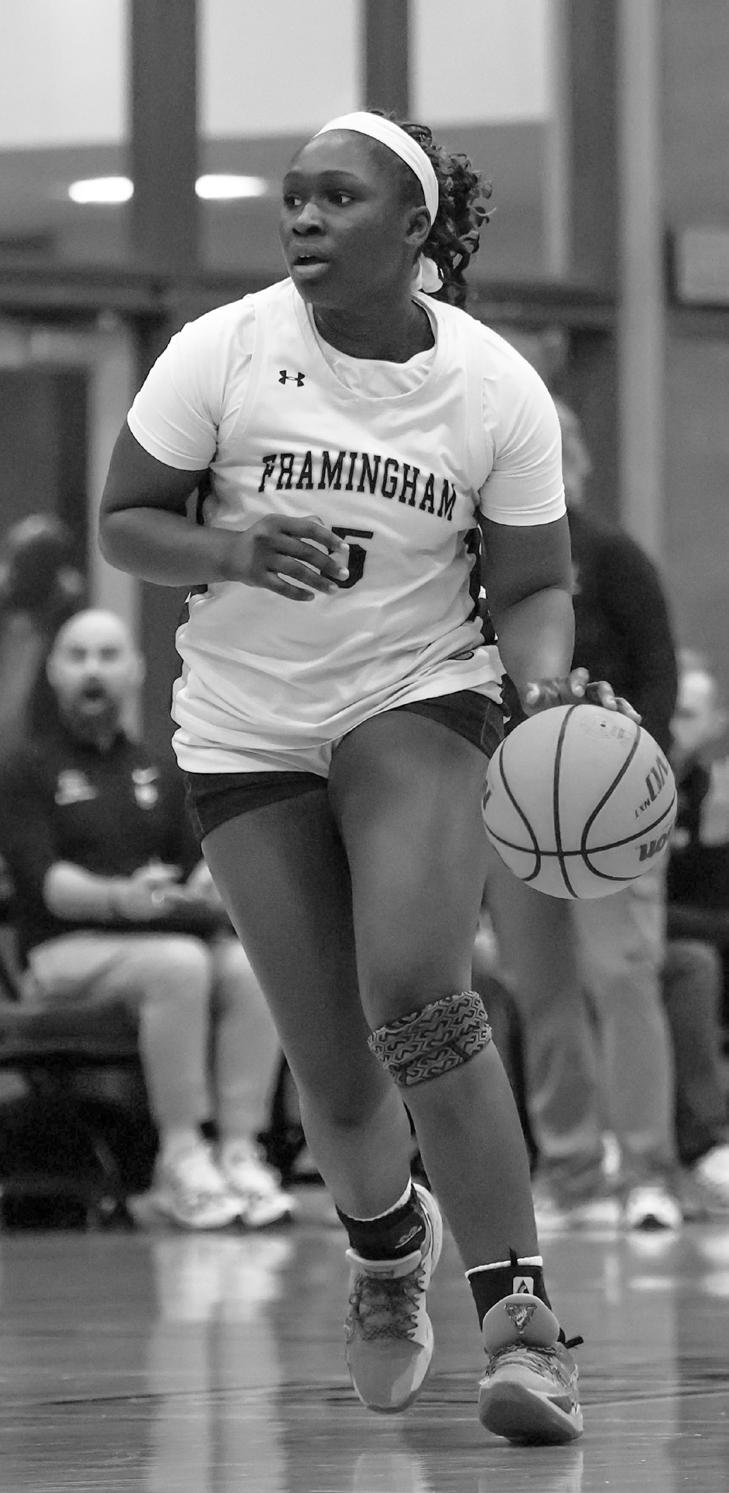
Adrien Gobin / THE GATEPOST Faith Greene dribbling the ball in win against Anna Maria College on Jan. 28.
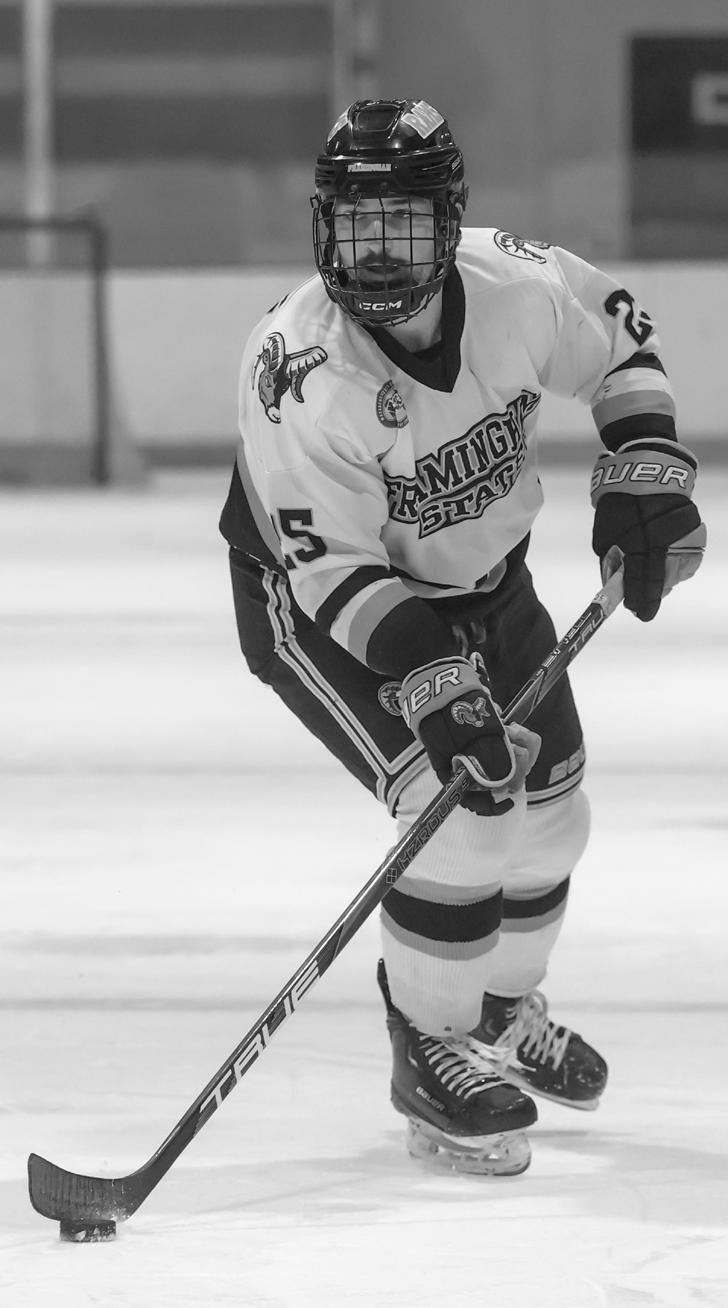
Adrien Gobin / THE GATEPOST Brent Scott skating with the puck in loss against Anna Maria College on Jan. 29
ARTS & FEATURES
Andrew Frimpong brings kindness to community policing
By Dylan Pichnarcik Associate Editor
With an uplifting British accent that turns routine greetings into quick moments of warmth, Officer Andrew Frimpong of the Framingham State University Police Department (FSUPD) has become a familiar presence brightening the days of many who cross his path.
Frimpong may seem like a campus presence going back generations. However, he only got his start in law enforcement at the age of 50. He is now 54.
Before working in law enforcement, Frimpong worked as an activities coordinator for individuals who struggled with mental health.
“I loved the job, and myself and another colleague, we actually set up a soccer league for people with mental health issues. It was a co-ed [league], and it was not only to enjoy sports, but also to break down the barriers and stigma surrounding mental health. And it grew so exponentially that we actually traveled the length and breadth of the UK, promoting sports for people with mental health issues,” he said.
He added his organization was recognized by multiple premier soccer clubs, and they were able to host a tournament at the Chelsea Football Stadium.
While working with individuals with mental health issues, Frimpong also had a passion for criminal justice, and after being offered a job in the States, he pursued his degree and was encouraged by a professor to become a police officer.
“I said, ‘To be honest, I’m way too old to become a police officer.’ And he said, ‘No, Andrew, they’re recruiting like crazy.’
“They were looking for people who had experience in de-escalation, and because of my past in mental health and doing therapy work, he thought that I would make an ideal police officer,” Frimpong said.
Shortly after, Frimpong joined a police academy led by former FSUPD Chief Joseph Checci.
Frimpong said when initial-
ly enrolling in the academy, he did not pass the Cooper Entrance Exam, a required fitness test for admission.
He said a portion of the exam is a mile run that must be completed in a short amount of
the campus, because I like chin-wagging. I like talking to people. And I love just taking the time and talking to people, asking how their day’s going, and seeing how things are. And if they’re having a bad day, how
to try and get her arrested, and the officer comes in, finds out the story behind what’s going on, and pays for the diapers,” he added.
Frimpong said, regarding FSU, “When I came to Fram-
time, which he was unable to complete.
“Damn, I just couldn’t do it,” he said.
Frimpong added, “One of the drill instructors actually pulled me aside after my attempt, and he said, ‘Listen, I want you to run for the whole year. I just want you to practice running for the whole year, and I’m gonna contact you again because I want you back at the academy.’”
He said he did not initially complete this challenge. However, he later began working toward improving his running time.
He later reapplied for the Cooper Fitness Test and completed the program.
After completing the police academy, Frimpong worked as a municipal police officer, but after a short while, he decided it was not for him.
Frimpong said a major driver of his work on the FSUPD and in law enforcement is communication and de-escalation.
He said he works with individuals who cross his path to hear their stories and come to a resolution.
“I tend to like being around
can we resolve it?
“The simple thing for me is all about time. Taking that extra 5-10 minutes to listen to someone, to find out how their day is going, and obviously helping when I can,” Frimpong said.
He added he also understands what policing has looked like in the past and how it continues to reflect on law enforcement institutions, citing incidents such as the murders of George Floyd and Stephen Lawrence as moments he was discouraged by law enforcement.
Frimpong added he believes “wearing this uniform - and I know this sounds like a cliché - you can really make a change. You can spend that few couple of seconds talking to a person and just get to know their story. Or, spending some time with them, even if it’s something so irrelevant, like their cat is in a tree, or something that you just help that person, and that’s what the uniform can aspire you to.”
“You never hear about the cases where a stranded mother who can’t pay for diapers is in a store and all of a sudden, the storekeeper calls the police
ingham, straight away, I loved it straight away. It was perfect.”
He added, “I could just see the whole department. The police department was absolutely phenomenal. Really easygoing. They could relate to students’ needs. It was a small corps of police officers, and they really, really did relate well to students as well.”
He moved to the United States 20 years ago from London. While being born in the United Kingdom, Frimprong is proud to say his “country of origin” is Ghana.
He added he still has family in London including his parents and son, and goes back frequently to visit them.
Frimpong, with a grin on his face, said his favorite food from back home consists of a full English breakfast.
“I’m a foodie. I am a real foodie. To get my day started, I usually have to have something in my stomach, and I do miss a good English breakfast,” he said.
According to Frimpong, a full English breakfast consists of sausages, bacon, eggs, baked beans, and toast, and he prefers pineapple juice instead of a traditional coffee or cup of tea.
While discussing his favorite breakfast items, Frimpong omitted a staple of a traditional English breakfast, the infamous “black pudding.”
“No, no, Hell to the no! Who would want to eat congealed pig’s blood? It’s so nasty,” he said.
Black pudding is a blood sausage, which is a traditional part of a full English breakfast.
In his free time, Frimpong enjoys playing pickleball with his colleagues at the Warren Conference Center and is the self-proclaimed “King of Foosball.”
Frimpong is also an avid ping pong player and still hasn’t found anyone within the University “to come and challenge me yet.”
CONNECT WITH DYLAN PICHNARCIK dpichnarcik@student.framingham.edu
Dylan Pichnarcik / THE GATEPOST
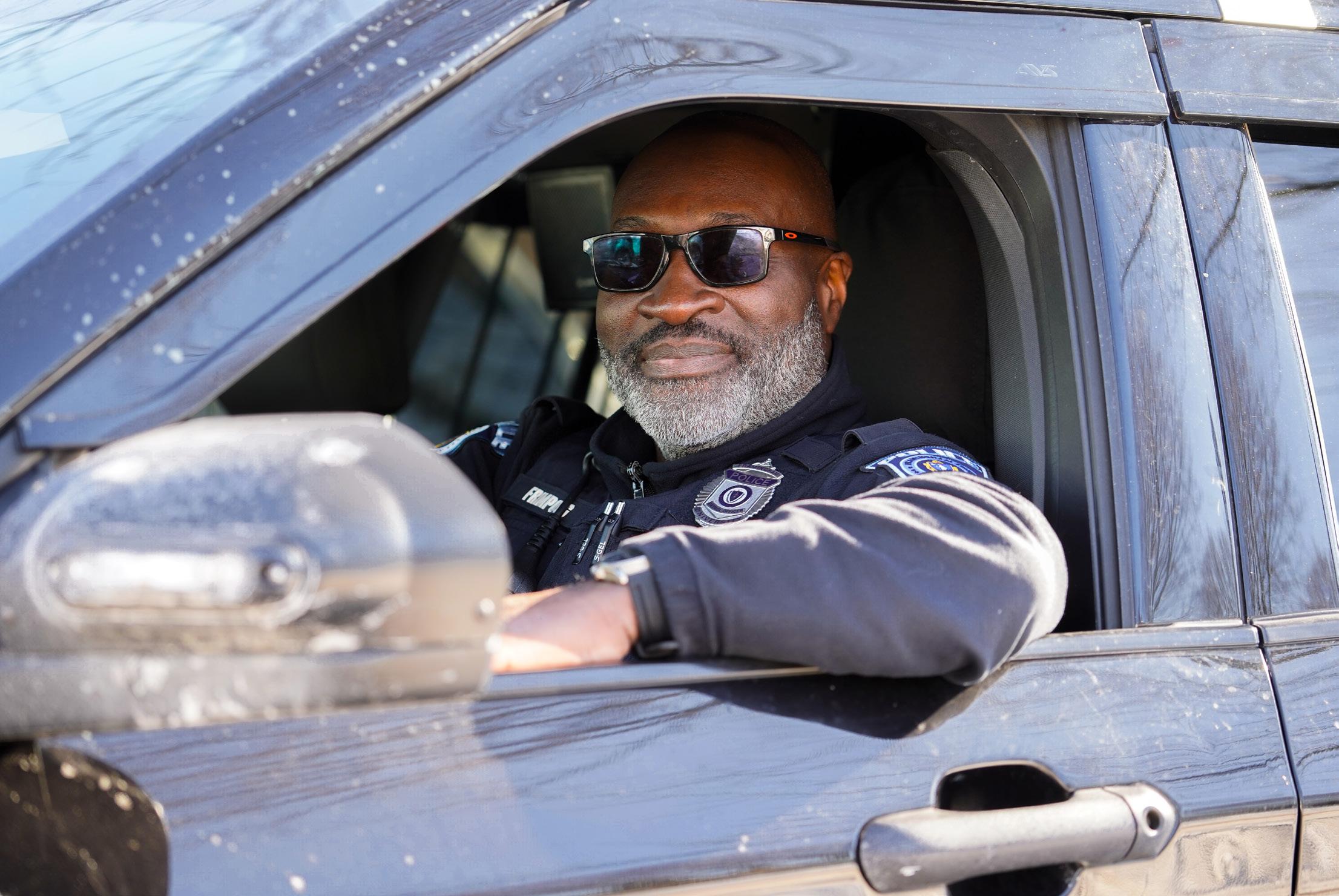
Officer Andrew Frimpong behind the wheel of an FSUPD cruiser.
Dylan Pichnarcik / THE GATEPOST
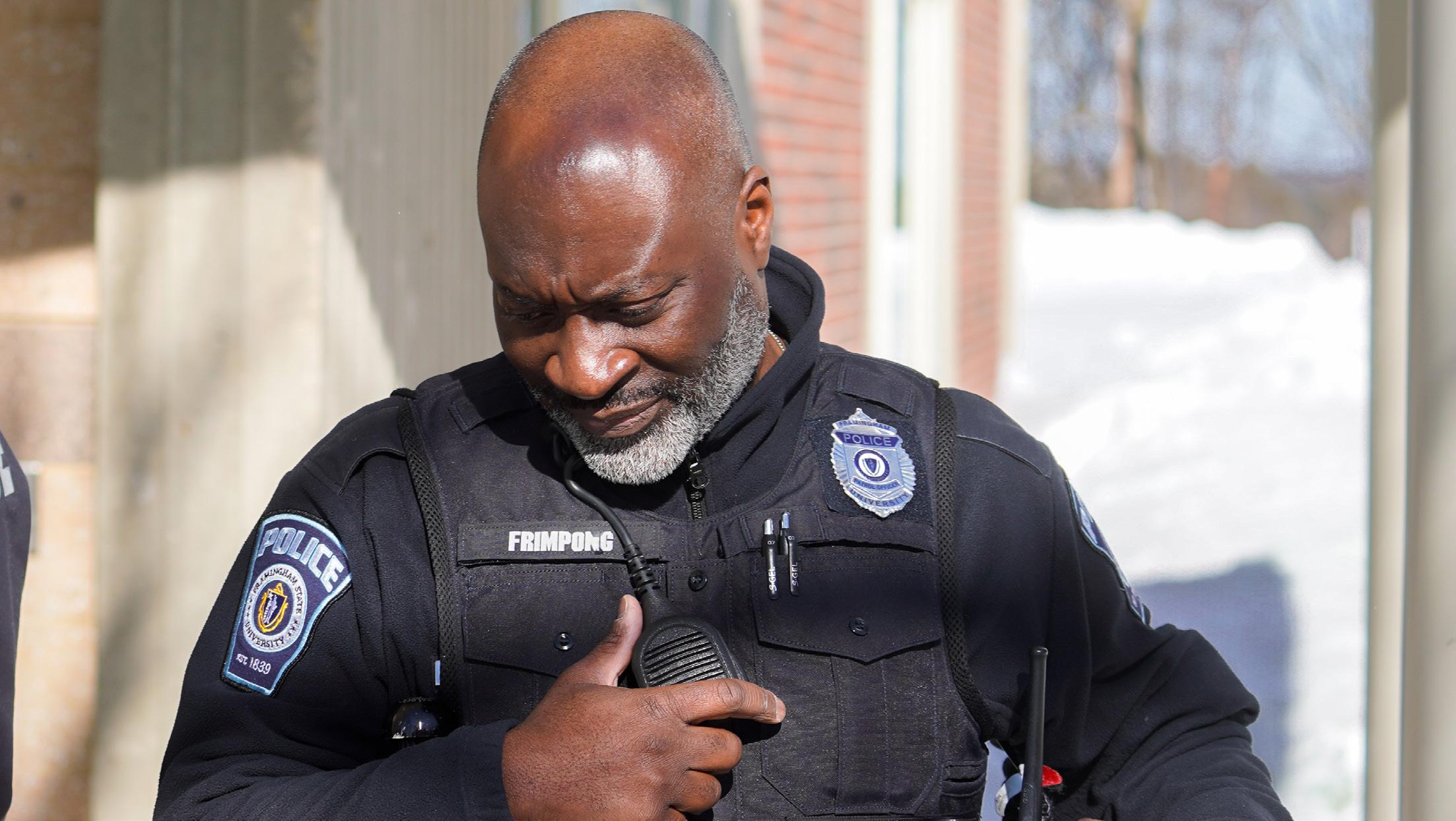
Officer Andrew Frimpong radioing FSUPD dispatch in front of Corrine Hall Towers.
Best of 2025
‘Kirby Air Riders’

‘Allston x Allston’
By Alexis Schlesinger Editorial Staff
Considering how many incredible albums and songs came out in 2025, I figured it would be an impossible task to highlight just one band and their work as the “Best of 2025.”
Fortunately for me, and everyone else on the planet who enjoys music, 27 of Boston’s greatest bands came together for the album collaboration of a lifetime.
The “Allston x Allston” album was released on Nov. 17, 2025, and consists of 27 tracks.
Local scene legends came together to cover each other’s songs, and the product is a unique listening experience you can’t find anywhere else.
The tracklist is compiled in a specific order, so don’t listen to this album on shuffle! Listening to the album straight through leads listeners from each cover to its original artist, creating a perfect loop all the way through.
As a huge fan of local folk-adjacent and shoegaze artists, I am incredibly partial to the first five tracks,
especially Kinship’s cover of Wulfer’s song “Cat.”
However, this is a no-skip album. Each band took their given cover and gave it their own unique spin, while still preserving the original song’s personality.
The existence of this album really speaks to the strength and beauty of the Boston music scene. You can hear the love and respect each band has for each other, and their greater community, in every track.
As if this album couldn’t get any sweeter than “friends covering each other’s music,” Allston x Allston was released to raise funds for “‘Warm Up Boston,’ a radical survival program serving Boston’s unhoused community.”
“Allston x Allston” is free to listen to, and available for purchase on the Bandcamp app for $16, or more, if you’re able. All proceeds from the album are donated to “Warm Up Boston.”
CONNECT WITH ALEXIS SCHLESINGER aschlesinger@student.framingham.edu

By Paul Harrington Staff Writer
Whenever a new racing game comes out, it usually gets compared to whatever the current iteration in the “Mario Kart” franchise is.
Surely, two great games can co-exist together.
But I think it’s safe to say that “Kirby Air Riders” for the Nintendo Switch 2 has solidified itself as one of the most chaotic and damn good racing games to have come during 2025.
Although I never got to play the original, I’m sure glad I’m here for the ride!
For beginners, the tutorial section offers a plethora of interactive exercises that teach you how to play the game and test you on what you just learned.
Having tutorials accessible from the start makes picking up the game a breeze for everyone.
They don’t go away even after completion, so if you want to practice a certain mechanic,
you’re always free to do so.
Where “Kirby Air Riders” excels the most, in my opinion, is the City Trial mode. What I love about this mode is just how chaotic and fast paced things are.
You’d be surprised how fast the time goes in this mode as you’re picking up buffs and dodging hyper beams! Once time is up, you play a little mini game and either win or lose.
Yes, the fast-paced and chaotic vibes can be said for just about every aspect of this game.
But that’s just what makes the gameplay so addicting and satisfying to experience.
“Kirby Air Riders” isn’t a racing game.
It’s a love letter to everyone who craves the fast life and messing around with friends on multiplayer.
CONNECT WITH PAUL HARRINGTON pharrington@student.framingham.edu

‘With A Vengeance’
By Dylan Pichnarcik Associate Editor
This train never slows, and neither does New York Times best-selling author Riley Sager, who produced this past June another captivating mystery novel, “With a Vengeance.”
Sager’s latest novel is a perfect reflection of the author’s dedicated work in publishing and is a high-speed revenge thriller that keeps the characters - and the readers - trapped on an ill-fated train ride on board The Philadelphia Phoenix, a fiery race where the secrets and misfortunes of the passengers are revealed.
The novel is set in 1942 and is a callback to the elegance of rail travel, and is sure to invoke memories of reading Agatha Christie’s “Murder on the Orient Express.”
What I appreciate most about Sager’s work across all of his titles, and particularly in this novel, is the development of his characters and the attention to detail he puts on their backstories.
While objectively, it may be
hard for readers to latch onto the idea that they have something in common with people who are supposed to live in the mid-century United States, Sager’s development of these individuals makes them leap from the page.
I also appreciate Sager’s representation of voices from many different backgrounds that allow people of different genders and groups to connect with.
Avid readers of Sager will also appreciate various nods and callbacks to “The Sagerverse” - a world that appears to be like our own, but is an external plane of existence where the characters he develops inhabit and interact with one another.
“With A Vengeance” will surely make you want to book a cross-country journey by train and get lost in a world of chaos, shock, and excitement.

Marcus Falcão / THE GATEPOST
Rileigh Kelley / THE GATEPOST
Marcus Falcão / THE GATEPOST
‘Kansas Anymore (The Longest Goodbye)’
By Sophia Oppedisano Editor-in-Chief
I am just as shocked as you are that one of my top albums of 2025 was Tucker Pillsbury’s deluxe edition of his sophomore album, “Kansas Anymore.”
If you know me, my name and Pillsbury’s - who goes by his stage name Role Modelwouldn’t have been caught dead in the same sentence after his rap-influenced debut album “Rx” released in 2022.
But hear me out!
“Kansas Anymore (The Longest Goodbye)” came out on Valentine’s Day as the perfect companion for those who may have recently been through a crushing breakup. What sets this pop rock, folk-influenced gem apart from a factory heartbreak album is the threads of gratitude and reflection that are laced through Pillsbury’s lyrics as well as his sentimentality for a love that simply wasn’t right.
His sincerity and self-awareness on tracks such as “Scumbag,” “The Dinner,” and “Some Protector” are a far cry from his bad-boy facade on “Rx,” and I found my-
self leaning into the longing lyrics on tracks such as “Slip fast” and “Something, Some how, Someday.”
Tracks such as “Writing’s on the Wall,” “Deeply Still in Love,” and of course, the vi ral hit “Sally, When the Wine Runs Out,” feature fast acous tics, addictive melodies, and that patented melancholic, yet energetic sound of the Noah Kahan era.
While yet another breakup album might be the last thing we needed in 2025, I found myself drawn to Pillsbury’s honesty and his willingness to sit and wallow in his feel ings while still managing to poke a bit of fun and sink into a sound that suits him.
“The Longest Goodbye” punctuates the album with a coy shrug from Pillsbury, sug gesting that maybe, just may be, we’ll be all right after all.
I’ll let you in on a secret: I listened to “Sally, When the Wine Runs Out” 359 times in 2025.
Help! I’m stuck at Sally’s Wine Bar, and the wine still hasn’t run out.
CONNECT WITH SOPHIA OPPEDISANO soppedisano@student.framingham.edu

‘One Battle After Another’
By Owen Glancy Arts & Features Editor
Of all the great films released last year, none made quite the impact that Paul Thomas Anderson’s “One Battle After Another” did. The first truly action outing from Anderson, the film follows Bob (Leonardo DiCaprio) and his daughter Willa (Chase Infinity) as Bob’s past finally catches up to him and the pair are forced to go on the run from an old nemesis.
The biggest positive of “One Battle After Another” is absolutely the cinematography. Every shot feels so dynamic and alive, even stills are infused with this breath of life that makes this chaotic world the film lives in so believable. There’s a car chase toward the end of the film that’s shot in such a unique and interesting way, that it makes you feel as if reality itself is bending and you’re being sucked right into the screen.
DiCaprio delivers a ca-

‘MAYHEM’
By Antonio Machado Multimedia Editor
Lady Gaga is a load-bearing name in the music industry. For so long, Gaga has repeatedly pushed the needle, reinventing how pop music is made through her innate theatricality.
Now, after spending a handful of years focusing on her acting career, Gaga has made a much-needed return to music with the release of her seventh studio album.
“MAYHEM” is something that has completely not ever been done before. It’s unafraid to reference or not reference, put it in a blender, s**t on it, vomit on it, eat it, and give birth to it.

reer-best performance as well, making up for his somewhat weaker string of performances in the 2020s in films such as “Don’t Look Up” and “Killers of the Flower Moon.” However, it’s Benicio del Toro and Sean Penn who dominate this film in the acting department, with Penn especially giving this creepily realistic yet oddly silly performance that could only work with Anderson’s directing.
“One Battle After Another” continues this new trend of auteurs in film making their most approachable works yet, getting a new audience interested in more challenging cinema. As Anderson’s first action film, it nails every aspect of the genre with great gun fights, simple yet endearing characters, and in-your-face social commentary all built on a foundation of incredible directing and performances.
CONNECT WITH OWEN GLANCY oglancy@student.framingham.edu
The record is pastiche done tastefully. Gaga knows and understands how to make music - it was immediately apparent from her debut - and that understanding of music is exactly what allows her to branch out into various genres and aesthetics to explore her artistry and execute them all masterfully. She
is unafraid to be influenced, but more importantly, she is aware of how to take her influences and throw them away to make her own sound.
This record is an invitation into the dance floor, and the introspective conversation that is had in the bathroom between dances. The record has a cutting grit, sharpened by Gaga’s flair for the dramatic, but it also has moments of blunt vulnerability, a peer into the softer artist underneath the persona.
“MAYHEM” is anything but. It’s a cohesive story of love, told through a raw, unfiltered inner conflict. It’s a record composed through the contradictions of the heart. It’s a constant, high-speed collision of Gaga and herself, constantly meeting at the intersection of Pop and Rock.
Good Gaga music? Recession indicator.
CONNECT WITH ANTONIO MACHADO amachado4@student.framingham.edu
Marcus Falcão / THE GATEPOST
Marcus Falcão / THE GATEPOST

By Owen Glancy Arts & Features Editor
“Owen’s Oldies” has historically been a column dedicated to exposing readers to a new world of cinema, films that are either too obscure or too old for most to have seen, let alone heard of. Across four semesters, that’s what “Owen’s Oldies” has done, quite successfully too. A few people have come up to me saying that they’ve watched films such as “The Umbrellas of Cherbourg” or “The Long Goodbye” thanks to “Owen’s Oldies.”
While I personally like every single one of the films I’ve talked about in this column, I’ve yet to discuss my personal favorites since the vast majority of them are more popular and less obscure. However, I’ve decided that to truly convince someone of anything, passion must be a guiding factor, and to that end, we arrive at “Dazed and Confused,” my favorite movie.
Richard Linklater’s 1993 followup to his directorial debut “Slacker,” “Dazed and Confused” carried that lackadaisical stoner energy from his prior work into his most iconic film. The movie follows an ensemble cast of Texan high school students on their last day of school in 1976 and the trouble they all get into.
The Lexicon
By Alexis Schlesinger Editorial Staff
“Film and Gender? More like lame and stupid.”
On Dec. 6, 2025, a “callout” video was posted to several local musicians’ Instagram pages containing clips of folk artists and punk artists insulting each other.
One folk musician even claimed, “I listened to ‘Maeve’ by Dowsing Rod, and now I have gout.”
Fortunately for New England folk-punk fans, nobody was really fighting, and the roast compilation was a promotional video for the show the musicians were performing that night.
“Folk vs Punk Fest” was organized by Iss of local punk band Film and Gender, and folk musician Lou Mace. Both performed for their respective genre.
The bill for the night also consisted of three additional folk acts - SB, Connor Storms and His Bouquet, and Colonel Starr - and three additional punk acts - Dinos, Inplainsight, and Dowsing Rod.
“Folk vs Punk Fest” was an all-ages show held in the Allston Abbey church, with music from 7 p.m.-11 p.m. Each of the eight artists that night got to showcase their music with 20-30 minute long sets.
While the event was marketed as a sort of battle-of-
In similar fashion to “Slacker,” “Dazed and Confused” is a love letter to Linklater’s own upbringing, told through a thick and incredibly rosy lens. The film feels like being told a story by a new friend about their times in high school, in
enhances its perfect atmosphere with incredible performances. The two stand outs are undeniably Ben Affleck and Matthew McConaughey in their breakout roles. Affleck plays the brutish super-senior O’Bannion, a bully who pur-

all of the best ways. Not everything is in chronological order, acts that are morally dubious such as destruction of property and hazing rituals are looked back upon fondly, and the future seemed like such a far away thing no matter which character was considering it.
The film is considered by many to be a seminal stoner classic, and this almost dreamlike tone combined with the truly ludicrous amount of pot smoked on screen, definitely creates that perfect atmosphere.
“Dazed and Confused” also
posefully stayed back a year of high school so he could participate in the town’s hazing ritual twice in a row. Affleck’s musculature and hard-headed attitude make this role one that’s incredibly memorable, even if he doesn’t stick around for long.
McConaughey on the other hand, played the charismatic and controversial Wooderson, an older bad boy with some concerning tendencies toward the women of the film who nonetheless manages to be incredibly memorable thanks to McConaughey’s performance. By all metrics, we should hate
Wooderson just as much as we hate O’Bannion, but McConaughey’s line delivery and signature relaxed style make him impossible to truly despise.
Jason London’s performance as Pink, the protagonist of the film, deserves special attention as well. He perfectly embodies this idea of the “senior mentor,” a kind upperclassman who shows you the ropes in your freshman year, but isn’t necessarily a paragon of virtue. Pink is lazy, addicted to both alcohol and weed, and unfaithful to his girlfriend, yet he’s so grounded. These flaws mix with his kindness and sense of responsibility he feels toward his friends and underclassmen to make a character who, while not perfect, is undeniably human.
“Dazed and Confused” is certainly not a movie for everyone. It’s a little slow paced, there’s essentially no plot, it’s a celebration of vice and of outdated social constructs, and it barely even has a protagonist for most of its run time. However, as a stoner hangout comedy, this film is top class. Every joke is funny, every character is memorable, and every performance is perfect.
To this day, this is the only film where immediately after I finished watching it for the first time, I started it up again, and then again a third time. If you haven’t seen “Dazed and Confused,” you’d be a lot cooler if you did. “Dazed and Confused” is currently streaming on the Criterion Channel.
CONNECT WITH OWEN GLANCY oglancy@student.framingham.edu
the-bands, it was also a fundraiser. All door proceeds were donated to people who were affected by a loss of SNAP benefits. “Warm Up Boston,” a local non-profit organization also held a table at this event.
Despite the way the musicians of each genre pretended to hate each other for the night, the event was a perfect reflection of punk values.
Community outreach, support, and inclusivity are what drove this event to be great and are values that continue to create the safe space that is the Boston music scene.
The “Folk vs Punk Fest” bill alternated every other set between folk and punk. The night was opened by Inplainsight from the punk side.
The band’s high energy was a great way to get the crowd excited, and their set even held some nostalgia. From her strong, crying lyrics, to her striking red hair, vocalist Jasmine truly gave Paramore energy.
Connor Storms followed this set, without his “Bouquet” of bandmates, but delivered a beautiful acoustic folk set nonetheless. He completely charmed the audience with his song “Thank You For Being My Friend.”
Slightly disrupting the back and forth of folk and punk, SB came on next with another folk set. SB was the only musician that night who opted to
play without an amplifier, and insisted the audience gather close to the stage to hear him better.
Most attendees opted to sit on the floor at this point, which proved to be a great chance to rest before one of the most intense sets of the night.
Dinos was certainly the loudest band at the fest, and immediately got everyone back up off the floor. Some fans even joined the band on stage, jamming around instruments and band members.
Lou Mace was the first of the two organizers to hit the stage for his folk set, and led the audience in his witty sing-along, “Cuck Song.” The audience laughed as he prompted them all to sing “I am a cuck and I don’t want to…”
You can probably fill in that rhyme for yourself.
Dowsing Rod followed from the punk side with a fantastic set that got the audience mov ing again.
A mosh pit quickly started, but it was probably one of the friendliest pits I’ve ever seen. Throughout the night, the au dience was generally respect ful of everyone around them and didn’t get too intense when the music didn’t call for it.
The last folk act of the night, Colonel Starr came onto the stage and delivered a beautiful set full of hopeful lyrics. As the largest and loudest folk act
of the night, they were a great closer for the folk side of the fest.
The final act was put on by local punk legends “Film and Gender.” This two-piece punk band is made up of only a bassist/vocalist and a drummer, and is popular around the Boston area for their high energy songs and politically charged lyrics.
Enough praise can’t be sung for this event, all its organizers, and volunteers, as well as the attendees who made it possible by donating to a good cause and dancing to great music.
“Folk vs Punk Fest” was not only successful in fundraising and attendance, but is a shining example of the strength and love the Boston music community creates.

‘Dazed and Confused’
Marcus Falcão / THE GATEPOST
A Church Full of Folking Punks
Rileigh Kelley / THE GATEPOST

23. Smoosh-faced dog breed
24. Words said while handing out a brochure
26. Pair
28. Pointless to discuss
29. Popular succulent
30. Gala spot with free drinks
33. Legit amazing
36. “Am not!” retort
37. Venomous snake
39. Swiss mathematician Leonhard
40. Bit of body art, briefly
41. Where bad ideas might look better
44. Bard’s “before”
45. The “S” of GPS: Abbr.
47. Places for murals
48. Finance ___ (guys who may work for hedge funds)
49. “Just listen to what I have to say,” and a hint to a sound you must ignore when reading each starred clue’s answer
52. “Waiting for ___” (Beckett play)
55. Tic-toe connector
56. Rings loudly
60. Abu Dhabi native
62. It borders both Minnesota and New York
64. *Joints above the ankles
65. *Sneaky scheme
66. Show Kristen Wiig has hosted five times, briefly
67. ___ bygones be bygones
68. Medium’s “gift”
69. Pair
DOWN
1. Baby bird’s sound
2. Major artery
3. *Areas of land
4. Expensive Super Bowl interruptions
Word Hunt
Confused
Police
Basket
Cancel
Review
British
5. Capital of Georgia
6. Really buff
7. Tofu descriptor
8. Nail the test
9. Subscription extension
10. Trivial complaint
11. *Electrically neutral, in chemistry
12. Blood plasma component
13. Timeless saying
21. Owie
22. Hair-curling item
25. Massive stretches of time
27. Annual presidential speech, briefly
30. Granola ingredients
31. Seek divine guidance
32. Lil’ Kim or Big Pun
33. Gala center?
34. Prefix with “space”
35. Uno + uno + uno
38. Hayek of “Puss in Boots”
42. “Straight Outta Compton” hip-hop group
43. That, in Spanish
46. Sharp part of a century plant
48. Secondstring squad
50. Online sales
51. “Gimme five!”
52. Precious stones
53. Warning sign 54. Radio knob 57. Desertlike 58. Stead 59. Just OK 61. Casual shirt 63. Refusals
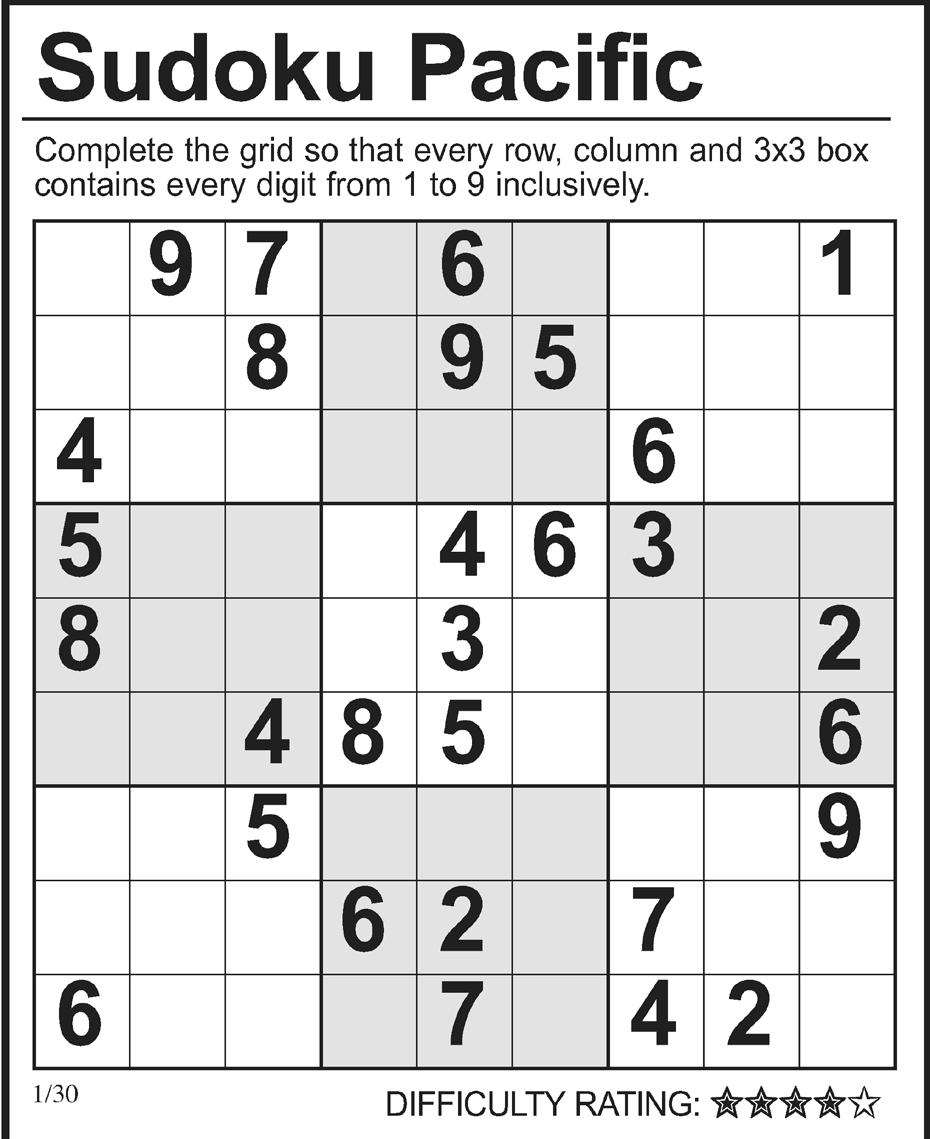


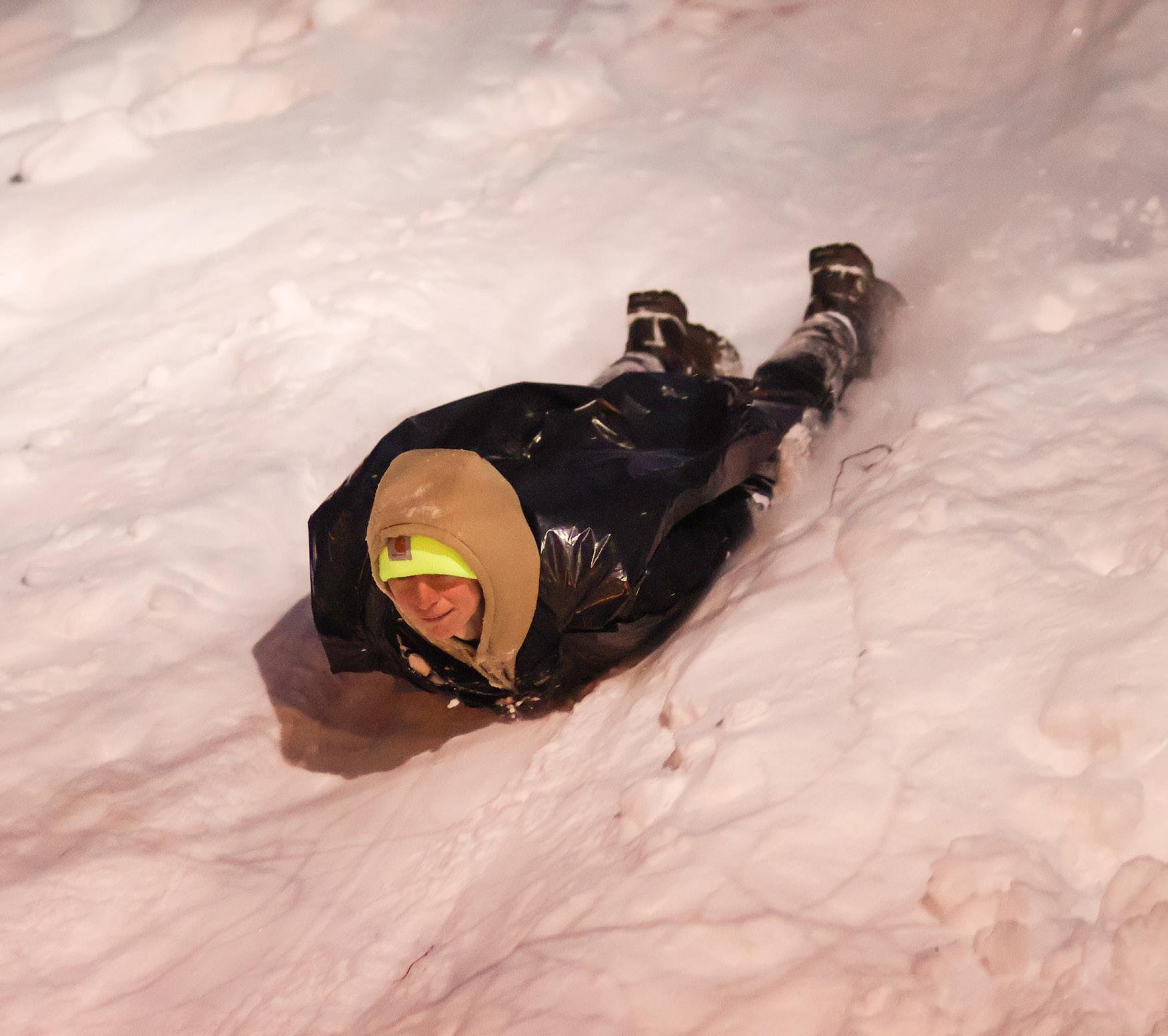

TAKE ON THE SNOW RAMS
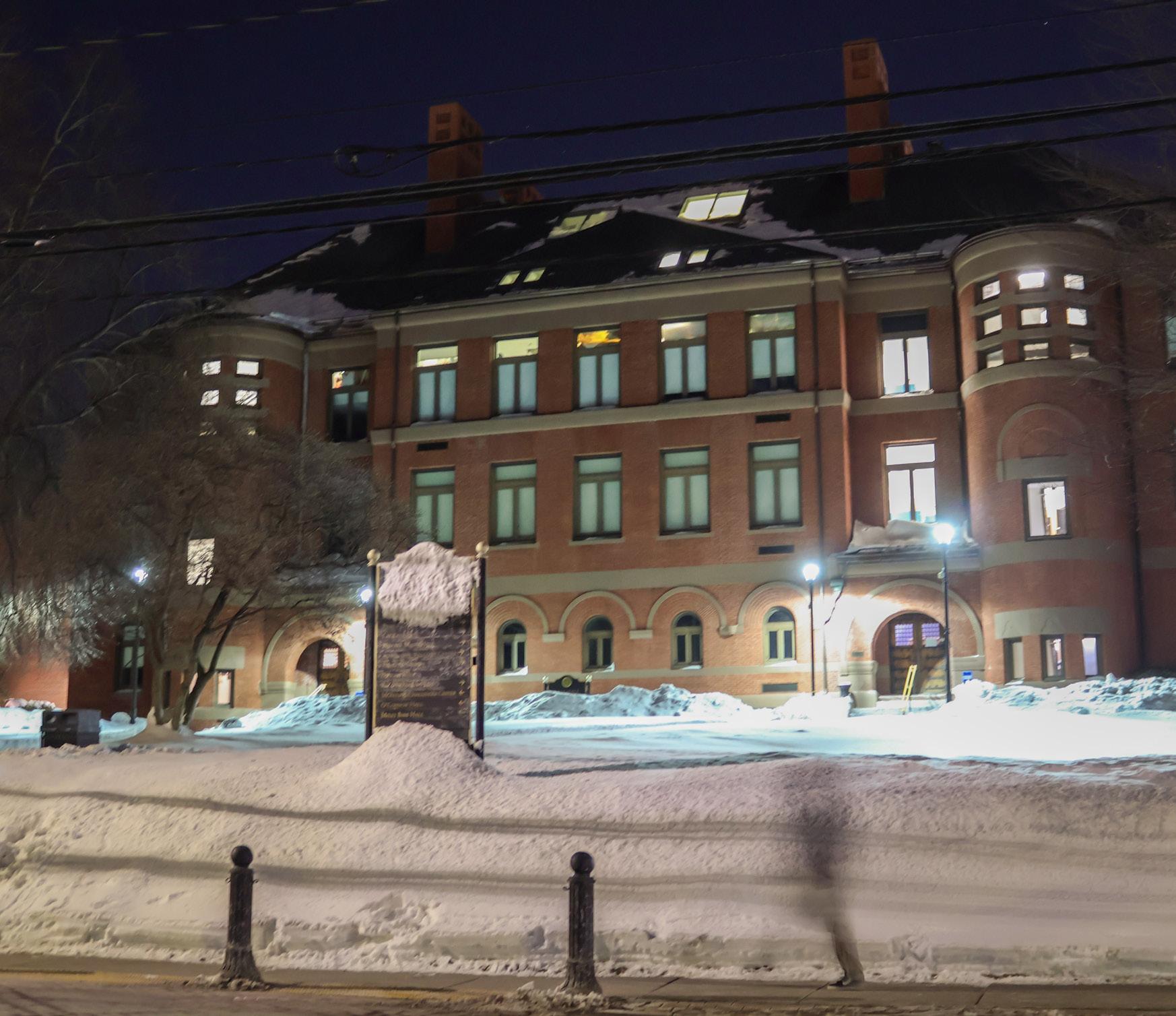
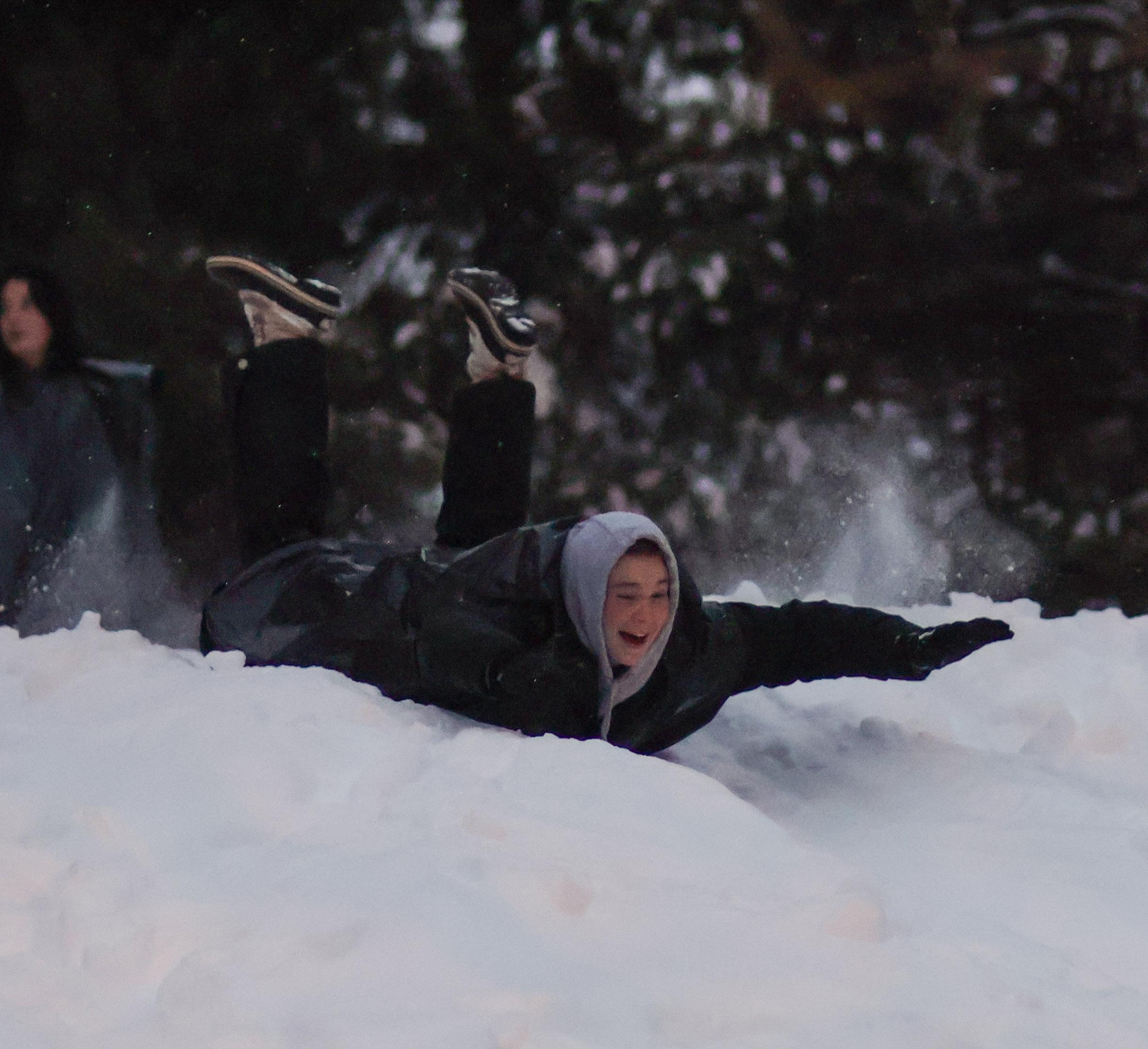





Mitch St. Ledger sledding behind West Hall on Jan. 26.
Snowy May Hall on Jan. 29.
Tarynn Smith sledding behind West Hall on Jan. 26.
Students shoveling at Maple parking lot Jan. 26.