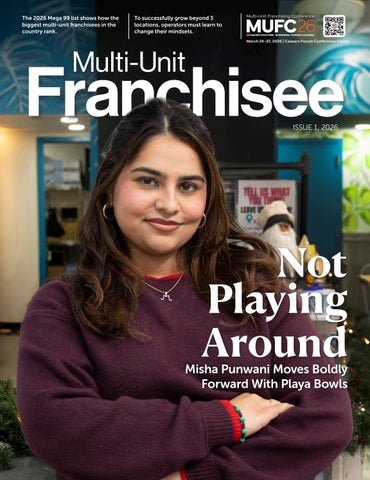
The 2026 Mega 99 list shows how the biggest multi-unit franchisees in the country rank.
To successfully grow beyond 3 locations, operators must learn to change their mindsets. March 24–27, 2026 | Caesars Forum Conference Center
Multi-Unit
Franchisee ISSUE 1, 2026
Not Playing Around
Misha Punwani Moves Boldly Forward With Playa Bowls
! S U H T I GROW W
e r e h s t r hueymagoos.com a t s e c n a n i m o d n e k c i h C d Worl h t i w t i f o t r a p a be ® n e k c i h C f o n o The Filet Mign Huey Magoo’s only serves tHe top 3% of tHe cHicken. We’re groWing fast WitH over 75+ stores across 12 states and territories available tHrougHout tHe u.s. noW is tHe tiMe to join tHe g.o.a.t. -tHe greatest of all tenders®!
scan for More info!
HTeaO is your perfect blend of simplicity and scalability that fits into your portfolio seamlessly — making ownership refreshingly easier.
“
Owning multiple HTeaO locations provides many competitive advantages, like increased brand awareness and operational efficiency.”
Bryan Benson
HTEAO FRANCHISE OWNER
READY TO TAP INTO SOMETHING BIG? ©2026 TBevCo IP, LLC. All rights reserved. This information is not intended as an offer to sell, or the solicitation of an offer to buy, an HTeaO franchise. It is for informational purposes only. We will not offer you a franchise in states where registration is required unless and until we have complied with applicable pre-sale registration or filing requirements in your state (or have been exempted therefrom) and a Franchise Disclosure Document has been delivered to you before the sale in compliance with applicable law.
CONTENTS
SCALING WITH PURPOSE 140
CHAIRMAN’S NOTE
MU PROFILES 06
04 Opportunities
Stephanie Altenburger Fitness franchisee thrives with a people-centric approach
Abound Find Your Answers at the 2026 Multi-Unit Franchising Conference
18
Andy Cabral Franchisee drives expansion with vertical integration
26
Matt Davis Honey Baked Ham franchisee expands parents’ legacy
2 | Multi-Unit Franchisee | Issue 1, 2026
36
Aaron Gillaspie
72
Former teacher becomes largest My Salon Suite franchisee
46
Eric Jenkins
Rocky start leads to successful ownership tenure
82
Doctor balances overnight ICU shifts with multi-unit ownership
56
Jonathan Steward Passion for franchising fuels multi-brand home services operator
Joey Pierson America’s largest Taco Bell franchisee diversifies with 7 Brew
64
Lisa Starnes
Misha Punwani Playa Bowls franchisee blends culture and growth
94
Clement Troutman Navy veteran doubled system record for sales in first year
Multi-Unit Franchisee Issue 1, 2026
RANKINGS 102 MEGA 99 Find out how the biggest multi-unit franchisees rank
FEATURES 112 From Operator
to Leader Success after 3 units requires a mindset change
122 Make It Right Customer experience is the competitive advantage
130 A Local Touch Franchisees weave into the fabric of their communities
140 Scaling With
Purpose Service brand franchisees build culture, careers, and legacy
Contents
150 Charting the
178 Franchisee
Path Ahead
Tactics
Top operators offer insights on growth, resilience, and strategy in 2026
Operators can co-opt screens to connect teams and build buy-in
COLUMNS 168 People Build resilient teams and grow with confidence
170 Customers Count Altruism has an important place in the business world
172 Finance Growth stalls when financial decisions don’t scale
174 Business Law
180 Human Capital Win the talent search and find the people your business needs
182 Exit Strategies
REGISTRATION NOW OPEN!
Why scaling beyond 3 units is so difficult
184 Market Trends Global brands arrive in the U.S. with intention
186 IFA Report 2025 was the year franchising went on offense
Best practices align multi-unit franchisees and franchisors
March 24–27,
2026
Caesars Forum Conference Center
176 Tech Beat AI can level the playing field for frontline workers
Our Team MANAGER, EDITOR
MANAGER, EVENT OPERATIONS
CONTRIBUTING WRITERS
Gary Gardner
M. Scott Morris
Sharon Wilkinson
CO-FOUNDER
MANAGER, EDITOR
COORDINATOR, EVENT OPERATIONS
Therese Thilgen
Kevin Behan
Leticia Pascal
Helen Bond Leon Stafford
VP, EVENT OPERATIONS
DIRECTOR, CREATIVE
MANAGER, GRAPHIC DESIGN
Sue Logan
Cindy Cruz
Michael Llantin
VP, MARKETING AND CONTENT
CO-FOUNDER
DIRECTOR, TECHNOLOGY
DIRECTOR, CUSTOMER EXPERIENCE
Diane Phibbs
Benjamin Foley
Chelsea Weitzman
VP, BUSINESS DEVELOPMENT
SENIOR MANAGER, WEB DEVELOPER
MANAGER, MARKETING
Barbara Yelmene
Matt Wing
Taylor Williams
DIRECTOR, BUSINESS DEVELOPMENT SALES
MANAGER, WEB DEVELOPER
COORDINATOR, SPONSORSHIP BENEFITS
Krystal Acre Jeff Katis
Hope Alteri
DIRECTOR, EXECUTIVE EDITOR
Kerry Pipes
Don Rush COORDINATOR, DIGITAL
Juliana Foley DIRECTOR, EVENT OPERATIONS
Katy Coutts
Alison Shelton Heather Stoner
Colleen McMillar
CONTRIBUTING EDITORS
John DiJulius Matt Forbush Meme Moy Mike Orwig
Brent Elsass Matt Haller Barbara Nuss Brian Schnell
ARTICLE INQUIRIES
editorial@franchiseupdate.com SUBSCRIPTIONS
subscriptions@franchising.com 408-402-5681
Issue 1, 2026 | Multi-Unit Franchisee | 3
Chairman’s Note
Find Your Answers at the 2026 Multi-Unit Franchising Conference As we enter 2026, it’s time to reflect on the goals we set last year. We need to make honest assessments and look at both the reasons we succeeded and the challenges that caused us to fall short. As I set my business goals for the coming year, I wonder what I could do better to overcome some of those challenges: • What changes do I need to make? • Where do I need to stay the course? • What do I need to learn? • Who can help me reach my goals? These are important questions, and the franchising community offers a variety of ways to answer them. Your franchisor could help. A mentor might offer insights. A vendor partner could help you create an action plan for the upcoming year. Where is the best and most effective place to meet a franchisor partner, mentor, or vendor? Every year, my answer is the Multi-Unit Franchising Conference in Las Vegas. It’s one place where you can find the knowledge and support you need to grow and thrive. I have always found that the MUFC has great sessions designed and delivered by franchisees for franchisees. This year, you can learn how to scale your enterprise, prepare your network for financial
4 | Multi-Unit Franchisee | Issue 1, 2026
growth, and effectively integrate artificial intelligence (AI) into your business. And that’s just a small sampling of session topics. While walking through the amazing exhibit hall, you’ll have plenty of time to meet with potential vendor partners. If you’re looking to expand into a new brand, franchisors will be ready and willing to talk with you. And I can’t forget to mention the speakers, who can fire you up while also helping you see your business from a different perspective. Brittany Hodak, author of Creating Super Fans, will highlight the impact of customer experience; magician Jon Dorenbos will challenge your perceptions; and Jim Craig will draw on his experiences on the gold-medalwinning 1980 U.S. Olympic Hockey Team to help your organization reach its goals. It’s a new year with fresh aspirations, challenges, and questions. Let’s find answers together at the Multi-Unit Franchising Conference in Las Vegas, March 24–27. I’m looking forward to seeing you there.
Mitch Cohens MITCH COHEN MUFC 2026 Chair
Expand Your Franchise Portfolio with Dine Brands With three iconic restaurant brands under one platform, Dine Brands helps franchisees expand, diversify, and adapt across markets nationwide.
Explore franchise opportunities at dinebrands.com This is not an offer to sell a franchise.
Stephanie Altenburger
“My team will tell you that consistency is a word they hear from me often.”
Culture Club
Fitness franchisee leads with people Written by KEVIN BEHAN
and was determined to bring a fitness concept to Northeast Ohio. W hen a col lea g ue introduced her to Orangetheory Fitness, the concept perfectly aligned with her vision. “It scared and excited the heck out of me,” she says. Altenburger knew nothing about franchising and was concerned about how her strong-willed management style would fit within an established system. With the help of her husband, Kurt, they invested their life savings into the plan and went all in on Orangetheory. “It was a big risk,” Altenburger says. “I told my husband, ‘If this doesn’t work, we lose everything. If it does work, everything we envisioned will become possible.’ Once we committed to it, there was no other option than to win.” After initially signing on as an area developer, Altenburger exceeded the development goals by opening 20 studios in the first three years. In 2023, she founded Thrive Venture Group, which currently owns and operates 28 Orangetheory studios across Ohio, West Virginia, and Arkansas. She also supports an additional 24 locations as an area developer and added three Restore Hyper Wellness franchises to her portfolio six years ago. Altenburger credits a strong culture that prioritizes the empowerment and development of company leaders and more than 300 employees throughout the Thrive system. She says team members hear from her nearly daily with words of encouragement, honesty, and transparency regarding performance and the company’s plans for the future. She takes a consistent approach to developing people, building trust, and creating a culture of accountability and care.
STEPHANIE ALTENBURGER Founder & CEO Company: Thrive Venture Group No. of units: 28 Orangetheory Fitness, 3 Restore Hyper Wellness Age: 41 Family: Husband Kurt, son, Gavyn, 12, and daughter, River, 6 Years in franchising: 10 Years in current position: 10 as an Orangetheory franchisee; 3 as founder/CEO of Thrive Venture Group
S
tephanie Altenburger’s knack for leadership showed up early. She landed her first job at Jamba Juice at age 15 and became the company’s youngest general manager two years later. “I took ownership of the store and saw the only limits were the ones I placed on myself,” Altenburger recalls of being a 17-year-old general manager. “I always had leadership skills, and it showed up there. I remember thinking to myself, ‘Wow, I am responsible for what happens within these four walls. This is my baby. I am running a store, and I can’t even vote yet.’” Altenburger’s drive and success with the store impressed Jamba Juice’s CEO, who moved on to Club One Fitness and offered her the general manager role at the brand’s flagship location in San Jose, California, when she was 21. She eventually left California’s Bay Area to move to Cleveland
“I lead by example, and it is something I practice daily,” Altenburger says. “We create leaders who have the same characteristics and show up even stronger for the team. That is where culture hits. I want my legacy to be that we grew by being dedicated to our people, who are the leadership team, employees, and Orangetheory studio members.” PERSONAL First job: I worked the counter at a Jamba Juice when I was 15 years old. Formative influences/events: Early in my career, I wasn’t surrounded by inspirational leaders. In fact, many of my direct leaders showed me exactly what I didn’t want to be. Their lack of vision and connection became the foundation for how I chose to lead differently. I learned the importance of empathy, communication, and accountability not by observing excellence, but by recognizing the void and deciding to fill it. That experience shaped my leadership philosophy that people come first and culture drives everything.
Stephanie Altenburger
“Success doesn’t come from what you do occasionally; it comes from what you do consistently.”
Key accomplishments: In 2023, I founded Thrive Venture Group, which quickly became one of the top 10 platforms in the Orangetheory system. We currently own and operate 28 studios across multiple states. This accomplishment came from a desire to chart our own path and believe in our strength as operators and community partners. Rather than following the traditional private equity route, we partnered with incredible family office investors who believed in our passion, experience, and vision to build a strong, people-centered portfolio. It represents not just growth in scale, but growth in leadership, innovation, and impact. Biggest current challenge: Continuing to scale while maintaining the same level of culture, care, and connection that got us here. Growth is exciting, but it also requires intentional focus to ensure every studio feels supported and every member feels seen. Next big goal: To expand our reach through Thrive Venture Group and hit the 40-studio milestone while continuing to build a leadership infrastructure that develops and empowers people at every level. First turning point in your career: I’ve had many points in my career that felt like opportunities to pause, reflect, and push forward, but the biggest turning point was opening our first Orangetheory studio in Rocky River, Ohio. It was the moment that changed everything and proved what was possible when vision, belief, and execution all aligned. We went from vision to reality and sparked a passion to grow something bigger than ourselves. Best business decision: Believing in myself and my husband. We invested our entire life savings to bring Orangetheory to the Cleveland market. It was a leap of faith that set the foundation for everything that came after in an industry that we love. That passion for health, wellness, and human potential continues to drive every decision we make. Hardest lesson learned: That success isn’t linear. There are peaks, valleys, and lessons in every phase of growth. Learning to navigate uncertainty with grace and persistence has been invaluable. I’ve also learned that the energy and determination to keep moving forward no matter what challenges arise are just as important. Work week: No two weeks are the same, and my work week isn’t confined to a Monday through Friday schedule. My focus is split between strategy, supporting network franchisees, and partnering with the franchisor on projects and pilots that strengthen the system and drive continued development. It’s a balance between leading my own team and contributing to the broader Orangetheory ecosystem. We all win together. Exercise/workout: Orangetheory, always. I make sure to have some sort of physical activity at least three times per week. Best advice you ever got: “Success doesn’t come from what you do occasionally; it comes from Issue 1, 2026 | Multi-Unit Franchisee | 7
“We create leaders who have the same characteristics and show up even stronger for the team. That is where culture hits. I want my legacy to be that we grew by being dedicated to our people, who are the leadership team, employees, and Orangetheory studio members.”
Stephanie Altenburger
what you do consistently.” It is something I heard expressed in different ways over the years. That’s the foundation of how I lead and live. My team will tell you that consistency is a word they hear from me often. It’s the foundation of everything we do in leadership, culture, and results. What’s your passion in business? Developing people. There’s nothing more rewarding than seeing someone grow from a frontline role to leadership and knowing their confidence, career, and life have all changed because of it. I’ve been humbled, and I am grateful to experience this several times within my organization. It’s what continues to fuel me to keep going. Watching others rise has become my greatest measure of success. How do you balance life and work? I’ll be the first to admit that I haven’t always been great at it. It’s often been one of my biggest challenges because I truly love what I do every day, and I equally love living life with my family and experiencing all the fun and craziness my kids bring. Finding balance has meant learning to be intentional with my time and presence, giving both my work and my family the best version of me wherever I am. The only way I can truly be intentional is by trusting my team to show up powerfully, so I don’t feel like I always need to be plugged in. That trust allows me to step back when needed and focus on what matters most both personally and professionally. Guilty pleasure: Coffee every morning and the occasional reality TV night when I need to unplug. Favorite book: This year, it is The CEO Only Does Three Things by Trey Taylor. It’s a great reminder that leadership boils down to clarity of purpose and focusing on people, culture, and numbers. It reinforces my belief that simplicity and consistency in leadership drive long-term success. Favorite movie: I don’t have a single favorite movie. I tend to enjoy anything that makes me think, laugh, or feel inspired in a new way. What do most people not know about you? Most people wouldn’t guess that I’m actually a pretty good drawer. Pet peeve: Excuses. I believe there’s always a way forward if you’re willing to take ownership. What did you want to be when you grew up? An architect. I’ve always loved design, structure, and the idea of creating something lasting from the ground up. While I didn’t pursue architecture in the traditional sense, that same passion carries into how I approach business. I take great pride in building strong foundations, designing scalable systems, and structuring teams in a way that supports growth and sustainability. In many ways, I still see myself as an architect of people, culture, and business. Last vacation: Spring break 2025 with my family to Disney World. Great memories! Person you’d most like to have lunch with: Businesswoman and philanthropist Sara Blakely. 10 | Multi-Unit Franchisee | Issue 1, 2026
She’s a master class in believing in yourself, building something authentic, and leading with both purpose and heart.
dialogue between franchisees and the franchisor. Collaboration and effective listening are what make the system successful.
MANAGEMENT Business philosophy: Lead with people, purpose, and performance in that order. I believe that when you develop people, build trust, and create a culture of accountability and care, performance naturally follows. A strong business starts with strong leadership and authentic relationships.
What you need from vendors: Consistency and partnership. I value responsive and proactive vendors who understand our pace and scale and operate with the same integrity and urgency that we do. I don’t look for transactional relationships. I look for long-term partners who share our commitment to excellence and being a part of our growth.
Management method or style: Empowerment and accountability. I believe great leaders don’t create followers; they create other leaders. I empower my team to make decisions, take ownership, and think like business owners, but I also believe accountability is essential. Empowerment without accountability creates chaos. Accountability without empowerment stunts growth. The balance between the two is where teams thrive. That’s why I chose to name our company “Thrive.” Greatest challenge: Balancing the scale of growth with maintaining deep cultural roots within our ecosystem. As our organization expands, ensuring that every studio still feels connected, valued, and supported is an ongoing and intentional effort. How do others describe you? Driven, focused, and passionate. I think they would also say I’m approachable and always there to listen. I have high standards but also genuine care. Have you ever been in a mentor-mentee relationship? What did you learn? Yes. I’ve learned that the best mentor-mentee relationships are built on mutual growth. As much as I’ve been able to pour into others, I’ve learned just as much in return. Great mentorship sharpens both people involved. One thing you’re looking to do better: To continue refining communication and alignment as our organization grows. With so many teams spread across multiple markets, ensuring clarity and connection takes consistent effort and creativity. How you give your team room to innovate and experiment: You need to be clear on the vision, understand the “why” behind what we are building, and trust leaders to take risks and try new things. My team knows our goals. They hear them often, and they understand that achieving them requires curiosity and the willingness to experiment. How close are you to operations? While I’ve built a strong leadership team, I still stay connected to the field. You can’t lead effectively from always being behind a desk. I try to balance my intentional office time with being present where the work happens in the studios. What are the two most important things you rely on from your franchisor? Alignment and innovation. Orangetheory’s commitment to evolving program design, technology, and member experience ensures that the brand stays relevant and strong. I also value the partnership and open
Have you changed your marketing strategy in response to the economy? How? Yes, of course. But it’s not only because of the economy; it’s also in response to shifting consumer sentiment. We’ve leaned into influencer partnerships in the digital space, finding authentic ways to connect with our prospective members through voices they follow and trust. At the same time, we’ve also returned to grassroots marketing by being out in our communities, building relationships, and creating experiences that reflect who we are. That’s how we built our brand. It’s part of our DNA, and while we got away from it for a while, we’ve made it a priority once again. How is social media affecting your business? Social media has shifted over time, but it continues to play an important role in how we connect with our communities. It allows us to amplify member stories, celebrate our studio culture, and strengthen our digital community. That said, what happens inside our studios is far more powerful. It’s where the real transformation and connection take place. Social media helps us share that story, but the in-person experience is what truly transcends and drives lasting impact. In what ways are you using technology (like AI) to manage your business? We use a variety of technology and software tools provided by our franchisor to analyze our business, identify trends, and provide the data we need to make informed decisions. While we haven’t tapped deeply into the AI space yet, it’s something that genuinely intrigues us and that we’re eager to explore, especially from an optimization standpoint. We’ll always be a human-to-human business, and that’s what makes us so special and different. But we also recognize that AI has the potential to simplify back-end processes, enhance efficiency, and free up more time for our teams to focus on what matters most: our people and our members. How do you hire and fire? We hire for the role. We hire for attitude, culture, and accountability. Skills can be taught, but alignment with our values and work ethic cannot. I believe in hiring people who have passion, curiosity, and a relentless desire to grow. On the other side, when someone isn’t the right fit, we handle it with transparency and respect. My philosophy is simple: Don’t surprise people. Communicate clearly, coach consistently, and when it’s time to part ways, do it quickly and with dignity.
FRANCHISE OPPORTUNITY
UNIQUE MENU. WE’VE CRACKED THE CODE ON PROFITABILITY LOW STARTUP WITH COST.A $3.8M AUV*$3.77M & $511K AVERAGE EBITDA.** AUV. Now’s the time to get your claws on a family-friendly, seafood boil franchise that’s cracked the code on profitability and bold Asian-Cajun flavors guests love. As the conversion experts in second generation restaurant sites, you’ll shell out less on your buildout while dramatically shortening the time to start bringing in the clams.
Unique menu and proprietary flavors drive repeat business
Underserved category in a crowded food segment
$577,415 Median Initial Investment***
Open faster with 2nd gen locations
Net a great opportunity.
angrycrabfranchise.com | 586-907-6404 franchised restaurants. *** This figure represents the Median Initial Investment to open twelve (12) franchised restaurants operating in 2024, all of which were opened in Second Generation Sites. Second Generation Sites are restaurant locations where the operator utilized a premises that was previously operated as a restaurant and therefore requires less initial investment to open and operate. Most Angry Crab Shacks are opened in Second Generation Sites. This information assurance that you will do as well. ©2026 Angry Crab Franchise Opportunity. All rights reserved. Angry Crab Franchise LLC. 2345 S. Alma School Rd. Suite 106, Mesa, Arizona 85210
Stephanie Altenburger
Hyper Wellness, which complements our fitness operations and broadens our influence in health and performance locally in Cleveland. How is the economy in your region(s) affecting you, your employees, your customers? The economy has undoubtedly affected our team members, which is why we’ve adjusted some of our compensation structures to better support them through the changes. It has also impacted our members, which makes the experience and sense of community we create inside our studios more important than ever. Those connections are what keep people committed, especially when times are uncertain. It’s critical that our brand message and in-studio experience clearly communicate the value of Orangetheory and that what we offer goes far beyond a workout. It’s a lifestyle investment with guaranteed results both physically and mentally. Are you experiencing economic growth in your market? Yes. It varies by region. What we’re seeing overall is steady demand for wellness and fitness, which continues to be a top priority for many people post-pandemic. That is also creating more competitors in our markets.
How do you train and retain? Employee retention comes from connection. A key part for us has been building a strong middle management layer that focuses on workshops, continued education, studio visits, and hands-on coaching for our teams. This not only strengthens our culture, but also creates consistent growth opportunities at every level of the organization. Retention comes naturally when people feel valued, seen, and supported. When our teams are winning, employees are rewarded, and they bring enthusiasm into everything they do. It’s equally important to recognize progress, not just outcomes, because that’s what builds confidence and longterm success. How do you deal with problem employees? Most performance issues come from a lack of understanding or connection, not intent. First, I have an honest conversation to uncover the “why.” If alignment can’t be reestablished during that conversation, then we move forward decisively. Every person we keep or separate with shapes not only our culture, but also how our team views what is acceptable and unacceptable within our space, so those decisions have to be thoughtful and intentional. Fastest way into your doghouse: Lack of accountability and lying. Mistakes are fine, and they are part of growth. But dishonesty or avoiding responsibility erodes my trust quickly. Once I lose trust, it’s not likely you will earn it back. We’re a team that values integrity and ownership. We own our outcomes, good or bad. 12 | Multi-Unit Franchisee | Issue 1, 2026
BOTTOM LINE Goals over the next year: Our primary goal is to continue expanding through Thrive Venture Group while deepening the quality of leadership within our existing studios. Hitting the 40-studio milestone remains a top priority, but equally important is strengthening our operational systems, community footprint, and culture so that we scale with excellence, not just size. Growth meter: How do you measure your growth? I measure growth beyond just revenue. For me, it’s about leadership depth, retention, and team development. I want to know our people are advancing, our members are thriving, our studios are performing consistently, and our business is growing. It’s also about growing our membership base because that means we’re reaching more people and introducing them to our life-changing brand that truly provides people “More Life.” We are our members’ partner in longevity, and we take that responsibility seriously while striving to share it with as many people as we can. Vision meter: Where do you want to be in five years? 10 years? In the next five to 10 years, I want Thrive Venture Group to be a recognized leader in franchise operations not only within Orangetheory, but across our industry. Do you have brands in different segments? Why/why not? Right now, Thrive is focused on Orangetheory and strengthening our impact within that brand. That said, I’ve personally diversified in the wellness and recovery space through Restore
How do changes in the economy affect the way you do business? Economic shifts push us to be more efficient, strategic, innovative, and focused. We look closely at spending, optimizing operations, and staying proactive with marketing and member retention. The key is to stay flexible without losing sight of who we are. How do you forecast for your business? We use a blend of historical data, real-time performance trends for Thrive and the Orangetheory franchise network, and the impact of innovation projects. We also rely heavily on communication with our leaders and our teams because numbers tell part of the story, and people tell the rest. What are the best sources for capital expansion? For us, it’s been our family office partnerships. We chose this route intentionally over private equity because we wanted partners who believed in us, our leadership, and our long-term vision. That alignment has been key to our growth. Experience with private equity, local banks, national banks, other institutions? Why/why not? Yes. We’ve built strong partnerships with all the above, and it has allowed us to ensure we are able to keep our studios best in class with updates and upgrades. We value these partnerships and relationships. We keep communication lines open to ensure we are doing the best for our business at all times. What are you doing to take care of your employees? We invest in development/training, benefits, and employee recognition. We have invested in a deep management team to be present for our team to support, inspire, and mentor. When people feel valued, supported, and seen, they bring their best selves to work, and that energy flows right back to our members. Taking care of our employees is
a crave-worthy brand your market will love.
550+ locaTiOnS*
$1,891,092 2024 aUv*
learn more here. * Average net sales in our 2024 fiscal year for 464 traditional franchises that operated throughout such fiscal year (out of 494 traditional franchises and 524 total franchises that were operating as of 12/29/24). See Item 19 of our March 2025 Franchise Disclosure Document for additional details. Some outlets have earned this amount, but your results may differ. This information is not intended as an offer to sell a franchise. We will not offer you a franchise until we have complied with disclosure and registration requirements in your jurisdiction. Contact McAlister’s Franchisor SPV LLC, located at 5620 Glenridge Drive, NE, Atlanta, GA 30342, to request a copy of our FDD. RESIDENTS OF NEW YORK: This advertisement is not an offering. An offering can only be made by a prospectus filed first with the Department of Law of the State of New York. Such filing does not constitute approval by the New York Department of Law. RESIDENTS OF MINNESOTA: MN Franchise Registration Numbers: McAlister’s Franchisor SPV LLC: F-8196.
Stephanie Altenburger
as much about providing servant leadership as it is offering a laundry list of benefits. How are you handling rising employee costs (payroll, minimum wage, healthcare, etc.)? We’re managing those increases by focusing on efficiency, retention, and leadership development. Reducing turnover and empowering internal growth create stability, which offsets some of the cost pressures. During distressed times, it takes even more effort and intentionality to ensure we don’t lose sight of these priorities. How do you reward/recognize top-performing employees? We make it a point to celebrate not only results, but also effort, leadership, and impact. Whether it’s public recognition, employee of the month, career advancement, or incentive programs, we want our top performers to feel seen and appreciated. Winning should feel great for everyone. What kind of exit strategy do you have in place? Right now, my focus is on growth and legacy building. My goal is to create a business that’s sustainable, scalable, and empowering for the people within it. If there’s ever an exit down the road, it would be one that honors our people, our brand, and the culture we’ve worked and continue to work so hard to build.
14 | Multi-Unit Franchisee | Issue 1, 2026
“Empowerment without accountability creates chaos. Accountability without empowerment stunts growth.”
Top Net Profit*
$245,051 $1,252,496 Top Store Sales*
*Based on the top Jeff's Bagel Run affiliate-operated store open and operating for a full fiscal year as of 12/31/24. There were two Jeff's Bagel Run affiliate-operated stores open and operating for a full fiscal year as of 12/31/24. The store with the lowest Sales was $841,884 and the lowest Net Profit was $49,991. “Sales” include all revenues, except tips and taxes. “Net Profit” is Sales minus the cost of goods sold, payroll, rent, store-level office and general operating expenses, utilities, merchant fees, local advertising and imputed 2% marketing fund contribution, and imputed 6% royalty, but with no deduction for amortization or depreciation. Additional information can be obtained from JBR Franchise Co's Franchise Disclosure Document. This advertisement is not an offering. An offering can only be made by prospectus filed first with the Department of Law of the State of New York. Such filing does not constitute approval by the Department of Law. MN – 11233. JBR Franchise Co, 4190 Millenia Blvd., Orlando, FL 32839
Experienced Franchisor. Aggressively Expanding.
Inquire Today.
The Next Evolution in Beauty: Delta Crown Hair Extensions ™
The first private-equity backed membership-driven hair extension brand, built by Head to Toe brands.
Jenna Bowden — Founder
Predictable Revenue
Simple Model
Recurring income powered by the Delta Crown Society membership creates steady cash flow and loyal, repeat clients.
An industry-changing and streamlined operating model that focuses on employee satisfaction, growth and retention.
Expert Education & Support
Strong Demand
As part of Head to Toe Brands, owners benefit from expert-led training programs for stylists and operators.
A $538M industry with guests investing $800+ for initial extensions installation.* *IBISWorld, Jan 2024.
Created by industry veterans and refined through real-world success, Delta Crown pairs luxury craftsmanship with operational precision. From membership pricing to stylist training, every detail is engineered for exceptional outcomes. Looking for your next concept? Consider Delta Crown—designed for entrepreneurs who want to capture market demand!
Visit franchise.deltacrown.com today to learn more about franchise opportunities. PA R T O F T H E H E A D TO TO E B R A N D S M U LT I - B R A N D P L AT F O R M . B AC K E D BY T H E R I V E R S I D E C O M PA N Y. *This does not constitute an offer to grant a franchise. The offer of a franchise can only be made through the delivery of a franchise disclosure document. Certain states require that we register the franchise disclosure document in those states. The communications on this notice are not directed by us to the residents of any of those states.
Powerful brands. One platform. Endless growth. Head to Toe Brands brings together category-leading beauty brands under one scalable operating platform. Our growth-minded infrastructure is powered by industry-tested systems across operations, marketing, education and technology.
Leading the lash industry through custom lash & brow services with 135+ locations across the country.
Redefining the salon experience—where edginess, inclusivity and expert hair care collide.
Elevating nail care through clean, non-toxic treatments designed around an innovative membership model.
Revolutionizing the beauty industry as the first membership-driven hair extensions salon backed by an experienced beauty portfolio.
Build your beauty empire with a platform designed for growth. Through one proven system, entrepreneurs can scale smarter inside a fast-growing portfolio with real momentum. Visit httbrands.com to explore ownership opportunities across our four distinctive beauty brands. B AC K E D BY T H E I N V E S T M E N T A N D E X P E R I E N C E O F P R I VAT E - E Q U I T Y PA R T N E R T H E R I V E R S I D E C O M PA N Y. *This does not constitute an offer to grant a franchise. The offer of a franchise can only be made through the delivery of a franchise disclosure document. Certain states require that we register the franchise disclosure document in those states. The communications on this notice are not directed by us to the residents of any of those states.
Andy Cabral
“I allow my team to follow their gut, and if I see they are getting off track a bit, I will help them get on track with a little nudge.”
Doing It All
Franchisee expands with vertical integration Written by KEVIN BEHAN
and his brother worked to load the trucks for their routes. Operating the business often meant long hours and modest pay for his divorced mother. In those days, Cabral spent many days and evenings at his grandparents’ home. Those experiences created a deep appreciation for the sacrifices his parents and grandparents made when moving their family to the U.S. from Portugal a few years before he was born. Cabral’s mother eventually sold the trucking company and moved the family to Maryland, where Cabral’s aunt and uncle owned three Dunkin’ stores. That association with the brand led Cabral’s family to purchase their first Dunkin’ location in 1999. They created their company, Vigario Management Corp, into an umbrella corporation that also operates vertical construction, manufacturing, and commercial real estate businesses. Having those divisions of the company has made a direct impact on the operations and growth of their franchise businesses. The manufacturing company produces all the donuts for Cabral’s locations and other Dunkin’ stores in the region. The company recently outgrew its current plant and is in the process of moving into a new 30,000-squarefoot facility. The group has built all its restaurants since becoming officially licensed in 2009 and owns the real estate for nearly all its Dunkin’ and BaskinRobbins stores.
ANDY CABRAL CEO Company: Vigario Management No. of units: 25 Dunkin’, 9 Baskin-Robbins Age: 43 Family: Wife Heidy and 3 children, Nicholas, Alexander, and Hailey. Business partners with mother, Marylou Vigario, and brother, David Cabral Years in franchising: 25 Years in current position: 25
A
s a high school senior, Andy Cabral carried a 4.0 grade point average and considered becoming a lawyer or a surgeon. But he didn’t have the patience to sit through the many years of school needed to attain a degree in either field. He wanted to start immediately, and franchising became his pathway. A year after graduation, Cabral received an ownership stake in a Dunkin’ store in Manassas, Virginia, through a family partnership with his mother, Marylou Vigario, and brother, David. Twenty-five years later, the three remain in business together, operating 25 Dunkin’ and nine BaskinRobbins locations in Northern Virginia. More units and brands are in development. Entrepreneurship runs deep in Cabral’s family. His mother owned a delivery truck company in Rhode Island when Cabral was a boy, and he
“The vertical integration with those divisions definitely helped us grow the business,” Cabral says. “We initially took those projects in-house to save money, but I do attribute a portion of the success we have today to those parts of the business. It sometimes comes with more headaches, but it gives us greater control in many areas, including construction timelines for new store openings.” Those divisions of the company will continue to play a major role in the group’s growth. The family plans to open six Dunkin’ locations this year and four in 2027. Cabral recently signed a 12-unit agreement with Slim Chickens and will open restaurants in Virginia, Maryland, and Delaware over the next five to seven years. He welcomes the return to the chicken segment. He operated three Pollo Campero restaurants for 11 years before selling them three years ago. When the Cabrals discussed options to return to the chicken business, their broker told them he went to school with a Slim Chickens’ franchisee in Bowie, Maryland. They jumped in the car on a Friday afternoon to make the two-hour trip to the restaurant and sampled the full menu.
GROW with
HEATING UP
NATIONWIDE GROWTH Recent openings in Texas, Nevada, Florida, New Jersey, New York and Colorado.
31%* OF SALES BEFORE 11 AM Our biscuits and breakfast favorites don’t just open the day, they open opportunity.
Born in the Carolinas, Bojangles has grown from a single Charlotte location into a legendary destination for Southern flavor and hospitality, now serving guests at more than 865 restaurants nationwide. Our growth is fueled by operational efficiency, craveable flavor and loyal consumer demand.
BREAKING RECORDS
43 restaurants opened in 2025 including 14 corporate locations.
865+ Total Locations Development Incentives Available 276 Corporate Locations Minimum Commitment of 3 Units 150 new units committed across New Jersey, Texas, New York, Tennessee, Ohio, Michigan and more coming in 2026
Contact Crystal Jones
(704) 989 - 3249 | cxjones@bojangles.com *The percentage of sales for the breakfast daypart for company-operated full-size restaurants serving the Boneless Chicken Only menu from July 29, 2024 – July 27, 2025. See the April 24, 2025 Bojangles Franchise Disclosure Document, as amended on September 24, 2025 for more information.
Andy Cabral
“I love to see the business and people grow.”
“Everything we ordered came out within five minutes, and I fell in love with the food,” Cabral says. “I needed a brand that resonated with me, and that was Slim Chickens. David went to discovery day and told me that the menu and processes were simple. We said, ‘Let’s do this.’” As Cabral looks ahead, the family’s vertically integrated structure, once a cost-saving necessity, has become a powerful engine for expansion. He and his family have the rare ability to control every step of development from dough production to store construction. What began with a teenager taking a modest stake in a single Dunkin’ has grown into a multi-brand enterprise. With the next chapter already underway, the Cabral family’s drive to build, adapt, and grow remains very much alive. PERSONAL First job: I started working for my family trucking company, V&L Delivery, when I was 10 years old. I arranged the trucks for routes each day. Formative influences/events: Coming from a very modest household and being the first 20 | Multi-Unit Franchisee | Issue 1, 2026
generation born in the U.S., I appreciated the risk my grandparents and parents took in 1975 when they immigrated from the small island of São Miguel, Portugal. Trying to imagine what they hoped for in the new world pushes me to make them proud of the accomplishments I can create after their humble journey. Key accomplishments: My family, first and foremost, and growing the business to the size it is today. My mother, brother, and I went into business together and faced long odds with limited money and experience, but we went on to form a successful company. Biggest current challenge: Completing two of the largest projects in our company’s history. We outgrew our manufacturing facility and are moving into a new 30,000-square-foot facility. Next big goal: Getting to 50 locations and again doubling our real estate holdings. We hope to accomplish both in the next five to seven years. First turning point in your career: Expanding our business with vertical integration. Having
manufacturing, construction, and real estate divisions unlocked many opportunities and helped us grow. Best business decision: Doubling down on expanding our real estate portfolio. It has unlocked so many other opportunities for capital. Hardest lesson learned: Never take things for granted. You need to always work hard for the things you admire the most. When business is doing well, if you don’t stay on top of it, tomorrow will start to disappear. You can’t take for granted that tomorrow will be successful. You need to keep working at it. Work week: I try to keep it to five days as much as possible, but that sixth day sneaks in sometimes. I try to reserve the seventh day for worship. Exercise/workout: I try to get in 10,000 steps per day. I enjoy long walks with my wife. Best advice you ever got: Never take no for an answer. That is something I learned from my grandparents, who showed us a lot of examples of ways to do things in life. If you receive a no, figure out how to make it a yes.
what’s missing in your market? Hot Dogs, Soft Serve, Chili Cheese Fries
AMERICAN FOOD LESS LABOR
SIMPLE OPERATIONS
LOW FOOD COSTS
MULTIPLE BUSINESS FORMATS
GET MORE INFO HERE
Andy Cabral
What’s your passion in business? I love to see the business and people grow. In the beginning, my brother and I would be happy to have one or two locations each. Now it is not about a number, but how we can provide for others and watch the people flourish with the business. How do you balance life and work? Sometimes, it means just putting the work down. The business often demands more from you than your personal life allows. You just have to be able to say that it has been enough today and spend that time on life. Those emergencies were there before you and will be there after you’re gone, so dedicating time to family is the top priority. Guilty pleasure: Snacking on anything with the family during movie night. Favorite book: Time to Make the Donuts by Dunkin’ founder William Rosenberg. Favorite movie: That is a hard one. Probably the original “Back to the Future” and “Fast and Furious” movies. What do most people not know about you? How much I love to cook. Pet peeve: Disorganization and when things are not in their place. What did you want to be when you grew up? A surgeon or an attorney, but I could not stand going to school for that long. Last vacation: I spent time with the entire family in São Miguel, Azores, in Portugal in July 2025. Unwinding on the peaceful island was great. Person you’d most like to have lunch with: My grandfather. Growing up, I admired the way he kept the family close and instilled the importance of respect toward those around him and the value of hard work. MANAGEMENT Business philosophy: Business is like most hard things in life because everyone wants a manual to follow. I look to treat everyone fairly and provide the best product I possibly can in the cleanest environment while adhering to the highest standards. Management method or style: I look at myself as a person who leads by example. We set the standards very high, and I know if I don’t try to seek perfection, those around me would not either. Greatest challenge: How to outdo my last accomplishment. This road of life has so many intersections and turns that it is sometimes hard to navigate. I want to keep pushing myself to see how far I can take it. How do others describe you? Driven and not afraid to push the envelope to the next step. Have you ever been in a mentor-mentee relationship? What did you learn? Yes. I learned from Mike Sanders, our good friend and legal counsel, to be patient and wait for those things 22 | Multi-Unit Franchisee | Issue 1, 2026
you want most. Pushing hard on something you don’t need is often a waste of time. Never be afraid to ask a question. I try to learn something new every day. One thing you’re looking to do better: I would say my top thing is consistent time management. I often change my focus as business needs change. It is not a horrible trait, but those pet projects are sometimes just as important as others. How you give your team room to innovate and experiment: I allow my team to follow their gut, and if I see they are getting off track a bit, I will help them get on track with a little nudge. I found that allowing them to trust in themselves to make the call often leads to a stronger team able to handle tough decisions almost the way I would have done myself. Hiring from within and keeping the culture alive helps a lot with this. How close are you to operations? Operations is at the core of my daily tasks. Every task I do affects operations, and so I need to be close to it to be able to be effective in the decisions I make to push the company forward. It is impossible to be part of every level of operations, but I try to get involved as much as possible. What are the two most important things you rely on from your franchisor? Brand protection and support. The franchisor needs to be there to protect the brand that every franchisee signs up for. Protecting it from competition and supporting franchisees when they need help to keep the brand to the standard it deserves. What you need from vendors: Simple: Offer their products and services at a price that is relative to the market without causing me any undue hardship by using them. I find lately that we need to increasingly follow up with our vendors about products and services not meeting the original standards. I should not have to send reminders to vendors of what the terms of our agreements are. Have you changed your marketing strategy in response to the economy? How? Our marketing strategy is guided by the franchisor, and they have done a great job balancing the strategy with the economy. Lately, they have launched a lot of value deals. They are very mindful of the effect rising costs of groceries and gas have on our customers. How is social media affecting your business? If technology is the engine of our business, then social media is the exterior of the car driving our business. We need to make sure it’s kept clean, polished, and looking its best as it’s our forwardfacing appearance of who we are. We often share announcements about new locations or internal promotions. We also use it for employee recruitment by highlighting our company culture, which shows who we are as a company. In what ways are you using technology (like AI) to manage your business? Technology is at the core of our business these days, and we can’t
operate without it. From our POS to the AI that forecasts our orders, we need technology to survive. How do you hire and fire? We use Paycom for all our HR tasks. When we don’t hire from within, we use that platform to push out to all the major online hiring firms to post ads. We also rely heavily on referrals from our current team members. As far as firing, we adhere to our written polices and document any issues that arise and hold our team to those standards. How do you train and retain? We have a network trainer who oversees the process of all our new employees and new product launches. The training process is dependent on the position that the person was hired for, and it also includes any promotion. Having a great training program and a company culture that motivates the team are key to retaining the best employees. How do you deal with problem employees? I listen to them first and ask them why there is an issue. If I can’t get to a resolution that makes both parties satisfied with the outcome, then we have to part ways. When someone shows they have no interest in staying on a team, there is no reason to keep that train going just for the sake of turning the wheels. Fastest way into your doghouse: Not owning up to your mistakes and pushing a narrative that points the blame onto others. BOTTOM LINE Goals over the next year: Expand our reach of restaurants into other states and double our manufacturing and real estate divisions. We have a lot of development happening in the next nine to 12 months, and we want to secure new business accounts. Growth meter: How do you measure your growth? Growth for me is measured by the growth of my team. That comes from pushing them beyond what they thought was possible by obtaining personal and business goals. Vision meter: Where do you want to be in five years? 10 years? In five years, I see our business almost doubling in size. In 10 years, I see us expanding into different types of businesses to help support or complement our main business. Do you have brands in different segments? Why/why not? Yes. Our market is diverse, and as such, we took advantage of the fact and got into different brands to thrive in those different segments. This narrows our operational net, which allows us to have great efficiency with our team. How is the economy in your region(s) affecting you, your employees, your customers? The past few years have been a roller coaster, and everyone is seeking some stability. We have tried to look at our costs and find ways to not increase menu prices unless it is absolutely necessary. Are you experiencing economic growth in your market? Most of our locations are within a stone’s throw of Washington, D.C. This area
INCENTIVE* 2%ROYALTY
$2.7 mil average systemwide AUV* (All stores—not just the top quartile) *2025 FDD, Item 19
THE FACTS • 8-HOUR DAY 7AM-3PM • 2 DAY PARTS, 1 SHIFT • 41 LOCATIONS / 5 STATES • FLEXIBLE REAL ESTATE — 2ND GEN / CONVERSIONS Valerie McCartney valeriem@brokenyolkcalfe.com
FRANCHISE TERMS • 4% ROYALTY • 2% ROYALTY FOR FIRST 2 YEARS* (for area development agreement signed by 12/31/26)
• 1% BRAND MARKETING / 2% LOCAL STORE MARKETING • $35,000 FRANCHISE FEE 858-740-9554 brokenyolkfranchise.com
Andy Cabral
“Operations is at the core of my daily tasks.”
continues to grow by leaps and bounds since the first day I arrived in 1997. That is the main reason why so many businesses seek to move to this area. How do changes in the economy affect the way you do business? As a business owner, I feel this is something you do constantly. Those who do not change with the times, including the ups and downs of the economy, get left behind in relevancy and profitability. Any change must be met with a solution to offset the effects of that change. Some of those changes are hard to make and sometimes not obvious. Our team needs to think outside the box. How do you forecast for your business? I establish our budgets every six months. With the current environment, setting budgets yearly opens the door to many unknowns. That also leaves people wondering how to fix problems when the year is almost over instead of focusing on the current trajectory with a shorter window to make things happen. With technology moving everything at a much faster pace, we also need to be able to react a lot quicker. What are the best sources for capital expansion? We fund our projects in-house and pull in 24 | Multi-Unit Franchisee | Issue 1, 2026
debt when it is needed for projects that bring in higher returns than we normally see. For our real estate, we tend to leverage that sector as the cost of real estate is very high in the D.C. metro area. Experience with private equity, local banks, national banks, other institutions? Why/ why not? We have a great relationship with both local and national banks. Private equity has knocked on our doors, but we have not had the reason to open them. What are you doing to take care of your employees? We often host events to celebrate the team’s accomplishments, birthdays, or anniversaries. We try to promote from within the team as much as possible. When we open a new location, we first look to the current team to fill key roles before we go out to the market. How are you handling rising employee costs (payroll, minimum wage, healthcare, etc.)? When we look at our pricing, the first question is about the team. How will this benefit the team, and what can we also do to help retain the team longer than our current average? We offer insurance to our
employees, and we look at bonuses and other incentives for employees to stay. Raising menu prices should be a last resort. What laws and regulations are affecting your business, and how are you dealing with them? Lately, it seems there is a new law or potential bill that could be the worst thing for our industry every week. In our case, the most recent government shutdown affected the day-to-day business in the D.C. market. Sales are affected negatively due to the number of government employees in the area. How do you reward/recognize top-performing employees? In our internal team message boards, we constantly recognize the folks who are going above and beyond to make their locations successful. At our year-end party, we celebrate the success we have accomplished together. What kind of exit strategy do you have in place? My brother and I have a strong family and see our kids taking the reins of the business once we decide it is time to hand them over. We would likely play a role that is more toned down, but I don’t see us slowing down any time soon.
! y P & &
Peak season for community events is coming and outdoor gatherings means it’s time to GET YOUR FRANCHISE OUT AND PLAY! Branded tents, custom table covers, and interactive games turn every event into a memorable brand experience that drives foot traffic and builds lasting connections.
WE ARE PRINT & APPAREL MANAGEMENT FOR YOUR FRANCHISE - MADE SIMPLE! OVER 30 YEARS IN BUSINESS • OVER 7,000 STORES OPENED & 600+ FLEET VEHICLES WRAPPED A YEAR
Corporate Apparel Vehicle Wraps
Direct Mail Print/Merch Portals
ON DEMAND, ON BRAND & ON TIME!
Signage
Uniforms
Tradeshows & more!
info@vox-pop-uli.com 770-476-5112 | vox-pop-uli.com
Matt Davis
“Lead by example, stay humble, and never forget where you started. ”
Hamming It Up
From college gig to Honey Baked Ham’s largest franchise group
When his father passed away in 2007, Davis assumed control of the family business. Although the family purchased and sold some stores over its first decade, growth was limited. His parents had been working toward retirement in the latter years, and the recession in 2008 limited any plans for expansion. Beginning with the purchase of a Concord, North Carolina, location in 2013, Davis shifted into growth mode with a clear, intentional plan. From there, he steadily added another dozen stores and then took the leap into new development by building his first unit in Monroe. To deepen his expertise, he served as his own general contractor, learning the construction process firsthand. Today, Davis owns 22 stores and is the largest Honey Baked Ham franchisee in the system’s history. Nine more locations are planned over the next three years.
Written by KEVIN BEHAN
As Davis has scaled the operation over the past decade, he has learned to deal with the challenges that come with running a seasonal business like Honey Baked Ham. More than half of its annual sales come during the final six weeks of the year. It can be difficult during the summer months and slow times, so he looks for ways to increase revenue streams throughout the year. He hired a corporate sales manager and works with an outside sales company to drive catering on a year-round basis. He also promotes the restaurant’s lunch menu.
MATT DAVIS President Company: The Davis Restaurant Group dba the Honey Baked Ham Co. No. of units: 22 Honey Baked Ham Age: 54 Family: Wife Julie and 2 daughters, Emma, 22, and Lily, 19 Years in franchising: 32 Years in current position: 18
F
rom the year-end holiday rush to managing massive catering orders, the Honey Baked Ham Co. has been woven into Matt Davis’ life for more than three decades. What started as a single store that his parents opened while he was in college has grown into the Honey Baked Ham system’s largest franchise group. And Davis isn’t done. He’s set on expanding further while keeping the business firmly in the family for years to come. Davis’ father, Marion, kicked off the family’s journey in 1993, opening a Hickory Hams store in Charlotte, North Carolina. Five years later, Honey Baked Ham bought the location and made the Davis family the brand’s first franchisees. While he was still in college, Davis jumped in to help during the holiday rush. As the business began to grow, he stepped into a full-time operations role.
“Being with Honey Baked Ham gives us a quality of life that can’t be found with any other restaurant chain,” Davis says. “I consider them to be more of a family than a franchisor. The entire corporate staff listens to our concerns and has been great to work with. It has always made sense to grow with Honey Baked Ham and stay with one brand.” Given his history with the franchise, it should come as little surprise that he has a desire to keep the business within the family for years to come. Both of his daughters have expressed interest in working with the company. His older daughter, Emma, recently began as an assistant manager at the store in Gastonia and strives to eventually oversee franchise operations. Davis envisions his other daughter, Lily, stepping into a sales or financial management position after she graduates from college. The plan is for his daughters to learn every aspect of the business from the ground up. “They have seen the hours and work I put into the business, and I’ve set them up to continue it on their own,” Davis says. “I think the biggest piece is for them to understand how to manage and work with all the people on staff. That’s not something
COFFEE DRIVE-THRU
Create a local favorite WITH A BEAN ON TOP®.
200+
LOCATIONS
1
600-900 SF
0%
ROYALTY2
EMAIL US AT FRANCHISING@THEHUMANBEAN.COM OR CALL 1-888-262-2215 1.186 currently open 16 signed agreements but not yet opened 15 obligated by area developers2.Franchisor derives revenue from required purchases of coffee and other supplies from franchisor or its designated suppliers. This information in not intended as an offer to sell or the solicitation of an offer to buy a franchise. It is for information purposes only. Contact us at franchising@thehumanbean.com for franchise sale.
“When I started in the business, my father told me to take care of our employees, and they will take care of us. I really see them more as co-workers than employees.”
Powerful. Positive. Proven.
60/40
1.28M AUV*
$
Powerful growth path
A top opportunity
Refreshing blend
$1.28M* Average Unit Volume for the top 50% of cafes. 1,650+ cafes open nationwide.
Ranked the #1 Smoothie/ Juice franchise for 6 consecutive years.
This 60/40 smoothie-to-food mix requires no hoods or fryers and provides multiple dayparts and revenue streams.
“ The economics, volume and
footprint make Tropical Smoothie Cafe an attractive brand that you can develop quickly.”
ROGER WAGNER Multi-Unit/Multi-Brand Franchise Owner
Own your piece of the tropics 770-580-2333 tropicalsmoothiefranchise.com
*$1,282,144 Top 50% Average Net Revenues, with 249 of 634 (39% of the top 50%) Restaurants attaining or surpassing this figure. $1,005,063 System Wide Average Net Revenues, with 562 of 1,268 (44%) Restaurants attaining or surpassing this figure. Based on our fiscal year ending 12/29/2024 and includes 1,268 restaurants (including one company-owned restaurant) that were open for at least 12 months as of 12/29/2024. Excludes non-traditional locations and restaurants that were not open for at least 357 days in 2024. This information appears in Item 19 of our Franchise Disclosure Document. Your results may differ. There is no assurance that you will do as well. This information is not intended as an offer to sell or the solicitation of an offer to buy a franchise. It is for information purposes only. The offering is by prospectus only. Currently, the following states regulate the offer and sale of franchises: California, Hawaii, Illinois, Indiana, Maryland, Michigan, Minnesota (File No. F-11356), New York, North Dakota, Oregon, Rhode Island, South Dakota, Virginia, Washington and Wisconsin. If you are a resident of or want to locate a franchise in one of these states, we will not offer you a franchise unless and until we have complied with applicable pre-sale registration and disclosure requirements in your state. New York State Disclaimer: This advertisement is not an offering. An offering can only be made by prospectus filed first with the Department of Law of the State of New York. Such filing does not constitute approval by the Department of Law. © 2026 TSC Franchisor, LLC, 1117 Perimeter Center West, Suite W200, Atlanta, GA 30338
CALIFORNIA DISCLAIMER: THESE FRANCHISES HAVE BEEN REGISTERED UNDER THE FRANCHISE INVESTMENT LAW OF THE STATE OF CALIFORNIA. SUCH REGISTRATION DOES NOT CONSTITUTE APPROVAL, RECOMMENDATION OR ENDORSEMENT BY THE COMMISSIONER OF CORPORATIONS NOR A FINDING BY THE COMMISSIONER THAT THE INFORMATION PROVIDED HEREIN IS TRUE, COMPLETE AND NOT MISLEADING.
Matt Davis
you can get from a book or computer. We don’t have a specific time frame in mind. It all depends on how quickly they learn.” PERSONAL First job: When I was 14, I put up door hanger advertisements for Domino’s Pizza. I went on to make pizzas a year later. Formative influences/events: My biggest influence has always been my parents. They started our family business back in 1993, and I learned early on the value of hard work, treating people right, and staying consistent. Key accomplishments: I am proud to have grown our business from two locations to 22 across six states. Becoming the largest Honey Baked Ham franchisee in company history is something I don’t take lightly; it’s a reflection of the great people who work with me. Biggest current challenge: As they have with most in the industry, labor costs and finding reliable staff have been tough. Balancing growth with maintaining the culture and quality that Honey Baked Ham is known for is always a challenge. Next big goal: Continue expanding our footprint with nine locations in four states over the next three years. We are also preparing the next generation to take on leadership roles in the company. First turning point in your career: The day I took over the business from my parents in 2007. It was a big step from being part of the team to being responsible for every decision. Best business decision: Hiring great people and trusting them to lead. The right managers have made all the difference in our success. Hardest lesson learned: You can’t do everything yourself. Delegation and trust are key to growing a business. I used to feel like I carried the weight of the world on my shoulders. I was working seven days a week when the economy tanked in 2008, and I realized life can’t continue like that. I had to put people in the right place to overcome that. Work week: Usually around 50 to 60 hours, depending on the season. The holidays are crazy, but that is also when we thrive. Exercise/workout: I try to stay active with some light workouts during the week and golf when I can. Best advice you ever got: When I started in the business, my father told me to take care of our employees, and they will take care of us. I really see them more as co-workers than employees. What’s your passion in business? People. Whether it’s employees, customers, or franchise partners, relationships are what drive me. How do you balance life and work? I make time for family. No matter how busy we get, we always find time to be together. Guilty pleasure: Sitting on the beach and relaxing. 30 | Multi-Unit Franchisee | Issue 1, 2026
“People. Whether it’s employees, customers, or franchise partners, relationships are what drive me.”
RELAX INTO REVENUE Predictable revenue. Repeatable operations.
Built for operators who think long term
Not a Trend.
Not a Hustle.
A Business.
This could be your story. Learn more!
Matt Davis
Favorite book: Start With Why: How Great Leaders Inspire Everyone To Take Action by Simon Sinek. Favorite movie: “Top Gun.” What do most people not know about you? I have a good sense of humor. Pet peeve: Having to repeat myself multiple times. What did you want to be when you grew up? Honestly, a business owner. I always admired my parents’ independence and the way they ran their business. Last vacation: Aruba in spring 2025. Person you’d most like to have lunch with: My late father and grandfather. Both were instrumental in building the idea of entrepreneurship in my life. MANAGEMENT Business philosophy: Lead by example, stay humble, and never forget where you started.
try new ideas, whether that’s local marketing campaigns or community partnerships. If something works, we roll it out to other stores.
How do you deal with problem employees? Directly and respectfully. I believe in giving people a fair chance to improve.
How close are you to operations? Very close. I visit stores regularly, talk with managers weekly, and stay involved in major decisions.
Fastest way into your doghouse: Not being a team player.
What are the two most important things you rely on from your franchisor? Consistent product quality and strong national marketing support. What you need from vendors: Reliability and clear communication. Have you changed your marketing strategy in response to the economy? How? Yes. We used to use direct mail, but that is now more costly. This year, we did more in marketing for holidays with a combination of direct mail, social media, and billboards.
BOTTOM LINE Annual revenue: Roughly $30 million. Goals over the next year: Open several more locations and continue building strong leadership within our management team. Growth meter: How do you measure your growth? Store count, year-over-year sales, and team development. Vision meter: Where do you want to be in five years? 10 years? In five years, I’d like to have 30 locations and a more structured regional management system. In 10, I hope to have the next generation fully integrated into the business.
Management method or style: Hands-on but trusting. I like to be involved, but I also give my team room to make decisions.
How is social media affecting your business? It is helping us grow. You can’t reach everyone through newspapers like we did 30 years ago. We spend money on Facebook and TikTok to reach customers where they are.
Greatest challenge: Keeping 22 stores consistent in quality, service, and culture. I do this by bringing in my district manager frequently, about every two months, to discuss operations. It is challenging when you acquire new stores.
In what ways are you using technology (like AI) to manage your business? We have started looking into AI tools for sales forecasting, scheduling, and customer engagement. It’s a new territory, but it’s the future.
Have you ever been in a mentor-mentee relationship? What did you learn? Not officially, but I would say Horace Williams, the vice president of franchise for Honey Baked Ham, was very influential for me. I remember he told me that while other people bought dots on a map when adding locations, you want a cluster.
How do you hire and fire? I hire for attitude and work ethic. You can train skills but not integrity. Firing is always the last resort; communication comes first.
How do changes in the economy affect the way you do business? They force us to be smarter about costs, staffing, and promotions.
One thing you’re looking to do better: Adapt new technology and use data more effectively to improve operations.
How do you train and retain? We promote from within and invest in leadership training. People stay when they see a future with you. Can you briefly describe your general training and leadership training? Our training wasn’t as strong as in the past, but we are now focusing on more one-on-one meetings where we can provide personalized guidance and training.
What are the best sources for capital expansion? Local banks and reinvesting our own profits.
How you give your team room to innovate and experiment: I encourage my managers to
32 | Multi-Unit Franchisee | Issue 1, 2026
Do you have brands in different segments? Why/why not? No. We have stayed focused on Honey Baked Ham. The brand is strong, and there’s still plenty of room to grow within it. How is the economy in your region(s) affecting you, your employees, your customers? Inflation and labor costs have created challenges, but demand remains strong. People still gather for holidays, and Honey Baked is a big part of that tradition. Are you experiencing economic growth in your market? Yes. Slow and steady growth, especially in catering and lunch sales.
How do you forecast for your business? We rely on historical sales data, seasonal patterns, and insights from the franchisor.
Matt Davis
Experience with private equity, local banks, national banks, other institutions? Why/ why not? We mainly use local and regional banks. They know our business and value relationships. What are you doing to take care of your employees? We offer competitive pay, bonuses, flexible schedules, and growth opportunities. I truly believe in taking care of our people. How are you handling rising employee costs (payroll, minimum wage, healthcare, etc.)? We have adjusted pricing and looked for efficiency improvements while continuing to prioritize retention. What laws and regulations are affecting your business, and how are you dealing with them? Labor laws and food safety regulations are always top of mind. We stay compliant through training and internal audits. Are there any specific regulations in the areas in which you operate that you are dealing with? Minimum wage is a challenge in some states. In Minnesota, sick time is a big issue. New regulations are coming in January for work breaks. How do you reward/recognize top-performing employees? Bonuses, recognition at company events, and promotion opportunities. What kind of exit strategy do you have in place? I plan to keep the business in the family and gradually transition leadership to the next generation. Both of my daughters want to be in business. My older daughter, Emma, recently graduated from college and is starting as an assistant manager at the store in Gastonia, North Carolina. The plan is for them to take over eventually, but they will have to work their way up through each level.
34 | Multi-Unit Franchisee | Issue 1, 2026
“I am proud to have grown our business from two locations to 22 across six states.”
Aaron Gillaspie
“When they say something can’t be done, I say, ‘Why not?’”
Franchising for Extra Credit Former teacher follows his business dream
the best practices and challenges of leading highperforming urban charter, private, and public schools across the country, he says. Among many other responsibilities, he came up with the name, curriculum, policies, and even uniforms for the school. “It was my R&D plan: rip off and duplicate,” Gillaspie says. “I didn’t know it at the time, but it was Franchising 101 when you look at how we built, replicated, and scaled the concept. It was the epitome of franchising.”
Written by KEVIN BEHAN
He loved educating young people, but when a mentor asked what he wanted in life, Gillaspie reevaluated his goals. He decided it was time to step away from teaching and into business ownership. Once again, Gillaspie had to overcome his lack of experience. This time, he had to learn how to be an entrepreneur. Rather than going it alone, he leaned into franchising and its proven business model. Much like his six-month study to research founding a school, Gillaspie immersed himself in the franchise process by meeting with franchisees and franchisors, attending discovery days, and reading more than 100 FDDs. He first bought the rights to three Hand & Stone Massage and Facial Spa units in 2015 and followed that up by becoming the first franchisee to sign a 10-unit deal with My Salon Suite later that year. He opened one Hand & Stone unit but later sold it. Today, Texas-based Gillaspie owns 25 My Salon Suite locations.
AARON GILLASPIE President & CEO Company: Willis Park Corporation dba My Salon Suite Texas No. of units: 25 My Salon Suite Age: 38 Family: Wife and 3 kids Years in franchising: 10 Years in current position: 10
B
efore becoming the largest franchisee in the My Salon Suites system, Aaron Gillaspie learned the value of hustle, research, and adaptability when pursuing his first career. A walk-on football player at the University of Nebraska, he graduated with a bachelor’s degree in entrepreneurship management. He was told that he would have to start college over to get the credits to become a coach or athletic director. Instead, he made a hard pivot and took a job as a Teach For America Corps member. As part of the program, he founded the seventh-grade math program at Bedford Stuyvesant Collegiate Charter School in Brooklyn despite never having taught a day in his life. Several years later, he founded Brilla College Prep School in the Bronx. To learn how to build a school from scratch, Gillaspie visited 150 schools in 22 states over the span of six months to study
Gillaspie was drawn to the real estate aspect of My Salon Suite ownership, which provides turnkey salon suite studios to beauty, health, and wellness professionals by giving them a personal space to build their businesses. He says the franchise’s concept empowers members to be their own bosses, giving them the tools and resources needed to open, build, and manage upscale businesses. After a decade of franchise ownership, Gillaspie is focused on the continuous growth and development of the business. He wants to double the number of locations to reach 50 units in the next three to five years. It’s an ambitious goal, but Gillaspie is confident. “I was 22 when I was principal of a school and 27 when I opened my first franchise location,” he says. “I love proving people wrong. When they say something can’t be done, I say, ‘Why not?’” PERSONAL First job: I’ve had jobs since I was 9 years old, and I haven’t known anything different. My first job was working at a snack bar and as a lifeguard intern while in elementary school. I later went on to trim trees and have a newspaper route.
launch with purpose
elementsfranchise.com
Master the wellness market with Elements Massage. A membership model designed for recurring revenue and multi-unit growth.
invest in
Health, Wellness, and Beauty:
all under one portfolio lead in style
Flawless style, growth opportunities, and proven systems built to scale. Bring Drybar to your community.
drybarfranchise.com
Expand your portfolio with WellBiz Brands, the leading franchise platform behind category-defining concepts built for multi-unit and multi-brand growth.*
*See the current Franchise Disclosure Document (FDD) for additional information. This information is not intended as an offer to sell, or the solicitation of an offer to buy, a franchise. It is for information purposes only. Currently, the following states regulate the offer and sale of franchises: California, Hawaii, Illinois, Indiana, Maryland, Michigan, Minnesota, New York, North Dakota, Rhode Island, South Dakota, Virginia, Washington, Wisconsin. If you are a resident of one of these states, we will not offer you a franchise unless and until we have complied with applicable presale registration and disclosure requirements in your jurisdiction. This advertisement is not an offering. An offering can only be made by a prospectus filed first with the Department of Law of the State of New York. Such filing does not constitute approval by the Department of Law. MN File No. F-4017; MN File No. F-5517; MN File No. F-8741. Drybar® is a registered trademark owned by Helen of Troy Limited and used by DB Franchise, LLC under license.
Aaron Gillaspie
Formative influences/events: Playing football at the University of Nebraska shaped my discipline, and teaching seventh-grade math in New York taught me the importance of empathy. Somewhere between those two experiences, I realized leadership is equal parts grit and heart. Key accomplishments: Founder of My Salon Suite’s “Suite Relief,” a program that has raised more than $2 million for incredible programs such as St. Jude Children’s Research Hospital and has evolved to include disaster relief fund grants and scholarships for our existing member base. I was also the founder of Brilla College Prep School in New York. Biggest current challenge: Finding the 25th hour in the day. When you run a growing company with three kids at home, the calendar doesn’t lie. Customer acquisition is also a moving target with online algorithms changing every five minutes, and construction costs seem to only increase. Next big goal: Our goal is to have 2,500 independent salon, spa, beauty, and wellness professionals running their businesses inside our walls in Texas. That’s 2,500 people betting on themselves and winning. To meet that goal, we would need to slightly more than double the number of our operating units in the next three to five years. First turning point in your career: A mentor once sat me down and asked, “What do you actually want out of life?” That one question forced me to face the gap between what I said I wanted and how I was living, and it changed everything for me. That is when I decided to shift from an education career in New York to owning a business and planting roots near family in Texas. Best business decision: Hiring our COO before we could afford one. We run on the Entrepreneurial Operating System (EOS), and I realized I’m the visionary, not the integrator. Letting someone else steer while I chart the map was a game changer. Hardest lesson learned: We once had five concurrent construction projects across four cities, and it was total chaos. I learned fast that relationships don’t protect you if your contract doesn’t. Everything can be fine until it isn’t. Contracts matter, and you don’t always control as much as you think, so plan for the unexpected. Work week: I’m up at 5 a.m. every day to train. Emails start at 7 a.m. Meetings and the rest of the workday go from 8:30 a.m. until 5 p.m. I make time with the family until 8 p.m. and return to work, depending on what’s on fire. I go to bed around 11 p.m. Exercise/workout: I lift four days a week, go to Orangetheory twice per week, and do recovery work weekly. I clock about 15,000 steps a day and have a love-hate relationship with the cold tub! Best advice you ever got: “Be like Reddi-wip: Stay cool, but don’t freeze.” This is still my favorite business metaphor. 38 | Multi-Unit Franchisee | Issue 1, 2026
Aaron Gillaspie
What’s your passion in business? Helping things grow, whether that’s people, ideas, or impact. I love watching others level up.
What are the two most important things you rely on from your franchisor? Vendor management and updated brand standards.
How do you balance life and work? There’s no balance, only integration. Sometimes, it’s 80% work, 20% family; other times, it flips. I bring my family into my work world and try to stay fully present wherever I am. I say it’s not balance but more like work-life integration.
What you need from vendors: Partnership, not transactions. We don’t need order takers; we need teammates.
Guilty pleasure: Chair massages. In New York, you could get them in five-minute increments. They are the cheapest energy boost out there. Favorite book: I cheat. I listen to three Blinkist summaries a week and then pick the ones worth the full read. I’m a huge Malcolm Gladwell fan. Favorite movie: I have two favorites, “Remember the Titans” and “Shawshank Redemption.” Both are about grit and redemption, which sums up entrepreneurship. What most people don’t know about you: I’m a picky eater: medium-well steak and sushi only if it’s cooked. I don’t want my food mooing or swimming. MANAGEMENT Business philosophy: High standards, disciplined growth, strong people, and clear decision-making. Build systems, empower leaders, protect margins, and never shy away from the hard conversations. Management style or style: Warm/strict. Visionary. People need to know you care and that you’ll hold them accountable. That combination worked in classrooms and still works in business. Greatest challenge: Leading while letting go. As a founder, you start by doing everything yourself. The real test is learning to trust others to do it. How others describe you: The Energizer Bunny. Talks a lot. Authentically himself. Coach. Have you ever been in a mentor-mentee relationship? What did you learn? I live by “Have a lifeline, be a lifeline.” I’ve had mentors since college; Coach Tom Osborne’s TeamMates Mentoring Program was the start. Now, I mentor athletes at the University of Houston, and they mentor my kids. It’s a full-circle thing. Everyone needs someone pulling them up and someone they’re pulling up. One thing you’re looking to do better: Slow down long enough to celebrate wins before sprinting to the next challenge. How you give your team room to innovate and experiment: We encourage people to fail forward. Just don’t fail the same way twice. How close are you to operations? Still in the trenches for big decisions like buildouts, capital spending, and major strategy. But my team runs the show daily. The hardest part was realizing that if I stay too hands-on, I’m actually holding them back. 40 | Multi-Unit Franchisee | Issue 1, 2026
Have you changed your marketing strategy in response to the economy? How? We’ve had to evolve fast; digital costs more and converts less if you don’t adapt. We’ve leaned into storytelling and community content instead of just ads. How is social media affecting your business? Social media has a major impact on our business because our beauty professional customers essentially live on those platforms. It’s where they market themselves, connect with clients, and build their brands, so we must show up authentically in those same spaces. In what ways are you using technology (like AI) to manage your business? We use technology to forecast, map sites, and manage growth, but at the end of the day, relationships still win. AI doesn’t replace a handshake. How do you hire and fire? Hire slow, fire fast. We use the Predictive Index plus live trials. Everyone says they want to win. When you hand them the playbook and workout schedule, the truth shows up fast. How do you train and retain? We have a strong hands-on 30–60–90 plan with checkpoints. It’s not just, “Here’s your login.” It’s coaching, feedback, and fit for all parties. How do you deal with problem employees? Daily feedback. No one should ever be surprised in a review. We coach live, not once a year. If that doesn’t work, we’ve used documented performance plans to help people land where they fit better. Fastest way into your doghouse: Lie. Hide problems or wait until it’s too late to fix them. Toothpaste is very hard to get back in the tube. BOTTOM LINE Goals over the next year: Keep growing samestore performance while ramping new ones. We’re also eyeing five to 10 units for smart acquisitions in 2026. Growth meter: How do you measure your growth? Happy customers, happy team members, more stores, healthy margins. That’s our scoreboard. Vision meter: Where do you want to be in five years? 10 years? 2,500 independent business owners thriving inside our Texas walls. Do you have brands in different segments? Why/why not? We used to own a Hand & Stone Massage and Facial Spa but sold it before Covid-19. We would consider new verticals if they fit our system and geography, but the model needs to fit—no random side quests.
“I live by ‘Have a lifeline, be a lifeline.’ I’ve had mentors since college; Coach Tom Osborne’s TeamMates Mentoring Program was the start. Now, I mentor athletes at the University of Houston, and they mentor my kids. It’s a full-circle thing. Everyone needs someone pulling them up and someone they’re pulling up.”
FRANCHISE WITH CONFIDENCE. Every franchisee should consider adding an auto repair franchise to their portfolio, and Bosch Auto Service is the clear strategic choice, for competent owners. As a global leader in the automotive industry, Bosch offers the knowledge, experience, and brand recognition needed to jump-start your automotive business journey. Discover the advantages of Bosch Auto Service.
LEARN MORE
“Playing football at the University of Nebraska shaped my discipline, and teaching seventh-grade math in New York taught me the importance of empathy. Somewhere between those two experiences, I realized leadership is equal parts grit and heart.”
Aaron Gillaspie
How is the economy in your region(s) affecting you, your employees, your customers? Texas is still strong, but the costs to build are up. The math on new locations is tighter, so we must be sharper. Are you experiencing economic growth in your market? The beauty industry as a whole is expanding, and we’re seeing more people pursue the freedom and flexibility that entrepreneurship can offer. That growth creates exciting opportunities for our business. At the same time, we’re realistic about the challenges. There is increasing market saturation, and broader economic factors such as real estate prices and construction costs directly impact the viability of our model and the pace at which we can expand. How do changes in the economy affect the way you do business? Buildouts cost more, and members’ clients may stretch appointments from every six weeks to every eight. We focus on helping our members weather those shifts. How do you forecast for your business? Our finance team tracks trends and performance by site. We also map potential locations with data overlays to make smarter bets. What are the best sources for capital expansion? It varies greatly. We look at every option. We often look at third-party lenders, and it can also be advantageous to work with local banks. Experience with private equity, local banks, national banks, other institutions? Why/ why not? It is very difficult to project only one avenue. We keep a steady pulse on each option. We gain knowledge on all of them, so when we need to scale, we are prepared for each. What are you doing to take care of your employees? We have quarterly bonding and development days designed to give employees space to connect beyond day-to-day tasks. We also make a point to celebrate milestones, both personal and professional, because recognition matters. Even as a smaller organization, we’re committed to building a robust, all-in benefits package, and we provide performance-based bonuses to keep our compensation aligned with the results that our employees drive. We want our employees to feel supported, appreciated, and excited to grow with us, and we’re constantly looking for new ways to enhance that experience. How are you handling rising employee costs (payroll, minimum wage, healthcare, etc.)? Healthcare is the hardest cost to predict. You pay more and somehow get less. Every year, it’s a new game with new rules. You are in no-man's-land when you are under the strict mandates.
44 | Multi-Unit Franchisee | Issue 1, 2026
What laws and regulations are affecting your business, and how are you dealing with them? There are not as many in the state of Texas. One of the hardest things is the regulations around HVAC and refrigerant levels in our locations. That is the same with energy codes. Some get grandfathered in. It has been interesting to watch. How do you reward/recognize top-performing employees? We do shout-outs, random acts of kindness, and incentives that actually mean something to that person, not cookie-cutter rewards. It’s about making people feel seen. What kind of exit strategy do you have in place? We operate like we could sell tomorrow with clean books and tight systems. But I’m not going anywhere. The next seven to 10 years are about seeing how far we can grow the business.
It’s hard to stop at just one We’re seeking multi-unit investors to develop three or more stores
“
Shipley is very profitable. Donuts are very, very high margin.” Aman Dhuka
Multi-Unit Franchise Owner
Shipley Do-Nuts combines a simple-to-run business model with freshly made products that customers crave. Markets are available across the U.S.. Add this in-demand QSR concept to your portfolio now.
$1.2M AUV* for top 50% of locations
20% EBITDA* for company-owned locations
$495K to $1.1M+ total estimated investment range
Make Life Delicious as a Shipley Do-Nuts franchisee Visit ownashipleydonuts.com/invest
*Top 50% Performing Shops Average Net Sales (304 shops) – Average Net Sales. EBITDA (12 Company-owned shops). Information provided in 2025 Franchise Disclosure Document (FDD) – Version Dated April 30, 2025. Some outlets have earned this amount. Your individual results may differ. There is no assurance that you’ll earn as much. This advertisement is not an offering. An offering can only be made by a prospectus. See Shipley Franchise Company, LLC’s 2025 FDD for defined terms and additional information. 55 Waugh Dr. Suite 1200, Houston, Texas 77007. © 2026 Shipley Do-Nuts. All Rights Reserved.
Eric Jenkins
“Medicine is a solid career, and it serves a need, but I thought it would be nice to have another option.”
A Good Steward Doctor balances overnight ICU shifts with multi-unit ownership Written by KEVIN BEHAN
told me I should be a good steward of what I have in life, and the word “steward” resonated with me. I looked at being able to provide opportunities for people within my circle that wouldn’t be limited to just medicine.” As a kid, Jenkins developed an interest in business ownership while playing the Rich Dad Cashflow board game with his brother. More than a decade ago, he received treatment at a MassageLuXe location after suffering a back injury and a dislocated rib. He spoke with the manager about the concept at checkout. He was impressed with the business model and started thinking about owning a spa. Eight years after graduating from medical school, Jenkins opened his first MassageLuXe unit in Fort Myers, Florida, in 2014. Although the original plan was for him to serve as an angel investor, a failed partnership forced Jenkins to take a more active role in operating the franchise. He turned around the struggling business within six months, which led him to move ahead with a three-unit agreement and acquire other locations. Jenkins now owns seven spas in Florida and one in Pennsylvania. To operate that number of units across the country while based in Missouri, Jenkins relies on a director of operations and two regional managers. Managers at each location set monthly goals and create end-of-month reports to hold themselves accountable. Every so often, the director of operations brings team members together in one location to celebrate wins, plan goals, and discuss ways to better support each location.
ERIC JENKINS Multi-Unit Franchisee Company: MassageLuXe No. of units: 8 MassageLuXe Age: 47 Family: Wife Rachel and 5 children Years in franchising: 11 Years in current position: 11
D
r. Eric Jenkins, a St. Louis–area critical care physician, owns eight MassageLuXe locations, and his schedule runs like a relay race with no slow laps. Every other week, Jenkins works 12-hour overnight ICU shifts at St. Luke’s Hospital in Chesterfield, Missouri. When he clocks out at 6 a.m., he goes to the gym instead of bed. From there, he goes home to see his family, knock out errands, and spend three to four hours overseeing his MassageLuXe spas. After that, he grabs four to five hours of sleep before heading back to the hospital for another overnight stretch. “I always wanted to have a backup plan for my career,” Jenkins says. “Medicine is a solid career, and it serves a need, but I thought it would be nice to have another option. It is a way to reach my retirement goal earlier or in a better way. My financial planner
Given his schedule, Jenkins doesn’t visit his spas often. Having a dependable team and promoting from within when possible help create a culture of accountability across his locations. This system allows Jenkins to own franchises in desirable markets while overseeing the business from afar in St. Louis. “I often tell other owners that they shouldn’t limit themselves by their geography,” Jenkins says. “If the best location is elsewhere, find a way to make it work or look for an area where you can make it work. If you limit yourself to your own geography, you won’t be a successful entrepreneur.” Jenkins is focused on improving two underperforming locations and paying off the financing on five others while leaving open the possibility of adding more units. It’s all part of being a good steward while getting a jumpstart on retirement. PERSONAL First job: I was a fry cook at Carl’s Jr. when I was 16 years old.
“Challenge yourself to grow but remember that you can’t grow without discomfort. Approach growth knowing it will be hard. Anything that will be worth it will be hard. It will have a great payoff, and you will be able to grow personally and professionally. You have to stick with it and ‘embrace the suck.’”
Eric Jenkins
“I always wanted to have a backup plan for my career.”
Formative influences/events: I moved several times as a child, and each move gave me a chance to reinvent myself. Being a member of the Boy Scouts of America and serving a two-year mission in Ecuador also shaped who I became. Key accomplishments: I earned the rank of Eagle Scout when I was younger and graduated in the top 5% of my medical school class. Biggest current challenge: Working on turning around two underperforming locations that we acquired from previous owners. We will try to do that by growing our membership base for each. The difficult thing is that if we cut costs in certain areas, it can reduce the resources available to improve and grow. Next big goal: Pay off my financing for five of my locations over the next two and a half to three years. First turning point in your career: Parting ways with my former partner after two years of struggling financially. I had no experience in running a business at that point, and that forced me to learn how to be an owner, interview people, and take charge of the operation. Best business decision: When I parted ways with my former partner, it gave me the freedom to take full ownership and make decisions that set us on the right path. I was later able to open a second location and continue to grow the business. Hardest lesson learned: People lie, cheat, and steal sometimes. I had a manager who stole more than $30,000 from me through credit card theft. 50 | Multi-Unit Franchisee | Issue 1, 2026
You need to be vigilant as a business owner. If not, people can take advantage of you. Work week: I work full-time as a critical care physician on overnight shifts, alternating weeks on and off. During my off weeks, I focus on accomplishing as much as possible outside the hospital. Exercise/workout: I exercise five to six days a week, mostly strength training for an hour and 15 minutes. Best advice you ever got: One of our church leaders, Thomas S. Monson, said to choose your love and love your choice. It’s about being deliberate in your choices. When you choose something, remember why you chose it. When things get hard, be loyal to that decision. It is something you can apply to many areas of life. What’s your passion in business? I love being in the wellness industry, knowing that our services improve the lives of our customers. I also love giving opportunities to our employees to change their lives for the better through their hard work. How do you balance life and work? I work a lot! But I make sure to take days off. I make the most of my time off by spending it with my wife, family, and friends. Guilty pleasure: Carbs—all of them. Favorite book: The Stormlight Archive series by Brandon Sanderson. Favorite movie: The “Lord of the Rings” trilogy. What do most people not know about you? I am good at quilting.
Pet peeve: Loud chewing. What did you want to be when you grew up? A veterinarian. Last vacation: To the Dominican Republic in November with my wife and five other couples who are good friends. Person you’d most like to have lunch with: Neil deGrasse Tyson. MANAGEMENT Business philosophy: Challenge yourself to grow but remember that you can’t grow without discomfort. Approach growth knowing it will be hard. Anything that will be worth it will be hard. It will have a great payoff, and you will be able to grow personally and professionally. You have to stick with it and “embrace the suck.” Management method or style: Set clear expectations and then empower and enable your staff to achieve success. Greatest challenge: Maintaining a positive and consistent culture across all locations. It is important to have someone who does that in person. If not yourself, then someone you trust. Culture is not something that can be built remotely. How do others describe you? Energetic and outgoing. Have you ever been in a mentor-mentee relationship? What did you learn? When I started, I had no experience as an owner or operator. Jason Malacarne, the former VP of operations, and Amy Hoelscher, a franchise rep on the MassageLuXe
DISRUPTIVELY DELICIOUS. EFFICIENT DESIGN BUILD
STREAMLINED OPERATIONS
INTENTIONAL & CRAVEABLE MENU
DRIVE-THRU, WALK-UP, ORDER AHEAD & DELIVERY
CLAIM YOUR TERRITORY
Eric Jenkins
corporate team, guided me as a first-time owner. They helped me build the foundation for expanding to additional spas. They taught me that a positive approach to challenging experiences matters more than how skilled you may be. One thing you’re looking to do better: Spend more time with friends and family. How you give your team room to innovate and experiment: We reward performance. Sometimes, location managers need to figure out what motivates them and their staff to achieve those rewards. How close are you to operations? I am fairly removed. I have multiple layers of management across my organization. What are the two most important things you rely on from your franchisor? Operational system and a consistently high brand standard. What you need from vendors: Consistent availability of supplies. Have you changed your marketing strategy in response to the economy? How? Less fluff. Anything that doesn’t drive business isn’t worth my time. Most of our marketing is done through Facebook and Google. How is social media affecting your business? For the better. Online gift card sales through social media advertising are key. In what ways are you using technology (like AI) to manage your business? Not yet, but MassageLuXe has innovations coming for us in 2026, so we’re looking forward to that. How do you hire and fire? Hiring comes either from trusted referrals or through platforms like Indeed. Firing should be quick and direct. If someone doesn’t believe it is fair, make sure to have clear and concrete reasons why they are being terminated. It needs to be action based, not attitude based. How do you train and retain? My managers do a great job with training their staff members, and performance-based bonuses help reward and retain top talent. Managers go through a two-week training process, which is a mix of online and in-person training. Corporate has put together online modules, and managers also take tests to go through front-desk training. How do you deal with problem employees? Make sure they were trained appropriately, redirect, reset expectations, and follow up. If they still don’t improve, then we promote them to customer (a line I heard from author Scott Greenberg). Fastest way into your doghouse: Lack of integrity. Your actions should match what you say. BOTTOM LINE Annual revenue: $9.25 million. Goals over the next year: To increase our member base by 10%. We want to make sure every single customer experience is top-notch. Our goals are to 52 | Multi-Unit Franchisee | Issue 1, 2026
“Set clear expectations and then empower and enable your staff to achieve success.”
THE BEST FINGERS & SAUCE ON THE MARKET 35-YEAR LEGACY
OF BOLD FLAVORS, SOUTHERN HOSPITALITY AND BRAND EVOLUTION
FLAVOR-FORWARD MENU
OF CHICKEN FINGERZ™, AWARD-WINNING SAUCES AND CRAVEABLE SIDES
EFFICIENT OPERATIONS ENGINEERED FOR SPEED, VOLUME AND DIGITAL INTEGRATION
1,000+ RESTAURANTS IN OPERATION ACROSS 21 STATES AND CONTINUING TO GROW
AL N O I T A M R O TRANSF OF 2025 BRAND
SCAN HERE TO LEARN MORE
Eric Jenkins
retain customers, decrease cancellations, improve our closing percentage, and have more stability at the front desk. Growth meter: How do you measure your growth? Through total revenue, number of customers, number of services we provide, and the satisfaction and happiness of our staff. Vision meter: Where do you want to be in five years? 10 years? I would like to be debt free in the financing of our locations over the next five years. I may look at expanding our number of locations, which may or may not impact the goal of being debt free. In 10 years, I may be planning to retire. Do you have brands in different segments? Why/why not? No. I’m focusing my energy and resources on growing what I have right now. How is the economy in your region(s) affecting you, your employees, your customers? We have seen a slide in our membership base and retail purchases. Are you experiencing economic growth in your market? Yes and no. More people are moving into most of my markets. However, the cost of living is outpacing income, and in some areas, a large portion of my customers are retirees.
54 | Multi-Unit Franchisee | Issue 1, 2026
How do changes in the economy affect the way you do business? As the economy fluctuates, expansion has to slow. We have been slower to increase customer prices than I would like, which has decreased our profit margin. A down economy can be tough on us because we are a luxury service. How do you forecast for your business? MassageLuXe has an internal system with a lot of features that forecast the business based on reaching certain benchmarks. Being able to achieve some of those goals is the unknown. What are the best sources for capital expansion? Close relationships with local bankers. Experience with private equity, local banks, national banks, other institutions? Why/ why not? I’ve only worked with banks so far, which allows me to maintain focus and control over decision-making. What are you doing to take care of your employees? We value our team, and ensuring they receive competitive wages is a top priority. We offer health insurance and PTO to our fulltime employees. How are you handling rising employee costs (payroll, minimum wage, healthcare, etc.)?
To stay competitive with employee pay and continue delivering high-quality service, we adjust customer pricing as needed. What laws and regulations are affecting your business, and how are you dealing with them? Recent changes to tip taxation laws have been beneficial. Since we are no longer taxed on a portion of the tips our employees receive, we’re able to redirect that money into strengthening the business. How do you reward/recognize top-performing employees? Through monthly top performer awards for reaching certain parameters based on performance metrics. What kind of exit strategy do you have in place? Sell all of them as a group to another owner who wants rapid expansion.
In 2025, we signed over 290 North American Agreements! Will you be next? More than 4,000 bakery cafés worldwide Growing with over $2.8 AUV 5+ consecutive years of positive comparable sales growth In 2025, 77 new bakery cafés opened, 101 leases signed, and nearly 300 development agreements signed
Are you next?
ownaparisbaguette.com
Entrepreneur Top 500 2026 List #1 in the bakery category #29 Overall Technomic's Top 500 Chain Restaurants Report #112 Overall in 2026 This advertisement is not an offering. An offering can only be made by a prospectus filed first with the Department of Law of the state of New York. Such filing does not constitute approval by the Department of Law. THESE FRANCHISES HAVE BEEN REGISTERED UNDER THE FRANCHISE INVESTMENT LAW OF THE STATE OF CALIFORNIA. SUCH REGISTRATION DOES NOT CONSTITUTE APPROVAL, RECOMMENDATION OR ENDORSEMENT BY THE COMMISSIONER OF FINANCIAL PROTECTION AND INNOVATION NOR A FINDING BY THE COMMISSIONER THAT THE INFORMATION PROVIDED HEREIN IS TRUE, COMPLETE AND NOT MISLEADING. This is not an offer to sell a franchise. This franchise is offered only by our delivery of a franchise disclosure document to you in compliance with the Federal Trade Commission’s rule on franchising and various state franchise sales laws. This communication is not directed towards residents of any state where we are not currently authorized to sell franchises and we will not sell franchises in those states or to residents of those states until we are authorized. Minn. # F-9691
Joey Pierson
“We will always take care of our employees and offer the best benefits in the industry.”
A New Growth Strategy
Taco Bell operator spices things up with a shot of 7 Brew Written by KEVIN BEHAN
and energy drink menu, and it’s clear why the brand is scaling so quickly.” 7 Brew went from 38 stores in 2022 to more than 320 by the end of 2024. It now has more than 470 locations nationwide. Tacala has built 29 new stores since joining with 7 Brew in 2022, and Pierson hopes to reach 200 total units by 2030. He has been at the center of Tacala’s growth over his 25-year tenure. Before coming to the company, he spent 15 years at the public accounting firm Ernst & Young, where he met Tacala’s founders Dick Reese and Don Chareeb. He was hired as CFO in 2001 before serving as co-CEO alongside Tim Morrison from 2017 until Morrison’s retirement in 2022. Tacala has added more than 200 Taco Bell locations during Pierson’s time with the group. He says private equity investment has shifted the restaurant franchise landscape and unlocked Tacala’s accelerated growth. Altamont Capital Partners acquired the company in 2012, providing the capital to fuel both acquisitions and development. Pierson estimates that half of Tacala’s expansion during this period has come from new builds and half from strategic acquisitions. Altamont’s backing will remain essential as Tacala continues to grow within both the Taco Bell and 7 Brew systems. Alongside expansion, Pierson is focused on building the company’s next generation of leadership amid several forthcoming retirements. He also has the ambitious goal of being the top franchise group in the nation while maintaining an unwavering commitment to Tacala’s long-standing service-forward mission.
JOEY PIERSON CEO & CFO Company: Tacala Companies No. of units: 381 Taco Bell, 38 7 Brew Age: 62 Family: Daughter, Abby, and son, Nathan Years in franchising: 24 Years in current position: 5
J
“Our goal is to be the premier multi-brand franchise group in the country,” Pierson says. “We’ll achieve that by growing both brands responsibly and by investing in the strongest teams possible. Development will drive the future of 7 Brew, but we won’t allow growth to get in the way of being the employer of choice. We will always take care of our employees and offer the best benefits in the industry. We have always been here to serve, and that’s not going to change.”
Pierson has added 36 units of 7 Brew, the drive-thru coffee and energy drink franchise that has surged in popularity among Gen Z consumers.
PERSONAL First job: I worked behind the counter and checked in customers at our family-owned motel in Monroeville, Alabama, when I was 10 years old.
oey Pierson’s job has taken a turn in recent years. The CEO and CFO of Tacala Companies oversees nearly 400 Taco Bell dips into sentence across seven southern states, primarily in Texas, Alabama, and Tennessee. Now, he’s leading a bold move into the fast-growing beverage segment.
“We’ve always kicked the tires about adding other brands, and 7 Brew came along at exactly the right time,” Pierson says. “When I visited their corporate headquarters in Arkansas, I couldn’t fully capture its energy or culture in words. The customer engagement is incredible. Team members use tablets to take orders outside and build real connections. Pair that with an innovative caffeine
Formative influences/events: Gary Waters, professor of accounting at Auburn University, and Don Ghareeb, co-founder of Tacala. Waters took an interest and believed in me, and he helped me get my first job. Ghareeb said he would teach me how to be a franchisee if I improved Tacala’s business after joining the company. He served as a mentor to me.
Where wellbeing becomes a business worth owning. • Ranked #1 in the massage and spa service category for Entrepreneur • 20 years of consecutive growth
FOR INFO
• Powerful membership-driven business model
$1.42 MILLION
average annual gross sales*
Call or text: 215-965-0253 Scan our QR Code Email: franchise@handandstone.com *More information can be found under Item 19 of Hand & Stone franchise disclosure document (FDD).
“I’m not a micromanager. They have the room to make decisions on their own. I would much prefer to hear what they think and why instead of telling them how to do something.”
WE DON’T MEAN TO BRAG, BUT c’mon look at this thing
The
Nashville Daddy
REGIONAL DEVELOPER TERRITORIES AVAILABLE NOW
Chef Inspired Menu Key Markets available
Strong Franchise Support Passive Income Potential
DaddysFranchising.com This advertisement does not constitute an offer to sell a franchise. A franchise offering can be made by us in a state only if we are first registered, exempted or otherwise qualified to offer franchises in that state, and only if we provide you with an appropriate franchise disclosure document. RESIDENTS OF NEW YORK: This advertisement is not an offering. An offering can only be made by a prospectus filed first with the Department of Law of the State of New York. Such filing does not constitute approval by the New York Department of Law. Each location is independently owned and operated.
Joey Pierson
“We have always been here to serve, and that’s not going to change.”
Key accomplishments: We have made several acquisitions over the past 20 years and successfully transitioned from being privately owned to being backed by private equity. When we found Altamont Capital, it was a major accomplishment for the company in terms of new development. It gave us the infusion of capital and the growth strategy we needed. Since partnering with Altamont, half of our new franchises have come through acquisition and half through development. Biggest current challenge: Dealing with commodities inflation and consumer fatigue. I think both are shared throughout the restaurant industry and in the current economy as a whole. Interest rates remain high. Next big goal: Finalize the transition of Tacala to next-generation leadership. We have several people who will be retiring soon, so we want to expand the depth of our leadership so that there will be enough leaders for the next generation. First turning point in your career: Leaving the security of corporate accounting to come to a franchise organization that had expanded very quickly without an expanded infrastructure. Best business decision: The decision to join Tacala. Hardest lesson learned: You can’t please everyone, so don’t be afraid to make the tough decisions. When I was with Ernst & Young, there were people who were there for too long, and they didn’t work out. You have to be who you are and be flexible. If it isn’t going to work out, you need to make the difficult decision to cut ties. Work week: Our business is 24/7, so it’s hard to define a workday, let alone a work week. Exercise/workout: Oops, forgot to work this into my schedule. Best advice you ever got: Don Ghareeb told me sometimes your first loss is your best loss. What’s your passion in business? Helping others succeed and creating opportunities for growth. If people are going to make the effort, I am going to help them grow. That is why I am in business. How do you balance life and work? I’m not sure I’ve figured this one out. Guilty pleasure: Auburn basketball. Favorite book: To Kill a Mockingbird by Harper Lee, someone who is also from Monroeville, Alabama. Favorite movie: “Caddyshack.” What do most people not know about you? I was born in California. Most people think I have been in Alabama my whole life. Pet peeve: Having to follow up on a project when it is past due. What did you want to be when you grew up? A professional bowler. Last vacation: The Bahamas for Thanksgiving in 2025. I’m a big fan of The Atlantis.
60 | Multi-Unit Franchisee | Issue 1, 2026
Simple Operations
Innovative Leadership
99% Brand Awareness*
Your experience. Our iconic brand. Name a better duo. With low CAPEX, low OPEX, and big brand power, Subway’s buy and build opportunities are positioned for long-term sustainability. And with 37,000 locations worldwide and nearly 60 years of QSR experience— we know what works. Now offering roll-up packages of 50 or 100 units.
Learn more about multi-unit ownership with the world’s largest sandwich brand at SubwayFranchise.com
*Source: Restaurant Research Reports as of March 19, 2024. Subway® is a registered trademark owned by Subway US IP Holder LLC. ©2025 Subway US IP Holder LLC.
Joey Pierson
Person you’d most like to have lunch with: Kenny Chesney.
limited so far, but I believe it will help with efficiencies in the future.
MANAGEMENT Business philosophy: Hire people who will challenge your capabilities and thought processes.
How do you hire and fire? Our team holds people accountable. People’s actions often dictate when they can no longer fit within our organization. If we have to let someone go, it is usually good for both sides.
Management method or style: Collaborative and hands-off. I love the ability to hear ideas and help someone develop, but I do not like to micromanage people. Greatest challenge: Letting go of things I like to do so that others can grow in their abilities. When you are driven, it is human nature to do the things you do well and like to do. If you are not willing to give up things, you are not going to grow. Letting go is not a bad thing. You can then take a broaderbased view of running the business. How do others describe you? Affable, curious, and driven. Have you ever been in a mentor-mentee relationship? What did you learn? Don Ghareeb of Tacala, who taught me a great deal about franchising. There have been others in my career whom I’ve gravitated to. I’ve picked their brains for good advice and counsel. One thing you’re looking to do better: Continue to let go of decision-making so that others will grow. How you give your team room to innovate and experiment: I’m not a micromanager. They have the room to make decisions on their own. I would much prefer to hear what they think and why instead of telling them how to do something. How close are you to operations? While I am not in the field on a regular basis, I am very familiar with challenges and wins in the field. I spend a lot of time with our president and COO. I keep up with the scores that the brand uses to measure our performance. What are the two most important things you rely on from your franchisor? Brand building, including marketing and asset design, and operations systems. What you need from vendors: Honesty and commitment to excellence. Have you changed your marketing strategy in response to the economy? How? Our marketing strategy has not changed. Taco Bell was built on a value platform, so the brand remains relevant during these challenging economic times. 7 Brew is also a more affordable coffee option. How is social media affecting your business? Social media makes it easier to connect with our teams and customers. We use our platform to promote our culture, including our involvement in the community. The challenges are online reviews where we cannot directly address customer dissatisfaction. In what ways are you using technology (like AI) to manage your business? It has been 62 | Multi-Unit Franchisee | Issue 1, 2026
How do you train and retain? We established Tacala Leadership University to help our top organizational and restaurant leaders grow professionally and personally. How do you deal with problem employees? I trust and support my team in their decisions. We generally give people the benefit of the doubt and don’t want to fire people. When we do have to make that decision, we have to be consistent in how we fire people across the board. Fastest way into your doghouse: Don’t do what you say you’re going to do. BOTTOM LINE Annual revenue: $875 million. Goals over the next year: We’d like to increase the customer counts in our restaurants/stands. Our primary area of growth is with 7 Brew as the brand continues to explode while also continuing Taco Bell’s growth. We are planning on a lot of new stand and store development and investing in our people. Growth meter: How do you measure your growth? Revenue, EBITDA, customer satisfaction, and employee engagement. Vision meter: Where do you want to be in five years? 10 years? To have 200 7 Brew locations by 2030. In the next five years, I would like to be the premier multi-brand franchisee in America. I have the same goal for the next 10 years but probably with additional brands. That isn’t just being the largest franchisee, but to be an employer of choice and developer of careers and talent. Do you have brands in different segments? Why/why not? They are both in the restaurant industry but in different categories. We are very good at running quick-serve restaurants. How is the economy in your region(s) affecting you, your employees, and your customers? Food cost inflation has exceeded our expectations for the past three years, putting pressure on the margins as we balance maintaining our important position as a value leader in both the QSR sandwich and coffee categories. Are you experiencing economic growth in your market? Not in the majority of our markets, but there are some pockets of growth such as Texas and eastern Tennessee. How do changes in the economy affect the way you do business? We’re careful about passing on rising costs to our customers, but we need to take strategic price increases throughout the year. Fortunately, we have been able to provide at
least cost-of-living adjustments for our employees. We did not freeze compensation during Covid-19. Ideally, with a focus on lower turnover, we will gain productivity. How do you forecast for your business? We start from the store/stand level up, layering in our expectations for sales comp, inflation, etc., and then roll in our expected development to establish our overall forecast. What are the best sources for capital expansion? A combination of cash flows and development lines. Experience with private equity, local banks, national banks, other institutions? Why/ why not? In 2012, Altamont Capital Partners backed our management team when our founder, Don Ghareeb, sold his family’s interest in Tacala. We still have Altamont leading our private equity investment in our brands. On the Taco Bell debt side, we went from a Term Loan A syndicate with 14 banks to the Term Loan B debt market in 2018 to better meet our growth and return needs. On our 7 Brew debt side, we utilize a Term Loan A syndicate currently with a combination of five national and local banks. What are you doing to take care of your employees? This is a priority of ours. We have robust incentive programs, high-level 401(k) matching, Tacala Employee Assistance Plan through our health insurance provider, and post-secondary education scholarships for team members. We introduced the Tacala Ownership Pool program as well as an employee relief program, Star Fund, in 2025. How are you handling rising employee costs (payroll, minimum wage, healthcare, etc.)? Driving top line is the best way to offset increasing costs. Fortunately, we have not experienced significant labor inflation in the past couple of years, which has helped us maintain margins. What laws and regulations are affecting your business, and how are you dealing with them? Tariffs have had some nominal impact on our business from a capital expenditures and store-level cost perspective. How do you reward/recognize top-performing employees? Through a bonus plan, annual top-performing manager trips, and an awards dinner at our annual leadership conference. What kind of exit strategy do you have in place? I currently don’t have a plan to exit. I am working with our senior leadership to ensure we are developing our next generation of leadership so that when the time comes, we will have the team in place to continue in the future.
SCAN THE CODE TO LEARN MORE
swthz.com | @sweathouz
This information is not intended as an offer to sell, or the solicitation of an offer to buy, a franchise. It is for information purposes only. Currently, the following states regulate the offer and sale of franchises: California, Hawaii, Illinois, Indiana, Maryland, Michigan, Minnesota, New York, North Dakota, Oregon, Rhode Island, South Dakota, Virginia, Washington, and Wisconsin. If you are a resident of one of these states, we will not offer you a franchise unless and until we have complied with applicable pre‑sale registration and disclosure requirements in your jurisdiction. FOR THE STATE OF NEW YORK: This advertisement is not an offering. An offering can only be made by a prospectus filed first with the Department of Law of the State of New York. Such filing does not constitute approval by the Department of Law. FOR THE STATE OF MINNESOTA: MN Franchise Registration Number #10777. LS Franchisor LLC; 120 Interstate N Pkwy SE, Suite 400, Atlanta, Georgia 30339; telephone number (678) 228-4435.
Misha Punwani
“Being young was a benefit in that I had my ears to the ground to hear what people were saying about the New York food scene.”
Bowled Over
Franchisee blends culture and growth Written by KEVIN BEHAN
Punwani’s first job as a digital media analyst trained her to read the numbers like a story: who the audience is, what clicks with them, how they decide, and what kind of messaging actually moves people to act. She carried that data-plus-empathy mindset into her marketing, leadership, and eventually, her franchise operations. She always starts with the customer experience. She knows that younger consumers tune out heavy copy and respond to strong visuals, especially when introduced to something new. Beyond making products look good, she focuses on making them instantly understandable, simple, clear, and easy to say yes to. Before becoming a franchise owner, Punwani was a fan of the fresh and healthy ingredients in Playa Bowls’ assortment of acai and coconut bowls, smoothies, and juices. The brand had many stores in nearby New Jersey but only two locations in Manhattan. When the opportunity arose to become a franchise owner and bring the concept to more areas in New York City, Punwani jumped at the chance. Her start in franchising with Playa Bowls was in the heart of Wall Street where she built one new store and took over a corporate location in 2019. Finding and affording real estate locations in New York can be a considerable challenge, but Punwani said it is the cost of doing business in the Big Apple. The key is in the preparation by knowing certain areas around the city and looking for vacancies. She says, “If something is not immediately available, sooner or later, it will be.” Twelve of her stores are in Manhattan with two each in Brooklyn and Long Island.
MISHA PUNWANI Multi-Unit Franchisee Company: Playa Bowls No. of units: 16 Playa Bowls Age: 30 Years in franchising: 6 Years in current position: 6
M
isha Punwani became a franchisee for the first time at 24. She never saw her age as a drawback. Instead, she leaned on it as an edge, connecting naturally with customers, anticipating their needs, and marketing Playa Bowls in an authentic way. That advantage helped her grow her business to 16 locations across the New York City area. “Being young was a benefit in that I had my ears to the ground to hear what people were saying about Playa Bowls and the New York food scene in general,” the 30-year-old says. “I can relate to how people my age view in-shop and online experiences. I tied it into my marketing background and believe I have a good perspective on what restaurants can do to make better, more efficient experiences for their customers.”
With so many stores in close proximity, Punwani can visit four to five units per day. She values having a consistent presence in her stores to directly interact with team members and customers. Ideally, she’d like to be at each location every day. Since that’s not possible, she leans into good leadership and consistent communication to establish a strong culture. “When team members see me in the shops doing all roles, whether it is sweeping, taking customer orders, or cleaning a blender, they know we are all in this together,” Punwani says. “No role is too big or too small. I always put myself in the shoes of the customer, and I repeat that question to our team members. ‘How would you feel, and what vibe do you get when you walk into a shop?’ Having a strong culture will automatically bleed into customer experience.” For Punwani, creating a positive employee culture goes beyond establishing the tone. It includes letting team members know their thoughts and
“We are all in this together. No role is too big or too small. I always put myself in the shoes of the customer, and I repeat that question to our team members. ‘How would you feel, and what vibe do you get when you walk into a shop?’ Having a strong culture will automatically bleed into customer experience.”
Misha Punwani
feelings are heard. That comes through individual interaction and multiple communication platforms. Valued and appreciated employees often deliver their best performance, affecting how customers see the brand, she says. With a cultural foundation and steady growth, Punwani has a playbook for success. With many years ahead, this Gen Y entrepreneur is just getting started in her franchise journey. PERSONAL First job: When I was in high school, I worked at a smoothie café as a barista and smoothie juice maker. Formative influences/events: Believing in the strength of New York City and signing leases in 2021, right in the middle of uncertainty, was a defining moment for me. It taught me to trust my instincts, take calculated risks, and have confidence in long-term vision even when the path forward isn’t clear. That experience reinforced the importance of resilience and conviction in business growth. Key accomplishments: Growing our Playa Bowls portfolio to 16 locations has been incredibly rewarding, but what I’m most proud of is building strong local teams along the way. Each shop is run by people who care deeply about their community and about upholding the consistency and culture that make Playa Bowls so special. Biggest current challenge: Our biggest challenge right now is balancing rapid operational growth with maintaining the same culture and guest experience that made Playa Bowls special from the start. To stay true to our roots, we make it a priority to be active in our communities and closely involved in day-to-day operations. That hands-on approach keeps our teams connected to the brand’s energy and ensures every location delivers the same experience guests have come to love. Next big goal: Our next big goal is to strengthen our training and development programs so that every team member feels supported in growing with Playa Bowls and beyond. Many of our team members at our local shops are students, and we want their time with us to be a meaningful stepping stone by teaching them valuable leadership, communication, and guest service skills they can carry into their future careers. Investing in our people ensures we continue to build strong teams and a positive culture across every location. First turning point in your career: The first major turning point in my career was moving from behind-the-scenes digital work with Playa Bowls into hands-on operations. That shift completely changed how I viewed leadership and impact. Being on the ground with our teams and guests gave me a deeper appreciation for the day-to-day effort that drives success and the importance of leading by example. Best business decision: The best business decision I’ve made was betting on a community-driven 66 | Multi-Unit Franchisee | Issue 1, 2026
brand with a strong identity and loyal guest base. Playa Bowls’ connection to wellness and surf culture has always felt genuine, and that authenticity continues to drive its long-term success. It’s a brand that resonates deeply with people. Being part of that has been incredibly rewarding. Hardest lesson learned: The hardest lesson I’ve learned is that you can’t do everything yourself. Growth and scalability depend on trusting others and empowering your team even when their approach might differ from your own. Learning to delegate and let go has been essential to building a strong, sustainable business. Work week: No two weeks look the same. I split my time between visiting shops, checking in with my teams, and focusing on strategy and long-term planning. I stay very hands-on when needed, but I also make it a priority to give my teams the space to lead and grow with confidence. Exercise/workout: I like to mix tennis and Pilates. Both help me stay grounded, clear my head, and maintain balance amid a busy schedule. Best advice you ever got: I’ve heard several different people say along the lines of “Don’t wait for perfect conditions to start.” That mindset has shaped how I lead through change and uncertainty, reminding me that progress often comes from taking action and adapting along the way. What’s your passion in business? I’m passionate about building people and culture. There’s nothing more rewarding than watching team members grow into confident leaders and seeing our guests feel a sense of belonging in our shops. Creating that positive environment is what drives me every day. How do you balance life and work? I’ve learned that balance doesn’t always mean splitting time evenly between work and personal life. For me, it’s about being fully present wherever I am, whether that’s in a meeting, at a shop, or spending time with family and friends. Guilty pleasure: Acai bowls with extra granola and Nutella, always. Favorite book: The Ride of a Lifetime by Bob Iger. Favorite movie: “The Devil Wears Prada” for its lessons on leadership, resilience, and growth under pressure. What do most people not know about you? Most people don’t realize that I love structure and systems just as much as creativity. Finding that balance helps me stay organized while still leaving room for innovation and new ideas. Pet peeve: Indecisiveness can be frustrating because it slows progress and creates uncertainty. I really appreciate it when people make confident, timely decisions. It keeps momentum strong and helps everyone move forward together. What did you want to be when you grew up? I wanted to be a journalist. I’ve always loved storytell-
ing and the idea of connecting with people through words and shared experiences. Last vacation: Portugal in 2022. The food was incredible, and the surf culture was inspiring. It was a perfect reminder to slow down and enjoy the moment. Person you’d most like to have lunch with: Businesswoman and entrepreneur Emma Grede. Her approach to brand building, collaboration, and empowerment is incredibly inspiring. She leads with authenticity and has built brands that resonate on both cultural and personal levels. MANAGEMENT Business philosophy: Lead with clarity, empathy, and accountability. When people understand the vision, feel supported, and know they’re trusted to deliver, great things happen. Management method or style: Collaborative and transparent. I believe in sharing the “why” behind decisions so that my team feels informed, empowered, and invested in the outcome. Greatest challenge: Scaling culture. As we grow, it’s important to make sure every new shop feels like part of the same family and carries the same energy and values that define Playa Bowls. We focus on this by staying closely connected with our teams, prioritizing communication, and making sure every new hire understands the “why” behind what we do. How do others describe you? People often describe me as driven, detail oriented, and creative with a calm and steady approach under pressure. I like to think that balance helps me lead with both focus and flexibility. Have you ever been in a mentor-mentee relationship? What did you learn? Yes! Mentorship taught me that growth happens fastest when you’re open to feedback and willing to step outside your comfort zone. The best mentors challenge you to think differently while giving you the confidence to keep pushing forward. One thing you’re looking to do better: I’m working on delegating more effectively so that I can focus more time on strategy and long-term growth. Empowering my team to take ownership of day-today tasks helps them develop as leaders and allows me to keep my focus on the bigger picture. How you give your team room to innovate and experiment: We encourage our store managers to test ideas that resonate with their local communities, whether that’s through collaborations, events, or creative marketing approaches. Giving them that freedom keeps the brand fresh and allows each location to build authentic connections with our guests. How close are you to operations? Very. I’m in our shops daily, and that hands-on involvement helps me stay connected to our teams and guests. It’s the best way to understand what’s working, where we can improve, and how to keep our culture strong.
“Growing our Playa Bowls portfolio to 16 locations has been incredibly rewarding, but what I’m most proud of is building strong local teams along the way.”
Misha Punwani
What are the two most important things you rely on from your franchisor? Brand support and consistency. Having strong marketing, menu innovation, and training resources from the franchisor allow us to focus on execution at the local level while keeping the guest experience consistent across every location. What you need from vendors: Reliability and partnership. I value vendors who view themselves as an extension of our team and take pride in contributing to our success. Strong partnerships make it easier to deliver a consistent, high-quality experience for our guests. Have you changed your marketing strategy in response to the economy? How? We’ve leaned more into community-based marketing and digital loyalty programs to strengthen relationships with our guests. The focus is on creating authentic connections and rewarding loyalty rather than competing on price. How is social media affecting your business? Social media has a huge impact on our business. It drives brand visibility, fuels local engagement, and helps us to authentically connect with younger audiences. We see it as an extension of the in-store experience. Our guests love sharing their favorite bowls and tagging us, and we’ve built strong relationships with influencers, especially in New York City, where the influencer community is so active and aligned with our brand. In what ways are you using technology (like AI) to manage your business? We’ve started using analytics and automation tools for scheduling, sales forecasting, and training. The goal is to streamline operations and make smarter decisions while keeping the human connection that defines our brand. How do you hire and fire? We hire based on attitude and potential rather than just experience. Skills can be taught, but passion and positivity can’t. When it’s not the right fit, we address it quickly and respectfully with an emphasis on growth and learning. How do you train and retain? We prioritize clear expectations, consistent feedback, and meaningful recognition. When people feel seen, supported, and appreciated for their work, they’re more motivated to grow with the brand and stay invested in its success. How do you deal with problem employees? I start with direct, honest conversations. Clear communication and feedback usually resolve most issues before they escalate. Addressing concerns early helps maintain trust and keeps the focus on growth and accountability. Fastest way into your doghouse: Blaming others instead of taking ownership. I really value accountability and team players who focus on solutions rather than excuses. It’s how we all grow and move forward together. 70 | Multi-Unit Franchisee | Issue 1, 2026
BOTTOM LINE Goals over the next year: My goals for the next year are to continue improving shop-level performance, strengthening our leadership bench, and opening new locations in high-impact markets. Each step is about building long-term stability and creating opportunities for our teams to grow alongside the brand. Growth meter: How do you measure your growth? We measure growth through both numbers and people. Same-store sales and performance metrics matter but so do team retention and leadership development. True growth means seeing our people advance and our culture strengthen as we expand. Vision meter: Where do you want to be in five years? 10 years? In five years, I want our team operating at a level where growth feels seamless and supported by strong systems and leaders. In 10 years, I’d love to be mentoring other multi-unit operators, helping them navigate their own growth journeys and build thriving teams. Do you have brands in different segments? Why/why not? Not currently. Right now, focus is key. We’re still expanding within the Playa Bowls brand and want to continue strengthening what we’ve built before exploring new segments. How is the economy in your region(s) affecting you, your employees, your customers? Costs are up across the board, but we’ve seen that guests continue to prioritize healthy, convenient options like Playa Bowls. We’re adapting by improving operational efficiency, managing costs thoughtfully, and continuing to innovate with our menu so that guests always feel good about their experience. Are you experiencing economic growth in your market? Yes. We’re seeing strong demand for fresh, fast, and wellness-focused concepts, especially in both urban and suburban areas. Consumers are more mindful about what they eat, and Playa Bowls fits perfectly into that lifestyle. How do changes in the economy affect the way you do business? We’ve learned to stay flexible by planning conservatively while being ready to move quickly when opportunities arise. That balance helps us adapt to changing conditions without losing momentum. How do you forecast for your business? Our approach is data driven with a human touch. We rely on past performance and local market trends, but we also incorporate insights from our teams on the ground. Their perspectives help ensure our forecasts reflect both numbers and real-world experience. What are the best sources for capital expansion? Primarily reinvestment and strategic lending relationships with partners who understand the franchise model. Working with lenders who recognize the strength of our operations makes growth more sustainable and efficient.
Experience with private equity, local banks, national banks, other institutions? Why/ why not? We’ve worked with both local and national banks, and those relationships have been key to our growth. Building trust and maintaining a clear track record have helped us secure support from partners who understand our business and share our long-term vision. What are you doing to take care of your employees? We focus on creating an environment where people feel valued and supported. That means offering growth opportunities, maintaining open communication, providing fair compensation, showing appreciation, and fostering a culture where feedback is encouraged and acted on. How are you handling rising employee costs (payroll, minimum wage, healthcare, etc.)? We’re addressing rising costs through operational efficiencies, cross-training, and a strong focus on retention. Investing in our people ultimately saves more than turnover ever would, and it helps us maintain a motivated, experienced team. What laws and regulations are affecting your business, and how are you dealing with them? Labor and wage regulations continue to evolve, so we stay proactive by investing in compliance tools, strong HR support, and ongoing education for our management teams. This helps ensure we’re always aligned with the latest requirements and supporting our employees effectively. How do you reward/recognize top-performing employees? We celebrate top performers through bonuses, public recognition, and opportunities for advancement. Highlighting their achievements not only shows appreciation, but also motivates the entire team to keep raising the bar and leveling up. What kind of exit strategy do you have in place? Nothing immediate. Our focus right now is on sustainable growth and continuing to build long-term value for our team, our guests, and the Playa Bowls brand.
JOIN THE BUFFET BRAND BUILT FOR THE NEXT ERA ENDLESS PIZZA. ENDLESS OPPORTUNITIES.
$1.4M
AUV*
SEASONED LEADERSHIP TEAM
NATIONAL DISTRIBUTION
MULTIPLE REVENUE STREAMS
GAME CHANGING REVENUE
CONTACT OUR FRANCHISE DEVELOPMENT TEAM JHALL@CICISPIZZA.COM | CICIS.COM/FRANCHISING
*as referenced in the item 19 in the 2025 FDD “This information is not intended as an offer to sell, or the solicitation of an offer to buy, a franchise. It is for information purposes only. Currently, the following states regulate the offer and sale of franchises: California, Hawaii, Illinois, Indiana, Maryland, Michigan, Minnesota, New York, North Dakota, Oregon, Rhode Island, South Dakota, Virginia, Washington, and Wisconsin. If you are a resident of one of these states, we will not offer you a franchise unless and until we have complied with applicable pre-sale registration and disclosure requirements in your jurisdiction.”
Lisa Starnes
“My management style is nontraditional, and I believe in maximizing the abilities of others.”
Won’t Back Down
Rocky start leads to successful ownership tenure
“If you can mess it up, I’ve done it,” Starnes says. “It was really ugly for a while. We didn’t have a whole lot of resources. The one thing I knew for sure was that the way we were running things wasn’t working. I had to figure out the best way because I wasn’t going to fail.” Managers at each restaurant left within the first six months of her taking over. After two years, the business lost $700,000, forcing her to make the difficult decision to close four stores. Friends and advisors suggested she should sell or declare bankruptcy, but she was determined to press on.
Written by KEVIN BEHAN
Starnes leaned on the experience of her restaurant teams as she worked from her kitchen table and set up copiers in the utility room. She closely scrutinized the financial numbers, made sure all items on the menu would be profitable, and incorporated the use of credit cards into the stores’ operations. During all that time, her duties as a mother didn’t let up. She was shuttling her son to one doctor’s appointment after another. Restaurant performance slowly improved, and she was able to pay off all the debt by 1998. Business stabilized, and she has become one of the top performers in the Captain D’s system for most of her tenure. Starnes opened her eighth restaurant, and first in 15 years, in November. She has led with a people-first approach and commitment to what she calls “unreasonable hospitality” by empowering employees to exceed guest expectations.
LISA STARNES Franchise Owner Company: Starnes Holdings No. of units: 8 Captain D’s Age: 65 Family: 2 sons, Rhys and Ryan, 1 daughter, Shauna, and 4 grandchildren, Addison, Charlotte, Ryder, and Arden Years in franchising: 32 Years in current position: 30
C
onsidering how it all began, Lisa Starnes never imagined she would be leading a thriving franchise business for three decades. In 1994, Starnes’ husband came home and announced he had purchased the 10 remaining corporate-owned Captain D’s restaurants in the DallasForth Worth area. While she initially assisted on the administrative side of the business, her primary focus was on raising their two boys. Her younger was on the autism spectrum. One year later, her husband suffered a heart attack, leaving him unable to work. In high school, she’d worked as a waitress, but handling restaurant operations for 10 units was a daunting new challenge. All of the struggling locations lost money in their first year.
As she reaches the twilight of her career, Starnes says she feels rejuvenated by identifying a future leadership team and providing them with the resources and support they will need to succeed. She keeps them in mind when reflecting on her 30-year journey as a Captain D’s franchisee. “It makes me smile. When I talk to our teams, I feel so fortunate and blessed,” Starnes says. “If not for this company, I wouldn’t have these people in my life. It has been a wild ride. I don’t know how I would deal with ‘easy.’ It has been an exciting adventure not just for me, but for all of us.” PERSONAL First job: I started as a waitress when I was 15 at a restaurant my father owned. I waited tables, cooked pies, and basically did anything that needed to be done, including taking my dad home after closing when he was too tired to drive. Formative influences/events: I had a lot of influences in my life. My father was a church pastor and then became an entrepreneur. After working in the restaurant over the summer, school
Leases easy as cake. Your whole portfolio in one place.
12:22 Wednesday, March 26
See How
Stop by booth #2040.
Lease Renewal Due Soon 123 Main Street
today
Lisa Starnes
responsibilities demanded that I work fewer hours. I worked at a Bible publishing company as a teenager. My mother worked there, and there were a few times I got to attend book sellers’ conventions. I loved the excitement and high energy I found at the booksellers’ convention and in the restaurants. Key accomplishments: Being a mother to my children is the best. While I was brought up in a more traditional environment, we had to navigate a situation where I worked a lot of hours outside the home. We had to be intentional in what we did to connect as a family. Professionally, I have been honored to serve on the PAC and DMAC committees for Captain D’s and was grateful to be named Captain D’s Operator of the Year in 2011. Biggest current challenge: Being in the restaurant business, labor costs and staffing are challenging. Maintaining high-quality food that is affordable for our guests is something that is nonnegotiable. Next big goal: I would like to streamline the administrative side of the business to put more focus on the guest. We have a great team, and I want our energies to be concentrated on taking care of the guests, building sales, and increasing profitability. I have done a lot of the administrative work myself over the past few years, and I plan to shift those responsibilities so that I can spend more time in our restaurants. First turning point in your career: Immediately after college, I went to work at Shoney’s Inc. Although the secretarial position was not my goal, I was afforded many opportunities such as working with our spice program and traveling to our distribution centers. I embraced everything that came my way and learned the restaurant business was fun and exciting. Best business decision: When faced with the decision to give up or keep going, I have always chosen to keep going. Due to circumstances during my early time as a Captain D’s owner, we lost a lot of money. Others told me to sell or file for bankruptcy. I decided to keep going, and we were able to turn things around and develop a successful business for more than 25 years. Hardest lesson learned: I am a believer in a saying I once heard at a Captain D’s meeting: “You cannot change what you tolerate.” Sometimes, you have to make difficult decisions with employees and set proper boundaries. You want people to do well and prosper, but if you keep tolerating behavior that leads to poor results, it will continue. Work week: At this point, my hours are flexible. So many things can be handled via text, phone conferences, web meetings, etc. The most important part is making sure I am available to our teams, addressing and responding to their needs, so that our guests are taken care of, and our business is growing. Exercise/workout: Yeah, right! 74 | Multi-Unit Franchisee | Issue 1, 2026
“In 10 years, I hope to have built a lasting legacy where the company can sustain itself and potentially be led or owned by the people who helped grow it. I would like our values of excellence, practicality, and people-first leadership to continue to guide every decision.”
3,800 square feet. 120 seats.
FULL COURT PERFORMANCE The model that’s built to do more with less.
It’s perfect as an end-cap unit with smaller staffing needs, making this model a flexible win anywhere.
Unleash Game Day Energy with a Walk-On’s Franchise
“When you join our company, whether you stay for a while or forever, I want us to contribute to your growth and improvement. In return, I want us to be better because you were here.”
Capture. Convert. Retain. The growth framework for multi-unit franchises.
CAPTURE
Cinch unites every stage of the customer journey—so each location performs at its best.
Why Multi-Unit Growth Stalls Growth breaks down in handoffs: • From first interest to booked job • From one visit to the next • From corporate strategy to local execution Cinch closes these gaps—fast.
CONVERT
RETAIN Thank Send Calendar you for your review.
Send Calendar
Turn interest into real customers—at scale.
Move customers to action—instantly.
Build loyalty. Increase lifetime value.
• AI-powered tools run 24/7
• Automated follow-ups
• Capture every lead from calls, chats, forms, and appointments
• Easy, intelligent scheduling
• Run automated loyalty programs
• No opportunities missed
• Consistent, on-brand responses
• Complete visibility
• Real-time insights for every location
• Generate more reviews • Deliver targeted, personalized engagement • Customers return, spend more, and stay longer
Why Choose Cinch? All-in-one solution
Drives results
No need for multiple tools
Proven ROI, higher retention
Works with your CRM
Easy adoption
Seamless integration
Intuitive platform, hands-on support
Visit www.cinch.io
Lisa Starnes
Best advice you ever got: In business, you must prioritize trust, integrity, and alignment of values above all else. The background of a person matters less than their character and reliability. That is a combination of a lot of things I’ve heard from many people over the years. What’s your passion in business? I have two passions that are the main motivating factors in my life. The first is my passion for our team. There was a time in my life when my pastor suggested that I go to work for my employees. That is what has provided the fuel for me to keep going even when things have not been easy. I have been given so many opportunities in my life, and I would like to be able to provide that for others. When you join our company, whether you stay for a while or forever, I want us to contribute to your growth and improvement. In return, I want us to be better because you were here. How do you balance life and work? I balance life and work carefully. There are times when work requires my full attention, and other times when family takes priority. The key is being intentional about where I focus my energy, making sure that my business and personal lives receive the care they deserve. Guilty pleasure: British comedies. Favorite book: My favorite book changes constantly. Right now, I am finishing up Grant by Ron Chernow. I enjoy biographies, but I must admit an affinity for Jane Austen. Favorite movie: “Gone with the Wind.” What do most people not know about you? I am not as demure as I sometimes come across to others. Pet peeve: Arrogance. What did you want to be when you grew up? Initially, I wanted to be a wife and mother. As I matured, I also wanted a career. One thing I did not want to be was a secretary, and that was ironically one of the best experiences to groom me for leadership. Last vacation: I usually take one to two-day excursions and rarely go for an entire week or more. I enjoy spending time with friends and family. I feel more comfortable with mini breaks as opposed to extended vacations. Person you’d most like to have lunch with: Mother Teresa. MANAGEMENT Business philosophy: I believe in excellence with practicality. While we always strive for perfection, we are people first, and that matters. Management method or style: My management style is nontraditional, and I believe in maximizing the abilities of others. In a perfect world, when I leave, my team will be well taken care of. If I could make it happen, the employees would own the company. Greatest challenge: Balance. I want to be the best businessperson, humanitarian, mother, daughter, 78 | Multi-Unit Franchisee | Issue 1, 2026
and friend to all. My desire is to be available, and that also requires boundaries. How do others describe you? I believe others would describe me as a hardworking and authentic leader. Have you ever been in a mentor-mentee relationship? What did you learn? Not formal mentorship, but I have learned from every experience and everyone around me. I learn every day from our teams, other franchise owners, friends, and family. I do not expect that to end. One thing you’re looking to do better: I want to lead our company more efficiently. I would like to be more involved in our communities. I’m doing this by putting others in leadership roles and giving them the support around them to succeed. How you give your team room to innovate and experiment: I give a lot of latitude, and I listen. We must follow procedures to meet cost and sales goals, but our general managers, under supervision, essentially run their own company. They order, hire, schedule, and maintain clean restaurants. How close are you to operations? Very. While I am not in every restaurant every day, I am always in contact with our management teams and available to them. What are the two most important things you rely on from your franchisor? I rely on my franchisor to protect and strengthen the brand not just through procurement and marketing, but also through operational standards that ensure consistency for our guests across the entire brand. I also expect a true franchise partnership, one that listens, adapts, and supports. There must be open communication and respect with decisions being made to foster better training, operator profitability, and sustainability. What you need from vendors: I need vendors who are reliable and consistent. They need to do what they say they are going to do. A great vendor also realizes that this is a partnership and that our profitability is tied to each other. It is innovation with practicality. I want to embrace change that works and not just change for change’s sake. Have you changed your marketing strategy in response to the economy? How? I rely heavily on our franchisor for marketing. Locally, we are trying to develop more social media, targeted print drops, and value offerings. How is social media affecting your business? Social media is an extraordinary concept that affects our business in practical ways. We used to look at the street sign as the first impression a guest has of your business. Today, social media shapes first impressions, drives traffic, and amplifies our reputation, making every post an extension of our brand and culture. When it is used intentionally, it connects us to guests, supports our teams, and strengthens the consistency and trust we’ve built across all locations.
In what ways are you using technology (like AI) to manage your business? AI touches our business in more ways than we may even realize, streamlining operations and shaping guest experiences behind the scenes. Our franchisor is actively leveraging AI in areas like recruitment, marketing, and operational insights, helping us run more efficiently and connect more effectively with both guests and team members. How do you hire and fire? We combine oldschool personal touch with modern technology. Candidates can apply traditionally or via QR codes, and onboarding is handled efficiently through Paychex to ensure compliance and consistency. For performance management, we set clear expectations and follow a structured process of verbal and written warnings before termination. How do you train and retain? Captain D’s has a very good guest service specialist training program that we utilize. It uses a phone app for easy training access. We give our general managers 45 hours for training new hires so that we can be fully staffed as we train without affecting the direct labor cost of the restaurant. Overall, I believe our retention comes through relational connection. When you are blessed to have team members who have been with you for 15, 20, or 30 years, over time, your work family just becomes your family. How do you deal with problem employees? We believe in clear expectations and accountability. When performance issues arise, we address them through verbal and written warnings, providing employees an opportunity to improve before making final employment decisions. Fastest way into your doghouse: Being disrespectful. Disrespecting our guests or fellow team members is never okay. BOTTOM LINE Annual revenue: More than $9 million. Goals over the next year: I would like to strengthen and develop our team, increase sales, consistently enhance guest experience across all locations, and lay the groundwork for a long-lasting legacy that supports our employees and the culture we’ve built. Growth meter: How do you measure your growth? Sales above all else. Sales growth with cost controls results in profitability. We also want to be a part of our community. Over the years, we have been blessed to give back, and that is a definite sign of growth for me. Vision meter: Where do you want to be in five years? 10 years? In five years, I want our business to continue to thrive with strong, empowered teams, consistent performance across all locations, and a culture where employees feel valued and supported. In 10 years, I hope to have built a lasting legacy where the company can sustain itself and potentially be led or owned by the people who
AMERICAN FRANCHISE ACADEMY
Helping franchisees build a successful multi-unit enterprise.
Multi-Unit Ownership Certification
Multi-Unit Leadership Certification
Franchise Unit Management Certification
A 12-month intensive training and group mastermind program for franchise owners.
A 10-week training program for new and developing District Managers.
4-week Basics 5-weeks Advanced training programs for Single-Unit Franchisees, Unit Managers and Assistant Managers.
commandafa.com
leadafa.com
www.AmericanFranchiseAcademy.com
manageafa.com
Lisa Starnes
helped grow it. I would like our values of excellence, practicality, and people-first leadership to continue to guide every decision. Do you have brands in different segments? Why/why not? I do not have other brands. I continue to choose Captain D’s because it balances proven systems with the ability to empower people, letting me build strong teams, deliver great guest experiences, and run a sustainable, highperforming business. How is the economy in your region(s) affecting you, your employees, your customers? The Dallas-Fort Worth economy remains robust compared with many other metro areas. It has ongoing job growth and rising wages. However, growth has slowed, and cost pressures persist, which influences consumer spending and makes labor quality and retention especially competitive for businesses like ours. We remain focused on supporting our team, maintaining strong operations, and providing a welcoming experience for every guest. Are you experiencing economic growth in your market? Our regional economy continues to grow. Jobs are still being added, and people are still moving here, but the pace has slowed compared to recent years. That moderation can make it feel like business is flat even though the Metroplex is still expanding overall. How do changes in the economy affect the way you do business? Changes in the economy affect nearly every aspect of how we run our business. We strive to operate lean while remaining sensitive to the offers and pricing of our competitors. At the same time, we focus on improving service, maintaining high-quality food, and providing value to our guests while protecting our margins to ensure long-term sustainability. How do you forecast for your business? We forecast our business by combining historical sales data, seasonal trends, and insights from our managers on the ground. We track traffic patterns, labor needs, and inventory requirements, and we adjust for local events, promotions, and competitor activity. This approach allows us to plan staffing, inventory, and marketing effectively while staying flexible to meet real-world conditions. What are the best sources for capital expansion? Over the years, I have used traditional banking, SBA, private investors, and retained earnings. It ultimately depends on the size of the project and the cost of capital. Experience with private equity, local banks, national banks, other institutions? Why/ why not? With private equity, you have more flexible terms but may have to give up some control.
80 | Multi-Unit Franchisee | Issue 1, 2026
When using local banks, it is invaluable to have a personal banker who understands your company and your needs. You do have to have a track record and provide financials. National banks are not as personal, and a change in personnel at the bank can alter the relationship. What are you doing to take care of your employees? We take pride in supporting our employees with a comprehensive benefits package, including health insurance, 401(k), and vacation time for both full-time and part-time team members. We recognize and reward longevity through milestone awards at years one, three, five, and every five years thereafter. Our store management team participates in bonus programs tied to store performance. These programs reflect our commitment to valuing employees, fostering loyalty, and creating a workplace where people can grow and succeed. How are you handling rising employee costs (payroll, minimum wage, healthcare, etc.)? Gingerly. Rising employee costs affect nearly every aspect of our business from payroll to benefits. We manage these increases by operating lean, optimizing scheduling, and using data-driven labor forecasting to ensure efficiency. We also focus on providing competitive wages, benefits, and incentives to attract and retain the best team members while maintaining service quality, operational consistency, and profitability. What laws and regulations are affecting your business, and how are you dealing with them? We comply with labor, health, safety, and food regulations through training, operational checks, and close collaboration with our franchisor, ensuring safe, consistent, and efficient operations. How do you reward/recognize top-performing employees? Top performers are recognized through annual evaluations, promotions from within, and performance-based bonuses that support growth and reward excellence. What kind of exit strategy do you have in place? My exit strategy focuses on securing the long-term success of the business and our team, ideally passing leadership to those who have helped build it while I transition to mentoring and the next chapter of life.
Jonathan Steward
“The best ideas never come from just one person.”
Better Together Passion for franchising fuels multi-brand home services operator Written by KEVIN BEHAN
advisory committees, and meaningful engagement, are consistently more successful than those who do not. The paper was published in an academic journal two years later, and Steward has applied that collaborative approach throughout his career. “I had spent the majority of my career coaching franchisees about all aspects of their business,” Steward says. “I learned a lot about the successes and failures in franchising, and I provided my recommendations to many mature multi-unit franchisees. I felt my journey would be incomplete if I never took that advice myself. Becoming a franchisee was the culmination of my career in helping others in franchising.” When his brother, Jim, walked away from his corporate role in search of a new challenge, Steward saw the opening to shift from advisor to owner. The two teamed up to buy a Mr. Handyman franchise, kicking off a new chapter that quickly grew into a thriving multi-territory business. In 2024, they doubled down by acquiring an existing 13-territory Mosquito Shield franchise and then added four more territories. Today, his brother oversees day-to-day operations for Mr. Handyman, and Steward runs Mosquito Shield. They share marketing, training, and financials across both brands. He learned from previous bosses who were micromanagers and decided to lead in a different direction by seeking input and feedback from all team members.
JONATHAN STEWARD Co-Owner & President Company: Rojo Mo (Mosquito Shield) and Fox Road (Mr. Handyman) No. of units: 17 Mosquito Shield, 3 Mr. Handyman Age: 56 Family: Wife Robin and 3 adult children Years in franchising: 26 Years in current position: 5
A
fter spending more than 20 years coaching franchise owners on how to win, Jonathan Steward decided to run the playbook from the other side of the counter. Steward was introduced to franchising in 1999 and spent the next 25 years in director of operations roles with Dairy Queen, Great Clips, and Planet Fitness. During that time, he earned a Certified Franchise Executive (CFE) designation, formed many peer connections through the International Franchise Association, and became a passionate advocate of the franchise model. When he pursued his master’s degree in 2016, Steward wrote his capstone about how social exchange drives franchise success. His research showed that franchisors who help franchisees feel part of something bigger than themselves, through peer performance groups, recognition programs,
“I work for my team, not the other way around,” he says, adding that delegation should not be about assigning tasks to staff to free up one’s time but to empower others. He’s also happy to share his accumulated experience with other franchisees. Steward is part of a peer group with Mosquito Shield owners who meet regularly to exchange ideas and hold one another accountable. Steward and his brother, along with their wives, work together on their two complementary home service businesses. The brother’s father had dreamed of owning a business but didn’t know how to make it a reality. Franchising has allowed them to achieve their father’s dream. “Franchising is an awesome path to generational wealth, and the chance of a business failing is much lower than if you start one on your own,” Steward says while reflecting on his early days with Dairy Queen. “When I attended a new restaurant opening, I got to hug the new franchisees when the doors opened, which was a powerful experience. That is someone’s lifelong dream to own a business, and I
GROW WITH A GLOBALLY RECOGNIZED BRAND Multi-Unit Incentives Available Flexible Format Options Seasoned Leadership with Track Record of Growing QSR Brands Vertically Integrated Supply Chain Delivering Fresh, Quality Ingredients
RANKED A TOP 50 QSR CHAIN
Proven Concept with Cutting Edge Support Since Our First Opening in 1984 Best-In-Class Franchisor Onboarding*
BY THE NUMBERS
$1.15M 6,000+
SYSTEMWIDE AVG. NET SALES**
2025 BEST OF BEST PIZZA FRANCHISE
TOTAL SYSTEMWIDE UNITS (FY2025)
CONTACT OUR FRANCHISE DEVELOPMENT TEAM FRANCHISING@PAPAJOHNS.COM • PAPAJOHNS.COM/FRANCHISE
RANKED #21 OUT OF 400 LARGEST FRANCHISES
*As outlined in Item 11 of our 2025 Franchise Disclosure Document **As outlined in Item 19 of our 2025 Franchise Disclosure Document. Net Sales represents the combined average restaurant net sales for standard corporate and franchise restaurants in fiscal year 2024 that were open the entire year of 2024. Results may differ. There is no assurance that you will do as well. This brochure and the information contained herein does not constitute an offer to sell a franchise. An offer to sell a franchise can only be made through delivery of a Franchise Disclosure Document. Certain states require that we register the franchise disclosure document in those states. We will not offer or sell franchises in those states until we have registered the Franchise Disclosure Document (or obtained an applicable exemption from registration) and delivered the Franchise Disclosure Document to the prospective franchisee in compliance with applicable law
“I learned a lot about the successes and failures in franchising, and I provided my recommendations to many mature multi-unit franchisees. I felt my journey would be incomplete if I never took that advice myself. Becoming a franchisee was the culmination of my career in helping others in franchising.”
Nationwide Brand Consistency For Franchises Made Easy Centralized Ordering for All Franchisees With agEnterprise, bring all of your branded print, signage, and marketing materials into a custom online ordering portal.
One Account, 240+ AlphaGraphics Locations Your orders go to the nearest AlphaGraphics for local production and delivery, giving you nationwide reach from a single customer account.
Nationwide Brand Consistency Color-certified centers keep your branding the same in every market.
Dedicated Account Manager Receive personalized support from a dedicated account manager for a seamless experience.
Schedule an introductory call and demo today.
Jonathan Steward
don’t know if they would have been able to realize that dream without franchising.” PERSONAL First job: I was a busboy and room service waiter at the local Holiday Inn when I was in high school. It was my introduction to hospitality and the beginning of a 30-year career in service businesses. Formative influences/events: In 1999, I responded almost on a whim to a newspaper ad for a position with Dairy Queen that would introduce me to the wonderful world of franchising. Getting involved with the International Franchise Association was a turning point that transformed my understanding of franchising. Earning my CFE designation in 2015 was a highlight of that journey, which opened doors to relationships with franchise leaders who became peers and mentors. The relationships I built there have been as valuable as any business education. Key accomplishments: I published research in an academic journal on peer performance groups in franchising. My master’s capstone proved that social exchange drives franchise success as powerfully as financial exchange. Franchisors who build genuine community alongside business systems and strong financials consistently outperform those who do not. I self-directed my entire master’s program to focus on franchising. That year, my work was the only capstone from my school selected for academic publication. Biggest current challenge: Managing cash flow across two businesses with different revenue cycles. Mosquito Shield is seasonal (April to October) while Mr. Handyman is year-round. Balancing investment, debt service, and operational needs across those cycles requires constant attention, especially during Mosquito Shield’s nonpeak season when revenue drops to near zero. However, vendors still want to be paid monthly or in advance during this time. Next big goal: Pay off our acquisition debt to position both businesses to support the next generation. If our adult children want to join us, there’s a path. If they want to start their own ventures, whether in franchising or something entirely different, I want to be able to help them without the financial constraints we’re currently managing. Taking the chance on Mosquito Shield was the right move, and once we have financial freedom, the possibilities open significantly. First turning point in your career: After 25 years of coaching franchisees on what they needed to do to be successful, I decided that my career would be unfulfilled if I didn’t take my own advice and prove that I could be successful in my own right as a franchisee. The acquisition of Mosquito Shield solidified that move and was a dream come true for my wife and me to own a business together. Best business decision: I have spent a career in brands that help people feel better, whether it was enjoying time together in restaurants and ho86 | Multi-Unit Franchisee | Issue 1, 2026
1.6M AUV *
16.97%* EBITDA
SCAN TO LEARN MORE
$17.13 GCA*
25.15%* COGS
*This information was obtained from the 2025 The Big Biscuit Industries, LLC Franchise Disclosure Document. This is for informational and illustrative purposes only and is not an offer to sell, or a solicitation of an offer to buy, a franchise. An offer or sale of a franchise will be made only in connection with a furnished Franchise Disclosure Document (“FDD”), or pursuant to exemptions available under the franchise laws from the need to furnish an FDD. Currently, the following states regulate the offer and sale of franchises: California, Hawaii, Maryland, Michigan, Minnesota, New York, North Dakota, Rhode Island, South Dakota, Virginia, Washington, and Wisconsin. If you are a resident of one of these states, we will not offer you a franchise unless and until we have complied with applicable pre-sale registration and disclosure requirements in your jurisdiction. There is no assurance or guarantee that you will be approved for development in any geographic area. There is no assurance or guarantee as to the profitability or success with respect to building a new restaurant in any geographic area, and Big Biscuit makes no representation of any kind in that regard.
Jonathan Steward
tels, helping people feel better about themselves in personal care, or encouraging them to become more fit. Getting involved in home services has been an extension of that mission by helping people enjoy their homes more fully. Hardest lesson learned: There are many, but you learn as much from bad leaders as good ones. Sometimes, the most valuable lessons come from seeing what not to do. Work week: During peak Mosquito Shield season (April to October), I’m working six to seven days a week, 60 to 70 hours. Mornings start early as technicians arrive at the shop by 6:30. In the afternoons, I balance Mr. Handyman strategy and administrative work, and evenings are often networking events or helping to follow up on leads that may come in after hours. The offseason drops to five days, 45 to 50 hours, which gives me more time for planning and Mr. Handyman focus. Exercise/workout: Hiking is my favorite activity; I’m a sucker for a good waterfall. Best advice you ever got: When I was lamenting a career decision I had no control over, a mentor once told me not to rethink decisions that have already been made. Make the decision the right
decision; don’t agonize over what might have been. Keeping my eyes forward has helped me clear my head once a decision is made. I focus on being successful rather than getting mired in regret. What’s your passion in business? Collaboration. I spent 25 years teaching franchisees that they’re stronger together than alone. Now, as a franchisee myself, I live that every day by collaborating with my brother across two brands, with fellow franchisees through the system, and with my team through weekly huddles. The best ideas never come from just one person. How do you balance life and work? Balance is more than just life and work. It shifts from year to year and life stage to life stage. I try to be intentional about which of the “Seven F’s” are getting more attention: family, faith, fitness, finance, friends, fun, and future. Guilty pleasure: A good nap during a Phillies game in the summer is awesome. Favorite book: I really like a good biography. Titan: The Life of John D. Rockefeller, Sr. by Ron Chernow is amazing. Rockefeller’s ability to build systems that outlasted him shaped how I think about legacy. As far as business books, I love The
First 90 Days by Michael D. Watkins. I’ve given it to new team members for years. Favorite movie: “Shawshank Redemption.” What do most people not know about you? My original major in college was architectural engineering as my first passion was architecture and drafting. I’ve also visited 47 of the 50 states. One of the things I loved most about the franchisor side of the business was the opportunity to see the country while helping franchisees build their businesses. Pet peeve: Bad tippers. What did you want to be when you grew up? An architect. Last vacation: Oceans Calling Music Festival in Ocean City, Maryland, in September 2025. We try to catch at least one music festival a year. Person you’d most like to have lunch with: William Penn. I’m passionate about genealogy, and so many of my ancestors escaped persecution in Europe to find freedom in Pennsylvania and the western part of New Jersey. His vision for religious tolerance was revolutionary. I’d love to hear firsthand what gave him the courage to build something so radically different from the other colonies of the time.
“Franchising is an awesome path to generational wealth, and the chance of a business failing is much lower than if you start one on your own.”
88 | Multi-Unit Franchisee | Issue 1, 2026
Jonathan Steward
“AI isn’t replacing anyone on our team; it’s amplifying what we already do.”
MANAGEMENT Business philosophy: Relationships over transactions. Whether it’s customers, vendors, or employees, I invest in knowing people. I want to understand what matters to them. Building real relationships takes more time, but it’s what turns transactions into partnerships and customers into advocates. I am a proud and active member of Business Network International (BNI). Their Givers Gain approach mirrors how I approach business development. Management method or style: I lead by listening first. Every week, I connect with both teams in group huddles not to tell them what to do but to gather their ideas and understand what they are seeing on the ground. Before making any significant decisions, I want to hear from people closest to our customers and operations, but once we’ve charted the course, I then hold the team accountable for executing with excellence. The heart of it is simple: I work for my team, not the other way around. When I ask them to put their families first, I mean it. Recognition matters, whether it is a handwritten note, cooking burgers at a team BBQ, or taking the time to genuinely say thank you. I’ve learned that helping people feel valued isn’t about grand gestures. It’s about showing up consistently and creating space for them to lead. Greatest challenge: Integrating two businesses with one small team. My brother runs Mr. Handyman, and I run Mosquito Shield, but we share marketing, financials, and strategic planning. The daily challenge is finding the right balance between autonomy and alignment by respecting our different leadership styles and family dynamics while building systems that work for both. How do others describe you? Strategic, values driven, and collaborative. I’m a systems thinker who 90 | Multi-Unit Franchisee | Issue 1, 2026
leads through relationships. I’m deeply committed to being a brand ambassador, not just for Mosquito Shield and Mr. Handyman, but for what franchising can be when done right.
I’m at the shop when technicians arrive during peak season. In a small business, you can’t lead from a distance. You need to see what your team sees and hear what customers are saying.
Have you ever been in a mentor-mentee relationship? What did you learn? Early in my career, my general manager taught me everything about managing a P&L and, more importantly, about respecting your team. As a leader, we can often solve problems quickly, but solving them ourselves can undermine our team’s authority. He taught me to always have my team’s back and protect their roles even when it may be faster to just fix it myself.
What are the two most important things you rely on from your franchisor? Benchmarking transparency and proven systems.
One thing you’re looking to do better: Shifting from working in the business to working on it. The first year after the acquisition was necessarily hands-on. Time was spent learning the business, executing alongside the team, understanding their strengths, and building trust. Now I’m deliberately creating systems and empowering my team to execute while I focus on strategy, growth, and giving both businesses the attention they need. It’s the transition every entrepreneur needs to make, and I’m actively making it. How you give your team room to innovate and experiment: For many years, I incorrectly delegated by assigning tasks instead of outcomes. I’ve evolved to delegate visions and end goals rather than step-by-step instructions. This allows team members to come back with solutions that play to their strengths. It sometimes takes longer, but the results are always better. How close are you to operations? Very close. I don’t run a regular service route, but I do service callbacks, take ride-alongs with technicians, and lead our weekly team huddles at Mosquito Shield. My brother does much the same at Mr. Handyman.
What you need from vendors: Vendors are where I find the latest ideas. I want relationships, not transactions, and partners who share best practices and think long term, not just to make a sale. Have you changed your marketing strategy in response to the economy? How? Not dramatically. Economic uncertainty and inflation keep people closer to home, which makes enjoying your backyard more important, not less. Same with home repairs and safety improvements because these aren’t purely discretionary for most customers. They’re investing in their primary asset and daily quality of life at a fraction of what they would spend on travel or major purchases. Home services have natural recession resistance when positioned correctly. How is social media affecting your business? Short-form video showing our team and process has been the biggest shift. Combined with community involvement, it means relationships start warmer with customers often knowing us before they call. That changes everything. In what ways are you using technology (like AI) to manage your business? Daily and strategically. I subscribe to multiple AI models because the ROI is undeniable. I use them in a variety of ways: editing content, analyzing results, summarizing meetings, responding to reviews, handling chat, and creating estimates. But it is important to know that AI isn’t replacing anyone on our team; it’s amplifying what we already do. It gives us bandwidth to tackle lower-priority growth
Driving Better Restaurant Results
Optimize restaurant performance by collecting, analyzing, and providing mission-critical data.
Boost staff accountability, spot & investigate fraud, and reduce theft.
Customize and deploy checklists to ensure consistent execution of key tasks like food safety, cleaning, restaurant visits, and more.
Clear and simple team communications from top to bottom.
With 6 brands and 400 locations across 21 provinces and states, the complexity of our business requires a solution that is as robust as our estate. We partnered with Parapet and have not looked back. InSight has allowed us to improve key financial metrics, and Overseer has been key in identifying and preventing loss. Jeff and team are a preferred partner! Chris Bain - COO Franchise Management Inc.
Get Started: schedule a demo of one or more of our
products. Or meet us in Vegas at MUFC #1911
888-301-9191 | sales@parapetstudios.com
Jonathan Steward
tasks that never seemed to rise to the top. For a lean team managing two seasonal businesses, AI is the difference between staying reactive and becoming truly strategic. How do you hire and fire? Hire for personality and train for skill. Hire ahead of growth because if you wait until you’re ready, you’ve already waited too long. When employment isn’t working, it’s usually knowledge, attitude, or ability. Before firing anyone, I make sure they’ve been retrained and I’ve addressed any attitude issues on my end. If those two are handled and it’s still not working, then it’s likely an ability mismatch, and we need to part ways. How do you train and retain? We cross-train across all functions for redundancy, so there is no single point of failure in any process. I invest in personal development such as courses, certifications, and growth opportunities for anyone who wants it. People stay when they feel valued as humans, not just employees. Since most of our Mosquito Shield team is seasonal, we also offer generous performance-based bonuses for completing the season. It rewards commitment and ensures we start each year with experienced people. How do you deal with problem employees? Early, direct, and with one-on-one conversations. Don’t let issues fester because they rarely improve on their own, and they can quickly poison team culture. Fair doesn’t always mean comfortable, but it always means honest. Fastest way into your doghouse: Not sharing your mistakes. I’ll always back my team and turn mistakes into learning moments but not when they’re hidden from me. BOTTOM LINE Annual revenue: $2.6 million. Goals over the next year: We have forecast a 12% customer count growth next year for some currently underserved ZIP codes within our Mosquito Shield territories. We believe we can add about 20% growth for Mr. Handyman in the next year. Our primary goal is to continue a consistent culture by embedding the same values-driven operation across both brands so that our team experiences the same leadership and growth opportunities. Growth meter: How do you measure your growth? We focus on customer count with Mosquito Shield. We track acquisition, retention, and density by ZIP Code. Those metrics tell us if we’re building sustainable neighborhood presence or just chasing one-time sales. With Mr. Handyman, we measure revenue by market segment: residential, commercial, and safety/mobility. Vision meter: Where do you want to be in five years? 10 years? In five years, I want our culture to be fully embedded in both businesses and at a place where people choose to build careers, not just collect paychecks. In 10 years, I hope one or 92 | Multi-Unit Franchisee | Issue 1, 2026
more of our adult children see value in joining us not because they feel obligated but because they’re inspired by what we’ve built. The goal isn’t succession for succession’s sake. It’s building something worth continuing. Do you have brands in different segments? Why/why not? Both brands are home services with shared geography and similar ideal customers. Mosquito Shield and Mr. Handyman complement each other naturally, and while we’re still cracking the code on cross-promotion, the opportunity is significant. How is the economy in your region(s) affecting you, your employees, your customers? Southern New Jersey continues to experience steady growth. Rising home values mean families are investing in their primary asset rather than trading up. We’ve seen increased demand because outdoor living and home safety aren’t discretionary for most customers. Are you experiencing economic growth in your market? Yes. Real estate appreciation creates opportunity as people stay put and reinvest. We’re also seeing new development expanding our addressable market. The key is staying focused on delivering exceptional value so that customers choose us even when budgets tighten. How do changes in the economy affect the way you do business? Economic uncertainty shifts priorities but doesn’t reduce demand. When families can’t afford to move or travel, they invest in their homes. We stay flexible with our messaging by emphasizing ROI and practical benefits during tight times and lifestyle and enjoyment when the economy is strong. How do you forecast for your business? We use a combination of historical data, market trends, and customer analytics, but the approach differs dramatically by business. Mosquito Shield’s selling season is compressed and weather dependent. We also look at government reporting on pest pressure to forecast when demand should spike. Mr. Handyman’s revenue is more consistent, and with five years of data, we can use that to our benefit. What are the best sources for capital expansion? We used an SBA loan for the Mosquito Shield acquisition. For Mr. Handyman, we intentionally chose a small local bank to build that relationship from the ground up. Through my networking, I’ve made it a priority to build relationships with smaller community banks, equipment financing companies, and alternative financing sources before we need capital. When you do need financing, you want to understand your options, and you want lenders who already know your business and track record and trust your strategy. Experience with private equity, local banks, national banks, other institutions? Why/ why not? For our scale and goals as franchisees, debt has been the right choice. We maintain con-
trol and stay aligned with our values. We’ve worked with both local and national banks. National banks often have more franchise experience, but local banks can be more flexible and relationship driven. The key is building those relationships before you need the money. What are you doing to take care of your employees? We create a culture where people feel valued, not just employed. That starts with a culture that puts family first, offers competitive compensation, and provides 401(k) matching. Our culture extends to the daily experience of weekly huddles where everyone has a voice. We have monthly BBQs, team-building events, and recognition programs throughout the season. We cross-train between companies to create growth opportunities so that our team members aren’t stuck in one role. How are you handling rising employee costs (payroll, minimum wage, healthcare, etc.)? Retention is the foundation of our cost-management strategy. Recruiting and training new employees is expensive, and keeping great people is far more cost-effective than constantly replacing them. Rather than continually raising base wages across the board, we’ve shifted to performance-based and longevity-based compensation that rewards productivity and tenure. We’ve also added benefits that matter: 401(k) matching, healthcare premium reimbursement for eligible employees, and schedule flexibility during nonpeak seasons. What laws and regulations are affecting your business, and how are you dealing with them? Noise limits on gas backpack sprayers/blowers, environmental regulations, joint-employer concerns, and differing construction codes between municipalities. How do you reward/recognize top-performing employees? Incentive-based pay is the foundation, but it extends further than that. Genuine and personalized thank-yous, supporting personal development opportunities, and cross-training across both businesses all play a role. We also give our top performers chances to be the “face” of the company, whether representing us within the brand system or at networking events. It communicates how important they are to us and creates growth opportunities they wouldn’t find elsewhere. What kind of exit strategy do you have in place? We have the luxury of multiple people in our ownership group with redundancy across all key functions. While we’d love our children to join the business someday, we’re building something they’ll want to be part of and not something they feel obligated to continue. But honestly, we’re focused on building, not leaving.
Partner and Provider Since 2001
Boost your bottom line with tax savings Save up to $9,600 per hire with the Work Opportunity Tax Credit Learn more at Booth #1840 CTILLC.COM
Clement Troutman
“Exceed customer expectations; don’t meet them.”
Sailing Into Franchising Navy veteran doubled system record for sales in first year Written by KEVIN BEHAN
say that with all humility,” Troutman says, referencing the man who broke the four-minute mile. “I didn’t know any better. There were no barriers to the dream. It was the power of teamwork working closely with the franchisor while serving a major need in the community. It wouldn’t have been possible without franchisor boots on the ground working with us each step of the way.” Troutman spent 23 years in the U.S. Navy before working as a defense contractor in cybersecurity consulting. A decade ago, a confluence of random factors pulled him into franchise ownership. His daughter, Jocelyn, was working on a college project about the smoothie industry’s popularity. Around the same time, a colleague recommended lunch at a Tropical Smoothie Cafe. Troutman came away impressed by the brand’s light, health-conscious menu and sustainable business model. The experience planted a seed, and later that night, he filled out an application to become a Tropical Smoothie Cafe franchisee. At that time, he had no experience as a business owner and no history in the restaurant industry, but he saw nothing risky about leaving his steady job. “Not at all. The bigger risk was continuing to do what I was doing,” he says. “Most people resist change, but it is necessary. I was still young enough and strong enough to do it. When you hit your 50s, you can reach a moment of clarity very quickly. I think the sweet spot is between 48 and 60 years old. At that point, many people are seeing kids off to college and can pursue their dreams to build something for the future.”
CLEMENT TROUTMAN CEO Company: Troutman Management No. of units: 2 Tropical Smoothie Cafe, 1 PJ’s Coffee of New Orleans Age: 67 Family: Wife Jackie, 2 daughters, Ashanti and Jocelyn, 1 son, Jordan, and 1 granddaughter, Johana Years in franchising: 9 Years in current position: 9
C
lement Troutman didn’t lack confidence as a first-time franchise owner. In his initial meeting with former Tropical Smoothie Cafe CEO Mike Rotondo, Troutman told the executive that he would become the system’s highestproducing franchisee. Troutman also ended each franchisee onboarding call with a confident message about the prospects of his first store in Capitol Heights, Maryland. “Make sure to tell Mr. Rotondo that MD 018 is coming,” he said. After five or six calls, the development team had heard it enough to finish the sentence for him. In 2017, Troutman backed up those words in his first year in business by reaching $2 million in sales, double Tropical Smoothie Cafe’s previous record. “I guess I was the Roger Bannister for Tropical Smoothie Cafe since it had never been done, and I
Troutman’s first cafe outside of Washington, D.C., was an immediate success. In an area with only fast-food restaurants at the time, Tropical Smoothie Cafe gave customers a healthy alternative that they craved. The franchise model provided an established playbook for success, and his team executed. One of Troutman’s first goals was to serve one million people, which he accomplished in just more than three years. The steady influx of customers created a good problem. The business outgrew its 1,600-square-foot space. Last year, the original Capitol Heights restaurant was relocated to another store that is three times the size of a standard Tropical Smoothie unit. Troutman currently has two Tropical Smoothies open with another three in development. In December, he opened the first of two PJ’s Coffee of New Orleans shops. Troutman keeps a firm hand on operations and can be found in one of his restaurants nearly every day. His dedication hasn’t gone unnoticed.
“Constant interaction with our staff is vital to ensure we understand how to meet their needs. We ensure that staff have the necessary operational tools to produce quality and do so in a timely fashion. Our goal is for each member of our staff to succeed when working with our teams and in life.”
Clement Troutman
“Most people resist change, but it is necessary.”
He is featured in the International Franchise Association’s new “Franchise Means Local” campaign and will serve on the IFA’s Board of Directors this year to help raise awareness and promote opportunities for others in franchising.
Biggest current challenge: The rising cost of goods and labor during a fragile economy. We try to manage that through enhanced quality control measures. We’re attentive to usage while reducing unnecessary waste.
After Jocelyn graduated from Howard University, she was hired as the franchise’s first manager. She now serves as its COO, Troutman’s wife, Jackie, is the CFO, and their son, Jordan, is the CTO. A succession plan is in place for the next generation to eventually take over the business and carry Troutman’s legacy into the future.
Next big goal: Help recruit and develop 500 franchise owners by being an advocate for franchising. I work with the IFA to promote opportunities that franchising presents.
PERSONAL First job: On a paper route delivering The Detroit News when I was 12 years old. Formative influences/events: Many family members but particularly my uncle and my mother, who were very influential in my life. My mother, Betty Troutman, taught me to be resilient against the odds and be kind to others. My uncle, Leon Thomas, was a decorated Marine (Purple Heart) and the family patriarch who taught me strength. My high school football coach, Gene Brodie, taught me core values such as character, winning in life, and discipline through athletics. Key accomplishments: U.S. Navy senior chief petty officer (ret.); top-producing Tropical Smoothie Cafe franchisee; Prosper Forum Accelerator/Leadership Council; Mission of Love Board of Directors; and selected to the 2026 IFA Board of Directors. 96 | Multi-Unit Franchisee | Issue 1, 2026
First turning point in your career: In our first year in business with Tropical Smoothie Cafe, we doubled the brand’s top revenue mark with more than $2 million in sales in 2017. Best business decision: Leaving my corporate job to start my franchise journey with no franchise experience. Hardest lesson learned: Better to decide and fail early than later. Not experiencing failure early delays real learning and can be very expensive due to great opportunity costs. The sooner you fail, the sooner you start learning how to get it right. I quickly decided to start learning right away. Work week: Four to five days a week. I’m in our restaurants on an almost daily basis. Exercise/workout: I walk three to four miles a day and ride a stationary bike. Best advice you ever got: To be successful, be willing to do whatever it takes plus a little bit more. What’s your passion in business? People. Serving others to help them achieve an optimum quality of life and reach their goals and dreams.
How do you balance life and work? God, family, business. I usually start my day by reading the Bible in the morning. I will then see my 1-year-old granddaughter before she goes to daycare and then turn my attention to business during the workday. My wife and two of my children are active in the business, so I will interact with them at work as well. Guilty pleasure: Cookies. Favorite books: Skill With People by Les Giblin and The Magic of Thinking Big by David J. Schwartz. Favorite movie: “Remember the Titans.” What do most people not know about you? My self-confidence grows as I serve others. The more I serve others and hear “thank you,” the less I focus on myself. Pet peeve: People who are disrespectful or lack empathy. What did you want to be when you grew up? An NFL football player. Last vacation: A five-day cruise to Mexico, Puerto Rico, and the Bahamas in December 2023. Person you’d most like to have lunch with: David Steward, the founder and chairman of World Wide Technology. MANAGEMENT Business philosophy: Exceed customer expectations; don’t meet them. Management method or style: Leadership by example and putting people first.
®
FUTURE MARKETS
Contact us to discuss
LIMITED AVAILABILITY
HOT MARKETS Multi-unit opportunities available
$1.26M AUV
3 CONCEPTS:
CARRYOUT & DELIVERY, EXPRESS, & PUB
TOP 50% OF STORES IN 2025
75+
YEARS OF SUCCESS
$125K MULTI-UNIT INCENTIVE Terms & Conditions Apply
57% 57%
GROWTH FROM 2023-2025
franchising@cottageinn.com
LOW STARTUP COSTS
Clement Troutman Greatest challenge: Finding good managers who want to become great leaders. Some managers have potential but may not be willing to do what it takes to be a leader. Many of them take pride in their skill set and how they do things, but they’re not focused on leading others. Some people hesitate to share too much information for fear of having competition for their job. How do others describe you? I hope they see me as inspiring, selfless, and generous toward others. Have you ever been in a mentor-mentee relationship? What did you learn? Yes. I learned from several very successful and highly respected mentors that leadership is based on trust, and trust must be earned. The key to great leadership is to listen, ask questions, and then serve those entrusted to you uncommonly well. Then and only then will they be willing to follow. One thing you’re looking to do better: Follow up more intentionally and quickly after establishing new personal and professional connections. How you give your team room to innovate and experiment: Our approach centers around empowering staff to do their jobs and do them well. While we do not look to deviate from our franchise model, we still encourage feedback on how we can improve. Any form of innovation is closely coordinated between the franchisee and franchisor. How close are you to operations? I’m on site between locations daily but still mindful not to get in the way of the team’s production. It’s important that they know I trust and believe in their performance. What are the two most important things you rely on from your franchisor? Timely and consistent communications and enforcement of brand standards. What you need from vendors: Timely and accurate deliveries. Have you changed your marketing strategy in response to the economy? How? Yes. We increased the amount of community outreach to connect with our customers. If they’re not coming to the mountain, we must take the mountain to them.
Firing only occurs after evidence clearly establishes that the employee cannot be retained or considered for corrective measures. In such instances, communication with the affected individual is done swiftly and in a dignified and respectful manner. How do you train and retain? Training is an ongoing process from the beginning with dedicated introduction modules that help the employee learn each position. Additionally, we assign an experienced operator to work side by side with new hires and verify that the new person completes all tasks correctly before moving on to the next phase. Only after completion of each station’s requirements will a staff member be placed in a position to operate alone. How do you deal with problem employees? Problem employees are counseled and reminded of their commitment to follow established policies and procedures. Verbal discussion, followed by written counseling sessions, will be introduced. We may suspend someone if we feel the behavior can be changed and the employee can get back on track. If all attempts fail, then the employee will be issued a termination notice. Fastest way into your doghouse: Not telling the truth. BOTTOM LINE Annual revenue: Between $2 million and $2.8 million in each of the first eight years in business. Goals over the next year: Increase revenue to the $3 million to $4 million range. Growth meter: How do you measure your growth? Based on the number of orders (transactions) and sales (revenue). Vision meter: Where do you want to be in five years? 10 years? In five years, double the number of locations. In 10 years, double that number of locations again. Do you have brands in different segments? Why/why not? Yes. While Tropical Smoothie and PJ’s Coffee are both in the beverage market, they are still different products and provide balance in our portfolio.
In what ways are you using technology (like AI) to manage your business? While we have not done so yet, we are planning to incorporate AI into our drive-thru ordering capabilities to take customer orders and free up staff to provide better and more timely drive-thru service.
How is the economy in your region(s) affecting you, your employees, your customers? The federal government shutdown had a significant impact on the economy in our region and, as a result, directly affected both our employees and customers. Our staff was concerned about their jobs and whether our businesses would be able to endure a stressed economy. Likewise, customer visits declined in large part due to economic uncertainty. A significant number of business closures, coupled with the government woes, make for a very delicate economic outlook. We are all affected, whether directly or indirectly, by the uncertainty.
How do you hire and fire? We conduct in-person interviews with candidates after reviewing applications to identify the best ones for consideration.
Are you experiencing economic growth in your market? Market growth has been steady rather than accelerating.
How is social media affecting your business? Social media has become a must to stay relevant in today’s business climate. Our younger Generation Z customers do not watch traditional television to get information. Messaging must be short, less than 15 seconds, and impactful.
98 | Multi-Unit Franchisee | Issue 1, 2026
The Hole-in-One Franchise Shot
Your Fresh and Healthy Franchise Opportunity Small Footprint Delicious & Nutritious TruGolf ® simulations of world class golf courses
Low Food & Labor Costs World-Class Leadership Regional Developer Model
Led by Todd Stottlemyre, 3x World Champion MLB Pitcher TruGolf Links is the state of-the-art indoor golf and entertainment venue with double-digit profit margin potential. With almost 40,000 golf courses in 4K being released on our new E6 APEX Software, our locations will be providing communities with the best indoor golf experience that is blurring the line of outdoor experiences. Take a swing at TruGolf Links today! For more information call 888.TGLINKS or visit trugolflinks.com
Franchise With Us Koibito Poke combines a mission-driven brand, a proven business model, and industry-leading support designed for experienced multi-unit operators who want a scalable, fresh concept. For more information, contact Andrew Johnson, CFE Vice President of Franchise Development 480.205.2947 andrew@koibitopoke.com
This advertisement does not constitute an offer to sell a franchise. A franchise offering can be made by us in a state only if we are first registered, exempted or otherwise qualified to offer franchises in that state, and only if we provide you with an appropriate franchise disclosure document. RESIDENTS OF NEW YORK: This advertisement is not an offering. An offering can only be made by a prospectus filed first with the Department of Law of the State of New York. Such filing does not constitute approval by the New York Department of Law. Each location is independently owned and operated. ©2026 TruGolf Links Franchising, LLC
This advertisement does not constitute an offer to sell a franchise. A franchise offering can be made by us in a state only if we are first registered, exempted or otherwise qualified to offer franchises in that state, and only if we provide you with an appropriate franchise disclosure document. RESIDENTS OF NEW YORK: This advertisement is not an offering. An offering can only be made by a prospectus filed first with the Department of Law of the State of New York. Such filing does not constitute approval by the New York Department of Law. Each location is independently owned and operated.
©2026 Koibito Poke Franchising, LLC
Clement Troutman
How do changes in the economy affect the way you do business? Changes in the economy affect our business in significant ways that require flexibility, often on short notice. As a result, evaluating fluctuations in consumer habits during these changes is vital. How do you forecast for your business? Forecasts are set first on an annual comparable-sales basis and then quarterly, monthly, and weekly. The same projections apply to the number of transactions or customer orders. What are the best sources for capital expansion? The best sources for capital expansion are local banks, national banks, and credit unions. Experience with private equity, local banks, national banks, other institutions? Why/ why not? Yes. We tend to focus first on local banks and then national ones with the intent of building mutually beneficial relationships. Credit unions sometimes play a role. What are you doing to take care of your employees? Constant interaction with our staff is
vital to ensure we understand how to meet their needs. We ensure that staff have the necessary operational tools to produce quality and do so in a timely fashion. In addition, we value being sensitive to staff needs. Two of our locations include a dedicated employee break room where staff can relax during breaks and train on-site. We also provide a customer-service library because we take our employees’ professional development seriously. Our goal is for each member of our staff to succeed when working with our teams and in life. How are you handling rising employee costs (payroll, minimum wage, healthcare, etc.)? For payroll, we increase training to make sure we have the best staff and reduce the cost of turnover. We also look for opportunities to increase sales rather than raise product prices to offset labor costs. What laws and regulations are affecting your business, and how are you dealing with them? Minimum wage-increase mandates significantly impact our business by increasing costs. Wage increases associated with performance and revenue growth are the most beneficial method for
all concerned. Minimum wage increases also result in higher costs of goods, which contribute to thinner profit margins for owners. We are considering adding kiosks to reduce labor costs. At the same time, we are mindful not to sacrifice the personal touch customers expect. How do you reward/recognize top-performing employees? There are myriad ways to reward/ recognize top performers. We offer performance bonuses related to projections. We also provide rewards for customer service achievements, including team recognition, the Employee of the Year Award, the MVP Award, and retention awards for years of service. The coveted Peer Award (one employee is selected as the top performer by their peers) is also part of this program. What kind of exit strategy do you have in place? We currently have a succession plan to keep the business in the family with our children. We want to build something to grow for future generations, starting with my granddaughter, Johana.
“To be successful, be willing to do whatever it takes plus a little bit more.”
100 | Multi-Unit Franchisee | Issue 1, 2026
CAPITAL, CONSOLIDATION, AND CONTROL The forces driving the 2026 Mega 99 Written by AMBIKA OBEROI
C
ompared to last year, this year’s Mega 99 reflects a market that is growing more selective rather than simply larger. Total units across the ranked operators declined modestly year over year, signaling a pause in pure unit accumulation as operators focused on portfolio reshaping, acquisitions, and balance-sheet discipline. The data also shows increased fragmentation within the rankings with more movement in the middle and lower tiers driven by large single-brand acquisitions, divestitures, and ownership transitions. In contrast to 2024, where scale was largely built through steady organic growth, 2025 marked a shift toward strategic realignment, characterized by fewer but more consequential transactions, deeper brand diversification, and a growing influence of private equity reshaping ownership structures rather than expanding footprints outright. Last year’s Mega 99 highlighted a market in transition with operators balancing organic growth against acquisitions and portfolio optimization. Over the past twelve months, that transition has accelerated. Several of the industry’s most prominent multi-unit owners made decisive moves in 2025 that will materially alter their standing in the 2026 rankings and, more broadly, signal where multi-unit franchising is headed. DIVERSIFICATION Few operators exemplify this trend better than Sun Holdings. In 2025, the company strengthened its position as a diversified restaurant platform through the acquisitions of Uncle Julio’s and Bar Louie. These transactions expand Sun Holdings’ footprint beyond traditional quick-service and into more complex casual-dining concepts, reinforcing a strategy that prioritizes brand balance, varied consumer occasions, and resilience across economic cycles. The moves underscore how leading operators are increasingly willing to absorb operational complexity in exchange for portfolio durability.
A similar willingness to rethink portfolio composition is evident at the Flynn Group, which made headlines with its agreement to develop 160 units of 7 Brew. Best known for its scale across legacy QSR brands, Flynn’s pivot into a fast-growing, drive-thru beverage concept reflects a broader recalibration among large operators toward emerging formats with strong unit economics and cultural relevance. Growth, in this case, is less about adding more of the same and more about positioning for the next demand curve. ACQUISITION Acquisitions continue to be one of the fastest ways to move up the Mega 99 ranks, and 2025 delivered a prime example. AES Restaurant Group, ranked 90th last year with nearly 180 units, completed the acquisition of 115 Arby’s restaurants. That transaction and others bring its total unit count to roughly 344, a nearly threefold increase that will almost certainly propel AES significantly higher in the 2026 rankings. Deals of this magnitude illustrate how quickly relative standing can change when capital, brand alignment, and opportunity converge. By contrast, some operators appear poised to hold steady rather than leapfrog. JIB Management, which ranked 25th last year with more than 360 units, continues to operate at a similar scale. Through its affiliation with Yadav Enterprises, the organization has built one of the most diversified portfolios in the sector, spanning Taco Cabana, Del Taco, Denny’s, and Nick the Greek. The 2025 acquisition of Del Taco, followed closely by participation alongside TriArtisan Capital and Treville Capital Group in the $620 million acquisition of Denny’s, reflects an evolution from franchisee to franchisor-level ownership. While these moves may not dramatically alter unit counts in the short term, they meaningfully expand strategic influence and long-term optionality. PRIVATE EQUITY Private equity’s presence in the Mega 99 continues to deepen not just at the brand
level but increasingly at the operator level. A defining transaction of the year was Bain Capital’s acquisition of Sizzling Platter, previously ranked eighth with 657 units. With a portfolio spanning Little Caesars, Wingstop, Dunkin’, Jersey Mike’s, and Jamba, Sizzling Platter represents exactly the kind of diversified, scaled platform that institutional capital finds attractive. Valued at more than $1 billion, the deal highlights how large franchisee groups have become investable assets in their own right with professionalized management, predictable cash flows, and multiple exit paths. TURNOVER Not every story in the Mega 99 is one of expansion. Industry consolidation also brings contraction and exit. EYM Group, which ranked 43rd last year, filed for bankruptcy in 2025, and its holdings were subsequently sold to multiple parties. As a result, EYM will not appear in the 2026 rankings. That’s a reminder that scale does not immunize operators from capital structure challenges, margin pressure, or brand-specific headwinds. SIGNALS Taken together, these developments point to a Mega 99 shaped as much by financial strategy as by franchising fundamentals. Operators are no longer competing solely on unit counts; they are competing on portfolio construction, access to capital, and the ability to adapt quickly as consumer behavior and brand economics evolve. As we finalize the 2026 Mega 99, one conclusion is already evident: The largest multi-unit owners are becoming more sophisticated, diversified, and intertwined with private equity and institutional capital than ever before. For franchisors, lenders, and investors alike, understanding how these operators grow is as important as knowing how big they are. Ambika Oberoi is director of information management at FRANdata.
TAKE CHARGE OF YOUR FUTURE The use of portable power is on the rise, with new technologies becoming increasingly reliant on portable power. For over 35 years, Batteries Plus has provided a stable franchise investment, offering power solutions that remain essential even in the most challenging economic conditions to both consumers and businesses. With our focus on commercial business, owners have the ability to sell to business customers before their physical store even opens, thus creating a way to become profitable sooner. Not only are our products needs-based, but our business is built to offset many of the challenges facing small business owners today. SCAN BELOW TO LEARN ABOUT
CH A L L E NG E
INVESTMEN T I N FORMATI ON
Staffing Shortages
An average store requires only 5-8 employees
Rising Minimum Wage Standards
Wages & compensation percentages for the top third of stores is less than 15%*
Inflation Reducing Profit Margins
Average merchandise margin of 51.6%*
Supply Chain Difficulties
In-house, centralized distribution center that supports franchisees with inventory replenishment, making sure you have the product when you need it!
MULTI-UNIT FRANCHISEE
MIGUEL PEREZ discuss hitting his major milestone of over $20 million in sales
TOP 75% OF FRANCHISED STORES
1,084,689*
$
TOP 10% OF FRANCHISED STORES
2,112,191*
$
ENTERPRISE REVENUE SPLIT
59% Retail / 41% Commercial A BUSINESS THAT IS
ALWAYS IN DEMAND Please visit batteriesplusfranchise.com to inquire and learn how our business model can power your future. *The $1,084,689 in average net revenue is based on net sales information for the 370 Batteries Plus stores that were in operation for at least 12 full months as of August 31, 2025. The average net revenue of the 370 Batteries Plus stores in the bottom 75% that were in operation for at least 12 full months as of August 31st, 2025 is $850,277. The $2,112,191 is based on net sales information for the 49 Batteries Plus stores that were in operation for at least 12 full months as of August 31, 2025. The average net revenue of the 49 Batteries Plus stores in the bottom 10% that were in operation for at least 12 full months as of August 31st, 2025 is $416,687. The 51.6% average merchandise margin is based on information reported by all franchise-owned Stores in operation during the Fiscal Year. There were 508 franchised-owned Stores open as of August 31, 2025 that also have been open at least 215 days from January 1, 2025 through August 31, 2025, are open standard store hours, sell to both retail and commercial customers, and/or have a minimum required amount of staffing/inventory. Of the 508 All Stores, there were 494 franchise-owned Stores that were in operation for 13 full months at the end of the Fiscal Year (the “Same Stores”). The Same Stores do not include 14 newStores that opened for retail sales from August 1, 2024 through August 31, 2025. There is no assurance, however, that you will do as well. See Item 19 of our 2025 FDD for further details.
Mega 99
RANK
COMPANY
UNITS BRANDS Pizza Hut, Applebee’s Neighborhood Grill & Bar, Arby’s, Wendy’s, Taco Bell, Panera Bread, Planet Fitness, Residence Inn by Marriott, Courtyard by Marriott, Hampton Inn by Hilton, Fairfield by Marriott, Homewood Suites by Hilton, Hilton Garden Inn, SpringHill Suites by Marriott, Country Inn & Suites by Radisson, Holiday Inn Express, Four Points by Sheraton, TownePlace Suites by Marriott
1
FLYNN GROUP
2,748
2
SUN HOLDINGS
1,680 Louisiana Kitchen, McAlister’s Deli, GNC Live Well, IHOP, Golden Corral, Bar Louie
3
KBP BRANDS
1,224 KFC, Taco Bell, Arby’s, Sonic
4
SIZZLING PLATTER
869
Little Caesars, Wingstop, Jamba, Jersey Mike’s, Dunkin’, Sizzler, Red Robin Gourmet Burgers and Brews, Cinnabon
5
TARGET CORPORATION
863
Pizza Hut
6
THE DHANANI GROUP
845
Burger King, Pizza Hut
7
LOVE’S TRAVEL STOPS & COUNTRY STORES
814
Subway, Godfather’s Pizza, Chester’s, Arby’s, Hardee’s, Carl’s Jr., Bojangles, Taco John’s, Dunkin’, Sleep Inn by Choice Hotels, DQ Treat, Best Western Hotels & Resorts, Bimbo Foods Bakeries Distribution, Fairfield by Marriott, MainStay Suites Extended Stay by Choice Hotels, Naf Naf Middle Eastern Grill
8
PILOT COMPANY
622
Subway, Cinnabon, Dunkin’, Wendy’s, Arby’s, Taco Bell, Moe’s Southwest Grill, Pizza Hut, Chester’s
9
HZ OPS GROUP
595
Popeyes Louisiana Kitchen, Dunkin’, Baskin-Robbins, La Madelleine
10
CMG COMPANIES
577
Sonic, KFC, Rent-A-Center, Little Caesars, Ace Hardware, Taco Bell
11
HAZA GROUP
568
Wendy’s, Taco Bell
12
FRASIER ENTERPRISES
496
Miracle-Ear
13
TASTY RESTAURANT GROUP
490
Pizza Hut, KFC, Burger King, Dunkin’, Taco Bell, Baskin-Robbins
14
TEAM CAR CARE
489
Jiffy Lube
15
AMPLER GROUP
476
Burger King, Taco Bell, Little Caesars, Church’s Texas Chicken
16
ARMY & AIR FORCE EXCHANGE SERVICES
476
Subway, Burger King, Charleys, Popeyes Louisiana Kitchen, Arby’s, Taco Bell, Qdoba Mexican Eats, Einstein Bros. Bagels, Baskin-Robbins, Dunkin’, Rice King, Wing Zone, Regal Nails Salon & Spa, Pizza Hut, Taco John’s
17
CHARTER FOODS
465
Taco Bell, Long John Silver’s, KFC, A&W, Pizza Hut
18
ANCHOR POINT MANAGEMENT/ PACIFIC BELLS
457
Taco Bell, European Wax Center, Buffalo Wild Wings, 7 Brew, Signarama, Fully Promoted
Arby’s, Papa Johns, Burger King, Applebee’s Neighborhood Grill & Bar, Popeyes
19
ARAMARK
413
Chick-fil-A, Einstein Bros. Bagels, Panda Express, Subway, Dunkin’, Moe’s Southwest Grill, Pizza Hut, Which Wich, Qdoba Mexican Eats, Steak n Shake by Biglari, Panera Bread, Jamba, Auntie Anne’s, Freshii, Raising Cane’s, Tim Hortons, Village Juice Co., Taco Bell, McAlister’s Deli, BurgerFi, PJ’s Coffee of New Orleans, La Madeleine, Mooyah, Quiznos, Caribou Coffee, Extreme Pita, Smashburger, Baja Fresh, Jersey Mike’s, Paciugo Gelato Caffe, Erbert & Gerbert’s Sandwich Shop
20
K-MAC ENTERPRISES
412
Taco Bell, 7 Brew, Whataburger
21
GPS HOSPITALITY
408
Burger King, Popeyes Louisiana Kitchen
22
TACALA
386
Taco Bell, 7 Brew
23
MERITAGE HOSPITALITY GROUP
373
Wendy’s
24
WKS RESTAURANT GROUP
371
Wendy’s, Denny’s, El Pollo Loco, Krispy Kreme Doughnuts
25
PURPLE ROCK INVESTMENT CO./PURPLE SQUARE MANAGEMENT CO.
369
Rent-A-Center, Dunkin’, Take 5 Oil Change Center, Popeyes Louisiana Kitchen, RimTyme, Baskin-Robbins, American Family Care, The Brass Tap Craft Beer Bar
104 | Multi-Unit Franchisee | Issue 1, 2026
Built for Scale. Designed for Profit. s Visit U h t At Boo0 #164
Serve Up Stronger Margins With Retro Fitness
SMOOTHIE BAR
PERSONAL TRAINING
MEMBERSHIP SNAPSHOT • ~4k visits per week/gym • Core member demographic ◦ $100k+ annual HHI ◦ 300k people in a 3 mi radius ◦ 50/50 male/female ◦ Primary age group 18-34 (spans multiple generational cohorts)
A Brand Built for Growth
PRO SHOP
HIGH-VALUE, LOW PRICE FITNESS BRAND • Recurring Revenue • Group Classes • Personal Training • Cardio & Strength Training • Recovery Equipment (Massage, Red Light Therapy, Tanning) 80+ Clubs Open & Operating
RetroFitnessFranchising.com
Mega 99 RANK
COMPANY
UNITS BRANDS
26
DIVERSIFIED RESTAURANT GROUP
365
Taco Bell, Arby’s
27
SUMMIT RESTAURANT GROUP
362
IHOP, Applebee’s Neighborhood Grill & Bar, Sonny’s BBQ
28
QUALITY RESTAURANT GROUP
357
Pizza Hut, Sonic, Moe’s Southwest Grill, Arby’s, Nothing Bundt Cakes, Primrose Schools
29
PVA GROUP
354
Jiffy Lube
30
HAZA GROUP
351
Wendy’s
31
DESERT DE ORO FOODS
345
Taco Bell, Pizza Hut, KFC, The Dinner Station
32
JIB MANAGEMENT
345
Jack in the Box, Denny’s, TGI Fridays, Sizzler, Corner Bakery Café
33
AES RESTAURANTS
344
Arby’s
34
GS DALLAS GROUP/GSR GROUP
335
Wingstop, Subway, Massage Envy, European Wax Center
35
KOVAN GROUP/DEKK GROUP/ NGP MANAGEMENT
334
Dunkin’, Baskin-Robbins
36
LUIHN VANTEDGE PARTNERS/ VANTEDGE PARTNERS
330
Taco Bell, Dunkin’, KFC, Take 5 Oil Change Center, Nothing Bundt Cakes
37
HARMAN MANAGEMENT CORPORATION
322
KFC, A&W, Taco Bell, Long John Silver’s
38
COMPASS GROUP USA
321
Chick-fil-A, Einstein Bros. Bagels, Panda Express, Papa Johns, Dunkin’, PJ’s Coffee of New Orleans, Subway, Caribou Coffee, Qdoba Mexican Eats, Pizza Hut, Jersey Mike’s, Panera Bread, Firehouse Subs, Jamba, Slim Chickens, Moe’s Southwest Grill, Taco Bell, Erbert & Gerbert’s Sandwich Shop, Wendy’s, Which Wich, Smashburger, Bojangles, Freddy’s Frozen Custard & Steakburgers, Auntie Anne’s, Popeyes Louisiana Kitchen, Tim Hortons, The Habit Burger Grill, Baskin-Robbins, illy Caffé, Steak n Shake by Biglari, Blimpie, Chili’s, KFC, Sbarro, Pita Pit, Burger King, Freshii, Mod Pizza
39
BODDIE-NOELL ENTERPRISES
320
Hardee’s
40
G & M OIL CO.
301
Chevron, ExtraMile
41
FEAST ENTERPRISES/BESHAY ENTERPRISES/DMSD FOODS
289
Jack in the Box, Denny’s, Popeyes Louisiana Kitchen, Del Taco, Corner Bakery Café
42
ROTTINGHAUS COMPANY
288
Subway
43
THE COVELLI FAMILY LIMITED PARTNERSHIP
281
Panera Bread, DQ Grill & Chill, O’Charley’s, Caribou Coffee, Oath Pizza, DQ Treat
44
SODEXO
281
Chick-fil-A, Einstein Bros. Bagels, Qdoba Mexican Eats, Dunkin’, Pizza Hut, Subway, Jamba, Moe’s Southwest Grill, Panera Bread, Taco Bell, Steak n Shake by Biglari, Erbert & Gerbert’s Sandwich Shop, Firehouse Subs, Garbanzo Mediterranean Fresh, Which Wich, Auntie Anne’s, Baskin-Robbins, McAlister’s Deli, Godfather’s Pizza, The Habit Burger Grill, Papa Johns, Blaze Pizza, PJ’s Coffee of New Orleans, DQ Treat, Burger King, Mrs. Fields, NrGize Lifestyle Cafe
45
TA OPERATING/ TRAVELCENTERS OF AMERICA
279
Popeyes Louisiana Kitchen, Subway, Taco Bell, Burger King, Pizza Hut, Dunkin’, Black Bear Diner, IHOP, Arby’s, Baskin-Robbins, Wendy’s, Charleys, Fazoli’s, KFC, A&W, Papa Johns, TacoTime, Tim Hortons, Jamba, Carl’s Jr.
46
PARIKH NETWORK
271
Popeyes Louisiana Kitchen, Arby’s, Uno Pizzeria & Grill
47
BAJCO
271
Papa Johns
48
DL ROGERS CORP.
269
Sonic
49
HENLEY ENTERPRISES
261
Valvoline Instant Oil Change
50
BANDON HOLDINGS
256
Anytime Fitness
106 | Multi-Unit Franchisee | Issue 1, 2026
LEAD THE FUTURE OF LONGEVITY & WELLNESS
Join the nation's largest anti-aging and vitality-focused wellness brand. Proven franchise model with comprehensive support and strong unit economics. AUV (MATURE CENTERS)
TOP FRANCHISEE REVENUE
YEAR 1 AVERAGE
YEAR 2 AVERAGE
+$2.5 M $858 K
$3.1 M
+$1.3 M
Open market and ideal for Multi-Unit expansion!
Ideal Candidates:
Ambitious entrepreneurs Experience in business operations, marketing, finance, or another relevant role Passion for wellness and a desire to make a difference in people's lives Leadership skills and the ability to build and inspire a team Medical background is always a plus but not required
Proven Performance:
Ranked in the Entrepreneur’s Franchise 500 Franchise Fee: 60K first unit Royalty Fee: 7% Brand Fund: 2% Total Investment: $521,650-754,900
Ready to Learn More? Booth Number: Booth No. #1720
Contact Email: amandah@fyinstitute.com
Website: https://4everyoungantiaging.com/franchise-opportunities
Mega 99 RANK
COMPANY
UNITS BRANDS
51
BORDER FOODS
250
Taco Bell
52
MASON-HARRISON-RATLIFF ENTERPRISES
246
Sonic
53
FOURTEEN FOODS
246
DQ Grill & Chill, DQ Treat
54
ALVARADO RESTAURANT NATION/ALARADO HOLDINGS/PALO ALTO
238
Taco Bell, KFC, Pizza Hut
55
COTTI FOODS CORPORATION
236
Wendy’s, Taco Bell, Pieology Pizzeria
56
FRESH DINING CONCEPTS
235
Auntie Anne’s, Jamba, Cinnabon, Carvel, Nothing Bundt Cakes
57
CAFUA MANAGEMENT COMPANY
229
Dunkin’
58
DELIGHT RESTAURANT GROUP
229
Wendy’s, Taco Bell
59
AMERICAN WEST RESTAURANT GROUP
227
Pizza Hut
60
CHUNARA GROUP OF COMPANIES/THE FALCONS GROUP
227
Dunkin’, Nothing Bundt Cakes, Checkers & Rally’s, Baskin-Robbins, Qdoba Mexican Eats, Take 5 Oil Change Center, TGI Fridays, Blaze Pizza, BurgerFi, Popeyes Louisiana Kitchen, Super Chix, Jimmy John’s, Kale Me Crazy, Church’s Texas Chicken
61
FUGATE ENTERPRISES
224
Pizza Hut, Taco Bell, Sonic
62
NORTHWEST RESTAURANTS
221
Taco Bell, KFC, A&W
63
CARLISLE
220
Wendy’s
64
WARNER FOODS
219
Jack in the Box, Del Taco, Noodles & Company, Black Bear Diner, Popeyes Louisiana Kitchen
65
MANNA INC
217
Wendy’s, Fazoli’s, Golden Corral, Jimmy John’s
66
APPLE HOSPITALITY REIT
217
Hilton Garden Inn, Hampton Inn by Hilton, Courtyard by Marriott, Residence Inn by Marriott, Homewood Suites by Hilton, Fairfield by Marriott, Home2 Suites by Hilton, TownePlace Suites by Marriott, SpringHill Suites by Marriott, AC Hotels by Marriott, Embassy Suites by Hilton, Hyatt Place, Marriott Hotels, Aloft Hotels, Hyatt House
67
A3H FOODS LP/HV RESTAURANTS
215
Jack in the Box
68
MBN BRANDS
215
Great American Cookies, Jimmy John’s, Burger King, KFC, Marble Slab Creamery, Pretzelmaker, IHOP
69
APPLEGREEN TRAVEL PLAZA/ APPLEGREEN WELCOME CENTRES LLC
208
Burger King, Dunkin’, Auntie Anne’s, 7-Eleven, Subway, Popeyes Louisiana Kitchen, Roy Rogers, Panera Bread, Panda Express, Cinnabon, Pizza Hut
70
AKASH MANAGEMENT/ADIR RESTAURANTS
208
Carl’s Jr., Wingstop, Jamba, Pieology Pizzeria, Arby’s
71
B&G FOOD ENTRPRISES
207
Taco Bell
72
AMBROSIA QSR
206
Burger King, Arby’s, Popeyes Louisiana Kitchen
73
SUMMERWOOD CORPORATION
203
Taco Bell, KFC, Long John Silver’s, Pizza Hut
74
TEAM LYDERS
200
Taco Bell, Arby’s
75
GHAI MANAGEMENT SERVICES
199
Burger King, Taco Bell, Popeyes Louisiana Kitchen
76
BLUEGRASS RESTAURANT HOLDINGS
198
Pizza Hut, Panera Bread, Orangetheory Fitness, Pieology Pizzeria
77
NATIONAL FITNESS PARTNERS
197
Planet Fitness
108 | Multi-Unit Franchisee | Issue 1, 2026
HAVE WE MET? All new family dining, all new fast casual.
66 YEARS
$3.2M AUV
Nearly 300 Locations Open or in Development
Iconic Brand with 66 Years of History
New Elevated Prototypes Include 1,500 SqFt QSR
Capitalize on The $17.1B Bakery Industry
Huge Multi-Unit Incentives
READY TO BUILD YOUR LEGACY? Visit perkinsfranchising.com
NATALIE HANSEN
PETER ORTIZ
MIKE ACKLEY
Vice President of Franchise Development
Chief Development Officer
Sr. Director of Franchise Development & Marketing
nhansen@ascenthm.com
portiz@ascenthm.com
mackley@ascenthm.com
720.212.3016
614.397.5811
908.907.5586
Mega 99 RANK
COMPANY
UNITS BRANDS
78
HAMRA ENTERPRISES
196
Wendy’s, Panera Bread, Noodles & Company
79
QUALITY AUTOMOTIVE SERVICES
196
Valvoline Instant Oil Change
80
UNITED PF/UNITED PF PARTNERS
196
Planet Fitness
81
PJ UNITED
195
Papa Johns
82
EYAS HOSPITALITY GROUP
195
Bojangles, Subway, Burger King, Salsarita’s Fresh Mexican Grill
83
WENDYS OF COLORADO SPRINGS/HOLLAND BUERK ENTERPRISES
192
Wendy’s, Golden Corral, Old Chicago Pizza & Taproom
84
THE RAJABALI GROUP/ ARS BRANDS/GRATITUDE RESTAURANT GROUP
191
Wingstop, Dunkin’, Baskin-Robbins, McAlister’s Deli, Little Caesars
85
PROMETHEUS PARTNERS/ COASTAL QSR/SOUTHEAST INVESTMENT PROPERTY HOLDINGS/SOUTHEAST QSR HOLDINGS
190
Taco Bell
86
THREE20 CAPITAL GROUP
190
Massage Envy, Sola Salon Studios
87
OM GROUP
188
Wingstop, Dunkin’, Smoothie King, Baskin-Robbins, Qdoba Mexican Eats
88
QUALITY BRAND GROUP
187
Dunkin’, Baskin-Robbins, Buffalo Wild Wings
89
AMPEX BRANDS
185
KFC, Pizza Hut, Long John Silver’s, Taco Bell
90
EMERGE! RESTAURANT GROUP
181
Pizza Hut, Sonic, Taco Bell, KFC
91
MERRITT GROUP/B&B CONSULTANTS
180
Sonic, Buffalo Wild Wings
92
CAVE ENTERPRISES OPERATIONS
178
Burger King
93
THRIVE RESTAURANT GROUP/ SASNAK MANAGEMENT CORPORATION
177
Applebee’s Neighborhood Grill & Bar, Modern Market Eatery, Qdoba Mexican Eats
94
ASHOORI GROUP/ CALIFORNIA FOOD MANAGEMENT/DAN ASHOORI GROUP/ PALMDALE
174
Burger King, IHOP
95
INTERFOODS OF AMERICA/ US LEADER RESTAURANTS/ SOUTHERN KING HOLDINGS
174
Popeyes Louisiana Kitchen, Taco Bell
96
SOUTHERN ROCK RESTAURANTS
173
McAlister’s Deli, Dave’s Hot Chicken
97
CIRCLE K STORES
172
Subway, Little Caesars, Krystal, Church’s Texas Chicken, Blimpie, Noble Roman’s, Hardee’s, DQ Treat, Chester’s
98
JS FORT GROUP
170
Jimmy John’s
99
DOHERTY ENTERPRISES
168
Applebee’s Neighborhood Grill & Bar, Panera Bread, Wendy’s, Sola Salon Studios, Chevys Fresh Mex SOURCE: FRANdata
110 | Multi-Unit Franchisee | Issue 1, 2026
From Operator to Leader Success after 3 units requires a mindset change Written by COLLEEN MCMILLAR
Growing Beyond 3 Units
W
hen he opened a Papa Johns Pizza in East Liverpool, Ohio, in 2002, Nadeem Bajwa was determined to get it right.
Bajwa had spent a decade rising through the ranks from dishwasher to delivery driver to the manager of multiple units. In his 30s, Bajwa leapt into ownership and spent most of his waking hours trying to ensure that his foray into franchising would be successful. He carefully watched over the building of the restaurant. He did all the hiring, training, scheduling, and inventorying. If he was short on staff, he got into his car and made deliveries. When he opened his second Papa Johns in Salem, Ohio, six months later, he followed the same script. “But that got a little bit tougher,” he says. As he set his sights on opening more restaurants, with a goal of owning 12, Bajwa came to a realization. “You can only go so far solo—one location, two locations. At some point, after three, you’re going to need somebody to help you,” he says. He needed to shift his mindset, become less of a hands-on owner, and focus on building leaders. “It’s very difficult because you get used to controlling things with one unit or two units,” Bajwa says. “But you cannot grow if you do not delegate. And the only way you can delegate and be successful is if you find someone who carries the same passion as you. And, if you’re going to find somebody who carries the same passion as you, they also are going to want to grow. You have to start thinking about other people’s growth, not just yours.” His goal of opening 12 Papa Johns locations? That went right out the window once he started growing capable leaders. Today, he owns nearly 300 units in 12 states. The shift in mindset that Bajwa underwent, relinquishing complete control and transitioning to strategic oversight, is often the first, most important step for franchisees who are looking to grow their operations into larger, multi-location enterprises. Hannibal Myers worked for years in brand corporate offices before becoming a multi-unit franchisee with Church’s Texas Chicken. He’s advised hundreds, if not thousands, of franchisees on growth strategies.
Nadeem Bajwa
Multi-Unit Franchisee Papa Johns Pizza
Hannibal Myers
Multi-Unit Franchisee Church’s Texas Chicken A different skill set comes into play when franchisees begin adding more units than they can personally manage, Myers says. When that happens, their mission should be developing strategies that can be replicated and “voiced by somebody else and then executed by these teams that are sometimes separated by large distances,” he says. “Rather than you making each one of these individual decisions yourself, you’re providing some oversight and some direction and a plan to follow. Somebody else is making those kinds of day-to-day decisions for you,” he continues. “So, you need to get comfortable with delegating, get comfortable with thinking about problems that are systemic rather than specific.” Franchisees who have successfully made the jump from one unit to many agree that as they added to their portfolio, they had to adjust the way they operated. Scaling requires franchisees to develop or hire strong leaders. You can’t be everywhere at once. Also on the to-do list: making sure you have the infrastructure in place to replicate success. This often requires centralizing some functions, such as HR and marketing, for efficiency. It’s also important to invest in technology to streamline operations, enhance the customer experience, and provide data insights.
“You have to be able to bring more people and coach more people into the circle. I tell people, if I am to be the smartest one in the room, then I’m in the wrong room.” and greater freedom. But there are pitfalls to avoid on the journey. We asked a handful of franchisees to share what they learned along the way as they successfully expanded their operations. Comfort is your enemy Let’s say you’re a franchisee with one very successful restaurant, but you want to add others. Your instincts might say that, as you grow, you should do things exactly the same way as in your first restaurant. But you’ve got to change that thinking, Bajwa says. “For a lot of people, the struggle is this: They grow their business, unit-wise and revenue-wise, but they haven’t grown mentally. You have to grow mentally also,” he says. “A lot of time, people will open one unit and want to go to a second unit and then more, but they want to do exactly what they did in the first unit. They think, ‘Why should I have an operating partner?’ ‘Why should I have an area manager?’ “You have to be able to bring more people and coach more people into the circle,” he continues. “I tell people, if I am to be the smartest one in the room, then I’m in the wrong room. I would not learn anything.” The great thing about franchising in general, and Papa Johns in particular, is that there are so many
Successful large-scale operators must carefully choose markets and grow at a deliberate pace. Some concepts “need time to ramp up. It may not be cash flowing as quickly as you need it to be. Also, rapid development is definitely taxing on the management team,” says David Paris, a lawyer who specializes in representing multi-unit franchisees. He’s also a partner in a company that owns multiple brands, including Popeyes Louisiana Kitchen, RimTyme, Take 5 Oil Change, and AFC Urgent Care. “Grow at a measured rate,” he advises. “Don’t be pressured by a franchisor to bite off more than you can chew.” In addition, he says, when choosing which markets to go into, “make sure that you’re getting good demographic and geographic analysis. That’s very important.” Growth brings many benefits like increased profits, more leverage with franchisors, bulk pricing,
David Paris
Lawyer & Multi-Unit Franchisee
Popeyes Louisiana Kitchen, RimTyme, Take 5 Oil Change, AFC Urgent Care Issue 1, 2026 | Multi-Unit Franchisee | 113
Growing Beyond 3 Units
“The more tools you have—whether it’s technology, whether it’s marketing—you have to invest in those. If you have a good franchisor, half of your work is done because they will provide you tools.” great tools and resources to help you grow the right way, Bajwa says. But some franchisees in the early stages of expanding their operations don’t take advantage of those. “Because they have been so successful in one or two units, they overlook all the tools that are being provided, all the training that Papa Johns has,” Bajwa says. That’s a mistake, he adds, because Papa Johns invests heavily in them. “When you buy into the Papa Johns franchise, you’re buying the business model. Yes, you’re very good at what you do in your store, one location,” he says. “But as you grow, there are a lot of data tools that are the result of a lot of experience, a lot of knowledge. So be open-minded. Your mindset needs to change. Believe that you need other people’s help to grow.” As you become a bigger player in franchising, you must constantly adapt, Bajwa says. That’s certainly true with technology. “With a good franchisor, like Papa Johns, at the end of the day, it’s all about how are you going to make it convenient and a good experience for the customer? How are you going to make it convenient for your team members to handle the customer?” he says. “The more tools you have—whether it’s technology, whether it’s marketing—you have to invest in those. If you have a good franchisor, half of your work is done because they will provide you tools. But some people do not want to invest in them because they feel they are already doing pretty good, and that’s where the problem lies.”
As he built restaurants, he was able to see that it would be cheaper and more efficient for him to have an in-house construction team. “I ended up with my own construction company,” he says. “They’ll build 15 in 2025.” Bajwa also has his own accounting business and technology business. “All of those, there was no plan for it,” he says. “It all came with growth because I was open-minded, adapting to change, and looking for efficiencies.” Through it all, Bajwa has managed to stay passionate about the business, always looking for ways to improve. He knows he’ll never be satisfied with things remaining just the way they are. “Staying in one place is just stale,” he says. “Comfort is your enemy.” Let go of your ego Ricky Davis had been a longtime Sonic franchisee when he convinced his son, Scott, to join him in the family business. The younger Davis was in college and had a son on the way. He had never shown more than a casual interest in Sonic. He was intent on blazing his own path. But his father handed him an opportunity he couldn’t pass up. “I needed to transition from college life,” Scott Davis says. He went 40 miles up the road to Batesville, Arkansas, to an entry-level position in a Sonic restaurant. “I learned every operational position in a Sonic Drive-In,” he says. “I guess I had kind of learned things by osmosis over the years, just being around it. I had always been good at networking with people and with communication. I learned pretty quickly that I was pretty good operationally in the restaurant, especially with building a team around me, and so moved up as an assistant manager in Batesville and succeeded at that level and then moved up into management not too long after that.” In 2007, he took charge of the construction and opening of another Sonic on the south side of Batesville. “That was my first baby restaurant business,” he says. “I was involved in finding the
114 | Multi-Unit Franchisee | Issue 1, 2026
Multi-Unit Franchisee Jersey Mike’s Subs real estate, designing the building, ordering equipment, and staffing. That’s when I first started and got involved in the ownership part of it. I was also running that same Sonic Drive-In that I had for several years.” By 2009, he was overseeing five Sonic units for Davis, Hull & Rowden (DHR), the franchise group founded by his father and two partners. “That’s when I really started venturing out into growing future managers,” he says. “I kind of really tried to put that—growing people—on my shoulders to be able to expand.” DHR’s company slogan is “Our People Make the Difference.” Davis always kept that in mind. It fit well with his natural networking skills. “If you don’t have great people to build infrastructure with, it can be very difficult to grow,” he says. He used the southside Batesville restaurant as a seed store. “For example, if I had another Sonic that I needed to place a general manager in, typically, I was pulling them from that southside location. Then, that would free up the spot for me to be able to load another potential future general manager for us there. “It really helped me as far as being able to have a great, established drive-in where I was able to continue to grow future great leaders for our organization.” Today, the group owns 36 Sonic units. In July 2019, DHR branched out into Slim Chickens and has operated the brand’s highest-volume restaurant since. In early 2026, DHR’s eighth Slim Chickens will open.
Because Bajwa stayed open-minded, he’s grown far beyond his original goal. Once he started identifying and developing future leaders, he knew he could keep adding units because he had built, and continues to build, a great team. As he added units, it became clear to him that he needed his own call center to take orders. “The call center worked so well that, fast forward, I am one of Papa Johns vendors,” he says. “My call center services multiple brands, including Papa Johns.”
Hector Haget
Scott Davis
Multi-Unit Franchisee Sonic, Slim Chickens
“If you don’t have great people to build infrastructure with, it can be very difficult to grow”
TOP 10
CHILDREN’S FRANCHISE IN 2025
— Entrepreneur Franchise 500
A FRANCHISE WORTH DIVING INTO Proven franchise model with 35+ years of experience 180 locations across 14 countries and growing Scalable, multi-unit potential with territories available worldwide Advanced technology designed to enhance the customer and franchisee experience
SCAN NOW To learn about franchising opportunities.
Growing Beyond 3 Units Scott Davis owns or has a significant interest in 14 of those Sonic units and all of the Slim Chickens restaurants. He’s learned a thing or two about operating multiple brands and locations. “Whether you’re looking at Sonic, whether you’re looking at Slim Chickens, or any concept out there, you want to grow in quality, not just in quantity,” he says. “And when I say growing quality, that means being able to go out and select good real estate. That means being able to make the investment in infrastructure, in your people, and then being able to continue to make investments in facilities. All those things are going to create a successful operation. “The other thing I would tell you is, it’s very pivotal, especially if you have the desire to grow past one or two units, to be able to let your pride and the ego go and to always be trying to figure out ways to replace yourself with somebody who’s better than you are, whether that’s better than you are in operations or better than you are in finding new people. Never have so much ego that you can’t rob another great idea, whether that’s from other concepts or from other organizations that you’re seeing be successful.” Plan 5 years out It wasn’t very long after Hector and Jennifer Haget opened their first Jersey Mike’s Subs in Foothill Ranch, California, that they decided to sign a threestore territory deal with the franchisor. Ten months later, in 2009, their second location opened. Suddenly, they were swamped. “The second one was much more difficult because we really were still a one-store operator,” says Hector Haget. “We basically were doing everything. All we did then was split our time between two stores.”
116 | Multi-Unit Franchisee | Issue 1, 2026
He was spending 60-plus hours in one of the restaurants; his wife was spending the same amount of time in the other. Six months in, they decided to hire a manager largely because of what was looming. “We knew we were going to open another store within 12 months,” he says. From that experience, the Hagets took away a key lesson in multi-unit ownership: Invest in people earlier than you need to. It’s a lesson that has guided Hector Haget’s planning as the pair have opened a total of 14 Jersey Mike’s, a Mountain Mike’s Pizza, and a Cilantro Taco Grill. More are on the way. He shares that lesson with other franchisees because it positioned him for growth. “I started investing in people whom I thought had potential to manage and run operations,” he says. “We basically made a conscious decision to invest in the future growth because we knew, once we did the three stores, we were going to do another 10-store deal with Jersey Mike’s. “I knew that in order to develop, we were going to have to invest early and not reap the benefits of all the work early. We would reap it later. I started investing in future general managers and carried that compensation burden earlier than probably a lot of people would have.” That strategy of looking ahead wasn’t just limited to finding future leaders. The Hagets kept investing the money they made back into their businesses. They kept positioning themselves to reach their goals. “We took just what we needed, and we put everything back into the business and into the systems and into the people to get to where we wanted to be five years down the road, seven years down the road,” he says.
Here’s another thing Haget shares with ambitious franchisees. “Find a concept that’s proven and find a concept that has the operating processes that are tried and proven because that eliminates a lot of the headaches, stress, and responsibility that could come on top of trying to open a new business and make it successful,” he says. “You’ve got enough to do just marketing that business. You don’t want to be worried about what’s going on inside your four walls. There’s a lot of great new concepts out there, but I’ve looked at some of them. They look great on the outside. But when you look at them on the inside, they’re not buttoned up; they’re not ready. So do you really want to risk your money, risk your time, and risk everything in that environment even though it may be the hottest thing going on paper?” Lastly, Haget has a warning. Good times don’t last forever, so plan for the rough periods. “When it comes to finances and managing finances, always keep a healthy working capital balance in your book, so you can weather storms,” he says. “We opened in 2008 and 2009. Well, the recession came in 2009, right? It was sinking all kinds of businesses. We were able to withstand that and prosper and grow between 2008 and 2010 because, financially, we were in a very good debt position and cash position, and we were very conservative. “I’m not saying that you have to be conservative. I’m saying you have to understand what your cash requirements are and plan for that. Don’t just assume because your business is killing it and the cash is coming in that it’s always like that. You want to plan for those times when it gets tough, and it will, especially in the restaurant business.”
Growing Beyond 3 Units
Making the leap from single to multiple units Written by KEVIN BEHAN
118 | Multi-Unit Franchisee | Issue 1, 2026
From One College Town In ‘94 To One Of The Fastest Growing Chicken Concepts Today
come join us
For the Ride PRIME MARKETS • REAL ESTATE FLEXIBILITY • MENU SIMPLICITY • CORPORATE SUPPORT 40+ LOCATIONS • $2.2M* AVG. UNIT VOLUME LAYNESCHICKENFRANCHISING.COM
Growing Beyond 3 Units
G
oing from owning one restaurant to multiple units is a big change for any operator. Whether adding locations or incorporating a new brand into the portfolio, becoming a multi-unit franchisee is a major step forward. We asked several restaurant owners about their transition into operating multiple locations and how they overcame challenges along the way. According to several franchisees, the first step is shifting their mindset and knowing they can’t be present and hands-on at multiple locations. They must rely on creating a strong system with clear guidelines and a structure that can be self-sustaining. That requires making key hires, especially at the management level, and trusting them to run the operation each day. Success involves proper delegation and training while holding employees accountable. It’s also important to pay close attention to financial numbers and key metrics to gauge restaurant performance. As is the case with most businesses, it’s essential to have clear and consistent communication with management and teams across all locations.
Stuart Ottinger
Multi-Unit Franchisee Another Broken Egg Cafe, Mercy Kitchen, BJ’s Pizza, Palmyre
The biggest shift when moving from a single unit to multiple locations, especially across different cities and states, is accepting that you can’t be hands-on every day. To make that transition successfully, you must rely on strong systems, clear processes, and empowered managers who can run the business in your absence.
whether sales are increasing or declining, how average spend per guest is trending, or if there are opportunities related to labor or guest experience. I don’t have to physically be in the café to understand what’s happening. Technology allows the numbers to tell the story of each restaurant, which is critical to maintaining consistency and performance across a multi-unit portfolio.
to offer a strong work-life balance to the teams. This helps with retention and the attraction of higher-quality teams. I’ve built a strong bench, which is critical for growth.
Joe Saldana
Learn how to properly delegate, train, and then hold people accountable. When you can’t be everywhere at once, you need to find people you can trust. The main factor that changed our trajectory for the better was adherence to our systems and structures. We worked hard with management teams to develop systems that increased productivity and clarity on performance standards. By creating a structure that they helped build, we saw enormous buy-in.
Multi-Unit Franchisee Smoothie King
One of the biggest challenges was shifting away from being a highly hands-on owner/operator. As we grew, it became increasingly difficult for me to personally train every new hire. That realization required a mindset change and a greater focus on leadership development. I began spending nearly 80% of my time investing in our leaders and developing them to train, coach, and lead their own teams effectively. This shift has made growth far more manageable as we’ve added units.
Ron Parikh
Multi-Unit Franchisee Little Caesars, Sonic, KFC/Taco Bell, Rent-A-Center, Ace Hardware, American Freight
The biggest shift from operating a single unit to becoming a multi-unit franchisee was learning to change our mindset. When you’re running one location, it’s possible to drive results through personal effort. But as you expand, success becomes less about what you do yourself and more about building an organization that can run without you. That means developing structure, trusting your team, and focusing on scalable systems that deliver results, whether you are present or not.
" Technology allows We didn’t get it perfect from the start, but those early challenges helped shape how we apthe numbers to proach growth. Expanding the business meant tell the story of building a playbook that covered training, scorecards, and operational consistency across every each restaurant, location. Once the foundation is solid, you can scale with confidence and trust that the right which is critical people are in place to lead. to maintaining consistency and performance Steve Zahn Multi-Unit Franchisee across a multiThe Big Biscuit, Sonic unit portfolio." I have more than 25 years of multi-unit ownerFrom my perspective as an owner operating Another Broken Egg Cafe in multiple states, visibility comes from data. By reviewing daily reporting and key KPIs through dashboards, I can quickly see how each restaurant is performing,
120 | Multi-Unit Franchisee | Issue 1, 2026
ship experience in QSR, including several years at The Big Biscuit. The only way to be successful is with strong leaders, strong systems, discipline, and trust. We balance our metrics with our experience and intuition. With The Big Biscuit, we are fortunate to have a limited daypart and the ability
Steven Young
Multi-Unit Franchisee Freddy’s Frozen Custard & Steakburgers
" Expanding the business meant building a playbook that covered training, scorecards, and operational consistency across every location." Dan Sacco
Multi-Unit Franchisee Pancheros, Your Pie Pizzerias
My business partner, Doug, and I opened our first two Pancheros locations within three months of each other in 2005. The first opening was in Davenport, Iowa, and the second was about an hour away in Dubuque, Iowa. We were learning the brand, figuring out operations, and managing a second opening at the same time. With the markets being similar and close in proximity, we quickly learned who our customers were and how to best serve them. We also jumped into business with Pancheros because we genuinely love their food, and we felt confident in their business model. When you admire a product and are able to seamlessly follow a proven business model, challenges become easier to overcome, and growth comes.
Make It Right Customer experience is the competitive advantage Written by HELEN BOND
Winning Your Market
You don’t want to just make people feel accepted. You want them to feel invited.”
D
uring a busy weekday lunch rush in downtown Orlando, a Firehouse Subs guest made an honest mistake. They grabbed the wrong online order from the pickup shelf and didn’t realize it until they were back at the office. They called the restaurant to explain what happened. Without hesitation, the general manager remade the order and personally delivered it to the customer’s office. “The customer was so excited to get their lunch,” says franchise owner Scott Anthony, a multi-unit franchisee with 23 Firehouse Subs in Central Florida and Wisconsin. “But for my general manager and her team, there was never any other option than to make it right.” For Anthony, moments like this aren’t unusual. They’re the standard he sets and expects at each of his locations. “I live by the customer service motto, ‘Do whatever it takes to make it right,’ and I instill this into our customer service culture within my business,” Anthony says.
Once considered a marketing tactic or frontline training topic, customer experience (CX) has moved to the center of operations. Top multi-unit franchisees like Anthony are treating CX as an operating discipline, building systems that remove friction, empowering teams to act in the moment, and using local insight to turn routine transactions into reasons to return.
Consistency to connection
Across franchise categories where consumers have endless options and little patience, franchisees can no longer rely on price, convenience, or brand recognition. Guests expect the same product, service, speed, and brand promise at every touchpoint and location. But consistency alone no longer sets operators apart. “You don’t want to just make people feel accepted. That’s now just part of the necessary elements in order to even be part of the conversation,” says Hannibal Myers, a multi-unit franchisee of 31 Church’s Texas Chicken in Southern California and Western Arizona. “You want them to feel invited.” At Myers’ restaurants, creating an inviting feel starts with small, intentional actions such as acknowledging guests as soon as they walk in, offering reassurance during a wait, and creating welcoming spaces. “It makes you feel like you’re seen,” Myers explains. “It just kind of allows them to relax a little bit and anticipate what’s coming next.” A veteran franchise executive with decades of development experience and senior franchisor leadership roles spanning Wendy’s, Shoney’s, and other major brands, Myers says the modern approach to CX is more nuanced than ever before.
Scott Anthony Multi-Unit Franchisee Firehouse Subs
124 | Multi-Unit Franchisee | Issue 1, 2026
“It’s how do you allow the customer to customize their experience in a way that resonates with them rather than just in a way that you choose to deliver it?” he says. That shift extends far beyond the front counter, shaping how franchisees lead, hire, and engage with their employees and communities. For multi-
unit operators, creating a personal touch at every location takes more than just following checklists. “Today’s customer experience champions are going to understand the need to be culture specific, not just behavior specific,” Myers says. Giving employees the right tools, training, and incentives helps teams consistently anticipate and deliver great experiences. Myers advises franchise owners to reinforce this mindset by being present and involved. “In the restaurant or franchise of whatever stripe, there should be some pride of ownership that we’re going to make our guests feel like they are welcome in our environment, and we are so happy to see them, and we can’t wait to serve them. The person who does that is going to get that repeat visit as opposed to just one,” Myers says. “That’s what everybody’s fighting for these days. There are no more magic bullets or silver bullets to wow the customer. The wow now is consistent, authentic desire to serve someone and have them leave knowing that they are appreciated.” Providing a great customer experience matters more than ever. PwC’s research shows that as expectations grow, customers prefer businesses that respect their time, treat them as individuals, and offer smooth service. According to PwC’s 2025 Customer Experience Survey, more than half of consumers (52%) stopped buying from a brand after a bad experience. Almost a third (29%) left because of poor customer service, whether online or in person.
From tech to trust
As multi-unit operations grow more complex, technology increasingly shapes the customer experience. Best-in-class operators, however, use their techdriven systems and tools like automation to support human connection, not replace it. That philosophy is central to Glo30, a fast-growing skincare franchise that emphasizes accessibility, personalization, and recurring relationships.
Winning Your Market in Austin, Texas, an esthetician suggested hosting a client appreciation event where members would pot Japanese plants together. “Pick a date,” Redus recalls saying.
The hiring process for me is still based on positive attitude Scaling that kind of culture across multiple locaand positive Kasey Redus tions requires discipline. Redus relies on franchisorMulti-Unit Franchisee provided digital tools for support and a daily train- culture. We can Glo30 ing app used across the system. “It doesn’t take long,” she says. “Sometimes, it’s train anyone Kasey Redus opened Glo30’s first franchise loa video. Sometimes, it’s something to read. Then cation in Austin in the fall of 2024 and now has on our process six studios open or under development. She plans there’s a quick test. But it’s constant.” At Firehouse Subs, Anthony focuses on hiring to ultimately own 14 locations. A former Primrose and procedures. School franchisee for 13 years, Redus was drawn and training people he trusts to make decisions. New hires receive hands-on instruction and go to Glo30’s monthly membership model that was We can’t train a designed to make skincare approachable and part through the Firehouse Subs Training Academy. They learn both the operating procedures and the of a regular routine. positive attitude.” Clients start with an AI-powered skin analysis brand’s roots in firefighting, public service, and The event had little to do with skincare and everything to do with creating community. “All the time, someone’s coming up with something cute, and it’s really just to give back to the members,” says Redus, pointing to Friendsgiving gatherings, happy hours for members and their friends, and other events that are hosted by her teams.
that helps the nurses and estheticians guide a personalized treatment plan that takes into account age, environment, and specific skin concerns. Treatments and products are adjusted monthly to reflect seasonal changes, giving members something new to experience while keeping the overall approach familiar. “We provide whatever the customer is looking for at that moment,” Redus says. “The relationship is definitely there, and the journey is fun.”
While the doctor-founded brand supplies the systems and structure, the most impactful moments happen when employees have room to connect locally, she says. At a West Lake Hills studio
126 | Multi-Unit Franchisee | Issue 1, 2026
community impact.
“The hiring process for me is still based on positive attitude and positive culture,” Anthony says. “We can train anyone on our process and procedures. We can’t train a positive attitude.” From that foundation, Anthony’s employees have the confidence to act when something goes wrong. “Every team member has the authority to correct issues immediately, always striving to deliver the best food and service in the business,” he says.
Getting personal
Few businesses are as personal and complex as nonmedical home care, where services are delivered in clients’ homes. Thomas Mangas, a multi-unit
HomeWell Care Services franchisee in Colorado, sees customer experience as more than a differentiator. It’s the business. “It’s the most personal, intimate service you can imagine,” Mangas says. “We’re going into people’s homes one-on-one with caregivers who start off as strangers and doing everything from companionship, playing games, and talking to them all the way through end-of-life, bed-bound care.” A former C-suite executive, Mangas entered the space in 2020 and saw a fragmented industry with enormous opportunity. “The only way you can differentiate is the quality of your execution,” Mangas says.
SIMPLY THE BEST SINCE 1976.
CELEBRATING 50 YEARS.
50 50 50 -
-
50 YEARS
50 PEOPLE
50% OFF
OF BEST-TASTING SANDWICHES
NEW FRANCHISE PARTNERS
INITIAL FRANCHISE FEE & ROYALTIES*
VISIT US AT
BOOTH #1721 TO EXPERIENCE OUR
EXTRAORDINARY SANDWICHES. ownacapriottis.com *UP TO 24 MONTHS FOR APPROVED FRANCHISEES.
Winning Your Market
If you know your customers and if you’re part of the community, you have a much better feel for what’s important." Mangas got busy applying a corporate operating model to his people-driven processes. He says that when he arrived, “everyone kind of did all the jobs.” He restructured the business and defined functional roles across HR, care management, recruiting, and sales. He also invested heavily in the training and systems needed to support a growing operation, covering certification costs for his care management team and liaisons to become Certified Dementia Practitioners. To manage the day-to-day challenge of pairing caregivers with clients, Mangas put scheduling, communication, and performance platforms in place, including WellSky, to help track arrival times, completed tasks, and follow-through in the field. Each move brought more consistency and accountability, making it easier for Mangas to share best practices across his organization. Today, he operates five offices and employs roughly 270 caregivers across eight territories, quadrupling sales since his first acquisition. In 2025, Franchise Business Review named him a Franchisee Rock Star, recognizing his leadership and impact among a field of hundreds of nominees across North America. His advice for fellow franchisees is straightforward: “You’ve got to invest well ahead of the growth and continue to invest ahead of growth,” Mangas says. “You can’t escape velocity without significant investment.”
Where it matters
Data provides franchisees another way to sharpen their performance at the local level, but more information doesn’t automatically lead to better decisions, Myers cautions. “Just having the data is like having a sheet of paper with a bunch of numbers on it,” Myers says. “It’s what you do with it that makes all the difference.” The real skill, Myers says, is knowing what deserves attention and what doesn’t. Owners who spend time in their stores and stay closely 128 | Multi-Unit Franchisee | Issue 1, 2026
connected to their communities can pick up things that make metrics matter: casual customer comments, familiar ordering habits, or minor shifts in traffic tied to local routines. “If you know your customers and if you’re part of the community, you have a much better feel for what’s important,” Myers says.
“We get a monthly report that breaks down communication, caregiver match, responsiveness, the whole shooting match,” Mangas says. “We get to read and see that very specific customer feedback with verbatim caregiver feedback. It allows our leadership team to home in on soft spots and recognize team members when it’s great feedback.”
Those observations give the numbers context and often explain what dashboards can’t. Patterns begin to emerge when customers repeatedly mention what they like or what they wish were different. Franchisees can act on that feedback and/or pass it along to their franchisor, he says.
Sometimes, frontline insight doesn’t just improve a store; it benefits the entire brand but only if a franchisor listens. Two years ago, Anthony approached Firehouse Subs leadership with a locally inspired idea: adding french fries to the menu at his high-traffic mall location.
When teams recognize regulars, prepare for predictable rushes, and adjust staffing or prep accordingly, they tend to move more smoothly and make customers feel noticed. When those practices are supported by data and shared across locations, they are easier to repeat to drive growth.
“Hot subs and hot fries—what a great combo,” Anthony says. Customers agreed. What started as a market-specific experiment is now rolling out system wide with fries already in hundreds of locations and full adoption planned by the end of 2026.
Still, Myers cautions against letting metrics become the goal instead of the guide. “Not all profit is good profit,” he says.
The future
The power of feedback
Tracking customer reviews and surveys is a critical part of Anthony’s quest to provide a best-in-class customer experience. “When someone takes the time to tell us how we did, good or bad, they’re doing us a huge favor,” Anthony says. He encourages his leadership teams to personally reach out and thank every customer who leaves feedback. Positive reviews are used to recognize employees and celebrate success. Complaints are handled differently and directly, often with an offer to provide the customer with their next order on the house. Anthony also keeps a close eye on OSAT scores for both in-house and digital orders. Rather than relying solely on the numbers as online ordering increased, his team invested more time in the field, watching customers move through the to-go pickup space. They noticed where people slowed down or got confused when looking for drink cups, backtracking for sides, or hesitating around pickup shelves. In Anthony’s newest restaurant, drinks and sides can now be found within arm’s reach of the pickup counter. “Our customers told us that when they order digital, they not only want their food ready when they arrive, but they want to get in and out as quickly and easily as possible,” Anthony says. “Our new restaurant design allows that to happen.” At HomeWell Care Services, Mangas looks to data and structured feedback systems to spot problems, recognize strong performance, and make operational adjustments over time. On the client side, customer experience shows up in ratings and referrals. Internally, he studies monthly client and caregiver reviews, which measure satisfaction using Net Promoter Scores and open-ended feedback in clients and caregivers’ own words.
Looking ahead, Myers says the next phase of CX innovation will come from franchisors that balance brand discipline with local expression. The strongest franchises, he says, will preserve what makes a brand recognizable while giving franchisees the flexibility to customize and reflect the communities they serve, whether that means celebrating a nearby school, recognizing graduation season, or finding small ways to show up beyond the transaction. In a marketplace where consumers are stretched for time, money, and attention, Myers still sees opportunity. “If we can aspire to have interactions with our guests during the time that they are there, it just feels like a sea of positiveness,” Myers says. “And I think it will bode well for the brands and for franchising in general since what we should be about is serving our guests and representing our individual brands in a way that makes those brands something that the customer wants to interact with increasing frequency.” In today’s franchise landscape, that kind of consistency—quiet, personal, and intentional—may be the most durable competitive advantage there is.
E S I H C FRAN US WITH
SIMPLE.
51
. PR D E T R O P SUP
OVEN.
OWN THE FRESH REVOLUTION
NS
LOCATIO
SIMPLIFIED FRANCHISE MODEL 2:1 sales to investment ratio Favorable labor model No hoods, fryers, or grills Flexible footprint up to 1,400 sq ft
OPEN MARKETS. OPEN OPPORTUNITIES.
Single-unit & ADA opportunities Markets available throughout the U.S.
This flyer is not an offer to sell a franchise, is for informational purposes only, and is not directed to any individual in a state that requires franchise registration. We will not offer or sell you a franchise until we have complied with applicable law in your state and provided you with our Franchise Disclosure Document.
VISIT FRANBEYOND.COM
Schedule your intro call today!
Franchisees weave into the fabric of their communities Written by LEON STAFFORD
Going Local
E
very October, businesses across the nation roll out a variety of pumpkin-themed promotions such as Dunkin’s Pumpkin Spice Grahams, Chick-filA’s Iced Pumpkin Pie Lattes, and Cicis Pizza’s Pumpkin Spice Cinnamon Rolls. Gary Peterson adapted those pumpkin-related marketing pitches for customers at his Herriman and Lehi, Utah, Grease Monkey locations. Anyone stopping in for an oil change, emissions test, or fall tune-up gets a free pumpkin. “That one is a big one for us,” Peterson says of the promotion that gives away as many as 2,000 pumpkins annually. “They love it.” It’s a $6 pumpkin, but it’s a big deal for customers, many of whom are repeat clients, Peterson says. It’s not about pumpkins. It’s about making connections and becoming part of the fabric of the population he serves. Franchise operators know that local marketing makes good sense because that’s where their customers are. “Businesses that routinely engage with their communities often see stronger customer loyalty and long-term success,” Peterson recently wrote in an article for Franchising.com. “Showing up is more than a kind gesture; it’s a year-round growth strategy.” SHOWING UP
Local marketing can take multiple forms. It can mean donating to coat drives in winter, sponsoring
132 | Multi-Unit Franchisee | Issue 1, 2026
“COMMUNITY IS EVERYTHING. COMMUNITY IS OUR FAMILY, STAFF, AND THE CUSTOMERS THAT WE SERVE.” a high school baseball team in the spring, or providing water for thirsty runners competing in a summer 5K.
Livingston says. That helps form bonds with consumers and builds trust and engagement. “We do that by being very present and participating in a way where people come to feel good and safe and happy,” Livingston says. “We create that kind of beacon in our communities that lifts everybody up.” The investment takes work. For instance, Livingston says, his Ziggi’s location in Louisville, Colorado, donated 3,000 cups of coffee for this year’s AdventHealth Avista Louisville Turkey Trot. The donation was about 10 times the amount of java the store normally brews a day.
Franchise operators can also contribute by providing their buildings for public meetings and encouraging workers to help construct houses for Habitat for Humanity. Some use their websites to congratulate children on school achievements or act as information centers during inclement weather. “Community is everything,” says Justin Livingston, a franchisee of three Ziggi’s Coffee locations in the Greater Boulder, Colorado, area, and vice president for franchise development for the beverage company. “Community is our family, staff, and the customers that we serve.” To turn businesses into community fixtures, franchisees must invest in events, programs, and celebrations that are important to customers,
GARY PETERSON Multi-Unit Franchisee Grease Monkey
UNBURDEN YOUR BACK OFFICE Tech-enabled accounting and IT solutions that improve accuracy, lower costs, and give you more time for what matters.
Key Services Core Accounting
Restaurant Operations Support
• Financial statements • Bank reconciliations • AP / AR support
• 3rd party delivery reconciliation • Chargeback dispute management • Royalty reporting
Compliance • State & local sales tax • Personal property tax
Preliminary financials in 10 days or less
Come See Us At Booth #1823 continuserve.com
Going Local To ensure she makes the sale, she helps an organization she’s pitching imagine how her business fits into their needs.
“ WHEN YOU’RE REACHING OUT, DON’T JUST ASK THEM WHAT THEY WANT. GIVE THEM EXAMPLES OF WHAT YOU CAN DO FOR THEM. THAT WAY, THE REQUEST FROM THEM IS REALISTIC FOR YOU.”
MARYNA SHULIAKOUSKAYA Multi-Unit Franchisee Aroma Joe’s
That meant bringing in staff early to hand out coffee to runners. Held every Thanksgiving, the 5K raises money for Community Food Share, a food bank addressing hunger in Colorado’s Boulder and Broomfield counties.
one-on-one interactions with franchise operators by making purchases on apps or using delivery services such as Uber Eats and DoorDash. Personal connections aren’t as frequent as they once were, so it’s challenging to create fans who come back over and over, Livingston says.
“Our store was crazy and packed full of staff to serve folks who had just finished the race or were just coming to the race,” he says, adding that this was the third year the store participated in the event. “It was a cold morning. We gave away a bunch of gifts and had buy-one, get-one free offers.” The work had to be done quickly. Normally, the Louisville store serves about 300 customers during an entire day. “We probably gave away 95% of those 3,000 cups of coffee in like 40 minutes,” says Livingston, whose other Ziggi’s Coffee locations are in Pine Brook Hill and Lafayette. “When the race started, I said, ‘Buckle up, we’ve got about 15 minutes before we see the first fast finisher.’” Livingston has been with Mead, Colorado-based Ziggi’s since 2016, and he became a franchisee three years ago. “This brand is so focused on service to community and family values and leaving the world better than the way we found it,” he says. CONNECTIONS
Livingston and his team also work with schools through donations, sponsor a Little League team, collect Toys for Tots, help with a coat drive in partnership with a local real estate agent, and host Coffee with a Cop events to bring the community closer to law enforcement leaders. “The police department is a wonderful presence in our community, and we host Coffee with a Cop at the same store used for the Turkey Trot,” Livingston says. “It allows the community to just come in and interact with officers and the community liaisons about concerns and to ask questions.” Building relationships with the community is especially important in this online era, Livingston says. Technological advances are good for efficiency but can make it difficult for business owners to connect with their customers. Customers can skip 134 | Multi-Unit Franchisee | Issue 1, 2026
“When you’re reaching out, don’t just ask them what they want. Give them examples of what you can do for them,” Shuliakouskaya says. “That way, the request from them is realistic for you.”
“We have to meet customers where they are,” he says, “and sometimes that is ‘I don’t want to talk to you.’ That’s generational. I’m of a generation where I want to talk to you. That’s part of the experience for me. But that’s not for everybody. “I sit in our stores, and I hear these amazing young folks talking to customers … and relating to them in a genuine and really authentic way,” he continues. “But I also see people come into stores, sit down, and order on the app for pickup. Then they walk up, get their order, and never really have any interaction. And that’s okay.” “MIDNIGHT MARKETING”
The relationship between a franchisee and a community is often built organically, says Maryna Shuliakouskaya, who owns 12 Aroma Joe’s stores in Maine. Recently, her Naples, Maine, store organized a raffle to raise money for a family in need. Customers were offered $15 raffle tickets during the one-day, six-hour event. Prizes included Aroma Joe’s gift cards and gift baskets. The store raised $700. “The team just wanted to do a fundraiser for a customer, who lost her husband,” Shuliakouskaya says. “So, they did.”
The effort has paid off. Her stores have participated in a fashion show that raised money for breast cancer awareness. They’ve also provided sponsorships for sports clubs, high school plays, and clothing drives. Close to her heart has been supporting Maine’s international community. A native of Belarus, Shuliakouskaya has used her stores to raise funds to help build a school in Peru and improve water systems in Honduras. For one project, she and her team partnered with a local Rotary Club to buy equipment for visually impaired children in Belarus. “Customers were super excited to find out where Belarus is and asking how they can donate directly,” she says. “It was not just about $1 off a coffee or energy drink; it was about being passionate about something.” At the end of the day, she says, franchisees can’t expect their businesses to grow solely on their product. Operators need customers to see them and their stores as part of the community. “You have to get to know your community,” she says. “There are so many 5K walks, Christmas parades, galas, food collections. There are endless opportunities for franchisees to get involved in.” LOCALLY OWNED
Mikaila Kemp, who operates a family-run Ziggi’s Coffee in Clayton, North Carolina, says business owners can connect with a community by emphasizing their local ownership. Customers are often more supportive of a franchise if they feel that one of their own is putting a local spin on a national product. “That is huge,” she says. “In recent years, supporting local businesses has been a huge movement. Because there are multiple Ziggi’s stores across the country, people think of Ziggi’s as a chain. But we
Other relationships, however, are born out of hard work. Shuliakouskaya says she periodically sits down in the wee hours of the morning to find community partnership opportunities for her stores by scouring the agendas of local governments, chambers of commerce, and civic groups such as the Rotary Club. She calls her process “midnight marketing.” “I’ll just email them or Facebook message them or Instagram message them and say, ‘I’m the owner of an Aroma Joe’s coffee. How can I help?’” she says. “I tell them I can offer product, or you can do a fundraiser in my shop. I tell them I can do free drinks or products. Ninety-nine percent of the time, they respond and say yes.”
MIKAILA KEMP Multi-Unit Franchisee Ziggi’s Coffee
NATIONWIDE GENERAL CONTRACTOR
FULL-SERVICE PROJECT MANAGEMENT
RESTAURANT
EXTRAORDINARY SERVICE
RETAIL
EXCEPTIONAL WORKMANSHIP
HEALTH & WELLNESS PROFESSIONAL INTEGRITY
www.actconstruction.com | 972.436.1144
Going Local
“ I TELL MY STAFF TO LOOK FOR OPPORTUNITIES TO CONNECT WITH THE COMMUNITY ON A GENUINE BASIS AND TO SEEK WAYS IN WHICH WE CAN ADD VALUE.” make it clear that we are locally owned. We have digital assets online that stress our local ownership. We have print marketing outside of our building that says in bold, ‘Locally Owned.’” Kemp’s family opened their Ziggi’s location in December 2023 and plans to open two more stores. The Clayton store is owned by Kemp’s father-in-law, a serial entrepreneur who has had many businesses, including a home care company in Colorado.
Other activities include giving coffee cups and tumblers to regular customers as Christmas presents, contributing to raffles, donating items to a dog shelter, and giving to more fundraisers than Kemp can count. “I don’t like to say no,” she says. “I like to think that everything offers a chance for learning, a chance to be creative. Obviously, we must weigh the risks. We must look at the return on investment. But we try, if we can, to put a yes on the table.” MULTI-UNIT BENEFITS
Rashmi Sharma, who owns six locations of education provider Sylvan Learning in the Dallas-Fort Worth area, became aware of the company after enrolling her eldest son. He began reading at the age of 2, and Sharm was attracted to Sylvan because of its focus on personalized learning. “It happened organically because I was looking for educational resources for my son,” says Sharma, a mother of two and a former engineer in the oil, gas, and green energy industries. “He was pretty advanced, and because of that, I was looking for resources that could enrich kids.”
The family chose Ziggi’s, Kemp says, out of a desire to recoup some of the money she spent as a longtime loyal customer. In addition, there is a surprise family tie to Brandon Knudsen, who co-founded the brand with his wife, Camrin Knudsen, in 2004. “I used to frequent Ziggi’s every day before I went to work,” says Kemp, who used to live in Colorado. “My husband asked, ‘What’s Ziggi’s? Why are you spending all our money there?’ He started looking up the company and realized that the CEO and founder of Ziggi’s actually coached him in middle school in basketball. So, there is kind of a family connection there.” Having owned a moving company with her husband when they were in their 20s, Kemp says she was acutely aware that she needed to do more than post an “open for business” sign in the window when they launched their Ziggi’s store. She needed to be intentional in how to reach customers in the early days. “Before we opened, the first thing we did was buy a few coffee brewers for our church and started serving Ziggi’s coffee prior to the building even being open,” she says. “That was to get people familiar with the coffee, familiar with the name, and familiar with us.” After opening, they started dropping off samples of Ziggi’s drinks to various businesses along with coupons and menus. Kemp and her husband, who share operating responsibilities at the store, also partnered with other businesses to get the word out, including a recent collaboration with a local medical spa. “We like to do really random, unique events such as a dog days event where customers can build their own pup cup on the patio,” she says. “We have also done fundraisers.” 136 | Multi-Unit Franchisee | Issue 1, 2026
RASHMI SHARMA Multi-Unit Franchisee Sylvan Learning That personal experience has made it easier for her to connect to the community because she thinks like a parent, she says. Parents are attracted to what her franchise brings to the community: an organization that offers tutoring at several Boys & Girls Club locations, provides free or subsidized education assessments for economically disadvantaged families and gives scholarships to those in need of financial assistance.
four and five but still have gaps from grades one and two. Unfortunately, they keep getting pushed forward, but they are not really understanding the material.” Sharma says that franchisees who own multiple locations of a business can promote that as a community benefit. Writing for Franchising.com recently, Sharma says, “As multi-unit franchisees, we have both the scale and the responsibility to be catalysts for positive change. Multi-unit franchisees enjoy additional advantages, such as bulk purchasing for charitable initiatives, preferred pricing, and operational efficiencies that make it easier to sustain long-term partnerships. The goodwill generated often leads to increased customer loyalty and organic, sustainable growth across all your locations.” EXTENDED FAMILY
Rob Hanson says franchisees often become part of a community’s fabric because of the people who work for them. The owner of nine Aroma Joe’s locations in New Hampshire, Hanson has a staff made up of teens and young adults who have strong connections to their communities. “Many of our students are high school students, and we end up going to high school sports events and high school plays,” he says. “You name it, we go because it’s like an extended family. And through those connections, we make connections in the schools where maybe they are doing some kind of event, and we’ll donate coffee, or we’ll donate energy drinks.” A former educator and school principal before switching to franchising a decade ago, Hanson says building community relationships requires franchisees to be on the ground. That includes talking one-on-one with dissatisfied customers, getting to know the movers and shakers of local civic organizations, and supporting fellow business owners to create symbiotic partnerships. He has found opportunities on Facebook, at teacher workshops, and during special occasions such as a midday New Year’s Eve celebration for children at one of the libraries in his service area. He donated four and a half gallons of hot chocolate for the event.
Her franchises help area school districts find grants that can help pay for Sylvan services. The businesses support school fundraisers and aid sports programs in the Carroll Independent School District in Southlake, Texas. Sylvan’s services can be crucial for students still struggling with learning loss because of the shutdown of schools during the Covid-19 pandemic. “A lot of students fell behind even though they weren’t held back,” she says. “They can be in grades
ROB HANSON Multi-Unit Franchisee Aroma Joe’s
Own a Slice of our leading franchise
top 10:
ranked
ERING
lun
g tin
CAT
ail
ret
Maximize profits with multiple revenue streams
america’s favorite chains
gif
#1 franchise 500 in category
ch
* Contact us today!
scan here to learn more
*Results from 214 franchise locations open for last three years. See Item 19 in The Honey Baked Ham Company 2025 FDD for more information. This information is not intended as an offer to sell, or the solicitation of an offer to buy, a franchise. It is for information purposes only. We offer franchises solely by means of our Franchise Disclosure Document. Certain states have laws governing the offer and sale of franchises. If you are a resident of one of these states, we will not offer you a franchise unless and until we have complied with applicable legal requirements in your state.
Going Local
“ I LIKE TO THINK THAT EVERYTHING OFFERS A CHANCE FOR LEARNING, A CHANCE TO BE CREATIVE. OBVIOUSLY, WE MUST WEIGH THE RISKS. WE MUST LOOK AT THE RETURN ON INVESTMENT. BUT WE TRY, IF WE CAN, TO PUT A YES ON THE TABLE.” “You have to connect on a human level,” Hanson says. “Those people skills that I’ve learned over the years are serving me well today.” A strong community connection can also help enhance sluggish sales, he says. One of his stores is partnering with a nurse who is raising money for cancer research as part of her plan to run in the 2026 Boston Marathon. The store will donate $1 to her fundraiser for every sale of a drink of the runner’s choice between January and March. “That came out of a regular conversation with her,” Hanson says. “I tell my staff to look for opportunities to connect with the community on a genuine basis and to seek ways in which we can add value.” The payoff can be surprising, Hanson says. At the beginning of the pandemic, his staff alerted him that a drive-thru customer at his Hooksett, New Hampshire, store wanted to speak with him. The request immediately sent shivers down his spine. “I said to myself, ‘Oh, Rob, this is never good,’” he recalls. The customer, a nurse, told him that the professionalism of the store’s staff brought her comfort every day during a difficult time. She said she was a mother of three and worried she would never see them again because of the work she did. Her daily interactions with the store’s staff brought her peace. “Your staff makes my day, and that’s why I keep coming back every single day,” Hanson recalls her saying. Hanson says the conversation deeply affected him. “At this point, I was a cross between having goose bumps and tears in my eyes,” he says, “because we are making a difference and having a positive impact on people’s lives.”
138 | Multi-Unit Franchisee | Issue 1, 2026
Hot-N-Ready FOR GROWTH? ®
VISIT BOOTH #2229
Grow Your Portfolio with Multi-Unit Opportunities • • • • •
Proven multi-unit experience Strong infrastructure & leadership Financial strength & liquidity Passion for food service & community Growth oriented mindset
Little Caesars Franchise Differentiators • • • • •
Record-breaking YoY Sales Streamlined operations Robust franchisee support Flexible formats available Award-winning technology
Join THE
LITTLE CAESARS FRANCHISE Contacyt !us toda
Service brand franchisees build culture, careers, and legacy Written by M. SCOTT MORRIS
Service Brands
S
ervice brands have long been treated as an entry point into franchising, valued for lower startup costs, leaner overhead, and faster paths to cash flow. For many operators, those practical beginnings evolved into something more. What started as a way to get a truck on the road and the phone ringing evolved into businesses built around people, trust, and long-term opportunity. Today, service brand operators like Jerry Akers and Saunda McDaniel are speakers and advocates within the franchising industry. While they started with different brands for distinct reasons, both have watched their businesses develop as their relationships with customers and employees have deepened. Wes Snyder got into Fastsigns because he liked the B2B aspects of it. He’s also learned there’s a substantial person-to-person aspect to business success. Over the years, employees have become partners as Synder has taken active steps to scale his business and share the wealth. Veteran franchisee Sean Falk and his daughter, Keely Garza, made a purposeful decision to steer clear of the restaurant business when choosing Scenthound. In addition to reduced initial investments compared to other types of franchises, the business allows them and their team members to become part of the dog families who frequent Scenthound. No matter how they got involved with service brands, each took advantage of what service brands have to offer by scaling their businesses and developing their in-house talent. A service brand’s initial investment is often a fraction of the costs associated with opening a restaurant. The businesses themselves often need fewer employees to operate than other types of franchises. Utility and maintenance costs can be lower, and most service brands don’t require large inventories. The following stories show how practical beginnings can lead to businesses defined not just by scale, but by longevity, culture, and the impact left behind. “For me, it was just a business. The franchising piece was ancillary,” Akers says of his start with Great Clips. “What I’ve learned since is that scaling a service business demands far more than operational efficiency.”
Diving in Akers didn’t enter franchising with a specific focus on service brands. Instead, he approached Great Clips as a business opportunity that offered a simple operating model, manageable investment levels, and a strong return on capital. The lower startup and overhead costs stood out quickly, giving him confidence that the numbers worked and that the model left room for disciplined, long-term growth. “The ROI for the investment was excellent,” he says. “I was a business guy more than a franchise guy at the time. It was about the simplicity of the business, the time that it was going to take away from my other endeavors, and the cost and ROI factor.”
JERRY AKERS President Sharpness, Inc., & Mocha, Inc. From that practical beginning, Akers, president of Sharpness, Inc., now operates 32 Great Clips salons across a multi-state territory that stretches from the Mississippi River west toward Colorado. He also serves as president of Mocha, Inc., which owns four The Joint Chiropractic clinics, extending the same service-driven, system-focused approach into another personal services category. He’s also a franchising expert who has testified before Congress twice. When it was time to scale up the business, Akers needed to build a team. That started with the stylists at Great Clips. Akers learned quickly that the stylists he hired were not wired like he was and had not been taught how customer service, behavior, and professionalism translated into income or opportunity. Akers built classes designed around what he calls the “WIFM” question: What’s in it for me? “Giving great customer service could lead to a 30% change in their income level without really working extra hours or working harder,” he says. The classes coached employees on eye contact, conversation, presentation, and punctuality, and tied those concepts directly to financial outcomes. Akers framed the material deliberately, avoiding judgment and emphasizing shared goals. “I wanted them to make as much money as possible,” he says. Over time, those sessions evolved into ongoing coaching and accountability, forming the foundation for a broader training system that supported growth across multiple locations as the business scaled. Akers developed management training programs that offered employees structured instruction on running a location and, eventually, overseeing multiple units.
IF YOU DON’T HAVE GREAT PEOPLE TO BUILD INFRASTRUCTURE WITH, IT CAN BE VERY DIFFICULT TO GROW.”
The programs ran in multi-month sessions and were designed to test both interest and readiness for leadership roles. Not everyone chose to continue. About halfway through the process, some participants opt out, deciding management is not for them. Even so, Akers says that stylists often become top performers and informal leaders when they return to their salons. Those who complete the program move on to a bench for future opportunities, creating a steady supply of internal candidates as the organization expands. Now that he has a talented and trained bench of performers on his team, scaling isn’t a daunting task. The past two acquisitions each involved 10 units. “We don’t get quite as nervous as others because we built in a group of prospective managers who are anxious for an opportunity, who would look forward to that challenge,” Akers says. He adds that one of his great pleasures of owning Great Clips salons is watching team members grow in confidence and ability. “For us, changing our employees’ lives helps change our business,” Akers says. “But more importantly, I’ve got about 250 employees between my two businesses. So, I’m changing 250 lives. But each of those employees has three kids. At the end of the day, I’m changing 1,000 to 1,200 lives every day by the way that we run our business.”
Shaping the future Nearly 30 years ago, Saunda McDaniel’s then-husband was working as a new construction electrical contractor and looking for a turnkey way to move into residential service. An advertisement for Mr. Electric caught his attention, offering a systemized model with low startup costs and built-in support. “It was very appealing because there was a system already in place for this,” she says. “There is really low overhead. There was a low startup cost: Just pay a royalty fee and get a truck loan, and off to the races.” As McDaniel spent more time with Neighborly franchisees, she gravitated toward the plumbers, who were often up-and-coming franchisees who seemed like fun. “We tried to get some plumbing friends to purchase the Rooter franchise, and nobody wanted to
SAUNDA McDANIEL Franchisee Mr. Rooter Issue 1, 2026 | Multi-Unit Franchisee | 141
Service Brands
WHAT CAME EASY FOR ME IS HARD FOR OTHERS, SO I GO NOW AND TEACH HOW I WAS ABLE TO BUILD OUR COMPANY FROM DOLLARS TO MILLIONS." do it,” she says. “I was like, ‘Well, let’s start it and see what we can do with it.’ It ended up passing Mr. Electric in sales within four months.” McDaniel leaned into hands-on, communityfirst marketing. Trucks served as billboards. T-shirts traveled through schools. Through sponsorships, door hangers, and other grassroots marketing, Mr. Rooter became a familiar presence in Sonoma County. “We really built our brand and built our presence within the community,” she says. “We would send kids to school with Mr. Rooter T-shirts. All the teachers were our customers.” Once McDaniel understood the business, it was time to scale into new territories. It was a logical next step to apply what her team had learned in other communities. Over the years, McDaniel operated multiple Mr. Rooter territories across Northern California and added other Neighborly brands, including Mr. Electric and Rainbow International. Eventually, her priorities shifted. “We had grown and sold those other locations off when I wanted to spend more time focusing on being a mama,” she says. “We had the opportunity to do that and solely work with Mr. Rooter of Sonoma County, which we continue to do now.” She says that success in a service brand depends on whom she hires and how they’re developed. Residential plumbing demands availability, empathy, and trust. “We wanted to be able to teach this trade to team members who would be awesome team members, who would really take care of the customers, and who had a service-first mindset,” she says. “That really paid off.” Training became central to the operation. McDaniel began holding regular meetings with just one or two employees, operating as if the company were already much bigger. Those early sessions evolved into a structured approach to coaching and accountability, reinforcing expectations around customer care, professionalism, and teamwork. That emphasis created stability and continuity, allowing the business to grow without losing its culture. These days, she shares what she’s learned as a keynote speaker. 142 | Multi-Unit Franchisee | Issue 1, 2026
“What came easy for me is hard for others, so I go now and teach how I was able to build our company from dollars to millions,” she says. “It’s something that’s near and dear to my heart.” Her approach created a business where tenure and continuity became part of the culture. Employees stayed, advanced, and, in some cases, encouraged their own children to join the company. That same sense of continuity eventually became personal. “I have two daughters who are in the business today,” she says. “I would have never anticipated that a franchise could provide a multi-generation legacy business. It’s absolutely doing that right now.”
Offering equity At 25, Wes Snyder wanted to do something on his own, and Fastsigns was one of the few brands he could afford. The model offered a low-cost way to get started, minimal barriers to entry, and a product he understood. “I didn’t really think about barriers to entry or competition. That thought never crossed my mind,” Snyder says. It’s safe to say that he learned along the way. Today, Snyder owns and operates seven Fastsigns centers, six Pirtek units, and five My Salon Suite units across multiple states. The appeal of service brands, and franchising more broadly, is the ability to learn a business and then replicate it across different territories. “We just run our model wherever we go,” Snyder says, “and that makes it work.” Unlike consumer-facing service brands, Snyder’s businesses operate largely behind the scenes. Fastsigns, Pirtek, and My Salon Suite all serve business owners rather than walk-in customers. As his portfolio grew across multiple states, Snyder’s role shifted away from day-to-day operations and toward building leadership capacity inside each location. “Most of my direct reports at this point are the general managers,” he says. “They’re doing the majority of the training for the employees. We have weekly phone calls with all the GMs to go over their financials and go over their training and hiring. We’ll help them with anything.” That structure allowed the brands to operate locally while still adhering to system standards, creating consistency without requiring his constant
I REALLY ENJOY THAT PART OF MY JOB, GETTING THE NEXT GENERATION OF ENTREPRENEURS AND SMALL BUSINESS OWNERS PREPARED TO START THAT JOURNEY THEMSELVES." presence. “Our general managers all have equity in the business,” Snyder says. By tying leadership responsibility to ownership outcomes, Snyder pushes decision-making closer to the market while reinforcing long-term accountability. General managers are expected to act like owners because they are. When Snyder evaluates new locations to add to the portfolio, the general manager usually understands day-to-day operations but not the back end of the business. Snyder brings general managers into accounting, human resources, and marketing decisions that they may not have handled before. “You’re helping bring some of them along and developing them to be in this position,” he says. By broadening their understanding of how the business works, Snyder prepares general managers to eventually purchase locations themselves, turning operators into owners and creating a natural succession path within the system. “I really enjoy that part of my job, getting the next generation of entrepreneurs and small business owners prepared to start that journey themselves,” he says. Snyder’s role has continued to evolve. He regularly speaks with prospective franchisees, fields validation calls, and serves on panels, offering a firsthand view of what the model demands and what it can deliver. Snyder says franchising is a way to create durable small businesses rather than short-term wins. For him, service brands were not just an entry point, but a platform that allowed ownership to scale through people willing to take responsibility for what they build. “At a certain point, the bank account is nice, and the travel is nice. You can do things with and for your family, which is nice,” Snyder says, “but when that is settled, then it’s like, ‘How can I bring other people up?’”
WES SNYDER
A part of life
Multi-Unit Franchisee
Sean Falk spent a quarter of a century as a franchise owner in the food industry, and he’s regularly
Fastsigns, Pirtek, My Salon Suite
Service Brands called upon to share his experience with franchisees and franchisors. His daughter, Keely Garza, was happy to tap into that accumulated wisdom, but she brought her own skills to the table. Her work as a kennel technician helped steer the pair toward Scenthound. “I walked into our discovery day, and I remember being like, ‘Oh my god.’ It just spoke to me on a heart level,” Garza says. “This is something I could see myself doing day after day.” The pair looked at multiple dog-care brands, but Scenthound stood out. It costs about $400,000 to open a location, and Falk says he’s been impressed by the margins. The business is ripe for scaling. “Our business model is set up to encourage multiple locations,” Falk says. He also appreciates the support the brand provides to its franchisees. “I’ve been with many different franchisors,” he says, “and not all the relationships have been great. This one is great.” Today, the family operates four Scenthound locations, and one or two additional centers are planned for next year. Garza says safety is the top priority, particularly for entry-level bathers who are often handling animals and equipment for the first time. “Training is something that we take very, very seriously,” Garza says. “You are entrusted with the safety of this animal in your care. It’s not like, ‘Oh, I made the sandwich wrong. Let’s swap it out.’ You
“They have a career now, and they have education and knowledge that they didn’t have previously.”
KEELY GARZA Multi-Unit Franchisee Scenthound could injure an animal for real. We rely on a lot of one-on-one training.” That focus has helped reduce turnover and build internal leadership. One team member joined before the first Wichita, Kansas, location opened three years ago and has since advanced from an entry-level role into an area manager position. The Scenthound model was designed for multi-unit growth with clear advancement paths for employees who want to stay in the industry. Entry-level team members can progress into trimming, customerfacing roles, training positions, or management, depending on their strengths and interests. “We’ve gotten the opportunity to make it more than just, ‘Oh yeah, I’m just here,’” Garza says.
SERVICE FRANCHISING BENEFITS
Service brands remain one of franchising’s most accessible models. The typical initial investment is far smaller than restaurant concepts. Other points to consider include: • Real estate and build-out costs. Many service brands operate without a storefront, eliminating leasehold improvements, kitchen equipment, and large footprint requirements common in food and retail franchising. • Ongoing overhead. Service franchises generally require fewer employees, minimal inventory, and lower utilities and maintenance costs, which result in leaner operating expenses and easier cash-flow management. • Franchise fee and equipment costs. Service brands typically carry lower franchise fees and equipment needs than restaurant or retail concepts where build-out and equipment costs can far exceed the franchise fee itself. • Barrier to entry. Lower capital requirements make service franchises a common entry point for first-time franchisees and an attractive platform for multi-unit growth without heavy leverage.
144 | Multi-Unit Franchisee | Issue 1, 2026
Scenthound’s Clean Start program provides a way to connect with the community, Garza says. Through partnerships with humane societies and rescue organizations, team members visit shelters each month to provide grooming services for dogs in their care. They focus on messy and matted animals most in need. The services help improve comfort and adoptability, and every dog adopted from a partner shelter also receives a voucher for a free bath at Scenthound. “Sometimes, we’ll see the same dog twice: once when we get them all cleaned up going into the shelter and again when they finally find that forever home,” she says. For Garza, the sense of purpose comes from relationships built over time, not just transactions. She recalled a longtime client whose dog was diagnosed with cancer after a lump was discovered during routine care. The dog eventually passed away, but the connection remained. The client still stops by regularly, Garza says, even without a pet. “We get to be a part of their lives. We get to change lives,” she says. “You don’t get that in some other business models. That is what honestly keeps me going: I get to make a difference in dogs’ lives, in employees’ lives, and in clients’ lives.”
THE BURGER THAT
STARTS CONVERSATIONS
Differentiated brand. Streamlined operations. Loyal fanbase. Voted Best Burgers: 7 years Locations: OR • WA • TX • ID Franchise with Us: MUFC Booth 2420
OPERATORS SHARE WHY THEY CHOSE SERVICE BRANDS Written by KEVIN BEHAN
S
ervice brands draw experienced operators who want more than transactional growth. Across education, wellness, fitness, and more, franchisees are choosing models built on recurring relationships, community presence, and people-first leadership rather than one-time sales. In the following Q&As, multi-unit franchisees share why they chose service-based concepts, how they evaluate brands and sectors, and what it takes to scale while maintaining culture and consistency. Their answers highlight a common theme: Long-term success in service franchising depends as much on people and purpose as it does on systems and execution.
building skills such as critical thinking, problemsolving, creativity, and resilience. That sense of purpose made the decision deeply personal for me. How did you choose the sector and brand you did? Education and coding felt like a natural fit. I worked in computer science for many years. I was often the only woman in the room, which deepened my passion for creating opportunities for all kids, especially girls, to feel empowered by technology.
ASHIMA GUPTA Multi-Unit Franchisee Code Ninjas
Why did you choose to franchise with a service brand? Service brands enable you to build something that extends far beyond a single transaction; it’s about delivering an experience and creating a lasting impact. I grew up immersed in entrepreneurship in India and previously owned retail businesses, but I was drawn to a model where customers return week after week, and relationships truly matter. With service brand franchising, you’re investing in people, not just products. Whether in education, fitness, healthcare, or another service sector, you’re often influencing someone’s growth, confidence, or well-being over time. That deeper sense of purpose and connection is what made service franchising the right fit for me, both professionally and personally. With a brand like Code Ninjas, we’re not just offering a service; we’re helping prepare kids for the future, even the parts we can’t yet predict, by
WITH SERVICE BRANDS, THE STRONGEST FRANCHISES ARE OFTEN THOSE WHO ADDRESS A REAL NEED AND CREATE MEANINGFUL OUTCOMES. I WAS DRAWN TO A MODEL THAT VALUES CURIOSITY, CREATIVITY, AND GROWTH RATHER THAN FOCUSING SOLELY ON PERFORMANCE OR CREDENTIALS."
With service brands, the strongest franchises are often those who address a real need and create meaningful outcomes. I was drawn to a model that values curiosity, creativity, and growth rather than focusing solely on performance or credentials. The education at Code Ninjas goes beyond basic coding and introduces kids to concepts like robotics and AI in an age-appropriate, hands-on way that builds confidence without intimidation. The brand’s overarching goal is to help kids develop an adaptable mindset to thrive in an ever-changing world, which is exactly where my professional experience and personal values intersect. Choosing a brand centered on that purpose has made it easier to lead authentically and remain committed for the long term.
A SERVICE BRAND FRANCHISE CAN BE DEEPLY FULFILLING, BUT IT ALSO REQUIRES CONSISTENCY, RESPECT FOR BRAND STANDARDS, AND A GENUINE INVESTMENT IN PEOPLE."
What skill sets are required for franchising with a service brand? Service brands require a strong people-first mindset. Customer experience, client communication, and community involvement become part of your daily life. For Code Ninjas specifically, parents trust us with their child, so safety, empathy, and communication are critical.
Standardized systems and a shared culture across all locations are equally critical. When something works, it’s important to keep it consistent. I also block time intentionally for marketing, partnerships, training, and regular check-ins, ensuring communication remains strong and aligned across every center.
Adaptability is also important. Service industries can evolve quickly, so having a team that is curious and open to change is a real advantage. While the franchisor often provides the core systems or programs, success at the local level depends on how well you tailor the experience to each customer’s needs. Operationally, training and trust are essential. They ensure your team is well trained, aligned with the brand’s mission, and capable of creating a safe, welcoming environment.
How do you market and promote your business? Community involvement is our strongest marketing tool. We partner with local schools, PTAs, libraries, and nonprofits, and we offer free demos, workshops, and sessions so that families can truly experience what Code Ninjas is about.
What are the advantages of choosing a service brand? Service brand franchises tend to become deeply rooted in their communities and build trust through relationships rather than one-time transactions. Growth often happens organically through partnerships, referrals, and word of mouth, creating a strong and sustainable foundation over time.
While I use social media to promote my businesses, nothing compares to showing parents in person how their children can go from consuming technology to creating with it. When parents see their children think critically, collaborate, and solve problems on their own, they understand that we are instilling skills in kids that go beyond digital literacy. Not every child will love coding and technology, and that’s okay, but giving families the chance to try it out builds trust and awareness in a very authentic way.
When executed well, service franchises offer more than financial returns. They provide a sense of personal fulfillment. You can clearly see the positive impact your business has on the individuals and families you serve. That combination of community connection, recurring engagement, and meaningful outcomes is what makes service brands especially rewarding to build and grow.
What would you recommend to anyone considering a service brand? Approach it as a relationship, not just a business. When you invest in a franchise, you’re not simply buying a name; you’re joining a brand, a community, and a long-term commitment. Success comes from fully embracing the franchise model, trusting your franchisor, and actively engaging with a network of fellow owners.
What are some keys to operating multiple units at the same time? You can’t do it alone. Building a strong, well-trained team is essential. I rely heavily on center directors to manage day-to-day operations and invest time to mentor them so they can lead with confidence and consistency.
A service brand franchise can be deeply fulfilling, but it also requires consistency, respect for brand standards, and a genuine investment in people. If you’re willing to trust the process and build meaningful connections, a service brand can be an incredibly rewarding path.
• Service, ensuring every client feels cared for and valued with a focus on personalized, world-class wellness experiences • Connection, building authentic relationships with clients, teams, and the community to make people feel seen and supported • Knowledge, empowering others with expertise and education so that clients and staff alike feel confident and informed in their wellness journeys
HEIDI NEVILLE Multi-Unit Franchisee Area Developer Prime IV Hydration & Wellness
Why did you choose to franchise with a service brand? I chose a service brand because I have a passion for connecting with people in a meaningful way. When you work with a service brand, it gives you many opportunities to connect with others and help them with their goals. I find that very rewarding. How did you choose the sector and brand you did? I was the first franchisee of Prime IV Hydration & Wellness. When I met CEO Amy Neary, she had just one location, but I immediately fell in love with her vision and the concept of IV therapy. Prime IV had everything I was looking for in a business: purpose, innovation, and scalability. From the start, I knew it would be a home run. I told Amy that if she ever decided to franchise, I’d be her first, and I kept that promise. Just six months later, on March 20, 2020, we opened our doors at the outset of the pandemic while most businesses were closing theirs. What skill sets are required for franchising with a service brand? Franchising a service brand like Prime IV, a spa, requires a blend of entrepreneurial, leadership, operational, and people-oriented skills. Unlike product or retail franchises, service brands depend heavily on experience delivery, team performance, and relationship-driven marketing. It requires hiring A-players and creating an environment of accountability, connection, and service. I have developed three pillars that I teach my teams:
SERVICE BRANDS CREATE TRANSFORMATIONAL IMPACT. YOU’RE IMPROVING PEOPLE’S HEALTH, CONFIDENCE, AND WELL-BEING, NOT JUST SELLING A PRODUCT."
I also like to align my teams with my vision and help them develop the same vision by continually sharing it. What are the advantages of choosing a service brand? Service brands can easily create predictable, repeatable income through recurring visits with memberships and packages. Service brands create transformational impact. You’re improving people’s health, confidence, and well-being, not just selling a product. It’s easier to personalize and create a “wow” factor in a service-based business rather than in retail. Service quality, culture, and consistency become your competitive edge. What are some keys to operating multiple units at the same time? To run multiple locations successfully, you need to shift from managing to leading. Build clear systems and protocols so that each location operates consistently without you. Hire strong managers and give them accountability. Keep communication tight with weekly meetings with each head manager and share performance KPIs. Focus on brand consistency, culture, and data-driven decisions. I have found that developing leaders and refining systems are most important. How do you market and promote your business? Some of the most effective ways I’ve marketed and promoted my businesses have been through community partnerships, social media campaigns, and local engagement. I collaborate with gyms and corporate offices to host wellness events and offer complimentary services that create lasting connections. Consistent, authentic content on Instagram and Facebook helps build brand trust and showcase real results. I also use local sponsorships, email, and SMS marketing to keep clients engaged and drive repeat visits. I partner with influencers and secure media features to expand visibility. It’s important to optimize Google listings and ensure we have people consistently review our business, which ensures that we rank high in local searches. Ultimately, blending community involvement with strong digital presence and consistent branding has been key to sustainable growth. What would you recommend to anyone considering a service brand? If you’re considering a service brand, focus on people, process, and purpose. Success comes from delivering a consistent, high-quality experience through strong systems and well-trained teams. Choose a service you truly believe in, build clear procedures, and lead with authenticity. In a service brand, you’re not just selling a product; you’re creating an experience that builds trust, loyalty, and lasting growth.
ZHANA GALI Multi-Unit Franchisee Jetset Pilates
Why did you choose to franchise with a service brand? I’d been a member at another Pilates studio for years with a more contemporary style. I enjoyed it, but the day I tried Jetset Pilates, I canceled my other membership. It’s as much for the mind as it is for the body, and I immediately knew this was a brand I wanted to be part of. What really drew me in beyond the workout is how much Jetset puts people at the center of everything. The instructors and the staff are the heart of every studio, what makes each location tick, and what creates a community. How the brand elevates each person in the studio to become the best version of themselves was important for me. How to lead and develop people, build strong teams, solve complex problems, and manage risk while thinking strategically about systems were a core of all I have been doing for over a decade. Doing it all now, having learned from the experience, and being aligned with the brand were super important for me when I was looking at different franchise opportunities. Entrepreneurship had always been on my mind, especially during my MBA at Emory University, but I wasn’t sure exactly what that would look like. Trying Jetset gave me clarity: This was a method I truly believed in and wanted to share. I started as a client and then became a three-unit developer. Now, I’m building the largest franchise platform with 10 studios soon to open and close to 150 people on the team. What skill sets are required for franchising with a service brand? When I first started opening Jetset studios, I quickly realized that this business is really about people rather than processes, systems, or numbers. Every studio is driven by the team you build.
I QUICKLY REALIZED THAT THIS BUSINESS IS REALLY ABOUT PEOPLE RATHER THAN PROCESSES, SYSTEMS, OR NUMBERS."
I LOVE IT WHEN THE ART OF PEOPLE AND CULTURE COMBINE WITH THE SCIENCE OF OPERATIONS. " Finding the right instructors, managers, and studio leads has a direct impact on the client experience. I mentor team members and create a culture where they feel supported and inspired. I’ve seen many times that when your team is energized and confident, the studio hums, clients feel it, and loyalty grows naturally. Emotional intelligence, leadership, and communication aren’t just “nice-to-haves”; they are what keep the heart of the business beating. At the same time, running multiple studios taught me that operations can’t be an afterthought. Although each location has its own timeline, market, and challenges, certain systems, scheduling, training, inventory, financials, and performance tracking need to be in place from day one. I learned that you can’t just copy and paste your approach from one studio to another; you must understand the nuances, roll up your sleeves, and tailor solutions to each community. I love it when the art of people and culture combine with the science of operations. When you get both right, every studio runs smoothly, clients thrive,
and the brand grows authentically. It’s hard work, but it’s also incredibly rewarding to see the impact in every class, every week, across multiple communities. What are the advantages of choosing a service brand? Jetset is built around real connections and real impact. At its core, it’s a service brand that becomes part of people’s lives, not just their schedules. Clients come for the workout, but they stay for how it makes them feel, both physically and mentally. That sense of belonging and transformation creates deep loyalty and a community that grows naturally and sustainably. From a business standpoint, Jetset offers the rare combination of inspiration and structure. The brand is aspirational, modern, and culturally relevant yet supported by thoughtful systems and strong leadership that allow owners to scale with confidence. It’s a model that encourages consistency without sacrificing individuality, which is essential when serving different communities and markets. What are some keys to operating multiple units at the same time? It really comes down to planning, people, and staying connected. Having strong leaders in each studio is essential but so is making sure you have the right corporate resources and a skilled team in place before moving forward. I’m very intentional about assessing staffing, leadership depth, and support needs for each location because growth only works when the team is set up to succeed. I also believe in regular touchpoints and staying close to the process. I make it a point to understand every step of development for each studio, from build-out to opening, because even though
the milestones may look the same, the timelines and challenges are often very different. Every market has its own dynamics, and every studio serves a unique community, so you can’t treat it as a copy-and-paste model. The systems provide the foundation, but it’s the people and the thoughtful, location-specific decisions that allow each studio to thrive while still delivering the true Jetset experience. How do you market and promote your business? For me, being present in the community is everything. Yes, digital marketing and social media matter a lot, and I’m very active there, but the real growth comes from showing up locally. Getting to know the neighborhood, talking to people in nearby buildings, and forming real relationships with local businesses make a huge difference. I’ve found that organic growth happens when you focus on collaboration rather than hard selling. Cross-promoting complementary businesses, hosting community events, and building personal relationships allow people to discover us in a natural, authentic way. When clients feel a true connection to the studio and the people behind it, they don’t just join, but they stay and bring others with them. What would you recommend to anyone considering a service brand? My advice is to go all in. Do your due diligence, trust the systems, and commit fully to the brand and its standards. Success comes from investing in people, culture, and consistency. For those willing to lead, stay engaged, and think long term, Jetset offers an exceptional opportunity to build a scalable business with real impact.
Top operators offer insights on growth, resilience, and strategy in 2026 Written by KERRY PIPES
A
s multi-unit franchising continues to be defined by economic uncertainty, rapid change, and evolving consumer expectations, the questions facing today’s operators are more complex and consequential than ever before. At the same time, technology is reshaping operations at a pace that leaves little room for standing still. Amid this shifting landscape, franchisees must rethink how, when, and where they grow. To better understand how operators are navigating this moment, we turned to some of the top multi-unit franchisees in the country. These are leaders who collectively operate hundreds of locations across multiple brands and markets. They’ve agreed to share their insights and predictions for the year ahead.
Projections for 2026 perceived as “luxury”: vacations, dining out, and home services. In an environment where customer confidence fluctuates weekly, my investment philosophy prioritizes maintaining strong liquidity, protecting margins, and safeguarding the customer experience above all else. For 2026, I’m not in growth mode. I’m in resilience mode, anchoring decisions in financial discipline and service consistency and protecting the culture and expectations we’ve established for our teams.
Jesse Keyser
Multi-Unit Franchisee Sport Clips, OxiFresh Carpet Cleaning, Ideal Image MedSpa How are you adjusting your investment and expansion strategy in light of current economic conditions? We are working on unit profitability more than unit growth right now. What are the biggest operational shifts you anticipate needing to make in 2026? I have got to get my teams more productive and increase employee retention. What advice would you give to emerging multi-unit operators about building resilience in turbulent times? Get your employee turnover down, and customer service will go up with lower labor costs. When you look beyond 2026, what do you see as the next big transformation for multi-unit franchising? As long as we have businesses with employees, upgrading the employees will always be where the competitive advantages will be.
What are the biggest operational shifts you anticipate needing to make in 2026? I anticipate continued pressure across three areas: • Labor. Shortages have eased, but wage competition and employee well-being remain top priorities. Supporting staff through their personal and financial challenges requires empathy and structure. It’s a balance that cannot be ignored.
• Technology. Technology investments are no longer optional. From enhanced customer communication tools to AI-enabled scheduling and forecasting, technology will drive efficiency, but it requires careful evaluation in a cost-conscious climate. Most operators will need to lead with flexibility, scenario planning, and data-driven decision-making. What advice would you give to emerging multi-unit operators about building resilience in turbulent times? My best advice is simple: Protect your foundation before pursuing expansion. Turbulent periods can make or break an operator. Those who thrive:
• Keep a pulse on consumer sentiment. • Invest in people even when it feels difficult. • Build operational systems that reduce chaos, not add to it. Multi-Unit Franchisee Two Men and a Truck
How are you adjusting your investment and expansion strategy in light of current economic conditions? Given the mixed economic signals, I’ve shifted my focus from rapid growth to strategic stabilization. The current administration has expressed support for small businesses and middle to high-income families yet simultaneously introduced regulatory changes that increase operational complexity and cost. Those contradictions create hesitancy for many operators considering expansion, and I’m no exception. Today’s consumer is more selective with their dollars, especially when it comes to purchases 152 | Multi-Unit Franchisee | Issue 1, 2026
Additionally, the franchise model will see greater scrutiny from both policymakers and consumers. Operators who embrace transparency, value alignment, and support their communities will stand out. These are challenging times for multi-unit operators. But challenge also creates opportunity. With disciplined planning, clear priorities, and a commitment to serving both customers and employees consistently, businesses can not only survive periods of uncertainty, but also capitalize on them. The operators who remain focused, grounded, and resilient will emerge stronger on the other side.
• Supply chain. While stability has improved, unpredictability still impacts cost control. Diversifying vendors, maintaining tighter inventory oversight, and building stronger partner relationships will be essential.
• Maintain discipline in their financial models.
Brooke Wilson
expectations, especially around scheduling flexibility, wellness, and career growth, will continue transforming how we lead teams across multiple units.
• Avoid overleveraging, especially with interest rates where they are. • Work closely with financial advisors, understand your downside risk, and plan for multiple possible 2026 outcomes. Growth is attractive, but stability is survival. When you look beyond 2026, what do you see as the next big transformation for multi-unit franchising? Beyond 2026, I see the next major transformation in multi-unit franchising centered on operational intelligence and workforce sustainability. AI and automation will streamline labor-heavy processes, but the real differentiator will be how operators maintain human connection in increasingly digital operations. Meanwhile, workforce
Rocco Fiorentino CEO Benetrends
How are you adjusting your investment and expansion strategy in light of current economic conditions? Before adjusting any strategy, we need to be sure our assumptions reflect realities, not stale forecasts. Interest rates are still relatively elevated, but there is some expectation of cuts in 2026. Also, there are certainly significant policy risks, including trade tariffs and even global growth risk for those with international assets. Despite the big appetite for AI, I still see the labor market growing even if only in single digits. There is some downside risk, and growth could be slightly lower than expected. I always recommend that you build in flexibility so that your projects can scale up or down more easily. The days of a real five-year business plan are out the window. Avoid the bet-the-farm investments unless you have a strong conviction and an even stronger buffer. Ensure you have an experienced leadership team and build a flexible talent model that includes contract workers or outsourced projects, or even entire departments, when feasible. What are the biggest operational shifts you anticipate needing to make in 2026? We will likely continue to see wage pressure, tight labor pools for skilled positions, and increasing expectations for flexibility, such as hybrid or remote work. It would be prudent to adopt a hybrid labor model that may include blending full-time staff with on-demand workers for peak or seasonal periods.
NEW ENERGY. NEW LOOK.
SAME LEGENDARY CRUNCH.
SEE WHAT'S DRIVING OUR SUCCESS AT
CHURCHSCHICKENFRANCHISE.COM
$1,604,687
*
NDIN MESTIC FREE-STA O D V U A E IL T R A TOP QU ITH DRIVE-THRUS W S T N A R U TA S E R
G
*This is the average annualized gross sales of the top quartile of domestic free-standing Company and Franchised Restaurants with drive-thrus from 2024. As of December 31, 2024, there were 588 domestic, free-standing Restaurants with drive-thrus. The Top Quartile was derived from 576 domestic, free-standing Restaurants, excluding 112 Franchised Restaurants in Puerto Rico and 12 Franchised Restaurants that were not open for at least 26 weeks or Restaurants classified as C-Stores. See Item 19 of the Franchise Disclosure Document for more information. Currently, the following states regulate the offer and sale of franchises: California, Hawaii, Illinois, Indiana, Maryland, Michigan, Minnesota (File No. 10927), New York, North Dakota, Rhode Island, South Dakota, Virginia, Washington and Wisconsin. If you are a resident of or want to locate a franchise in one of these states, we will not offer you a franchise unless and until we have complied with applicable pre-sale registration and disclosure requirements in your state. For New York Prospective Franchisees: This advertisement is not an offering. An offering can only be made by prospectus filed first with the Department of Law of the State of New York. Such filing does not constitute approval by the Department of Law. For California Prospective Franchisees: THESE FRANCHISES HAVE BEEN REGISTERED UNDER THE FRANCHISE INVESTMENT LAW OF THE STATE OF CALIFORNIA. SUCH REGISTRATION DOES NOT CONSTITUTE APPROVAL, RECOMMENDATION OR ENDORSEMENT BY THE COMMISSIONER OF FINANCIAL PROTECTION AND INNOVATION NOR A FINDING BY THE COMMISSIONER THAT THE INFORMATION PROVIDED HEREIN IS TRUE, COMPLETE, AND NOT MISLEADING. Cajun Global, LLC, 980 Hammond Drive, Suite 1100, Atlanta, Georgia 30328-6161, (770) 350-3800 © 2026 Cajun Operating Company, under license by Cajun Funding Corp.
Projections for 2026
Consider increasing cross-training for different skill sets. Provide a structured career path for your key employees. I believe that will be a game changer for employers. As always, invest in automation when it changes your efficiencies and economics. Supply chain strategy should include consideration of geopolitical risk, occasional shipping disruptions, and cost pressure on unit economics.
"Our long-term investment in developing relationships with government officials has been the gift that keeps on giving." We are not sure about how the tariffs might affect the supply chain within your industry. Dual sourcing is certainly a smart consideration, when possible, to lower your risk. We look at contracts differently than ever before and always prefer shorter terms and price adjustment windows, especially if you’re dealing with commodities. In terms of menu offerings, I believe consumers will continue to favor value and healthier options, which may lead you to fewer SKUs and streamlined inventories. For 2026, I would probably consider simplifying the core product menu and expanding health-conscious and dietary options for food service. I also suggest more affordable bundling for home services and non-food retail. 154 | Multi-Unit Franchisee | Issue 1, 2026
What advice would you give to emerging multi-unit operators about building resilience in turbulent times? It seems to me that almost every year when we take the time to look at the upcoming year and forecast our business models, I constantly hear the term “turbulent times.” The norm has become turbulent times. For multi-unit franchisees building their portfolio, it is imperative to protect cash first; it’s the oxygen of a small business. If possible, diversify your revenue streams. Overdependence on one customer, product, or channel is somewhat dangerous. The advantage smaller businesses have is that they can pivot faster than larger competitors, so please use that to your advantage. Keep a keen eye on expenses and make sure that if revenue shrinks, your expenses shrink as well. (Easier said than done.) Keep operations lightweight as complexity is definitely the enemy of resilience. Focus on customer retention, and it is certainly wise to invest in loyalty programs, bundling, and faster customer support in building a community around your brand. It’s always wise to create three plans when budgeting: your base plan, your downsize plan in the event your revenue drops more than 20%, and certainly an upside plan when demands spike and you have the opportunity to increase your revenue. When you look beyond 2026, what do you see as the next big transformation for multi-unit franchising? When I look beyond 2026 after being in the multi-unit franchise category for a long time as a multi-unit franchisee, I imagine multi-
unit operators will increasingly run 20 to 200 units with leaner management structures because of all the opportunities in technology and robotics. We will use AI for scheduling, inventory, pricing, and compliance. We will automate what field support teams currently handle. Also, technology will allow us to create predictive models to identify underperforming units before the metrics decline. Support teams will be able to do more with the use of technology, and field coaches may oversee more than 30 locations instead of the current 10 to 20. Multi-brand, mega operators will become the industry’s new private equity. That will be different than private equity owning franchisors. I see top operators owning anywhere from five to 10 different brands across many categories, including food and home services. Franchisee and franchisor relationships may change drastically and become more data-driven partnerships, which will change the current roles of Zees and Zors. I expect us to see more real-time dashboards shared between franchisors and multi-unit franchisees and more joint decision-making on labor models, pricing, and promotions. The relationship will become less about policy and pleasing and more about building the brand. I am hopeful that franchise operators themselves will become the most powerful stakeholders in the industry, consolidating units across brands and using automation to scale and act as the capital aggregators. This could be the new age in franchising: professionalization that this industry has never seen before.
A Modern Take on Your Classic Diner A Proven Concept
Growing Market
Complete Support
Early Bird Brunch is a popular destination for brunch enthusiasts, known for their indulgent menu, award-winning cocktails, and commitment to quality
Brunch is no longer just a meal- it’s a lifestyle. Early Bird Brunch taps into the growing trend of all-day breakfast, catering to a qide demographic seeking indulgent, wholesome options.
When you join the Early bird Brunch family, you gain access to our dedicated franchise team. We provide training, operational support, marketing assistance, and guidance throughout your journey to ensure your success.
BECOME A LEADER OF YOUR OWN FLOCK.
Franchise.earlybirdbrunch.com • EarlyBirdBrunch.com
Projections for 2026 focus is shifting toward strengthening the numerator of our value equation. For us, value = (quality + convenience + hospitality) ÷ price (including the time and effort guests invest in engaging with our brands). In 2026, we plan to concentrate on elevating product quality, streamlining the guest experience, and enhancing hospitality to ensure we continue delivering superior value without relying on further price increases.
Gary Robins
Multi-Unit Franchisee Supercuts, Waxing the City How are you adjusting your investment and expansion strategy in light of current economic conditions? Our investment strategy always begins with identifying a forward-looking growth rate we believe is both achievable and sustainable. We typically pursue growth through three channels: new unit development, acquisitions, and same-store sales. Given current economic conditions, we see the most attractive returns coming from acquisitions and same-store performance improvements rather than new builds. As a result, we expect to deploy the majority of our capital toward those two areas in the near term. What are the biggest operational shifts you anticipate needing to make in 2026? After several years of meaningful price increases driven by inflation and regulatory wage pressures, our
156 | Multi-Unit Franchisee | Issue 1, 2026
What advice would you give to emerging multi-unit operators about building resilience in turbulent times? Resilience is foundational to entrepreneurship. We measure our success not by the number of units we operate, but by the number of times we’ve been knocked down, stood back up, and continued moving forward. One of the most essential skills is the ability to reframe challenges as opportunities and learn from setbacks, strengthen your leadership team, and invest in the growth of your people. That mindset fuels longterm progress. When you look beyond 2026, what do you see as the next big transformation for multiunit franchising? I expect to see a significant rise in next-generation leaders entering the franchising space. They bring new perspectives, fresh ideas, and different mindsets shaped by a changing world. I’m excited to learn from them while helping develop their operational and leadership capabilities so that they’re equipped to guide the next era of franchising.
Sean Falk
Multi-Unit Franchisee Scenthound How are you adjusting your investment and expansion strategy in light of current economic conditions? I’m still building aggressively. My plan is to have one or two new locations open in 2026. While some competitors made reactive or questionable moves in 2024 and 2025, we stayed measured, deliberate, and conservative. That discipline puts us in a great position to move faster now. We want to get ahead of the market, and we’re confident that leaning in while others hesitate will create real long-term advantages. What are the biggest operational shifts you anticipate needing to make in 2026? Labor continues to be our biggest challenge and our biggest opportunity. Culture building, leadership development, and finding the right people will take
S CA N H E R E F O R M OR E INF O R MAT ION
BECOME A MASTER OR MULTI UNIT FRANCHISEE
PRIME MASTER TERRITORIES AVAILABLE THROUGHOUT THE USA
= Master territories awarded = Master territories available
STRONG HISTORY OF SUCCESS
UNITS UNDER CONTRACT
SMALL FOOTPRINT
LOW-COST INVESTMENT
INTERNATIONAL PRESENCE
Established in 2005*
Over 1,600 stores committed in the USA
Average size store is 1,400 square feet
$350,000 - $500,000 build out cost
Over 425 stores open in North America**
Contact: Jeff Young | Chief Development Officer | 647.888.8420 | jeff@barrioburritobar.com | barrioburritobar.com *barBURRITO was established in Toronto in 2005 and is Canada’s largest and fastest growing Tex-Mex franchise. The first unit in the USA opened in Michigan in 2020. **Total units of BARRIO Burrito Bar and barBURRITO combined
Projections for 2026 more focus than ever. We’re investing heavily in the customer experience, and that starts with the team. Better training, clearer expectations, and stronger frontline leaders are where we’ll win. Supply chain and tech matter, but without great people, those things don’t have the same impact. What advice would you give to emerging multi-unit operators about building resilience in turbulent times? Good times and hard times are always going to come and go. The operators who last are the ones who stay humble enough to learn. My best advice is to surround yourself with mentors and business coaches. Leadership and executive coaching have helped me tremendously. So many people have already walked through the challenges you’re about to face. Why wait to learn everything the hard way when you can learn from their experience?
"AI will quietly become the invisible manager behind scheduling, pricing, ordering, and even local marketing. And the operators who succeed will be the ones who think like builders, not just executors." When you look beyond 2026, what do you see as the next big transformation for multi-unit franchising? I think private equity is going to shape the next phase of franchising in a major way. That can be a good thing or a bad thing, depending on how franchisors and large multi-unit franchisees respond. If leaders chase quick cash-outs and shortterm profit, we will lose sight of long-term strategy, vision, and the health of the brands. The groups that stay principled and focused on sustainable growth will be the ones who thrive in the next wave of consolidation and investment.
"One tip would be to hire leadership before you feel ready. Keep your debt light enough to move when opportunity shows up. And don’t expect the franchisor to carry your vision of how you want to grow."
The franchise world used to revolve around brands and brand recognition. After 2026, it’s going to revolve around the people running multiple brands. The marketplace will reward brands that simply have good products.
dense residential pockets with consistent Amazon return volume and strong SMB activity. On the food side, I’m prioritizing trade areas anchored by health, fitness, and school traffic, places where wellness spending hasn’t softened even with inflation. I believe it’s more important right now for me to shift capital toward strengthening the stores I already own to optimize labor models, upgrade equipment, and tighten cost controls. I’d rather have more high-performing stores and fewer average ones. My expansion strategy is to grow slowly and intelligently while letting performance, not debt, fund the next move.
Rob Branca
Multi-Unit Franchisee Dunkin’, RimTyme, Interstate Battery
What are the biggest operational shifts you anticipate needing to make in 2026? Labor and technology will be the biggest shifts for both brands. My hope is that 2026 will be the year of operational simplification. That includes automated intake, more digital workflows, and fewer moments where a staff member gets bogged down doing something a machine could have handled.
What are the biggest operational shifts you anticipate needing to make in 2026? Technology is always evolving, and our industry as a whole seems to always be on the most recent version of it. However, the newest often is not ready for scale in a large franchise network. Tech is typically one-size-fits-all and not molded to particular brand-standard needs.
For food, I’m expecting fewer SKUs, faster builds, smarter thaw/prep systems, and real inventory forecasting with less guesswork. Labor isn’t getting cheaper, so every process has to earn its keep.
While supply chains have eased, there have been newer challenges like tariffs on products we cannot grow here. We recently got some relief on that, which was due to our robust team effort on government relations. Our long-term investment in developing relationships with government officials has been the gift that keeps on giving.
Across brands, tech isn’t a “nice to have” anymore; it’s the new backbone. It feels like this will be the year we move from adding tech to rewriting operations around tech. What advice would you give to emerging multi-unit operators about building resilience in turbulent times? The real flex is operational calm. That means stores run the same on Tuesday morning as they do on Saturday afternoon. One tip would be to hire leadership before you feel ready. Keep your debt light enough to move when opportunity shows up. And don’t expect the franchisor to carry your vision of how you want to grow. They give you a framework, and you give yourself your future.
Lauren Johnson
Multi-Unit Franchisee The UPS Store, Tropical Smoothie Cafe
Resilience isn’t built during turbulent times; it’s built in all the mundane decisions you made before the turbulence arrived.
How are you adjusting your investment and expansion strategy in light of current economic conditions? I’m being more surgical with expansion than I was in the first years of growth. I’m only moving on sites where the unit economics are undeniable. For The UPS Store, that means
When you look beyond 2026, what do you see as the next big transformation for multiunit franchising? I think, much like my mentor and his operations, multi-unit franchisees will own centralized HR, training, data analytics, and crossbrand talent pipelines.
158 | Multi-Unit Franchisee | Issue 1, 2026
AI will quietly become the invisible manager behind scheduling, pricing, ordering, and even local marketing. And the operators who succeed will be the ones who think like builders, not just executors.
What advice would you give to emerging multi-unit operators about building resilience in turbulent times? As I say all the time, the math never changes, but tastes and sentiments do. Make prudent financial decisions and plan for growth before you do it. Be prudent with leverage. All bad economic things in our society started with leverage—every time. When it happens, there is no cushion for bounce back for individual businesses or society as a whole. When you look beyond 2026, what do you see as the next big transformation for multi-unit franchising? Wow, the multi-brand franchisee has begun to catch up with multi-unit franchisees. I don’t believe franchisees are equally suited to pursue this path. I also believe that the impact of the recent One, Big, Beautiful Bill tax law will begin to be realized when people get refunds. Many are not aware of the changes that were made and do not expect the money that will be coming back to them. These are our customers who will have more money to spend than they perhaps planned for.
Projections for 2026 Clips in the past couple of years. In 2026, we plan to curtail our new builds to about one a year, and the rest of our growth will be through acquisitions.
Nicholas Marco
Multi-Unit Franchisee Hand & Stone Massage and Facial Spa, Drybar, Fit30 What are the biggest operational shifts you anticipate needing to make in 2026? My brands will operate with a more streamlined menu focused on our most profitable services. We’ve also restructured our labor compensation to better align with profitability, and we are integrating AI wherever it can meaningfully enhance operations. What advice would you give to emerging multi-unit operators about building resilience in turbulent times? For emerging multiunit operators, my advice is simple: value your time. Don’t overload your schedule with tasks you’re not great at or responsibilities that should belong to your team. The growth and financial health of your company ultimately rest on your shoulders, so don’t feel guilty about being selective with your time. Protect your energy. When you look beyond 2026, what do you see as the next big transformation for multi-unit franchising? Technology is making multi-unit franchising increasingly efficient, and because of that, I expect significant capital to continue flowing into the space to help scale strong organizations.
Greg Thomas
Multi-Unit Franchisee Great Clips, Smoothie King How are you adjusting your investment and expansion strategy in light of current economic conditions? Construction costs have skyrocketed in recent years. Rent has gone up too. All told, the cost to open a new location is up about 30%. The higher cost basis means a lower ROI, so I think the smarter investment for 2026 is to acquire existing stores rather than build new ones. My business partner, Grant Simon, and I built six new Great 160 | Multi-Unit Franchisee | Issue 1, 2026
On the consumer side, we’re seeing brands increase their discounts (coupons) to try to boost traffic. At the same time, franchisors are encouraging stores to keep their prices down, saying this is not the right time to raise prices. Franchisors make their money off top-line sales while franchisees make their money off bottom-line profits. While I respect their opinion, higher construction costs combined with higher discounts mean lower profits, and I’m not willing to do that. Why? Because lower profitability hurts not only our cash flow, but also the resale value of your stores because stores sell for a multiple of earnings. Fortunately, as a franchisee, I have the right to set my own prices. For 2026, our plan is to adjust prices so that we can maintain store-level profitability of 20% of sales.
building new locations. The larger operators will have a bigger advantage moving forward. The entire franchise world will see consolidation into multiple brands and multiple geographical locations across the U.S. and around the world. AI will play a bigger role in all franchise models. Franchisees will need to be ready for this AI revolution that is here and here to stay.
Paul Booth
Multi-Unit Franchisee Ace Hardware
Karim Khoja
Multi-Unit Franchisee Comfort Suites, Four Points by Sheraton What are the biggest operational shifts you anticipate needing to make in 2026? Menu strategy in 2026 will focus on speed, profitability, and clarity more than variety. Complex menus will have to be streamlined. Franchisees should be looking at adding higher-margin extras. Another key driver will be using shared items to build different products. The consumer of 2026 will become more educated on the health effects of the foods they consume. In addition, items that come back into the menu mix for a short time will have a profound and profitable effect on the restaurants. LTOs will be a bigger piece for 2026. What advice would you give to emerging multi-unit operators about building resilience in turbulent times? The most important item I feel is going to be unit economics. Operators will have to be disciplined unit by unit. Tools are available to help franchisees track food, labor, and other costs every day. In addition, menu rationalization will also be important, so remove items from the menu that don’t sell. Having buying power with vendors will also be very important. Some brands do that very well, but others have a long way to go. When you look beyond 2026, what do you see as the next big transformation for multiunit franchising? I see a lot of smaller operators become bigger by acquiring more locations or
What are the biggest operational shifts you anticipate needing to make in 2026? The most significant operational shift for multi-unit owners will be the integration of intelligent automation across the business. Labor challenges aren’t going away, so tools that streamline scheduling, enhance training, and assist with task execution will become essential, not optional. Supply chain volatility will push franchisees to rely on real-time inventory systems and predictive analytics to prevent disruptions and waste. On the menu side, we’ll continue to simplify offerings to increase speed, maintain quality, and reduce back-of-house complexity. But the largest shift will be in consumer-facing technology. Customers increasingly expect frictionless experiences, whether through mobile ordering, loyalty integration, or AI-driven personalization. The brands that empower operators with adaptable technology will outperform those that lag behind. What advice would you give to emerging multi-unit operators about building resilience in turbulent times? Resilience starts with discipline and clarity. Know your numbers, know your teams, and know your brand’s strengths better than anyone. Build bench strength early. Your people are the engine that carries you through un-
"For emerging multi-unit operators, my advice is simple: value your time. Don’t overload your schedule with tasks you’re not great at or responsibilities that should belong to your team."
DISCOVER THE DONATOS FRANCHISE DIFFERENCE. ABUNDANCE: STRONG ROI + AVAILABLE MARKETS* PREMIUM: DELICIOUS PIZZAS + PRIME LOCATIONS PURPOSE: IT’S BIGGER THAN THE PIZZA SCAN THE QR CODE TO LEARN MORE FRANCHISE OPPORTUNITY
$1.23 AUV • ESTABLISHED BRAND SERVED IN 460+ LOCATIONS TO LEARN MORE VISIT DONATOSFRANCHISE.COM *2026 DONATOS PIZZERIA, LLC. THIS ADVERTISEMENT DOES NOT CONSTITUTE AN OFFER TO SELL A FRANCHISE. THE OFFER OF A FRANCHISE CAN BE MADE ONLY THROUGH THE DELIVERY OF A FRANCHISE DISCLOSURE DOCUMENT (FDD). CERTAIN STATES REQUIRE THAT WE REGISTER THE FDD IN THOSE STATES. THE COMMUNICATIONS IN THIS ADVERTISEMENT ARE NOT DIRECTED BY US TO THE RESIDENTS OF ANY OF THOSE STATES. MOREOVER, WE WILL NOT OFFER OR SELL FRANCHISES IN THOSE STATES UNTIL WE HAVE REGISTERED THE FRANCHISE (OR OBTAINED AN APPLICABLE EXEMPTION FROM REGISTRATION) AND DELIVERED THE FDD TO THE PROSPECTIVE FRANCHISEE IN COMPLIANCE WITH THE APPLICABLE LAW.
Projections for 2026
"Treat technology not as a luxury but as an operational lever to stabilize performance when external conditions fluctuate. Diversify your risk where it makes sense, but stay laser focused on operational excellence in every location you run. And finally, cultivate relationships with banking partners, vendors, fellow franchisees, and your support office. In turbulent seasons, collaboration and transparency can unlock solutions you can’t create alone."
162 | Multi-Unit Franchisee | Issue 1, 2026
Projections for 2026
"Treat technology not as a luxury but as an operational lever to stabilize performance when external conditions fluctuate." certainty. Treat technology not as a luxury but as an operational lever to stabilize performance when external conditions fluctuate. Diversify your risk where it makes sense, but stay laser focused on operational excellence in every location you run. And finally, cultivate relationships with banking partners, vendors, fellow franchisees, and your support office. In turbulent seasons, collaboration and transparency can unlock solutions you can’t create alone. When you look beyond 2026, what do you see as the next big transformation for multiunit franchising? The next major transformation will be the shift toward fully data-driven operations where decisions about marketing, staffing, development, and guest experience are grounded in predictive insights rather than historical reporting. Multiunit franchisees will operate more like portfolio managers, using advanced analytics to assess unit performance, optimize locations, and strategically reinvest capital. Additionally, I believe franchise models will evolve to offer more flexible formats such as microlocations, mobile units, and hybrid service models, which allow operators to scale more efficiently in diverse markets. Ultimately, the franchisees who embrace innovation, develop adaptable teams, and build systems that scale will lead the next era of growth.
current environment is to exercise caution about the amount of debt you assume to grow your business. Use your lowest profit projections as the basis to determine how much debt you can service. When you look beyond 2026, what do you see as the next big transformation for multi-unit franchising? I believe the consolidation trend will continue due to basic economic constructs. The scalability and efficiencies of scale associated with additional units typically give larger operators significant advantages over single-unit operators.
Multi-Unit Franchisee Church’s Texas Chicken
What are the biggest operational shifts you anticipate needing to make in 2026? Given the anticipated further minimum wage increases in the California markets where we operate and continued pressure on the fundamental QSR supply chain elements, regardless of concept particulars, the following operational shifts are being prepped by our team and every other QSR franchisee that I’ve spoken with lately:
• Enhanced menu management to ensure any promotional offers are properly tested and vetted by the franchisor before rollout. Slowmoving menu items must be more thoroughly and quickly analyzed than in the past and removed from the menu if warranted.
Multi-Unit Franchisee Great Clips, Smoothie King What are the biggest operational shifts you anticipate needing to make in 2026? Over the past couple of years, we have implemented several operational changes to combat rising expenses, particularly in pricing and labor. I believe 2026 will be relatively stable, and thus, we will not have to raise prices anymore. Our corporate imperative is to maintain margins while specifically focusing on additional labor efficiencies. What advice would you give to emerging multi-unit operators about building resilience in turbulent times? My best advice in the 164 | Multi-Unit Franchisee | Issue 1, 2026
When you look beyond 2026, what do you see as the next big transformation for multi-unit franchising? I believe one of the next big transformations will be the purposeful leveraging of shared experiences across different brands. In 2026 and beyond, the insightful multi-unit franchisee will increasingly curate a portfolio of brands that they can not only scale efficiently, but also market, promote, and create complementary guest interactions. Much like a skilled artist arranges the song tracks on their CD/album to communicate a specific theme/message, so will tomorrow’s multi-unit innovators look to assemble their brand portfolios to give voice to their passions and intentions for how they want their companies to excel in serving guests.
Hannibal Myers
• Tighten labor scheduling, including a maniacal focus on eliminating overtime creep by staying fully staffed at all times across all positions.
Grant Simon
recovery and growth. Keep an eye toward the recovery and growth that will come regardless of how trying things may seem at any given moment. Use times of turbulence as an opportunity to establish survival habits that will supercharge the efficiency of your business when things turn around. Greater business efficiency leads to greater profits, and that’s the silver lining of going through turbulent times.
• Continued technology assessments to identify ways to automate the simpler, repetitive tasks or processes involved in operating our stores. The initial focus of this initiative will be on ways to extend the life of products used in the cooking process, ways to extend and monitor the mean time between failure metrics of key equipment, and opportunities to automate simpler cooking tasks that don’t require meaningful skill or human judgment to perform. What advice would you give to emerging multi-unit operators about building resilience in turbulent times? Expand your perspective on both the length of time that the turbulence is likely to last and the severity of the turbulence. Most franchising businesses are cyclical in nature, and times of turbulence are followed by times of
Nadeem Bajwa Multi-Unit Franchisee Papa Johns
What are the biggest operational shifts you anticipate needing to make in 2026? We plan to use technology to streamline operations, reduce labor costs, and enhance the customer experience. It’s important to invest in comprehensive training across technology, customer service, and culinary execution. This is also a good time to mitigate risk by diversifying suppliers and exploring local sourcing. On the menu side, we will continue to focus on innovation, including plant-based and allergen-friendly options. Our digital platforms, mobile apps, and delivery services will play a bigger role in improving convenience and engagement. AI, automation, and data analytics will be key tools as we make strategic decisions and look to expand. What advice would you give to emerging multi-unit operators about building resilience in turbulent times? Emerging multi-unit operators should focus on diversification and adaptability to stay aligned with shifting markets and evolving consumer preferences. Leveraging technology to drive operational efficiency and enhance the customer experience can also provide a meaningful
ADD CHICKEN TO YOUR MULTI-UNIT FRANCHISE PORTFOLIO 3.6M AUV* *Top Quartile
2.4M AUV**
2026 Fast & Serious List 2026 Franchise 500 List
Top 50 Contenders for 2025
WHY FRANCHISE WITH US? Ground-Up, Conversion, Drive-Thru Only, In-Line, & Endcap Drive-Thru Locations Simplicity of Operations Passionate Executive Team Open Markets, High Demand *AUV of Top Quartile of Franchised Locations per Item 19 in 2025 FDD **AUV of Franchised Locations per Item 19 in 2025 FDD
JACKIE LOBDELL
SLIMCHICKENSFRANCHISE.COM JACKIE@SLIMCHICKENS.COM
630-300-4798
Projections for 2026
"Maintaining a solid financial foundation while continuing to invest strategically in growth helps create stability during uncertain periods." competitive advantage. Equally important is building a strong, skilled team through ongoing training and development, ensuring the organization is prepared to perform under pressure. Maintaining a solid financial foundation while continuing to invest strategically in growth helps create stability during uncertain periods. Operators should foster a culture of agility, innovation, and continuous improvement that is supported by strategic partnerships and data-driven decisionmaking. Finally, prepare for potential disruptions through thoughtful planning and decisive leadership. Leading with a clear vision, mission, and values can inspire teams and strengthen resilience in turbulent times. When you look beyond 2026, what do you see as the next big transformation for multi-unit franchising? The next major transformation in multi-unit franchising will be driven by advances in AI, automation, and data analytics, which will increasingly optimize operations and elevate the customer experience. Sustainability will also move from a differentiator to a standard with eco-friendly practices, green technologies, and recycling programs becoming integral to franchise operations. At the same time, AI-powered tools will enable more personalized guest experiences by anticipating customer needs and preferences. Franchises will continue to expand into new domestic and international markets, adapting concepts to local tastes and conditions. Additionally, multi-unit operators are expected to further diversify their portfolios by investing across multiple brands and sectors to manage risk and support long-term growth.
166 | Multi-Unit Franchisee | Issue 1, 2026
World’s Largest Facial Bar Concept $801,297 AUV* AND 175+ TOTAL UNITS AWARDED STRONG SUPPORT SYSTEM + Dedicated support for real estate, construction, operations and marketing + Online training and education + Best in class franchisee support
COST EFFECTIVE BUILD OUT + Flexible store layout + 1,400–1,800 sq. ft. + Open-air concept + ESTIMATED INITIAL INVESTMENT $351,900–$698,850*
LARGE MARKETS AVAILABLE Los Angeles, CA • Jacksonville, FL • Miami, FL • Atlanta, GA New Orleans, LA • Boston, MA • Charlotte, NC • NY (Manhattan, Long Island, Brooklyn) • Austin, TX • Nashville, TN
SMALL–MID MARKETS AVAILABLE Birmingham, AL • Washington, DC • Orlando, FL Louisville, KY • Baton Rouge, LA • Lincoln, NE • Omaha, NE Cincinnati, OH • Cleveland, OH • Columbus, OH Portland, OR • Memphis, TN • San Antonio, TX
Learn More *The Franchise Disclosure Document (FDD) will provide more information. The Initial Investment and AUV are based on our experiences and are not guaranteed and your individual costs and results may differ.
People
Staff To Scale Build resilient teams and grow with confidence Written by MIKE ORWIG
G
rowing a franchise can be tricky. As a franchise owner, the goal is to add locations, which helps attract new customers while driving growth. However, that requires a strong team. If you’re not paying attention to your team, things can spiral fast, stunting growth. I began my journey as a franchisee more than a decade ago. Today, in my role as vice president of people development and a multi-unit owner across a growing franchise system, I’ve learned that how you hire, train, and support your staff can make all the difference when it comes to scaling a business and ensuring long-term success. Your employees aren’t just completing tasks. They set the tone for the culture, driving results while shaping the customer experience. Holding regular one-on-one meetings and listening to staff ideas build trust and develop a sense of ownership and responsibility. When workers feel supported, they stay. And they do it for the right reasons, not just a paycheck. WARNING SIGNS If stress becomes a common takeaway from those one-on-one sessions, it could be an important warning sign. When team members feel overwhelmed, it can signal that it is time to add staff or delegate responsibilities. That is why it is crucial to keep an active recruiting pipeline. In many franchise businesses, some of the strongest candidates already have a relationship with the brand, whether as customers, members, or referrals. I am always interviewing because even when the team feels strong, the right person can come along at any time with the potential to grow within the system or become a franchise owner. Showing candidates a clear path to advancement (and, in some cases, ownership) helps attract and retain motivated team members.
168 | Multi-Unit Franchisee | Issue 1, 2026
OWNERSHIP AND RESULTS It’s imperative to track performance metrics. Technology has made it easier than ever to gather and assess data. I like to assign each team member ownership over a specific element of the franchised business, from new memberships and retention to daily operations. Empowering workers with clear roles and a sense of responsibility enhances accountability and strengthens the team while improving morale. It helps to have a stake in the game. When the staff knows it plays a measurable role in results, the workplace takes on a more collaborative spirit. STRATEGIC HIRING Finding great workers who stay can be a challenge. It helps to know where to look. Sometimes, the best fit is already in-house and familiar with the brand. Sharing a clear vision for growth that includes the potential for advancement can provide inspiration and hope that trickles down to the daily member experience. While platforms like Indeed or Facebook can help fill job openings quickly, recruiting from within can deliver qualified employees who stick around and grow. TRAINING AND DEVELOPMENT Regular coaching and professional growth opportunities help foster a collaborative spirit while ensuring workers are personally invested. Consistency is a franchising hallmark. Ongoing training helps ensure that standards don’t slip as the business grows and that customers continue to receive the experience they expect. It’s not easy to build a culture where a feeling of engagement thrives. Instilling a sense of ownership in each employee will go a long way toward establishing culture while retaining qualified workers. REEVALUATE BENEFITS The Great Resignation hit franchises hard in terms of staff retention, which is why it’s important to
make sure workers feel invested. Benefits are part of that equation, but there’s more. While providing adequate healthcare is important, educating workers on the importance and long-term benefits of savings options like 401(k) plans or Roth IRAs will have a tangible impact on retention. Beyond the financial considerations, investing in personal growth builds better, happier workers. People stay when they feel valued and supported, which can pay dividends when scaling a business for longterm success. GROWTH MISTAKES The road to franchise growth isn’t without the occasional pothole. One mistake I see owners make is trying to do too much all at once. Focus on a few important initiatives, whether it’s improving equipment, updating training protocols, or delivering efficient daily operations. Losing staff? That could indicate a leadership gap as much as a budgeting issue. Taking the time to properly develop, train, and support a team will prevent turnover while delivering sustainable growth. SHARED STORIES Employees who feel engaged stay, so it’s important to share your team’s stories and celebrate their achievements. Real experiences resonate more than any memo or email ever could. And active listening, coupled with the ability to adapt, is an invaluable way to invest in people, ultimately building a workplace where loyal, engaged employees consistently deliver a high-quality guest experience while enabling scaling of the business. Growing a franchise is about a lot more than just hitting the numbers. At the end of the day, it’s about people, whether they work for you or frequent your business. Placing a focus on putting a properly trained team in place will take franchise owners far, and delivering benefits that matter will help you hold on to that team. Once that’s in place, growth, retention, and long-term success will follow. Mike Orwig is a multi-unit franchise owner with more than a decade of experience in franchise growth and operations. He serves as vice president of people development at Fitness Premier, where he focuses on hiring, training, and leadership development to support scalable, sustainable growth across the system.
VISIT US Booth #2010
INVEST IN A TRUSTED BRAND NO ONGOING FRANCHISE FEES NO ROYALTY FEES FREE INITIAL INVENTORY*
SCAN FOR MORE INFORMATION
RANKED #1
RANKED #1
Best Customer Service
Forbes Magazine’s 2026 rankings in the Home Improvement category
in our category &
5TH LARGEST
#4 OVERALL
by Entrepreneur Magazine’s Franchise 500 List
Booth #2010 *Incentive varies by store. Format/size are based on Discovery recommended products and quantities. Incentive given as a credit, not as cash or a loan.
Customers Count
“Helper’s High”
Altruism serves an important function in business Written by JOHN DIJULIUS
T
oo often, when a customer/client decides to stop doing business with a company, things can get ugly. Businesses will point to existing contracts/memberships or lay on guilt trips about how much they have done for their customer over time. All these tactics only confirm to the client that they are making the right decision. This doesn’t happen at Chewy.com. The brand does the total opposite when it finds out a customer will be terminating their services. When a customer’s beloved dog recently died, she canceled her petfood membership. Chewy responded by sending a condolence card and a portrait of her dog. The woman put her grateful and teary-eyed response on TikTok where it had received more than 40,000 likes by the end of 2025.
ROI of CX With 70% of sales coming from automatic order refills, it is no surprise that Chewy’s customer service experiences have earned the company one of the highest Net Promoter Scores, consistently in the 80s and 25 points higher than its nearest competition. In 2017, Chewy was acquired by PetSmart for $3.35 billion. At the time, it was the largest-ever acquisition of an e-commerce business. According to an American Customer Satisfaction Index review of nearly 42,000 consumer surveys, overall customer satisfaction with online retailers fell over the past year. More than two-thirds of online retailers experienced declines in satisfaction compared to the prior retail study. However, Chewy bucked the trend by maintaining the highest overall customer satisfaction among online retailers with a score of 85. Chewy has held the top spot for the past three years. An online retailer of pet food and other petrelated products, Chewy has become a brand that
170 | Multi-Unit Franchisee | Issue 1, 2026
pet owners can’t live without. Chewy’s customer service and resulting customer satisfaction score with pet owners are outstanding, providing the company with a competitive advantage that is hard to beat.
Chewy’s approach Chewy focuses on creating a signature experience at every touchpoint, starting with customer service training that teaches representatives to build connections with customers. Reps learn to go above and beyond, especially when their customers are dealing with the emotional loss of a pet. For American consumers, who tend to think of themselves as pet parents, it is a particularly touching and compelling example of how being human is good business and can lead to an extended customer lifetime. Chewy’s customer experience action statement is “Exceeding Expectations Through Every Interaction.” Channels for customer service include over the phone and via their website. Contact centers are staffed 24/7 with employees who love pets, all but guaranteeing a warm chat experience in which the customer feels cared for and heard. Chewy built a large internal “wow team” responsible for dreaming up and executing remarkably thoughtful, kind, customizable solutions like the example above. With company policy clearly being to offer the best service ever, it’s not surprising that Chewy has made the list of favorite brands.
“Day-maker dopamine” Going above and beyond for your customer is about pattern recognition and educating your customer-facing employees on what to look for at each touchpoint. I like to call it the “day-maker dopamine,” which refers to a phenomenon often discussed in psychology and neuroscience. When we engage in acts of kindness or altruism, it can lead to
a release of dopamine, a neurotransmitter associated with pleasure and reward. And it absolutely has a place in the modern workplace. This effect has been referred to as a “helper’s high” and has been studied in the context of why people feel good when they help others. The idea is that engaging in altruistic behavior activates the reward centers in the brain, leading to the release of dopamine, which in turn creates a feeling of pleasure or satisfaction. As it turns out, it is a key driver of both employee satisfaction and best-in-class customer experience.
How to wow The ability to go above and beyond for customers and co-workers alike allows your employees to put their unique fingerprint on the experience. This fosters creative autonomy, allowing them to come up with their own ideas and exercise their brains in ways that they hadn’t before, giving them a sense of ownership in the experiences they provide. Beyond a basic sense of responsibility, employees are more connected to the experience they are providing when they feel they have a hand in creating it. For strong company cultures and the strongest impact on employee engagement, leaders need to make employees feel safe in always doing the right thing. Best of all, when your employees perform an act of kindness, they experience an increase in oxytocin, the chemical that makes us feel warm and fuzzy. We even appreciate it when we hear a story of generosity or witness one. This releases oxytocin. It makes us want to be more generous. That is why storytelling and sharing all the great things your team members do for customers and each other is so important. Organizations achieve greatness when employees are allowed to do unexpected things, showing initiative and creative thinking. They thrive when they are empowered to step outside the norm. That is when delightful, engaging, and amazing results occur. John DiJulius III, author of The Customer Service Revolution, is president of The DiJulius Group, a customer service consulting firm that works with companies such as Starbucks, Chick-fil-A, RitzCarlton, Nestle, PwC, Lexus, and many more. Contact him at info@thedijuliusgroup.com or 216-839-1430.
, [ @ ne G, n &Jf ¿
ȊǍǧǐ n £ J], £¸ǝ
15.3% FRANCHISE EBITDA POST FEES 840 , £ f ACROSS 45 STATES/ f & /PUERTO RICO 5ǧNjȶ @ f GJ , ne ], A n¹ G Jf ǍNjǍ5 Je ], n , JfA en&,] ȊnjNjNj[ G Jf ,f J¸, ǝ n £ J], ,& nf J ,eǹnjǔ Jf G, 2026 @&&
&& @] ¸n n ¿n£ n @n]Jn
@ f GJ JfAȹ &n ǧ ne
&n @ f GJ ,ǧ ne
Finance
Avoid the Bottleneck Growth stalls when financial decisions don’t scale Written by BARBARA NUSS
Y
ou trust your numbers and understand how daily decisions affect the P&L, but if every meaningful financial decision still f lows through you, growth will eventually stall. It’s not because you lack capital or opportunity, but because you’ve become the bottleneck.
preventable issues surface too late, and owners stay deeply involved in operational choices long after the business calls for a more strategic focus. The issue isn’t access to reports; it’s confidence.
Understanding data Most managers can read a P&L. Far fewer can interpret it, explain what’s driving results, and decide what action to take next. This is particularly true for those promoted from operations. Without confidence in their financial understanding, managers avoid profitability conversations and defer decisions to the owner. Adding more dashboards or KPIs won’t fix this. Data without understanding doesn’t change behavior. You’ve likely hit this ceiling if general managers seek approval for routine expenses instead of making the call themselves, labor overruns are identified only after the period closes, or managers can quote numbers but struggle to explain what drives them. They don’t know which lever matters most.
Make the shift
When general managers and district managers lack the ability or confidence to think financially, responsibility for profitability remains concentrated at the top. Decisions are deferred upward, 172 | Multi-Unit Franchisee | Issue 1, 2026
Education alone isn’t enough. Managers also need access to the right information to apply what they’ve learned. General managers should see full unit-level P&Ls, controllable costs, and peer benchmarks. District managers need portfolio-level views, comparative unit economics, and frameworks for evaluating capital investments across locations. Some information should remain at the owner level: compensation structures, financing strategy, acquisition decisions, and exit decisions. But withholding core operating economics out of fear rarely improves performance. Owners often worry that transparency will lead to compensation pressure. In practice, financially fluent managers make better decisions, improve profitability, and create room for performance-based rewards.
Coaching
Once education and transparency are in place, coaching becomes the mechanism for transferring ownership downward. Effective coaching conversations are structured, not improvisational. Managers come prepared, having reviewed their numbers in advance. Discussions focus on diagnosing performance: What’s working, what isn’t, and what’s driving the variance? Then move to decision-making. Which lever matters most? If only one thing changed, what would most improve growth and profitability?
Scaling requires a fundamental shift in the owner’s role from being the best financial decision-maker in the organization to being the architect of financial capability across it. That shift depends on two complementary elements: education and coaching.
Critically, these conversations end with commitment. What action will be taken, and what will change over the next 90 days? Meetings that end without decisions reinforce dependency instead of accountability.
Education provides the foundation. Coaching turns understanding into action. One without the other creates either dependence or hesitation but never confident decision-makers.
Depth, not control
Build the base
This constraint typically emerges between three and five units. At that point, close owner involvement still feels necessary and often beneficial. You are the most financially capable person in the organization. But as units multiply, complexity increases, and brands diversify, that strength quietly becomes a limitation on scale.
Transparency
Most general managers and district managers earned their roles through operational excellence, not financial fluency. Before they can truly own profitability, they need baseline knowledge: how the P&L is structured, which costs they control, how KPIs connect to financial outcomes, and how to think about breakeven, trade-offs, and return on investment. This doesn’t require owners to teach finance themselves. High-performing multi-unit organizations use leverage: online courses, group workshops, external certifications, and internal best practices shared by top performers. Learning paths should also be role specific: New general managers need fundamentals while experienced district managers must learn portfolio-level thinking and how to coach financial decisions across multiple units.
If district managers cannot coach general managers on financial thinking, decisions will continue to flow upward. Scaling beyond five units requires embedding financial acumen and coaching skills into roles, expectations, and performance reviews at every level. Growth isn’t constrained by capital or opportunity. It’s constrained by how effectively financial understanding and decision-making move out of the owner’s head and into the organization. At scale, the owner’s role is no longer to make every financial decision, but to build the team’s ability to make them well. Barbara Nuss is president and founder of Profit Soup, a financial education organization specializing in providing services to franchisors and franchisees to enable them to trust their numbers, focus on priorities, make better decisions, and earn more profit. She can be reached at 206282-3888 or barbara.nuss@profitsoup.com.
Proprietary Estate Planning • Real-Time Estate Planning • Proprietary Dynastic Planning • Trust Company Services
Business Planning & Services
Financing
• Business Valuations • Mergers & Acquisitions • Franchise Development Consulting
• Traditional & Mezzanine debt placement • Acquisitions, development and restructuring
JCM Franchise Development, LLC is a subsidiary of Joyal Capital Management, LLC, a rm founded on the concept of Total Plan Integration. We specialize in the acquisition, disposition, nancing, and valuation of franchised businesses on behalf of our clients and other franchise owners. Our team takes a holistic, non-transactional approach to each engagement, integrating the myriad of constituencies that have a role and a voice in the increasingly complex arena of franchising. We model every possible scenario, and examine every angle, to ensu ensure that the ultimate deal structure is sensible for all parties: buyer, seller, counsel, franchisor and lender.
Signiicant Milestones Since Inception Include:
• Over 235 M&A related transactions • Representing over 1,750 restaurants sold • Procuring an aggregate transaction value exceeding $2.2 Billion Joyal Capital Management is a distinctly different nancial consultation rm. Our interests are always aligned with those of our clients and we develop long-lasting client relationships that are based on trust, sound nancial information and personal client service. We have created in-house capabilities for all speciali specialized professional services, including those related to trust and estate planning, taxation, legal, risk management, M&A and nancing enabling our clients to work with one rm for all of their nancial needs. Our clients also beneet from our web-based Private Client Group Platform, which provides for a nancial plan to be aactively managed and completely integrated, including estate, cash management and other essential plan elements.
In response to an increased demand for the funding of real property reenancing and acquisitions, JCM Finance, LLC, also a subsidiary of Joyal Capital Management, LLC, was formed. The company achieved a reduction in turnaround times for nance approvals, and opened a pipeline of creative nance options for small businesses with our strategic lending relationships. Using a combination of debt, equity and mezzanine nancing we take a solutions-based approach to each and every inquiry that comes into our rm. Understanding the immense variation from one loan to the ne our main focus is to provide options that t the unique needs of our clients. next, Since inception we have placed over $1.6 Billion of debt for our clients.
Banking Services Include:
• New development nancing • Commercial real estate debt restructure • Franchise cash ow lending • Acquisition nancing • Remodel loans • Credit lines • Construction nancing
For more information on our vast service offerings please reach out to: Jeffrey Richard - Director, JCM Franchise Development jrichard@joycapmgt.com 508-747-2237
Business Law
Fixing Franchise Support
Best practices align multi-unit franchisees and franchisors Written by BRIAN SCHNELL
F
ranchisors and multi-unit franchisees understand the importance of franchise support. Yet too often there is misalignment. In far too many franchise systems, either one or both of the following scenarios exist: 1. The franchisor believes the multi-unit franchisee refuses to fully embrace the system standards that support the franchise brand promise. The multi-unit franchisee does it their way, claiming they know what works best in their business, with their customer base, or in their geographic area.
Multi-unit needs
One-size franchise support does not fit all franchisees. This is particularly true with more private equity groups investing in multi-unit franchisees. Single-unit franchisees, especially first-time franchise owners, typically need more operational support, focusing on all the different components of starting and building a franchise business at a single location or territory. Without those fundamentals, a single-unit operator finds unit-level success more challenging.
These beliefs then become each party’s truth, resulting in franchise support dialogue that is misaligned. Misalignment is simply ineffective, unnecessary, and a waste of valuable time and resources.
Alignment between franchisors and multi-unit franchisees will not improve unless it’s measured, understood, and acted upon. Infinity Systems, an industry leader in organizational alignment, describes misalignment as “the silent cost center, killer of strategy, morale, and results.” The company advises clients to measure alignment at every level so that everyone understands the mission and their own role in achieving shared outcomes. This key best practice is where many franchise systems with multi-unit franchisees fall short by often assuming that alignment exists when it does not. 174 | Multi-Unit Franchisee | Issue 1, 2026
To provide the necessary support, relationships are crucial. Field consultants need to be highly experienced with strong communication and collaborative coaching skills. They should also be financially sound on the system’s unit-level economics. Individuals with those skill sets are tough to find, so it is incumbent upon a franchisor to develop these team members, make that development part of the franchisor’s DNA and culture, and then empower the field support team to deliver. Understanding the challenges of developing the right types of franchisor support team members, multi-unit franchisees should show patience and grace. They need a coaching mindset to own their part and work with their franchisor support team. A collaborative relationship sets the stage for success.
The franchise agreement
While a franchisor should not make wholesale changes to its franchise agreement to accommodate multi-unit franchisees, some franchisors are adjusting certain franchise agreement provisions to reflect the nature of the multi-unit franchisee’s investment and ownership group. In part, this is a response to the rise in private equity ownership.
However, there are a few best practices for multiunit franchisees and franchisors to consider in redesigning franchise support. By working together in alignment, both parties can affect performance metrics that matter.
Shared outcomes
Consultants and coaches
A franchisor’s willingness to invest in experienced and well-trained field support personnel begins with the CEO. Highly effective franchisor executives understand that their personal commitment to regular communications and meetings with their multi-unit franchisees is crucial to getting multi-unit franchisee buy-in and further investment across all brand initiatives.
2. The multi-unit franchisee believes the franchisor focuses its support on compliancerelated matters or system changes that don’t meaningfully improve the business rather than franchise support that will drive unitlevel profitability.
The reference to multi-unit franchisees and franchisors having input on franchise support is intentional. Franchisors who engage multi-unit franchisees in redesigning franchise support will see more buy-in and engagement. Proper alignment makes it easier for franchisees to deliver on the brand promise to customers and guests at the unit level.
Bottom line: Within certain standard guidelines, a franchisor and each multi-unit franchisee are best served in designing a franchise support plan that is within the franchisor’s capabilities and will drive the multi-unit franchisee’s performance.
On the other hand, multi-unit franchisees do not need the same level of support for each unit. These franchisees expect support that helps them from a scalability, cost, and operational efficiency perspective at the enterprise level. They can leverage their shared resources in areas like training, marketing, and back-office support functions at the unit level. A primary feature of scalability is expansion. Multi-unit franchisees, especially private equitybacked franchisees, expect expansion opportunities. Those discussions must be intentional, fit with the franchisor’s strategic objectives, and result in the right growth opportunities based on performance rather than desire. Topics of concern may include expanding with new units, closing unprofitable locations, and purchasing unprofitable locations from other franchisees.
Changes can include modifications to some restrictive covenants, including noncompete clauses. Other changes could affect provisions pertaining to transfer/change of control, liquidated damages, and personal guarantees. In some instances, there could be changes to initial fees more so than royalty fees.
Trust
At heart, these best practices are about building trust between franchisors and multi-unit franchisees. By working together, both sides lower the barriers to long-term success. Brian Schnell is the chair of Faegre Drinker’s franchise practice. He is passionate about franchising and has more than 35 years of experience focusing on finding solutions to challenges and opportunities for clients. He is also the chair of IFA’s Franchise Relations Committee.
PROVEN RENT-TO-OWN MODEL
WITH RECURRING REVENUE
86% OF BUDDY’S FRANCHISEES OWN MULTIPLE UNITS AVERAGE GROSS SALES*
$1,452,318 *PER STORE FOR TOP 25% OF STORES
BUDDY’S FOOTPRINT: ONLY 4K SQUARE FEET AND 5 FULL-TIME EMPLOYEES NEEDED
0% ROYALTY FREE FIRST 6 MONTHS
AVERAGE CASH FLOW*
$421,834 *PER STORE FOR TOP 25% OF STORES
RECESSION-RESISTANT MODEL WITH 60+ YEARS OF PROVEN SUCCESS
DON’T DO BUSINESS ALONE - FRANCHISE WITH BUDDY’S.
BUDDYSFRANCHISING.COM *This information reflects the Average Gross Sales and Average Free Cash Flow for the Top 25% of Buddy’s Home Furnishings company-owned retail businesses which were in operation for the entirety of the 2024 fiscal year. Of the 33 retail businesses that were in operation for all of 2024, 8 were included in the Top 25% sample set and 3 attained or surpassed the Average Gross Sales and 3 attained or surpassed the Average Free Cash Flow as described above. We refer you to Item 19 of our 2025 Franchise Disclosure Document for additional information. A NEW FRANCHISEE’S RESULTS MAY DIFFER FROM THE REPRESENTED PERFORMANCE. This advertisement is not intended as an offer to sell, or the solicitation of an offer to buy, a franchise. Offerings made by prospectus only and in compliance with the applicable pre-sale registration and disclosure requirements in your state. ©2026 Buddy’s Home Furnishings®. All rights reserved.
Tech Beat
The New Frontier
AI can level the playing field for frontline workers Written by MATT FORBUSH
I
’ve spent the past twenty years on the front line, running restaurants, training teams, and navigating the chaos of customer service. I have seen trends come and go, but none have excited me quite like the potential AI holds for today’s frontline workers. AI is about to hand frontline hourly workers something they have rarely experienced: a truly level playing field.
A great equalizer Think about the internet. Before it became mainstream, access to information and opportunity depended on where you lived, who you knew, and what you could afford. Once the internet arrived, everything changed. Suddenly, anyone with a connection could access the same knowledge, tools, and global networks as the elite. AI now holds the same promise, especially for frontline workers. It has the power to flatten hierarchies, dissolve gatekeeping, and deliver personalized growth tools to people who have historically been overlooked. What the internet did for access, AI will do for advancement. Today’s teenagers, the 14 to 18-year-olds flipping burgers, stocking shelves, and handling customer complaints, will be the first generation to fully benefit. They will soon realize that entry-level service jobs are not just first jobs anymore. Instead, these roles will become springboards into dynamic, fulfilling careers.
Algorithm as mentor One of the most exciting things about AI is that it doesn’t just provide information; rather, it provides personalized mentorship at scale. Imagine having a top-tier mentor in your pocket, always available to give tailored advice and support. Historically, this kind of guidance was limited to privileged circles, but AI makes it universally accessible. It’s like having your favorite coach or mentor constantly whispering in your ear, nudging you toward success. Personalized coaching, always available support, and real-time professional growth
176 | Multi-Unit Franchisee | Issue 1, 2026
advice are finally within reach for everyone, not just those in elite educational programs or expensive professional training.
New ways to learn Don’t get me wrong because higher education is not going away. But its role as a guaranteed pathway to success is changing quickly. Soon, four years spent on the front line, honing skills in customer interaction, teamwork, and problem solving under pressure, will hold as much value, or even more, than four years spent earning a traditional degree without practical experience. As this shift takes hold, expect more hybrid, experience-first programs to emerge, focused less on theory and more on application. The new currency of career growth will be execution, and that is something frontline workers already do every day.
Growing from within Companies will soon realize their most valuable employees are not necessarily those with impressive degrees. They’re the ones who live the brand. This alignment does not happen overnight; it develops through sustained engagement that’s absorbed through experience. As a result, businesses will increasingly promote from within. Employees who genuinely represent the company’s ethos will become invaluable, leading to less turnover, more stable career pathways, and healthier workplace cultures overall. As AI takes on repetitive back-office functions, businesses will double down on developing talent from within. Loyalty will rise. Retention will improve. And companies will grow stronger not through constant hiring, but through helping their people thrive.
Tomorrow’s managers Forget the stereotype of a manager stuck in the back office, buried in paperwork. The manager of tomorrow spends almost all their time on the floor coaching teams, nurturing customer relationships, and scouting new talent. Administrative duties like scheduling and accounting will be handled by AI.
Future managers will focus entirely on what matters most: people. They’ll be trainers, motivators, and customer experience leaders. The best of them will be less like bosses and more like player coaches: present, human, and connected, creating a vibrant and engaging work environment. That shift alone could transform how people feel about coming to work.
Front line = bottom line When companies apply AI at the executive level, the outcome is usually cost reduction. Tasks become streamlined, headcounts shrink, and margins improve slightly. It’s optimization, but it’s incremental. You’re making already skilled people slightly more efficient. But when AI reaches the front line, something different happens. Frontline AI doesn’t just save money; it makes it not through efficiency alone, but through transformation because frontline workers are the face of your business. They interact with customers. They shape the experience. When you equip them with real-time coaching, personalized feedback, and professional growth tools powered by AI, you create the kind of workforce that drives loyalty, lifts sales, and grows your brand from the inside out. You don’t just cut costs. You increase capability. You build confidence. You elevate guest experiences. If we do this right, AI will not be the reason people lose jobs. It’ll be the reason they keep them, grow in them, and build entire careers around them. This generation of frontline workers is uniquely positioned to capitalize on AI’s enormous potential, ushering in a golden era for frontline employees and transforming how we perceive, value, and reward everyday workers. Matt Forbush is the founder and CEO of Zigy, a groundbreaking AI-powered solution purpose-built for QSR franchisees. Drawing from his extensive experience owning franchises like Auntie Anne’s and Cinnabon, Forbush recognized a critical gap in data analytics for franchise operators. This insight led to the development of Zigy, an intelligent agent that performs complex data analysis by aggregating real-time information across all platforms, empowering franchisees to make swift, informed decisions. By transforming raw data into actionable insights, the platform helps operators reduce costs, drive sales, and improve talent retention.
Build Your Legacy With The Future of Skincare Doctor Founded | Technology Advanced | Membership Model
www.fransmart.com/GLO30
100+
1800%
4X
Studios In Development
Growth Since 2023 Franchise Launch
Operating Location Increase
Visit Us! Booth #2441
“I see this as the Starbucks of Skincare. It's the easiest business ever to convert to a membership. Love it! We sold 100 memberships before opening.” -Kasey Redus, 14-unit GLO30 Franchisee
Glowing Brand. Glowing Numbers. Bethesda, MD Total Income 5 rooms, 2,000 sqft
Shaw, D.C. Total Income 2 rooms, 500 sqft
Warf, D.C. Total Income 3 rooms, 1,000 sqft
$1,633,916
$646,222
$778,434
EBITDA After Royalties & Marketing
EBITDA After Royalties & Marketing
EBITDA After Royalties & Marketing
$627,538
$234,192
$302,453
*The numbers illustrate the total Income generated by the company-operated store during the Applicable Measurement Period (Jan. 2021 to Dec. 2023), as stated in Item 19 of GLO30's Disclosure Document dated April 19, 2024.
Franchisee Tactics
Building Buy-In Operators can co-opt screens to connect teams Written by M. SCOTT MORRIS
F
ranchise veteran David Plait and his management team look for ways to pull young team members out of their smartphones and into the world at large. “Their world is right here,” says Plait, holding up his phone. “It’s arguable that they feel as if their presence at the store is overwhelming compared to being in their comfortable surroundings, whether it be in their living room or their bedroom or a friend’s house, where the world is at their fingertips.” Plait was filling up his tank at a Speedway when a screen embedded in the gas pump gave him an idea: What if he co-opted some of the features that phones provide to help pull people out of their devices? “In today’s social media world, everything has to be media worthy, you know, posting worthy. ‘My photograph has to be perfect. I need to get followers and likes,’” Plait says. “I think some of it just has to do with feeling part of something. Giving people recognition really seems to be successful.” He and his team installed an intranet system with screens at the back of house of his Hungry Howie’s locations. When a team at store No. 3 can compare their average drive-thru times to those at store No. 7, the world gets a bit bigger. “To be able to create healthy competition and recognition among the team members by using the intranet and casting others’ accomplishments to each other, they feel as if the environment that they’re working within isn’t just their four walls,” Plait says. The system encourages participation. As part of a Hungry Howie’s LTO, pizza chefs were tasked with making Pickle Bacon Ranch Pizza. When the pizza was finished, a creator snapped a photo and sent it in.
178 | Multi-Unit Franchisee | Issue 1, 2026
“It spurred communication and competition among different stores, which was actually fantastic,” Plait says. “Next thing you know, we were getting 15 to 25 photographs sent in a day. ‘My pickle bacon ranch is better than your pickle bacon ranch. How come you didn’t portion your pickles properly?’” As the questions indicate, pizza chefs spontaneously policed each other. The photos also provided teachable moments for management because some pickles actually weren’t properly portioned. When a district manager visits a store, they have only so much time. The photos alert leaders to what needs to be applauded and what needs to be retaught. “It really made them feel proud to send their photographs in,” Plait says. “The next thing you know, we’re getting photographs of the perfect salad, and we’re getting photographs of the perfect cheese bread and the perfect sub.” By mimicking some of our phones’ features, Plait and his team helped pull people out of their devices and out of their individual stores. The intranet screens and other practices help team members see themselves as part of a whole. It’s about encouraging connections, building a brand, and reducing turnover. “We are no longer just an individual making pizzas or greeting guests,” Plait says. “We are truly a brand. We see how we affect each other in positive and negative ways, and our world is bigger because of it.”
FOR OVER A DECADE, WE HAVE BEEN REVOLUTIONIZING THE COFFEE SPACE AND MOVING TO OUR OWN BEAT. WE OFFER FRANCHISE OPPORTUNITIES IN SELECTED US STATES FOR THOSE WHO WANT TO LEAVE THE HERD BEHIND. How we are growing Our key growth strategy is to partner with franchisees on exclusive development areas, consisting of multiple zip codes within a state. We are looking for experienced, multi-unit or multi-brand operators who want to help Black Sheep Coffee grow. Minimum commitment of 5+ locations. $1.0 million in cash/liquid assets required. We are focusing our growth on the states of Florida and Texas, but other states are available subject to a larger store opening commitment. NEXT STEPS - TO REGISTER YOUR INTEREST AND RECEIVE OUR FDD Please visit: https://blacksheepcoffee.co.uk/pages/franchising-us
Human Capital
Winning the Talent Search Tips for finding the people your business needs Written by KATHY GEORGE
F
ranchise owners have a unique opportunity to rethink how they attract and retain talent as employee priorities continue to shift. Today’s workforce values more than just pay: Randstad’s 2025 Workmonitor report found that work-life balance has surpassed income as the leading motivator for the first time in 22 years. Authentic connection, community involvement, and career growth opportunities are also driving satisfaction. In this environment, success in recruiting and retention depends on creativity and a people-first mindset. Franchisees have an advantage over large corporations when it comes to building local relationships. As president of Spherion Staffing and Recruiting, I’ve seen how franchise owners across 180-plus U.S. offices navigate hiring challenges. Local businesses thrive by combining human connection with smart, localized recruiting practices. Here are three strategies to strengthen local talent pipelines and retain great employees. Embrace community Employees crave connection at work. When that’s missing, performance suffers. According to meQuilibrium’s State of the Workforce Report, more than half of employees exhibit at least one symptom of disconnect, and those affected can experience up to a 66% greater productivity impairment. It’s essential to foster genuine connections among team members and create a strong employer identity to attract and retain high-performing candidates. The most authentic brand advocacy comes from your own employees rather than solely from a corporate-backed campaign. Franchise owners can encourage current and former employees to share their experiences on platforms such as Google, Facebook,
180 | Multi-Unit Franchisee | Issue 1, 2026
Yelp, Indeed, and Glassdoor. Another tactic is to create employee alumni groups to maintain strong relationships. Alumni can become some of your best ambassadors. Simple actions like encouraging team members to post about their work, celebrating community events that resonate, or highlighting local volunteer efforts bring your company’s values to life in visible, meaningful ways. Leverage social media Social media is one of the most powerful recruiting tools. The Society for Human Resource Management (SHRM) reports 95% of Gen Z evaluate a company’s social media presence before applying, often seeking career-related content on Instagram and TikTok. But this trend extends well beyond Gen Z. Studies show most job seekers now use social media to explore new opportunities, making it a crucial recruiting channel across all age groups. Even previously retired professionals are using platforms like LinkedIn to reenter the workforce. Business Insider reports that 13% of retired baby boomers on LinkedIn announced and then retracted their retirement in 2023. For franchise owners, this is a huge opportunity. Job seekers across generations are already scrolling, so meet them there, whether it’s LinkedIn, Facebook, TikTok, or Instagram. Post short videos that showcase your company culture and use keyworded captions to expand reach. Target local hashtags, geotags, and Facebook or LinkedIn groups to reach nearby candidates. Remember, not every opportunity requires a full-time employee. Social media also helps you reach semi-retired professionals, freelancers, and
gig workers who might be open to part-time or flexible positions. Upskill and reskill Upskilling is top of mind for today’s workforce. According to the latest McKinsey American Opportunity Survey, 42% of respondents overall say they are interested in or currently pursuing upskilling opportunities. Among workers aged 18 to 24, that number climbs to 63%, and it’s 53% for those aged 25 to 34, revealing a strong motivation to grow and develop their careers. While some worry that trained employees will leave, the greater risk is having under-skilled teams that can’t meet growing business needs. Growth happens when employees apply what they’ve learned in real situations and receive consistent coaching to strengthen those skills. When franchise owners provide opportunities for learning and career growth, employees see a clear path forward and are more engaged, perform better, and are more likely to refer others. By building a strong local employer brand, using social media to connect authentically, and investing in employee growth, leaders can create workplaces where employees want to stay and where top employees want to apply. Winning the talent search doesn’t require a massive recruiting budget. Start with building a culture where people feel seen and supported. Make them proud to be part of your team. Kathy George is the president of Spherion Staffing and Recruiting.
Our success is built on your success!
e h t o tto k k o o o o L L dee ss iid y y S S a a w w All SSuunnnnyy A
e th
35 new locations opening in 13 States Across the Country 35 new locations opening in
13 States Across the Country
s e l a S $1.2M
s le a S M .2 $1 iate
Affil qft 0s in 135 erified V *fdd e at li fi Af
in
50 13
dd *f
ft sq
ed fi ri Ve
Chef Inspired Concept Comprehensive Training Ongoing Support Quality Control Community Involvement Customer Centric Great Hours Work/Life Balance
Business Hours
Busin ess
Different Yolks Different Yolks For Different For Different Folks! Folks!
Hour s
m-f 7am - 2pm s-s 7am - 4pm m-f 7 am
s-s 7 am
- 2pm
- 4pm
Want more information? Call Karen Finkelstein: 714.844.7989
Exit Strategies
The Growth Wall Why scaling beyond 3 units is so difficult Written by BRENT ELSASS
F
or many multi-unit operators, opening the first location feels like the hardest step, but after advising hundreds of clients across brands and markets, I have learned that the true “growth wall” rarely appears at unit one. Instead, it most often emerges later, typically between units three and five. This stage marks a fundamental transition from an owner-operator business to a multi-unit enterprise. Moving beyond three units requires a new mindset, capital structure, and organizational model. The skills that drove early success (constant presence, hands-on control, and personal oversight) are no longer sufficient to support sustained growth. Crossing this threshold is difficult, but for operators who do it well, it unlocks meaningful strategic and economic upside.
framework built on delegation, accountability, and repeatable processes.
The organizational challenge Early success is often driven by one or two exceptional general managers, but scaling requires a deep bench of capable leaders, which is not easy to build. Your roster needs an above-store operator (ASO) to oversee day-to-day execution across multiple locations.
Several dynamics tend to appear simultaneously: • Complexity increases nonlinearly. Running three stores is not simply three times harder than running one; in practice, it is much harder. Multiple labor models, distinct real estate footprints, separate leadership teams, and differing store dynamics compound quickly. • Time becomes the first scarce resource. At two units, owners can still spend meaningful time inside each location. At three, they begin chasing problems instead of preventing them. The business shifts from proactive to reactive, and small issues escalate before leadership even has visibility. • Systems and process discipline become essential. Inventory control, cost management, training, scheduling, and cash handling must move from owner-managed to manager-managed systems. Standardization becomes essential. Many operators stall at this point because they attempt to scale the original owner-operator model rather than adopting a true multi-unit operating 182 | Multi-Unit Franchisee | Issue 1, 2026
Capital structure represents a second major inflection point. Most multi-unit operators fund their first one or two locations through a combination of SBA financing and relationships with local or community banks. These sources are accessible, relationship driven, and well suited for early-stage operators. Over time, however, they often become constraints rather than catalysts for growth. As operators scale, personal guarantees are still required, collateral expectations tighten, total borrowing capacity becomes limited, and approval processes grow slower and more documentation heavy. These structures are not designed to efficiently support multi-unit expansion. To grow beyond three to five units, operators typically transition to conventional multi-unit lending. Lenders underwriting established brands can provide more scalable capital through term loans, development lines of credit, and acquisition financing. Once EBITDA supports appropriate debt ratios, underwriting shifts away from personal balance sheets and toward enterprise-level cash flow, operating history, and brand strength.
Scale the wall Despite the challenges, scaling beyond three units introduces meaningful advantages that materially improve resilience and long-term value:
The operational shift In the early stages, running one or two locations depends heavily on the owner’s direct involvement. The operator manages the P&L closely, hires and trains key staff, maintains guest relationships, and serves as the connective tissue holding the business together. That model can work on a small scale, but its limitations become clear by the time an operator reaches three units.
The capital barrier
• Purchasing leverage begins to accrue across COGS, packaging, and maintenance. • Labor efficiency improves as payroll, HR, scheduling, and training become centralized. For most brands, the threshold to support an ASO varies depending on average unit volumes, labor structure, and concept complexity. The challenge for three-unit operators is timing: • Hiring too early can be cost prohibitive. An ASO with a $100,000-plus salary can quickly consume the EBITDA of a three-unit platform, eliminating profits and limiting reinvestment capacity. • Hiring too late leads to operational decline. Delaying the hire often results in owner burnout, deteriorating guest experience, rising employee turnover, and inconsistent execution across stores. Compounding the challenge is the very real bandwidth gap. Operators often know what needs to be built (training systems, benchmarking, performance scorecards, and playbooks) but lack the time or experience to build them while still running the business. Once an owner can properly support an ASO, performance often improves materially. Costs stabilize, turnover declines, and execution tightens. The owner steps out of the daily fire drills and into a strategic role.
• Operating variability declines, reducing reliance on any single store. • Talent development strengthens with clearer advancement paths for managers.
Long-term success Growing from one to three units proves an operator can operate, but growing beyond three proves they can scale. Making that leap requires a new organizational model, leadership structure, and capital strategy. The operator must take on a fundamentally new role. It is one of the most challenging chapters in an operator’s growth journey and also one of the most rewarding. Operators who invest in people, embrace systems, and align their capital structure with their ambitions position themselves not just to grow, but to build enterprise value far exceeding the sum of individual units. Brent Elsass is a partner with C Squared Advisors, an investment bank that has completed hundreds of transactions in the multi-unit franchise and restaurant space. Contact him at (937) 623-6121 or brent@c2advisorygroup.com.
Lease Management Software Quarem is the cloud-based platform that makes real estate management simple. Track every property, lease, and asset in one place, stay ahead of deadlines with smart reminders, and unlock insights that keep your portfolio running smoothly. Stay Ahead of Every Deadline Get proactive reminders for renewals, expirations and key obligations-- so you’ll never miss important data again.
Confidence in Every Payment Track rent and expenses within the system to ensure payments are always accurate and on time.
Insights That Matter From high-level summaries to detailed portfolio analysis. Quarem’s robust reporting tools give you the visibility you need to make informed decisions.
Support That Scales With You Every client is paired with a dedicated account manager to guide system setup, answer questions, and keep your team running smoothly.
ASC 842 & IFRS 16 Compliance Made Easy A centralized lease platform that automates ROU reporting, ensures compliance, and keeps you auditready while reducing risk.
SCHEDULE A DEMO TODAY www.quarem.com 346-266-2500
919 Milam St. Suite 1950 Houston TX
Market Trends
Deliberate Rollouts Global brands arrive in the U.S. with intention Written by MEME MOY
F
or decades, the U.S. has been viewed as the ultimate growth market for franchising. What is changing is not whether international brands pursue U.S. expansion, but how, when, and which brands are making the move. At FRANdata, we continuously track new franchise concepts entering the U.S. Through the years, a clearer picture has emerged: Foreign franchisors are no longer approaching the U.S. as an experimental opportunity. They are entering with intention, preparation, and increasingly, a long-term view of system health. This shift is subtle but meaningful, and it carries important implications for established franchisors, emerging brands, and the broader franchise ecosystem.
opportunistic growth. More recently, concepts like Gong Cha (Taiwan) followed a similar pattern by entering the U.S. as part of a broader global strategy rather than a standalone bet. That consistency tells us something important: International franchisors increasingly view the U.S. not as a timing play, but as a structural milestone in their brand evolution. For many systems, U.S. entry is driven by long-term positioning, brand validation, operational scale, and global credibility. Prepared entrants While the total number of foreign brands entering the U.S. fluctuates from year to year, recent data points to a notable shift in who is entering. In the years following 2020, foreign franchisors arriving in the U.S. tend to be more mature systems. They often have strong operating discipline, clear unit-level economics, and defined brand standards. Recent entrants such as Jollibee (Philippines) and Paris Baguette (South Korea) reflect this trend. These brands did not enter the U.S. as early-stage concepts; they arrived with substantial international operating experience and a clear understanding of how to localize their models for U.S. consumers. Rather than accelerating prematurely, many international brands appear to be waiting longer before entering the U.S., using that time to refine their systems in their home or adjacent markets. The result is a cohort of entrants that are generally better prepared for the operational, regulatory, and cultural realities of the U.S. franchise environment. For U.S.-based franchise executives, this raises the competitive bar. New foreign entrants are less likely to be loosely structured; instead, they are arriving with intention and selectivity.
A consistent pipeline Foreign franchise concepts have entered the U.S. market year after year across multiple economic cycles. This activity did not disappear during periods of uncertainty, nor was it limited to moments of rapid domestic expansion. Brands such as Tim Hortons (Canada) and Pret a Manger (United Kingdom) illustrate this longterm perspective. Their U.S. presence expanded gradually, reflecting deliberate pacing rather than 184 | Multi-Unit Franchisee | Issue 1, 2026
Brand origins The New Concept Report data also shows a clear concentration by country of origin. A relatively small group of countries accounts for a significant share of U.S. franchise entries, reflecting deeper franchise maturity, legal familiarity, and operational alignment with the U.S. model. Canada, the United Kingdom, South Korea, and Australia continue to be reliable sources of U.S.-bound franchise brands. Examples include Freshii (Canada), The Coffee Club (Australia), and Bonchon (South Korea). Each brings a proven franchise playbook shaped by markets with strong regulatory and operational parallels to the U.S.
At the same time, the dataset reveals a growing number of countries contributing smaller numbers of brands over time. Concepts originating in Southeast Asia, parts of Europe, and the Middle East—often entering with one or two flagship brands—signal a gradual broadening of global franchising pathways into the U.S. For franchise executives, this means competitive benchmarks increasingly extend beyond U.S. peers, and innovation and operating discipline are being imported from a wider range of global markets. Structural patterns Across countries and years, we’ve seen recurring structural characteristics among foreign franchisors entering the U.S. These systems often prioritize multi-unit development models, move deliberately rather than rapidly, and emphasize operational consistency over aggressive unit count growth. Brands such as Miniso (China) and Läderach (Switzerland) demonstrate this deliberate approach. They enter the U.S. through tightly managed, multi-unit strategies that focus on establishing operational proof in select markets before expanding their overall footprint. This approach reflects a recognition that U.S. success depends less on speed and more on adaptability, particularly around real estate strategy, labor models, marketing execution, and franchisee support. In many cases, these brands design their U.S. footprint to differ meaningfully from their home market rather than forcing a one-sizefits-all expansion. Possible effects For established U.S. franchisors, the steady flow of prepared international entrants underscores the importance of differentiation not just in brand positioning, but in systems, support infrastructure, and long-term franchisee value creation. For emerging franchisors, the lesson is equally clear. Many foreign brands arriving today resemble what U.S. emerging brands aspire to become: disciplined, well-documented systems with a clear operating identity. Concepts such as Leon (United Kingdom) and Haidilao (China) illustrate how strong operational foundations can translate across borders when growth is paced thoughtfully. Final thoughts The takeaway is not that foreign brands are flooding the U.S. market. Rather, the data shows a U.S. franchise landscape that is becoming more global in origin and more selective in execution. As franchising continues to evolve, the most successful systems, whether domestic or international, will be those that treat growth as a long-term strategy, grounded in data, discipline, and adaptability. Meme Moy is director of marketing at FRANdata.
Discover what the jolly-buzz is about.
107 Units
Jollibee, the largest fast-food chain in the Philippines with over 1,700 stores across 17 countries, has a proven track record of success in the North American market and has set ambitious goals to triple its network in 5 years.
Top 500
Restaurant Ranking USA #143 | Canada #62
$4.5M AUV
H ICKEN )J OY (C E R TU A N IG S R U O icken, known as Our signature fried ch ely hand-breaded to Chickenjoy, is delicat on the outside and be next-level crispy e inside. next-level juicy on th
Learn more about franchising with Jollibee
Franchise Sales & Development Contact: Ruzell.Ticsay@Jollibeeusa.com
IFA Report
Going Big
2025 was the year franchising went on offense Written by MATT HALLER
W
hen 2025 began, the International Franchise Association (IFA) decided the time was right to “go big,” go on offense, and make it the year of franchising. From start to finish, it truly was a banner year protecting, enhancing, and promoting the franchise model and the approximately 850,000 franchise establishments and nearly nine million jobs it supports.
The AFA was introduced with an equal seven Republicans and seven Democrats. IFA immediately launched a full-scale national and regional advocacy push for the legislation. We brought more than 400 franchise leaders, owners, and advocates to Washington, D.C., for the annual Advocacy Summit. They urged lawmakers to move the AFA forward. By year’s end, the House bill was up to 66 cosponsors.
Now, with a new year upon us, it’s worth looking back on how far we’ve come. It’s also a time to look forward to 2026, see what results are within reach, and decide how the franchise community can help achieve them.
Two months later, after the longest federal government shutdown in history, President Trump became the first president in recent political history to say the words “joint employer” during a speech in Washington, D.C. Meanwhile, IFA mobilized a powerful coalition of more than 100 business, advocacy, and diversity organizations across 50 states, urging Congress to move on the AFA.
There was no bigger moment than the September introduction of the landmark American Franchise Act (AFA) in the U.S. House of Representatives and, three months later, in the U.S. Senate. The AFA has been one of the most significant, proactive measures to protect the business model in IFA history, but there was no shortage of other tangible accomplishments during the previous 12 months that led to this historic position. Throughout the spring, IFA led the charge, urging the extension of the 2017 Tax Cuts and Jobs Act (TCJA), emphasizing the importance of making the Section 199A deduction for qualified business income permanent. With four IFA members testifying before Congress on the importance of permanent tax relief for small businesses and nine franchise owners joining President Donald Trump at a White House event urging Congress to extend the TCJA via the One, Big, Beautiful Bill, franchising has had a seat at the table. The bill ultimately became law with all provisions critical to franchise businesses included. With a number of wins on the regulatory front and state level, it is also important to know that a bipartisan and bicameral group of lawmakers introduced a historic congressional resolution recognizing June 11 as the first-ever World Franchise Day, honoring the franchise business model’s impact on job creation, entrepreneurship, and economic development. Throughout it all, IFA has been relentless in our advocacy for policy objectives to support our members, which culminated in September and the introduction of the AFA, a narrow, standalone piece of legislation that provides long-term certainty after a decade of joint-employer whiplash and ensures franchise owners can continue operating independently. 186 | Multi-Unit Franchisee | Issue 1, 2026
Just before Congress recessed for the year, the U.S. Senate introduced bipartisan companion legislation to the AFA. It was another watershed moment and spoke to the widespread and growing bipartisan support of local businesses. And it set up the momentum for 2026. Outside of each of these advocacy efforts, IFA has been working to tell the story of local franchise owners through the “Franchise Means Local” campaign, putting human faces behind the brand names and working to reinforce the narrative that franchising is small business. Even with all this incredible progress, we need your help to educate Congress about the value of franchising and ensure that it remains a strong, viable business model for years to come. Your voice will be essential to getting the AFA passed and signed into law. Tell lawmakers that franchising is a cornerstone of America’s economy, thriving due to the unique partnership between franchisors and franchisees. To keep the American dream local, the AFA must become law. Whether you’re a franchisee, franchisor, or supplier, reach out to your members of Congress to tell your story and share the positive impact that AFA’s permanent joint-employer standard would bring to every corner of this country. We’re so close to providing certainty for franchisors and franchisees for the long term. With your help, we will get it done. Matt Haller is president and CEO of the International Franchise Association.
1,060+ cafes worldwide
60+
years of experience
Scan to learn more
Why Expand With Us? • Established business model • Scalable cafe format & size
• Professional onboarding & training
• Join a dynamic franchise community • Continuous innovation • Ongoing support
FLEXIBLE FORMATS stand alone • in-line • drive-thru • kiosk
EXPLORE OUR FRANCHISE OPPORTUNITIES www.coffeebean.com/pages/franchising
Peter Vavra Director of Franchise Development pvavra@coffeebean.com This advertisement does not constitute an offer to sell any “The Coffee Bean & Tea Leaf®” franchise in, nor is this intended to be directed to the residents of any jurisdiction requiring registration of the franchise before it is offered and sold in that jurisdiction. No “The Coffee Bean & Tea Leaf®” franchises will be sold to any resident of any such jurisdiction until the offering has been exempted from the requirements of, or duly registered in and declared effective by, such jurisdiction and the required Franchise Disclosure Document (if applicable) has been delivered to the prospective franchisee before the sale in compliance with applicable law.
ADVERTISERS INDEX
Multi-Unit Franchisee Issue 1, 2026
PAGE COMPANY
PAGE COMPANY
IFC
Huey Magoo's Chicken Tenders
63
1
HTeaO
67 Port of Subs
129 Beyond Juicery + Eatery
5
Dine Brands
69 Ziggi's Coffee Franchise
133 ContinuServe
9
Indevia Accounting
71 Cici's Pizza
135 ACT Construction
11 Angry Crab Shack
73 Leasecake
13 McAlister's Deli
75
15 Jeff's Bagel Run 16-17 The Lash Lounge 19 Bojangles 21 Wienerschnitzel 23 Broken Yolk Cafe
Walk-On's Sports Bistreaux
79
American Franchise Academy
41 Bosch Auto Service 43 Dogtopia 45 Shipley Do-Nuts 47
Shelby's Legendary Shawarma
49 My Salon Suite 51 Smalls Sliders 53 Zaxbys 55 Paris Baguette Hand & Stone Massage 57 and Facial Spa 59 Daddy's Chicken Shack 61 Subway
139
Little Caesar Enterprises, Inc.
143 Ellianos Coffee 145 Killer Burger
155 Early Bird Brunch
85
AlphaGraphics National Programs
BOBBYS BURGERS 89 BY BOBBY FLAY
39 Movita Juice Bar
The Honey Baked Ham Co.
83 Papa Johns
31 MassageLuXe
37 WellBiz Brands, Inc.
137
153 Church's Texas Chicken
87 The Big Biscuit
35 Jersey Mike's Subs
Capriotti's Sandwich Shop Inc
81 Tierra Encantada
29 Tropical Smoothie Cafe
33 American Family Care
127
77 Cinch
25 Vox-Pop-Uli 27 The Human Bean
SWTHZ Contrast Therapy Studios
PAGE COMPANY
91 Parapet Studios 93 CTI 97
Cottage Inn Gourmet Pizza
99 FranchiseWell
157 Barrio Burrito Bar 159 VIO Med Spa 161 Donatos Pizza 163 RNR Tire Express 165 Slim Chickens 167 FACE FOUNDRIÉ 169 Ace Hardware 171 QDOBA Mexican Eats 173
101 Dairy Queen 103 Batteries Plus 105 Retro Fitness 107 4Ever Young 109
Perkins American Food Co.
111 Rosati's Pizza 115 Aqua-Tots Swim Schools 117 RESOLUT RE 119 Layne's Chicken Fingers 121 Label King Turbo 125 Lime Fresh Mexican Grill
Joyal Capital Management, LLC.
175 Buddy's Home Furnishings 177 GLO30 179 Black Sheep Coffee 181 EGG BRED 183 Quarem 185 Jollibee USA 187
The Coffee Bean & Tea Leaf®
189 bb.q Chicken IBC Burn Boot Camp BC Camp Bow Wow
THANK YOU SPONSORS
*as of press time
PLATINUM SPONSORS
BREAKOUT VIDEO SPONSOR
GROWTH WORKSHOP SPONSOR
FRANCHISEE-ONLY OPENING EVENT SPONSORS
FRANCHISEE TOTE BAG SPONSOR
TIRE EXPRESS GOLD SPONSORS
CHAIRMAN'S DINNER SPONSORS
COFFEE SPONSOR
SILVER SPONSORS
The Coffee Bean & Tea Leaf®
CONFERENCE HANDBOOK SPONSOR
Baker Tilly CLA (CliftonLarsonAllen LLP) First Choice Business Brokers Handel's Homemade Ice Cream Salsarita's Fresh Mexican Grill Tracon Construction
Rosati's Pizza
BRONZE SPONSORS
LANYARD SPONSORS
BML Public Relations (BML) CloudKitchens Essential Properties Realty Trust F.C. Dadson Feng Cha Franchise Business Review Guidant Financial Haven Franchising Kimco Realty MilkShake Factory Noble Chicken Paylocity Potbelly Sandwich Shop Restore Hyper Wellness Salata SAMBAZON Açaí Bowls Square One Franchise Architecture Taco John’s® Top 2 Bottom Business Solutions
EXHIBIT HALL BAR SPONSOR Citrin Cooperman
LUNCH SPONSORS ®
FisherZucker Shelby’s Legendary Shawarma REGISTRATION SPONSOR AlphaGraphics National Programs
MOBILE APP SPONSOR
KEYNOTE SPEAKER SPONSORS
MVP AWARDS SPONSOR
KICK-OFF PARTY SPONSORS Benetrends Financial Bikky Century Partners Real Estate, Inc. Hot Dish Advertising ReputationStacker Sonny's BBQ GOLF SPONSORS Careertopia Franchise Executive Search Hot Dish Advertising Inspire Brands
THANK YOU EXHIBITORS
*as of press time
1-Tom-Plumber
Cascadia Pizza Co
Golden Corral
Makenna Koffee
Roti Modern Mediterranean
16 Handles
CEFA Early Learning
Gong Cha Americas, Inc.
Marco's Pizza
3ME QSR Solutions
Celtic Bank
GR8 Global
MassageLuXe
Salty Dawg Pet Salon + Bakery
4Ever Young
Ceterus
The Great Greek
McAlister's Deli
Ace Hardware
Charleys Cheesesteaks & Wings
Guggenheim Retail Real Estate Partners, LLC
Meineke Car Care
Checkers Drive In Restaurants Inc.
GUINOT SKINCARE BEAUTY SALONS
The Melt
ACT Construction Adams Keegan aha! Talent Experts Alliance Building Group AlphaGraphics National Programs
Chicken Salad Chick Church's Texas Chicken Cicis Pizza
American Family Care
Cinch
American Franchise Academy
Cinnabon Cipe
Amorino Gelato
The Coffee Bean & Tea Leaf®
Anago Cleaning Systems
Commercial Millwork & Installation
Angry Crab Shack Another Broken Egg Cafe Anytime Fitness Applebee's ApplePie Capital Aqua-Tots Swim Schools Arby's Ascentium Capital The Authority Company Bad Ass Coffee of Hawaii Bank of America Barrio Burrito Bar Baskin-Robbins Batteries Plus bb.q Chicken BBSI BeanSquad Benihana Beyond Juicery + Eatery Big Air The Big Biscuit Big Blue Swim School BILL Black Sheep Coffee Blaze Pizza BOBBYS BURGERS BY BOBBY FLAY Bojangles Boulevard BrightStar Care Broken Yolk Cafe Brooklyn Water Bagel Budderfly Buddy's Home Furnishings Buffalo Wild Wings
ContinuServe Cottage Inn Gourmet Pizza CTI Daddy's Chicken Shack Dairy Queen Degrees@Work Deka+ Denny's Inc. Dominion Payroll Donatos Pizza
Gulf Coast Franchise Finance Hand & Stone Massage and Facial Spa Harri Hawaiian Bros Heights Wellness Retreat Heritage Management Group, LLC The Honey Baked Ham Co. Hot Head Burritos Houston TX Hot Chicken HTeaO Huey Magoo's Chicken Tenders The Human Bean IHOP iM4 Health INFINITI HR InfoSync
Drybar
The Internicola Law Firm, P.C.
DualEntry
IRH Capital
Dunkin'
Jack in the Box Inc
Early Bird Brunch
Jeff's Bagel Run
EGG BRED
Jimmy John's
Eggs Up Grill
JMC Commercial Contractors
Elements Massage Elevanta Ellianos Coffee ESCAPOLOGY FACE FOUNDRIÉ Fantasy Claw Arcade FARMER BOYS FRANCHISING CO. Firehouse Subs First Bank of the Lake FIS Fitness Together Five Iron Golf Flint Group Fortem International Franchise Capital Solutions FranCoach Frans Construction, Inc.
The Joint Chiropractic Jollibee USA Joyal Capital Management, LLC.
Mr. Pickle's Franchise Systems, LLC My Salon Suite Naz's Halal Food Northern Bank OAKBERRY Açaí Opus Orangetheory® Fitness Osmow's Mediterranean OwlOps Pacific Accounting & Business Services Pancheros Mexican Grill The Pantry Cafe and Restaurant Papa Johns Paradox Parapet Studios Paris Baguette Party Fowl PastaNito PDS Architecture Peet's Coffee Penn Station East Coast Subs Perkins American Food Co. Phenix Salon Suites Philly Pretzel Factory
Poke House
Keke's Breakfast Cafe
Popeyes Louisiana Kitchen
Key HR
Port of Subs
Killer Burger
Primrose Schools
Kilwins
ProSource Wholesale
King Stud Contracting
Pryzeapp
Koibito Poke
Pure Barre
Kommunity Fitness
QDOBA Mexican Eats
Konala Protein Bowls & Salads
Quarem
Krystal Restaurants
Randy's Donuts
Label King Turbo Layne's Chicken Fingers
Fuku
Leasecake
Fuzzy's Taco Shop
Lightbridge Academy
Camp Bow Wow
Gigglewaters
Lime Fresh Mexican Grill
Capriotti's Sandwich Shop Inc
GLO30
Little Caesar Enterprises, Inc.
Goddard Systems, LLC
LookOurWay
Captain D's
Gold's Gym International
Cardata
Golden Chick
Byrider Franchising
Mountain Mike's Pizza
Kalibrate
Friendly Fire
BYou Laser Clinics
Moe's Southwest Grill
PickleRage
LaundryLuv
Burn Boot Camp
MFV Expositions
JUNG KWAN JANG Korean Red Ginseng
FranShares
Burger King
Mellow Mushroom
Placer.ai
Ramp Raynmaker Re-Bath Corporation RESOLUT RE Restaurant Technologies Retro Fitness RKL LLP
Savvy Sliders ScaleMates Scenthound Franchising LLC ServiceChannel SFV Services Shakey's USA, Inc. Shelby's Legendary Shawarma Shipley Do-Nuts SignArt, Inc. Slim Chickens Slumberland Furniture Smalls Sliders Smithfield’s Chicken and BBQ Smokey Mo's BBQ Smoothie King Sola Salons Solvo Global HR SONIC Sparkle Grooming Corp. Specialized Accounting Services, LLC Spectrum Business Strong Pilates Subway Summit Properties Supply Pointe SWTHZ Contrast Therapy Studios Synergy HomeCare Synexus Tax Solutions, LLC Tide Services Tierra Encantada Tim Hortons Toastique Tommy's Express Car Wash TONCHIN Tous les Jours International Corp. Trimark USA, LLC Tropical Smoothie Cafe TruGolf Links Twin Pillars UniFiX VIO Med Spa Vox-Pop-Uli Walk-On's Sports Bistreaux The Wendy's Company Wienerschnitzel Windy Street Woodhouse Spas Workstream WorkWizard
RNR Tire Express
Xenia YogaSix
Loomis
Rocky Mountain Chocolate Factory
Zaxbys
Luther Lanard, PC
Rosati's Pizza
Ziggi's Coffee Franchise
Produced by
SAVE THE DATE
April 27-30, 2027
Caesars Forum Conference Center, Las Vegas If you are interested in sponsoring, please call: 800.289.4232, Ext. 202 or email: sales@franchiseupdatemedia.com
www.multiunitfranchisingconference.com ©2026 Franchise Update Media. All rights reserved.
2026 ENTREPRENEUR MEDIA® LLC USED WITH PERMISSION
START YOUR JOURNEY
YOU BELONG HERE.
INVEST IN YOURSELF. IMPACT A COMMUNITY.
OUR MISSION To ignite a global health transformation through empowering women and their families. We seek to build confidence, happiness, and disciplines that transcend fitness, creating mentally and physically strong communities.
OUR SCORECARD
INVESTMENT DIFFERENTIATORS
$114K+ $495K 400+ AVERAGE EBITDA
*Refer to our FDD Item 19 for more info.
1000+
AVAILABLE TRADE AREAS
TOP GYM EBITDA*
*Refer to our FDD Item 19 for more info.
60%
MULTI-UNIT OPERATORS
OPERATING LOCATIONS
10+
YEARS FRANCHISING
WE'RE LOOKING FOR:
Multiple revenue streams: In-gym memberships, retail, nutrition, digital memberships, & smoothie bar.
Low cost investment to access the $25 billion dollar boutique fitness industry.
Healthy development incentives for existing Franchise Partners via Build Your Empire (BYE) Access to preferred lenders for qualified Franchise Partners. *Refer to qualfications listed.
$200K+ $500K+ 700+ LIQUIDITY
NET WORTH
CREDIT SCORE
Multi-unit ownership opportunities and area development agreements available in prime domestic territories.