Subscriptions: Canada $58 a year; two years $70; three years, $85. Group accounts, six or more subscriptions, $25 per subscription per year. Outside Canada, $95 per year. Airmail $165. Single copy, Canada $6; elsewhere $10.
Reproduction prohibited without permission of the publisher.
ISSN 0226-7572. Back copies from 1996 onward are available through our website www.forestnet.com
Publications Mail Agree ment No. 40064045
Return undeliverable Canadian addresses to CIRCULATION DEPT. PO Box 86670 Stn Main North Vancouver BC V7L 4L2
e-mail: SubscribeLSJ@forestnet.com
POSTMASTER: Send US address changes to LSJ Publishing Ltd., PO Box 9058, Fargo, ND 58106
Printed on FSC®certified paper.
Published November/December 2025
“We acknowledge the financial support of the Government of Canada”
“Supported by Creative BC and the Province of British Columbia”
Logging & Sawmilling Journal is a member/associate member of the following industry organizations:
FEATURES
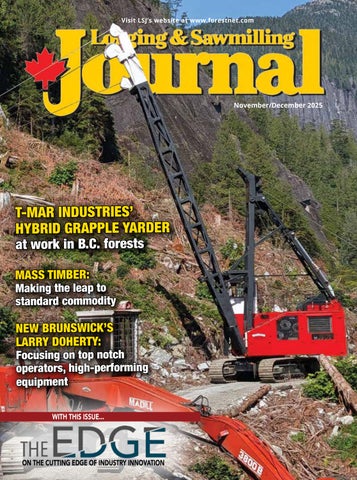
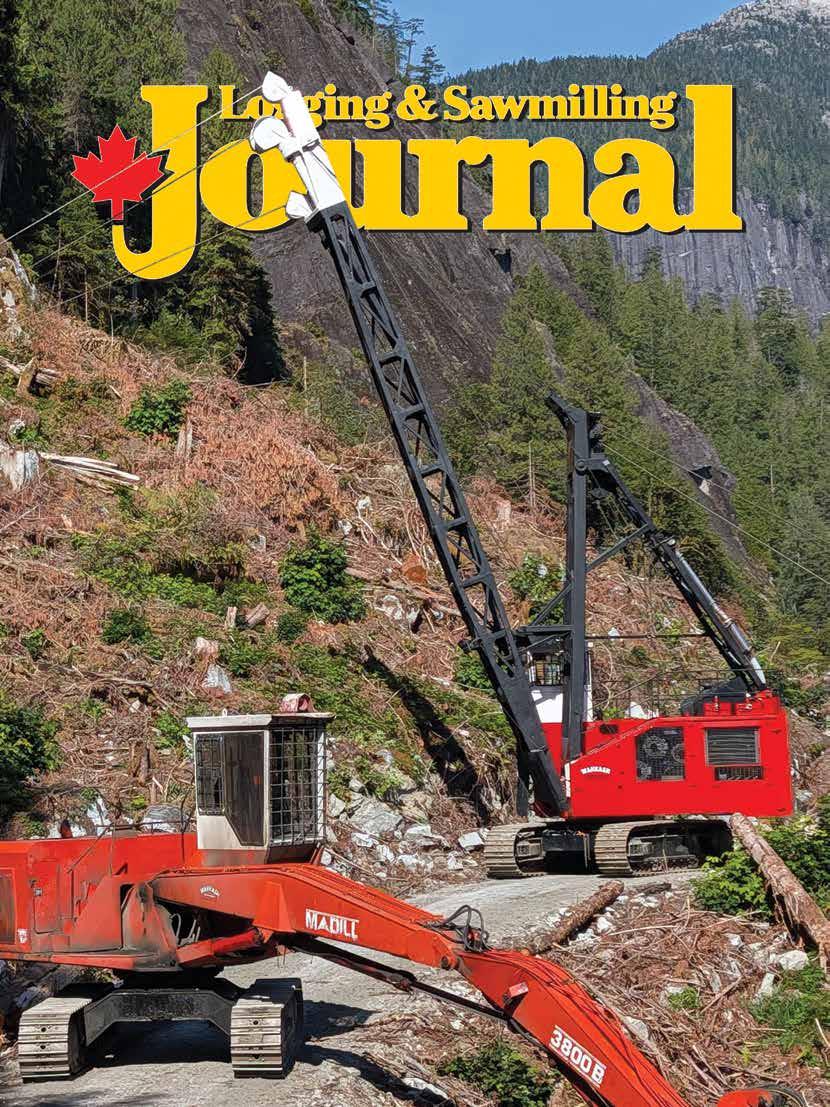
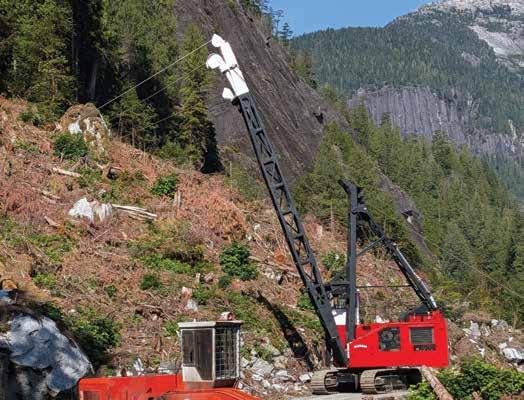
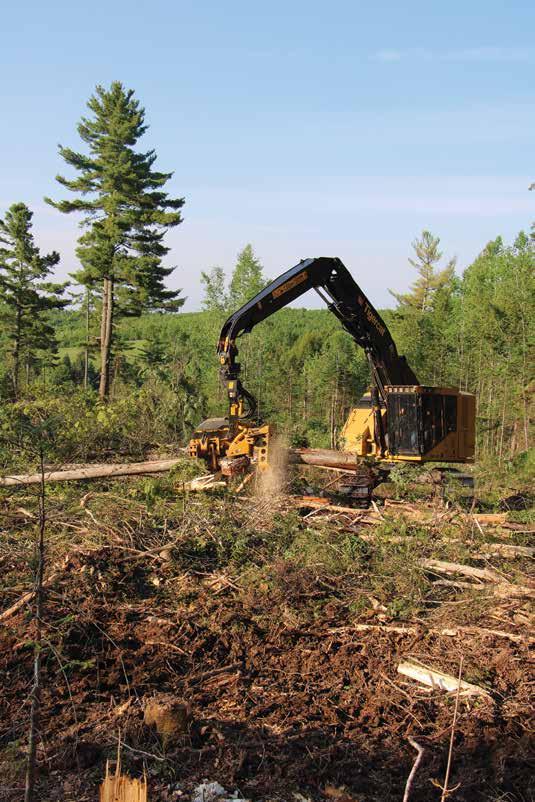
On the Cover: Hybrid cars and trucks seem to be everywhere these days, but a hybrid piece of logging equipment—a diesel-electric hybrid grapple yarder—recently started working in the forests on the British Columbia coast, and it’s getting some attention. The innovative piece of equipment was built by family-owned T-Mar Industries, a longtime supplier to the forest industry, which meets the needs of B.C. loggers—and loggers as far afield as New Zealand—with heavy duty logging equipment that the company manufactures, and rebuilds, in Campbell River, such as grapple yarders, grapples, and related logging equipment. T-Mar has been working closely with B.C. coastal logging company Wahkash Contracting, also based in Campbell River, on the hybrid project. Read all about this new development in logging equipment beginning on page 8 of this issue. (Cover photo and story photos courtesy of T-Mar Industries).
4 Spotlight— Mass timber: making the leap to standard commodity
The mass timber industry is moving closer to making the leap from niche product to a standard commodity, with a new partnership by Mercer Mass Timber—which has operations in B.C.—that will see the material spec’ed more often by builders.
8
Hybrid harvesting in B.C.
A diesel-electric hybrid grapple yarder from T-Mar Industries is now working in B.C.’s coastal forest, and it has the potential to cut fuel and maintenance costs, helping to make coastal logging more cost effective.
DEPARTMENTS
14
Top notch timber harvester
New Brunswick’s Larry Doherty is doing exactly what he has always wanted to do—run a productive logging operation with top notch operators, and high-performing and efficient equipment.
20
Included in this edition of The Edge, Canada’s leading publication on research in the forest industry, is a story from the Canadian Forest Service (CFS).
30 The Last Word
The federal government’s Build Canada Homes program invites softwood lumber exporters to come home—but will they respond, asks Tony Kryzanowski.
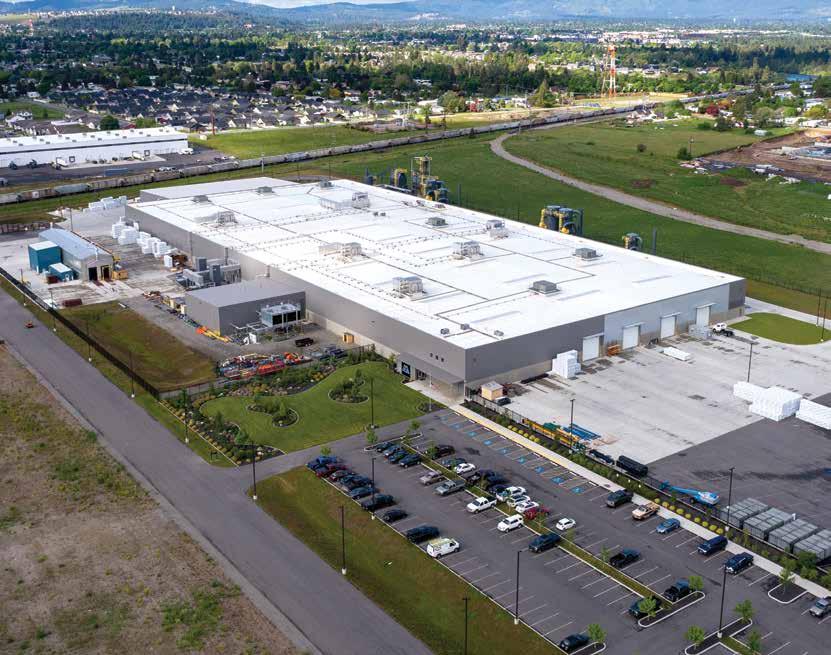
Mercer Mass Timber is North America’s largest mass timber producer, with production plants in Okanagan Falls, B.C., Spokane Valley, Washington and Conway, Arkansas. The company can produce up to 255,000 cubic metres of CLT and glulam per year.
MASS TIMBER:
Making the leap to standard commodity
The mass timber industry is moving closer to making the leap from niche product to a standard commodity, with a new partnership by Mercer Mass Timber—which has operations in B.C.—that will see the material spec’ed more often by designers and builders.
By Tony Kryzanowski
North America’s largest mass timber producer, Mercer Mass Timber (MMT), has announced a partnership with an Australian-based digital software provider to make their mass timberspecific and code-compliant digital design platform freely available to architects and engineers throughout the continent.
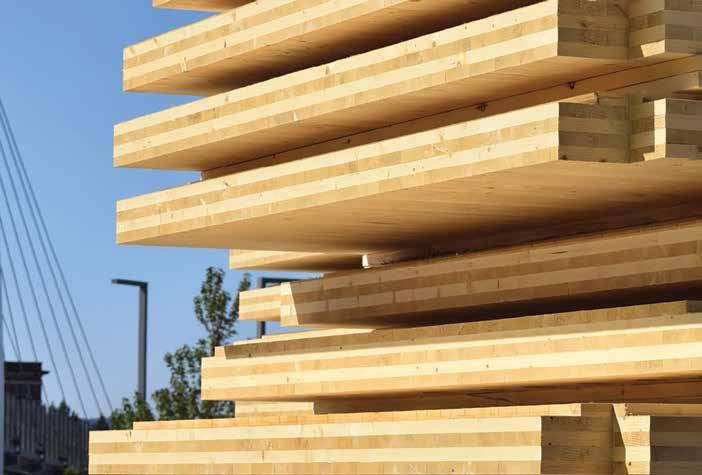
Mass timbers like cross-laminated timbers (CLT) and glulam are used as an equal but more environmentally-friendly alternative to concrete and steel in many building applications.
With this partnership, the goal is to
quickly advance mass timber from a niche product to a common commodity in building construction.
MMT wants to make it easier for specifiers like architects and engineers to choose mass timbers in their designs and also connect more seamlessly with supply chains to source building materials and connectors.
“This is sort of a team made in heaven because this is exactly what we were looking to do,” says Ricardo Brites, Director of Engineering/Virtual Design and Construction (VDC), at Mercer Mass Timber.
MMT is North America’s largest mass timber producer, with production plants
in Okanagan Falls, B.C., Spokane Valley, Washington and Conway, Arkansas. They can produce up to 255,000 cubic metres of CLT and glulam per year, which is more than their next two competitors combined.
Initially called CLT Toolbox and designed for use by specifiers exclusively for mass timbers, demand for this digital design platform has been so great because of its ease of use that it has been renamed SPEC Toolbox, now taking other codecompliant materials into account within the building design software.
Rather than developing an in-house design tool specific to its products, Brites says that MMT decided to partner with
SPEC Toolbox, which works with multiple mass timber producers, because MMT’s overall goal is to advance mass timber use and consumption, describing North America as the last frontier for widespread mass timber adoption.
Brites says that more widespread use of SPEC Toolbox benefits all mass timber producers because it coincides with a trend towards greater product standardization within the industry, indicating that about 80 per cent of what MMT can produce can also be manufactured by other mass timber producers. Greater standardization also promotes greater consumption because by using this digital design software, specifiers won’t need to have a strong understanding of the product line of each individual mass timber plant when designing buildings.
“What the software accomplishes is that it gives mass timber producers a seat early on at the design table, which largely has not existed up till now,” Brites says.
He describes each MMT plant as “agnostic”, meaning that all are capable of making the same products from the same softwood species as needed, although each plant tends to use local species. The Okanagan Falls plant is focused significantly more on glulam production, for example, that is often included in projects on both sides of the border.
SPEC Toolbox has
already been rolled out to specifiers in Australia, New Zealand, Britain and Europe. Its launch in North America was announced this summer with a presentation provided by company representatives to North American specifiers at the recent Woodrise 2025 Conference in Vancouver.
At present, the typical method being used by specifiers to include mass timbers in their building designs is to develop inhouse spreadsheets that provide the code parameters where mass timbers could be applied as an alternative to concrete or steel.
Both Brites and Adam Jones, CEO and Founder of SPEC Toolbox, say that developing these spreadsheets is an onerous and labour-intensive task, representing a significant barrier to more mass timber adoption
in building construction. On average it has been estimated that this task adds about 500 hours of unpaid work or consultancy hours for each engineering firm.
SPEC Toolbox represents a breakthrough because it substitutes the development of these spreadsheets with a code-compliant, easy-to-access digital platform. What once might have taken days or weeks in a design office has been reduced to minutes or hours, much to the joy of both the design community and mass timber producers.
The launch of this digital platform offers both a free and subscriber-based version.
Mercer Mass Timber has announced a partnership with a digital software provider to make a mass timber specific and codecompliant digital design platform—called CLT Toolbox—freely available to architects and engineers throughout North America.
spotlight
from page 5
“No engineering software out there is free like ours,” says Jones, looking beyond CLT to what’s currently available to specifiers from the concrete or steel sectors. “That free aspect is also very important for educators.”
Brites adds that the launch is timely as demand for mass timber in building construction is growing exponentially. He says that at present, the number of projects in North America specifying mass timber in the design phase is twice as many as all mass timber projects that have been completed in North America to date.
“We are expecting 15 to 20 per cent growth per year (in mass timber demand) for the next five years,” he says, adding that in terms of mass timber consumption, North America is about a decade behind Europe.
Making it easy and commonplace for specifiers to choose mass timbers in their designs is considered the final hurdle to overcome for widespread usage.
“There is a big infrastructure gap to mass timber use today,” says Jones. “In university, there is a lack of broad-based knowledge of mass timber compared to concrete and steel. So, our software makes it as easy as possible to design with mass timber products, because engineers will choose the path of least resistance and if mass timber is in the ‘too hard’ basket, that’s been one of the roadblocks for industry so far.”
SPEC Toolbox was launched in Australia and New Zealand two years ago and
in Britain and Europe early in 2025. The software company started with a small team and now has 46 employees.
“We’re maybe the only team dedicated to this problem, but we are also the most dedicated,” Jones says.
In preparation for launch in North America, SPEC Toolbox hired a building code expert to ensure that specifying mass timber for local projects adheres to all local building codes.
“We’ve gone through all the local design codes and methodologies in building out the software,” Jones says, with the initial release of a beta tool used by actual engineers to ensure that it met the design community’s needs before it was launched publicly.
As mentioned earlier, while the software solves the building design challenge for specifiers to include more mass timber, it also solves the supply chain issue for them and that’s where the partnership with MMT comes in.
“The product availability and what is preferred in the supply chain is on the app so it does give the users that understanding,” says Jones. MMT products can be specified directly within the engineered designs.
It also provides an educational role, particularly with newer engineers working in building design who may not have obtained training in the use of mass timber or gained knowledge of its availability.
The software platform will be updated roughly every three weeks to improve and refine the product and also to respond to user feedback.
On the horizon in 2026, SPEC Toolbox plans to include calculations for sustainability into the software where specifiers can also compare mass timber with concrete in steel where greener construction is an important design consideration.
December 10-11
Lumber and Building Materials LBM 2024 Expo, Uncasville, CT 518-286-1010, www.lbmexpo.com
January 14-16
Truck Loggers Association Annual Convention, Vancouver, BC 604-684-4291, www.tla.ca
January 20-22
BC Natural Resources Forum Annual Meetings, Prince George, BC 250-640-7469 www.bcnaturalresourcesforum.com
January 28-30
Western Forestry Contractors' Assoc. Conference & Expo, Victoria, BC 604-736-8660, wfca.ca
February 4-6
Forest Professionals British Columbia (FPBC) AGM, Vancouver, BC 604-687-3264, www.fpbc.ca
February 5-7
Sierra-Cascade Logging Conference, Anderson, CA 530-222-1290 www.sierracascadeexpo.com
February 19-21
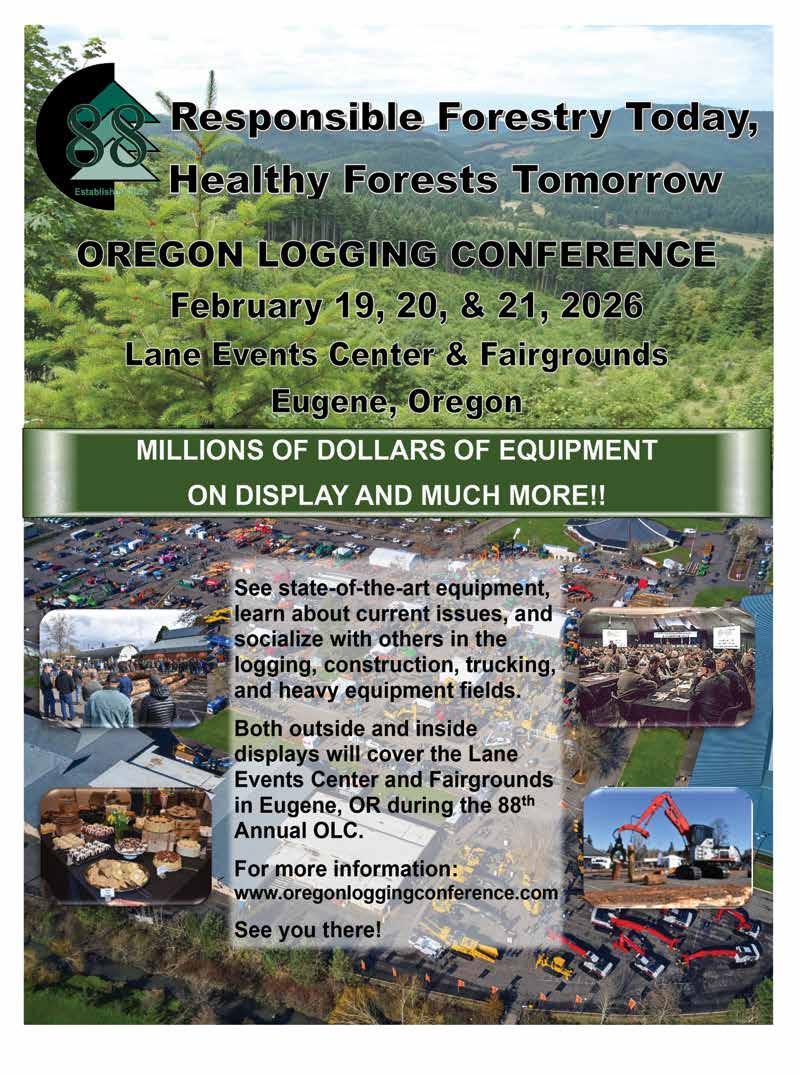
Oregon Logging Conference, Eugene, OR 541-686-9191 www.oregonloggingconference.com
FPInnovations steps up with offsite wood construction handbook
By Tony Kryzanowski
Just as Mercer Mass Timber (MMT) and SPEC Toolbox are breaking new ground by removing critical barriers for specifiers like engineers to include more mass timber in their building designs, FPInnovations, Canada’s forest products research institute, has launched a free guide called the ‘Offsite Wood Construction Handbook’ to improve general knowledge related to construction where considerably more mass timber could be used.
The Institute says that industrialized offsite construction, also known as prefabricated or modular construction, is a construction method where building materials
and components are manufactured and assembled offsite in factories before being transported to the project site for the final assembly.
The benefits to this construction method is that it can improve efficiency, reduce cost, and enhance quality compared to traditional onsite construction.
This construction method is being touted as the backbone of the federal government’s new $13 billion, Build Canada Homes program, which has the potential to redirect considerable Canadian wood products toward domestic consumption in the face of onerous tariffs recently slapped on Canadian softwood lumber by the United States.
The guide, which has been in the works for the past decade, provides information on the design process associated with offsite construction; the offsite manufacturing process; the lumber and engineered wood product portfolio available in Canada for offsite construction; performance of buildings manufactured offsite; essential activities outside the manufacturing plants for offsite construction; and environmental impacts of offsite construction.
One of the benefits often noted with offsite construction is a considerable reduction in building waste.
A free download of the handbook is available at https://web.fpinnovations.ca/ offsite-wood-construction-handbook/
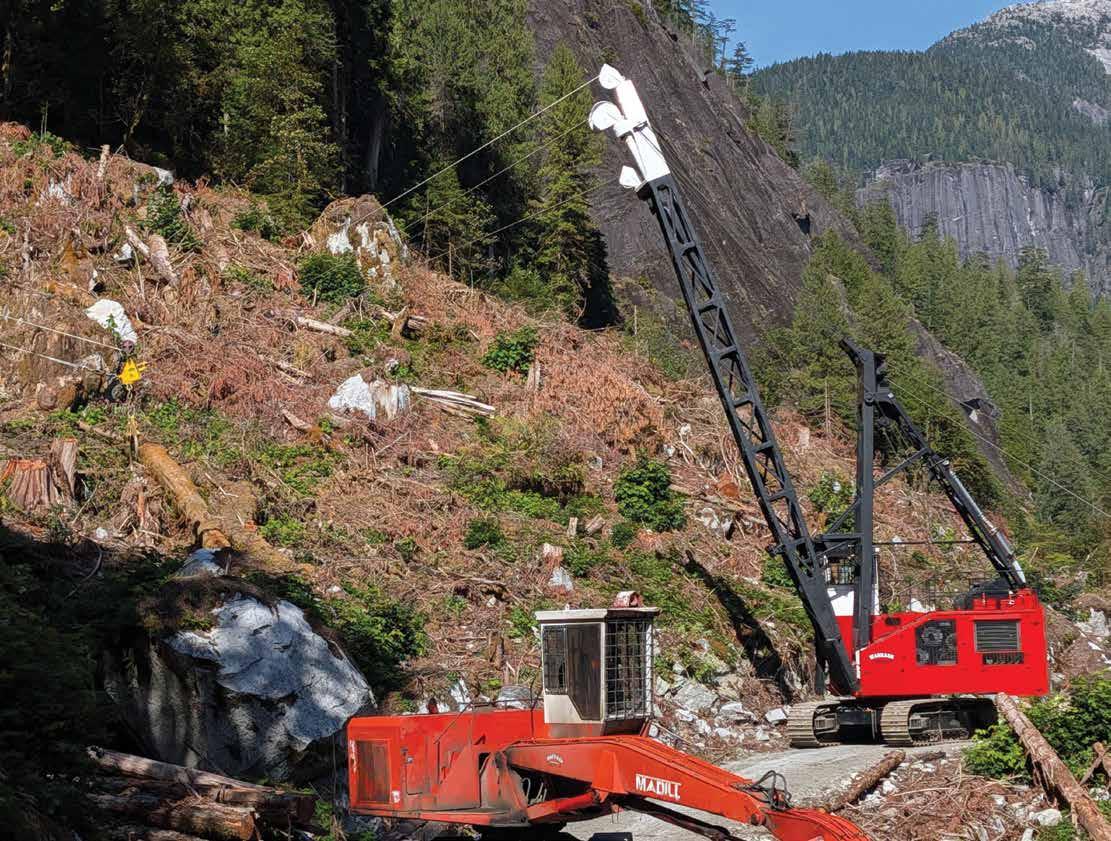
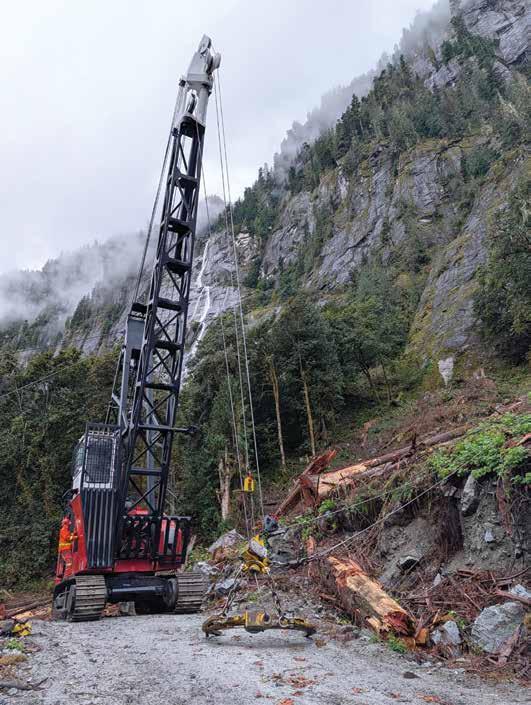
The new T-Mar Industries dieselelectric hybrid grapple yarder working for Wahkash Contracting on Vancouver Island, in B.C.
HYBRID
HARVESTING
A diesel-electric hybrid grapple yarder from T-Mar Industries is now working in B.C.’s coastal forest, and it has the potential to cut fuel and maintenance costs, helping to make coastal logging more cost effective.
By Paul MacDonald
Hybrid cars and trucks seem to be everywhere these days—but a hybrid piece of logging equipment recently started working in the forests on the British Columbia coast, and it’s getting some attention.
And it all started with a mini unintentional demo in the yard of T-Mar Industries of Campbell River, on B.C.’s Vancouver
Island, a couple of years ago.
Family-owned T-Mar Industries is a long-time supplier to the forest industry, meeting the needs of B.C. loggers—and loggers as far afield as New Zealand—with heavy duty logging equipment that the company manufactures, and rebuilds, in Campbell River, such as grapple yarders, grapples, and related logging equipment.
In other words, they deal big time in the heavy duty equipment required for
steep slope yarding.
For those in other parts of Canada unfamiliar with the equipment, Tyson Lambert, Vice-President of T-Mar, described grapple yarding as a “zip line for logs”. Cables are laid out over a steep slope area from the grapple yarder, logs are attached to a grapple that rides the cables, and reeled back in. Grapple yarders are used in areas that are inaccessible to conventional machinery, such as skidders.
“We’ve been around for 40 years, producing equipment,” explains Lambert. “And we’re always looking for ways to improve on our designs.
“And the idea of doing something hybrid came up in our engineering department a few years ago, what with all the electric powertrain parts that were becoming available.”
The thinking was that perhaps the traditional powertrain components that
T-Mar had been using for many years— decades, really—could be replaced with new electrical drive technologies.
“We started doing a little research on it, and we had had an engineer, Philip Biebach, that was pretty conversant in that hybrid world, and had done some of that work in the past.
“We started out by designing and building a small prototype, just to make sure that these types of drives and components would work in a grapple yarder.”
At its core, the hybrid concept was solid, since a grapple yarder is a regenerative machine—it can utilize regenerative braking to recapture energy that would otherwise be spent keeping the cables tight, and convert it into electrical energy to reuse.
They built the prototype, and it worked really well—better than they expected, said Lambert.
“We were doing that on our own, and Dorian Uzzell and the people from Wahkash Contracting came to visit the shop one day.
“We had the prototype set up in the yard, and we were simulating pulling in logs—and the Wahkash guys went on the controls, and had a go at it.
“Dorian and the guys were so impressed with what they saw that day that they commissioned us to build a full-scale working hybrid grapple yarder, using the technology.”
When it comes to B.C. coastal logging, Wahkash Contracting, also based in Campbell River, knows its stuff. For 35 years, it has been providing stump to dump logging services in remote locations throughout coastal British Columbia. When it comes to dealing with grapple yarders, it has been there, and done that, for many years. It speaks a lot about the work T-Mar had done, and their business relationship, that Uzzell and Wahkash would commit to a hybrid machine based on a prototype—and an unintentional demo in the T-Mar yard.
Wahkash, which has a fleet of coastal logging equipment, was looking to repower one of their existing grapple swing yarders, a Cypress 7280. The Cypress machines, built in the 1980s and 1990s, are quite common on the B.C. coast, and are robust workhorses. They are the giants of B.C. coastal logging—weighing in at 190,000 lbs., and equipped with a 70foot boom.
“Instead of just rebuilding it, though, Wahkash wanted us to put the best technology in the yarder,” said Lambert. “We said, OK, based on the hybrid work we’ve
BCcoastallogging
done, it will be easy to do that.
“It wasn’t as easy as we thought it would be,” he quickly added.
They worked on it for two years, and this past summer, it was at the point that the hybrid machine was ready to go logging.
“It is,” says Lambert, “the first machine of its type in the world.”
He notes that the yarder marks the first time anyone has tried to put a hybrid electric power train, or any sort of electric power train, in any type of logging equipment.
To build the hybrid yarder, T-Mar had to develop the drives that were going to drive the large winches on the machine.
“We had to build everything that makes the powertrain work—we could not just go to a drive supplier, and purchase their industrial drives and put it in the yarder, because nothing would fit. We designed and built all the electrical, the drive, the cabling and components.”
They could buy the specialized, high power electrical motors—“everything else, we had to build ourselves.”
They initially built a 1/5 size, working prototype, which helped tremendously, says Lambert. “It was a lot of learning along the way because this is the first time anyone has done it,” he explained. “We figured out the sizing of components based on how fast or slow the machine needs to go—it was really the nuts and bolts of it. We needed to know the specifics on what an average turn cycle on a grapple yarder actually looks like so we can build equipment that meets that need.”
The learnings from the prototype were passed on to the production machine, which is now out in the B.C. woods, grappling logs on Vancouver Island, for Wahkash.
Even though T-Mar has a very impressive history of equipment innovation for the forest industry, tackling such groundbreaking work was a big challenge.
“It was daunting at the beginning, it was daunting in the middle, and only now is it becoming less daunting now that we’ve done the machine,” Lambert says.
The 7280E diesel-electric hybrid yarder is powered by Infinity 1132 drives developed and built by T-Mar. The drums on the machines are completely electrically driven, as is the interlock. Each drum features a dual motor drive. Each drive is capable of 1140 hp, and a little over 125,000 foot pds of torque. The slack line
BCcoastallogging
from page 9
Dorian Uzzell, the owner of B.C. logging operation Wahkash Contracting, was an instrumental part of the building of the first diesel-electric hybrid grapple yarder by T-Mar Industries—he’s the customer for the yarder.
puller features a single-motor drive.
The generator sits where the transmission/torque convertor used to be on the machine. The generator is connected to the engine through the pump box assembly.
“This set up allows us to run the engine at any speed we want and generate the voltage we want. So, the engine can be throttled up and down, and it can still be making power and running loads dynamically. It allows us to run the machine very economically.”
Big picture, it was important, also, to realize that some of the suppliers for conventional components were nearing the end of their product development cycles—making moving ahead with new technology even more imperative.
“With major components, the clutches we use to manufacture grapple yarders were getting harder to get, with longer lead times, and with transmissions, some companies were starting to leave the market,” says Lambert. “All sorts of components are becoming harder to get, because other industries that also use these components, such as oil and gas and mining, are moving to similar technologies: electrostatic or hybrid drivetrains.”
At one point, though it may be quite a bit further into the future, it may not be possible to get some of these components, at all.
“It seemed like there will come a day when we would not be able to buy the components we need to build the machines the way we build them now, or customers might not be able to use them because they could not train people quickly enough or they required too much maintenance, so the cost of using them would fall out of line with where the market was at.”
For the forest industry as a whole, finding, and training, operators is an ongoing challenge. The hybrid yarder is easier to operate, and more intuitive, than traditional yarders, with very user-friendly operator controls.
In this respect, it was a matter of T-Mar seeing where things were going—before they got there.
“I thought that not doing anything posed a much bigger risk for T-Mar, than trying to move the industry forward in a meaningful way,” says Lambert. “There was risk everywhere, but the risk of doing nothing was always higher.”
In terms of development and manufacturing the machine, Lambert said the whole
process involved a lot of plain hard work.
“There were many things around it that we were going, ok, how do we approach this or that—but we have an excellent engineering team and shop at T-Mar,” says Lambert.
There is a real sense of pride in what T-Mar has been able to achieve.
“I can’t overstate how proud our crew is that this technology was designed and produced here for a local logger, and the B.C. logging industry will be the first to use a machine like this that was built right here in B.C.
“One of the things that made this project less daunting was the support of Wahkash Contracting—they have been very accommodating and 100 per cent supportive all the way through, from commissioning us to do the project, to helping us set it up to test.” (on page 12 see the sidebar story on the benefits Wahkash is looking to get from the hybrid yarder). And Mosaic Forest Products, who Wahkash does most of its logging for, also supported the project.
They also received some federal government funding, which helped with some of the costs.
“You roll all of that together, and all of this really made the project possible,” explained Lambert. “We could not have done this on our own without everyone who has been part of it, helping along the way. A lot of people and organizations wanted us to succeed at this, and we are very grateful for their support.
“The real prize for us at T-Mar is that we can now take that technology and integrate it into the new machines we build here, going forward. Our intention was always to use this machine as a platform for the machines we build here.
“We were really fortunate to have a stepping stone along the way, with the conversion for Wahkash, so we could focus on the power train for an existing machine, which was a lot of learning and a lot of work. And that, of course, will also be available for the other machines that could be converted.”
So, what has the end result been? How does the hybrid machine perform? “I’ve personally run the yarder quite a bit in our testing, and it is incredible,” says Lambert. “It’s quick and it’s powerful, and easy to run. It doesn’t struggle to do anything—we’re really happy with the results.”
STRONGER, TOUGHER,
BCcoastallogging
The government funding makes a lot of sense, says Lambert. “We’re a Canadian manufacturer developing a technology that no one else has, that we can use here and also export.”
There is possible opportunity to transfer some of this hybrid technology for use in other industries, such as mining and marine industries, says Lambert. “It could be something the federal government could look at supporting to make sure new infrastructure projects are more efficient and make sure Canadians have the best gear to build and operate those projects.
“This is the type of equipment we need, to build Canada.”
As for the hybrid yarder, T-Mar has already received interest in the hybrid model from New Zealand and American loggers who are using their diesel-powered Log-Champ 550 and 650 yarders. One customer is looking at employing some new logging techniques, that would involve the use of more powerful winches and require more control, which is right up the hybrid yarder’s alley.
Wahkash Contracting a big part of the first hybrid grapple yarder
Dorian Uzzell, the owner of B.C. logging operation Wahkash Contracting, was an instrumental part of the building of the first dieselelectric hybrid grapple yarder by T-Mar Industries—he’s the customer for the yarder.
“We are definitely excited about the hybrid yarder,” says Uzzell. “There is some anxiousness about how it will perform—we’ve invested a lot in it—but I’m very confident it will perform very well.”
Over the last several years, Uzzell and the Wahkash crew have been able to monitor the progress of building the yarder, and provide feedback to T-Mar. That part of it is pretty easy, considering T-Mar is down the street from the Wahkash shop, in Campbell River, on Vancouver Island.
“We could run up there and look at how things were going with Tyson and the T-Mar team,” Uzzell explained.
There was feedback on everything from powering the machine, to the everyday features. “When they were configuring the new operator’s cab, we’d be able to have our operators sit in the seat and give them feedback.”
This past summer, before it went out to the bush, operators from Wahkash had the opportunity to try out the fully-built rebuilt 7280 hybrid yarder at the T-Mar yard. This involved installing thousands of feet of heavy cable on the yarder’s drums, which is a process in itself, but it was well worth the effort, as the comments were positive on the machine’s performance.
Uzzell sees the hybrid yarder as both part of an overall forest industry initiative to be better stewards of the land, and be more efficient and competitive. The move to a hybrid yarder was supported by Mosaic Forest Management, which manages the forest planning and operations for TimberWest and Island Timberlands on Vancouver Island. Wahkash
does most of its logging for Mosaic. Mosaic has fully electric pick-up trucks as part of its fleet, and has looked into all-electric logging trucks.
Uzzell explained that Wahkash was looking at rebuilding one of its 7280 grapple yarders at a cost range from $1 million to $1.4 million. They rebuild their yarders every 10 to 12 years. “Tyson from T-Mar was proposing the hybrid machine at the time, so it aligned with what we had planned, and with about a $1.3 million budget.”
Like anyone who is investing in new technology, Uzzell said there is some natural anxiety about how the new hybrid yarder will perform—especially as they are looking for it to function better, and more efficiently, than a conventional yarder.
And for operators who are used to the older yarders, there are changes.
“The process that you are going to use to grab the logs out of the forest is going to be very, very different with the hybrid yarder,” explains Uzzell. “We’ve always used foot and hand controls, essentially using friction and braking, to control where the grapple drops, to grab logs.”
This combination of hand controls and foot controls is something that experienced operators know and do very well—but it took many, many operating hours to get to that level of proficiency. Those experienced operators can be hard to find these days.
“That is now going to be controlled by a computer program that directs what your hands are going to do on the controls,” says Uzzell. “It will make the grapple yarder way easier to operate, and it will make it easier to train younger people on the machine.”
It’s important, he says, to be able to train the next generation of machine operators more easily on an advanced piece of equipment—Uzzell believes that operating a cutting-edge piece of equipment will appeal to younger people, and, in turn, help continue to maintain his crews.
And, says Uzzell, the hybrid machine packs more punch. “It has more torque and pulling power, and speed and precision, than any machine we’ve ever had.”
Any productivity gains would be a bonus, though, he says.
“I’m not counting on that from the machine. The functions of a yarder are pretty straightforward. You can only realistically yard so much wood in a setting. Grapple yarders operate in steep ground, with big wood and they work hard to get the wood out of the pile and land it, because you are usually on the side of a mountain.” You can only move timber so fast, given that environment.
But there are still significant potential savings, he said.
“Conventional grapple yarders burn 400 litres of fuel a day, and we are looking to reduce that by 50 per cent with the new hybrid machine.” Based on the cost of fuel, and the number of operating days, that alone could represent savings of $80,000 a year.
Longer term, they could also see savings on maintenance. The thinking is that the electric motors on the hybrid yarder would have a 25,000 operating hours’ life, vs. the 5,000-hour life of clutches and brakes in the older machines. “The electric motors are more expensive, but we still expect this could be a win for us,” says Uzzell.
Built to work as hard as
• 20+ Upgrades & Accessories
Stephan Zeit Woodworks
TOP NOTCH TIMBER HARVESTING
New Brunswick’s Larry Doherty is doing exactly what he has always wanted to do—run a productive logging operation with top notch operators, and high-performing and efficient equipment.
By George Fullerton
“Iamdoing exactly what I always wanted to do,” shared Larry Doherty on a private woodlot harvest operation, about 10 kilometres north of Sussex, New Brunswick.
Doherty has been a harvest contractor for the past 36 years, and continues to invest, and look forward to opportunities in the forestry sector.
With his harvesting machinery kit and two log trucks, along with his team of four operators/drivers, he produces around 35,000 tonnes of timber annually, supplying mills in southern New Brunswick and in neighbouring Maine.
While Doherty was recently supervising a road building contractor, Jerry Smith, on the operation, his three pieces of Tigercat gear were busy bunching, processing and getting timber to roadside, where his pair of Kenworth W900s were loading and hauling to regional mills.
The private woodlot stumpage he was operating in featured a mixed wood stand of spruce, over-mature balsam fir and a significant component of eastern white cedar, in addition to a mix of tolerant and intolerant hardwoods and a significant volume of poplar.
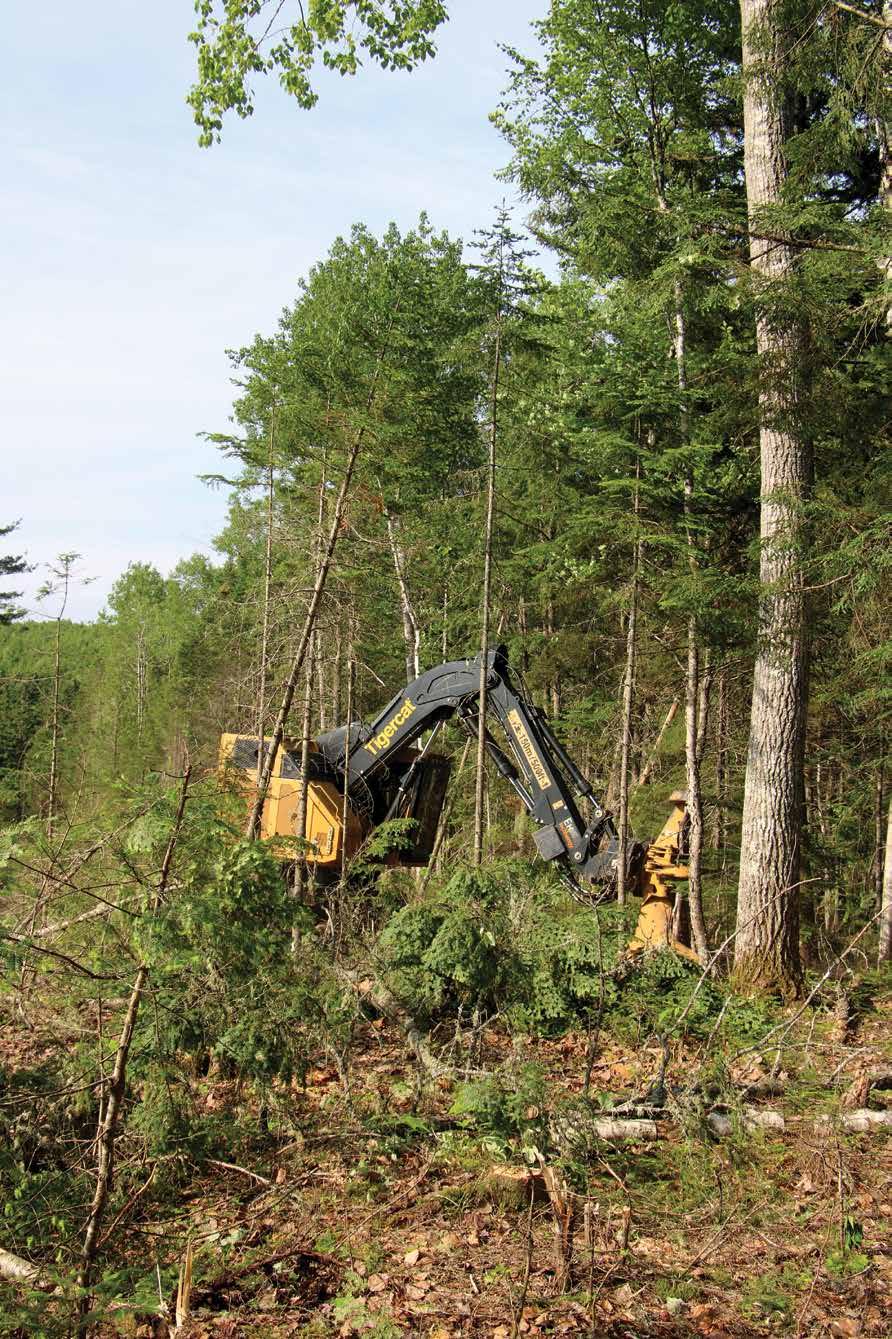
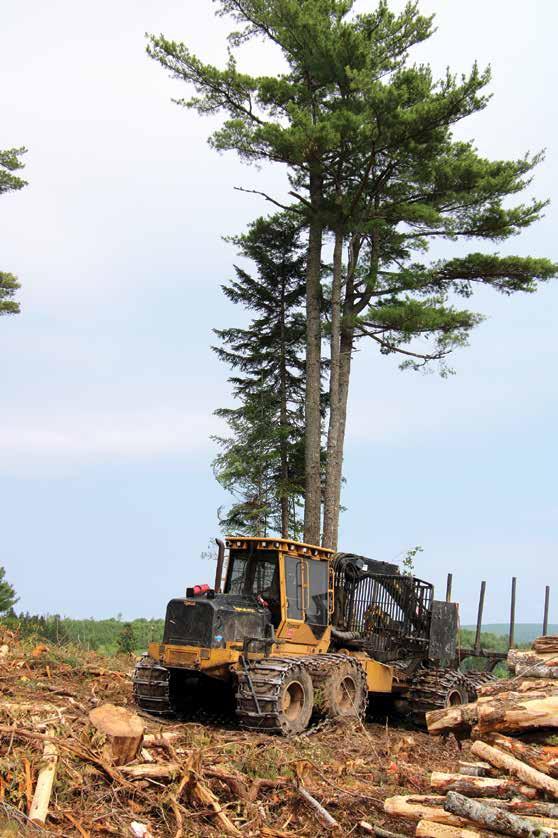
The Tigercat team includes a L822D levelling buncher purchased in 2020, with Tigercat 5400 bunching head. The processor, also an 822, was purchased in 2024 and handles a Tigercat TH570 harvest process head with top saw. Forwarding wood was being handled with a Tigercat 1075, twenty-tonne machine purchased in 2020.
Throughout his 36-year contracting career, Doherty has operated trucks for periods of time, as well as a wood purchasing yard. He readily admits he prefers to contract the trucking. However, in the past few years, the availability of contract trucking service has become scant, and as result he has purchased two log trucks.
Doherty’s career in harvest contracting began when he was 14, trail cutting for family and local harvest contractors. He very soon began contracting for his neighbours around Apohaqui, a few kilometres south of Sussex. He picked up a good deal of heavy equipment knowledge from his father, Joe, who operated dozers for agricultural land clearing, and who became a noted forestry road builder with dozers. Joe also had a forwarder to keep himself busy through the off seasons, and
to page 16
Larry Doherty’s Tigercat team includes a Tigercat 1075 for forwarding wood (pictured), a L822D levelling buncher with Tigercat 5400 bunching head, with processing handled by an 822 machine equipped with a Tigercat TH570 harvest process head with top saw.
eastcoastlogging
from page 15
provided the opportunity for Larry to gain early operating experience.
Following high school, Doherty attended Maritime Forest Ranger School, graduating in 1988. In 1989, he began contracting as L. Doherty Chipping Ltd., delivering chips to Woodland Pulp in Maine.
Initially the operation was with chainsaws and a Timberjack cable skidder.
Eventually, the operation mechanized with a Wolverine three-wheel buncher to feed a Morbark full tree chipper. Doherty relied on contract truckers to deliver chips to the Woodland mill.
In 1998, he made the move to cutto-length harvesting with the purchase of a new Timberjack 608B harvester with a Timberjack 762C head. The following year, he added a Timberjack 1410 forwarder. In 2004, the operation added a new Ponsse Ergo harvester.
“At that time, the 608 offered a high degree of productivity and the dealer provided great service and support. I still use the 608, running a LogMax 6000B, as a processor. It is still productive, depending on the stand type and maintenance and repair schedule. It may sit idle several days a week, but it works when I need it.”
Doherty bought his first Tigercat 822 in 2020. He points to Tigercat’s reputation for productivity and reliability as key attributes that won him over.
“Where other manufacturers use halfinch plate, Tigercat uses three-quarterinch plate,” he says, as an example. “They are built tough and they are highly productive machines.”
Doherty added a Tigercat 1075 forwarder in 2020, and added another 822 with Tigercat TH572 processing head with top saw, in 2024.
“My Tigercat dealer, Wajax, is in Moncton, which is only an hour or so from my base, and they keep a great supply of service and repair parts,” he explains. “And just as importantly, if I have an issue, I can call them and quickly sort most technical problems out with their technicians.
“Additionally, Tigercat is based in Ontario and if I ever need a major Tigercatexclusive component, I can have the piece here in a couple of days. I have continually had great support from the Tigercat factory and their management team.”
The decision to purchase the Tigercat 822 levelling buncher with Tigercat 5400 buncher head came after long discussions with Wajax rep Sandy Hodgson.
“We operate on some steep ground, up to 80 per cent slope, so the levelling capacity is a great asset,” says Doherty. “In our forest type, we have a good deal of supressed understory, and over-mature and unmerchantable stems to deal with, as we are harvesting. The Tigercat buncher offers a quick and very effective means to clear away that unmerchantable growth, to reach the timber. To handle that understory and over-mature and unmerchantable trees with a harvester would be time consuming, less productive, and risk damage to bars, chains and the harvester head.
“My vision for the buncher was to have a quick-attach mounting system, so I had the option to drop the buncher head and hook on a processing head, to ensure my operation was versatile and able to move wood to roadside smoothly, and ensure fresh deliveries to mills. I did not want to see a lot of wood bunched on the ground and then idle the buncher while the trees were processed and then forwarded.”
Doherty talked to Tigercat engineers, and the response was that his concept could not be engineered effectively. “They pointed out that the Quick-Attach hardware would put heads eighteen inches out from the original engineered position. Several months later, Sandy Hodgson came back with the suggestion that Tigercat was interested in my project and ready to offer support.
“In spring 2021, I hired a machinist and a welder, and in two weeks we had fabricated a three-plate coupling system, which positions heads ten inches out from the engineered position. We had a Tigercat technician come and wire the electronics and controls for the dual head application.”
Over the five years they have used the system, they have switched heads an average of two times per week. “Depending on stand type, the buncher can lay down a lot of wood, and if we did not have the option to switch it to processing, with the LogMax 6000B head, we would see wood drying to the extent that the mass scale would be lower, and consequently our revenue. It’s very important to minimize the time from felling to delivering to the mill.
“Troy Webb has been my buncher/processor operator for four years,” Doherty added. “He came with a lot of experience and is a great operator with the Tigercat 822 leveler. If required, he is also comfortable to quick-attach the LogMax head, or jump in the second 822 processor, when that operator, Justin MacKay, fills in on the forwarder.”
Doherty gives credit to Troy’s bunching talents, pointing out good bunching skills help make the entire operation run smoothly and efficiently.
“Since Troy moves between bunching trees and then processing the bunches he lays down, he understands that good bunching skills make for productive processing. He is careful with positioning bunches, sorting species and ensuring the tops of bunches do not tangle.
“When in the processor, he can’t very well complain about the quality of work the buncher guy has provided. The same goes for Justin, and his switching between processing and forwarding. Good processing, sorting and piling techniques make for fluid and productive forwarding. No operator wants to struggle more than necessary to get their respective tasks completed.”
Justin MacKay began working for Larry some 15 years ago. At the time, Justin’s father, Freeman, was Doherty’s dedicated log trucker. Doherty suggested that Justin should try out on their forwarder.
“I spent about an hour with him in the forwarder cab, and then he went to work by himself, and became a very good forwarder operator,” says Doherty. “Once he accomplished the forwarder, I set him in the harvester and he became a competent operator and mechanic. He can comfortably transition between processing and forwarding, which helps make our operation fluid and productive.”
The TH570 harvest/process head is equipped with processor delimbing arms,
eastcoastlogging
which allows either operator to easily select individual stems from the bunched trees. The head has excellent delimbing traction and power attributes, with very little ‘back up and push through again’, to get tough limbs.
MacKay explained that he had no experience with top saws prior to working with the TH570 head. “As I became famil-
to page 18
eastcoastlogging
from page 17
iar with the head, I began utilizing the top saw some, and now it has become second nature and it increases productivity—it is especially handy to cut gnarly hardwood limbs and crotches.”
Doherty notes that the TH570 head features a large measuring wheel with aggressive teeth, which allows it to follow contours of stems extremely well.
Doherty says that when he is busy on road building or other tasks and they have three machines on site, and they get a lot of bunched wood on the ground, he will shut down the buncher, and have Webb operate the processor and MacKay moves into the forwarder.
at maximum power. When the operators face a dose of big poplar or hardwoods, they can up the RPM and get the power that they need to handle that big stuff. Then, when back to average running, you’re back to fuel saving power range.”
The harvesting operators work ten-hour shifts, getting up early in the summer to minimize hot afternoons. For the cold
“I’m appreciative of the talents and commitment of all my operators. It takes a committed team to have a successful business in the forestry sector.”
BWS) and hired a driver. The trailer was upgraded with the addition of a Kesla 2212ZT loader, which features a climate controlled cab. With the single truck, the operation still required additional trucking capacity to move the production. When contract trucking service again became a challenge, he bought a second Kenworth matched to a Manac forty-eight-foot, five-tier trailer. Drivers Keith Savoie and Chris Forgraves typically choose to work nights, to mitigate traffic and congestion issues.
“I am pretty happy with the performance of Tigercat’s FPT Tier 4 engines, and fuel economy,” he says. “One fuel economy strategy we have adopted is to operate the buncher and processor at 1750 to 1800 RPM when working in average stand conditions, which gives us a substantial fuel saving compared to operating
seasons, the Tigercats have engine heaters timed to have things warmed up when operator climbs in. “On those very cold and nasty winter days, it’s great to jump in start up and enjoy instant heat and comfort,” commented MacKay.
Securing consistent trucking capacity has been a concern for Doherty, pointing out that he purchased a new Kenworth and trailer (forty-eight-foot, five-tier
Doherty’s operation includes a Cat D6D bulldozer for road maintenance, pushing trucks in mud or ice conditions and as an insurance factor in case of fire.
L. Doherty Chipping has continued a positive business relationship with Woodland Pulp, and currently delivers hardwood pulpwood logs to the mill. Poplar logs are supplied to the Louisiana-Pacific board mill in Houlton, Maine. Wood directed to U.S. mills is brokered by H.C. Haynes Ltd.
Currently, spruce and fir logs are supplied to J.D. Irving mills in Sussex and
Chipman, New Brunswick. Spruce and fir pulpwood is delivered to the JDI Sussex pulp chipping operation.
Over his career, Doherty has shipped saw and stud logs to mills in Nova Scotia, and has shipped softwood pulpwood to mills in Nova Scotia and Riviere du Loupe, Quebec.
Doherty currently contracts private woodlot stumpage in a 30-mile radius of Sussex.
“We have lots of people reaching out for harvesting services,” he says, and Doherty and his top notch team and equipment are ready to meet their needs. “I’m very well satisfied with the performance of my harvesting and trucking equipment and I am well satisfied and appreciative of the talents and commitment of all my operators. It takes a committed team to have a successful business in the forestry sector.”
That top notch talent extends to his family. A significant contribution to the L. Doherty Chipping operation comes from Larry’s mother, Joan, who at eighty-seven years of age, still does most of the day to day bookkeeping tasks.
With his harvesting machinery kit and two log trucks, along with his team of four operators/drivers, Larry Doherty produces around 35,000 tonnes of timber annually, supplying mills in southern New Brunswick and in neighbouring Maine.
Forest 2020 Plantation Development and Assessment Initiative Using Afforestation
BY TONY KRYZANOWSKI
Afforestation research, development and demonstration sites established under the federal government's Forest 2020 Program delivered by the Canadian Forest Service (CFS) and its many partners— as well as sites established by programs spawned from the initial research launched under Forest 2020—are more notable examples of past afforestation management research programs that began with a short term and specific initial focus that are now delivering secondary values.
This includes quantified above and below ground carbon sequestration, high production growth validation and site disturbance restoration, and related climate change mitigation.
The bulk of the Forest 2020 development sites were established in 2004/2005. The reason for that name was to primarily evaluate outcomes and implications of afforestation plantations comprised of fast-growing tree species over a 16/17 year time horizon ending in 2020. It was one of the Government of Canada's first programs to address issues related to a changing climate. Trees are natural carbon sinks and high yield fibre/ carbon dioxide equivalent production systems. Expanding the forest cover in Canada while capturing carbon was the objective.
The prerequisite for any site to be included in the Forest 2020 Program was that the plantation would have to qualify as afforestation under the Kyoto Protocol of 1997 to reduce GHG emissions, with Canada's objective of production yields being at least eight times that of the average native forest in Canada's commercial zone, which is 1.7 cubic metres per hectare per year—meaning that the Forest 2020 site would have to achieve a minimum average growth of 13.6 cubic metres per hectare per year to maturity.
"The legacy value of these sites is that we can still capture information from them as they continue to grow and contribute to the ecosystem after maturity and can leverage their adoption elsewhere—such as for potential reclamation of mine sites, expansion of forested areas, establishing fire risk reduction areas around communities, biodiversity and providing new sources of raw material for bioenergy—while also cleansing the air, water and land," says Derek Sidders, Legacy Program Coordinator and Technology Advisor, Science Partnerships and Knowledge Mobilization Division, Canadian Forest Service.
The Forest 2020 sites profiled in this article evolved through partnerships with agriculture landowners, forest industry, First Nations, provincial governments and municipalities to establish, on their private non-forested land, afforestation plantations of high yield poplar, aspen and poplar/ tolerant spruce and pine species mixes for primarily carbon sequestration to create alternative sources of potentially commercial fibre, diversity and mitigate climate change with long-term cover, as well as soil, water and air quality benefits. The plantations featured proven hybrid poplar clones for each bio geoclimatic zone paired with suitable intensive management practices, which were developed and adopted as part of the program. Sites were also placed in strategic locations to maximize exposure, range, and scale of the program's impact.
A total of 1,737 hectares of high yield afforestation plantations were established in the Prairie Provinces during the initial Forest 2020 Program, with additional sites established in eastern and southern Ontario following Forest 2020 as developmental fulllifespan demonstrations in partnership with with universities, tree nursery and afforestation service suppliers.
The Program succeeded mainly due to the dedication demonstrated by all parties, and lead to other successful fast growing afforestation programs such as the Canadian Biomass Innovation Network and others that investigated green energy alternatives and site remediation.
Several of these development sites are described and illustrated here.
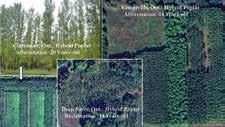
Kemptville, Ontario - Located in downtown Kemptville, this site demonstrates several hybrid poplar clones suitable for Eastern Ontario and promotes access to local resources as the clones were supplied by a local nursery. Another associated site is one near Claremont, Ontario owned by Transport Canada, demonstrating both concentrated and high yield afforestation of large stem and small stem fast-growing species.
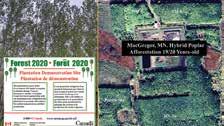
MacGregor, Manitoba - This project, completed in partnership between the Town of MacGregor and CFS, is located adjacent to the TransCanada Highway. It is a 35 hectare demonstration site that surrounds a landfill. After 20 years, a highly successful plantation has been established, featuring multiple clones.
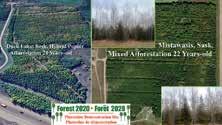
Duck Lake and Mistawasis, Saskatchewan - These sites demonstrate local First Nations' interest in land management, diversification, and community stability by introducing a new land use. As a good example of afforestation, agricultural land was transformed into forested land. In some cases, softwood species were included to create a mixed forest. Today, the sites consist of 250 to 280 cubic metres per hectare with a white spruce mix in the understorey.
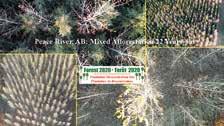
Peace River, Alberta - This site features the establishment of a mixedwood plantation with hybrid poplar and white spruce.
For more information, contact Derek Sidders, Legacy Program Coordinator and Technology Advisor, Science Partnerships and Knowledge Mobilization Division, Canadian Forest Service, at derek.sidders@ nrcan-rncan.gc.ca.
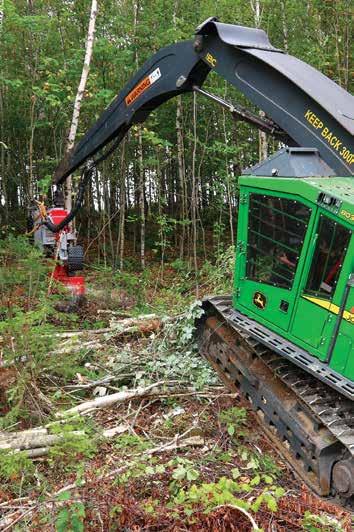
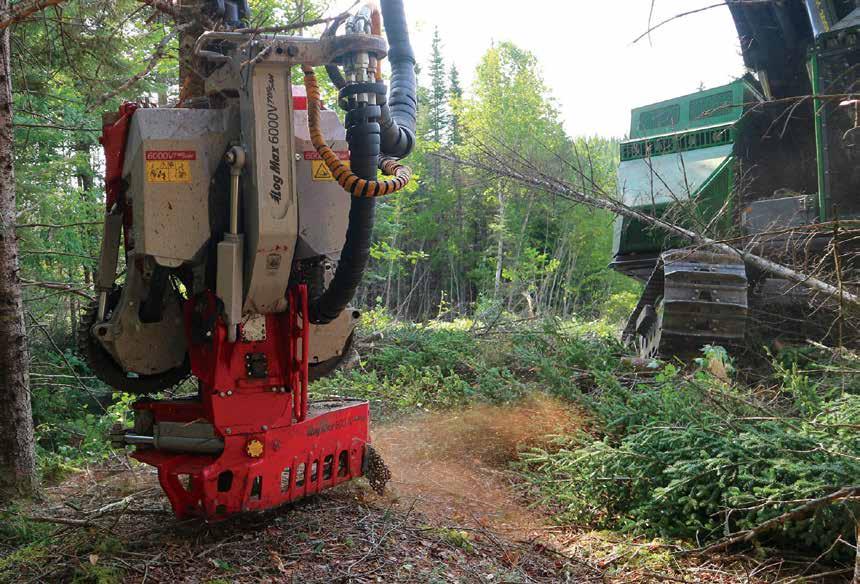
Log Max Forestry Inc. are very pleased to announce that the first series of the 6000V harvesting heads including a topsaw unit, has been sold in Southern New Brunswick.
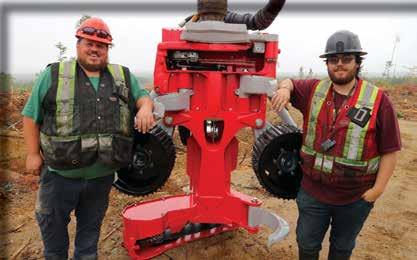
The unit was sold to seasoned logger Josh Orr, GWO Logging Ltd. and installed on a John Deere 803M and initial comments were, “very impressive”.
New features on the 6000V TS include a top saw unit with two MKII 30cc saw motors to assist the contractor in maximizing yield out of forked softwoods and nasty hardwoods. As well, standard tilt-control to place the head at the desired tilt angle, optimized saw box to accommodate up to 90cm saw bars, redesigned measuring wheel cylinder and hydraulic circuit, lubrication points to facilitate maintenance, reinforced frame with safety lock pin, expander pins plus many more updates.
Serial production units will be available in Q1 2026.
To find out how the new 6000V TS can assist you in your logging needs, please contact your local Log Max dealer or visit www.logmax.com
L-R: Owner Josh Orr and operator Carter Greer
TECHUPDATE
Dry Kilns
Logging and Sawmilling Journal solicited information from suppliers of dry kilns for the following Tech Update. For companies that did not respond, we captured information available on their website. The suppliers are listed in alphabetical order.
American Wood Dryers
American Wood Dryers offers a full range of lumber kiln solutions, including continuous kilns, package kilns, and track kilns. The company also supplies
pre-dryers, fan sheds, and cooling sheds. It offers kiln control systems, a patented heat exchanger with reversible flow fans, an air-atomized water mist system, and heat energy systems for direct-fired kilns. American Wood Dryers also offers complete kiln refurbishing and retrofits.
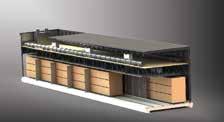
The Single Pass is a patented type of continuous dry kiln; all the wood enters at one end and is discharged at the opposite end. Single Pass has several advantages: improved flow with dedicated green and dry ends like batch kiln operations, reduced costs for energy and material handling labour and equipment, and improved grade recovery. www.drykilns.com
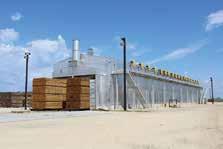
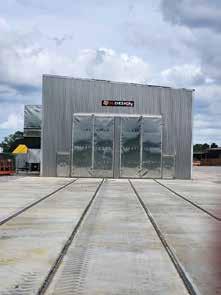
BolDesign
of high-tech processing equipment in the wood industry for more than 30 years,
and is a family-owned and operated business. Its mission is to help businesses large and small to streamline their operations, cut overhead costs, and increase profits. The company supplies kilns for drying hardwoods and softwoods, from lumber to pylons and utility poles.
BolDesign’s X Power kiln technology includes features like externally located fan motors for increased longevity and ease of maintenance, and bi-directional fans located across from each other for the most even air flow across the entire pack of wood. The X-Power design compliments BolDesign Wet-Air Venting technology: maximum air flow only vents at its wettest point and doesn’t waste energy.
www.boldesigninc.com
Brunner-Hildebrand
Brunner-Hildebrand has been serving the lumber industry for more than 70 years. In addition to conventional dry kilns, Brunner-Hildebrand has developed unique products, such as the world’s
largest vacuum dryer, HIGHVAC, and the Alexander continuous dry kiln. The company also has introduced Hildebrand Weight Precision Technology, the easiest, most accurate way of measuring lumber moisture content, says the company. Brunner-Hildebrand offers batch kilns, track-loaded kilns, conventional kilns, continuous dry kilns, and vacuum kilns. It also offers steamers. The company also offers kiln control systems.
firewood producers that want to increase profits and take control of the drying process. Built with industrial grade components and a Smart Control system, it delivers consistent, high-quality results while using a fraction of the energy of traditional kilns. The iDRY AIR installs easily, operates on single-phase power, and can be monitored remotely, making it ideal for small and mid-size operations seeking reliable, automated drying with minimal supervision.
iDRY AIR has faster turnaround, higher yields, and generates greater value from every board or cord—helping businesses stay competitive and capture more revenue from their own lumber, says the company.
www.idrywood.com
KDS Windsor
KDS Windsor has been in business since 1992, and specializes in the design, manufacture and installation of batch and continuous lumber drying kilns, wood waste heat plants, and material handling systems, offering equipment for both hardwood and softwood markets.
The Hildebrand Weight Precision Technology (HWPT) is capable of weighing entire lumber stacks in wireless mode. It provides more accurate results and is easily integrated into the daily work routine. For track and continuous kilns, it is also available installed in kiln carts.
www.bhl-drykilns.com
iDRY
The KDS Windsor advanced DrySpec family of electrical controls and DryTrack in-kiln moisture measurement system provide precise, automatic, and troublefree drying systems, says the company. It offers a variety of kilns for every need, including continuous dry kilns, batch kilns, and hardwood kilns. KDS Windsor Performance Series kilns feature industry-
The iDRY AIR is a high-performance, plug-and-play wood-drying kiln designed for sawmills, custom woodshops, and to page 24
NDK-R Kiln Controls
• Enhanced Sensor Technology
• Integrated Energy Management System
• Retrofitted To Any Kiln Regardless of Manufacturer
Heat Recovery Vents
• Shorter Drying Cycles
• Qualifies for Carbon Cred its
• Saves Up to 80% of Lost Heat
• Increases Boiler Capacity
techupdate
from page 24
leading durability. The stainless steel floating tray design provides a tight interior seal while allowing the outside to breathe and self-drain; this is the most durable kiln skin option on the market, says the company.
www.kdskilns.com
Kiln-direct
Kiln-direct offers state-of-the-art wood drying technology, strong customer support, and value to customers worldwide, says the company. It manufactures numerous kiln models with multiple
heat and airflow variations, and has kilns operating in North and South America, Europe, Africa and Asia. The company’s expertise with regards to kiln software allows operators to run, maintain and adjust kiln operations, making units easy to deal with.
Kiln-direct offers the Wooddryer Kiln Control System management software. The company supplies kilns with capacity ranging from 9,000 to 40,000 board feet. The widest version of the standard turnkey delivered kiln has a capacity of 14,000 board feet of 4/4 lumber; it is popular for higher temperatures and faster drying of softwoods. Kiln-direct also offers kilns for drying firewood and heattreat pallets.
www.kiln-direct.com
Nova Dry Kiln
Nova Dry Kiln is a world-wide producer of high quality lumber dry kilns that are designed to produce a brighter
kiln dried product. Nova Dry Kiln systems have the lowest operating cost using hot water and calibrated powered exhaust, says the company. Other characteristics include high thermal efficiency, long life expectancy, and simplicity of operation.
www.novadrykiln.com
Nyle Dry Kilns
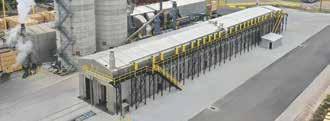
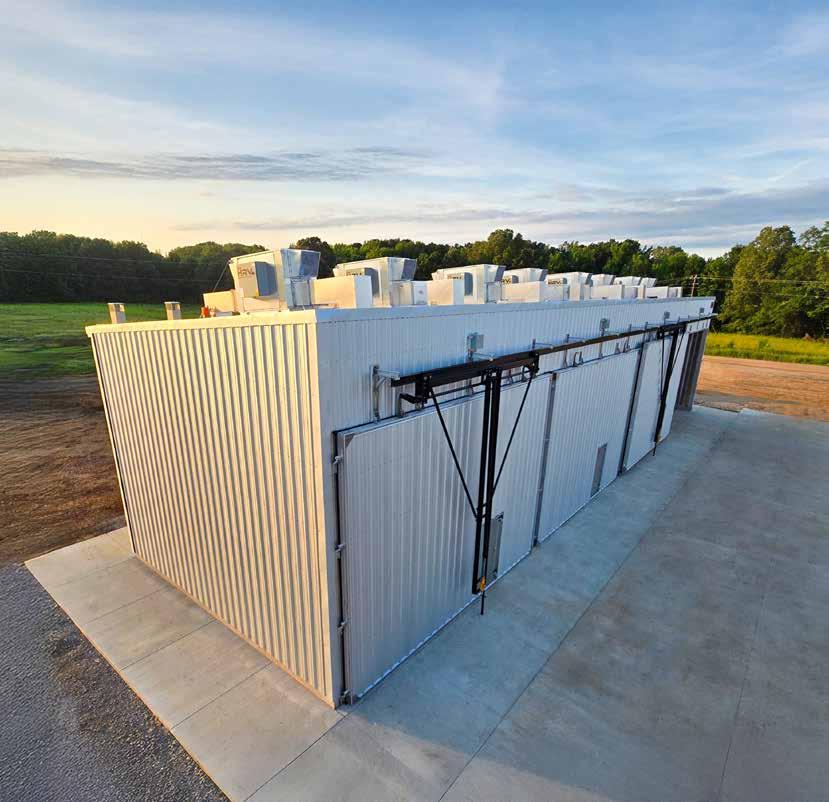
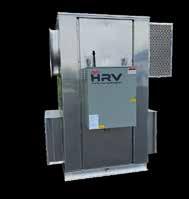
Nyle Dry Kilns says it is advancing the lumber industry with its new rooftop Heat Recovery Vent (HRV) option, which
addresses rising energy costs and sustainability goals. Lumber drying traditionally wastes significant energy by venting hot, moist air. Nyle’s HRV option solves this by capturing and recirculating waste heat back into the kiln. This dynamic heat recovery dramatically reduces fuel con sumption, with savings potentially reach ing 30 per cent, while stabilizing crucial drying conditions.
The rooftop unit, along with an exist ing stand-alone model, ensures versatility for nearly any facility. The systems can be retrofitted on to existing kilns from any manufacturer, avoiding costly full replacements. This accessibility provides rapid return on investment, often under two years. Nyle HRVs are a strategic asset that enhances profitability and support a sustainable future by cutting fuel use and emissions, says the company.
www.nyledrykilns.com
SII Dry Kilns
and sterilizing industries. It offers innovative design and manufacture of kilns for drying hardwoods and softwoods as well as pallet heat-treating systems and firewood kilns.
For softwood lumber producers, the company offers batch track kilns and dual-path continuous kilns. A dual-path continuous dry kiln can increase production 150 to 200 per cent compared to a traditional batch kiln while at the same time reducing energy consumption by 20 to 25 per cent per board foot. The company also offers pre-dryers, fan sheds, components and equipment, and kiln control systems.
www.siidrykilns.com
USNR
USNR’s UniFlow kiln conversions increase drying efficiency and simplify maintenance. UniFlow kilns are an industry success proven on SYP, Douglas fir, and hemlock. It is cost-effective to convert batch kilns and even counterflow kilns to the UniFlow design, providing more efficient operation and energy conservation
SII Dry Kilns has served the lumber industry for more than 50 years and has over 2,000 kilns operating around the globe. The company is known for its superior reputation in the lumber drying
A recent project converted four common-wall kilns at Rosboro Lumber in Springfield, Oregon, to UniFlow, increasing production by 35 per cent while dramatically reducing boiler consumption. Another project converted a continuous kiln to UniFlow with equally powerful results. USNR has improved the original UniFlow design, increasing efficiency and simplifying maintenance. Adjustments have increased the service life of motors, increased air flow to the blowers, and reduced the number of different parts required to operate.
www.usnr.com
Valutec
Valutec is said to be a world leader in continuous kilns and has delivered more than 1,500 kilns to sawmills around the world. The company has combined Nordic expertise in lumber drying with insights into challenges facing customers for almost 100
to page 26
from page 26
years. Valutec is the only company offering TC kilns, which come with distinguishing
features such as low energy consumption, high flexibility, and superior capacity. It gives the operator the possibility to create the ultimate drying process with freedom to mix dimensions, minimal moisture content variation, and reduced risk of checking. Annual capacity can reach 150 MMBF with target moisture contents down to around 12 to 18 per cent with a standard deviation of one per cent.
www.valutec.se/en
Wellons
For more than 50 years, Wellons has provided steam generating plants and lumber dry kilns to the forest products industry and currently has more than 1,300 steam-heated lumber dry kilns in operation, producing high quality lumber.
The company offers track-loading kilns, high temperature kilns, continuous dry kilns, and package kilns. Wellons has developed what it says is the most significant advance in lumber drying of the last 50 years: Computerized Multizone Control. The Wellons multi-zoned computer controlled kiln uses the temperature-dropacross-the-load (TDAL) principle to monitor and control drying. Optimum drying rates are achieved with multiple electronic sensors that send data to the computer for automatic evaluation and reaction. The technology has demonstrated improvements in moisture content uniformity, resulting in better grade recovery, faster schedules, reduced energy consumption, and increased drying efficiency.
www.wellons.com
Wood-Mizer
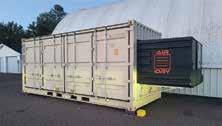
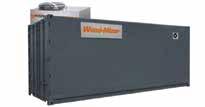
Wood-Mizer manufactures portable sawmills and woodworking equipment for hobbyists and industrial mills. Wood-Mizer offers several small dehumidification systems—without chambers—for drying wood as well as a system that is offered with an insulated shipping container for a kiln.
The PRO container kiln package combines its high-quality drying system with a 20 foot insulated shipping container and everything needed to make a top-quality drying kiln. This container package includes the KD250PRO dehumidification kiln unit, pro controls, circulating fans, and powered vent kits. It accommodates a wide range of load sizes, making it suitable for various drying needs, from small batches to larger quantities. Capacity is 1,500 to 2,000 board feet for softwood or fast-drying hardwood or 2,300 board feet for slow-drying hardwood.
www.woodmizer.com
SUPPLIERNEWSLINE
Courizon Partners acquires Air Burners Inc.
Courizon Partners LLC has announced its acquisition of Air Burners, Inc., a global leader in air curtain burner systems used for environmentally responsible, on-site disposal of wood and vegetative waste.
Air Burners’ product line is widely used across land clearing, forestry management, wildfire mitigation, agriculture, and municipal waste applications in North America and more than 30 other markets.
Courizon also announced that Darin Clause has been named Chief Executive Officer of Air Burners and Brian O’Connor, founder and long-time CEO of Air Burners, will transition into the role of Chief Technology Officer.
Clause brings extensive leadership experience across manufacturing and industrial distribution, says the company, most recently serving as President of Cadrex Manufacturing Solutions. He previously held senior roles at Airtech Advanced Materials Group, Diploma plc, and AFGlobal Corporation.
“Air Burners is uniquely positioned to solve an urgent and growing need as operators seek cleaner, safer, and more costeffective ways to process wood and vegetative waste,” said Evan LePatner, founder and Managing Partner of Courizon. “Brian has built an extraordinary company over these past 27 years, and we are excited to partner with him and Darin to strengthen and dramatically scale the business.”
“I chose to partner with Courizon given their proven experience investing in and scaling industrial businesses,” said O’Connor. “Our team is excited to work with them and their outstanding industry executives to take Air Burners to new heights.”
“It is an honor to lead Air Burners at this pivotal moment when there is accelerating demand for its products across multiple end-markets,” said Clause.
www.courizonpartners.com www.airburners.com
Tigercat rebrands attachments as TCi
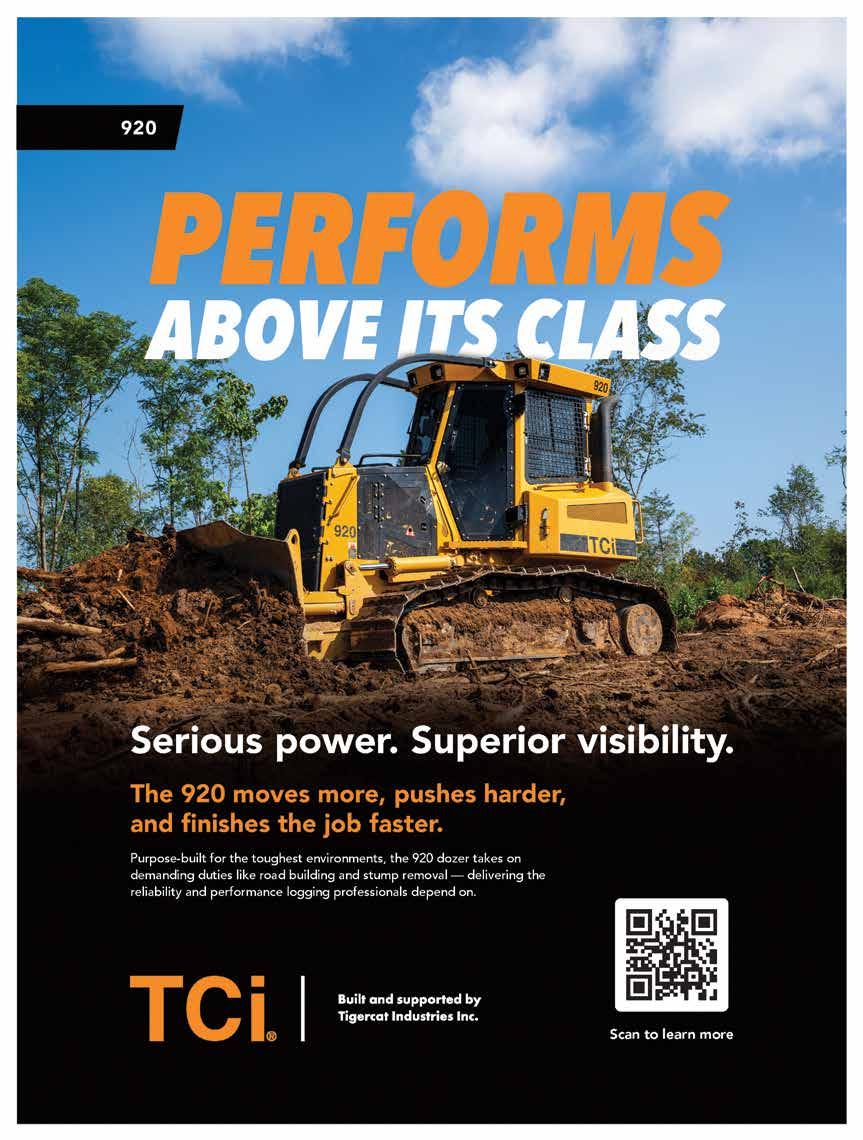
As part of its evolving international brand strategy, Tigercat Industries says it will rebrand its entire line of harvesting heads, felling heads, grapples, mulching heads, and other attachments under the TCi badge.
The company, headquartered in Brantford, Ontario, says that this provides a single brand identity for Tigercat Industries’ attachments worldwide.
The TCi brand was established to address limitations on the use of the Tigercat brand name in specific markets. The TCi badge indicates that the attachment is engineered, and fully supported by Tigercat Industries, and designed to optimize the performance of the Tigercat or TCi carrier to which the attachment is mated.
Tigercat says that customers can expect the same quality, reliability, and durability across the full range of attachments as this is a branding change only. The value proposition remains unchanged. The design intent and warranty coverage remains the same.
TCi branded attachments will transition worldwide starting in the 2026 model year. Harvesting heads and some felling attachments will begin to arrive on dealer lots starting in the fourth quarter of 2025.
www.tigercat.com
Comact launches new generation single step log pusher
Comact has announced a new generation log pusher, featuring a patent pending single step design for heavy duty applications.
This new model expands Comact’s existing range of log pushers, which also includes double step and multi step designs, providing mills with tailored solutions to meet specific operational needs.
Engineered to withstand the harshest operating conditions, the single step pusher design significantly extends equipment lifecycle while simplifying maintenance and improving operational safety. Traditional log pushers work under extreme conditions, receiving and handling heavy materials, which can lead to wear and costly replacements. The new single step
By Tony Kryzanowski
pusher is built for durability, allowing operators to replace only the step when needed, eliminating the need to change the entire pusher.
To further protect the equipment, the system incorporates dampers for enhanced shock absorption, ensuring smoother log reception with reduced mechanical stress. In addition, an integrated camera system monitors the presence of logs in the pocket, preventing the pusher from operating when a pocket is empty. This smart safeguard avoids direct impacts on the step and reduces unnecessary wear.
www.comact.com
Norwood Sawmills now part of Wood Technologies International
Barrie, Ontario-based, Norwood Sawmills has joined Wood Technologies International (WTI), home to USNR and Burton Mill Solutions.
WTI was formed in 2021 through the merger of USNR and Burton Mill Solutions (formerly Wood Fiber Group), and is backed by private equity firm One Equity Partners. Headquartered in Woodland, Washington, the company now includes five business units serving the wood products industry: USNR, Burton Mill Solutions, Mid-South Engineering, Global Tooling and Supply, and now Norwood Sawmills.
By becoming part of WTI, Norwood says that the move brings the company into a focused team of world leading lumber processing companies. The result for sawmill owners is straightforward: more capability, enhanced product advancement, and stronger technical support for new and existing portable sawmill owners.
For over 30 years, Norwood Sawmills says that it has led the industry in portable sawmill design with a legacy of craftsmanship, ingenuity, and customer commitment. Joining WTI places Norwood with owners who speak the language of the wood products industry and understand the challenges and responsibilities that come with building sawmills for real world use, it says.
www.norwoodsawmills.com
to page 28
suppliernewsline
from page 28
Brunette Machinery expands international reach with acquisition of Salem Equipment
Vancouver, B.C.- based Brunette Machinery Company Inc has purchased Salem Equipment Inc, a leading U.S. manufacturer of premium sawmill machinery.
Founded in 1946, Salem Equipment Inc has been a leader in providing complete sawmill systems and individual machine centres along with complete services in design, manufacturing, and technical support. Salem offers a full range of products including log debarking and bucking systems, primary breakdown systems, resaw systems, board and gang edging systems, trimming and sorting systems, and residuals processing and handling systems.
Brunette says that the acquisition strengthens its North American growth strategy and reinforces its commitment to delivering expert solutions to customers and gives Salem Equipment deep support to continue its seven decade tradition of innovation and quality in wood processing machinery.
www.brunettemc.com
FPAC sees biomass investment tax credits and regulatory efficiency commitments as key
The Forest Products Association of Canada (FPAC) put forward 19 recommendations for Budget 2025 focusing on three areas where immediate federal action can make a tangible difference.
These are smarter regulation to improve competitiveness, clear signals to improve investment confidence, and stronger trade and market access measures to protect Canadian jobs.
The federal government’s $1.25 billion softwood package is welcome support for the immediate term, but finding a path to a more certain trading arrangement with the United States remains the Canadian forest sector’s top priority.
The inclusion of Investment Tax Credits (ITCs) for biomass projects in Budget 2025 is a welcome, long overdue step for Canada’s forest sector, FPAC says. After years of uncertainty, the measure offers a starting point to restore investor confidence, but its impact will depend on how quickly and clearly the federal government follows through.
Biomass projects give new life to forest residuals by turning them into reliable, locally sourced energy. With the right tax measures in place, these projects can modernize mill operations, sustain and grow jobs in rural and northern communities, and strengthen Canada’s position as a secure producer of renewable energy.
FPAC also welcomed commitments to address regulatory duplication and confusion between federal and provincial governments and says it stands ready to work with the federal government on the affordable housing agenda, sector innovation, and product and export market diversification.
www.fpac.ca
Komatsu invests in Canadian operations with new full service parts distribution centre
Komatsu says that it is strengthening its commitment to Canadian customers with a major investment to double the size of its parts distribution footprint and trans -
form its Edmonton, Alberta, parts depot into a full service distribution centre.
This expansion, the company says, marks a significant step in Komatsu’s ongoing effort to enhance service levels, reduce lead times and better support dealers and customers across Canada.
The new facility, spanning approximately 135,000 square feet, will double the capacity of Komatsu’s existing warehouse. This upgrade enables Komatsu to store and distribute fast-moving parts directly from Edmonton, significantly improving delivery times, including 24hour delivery capabilities to its dealers in Western Canada.
www.komatsu.com
KEITH unveils RX Technology, deemed the next evolution of Walking Floor systems
KEITH Manufacturing Company recently introduced its RX Technology, which it describes as the latest evolution in Walking Floor material handling solutions.
It is engineered to deliver complete performance and peace of mind for today’s demanding wood and forestry operations.
Leveraging decades of expertise, KEITH says that its RX Technology combines robust innovation with trusted reliability, setting a new benchmark for efficiency, safety, and operational ease.
RX Technology stands out with comprehensive thermal protection, integrating electric heat sensors and temperature switches to prevent overheating and protect critical components during the toughest jobs. Its redesigned switching valve requires no adjustments, simplifying operation and significantly reducing time spent on maintenance. The oil pressure filter, rated for up to 60 gallons per minute, ensures a cleaner system, leading to less contamination, smoother performance, and dependable system longevity.
With fewer parts and internal check valves, RX Technology reduces complexity and boosts overall reliability. The system’s smarter controls feature both automatic and intuitive electronic controls, as well as optional manual options, ensuring ease of use, adaptability, and efficient unloading of wood chips, biomass, pellets, or sawdust.
www.KEITHwalkingfloor.com
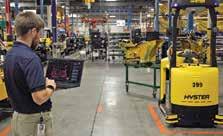
Hyster launches new revolutionary lift truck automation solution
Hyster now offers a brand new automated lift truck platform, Hyster Atlas, engineered for ease of use and dependability to help teams work more efficiently and accomplish more.
The straightforward, easy-to-deploy solution features a drag-and-drop portal that allows for fast, easy setup and facilitates intuitive management and on-the-fly adjustments without the need for software engineering or custom code.
The user-friendly, drag-and-drop portal enables operations to implement automated lift trucks in as little as a day, and empowers users to make changes quickly and easily with no on-site software engineering required. The portal is cloudbased, equipping managers with anytimeanywhere access for easy automated fleet management across multiple facilities and remote monitoring, access and update capabilities.
The automated tow tractor is the first model available on the new platform. For manufacturers using automation for repetitive tasks like towing carts, automated tow tractors are designed to use a variety of hitches for compatibility with all cart styles and are available with an automated hitch and unhitch option.
www.hyster.com
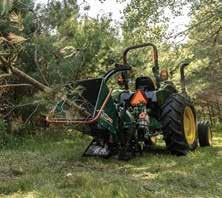
Patented Woodland Mills technology creates new category of wood chipper
Almost a year after expanding its patented twin flywheel technology into four new wood chipper models—the TF46 PRO, TF68 PRO, TFG55 PTO, and TFG55 GAS—Ontario-based, Woodland Mills, reports strong adoption and performance from customers worldwide.
Woodland Mills designs and engineers forestry equipment for landowners worldwide, including portable sawmills, wood chippers, stump grinders, ATV trailers and more.
The system separates the chipping and throwing functions with two specialized flywheels, resulting in more efficient material processing and improved output. Twin flywheel technology features a high torque chipping flywheel for processing larger materials, while a secondary flywheel spinning at twice the speed ensures faster and farther material discharge. The increased air velocity also helps keep lightweight and leafy materials in the chip stream.
suppliernewsline
The company says that these chipper models expanded twin flywheel technology beyond the original TF810 PRO wood chipper, bringing the design to smaller PTO-driven units and, for the first time, to a gas powered chipper. Together, they’ve opened up a new category in the wood chipper market by making this exclusive technology accessible to a wider range of tractor owners and non-tractor users alike. www.woodlandmills.com
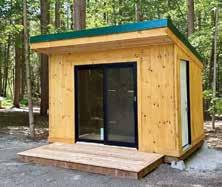
Red Pine CLT shelter a first in Canadian construction
For the first time, Eastern Canada’s red pine—a species historically overlooked for panel construction and used for hydro poles and home finishes—was successfully tested, validated by the University of Toronto’s wood lab, and transformed into cross laminated timber (CLT).
The project by the Mass Timber Institute of the University of Toronto, Ontario Woodlot Association, Limerick Forest and Canadian home builder CABN, turned sustainably harvested red pine into structural CLT panels.
Toronto-based CABN builds energy efficient smart homes for unique locations worldwide.
One of CABN’s solar powered HUTTs, now installed in Limerick Forest, was built using red pine CLT sourced directly from the same forest.
This breakthrough presents untapped potential to scale green, prefabricated construction in Ontario and beyond with red pine. The red pine stock in Limerick Forest alone could support the construction of 2000 new homes in Canada. Across Ontario, red pine dominates more than 280,000 hectares of forest, offering a local, renewable path to help achieve
The Build Canada Homes program invites softwood lumber exporters to come home—but will they respond?
By Tony Kryzanowski
“
We’re just waiting for the dust to settle.”
That sentiment was expressed recently by Nick Arkle, CEO of Gorman Bros. Lumber, a B.C. softwood lumber producer, regarding the current 45 per cent tariff on Canadian lumber exported to the U.S.
In other words, what the industry is seeking more than anything else is clarity. According to industry analysts who track the North American softwood lumber market every day, there is an awful lot of dust that has to settle—and it’s escalating. American tariffs are only part of the dust storm. Canadian lumber producers may not even be that concerned since they can decide whether or not to pass on the cost of tariffs to their customers. In fact, many experts were predicting that the combined tariff would be 45 per cent long before it was announced.
It’s the issues out of their control—like the housing affordability crisis and decreasing fibre access due to provincial government policies—that are keeping Canadian lumber producers awake at night.
The general affordability crisis in North America, where prospective homebuyers can’t even afford to save for a down payment to qualify for a mortgage, has created a current oversupply of lumber production in the range of about 1 billion board feet annually.
So, when Canadian producers announce curtailments or use this opportunity to close sawmills, the impact of the U.S. tariff may not be the primary reason for this decision, but it could perhaps be the tipping point of an already untenable position based on the current market supply and demand imbalance.
Regarding the affordability issue,
experts say that mortgage payments for prospective homeowners in the U.S. have risen on average from about $1,800 per month in 2022 to $3,000 per month in 2025, representing an increase of 63 per cent. Imagine tacking that extra amount onto the rising cost of groceries, fuel, and utilities, and no wonder so many Americans and Canadians can’t afford to save for a down payment on a new home.
Complicating this scenario for softwood lumber producers—and one that should not and cannot be overlooked—is provincial government policy, especially in B.C., Ontario and Quebec, that according to the experts is either limiting fibre supply or making it uneconomical to log. So, when provincial premiers quickly point the finger at American softwood lumber tariffs for closures and job loss, they shouldn’t forget to look in the mirror—or at least be honest and acknowledge that many of their forest management policies have become a huge drag on industry revenues, and even abilities to efficiently operate sawmills.
If there is a potential silver lining in Canada to the ongoing tariff soap opera, it’s the promise by the Canadian Liberal government to build 500,000 new, affordable homes per year to tackle the ongoing Canadian housing crisis, thus theoretically creating significant domestic demand for building materials like softwood lumber.
The government has set aside $13 billion over five years for its new Build Canada Homes program to accelerate housing development, help builders with financing, reduce upfront costs, and streamline the permitting process.
It’s a great idea. Prime Minister Mark Carney is correct when he points to the massive home building program that took place after World War II when many
returning veterans found jobs building homes and a housing boom ensued. Many of those homes still exist.
Carney has stated numerous times that we can tackle this issue of American tariffs by being our own best customer. In other words, the federal government is using its power to drive growth in a particular sector by creating a market through policy. It can work, and a good recent example is how the government used incentives to grow the EV vehicle market in Central Canada.
The only potential drag on the roll-out of this program is with premiers who for political reasons find all sorts of excuses to slow down actual construction in a blatant attempt to shine a negative spotlight on the federal Liberal government. Let’s hope for the forest industry’s sake that doesn’t happen.
While the experts are skeptical that the federal government will meet its goal of building 500,000 new homes per year— which is about is about one-third of how many homes are built on average in the U.S. annually, with a population 10 times as great as Canada—it will be worthwhile watching to see if Canadian softwood lumber producers will step up and benefit from this initiative.
It won’t be so easy. These producers have spent decades establishing customer relationships and supply chains with American customers, and they are also well aware that our neighbors to the south are extremely prone to hurricanes, tornadoes and wildfire. But if they find that they are having a hard time passing on the cost of American tariffs to their customers, then they just might be ready to buy into what our Prime Minister is selling.
Let’s hope he meant it when he said, “build baby, build.”