sea turtles, West Indian manatees, and dugongs feed on theseseagrasses. Since they are the only seagrass capable of forming extensive seagrass meadows in deep waters, Halophila seagrasses are important contributors to marine ecosystems.
Within the genus, methods of producing new plants vary. Some lave male and female flowers or different plants (called dioecious ?lants, meaning "two houses"); some lave male and female flowers on the same plant (called monoecious, meaning "one house"). Both types are capable of producing numerous seeds. One species, Halophila johnsonii, or Johnson's seagrass, appears to sterile or capable only of producing unpollinated seeds, which may become clones identical to the female parent. High seed production and lateral growth rates enable most Halophila seagrasses to quickly cover and stabilize bottom sediments. Scientists have never observed new Halophila plants to grow from root or stem fragments of another plant. This vegetative reproduction is common in other seagrasses.
Pertinent Facts about Halophila johnsonii, (Johnson's seagrass)
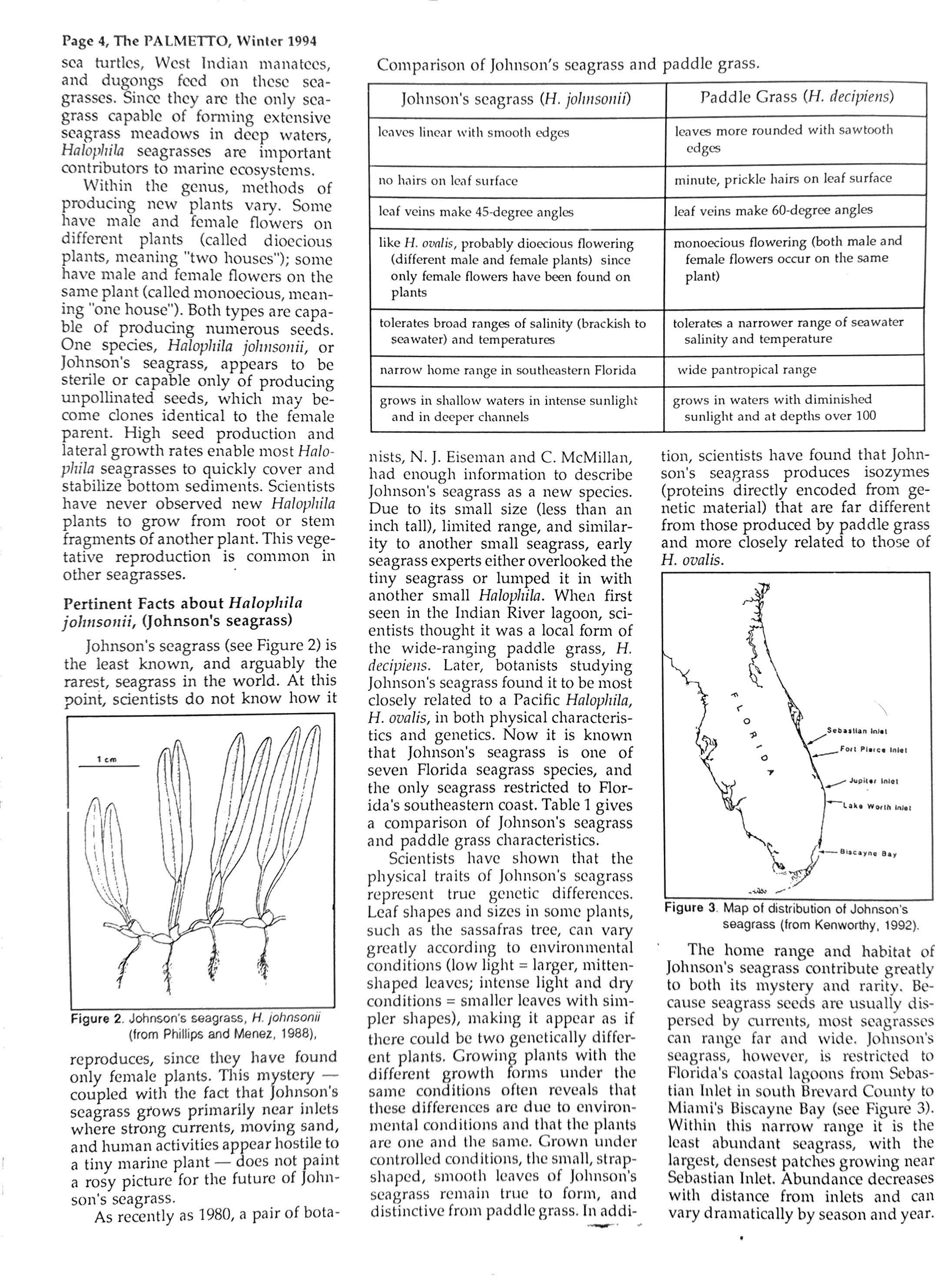
Johnson's seagrass (see Figure 2) is the least known, and arguably the rarest, seagrass in the world. At this point, scientists do not know how it
Figure 2. Johnson's seagrass, H. johnsonii (from Phillips and Menez, 1988), reproduces, since they have found only female plants. This mysterycoupled with the fact that Johnson's seagrass grows primarily near inlets where strong currents, moving sand, and human activities appear hostile to a tiny marine plant - does not paint a rosy picture for the future of Johnson's seagrass.
As recently as 1980, a pair of bota-
Comparison of Johnson's seagrass and paddle grass.
Johnson's seagrass (H. johnsonii) leaves linear with smooth edges
no hairs on leaf surface
leaf veins make 45-degree angles like H. ovalis, probably dioecious flowering (different male and female plants) since only female flowers have been found on plants
tolerates broad ranges of salinity (brackish to seawater) and temperatures
narrow home range in southeastern Florida grows in shallow waters in intense sunlighi and in deeper channels
nists, N. J. Eiseman and C. McMillan, had enough information to describe Johnson's seagrass as a new species. Due to its small size (less than an inch tall), limited range, and similarity to another small seagrass, early seagrass experts either overlooked the tiny seagrass or lumped it in with another small Halophila. When first seen in the Indian River lagoon, scientists thought it was a local form of the wide-ranging paddle grass, H decipiens. Later, botanists studying Johnson's seagrass found it to be most closely related to a Pacific Halophila, H. ovalis, in both physical characteristics and genetics. Now it is known that Johnson's seagrass is one of seven Florida seagrass species, and the only seagrass restricted to Florida's southeastern coast. Table 1 gives a comparison of Johnson's seagrass and paddle grass characteristics.
Scientists have shown that the physical traits of Johnson's seagrass represent true genetic differences. Leaf shapes and sizes in some plants, such as the sassafras tree, can vary greatly according to environmental conditions (low light = larger, mittenshaped leaves; intense light and dry conditions = smaller leaves with simpler shapes), making it appear as if there could be two genetically different plants. Growing plants with the different growth forms under the same conditions often reveals that these differences are due to environmental conditions and that the plants are one and the same, Grown under controlled conditions, the small, strapshaped, smooth leaves of Johnson's seagrass remain true to form, and distinctive from paddle grass. In addi-
Paddle Grass (H. decipiens) leaves more rounded with sawtooth edges
minute, prickle hairs on leaf surface
leaf veins make 60-degree angles
monoecious flowering (both male and female flowers occur on the same plant)
tolerates a narrower range of seawater salinity and temperature
wide pantropical range
grows in waters with diminished sunlight and at depths over 100
tion, scientists have found that Johnson's seagrass produces isozymes (proteins directly encoded from genetic material) that are far different from those produced by paddle grass and more closely related to those of H. ovalis.
3. Map of distribution of Johnson's seagrass (from Kenworthy, 1992).
The home range and habitat of Johnson's seagrass contribute greatly to both its mystery and rarity. Because seagrass seeds are usually dispersed by currents, most seagrasses can range far and wide. Johnson's seagrass, however, is restricted to Florida's coastal lagoons from Sebastian Inlet in south Brevard County to Miami's Biscayne Bay (see Figure 3). Within this narrow range it is the least abundant seagrass, with the largest, densest patches growing near Sebastian Inlet. Abundance decreases with distance from inlets and can vary dramatically by season and year.
Sebastian Iniat
- Biscayne Bay
Figure
Compounded with its restricted range, a preference for growing on sandy shoals near inlets gives Johnson's seagrass the most limited distribution of any known seagrass. Scientists believe this could be related to either the plant's limited reproductive strategy or loss of clear water habitat. The limited niche may be related to the small plant's struggle to compete with larger seagrasses and algae for space in the marine environment.
Johnson's seagrass grows where it does not have to compete with other vegetation. It occurs primarily on sandy intertidal shoals that are often exposed at low tide. This suggests that Johnson's seagrass possesses a tolerance for conditions that few seagrasses can withstand: drying out at low tide, intense sunlight, and dramatic temperature changes. It can also gain a toehold in deeper sandy areas where the speed of the current is fast enough to otherwise erode sand on the bottom. Salinity tolerance ranges from full seawater strength to mixed salt/fresh water characteristic of estuaries. Its presence in inlets and on shoals ? where sunlight is abundant and tides bring clear seawater into the lagoon - shows either an affinity for clean water or a tolerance
for changing conditions. Understanding the mysterious life history of seagrass mayreveal whether it was once more widely distributed when the east coast Florida lagoons were pristine and clear, or whether it is uniquely adapted to inlet habitats. Not able to compete with taller, longer-lived turtle or manitee grasses, or with taster-growins ?addle grass, Johnson's seagrass ma have found a niche in the ever-changing, habitat opportunities of inlet shoals and channels.
As with its restricted range, the habitat requirements of Johnson's seagrass may be related to littleunderstood reproductive strategies. The wide tolerance to changing environmental conditions and possible sterility provide evidence that the plant may be the result of a genetic cross between two other species. The lack of known seed production means that the plant can only survive by continuously branching out to cover lagoon bottoms. Thus, if a storm or other catastrophic event damages seagrass beds, Johnson's seagrass may not recover. Paddle grass, with its heavy seed production and faster growth rate, can quickly re-colonize open lagoon bottoms. Large sea-
The PALMETTO, Winter 1994, Page 5
grasses with greater energy reserves, such as turtle grass (Thalassia testudinum, may better withstand burial by new sediments or long turbulent periods when photosynthesis is reduced. Because it is at a disadvantage growing in seagrass meadows, Johnson's seagrass seems capable of growing only where it has a slight edge ? in inlets and channels. In such unstable habitat conditions, the survival of this small, fragile seagrass seems precarious.
References
Dawes,C.J., C.S. Lobban, D.A. Tomasko 1989. A comparison of the physiological ecology of the seagrasses Halophila deciplens Ostenfeld and H. johnsonii Eiseman from Florida. Aquatic Botany 33:149-154. Eiseman, N.J. 1980. An Illustrated Guide to the Sea Grasses of the Indian River Region of Florida, Technical Report No. 31. Harbor Branch Foundation, Inc Eiseman, N.J. and C. McMillan. 1980. A nev species of seagrass, Halophila johnsonii, from the Atlantic coast of Florida. Aquatic Botany 9:15-19
Kenworthy, J.W.1992. The Distribution, Abundance and Ecology of Halophila johnsonii (Eiseman) in the Lower Indian River, Florida NationalMarine Fisheries Service for the Office of Protected Resources
McMillan, C. and S.C. Williams. 1980. System atic implications of isozymes in Halophila
Phillips, Menez. grasses. Smithsonian Contributions to the Marine Sciences; No. 34. Smithsonian Institution Press, Washington D.C.
Natives are our only business
Creepers, Climbers, Twiners, Lianas, Vines, and Wines
by.Daniel F. Austin
Some time ago, a letter from a friend of mine in Pakistan said of a paper that I had written,"The term 'vine', though quite correct, is rather foreign to non-American readers, and I have changed it to climbers, twiners, etc."
For a while I was astonished that English-speaking people outside the United States did not use the word "vine". Then I thought of plants called trumpet creepers, Virginia creepers, Rangoon creepers, coral creepers, railway creepers, elephant creepers, and elephant climbers. I remembered noticing that "climber" or "creeper" was used in Pakistan and Sri Lanka when I was there, and that they had never used the word "vine". At the time I thought it curious, but had neither the opportunity nor time to look into it further. Also, I remembered that we took our word "vine" from French and Latin words that specifically reference to "The Vine", or the grapevine (Vitis vinifera). Indeed, in many places outside the United States, the word "vine" still refers to only the grapevine from which wine is made."Wine" itself is taken from the same base word, vinum.
Finally, I realized that what the British call "American English" ? a complex mixture of languages from various times and geographic regions - has obscured the original meanings of many American words. Eng-
lish in other countries has sometimes retained a purer (or older) form of words, or at least their meaning Words that we use to talk about certain growth habits of plants show several related ideas.
A "climber" is a plant that goes up some supporting host, as the original Anglo-Saxon word climban implies. Similar concepts are found in the Spanish words enredadera and trepador. This action in plants is achieved by using specialized leaves or other organs called tendrils, or by wrapping the stem around something else so that the result is an ascending of the growing tip. Typically, this movement is a product of the biological functions causing the plant to grow toward brighter light.
Closely related is the idea inherent in the word "creeper". This again is an Anglo-Saxon derivative, coming from creopan. when climbers fail to find a support, they trail along the ground, or creep, until they find something to grow up. Many plants that are primarily climbers send off shoots that creep along the ground until they find something to elevate This action seems to be a mechanism to increase the area in the plant producing food for those parts using energy.
Well known to anyone who has purposefully or accidentally been involved with these types of plants is that they are "twiners" and wrap
around everything possible. This is a form of twinen, the Middle English form of another Anglo-Saxon word. Inherent in these words is the concept of being tangled, snarled, and twisted. This idea is almost the same as that used in the French liane and Spanish liana. These latter words are taken from lier that means to tie or bind
Because the original "grapevine" creeps, climbs, twines, and binds, Americans have used 'vine' as the word for all creepers, climbers, twiners, and binders. In the United States we have a conglomerate of people and we tend to apply words broadly. A few of the archaic meanings have persisted in common names such as "trumpet creeper", but we mostly use the word "vine" as a general term. In England and the countries where British influence has been most important, the Anglo-Saxon meanings have often been kept for the variety of plants, and "vine" is still strictly applied to the grapevine. In the United States few even realize the anng uity of the product or of the worc when they sip a glass of wine with their meals. Fewer still know that "wine" and "vine" are etymologically so closely related.
Daniel F. Austin has been studying the native flora of Florida since 1970, and is Professor of Botany at Florida Atlantic University.
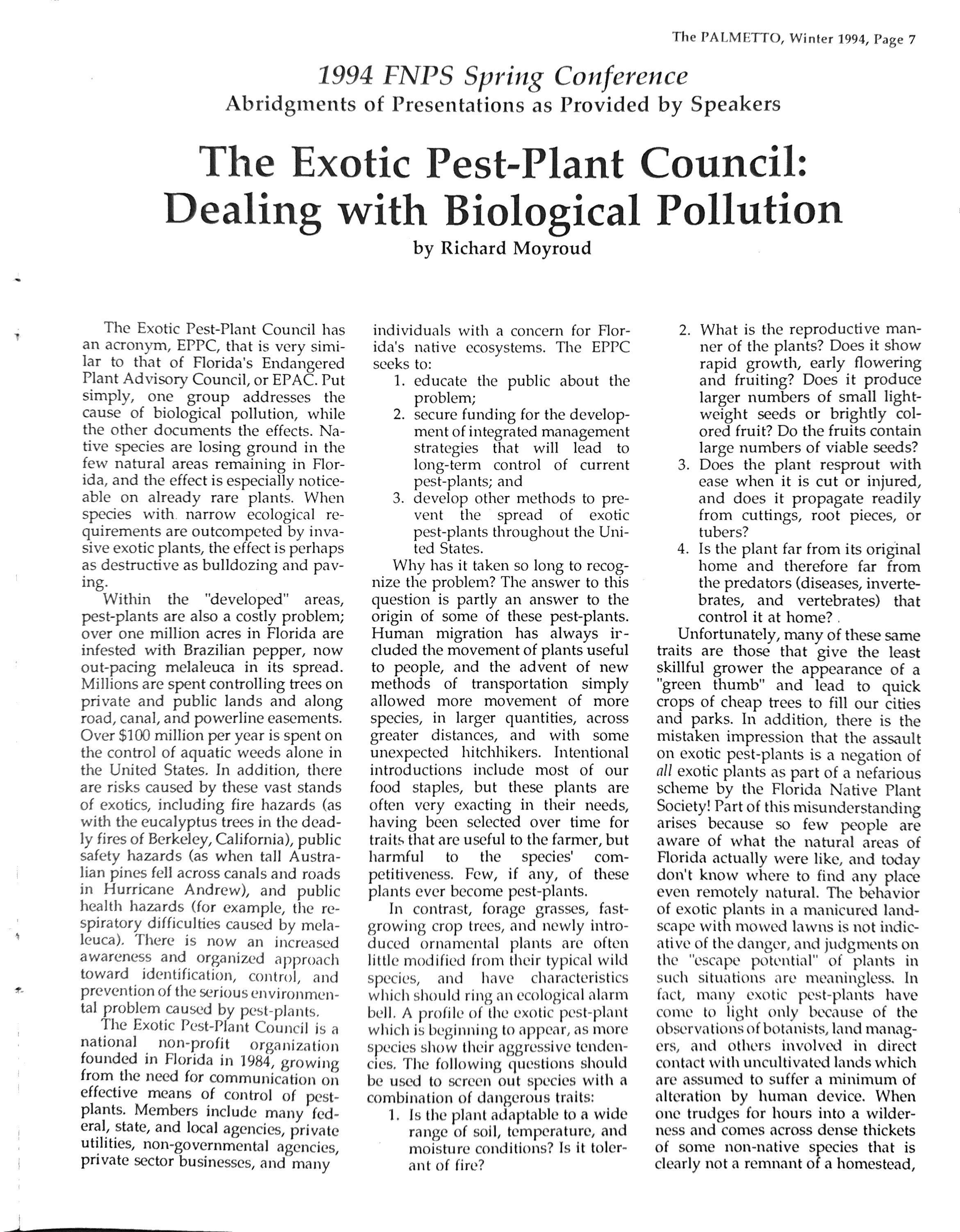
Railroad-vine (Ipomoea pes-caprae)
Virginia creeper (Parthenocissus quinquefolia)
Grapevine (Vitis rotundifolia)
Abridgments of Presentations as Provided by Speakers
The Exotic Pest-Plant Council: Dealing with Biological Pollution
by Richard Moyroud
The Exotic Pest-Plant Council has an acronym, EPPC, that is very similar to that of Florida's Endangered Plant Advisory Council, or EPA?. Put simply,one group addresses the cause of biological pollution, while the other documents the effects. Native species are losing ground in the tew natural areas remaining in Florida, and the effect is especially noticeable on already rare plants. When species with. narrow ecological requirements are outcompeted by invasive exotic plants, the effect is perhaps as destructive as bulldozing and paving.
Within the "developed" areas, pest-plants are also a costly problem; over one million acres in Florida are infested with Brazilian pepper, now out-pacing melaleuca in its spread. Millions are spent controlling trees on private and public lands and along road, canal, and powerline easements. Over $100 million per year is spent on the control of aquatic weeds alone in the United States. In addition, there are risks caused by these vast stands of exotics, including fire hazards (as with the eucalyptus trees in the deadly fires of Berkeley, California), public safety hazards (as when tall Australian pines fell across canals and roads in Hurricane Andrew), and public health hazards (for example, the re spiratory difficulties caused by melaleuca). There is now an increased awareness and organized approach towardidentification, control, and prevention of the serious environmental problem caused by pest-plants.
The Exotic Pest-Plant Council is a nationalnon-profit organization founded in Florida in 1984, growing from the need for communication on effective means of control of pestplants. Members include many federal, state, and local agencies, private utilities, non-governmental agencies, private sector businesses, and many
individuals with a concern for Florida's native ecosystems. The EPPC seeks to:
1. educate the public about the problem;
2. secure funding for the development of integrated management strategies that will lead to long-term control of current pest-plants; and
3. develop other methods to pre-
pest-plants throughout the Uni-
Why has it taken so long to recog nize the problem? The answer to this question is partly an answer to the origin of some of these pest-plants. Human migration has always ircluded the movement of plants useful to people, and the advent of new methods of transportation simply allowed more movement of more species, in larger quantities, across greater distances,and with unexpected hitchhikers. Intentional introductions include most of our food staples, but these plants are often very exacting in their needs, having been selected over time for traits that are useful to the farmer, but harmful to thespecies' petitiveness. Few, if any, of these plants ever become pest-plants.
In contrast, forage grasses, fastgrowing crop trees, and newly introduced ornamental plants are often little modified from their typical wild species, and have characteristics which should ring an ecological alarm bell. A profile of the exotic pest-plant which is beginning to appear, as more species show their aggressive tendencies. The following questions should be used to screen out species with a combination of dangerous traits:
1. Is the plant adaptable to a wide range of soil, temperature, and moisture conditions? Is it tolerant of fire?
2. What is the reproductive manner of the plants? Does it show rapid growth, early flowering and fruiting? Does it produce larger numbers of small lightweight seeds or brightly colored fruit? Do the fruits contain large numbers of viable seeds?
3. Does the plant resprout with ease when it is cut or injured, and does it propagate readily from cuttings, root pieces, or tubers?
4. Is the plant far from its original home and therefore far from the predators (diseases, invertebrates, and vertebrates)that control it at home?
Unfortunately, many of these same traits are those that give the least Skillful grower the appearance of a "green thumb" and lead to quick crops of cheap trees to fill our cities and parks. In addition, there is the mistaken impression that the assault on exotic pest-plants is a negation of all exotic plants as part of a nefarious scheme by the Florida Native Plant Society! Part of this misunderstanding arises because so few people are aware of what the natural areas of Florida actually were like, and today don't know where to find any place even remotely natural. The behavior of exotic plants in a manicured landscape with mowed lawns is not indicative of the danger, and judgments on the "escape potential" of plants in such situations are meaningless. In fact, many exotic pest-plants have come to light only because of the observations of botanists, land managers, andothers involved in direct contact with uncultivated lands which are assumed to suffer a minimum of alteration by human device. When one trudges for hours into a wilderness and comes across dense thickets of some non-native species that is clearly not a remnant of a homestead,
Page 8, The PALMETTO, Winter 1994 it is disappointing. When one sees seedlings of that same plant spreading in all directions from the source plants, it becomes a greater concern. Finally, when, after freeze and fire, the exotic pest-plant seems to dominate a site where there was once a wide diversity of native species, both animal and plant, the phrase "biological desert" strikes home and pushes one to action.
What can we do? First, it is critically important to have proper identification of a species. For example, there are several native prickly species of Solanum, or soda apple, in Florida. Two very recent arrivals from South America resemble the natives, but are spreading rapidly and invading many habitats. These species can be distinguished by several characters which are clearly described in a special publication issued by the Florida Department of Agriculture, Division of Plant Industry (and described in the Fall 1993 issue of The Palmetto). Such educational outreach is critical and must be expanded to cover more of the invasive exotic plants, so that control efforts are properly directed at the problem plants.
The current EPPC 1993 list of the most invasive species includes 126 taxa that are documented to have invaded and displaced native plants in natural areas. Every year this list seems to grow larger. The EPPC has also published the proceedings of several symposia, and a booklet on the current techniques used in the control of four of the worst pestplants. These four ? melaleuca, Brazilian pepper, Australian pine, and latherleaf ? are also prohibited species under Florida law. Research on biological control organisms is the most promising and ecologically desirable long-term- solution, but requires funding in a time of budget cutbacks. However, this is an investment with significant returns, and permanent funding must be secured for this important research.
Today, public education is essential in stopping the spread of exotic pest- plants. If there is no demand for certain exotics, then they will no longer be grown and sold to the public. A flyer is available which describes the worst plants now being offered for sale in the trade, and suggests avoiding purchase of these plants.
Government must also be made more responsible. If we cannot mandate that all landscapes in the state be planted with natives, then we must at
least make certain that exotic pestplants be strictly excluded.
Finally, there is the private garden. We all have personal interests and we all enjoy plants in the wild or in cultivation, but we must now take respon sibility for the escapees and re-evaluate our plantings. Again, the native solution is the obvious answer. Save money, save water, save the environment. Leave the natives in place.
Richard Moyroud is the president of Mesozoic Landscapes, Inc., a native plant nursery, and also works at Gemini Botanical Garden, a private native plant garden. He is a past president and current secretary/editor of the Palm Beach County chapter of FNPS, and past president and current board member of the Association of Florida Native Nurseries. He currently chairs the Endangered Plant Advisory Council and is a member of the Exotic Pest-Plant Council subcommittee on plants.
EXOTICS
Exotic Pest Plants by Greg Jubinsky
In much of Florida, non-native, or exotic, plants threaten remaining natural ecosystems. Exotic plants are a form of biological pollution that invades aquatic and terrestrial landscapes, both natural and developed. Most non-native plants die if released into a new environment, but the few that live and reproduce may spread explosively. Because such exotics find few (if any) predators, parasites, or other competitors in their new homes, once established, they often out-reproduce, outgrow, and displace entire native plant communities.
Of the 3500 plant species found in Florida, about 900 are exotic. Many were imported for use as landscape ornamentals, others for their decorative quality for aquarium hobbyists. Of the 123 species listed by the Exotic Pest-Plant Council, twenty are aquatic or wetland invaders.
Early detection, eradication, or prevention are the only sure controls for some of these species. Once the plants are established, exotic pest-plants are extremely difficult and expensive to control. Unfortunately, many known exotic pest-plants continue to be sold in plant nurseries, and several garden "how-to" books still actively promote them.
While it is illegal to bring plants into the United States without inspection and approval, there are thousands imported legally into Florida each year. Few, if any, are thoroughly evaluated for their invasive potential. Even though the 1974 Federal Noxious Weed Act was established to
prevent pest-plants from entering the country, the program has largely failed due to insufficient funding.
Greg Jubinsky is currently an Environmental Administrator with the Department of Environmental Protection, Bureau of Aquatic Plant Management (formerly Department of Natural Resources). He coordinates statewide use of. biological control agents for management of exotic plants, and establishes screening methodologies to prohibit introduction of additional invasive plant species. He is a graduate of the University of Central Florida with degrees in Limnology and Botany and serves on the Board of Directors for the Exotic Pest-Plant Council.
ENDANGERED PLANTS
Some Endangered Plant Species in Florida: Why are They Designated 'Endangered"? by Nancy
C. Coile
The official state list of endangered and threatened plant species is maintained by the Division of Plant Industry, Florida Department of Agriculture and Consumer Services. This list is compiled under advisement of the Endangered Plant Advisory Council (EPAC), whose membership is specified by Florida Statute. One of the specified EPAC members must be from the Florida Native Plant Society. Currently, the representative is Richard L.
The current list has 255 endangered plant species, 45 threatened plant species or categories, and 12 commercially exloited plant species. The list includes Silene polypetala (fringed pink), Lobelia cardinalis (cardinal flower), Sarracenia rubra (red-flowered pitcher-plant), Cassia keyensis (Key cassia), Chionanthus pygmaeus (pygmy fringe tree), Torreya taxifolia (gopherwood or stinking cedar), Ribes echinel um (Miccosukee gooseberry), Asimina tetramera (four-petal pawpaw), Ziziphus celata (scrub ziziphus), and Polyradicion lindenii (ghost orchid). Several species additions are under consideration.
The endangered species are located throughout the state, but with concentrations in the Panhandle, the Central Ridge, and south Florida's rockland hammocks and Everglades. Often these rare species
Why are these species rare? Each spe cies has its own unique characteristics which cause the species to be placed in jeopardy. Traits or changes that may contribute to a species' vulnerability include: reduction of genetic variability, poor seed set, low viability of seeds, reduction of pollinators, dioecious traits, change in available water or in temperature, change in associated plants through natural succession, competition with other
MATIVE? PLANT
serenoa
plants (especially exotics), reduction or change in natural burn cycles, disease, insect predation, pollution, collection pressures by humans, and habitat destruction by natural events or human activities.
Dr. Coile is the Botany Administrator for the Division of Plant Industry, Florida Department of Agriculture and Consumer Services. She received her M.S. and Ph.D. in Botany from the University of Georgia. She is the secretary for the Association of Southeastern Biologists, 1991-94. She is a member of FNPS and has contributed several articles to The Palmetto.
LATIVE: PLANT
ENDANGERED PLANTS
Permitting Procedures for Harvesting Plants on the Regulated Plant Index by Paul L. Hornby
The Florida Department of Agriculture and Consumer Services (FDACS) is responsible for enforcing Chapter 581.185 of
tive Flora of Florida. The Division of Plant Industry (DPI) provides recognition and protection of these native plant species that are endangered, threatened, or commercially exploited. A controlled prorestricted harvesting of protected species from the wilds in order to encourage propagation of native species and prevent the wanton destruction of native plant populations. Copies of both Florida Statute 581.185 and Rule Chapter 5B-40, 'Preservation of Native Flora of Florida' may be obtained by writing the FDACS/ DPI - Bureau of Plant Inspection at Post Office Box Gainesville, 32614-7100 or by phone at 904/372-3505.
Paul L. Hornby is originally from England, grew up in Miami, attended the University of Nebraska and received a B.S, in Agronomy. He joined the FDACS/DPI in 1983 and has worked as a district inspector in Ft. Lauderdale, Naples, and Gainesville. He is currently a Certification Specialist?Agriculture, work ing in the area of import/export plant quarantine requirements involving Florida plants and plant products.
GATIVE PLANT
GARDENING
Creating Habitats for Butterflies by Judy Morris
The two basic principles used in creating butterfly habitats are: 1. Caterpillars eat - larval food (green leafy) plants, and 2. Butterflies drink - nectar from flowers. Success in attracting butterflies to any
area lies first in awareness of the insect-plant connection, which is evident in all four stages of the butterfly's metamorphosis
As well as offering food sources, a butterfly habitat needs to have:
? Sunshine - both for the plants and the butterflies;
? Shelter from wind;
? Moisture - butterflies drink from
If the right plants are planted, the butterflies will come.Their caterpillars generally feed on specific plants, and the outtertlies generally lay their eggs only or these plants. Butterflies nectar from a wide variety of flowers, with a strong preference for simple flowers such as asters and daisies, or cluster flowers such as milkweeds. Butterflies will visit a garden full of nectar plants, drink, and pass on, but they are more likely to stay around in the areas where they find the larval food plants for their caterpillars
The only butterflies that will be attracted are those that occur naturally in the area, so the first step is to identify these butterflies - then plant both larval food sources (for their caterpillars) and a variety of nectar sources, preferably native plants in both cases. Using plants that flower in succession will help provide nectar throughout the year for the butter-
Why plant a butterfly habitat?
? To give the butterflies back some of the habitat that we have destroyed by coming to live here, and thereby help rebuild the butterfly populations. Butterflies in all stages of their metamorphosis play an important role in the
? To educate and to delight. People of all ages and from many walks of life (preschoolers, schoolchildren, homeowners, residents of centers, to mention a few) can have fun learning how to attract butterflies.
Our Butterfly Gardening Club at the Children's Haven and Adult Center an agency serving mentally and physically handicapped people, is very active; and club members love to give tours, identifying the butterflies and pointing out eggs, caterpillars, and
The most successful butterfly habitat that I have helped create is The Haven Butterfly Garden. On a sunny day, the area is alive with many varieties of butterflies, laying eggs, nectaring, and just danc ing with joy. I think the secret lies in the location, which is a sunny, sheltered spot surrounded by native woods, - a perfect
Judy Morris is president of the Florida Chapter of the American Horticultural Therapy Association and volunteer coordinator of the Children's Haven and Adult Center Butterfly Gardening Club, She also helps in The Haven Plant Nursery, which specializes in growing butterfly-attracting plants, and designs and installs butterfly gardens.She was born and raised in England, lived in Zimbabwe, and has been in Florida for 14 years.
Planning a Wildlife Garden by Judith Buhrman
Planning a landscape for wildlife, whether a whole yard or fifty square feet, means simply identifying the creatures you want to attract, analyzing your present landscape, and designing your new one to meet the needs of your desired
Be realistic in your expectations. If the creatures you wish to attract have special needs you cannot fill or that are not found in your area, you won't get these creatures no matter what you do. Keep wintering birds in mind if you do your plan when they are not around. Part of the fun in planning is observation to learn what wildlife is in the neighborhood that might be induced to settle down. This may entail purchasing or borrowing a couple of field guides and binoculars (you can get a good pair of binoculars for under $100).
Make a scaled drawing of your present landscape, noting structures, sidewalks and driveways, power lines, trees and other plantings, slopes, runoff pathways, areas of perpetual sun or shade, and compass orientation. Decide what, if anything, is to be removed. Make several copies so you can play with alternate
Do a soil test, and a drainage test if you are not familiar with your yard's characteristics. Learn what plant community existed before development - in most cases, that will give you most of
Decide how you will provide water for wildlife. If you want something more elaborate than a simple birdbath on the ground, now is the time to plan it.
Now you can select your plantskeeping in mind the principles of biological, structural, and temporal diversity to match the needs of wildlife for food, cover, and water within the constraints of
Please yourself with your design, and put features such as brush and compost piles out of public view. Look at your design from inside your home as well as outside. Think about maintenance now, in the design phase. The plan should reflect the mature size of the plants you select, or you will be doing a lot of pruning and digging up. Think curves. They are pleasing to the eye, and give more "edge
Also, know your local landscape code. A thoughtfully planned wildlife landscape, vibrant with song and motion and color all the year-round, will reward you with delightful surprises and deep per-
Judith Buhrman has been a member of FNPS since 1988 and was the founding president of Pinellas Chapter. She is an occasional contributor to The Palmetto and is a regular columnist for the St. Petersburg Audubon Society newsletter.
Florida Native Plant Society's 15th Annual Spring Conference
May 4 - May 7, 1995
Ramada Inn, Tallahassee Host: Magnolia Chapter
"La Florida: Florida's Native Flora -Past,Present,andFuture
JoinustocelebrateFlorida'sbotanicalheritage? the past, the present, and challenges for the future.
Explore the natural beauty and diversity of the Land of Flowers, from the time of Spanish conquistadors and Florida crackers into the future. The 1995 conference promises to bring you La Florida's botanical wonders, with workshops on native landscapes of the southeastern United States coastal plain, sessions highlighting important natural communities, and field trips exploring the diversity of Florida's Big Bend forests.
Thursday: Field trips led by expert field botanists and area naturalists.
Friday: Opening session, scientific papers and poster session, concurrent workshops on natural communities and native gardens, and vendor sales.
Saturday: Plenary session - Jim Stevenson, Florida Park naturalist, with photographic images of Florida's past; and Dr. Andre F. Clewell, botanist and plant ecologist, on ecological restoration for Florida's future
Florida Native Plant Society annual membership meeting, landscape awards, president's address, and luncheon.
Concurrent sessions on natural communities, native gardens, natural history, plant identification and propagation, low-maintenance plants that attract wildlife, and beautification projects.
Plant raffle, Regional vendors will sell natural history books, stationery, calendars, T-shirts, art work, crafts, and a special selection of native plants
Aucilla Sinks and Leon Sinks, the Lower Suwannee, Apalachicola Bluffs, and the Apalachicola National Forest
Fees: (to be announced) In addition to a general registration fee, which covers conference admission, a continental breakfast and lunch on Saturday, fees will be charged for certain field trips and special events. The fee for the Thursday evening reception/boat tour at Wakulla Springs State Park will be
Accommodations: Rooms for conference attendees will be $60 per night at the Ramada Inn (904/386-1027) and other Tallahassee hotels located near the conference site at the intersection of North Monroe Street (U.S. Hwy. 27) and Interstate 10.
Weather: Tallahassee in May is mild, with temperatures from a high of 89 degrees to a low of 52 degrees.
Chapter president Fritz Wettstein is working with a dedicated core of volunteers from the Magnolia Chapter to coordinate a stimulating, educational, and entertaining conference. "The event hasn't been held Sunday: Field trips. in North Florida for about ten years. We want to
Twenty-one field trips, some on Thursday and make sure that participants get to see some of the some on Sunday, will include tours of local gardens unique botanical areas that make this part of the and nature hikes to areas of statewide and regional state so special," he said. "The conference will offer significance. They include two driving tours, a trip for sessions geared to a variety of interest kids, one canoe, one boat, and one bicycle trip, five including nursery professionals, scientists, and the easy walks, five moderate hikes, and five strenuous lay audience." hikes to such places as private and public gardens, Birdsong Nature Center, a large land acquisition
A tentative schedule will be published in the within Tallahassee city limits, the Wade Tract, Spring issue of The Palmetto, and an announcement flyer with registration form will be sent to every Wakulla Springs, St. Marks National Wildlife Refuge, member.
For more information, call Native Nurseries at 904/386-2747, Monday through Saturday from 8 AM until 6 PM. Or write to the Florida Native Plant Society, P.O. Box 680008, Orlando, FL 32868.
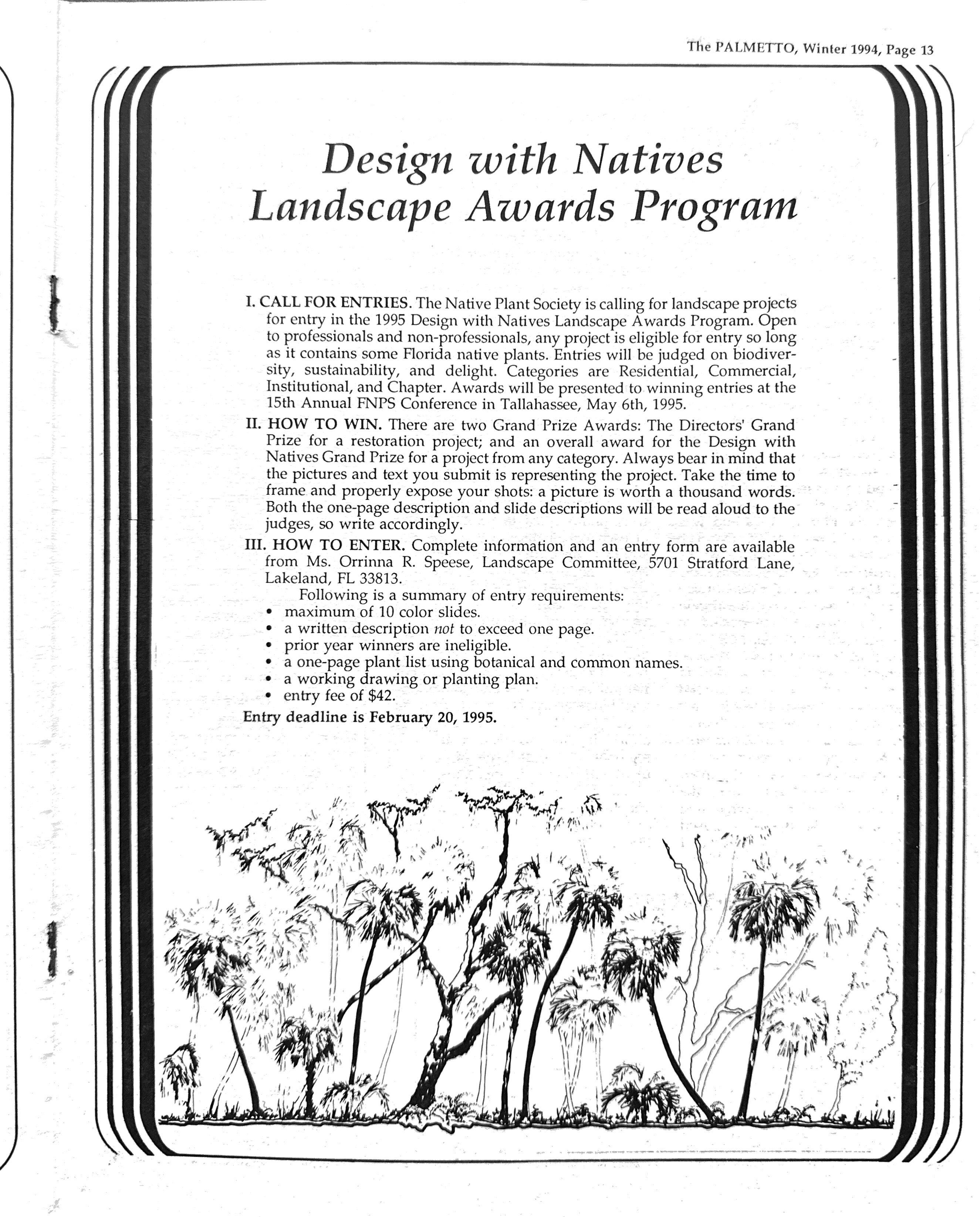
Design with Natives Landscape Awards Program
I. CALL FOR ENTRIES. The Native Plant Society is calling for landscape projects for entry in the 1995 Design with Natives Landscape Awards Program. Open to protessionals and non-professionals, any project is eligible for entry so long as it contains some Florida native plants. Entries will be judged on biodiversity, sustainability, and delight. Categories are Residential, Commercial, Institutional, and Chapter. Awards will be presented to winning entries at the 15th Annual FNPS Conference in Tallahassee, May 6th, 1995.
II. HOW TO WIN. There are two Grand Prize Awards: The Directors' Grand Prize for a restoration project; and an overall award for the Design with Natives Grand Prize for a project from any category. Always bear in mind that the pictures and text you submit is representing the project. Take the time to frame and properly expose your shots: a picture is worth a thousand words. Both the one-page description and slide descriptions will be read aloud to the judges, so write accordingly.
III. HOW TO ENTER. Complete information and an entry form are available from Ms. Orrinna R. Speese, Landscape Committee, 5701 Stratford Lane, Lakeland, FL 33813.
Following is a summary of entry requirements: ? maximum of 10 color slides.
? a written description not to exceed one page.
? prior year winners are ineligible.
? a one-page plant list using botanical and common names.
? a working drawing or planting plan.
? entry fee of $42.
Entry deadline is February 20, 1995.
Science Roundup
by I. Jack Stout
(Dr. Stout, Professor of Botany at the University of Central Florida and Science Committee Chairman for FNPS, will be presenting this regular column.)
One of FNPS's members, Dr. Ann Johnson, with various co-workers, has written five volumes of wonderful material on coastal upland ecosystems (natural communities) of our coasts and barrier islands. The second volume in this six-volume series focuses on the Florida Keys and was prepared by Curtis R. Kruer. The primary title of each volume is: An Assessment of Florida's Remaining Coastal Upland Natural Communities; secondary titles reference the region of coastal Florida that is reported on in the particular volume. Full titles are listed at the end of this review. The objective of the study was to identify the undeveloped coastal upland natural communities in each coastal county. Parcels greater than 20 acres were eventually ranked according to plant species diversity, structure, and the degree of exotic invasion. Site visits and surveys of the vegetation allowed these remaining communities to be described based on the dominant plant species and their frequency of occurrence. Plants
were referenced as abundant, locally abundant, frequent, occasional, and rare, based on the canopy coverage. Community classification followed the scheme outlined in A Guide to the Natural Communities of Florida, published by the Florida Natural Areas Inventory and the Florida Department of Natural Resources in 1990. The communities reported in this series include beach dune, coastal strand, coastal grassland, coastal hammock, and coastal rock barren.
The contents of the separate volumes varies slightly, but each reports on the communities discovered, plant species found in each community, and rare plants and animals. Common and scientific names are provided for the various taxa. Community composition by region is summarized in terms of acreage (albeit imprecise), ownership (public and private), and rating of quality. United State Geological Survey quad sheets were photocopied to produce maps of each parcel discussed in the site summary appendix. The site summaries are extremely valuable, providing descriptive text on the physical setting, plant communities, and species, among other things.
The collective work is outstanding and illustrates the level of field effort needed to get a handle on a subset of natural communities and the associated biodiversity. These data provide a strong scientific basis for thoughtful efforts in land acquisition at state, regional, and local levels of government and in the private sector.
This two and one-half year project was funded through the Department of Community Affairs from the National Oceanic and Atmospheric Administration. Additional support was
derived from the Florida Department of Natural Resources, the Florida Department of Environmental Regulation, and the Conservation and Recreational Lands Trust Fund.
Johnson, A.F., J.W. Muller, and K.A. Bettinger. 1990. An Assessment of Florida's Remaining Coastal Upland Natural Communities: Southeast Florida. Florida Natural Areas Inventory, Tallahassee,
Johnson, A.F., J.W. Muller, and K.A. Bettinger. 1992. An Assessment of Florida's Remaining Coastal Upland Natural Communities: Panhandle. Florida Natural Areas Inventory, Tallahassee, FL.
Johnson, A.F., and J.W. Muller. 1993a. An Assessment of Florida's Remaining Coastal Upland Natural Communities: Northeast Florida. Florida Natural Areas Inventory, Tallahassee, FL.
Johnson, A.F., and J.W. Muller. 1993b. An Assessment of Florida's Remaining Coastal Upland Natural Communities: Final Summary Report. Florida Natural Areas Inventory, Tallahassee, FL.
Johnson, A.F., and J.W. Muller. 1993c. An Assessment of Florida's Remaining Coastal Upland Natural Communities: Southwest Florida. Florida Natural Areas Inventory, Tallahassee, FL.
Kruer, C.R. 1992. An Assessment of Florida's Remaining Coastal Upland Natural Communities: Florida Keys. Florida Natural Areas Inventory, Tallahassee, FL.
Position Available Biologist
Freshwater/upland/wildlife biologist position available. Experience with south Florida freshwater plant species and upland tree resources required Work includes site assessments, jurisdictional determinations, preparation and processing of applications with local, state and federal governmental agencies. WordPerfect, spreadsheet and database knowledge preferred. Salary based upon experience.
Direct inquiries to:
Ed Swakon, P.E. President
EAS Engineering, Inc. 55 Almeria Ave.
Coral Gables, FL 33134
Centuries ago longleaf pine forests dominated the coastal Southeast. Under hat seemingly continuous canopy of pines, a tremendous diversity of plant and an?mal species coexisted. Today, longleaf covers less than 4% of its origina range and is still being lost at the rate of over 140,000 acres a year. New awareness of natural ecosystem management provides hope that longleaf can be restored. Send $8 to order one informational calendar, or $7 if or more, and thank you for helping perpetuate longleat forests for the future.
LONGLEAF LEGACIES
Phone: 305/445-5553
Fax: 305/444-2112
Resumés and references required for all applicants.
EAS Engineering, Inc. is a local engineering firm specializing in coastal and freshwater wetland permitting, mitigation design and monitoring and GIS applications. EAS Engineering, Inc. is an Equal Opportunity Employer.
SOCIETY BUSINESS
ENPS TO HIRE OFFICE HELP
Part of the Strategic Plan for ENPS includes an office, an administrative secretary or office manager, a new phone number including an 800 number, e-mail, combining some standing committees and the establishment of new committees. The reorganized committees are listed on the inside front cover of this issue of The Palmetto.
To be filled as soon as possible is the position for a part-time clerical person to assist in administrative and membership services for the Society. The person will work approximately 20 hours per week, on a contract basis, in his/her own home. Applicant should have general office and organizational skills, own a computer, and enjoy, public contact.
Responsibilities include answering phone, directing inquiries, opening mail, forwarding checks to bookkeeper, filling orders for books and merchandise, record keeping, assisting in general mailings and conference administration.Interviews will be conducted at the Executive Committee Meeting, January 20, 1995. Please send resumé and writing sample to Janice Broda, P.O. Box 660, Wabasso, 32970.
PRESIDENT'S MESSAGE
I am pleased to announce the formation of FPS's Scientific Advisory Board. The purpose of this Board is to inform the membership of the current status of native plant scientific research; to promote education relating to native plants; to increase scientific interest and promote inquiry concerning Florida native plant communities; and to encourage interdisciplinary study in a broad diversity of approaches. The Board will act as an advisory panel in reviewing policy matters and will recommend actions to the Board of Directors. The Board will also review and recommend grant proposals, educational publications, and disbursements of Endowment Funds for research. The Chair will report to the BOD and will act as coordinator of the Advisory Board's activities. The following individuals have agreed to serve on the Board: Chair, Dr. Jack Stout, UCF, Biology; Dr. Dan Ward, UF, Botany; Dr. Richard Wunderland, USF, Botany; Dr. Doria Gordon, The
Nature Conservancy; Dr. Henry Gholz, UF, Forestry & Resource Conservation; Dr. Bijan Dehgan, UF, Environmental Horticulture; and Dr. David Hall, KBN Engineering
David Pais, FNPS President
FNPS's BOOKKEEPER RESIGNS
Claudia Guest, FPS's part-time bookkeeper for the past five years, has resigned for health reasons. She has maintained FNPS's books, deposited incoming checks and written payment checks, and prepared reports for the board of directors, for much less pay than the going rate as a service to our society. FNPS appreciates her service to us, and wishes her improved health.
FNPS treasurer Candace Weller has engaged Daniel Carter, a bookkeeper in St. Petersburg, to continue maintenance of the books.
ENDANGERED PLANT LIST
Tables listing Florida's 255 endangered species, eight categories of threatened taxa and 37 threatened SPecies have been compiled by Nancy ? Coile into a 50-page document containing scientific and common names, references, family, and descriptions.
The publication, titled Florida's Endangered and Threatened Plants,is ounched for insertion in a binder Single copies are available free to residents of Florida ($3 out-of-state) from the Florida Department of Agriculture and Consumer Services, Division of Plant Industry, P.O. Box 147100, Gainesville, 32614-7100.
Dr. Coile is a botanist with the Division of Plant Industry and has contributed several articles to The Palmetto.
FPS's NEW BOOK!
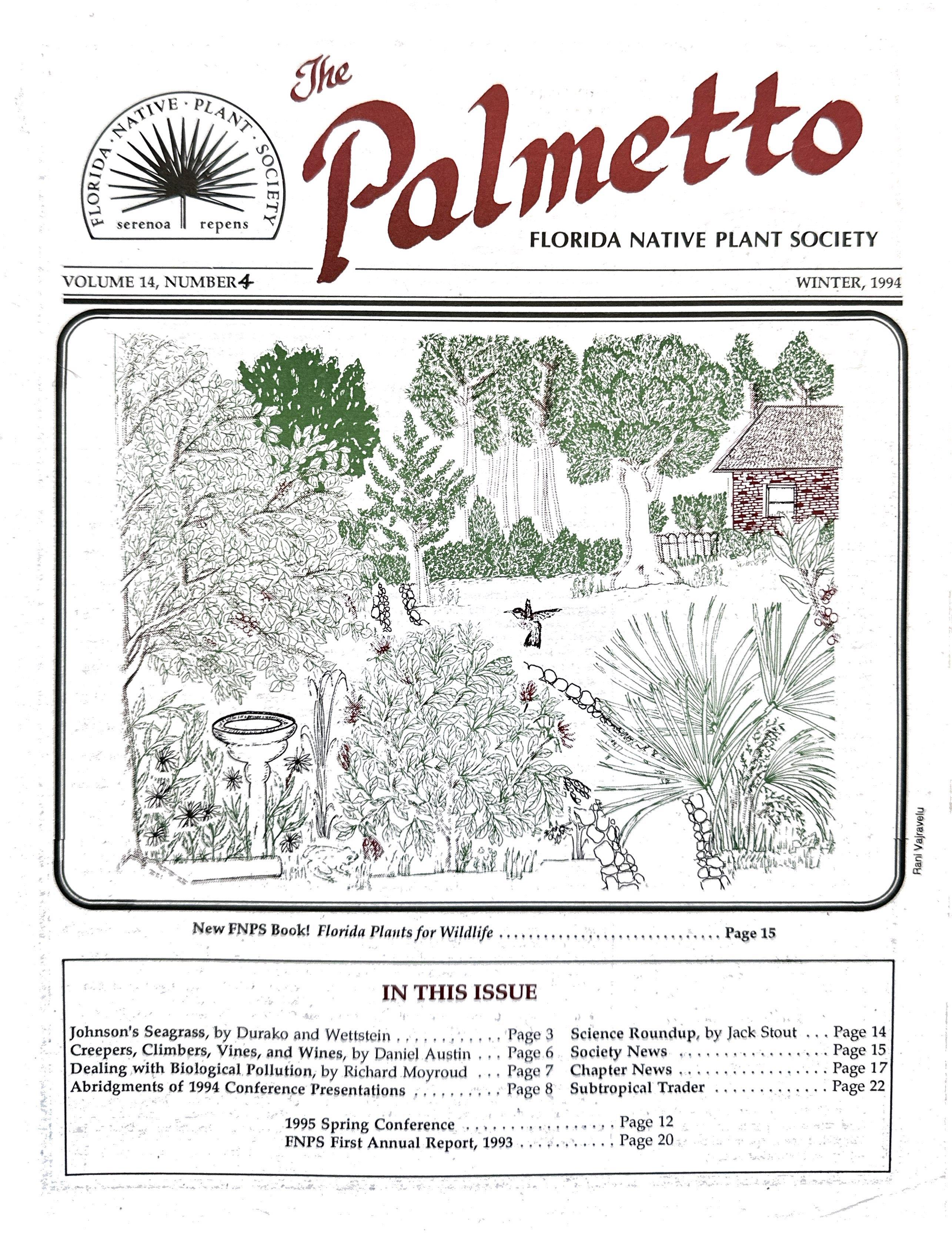
Florida Plants for Wildlife: A Selection Guide for Trees and Shrubs, Craig Huegel's second book for the Florida Native Plant Society, will be available early in 1995. More than 100 pages long and illustrated with line drawings by Rani Vajravelu, this book is a guide for turning your home landscape into a haven for wildlife - a place where birds, mammals, anc utterflies can find food, shelter, an nesting places. Dr. Huegel is manager of the Brooker Creek Preserve in Pinellas County and author of Butterfly Gardening with Florida's Native Plants, published by FNPS in 1991 and now in its 5th printing
The new book will sell for $12.00 to non-members and $10.00 to members, including sales tax and shipping Make checks payable to Florida Native Plant Society, and mail to P.O Box 680008, Orlando, FL 32868. It is expected that books will be ready to ship by February 1, 1995.
CALL FOR ROADSIDE WILDFLOWER SEEDS
The Florida Department of Transportation's Environmental Management Office has announced its Native Florida Wildflower Seed Specifica-
Native Plant Nursery Internships
? Positions availahle for Summer 1995
? Assist in all areas of non-profit Native Plant Nursery operation.
? Student of horticulture/botany or related field preferred
? On-site housing and stipend provided
? Send resume and 2 references to: The Sanibel-Captiva Conservation Foundation, Native Plant Nursery, P.O. Box 839, Sanibel, FL 33957. (813)472-1932
Page 16, The PALMETTO, Winter 1994 tions for growers and contractors. Florida Statutes call for the conservation of natural roadside growth, and the Department of Transportation (FDOT) wishes to purchase native Florida-grown wildflower seed in 1998, increasing the amount purchased each year until, by 2003, 100% of seed purchased will be certified native Florida wildflower seed.
Seed will be from Coreopsis basalis, Coreopsis leavenworthii, Gaillardia pulchella, Phlox drummondii, and Rudbeckia hirta.
To receive the two-sheet seed specification information already issued, and for the bid announcement to be issued in the spring of 1998, please send your name and address to Mr. Gary L. Henry, L.A., Environmental Administrator of Roadside Management, Florida Department of Transportaiton, 605 Suwannee Street, MS-37, Tallahassee 32399-0450.
The Environmental Management Office of FDOT publishes a quarterly newsletter called EnviroNews. Intended primarily for its employees, it is of interest also to FNPS members concerned with roadside right-of-way projects. Inquire about receiving a subscription from the same address (Mail Station 37).
Florida's Native Underwater Forests
A 20" x 30" full-color poster featuringunderwater photographs of native freshwater plants in Florida is available from the Bureau of Aquatic Plant Management, Florida Department of Environmental Protection. Plant species depicted in the photographs are identified by Latin and common name. The poster's title is Florida's Native Underwater Forests. For copies, write or call the Bureau's Technical Services Section, 3917 Commonwealth Blvd., MS 710, Tallahassee, FL 32399(904 / 487- 2600).
INVASION OF THE SOUTH
A conference entitled, "Invasion of the South ? Ecological Impact and Control of Exotic Weeds in Southeastern United States" will be held in Knoxville, Tennessee, April 20-22, 1995. Presented by the Association of Southeastern Biologists, several Florida Native Plant Society members will
be on the panel of speakers to discuss Florida weeds.
The registration fee is $50. For more information, contact Nancy Coile, Florida Dept. of Agriculture & Consumer Services, Div. of Plant Industry, P.O. Box 147100, Gainesville, 32614-7100, or call 904/372-3505 ext. 402.
REGIONAL FUND-RAISING COORDINATOR
Volunteer Job Opening - three-year commitment
The Florida Native Plant Society is one of twenty Florida 501(c)3 environmenta organizations that are members of the Environmental Fund for Florida (EFF). EFF generated a remarkable $67,000 in voluntary employee pay-roll deduction donations during its first year of operation (1993-94). FNPS expects to receive more than $2,500 of that amount, to be used as determined by the FPS board
The FPS Board of Directors is seeking: 1. One alternate FPS representative to the EFF board. (Meetings in Orlando alternate 3rd Fridays or Saturdays six times each rear, plus occasional committee work.) 2. Three to five volunteers to coordinate loca FPS access with one of the four EFF regional chairpersons in North, South, East, o West Florida. (Each can expect to work 30-40 hours during the fall campaign, attend one board meeting, and attend one or two spring training sessions.)
United Way training, or other fund-raising, marketing, PR, or sales experience would be welcome, but is not required. A training manual and literature will be available. Contact Paul M. Davis, P.O. Box 536863, Orlando, FL 32853, 407/898-5896.
Upcoming Events
April 7-9, 1995
League of Environmental Educators of Florida Annual Conference, Leesburg Contact: Diane Stevens, President, 8728 Jasmine Pond Road, Tampa, FL 33614
May 4-7, 1995
FPS 15th Annual Conference, La Florida: Florida's Native Flora - Past, Present and Future. Tallahassee
Contact: Fritz Wettstein (904/224-6675
May 18-19, 1995
Ecosystems Restoration and Creation, sponsored by Hillsborough Community College Institute of Florida Studies, Tampa
Paper abstract deadline: February 1
Contact: Frederick Webb, Hillsborough Community College, Plant City Campus, 1206 N. Park Rd., Plant City 33566 (813/757-2104)
May 30-June 3, 1995
Society of Wetland Scientists 15th Annual Meeting, Wetlands: Local Functions, Global Dependence, Portland, Oregon
Third Symposium on the Biogeochemistry of Wetlands, sponsored by University of Florida, Institute of Food and Agricultural Sciences, Orlando Contact: Dr. K.R. Reddy, University of Florida (904/392-1804)
Compiled by Janice Broda
A GIFT FOR ANY OCCASION
Butterflies of North America by Diane Pierce
Choose from 8 exquisite reproductions depicting flutterbys on their nectar flowers. Double-matted with offwhite 12"x14" frame, or print only
FREE COLOR BROCHURE
EDGE OF THE WILD Lake Pierce Drive, Lake Wales, FL 33853
PLANTS OF THE SOUTHERN PIEDMONT & COASTAL PLAIN MANY FLORIDA ENDEMICS ALL NURSERY-GROWN
We ship Oct.-March. Send $2.00 for mail-order list to:
ENVIRONMENTAL LANDSCAPE MAINTENANCE
A two-day training workshop for landscape professionals in three central Florida locations - Sanford, January 11 and 18, Kissimmee, January 25 and February 1, and Orlando, February 8 and 15 ? is being sponsored by the University of Floridas Cooperative Extension Service in Orange, Seminole, and Osceola counties. Eight ornamental and turf CEU's and eight classroom hours for the Limited Commercial Landscape Maintenance License are available. Registration fee is $30. Registration deadline is January 4, 1995. For workshop information, contact Eleanor Foerste at 407/846-4181, Cathy Neal at 407/323-2500 ext. 5551, or Celeste White, who is also handling registration, at 407/836-7570.
NEWSLETTERS OF INTEREST
Native Notes, "a newsletter devoted to landscaping with native plants", is published in Tennessee and includes articles, short pieces, and calendar of events about native plants east of the Mississippi. Published four times a year, it varies in length the current issue is 15 pages), is 8 ? by 11, stapled at the corner. A year's subscription is $15.00, payable to Bluebird Nursery. Mail to Native Notes, 985 Brushy Valley Road, Heiskell, TN 37754.
Backyard Habitats is published monthly, primarily for its customers, by Backyard Habitats, a wild bird feed and supply store in Leesburg Six pages, it has pieces mostly about birds, but sometimes butterflies and plants. $12/year. Write Alysse Suzanne Rasmussen, editor/publisher, 407 S. 12th St., Leesburg 34748-5747.
PHOTOGRAPHY CONTEST
Taking a cue from the People, Water and Wildlife theme of the National Audubon Society's Biennial Convention held in Ft. Myers in November, Orange Audubon Society's Seventh Annual Chertok Nature Photography Contest theme is Florida's Waters and Native Wildlife. Children 14 years of age and younger may enter the print competition, and the slide competition is open to all ages.Entries must be received by May 15, 1995. For rules/entry form, contact Peggy Cox, 3912 Harbour Drive, Orlando, FL 32806 (407/ 826-0767).
CHAPTER NEWS
KISSIMMEE PRAIRIE
Jean Quick, president and director of the Kissimmee Prairie Chapter, requested that the FNPS board of directors disband the chapter. She said that the last of her officers had resigned and she has been unable to find other members who will serve.
The chapter was formed in 1991 to provide programs and activities for members in Osceola County who lived too far away to attend adjacent chapter meetings.
The board of directors regretfully approved the request. Members of the Kissimmee Prairie Chapter will be reassigned to the Heartland Chapter, or the Tarflower Chapter, if they prefer.
FNPS DECORATES NAS CONVENTION
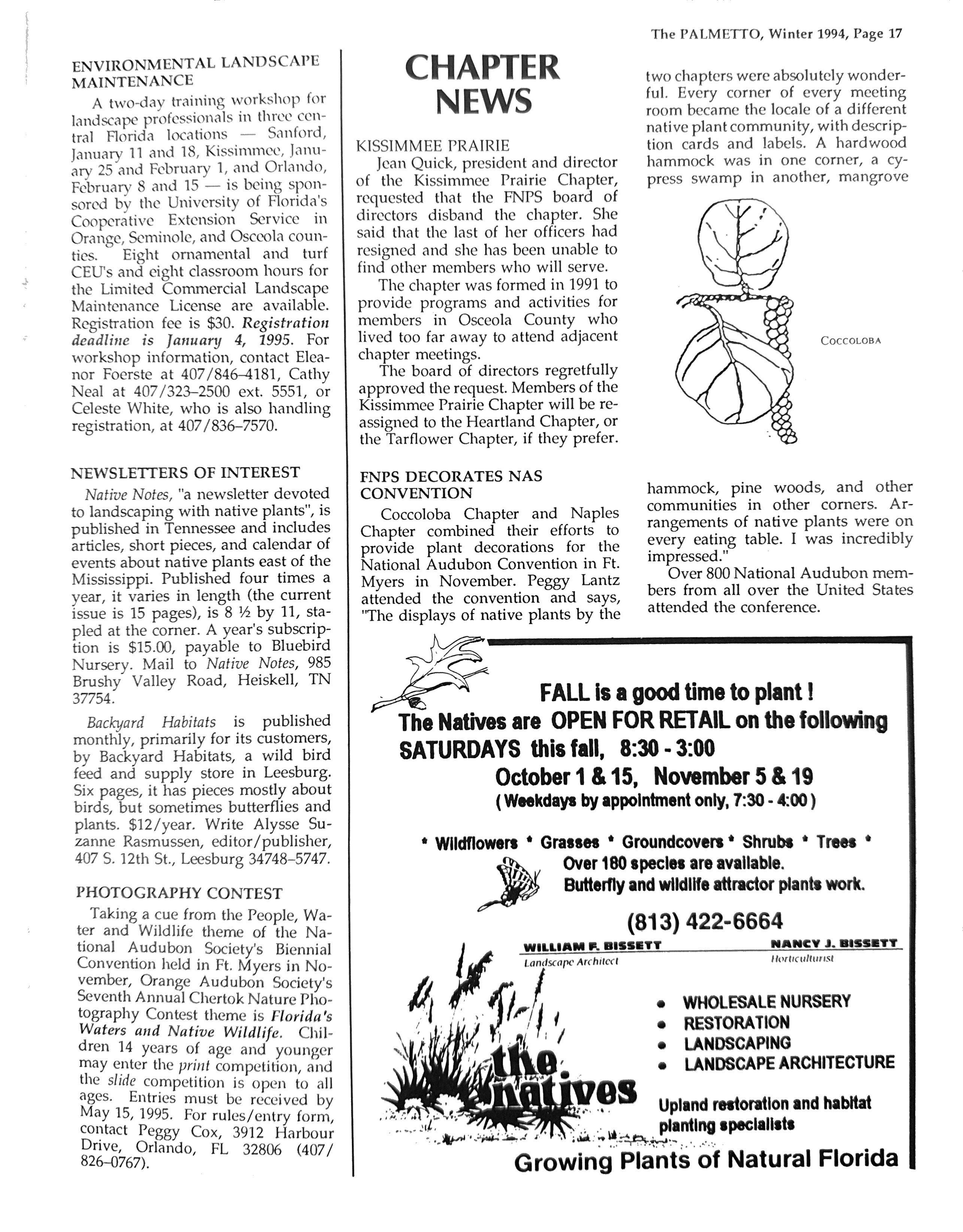
Coccoloba Chapter and Naples Chapter combined their efforts to provide plant decorations for the National Audubon Convention in Ft. Myers in November. Peggy Lantz attended the convention and says, "The displays of native plants by the
two chapters were absolutely wonderful. Every corner of every meeting room became the locale of a different native plant community, with description cards and labels. A hardwood hammock was in one corner, a cypress swamp in another, mangrove
hammock, pine woods, and other communities in other corners. Arrangements of native plants were on every eating table. I was incredibly impressed."
Over 800 National Audubon members from all over the United States attended the conference.
PINELLAS
Pinellas Chapter hosted its "best meeting ever" in December, attended by 250 people from Audubon chapters and the arts community, as well as FPS members. Clyde Bucher, renowned photographer, presented a huge photo display and slide program. A silent auction of art and posters filled Pinellas Chapter's coffers. Exhibitors included U.S. Fish & Wildlife Service, Florida Game & Fresh Water Fish Commission, Florida State Parks, the Gopher Tortoise Council, Florida Yards and Neighborhoods, Brooker Creek State Preserve, and others.
It was an "event".
Judith Buhrman
NAPLES
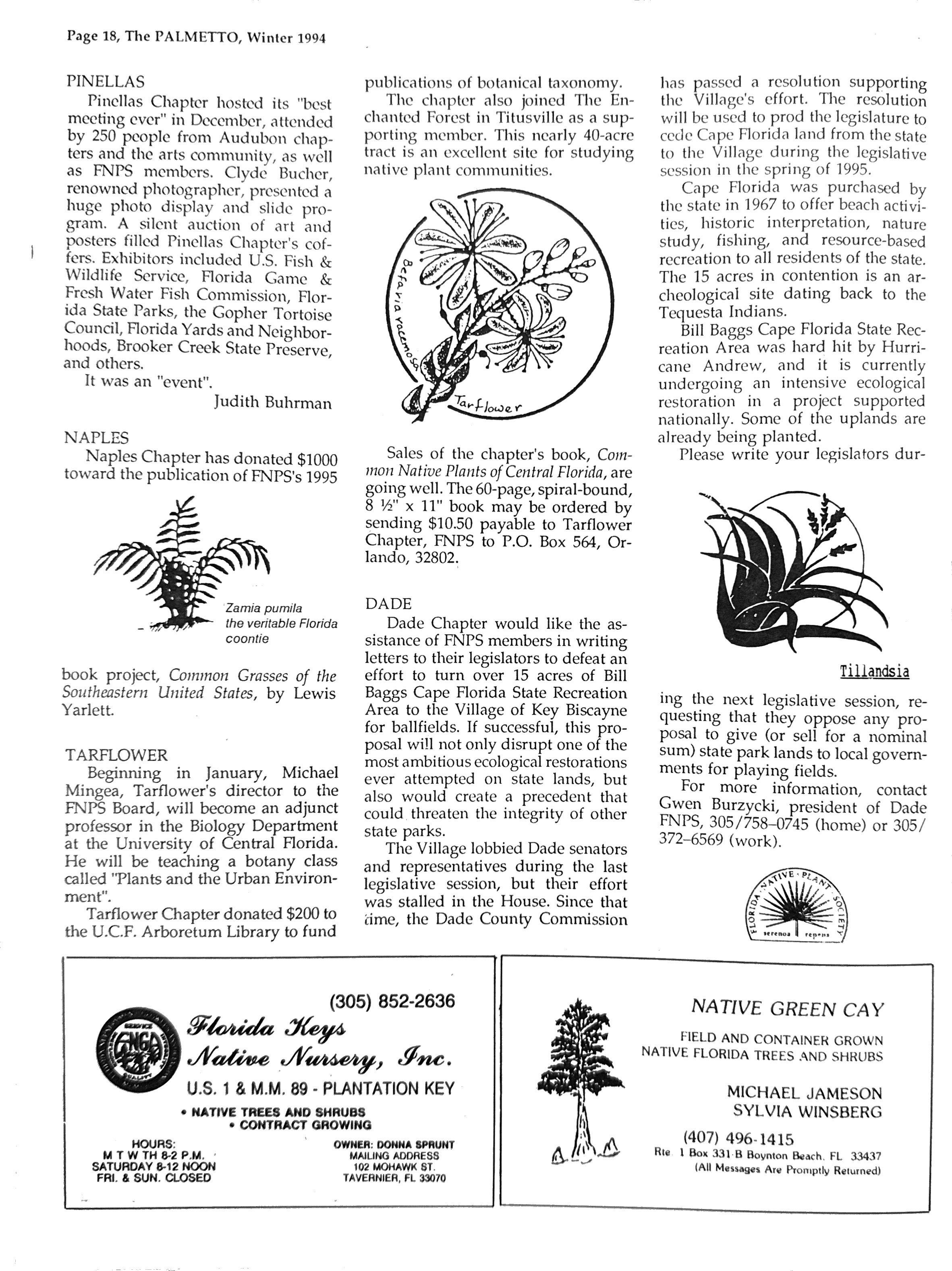
Naples Chapter has donated $1000 toward the publication of FPS's 1995
publications of botanical taxonomy.
The chapter also joined The Enchanted Forest in Titusville as a sup porting member. This nearly 40-acre tract is an excellent site for studying native plant communities.
book project, Common Grasses of the Southeastern United States, by Lewis Yarlett.
TARFLOWER
Beginning in January, Michael Mingea, Tarflower's director to the ENPS Board, will become an adjunct professor in the Biology Department at the University of Central Florida. He will be teaching a botany class called "Plants and the Urban Environment".
Tarflower Chapter donated $200 to the U.C.F. Arboretum Library to fund
Sales of the chapter's book, Common Native Plants of Central Florida, are going well. The 60-page, spiral-bound, 8 ?" × 11" book may be ordered by sending $10.50 payable to Tarflower Chapter, FNPS to P.O. Box 564, Orlando, 32802.
DADE
Dade Chapter would like the assistance of FNPS members in writing letters to their legislators to defeat an effort to turn over 15 acres of Bill Baggs Cape Florida State Recreation Area to the Village of Key Biscayne or ballfields. If successful, this proposal will not only disrupt one of th most ambitious ecological restorations everattempted on state lands, but also would create a precedent that could threaten the integrity of other state parks.
The Village lobbied Dade senators and representatives during the last legislative session, but their effort was stalled in the House. Since that time, the Dade County Commission
has passed a resolution supporting the Village's effort. The resolution will be used to prod the legislature to cede Cape Florida land from the state to the Village during the legislative session in the spring of 1995.
Cape Florida was purchased by the state in 1967 to offer beach activities, historic interpretation, nature study,fishing, and resource-based recreation to all residents of the state. The 15 acres in contention is an archeological site dating back to the Tequesta Indians.
Bill Baggs Cape Florida State Recreation Area was hard hit by Hurricane Andrew, and it is currently undergoing an intensive ecological restoration in a project supported nationally. Some of the uplands are already being planted.
Please write your legislators dur-
Tillandsia
ing the next legislative session, requesting that they oppose any pro- posal to give (or sell for a nominal sum) state park lands to local governments for playing fields.
For more information, contact Gwen Burzycki, president of Dade FPS, 305/758-0745 (home) or 305/ 372-6569 (work).
Zamia pumila the veritable Florida coontie
arflower
CONTRIBUTORS
FNPS recognizes here those firms and individuals who provide additional financial support, by acknowledging them in The Palmetto. Supporting Members
FPS gratefully acknowledges the following Supporting ($100) memberships, which were renewed or have begun since the Fall 1994 issue of The Palmetto.
Janine Barre of Tamarac (Broward Chapter)
Roy Rood Landscaping of Tequesta (Palm Beach Chapter)
John Sharpe of Ocala (Big Scrub Chapter)
Organizational Members
The following are Organizational ($50) memberships which were renewed or have begun since the Fall 1994 issue of The Palmetto:
Alger Farms (Debbie West), Homestead (Dade)
Archbold Biological Station (Library), Lake Placid (Dicerandra)
Big Pine Key Botanical Society, Big Pine Key (Dade)
Biological Research Associates (Richard Callahan), Tampa (Suncoast)
Central Florida Lands & Timber (Marvin Buchanan), Mayo
Environmental Consulting Group (Reese & Helen Kessler), Fern Park (Tarflow-
U.S. Golf Assn.- Green Section (John & Shelly Foy), Hobe Sound (Martin Cocoplum)
** Organizational member is new to FNPS
* Regular member now is Organizational Endowment Fund
FNPS also wishes to recognize those members who have contributed to the FNPS Endowment Fund. The following list includes all those who have contributed to this fund since the Fall 1994 issue of The Palmetto. Endowment contributions separate from and in addition to membership dues, included in the same check with your
Lynn Leverett, Miami (Dade) $100
Orrinna Speese, Lakeland (Heartland) $50
M. Visser, Miami Shores (Dade) $50
Lea Brennan, Naples (Naples) $30
William & Margaret Broussard, Indialantic (Conradina) $25
Cammie Donaldson,Melbourne (Conradina) $25
John & Mary Waters, Tampa (Suncoast)
Elizabeth Whalen & Doris Waller, Estero (Coccoloba) $25
Doris Lommel, Nokomis (Serenoa) $20
The PALMETTO, Winter 1994, Page 19
The following members gave $5, $10 or $15 to the Endowment Fund:
Janet Allen, Michael Brezin, Andrea Burnap, Daniel Burris, Bob & Nancy Bushoven, Douglas & Beverley Cram, June & Robert Cummings, Sally DeGroot, Elizabeth DiFranco, Ernest & Marcia Fedora, Yvonne Froscher, Irene Garrett, Terry Ann Gaunt, Candis Harbison, Howard & Alice Jelks, Robert & Irene Keim, Helen Kidd, Darcie MacMahon & DavidHarlos, Lei Marshall, Donna Masiak, Wendy McHale, Linda & Kenneth Menke, Mary Mercer, Ron & Cheryl Oswald, Valerie Prime, Nancy Prine, Christina Purinton, Barry & Donna Robbins, Nancy Rutledge, Bud & Nancy Schuler, Kathleen Shopa, Allen Shuey, Helen Sweatt, Gina Tamargo, Arlene & Robert Thatcher, Betty Wargo, Elizabeth & Gerald Wilkinson.
Total given to the FNPS Endowment Fund during this period was $635.
FPS most sincerely appreciates the extra financial support provided by all of the above contributors. ? Don Lantz
" The first field guide of its kind... a book that botanists can respect and nature lovers can understand."
...Miami HERALD
In 220 pages, with over 490 color plates, 170 trees and shrubs native to the Florida Keys are illustrated and described. Includes characteristics, growth habits, and close-ups of each in leaf, flower and fruit. Identification keys and indexes to scientific and common names. Authoritative, yet easy to read.
SPECIAL PRICE FOR MEMBERS
Native Trees and Shrubs of the Florida Keys retails for $32.95 plus
Native Trees and Shrubs of the
Florida Keys tax. But FNPS members can save $6.50 by sending $28.75 (includes sales tax, handling & postage) to Laurel Press, P.O. Box 266, Sugarloaf Shs., FL 33044, Laurel Press is a member of FNPS. . Paul Scurlock
The Palmetto is printed on recycled paper with soy ink.
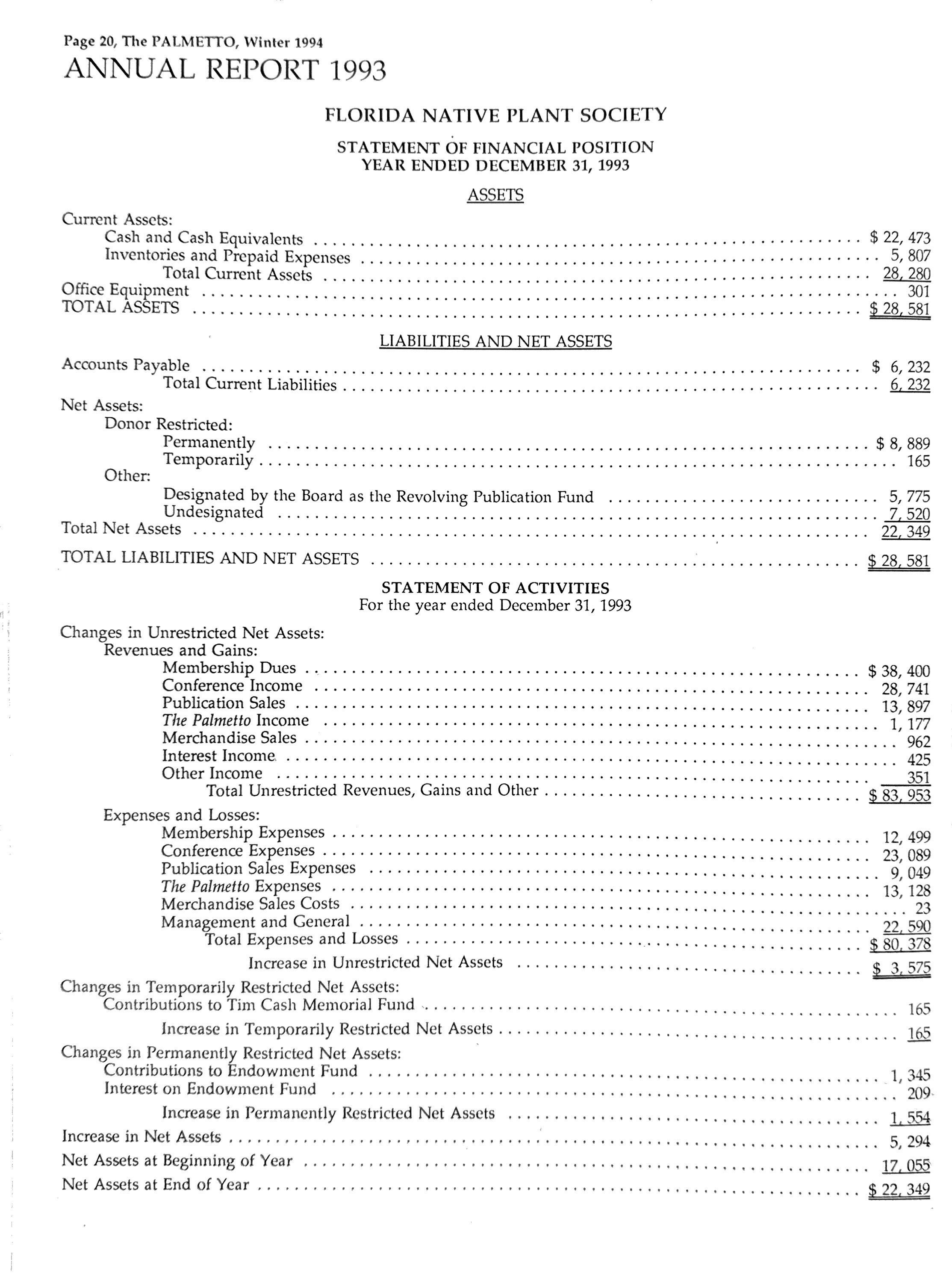
Current Assets: Cash and Cash Equivalents.
FLORIDA NATIVE PLANT SOCIETY
STATEMENT OF FINANCIAL POSITION YEAR ENDED DECEMBER 31, 1993 ASSETS
Inventories and Prepaid Expenses
Total Current Assets
Office Equipment
TOTAL ASSETS
Accounts Payable
Net Assets:
LIABILITIES AND NET ASSETS
Total Current Liabilities
Donor Restricted: Permanently Temporarily
Other:
Designated by the Board as the Revolving Publication Fund Undesignated
Total Net Assets
TOTAL LIABILITIES AND NET ASSETS
STATEMENT OF ACTIVITIES
For the year ended December 31, 1993
Changes in Unrestricted Net Assets: Revenues and Gains:
Total Unrestricted Revenues, Gains and Other. Expenses and Losses:
Net Assets at Beginning of Year
Net Assets at End of Year $ 22,473 5, 807 28,280 301 $ 28, 581 $ 6, 232 6, 232 $ 8,889 165 5, 775 7, 520 22,349 $ 28, 581 $ 38,400 28, 741 13, 897 1, 177 962 425
17,055 $ 22,349
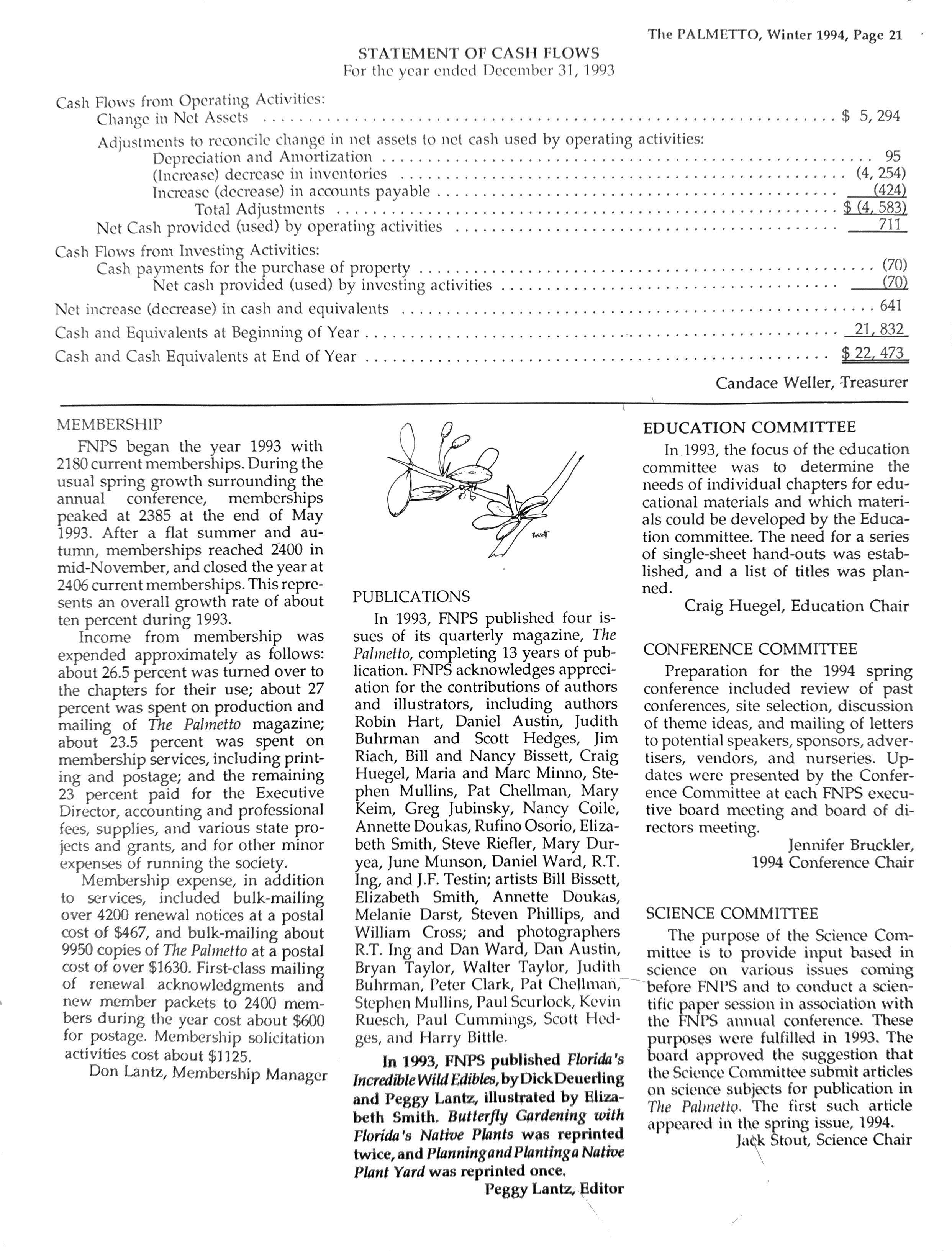
STATEMENT OF CASH FLOWS
For the year ended December 31, 1993
Cash Flows from Operating Activities:
Change in Net Assets
Adjustments to reconcile change in net assets to net cash used by operating activities:
Depreciation and Amortization (Increase) decrease in inventories
Increase (decrease) in accounts payable
Total Adjustments
Net Cash provided (used) by operating activities
Cash Flows from Investing Activities:
Cash payments for the purchase of property ..
Net cash provided (used) by investing activities
Net increase (decrease) in cash and equivalents
Cash and Equivalents at Beginning of Year
Cash and Cash Equivalents at End of Year
MEMBERSHIP
FNPS began the year 1993 with 2180 current memberships. During the usual spring growth surrounding the conference, memberships peaked at 2385 at the end of May 1993. After a flat summer and autumn, memberships reached 2400 in mid-November, and closed the year at 2406 current memberships. This represents an overall growth rate of about ten percent during 1993.
Income from membership was expended approximately as follows: about 26.5 percent was turned over to the chapters for their use; about 27 percent was spent on production and mailing of The Palmetto magazine; about 23.5 percent was spent on membership services, including printing and postage; and the remaining 23 percent paid for the Executive Director, accounting and professional fees, supplies, and various state pro- jects and grants, and for other minor expenses of running the society.
Membership expense, in addition to services, included bulk-mailing over 4200 renewal notices at a postal cost of $467, and bulk-mailing about 9950 copies of The Palmetto at a postal cost of over $1630. First-class mailing of renewalacknowledgments and new member packets to 2400 members during the year cost about $600 for postage. Membership solicitation activities cost about $1125.
Don Lantz, Membership Manager
PUBLICATIONS
In 1993, FNS published four issues of its quarterly magazine, The Palmetto, completing 13 years of publication. FNPS acknowledges appreciation for the contributions of authors and illustrators, including authors Robin Hart, Daniel Austin, Judith Buhrman and Scott Hedges, Jim Riach, Bill and Nancy Bissett, Craig Huegel, Maria and Marc Minno, Stephen Mullins, Pat Chellman, Mary Keim, Greg Jubinsky, Nancy Coile, Annette Doukas, Rufino Osorio, Elizabeth Smith, Steve Riefler, Mary Duryea, June Munson, Daniel Ward, R.T. Ing, and J.F. Testin; artists Bill Bissett, Elizabeth Smith, Annette Doukas, Melanie Darst, Steven Phillips, and William Cross; and photographers R.T. Ing and Dan Ward, Dan Austin, Bryan Taylor, Walter Taylor, Judith Buhrman, Peter Clark, Pat Chellman, Stephen Mullins, Paul Scurlock, Kevin Ruesch, Paul Cummings, Scott Hedges, and Harry Bittle.
In 1993, FNPS published Florida's Incredible Wild Edibles, by Dick Deuerling and Peggy Lantz, illustrated by Elizabeth Smith. Butterfly Gardening with Florida's Native Plants was reprinted twice, and Planningand Plantinga Native Plant Yard was reprinted once.
Peggy Lantz, Editor
Candace Weller, Treasurer
EDUCATION COMMITTEE
In 1993, the focus of the education committee was to determine the needs of individual chapters for educational materials and which materials could be developed by the Education committee. The need for a series of single-sheet hand-outs was established, and a list of titles was planned.
Craig Huegel, Education Chair
CONFERENCE COMMITTEE
Preparation for the 1994 spring conference included review of past conferences, site selection, discussion of theme ideas, and mailing of letters to potential speakers, sponsors, advertisers, vendors, and nurseries. Updates were presented by the Conference Committee at each FNPS executive board meeting and board of directors meeting.
Jennifer Bruckler, 1994 Conference Chair
SCIENCE COMMITTEE
The purpose of the Science Committee is to provide input based in science on various issues coming before FNPS and to conduct a scieninc paper session in association with he FPS annual conference. These purposes were fulfilled in 1993. The oard approved the suggestion that the Science Committee submit articles on science subjects for publication in The Palmetto. The first such article appeared in the spring issue, 1994. Jack Stout, Science Chair
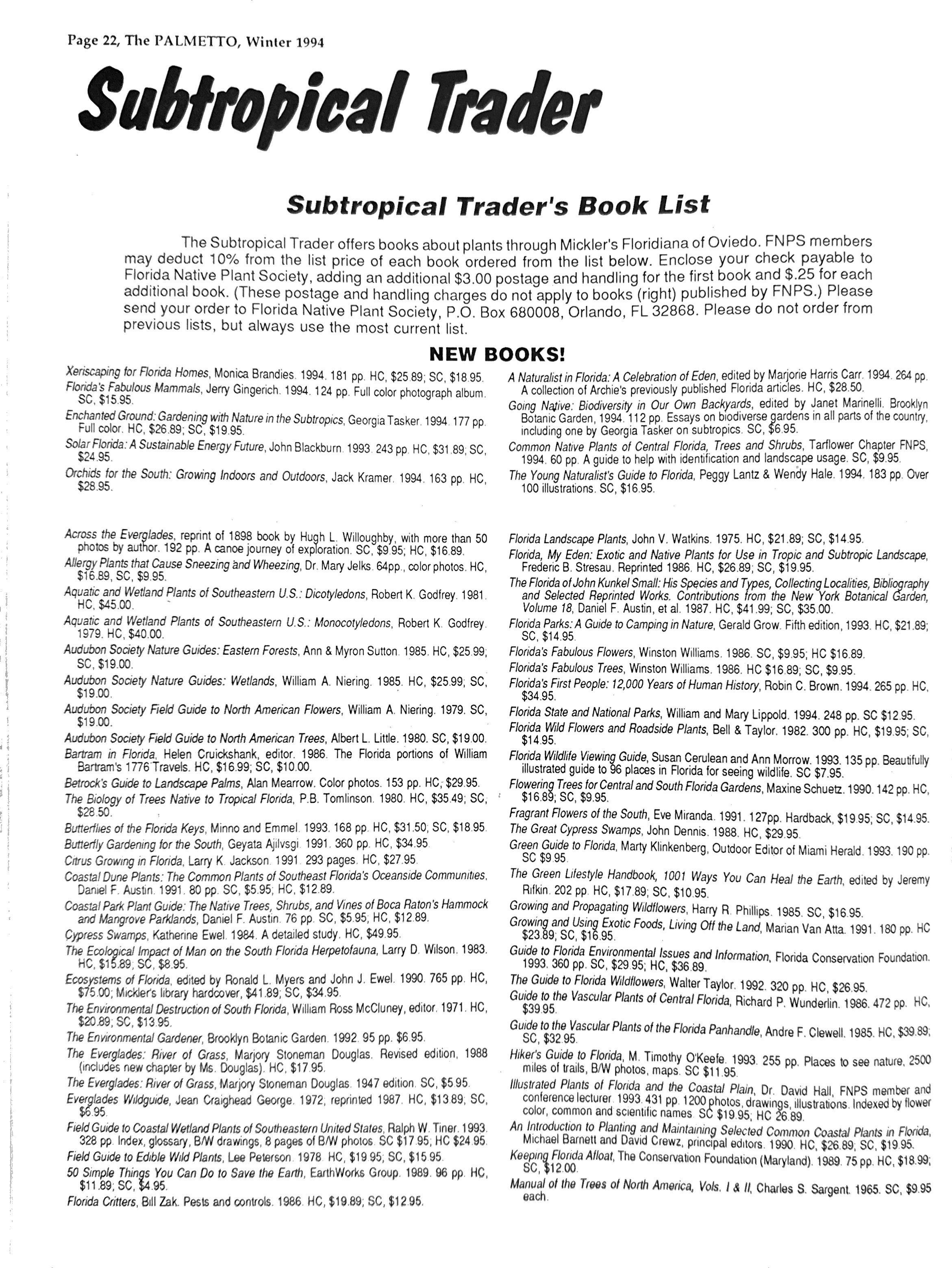
Subtropical Trader
Subtropical Trader's Book List
The Subtropical Trader offers books about plants through Mickler's Floridiana of Oviedo. FPS members may deduct 10% from the list price of each book ordered from the list below. Enclose your check payable to Florida Native Plant Society, adding an additional $3.00 postage and handling for the first book and $.25 for each additional book. (These postage and handling charges do not apply to books (right) published by FNPS.) Please send your order to Florida Native Plant Society, P.O. Box 680008, Orlando, FL 32868. Please do not order from previous lists, but always use the most current list.
NEW BOOKS!
Xeriscaping for Florida Homes, Monica Brandies. 1994. 181 pp. HC, $25.89; SC, $18.95 A Naturalist in Florida: A Celebration of Eden, edited by Marjorie Harris Carr. 1994. 264 pp Florida's Fabulous Mammals, Jerry Gingerich. 1994. 124 pp. Full color photograph album A collection of Archie's previously published Florida articles. HC, $28.50. SC, $15.95 Going Native: Biodiversity in Our Own Backyards, edited by Janet Marinelli. Brooklyr Enchanted Ground: Gardening with Nature in the Subtropics, Georgia Tasker. 1994. 177 pp. Botanic Garden, 1994. 112 pp. Essays on biodiverse gardens in all parts of the country Full color. HC, $26.89; SC, $19.95. including one by Georgia Tasker on subtropics. SC, $6.95
Solar Florida: A Sustainable Energy Future, John Blackburn. 1993. 243 pp. HC, $31.89; SC Common Native Plants of Central Florida, Trees and Shrubs, Tarflower Chapter FNPS 1994. 60 pp. A guide to help with identification and landscape usage. SC, $9.95
Orchids for the South: Growing Indoors and Outdoors, Jack Kramer. 1994. 163 pp. HC, The Young Naturalist's Guide to Florida, Peggy Lantz & Wendy Hale. 1994. 183 pp. Over 100 illustrations. SC, $16.95
Across the Everglades, reprint of 1898 book by Hugh L. Willoughby, with more than 50 photos by author. 192 pp. A canoe journey of exploration. SC.
Allergy Plants that Cause Sneezing and Wheezing, Dr. Mary Jelks. 64pp., color photos. HC, $16.89, SC, $9.95.
Aquatic and Wetland Plants of Southeastern U.S.: Dicotyledons, Robert K. Godfrey. 1981.
Aquatic and Wetland Plants of Southeastern U.S.: Monocotyledons, Robert K. Godfrey. 1979.HC,$40.00
Audubon Society Nature Guides: Eastern Forests, Ann & Myron Sutton. 1985. HC, $25.99; SC, $19.00
Audubon Society Nature Guides: Wetlands, William A. Niering. 1985. HC, $25.99; SC, $19.00.
Audubon Society Field Guide to North American Flowers, William A. Niering. 1979. SC,
Audubon Society Field Guide to North American Trees, Albert L. Little. 1980. SC, $19.00 Bartram in Florida, Helen Cruickshank, editor. 1986. The Florida portions of William Bartram's 1776 Travels. HC, $16.99; SC, $10.00.
Betrock's Guide to Landscape Palms, Alan Mearrow. Color photos. 153 pp. HC, $29.95
The Biology of Trees Native to Tropical Florida, P.B. Tomlinson. 1980. HC, $35.49; SC $28.50.
Butterflies of the Florida Keys, Minno and Emmel. 1993. 168 pp. HC, $31.50; SC, $18.95 Butterfly Gardening for the South, Geyata Ajilvsgi. 1991. 360 pp. HC, $34.95
Citrus Growing in Florida, Larry K. Jackson. 1991. 293 pages. HC, $27.95
Coastal Dune Plants: The Common Plants of Southeast Florida's Oceanside Communities, Daniel F. Austin. 1991. 80 pp. SC, $5.95; HC, $12.89
Coastal Park Plant Guide: The Native Trees, Shrubs, and Vines of Boca Raton's Hammock and Mangrove Parklands, Daniel F. Austin. 76 pp. SC, $5.95; HC, $12.89 Cypress Swamps, Katherine Ewel. 1984. A detailed study. HC, $49.95
The Ecological Impact of Man on the South Florida Herpetofauna, Larry D. Wilson. 1983
Ecosystems of Florida, edited by Ronald L. Myers and John J. Ewel. 1990. 765 pp. HC, $75.00; Mickler's library hardcover, $41.89; SC, $34.95
The Environmental Destruction of South Florida, William Ross McCluney, editor. 1971. HC, $20.89; SC, $13.95
The Environmental Gardener, Brooklyn Botanic Garden. 1992. 95 pp. $6.95
The Everglades: River of Grass, Marjory Stoneman Douglas, Revised edition, 1988 (includes new chapter by Ms. Douglas). HC, $17.95
The Everglades: River of Grass, Marjory Stoneman Douglas. 1947 edition. SC, $5.95
Field Guide to Coastal Wetland Plants of Southeastern United States, Ralph W. Tiner. 1993 328 pp. Index, glossary, B/W drawings, 8 pages of B/W photos. SC $17.95; HC $24.95
Field Guide to Edible Wild Plants, Lee Peterson. 1978. HC, $19.95; SC, $15.95. 5051189, 5C. B. You Can Do 1o Save the Earh, EarhWorks Group, 1989. 96 pp. HC, Florida Critters, Bill Zak. Pests and controls. 1986. HC, $19.89; SC, $12.95.
Florida Landscape Plants, John V. Watkins. 1975. HC, $21.89; SC, $14.95
Florida, My Eden: Exotic and Native Plants for Use in Tropic and Subtropic Landscape Frederic B. Stresau. Reprinted 1986. HC, $26.89; SC, $19.95
The Florida of John Kunkel Small: His Species and Types, Collecting Localities, Bibliography and Selected Reprinted Works. Contributions from the New York Botanical Garden, Volume 18, Daniel F. Austin, et al. 1987. HC, $41.99; SC, $35.00
Florida Parks: A Guide to Camping in Nature, Gerald Grow. Fifth edition, 1993. HC, $21.89; SC, $14.95
Florida's Fabulous Flowers, Winston Williams. 1986. SC, $9.95; HC $16.89
Florida's Fabulous Trees, Winston Williams. 1986. HC $16.89; SC, $9.95.
Florida's First People: 12,000 Years of Human History, Robin C. Brown. 1994. 265 pp. HC $34.95
Florida State and National Parks, William and Mary Lippold. 1994. 248 pp. SC $12.95
Florida Wild Flowers and Roadside Plants, Bell & Taylor. 1982. 300 pp. HC, $19.95; SC $14.95
Florida Wildlife Viewing Guide, Susan Cerulean and Ann Morrow. 1993. 135 pp. Beautifully lustrated guide to 96 places in Florida for seeing wildlife. SC $7.9!
Flowering Trees for Central and South Florida Gardens, Maxine Schuetz. 1990. 142 pp. HC $16.89; SC, $9.95
Fragrant Flowers of the South, Eve Miranda. 1991. 127pp. Hardback, $19.95; SC, $14.95
The Great Cypress Swamps, John Dennis. 1988. HC, $29.95
Green Guide to Florida, Marty Klinkenberg, Outdoor Editor of Miami Herald. 1993. 190 pp. SC $9.95
The Green Lifestyle Handbook, 1001 Ways You Can Heal the Earth, edited by Jeremy Rifkin. 202 pp. HC, $17.89; SC, $10.95
Growing and Propagating Wildflowers, Harry R. Phillips. 1985. SC, $16.95
Growing and Using Exotic Foods, Living Off the Land, Marian Van Atta. 1991. 180 pp. HC $23.89: SC. $16.95
Guide to Florida Environmental Issues and Information, Florida Conservation Foundation. 1993. 360 pp. SC, $29.95; HC, $36.89
The Guide to Florida Wildflowers, Walter Taylor. 1992. 320 pp. HC, $26.95
Guide to the Vascular Plants of Central Florida, Richard P. Wunderlin. 1986. 472 pp. HC,
Guide to the Vascular Plants of the Florida Panhandle, Andre F. Clewell. 1985. HC, $39.89;
Hiker's Guide to Florida, M. Timothy O'Keefe. 1993. 255 pp. Places to see nature, 2500 miles of trails, B/W photos, maps. SC $11.95
Illustrated Plants of Florida and the Coastal Plain, Dr. David Hall, FPS member and conterence lecturer. 1993. 431 pp. 1200 photos, drawings, illustrations. Indexed by flower color, common and scientitic names. SC $19.95; HC 26.89
An Introduction to Planting and Maintaining Selected Common Coastal Plants in Florida, Michael Barnett and David Crewz, principal editors. 1990. HC, $26.89; SC, $19.95
Manual of the Trees of North America, Vols. / & II, Charles S. Sargent. 1965. SC, $9.95 each
Marjory Stoneman Douglas: Guardian of the Everglades, Kem Knapp Sawyer. 72 pp. A book for your kids; they need to learn about Ms. Douglas and the Everglades, too. SC $7,95: HC $14 95
Marshes of the Ocean Shore: Development of an Ecological Ethic, Joseph V. Siry. 1984. HC, $19.89;
Mosses of the Gulf South, William D. Reese. 1984. HC, $35.00.
Native Trees and Shrubs of the Florida Keys, J. Paul Scurlock, 1987. 220pp., color photos. HC, $42.89;
A Naturalist in Southern Florida, Charlotte Orr Gantz. 1971, reprinted 1982. HC, $15.95.
The Nature of Dade County - A Hometown Handbook, Sande Ross. 1990. 73 pp. HC, $11.89; SC,
Plants Poisonous to People, Julia F. Morton. 1982. HC, $26.89; SC, $19.95.
Protecting Paradise. 300 Ways to Protect Florida's Environment, Peggy Cavanaugh and Margaret Spontek. 1992. 160 pp. SC, $11.95; HC, $18.89.
Rare and Endangered Biota of Florida: Vol. I, Mammals, Revised Edition, 1992. Stephen R. Humphrey, editor. 392 pp. HC, $59.95; SC, $27.95
Rare and Endangered Biota of Florida: Vol. II, Fishes, Revised Edition, 1992. Carter R. Gilbert, editor. 247 pp. HC, $54.95; SC, $25.95.
Rare and Endangered Biota of Florida: Vol. III, Amphibians, Revised Edition, 1992. Paul E. Moler, editor. 272 pp. HC, $49.95; SC, $23.95.
Requiem for a Lawnmower and Other Essays on Easy Gardening with Native Plants, Sally Wasowski 1992. 180 pp. HC, $15.95.
Scrub Plant Guide: A Pocket Guide to Common Plants of Southern Florida's Scrub Community, Dr. Daniel Austin, Florida Atlantic University, FNPS member. 1994. 84 pp. SC $5.95; HC $12.89.
Seashore Plants of South Florida and the Caribbean, David W. Nellis. 1994. 160 pp. HC, $27.95; SC,
A Shadow and a Song, The Struggle to Save an Endangered Species, Mark Jerome Walters. 238 pp. About the Dusky Seaside Sparrow. HC, $21.95.
The Smithsonian Guide to Seaside Plants of the Gulf and Atlantic Coasts from Louisiana to Massachusetts, Exclusive of Lower Peninsular Florida, Wilbur H. Duncan. 1987. HC, $36.89; SC,
Southern Forests, A Chronicle, Laurence Walker. 1991. 322p?. HC, $29.95
Tidal Marsh Plants, Lionel N. Eleuterius, Mississippi State University. 1981. For use in the field in salt marshes of Atlantic and Gulf coasts of United States. Illustrated in color and B/W. HC
Travels of William Bartram, Mark Van Doren. 1928. HC, $14.89; SC, $7.95.
Trees of the Everglades National Park and the Florida Keys, George B. Stevenson. 1986. HC, $9.89;
Trees of Florida, Gil Nelson. 1994. 338 pp. Line drawings and color photos. HC, $29.95; SC, $19.95.
Trees of Northern Florida, Herman Kurz. 1962. 311 pp. HC, $29.89; SC, $22.95.
Trees of the Southeastern United States, Wilbur H. Duncan. 1988. HC, $19.95
Vascular Flora of the Southeastern United States, Vol. 1, Asteracee, Arthur Cronquist. 1980. 261pp, no illustrations. HC, $35.00
Vascular Flora of the Southeastern United States, Vol. 3, Part 2: Leguminosae (Fabaceae), Duane Isely 1990. 258pp, some line drawings. $35.00
The Water-Thrifty Garden, Stan DeFreitas. 1993. $19.95
Wekiva River: Scenic and Wild, Wekiva River Writers. 1988. 32pp. HC, $9.89; paper, $2.95. Wild Plants for Survival in South Florida, Julia F. Morton. 1974. HC, $18.89; SC, $11.95. Wildflowers, Richard Parker. 1986. HC, $14.89; SC, $7.95 Wildflowers: South Florida Natives, Arlene Adams Schuyler. 1982. HC, $13.89; SC, $6.95
You Can Grow Cattleya Orchids, Mary Noble McQuerry. 128 pp. HC, $19.89; SC, $12.95. You Can Grow Orchids, Mary Noble McQuerry. 128 pp. HC, $19.89; SC, $12.95.
Your Florida Garden, John V. Watkins. 1954, revised 1986. HC, $21.89; SC, $14.95.
These three books may be ordered through Subtropical Trader. Prices, as printed, are already discounted and include postage and tax.
PLANNING AND PLANTING A NATIVE PLANT YARD
Planning and Planting a Native Plant Yard byJohnBeriault
Crammed into its 24 pages are illustrated suggestions for turning your entire house lot into a native habitatsuitableforvourFlorida location. Includes list of suggested native plants.
$4.00 for nonmembers; $3.50 for members (includes postage).
Butterfly Gardening with Florida's Native Plants by Craig Huegel
How to design and plant your gardentoattractthespeciesof butterfliesinyourpartofFlorida
40 pages, illustrated.
$6.50 for nonmembers; $6.00 for members (includes postage).
Florida's
Chapters on gathering and preparing salad greens, potherbs, and potato substitutes; drying wild plant leaves for beverages; recipes for jellies and syrups, pancakes, and candies. 72 pages, illustrated.
$7.00tononmembers;$6.50to members (includes postage).
Butterfly Gardening will Storida's Native Mants
Horida a Weed Editer
Incredible Wild Edibles by Dick Deuerling and Peggy Lantz
30 ACRES CONTAINERS
50 ACRES FIELD GROWN CONTRACT GROWING AVAILABLE
SINCLAIR
LANDSCAPE NURSERY INC.
80 ACRES NURSERY MATERIAL
Forestiera pinetorum
Acoelorrhaphe wrighti
Annona glabra
Bumelia tenax
Byrsonima lucida
Callicarpa americana
Canella winterana
Capparis cynophallophora
Chrysobalanus icaco
Citharexylum fruticosum
Clusea rosea
Coccoloba uvifera
Conocarpus erectus
Conocarpus erectus var. sericea
Diospyros virginiana
Eugenia axillaris
Eugenia confusa
Eugenia foetida
Forestiera segregata
Fraxinus carolinana
Gordonia lasianthus
Ilex cassine
Ilex glabra
Ilex vomitoria cv. 'Schellings Dwarf"
Iris hexagona
Juncus spp
Juniper silicicola
Krugiodendron ferrum
Magnolia grandiflora
Magnolia virginiana
Muhlenbergia capillaris
Myrcianthes fragrans
Myrica cerifera
Myrsine guianensis
Persea borbonia
Pinus elliott var. densa
Prunus caroliniana
Psidium longipes
Quercus laurifolia
Quercus virginiana
Randia aculeata
Roystonea elata
Sabal palmetto
Serenoa repens
Spartina bakeri
Suriana maritima
Swietenia mahogani
Taxodium ascendens
Taxodium distichum
Tripsacum dactyloides
Tripsacum floridanum
Nyssa sylvatica var. biflora 11011 HAGEN RANCH ROAD ? BOYNTON BEACH, FL 33437 (407) 737-6904 FAX 737-9342