The purpose of the Florida Native Plant Society is the preservation, conservation, and restoration of the native plants and native plant communities of Florida.
THE PALMETTO (ISSN-0276-4164)
Florida Native Plant Society 2020 Red Gate Road Orlando, Florida 32818
Copyright 1994 by Florida Native Plant Society
Peggy S. Lantz, Editor P.O. Box 680008, Orlando, FL 32868
The Palmetto is published quarterly by the Florida Native Plant Society. We encourage the reuse of the articles appearing in The Palmetto in order to disseminate information on Florida native plants as widely as possible; but, in accordance with the copyright law, permission must be granted in writing by the Editor or the Publisher, credit must be given to The Palmetto and the Florida Native Plant Society, and notice of copyright must appear in the reprinted article.
SUBMISSIONS
Articles on any aspect of Florida native plants are invited. Include drawings or photos, if possible. They will be handled with care, and will be returned if you include a self-addressed, stamped envelope. Send to Peggy S. Lantz, Editor, The Palmetto, P.O. Box 680008, Orlando, FL 32868. Phone: 407/299-1472.
ADVERTISING
You are invited to place an advertisement for your company in The Palmetto. Rates for camera-ready copy are $200 for a full page, $110 for a half page, $75 for one-third page (two columns wide by 4%g" high), $60 for one-fourth page (two columns wide by 3%" high), and $40 for one-sixth page (one column wide by 4'/" high, or two columns wide by 2%" high). For running the same display ad in two issues, there will be a 20% discount, and for three issues a 30% discount. Business card rate is $20 per issue (no discount). Copy that needs special photography or set-up will be billed at cost.
FNPS OFFICERS AND BOARD OF DIRECTORS
EXECUTIVE COMMITTEE:
President: David Pais, 2306 N.W. 47th Terr., Gainesville, 32604; 904/372-3899. 1st Vice President: Janice Broda, 9335 Frangipani Dr., Vero Beach, 32963; 407/589-0319. 2nd Vice President: Judith Buhrman, 4362 80th Ave. N., Pinellas Park, 34665; 813/546-7661. Secretary: Debbie Butts, 4321 Needle Palm Rd., Plant City, 33565; 813/754-7374. Treasurer: Candace Weller, 1515 Country Club Rd. N., St. Petersburg, 33710; 813/345-4619h.
STANDING COMMITTEE CHAIRS:
Chapter Liaison: Richard Workman, 1705 Maple Ave., Ft. Myers, 33901; 813/936-8282w. Education: Craig Huegel, 999 Lora Ln., Tarpon Springs, 34689; 813/943-9216h; 937-0306w. Landscape: Orrinna Speese, 5701 Stratford Lane, Lakeland, 33813; 813/646-7074. Legislation: David Drylie, 1333 Taylor Creek Rd., Christmas, 32709; 407 / 568-1333w. Membership: Don Lantz, P.O. Box 680008, Orlando, 32868; 407/299-1472
Publications: Peggy Lantz, 2020 Red Gate Rd., Orlando, 32818; 407/299-1472.
Rick Joyce, 123 W. Mariana Ave., N. Fort Myers, 33903; 813/335-2352w, 813/995-4489h. (94-96)
Gary Patterson, 1209 Ridge St., Naples, 33940; 813/262-3602. (93-95)
Larry Thompson, 1229 Sarasota Dr., Tallahassee, 32303; 904/222-2473. (94-96)
Walt Thomson, 1581 Arden St., Longwood, 32750; 407/935-0002w, 407/331-1715h. (94-96)
Richard Workman, 1705 Maple Ave., Ft.Myers, 33901; 813/936-8282w. (93-95)
Kim Zarillo, 760 Cajeput cir., Melbourne Village, 32904; 407 / 727-1713. (94-96)
FPS CHAPTER INFORMATION
Big Scrub (Marion & Citrus counties): 2nd Weds., 7 p.m.; Silver River Museum & Environmental Center, 7189 N.E. 7th St., Ocala. Director: Denver Raney, 5525 S.E. Maricamp Rd., Ocala, 34480; Broward: 2nd Tues., 7:30 p.m.; Secret Woods Nature Center, 2701 W. State Rd. 84, Ft. Lauderdale. Director: Ann Murray, 608 S. W. 7th Ave., Ft. Lauderdale, 33315; 305/523-0288.
Charlotte Harbor: 4th Tues., 7 p.m.; Board Room, 2nd Floor, Library, Aaron St., Pt. Charlotte. Director: Dave Wilson, 426 Little Falls Ave., NE., Pt. Charlotte, 33952; 813/625-4402h.
Coccoloba (Lee County): 2nd Thurs., 7:30 p.m. (Oct. thru April); Iona House, Nature Center of Lee County, Fort Myers. Chapter Mail: P.O. Box 1942, Fort Myers, 33902. Director: Robert Irving 813/472-1932w.
Conradina (South Brevard): 3rd Wed., 7 p.m.; Margaret Hames Nature Center, Turkey Creek Sanctuary, Melbourne. Chapter Mail: P.O. Box 1543, Melbourne, 32902. Director: Camy Donaldson, 407/951-
Dicerandra (Highlands County): 2nd Wed., 7 p.m.; Conference Room, Home Savings Bank, 3200 US-27 S., Sebring. Director: Natalie Patton, 7425 St. Rd. 17 S., Sebring, 33870; 813/655-0715.
Eugenia (Indian River & St.Lucie counties): 3rd Thurs., 7:30 p.m.; Library, Fla. Medical Entomology Lab., 200 9th St. S.E., Vero Beach. Director: Peggy Brinson, 566 6th Ave., Vero Beach, 32962;
[xia (Northeast Florida): Ist Thurs., 7:30 p.m.; St. Andrews Episcopal Church, 7801 Lone Star Rd., lacksonville. Director: Kathy Mease, 4317 Rosewood Ave., Jacksonville, 32207; 904/733-6195. Kissimmee Prairie (Osceola County): Ist Wed., 7 p.m.; Meeting Room, Lake Toho Yacht Club, Lakeshore Drive, Kissimmee. Director: Jean Quick, 315 Bowen Rd., Davenport, 33837; 813/424-2203. Magnolia (Northwest Florida): Ist Tues., 7 p.m.; Dorothy Oven Park, 3205 Thomasville Rd., Tallahassee. Director: Fritz Wettstein, 5920 Blountstown Hwy. #8, Tallahassee, 32304: 904/488-1555.
Martin Cocoplum: 3rd Tues., 7:30 p.m.; Environmental Studies Center, 2900 Indian River Dr., Jensen Beach. Chapter Mail: P.O, Box 801, Jensen Beach, 34958. Director: Sally O'Connell, 407/878-6010. Naples (Collier County): 4th Mon., 7:30 p.m.; Pelican Room, Conservancy Nature Center, 1450 Merrihue Dr., Naples. Chapter Mail: P.O. Box 422, Naples, 33939. Director: Lea Brennan, 813/263-1610. Nature Coast (Pasco & Hernando counties): 2nd Tues., 7 p.m.; Concourse Bldg. & Nature Center, S.R. 52, 3 mi. W. of U,S. 41 in Pasco County; Director: Ben Mercadante, 904/754-9701w. Palm Beach: 3rd Mon., 7:30 p.m.; Pavilion, Mounts Botanical Garden, 531 N. Military Trail, West Palm Beach. Director: Dan Boyar, 712 S. W. 3rd Ave., Boynton Beach, 33426; 407/737-3958h; 687-6973w. Paynes Prairie (Alachua, Putnam, Columbia): 3rd Thurs., 7:30 p.m.; Doyle Conner Auditorium, 1911 S.W. 34th St., Gainesville. Director: Frank Alsobrook, P.O. Box 1063, Melrose 32666; 904/475-1335. Pinellas: Ist Wed., 7:30 p.m.; Pinellas County Coop, Extension Serv., 12175 125th St. N., Largo. Director: Candace Weller, 1515 Country Club Rd. N., St. Petersburg, 33710; 813/345-46196
Sea Rocket (North & Central Brevard): 4th Mon., 7 p.m.; Rec. Center, Manatee Hammock Park, 7275 S. US-1, Bellwood, Director: Jennifer Bruckler, 4010 Barr Ct., Titusville, 32796; 407/268-0690. Serenoa (Sarasota & Manatee counties): 3rd Tues., 7:30 p.m.; Sarasota Garden Club, 1131 Blvd. of the Sarasota. Chapter Mail: P.O. Box 564, Sarasota,34230; Director: Roxanne Williamson, 813/366-7110h.
Suncoast (Hillsborough County): 3rd Wed., 7:30 for directins DirectOr Carl ral menger, menger, Box 15588, Tampa, 3in in 84, 072h, 97al-
Tarflower (Central Florida): Ist Tues., 7 p.m.; Orlando Garden Club, 710 E. Rollins Ave., Orlando. Chapter Mail: P.O. Box 564, Orlando, 32802; Director: Mike Mingea, 407/366-MIKE (6453). Volusia Pawpaw: 3rd Tues., 7 p.m.; River Bridge Meeting Hall, 1 N. Beach St., Ormond Beach. Director: Larry Sauter, 3639 Conifer Ln., Ormond Beach, 32174; 904/677-3488.
serenoa repens
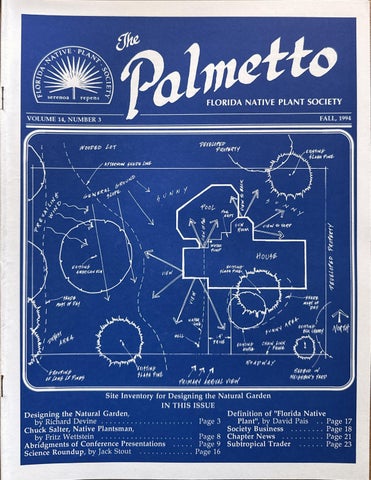
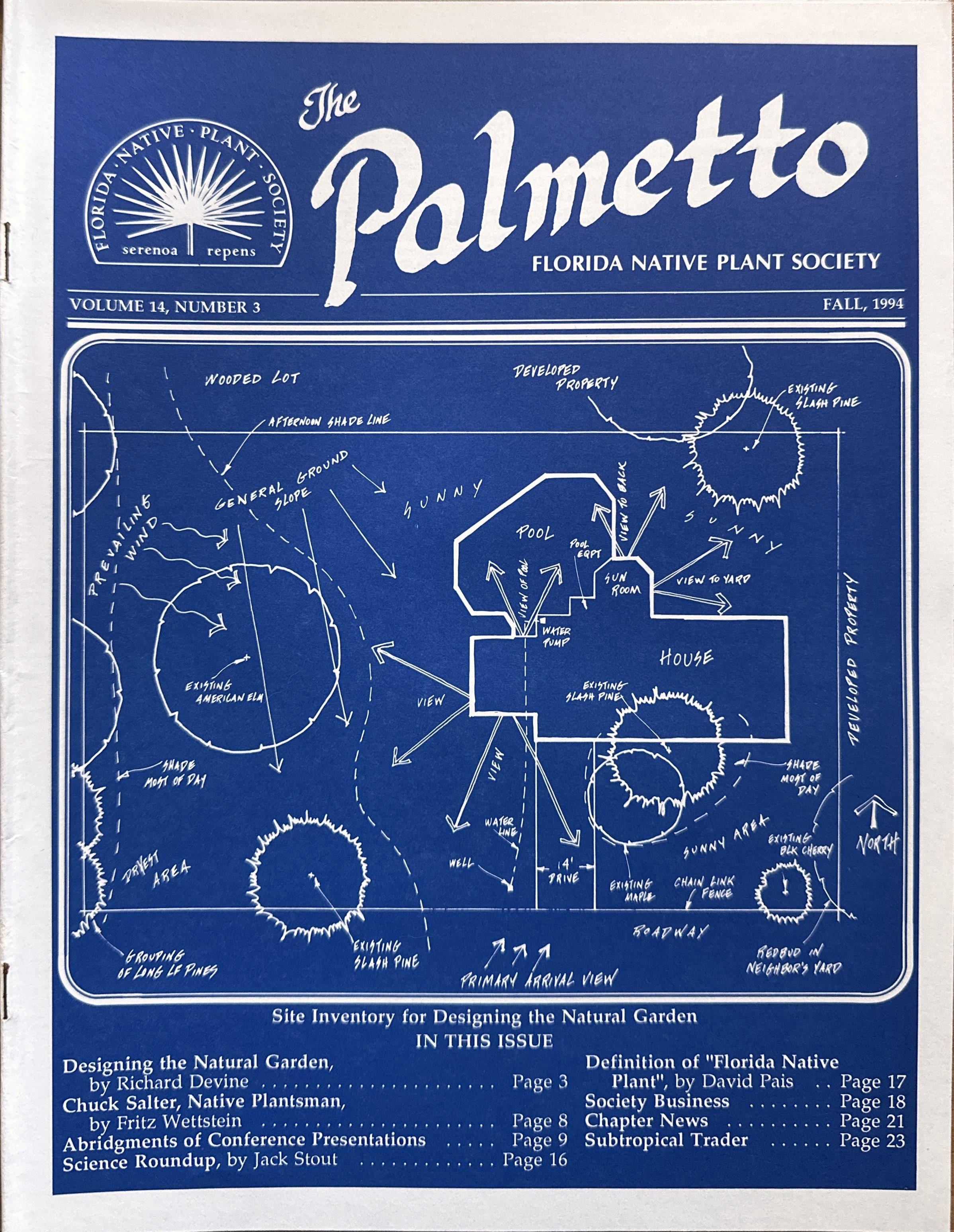
Designing the Natural Garden
by Richard Devine
Natural landscaping is as much a concept as it is a step-by-step process. Conceptually, it involves the use of trees and large masses of evergreens, multi-season grasses, and perennials in bold sweeps of color and texture. They are combined in a step-by-step process in a functional and aesthetic manner to provide beauty and interest through all four seasons. The plants chosen have low maintenance requirements and are allowed to grow to their natural form and height.
Once you're convinced of the benefits to be derived from a natural landscape around your home, both to you and the wildlife that depend on it, the next step is to plan it.
The easiest method would be to let it go its own direction. And, although there is an intrinsic beauty to the natural world, there is also a degree of randomness. While we accept and expect that in wild areas, allowing our residential lots to develop without any control is unacceptable to most of us (and to most landscape codes). Also the soil has usually been so altered in the development process that many undesirable and oppor tunistic plants would take over. And few people would want to wait for natural succession to take place
What we can do, however, is learn from nature, mimic or enhance its best qualities and mute its negative ones, while retaining its overall character and function.
4s with any other project, the best results come from a carefully thought ut plan. The design process can be separated into several logical steps Preplanning, Site Inventory, Site Analysis, Special Requirements, and the Design itself.
Preplanning Considerations
Before any actual design work takes place, think about how the site will function - how it will be used by both humans and wildlife. The needs of both must be taken into account and compromises made so both benefit from the results.
For humans, some important questions could be: Who is going to use the landscape and in what kind of activities will they be engaged? Will there be entertaining, swimming, playing games, or cooking? Are areas or parking necessary, and will there be walkways, terraces, or patios? Is
lighting going to be necessary? Are
storage and trash? If children are part of the family, will they require specia play areas? Utilities, water supply, septic tank location, electric service, and fire protection also are important considerations and influence the final design.
If the landscape is also to function as a habitat for a wide diversity of creatures that formerly had free rein over the countryside, then food, waShelter, and nesting areas for wildlife should be built into the design. Find out what kinds of creatures are native to the area and in what type of environments they live. Do they use burrows or do they live in trees? Do they need tall grass or are
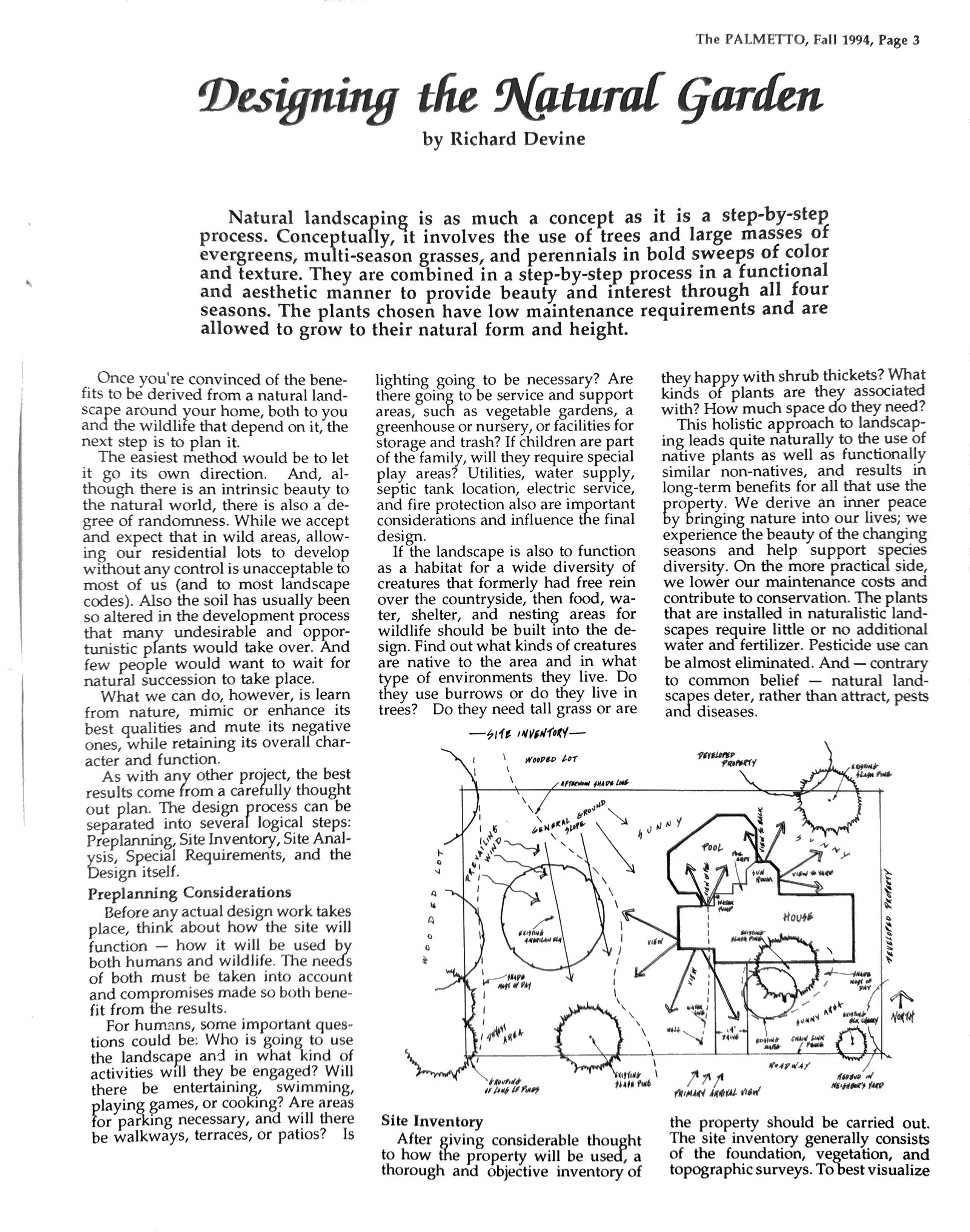
INVENTORY-
Site Inventory
After giving considerable thought o how the property will be used, a thorough and objective inventory of
they happy with shrub thickets? What kinds of plants are they associated with? How much space do they need?
This holistic approach to landscaping leads quite naturally to the use of native plants as well as functionally similar non-natives, and resultsin long-term benefits for all that use the property. We derive an inner peace y bringing nature into our lives; we experience the beauty of the changing seasons and help support species diversity. On the more practical side, we lower our maintenance costs and contribute to conservation. The plants that are installed in naturalistic landscapes require little or no additional water and fertilizer. Pesticide use can be almost eliminated. And - contrary to common belief - natural landscapes deter, rather than attract, pests and diseases.
the property should be carried out. The site inventory generally consists of the foundation, vegetation, and topographic surveys. To best visualize
4, The PALMETTO, Fall 1994
the property as a unit, each can be drawn on a separate overlay.
The foundation survey includes the house, garage, sheds, and other buildings, as well as fences, sidewalks, driveways, septic tank, and well. The vegetation survey shows the location of all important plants as they now exist on the site. Be as thorough as possible. First, show all canopy trees then understory, then shrubs and finally grasses, perennials, and annuals. Ideally, this should be done over an entire year, so that plants that haven't come up yet, or are inconspicuous during one season, are identified when they are present. It can be very helpful for later design work to separate the evergreens from the deciduous plants.
Finally, the topographic survey shows the changing elevations over the entire property. It can be as detailed as you want: a highly accurate analysis accomplished with the use of a transit, or a general layout showing high and low points of the property The idea is to get a feel for property contours that will be helpful when the site analysis is done.
Site Analysis
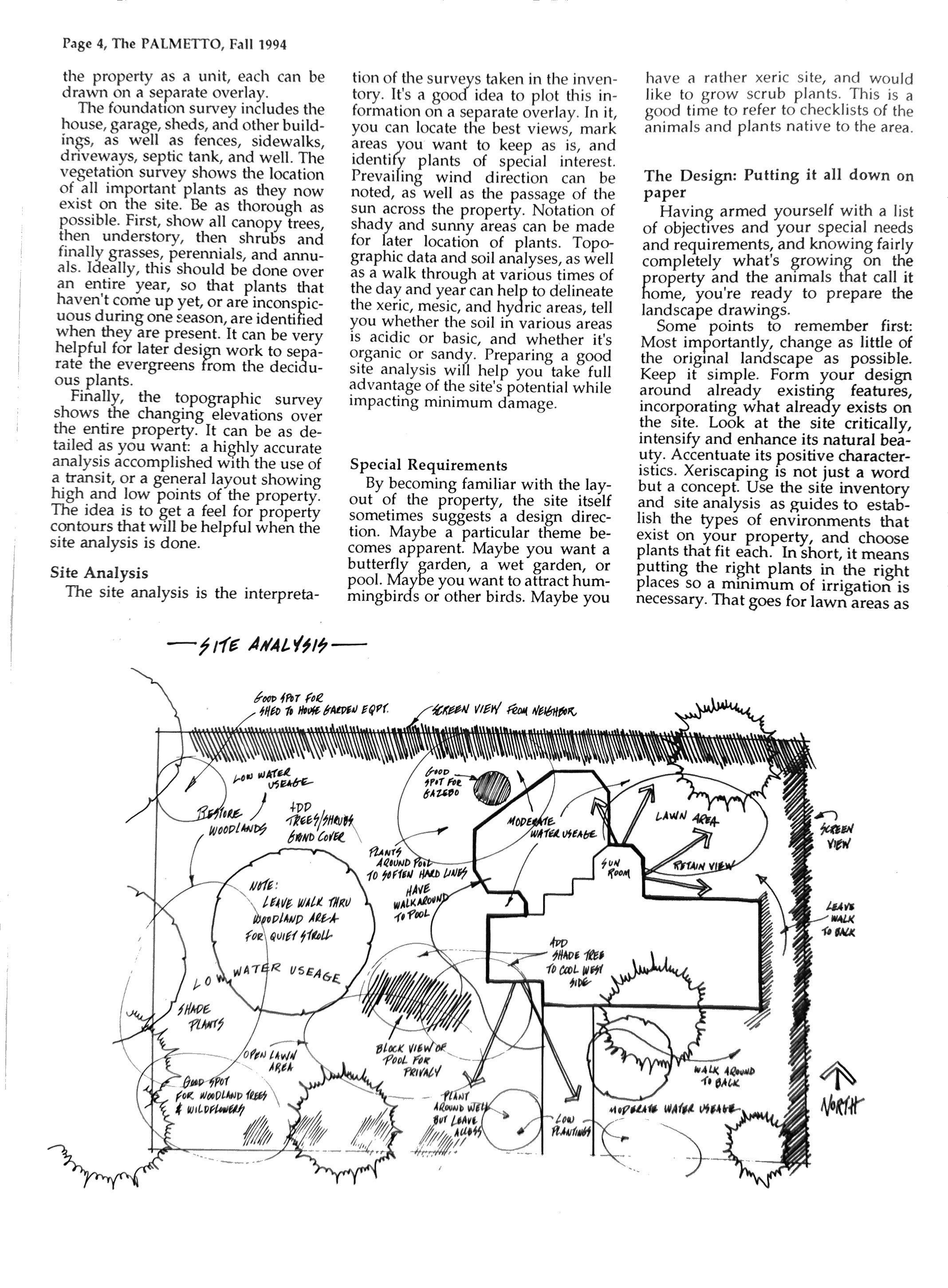
The site analysis is the interpreta- SITE ANALYSIS.
tion of the surveys taken in the inventory. It's a good idea to plot this information on a separate overlay. In it, you can locate the best views, mark areas you want to keep as is, and Identity plants of special interest Prevailing wind direction can noted, as well as the passage of the sun across the property. Notation of shady and sunny areas can be made for later location of plants. Topo graphic data and soil analyses, as well as a walk through at various times of the day and year can help to delineate the xeric, mesic, and hydric areas, tell you whether the soil in various areas is acidic or basic, and whether it's organic or sandy. Preparing a good site analysis will help you take full advantage of the site's potential while impacting minimum damage.
Special Requirements
By becoming familiar with the layout of the property, the site itself sometimes suggests a design direction. Maybe a particular theme becomes apparent. Maybe you want a buttertly garden, a wet garden, pool. Maybe you want to attract hummingbirds or other birds. Maybe you
have a rather xeric site, and would like to grow scrub plants. This is a good time to refer to checklists of the animals and plants native to the area.
The Design: Putting it all down on
Having armed yourself with a list of objectives and your special needs and requirements, and knowing fairly completely whats growing on the roperty and the animals that call i ome, youre ready to prepare the landscape drawings.
Some points toremember first: Most importantly, change as little of the original landscape as possible. Keep it simple. Form your design around already existing features, incorporating what already exists on the site. Look at the site critically, intensify and enhance its natural beauty. Accentuate its positive characteristics. Xeriscaping is not just a word but a concept. Use the site inventory and site analysis as guides to establish the types of environments that exist on your property, and choose plants that fit each. In short, it means putting the right plants in the right places so a minimum of irrigation is necessary. That goes for lawn areas as
RHODODENDRON CANESCENS
VIBURNUM PENTATUM.
AQUILEBNADENSIS
VIBURNUM DENTATUM
PHODODENDRON 1USTRINUM
CEANOTHUS AMERICANUS
GARBERIA HETEROPAYLLK
CLETHRA ALNIFOLIA CRATAEGUS MARSHALLI
CRATAEGUS MARSHALII-
MITED WILDFLOWERY.
DECIDUOUS/ PERENNIALL?
MIXED WILDFLOWERS
ULMUS AMERICANA STOKESIA LAEVIS
YORGHASTRUM I SECUNDUM CRINUM AMERICANUM
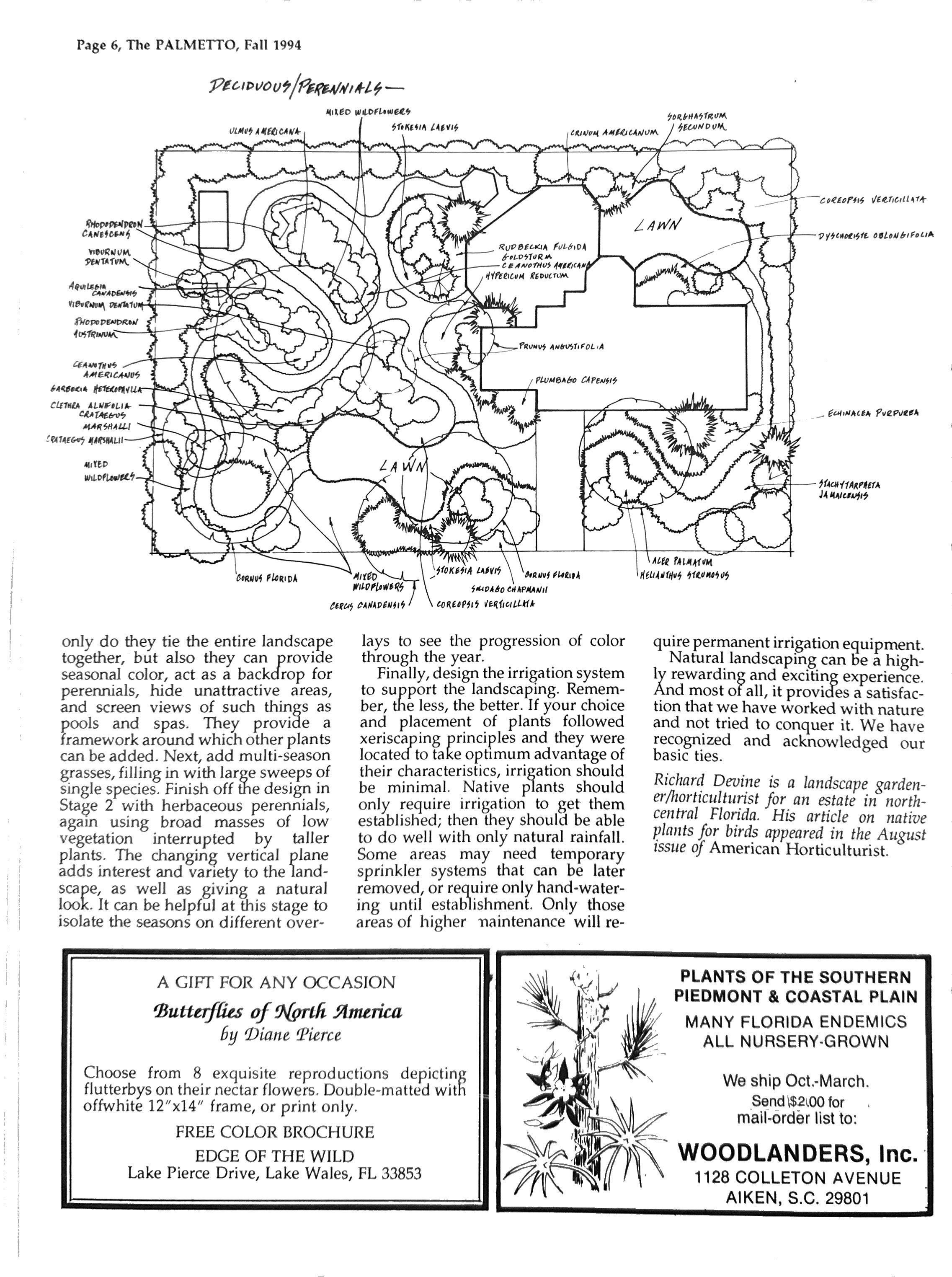
only do they tie the entire landscape ogether, but also they can provid easonal color, act as a backdrop fo perennials, hide unattractive areas, and screen views of such things as pools and spas. They provide framework around which other plants can be added. Next, add multi-season rrasses, filling in with large sweeps o ingle species. Finish off the design it Stage 2 with herbaceous perennials, again using broad masses of low vegetation interrupted by taller plants. The changing vertical plane adds interest and variety to the landscape, as well as giving a natural look. It can be helpful at this stage to isolate the seasons on different over-
lays to see the progression of color through the year.
Finally, design the irrigation system to support the landscaping. kemember, the less, the better. If your choice and placement of plants followed xeriscaping principles and they were located to take optimum advantage of their characteristics, irrigation should be minimal. Native plants should only require ?rrigation to get then stablished; then thev should be abl to do well with only natural rainfall. Some areas may need temporary sprinkler systems that can be later removed, or require only hand-watering until establishment. Only those areas of higher naintenance will re-
A GIFT FOR ANY OCCASION
Butterflies of North America by Diane Pierce
Choose from 8 exquisite reproductions depicting lutterbys on their nectar flowers. Double-matted with offwhite 12"x14" frame, or print only.
FREE COLOR BROCHURE
EDGE OF THE WILD Lake Pierce Drive, Lake Wales, FL 33853
LAWN
quire permanent irrigation equipment
Natural landscaping can be à highly rewarding and exciting experience And most of all, it provides a satisfac tion that we have worked with nature and not tried to conquer it. We have recognized and acknowledged our basic ties.
Richard Devine is a landscape gardener/horticulturist for an estate in northcentral Florida. His article on native plants for birds appeared in the August issue of American Horticulturist
PLANTS OF THE SOUTHERN PIEDMONT & COASTAL PLAIN MANY FLORIDA ENDEMICS ALL NURSERY-GROWN
We ship Oct.-March. Send $2.00 for mail-order list to: WOODLANDERS,
This enticing book for young readers offers information and suggestions on what, where, and how to look for Florida's most interesting plants and animals, many of which are only found in Florida. A glossary of unfamiliar words and hundreds of original drawings by 25 Florida artists are also featured in this book.
ISBN 1-56164-051-4 Pb $16.95
The Young Naturalist's Guide to Florida
Seashore Plants of South Florida and the Caribbean by
David W. Nellis
A color photograph of each plant, plus information about form, distribution, flower and fruit date, and habitat make this book a must for all gardeners, naturalists, and ecologists.
ISBN 1-56164-026-3 Hb $27.95 ISBN 1-56164-056-5 Pb $19.95
The Trees of Florida by Gil
Nelson
Identifying more than 350 of Florida tree species is made easy with this comprehensive reference and field guide. This book focuses on tree families and offers many detailed line drawings and color photographs.
ISBN Hb 1-56164-053-0 $27.95 ISBN Pb 1-56164-055-7 $17.97
Florida's First People: 12,000 Years of Human History by
Robin C. Brown
A richly illustrated book about the daily lives of Florida's earliest inhabitants. The author relies on archaeological finds of typical plants, animals, and pottery in addition to his own experiments with native technology to bring this era to life.
Tallahassed Red its and Aplor ico diver Ba sit area is blessed the
an assortment of colorful people. Here is a profile of one of them, native plant nurseryman Chuck Salter, written after a conversation with him at a Magnolia Chapter meeting.
Chuck Salter is not much into "clubbing" these days: "You can club just so long. I've got all I can do just to keep my plants wet and seeds planted." But he keeps a discriminating eye on what's going on in the chapter, evidenced by his showing up for Guy Anglin's two-slide-tray proram ot every plant of the Apalachi ola National Forest that is endan gered, rare, or otherwise significant.
Chuck is an older man with a broad face, physique, and grip; and a gray, stubbly haircut. He recalls both the 1970s and the 1930s as if they were yesterday. Chuck recalls his first experience with forestry. When he was 12 years old he won a prize for an essay he wrote on "Why We Need Trees". He traces the first efforts on the conservation front in Florida to the Depression years of the 1930s. At that time, the pine flatwoods and sandhills were cut over from one side of the state to the other. From Tallahassee to Medart, nothing broke the horizon line except some scrub oaks. During the Depression many cutover land tracts with delinquent taxes were bought under presumption laws by giant timbering interests like DuPont and St. Regis, and later reforested "It's easy to be critical, but if you ever saw what they started with...
Mr. Salter describes his early career "talkin' forester". When they thought he was out putting up Smokey Bear signs, he was spending his time finding out what was growing in the woods. He came upon Chapman's rhododendron as an odd plant on the Liberty County line, looked it up, went back into the woods and dug one to plant by Chapman's grave. Through a friend he secured protection for the plant from landowner Ed Ball ("He was a pirate ... flew the Jolly Roger."), who in learning of the rare plant was rumored to have said, 'You mean the same as in Scotland?"
and decided to protect the plants. This was thirty years prior to the Endangered Species Act. Chuck estimates that between 2500 and 3000 plants remain in the flatwoods between Hosford and Port St. Joe.
Magnolia Chapter has yet to get Chuck to lead a field trip to one of the patches of Chapman's rhododendrons that he keeps a watchful eye on, but he teaches every young forester about the plant and its conservation. "TIl do that 'til I die," he says, talking about how to keep them from "buggerin' it up" until the land isn't good for much of anything else but little pine trees. Still, he notes with a twinkle, that one colony has been through forestry regeneration prac tices twice, having been plowed, piled in to piles, and burned. Now with the saw palmetto suppression practices of burning, tilling, and spraying, the endangered colony requires protection by a fence.
Chuck Salter was in the vanguard of the native plant preservation movement, not only as a charter member of the Florida Native Plant Society, but also prior to that as a co-founder of what became kiddingly known as the Upsy Daisy Plant Uplift Society. In the 1970s, he, Paul Wills, and Malcolm Johnson, the newspaperman, had long admired the prettiest, sweetest smelling wild azaleas in the Tallahassee area. As it turned out, the best locale of these jewels was the planned Interstate 10 corridor north of town. Chuck credits Malcolm with the idea of seeing if people would be interested in a plant dig and convincing the DOT lawyers that their bureaucratic reaction to the idea would make good press.
The first public plant dig was held on a wet, cold, February day that, according to Chuck, "would make the dogs go back into the doghouse." Before noon over 5000 people had
shown up and "there was no end to the amusingthings that went on."
Chuck recalls the proverbial little old lady in tennis shoes" digging a 7-foot azalea out of the mud, then dragging it into her Volkswagen; and another time when some boys having a hunt ran a deer through the digging party. When all was said and done, the Upsy Daisy Plant Uplift Society had 14 plant digs, with an estimated 60,000 participants and 200,000 rescued plants and national television coverage by Charles Kurault. Chuck Salter is proud of the accomplishments of FNPS and native plant growers such as Joyce and Don Gann. 'In fifteen years we have made inroads in the plant business." Chuck points to several factors as important to this success. One is that the native plants in the southeastern United States are as good a group of ornamental species as will be found in the world. Another is that propagation, production, and sale of native plants is good plant conservation. Chuck Salter was among the first to recog nize the importance of the profit motive. For many native plants such as Franklinia and perhaps Torreya, persistence cannot be guaranteed unless the plants'survival is carried on through the plant trade.
Still thinking out loud about the torreya tree and his traverses of north Florida and south Georgia's steephead ravines, with a wink of his eye, Chuck declares,"There may be more of them out there than we know about." It is the mission of the Florida Native Plant Society to find these stands and preserve their habitats for future generations - of trees and humans.
Fritz Wettstein, president of Magnolia Chapter, is with the Department of Environmental Protection.
1994 FNPS Spring Conference
Abridgments of Presentations as Provided by Speakers
LAND MANAGEMENT
Passive Recreation: Integrating Public Needs with Preserve Management by
Latane N. Donelin
To meet various water management needs, the St. Johns River Water Management District has acquired over 310,000 acres of land in northeast and east-central Florida and is responsible for the management of these lands. Although water supply, flood protection, protection of natural systems, and water quality are primary benefits, these natural and restored Florida communities also provide opportunities for enriching outdoor recreation and environmental education.
The water management districts are directed by Chapters 373 and 259, Florida Statutes, to manage and maintain acquired lands in ronmentally acceptable manner and to preserve, restore, and protect the land's natural state and condition. The districts are also mandated to accommodate public recreation, provided the recreational uses are compatible with the purposes for which the lands were acquired and that they are preserved in a natural state.
Working within the constraints imposed by statutory mandate to preserve the environmental values of these lands, the St. Johns River Water Management District seeks to provide an array of quality recreational opportunities to the public. This is often accomplished in partnership with local or state governments and other public and nonprofit agencies.
The District developed a Land Management Plan that addresses water resource protection, habitat management, compatible recreational uses, wildlife habitat restoration and enhancement, and the continuation, where possible, of traditional land and water resource uses. The management planning process provides a method for evaluation, recommendation, review, public input, and synthesis of resource and land use issues and strategies. Development of partnership agreements to implement
improvements for recreational opportunities and provide resource management is a key to the success of the District's management program.
Latane N. Donelin is the Senior Land Resource Planner for the Department of Planning and Acquisition, Division of Land Management, St. Johns River Water Management District. She received her Bachelor of Landscape Architecture degree from the University of Georgia and M.A. in Urban and Regional Planning from the University of Florida. Her work with the District since 1988 primarily involves environmental planning for both acquisition and management of District-owned lands.
LAND MANAGEMENT
The Environmentally Endangered Lands Program in Brevard County, Florida ?
Using Biodiversity as a Guiding Principle for Local Land Acquisition and Management by
Hilary M. Swain
In Brevard County a seven-member expert volunteer committee is responsible for recommending sites for acquisition and for preparing management plans for these sites. The goal of this program is the protection of biodiversity; this principle has served as guide, not only for which sites to select, but also for how to determine management priorities on sites. The biodiversity goal differs from the goals of other land acquisition and land management agencies present in the county, which have different constituencies and a differmaking, but it provides for some overlap in their goals.
The selected lands include the Scrub Jay Refugia Project, the Mari-
time Hammock Initiative, and the North Indian River Lagoon Program.
The focus is on how to incorporate the goal of protecting biodiversity into management planning for the lands we acquire. Our management objective for each site will be coordinated with other management partners and will cover three broad areas.
First, how can we review the biological attributes of a site in relation to the local, regional, and statewide protected areas network in order to develop a more regional perspective for determining, the management priorities for each site?
Second, how can acquired sites contribute to the overall public user group needs of the region? Each site should be managed to provide different elements of the overall provision for all acceptable user groups throughout the region, without jeopardizing biological integrity.
Third, how can the management plans for each site help to meet the overall regulatory goals of every agency participating in the network?
Finally, the program recognizes that integrating management across the network of protected areas will need to include private landowners in management planning for this region.
Hilary M. Swain is chairperson of the Brevard County Environmentally Endangered Lands Selection Committee. She is employed by the Department of Biological Sciences, Florida Institute of Technology, Melbourne.
LAND MANAGEMENT
Preserving Land: Economic, Environmental, and Community Benefits by Duane E. De Freese
The Environmentally Endangered Lands (EEL) Program, Brevard Coun ty, Florida, is a local land acquisition
MATINE PLANT
serenoa | repens
value of our native plants can these species keep their place in a world under siege by the human species.
Richard Moyroud is chair of the Endangered Plant Advisory Council, and member of Palm Beach Chapter.
MATIVE PLANT
ENDANGERED PLANTS/MANAGEMENT
Protection and Management of the Florida Golden Aster (Chrysopsis floridana Small) in Hillsborough County, Florida by
Sheryl Bowman
The Florida Golden Aster (Chrysopsis floridana Small) is a federally endangered plant whose range is restricted to open sand pine and oak scrub of west-central Florida. It is easily identifiable by long fuzzy stems with round silver-gray leaves and masses of yellow blooms in the au-
Initial protection efforts for this species consisted of collecting seeds, as the plant was known primarily from private housing tracts and proposed developments. Seedlings were grown with the assistance of Bok Tower Gardens, and distributed to publicly owned areas in the Tampa area. These populations appeared to be successful initially, but several years of monitoring have shown a steady decline in their viability.
Hillsborough County began identifying and purchasing lands which contained Florida Golden Aster populations after the passage of the Environmental Lands Acquisition and Protection Program (ELAPP) by voter referendum in 1987. The Hillsborough County Parks and Recreation Department is responsible for managing these populations. This is being accomplished through survey work, prescribed burning, mechanical clearing, involvement of volunteers, and relocation from private lands that have development approval. The parks department is also working with other public agencies to develop protection and management strategies for other populations.
Sheryl Bowman is an Environmental Scientist with the Hillsborough County Parks and Recreation Department, She has been a member of the Florida Native Plant Society since 1985, was president of the Suncoast Chapter, 1992-93, and now serves as its Field Trip Coordinator.
nectarines, apricots, almonds, blackberries, raspberries, strawberries, loquats, quinces, and rose hips. In addition, some rose species have also been used as home remedies for a variety of medical disorders, others in the manufacture of perfumes, and still others as outstanding ornamental and landscape plants.
Gil Nelson is a writer, naturalist, and Florida native who lives and works in Tallahassee. He specializes in natural history, ecology, outdoor recreation, and environmental science topics, especially as they relate to Florida and the southeastern United States. His recently published book, The Trees of Florida: A Reference and Field Guide available from Subtropical Trader) is a comprehensive treatment of 342 of Florida's tree species. He holds a Ph.D. in Adult Education from Florida State University.
PLANT IDENTIFICATION
Common Coastal Plants of Brevard and Volusia Counties by Walter K. Taylor
A rich diversity of plants can be observed along the coast of Brevard and Volusia counties. This diversity includes tropical and temperate species as well as native and non-native plants. Some tropical species nearly reach their northernmost limits in these areas. Good places to botanize include Melbourne Beach, Playalinda Beach (south Canaveral National Seashore), Merritt Island National Wildlife Refuge, Turtle Mound, and other sites in the northern part of Canaveral National Seashore.
Walter K. Taylor, Professor of Biology, has been with the University of Central Florida for 25 years. He is a native of Kentucky, and author of the popular Guide to Florida Wildflowers. ? ??????
HABITAT MAPPING
Modeling the Plant Communities of Florida by Richard Workman, Nancy Bissett, Pete Wallace, and David Drylie
A Florida Native Plant Society standard and easily used procedure for mapping piant communities, trees,
and ground covers was presented, followed by a field trip to Malabar Scrub with a walk-through and actual mapping of a plant community. This proposed project would involve chapters of FNPS in sampling plant communities throughout Florida in order to record the general species frequency, patterns, spacing, diversity, and other features of each community in a landscape plan style with informational charts. This information would be assembled into a usable format for designers, restorationists,
We anticipate two to three years of data collection and modeling from twenty plant communities in north, central, and south Florida, before they
Richard Workman is a founding member and a past president of FNPS. He is the author of Growing Native and a long time critic of wasting precious space in residential areas for tasteless decorating with exotic plants. He says: "If we are going to survive the next influx of new residents and maintain a reasonable quality of life in Florida, we ll have to radically modify the mindset of the Florida residential land steward." Richard Workman is president of Coastplan, Inc., an environmental consulting firm based in Fort Myers.
Nancy J. Bissett is co-founder and past president of Heartland Chapter, vice-president of the AFNN, FNS representative to the Florida Division of Recreation and Parks Advisory Board, and board member of the Green Horizon Land Trust. She is a horticulturist, manager, and co-owner of The Natives, a nursery growing only Florida native plants since 1982. She discovered a new species of Dicerandra, still unnamed.
Pete Wallace is president of Ecosystem Research Corp
David Drylie is the FNPS Committee Chair for Legislation, a landscape architect, and owner of Green Images, a Florida native plant nursery in Christmas
may Wildlife Sanctuary in Merritt Island. This invasive exotic had virtually overtaken the levees of the 457acre sanctuary. The stump treatment method employed at Ulumay required chain saws, herbicide (Rodeo by Monsanto), chippers, dumpsters, and many hours of labor. After the initial pepper removal effort, red mangroves (Rhizophora mangle) and Spartina patens were planted along the
Follow-up inspections of the site revealed the following:
? Subsequent pepper sprouting occurred as a result of flawed or incomplete herbicide application, as well as from seeds left on the ground. The herbicide's effect on some of this new growth is evident by the presence ot deformed leaves and branches that break very easily.
? After pepper removal, the areas exposed to sunlight fostered existing native plant growth, particularly red and white mangroves. Exotic Guinea grass (Pancium maximum), however, has spread along the sides of the trails and will require foliar application to bring under control.
? Most of the new plantings have since perished, mostly due to lack of rainfall, but Nature's native volunteers have fared quite well.
Work days to remove Brazilian peppers at Ulumay took place three times between the fall of '92 and spring of '93. Approximately 1.5 miles of the west levee and 0.5 mile of the east levee were cleared of exotics. Native plants were added during the third work day. Volunteers from many organizations (75-100 per work day worked together in this effort.
HABITAT RESTORATION
Pepper-busting at Ulumay Wildlife Sanctuary by Diane Stees and Kim Zarillo Pepper-busting, or the removal of Brazilian peppers (Schinus terebinthifolius), was the primary task of a recent habitat restoration project at the Ulu-
The Ulumay Wildlife Sanctuary is home to a variety of native plants and is an important refuge for over 200 species of birds and other wildlife. Dominant woody plant species include white mangroves (Laguncularia racemosa), red mangroves (Rhizophora mangle), black mangroves (Avicennia germinans) and buttonwood (Conocarpus erectus). Prevalent understory plants include Florida privet (Forestiera segregata), Christmas berry (Lycium carolinianum) and annual glasswort (Salicornia bigelowii). A noteworthy species found at Ulumay is Lantana involucrata.
Habitat restoration at Ulumay is far from complete; however, much has been learned from this effort about Brazilian pepper removal techniques and the mechanics of organizing a
large-scale volunteer project. These lessons learned can be used in your community or even in your own backyard.
Kim Zarillo has thirteen years of experience in environmental education, research, and consulting. She is president of Scientific Environmental Applications, Inc., and is also president of the Conradina Chapter of the FPS Diane Stees is a NASA Space Shuttle systems engineer, and is currently president of the Indian River Audubon Society and a member of the Sea Rocket Chapter of ENPS. She was also "co-chairman" of the Ulumay habitat restoration effort.
WILDLIFE GARDENING
Schoolyards
by Candace L. Weller
Wildlife gardening ideas have been applied for several years to the home landscape. The same concepts can and should be applied to public property. There are vast areas of lawn parks surrounding our public buildings that serve no purpose other than acting as a resource and maintenance money vortex. One of the best public areas available to create an example is at a school. Usually, a neglected or unused area exists somewhere on the grounds that many people think could be improved. There are a multitude of student volunteers who would like to discover what they can do for wildlife and who will be around to see and learn from the results of their efforts. Teachers, parents, local businesses, organizations, governments, and citizens are available to provide financial and physical support.
One school that has embraced the idea of a wildlife garden is Gulf Beaches Elementary on St. Petersburg Beach in Pinellas County. This school's outdoor classroom will be used as an example for the why, who, where, and how questions that will come up when a similar project is desired. By using plants that exist in the dune, forest, and mangrove communities of a local barrier island habitat, we have reaped the following results: the fifth graders lead tours for all the other students, one on one, at the beginning of the academic year. This class also puts on a "Butterfly" play for the rest of the school and
each child makes his or her own costume: butterfly, caterpillar, nectar or larval food plant. Newsweek included our efforts in their special section on the environment, "Just for Kids" (March 26, 1993). A garden manual has been created for every class. Where there used to be sandspurs and starlings, we have redbays, myrSines, bay cedars, beach lantanas, necklace pods, yellow-rumped warblers, palm warblers, red-bellied woodpeckers, Carolina wrens, ground doves, Gulf fritillaries, giant cloudless sulphurs, long-tailed skippers, spicebush swallowtail larvae and ... sandspurs and starlings.
A wildlife garden is an environmental project. This may not seem like a radical idea to many of the converted, but to those who aren't, and are willing to help, it will become apparent, sooner or later. At Gulf Beaches Elementary, a determined parent wanted a butterfly garden. She wanted her child to help create something for her school that would be useful, educational, and would instill in her daughter a sense of community responsibility and pride. Sounds like a tall order, but all of this came to be, and the butterfly garden grew into a coastal woods restoration, available to myriad critters, students, teachers, and the community at large. Although I have no children at this school, or any other for that matter, I was enlisted as a representative of our local FPS chapter by this determined woman and friend. She and her daughter have since gone on to another school. The garden and I - and an ever changing palette of delighted children and teachers - are still there. Some of the most satisfying comments on our garden have been unsolicited: the boy who was overheard explaining to his classmate the rate of leaf consumption by a Gulf fritillary caterpillar; the teacher who confused her class by running out the door of her classroom in pursuit of a giant swallowtail, hoping it was heading to a hercules club; the neighbor, out for his walk, responding to his companion's unheard query, that's a special kind of garden." In-
The PALMETTO, Fall
Candace L. Weller is a member of the Pinellas Chapter and treasurer of FPS She is a volunteer designer and consul tant for the Gulf Beaches Elementary barrier island habitat. She is the owner of Indigenous Ingenuity, native plant consulting for the homeowner.
NATURE
PHOTOGRAPHY
Getting Close to Nature with your Camera
by Steve Shirah
The basics of good photography are Exposure, Depth of Field, Composition, and Magnification.
Proper exposure is one of the big. gest problems for all photographers. Proper exposure depends on two basic camera controls: 1. Shutter Speed ? the length of time the shutter stays open, and 2. Aperture (f/ stop) - the size of the lens opening. Both of these control the total amount of light that is reaching the film. Shutter speeds on a camera are marked as seconds and fractions of seconds (1, 1/2, 1/4, 1/8, 1/15, 1/60, 1/125, 1/500, 1/1000). For all lenses, the smallest number on the aperture ring always admits the greatest amount of light. When you shift from a smallnumbered aperture to a larger one you are admitting less light.
Depth of Field
Depth of Field is the portion of a photograph, trom near to far, that is in sharp focus. With any one lens, the smaller the aperture, the greater the depth of field. The larger the aperture, the shallower the depth of field. Depth of field is controlled by the f/stops on the lens.
Terminology
Stop Down - going to a smaller aperture (larger number on the aperture ring to decrease the amount of light reaching the film. Using a faster shutter speed is another way of stop ping down.
Open Up - going to a larger aperture (smaller number on the aperture ring) to increase the amount of light reaching the film. Using a slower shutter speed is the same as opening up In order to open up or stop down, you will probably want to operate the camera in a manual mode of operation (not automatic) or you may not achieve the desired results. This is because the lens opening and speed work together in a reciprocal relationship. That is, you can exchange shutter speeds and f/stops and still get the proper exposure. For instance, if f/8 at 1/60 is the proper exposure and you open up to f/5.6, then a 1/125 would be the proper speed. Or
Page 14, The PALMETTO, Fall 1994 if you stop down to f/11, then 1/30 would be the correct speed. However, many times you may want to over-expose or perhaps under-expose slightly. In order to do this, you keep the speed the same and adjust the f/stop on the lens by opening up or stop ping down. Or you can keep the aperture the same, if you like the depth of field, and simply adjust the speed up or down. This will accomplish the same exposure.
Composition
Composition is how you choose to coordinate all the parts of a picture into a whole.
Light
Become aware of light. Light strikes a scene in basically three ways: 1. Frontlit - this is considered normal by most. This is when the sun is behind you. 2. Backlit ? direct opposite to front lighting ? the sun is facing you. 3. Sidelit ? the light source is at a right angle.
Light has character: 1. Hard Light ? harsh sun on a cloudless day. The shadows are sharply defined. 2. Soft Light - an even illumination found in open shade, an overcast day, or before dawn and after sunset. The shadows are diffused.
Light has color: 1. Early and late day is warm. 2. Midday is cooler.
Once there is light we begin to see forms and the color of forms. We then arrange these forms into a picture. Ask yourself these questions before you take the picture:
1. What is the Subject?
2. Where is the Subject placed in the frame?
3. What kind of Light is on the Subject?
4. Does the background enhance the Subject?
5. Does the foreground enhance the Subject?
Always check for "clutter" in a picture. Clutter can ruin an otherwise good picture.
Magnification
Any lens will focus closer if you move it physically away from the film plane. With any lens, you lose depth of field as you move the camera closer to the subject and gain magnification. The greater the distance from the subject, the greater the depth of field.
Extension tubes are an easy way to gain magnification. An extension tube is merely a fixed length, rigid tube that is placed between the lens and the camera body. They come in various sizes depending on how many
millimeters of extension you need. You need approximately the same millimeter of extension as you have millimeter of lens for a 1x or life size image. For instance if you have a 50 mm lens, you need to have 50mm of extension to reach 1X. If you use a "macro" lens, this simply means the lens has a certain amount of extension already built into it. The manufacturer can tell you how much so you can determine what magnification you can achieve.
Diopters are an easier way to gain magnification. Diopters are simple, single-element lenses that attach to a lens the same way filters do. By attaching a diopter to a lens you can now focus in the closeup range. They come in various strengths - +1, +2, +3 and so on. The greater the strength the more magnification it yields. They are low cost and easy to carry around There is no loss of focusing light when you use one. There is some loss
of optical quality but generally not enough to be concerned about. Take pictures and document your exposures so you will become familiar with the terms discussed. There is nothing quite so helpful as practice. Your pictures Will begin to take on a greater meaning as you develop your own particular style of photography
Steve Shirah is a local businessman in Ormond Beach. Photography has been an avid hobby of his for the past 20 years. His photos have been published on the cover of The Palmetto, and in The Florida Wildlife Magazine, newspapers, and other local publications. Some of his works were displayed in the Museum of Arts and Science in Daytona Beach, and his multi-media slide shows on wildflowers have been shown throughout the central Florida area. Currently, he is trying to document on film all the endangered and threatened plants of Florida, a task that keeps growing larger each year.
More Abstracts from Scientific Papers Presented at the 1994 FNPS Conference
careous or brackish shallow marshes and wet savannas, in contrast to the predominately acidic freshwater habirepens tats of the other spe-cies. Lachnocaulon beyrichianum occupies the driest The Taxonomy, Distribution, and habitats of any United States EriocaulEcology of the Eriocaulaceae in aceae, forming large mats in scrub, Florida scrubby flatwoods, and very dry upby Edwin L. Bridges per zones of sand ponds.
The Eriocaulaceae (pipeworts and Field identification of Florida Eriocaulaceae is often possible by use of vegetative characters, with confirmation by easily visible inflorescence features. This presentation is based on species are widespread within the the treatment of this family by the state in a variety of habitats (Eriocau- author for the forthcoming Flora of lon compressum, E. decangulare, Lachnocaulon anceps, Syngonanthus flaviduFlorida.
SATIVE: PLANT lus).
Most Florida Eriocaulaceae are restricted to a narrow range of habitats and specific geographic regions of the state, and knowledge of these relationships can often simplify field identification of the species. Eriocaulon texense, E. nigrobracteatum, and Lachnocaulon digynum are restricted to herbaceous hillside seepage bogs or poor fens in the Florida Panhandle. Eriocaulon lineare, Lachnocaulon engleri, and L. minus are characteristic of sandy fluctuating lakeshores and pondshores, but occasionally are found in other habitats. Eriocaulon ravenelii is typical of somewhat cal-
Fish and Wildlife Service Activities in Plant Conservation in Florida by David L. Martin Congress provided emergency funds for recovery of natural resources from Hurricane Andrew. The largest plant-related grant administered by the Fish and Wildlife Service supports restoration and improvement of Fairchild's living collections of endangered species, and is sup porting the work of their recently
serenaal TRORNI
hired Conservation Biologist. Research on the recovery of hammocks in Dade and Monroe counties is also being supported through funds administered by the Service, as is management work in Dade County pinelands. Recovery projects were also funded for four-petal pawpaw (Asimina tetramera) and clasping warea (Warea amplexifolia). Two recovery plans are in preparation, for plants of the lower Apalachicola (including white birds-in-a-nest and Godfrey's butterwort), and of the Hernando County hills (Brooksville bellflower and Cooley's water-willow). Congress provided $2 million in initial land acquisition funds for the Lake Wales
Which Will protect scrub plants. The most recent plant to be listed is the beach jacquemontia, a species restricted to beachfronts in southeastern Florida.
David Martin is a botanist with the U.S. Fish and Wildlife Service.
NATIVE? PLANT
The Critical Role of Hurricanes in the Population Dynamics of Ardisia escallonioides (Myrsinaceae)
by John B. Pascarella
The impact of hurricane disturbance (Hurricane Andrew,1992) on the population dynamics of Ardisia escallonioides was examined in four forests that experienced differential canopy disturbance. In three sites that experienced hurricane force winds, levels of damage and defoliation were strongly correlated with level of canopy disturbance, but direct mortality was low in all three sites. Flowering phenology in 1992 was delayed two months from normal, which resulted in a population decline of a specialized moth seed predator, but total fruit produc tion for 1992 remained low due to few individuals flowering. In 1993, a significant increase in percentage of individuals flowering, flowers produced, and fruit productionwas found for all three damaged sites, while no reproductive activity was found for an undamaged site. Hurricane disturbance may be the critical ecological factor regulating the population dynamics of this species.
John B. Pascarella is with the Department of Biology at University of Miami.
Adapting Systematic Natural Area Inventory Methods to Florida
by Gary A. Reese
Over the last two decades, midwestern states have been identifying and evaluating natural areas using aerial photo interpretation, aerial reconnaissance, and follow-up ground survey techniques. The Florida Natural Areas Inventory (FNAI) is adapting these cost-effective techniques to systematically inventory counties and regions in Florida. The goal of each inventory is to complete a biological assessment of all the remaining high quality examples of natural community types in the inventory area. Additionally, Endangered, Threatened, and other Species of Special Concern are incidentally sought on the inventoried sites. The significant biological elements of each site are summarized and mapped for entry into the FNAI database and geographical information system. The results of inventories elsewhere have consistently shown that a systematic aerial photo-based identification of potential natural areas leads to a seven- to ten-fold increase in the number of known significant sites. Methods and preliminary results from the current Lake County, Florida, inventory were presented. This, and additional inventories, can aid land acquisition and protection efforts by producing rankings of sites based on their biodiversity significance. Using standardized Nature Conservancy ranking criteria, sites can be compared with respect to their levels of human disturbance, biodiversity value, number of sensitive biological elements present, etc. These inventories provide an important tool towards fostering protection of the best of Florida's remaining natural areas, especially at the local level.
Gary A, Reese is an ecologist with Lake County Natural Areas Inventory, FNAI, Okahumpka.
The PALMETTO, Fall 1994,
Removal of Colocasia esculentum from Rock Springs Run, and the Wekiva and Little Wekiva Rivers by Deborah Shelley
Department of Environmental Protection staff are working to control or eradicate the invasive exotic species w#l taro (Colocasia esculentum) from the Wekiva River, Rock Springs Run, and portions of the Little Wekiva River. In 1983, Colocasia was documented to occur in at least 30 small but discrete clumps along a four-mile upstream reach of Rock Springs Run. By 1990, Colocasia had expanded to nuisance proportions throughout the nine-mile run and was found sporadically along the entire 20-mile length of the Wekiva River. Control and management activities included manual removal and chemical applicaManual removal techniques, chemical applications, success, and shortcomings were discussed.
Ms. Shelley is with the Department of Environmental Protection.
NATIVE? PLANT
serenos
The Revegetation of Bill Baggs Cape Florida State Recreation Area by Peter Schroeder
Except for a small area of native beach and coastal-strand plants, prior to Hurricane Andrew Bill Baggs Cape Florida State Recreational Area was a monoculture of Australian pine (Casuarina equisetifolia). Hurricane Andrew and the following clean-up removed nost of the Australian pines. It wa. lecided to revegetate the park witl native plant communities found on the island prior to European settle-
Reports of plants on Key Biscayne are found from the mid-16th century to the present. Predevelopment vegetation communities are determined from pre-20th century maps and reports, and floral reports from the 20th
Plans have been made to prevent re-establishment of exotics and develop native-plant communities in
Peter Schroeder is an ecologist for the Cape Florida Restoration.
More workshop presentation notes will appear in the next issue of The Palmetto.
ScienceRoundup
by I. Jack Stout
(Dr. Stout, Professor of Botany at the University of Central Florida and Science Committee Chairman for FNPS, will be presenting this regular column.)
Most everyone is for biodiversity, if asked. Biodiversity has a good ring to it, and it is now fashionable to use the term in the political arena, and in the titles of talks, scientific papers, and books. Probably the best place to read about the scientific basis for our concern about biodiversity is E. O. Wilson's book titled The Diversity of Life, published by W. W. Norton & Co. in 1992.
One of the challenges that comes with a cause like biodiversity is its justification to those who do not feel a strong bond to and need for contact
with natural communities and their species assemblages. It is generally not enough to say biodiversity should be protected because it is the right thing to do for ethical, moral, or aesthetic reasons. Until about 20 years ago, ecologists were defending biodiversity with the argument that diversity begot stability at the community level of organization. This argument fell on hard times as various theoretical and practical results suggested that the facts did not support the concept.
In a recent paper in Nature, perhaps the most important science journal in the world, David Tilman and John Downing reported that the yield of green plant material each year and the resistance to drought in 207 grass-
stability (D. Tilman and J. A. Down363-365. Up to a point, plots with more species of grasses and herbs (15 to 20 species) produced more biomass and were less impacted by a record drought than were plots with fewer (1 to 6) species.
An alternative idea to the diversitystability notion is one that claims many species in complex systems are
redundant and, as long as one or more of the dominant species survives some perturbation of the environment such as a drought, biomass production would be the same from year to year. The evidence from the Tilman work in Minnesota is not consistent with the species-redundancy hypothesis.
The authors concluded that preservation of biodiversity may be essential to the maintenance of stable productivity in natural communities. This is also the message that serves the cause of conservation biology and ecosystem management.
Ecosystem management has reached the status of a buzzword, along with landscape ecology, GIS, metapopulations, and gap analysis. Ecosystem management has been embraced by the Department of Environmental Protection in what some might refer to as a "paradigm shift" (which means that scientists have adopted a new way of thinking about some concept in a really big way). It also could be said that ecosystem management is an old idea dressed up in new language.
The writings of R. Edward Grumbine provide a convenient source of current thinking on ecosystem management. His most recent paper (R. E Grumbine. 1994. What is ecosystem management? Conservation Biology 8:27-38.) contains most of the themes and goals that will be adopted by land management agencies in Florida Grumbine provides a working definition of the process as: "Ecosystem management integrates scientific knowledge of ecological relationships within a complex sociopolitical and values framework toward the general goal of protecting native ecosystem integrity over the long term."
The biodiversity crisis has, in part, forced land management experts to think beyond species management to whole systems. In my judgment, the recent and continuing focus on ecosystem management is a necessary step toward landscape management, which is on a larger scale and includes many diverse ecosystem types Wild land management is, after all, a giant experiment being played out in big and small steps with much uncer tainty associated with it. Keal prog ress is being made, however, and the biota of Florida should be a big winner in this game.
Toward a Working Definition of "Florida Native Plant"
by David Pais
For most purposes, the phrase "Florida native plant" refers to those species occurring within the state boundaries prior to Europear contact, according to best scientific and historical documentation More specifically, it includes those species understood indigenous, occurring in natural associations in habitats that existed prior to significant human impacts and alterations of the landscape.
What is a native plant? This ques- Ridge scrub, or Torreya taxifolia is eric or bioengineered cultivars, or tion?- which on the surface seems native along the Apalachicola bluffs. those of uncertain parentage. While quite simple ? reveals, upon further While the extension of the natural hese may possibly be native, the examination, a greater degree of com- range of some species may have horti- would probably have to be consid plexity than first imagined. What we cultural merit, many endangered or ered non-native by most standards. commonly understand as the meaning endemic native species may be inap- The Florida Department of Environof native is "born or naturally occur- propriate if planted outside specific mental Protection has defined native ring in a specific area". However, it is habitats or communities as "a species that occurred in Florida not always possible to reduce the The classification of indigenous at the time of European contact or meaning of native plant to a simple plants, understood as those species 1500s." Many land management deci- slogan or precise date. Some defini- occurring within a specific habitat or sions for the Florida State Parks are tions of a Florida native plant have biogeographical region prior to signif- relied upon determining a precise icant human impacts, is more precise of side landsca peoto ical esturation historical event such as Columbus in meaning. In one sense, indigenous conditions. This policy has caused arriving in the Bahamas or De Leon's implies origination and belonging to some controversy among some who landingin 1513. These attempts to a particular place. It also carries the fail to appreciate that not all native define Florida native plant with an connotation of not having been intro- species are equal or belong everyarbitrary date are unnecessarily com- duced from elsewhere. For example, plicated. There are a number of spe Hand Fern, Ophioglossum palmatum, is A recently released memorandum cies, including papaya, which were indigenous to Sabal Palm boots in concerning native plant conservation probably introduced by indigenous low subtropical hammocks; it doesn't among seven Federal Agencies has people for medicinal or agronomic belong elsewhere. Indigenous species defined native plant as the following: value and which would have to be would include those naturally occur- "A native plant species is one that included as native under these defini- ring and self-reproducing species occurs naturally in a particular region tions. There is also the question of a dispersed by wind, water, and migra- state, ecosystem, and habitat withou number of species, particularly in the tory birds in populations unattected direct or indirect human actions." A Keys, such as Geiger Tree (Cordia by human actions. Indigenous species broad range of policy and conservasebestina) or Pitch Apple (Clusia rosea), are those species that have originated tion issues will have to be resolved which are most probably of Caribbean and belong in a particular place and based upon the definitions and stanorigin, and their nativity will never be specific habitat that can be geographi- dards of what constitutes a native established beyond a doubt cally identified. species. Different criteria may be In the botanical sense, the meaning There are also the questions to con- applied according to the specific ap of "Florida native plant" and a precise sider of both naturally occurring hy- plication. Aresidential landscape definition is somewhat elusive. Native brids and cultivated varieties (culti- would have different criteria than a generally refers to species "occurring vars) of native species, those selected large wetland restoration. A very in a specific geographical area or for specific horticultural traits and restrictive sense of native is appropribiogeographical region, which do not propagated asexually. It is generally ate for ecological restoration programs directly correspond to political boun accepted that these are legitimate concerned with protecting genetic ? What has been called the natives, although they may or may diversity as well as species diversity. European Ecological Imperialism, not have been present at the time ot marked by the drastic alteration of the It is possible that more stringent crite- European contact. important occurred several centuries before the factor regarding nativity is, however, ria may be applied to certain endangered or imperiled taxon than to more occurred several centuries establishment of statehood. What is the geographical origin of the genetic widely occurring species. Our insignificant is not a date, but an event parent plant. For instance, Schillings creased understanding and continued - the radical transformation of the Holly, Ilex vomitoria Schillings Dwarf refinement of the definition and polnative species and habitats _ that is generally considered to be a native icy implications of native plants will Florida species, selected and propa occurred after European contact rated for its compact growth habit In one sense, native refers to "occur- he bal bid versity enter one ing from a naturally occurring dwart ring in a specific habitat and plant association Yaupon Holly. On the other hand, Therefore, while the definition at boundaries of Florida, species may Magnolia grandiflora Little Gem' is a the beginning may be simple, its apcultivar selected from a North Caroonly be native to a very small and restrictive habitat type and particular wouldent plant and technically plication is ? as you can see ? comnot be a Florida native. The region. For example, a species such as This definition and explanation is the Amorpha crenulata is native in the species may be native, although the result of the work of an FPS subcomDade pine rocklands, or Chionanthus particular cultivar may not. The ques mittee chaired by David Pais, FPS's ion becomes even more problemati Pygmaeus is native to the Lake Wales for human-induced hvbrids, intergen president.
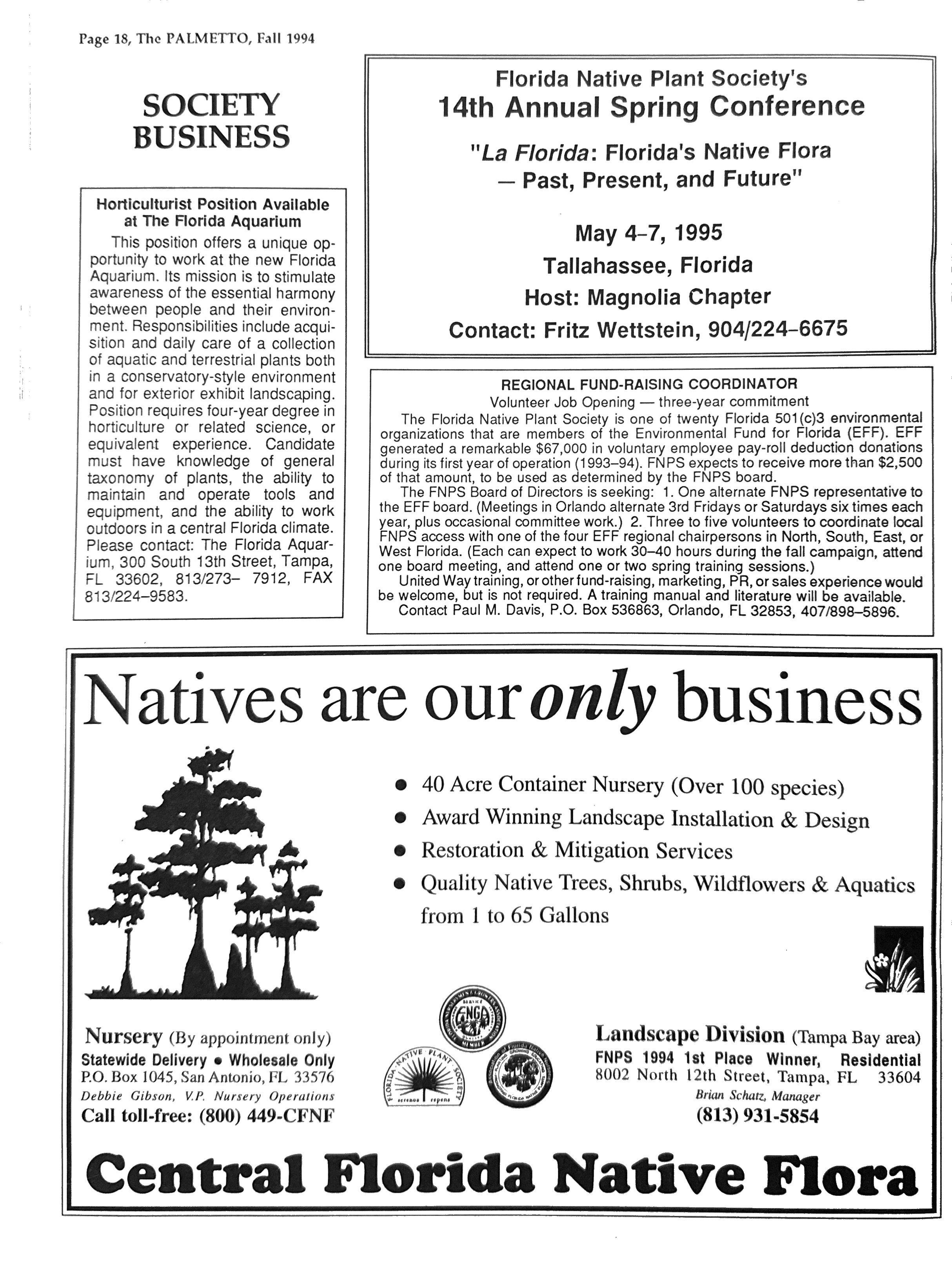
SOCIETY BUSINESS
Horticulturist Position Available at The Florida Aquarium
This position offers a unique opportunity to work at the new Florida Aquarium. Its mission is to stimulate awareness of the essential harmony between people and their environment. Responsibilities include acquisition and daily care of a collection of aquatic and terrestrial plants both in a conservatory-style environment and for exterior exhibit landscaping. Position requires tour-year degree in horticulture or related science, or equivalentexperience. Candidate must have knowledge of general taxonomy of plants, the ability to maintain and operate tools and equipment, and the ability to work outdoors in a central Florida climate.
Please contact: The Florida Aquarium, 300 South 13th Street, Tampa, FL 33602,813/273-7912, FAX 813/224-9583.
Florida Native Plant Society's 14th Annual Spring Conference
"La Florida: Florida's Native Flora - Past, Present, and Future"
May 4-7, 1995
Tallahassee, Florida
Host: Magnolia Chapter
Contact: Fritz Wettstein, 904/224-6675
REGIONAL FUND-RAISING COORDINATOR
Volunteer Job Opening - three-year commitment
The Florida Native Plant Society is one of twenty Florida 501(c)3 environmental organizations that are members of the Environmental Fund for Florida (EFF). EFF generated a remarkable $67,000 in voluntary employee pay-roll deduction donations during its first year of operation (1993-94). FPS expects to receive more than $2,500 of that amount, to be used as determined by the FPS board
The FPS Board of Directors is seeking: 1. One alternate FNPS representative to the EFF board. (Meetings in Orlando alternate 3rd Fridays or Saturdays six times each year, plus occasional committee work. 2. Three to five volunteers to coordinate loca -NPS access with one of the four EFF regional chairpersons in North, South, East, ol West Florida. (Each can expect to work 30-40 hours during the fall campaign, attend one board meeting, and attend one or two spring training sessions.)
United Way training, or other fund-raising, marketing, PR, or sales experience would be welcome, but is not required. A training manual and literature will be available. Contact Paul M. Davis, P.O. Box 536863, Orlando, FL 32853, 407/898-5896.
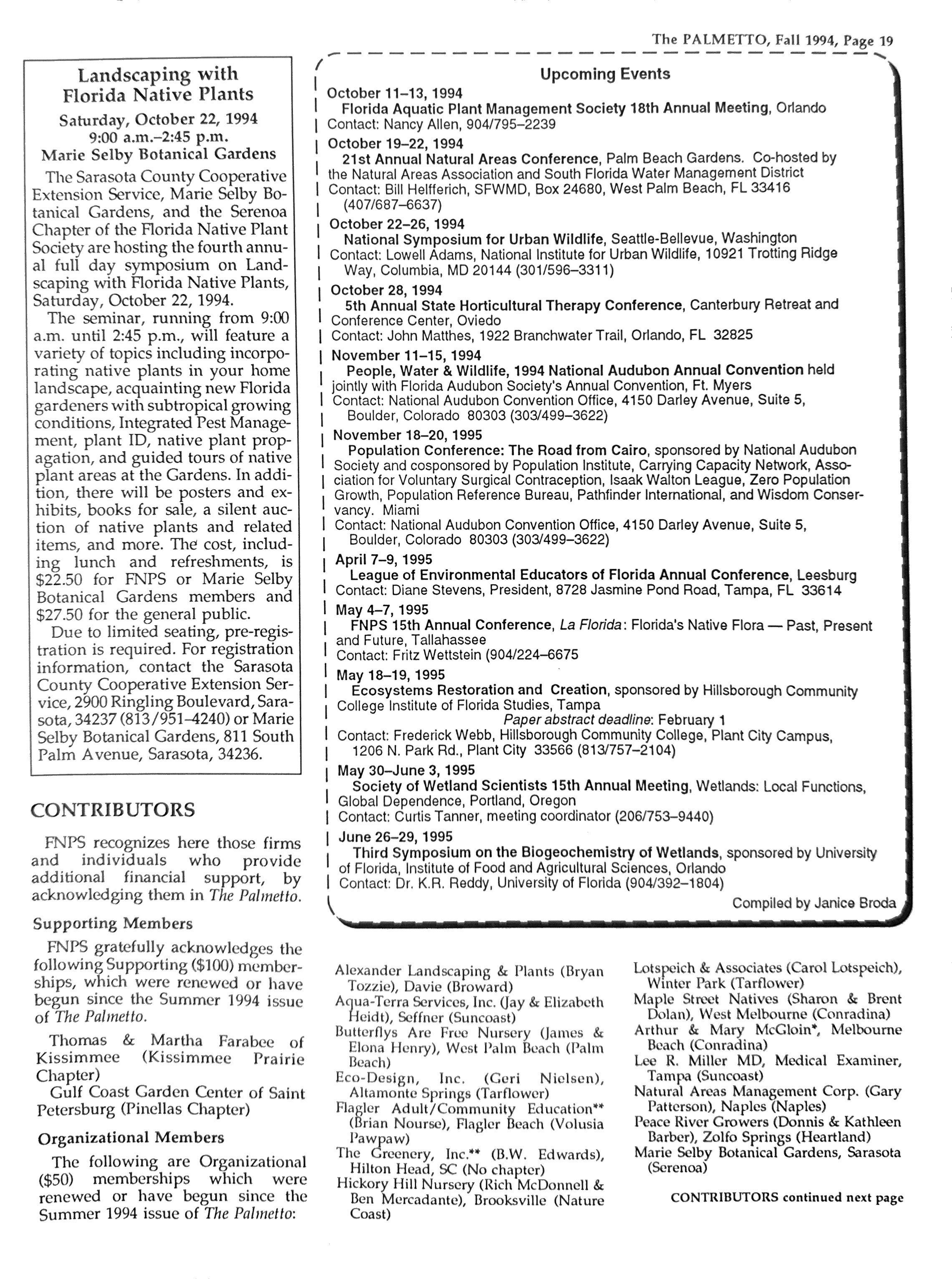
Landscaping with Florida Native Plants
Saturday, October 22, 1994 9:00 a.m.-2:45 p.m.
Marie Selby Botanical Gardens
The Sarasota County Cooperative Extension Service, Marie Selby Botanical Gardens, and the Serenoa Chapter of the Florida Native Plant Society are hosting the fourth annual full day symposium on Landscaping with Florida Native Plants, Saturday, October 22, 1994.
The seminar, running from 9:00 a.m. until 2:45 p.m., will feature a variety of topics including incorporating native plants in your home landscape, acquainting new Florida gardeners with subtropical growing conditions, Integrated Pest Management, plant ID, native plant propagation, and guided tours of native plant areas at the Gardens. In addition, there will be posters and exhibits, books for sale, a silent auction of native plants and related items, and more. The cost, including lunch and refreshments, is $22.50 for FNPS or Marie Selby Botanical Gardens members and $27.50 for the general public.
Due to limited seating, pre-registration is required. For registration information, contact the Sarasota County Cooperative Extension Service, 2900 Ringling Boulevard, Sarasota, 34237 (813/951-4240) or Marie Selby Botanical Gardens, 811 South Palm Avenue, Sarasota, 34236.
CONTRIBUTORS
FPS recognizes here those firms and individuals who provide additionalfinancial support, by acknowledging them in The Palmetto.
Supporting Members
FPS gratefully acknowledges the following Supporting ($100) memberships, which were renewed or have begun since the Summer 1994 issue of The Palmetto.
Thomas& Martha Farabee of Kissimmee (Kissimmee Prairie Chapter)
Gulf Coast Garden Center of Saint Petersburg (Pinellas Chapter)
Organizational Members
The following are Organizational ($50) memberships which were renewed or have begun since the Summer 1994 issue of The Palmetto:
October 11-13, 1994
Upcoming Events
Florida Aquatic Plant Management Society 18th Annual Meeting, Orlando
Contact: Nancy Allen, 904/795-2239
October 19-22, 1994
21st Annual Natural Areas Conference, Palm Beach Gardens. Co-hosted by the Natural Areas Association and South Florida Water Management District
| Contact: Bill Helfferich, SFWMD, Box 24680, West Palm Beach, FL 33416 (407/687-6637)
| October 22-26, 1994
National Symposium for Urban Wildlife, Seattle-Bellevue, Washington
| Contact: Lowell Adams, National Institute for Urban Wildlife, 10921 Trotting Ridge Way, Columbia, MD 20144 (301/596-3311)
| October 28, 1994
5th Annual State Horticultural Therapy Conference, Canterbury Retreat and Conference Center, Oviedo
| Contact: John Matthes, 1922 Branchwater Trail, Orlando, FL 32825
| November 11-15, 1994
People, Water & Wildlife, 1994 National Audubon Annual Convention held jointly with Florida Audubon Society's Annual Convention, Ft. Myers
| Contact: National Audubon Convention Office, 4150 Darley Avenue, Suite 5,
1 Boulder, Colorado 80303(303/499-3622)
| November 18-20, 1995
Population Conference: The Road from Cairo, sponsored by National Audubon Society and cosponsored by Population Institute, Carrying Capacity Network, Association for Voluntary Surgical Contraception, Isaak Walton League, Zero Population Growth, Population Reference Bureau, Pathfinder International, and Wisdom Conservancy. Miami
/ Contact: National Audubon Convention Office, 4150 Darley Avenue, Suite 5, Boulder, Colorado 80303(303/499-3622)
/ April 7-9, 1995
League of Environmental Educators of Florida Annual Conference, Leesburg
FPS 15th Annual Conference, La Florida: Florida's Native Flora - Past, Preseni and Future. Tallahassee
Contact: Fritz Wettstein (904/224-6675
May 18-19, 1995
Ecosystems Restoration and Creation, sponsored by Hillsborough Community College Institute of Florida Studies, Tampa Paper abstract deadline: February 1
Contact: Frederick Webb, Hillsborough Community College, Plant City Campus, 1206 N. Park Rd., Plant City 33566 (813/757-2104)
May 30-June 3, 1995
Society of Wetland Scientists 15th Annual Meeting, Wetlands: Local Functions, Global Dependence, Portland, Oregon
The Greenery, Inc.** (B.W. Edwards), Hilton Head, SC (No chapter)
Hickory Hill Nursery (Rich McDonnell & Ben Mercadante), Brooksville (Nature Coast)
Lotspeich & Associates (Carol Lotspeich), Winter Park (Tarflower)
Maple Street Natives (Sharon & Brent Dolan), West Melbourne (Conradina)
Arthur & Mary McGloin*, Melbourne Beach (Conradina)
Lee R. Miller MD, Medical Examiner, Tampa (Suncoast)
Natural Areas Management Corp. (Gary Patterson), Naples (Naples)
Peace River Growers (Donnis & Kathleen Barber), Zolfo Springs (Heartland)
Marie Selby Botanical Gardens, Sarasota (Serenoa)
CONTRIBUTORS continued next page
Do You Love the Everglades and Big Cypress Swamp?
Listen to the sounds of the Everglades and Big Cypress Swamp as you thumb through a coffee-table book brimming with breathtaking images of rare flowers, birds, cypress domes, marshes, mangroveswampsand much more.
Big Cypress Swamp and the Ten Thousand Islands
Natural history author/ photographer Jeff Ripple presents 137 pages of beautiful color photographs and informative text devoted to the wilderness of Florida's southwest coast.
Published by the University of South Carolina Press, 1992, cloth, 64 color photographs, map. -$24.95 (plus $3.00 each S/H). Florida residents add 6% sales tax.
Everglades: Dawn and Dusk in the Swamps of Southern Florida Experience 60 minutes of birds, frogs, insects, and thunderstorms from the swamps of southern Florida in this unique recording by Richard Hooper and Jeff Ripple. Produced by World Disc Productions, 1992.
Make check or money order payable to: Jeff Ripple P.O. Box 142613 Gainesville, FL 32614-2613 (904) 528-2741
*Price is for book and cassette (add $2.00 for CD). Add $4.50 S/H for each order. Florida residents add 6% sales tax.
We also have the state's largest supply of
saw palmetto for upland restoration
Many other species are also available.
If you need a quality native planting or plant supply please call.
CONTRIBUTORS continued
S.W. Fla. Water Management District (Lou Kavouras), Brooksville (Nature Coast)
S.W. Fla. Water Management District ? Land Resources (Kevin Love), Brooksville (Suncoast)
** Organizational member is new to FNPS * Regular member now is Organizational Endowment Fund
FNPS also wishes to recognize those members who have contributed to the FNPS Endowment Fund. The following list includes all those who have contributed to this fund since the Summer 1994 issue
Palmetto.Endowment contributions are in addition to membership dues, but may be included in the same check with your dues.
Gary Patterson- NAMCO, Naples (Naples) $50
Ronald Rollins, Vero Beach (Eugenia) $50 Paula McPherson, Largo (Pinellas) $30
M/M Kenneth Zellers, Brandon (Suncoast) $25
Anonymous, Orlando (Tarflower) $25
Becky Brushwood, Maitland (Tarflower) $20
Sheryl & David Bowman, Lutz (Suncoast) $15
Pauline Record, Orange City (Volusia Pawpaw) $15
The following members gave $10 or $5 to the Endowment Fund:
Margaret Bowman, Cynthia & Leslie Cline, Norma Clous, Dan Culbert & Miriam Soto, Andrea Drake, Ruth Edens, Mary Engstrom, Jayne Frye, Roger & Sally Gourd, Cathy & Michael Grogg Lisa Gustafson, William Hortos, Gloria Hunter, Susan Kimball, Arthur & Mary McGloin, Russell & Maryanne Owens, Terry Perrone, Gloria Richards,Toni Robinson, Sarah & Stuart Schulman, Ann Seidenkranz, Bob & Patricia Sisson, Jay & Marsha Starkey, Lynda Strickler, Gordon & Doris Thomas, Marley Watko, Fritz Wettstein, Harold Wiedemann.
Total given to the FNPS Endowment Fund during this period was $450.
FPS most sincerely appreciates the extra financial support provided by all of the above contributors. ? Don Lantz
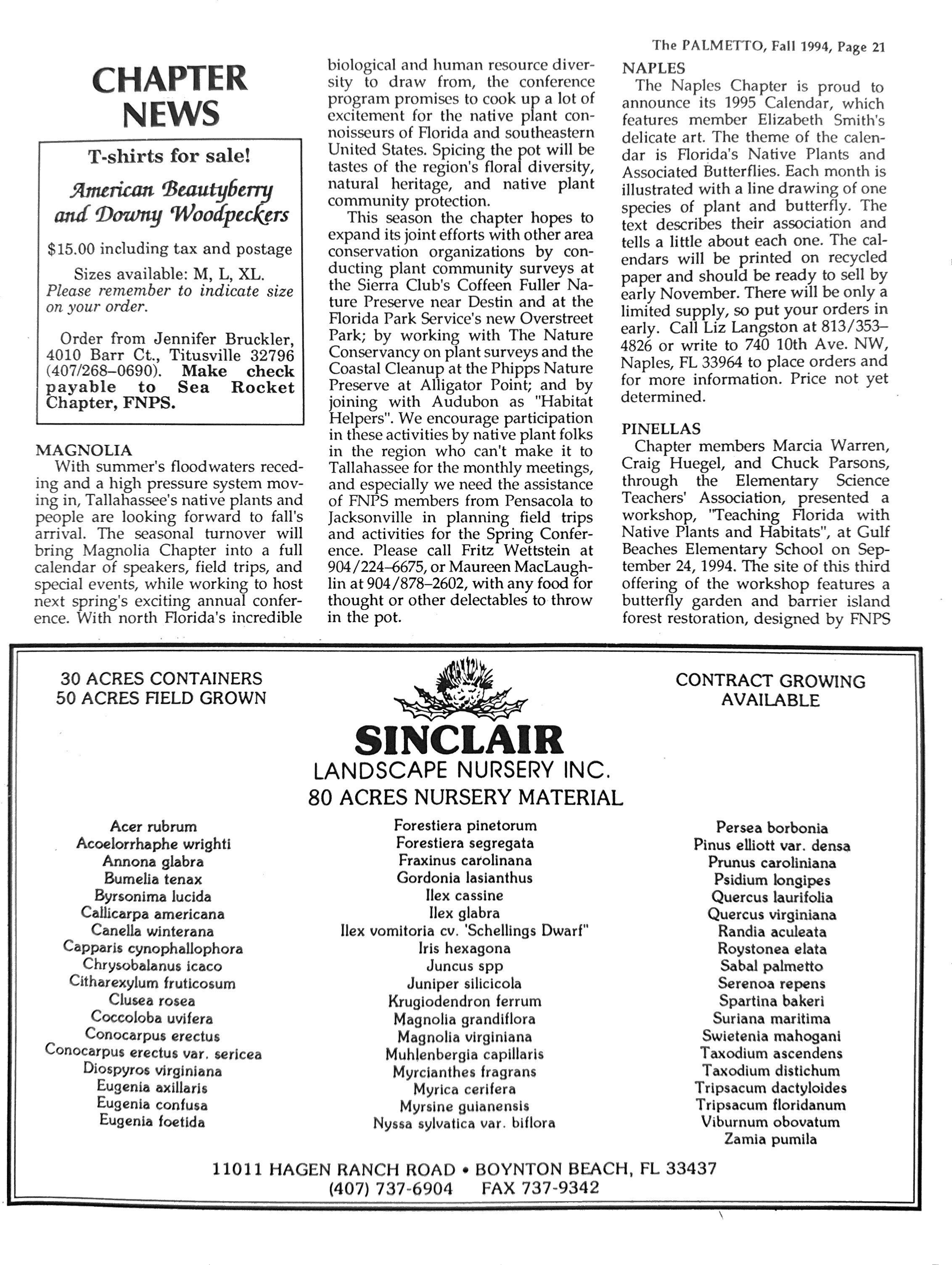
CHAPTER NEWS
T-shirts for sale!
American Beautyberry and Downy Woodpeckers
$15.00 including tax and postage
Sizes available: M, L, XL. Please remember to indicate size on your order.
Order from Jennifer Bruckler, 4010 Barr Ct., Titusville 32796 (407/268-0690). Make check payable to Sea Rocket Chapter, FNPS.
MAGNOLIA
With summer's floodwaters receding and a high pressure system moving in, Tallahassee's native plants and people are looking forward to fall's arrival. The seasonal turnover will bring Magnolia Chapter into a full calendar of speakers, field trips, and special events, while working to host next spring's exciting annual conference. With north Florida's incredible
Acer rubrum
Acoelorrhaphe wrighti
Annona glabra
Bumelia tenax
Byrsonima lucida
Callicarpa americana
Canella winterana
Capparis cynophallophora
Chrysobalanus icaco
Citharexylum fruticosum
Clusea rosea
Coccoloba uvifera
Conocarpus erectus
Conocarpus erectus var. sericea
Diospyros virginiana
Eugenia axillaris
Eugenia confusa
Eugenia foetida
biological and human resource diversity to draw from, the conference program promises to cook up a lot of excitement for the native plant connoisseurs of Florida and southeastern United States. Spicing the pot will b astes of the region's floral diversity natural heritage, and native plant community protection.
This season the chapter hopes to expand its joint efforts with other area conservation organizations by conducting plant community surveys at the Sierra Club's Coffeen Fuller Nature Preserve near Destin and at the Florida Park Service's new Overstreet Park; by working with The Nature Conservancy on plant surveys and the Coastal Cleanup at the Phipps Nature Preserve at Alligator Point; and by ? with Audubon as Helpers". We encourage participation in these activities by native plant folks in the region who can't make it to Tallahassee for the monthly meetings, and especially we need the assistance of FNPS members from Pensacola to Jacksonville in planning field trips and activities for the Spring Conference. Please call Fritz Wettstein at 904/224-6675, or Maureen MacLaughlin at 904/878-2602, with any food for thought or other delectables to throw in the pot.
SINCLAIR
Forestiera pinetorum
Forestiera segregata
Fraxinus carolinana
Gordonia lasianthus
Ilex cassine
Ilex glabra
Ilex vomitoria cv. 'Schellings Dwarf"
Iris hexagona
Juncus spp
Juniper silicicola
Krugiodendron ferrum
Magnolia grandiflora
Magnolia virginiana
Muhlenbergia capillaris
Myrcianthes fragrans
Myrica ceritera
Myrsine guianensis
Nyssa sylvatica var. biflora
The PALMETTO, Fall 1994, Page 21 NAPLES
The Naples Chapter is proud to announce its 1995 Calendar, which features member Elizabeth Smith's delicate art. The theme of the calendar is Florida's Native Plants and Associated Butterflies. Each month is illustrated with a line drawing of one species of plant and butterfly. The text describes their association and tells a little about each one. The calendars will be printed on recycled paper and should be ready to sell by early November. There will be only a limited supply, so put your orders in early. Call Liz Langston at 813/3534826 or write to 740 10th Ave. NW, Naples, FL 33964 to place orders and for more information. Price not yet determined.
PINELLAS
Chapter members Marcia Warren, Craig Huegel, and Chuck Parsons, through the Elementary Science Teachers' Association, presented a workshop, "Teaching Florida with Native Plants and Habitats", at Gulf Beaches Elementary School on September 24, 1994. The site of this third offering of the workshop features a butterfly garden and barrier island forest restoration, designed by ENPS