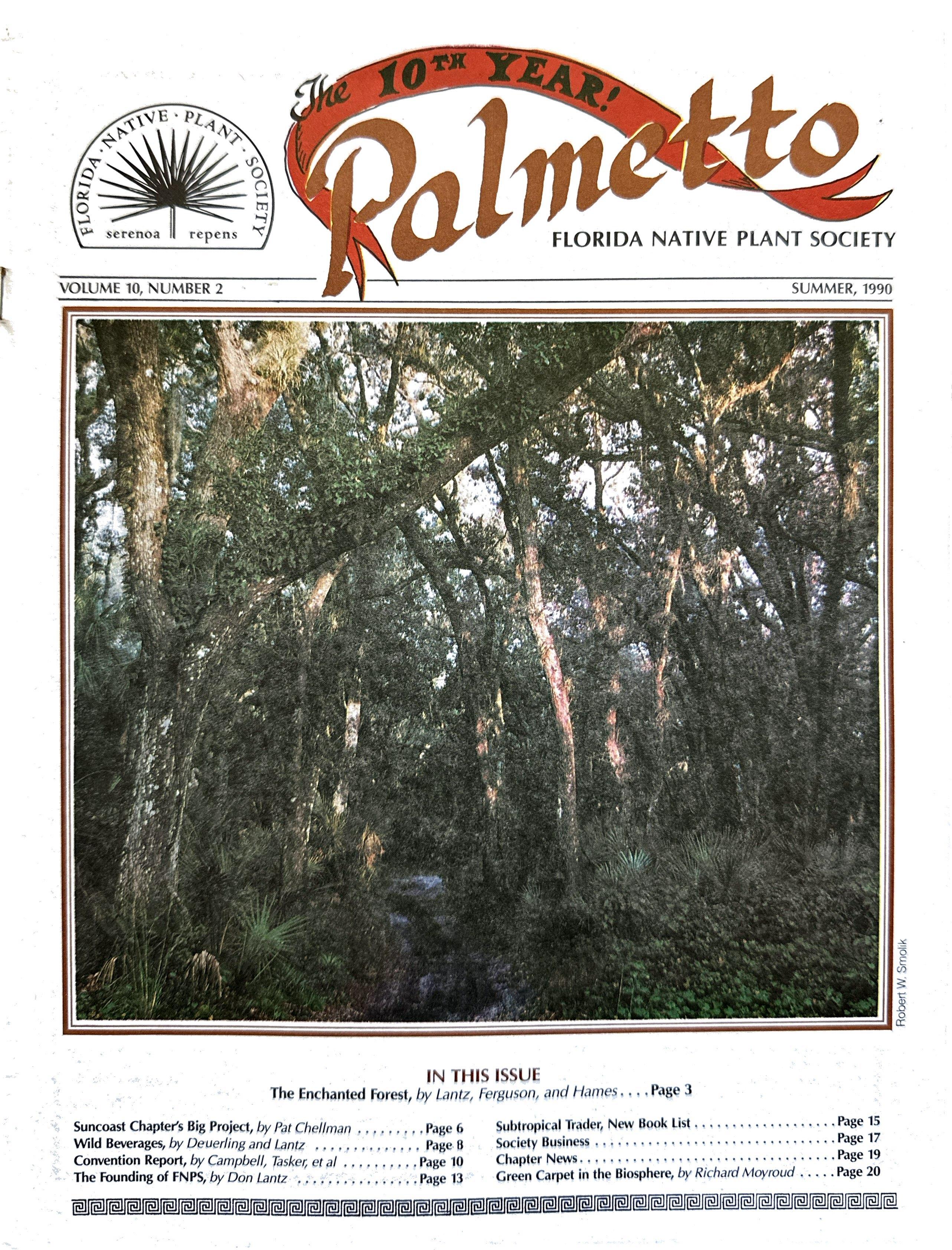
The Enchanted Forest, by Lantz, Ferguson, and Hames. . Page 3
by Pat Chellman Wild Beverages, by Deuerling and Lantz ... Convention Report, by Campbell, Tasker, et al The Founding of FNPS, by Don Lantz
. Page 6 Page 8
. Page 10
. Page 13
Subtropical Trader, New Book List Society Business Chapter News.. Green Carpet in the Biosphere, by Richard Moyroud
. Page 15
. Page 17 Page 19 Page 20
serenoa repens
Suncoast Chapter's Big Project,
Page 4, The Palmetto, Summer, 1990
"threatened"- grows on the ground. At least eighteen species of ferns- including the threatened royal fern and strap fern-can be found here.
The Addison Canal cuts across the property from southwest to northeast. According to long-time Titusville resident Bob Hudson, it was dug in the 1920s by a Mr. Lewis to drain the swamps along the St. Johns River into the Indian River to make the land usable for cattle or farming. The canal was only partially constructed. The geodedic survey maps indicate that it was cut through Anastasia rock, the largest exposed surface of this rock anywhere known. Looking down into the canal and seeing the many tiny sea shells in the sand makes it easy to see that at one time the
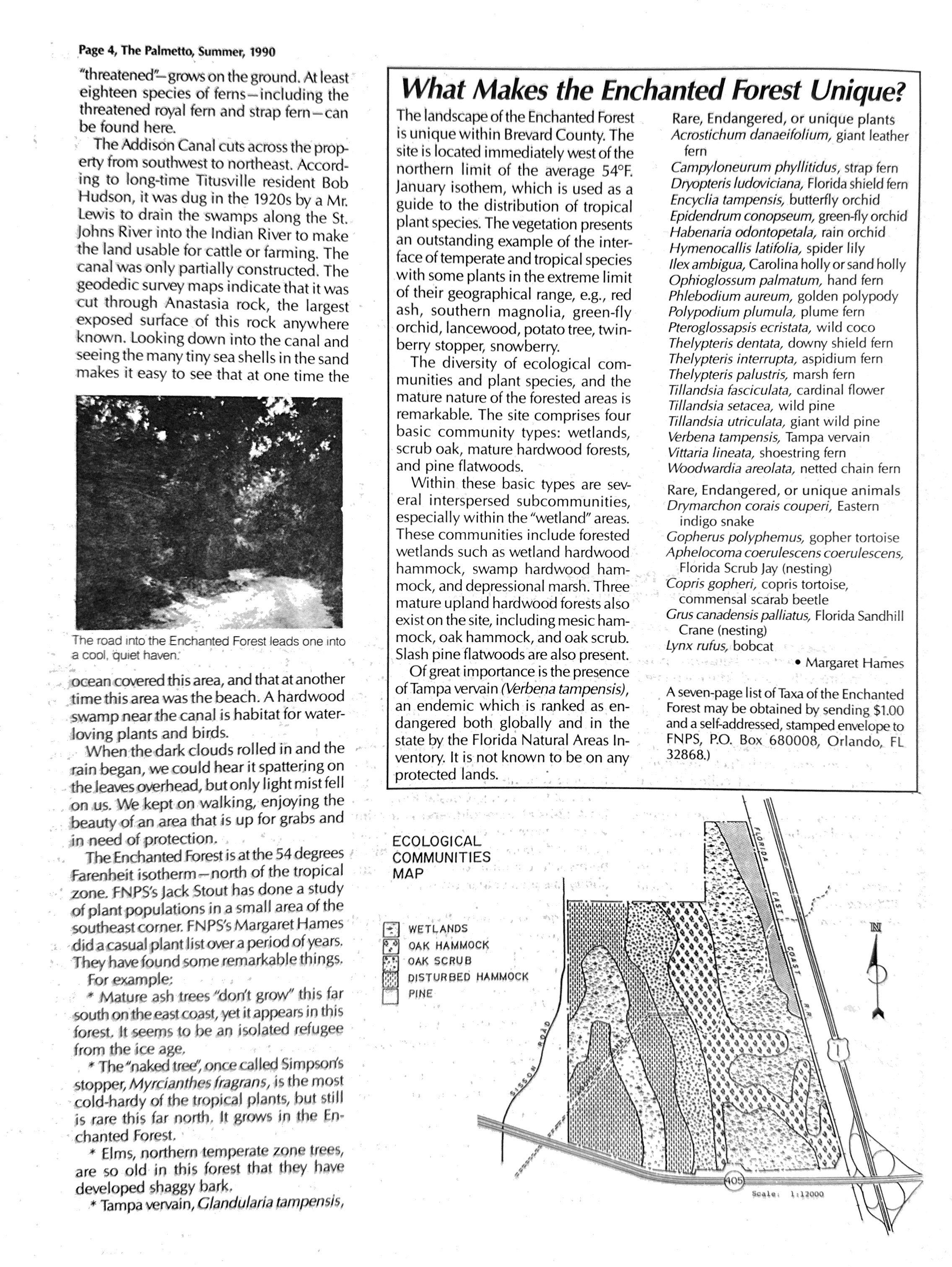
The road into the Enchanted Forest leads one into a cool, quiet haven.
ocean covered this area, and that at another time this area was the beach. A hardwood swamp near the canal is habitat for waterloving plants and birds.
When the dark clouds rolled in and the rain began, we could hear it spattering on the leaves overhead, but only light mist fell on us. We kept on walking, enjoying the beauty of an area that is up for grabs and in need of protection.
The Enchanted Forest is at the 54 degrees Farenheit isotherm -north of the tropical zone. FPS's Jack Stout has done a study of plant populations in a small area of the southeast corner. FPS's Margaret Hames did a casual plant list over a period of years. They have found some remarkable things.
For example:
* Mature ash trees "don't grow" this far south on the east coast, yet it appears in this forest. It seems to be an isolated refugee from the ice age.
*The"naked tree", once called Simpson's stopper, Myrcianthes fragrans, is the most cold-hardy of the tropical plants, but still is rare this far north. It grows in the Enchanted Forest,
* Elms, northern temperate zone trees, are so old in this forest that they have developed shaggy bark.
* Tampa vervain, Glandularia tampensis,
What Makes the Enchanted Forest Unique?
Campyloneurum phyllitidus, strap fern
Dryopteris ludoviciana, Florida shield fern
Encyclia tampensis, butterfly orchid
Epidendrum conopseum, green-fly orchid
Habenaria odontopetala, rain orchid
Hymenocallis latifolia, spider lily
llex ambigua, Carolina holly or sand holly
Ophioglossum palmatum, hand fern
Phlebodium aureum, golden polypody
Polypodium plumula, plume fern
Pteroglossapsis ecristata, wild coco
The landscape of the Enchanted Forest Rare, Endangered, or unique plants is unique within Brevard County. The Acrostichum danaeifolium, giant leather site is located immediately west of the northern limit of the average 54°F. January isothem, which is used as a guide to the distribution of tropical plant species. The vegetation presents an outstanding example of the interface of temperate and tropical species with some plants in the extreme limit of their geographical range, e.g., red ash, southern magnolia, green-fly orchid, lancewood, potato tree, twinberry stopper, snowberry.
The diversity of ecological communities and plant species, and the mature nature of the forested areas is remarkable. The site comprises four basic community types: wetlands, scrub oak, mature hardwood forests, and pine flatwoods.
Within these basic types are several interspersed subcommunities, especially within the "wetland" areas. These communities include forested wetlands such as wetland hardwood hammock, swamp hardwood hammock, and depressional marsh. Three mature upland hardwood forests also exist on the site, including mesic hammock, oak hammock, and oak scrub.
Thelypteris dentata, downy shield fern
Thelypteris interrupta, aspidium fern
Thelypteris palustris, marsh fern
Tillandsia fasciculata, cardinal flower
Tillandsia setacea, wild pine
Tillandsia utriculata, giant wild pine
Verbena tampensis, Tampa vervain
Vittaria lineata, shoestring fern
Woodwardia areolata, netted chain fern
Rare, Endangered, or unique animals
Drymarchon corais couperi, Eastern indigo snake
Gopherus polyphemus, gopher tortoise
Aphelocoma coerulescens coerulescens, Florida Scrub Jay (nesting)
Slash pine flatwoods are also present. ? Margaret Hames Of great importance is the presence of Tampa vervain (Verbena tampensis), an endemic which is ranked as endangered both globally and in the state by the Florida Natural Areas Inventory. It is not known to be on any
protected lands.
ECOLOGICAL COMMUNITIES
MAP
WETLANDS
OAK
OAK SCRUB
DISTURBED HAMMOCK
PINE
A seven-page list of Taxa of the Enchanted Forest may be obtained by sending $1.00 and a self-addressed, stamped envelope to FNPS, P.O. Box 680008, Orlando, FL 32868.)
1:12000
grows here. It is an endemic plant listed as globally and state endangered by the Florida Natural Areas Inventory. It is not known to exist on any sites that are protected.
The Sea Rocket (North Brevard) Chapter and the Conradina (South Brevard) Chapter have led walks through the Enchanted Forest, written letters, passed resolutions, and talked to garden clubs, museums, and officials about the value of this woods. Articles have appeared in newspapers, quoting Jane Ferguson of Sea Rocket Chapter, and Bill Killen and Margaret Hames of Conradina Chapter.
The Enchanted Forest is owned by several different families, and is ripe for development. The owners tried to rezone for an industrial park, but - largely because of efforts by the FPS chapters-public opposition forced the commission to vote against it. The Nature Conservancy visited the site, offered the owners a price that was accepted by all but one of the owners. Now, the property is on the state CARL (Conservation and Recreation Lands) proposed list. Joe Zyas, who works for Martin Marietta, is preparing a videotape about the Enchanted Forest to show at the public hearing on proposed CARL sites at Tallahassee in July. (He will be written up in the Martin Marietta newsletter for his activities in promoting the preservation of the Enchanted Forest.)
If you are concerned about saving another piece of Florida's vanishing natural areas, call Jane Ferguson, 407/267-7618, or Margaret Hames, 407/724-1516. Or write a letter to:
Dr. O. Greg Brock, Environmental Administrator
Dept. of Natural Resources, Attn.: CARL Suite B 114, Box 58, 2639 N. Monroe St. Tallahassee 32303
Peggy Lantz has been editor of The Palmetto and publications chair of FNPS since its inception. Jane Ferguson is secretary of North Brevard's Sea Rocket Chapter, and Margaret Hames is chairperson of the Conservation and Legislation Committee for FNPS.
WHOLESALE
We're Wild About Natives!...
but, in order to expand our wholesale nursery and installation services we need more quality work!
We are specialists in commercial wetland restoration (1-100 acres).
We GROW our plants from seed and division plus install statewide. We also have the state's largest supply of seed-grown saw palmetto for upland restoration plus xeriscapes. (Many other species are also available.]
If you need a quality native planting or plant supply please call.
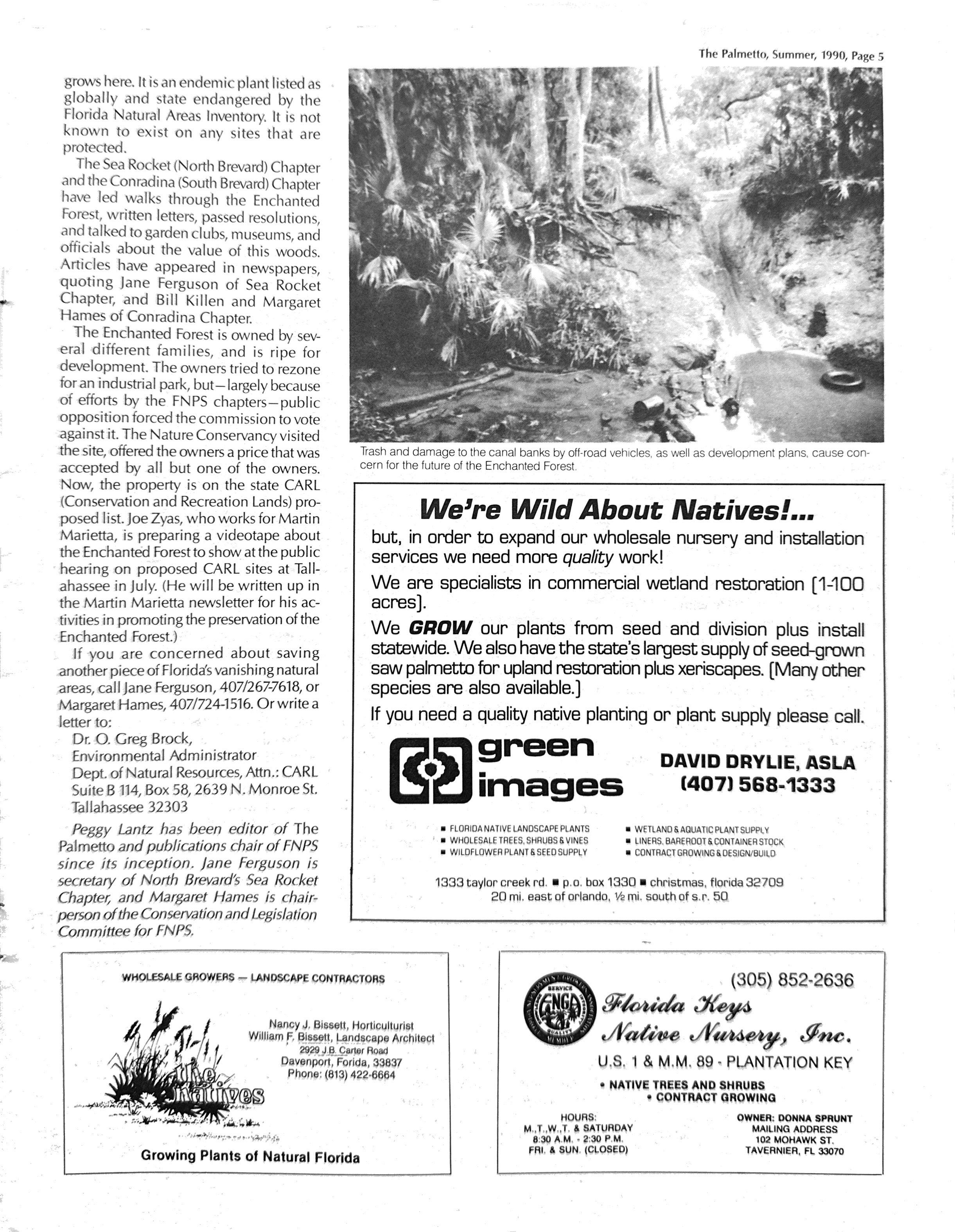
Trash and damage to the canal banks by off-road vehicles, as well as development plans, cause concern for the future of the Enchanted Forest.
SUNCOAST CHAPTER'S BIG PROJECT
by Patricia Chellman
The Suncoast Chapter has been working on the bridge approaches at I-275 and Busch Boulevard in Tampa since July, 1989
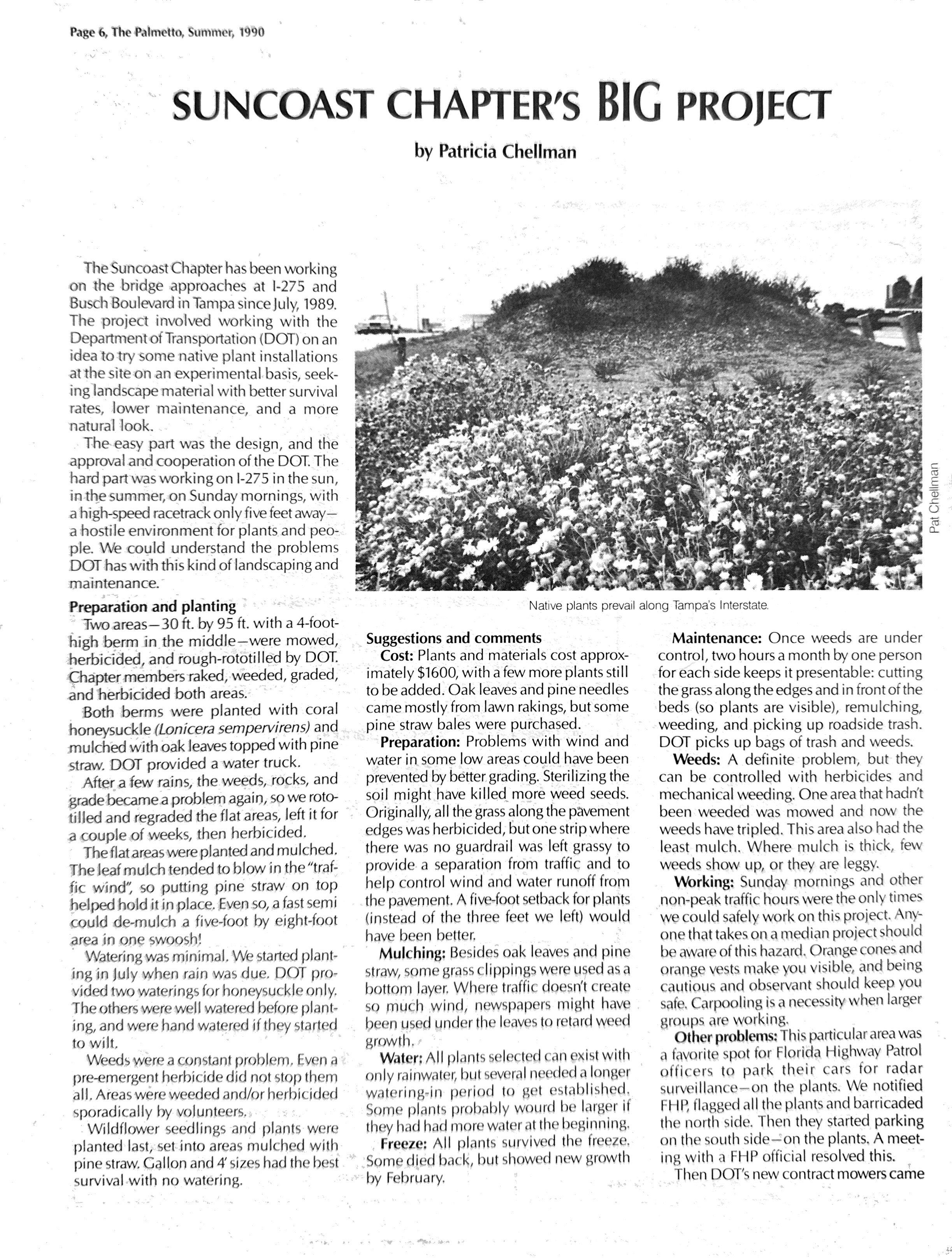
The project involved working with the Department of Transportation (DOT) on an idea to try some native plant installations at the site on an experimental basis, seeking landscape material with better survival rates, lower maintenance, and a more natural look.
The easy part was the design, and the approval and cooperation of the DOT. The hard part was working on I-275 in the sun, in the summer, on Sunday mornings, with a high-speed racetrack only five feet awaya hostile environment for plants and people. We could understand the problems DOT has with this kind of landscaping and maintenance.
Preparation and planting
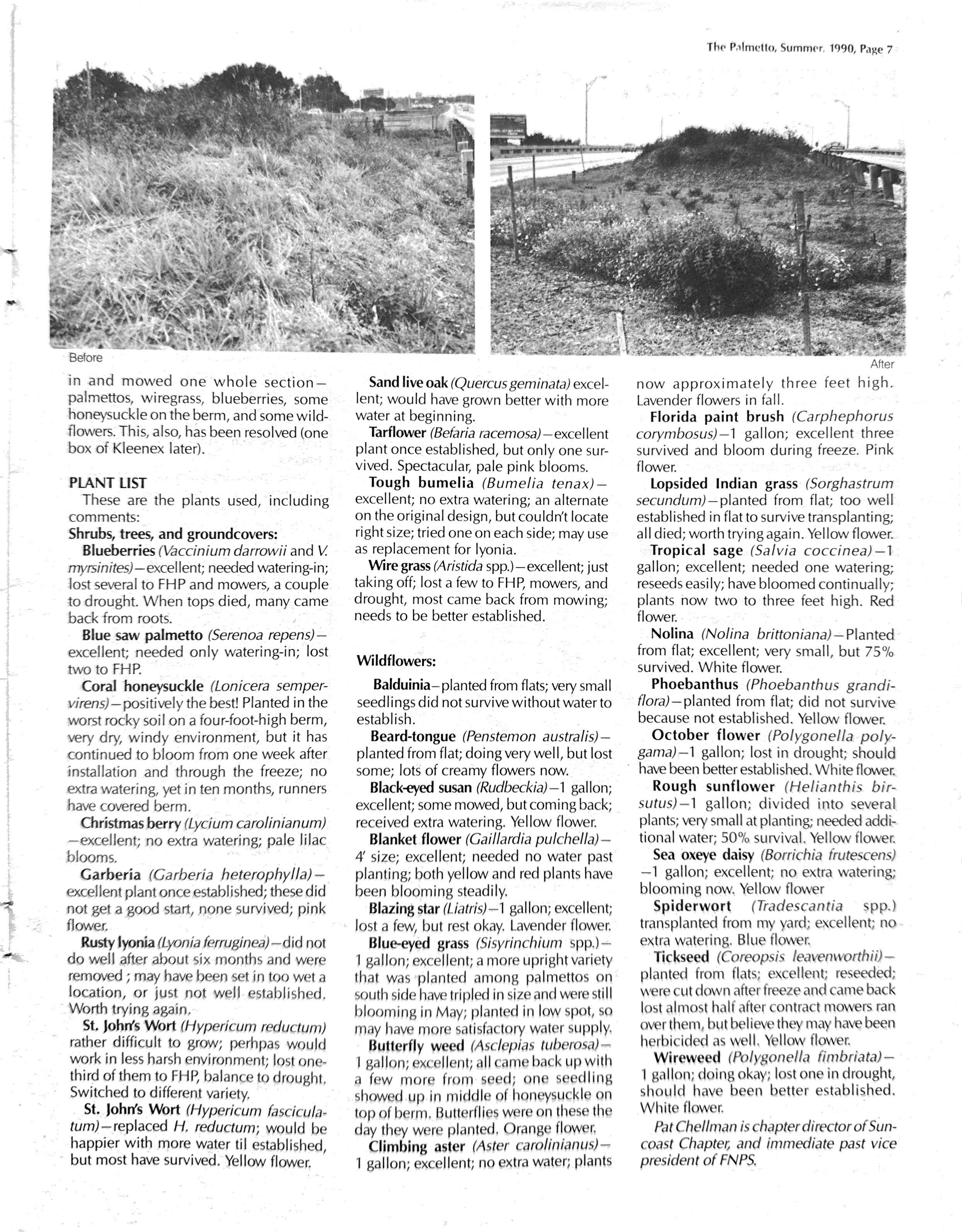
Two areas - 30 ft. by 95 ft. with a 4-foothigh berm in the middle-were mowed herbicided, and rough-rototilled by DOT. Chapter members raked, weeded, graded, and herbicided both areas.
Both berms were planted with coral honeysuckle (Lonicera sempervirens) and mulched with oak leaves topped with pine straw. DOT provided a water truck.
After a few rains, the weeds, rocks, and grade became a problem again, so we rototilled and regraded the flat areas, left it for a couple of weeks, then herbicided
The flat areas were planted and mulched. The leaf mulch tended to blow in the "traffic wind", so putting pine straw on top helped hold it in place. Even so, a fast semi could de-mulch a five-foot by eight-foot area in one swoosh!
Watering was minimal. We started planting in July when rain was due. DOT provided two waterings for honeysuckle only. The others were well watered before planting, and were hand watered if they started to wilt.
Weeds were a constant problem. Even a pre-emergent herbicide did not stop them all. Areas were weeded and/or herbicided sporadically by volunteers.
Wildflower seedlings and plants were planted last, set into areas mulched with pine straw. Gallon and 4' sizes had the best survival with no watering.
Suggestions and comments
Cost: Plants and materials cost approximately $1600, with a few more plants still to be added. Oak leaves and pine needles came mostly from lawn rakings, but some pine straw bales were purchased
Preparation: Problems with wind and water in some low areas could have been prevented by better grading. Sterilizing the soil might have killed more weed seeds. Originally, all the grass along the pavement edges was herbicided, but one strip where there was no guardrail was left grassy to provide a separation from traffic and to help control wind and water runoff from the pavement. A five-foot setback for plants (instead of the three feet we left) would have been better.
Mulching: Besides oak leaves and pine straw, some grass clippings were used as a bottom layer. Where traffic doesn't create so much wind, newspapers might have been used under the leaves to retard weed
Water: All plants selected can exist with only rainwater, but several needed a longer watering-in period to get established. Some plants probably wourd be larger if they had had more water at the beginning. Freeze: All plants survived the freeze. Some died back, but showed new growth by February.
Maintenance: Once weeds are under control, two hours a month by one person for each side keeps it presentable: cutting the grass along the edges and in front of the beds (so plants are visible), remulching, weeding, and picking up roadside trash. DOT picks up bags of trash and weeds. Weeds: A definite problem, but they can be controlled with herbicides and mechanical weeding. One area that hadn't been weeded was mowed and now the weeds have tripled. This area also had the least mulch. Where mulch is thick, few weeds show up, or they are leggy.
Working: Sunday mornings and other non-peak traffic hours were the only times we could safely work on this project. Anyone that takes on a median project should be aware of this hazard. Orange cones and orange vests make you visible, and being cautious and observant should keep you safe. Carpooling is a necessity when larger groups are working
Other problems: This particular area was a favorite spot for Florida Highway Patrol officers to park their cars for radar surveillance-on the plants. We notified FHP, flagged all the plants and barricaded the north side. Then they started parking on the south side-on the plants. A meeting with a FHP official resolved this. Then DOT's new contract mowers came
Native plants prevail along Tampa's Interstate.
Before in and mowed one whole sectionpalmettos, wiregrass, blueberries, some honeysuckle on the berm, and some wildflowers. This, also, has been resolved (one box of Kleenex later).
PLANT LIST
These are the plants used, including comments:
Shrubs, trees, and groundcovers:
Blueberries (Vaccinium darrowii and V. myrsinites) ?excellent; needed watering-in; lost several to FHP and mowers, a couple to drought. When tops died, many came back from roots.
Blue saw palmetto (Serenoa repens)excellent; needed only watering-in; lost two to FHP.
Coral honeysuckle (Lonicera sempervirens) - positively the best! Planted in the worst rocky soil on a four-foot-high berm, very dry, windy environment, but it has continued to bloom from one week after installation and through the freeze; no extra watering, yet in ten months, runners have covered berm.
Christmas berry (Lycium carolinianum) -excellent; no extra watering; pale lilac blooms.
Garberia (Carberia heterophylla)excellent plant once established; these did not get a good start, none survived; pink flower.
Rusty lyonia (Lyonia ferruginea) ? did not do well after about six months and were removed ; may have been set in too wet a location, or just not well established Worth trying again.
St. John's Wort (Hypericum reductum) rather difficult to grow; perhpas would work in less harsh environment; lost onethird of them to FHP, balance to drought. Switched to different variety.
St. John's Wort (Hypericum fasciculatum) - replaced H. reductum; would be happier with more water til established, but most have survived. Yellow flower.
Sand live oak (Quercus geminata) excellent; would have grown better with more water at beginning.
Tarflower (Befaria racemosa) - excellent plant once established, but only one survived. Spectacular, pale pink blooms.
Tough bumelia (Bumelia tenax)excellent; no extra watering; an alternate on the original design, but couldn't locate right size; tried one on each side; may use as replacement for lyonia.
Wire grass (Aristida spp.) - excellent; just taking off; lost a few to FHP, mowers, and drought, most came back from mowing; needs to be better established.
Wildflowers:
Balduinia- planted from flats; very small seedlings did not survive without water to establish.
Beard-tongue (Penstemon australis)planted from flat; doing very well, but lost some; lots of creamy flowers now.
Black-eyed susan (Rudbeckia) -1 gallon; excellent; some mowed, but coming back; received extra watering. Yellow flower.
Blanket flower (Gaillardia pulchella)4' size; excellent; needed no water past planting; both yellow and red plants have been blooming steadily.
Blazing star (Liatris) -1 gallon; excellent; lost a few, but rest okay. Lavender flower.
Blue-eyed grass (Sisyrinchium spp.)1 gallon; excellent; a more upright variety that was planted among palmettos on south side have tripled in size and were still blooming in May; planted in low spot, so may have more satisfactory water supply.
Butterfly weed (Asclepias tuberosa)1 gallon; excellent; all came back up with a few more from seed; one seedling showed up in middle of honeysuckle on top of berm. Butterflies were on these the day they were planted. Orange flower.
Climbing aster (Aster carolinianus)1 gallon; excellent; no extra water; plants
now approximately three feet high. Lavender flowers in fall.
Florida paint brush (Carphephorus corymbosus) -1 gallon; excellent three survived and bloom during freeze. Pink flower.
Lopsided Indian grass (Sorghastrum secundum) - planted from flat; too well established in flat to survive transplanting; all died; worth trying again. Yellow flower.
Tropical sage (Salvia coccinea) -1 gallon; excellent; needed one watering; reseeds easily; have bloomed continually; plants now two to three feet high. Red flower.
Nolina (Nolina brittoniana) - Planted from flat; excellent; very small, but 75% survived. White flower.
Phoebanthus (Phoebanthus grandiflora) - planted from flat; did not survive because not established. Yellow flower.
October flower (Polygonella polygama) -1 gallon; lost in drought; should have been better established. White flower.
Rough sunflower (Helianthis birsutus) -1 gallon; divided into several plants; very small at planting; needed additional water; 50% survival. Yellow flower.
Sea oxeye daisy (Borrichia frutescens) -1 gallon; excellent; no extra watering; blooming now. Yellow flower
Spiderwort (Tradescantia spp.) transplanted from my yard; excellent; no extra watering. Blue flower.
Tickseed (Coreopsis leavenworthii)planted from flats; excellent; reseeded; were cut down after freeze and came back lost almost half after contract mowers ran over them, but believe they may have been herbicided as well. Yellow flower.
Wireweed (Polygonella fimbriata)1 gallon; doing okay; lost one in drought, should have been better established. White flower.
Pat Chellman is chapter director of Suncoast Chapter, and immediate past vice president of FNPS.
NATIVE WILD FOODS:
Wild Beverages
by Dick Deuerling and Peggy Lantz
Tired of coffee? Too much caffeine? Why not try making your own teas and coffee from wild plants? You can brighten your day and sweeten your palate with a new taste treat by doing it yourself! Hollies, wild mints, the persimmon tree, and even goldenrod brew up interesting and delightful teas.
Hollies
The various species of holly leaves must be dried and then roasted until golden brown before steeping. Hollies and the four "coffees" described are the only ones that require roasting to finish the drying process.
Yaupon, llex vomitoria, has the highest caffeine content of any North American plant. It was the source of the Indians' infamous "black drink", which they prepared by boiling it to excess, and then they drank it to excess, causing-true to its botanical name-all manner of ill after-effects. It makes a good tea if the leaves are steeped for just six or seven minutes without boiling them, but don't use yaupon if you're trying to brew a non-caffeinated drink.
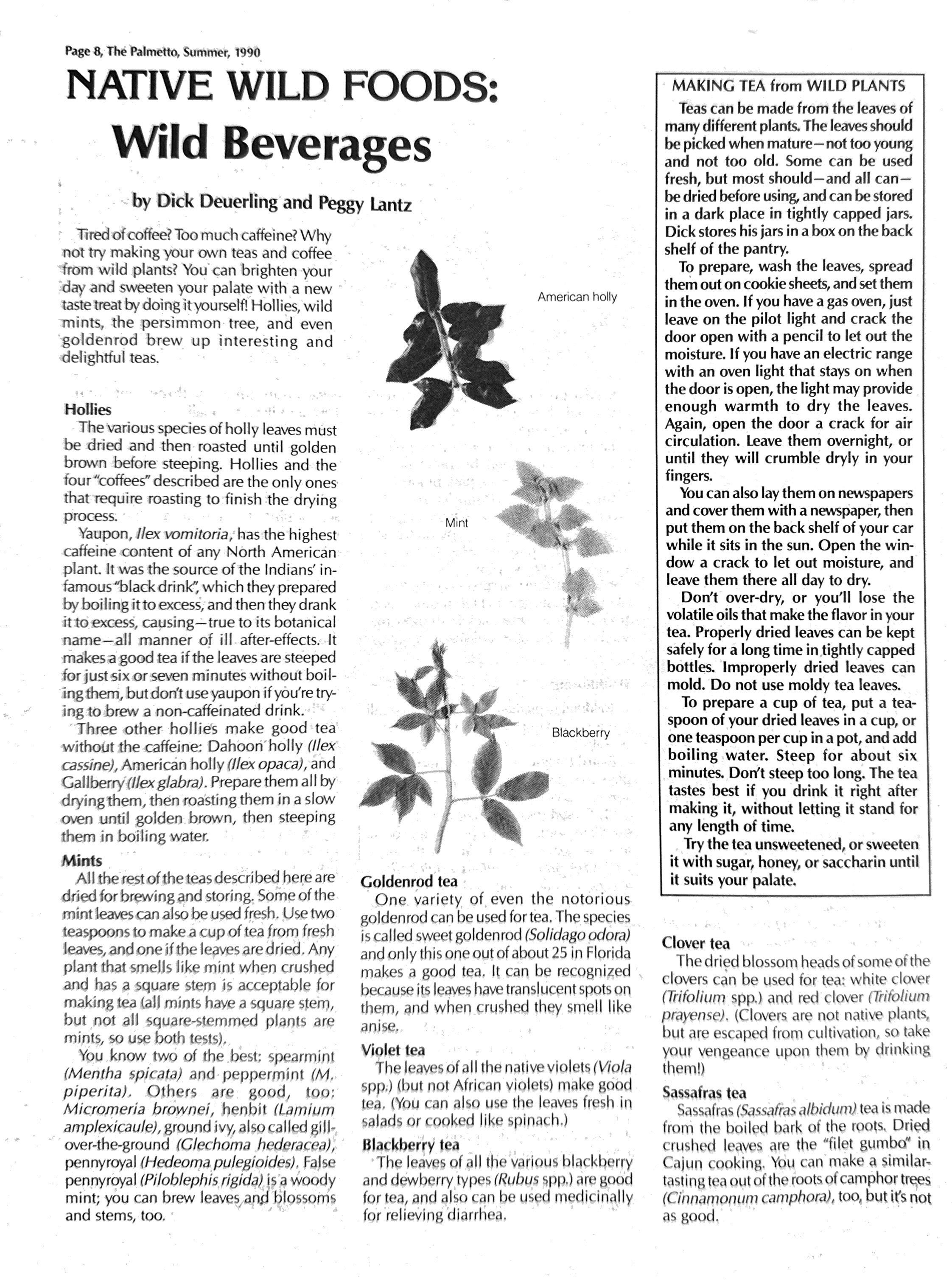
Three other hollies make good tea without the caffeine: Dahoon holly (lex cassine), American holly (Ilex opaca), and Gallberry (Ilex glabra). Prepare them all by drying them, then roasting them in a slow oven until golden brown, then steeping them in boiling water.
Mints
All the rest of the teas described here are dried for brewing and storing. Some of the mint leaves can also be used fresh. Use two teaspoons to make a cup of tea from fresh leaves, and one if the leaves are dried. Any plant that smells like mint when crushed and has a square stem is acceptable for making tea (all mints have a square stem, but not all square-stemmed plants are mints, so use both tests).
You know two of the best: spearmint (Mentha spicata) and peppermint (M. piperita). Others are good, too: Micromeria brownei, henbit (Lamium amplexicaule), ground ivy, also called gillover-the-ground (Glechoma hederacea), pennyroyal (Hedeoma pulegioides). False pennyroyal (Piloblephis rigida) is a woody mint; you can brew leaves and blossoms and stems, too.
Goldenrod tea
One variety of even the notorious goldenrod can be used for tea. The species is called sweet goldenrod (Solidago odora) and only this one out of about 25 in Florida makes a good tea. It can be recognized because its leaves have translucent spots on them, and when crushed they smell like anise.
Violet tea
The leaves of all the native violets (Viola spp.) (but not African violets) make good tea. (You can also use the leaves fresh in salads or cooked like spinach.)
Blackberry tea
The leaves of all the various blackberry and dewberry types (Rubus spp.) are good for tea, and also can be used medicinally for relieving diarrhea.
MAKING TEA from WILD PLANTS
Teas can be made from the leaves of many different plants. The leaves should be picked when mature- not too young and not too old. Some can be used fresh, but most should-and all canbe dried before using, and can be stored in a dark place in tightly capped jars. Dick stores his jars in a box on the back shelf of the pantry.
To prepare, wash the leaves, spread them out on cookie sheets, and set them in the oven. If you have a gas oven, just leave on the pilot light and crack the door open with a pencil to let out the moisture. If you have an electric range with an oven light that stays on when the door is open, the light may provide enough warmth to dry the leaves. Again, open the door a crack for air circulation. Leave them overnight, or until they will crumble dryly in your fingers.
You can also lay them on newspapers and cover them with a newspaper, then put them on the back shelf of your car while it sits in the sun. Open the window a crack to let out moisture, and leave them there all day to dry. Don't over-dry, or you'll lose the volatile oils that make the flavor in your tea. Properly dried leaves can be kept safely for a long time in tightly capped bottles. Improperly dried leaves can mold. Do not use moldy tea leaves.
To prepare a cup of tea, put a teaspoon of your dried leaves in a cup, or one teaspoon per cup in a pot, and add boiling water. Steep for about six minutes. Don't steep too long. The tea tastes best if you drink it right after making it, without letting it stand for any length of time.
Try the tea unsweetened, or sweeten it with sugar, honey, or saccharin until it suits your palate.
Clover tea
The dried blossom heads of some of the clovers can be used for tea: white clover (Trifolium spp.) and red clover (Trifolium prayense). (Clovers are not native plants, but are escaped from cultivation, so take your vengeance upon them by drinking them!)
Sassafras tea
Sassafras (Sassafras albidum) tea is made from the boiled bark of the roots. Dried crushed leaves are the "filet gumbo" in Cajun cooking. You can make a similartasting tea out of the roots of camphor trees (Cinnamonum camphora), too, but it's not as good.
American holly
Mint
Blackberry
Persimmon tea
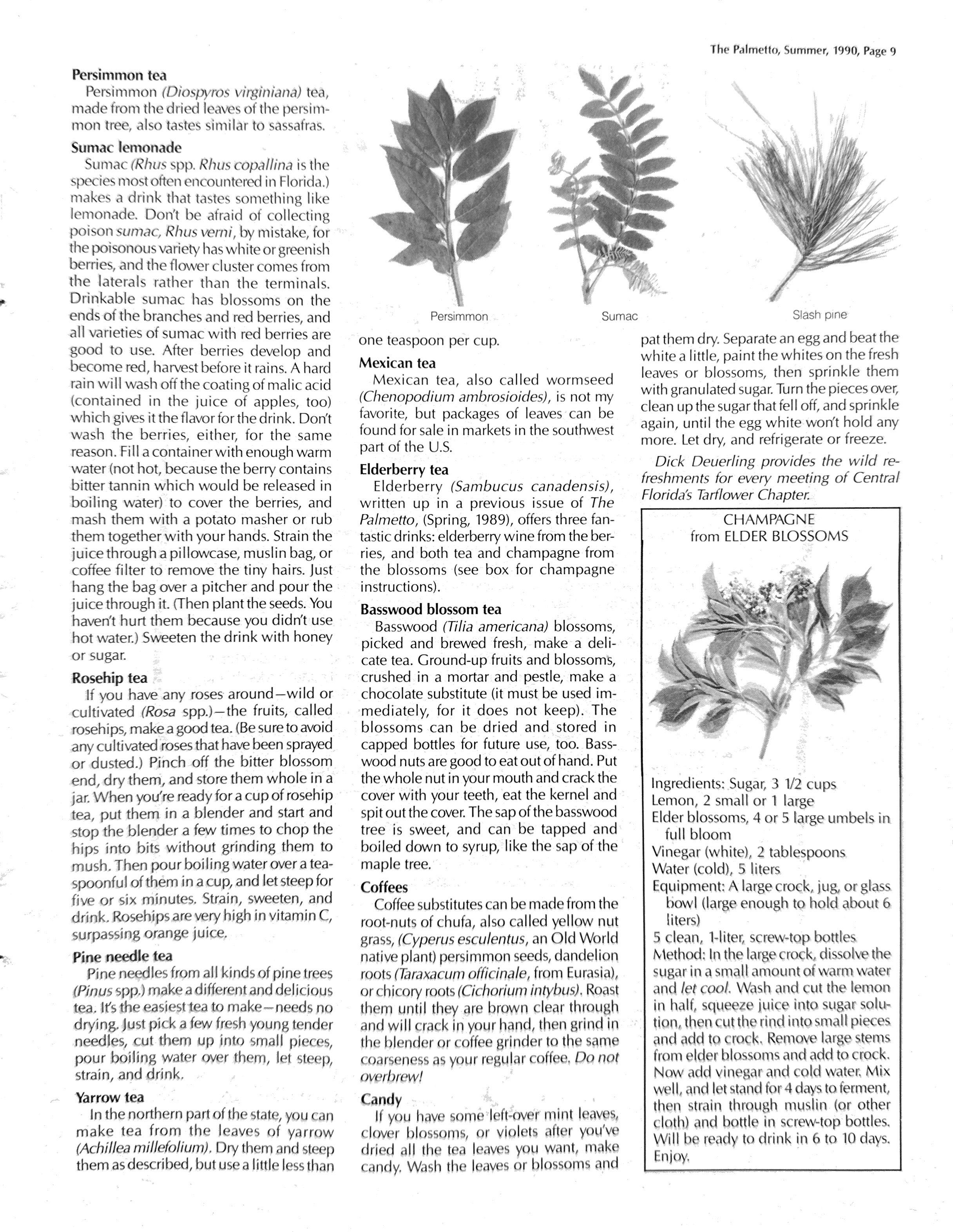
Persimmon (Diospyros virginiana) tea, made from the dried leaves of the persimmon tree, also tastes similar to sassafras.
Sumac lemonade
Sumac (Rhus spp. Rhus copallina is the species most often encountered in Florida.) makes a drink that tastes something like lemonade. Don't be afraid of collecting poison sumac, Rhus verni, by mistake, for the poisonous variety has white or greenish berries, and the flower cluster comes from the laterals rather than the terminals. Drinkable sumac has blossoms on the ends of the branches and red berries, and all varieties of sumac with red berries are good to use. After berries develop and become red, harvest before it rains. A hard rain will wash off the coating of malic acid (contained in the juice of apples, too which gives it the flavor for the drink. Don't wash the berries, either, for the same reason. Fill a container with enough warm water (not hot, because the berry contains bitter tannin which would be released in boiling water) to cover the berries, and mash them with a potato masher or rub them together with your hands. Strain the juice through a pillowcase, muslin bag, or coffee filter to remove the tiny hairs. Just hang the bag over a pitcher and pour the juice through it. (Then plant the seeds. You haven't hurt them because you didn't use hot water.) Sweeten the drink with honey or sugar.
If you have any roses around ?wild or cultivated (Rosa spp.) - the fruits, called rosehips, make a good tea. (Be sure to avoid any cultivated roses that have been sprayed or dusted.) Pinch off the bitter blossom end, dry them, and store them whole in a jar. When you're ready for a cup of rosehip tea, put them in a blender and start and stop the blender a few times to chop the hips into bits without grinding them to mush. Then pour boiling water over a teaspoonful of them in a cup, and let steep for five or six minutes. Strain, sweeten, and drink. Rosehips are very high in vitamin C, surpassing orange juice.
Pine needle tea
Pine needles from all kinds of pine trees (Pinus spp.) make a different and delicious tea. It's the easiest tea to make- needs no drying. Just pick a few fresh young tender needles, cut them up into small pieces, pour boiling water over them, let steep, strain, and drink.
Yarrow tea
In the northern part of the state, you can make tea from the leaves of yarrow (Achillea millefolium). Dry them and steep them as described, but use a little less than
one teaspoon per cup.
Mexican tea
Mexican tea, also called wormseed (Chenopodium ambrosioides), is not my tavorite, but packages of leaves can be found for sale in markets in the southwest
Elderberry tea
Elderberry (Sambucus canadensis), written up in a previous issue of The Palmetto, (Spring, 1989), offers three fantastic drinks: elderberry wine from the berries, and both tea and champagne from the blossoms (see box for champagne instructions).
Basswood blossom tea
Basswood (Tilia americana) blossoms, picked and brewed fresh, make a delicate tea. Ground-up fruits and blossoms, crushed in a mortar and pestle, make a chocolate substitute (it must be used immediately, for it does not keep). The blossoms can be dried and stored in capped bottles for future use, too. Basswood nuts are good to eat out of hand. Put the whole nut in your mouth and crack the cover with your teeth, eat the kernel and spit out the cover. The sap of the basswood tree is sweet, and can be tapped and boiled down to syrup, like the sap of the maple tree.
Coffees
Coffee substitutes can be made from the root-nuts of chufa, also called yellow nut grass, (Cyperus esculentus, an Old World native plant) persimmon seeds, dandelion roots (Taraxacum officinale, from Eurasia), or chicory roots (Cichorium intybus). Roast them until they are brown clear through and will crack in your hand, then grind in the blender or coffee grinder to the same coarseness as your regular coffee. Do not overbrew!
Candy
If you have some left-over mint leaves, clover blossoms, or violets after you've dried all the tea leaves you want, make candy, Wash the leaves or blossoms and
pat them dry. Separate an egg and beat the white a little, paint the whites on the fresh leaves or blossoms, then sprinkle them with granulated sugar. Turn the pieces over, clean up the sugar that fell off, and sprinkle again, until the egg white won't hold any more. Let dry, and refrigerate or freeze.
Dick Deuerling provides the wild refreshments for every meeting of Central Florida's Tarflower Chapter.
CHAMPAGNE from ELDER BLOSSOMS
Ingredients: Sugar, 3 1/2 cups
Lemon, 2 small or 1 large
Elder blossoms, 4 or 5 large umbels in full bloom
Vinegar (white), 2 tablespoons
Water (cold), 5 liters
Equipment: A large crock, jug, or glass bowl (large enough to hold about 6 liters)
5 clean, 1-liter, screw-top bottles
Method: In the large crock, dissolve the sugar in a small amount of warm water and let cool. Wash and cut the lemon in half, squeeze juice into sugar solution, then cut the rind into small pieces and add to crock. Remove large stems from elder blossoms and add to crock. Now add vinegar and cold water. Mix well, and let stand for 4 days to ferment, then strain through muslin (or other cloth) and bottle in screw-top bottles. Will be ready to drink in 6 to 10 days. Enjoy.
Persimmon
Sumac
Slash pine
FNPS HOLDS ITS
TENTH ANNUAL CONVENTION
Editor:
I am writing this letter in praise of this year's FNPS conference. It was held in Miami, only about twenty miles from my residence.
Unfortunately, I had not attended a state conference for a few years, so it was a good opportunity to observe how the society had changed over time. My impression was that we had changed in some very positive ways. The society is now on the cutting edge of many extremely important environmental movements. Issues such as water availability and quality, along with xeriscape planting practices, are of utmost importance. Vital topics ranging from environmental education to conservation of species and habitat diversity were discussed. Several speakers displayed a keen awareness of the ecological problems that loom over the heads of Floridians and everyone else on our planet. Of all the fine minds disseminating information this year, Larry Harris stood out as having a fresh way of viewing these modern problems. I was pleased to see old friends from up-state that I'd missed for half a decade. Alas the life of a nurseryman usually doesn't allow for much travel I have a confession to make in regard to the choice of topics for this conference. At first, I'd considered not attending, because these topics seemed rather in-depth and specialized. Do I really want to hear about "Regional and Local Planning for the TwentyFirst Century?" I thought. I longed for the old days of barefoot travelogues through our wild areas, with slides of fine and rare plants and animals. As it turned out, we saw some rare animals pictured that weekend, but most were somewhat flattened by autos. Yes, I had to face reality. These areas cannot save themselves. Even if we put twenty-foot walls around them, our pollution and destruction of the water resources would eventually do them in.
The time to act is now! The watchword is planning, not fix it later when there will be nothing left to fix. The sort of issues being acted upon by the society as we head into the new century are, while not very entertaining to me, some of the most important and challenging issues our organization could possibly address. I thank everyone involved for a wonderful 1990 conference.
? Rob L. Campbell Homestead
Saving parts of Florida won't save the whole
Georgia Tasker- the Florida Native Plant Society's most prominent journalist advocate,andauthorofthesociety'spublication,WildThings-wrotewonderfulthings in The Miami Herald about the Annual Spring Conference in Miami.
'Cascades of extinction' ahead, biologist warns
By GEORGIA TASKER Herald Garden Writer
Saving pieces of Florida isn't working to save ecosystems. Plants and animals of native Florida are falling to the wayside, being sequestered in islands of habitats, run over at stomach-churning rates when they wander outside them.They are being edged out by animal weeds and plant weeds, and driven to extinction by piecemeal management.
This was the urgent message delivered to the 10th annual conference of the Florida Native Plant Society last weekend at Florida International University by wildlife biologist Larry Harris.
"Living With Nature in the 21st Century, The conferency looked to the future and saw the need for:
? Regional conservation efforts that will allow whole ecosystems to function, rather than stranding plants and animals on ecological islands.
? Small conservation areas that both educate and conserve green space without pretending to be fully functioning habitats.
? Natural areas around schools throughout the state to be used as outdoor classrooms, with curricula designed to teach children about their natural heritage.
? State-initiated programs to help manage privately owned areas, and implement recovery plans for Florida's 34 plants listed as federally endangered
"Feel-good ecology'
Florida's successes in bringing back the alligator, the bald eagle and the wood duck are "19th and 20th Century stories, versity of Florida scientist Harris in his key"Florida's conservation gramming continues to stack up, but in my book it doesn't add up."
Harris, a member of the National Academy of Sciences and a former visiting scholar at
Harvard University, is author of The Fragmented Forest and 90 other publications on wildlife ecology. He is working with the National Academy of Engineers on highway designs for wildlife and is an adviser to Costa Rica, where efforts are under way to establish an international, multiuse conservation area.
Dribs and drabs of new land purchases and single species reintroductions"make us feel good ? it's sort of like feel-good ecology," he said,"but it has very little to do with ecology."
A new approach is needed, Harris said, because "The erosion of Florida's biological diversity rivals that of anywhere on the face of the Earth."
The Florida scrub's red widow spider that could provide secrets to a natural insecticide - being investigated at Harvard ? is being lost as its habitat is destroyed
Genetic diversity is being lost, too, Harris "Only eight genetically independent Florida panthers remain in the world. There are only eight that you would marry your daughter to ... that aren't you uncle, your mother your brother, your father, your
Dangerous inbreeding
Inbreeding among Florida panthers has reached the point where 50 percent of the male panthers alive today have only one testicle. And 95 percent of the spermatozoa of the adult males tested is congenitally infertile. What happens, Harris asked, when panthers begin showing up with no testicles?
Complexes of animals also are being lost.
Among the interacting pinelands birds, the brown-headed nuthatch, the white-breasted nuthatch and the cockaded woodpecker are all but gone, Sparrows, starlings, rats, mice and red-bellied woodpeckers are taking their
Harris was scathing in his assessment of the viability of Ocala National Forest: "Somebody's been doing a number on our head. This is not a forest by most people's reckoning. It's
Small land purchases and reintroduction of single species are not the way to preserve Florida's biological and genetic diversity, warns wildlife biologist Larry Harris.
an academic nicety to call that a forest. It's going to become a plantation. And plantations are not a forest."
As the seas continue to rise and condos continue to be built, plants and animals are being squeezed to death in the middle, which is often the site of a highway.
Look to the north
What we need, he said, is for the Everglades system to be able to move north as the seas push inland from the south.
"The salt water will continue to come in and the cypress will be invaded by mangroves and we should plan on it. Because in our lifetime, State Road 27 from Homestead to Flamingo will be under water."
To survive rising seas, calculations are that the whole system will have to move 300 miles north in the next 50 years.
New measures needed
Such movement means more than just building culverts for panthers, he said.
"It means we've either got to wall off the system and see it go extinct, or we've got to provide new measures of conservation that allow for this dynamic system to continue to work."
Our old conservation methods are "bankrupt" ? both the park set-aside approach and the utilitarian, sustained-yield approach "that says if you harvest whales on a sustainingyield basis and you don't harvest too many, there will be whales. You can have your cake and eat it, too. Neither of these can be depended on to save Florida's biological diversity for the future," he said.
"If sustained yield is so great, why isn't there a huntable population of Canada geese in Florida anymore? North America's waterfowl populations have never been this bad off.
Florida's marine resources ? porpoises, tuna, redfish ? as well as its forest resources are being devastated by the sustained-yield approach, he said. "We're over-exploiting everything we ever put our hands on."
Artificial boundaries
Florida forests are being lost at the rate of 150,000 acres a year, 2? times the rate of forest loss in Brazil. The forest cover is being broken up, and habitat islands are being created. Plants and animals can't get outside the artificial boundaries of the islands. When they try, automobiles kill them with astonishing efficiency.
"If you analyze the 333 biggest parks). 85 percent are smaller than the home range of a single mink or otter, " Harris said.
Until 200 years ago, Harris said, Florida had 11 native mammals of any size. Today, the bison, monk seal and red wolf are either locally or globally extinct; the panther, Key deer and manatee are federally endangered; the otter, bobcat and black bear are state listed or listed by the Convention on International Trade of Endangered Species (CITES); only two - the raccoon and white-tailed deer ? are doing well.
Ironically, while Florida is losing plants and animals, the state is gaining hundreds of unwanted exotic ones. There are 100 species of free-ranging vertebrates in Florida that don't belong here, from fish to reptiles to mammals.
Unwelcome inhabitants
"Opossums, armadillos, dogs, cats ... you name it, we've got it, and most are bandits, renegades. We should not rejoice that we've been invaded by the red fox or the coyote or the bufo marinus."
A dangerously robust population of raccoons is particularly menacing, preying on marine turtles, wood ducks, gopher tortoises. In all, jeopardizing 180 species of Florida amphibians, reptiles and birds that nest near or on the ground
The decline of everything from woodstorks to Carolina parakeets to panthers signals an approaching"faunal collapse" that will cause "cascades of extinction in the future."
A different approach
Harris' solutions are to create a regional mosaic, based on a design that allows for zones of different uses, buffering zones and highly protected natural areas that are not managed
Harris proposed a feathered buffer on the east and west coasts that would put such things as prisons and half-way houses between development and the Everglades preserve area. Hunting would be allowed in certain areas, as well, to rid us of raccoons and other "bandits" that can displace native ani-
Highways have to be redesigned. "If we can build a bridge to Key West, why can't we build one across the Everglades?"
And entire corridors of systems must be saved and allowed to function naturally, following the philosophy that now is developing ? the Suwanee corridor, the Weikiva corridor, the Kissimmee River corridor and the Cross-Florida Barge Canal greenway.
"We're starting to restore natural, functioning systems, not just for bears and manatees to march around in, but to piece this puzzle back together."
The Palmetto, Summer, 1990, Page
THE FOUNDING OF FNPS
A Short History
QUOTABLE COMMENTS
"The erosion of Florida's biological diversity rivals that of anywhere on the face of the Earth"
Concerning the Ocala National Forest: "Somebody's been doing a number on our head. This is not a forest by most people's reckoning. It's an academic nicety to call that a forest. It's going to become a plantation. And plantations are not forests."
"If you analyze the 333 biggest [parks in Floridal, 85 percent are smaller than the home range of a single mink or otter."
? Larry Harris University of Florida Wildlife Biologist
"People need to understand that [forest] understory is not underwear, something to be embarrassed about showing in public"
"You've got to let people know that God created rattlesnakes; their palmetto patch did not."
How to save native Florida! Regulation, education, and purchase. If you choose education and purchase over regulation, you will have lost the ball game. You need a clearing ordinance that says, "Don't touch that!"
? Maggie Hurchalla Martin County Commissioner
If a landowner wants to manage his property for wildlife, so far all he gets is 'a sign that says "Florida Forest Steward" and a handshake. The next step is to formally recognize some of these efforts with tax breaks"
? Dennis Hardin Florida Dept. of Agriculture Div. of Forestry
Wetlands have been identified as the most efficient way to filter pollutants from surface run-off."
? Chuck Alden Landscape Architect
Roger Hammer is trying to get people to call the endangered Key Largo Wood Rat by a new name- Key Largo Wood Gerbil-to change their image. "They're about the size of a hamster, with cute rounded ears, and don't look anything like roof rats!
? Roger Hammer Chief Naturalist for Metro-Dade Parks
byDonLantz
The Florida Native Plant Society is ten Chapters in existence in the winter years old this year-this summer, in fact. 1981-82 were Big Pine Key, Central Florida, The Spring Conference in May in Miami Gainesville, Naples, Palm Beach, South was the Tenth Annual FNPS Conference. At Brevard, and Tampa Bay. that conference, Dick Workman presented The second FNPS Spring Conference a slide show of scenes from past confer- was held in mid-May of 1982 at Gainesville ences. Then Steve Farnsworth presented on the University of Florida campus. The Certificates of Recognition to those Found- Dade and Coccoloba chapters were forming Members who were present. Other ed sometime during 1982. By this time The FNPS Founders who are still members are Palmetto was a 12-page magazine. The being mailed their certificates. second Fall Members Meeting was held at
In the summer of 1980, William Parting- .Crystal River in mid-November, 1982. At ton, the Director of the Florida Conserva- that time the board decided to elect officers tion Foundation (FCF) in Winter Park, was thereafter at the Spring Conference, rather asked by a number of interested environ- than at the Fall Meeting mentalists around the state to take the lead The third Spring Conference was held at in forming a native plant society in Florida. Naples in late April, 1983, at The ConTwo preliminary organizing meetings servancy. Richard Workman was elected were held: at the first meeting in August, president, with Dorie Karl as vice presiit was agreed to proceed and 11 people dent. Bill Partington was appointed to the joined the new FNPS via FCF. A second new post of executive director. There were meeting was held in September, and 15 now only four Directors at Large, but 12 more people paid dues to FNPS/FCF; five District Directors. more people joined in December 1980. New chapters formed in 1983 were
At the beginning of 1981, plans were Martin County, North Florida Chapter in brewing to publish a state newsletter, and the Tallahassee area, and Heartland Chapto hold a native plant conference in the ter based in Polk County. Suncoast (formspring. FPS was gathering momentum, erly Tampa Bay) was also admitted to FNPS with 23 people joining in January and The third Fall Members Meeting was held another 18 people joining in February. at Tallahassee in late October 1983.
Peggy Lantz appeared on the scene, and The fourth Spring Conference was held in February the first issue of The Palmetto at Boca Raton in early May, 1984, on the was published -eight pages long. Soon campus of Florida Atlantic University. membership began to accelerate, with 38 Sherry Cummings was elected president, new members in March and 39 new mem- and Carol Lotspeich became vice presibers in April, for a total membership of dent. There were now seven Directors at Large and 14 District Directors. The
In late April 1981, the first Spring Con- Palmetto magazine was now 16 pages ference was held at Rollins College in long. FNPS published a 100-page book, Winter Park. An Interim Board of Directors Wild Things, which included many color was elected; these 21 people were to draft policies, objectives, and bylaws for FNPS. An Establishing Resolution and ByLaws were produced at a BOD meeting on June 27.
The By-Laws were adopted at the first FPS Fall Members Meeting at Highlands Hammock State Park on September 19th. At that time Bill Partington was elected as the first FPS president, with Terry Mock as vice president. Seven District Directors were elected, as were seven Directors at Large.
In 1984, the North Florida Chapter changed its name to Magnolia, and the Central Florida Chapter changed its name to Tarflower. New chapters admitted in 1984 were Serenoa (Sarasota) and Uniola (Fort Pierce). There was no Fall Members Meeting in 1984.
The fifth Spring Conference was held at Winter Park in early May, 1985, at Rollins College. Sherry Cummings was elected to a second term as president. The North Brevard Chapter was organized in
14, The Palmetto, Summer, 1990
mid-1985, and The Palmetto magazine had its first full-color cover.
The fourth Fall Members Meeting was held at Upper Tampa Bay Park in midOctober, 1985. In November, the board decided to leave the Florida Conservation Foundation and become a completely independent organization. Crow-Segal Management Company in Winter Park was hired to handle the membership and financial business of the society.
The sixth Spring Conference was held at Tampa in early May, 1986, on the campus of University of South Florida. Terry Mock was elected president, with Ralph Ranney and Dick Wunderlin as vice presidents. It was at this conference that the annual Green and Silver Palmetto Awards were started. In January, the board decided to change to a unified dues system, whereby chapters did not assess dues but shared in the dues paid to the state FNPS.
In 1986, the Charlotte Harbor Chapter and the Morning Glory (Northeast Florida) Chapter were admitted to FNPS. The Paynes Prairie Chapter was organized to replace the defunct Gainesville Chapter.
The seventh Spring Conference was held at Lakeland in mid-May, 1987, on the campus of Florida Southern College. Dick Wunderlin was elected president, with Ralph Ranney continuing as vice president. The board decided to change from having District Directors to having each chapter designate one member to the FNPS Board of Directors.
The eighth Spring Conference was held at Gainesville in early May, 1988, on the campus of the University of Florida. Dick Wunderlin was elected to a second term as president, with Steve Farnsworth and Blaine Williams as vice presidents. FNPS published a 24-page booklet, Planning and Planting a Native Plant Yard.
In February 1988 the board decided to terminate the contract with the management firm, and convert to administrative services provided by paid FNPS members. The South Brevard Chapter changed its name to Conradina, and the Broward Native Plant Society was readmitted as a chapter of FNPS.
The ninth Spring Conference was held at Fort Myers in early May, 1989, at Edison Community College, Steve Farnsworth was elected as president, with Pat Chellman and Rick Joyce as vice presidents. The North Brevard Chapter changed its name to Sea Rocket.
The tenth Spring Conference was held at Miami in mid-May, 1990, on the campus of Florida International University. Steve Farnsworth was elected to a second term as president, with Blaine Williams and Rick Joyce as vice presidents. The Volusia
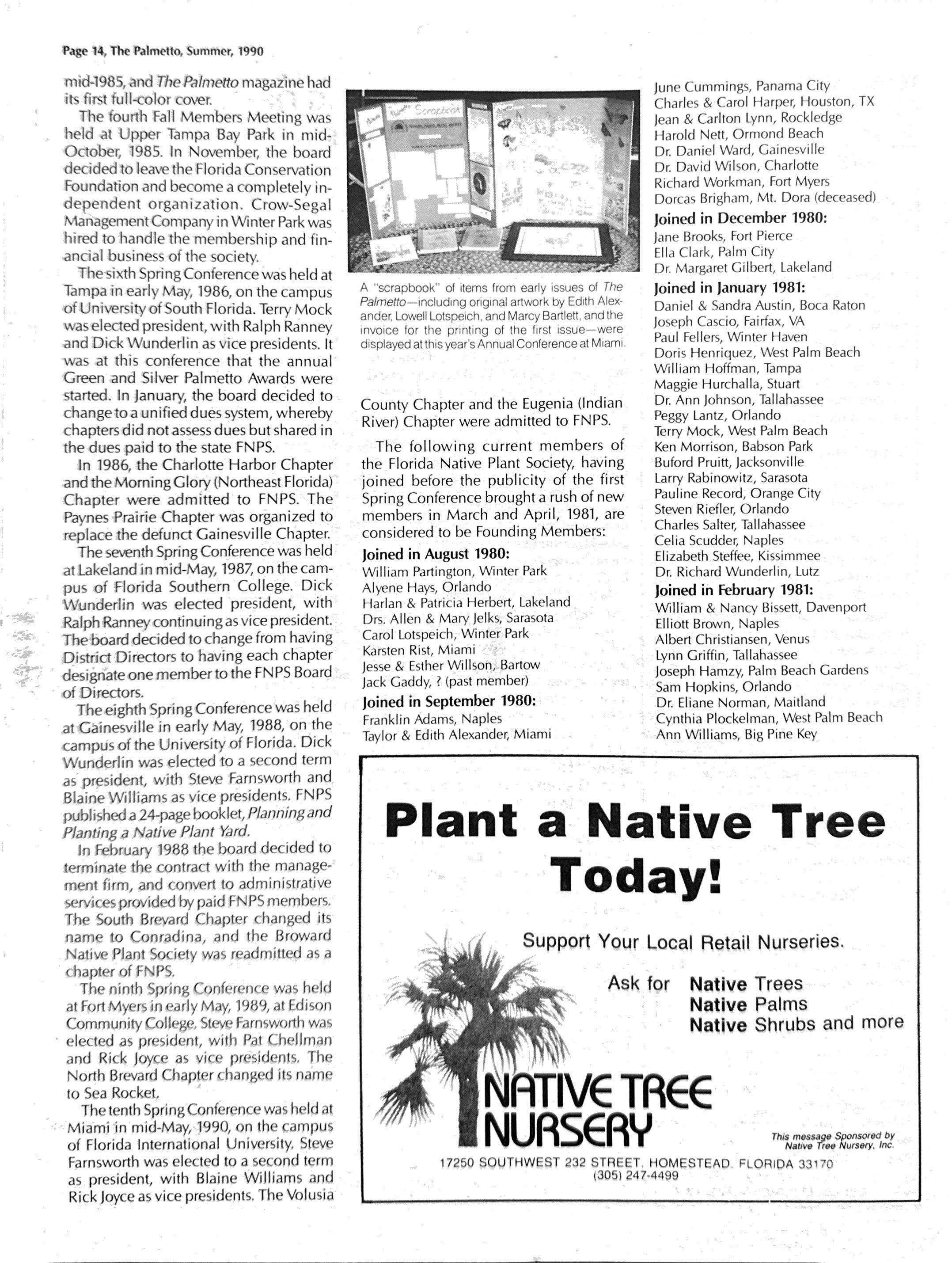
A "scrapbook" of items from early issues of The Palmetto-including original artwork by Edith Alexander, Lowell Lotspeich, and Marcy Bartlett, andthe invoice for the printing of the first issue-were displayed at this year's Annual Conference at Miami.
County Chapter and the Eugenia (Indian River) Chapter were admitted to FNPS.
The following current members of the Florida Native Plant Society, having joined before the publicity of the first Spring Conference brought a rush of new members in March and April, 1981, are considered to be Founding Members:
Joined in August 1980:
William Partington, Winter Park
Alyene Hays, Orlando
Harlan & Patricia Herbert, Lakeland
Drs. Allen & Mary Jelks, Sarasota
Carol Lotspeich, Winter Park
Karsten Rist, Miami
Jesse & Esther Willson, Bartow Jack Gaddy, ? (past member)
Joined in September 1980:
Franklin Adams, Naples
Taylor & Edith Alexander, Miami
June Cummings, Panama City
Charles & Carol Harper, Houston, TX
Jean & Carlton Lynn, Rockledge
Harold Nett, Ormond Beach
Dr. Daniel Ward, Gainesville
Dr. David Wilson, Charlotte
Richard Workman, Fort Myers
Dorcas Brigham, Mt. Dora (deceased)
Joined in December 1980:
Jane Brooks, Fort Pierce
Ella Clark, Palm City
Dr. Margaret Gilbert, Lakeland
Joined in January 1981:
Daniel & Sandra Austin, Boca Raton
Joseph Cascio, Fairfax, VA
Paul Fellers, Winter Haven
Doris Henriquez, West Palm Beach
William Hoffman, Tampa
Maggie Hurchalla, Stuart
Dr. Ann Johnson, Tallahassee
Peggy Lantz, Orlando
Terry Mock, West Palm Beach
Ken Morrison, Babson Park
Buford Pruitt, Jacksonville
Larry Rabinowitz, Sarasota
Pauline Record, Orange City
Steven Riefler, Orlando
Charles Salter, Tallahassee
Celia Scudder, Naples
Elizabeth Steffee, Kissimmee
Dr. Richard Wunderlin, Lutz
Joined in February 1981:
William & Nancy Bissett, Davenport
Elliott Brown, Naples
Albert Christiansen, Venus
Lynn Griffin, Tallahassee
Joseph Hamzy, Palm Beach Gardens
Sam Hopkins, Orlando
Dr. Eliane Norman, Maitland
Cynthia Plockelman, West Palm Beach
Ann Williams, Big Pine Key
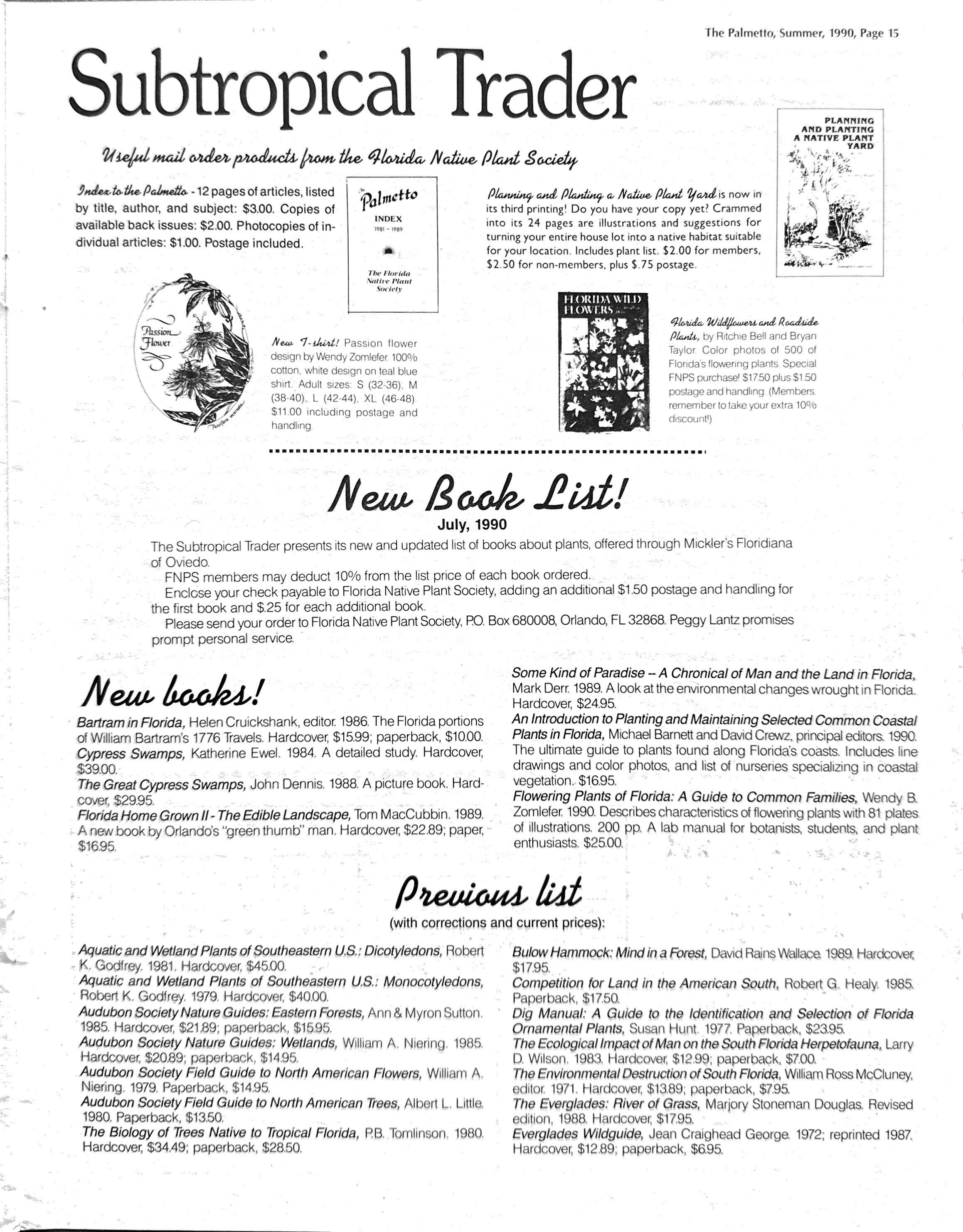
Subtropical Trader
Useful mail order products from the Harida Native Plant Society
Index to the Palmetta - 12 pages of articles, listed by title, author, and subject: $3.00. Copies of available back issues: $2.00. Photocopies of in-
Palmetto INDEX 1981 - 1989 dividual articles: $1.00. Postage included.
Flower New 7-shirt! Passion flower design by Wendy Zomlefer. 100% cotton, white design on teal blue shirt. Adult sizes: S (32-36), M (38-40),. L (42-44), XL (46-48). $11.00 including postage and handling
Planning and Planting a Native Plant Yard is now in its third printing! Do you have your copy yet? Crammed into its 24 pages are illustrations and suggestions for turning your entire house lot into a native habitat suitable for your location. Includes plant list. $2.00 for members, $2.50 for non-members, plus $.75 postage.
postage and handling. (Members. remember to take your extra 10% discount!)
New Book List!
July, 1990
The Subtropical Trader presents its new and updated list of books about plants, offered through Mickler's Floridiana
FPS members may deduct 10% from the list price of each book ordered.
Enclose your check payable to Florida Native Plant Society, adding an additional $1.50 postage and handling for the first book and $.25 for each additional book.
Please send your order to Florida Native Plant Society, P.O. Box 680008, Orlando, FL 32868. Peggy Lantz promises prompt personal service.
New books!
Bartram in Florida, Helen Cruickshank, editor. 1986. The Florida portions of William Bartram's 1776 Travels. Hardcover, $15.99; paperback, $10.00. Cypress Swamps, Katherine Ewel. 1984. A detailed study. Hardcover, $39.00.
The Great Cypress Swamps, John Dennis. 1988. A picture book. Hardcover, $29.95.
Florida Home Grown I/ - The Edible Landscape, Tom MacCubbin. 1989. A new book by Orlando's "green thumb" man. Hardcover, $22.89; paper, $16.95
Some Kind of Paradise -- A Chronical of Man and the Land in Florida, Mark Derr. 1989. A look at the environmental changes wrought in Florida. Hardcover, $24.95.
An Introduction to Planting and Maintaining Selected Common Coastal Plants in Florida, Michael Barnett and David Crewz, principal editors. 1990. The ultimate guide to plants found along Florida's coasts. Includes line drawings and color photos, and list of nurseries specializing in coastal vegetation. $16.95.
Flowering Plants of Florida: A Guide to Common Families, Wendy B. Zomlefer. 1990. Describes characteristics of flowering plants with 81 plates of illustrations. 200 pp. A lab manual for botanists, students, and plant enthusiasts. $25.00
Previous list
(with corrections and current prices):
Aquatic and Wetland Plants of Southeastern U.S.: Dicotyledons, Robert K. Godfrey, 1981. Hardcover, $45.00.
Aquatic and Wetland Plants of Southeastern U.S.: Monocotyledons, Robert K. Godfrey. 1979. Hardcover, $40.00.
Audubon Society Nature Guides: Eastern Forests, Ann & Myron Sutton. 1985. Hardcover, $21.89; paperback, $15.95.
Audubon Society Nature Guides: Wetlands, William A. Niering. 1985. Hardcover, $20.89; paperback, $14.95.
Audubon Society Field Guide to North American Flowers, William A. Niering. 1979. Paperback, $14.95.
Audubon Society Field Guide to North American Trees, Albert L. Little,
The Biology of Trees Native to Tropical Florida, P.B. Tomlinson, 1980 Hardcover, $34.49; paperback, $28.50.
Hammock: Mind in a Forest, David Rains Wallace. 1989. Hardcover, $17.95.
Competition for Land in the American South, Robert G. Healy. 1985. Paperback, $17.50.
Dig Manual: A Guide to the Identification and Selection of Florida Ornamental Plants, Susan Hunt. 1977. Paperback, $23.95.
The Ecological Impact of Man on the South Florida Herpetofauna, Larry D. Wilson. 1983. Hardcover, $12.99; paperback, $7.00.
The Environmental Destruction of South Florida, William Ross McCluney, editor. 1971. Hardcover, $13.89; paperback, $7.95.
The Everglades: River of Grass, Marjory Stoneman Douglas. Revised edition, 1988. Hardcover, $17.95.
Horida Wildflowers and Roadside Plants, by Ritchie Bell and Bryan Taylor. Color photos of 500 of Florida's flowering plants. Special FNPS purchase! $1750 plus $1.50
Bulow
Page 16, The Palmetto, Summer, 1990
Ferns to Know and Grow, J. Gordon Foster 1984. Hardcover, $29.95.
Field Guide to Edible Wild Plants, Lee Peterson. 1978. Hardcover, $17.95; paperback, $12.95.
Field Manual of the Ferns and Fern Allies of the United States and Canada, David B. Lellinger. 1985. Hardcover, $45.00; paperback, $21.95.
Florida Critters, Bill Zak. 1986. Hardcover, $17.95.
Florida Home Grown: Landscaping, Tom MacCubbin. 1987. Hardcover, $13.89; paperback, $7.95.
paperback, $12.95.
Florida, My Eden: Exotic and Native Plants for Use in Tropic and Subtropic Landscape, Frederic B. Stresau. Reprinted 1986. Hardcover, $25.89; paperback, $19.95.
The Florida of John Kunkel Small: His Species and Types, Collecting Localities, Bibliography and Selected Reprinted Works. Contributions from the New York Botanical Garden, Volume 18, Daniel F. Austin, et al. 1987. Hardcover, $40.99; paperback, $35.00
Florida Parks: A Guide to Camping in Nature, Gerald Grow. Revised 1989. Hardcover, $18.89; paperback, $12.95.
Florida's Poisonous Plants, Snakes, Insects, Lewis Maxwell. 1986 Paperback, $5.00.
Growing and Propagating Wildflowers, Harry R. Phillips. 1985. Paperback, $14.95.
Guide to the Vascular Plants of Central Florida, Richard P. Wunderlin. 1982. Hardcover, $32.00
Guide to the Vascular Plants of the Florida Panhandle, Andre F. Clewell. 1985. Hardcover. $30.99; paperback, $25.00.
Managing Cumulative Effects in Florida Wetlands - Conference Summary and Executive Summary, E.D. Estevez. 1986. Paperback, $20.00/set.
Manual of the Trees of North America, Vols. I & II, CharlesS. Sargent. 1965 Paperback, $7.95 each.
Manual of the Vascular Flora of the Carolinas, Albert E. Radford. 1964. Hardcover, $24.95
Marshes of the Ocean Shore: Development of an Ecological Ethic, Joseph V. Siry. 1984. Hardcover, $18.89; paperback, $12.95. Mosses of the Gulf South, William D. Reese. 1984. Hardcover, $30.00. The Native Orchids of Florida, Carlyle A. Luer. 1972. Hardcover, $24.98. Natives Preferred, Caroline Dormon. 1965. Hardcover, $12.50.
Native Trees and Shrubs of the Florida Keys, J. Paul Scurlock. 1987. Hardcover, $42.89; paperback, $36.95.
A Naturalist in Southern Florida, Charlotte Orr Gantz. 1971, reprinted 1982 Hardcover, $15.95
Plants Poisonous to People, Julia F. Morton. 1982. Hardcover, $25.89; paperback, $19.95.
Rare and Endangered Biota of Florida: Fishes, Peter C. Pritchard. 1978 Hardcover, $12.99; paperback, $7.00
Rare and Endangered Biota of Florida: Invertebrates, Peter C Pritchard. 1982. Hardcover, $15.99; paperback, $10.00.
Rare and Endangered Biota of Florida: Plants, Peter C. Pritchard. 1979. Hardcover, $17.89; paperback, $11.95.
The Smithsonian Guide to Seaside Plants of the Gulf and Atlantic Coasts from Louisiana to Massachusetts, Exclusive of Lower Peninsular Florida, Wilbur H. Duncan. 1987. Hardcover, $35.89; paperback, $29.95
The Swamp, Bill Thomas. 1976. Hardcover, $29.95
Travels of William Bartram, Mark Van Doren. 1928. Hardcover, $12.89; paperback, $6.95.
Trees of Northern Florida, Hurman Kurz. 1962. Hardcover, $21.89 paperback, $15.95.
Trees of the Everglades National Park and the Florida Keys, George B Stevenson. 1986. Hardcover, $8.49; paperback, $2.50
Trees of the Southeastern United States, Wilbur H. Duncan. 1988 Hardcover, $19.95
Tropical Flowers of Florida, Elsie F. Friedrich. 1989. Hardcover, $9.89; paperback, $3.95.
Twenty-six Ecological Communities of Florida, Florida Chapter, Soil Conservation Society of America. Revised 1987. Paperback, $29.95. Water Resources Atlas, Edward A Fernald. 1984. Hardcover, $29.50. Wild Plants for Survival in South Florida, Julia F. Morton. 1974. Hardcover, $13.89; paperback, $7.95
Wilderness Florida, Robert Anderson. 1989. Hardcover, $20.89; paperback, $14.95.
Wildflowers, Richard Parker. 1986. Hardcover, $13.89; paperback, $7.95
Wildflowers of the Southeastern States, Wilbur H. Duncan. 1975. Hardcover, $17.95
The Wonder World of Our Wild Plants, Carol Beck. Spiralbound paperback, $5.00
Your Florida Garden, John V. Watkins. 1954, revised 1986. Hardcover, $16.89; paperback, $10.95.
serenoa repens
SOCIETY BUSINESS
ANNUAL MEETING
May 11, 1990
Florida International University, Miami
The 1991 meeting of the FNS general membership was held on May 12 at the Spring Conference at FIU in Miami. The slate of officers and directors presented by the nominating committee for the fiscal year May 1990 - May 1991 was unanimously elected. They are:
President: Steve Farnsworth
1st Vice President: Blaine Williams
2nd Vice President: Rick Joyce
Secretary: Debbie Butts
Treasurer: Carol Lotspeich
Directors: Joseph Durando, Joseph Lawson, Richard Workman. It was announced that the 1991 Annual Conference and General Meeting would probably be in Orlando, the exact date, time, and location to be announced later.
BOARD OF DIRECTORS MEETING
Executive Director: Bob Craig announced that two new chapters, Volusia (County) and Eugenia (Indian River County), had filed applications; they were approved by the Board. FNPS members in Pinellas County have met and are in the process of forming a new chapter. There is also some activity by Lake County members toward forming a new chapter.
Membership: Don Lantz reported that FNPS had 1647 memberships, including 84 organizational members, which translates to about 2200 people. 1900 copies of the Spring, 1990, issue of The Palmetto were printed, of which 1724 were bulk-mailed. The number of new members received in one month set records in both March and April.
Treasurer: Peggy Lantz reported that the FNPS bookkeeper said that there was over $12,000 in the bank account around May 1.
Committees: Publications: The Native
Plant Yard booklet is going into its fourth printing, which will be paid for out of the Publications Fund. The butterfly booklet is being worked on and should be ready by Fall.
Committees: Membership: The board approved another annual membership mailing to past members, to be made in June/July to about 400 selected people. Past results indicate that such mailings repay their expenses.
Sharron Richards has moved out of Florida, and the Morning Glory Chapter is probably defunct. Don Lantz offered to write to all Morning Glory members requesting volunteers to reorganize the
Old Business: The Board decided that revising and reprinting the membership directory was not financially practical. A motion was passed to offer a roster of their chapters current members to any member that requests it and sends a self-addressed, stamped envelope; the costs for these rosters will be paid by FNPS.
New Business: The Tarflower Chapter has expressed interest in hosting the 1991 Spring Conference. They are expected to make a commitment before the next board meeting in August.
PALMETTO AWARD WINNERS
The Palmetto Awards were initiated in 1986 by FNPS president Sherry Cummings to honor those of our membership who have contributed in outstanding ways to the Society.
Two Green Palmetto Awards are given to members, selected by the board of directors but not on the board, whose service extends beyond the scope of a single chapter in areas of Science, Education, Information, and Service/Administration.
One was awarded to Rosa Durando for being the environmental watchdog on the Treasure Coast, attending governmental meetings and speaking out for conservation.
The other award was given to Ted Center for his work on the biological control of
The Palmetto, Summer,
exotic pest plants, and especially for spearheading the Melaleuca Biological Control Project.
The Silver Palmetto Award is presented to a board member, selected by the president, who has given special service to FNPS during the year. This year's award was given to Blaine Williams for his services as treasurer, and his efforts toward improving the financial management of the society.
LANDSCAPING AWARD WINNERS
The second annual presentation of Landscape Awards was made at the Annual Spring Conference in Miami. These awards are offered for projects landscaped with native plants that are submitted by FNPS chapters. Categories include residential, institutional, and commercial.
The overall winner was the first place project in the Commercial category: Post Cove, an apartment complex submitted by the Volusia County Chapter. The designer/ installer was Post Landscape, and the owner/developer was Post Properties.
Bill Bissett, FPS Landscape Committee chairman, says that this is the best example of natural landscaping by a commercial developer in the state of Florida. No natural vegetation was disturbed more than five feet away from the walls except for parking spaces and walkways. Of the 14 acres, only 10,000 square feet (equal to an area 100' by 100) was sodded. Post Properties says that the maintenance costs per acre are 1/3 lower on Post Cove than at any of their other developments.
The first place winner in the Residential category was the home of Cathy and Henry Block, submitted by Dade Chapter. The designers were Peter Strelkow & Associates and Henry Block. Ecohorizons was their consultant.
Second place was won by James and JoAnne Sammons, submitted by Heartland Chapter. William F. Bissett, L.A., was the designer, and The Natives was the contractor.
Third place was won by Hidden Lagoon, owned by Wadnor/Hidden Lagoon Corp.,
SAVE-ON-PLANTS NURSERY.IVC.
JOYCE AND DON GANN
Page 18, The Palmetto, Summer, 1990
submitted by Coccoloba Chapter. The designer/consultant was Margaret L. Fritts.
In the Institutional category, first place was won by Pine Jog Environmental Education Center, owned by Florida Atlantic University, and submitted by Palm Beach Chapter. The designer/consultant was Joseph P. Lawson.
Second place went to Crystal Springs Park and Recreation Preserve, submitted by Suncoast Chapter. Mike Callahan, A.S.L.A., designed it, and Brightman Logan, Central Florida Native Flora, was the consultant/ contractor.
In third place was Limestone Creek Elementary School, submitted by Palm Beach Chapter. The designer was Team Plan, Inc., and the contractor was Moesly Nurseries.
Post Cove, the overall winner, was the only entry in the Commercial category.
ORGANIZATIONAL MEMBERS
The Florida Native Plant Society recognizes those firms and others who take Organizational Memberships by acknowledging them in The Palmetto. FNPS sincerely appreciates the extra financial support provided by these groups.
The following are Organizational ($50) memberships which were renewed or have joined in the latest quarter. This quarter we have an unprecedented 29 Organizations
Apopka City Parks Dept. (Mark Miller), Apopka
Aqua-Terra Services, Inc. (Elizabeth Heidt), Seffner (Suncoast)
Bonita Bay Properties (Steve Trudnak), Bonita Springs (Coccoloba)
Brad Smith Associates, Inc., Melbourne (Conradina)
Butterfly World** (Ronald Boender), Coconut Creek (Broward)
Butterflys Are Free Nursery (Cline & Henry), West Palm Beach (Palm Beach) City of Coral Springs (Joann Phillips), Coral Springs (Broward) Coastplan, Inc. (Richard Workman), Fort Myers (Coccoloba)
Darryl Brown Associates** (Robert Mitchell), Miami (Dade)
Senior Adult Fellowship, First United Methodist Church**, Coral Gables (Dade)
Florida Keys Native Nursery* (Donna Sprunt),
Florida Natives Nursery (Judy & Patrick Milam), Odessa (Suncoast)
Forestry Resources, Inc. (John Cauthen), Fort Myers (Coccoloba)
Gardinier, Inc.* (Joyce Bode), Fort Meade
GOALS FOR FNPS
During the Tenth Annual Conference, members and other attendees participated in an open meeting to offer suggestions for the improvement of the Florida Native Plant Society. Many of the ideas presented are beyond the personal and/or financial capabilities of our small society, but all will be discussed by the board of directors in an effort to implement some of them.
Here are most of the suggestions offered: ? FNPS should notify chapters of pending state legislation that needs local attention.
? FNPS could offer marketing gimmicks and prizes to attract new members. ? FNS should identify land needing preserving, and agitate for state purchase.
? Perhaps the conference should be held prior to the legislative session, so
S.W. Fla. Water Management District- Land Resources** (Kevin Love), Brooksville (Suncoast)
Terra Systems, Inc. (T J Coburn), Winter Haven (Heartland)
K. Terrance Mock & Co, Inc., West Palm Beach (Palm Beach)
* Regular member now is Organizational
** Organizational member is new to FNPS FNPS also wishes to acknowledge the following Supporting Members, whose generous contributions of $100 are most gratefully appreciated:
Judith Buechner of Hobe Sound (Martin
Central Florida Native Flora (Brightman S. Logan), of San Antonio (Suncoast Chapter).
Diane Pierce & Skip Huxtable of Bonita Springs (Coccoloba Chapter).
Margaret G, Rogers of Daytona Beach (Volusia Chapter).
Betty J. Suter of Jensen Beach (Martin Chapter),
that information on legislative issues could be disseminated while there is still time for membership letter-writing campaigns, etc.
? FNPS could organize a telephone "hot-line" to deal with immediate legislative concerns.
? It was suggested that FPS offer Science Fair awards for native plant experiments, or work with Scouts on badges.
? Chapters could run retail nurseries.
? It was suggested that FNS broaden its education outreach to blacks, hispanics, orientals, and Native Americans.
? FNPS needs to attract more public attention by taking on native planting projects, sending out news releases, getting in the newspaper.
? FNPS should lobby the legislature to get the same status for endangered plants as endangered animals have (plants "belong" to the landowner, while animals "belong" to the public).
? FNPS should buy five acres and restore it.
? FNPS members should attend comprehensive planning meetings as representatives.
?S member should watchdog" agencies.
? FNPS should make a videotape or slide show for public broadcasting, or for schools.
? FNPS should coordinate joint conferences with other environmental organizations.
? Each chapter should have a conservation chairperson to be the "watchdog" for the area and coordinate with other FNPS chapter conservation chairs.
? FNPS should participate in the establishment of a national affiliation of native plant societies.
? FNPS should draw up a model ordinance for landscaping with native plants.
? It was requested that The Palmetto reprint FPS' goals as outlined by Reed Noss, 1985-87 conservation chairman, and published in the Summer 1986, Palmetto.
? Peggy Lantz
COLLOWHEE CONFERENCE
The "Landscaping with Native Plants" Conference at Western Carolina University in North Carolina will be held July 26, 27, and 28. Call Sue DeBord at Continuing Education, 704/227-7397, for more information.
LIBRARY MEMBERS
A year ago FNPS decided to offer Library Memberships for $10 to qualified organizations who only wanted The Palmetto magazine. At this time there are only nine Library members, and most of those were already members and have converted to the new rate. Some are out-of-state botanical gardens, etc. (New York, Brooklyn, Missouri, New England Wildflower); and some are in-state libraries (Orange County, Selby in Sarasota, Olin at Rollins College, Polk Community College).
The purpose of the Library rate is to encourage and promote the placing of The Palmetto in many public libraries throughout the state. The desired result is to expose more people to the ideas about Florida native plants, who would then use them, and help protect them -and perhaps even join FNPS.
But it is apparent that for this to work as intended, something more must be done. Members of FNPS throughout the state should contact their local libraries and encourage them to join FNPS as Library members. An alternative is for local chapters to donate the money to purchase one or more Library memberships for their area libraries, or for individual members to pay for such Library memberships.
However it is accomplished, getting The Palmetto into many more public libraries of Florida is a worthwhile effort, both for native plants and for FNPS.
? Don Lantz
788 North S.R. 434 - Suite 102 Altamonte Springs, FL 32714 (407) 869-9019
CHAPTER NEWS
PROSPECTIVE CHAPTERS
Several groups of FNPS members around the state are in the process of organizing new chapters in their area. If you are interested in these efforts, and want to help or comment on them, here are the people to contact:
Citrus/Hernando Counties: Robert Dudley, P.O. Box 1235, Inverness, 32651; 904/344-2351.
Looking at the above, and recalling that the new Eugenia Chapter was organized primarily by Peggy Brinson and Janice Broda, one is forced to conclude that to start a new chapter one should be a woman whose last name begins with the letter "B". Mr. Dudley, how did you get in here? | suggest you seek the help of Frances Brown of Brooksville! ? Don Lantz
SEA ROCKET
Naida Loudon of the Sea Rocket Chapter in North Brevard County has published a 22-page book, 8"x14" in size, of the Native Plants of North Brevard. The front and back covers are filled with drawings of 108 flowers, leaves, and plants. Listings include the family, botanical name, common name, descriptive comments, habitat, and its frequency. What an accomplishment!
TARFLOWER
The Tarflower Chapter had a busy spring. In February, we presented the first annual special category awards at the 1990 Orange County Regional Science and Engineering Fair. Awards were given to the best science projects using native plant materials. First place winners received a $50 U.S. Savings Bond, and all six winners received ribbons and a years complimentary subscription to the Tarflower newsletter. In March, similar awards were presented for projects on native plants at the Seminole County Regional Science Fair.
Leu Gardens Spring Lawn and Garden Show in March was a big success for us. Our booth totaled nearly $3000 in native plant sales. At the same time we were able to promote FNPS.
On April 22, we celebrated Earth Day with a booth at Mead Gardens, and added several new people to our membership. On April 28, Earth Day was observed at Wekiwa Springs State Park, where our chapter sponsored a booth, and Dick Deuerling, Tarflower's eminent wild food specialist, offered wild teas and jellies to visitors. Poor Dick never had a chance to eat lunch because he was so busy feeding everyone with his wonderful native edibles. He was such a success that he even made it on the evening news on TV.
Our field trips are always well attended and lots of fun. In April we went to the Lighter Knots Hunting and Fishing Club property near Daytona for a picnic. In May we did a plant survey at the DMK Ranch near the Lower Wekiva River Reserve. In June we explored Spring Hammock near Lake Jessup with Dr. Jose Godts.
Our section of Leu Gardens looks better than ever because of the many members who show up for "groomings". These we combine with potluck lunches where we visit with other local plant and garden clubs and enjoy good food. We have plans to enlarge the garden and show off an even wider array of native plants to the visitors of Leu Gardens.
NATIVE GREEN CAY
P.O.
MICHAEL JAMESON SYLVIA WINSBERG (407) 496-1415 ? 499-7065
Rte 1 Box 331 B Boynton Beach, FL. 33437 (All Messages Are Promptly Returned)
The Palmetto is printed on recycled paper.
Page 20, The Palmetto, Summer, 1990
A Green Carpet In The Biosphere
by Richard Moyroud
If one looks at any area of land not covered by permanent ice, species of grasses are likely to be present. Some species, with the help of human activity, have spread far beyond their native ranges to become staple food crops, ornamentals, or - the incarnation of the gardener's nemesis ? a weed! Because grass seed is small and often has barbs, unintentional introduction has been the rule while animals have roamed the earth. We humans have accelerated the process with ships and airplanes.
More than half of the world's population is fed by one small semi-aquatic grass cultivated since antiquity - rice (Oryza sativa). Our own Western economy is heavily dependent on a handful of grass species for direct or indirect consumption. These include wheat (Triticum spp.), corn (Zea mays), and oats (Avena sativa).
Among ornamentals, many of the typical lawn grasses in temperate North America were introduced from Eurasia. Most surprising of these is "Kentucky" bluegrass. Our commonly used St. Augustine grass (Stenotaphrum secundatum) has an obscure history, and is doubtfully native.
As might be expected, many introduced grasses have become pest plants. Pampas grass (Cortaderia selloana) is a designated pest plant in southern California. A number of introduced forage grasses have become serious
pests in Florida. Johnson grass (Sorghum halepense) is one such pest plant introduced from Africa. Some species are pests in garden situations, but may prevent erosion in other places; the aggressive torpedograss (Panicum repens) is one such plant.
Some of our native species have become popular ornamentals in their own right. Foremost of these is Tripsacum dactyloides, commonly called gama grass and found throughout eastern North America. Enterprising Florida nurseries have capitalized on the intriguing, but fabricated, common name, Fakahatchee grass. The related Tripsacum floridanum is a Florida endemic, and resembles a miniature version of T. dactyloides.
Other native species being prop-
agated are: Purple-flowered muhly grass (Muhlenbergia capillaris), a fine-leaved clump grass with feathery purple flower spikes throughout the fall; Lopsided Indian grass (Sorghastrum secundum; Wild bamboo (Lasiacis divaricata); Cordgrass (Spartina species); and even wiregrass (Aristida spp.). As more species become recognized and used in new plantings, our landscapes will reflect more of Florida's own carpet of green, from wiregrass under pine canopies to wet prairies inland and sea oats on coastal dunes. Plant some grasses today and add to the real wallto-wall outdoor carpet.
from The Dahoon Palm Beach County Chapter
Native Plant Nursery and Unique House on Pine Island
Great Business Potential in a Tropical Setting
An established firm specializing in quality grown and salt tolerant native plant material in an active and growing coastal market. Pine Breeze Nursery encompasses ten beautiful acres with many mature mango and citrus trees located on tropical Pine Island in the Gulf of Mexico. A charming, newly renovated two bedroom, two bath old Florida style house, barn, propagation house, modern irrigation system and all equipment are included for only $250,000 plus stock.
The property is being offered by Harald and Anna Riehm, Realtor Associates, Islands Realty Inc., P.O. Box 488, Matlacha, Florida 33909 Tel. 813/283-1100 or 283-3731 after hours.