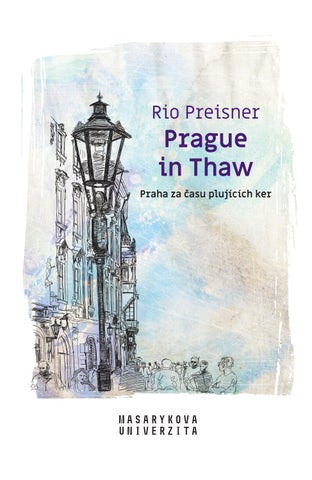

Rio Preisner Prague in Thaw
Praha za času plujících ker
RIO PREISNER PRAGUE IN THAW
PRAHA ZA ČASU PLUJÍCÍCH KER

RIO PREISNER PRAGUE IN THAW
PRAHA ZA ČASU PLUJÍCÍCH KER
Translated by Charles S. Kraszewski
Foreword by Jiří Hanuš
Afterword by Charles S. Kraszewski
Masaryk University Press Brno 2025
© 2025 Ruth Preisner Quinlan
© 2025 Translation Foreword Štěpán Kaňa
© 2025 Foreword by Jiří Hanuš
© 2025 Afterword by Charles S. Kraszewski
© 2025 Layout and illustrations by Beata Korbačková
© 2025 Masarykova univerzita
ISBN 978-80-280-0788-1 (online ; pdf)
ISBN 978-80-280-0787-4 (hardback)
Publisher ’ s acknowledgements
The book is being published on the occasion of the 100th anniversary of Rio Preisner’s birth (1925–2007).
The poet’s daughter, Mrs. Ruth Preisner Quinlan, provided tremendous support for the publication of this book.
We owe her a debt of gratitude.
We would also like to thank Prof. Charles S. Kraszewski and Prof. Jiří Hanuš for their inspiration for this bilingual edition.
Preisner: Even the Czech Lyre Succumbed to the Jacobin Metre By
Jiří Hanuš
Dürer’s Ritter, not Orpheus: Rio Preisner Returns to Prague… and Leaves Again By
Charles S. Kraszewski
Foreword
Rio Preisner: Even the Czech Lyre
Succumbed to the Jacobin Metre
Jiří Hanuš
When our Brno publishing house released a collection of poems in 2013 (previously included in Proglas and Kontexty magazines since 1989), edited by my colleague and friend František Mikš, he gave it the title Co zůstává: malá antologie soudobé české poezie [What Remains: A Little Anthology of Contemporary Czech Poetry]. For every author, this is an essential, existential question. What remains of those who dedicate themselves to writing? It hardly matters whether they produce poems, novels or philosophical treatises. It is an interesting question, not least because it has been addressed by giants of Czech and international culture (including F. X. Šalda). It can be answered in two ways — both are essentially optimistic, although the first makes certain assumptions. The first says that quality texts endure, though these might be few and far between. The assumption is that there is a criterion of evaluation and quality, which, likewise, is expected to be permanent, to endure. Strange though it may seem, this assumption works in practice, but only to a certain extent. Karel Hynek Mácha’s May has been considered a first-rate work for nearly two centuries (despite
the fact that it is often featured in reading-books!), while works by other Czech Romantics have become so outdated and stale that no matter what waves of enthusiasm for Romanticism are yet to come, they are unlikely to be revived. The fact that people no longer read May or various other Czech poems of the National Revival period is a separate issue. The second, just as optimistic, option does not assume any criterion of value but rather emphasises the durability of material that will not yield — as the old saying goes — to fire or sword. Here we encounter the interesting phenomenon of the disobedient literary executor. For example, thanks to Max Brod, who refused to obey the wishes of his friend Franz Kafka and did not burn Kafka’s life’s work, generations of future readers have been, and will continue to be, enabled to rack their brains over Kafkaesque allegories and parables. Certainly, manuscripts can succumb to fire, and we can imagine some kind of technological blackout or computer virus that might, for example, erase all post-modern poetry from the world’s servers — an apocalyptic vision that could well inspire a good many new (!) literary works. And so on ad infinitum. But setting that aside, the question can be put in concrete terms: What remains of the works of a particular author, in our case, the very varied body of texts by Rio Preisner, who was born in Subcarpathian Rus in 1925 and died in Pennsylvania in 2007?
First of all, we must admit that Preisner is not an author who has remained in the public consciousness. He is known by a few Germanists and literary scholars, as well as a handful of conservative and Christian intellectuals in Czechia who could be counted on two hands at best. Even
should we add collectors of early émigré publications and fans of any anti-communist literature, we might reach a total of 50 readers at most. That is not many — despite the fact that Preisner was a remarkable, original, and very industrious author who devoted his entire professional life to literature and original composition. (I leave aside here his translations from German into Czech, which are also outstanding but not exactly bestsellers.) We may expect his three large, original works to survive: his philosophical, historical and theological fragments, brought out in a comprehensive edition as Kritika totalitarismu [A Critique of Totalitarianism; CDK 2020], his studies of German literature collected under the title Když myslím na Evropu [When I Think of Europe; Torst 2003, 2004] and his Americana (Atlantis 1992, 1993), a Tocquevillian treatise on America for Central Europeans in the late 20th century. This is an estimate of these works’ survivability according to the value criterion, one that is subjective and dubious in character, because, it could be objected, it is only my opinion. And since I have mentioned Alexis de Tocqueville, a liberal author of the first half of the 19th century who admired democracy while also warning of its obsession with the principle of equality, it may be that Preisner’s works will share the fate of Tocqueville’s, in the sense that he will be entirely forgotten and only read again 120 years after his death — with tremendous interest and to critical acclaim.
But what about Preisner’s poetry? Almost all of it was published under the simple title Básně [Poems; Torst, 1997] with a fine afterword by Ivan Slavík, a Czech Catholic poet who has also drifted away from the consciousness of younger
readers. Preisner’s poems are heavy reading, even for those used to the genre. The volume includes seven collections and stand-alone poems as well as some translations of poetry by Paul Celan, Friedrich Holderlin, T. S. Eliot and other poets dear to his heart. Preisner’s collected poems were carefully edited by none other than Jan Šulc, who — perhaps it can now be said — had a hard time publishing Preisner’s works. Yet published they were, so Czech readers do not have to patronise second-hand bookshops or wait for the doors of Libri prohibiti, the library of Czech exile literature, to open. They can just sit down and start reading.
For Preisner, poetry was a life-long struggle. Although he devoted a great deal of attention to it (seven collections is an impressive total), he knew that his metier was something else. And yet he could not stop himself from his poetic pursuits. I believe that this struggle was kept in motion by his lifelong friendship with the poet Ivan Diviš (1924–1999), one of the most talented Czech lyricists of the second half of the 20th century. Preisner constantly measured himself against Diviš and was well aware that the muses had not granted the two men equal talents. This could be dismissed as undue modesty — yet that is how he recorded it in his diaries. He considered Diviš a poet by the grace of God, and tested by God by various sicknesses and sufferings. Certainly, this was a central element of Preisner’s spiritual world: a Christian vision, according to which Christ redeemed the world by dying in pain on the Cross in the presence of the mocking crowd, ignored by the indifferent powerful. Still, despite Preisner’s self-awareness of his inadequacy compared to Diviš, his poetry can be rated highly.
It is, first of all, writing that provides a very personal guide to its author’s life story. There are exceptional poems from his childhood in Uzhhorod (which are my favourites), the mostly experimental poems written during the promisingly creative yet somewhat confused 1960s, and the later works — some full of an émigré longing for home and others full of bitterness for the post-communist legacy, beginning with the years following 1989, when Preisner occasionally returned to Prague, but never to stay. In his poetry, Preisner captured the long-lost world of the little people including the Jewish community in Zvíře dětství [The Animal of Childhood], the Kafkaesque atmosphere of Prague in Kapiláry [Capillaries], a topic he returned to repeatedly, including its post-1968 ‘normalisation’ period in Praha za času plujících ker [Prague in Thaw]. But above all his poetry expresses his thinking about fallen human nature, the communist paradise on Earth, the loss of authentic Christianity and the general decay of the era in which he lived that had, he was convinced, a spiritual cause. If his fragments are the ‘bloody lumps of this era’, so similarly are some of his poems, only expressed in a different form:
The timelessness of the genocides began. The theologian aborted the emerging god anointed in a Finnish sauna in the name of the father of progress, the whore of utopia and the spirit of dialectics amen. The new man proudly measured the length of his coccyx. In the omega dungeon the Gallic goat stank. The cloaca of liberation, Semperaperta,