fissionline 77

Page 1


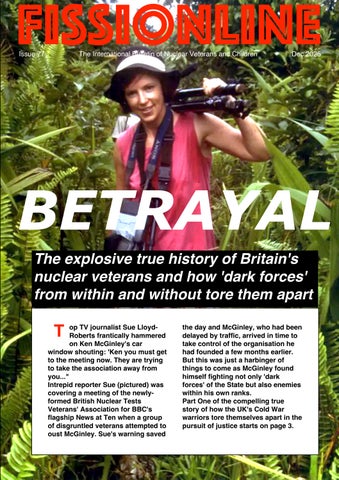
FISSIONLINE BETRAYAL

The explosive true history of Britain's nuclear veterans and how 'dark forces' from within and without tore them apart

Top TV journalist Sue LloydRoberts frantically hammered on Ken McGinley's car window shouting: 'Ken you must get to the meeting now. They are trying to take the association away from you..."

Intrepid reporter Sue (pictured) was covering a meeting of the newlyformed British Nuclear Tests Veterans' Association for BBC's flagship News at Ten when a group of disgruntled veterans attempted to oust McGinley. Sue's warning saved

the day and McGinley, who had been delayed by traffic, arrived in time to take control of the organisation he had founded a few months earlier.

But this was just a harbinger of things to come as McGinley found himself fighting not only 'dark forces' of the State but also enemies within his own ranks.

Part One of the compelling true story of how the UK's Cold War warriors tore themselves apart in the pursuit of justice starts on page 3.

FISSIONLINE

was outraged to see on Youtube a nuclear veteran pleading with the prime minister for a meeting "Pathetic" is the way I described it, believing it should be the government going cap in hand to the veterans rather than the other way round. For that I have been criticised by some veterans. "What's fissionline ever done for the veterans?" was the cry. They rightly pointed out that they had achieved some progress to redress the injuries veterans undoubtedly endured by witnessing nuclear bomb tests The original nuclear veterans association achieved some pensions and some legal rights; the charity following managed to grab ÂŁ5million charity cash from the government's Aged Veterans Fund, while the latest incarnation of veterans' representatives have managed to get a medal for the veterans, money for social events, and funds to set up a museum These are undoubted achievements and one in which all the various groups are justly proud But in defence of fissionline, we have only campaigned for two things:

1: An apology to servicemen injured by radiation, and

2: Proper compenation for the men and their descendents '

'Say sorry and pay up ' was our mantra, and we stick by that now. We believe that if this simple demand had been adhered to from the beginning, justice would have been achieved by now Instead we have had a fandango of incremental minor successes which the government will undoubtedly use to justify not paying compensation.

Fissionline was started in late 2012 by three people: BNTVA founder Ken

McGinley, Roy Sefton, chairman of the New Zealand Nuclear Test Veterans Association and Journalist and author, Alan Rimmer We wanted to give a voice to nuclear veterans everywhere, a voice that was eerily absent in the mainstream media and even in the veterans own journals. We believed, and still do, that nuclear veterans were 'special' because of the special nature of the service they gave. Injuries to both themselves and their children were unique and required a unique response from the government. Over the years we have amassed a powerful archive of material that proves beyond any reasonable doubt that the UK government was at best criminally negligent in the way nuclear servicemen were exposed to unacceptible levels of radiation. In exposing this truth we have come up against all manner of obstacles not only from governments, but also from within the ranks of the veterans themselves, some of whom seemed determined to spend their time fighting among themselves

The story of the nuclear veterans' fight for justice is a modern-day parable of high politics and low ideals. A shameful catalogue of secrecy, lies and coverups. But it is also an all-too human odyssey of backbiting, avarice, jealousy and naked ambition all fused together in an explosive psychological mix as devastating as the nuclear weapons the veterans were forced to witness.

I was there from the beginning and I hope my chronicle of those events will help in the understanding of what I believe to be the most important events in history.

BETRAYAL

Alan Rimmer PART ONE

Windswept and dishevelled, Ken McGinley rushed into the back room of a small hotel in Brighton just as the man who wanted to take over was calling for order. There were 59 people crammed into room, all talking at once, all with a story to tell. There were widows brandishing photo albums, mothers holding tear-stained letters and angry fathers with sad mementoes of sons lost to cancer. And then there were the veterans themselves Men cut down in the prime of life. All with variations of the same story: mighty explosions, mushroom clouds, tropical lagoons, scorching deserts And all talking of sicknesses in its grimmest forms. All angry and excited and wanting their voices to be heard

Into this frentic melee rushed McGinley after being warned by Sue Lloyd-Roberts a powerful TV journalist who had broken the story of the plight of Britain's Cold War warriors to a shocked nation. It was Sue after meeting McGinley, who forced the government to confront the consequences of its sinister past. In a powerful documentary on BBC's Nationwide programme she told how many of the thousands of young servicemen, exposed to radiation during 1950s nuclear bomb tests in the Pacific and Australia, were now suffering from leukaemia and other cancers Sue had grown to admire McGinley, a former Army Sapper who had witnessed five nuclear explosions on Christmas Island in

1958. And she was shocked when a small but vociferous group of veterans, led by a former Army sergeant major named Tom Armstrong, attempted a coup. Taking advantage of McGinlery's absence, Armstrong called for a new committee to be elected with himself as chairman, but was cut off as McGinley entered the room. Armstrong, burly, bespectabled, with a shock of dark hair and a Charlie Chaplin moustache glowered at McGinley sullenly. But McGinley, small and wiry, brushed him aside. The hubbub subsided as McGinley rose to his feet and called for order. Armstrong stubbornly remained slouched beside him, his eyes boring into the back of McGinley's head as Sue Lloyd Roberts surrounded by a gaggle of veterans ordered the camera to be turned on.

Armstrong (left) with McGinley at Brighton and (below) Sue Lloyd Roberts talks with a veteran's widow

The air was thick with tension as McGinley spoke, his thick Glasgow accent, sounding incongruous in the quintesentially English hotel with its net curtains and chintz furnishing.

However, he was a natural orator and the crowd fell silent. He told them about the work of Dr Alice Stewart, a renowned epidemiologist and scientist Tom Sorohan They had some very encouraging news about an early survey being conducted at Birmingham University into leukaemia cases among the veterans.

This had already shown that cases of the blood disease among the veterans was very much higher than the general population. And the numbers were growing daily as more and more veterans came forward.

There were bursts of applause at each statement, and murmurs of approval greeted each announcement. The only ones not applauding were Armstrong and his little cohort who sat in stubborn silence refusing to engage in the excitement.

Sue was puzzled. What was wrong with them? This was a question she managed to put to Armstrong during a break in proceedings; she didn’t really get an answer except some vague talk of ‘feelings.’ He didn’t 'f McGinley was up to His rank (he was just service private) seem grate with him. Arms to think the associati by an officer.

Sue was not impresse Armstrong that he sh McGinley and suppor pointing out that law MPs and even high-ra the armed forces fou likeable even.

Sue had been the firs reporter to recognis and thought the vete McGinley was the be would ever have of g and justice.

Professor Alice Stew

Birmingham university was another fan. She was a very well respected scientist and epidemiologist who gained international fame by exposing the dangers to unborn babies from X-rays received by their mothers

The early results from her investigations into the nuclear veterans had rattled the Government who quickly ordered an epidemiological study into the health of the veterans. A defence spokesman said this would take two years and that everyone should calm down and wait for the results.

To loud applause, McGinley told his audience he was not prepared to wait five minutes. Action was needed. Now! The meeting broke up to wild applause and the resulting News at Ten bulletin fronted by Sue Lloyd-Roberts garnered widespread support for McGinley's growing organisation.

Prof Stewart and others could see the impact the BNTVA was having on both the government and the public And they were worried. Prof Stewart specifically warned McGinley that he should 'take care ' because he and his organisation were upsetting a lot of ' very powerful people.'

Prof Alice Stewart and Tom Sorohan at work.

And this wasn't a hollow warning. 1984 was a time of considerable political turmoil with the burgeoning anti-nuclear movement becoming an increasing embarrassment to the Thatcher government.

The year started off with the brutal murder of prominent rose grower Hilda Murrell whose body was found in woodland half a mile from her home. At first it looked as though it was a burglary gone wrong until it emerged she had been about to expose alarming nuclear secrets, more of which later.

Thatcher called a special meeting of security advisers

Then there was the powerful women ' s peace camp movement that sprang up at Greenham Common near Newbury.This group, composed entirely of women, tried to blockade the Lakenheath US air base from installing cruise missiles on British soil.

CND and other peace groups got involved and for a time it looked as

though Ronald Reagan might bow to pressure and decide not to install the missiles because of security implications. It was a considerable embarrassment to Margaret Thatcher who valued her friendship with Reagan and AngloAmerican relations above all else She held a special meeting at Chequers with senior advisers from the civil service and the security services to deal with the problem of 'subversives' in the antinuclear movement.

The threat from CND, said to be 'riddled' with communists, and alleged to be infiltrated by the KGB was top of the agenda. But other groups, almost certainly including Greenpeace and the BNTVA, would have been discussed together with action plans (which have never been published) agreed upon

At about the same time a rogue Mi5 spy master called Peter Wright published his book Spycather which although quickly banned in the UK, became a best seller abroad.

He revealed he had a close personal relationship with Sir William Cook, Chief scientific officer for the UK's Christmas Island H-bomb tests He claimed Cook, as well as most of the other scientists on the project, were sceptical about the bomb tests, believing them to be a waste of time .

Add to this the miner's strike which led to widespread industrial unrest and confrontation with the government, the Brighton hotel bombing by the IRA attempting to assassinate Margaret Thatcher, and a picture emerges of a country in political turmoil.

Greenham Common Women's peace camp

In the midst of all this McGinley was invited by the powerful anti-nuclear environmental group Greenpeace to take part in a 6-week whistle-top tour of America.

He would join peace groups from all over the world, including, France, New Zealand, Australia and Canada in a major move to lobby congress and senators

The aim was to put pressure on Ronald Reagan to recognise and compensate nuclear veterans, particularly American, for injuries caused by nuclear testing. It was an invitation McGinley couldn’t refuse, especially as Greenpeace were picking up the tab

The trip turned out to be a huge personal success for McGinley whose easy manner and down-to-earth rhetoric won over American audiences Peop like Loretta King, wife of Martin Luther King, invited him along to speak at rallie while in congress the famous Kennedy family invited him to their offices for interviews.

Figures

Dalyell nominally a Labour MP, but fiercely independent, was known for his forensic debating skills and ferocious attention to detail. He had infuriated the Tories, and Margaret Thatcher, in particular for his relentless pursuit of the truth concerning the Argentine cruiser Beltrano sunk by a British submarine during the 1982 Falklands war

Dalyell discovered that the Belgrano was sailing away from the British exclusion zone when it was sunk with the loss of more than 300 lives. Thatcher was humiliated in a tense TV interview as she attempted to defend the action.

Author and Radio broadcaster Studtz Terkel and other celebrity commentators also made a fuss of him; all in all it was a wildly successful tour
 but back home it was viewed differently.

Some veterans objected to McGinley consorting with organisations like Greenpeace because of its leftist leanings, and started openly pushing for him to be replaced.

Things reached a head when not long after his return, McGinley was invited to meet some powerful politicians in Parliament Chief of these was maverick MP Tam Dalyell who had long been a thorn in the governments side

Adding to the explosive mix of conspiracy theories and accusations was the allegation that the HMS Conqueror, the submarine that sank the Belgrano, was carrying nuclear ipped torpedoes. This wasn’t ue, but the rumours ersisted alyell later conceded HMS onqueror only carried onventional weapons but ggested that Thatcher ordered the sinking to scupper peace talks being set up by Peru, and to bolster her popularity at home

He then introduced the devastating revelation by that Commander Robert Green an intelligence officer on board HMS Conqueror was in fact the nephew of Hilda Murrell, the murdered rose grower and anti-nuclear activist Dalyell suggested that shadowy security figures had murdered Murrell while searching for secret papers linked to the sinking of the Belgrano. None of this was ever proven but it all added to the feverish zeitgeist of nuclear paranoia that existed at the time

Murdered by 'Shadowy' Security
Hilda Murrell

McGinley by this time had morphed into a full time peace activist and was only too pleased to go along with the aims of Greenpeace and its stance against nuclear testing

On arrival in London, McGinley spent the morning helping Greenpeace activists set up a stunt calling for a worldwide ban on nuclear testing.

A huge net bearing Ban The Bomb slogans was subsequently draped across the Big Ben clock tower watched by McGinley from below. A couple of activists were arrested as they descended, but McGinley evaded sanction.

They later discussed a publicity stunt being planned for the following year which involved a trip to the south seas where the French were testing nuclear weapons on their flagship protest vessel the Rainbow Warrior They said it would be good if Ken could join them to which he replied: " no chance
my wife won’t let me!"

It was just as well he didn’t as the Rainbow Warrior was subsequently blown

famed war-time leader, who had arranged a meeting with a junior defence minister The meeting didn't go well The minister dismissed McGinley's demand for compensation with the words: "Not while it is my job to take care of the public purse... "

McGinley declared that if that was the case the meeting was over and stood up to leave. Churchill was aghast: "It's protocol for the minister to call an end to the meeting," he said McGinley shrugged and walked out, with the words: "Well I've just changed the protocol."

Later he met up with several colleagues who had trevelled to take part in planned discussions with MPs the following day.

To their surprise they were joined by a smartly-dressed man who introduced himself as Ernie Cox from the Birmingham branch of the BNTVA

He said he was from Shrewsbury and that he used to work for the Atomic Weapons Research Establishment (AWRE).

McGinley was impressed: members who worked for the government's bombmaking arm were valuable and he invited Cox to join them

up by the French secret service when it docked in Auckland prior to setting off for the Mururoa atoll. A Portuguese photographer was killed.

Later that day McGinley met up with Tory MP Winston Churchill, grandson of the

“Me and the lads ordered a meal from the set menu to save money, " recalled McGinley.

"Mr Cox ordered al a carte I remember he had prawn cocktail to start, followed by something like salmon which we thought was a bit extravagant.

But we said nothing because he was very well-spoken and quite an old guy I told him he would be able to claim his meal back on expenses ”

To McGinley’s surprise, Cox said he would pay out of his own pocket and he also refused travel expenses. “He said he only lived across town and had come by tube, which surprised me a bit because he had given his address as Shrewsbury, 60 miles away. "

One of the veterans, Mike Doyle, a former AWRE worker, told McGinley privately that he didn’t trust Cox because he didn’t remember Cox being there When he quizzed him about it Cox clammed up, refusing to be drawn on which department he worked in.

as a delegation from the American Peace Corps led by Professor of Anthropology and activist Glenn Alcalay.

By this time Cox had been joined by none other than his Tom Armstrong who declared that as he had been elected chairman of the Birmingham branch of the BNTVA he was entitled to attend the meeting. To avoid a scene, McGinley said nothing despite the fact he had a foreboding that Armstrong and Cox were out to cause trouble

The Pair Squared up To each Other

But nothing was said, and all seemed well the following day as the veteran’s group met with Anthony Guarisco, the powerful leader of America's atomic veterans organisation who had flown in from the US especially to meet with McGinley and his group

The group, accompanied by Cox, met Guarisco in his hotel room to discuss the days meetings Guarisco was in bed after suffering a sudden heavy cold on arrival in Britain, but he declared himself fit enough to meet with MPs later that day Cox sat quietly throughout, saying little but always listening intently. It was later in the day after the veterans had been to see MPs in Parliament that he showed his true colours.

The veterans had moved on to a meeting with Greenpeace representatives as well

And so it proved. As the meeting discussed the trip to America, Armstrong and Cox, who had been involved in an intense whispered discussion throughout, suddenly made noisy objections about the BNTVA and its links with Greenpeace.

Cox was particularly scathing of McGinley who, he claimed, 'didn’t have what it took' to chair the association and was allowing the BNTVA to be manipulated by leftwing groups.

He was loudly backed by Armstrong who after the meeting broke up accused McGinley of all but being a Communist spy and that he should go back to Scotland where he belonged.

The pair ended up squaring up to each other, but luckily BNTVA solicitor Mark Mildred cooled things down. But it wasn’t a very pleasant experience.

Cox and Armstrong soon departed with Armstrong still loudly protesting about McGinley’s involvement with Greenpeace. McGinley however soon found out that Cox and Armstrong had been busy ndermining both he and the ssociation for some time hey had held a series of meetings with MPs, civil servants and Ministry of Defence officials without telling McGinley or the NTVA committee.

McGinley read them the riot act in blistering letter to the irmingham branch. The branch acked McGinley and both rmstrong and Cox were forced out.

Cox (left) with McGinley and Guarisco

But that wasn't the end of them. Cox and Armstrong went on to form a rival group called the British Atomic Veterans Association(BAVA). But in a last act of defiance Cox produced a scathing “ progress report” on the BNTVA and in particular chairman Ken McGinley.

“Have we made progress?” He wrote. “The quick answer to that is no, and there is only one person to blame, that is your chairman.”

Cox continued that he had had complaints from“certain people” about McGinley’s attitude. “Only recently I was told by an official from a government department that he had been aggressive toward him and that he would gain nothing by being like that

'There is Only one Person to Blame...'

“The Chairman has not had the experience of a chairmanship before, certainly not in the capacity of dealing with departments of the government We need a change quickly if we want to get something sorted out very soon ”

Cox concluded: “Fringe organisations such as CND, Greenpeace, Nuclear Freeze, Peace Movements, and the like should be kept completely out of our fight They have their own aims, they must not be part of our plans or our normal activities, it will only affect our progress I ask you to be sensible about what you have read and back my statement.”

Cox became chairman of the new organisation and urged members to place their faith in a Government-backed study by the National Radiological Protection Board into death rates among nuclear veterans a study that eventually exonerated the government.

But Cox had disappeared long before the results were made public in 1986. He resigned from BAVA after only a couple of months in the chair and cut off all contact

The British Nuclear Tests Veterans’ Association, may have been targeted by the British Government not only because of its left-wing links, but because it was an organisation of ex- servicemen who had attracted to its ranks former high-ranking

officers from all three armed services. Ken McGinley, would have been given special attention because he was the chairman, and because he had proved to be a media natural with the ability to converse easily with politicians across the spectrum

In an interview McGinley said: “I know we must have been seen as a considerable nuisance by the British Government, Cox clearly set out to destroy us. I’d like to know who put him up to it and who he was reporting to “We had no idea who Cox really was; this was 1983, long before computers and the internet. In those days we took everyone at face value “I am appalled at the lengths he went to try to destroy an association of old soldiers just because they believed their illnesses were caused by their participation in the nuclear bomb tests,”

Next time...
How Robert Maxwell and the KGB waded into the fray, and How author Catherine Cookson's generosity led to bitter in-fighting and accusations of fraud and doubledealing

FISSIONLINE KEN'S LEGACY

Coming Soon

Turn static files into dynamic content formats.

Create a flipbook
Issuu converts static files into: digital portfolios, online yearbooks, online catalogs, digital photo albums and more. Sign up and create your flipbook.