FISSIONLINE
Court papers reveal chaos after UK HBomb blast
Pg 5
PM's 'It's Pity' paper was fake news
Pg 9
'Sabotage' Nagasaki
pilot's grim fate
pgs 6,7

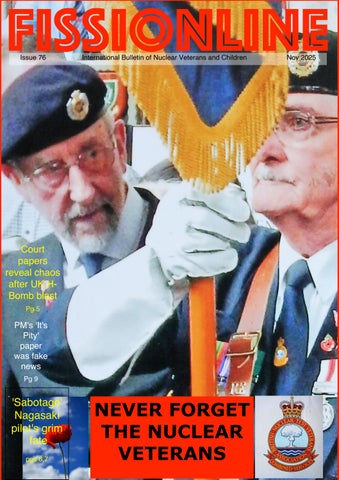
Court papers reveal chaos after UK HBomb blast
Pg 5
PM's 'It's Pity' paper was fake news
Pg 9
'Sabotage' Nagasaki
pilot's grim fate
pgs 6,7
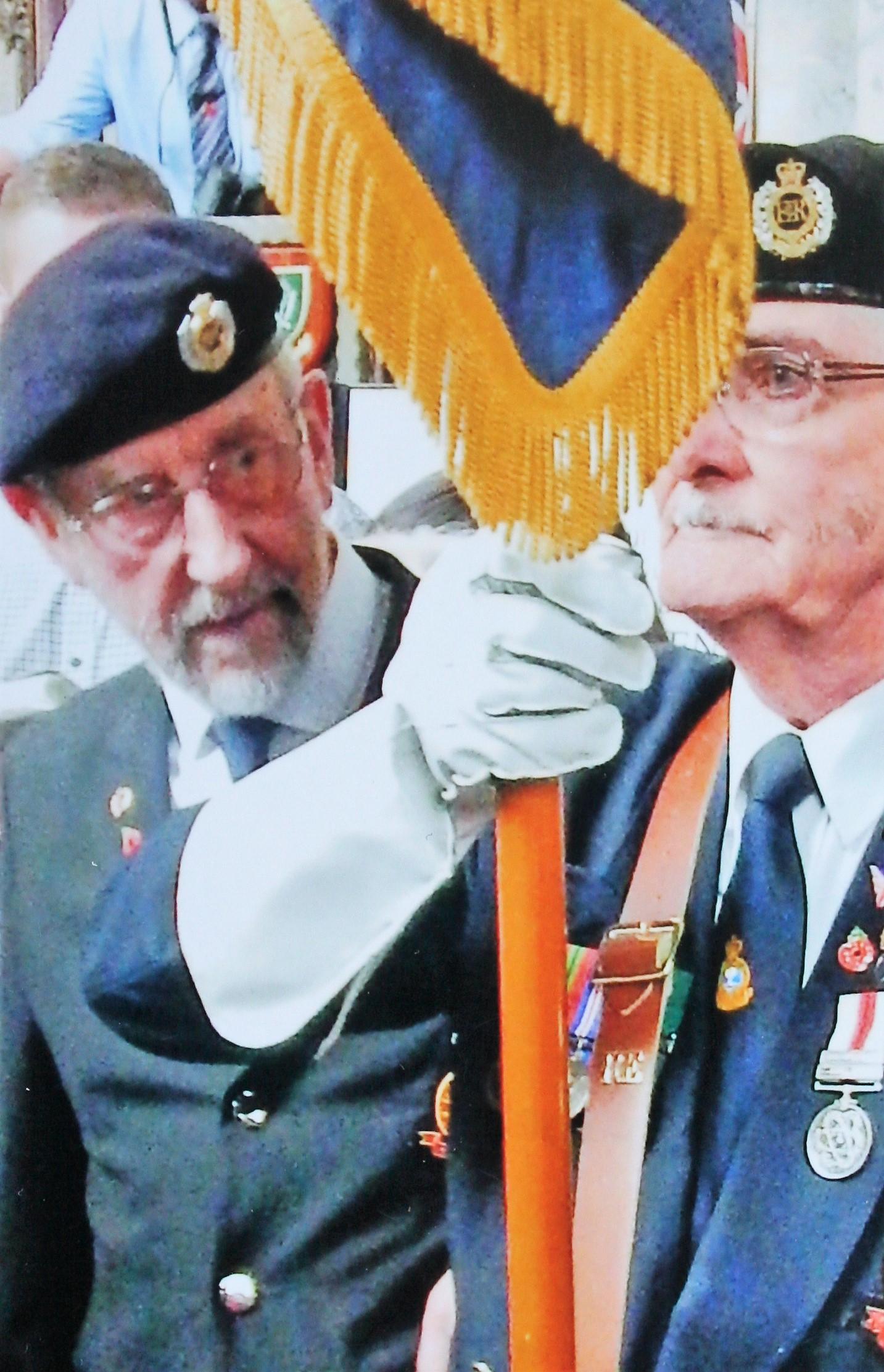
we remember the millions of men slaughtered on the killing fields of the Somme, Ypres, Flanders, Normandy, Sicily, North Africa, Burma, and all the other bloody conflicts that have torn apart this world of ours over the last century, spare a thought for a relatively small and little known army of men who at the height of the Cold War fought an invisible but no less deadly foe. They were the thousands of men, many of them mere boys and conscripts, who were sent overseas to remote parts of the world as participants in nuclear weapons tests. They flew the planes, manned the ships and laboured to build the runways and the infrastructure to facilitate Britain's nuclear bomb test program which would play a crucial part in staving off a nuclear bomb attack by the USSR
Part of their job was one of the most dangerous of all...to act as human guinea pigs to gauge the effects on soldiers of the explosions in battlefield conditions should the very real possibility of a nuclear war break out.
But unlike their comrades in arms who fought in more conventional wars, nuclear veterans didn’t carry guns nor fall on the battlefields. Their deaths were more insidious. They fell years later when the minute but deadly, bullets of radiation had wormed their way through their blood, flesh and bones to attack their nervous systems and vital organs. Some fell soon after returning home, from radiation boosted aggressive cancers like leukaemia and multiple myeloma; others died writhing in agony from illnesses that seemed to have no known cause.
Saddest of all were those who died long, miserable deaths, overcome by exhaustion from maladies that over the years just quietly sucked the life out of them.
Shamefully, their pain has never been properly recognised by successive British governments who insist their illnesses were not caused by radiation. This, of course comes as no surprise for acknowledgement of harm by radiation would open the door to huge compensation claims.
So the government covered it up. The
complicity of the judiciary and academics in this historic scandal is also not a surprise. In recent years there have been several highprofile court cases involving compensation claims by nuclear veterans that have found in their favour, only to have their hard-won victories snatched from them by successful appeals by the Ministry of Defence (at taxpayers’ expense, of course )
Some judges even brutally threw out the claims on the grounds the illnesses suffered by the veterans were “fanciful.”
They were following a worrying and growing trend to play down the effects of low-level radiation on the human body. These effects are well-known in scientific circles where it has been proven time and again that radiation exposure, even at very low levels, can harm human beings.
But there has always been a tendency in Establishment circles, particularly those that rely on Government funding for their existence, to play down those effects.
But no matter what the nuclear apologists say, those who have actually experienced the fallout from nuclear bombs know the truth
Fissionline has records of nearly 2,500 nuclear veterans whose suffering is writ large across the blood-stained annals of man’s inhumanity to man.
They may not have fallen in a foreign field, but their deaths were no less significant. Let us add their names to the scrolls of honour that mark the heroism of those brave men who gave their ’todays for our tomorrow '
July
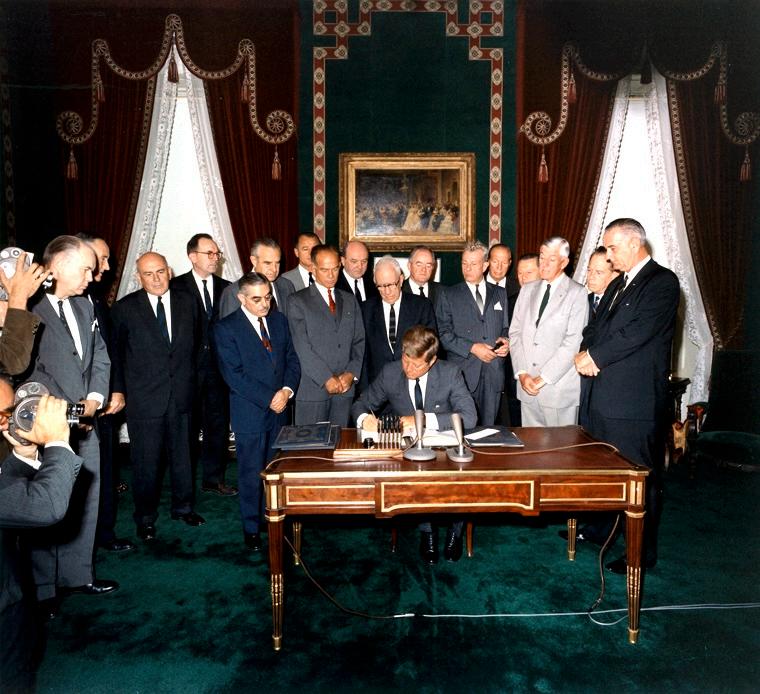
As Trump prepares to trash the international Nuclear Test Ban Treaty, here is a timely reminder of what another American President said when he ratified the Treaty back in July 1963.
"A war today or tomorrow, if it led to nuclear war, would not be like any war in history. A full-scale nuclear exchange, lasting less than 60 minutes, with the weapons now in existence, could wipe out more than 300million Americans, Europeans and Russians, as well as untold millions elsewhere And the survivors, as Chairman Khrushchev warned the Communist Chinese, "the survivors would envy the dead," For they would inherit a world so devastated by explosion and poison and fire that today we cannot even conceive of its horrors So let us try to turn the world away from war. Let us make the most of this opportunity, and every opportunity, to reduce tension, to slow down the perilous nuclear arms race, and to check the world's slide toward final annihilation. Second, this treaty can be a step towards freeing the
world from the fears and dangers of radioactive fallout Our own atmospheric tests last year were conducted under conditions which restricted such fallout to an absolute minimum But over the years the number and the yield of weapons tested have rapidly increased and so have the radioactive hazards from such testing Continued unrestricted testing by the nuclear powers, joined in time by other nations which may be less adept in limiting pollution, will increasingly contaminate the air that all of us must breathe. Even then, the number of children and grandchildren with cancer in their bones with leukaemia in their blood, or with poison in their lungs might seem statistically small to some, in comparison with natural health hazards. But this is not a natural health hazard and it is not a statistical issue The loss of even one human life, or the malformation of even one baby who may be born long after all of us have gone-should be of concern to us all Our children and grandchildren are not merely statistics towards which we can be indifferent. "
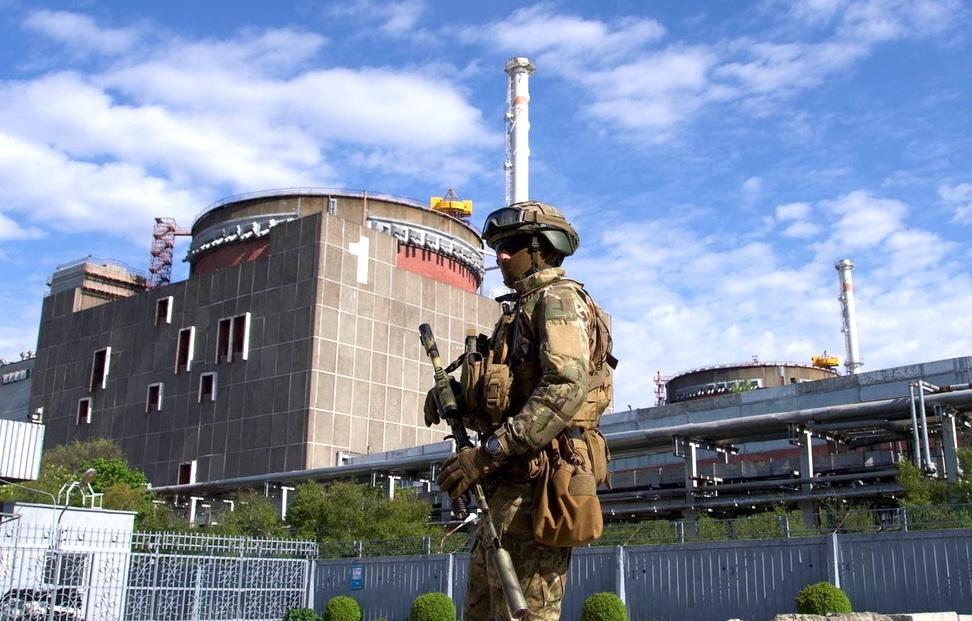
s war continues to rage in Ukraine the International Atomic Energy Agency (IAEA) continues to warn of dire consequences for nuclear plants in the path of war.
Experts say repeated loss of external power, which is vital for cooling the reactors and spent fuel meant plants like the giant Z r B p c
IAEA.
While a Chernobyl-style catastrophe is considered unlikely under current conditions, a severe incident could still occur. Loss of external power is the primary risk factor. The reactors and spent fuel require a constant supply of cooling water to prevent overheating. This cooling is typically maintained by external power from the grid.
Meanwhile after recent drone attacks caused alarm, the IAEA says that negotiations are on-going to allow work to take place to restore a backup external power supply to the Plant.
The six-unit plant has been under Russian military control since March 2022. It had 10 external power lines before the war began, but there is currently only one line working, and it recently spent a month without external power when that line was lost.
During the loss of external power, emergency diesel generators supplied the power but they are not intended to be a long-term solution
International Atomic Energy chairman Rafael Grossi said: "The dangers to nuclear safety i b l d I
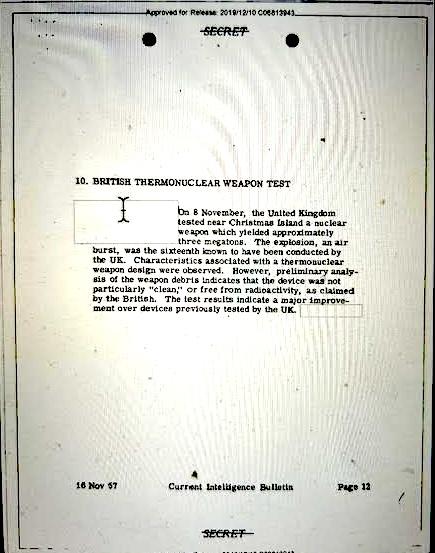
Following fissionline’s revelations about a UK cover-up of the effects of a huge H-bomb codenamed Grapple X on Christmas Island in November 1957, more evidence has come to light.
By Alan Rimmer
In issue 74 we revealed how the CIA exposed UK government lies about both the size of the bomb and the radioactive fallout that resulted. Now unearthed court documents recount how t brass fled the island after Major-General G r a h a m Messervy-Whiting who sa on the Stubbs Ionising Radiation T r i b u n a l in 2015 made the revelation during closing submissions the controversial trial whi was to set up to decide if illnesses among Christmas Island veterans were caus by radiation exposure The tribunal was discussin the mysterious absence of documentation relating to radiation dose records wh Messervy-Whiting, former military adviser to NATO made his intervention. He said: “I mean we could find any 76 Squadron (Canberra “sniffer” squad documentation at all,” ad “It was a period of major handling by Task Force Commanders and key personnel who sort of le it quickly ” Adam Heppinstall, QC fo Ministry of Defence, told Tribunal: “Indeed there w massive personnel transfe which we referenced Th also doesn’t appear to be interim reports of the sam style as other tests ” Messervy-Whiting, who h
access to highly-classified MoD documents, expressed dismay at the chaos that followed the test. Many key documents concerning the test were lost forever, he told the court Judge Stubbs also raised concerns about the test when he stated: “The most important point is we don’t think there is any evidence anywhere of dosimetry after Grapple X ” Heppinstall replied: “I’ve spent three years asking to see those documents because they ground ave where there is a I am guessing, referred o some form of roceedings about omebody who died or ad been injured. One can speculate, but here is a lack of ocumentary evidence t’s either because it was ever created or because he Public Record Act as had it destroyed ” Neil Sampson, for osenblatts solicitors epresenting 1,000 uclear veterans told the ourt that the Secretary f State had only isclosed about 8 per cent of its admitted documentation in relation to Grapple X. " *In Issue 74 we revealed how the blood testing for leukaemia was carried out on men returning from Christmas Island after the Grapple X explosion. Sapper Phil Munn who later died of the disease was convinced he was used as a nuclear guinea pig.
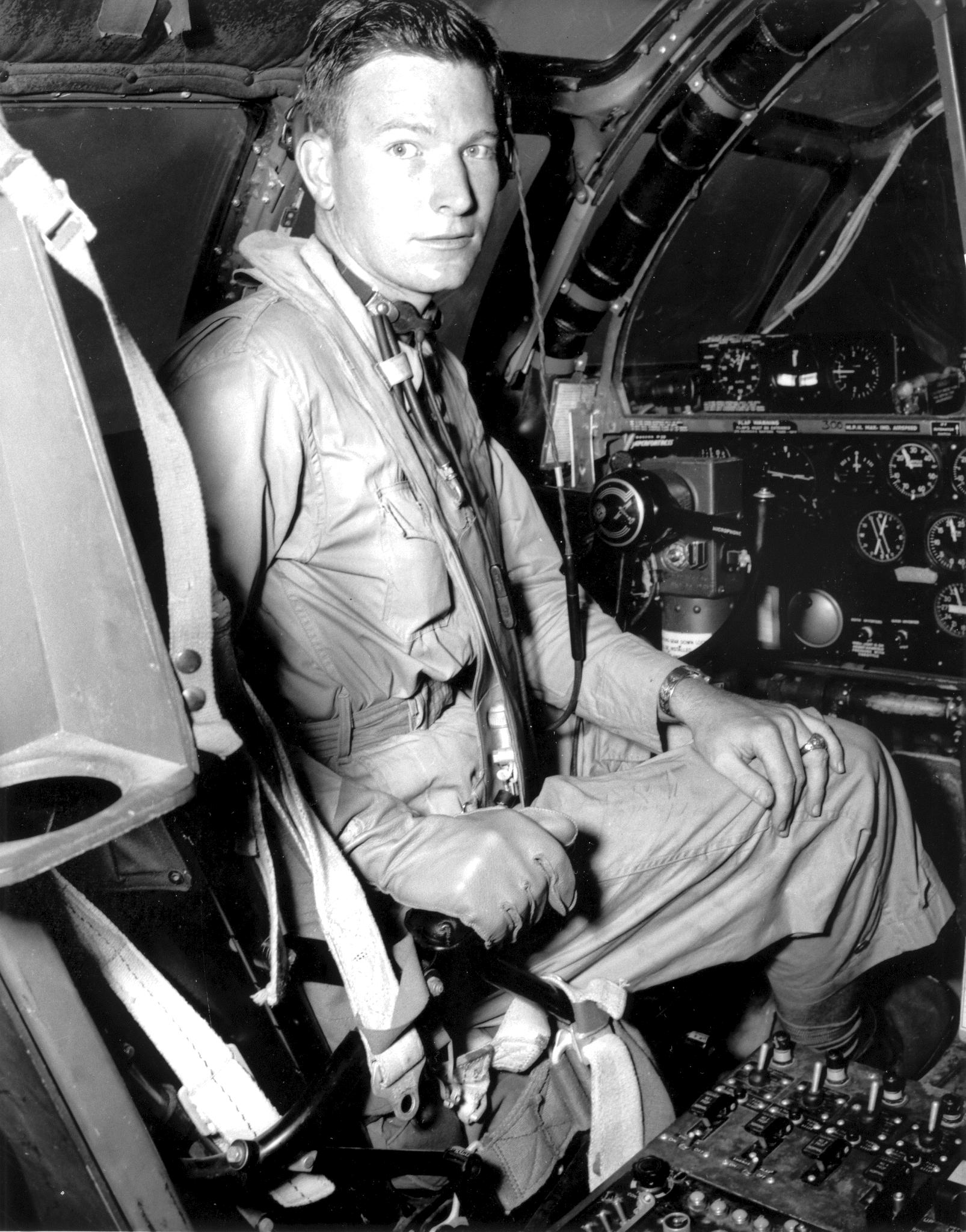
anas August 9th, 1945 and the aircraft set to deliver the final blow to the Japanese empire is in trouble.
By Alan Rimmer
Last minute checks have identified problems with a fuel pump holding a reserve 500 gallons of gasoline
As the weather closed in a decision had to be made whether to continue the mission or not.
The Superfortress plane, it's nosecone proudly displaying the name 'Bockscar' had just about enough fuel to complete the 4,000 mile round trip without the reserve tank, but it would be touch and go
The commander, Major Jim Sweeney weighed the odds, and after consulting senior officers, decided it was a risk worth taking; he wasn't about to lose his place in history 'Let's go " he ordered and his 12-man crew scrambled aboard. Their destination was the Japanese city of Kokura, an important industrial centre for Japanese arms manufacturing
As Sweeney fired up the four huge Wright R-3350 Duplex-Cyclone engines, the two accompanying aircraft moved into position at his wingtips.
One of these was the photographic reconnaisance plane called 'The Big Stink' commanded by Lt Col Jim 'Hoppy' Hopkins, a career airman with a reputation for being a stickler for procedure
Los Alamos Scientist Robert Serber was soon to find this out after he scrambled aboard the aircfraft and took his seat. He had with him sophisticated camera equipment specially calibrated to take the best possible pictures of the atomic explosion.
Hopkins observed him cooly and without preamble barked: "Where's your parachute? Serber, flustered, shrugged his shoulders and said
no-one had given him one. "Then I'm afraid you will have to vacate the aircraft," said Hopkins And despite Serber's protestations was unceremoniously thrown off the plane
It was an absurd decision by Hopkins...what was the point of photographic flight without a camera or cameraman? But this does not seem to have bothered Hopkins as he followed in the wake of Sweeney
Both aircraft took off smoothly into the darkening skies, lightening flashing eerily as they ascended through a thunderstorm As well as his crew Hopkins was carrying two British observers that Churchill had insisted should be aboard the plane for the historic mission
One was Dr William Penney, who would later go on to mastermind the UK's own atomic programme, and Squadron Leader Leonard Cheshire VC, a war hero who had flown many hazardous missions in Lancaster bombers over Germany.
The pair had only made the flight by the skin of their teeth as it was made clear to them from the outset that the Americans were not keen to have them on board.
This antagonism was almost certainly led by General Curtis LeMay, the cigar chewing mastermind in charge of America's huge bombing fleet He had had his nose put out of joint by not being involved in the atomic bombing mission
After one huge night raid over Tokyo earlier that year he had wiped out more than 100,000 civilians in a firestorm that destroyed a third of the city. He reckoned he could finish the war with his huge airforce without relying on the "new-fangled' atomic bomb
A lot of his airmen were loyal to him, and one of these was Hopkins. He and other senior officers had worked closely with Lemay and may well have frowned on the atomic missions Cheshire
must have wondered at Hopkins's decision to evacuate Serber. And he must have been even more concerned when there was a sudden emergency as the plane reached cruising height.
The navy officer in charge of the nuclear weapon Frederick Lincoln "Dick" Ashworth, plunged down a hatch into the bomb bay to discover emergency lights flashing on the bomb, nicknamed 'Fat Man'.
As tension aboard the aircraft mounted, Ashworth and an aide cooly examined the switches and discovered a vital connection had been wired wrongly.
They soon fixed the problem and the lights stopped flashing. The plane continued without further incident until it reached Yakushima Island where it was due to rendezvous with Bockscar and the other aircraft
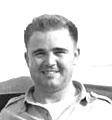
it to Iwo Jima which had only recently been captured by the Americans When he finally made it back to Tinian there was no hero's welcome As far as the Top Brass was concerned, the Nagasaki mission with all its flaws and mishaps was best forgotten about.
No sense in raking over the coals of the mission that nearly failed
No official enquiry was ever conducted into the causes of the near catastrophe and Hopkins's role was never really questioned
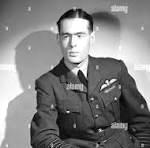
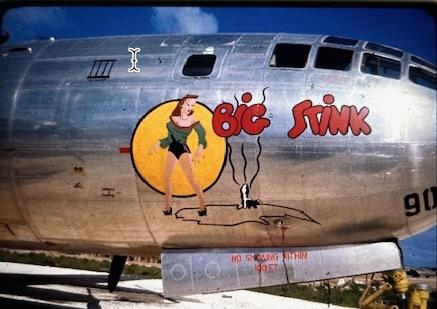
At this stage Cheshire noticed something strange: 'Big Stink' appeared to be flying 9,000 feet above the chosen rendevous height. Glancing at Hopkins he was about to point this out, but something told him it was not a good idea.
Meanwhile Sweeney in Bockscar was just as puzzled The other aircraft had reached the rendevous point, but there was no sign of Hopkins who was of course 9,000 feet higher
Unable to make contact because of strict radio silence rules, Sweeney wasted 45 precious minutes waiting for Hopkins to show up With fuel running dangerously low, and after discovering too much cloud cover over Kokura, Sweeney finally headed for the secondary target, Nagasaki Cloud cover there was also bad, but at the last minute a hole appeared in the clouds and the bomb was dropped. It was 500 yards off its intended target, the centre of the city, but it was more powereful than the Hiroshima bomb wreaking havoc along the length of the Urakami Valley 70,000 souls perished at a stroke. Sweeney barely made
In fact he, along with the rest of the crew received a gong for the mission; ironically Hopkins even received a promotion Doubts and suspicions were aired about the mission in various books, notatably by Sweeney mself, who xpressed uzzlement bout opkins's ehaviour. But these suspicions were only ever couched in oblique terms with no actual accusations ever being made
Either way it never affected Hopkins's career as he rose smoothly up the Air Force ranks in the years following In 1951 he along with some of the USAF's most senior commanders boarded a huge C-124 Globemaster Airforce Carrier at Walker air force base in New Mexico for what turned out to be his last mission.
Bound for Lakenheath strategic air command base in England, the mission was shrouded in secrecy, although rumour had it there was an atomic bomb on board.
The plane never reached its destination. For some unaccountable reason there was an explosion on board and the plane plunged into the cold Atlantic ocean 800 miles south west of Ireland.
A huge rescue operation swung into action, but although one aircraft reported seeing flares and life rafts, none of the 52 passengers were ever seen again
Observers of the huge exclusion zone surrounding the stricken Chernobyl nuclear power ststion were startled to discover herds of "blue" dogs wandering in the woods. Pictures of the strange but otherwise healthy looking dogs went viral amid speculation they might be affected by a strange mutation caused by radiation. But local welfare groups who went in to investigate soon discovered the reason: the colour was not from radiation but from the dogs rolling in a blue chemical fluid used in portable toilets on the site. The "dogs of Chernobyl" are the descendants of pets left behind after the 1986 nuclear disaster. These feral dogs r
Multiple organisations are working to help the dog population, including providing veterinary care and sterilising them to control the population size.
After the initial evacuation, many of these animals were killed, but some survived and reproduced, establishing the current population.
There are thousands of stray dogs in the area, with distinct populations in and around the power plant and Chernobyl City.
The dogs are the subject of scientific study due to their unique adaptation to a highly radioactive environment.
Researchers are studying their genetics to understand the long-term effects of

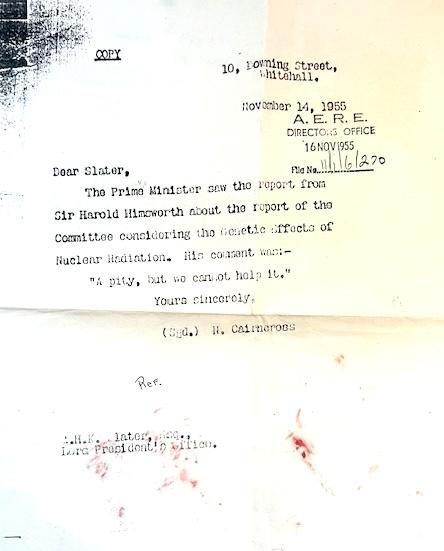
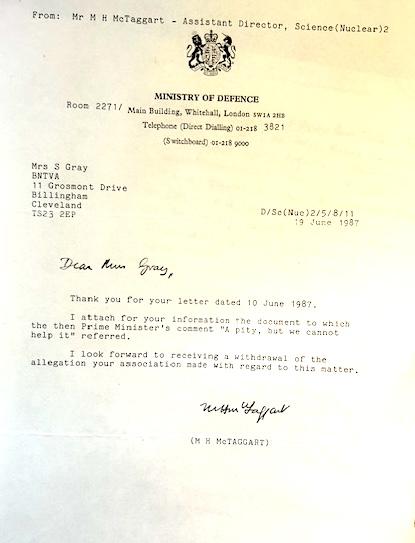
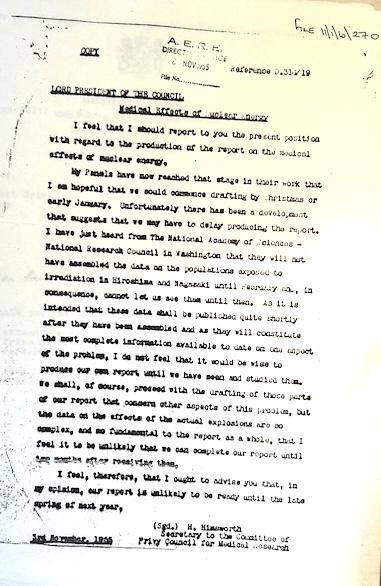
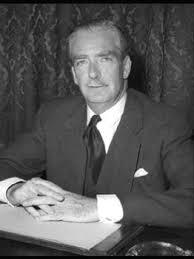
It is one of the most infamous letters in the pantheon of alleged perfidy carried out by the British government in response to fears about the genetic effects of radiation. Referring to a report being prepared in 1955 about the dire consequences of radioactive fallout from nuclear bomb tests on future generations, the Prime Minister of the day, Sir Antony Eden wrote, "A pity, but we cannot help it "
This seemingly callous comment has been used in countless TV programs and newspapers to suggest a cruel and unfeeling attitude by the British Government toward the plight of Britain's nuclear veterans and their children. The Medical Research Council's report, "Hazards to Man of Nuclear and Allied Radiations" was being prepared following widespread concerns about nuclear bomb testing. Some of the most eminent doctors and medical experts in the land had been tasked to give a comprehensive expert opinion on the problem. A crucial aspect of the report concerned the effects of radiations on the citizens of Hiroshima and Nagasaki. Experts in Washington were preparing data for the report, but had indicated that this would be delayed. It meant that the British report would also be delayed and this was communicated to Eden in a letter from the report's chairman Sir Harold Himsworth. It was in response to this letter that Eden made his comment. This was sent to the secretary of the British Nuclear Tests Veterans Association in 1987, but was never put into the public domain, until now.
Reporter Wilfred Burchett staggered off the train and o hell. He couldn't d Japanese but he w what the rred railway sign above his head said: 'Hiroshima '
While the rest of the press pack covered the official surrender signing ceremony in Tokyo Bay, Burchett had set off to see for himself the fate of the city destroyed by the new 'wonder weapon ' that had brought World War Two to an end
One of the first things he was told on enquiring how to get to the city was: "No-one goes to Hiroshima Everyone is dying there..."
instruments to tend to the ever-growing army of injured people queuing outside.
Blast and burn injuries accounted for the majority of the suffering; but there was another inexplicable malady being visited upon many others: a sickness marked by nausea and hair loss, diahorrea and acute fatigue Victims lost the will to live and simply wasted away Burchett with his practised journalistic eye knew this was the real story about the atomic bomb and coined a new phrase : The Atomic Plague.
Using all the skill and guile of someone who had been reporting in war zones for five years he got himself aboard one of the very few trains to Hiroshima.
He found himself crammed in the corner of a carriage under the sullen gaze of a group of recently demobbed Japanese soldiers who looked as though they would like to kill him. Somehow he survived and after a nervewracking 15-hour journey found himself in Hiroshima, the first western journalist to reach the shattered city after the A-Bomb attack
Burchett had witnessed the carnage of Iwo Jima, and many other battlefields and was used to death in all its grisly obscenities
But nothing compared to Hiroshima Acrid smoke hung in a pall over the entire city, fires blazed everywhere, the cries of the sick and wounded rent the choked air; piles of bodies were being burnt without ceremony on funeral pyres; death seeped from every stone and brick left standing from the whirlwind of destruction that had flattened an entire city. In a daze Burchett wandered about the hellish landscape until he came across a makeshift hospital staffed by surgeons and nurses with soot-blackened faces and tattered clothing trying desperately, with the most rudimentary
Without further ado he sat down on a chunk of concrete at what he believed to be ground zero and pounded out on his Baby Hermes typewriter the scoop of the century:-
A warning to the world
"In Hiroshima, 30 days after the atomic bomb destroyed the city, people are still dying, mysteriously and horribly -- people who were uninjured in the cataclysm from an unknown something which I can only describe as the atomic plague..."
The story was published in the Daily Express to worldwide aclaim But the authorities weren't happy. Radiation sickness was a Pandora's box they simple did not want opened They ordered tame newspaper hacks to refer only to "blast and burn" effects, insisting that Burchett's story was exaggerated
He was later accused of having close ties with communist governments and was even accused of being a traitor He had his Australian citizenship stripped in 1955 but later restored in 1972.
In later life He continued to cover major conflicts, including the Korean and Vietnam Wars He died on September 27, 1983, in Sofia, Bulgaria, where he had settled.
All his life Burchett believed there had been a massive cover-up, beginning in Hiroshima, of the genetic affects of radiation.
We at fissionline believe that cover-up continues to this day
It is why we exist, why we fight and why we will never give up until nuclear weapons and the threat of nuclear war are eradicated from the face of mankind for all time