CD Reviews
HOWARD BLAKE Lifecycle Piano music of imagination and reflection William Chen piano ABC Classics
✶✶✶✶
JOURNEY EAST Nemanja Radulovic, violin with assorted guests Deutsche Symphonie-Orchester Berlin/ Michail Jurowski Deutsche Grammophon
✶✶✶✶ I’d never heard of Radulovic before this CD came out with its vignettes from the world of violin sparklers. In a way the album is very reminiscent of another celebrated violinist – Andre Rieu – so if you are an admirer of the latter you’ll really enjoy this album. If you’re not – and I must say I’m ambivalent – then there are enough differences in the repertoire
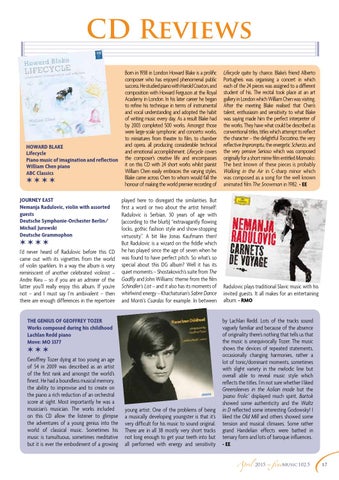
Born in 1938 in London Howard Blake is a prolific composer who has enjoyed phenomenal public success. He studied piano with Harold Craxton, and composition with Howard Ferguson at the Royal Academy in London. In his later career he began to refine his technique in terms of instrumental and vocal understanding and adopted the habit of writing music every day. As a result Blake had by 2003 completed 500 works. Amongst those were large-scale symphonic and concerto works, to miniatures from theatre to film, to chamber and opera, all producing considerable technical and emotional accomplishment. Lifecycle covers the composer’s creative life and encompasses it on this CD with 24 short works whilst pianist William Chen easily embraces the varying styles. Blake came across Chen to whom would fall the honour of making the world premier recording of
Lifecycle quite by chance. Blake’s friend Alberto Portugheis was organising a concert in which each of the 24 pieces was assigned to a different student of his. The recital took place at an art gallery in London which William Chen was visiting. After the meeting Blake realised that Chen’s talent, enthusiasm and sensitivity to what Blake was saying made him the perfect interpreter of the works. They have what could be described as conventional titles, titles which attempt to reflect the character – the delightful Toccatina, the very reflective Impromptu, the energetic Scherzo, and the very pensive Serioso which was composed originally for a short mime film entitled Mamako. The best known of these pieces is probably Walking in the Air in C-sharp minor which was composed as a song for the well known animated film The Snowman in 1982. - EE
played here to disregard the similarities. But first a word or two about the artist himself: Radulovic is Serbian, 30 years of age with (according to the blurb) “extravagantly flowing locks, gothic fashion style and show-stopping virtuosity”. A bit like Jonas Kaufmann then! But Radulovic is a wizard on the fiddle which he has played since the age of seven when he was found to have perfect pitch. So what’s so special about this DG album? Well it has its quiet moments – Shostakovich’s suite from The Gadfly and John Williams’ theme from the film Schindler’s List – and it also has its moments of whirlwind energy – Khachaturian’s Sabre Dance and Monti’s Csardas for example. In between
Radulovic plays traditional Slavic music with his invited guests. It all makes for an entertaining album. - RMO
THE GENIUS OF GEOFFREY TOZER Works composed during his childhood Lachlan Redd piano Move: MO 3377
✶✶✶ Geoffrey Tozer dying at too young an age of 54 in 2009 was described as an artist of the first rank and amongst the world’s finest. He had a boundless musical memory, the ability to improvise and to create on the piano a rich reduction of an orchestral score at sight. Most importantly he was a musician’s musician. The works included on this CD allow the listener to glimpse the adventures of a young genius into the world of classical music. Sometimes his music is tumultuous, sometimes meditative but it is ever the embodiment of a growing
young artist. One of the problems of being a musically developing youngster is that it’s very difficult for his music to sound original. There are in all 38 mostly very short tracks not long enough to get your teeth into but all performed with energy and sensitivity
by Lachlan Redd. Lots of the tracks sound vaguely familiar and because of the absence of originality there’s nothing that tells us that the music is unequivocally Tozer. The music shows the devices of repeated statements, occasionally changing harmonies, rather a lot of tonic/dominant moments, sometimes with slight variety in the melodic line but overall able to reveal music style which reflects the titles. I’m not sure whether I liked Greensleeves in the Aolian mode but the ‘piano frolic’ displayed much spirit, Bartok showed some authenticity and the Waltz in D reflected some interesting Godowsky! I liked the Old Mill and others showed some tension and musical climaxes. Some rather grand Handelian effects were bathed in ternary form and lots of baroque influences. - EE April 2015
fineMusic 102.5
17