THE PROPERTY MARKET
A REVIEW OF THE KEY TRENDS IN THE NATIONAL AND LOCAL HOUSING MARKET

SCOTLAND
Analysis by PriceHubble


Analysis by PriceHubble
House prices
£265,085 August 2024 vs £272,995 August 2025
50,767 Q4 2024 vs 52,548 Q4 2025 3.5% 0.5% 3.7% 3.0%
92,590 September 2024 vs 95,980 September 2025
Mortgage approvals
65,628 September 2024 vs 65,944 September 2025 Property sales
Source: Pricehubble, ONS, HMRC, Bank of England, DLUHC, HomeLet *Figures rounded to nearest £0.1bn
New private homes built (completed)
28.0%
Gross mortgage lending
£19.5bn* September 2024 vs £24.9bn* September 2025
THE MARKET SHOWED UNDERLYING STRENGTH DESPITE UNCERTAINTY IN THE RUN-UP TO THE AUTUMN BUDGET, WITH STEADY TRANSACTIONS AND PRICES. GREATER CLARITY NOW SHOULD HELP BOOST CONFIDENCE AND ALLOW BUYERS AND SELLERS TO MOVE AHEAD.
The Bank of England held interest rates at 4% in November, reflecting a cautious approach as inflation remains above target. Inflation came in marginally softer than expected, rising by 3.8% in the year to September. Forecast suggest inflation will be a little lower by year end (3.6%) and more measurable improvement next year (2.4% by end 2026)¹. While inflation remains elevated, some analysts still see a small chance of a Bank Rate reduction in December, though most economists now anticipate the next cuts to be in 2026, with two further 0.25 percentage point reductions across the year². Any extra improvement will be extra relief to borrowers.
Mortgage rates remained steady following the Bank of England’s decision to hold interest rates in September but have since edged up very slightly. The recent decline in fixed mortgage rates came to an end at the start of autumn, with the average two-year fixed rate (75% LTV) rising from 4.1% in August to 4.2% in September, with a parallel increase in the five-year rate (4.1% to 4.2%) over the same period³. However, product choice remains broad: the number of mortgage deals dipped slightly below 7,000 in October, down from a 17-year high in September but well above the 5,495 available two years ago.
Mortgage approvals, an indicator of longer-term housing demand, have remained resilient despite wider political and economic uncertainty, helping to offset signs of caution elsewhere in the lead-up to the November Budget. In September, there were 65,944 mortgage approvals, just above the median forecast of 64,000 in a Reuters poll of economists. This figure is the highest since December 2024 and slightly above the long-term monthly average rate since 2012³. We are yet to see how the Budget will affect consumer confidence in the coming months, although greater certainty is typically positive for the housing market.

£1,345
Average monthly rent across the UK October 2025 1.4%
Average rents October 2024 vs October 2025
21 days AVERAGE VOID PERIOD IN OCTOBER. UP FROM 16 DAYS IN SEPTEMBER
As the market enters the winter months, rental activity typically eases from summer peaks, leading to a moderation in demand. After several years of sharp increases, rental growth is now easing as affordability pressures and an improving supply picture begin to help the market rebalance. Rental listings are up 6.9% on last year, though undersupply is still a market constraint as available stock remains 159,000 below 2019 levels¹. Annual UK rental growth stands at 1.4%, with the average rent at £1,345 per month. Regional trends vary, with Northern Ireland leading at 10.6% nnual growth, while rents in the Wales are unchanged year-on-year².
¹TwentyEA, ²Dataloft by PriceHubble, HomeLet
The Autumn Budget has provided much-needed clarity after prolonged speculation. It was less adverse than expected, although some market pockets were more affected. This should help end months of uncertainty and allow the mainstream market to move forward.
NICKY STEVENSON MD, FINE & COUNTRY UK
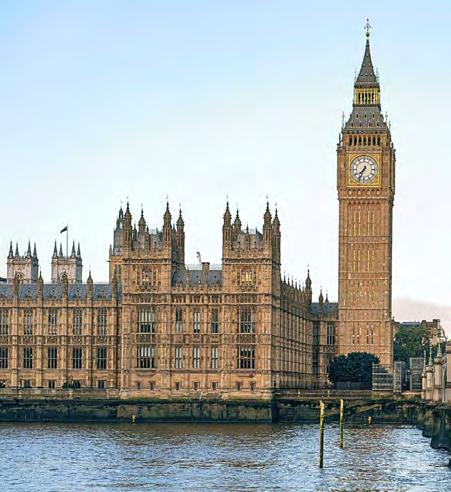
Chancellor Rachel Reeves has delivered the Autumn Budget, confirming a new mansion levy on properties over £2m from 2028 and a 2% property income tax rise from 2027. There were no changes to capital gains tax rates, welcome news to many. The mansion tax surcharge starts at £2,500 for the lowest band above £2m. We expect this to be an unwelcome addition although it is unlikely to materially distort activity across the prime market, though it may prompt mild price adjustments.
¹PriceHubble poll of subscribers, ²Zoopla, ³HMRC
Leading up to the Budget, 59% of agents¹ reported activity levels had been significantly affected by the wide-ranging rumours. This pause is reflected in the data: buyer demand is down 8% yearon-year, while sales agreed have dipped 3%². The slowdown partly reflects last year’s market recovery and buyers moving ahead of stamp duty changes earlier in the year. Drops in pre-Budget activity were most evident at the top end, where the threat of a mansion tax was felt most keenly.
Buyer demand
8%
Year-on-year
Source: Zoopla
Year-on-year
Source: HMRC Transaction levels 3.4%
Homes on the market 3.1%
Compared with a year ago
Source: Information Works
Despite a notable sense of caution, transaction activity remained steady as focused buyers and needs-based movers continued to proceed. Transactions so far this year are 13% higher than in 2024, boosted by the March 2025 SDLT rush and last year’s election dip. September saw 95,980 transactions, the highest since March 2025³. Now that buyers and sellers have more certainty over tax changes, we would expect some increase in activity and the market to return to the more normal market drivers like affordability.
Overall property price growth remains stable, despite the headwinds experienced in the lead-up to the Budget and a rise in homes for sale compared with last year. The average UK house price rose to £272,995 in August, a 3.0% annual increase, easing slightly from 3.2% in July¹. Regional variations remain pronounced: affordabilityconstrained areas continue to see slower growth, with London the only region recording negative annual growth at -0.3% and the South East up just 1.8%. By contrast, the North East posted the strongest annual rise at 6.6%, followed by Northern Ireland at 5.5%. High levels of supply are expected to put downward pressure on growth in the near future. OBR forecasts suggest a modest rise in house prices, averaging 2.5% per annum over the forecast period.
5.5%
ANNUAL CHANGE IN HOUSE PRICES AND TRANSACTIONS, AUGUST 2025
House prices Transactions
Source: PriceHubble, HMRC, ONS, UK HPI (August 2025) ¹ONS
4.0% 4.5% 6.6% 2.7%
NORTH WEST
YORKSHIRE AND THE HUMBER HOUSE PRICE GROWTH TO AUGUST 2025
Source: PriceHubble, HMRC, ONS, UK HPI (August 2025)
NORTH EAST
NORTHERN IRELAND 4.4% EAST MIDLANDS 2.0% 2.4% 1.8% 3.0%
Transactions edged higher in September¹, however more real-time indicators such as sales agreed show a mixed regional picture, with activity strengthening across parts of Scotland, northern England, and the Midlands, while conditions remain more subdued further south². The number of property sales falling through also edged higher in Q3 2025, up 0.5% year-on-year, reflecting ongoing challenges around financing, delayed chains, and shifting buyer sentiment³. The latest RICS
survey reported a decline in near-term sales expectations, signalling some caution in the coming months4 . However, activity levels are expected to pick up post-Budget as clarity over tax changes was gained, which proved less severe than many had feared.
Across Scotland, the most active housing markets are currently those of East Lothian, Midlothian and West Lothian, where close to one in every 17 properties has changed hands in the past year.
% Private Stock Turnover
Less than 4%
4.0% to 4.49%
4.5% to 4.99%
5.0% to 5.49%
Over 5.5%
Source: PriceHubble, National Records Scotland, ONS, UK HPI (August 2025)
Contains OS data © Crown copyright and database right 2016
¹HMRC, ²Zoopla, ³TwentyEA, 4RICS
12.1%
CURRENT ANNUAL RATE OF PRICE CHANGE (%)
Source: PriceHubble, ONS, UK HPI (August 2025)
The average time to sell has edged up from 31 days in July to 39 days in October, though still below 41 days at the start of the year¹. Accurate initial pricing and careful monitoring of time on the market are essential as homes take longer to sell. Research shows that properties withdrawn and later relisted are around three times more likely to sell than those left listed continuously, with a 42% success rate versus 14.5%².
AVERAGE TIME TO SELL IN
Source: Dataloft by PriceHubble using Information Works data, October 2025, average number of days on the market for all properties that went under offer or SSTC in the month
The Government reaffirmed in October 2025 its pledge to deliver 1.5 million new homes by 2029, despite slower delivery as build and financing costs affect viability. Over 208,000 homes were completed in the year to Q3 2025, 5% lower than the previous 12 months3 , leaving progress behind target. The Chartered Institute of Housing warns output could fall about 25% short, though ministers maintain the goal is “stretching but achievable”, supported by planning reforms and £39 billion in housing.
208,317
NEW HOMES BUILT IN THE YEAR TO END Q3 2025
Source: DLUHC
¹Dataloft by PriceHubble using Information Works data, October 2025, average number of days on the market for all properties that went under offer or SSTC in the month, ²TwentyEA, 3DLUHC
Fine & Country Head Office, 119–121 Park Lane, Mayfair, London W1K 7AG +44 (0)20 7079 1515 | parklane@fineandcountry.com | fineandcountry.com
Analysis by PriceHubble
PriceHubble is a European B2B company that builds innovative digital solutions for the financial and real estate industries based on property valuations and market insights. PriceHubble’s digital solutions are designed to help all players across the entire real estate value chain (banks, asset managers, developers, property managers and real estate agents). PriceHubble is already active in Europe, Japan and the United States.
pricehubble.com/uk

Disclaimer: This report is produced for general information only. While every effort has been made to ensure the accuracy of this publication, Dataloft Ltd accepts no liability for any loss or damage of any nature arising from its use. At all times the content remains the property of Dataloft Ltd under copyright, and reproduction of all or part of it in any form is prohibited without written permission from Dataloft Ltd.
Date of publication: December 2025 Analysis, editorial, design, graphics and charts by Dataloft.