FastForward Vol. 30 #2 November-December 2020
BL ACK , INDIGE NO U S A ND P E OP L E OF COLOR
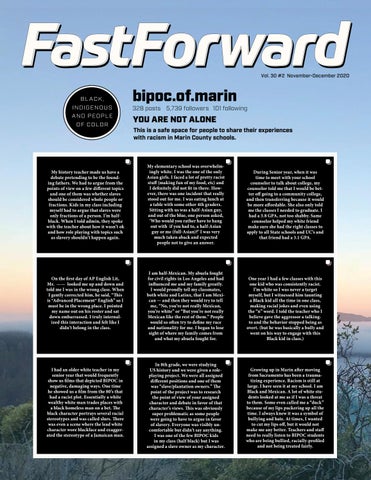
My history teacher made us have a debate pretending to be the founding fathers. We had to argue from the points of view on a few different topics and one of them was whether slaves should be considered whole people or fractions. Kids in my class including myself had to argue that slaves were only fractions of a person. I’m halfblack. When I told admin, they spoke with the teacher about how it wasn’t ok and how role playing with topics such as slavery shouldn’t happen again.
On the first day of AP English Lit, Mr. —— looked me up and down and told me I was in the wrong class. When I gently corrected him, he said, “This is *Advanced Placement* English” so I must be in the wrong place. I pointed my name out on his roster and sat down embarrassed. I truly internalized this interaction and felt like I didn’t belong in the class.
I had an older white teacher in my senior year that would frequently show us films that depicted BIPOC in negative, damaging ways. One time he showed us a film from the 80’s that had a racist plot. Essentially a white wealthy white man trades places with a black homeless man on a bet. The black character portrays several racial stereotypes and was called slurs. There was even a scene where the lead white character wore blackface and exaggerated the stereotype of a Jamaican man.
bipoc.of.marin
328 posts 5,739 followers 101 following
YOU ARE NOT ALONE This is a safe space for people to share their experiences with racism in Marin County schools.
My elementary school was overwhelmingly white. I was the one of the only Asian girls. I faced a lot of pretty racist stuff (making fun of my food, etc) and I definitely did not fit in there. However, there was one incident that really stood out for me. I was eating lunch at a table with some other 4th graders. Sitting with us was a half-Asian guy, and out of the blue, one person asked, ‘Who would you rather have to hang out with if you had to, a half-Asian guy or me (full-Asian)?’ I was very much taken aback and expected people not to give an answer.
During Senior year, when it was time to meet with your school counselor to talk about college, my counselor told me that I would be better off going to a community college, and then transferring because it would be more affordable. She also only told me the classes I needed to graduate. I had a 3.8 GPA, not too shabby. Same counselor helped my white friend make sure she had the right classes to apply to all State schools and UC’s and that friend had a 3.1 GPA.
I am half-Mexican. My abuela fought for civil rights in Los Angeles and had influenced me and my family greatly. I would proudly tell my classmates, both white and Latinx, that I am Mexican — and then they would try to tell me, “No, you’re not really Mexican, you’re white” or “But you’re not really Mexican like the rest of them.” People would so often try to define my race and nationality for me. I began to lose sight of where my family comes from and what my abuela fought for.
One year I had a few classes with this one kid who was consistently racist. I’m white so I was never a target myself, but I witnessed him taunting a Black kid all the time in one class, making racial jokes and even using the “n” word. I told the teacher who I believe gave the aggressor a talkingto and the behavior stopped being as overt. (but he was basically a bully and went on his way to engage with this Black kid in class.)
In 8th grade, we were studying US history and we were given a roleplaying project. We were all assigned different positions and one of them was “slave/plantation owners.” The point of the project was to research the point of view of your assigned character and debate in favor of that character’s views. This was obviously super problematic as some people were going to have to argue in favor of slavery. Everyone was visibly uncomfortable but didn’t say anything. I was one of the few BIPOC kids in my class (half black) but I was assigned a slave owner as my character.
Growing up in Marin after moving from Sacramento has been a traumatizing experience. Racism is still at large. I have seen it at my school. I am Black and Mexican. A lot of white students looked at me as if I was a threat to them. Some even called me a “duck” because of my lips puckering up all the time. I always knew it was a symbol of bullying and hate. At times, I wanted to cut my lips off, but it would not make me any better. Teachers and staff need to really listen to BIPOC students who are being bullied, racially-profiled and not being treated fairly.
SPONSORS PLATINUM
WASTEWATER AGENCIES OF MARIN COUNTY
GOLD
Jason Matlon, new Principal at Old Mill School meets with students to participate in a scavenger hunt.
OLD MILL SCHOOL Welcomes our new Principal Jason Matlon! Old Mill School is a wonderful place to learn and grow. All of our staff are highly trained professionals and deeply caring individuals who love what they do. Our parent community is one of the most supportive you will find anywhere and help make our school such an amazing place for children and families. We continue to look for new ways to innovate so our children are prepared for the future. In addition to the daily guidance provided by our homeroom teachers, we currently offer music, art, library, physical education, and dance classes.
SPONSORED BY: Check out our Shop & Give Donations Program — Select your favorite charity and we’ll donate 2% of your total grocery receipts.
CONTENTS
NOVEMBER/DECEMBER 2020
For our cover story, we interviewed Zianah Monroe and Maycee Moseley, the Founders of BIPOC.MARIN, an Instagram site for students to share their experiences with racism. We hope this story will encourage us to think about our biases and any comments we may have said that made someone else feel uncomfortable. We interviewed journalist and author of “Self-Portrait in Black and White,” Thomas Chatterton. We also spoke with author Raina Telegemeier, whose books such as “Sisters,” “Smile”, “Guts” (and more) are treasured. “Listening to someone else can change our lives.”
LEARN, EXPAND... P. 4 BIPOC.MARIN— ZIANAH MONROE + MAYCEE MOSELEY TALK P. 8 TAMALPAIS HIGH + SAN DOMENICO STUDENT ARTISTS P. 10 DAN NOYES—THE LIFE OF AN AN INVESTIGATIVE REPORTER P. 12 RAINA TELGEMEIER— AN AUTHOR WE LOVE P. 14 THOMAS CHATTERTON— A WRITER, JOURNALIST + AUTHOR P. 18 ARTIST SPOTLIGHT — MARLENA HIGH P. 20 TAMALPAIS HIGH SCHOOL — FEATURED SCHOOL P. 22 ENVIRONMENTAL PAGE — CLIMATE CHANGE IS HAPPENING P. 25 ART PAGE— ST. HILARY SCHOOL
FASTFORWARD PUBLISHER: Winifred MacLeod winifred@fastforwardweb.com 415-272-3569 775 E.Blithedale Ave #388 Mill Valley, CA 94941 Published by KidSpeak, Inc., Vol 30 #2 www.fastforwardweb.com EDITORS: Zadie Winthrop (High School) + Emerson Swift (Middle School) CONTRIBUTING INTERVIEWERS/WRITERS: Colin Bender, Jackie Chin, Jack Callaway, Max Goldman, Patrick Helios-Lenihan, Eliza Gould, Anna Palfy, Zadie Winthrop, Leah Kennedy, Liza Lachter, Lily Leone, Hugo Leinbach, Kayla Boon, Marguerite Waldman-Kaufman, Angela Tsai, Lilah Richman, Patrick Lenihan, Semira Robinson, Kimberly DeLeon, Jacob Taichman-Bernstein, Wesley Slavin, Emily Stull. CONTRIBUTING ARTISTS: Marlena High, Nicole Everage, Isabel Pollacek, Kara Botha, Phoebe Leisek, Tobe Ohajunwa, Sophia Hatfield, Lindsay Tenaglia, Kate Donnelly, Tanya Yeung, Georgia Brennan, Leighton Olsen, Piper Touhey, Kaitlyn Widman.
ADVERTISERS/SUPPORTERS of STUDENT ART + JOURNALISM Extreme Pizza Headlands Preparatory School La Ginestra Marin Academy Marin Catholic High School
Marin Primary & Middle School Marin Waves & Track Club Marin Honda Marin Horizon School Montecito Plaza
Mount Tamalpais School Mill Valley Market Saint Hilary School San Domenico School Sloat Garden Center
Soloquest School & Learning Center St. Isabella School The Good Earth The Marin School United Markets
WIN!FastForward Photography Contest
share your talent, your vision, your perspective
Email 1-3 entries (Send as a jpeg, PDF or PNG- High Res) Winifred@fastforwardweb.com Include your name, school + grade Entries will be published in an upcoming FastForward
FIRST PRIZE - $100
2nd $75
3rd $50
Be connected. Be curious. Be courageous. VISIT US VIRTUALLY! At Marin Primary & Middle School we make education meaningful, while encouraging pride in self, respect for others, and enthusiasm for learning from preschool through eighth grade. Located on eight acres in Larkspur, California. Learn more at www.mpms.org Contact Alex Norris or Angela Yokota at admissions@mpms.org
at at
FASTFORWARD
NOVEMBER-DECEMBER
2020
3
BIPOC MARIN ZIANAH MONROE AND MAYCEE MOSELEY SHARE CO-FOUNDERS OF BIPOC.MARIN WRITER: Zadie Winthrop Urban School of San Francisco
Scenic walking trails, good school districts, the occasional pot dispensary, a progressive “coexistence” attitude. To the external eye, Marin has mastered the concept of the beautiful yet accepting suburb. But if you look at this predominantly white county more closely, you’ll see that students of color who grow up here rarely experience the beauty and acceptance Marin is known for. CONTINUED ON PAGE 6
4 FASTFORWARD NOVEMBER-DECEMBER 2020
DID SOMEONE SAY SOMETHING OFFENSIVE BUT YOU DON’T KNOW HOW TO CORRECT THEM? SWIPE
FASTFORWARD
NOVEMBER-DECEMBER
2020
6
The undercurrent runs deep. When Zianah Monroe was a middle-schooler in Fairfax, she experienced many microaggressions—the day-to-day slights, looks and insults by fellow classmates in school culture and in society at large. When Zianah finished talking, her friend Maycee Moseley had a slight smile—a smile of connection, not necessarily one of joy, adding that she attended the same middle school with Zianah. She spoke about experiencing similar struggles. As the two of them sat with me, they reflected on how they felt alone then and mostly, how they wish their younger selves could have talked to each other, how they wished they could have known that they weren’t alone in this experience. This is exactly what their newly created @bipocofmarin Instagram account has set out to fix. The account, run by Zianah and Maycee, both graduates from High School 1327, formerly known as Sir Francis Drake High School, is a safe space for Black Indigenous People of Color (BIPOC) to share their experiences with racism in Marin County schools. Notably, and aligning with their mission, the bio of their Instagram reads, “You are not alone.” This message has been the essence of @ bipocofmarin. Both Zianah and Maycee think this sense of loneliness and otherness felt by people of color in Marin is significantly related to the county’s demographic makeup. “I feel like as a person of color in Marin, it’s really easy to feel like you are the only person experiencing what you’re experiencing,” said Maycee. They hope that by sharing Marin County students’ experiences with racial slurs and discrimination, they will show students who are experiencing similar situations that they are not alone. To their credit, it appears that Zianah and Maycee have been successful. Their message has resonated with their more than 5000 followers, and people frequently message the account with comments like, “I never realized I’m really not alone,” an actual message Maycee recalled. Given this digital age, and the account’s Gen-Z leadership, social media felt to them like the perfect place to build this 6 FASTFORWARD NOVEMBER-DECEMBER 2020
multi-school, multi-town, and multigenerational community. “Instagram is a super effective way to reach people, especially our generation,” said Zianah. Maycee added, “Social media for me, it’s kind of my thing.” Maycee has always been an advocate for social media as a platform of activism, because, as she sees it, “it doesn’t matter how many followers you have, “using your platform is important — it reaches people no matter what.” For Maycee, even reaching one person through a link or a post is meaningful. For Zianah, social media hasn’t always been a natural fit. “As I got older and more confident in myself, I just felt like social media is toxic and [that] I don’t need it.” But, since starting the @bipocofmarin page, her perspective has changed. “I’m kind of resurged through social media and now Instagram is a super useful tool for me,” she said. While Zianah and Maycee are interested in creating an inclusive and strong digital community, their work does not end there. Because the account highlights students’ stories and experiences, it is mostly focused on change in schools. The account includes a section on racial education, and recently featured an interview with Brandon Johnson, a Black graduate of High School 1327 who is now a candidate for the Tamalpais Unified School District. In addition, Macee and Zianah often use their large platform to encourage attendance to marches and events throughout Marin County. Recently, Zianah and Maycee have seen students, parents, and concerned adults show up to local school board meetings armed with the content of the @bipocofmarin Instagram account as evidence of the need to create better racial policies in Marin public schools. Zianah thinks that compiling all the stories— essentially the @bipocofmarin Instagram account— helps demonstrate the importance and need for change. “I feel like before, it was like, ‘Oh yeah, racism, but now, it’s right in your face,” said Zianah. In response, the TAM District has made a Google form for people to submit experiences with racism that allows people to name students and teachers involved. This link is included in the link tree on the @bipocofmarin Instagram page. Maycee and Zianah would also like to see discussions surrounding race and antiracism incorporated into school curriculums as well as more hiring of teachers of color. Zianah specifically wants to see, “white teachers talk about racism and
talk about their white privilege because that sets a [good] example for white kids.” Zianah has observed that often these conversations are mostly brought up by teachers of color. Both Maycee and Zianah remember their first teacher of color, Ms. Ortega. Maycee had her as a freshman and Zianah had her as a senior. To Zianah, having Ms. Ortega meant everything. “She gave me someone to look up to and [showed me] I could be someone,” she said. Both of them remarked that high school was very late for them to have their first teacher of color. They would like to see that change for today’s students. Zianah and Maycee point out that anti-racist work goes beyond hiring more teachers of color. “The district needs to make our communities welcoming for staff of color because they’ve come and they’ve left feeling it’s not a safe place for them,” said Zianah. One post that Zianah strongly remembers was from a local middle school teacher in Marin. Following the death of George Floyd, she tried to bring him up in class, and talk more broadly about race. The school and parents were angry with her, and according to her post, she was fired for trying to talk about race with her middle school students. She also said that other teachers of color also felt that they had lost their jobs for similar reasons. Because stories on @bipocofmarin describe racist experiences interlaced with sexual assault, harassment, self-harm, bullying, slurs, and more, running this account has taken an emotional toll. “It’s just so sad,” said Maycee. She added, “there’s so many so many entries, and it’s hard not to focus on the fact that this is just one example of something that people experience every day.” In spite of this, the support and the changes that Zianah and Maycee have been able to create outweighs the sadness. “We don’t want to ever stop sharing people’s stories and helping them voice what’s happened to them,” said Maycee. It is clear that Ziannah and Maycee are doing such important work — and it is up to us to read, learn and strive for change too.
For more info, to read or share an experience, visit @bipocofmarin and reach out at bipocofmarin@gmail.com
THE WORD:
MICROAGRESSION: Microaggressions can be a statement, action, or incident regarded as an instance of indirect, subtle, or unintentional discrimination against members of a marginalized group such as a racial or ethnic minority. They occurr casually, frequently and often —without any harm intended. Thus, our major task is to make the invisible visible. Below are five things that we need to do individually. 1. Learn from constant vigilance of our biases and fears. 2.) Experiencial reality is important in interacting with people who differ from us in terms of race, culture, ethnicity. 3.) Don’t be defensive. 4.) Be open to discussing your attitudes and biases and how they have hurt others. 5.) Be an ally and stand personally against all forms of bias and discrimination. An excerpt from a post @bipocofmarin: In elementary and middle school, we were occasionally taught about indigenous people. Yet there was continuous, constant glorification of explorers, missionaries, and missions without any mention of the population and cultural genocide mine and my fellow indigenous people face(d.) It was presented like we were almost a lost memory simply consisting of old photos exhibiting an exotic and archaic past. I learned to glorify those who could not see the glory in my own people.
The Marin County Free Library’s Mission is to provide welcoming, equitable and inclusive opportunities for all to connect, learn and explore. A core strategy to achieve our Mission is providing resources and information that will help our community learn about and more deeply engage in racial equity. For more info, Visit: marinlibrary.org.
Art Gallery
Zach Gilmour’s art students — Tamalpais High School Carina Ybarra’s art students — San Domenico High School
Nicole Everage
Sophomore, Tamalpais High School
Isabel Pollacek, Senior, San Domenico School
Lindsay Tenaglia
Senior, Tamalpais High School
Phoebe Leisek
Senior, Tamalpais High School
Kara Botha, Senior, San Domenico School
8 FASTFORWARD NOVEMBER-DECEMBER 2020
Take part in our photo contest — Page 26
Sophia Hatfield Tobe Ohajunwa, Senior, San Domenico School
Senior, Tamalpais High School
Kate Donnelly, Junior, Tamalpais High School Tanya Yeung, Sophomore, San Domenico School
FASTFORWARD
NOVEMBER-DECEMBER
2020
9
“Investigative reporting is doing a story that’s going to make a difference in someone’s life directly or hold public officials accountable for their actions.” “No matter how the platforms change, there’s always going to be a need for us, for people who are doing important stories and are doing them well.” “If you’ve done a good job, it’s gratifying to realize the impact you’ve had on people’s lives.”
DAN NOYES WRITERS/REPORTERS: Max Goldman, Jacob TaichmanBernstein, Jackie Chin, Lily Leone, Marguerite Walden-Kaufman, Hugo Leinbach, Lilah Richman, Semira Robinson, Zadie Winthrop, Ashley Grady, Patrick HeliosLenihan, Kimberly DeLeon, Ana Palfy, Wesley Slavin, Eliza Gould, Jack Callahan SCHOOLS: Branson, Marin Academy, Marin School of the Arts, Davidson Middle, Phillips Academy Andover, San Rafael High, Sacred Heart Preparatory, Sidwell Friends High, Sir Francis Drake High, Tamalpais High, The Menlo School, Urban School of San Francisco
10
FASTFORWARD
We’ve all played investigator before. Whether we’re trying to find a belonging we’ve lost, attempting to solve a fictional mystery, or digging through someone’s social media accounts to learn more about them, it’s not uncommon for us to put ourselves up to nearly impossible tasks in order to achieve some sort of goal. And most of us tend to feel some degree of satisfaction when we achieve that goal, even if no real reward is involved. But those who decide to make a career out of investigation actually have to put themselves in potentially dangerous situations to get the answers they’re looking for. For them, the reward is real — they uncover the truth and help serve
NOVEMBER-DECEMBER 2020
justice — but so are the consequences: traveling the world for months at a time in search of answers, enduring no end to obstacles along the way. An investigative reporter doesn’t suspend their work until their objective has been realized. Dan Noyes is one of these people. Dan Noyes wasted no time pursuing a career he was passionate about. “I really caught the news bug from the beginning,” he told us, recalling his start as an intern for CNN in Washington. Today, Noyes has been working for ABC News for over 35 years, from what started out as a producing job and evolved into a full investigative reporting position. “I always wanted to do stories that weren’t seen in other places,” he explained. “I didn’t want to cover the car crashes and the house fires; I wanted to do stories that make a difference.” While daily news stories are important, investigative reporting goes beyond the everyday, according to Noyes. It’s about digging below the surface, asking important questions, exposing corruption, and standing up for those who need it. “For me,” he explained, “investigative reporting is doing a story that’s going to make a difference in someone’s life directly or hold public officials accountable for their actions.” He cites one story that particularly made him reflect on the rewarding
busy, and you’ve got 10 stories that are great that you’re working on, or you’ve got nothing, and there’s no in-between. So for me, the part that I hate is when I’m trying to find something and I don’t have anything really working.” While frustrating, Noyes says these “dry” moments usually don’t last for long; he will soon find his desk piling up with stories to be investigated. However, this too can be difficult — it’s easy to let his work take over his life, he told us, and he has to make sure he doesn’t get too overwhelmed. “If you keep your eye on the ball, on what’s really important, there’s definitely a way to make it work, where you do have a life and you do get to do the things that are important to you,” he explained, noting how he makes a point to prioritize his family. When my kid was a senior at Redwood, he was on the water polo team, and I made every single game — I was able to work my stories around his games.” Besides getting overwhelmed or facing “dry” moments, Noyes often faces a more significant threat on the job: danger. He’s been in several tense and potentially dangerous situations, he told us, and he has to make an effort to remain calm and focus on the story at hand. “There have been some close calls,” he explained. “I’ve been threat-
would have been.” During another investigation, Noyes was in Germany confronting a Nazi war criminal who was working as a doctor. Noyes went into the clinic and only revealed his true identity once he was face to face with the doctor. After Noyes asked him about the children he had sent to killing centers, the doctor tried to detain Noyes by blocking the door, which Noyes was able to force through and wait for police to arrive. Intense moments like this have occurred many times during Noyes’ career, but he remains confident that he knows how to remain calm. “You just keep focused on what you need to do,” he told us. “Get the story and get on the air.” When asked if he has any advice for aspiring investigative journalists, Noyes had a suggestion that extends beyond this specific career and applies to any life goals: “Do more than the person next to you.” He recalled his start at CNN as an intern, and how he would come in on weekends and put extra effort into learning the job, which resulted in him getting offered a full-time position. “The aim ought to be to make yourself stand out. And you stand out by asking questions, by being involved, and by doing more than the person next to you. That’s the kind of thing that has driven me throughout my career and
FastFact: An investigative reporter typically works for a newspaper, website, magazine, radio or television station, and researches topics of interest, such as serious crimes, political corruption or corporate wrongdoing. Some investigations focus on social trends. A day-in-the-life looks like reaching out to sources, arranging interviews, organizing information (including fact checking), posting updates on social media, and then writing, reviewing, and submitting a story to their director. Dan Noyes must also secure and edit any video that is necessary for the story. In essence, he is the writer, producer and editor. nature of his job: he exposed a priest for molesting dozens of children, which resulted in the priest going to prison. He recounted for us the moment that the parents of the victims thanked him for what he had done for their families, and the sense of fulfillment it provided him. “If you’ve done a good job, it’s gratifying to realize the impact you’ve had on people’s lives.” While Noyes appreciates the fulfilling nature of his job, there are parts of investigative reporting that have proven to be difficult. “The most taxing part,” he says, “is finding the important story. And that’s the part of it that I really hate, when I’m dry...You’re either really
ened. I’ve had a gun pointed at me. I’ve been shot at. I’ve been punched. But I’ve been at this long enough to know that you need to keep your eye on the ball.” He noted one instance when he was doing a story about Pit Bull fighting in San Francisco, and a man starting shooting at him and his crew in broad daylight. “I looked up and I just saw the silhouette of a guy leaning against the building. It was a rifleman pointed at the van. And I screamed to my cameraman, ‘he’s got a gun!’ And we dove into the dashboard while pulling the doors open, putting the van in reverse to get out of there. But he fired and blew out the windshield, right where the camera man’s chest
it’s really worked out well.” For those of us wanting to pursue investigative journalism, his advice was to make sure it’s something you are truly passionate about. “You really have to have the guts for it; you have to have a desire for helping people, for holding public officials accountable, and for standing up for the little guy. And it’s not easy sometimes.” However, he made sure to reiterate how fulfilling this job can be if you are truly invested in it, and how essential jobs like his are. “No matter how the platforms change, there’s always going to be a need for us, for people who are doing important stories and are doing them well.” FASTFORWARD
NOVEMBER-DECEMBER 2020
11
Raina Telgemeier
WRITERS/REPORTERS: Introduction by Maisey Tommei, 7th Grade. Interview conducted by Katherine Obertance’s 5th Grade Class at Marin Horizon School
Meeting Raina Telgemeier was beyond anything I had imagined. She was funny, sweet and had such a glowing smile on her face. It was exciting to talk with her because I am one of her biggest fans. Listening to her tell us how her books “Sisters”, “Smile” and “Ghosts” were based on events that actually happened to her made me feel even more connected. Raina Telgemeier is my inspiration for writing and for journalism.
12 FASTFORWARD
NOVEMBER-DECEMBER 2020
Q: What inspired you to write books for kids? I’ve been writing stories since I was a kid, but I didn’t realize they were stories; I was just writing in my journal. Every day after school I’d come home and I’d write about what happened to me that day, and about my friends, and about my crushes, and anything I was frustrated about. And when I was in sixth grade, I started illustrating those diary entries. In the years after that, I was basically making a comic about my day every single day of my life. And I never showed them to anybody because they were personal and embarrassing. When I was in my twenties, I looked back and I thought, gosh, I have a lot of material here. I just wrote for myself and was really surprised when I figured out that people were interested in those stories. The books that I’ve published are sort of taking those stories and rewriting them into a book format that I’d be comfortable with somebody else reading, and so that’s where my stories’ inspiration comes from. Q: When did you start creating comics? I first started drawing comics about my life when I was about 10 or 11 years old, but I had been drawing characters and stories and pictures from the time I was a baby. As I learned to draw, I learned to write, and by the time I was able to both write and draw, I discovered comics and wanted to make my own. I started publishing my comics when I was about 22, but I didn’t get my first book published until I was 28, so it took quite a few years between the time I started trying to make and draw comics until the time I was actually published. Q: Who has inspired you to write graphic novels? I took a lot of my early inspiration from comic strips, so Calvin & Hobbs and For Better or For Worse, and FoxTrot were some of my favorites when I was younger. There really weren’t graphic novels back then. One of the first graphic novels I ever read that I just loved was “Bone” by Jeff Smith, and that was probably the book that made me realize I could definitely do longer-form stories with characters that continue on beyond just a few panels, beyond making punchlines and jokes. I give credit to Jeff Smith for some of my early graphic novel inspiration. Q: What advice would you give to your middle-school self? I would want to tell her that it’s going to be okay, because at that time, I had a horrible dental accident. I was in sixth grade when I tripped and fell and knocked out my two front teeth. I thought that I was different and it was going to mean that people didn’t like me as a person, so my self-esteem was pretty bad then. Now, I would want to go back in time and tell her just because you have something a little bit different about you, it doesn’t mean there’s anything wrong with you as a person. I think everybody at this age is dealing with insecurity and a little bit of anxiety, but you’re you and you’re awesome. Q: What is important when starting a story? That’s one of the hardest things to do. For me it takes anywhere between two and five years to make a book, so it has to be a very good idea. And sometimes the pressure of coming up with something that’s really good is hard and intimidating. For me, the kernel of an idea that’s going to carry me through tends to be emotions. I remember feeling a certain way so strongly when I was a kid. I needed to write about those feelings and where they came from and how I dealt with them, and then, what I learned from those feelings. It’s really hard to see that when you’re in the middle of them. That’s why I often write stories about stuff that happened to me 20 years ago or 30 years ago. Sometimes just the passage of time is what helps those emotions become stories. Q: What is your favorite part about writing books? My favorite part is when I get to the artwork. I get the whole story down on paper and then my editor and I work on that story together to make sure that it’s as good as it can be. By the time I sit down to start the art, I feel a little bit more free to just play and have fun. It’s pretty labor-intensive, but I like it. And then the end part is inking my drawings. I just sit here at my desk and ink all day. That’s probably my favorite part.
Q: What inspired you to write the
books “Ghosts” and “Drama”? “Drama” was inspired pretty much by real life. When I was in high school, I was in all of my school musicals and met a lot of really fun people. I was never the star of the show, so I spent a lot of time backstage playing jokes on people and giggling. The friendships I made backstage were a big part of my life. I just wanted to capture some of that spirit on the page, but not actually talk about my own experiences. “Ghosts” is a little bit more complex. It’s inspired partly by place. If you’ve ever been down to Half Moon Bay or up north on the coast in Marin, just those foggy/ beachy places that are all over Northern California, these places really inspire me. All of the autumn stories I had ever read were about crunchy leaves and spooky Victorian mansions and walking around in graveyards, and I realized I’ve never seen Northern California depicted in the fall. The crux of the story is that I had a cousin who passed away from cancer when she was 13, and seeing a young person get sick and how her family supported her and how much they loved each other was so powerful and there are a lot of aspects of that family in my story. I was pulling a lot of elements from real life in that sense, but then the characters are characters that I created myself. Q: How long does it take to finish and publish a book? The work itself can take between two and five years. My shortest turnaround time for my original books was “Sisters,” and that was about a year and threequarters. “Smile” took me five years from start to finish. Sometimes the ideas generate for a lot longer than that. As far as the publishing part goes, I generally turn my books in and then about nine months later they hit shelves. I’ve been publishing now since 2006, so I know to anticipate that process. But when I talk to younger authors, they ask, “Why is it taking so long?” I tell them, “You’ve just got to be patient.” Q: When you first submitted work, was it accepted by publishers or did you get rejection letters?
Want to be an author?
“
I used to keep a journal and every day I would write in it. I would write down what happened to me. It didn’t matter if it was interesting or funny or great writing or whatever; I just got those things down. That’s what I would suggest for you. So, journaling and then, as I did myself, drawing. Just looking around me and seeing things and trying to sketch from life — whether that’s people, whether that’s objects. Just play. Just try. Just have that pencil in your hand and a piece of paper in front of you.
I started out self-publishing, which means that I was writing short diary comics and stories and making them by hand into little booklets. I would Xerox them and print them out and sell them to my friends for a dollar apiece. So, I didn’t have anybody to reject or accept the work. Scholastic found those little booklets, and that’s how I got approached to potentially write and draw for their Graphix imprint, which was just being formed around that time. When it came time to get “Smile” published, my editor was on a sabbatical and I didn’t know whether it was ever going to be published or not. There was a period of me showing the work to people who said, “We’re not sure. This might not be interesting to people.” I got very lucky that my editor came back from his break and immediately said “Okay, let’s publish ‘Smile’.” I still have to submit an actual pitch proposal for every single book that I do, and there are times when my ideas are ready to fly, and sometimes that’s not the case. It’s always a conversation and it’s ongoing. I like being made to continue to push myself to be better at what I do. Q: How does the editing process work after writing a first draft? That’s part of what goes into those two years that it takes. I write a script, and my scripts are visual, so I’m actually doodling all the little stick figures and writing word balloons, and so it looks kind of like a comic; it’s really loose and rough. I submit that to my editor and then the editing process can take many months until we are both satisfied that the story is what it needs to be. So, I’m redrawing every one of those little sketches, and sometimes whole chunks of books get scrapped. Sometimes one chapter in a story turns into a whole book. I was working on something a couple of years ago and it was really difficult for some reason. There was a short chapter about anxiety and about how I was experiencing that when I was in fourth and fifth grade. And at one point I stepped back and said, wait a minute, this is the whole book. That took some time to figure that out and it was a little bit frustrating at the time. Once I figured it out, though, I could tell it was the right thing.
”
FASTFORWARD
NOVEMBER-DECEMBER 2020
13
THOMAS CHATTERTON An Author and Journalist
WRITERS: Jackie Chin, Lily Leone REPORTERS: Jacob Taichman-Bernstein, Jack Callaway, Kimberly DeLeon, Max Goldman, Eliza Gould, Marguerite Walden-Kaufman, Patrick Helios-Lenihan, Hugo Leinbach, Anna Palfy, Lilah Richman, Semira Robinson and Wesley Slavin
M
Branson, Marin Academy, Marin School of the Arts, Davidson Middle, Phillips Academy Andover, San Rafael High, Sacred Heart Preparatory, Sidwell Friends High, Sir Francis Drake High, Tamalpais High, The Menlo School, Urban School of San Francisco
any crossroads he came from. Many crossroads he still encounters. Every person struggles with their identity and path, but what Thomas Chatterton Williams believed in and embarked on was different — well, he wanted “different.” What he wanted he did achieve through the choices he made at the crossroads, but not without the in-
14
FASTFORWARD NOVEMBER-DECEMBER
2020
coming trains and cars that puzzled him all the more. Chatterton’s father was a black man from the South and was an adult before segregation in the law was ended. His mother was a white Protestant from San Diego, California. Even though his parents were legally married after the landmark Supreme Court case Loving v. Virginia, which struck down laws that banned interracial marriage, his parents’ families were not pleased
with the marriage. His father was also denied the GI bill, which provided benefits to veterans so that they could buy homes and pay their finances. “He was told straight-up that n****** don’t get this in Texas,” Chatterton told us. “He was shut out of an opportunity that helped build the middle class for so many white Americans... He was then forced into neighborhoods in parts of towns that were less valuable.” With a black father and a white mother, Chatterton struggled with his biracial identity and experienced many crossroads. Was his allegiance
with black or white? Which did he associate himself with more? In the census before 2000, he would mark “Black/African-American” as his race. “That felt like the closest to what my identity was. And I didn’t really think very hard about it,” he said. “And many people around me didn’t really think much about being mixed.” Chatterton grew up in what he considers a black household, and as a teenager, he and his friends bought into a “black culture.” However, as he met more biracial and mixed-race people, especially in college, Chatterton began to realize that his racial identity was more complicated than he had perceived. It was not a general “black culture” that he bought into; rather, it was a “narrow version” of a black street culture. As he became an adult, Chatterton began to question the idea of the one-drop rule,
shifted the system so that the child’s race depended on the mother’s race. Thus, the shift in this racial culture perpetuated the concept of the one-drop rule. Before the birth of his daughter, Chatterton often thought about what his daughter’s skin color would look like. His wife was white, and he was mixed-race. How was it possible for a man, who saw himself as black, to have a child with a heavily white skin color? Would the one-drop rule apply to his daughter, who would be about 25 percent black? When his daughter was born, the idea of the one-drop rule dissolved in his mind, and an encounter with another crossroad ensued. Chatterton, a mixed-race man who mostly identified as black, could not imagine himself to be a different race than his daughter, who was mostly white. The existence of race no longer seemed real,
the pressures of the group, whatever that group may be.” Above all, Chatterton hopes that his readers learn to examine their own identity and question the labels that society has put on them. “I hope that they look more skeptically at the identity that they’ve kind of been told is their own,” he explained. “I would like people to interrogate the terms that they use very easily both about themselves and about each other.” Chatterton wishes to one day live in a world where we have unlearned racial categories and the color of one’s skin means nothing more than the color of one’s hair. It should be acknowledged but shouldn’t play a part in how someone is treated or serve as a label under which one is stuck. Chatterton values intersectionality, but believes it should be far more nuanced than we usually consider it to be. “What would the world look like if we thought about iden-
“What would the world look like if we thought about identity as being more than just these three things we prioritize— our gender, our sexuality and our race?” — Thomas Chatterton, Journalist, Writer and Author of “Losing my Cool” and “Self-Portrait in Black and White”
which states that any person with black ancestors is considered Black, even if they are half or more than half a different race. For instance, many consider former President Barack Obama to be the first Black president. But Obama was not simply the first Black president: he was the first halfblack, half-white president. Chatterton, indeed, had reached another crossroad: whether to accept the one-drop rule. The one-drop rule had been applied since the era of slavery in America and has arguably been used to justify exploitations in a country supposedly founded on the pillars of equality. Traditionally in Europe, a child’s lineage depended on the father’s lineage. A mixed-race child was considered to be his or her father’s race. However, in the era of American slavery, the child’s identity began to shift more towards the mother. Often, the case was that white male slaveowners raped their black female slaves and fathered a mixed-race child. In order to maintain their dominant status and to not be held accountable for the child they fathered, the white slaveowners, who held the privilege and power,
even if he did grow up with a black father and white mother. “[It] thrust the fiction of race into my consciousness for the first time,” he explained. “And then around the age of 30, the idea of racial categories really stopped being something that I could really believe in. Full stop.” Chatterton has shared his ideologies about race in his books “Losing My Cool” and “Self-Portrait in Black and White.” Though he had some apprehension about becoming a writer that solely focuses on the topic of race, he’s realized how strongly he feels about expressing his thoughts on the subject. “I’ve just embraced it. I’m really interested in it,” he told us. “And my identity gave me some insight; it certainly gave me some experiences, and it gave me access to the subject.” Although “Losing My Cool” centers around Chatterton’s personal experiences with hip-hop culture and discovering his own identity, he says it’s really about much more than that: “It’s not just about hip hop. And it’s not just about blackness. It’s about this universal human condition of being, like the individual struggle to create yourself, despite
tity as being much more than just these three things we prioritize — our gender, our sexuality, and our race? What if, for me, one of the things that’s most important would be that I’m a Francophile, or I’m a basketball player? We need to be intersectional to the point where we overlap so many things that we actually start to see an individual,” he explained. “Past the idea that you are your gender, or you are your skin color. These are meaningful things that influence the way you pass through the world and the way that other people interact with you, but I don’t know that these are the things that tell you the most about who you are as a person.” As he spoke with us, Chatterton repeatedly emphasized how powerful the notion of identity is, and how important it is that we don’t reduce ourselves to one aspect of our identities. “What I always try to do,” he told us, “is push back against the idea that people are reducible to labels or the individual experience should be subsumed into the group experience...I wish that a lot of us would come to that conclusion on our own instead of just accepting that this is the way that business is done.” FASTFORWARD NOVEMBER-DECEMBER
2020 15
JOIN US FOR A VIRTUAL ADMISSIONS EVENT!
Meaningfully engaged
One-on-one
Visit marincatholic.org for more details or email jrockett@marincatholic.org with questions.
Passionate
Join a community that pushes intellectual boundaries, immerses itself in critical and creative thinking, and cultivates the tools to live life fully. Admissions Application Deadline: December 4
Visit our website to explore the school and submit an inquiry. www.ma.org 1600 Mission Avenue, San Rafael
Confidence, creativity, and academic excellence. College prep high school with a creative approach since 1981
• • • •
Middle & high school One-to-one instruction Master material at your own pace Full-time school or single courses
Explore our wide range of over 140 UC-approved classes, including 34 AP and 24 honors classes. Rolling Enrollment at www.HeadlandsPrep.com
Find out how a small school can make BIG difference:
Join us for a Virtual Open House on Sunday 11/15 WWW.THEMARINSCHOOL.ORG www.themarinschool.org 16 FASTFORWARD NOVEMBER-DECEMBER 2020
W E HAV E A N E W S C H O O L NAM E ! Headlands Preparatory School was formerly known as Tilden Preparatory School Marin
415-944-2254
MTS
EXCEPTIONAL TEACHING EVERY DAY.
Collaborative Learners
In every classroom or setting, our teachers are reimagining what’s possible.
Learn more from our Admissions Consultants
REGISTER FOR A VIRTUAL TOUR MOUNT TAMALPAIS SCHOOL KINDERGARTEN THROUGH 8TH GRADE
To set up a meeting with Admissions please call 415.937.5502
MTTAM.ORG
SAN DOMENICO SCHOOL
Exceptional Education and a Sense of Purpose with a New HyFlex Model
Join us for a Virtual Preview Day
GRADES 9-12: DECEMBER 6
•
GRADES K-8: DECEMBER 12
Learn more at sandomenico.org | Independent, K-12, Day and Boarding
FASTFORWARD NOVEMBER-DECEMBER 2020 17
Spotlight
PORTRAIT OF AN ARTIST Q&A
||||||||||||||||||||||||||||||||||||||||||||||||||||||||||||||||||||||||||||||||||||||||||||||||||||||||||||||||||||||||||||||||||||||||||||||||||||||||||
CELEBRATING YOUTH ARTISTS MARLENA HIGH
San Domenico School Grade 11
capturing moments in time.... Q: What are six words that describe you? High: Organized, funny, passionate, compassionate, dedicated, and amiable. Q: What does art mean to you? High: I think art should make people feel good to see. I want to reflect the beauty of the Earth and everything on it.
PROUD TO SUPPORT ART BY STUDENTS OF MARIN 24 Bellam Blvd. San Rafael, CA 94901 415 454-1983 www.bellamstorage.com 18 FASTFORWARD NOVEMBER-DECEMBER 2020
Q: What kind of art do you create? High: I’m a photographer and I enjoy experimenting with a broad variety of styles. I’ve done a bit of everything from landscape to portrait to food to even a
bit of abstract. I like to capture specific moments in time and sights I see so that I can share it with other people. I’m also a filmmaker and enjoy creating fun films that make people smile, but in the future I’d like to try more dramatic and emotional filmmaking.. Q: How much time do you spend doing art? High: It depends.I go through phases where I’ll start a new technique, style, or just something new and I’ll spend hours working and learning, but then
other times I’ll go days without shooting anything. Q: Why is art important in the world? High: I don’t think there is any single reason why art is important in the world. Art is individual and has a different meaning for everyone. I personally think art is a way to convey emotions that can’t be captured in words. Q: Who inspires you as an artist? High: Quinn Schrock and Tabitha Park have both inspired me as a photographer. I’ve followed Quinn on Instagram for years and have been amazed at his photography and lifestyle. He lives out of a van and spends his life traveling the continent and taking amazing photographs. I found Tabitha more recently on the website Skillshare where I’ve taken many of her food photography classes. Q: How do you find inspiration for a piece? High: Most of my photographs are spontaneous, moments that occur when I’m hiking, traveling, or spending time with friends. I’ll see a view and intuitively think that it would be a good photo. Some photos I plan out a bit more, like my food photography or studio portraits. For that I think about what I’m in the mood to eat and then style the picture around that. Q: What do you hope people take away after seeing your art? High: My photos don’t have a specific intent or message. My aim is simply to capture the beauty around me, to share with others and bring joy. Through my landscape and flower photos I want people to see the beauty of the natural world and sights that I think are worth capturing. Others are more fun and I just want people to see them and feel good. To see more, check out Marlena’s Instagram (@marlenahighphotography) and her website (marlenahigh.weebly.com). FASTFORWARD NOVEMBER-DECEMBER 2020 19
Tamalpais High School Mill Valley Middle School Colin Bender, 12th Grade
Our Passions + Issues We Care About — Sarah Black’s Students
Ceci Meade
Senior, Tamalpais High School
Kayla Boon , 10th Grade
The Fashion Industry At the beginning of 2020, I started really getting into fashion, I wanted to dress like people in the 90s and early 2000s and I decided I would try to thrift clothes. At first, this thrifting hobby was a just a fun thing for my dad and I to do, a way to find new clothes, but as I learned more about the fashion industry, reselling clothes, and buying brand new clothes, I started to feel sick and I didn’t know why we were letting this go on. As I started to research I learned more and more about what really goes into making brand new clothes: child labor, dumping clothing into landfills, how the fashion industry contributes to climate change. “[The] average American throws away about 81 pounds of clothing every year,” according to the EPA (the environmental protection agency) states. This means you are throwing away almost half your body weight in clothes each year, and it goes straight
to the landfills that pollute our earth. All fossil fuels, water, and human labor are wasted in the one second when you throw that clothing away — “..while 95 percent of used textiles can be recycled, 85 percent [end up] in the trash.” So what can you do to solve these problems? To start, do not support fast fashion. Ever seen a deal that just is so cheap on random names sites and you wonder why it takes so long to ship? Well, that is most likely fast fashion. Know where your clothes are coming from, support small businesses, and sustainable shops. Or, just don’t buy new clothes. Go to thrift shops, charity shops, and buy second-hand apps. Try to give your clothes away to siblings, family friends, or repurpose it into your everyday life. Rework clothes, sew them, but be careful donating them to thrift stores unless they are of nice quality (because even thrift stores are throwing away mass amounts of clothes).
I bounce my ideas off of each drum, and with a little bit of time, it returns each idea back to me in a way that I hadn’t thought of before; it’s almost like a type of meditation or therapy. My relationship with the drums is very similar to that of two best friends or close relatives. We explore uncharted territory together, work our way through emotional struggles, and talk to each other in a way many people looking in from the outside wouldn’t understand. Whether it’s anxiety about the future, frustration with the present, or just plain boredom, there really isn’t anything I’m scared to share with my kit, and I know for a fact it doesn’t fear sharing anything with me. For example, if I had just gotten into a petty argument with one of my close buddies, I’d go to the drums and play to cool off; and then towards the end of my drumming session, I’d look for solutions and different ways of handling the situation going forward. On the other hand, if I had an amazing time with a buddy or someone I really cared about, the drums would offer a place for me to hold those inFiona McDermott
Junior, Tamalpais High School
CLOVER SONOMA
HONORED TO SUPPORT FASTFORWARD, JOURNALISM AND EDUCATION
ner feelings of joy; and then give me an opportunity to look for ways to continue the feeling. When I play drums it creates the absence of time and worry, which is very peaceful. And experimenting allows me to navigate complicated situations in a more thoughtful and constructive way. If I can’t get a particular beat down that I’m interested in learning, I’ll usually feel uncomfortable or frustrated in the moment, but then I’ll be reminded by slow progress that those feelings eventually pass. And then sure enough, a couple hours or days go by (depending on the difficulty of the beat), and I’ll get that gratification I was working for. After that, the drums and I will want to start the process over with another beat, and keep the cycle going. Emily Stull, 11th Grade I hated my name growing up. There was always another girl in my class named Emily. There’s nothing wrong with that, other than the fact that my overly sensitive sixyear-old-self took it personally. A name may be part of a person’s identity, but it doesn’t give any indication as to who you are on the inside. But at six years old, I didn’t see it that way. I would get heated whenever someone mixed me up with the other Emily. The audacity to attach someone else’s character to my name and my face was simply unfathomable to my younger self. I so desperately wanted to stand out from the crowd, but I considered it impossible given my name was the most common for girls born in 2003. Of course, it was neat that I was guaranteed to find my name on a keychain in any gift shop, but I saw it as a barrier to being independent. Looking back, age six was pivotal for me, because it was the first time I demonstrated how important it was to me to be my own person. Growing up, we were showered in tabloids, media, gossip, TV, and everything relating to pop culture. These outlets presented characters we came to idolize and mirror in our own lives, sometimes to the detriment to our personalities. While living in Ohio during elementary school, one of my favorite shows on Disney Channel was Hannah Mon-
Mariel Moore
Junior, Tamalpais High School
tanna. My mother pointed out that I was especially bratty after watching a few episodes of it on TV, and honestly, I probably was. The main character, Miley Stewart, was kind of a you-know-what to her family, and I likely mirrored her attitude because that was what was considered to be “cool.” I figured it was a fail-safe: I knew that the people on TV were accepted by society, so wouldn’t I be accepted if I was just like them? That’s not to say that we shouldn’t be influenced by pop culture and other trends, but perhaps we should use it as inspiration to discover more of our own characteristics and interests, rather than simply mimic it. I think another reason why the majority of people undergo this process of adopting a certain personality is because they don’t know who they are yet, which is perfectly fine. On one hand it’s important to represent who you are as a person. On the other hand, it’s valuable to have the full experience of finding out who that is in the first place. Establishing your own sense of self is a long, complicated process that doesn’t end. But it’s something I find worthy to continue; it’s all part of the process. Liza Lachter, 12th Grade
Leah Kennedy, 12th Grade My voice and my music. For as long as I can remember, singing has been the biggest part of my life that was just mine. It wasn’t something I had to learn in school and I definitely didn’t get it from my parents. It belonged to me. I have written songs and created melodies since I was a little girl. One day I decided that the only way I could do this for the rest of my life would be if I wrote an album. So, my six-year-old-self decided to write an album about any and everything that came to mind: my dogs, my family, my friends, and my personal favorite, the fact that doors open and close. Back then, I wrote the song so it could be interpreted in the sense that a door will close but another one will open, there is always another direction to go in. Singing and music accompanied me throughout middle school, while
moving across the world, and inside the ups and downs of being a teenager. Once I got to high school, I knew singing wasn’t just a hobby, it was part of who I am. I joined the choir at school and successfully auditioned for the jazz choir that traveled throughout California and competed with college level choirs. The first semester of junior year was a high point when it came to singing. I had solos and performed in front of many people, and I realized that I was actually good at it. Somehow, I had always doubted myself before. Singing is more than just a dream or a career to me. It is my escape from reality — I can sing whenever I want: when I am sad, angry, or extremely giddy and excited. It is always there, and perhaps after I go through a phase where I don’t sing, it will always return.
Carrying packs of colorful string to camp in a duffel bag, sharing colors, attaching the bracelet to a water bottle, and weaving sporadically throughout the day. As an avid sleep-away camper, making friendship bracelets has always been a staple activity in the camp world. When the pandemic prevented me from participating in many activities, I saw a bag of string, and started making bracelets again. I was immersed in the whole process of creating and displaying my final project to family and friends. Soon enough, I was creating very intricate bracelets, anywhere from ten colors to twenty; it was a fun pastime during zoom class and I continue to make them to keep myself entertained when classes become monotonous. Next, my mom suggested I start selling the bracelets. I thought she was just being nice, but my friends loved them, and I was really happy to have rediscovered my love for making bracelets from summer camp. Check out my Instagram with my friendship bracelets @lizasfriendshipbracelets. FASTFORWARD
NOVEMBER-DECEMBER 2020
21
CLIMATE CHANGE By Angela Tsai, MSEL, Senior
No one was ready for the California fire season to start as early as August. This year, wildfires blazed across the west coast at a more severe rate than ever before. As of September, these fires have burned over five million acres of land, according to the New York Times. Just like California’s infamous fires, natural disasters across the world have intensified throughout the decade. Hurricanes, droughts, and heatwaves have displaced millions of climate refugees. While some claim these natural disasters are ordinary, the reality is these everworsening events have a human fingerprint. Natural disasters are just one consequence of climate change. As global temperatures rise, soil and its vegetation dry out. While many wildfires are due to human activity, these desert-like conditions provide endless fuel for the fires to rage on. In terms of oceanic disasters, hurricanes and tsunamis become intensified as the ocean warms. A slight temperature increase in water generates more energy for the ocean to absorb. According to Surabhi Konkar of the Medium magazine, the ocean absorbs the energy of “1.5 Hiroshima sized bombs every second,” which “supercharges”
tropical storms and intensifies their impact. Climate change will eventually affect every city on an economic and social level. A blog post from Columbia University describes the economic impacts of climate change. Rebuilding towns costs billions of dollars, and tourism, which generates a significant profit, would decrease as a city becomes less attractive due to poor air quality, flooding, or heat. Furthermore, as the average temperature rises, soil loses its fertility, stunting agricultural production. Areas that provide a significant share of crops, such as Central California or the Midwest, would take an overwhelming hit to their economies. Additionally, climate change highlights the ever-widening social divide. Third-world countries are more likely to suffer these effects, as they do not have the resources to predict disasters or prepare for them. On the contrary, wealthy nations typically emit more greenhouse gases but are able to protect themselves from damaging events. The impoverished
end up paying for the actions of the affluent. That being said, climate change will eventually impact every city no matter their wealth, as we’ve seen with the South Bay fires. It is crucial to keep these devastating impacts in mind for this upcoming election. If you’re 18 or older, voting for the politician who has concrete plans surrounding the environment will ensure that large-scale policy change is in the near future. If you are underage, you can still instill change. Sending letters to local government officials, signing petitions, or using social media as an advocacy platform ensures the youth will be heard. As society pushes for widespread legislative improvement, it is crucial to not underscore the value of everyday tasks. Simply eating less meat, using reusable containers, or not idling in your car are all small actions that will accumulate into a massive movement. By working together and taking initiative, we will pave our way to a sustainable future with climate justice for all.
How rising global temperatures lead to severe fires, droughts and hurricanes
Trapped greenhouse gases form a blanket around the Earth, raising the overall temperature
Rising ocean temperatures means the water absorbs more energy, supercharging hurricanes & tsunamis
There are 25 million climate refugees. The number is expected to double in 5 years Dry soil & vegetation are perfect fuel for wildfires
PROUD TO SUPPORT ENVIRONMENTAL EDUCATION Las Gallinas Valley Sanitary District l Central Marin Sanitation District l Novato Sanitary District Sewerage Agency of Southern Marin l Sausalito-Marin City Sanitary District l Tiburon Sanitary District To report a polluter call 1-800-SAV-R-BAY
Good earth To Go Order Your Groceries Online
Curbside Pick Up & Delivery Available
Order At :
shop.genatural.com
La Ginestra Ginestra La RISTORANTE — PIZZERIA — BAR RISTORANTE — PIZZERIA — BAR
127 Throckmorton Avenue 127 Throckmorton Avenue Mill Valley, CA Mill Valley, CA 127 Throckmorton Avenue 415.388.0224 415.388 0224 Mill Valley, CA 415.388 0224
Need For Speed?
MARIN WAVES TRACK CLUB
PRIVATE & SMALL GROUP SESSIONS FALL & WINTER XC/Track & Field
OPEN REGISTRATION Sign Up Today marinwavestrack.com FASTFORWARD NOVEMBER-DECEMBER 2020
23
Preser ve your childʻs art
Monday - Saturday 10-6 320 Bon Air Center Greenbrae ~ www.framecraftersgallery.com (415) 461-7688 ~
SPONSORING SUN VALLEY SCHOOL GARDEN Each month Sloat Garden Center offers a $250 garden grant to a new Marin County school. Here’s what’s happening in the Sun Valley School garden while students are remote learning: Sun Valley School garden is donating all produce to The Ceres Project, a non-profit organization that mentors teens in nutrient-dense food preparation, then works with volunteers to deliver the food to people with life-threatening illnesses and their families. I like the garden because it has many monarch butterflies visiting. The monarch butterflies are endangered and we are helping them by planting milkweed. — Sylvie Smolikowski, 4th Grade I am happy about the garden because there are sunflowers in it. And bees love sunflowers. — Harvey Smolikowski, 2nd Grade
This spring and summer brought us so many butterflies! Each year there are more and more! — Piper Truitt, 4th Grade
Sylvie To learn more about our work with Bay Area school gardens, visit www.sloatgardens.com
24
FASTFORWARD NOVEMBER-DECEMBER
Harvey
Piper
Mill Valley: 401 Miller Ave. 415-388-0365 & 657 E. Blithedale Ave. 415-388-0102 Kentfield: 700 Sir Francis Drake Blvd. 415-454-0262 San Rafael: 1580 Lincoln Ave. 415-453-3977 Novato: 2000 Novato Blvd. 415-897-2169
2020
Art Gallery
Leighton Olsen, 7th Grade, Saint Hilary School
Chyah Weitzman’s art students create at Saint Hilary School
Kaitlyn Widman, 8th Grade, Saint Hilary School
Georgia Brennan, 6th Grade, Saint Hilary School
Piper Touhey, 8th Grade, Saint Hilary School
PROUD TO SPONSOR STUDENT ART MON—SAT 10AM - 6PM Sun 11AM - 4PM 415-457-2787
1138 FOURTH STREET SAN RAFAEL WWW.RILEYSTREET.COM FASTFORWARD APRIL 2017 27
WIN!FastForward Photography Contest share your talent, your vision, your perspective Email 1-3 entries (Send as a jpeg, PDF or PNG- High Res) Winifred@fastforwardweb.com Include your name, school + grade Entries will be published in an upcoming FastForward
FIRST PRIZE - $100
STEM CLASS
MOUNT TAMALPAIS SCHOOL
Mount Tamalpais School second graders participated in a LEGO playground challenge as part of a structures unit in STEM class. Students created a playground that was required to include a slide, moving part, and play structure. The project was a great way for students to get creative and learn about how interlocking bricks makes them stronger.
FASTFORWARD NOVEMBER-DECEMBER
3rd $50
SPONSORED BY:
Check out our Shop & Give Donations Program — Select your favorite charity and we’ll donate 2% of your total grocery receipts.
MON-SAT 7am - 7:30pm SUN 9am-7pm
12 Corte Madera Avenue Mill Valley 415-388-3222
Photo, left to right clockwise: Reggie, Alex, Zola, and Carson. — 2nd Grade 26
2nd $75
2020
`Til Dawn, Youth In Arts
Top Row, l to r: Emma Orrick, Alisa Costello, Ian Sotnick and Megan Bober. Middle Row, l to r: Jacquie Kizer, Anna McShea, Leah Nemerovsky and Franco Muñoz-McCue. Bottom Row, l to r: Aidan Bergman, Will Ferris, Maycie Cooper and Isadora Zucker.
United Markets congratulates `Til Dawn, Youth in Arts’ award-winning teen a cappella singing group that performs at a variety of community events, benefits and schools. The group was presented with unique challenges during the shelter in place, most importantly attempting to harmonize...on Zoom. But, director Austin Willacy and the members of `Til Dawn have been nimble and creative in finding ways to use technology to support their singing and songwriting. The group meets online and rehearses twice weekly, and have adapted their rehearsal to the technology. “Truth be told, though we’re a singing group, we spend as much of our time listening as we do singing. Learning to listen to each other while singing, to navigate our individual voice’s proper place as we’re performing, is the most important part of what we do at rehearsal,” Willacy said. The youth and community development aspect of ‘Til Dawn has continued to flourish in quarantine. Students are continually discussing the major issues teens are facing in our current world and process them together as a group. They have pivoted from performing in front of crowds to highlighting each student in their Monday Mini Showcases. Free to the public, these online performances have given each ‘Til Dawn member a chance to share their passions. `Til Dawn students share: “The arts have been a way for me to connect with myself and connect with the world. I’ve grown as a person and a singer in this group. I’ve grown a family here.”— Alisa Costello “’Til Dawn has been really really good for me. It’s the first group I’ve been a part of and stuck with.”— Will Ferris “Not only has ’Til Dawn helped me grow as a singer, it’s provided me with a family and a safe place where I can grow as a person, as well.” — Jacquie Kizer “Since the day I got into ’Til Dawn I feel like I’ve been a different person. I have a special family that’re all amazing singers. They’re my best friends, and I can be vulnerable with every single one of them.” — Paul Makuh “For me, ’Til Dawn means family. We connect on a much deeper level than other groups I’m a part of. I treat them as a second family unit. ’Til Dawn is a real source of stability for me. I really love them with all my heart.” — Franco Muñoz-McCue
DEDICATED TO SERVING THE COMMUNITY WE LIVE IN Two Convenient Locations For Your Shopping Needs San Rafael 515 3rd Street • 415-454-8912
www.unitedmarkets.com
San Anselmo 100 Redhill Ave. • 415-456-1271