
Financial Statements to 31 July 2025





Financial Statements to 31 July 2025
Chair Helen Owers
Deputy Chair Iain Ellwood
Senior Independent Member and Chair of Audit & Risk Committee
Vice-Chancellor & Chief Executive
Independent Members
Co-opted Independent Member
Academic Staff Member
Co-opted Professional Services Staff Member
Co-opted Technical Staff Member
President of the Students’ Union
Vice-President of the Students’ Union
Other Officers (at date of signing)
Deputy Vice-Chancellor (interim)
Pro Vice-Chancellor, Research & Knowledge Exchange
Chief People Officer
Executive Director, Estates, Operations & Infrastructure
Executive Director, Finance, Audit & Risk
Director of Planning & Business Intelligence Services
Director of Marketing & Engagement
Secretary to the Board of Governors
Registered Office Address
Bankers
External Auditor
Internal Auditor
Diane Grannell
Professor Emma Hunt
Cathrine Armour
Paul Beaver
Bob Fahy
Dr Tadhg Leane
Evelyn Timson
Francoise Woodward
Dean Wei
John Boddy
Mark Ricketts
David Smithers
Jadelle Luckman
Aisha Lord
Professor Russell Crawford
Professor David Prior
Christine Turton
Simon Foster
Rob Holmes
Wayne Evans
Anna Brown
Robyn Wyatt
Falmouth Campus
Woodlane
Falmouth
TR11 4RH
Barclays Bank plc
Windsor Court 3 Windsor Place
Cardiff
CF10 3BX
Forvis Mazars LLP
8th Floor Assembly Building C
Cheese Lane
Bristol BS2 0JJ
TIAA Ltd
Artillery House
Fort Fareham
Fareham PO14 1AH
*at the date of signing
Falmouth University continues to strengthen its position as a leading specialist creative arts university in the UK, while dealing with extraordinary headwinds.
The University is immersed in innovation, working at the forefront of new disciplines emerging from the fusion of creativity and technology. Our students and academics are inspired and energised by the dynamic industryfocused teaching that prepares our students to shape the future, as well as our outstanding research.
This forward-looking activity depends on the University’s financial sustainability and regulatory compliance. These foundations safeguard the student experience, enable new research and enhance our institutional reputation.
In a challenging financial context, I am proud that the University has again delivered a surplus, demonstrating our ability to balance careful financial management with investment in the institution.
This year, we made important strides in how we monitor and enhance the University’s strategic performance. We invested in business intelligence and robust market insights, better informing decision-making and supporting financial resiliance.
We also introduced a transformation methodology to underpin the development of successful business models across the University’s three core pillars; on campus, online, and on demand, driving innovation and growth across our dynamic portfolio.
We implemented key recommendations from the September 2024 external review of governance effectiveness, which acknowledged the strength of our governance arrangements. The Board’s response to the review was commended in the independent impact review, one year on.
As Cornwall’s University, and a key anchor institution in the region, it is vital that, through responsible stewardship, we continue to be ambitious and forward-looking, but resilient, so that we can continue to serve students our community and wider society long into the future.
The Board extends its sincere thanks to the University’s staff, students and partners for their dedication and achievements, and is grateful for the continued support from our stakeholders across Cornwall and beyond.

Helen Owers Chair of the Board of Governors
Creativity and Innovation are resilient and enduring forces. Woven through every culture and society, they adapt to change and thrive through reinvention. They embody the ability to envision what comes next and can help shape its realisation.
Falmouth University is anchored in its history as an art school and driven by its mission to be the university for the nexus of creativity and technology – the foundations of the future economy.
We welcomed the publication of the Government’s Modern Industrial Strategy in June, which positions the Creative Industries as one of eight priority sectors. As a futurefocused specialist institution, Falmouth has a key role to play in delivering this vision; through skills development, innovation and growth – both regional and national.
We were proud to lead on the Creative Industries in the Great South West report, which we launched in Westminster. Although the HE sector faces real challenges, from AI, global competition and funding pressures, the future is bright for the Creative Industries, and for Falmouth.
Our growing research community reflects this momentum. We welcomed our largest ever cohort of doctoral students to our academic community. We are also the only specialist creative arts university to join a major AHRC-funded project, led by Oxford Brookes University, addressing the barriers to designing healthy, inclusive and sustainable places.
Alongside this, we also joined a consortium including AI company Charisma, the University of the Arts London, Channel Four, Aardman Animations and others to explore the potential of AI to enhance creative practice. And, our ground-breaking Attune project, delivered in partnership with the University of Oxford concluded, evidencing the role of creative arts in tackling mental health and wellbeing in young people.
Just some examples of how creativity and technology can change lives.
We were very proud to achieve the University Mental Health Charter Award –the first and only specialist arts institution to do so. It is recognition of the quality of our mental health and wellbeing support for our community and of the innovative and creative approaches we have developed.
This year has seen more progress against challenging headwinds and we continue to deliver for our students, community and wider society and show how creativity, research and innovation can shape a better future.

Professor Emma Hunt Vice-Chancellor & Chief Executive
Key numbers
Here’s a snapshot of some key numbers and milestones achieved in 2024/25:
8077
students studied on campus, online and through academic partnerships
£84.1.million
INCOME GENERATED
£359,00 0
SU RPLUS
Students celebrated their graduation
82
short courses delivered through our Academy of Continuing Education, with 95% satisfaction
3,099 years at Penryn Campus
1st specialist creative institution to achieve

£189,000
investment facilitated through the new Cornwall Angel Network
The Princeton Review’s Top
5

Undergraduate Schools for Game Design in 2025, and 11th globally for postgraduate

Our Mission Vision and Values set our long-term vision, inform our day-to-day decision-making and help shape our institutional culture.
In a period of change and operating as part of a sector under economic, social and regulatory pressures, our Mission, Vision and Values keep us focused on delivering for our people and place.




To deliver exceptional higher education and research, harnessing the power of creativity and technology as foundations of the future economy.
To be the leading unversity for the nexus of creativity and technology
To establish Cornwall as the county of creative learning
To develop the next generation of creative leaders and explorers
As part of a new consortium backed by £1.04m from the government’s Innovate UK programme, Falmouth University is exploring Artificial Intelligence prototypes and publishing new research into how AI could support under-represented content creators and established producers to enhance storytelling in film and television.
We began a comprehensive portfolio review process, ensuring our undergraduate and postgraduate provision meet the needs of the future economy.
We were proud to be shortlisted by the Times Higher Education for its Specialist Institution of the Year award (2025).
Taking our outstanding teaching and learning experiences to new audiences, we expanded the Academy of Continuing Education, a new portfolio of on demand short courses. In 2024/25, 82 short courses were delivered to 821 students with 95% satisfaction, building Cornwall’s reputation as a creative education hub.
Going from strength to strength, Launchpad Futures continues its outreach and activity with the Cornwall business community, using knowledge exchange as a tool for growth.
We launched the Cornwall Angel Network, which fosters connections between ambitious founders and forwardthinking investors, with the aim of growing the regional economy.
To continue delivering exceptional online learning experiences, we completed the online portfolio consolidation, bringing our whole portfolio of online courses in-house.
To support our creative leaders and explorers to make an impact after graduation, we developed a new Employability Framework, which will address key skills gaps within new and existing course development and to support a crossuniversity approach to embedding transferable in-demand skills.
We achieved University Mental Health Charter accreditation, enabling all of our people to thrive.
To build on our strengths in research and knowledge exchange to deliver experimental, environmental and social impact
Reflecting our excellent research environment, we have prepared our application for Research Degree Awarding Powers, following 30 years of delivering research degrees in partnership and 20 years since receiving Taught Degree Awarding Powers.
Falmouth joined an Arts and Humanities Research Council (AHRC) funded consortium as the only specialist creative arts university involved in a major new research project, led by Oxford Brookes University, and working with Cardiff University, exploring how we reimagine how we build healthy places for people and the planet.
We are immensely proud of the achievements of our student, alumni and staff communities, which are brought to life in our Annual Review and published stories. A selection of highlights from the year that demonstrate the breadth of creative talent include:
• D&AD Awards 2024: Four projects received coveted Wood Pencils, representing Creative Advertising BA(Hons) and MA, Marketing Communications BA, Communication Design MA, and Graphic Design BA(Hons).
• Creative Conscience Awards 2024: Four student projects won Gold, with three more projects shortlisted.
• Photography Excellence: Jacob Guy, Marine & Natural History Photography BA(Hons) graduate, won Young Ocean Photographer of the Year while William Fortescue, fellow course alumnus, received a Highly Commended for his image Romance is Dead in the Wildlife Photographer of the Year 2024 competition.
• Portrait of Britain: Niamh Shergold, Photography graduate, was named a winner for her image Maria & Connie, part of her final major project: Lost & Found, exploring human connection through intimate portraiture.
• London Games Festival: Third-year Games Academy student team, Inkforge Studios, had their game Fireside Fables presented as part of the Official Selection at the London Games Festival. This is the second charity game they have made whilst at Falmouth University, with all proceeds going to Great Ormond Street Hospital.
• Top Illustration graduates: Rosie Dunbar, Illustration BA(Hons) graduate, was named one of the Top 10 UK Graduates for 2025 by the Association of Illustrators.
• World Illustration Awards: Hugh Hadfield (student) and Liberty Opal (2024 graduate), both from Illustration MA (Online), were shortlisted.
• Young Embroiderer of the Year: Beth Somerville, Textile Design BA(Hons) graduate went on to graduate from CHANEL and King’s Foundation Métiers D’Arts Fellowship in Embroidery in 2024. Beth produced outstanding work on the fellowship which led her to be awarded The Young Embroiderer of the Year by Heritage Crafts.
• Film premiere: Rose of Nevada, written and directed by Distinguished Professor of Film Mark Jenkin and crewed by staff and students, premiered at the Venice Film Festival.
• Feature film: Dean Puckett, Lecturer for BA(Hons) Film & Television, saw his feature film, The Severed Sun released in North America by Dark Sky films in May 2025. The folk horror feature film hosted over 20 students on placements.
• Spotlight Prize Finalist: Theo Athinou, third-year Acting BA(Hons) student, was selected as a finalist for the prestigious Spotlight Prize, chosen from hundreds of graduating drama students across the UK and Ireland.
• Basket shark: to mark World Ocean Day, staff and students from Falmouth University paraded a hand-crafted, life-size, mechanical 20-foot sculpture of a basking shark from Falmouth Campus through to Gyllyngvase Beach for Falmouth’s ‘Festival for the Ocean’, highlighting the dangers caused by plastic pollution. Made from carbon-light materials such as salvaged bamboo, willow and pallet wood, the shark – aptly named the ‘Basket Shark’ – is a visually inspiring collaborative student project, led by Senior Lecturer for the Integrated Foundation Year Fine Art & Drawing course, Duncan Cameron.
The Annual Plan links key strategic actions to Board-approved performance indicators and targets ( Annual Plan Metrics), and enables consistent oversight of progress and performance in delivering excellence and sustainable growth. In a rapidly evolving external landscape, this methodology enables agility while retaining a clear long-term strategic focus.
In January 2025, a strategic transformation programme was established, focusing on delivering the Mission and Vision, Annual Plan targets, and managing key organisational risks, while remaining on the lookout for new opportunities and threats across the University’s three core business units: on campus, online and on demand. Each business unit is at a different stage of its transformation journey, with transformation projects planned over multi-year horizons.
A summary of key metrics from the growth and excellence pillars of the Annual Plan are as follows:
Commentary on these results is provided in the pages that follow; *Green: within 1% of target; amber within 3% of target; red more than 3% outside of target; **including franchise partnerships; ***Cumulative % of target number of 3-star and 4-star research outputs required for the next Research Excellence Framework (REF) which was delayed from 2028 to 2029 within the reporting period.
Student recruitment
Overall student numbers (on campus, online and franchise partnership students at the October 2024 census date) increased from 7,418 in 2023/24 to 8,077.
In response to a decline in undergraduate applications at the equal consideration deadline in January 2025, we sought to understand the underlying causes. We commissioned a project with UCAS, drawing on its market data, which revealed that the drop was largely driven by a significant fall in demand for creative and performing arts subjects. Despite this sector-wide trend, Falmouth University has successfully maintained its market share.
In response to this challenge, we have partnered with an external market intelligence company to explore opportunities for realigning our portfolio. We are also leveraging enhanced data insights to accelerate the development of new courses and inform improvements to our existing portfolio for the next academic year. This methodology will also support future portfolio development.
On-campus student recruitment
This year, we enrolled 1,577 new undergraduate students in September 2024 versus an Annual Plan target of 1,607. In addition, 245 new, on-campus postgraduate students enrolled.
Online and partner student recruitment
Most of our online courses and some of our partnership courses have multiple intakes each year (January, May and September), which means we recruit students across multiple academic years.
Successful transfer of online courses delivered in partnership in house has supported the sustainable growth of enrolments to our online portfolio. This year at the October population census date, 1,279 students were enrolled on online courses vs the Annual Plan target of 1,423. Although short of our planned target, this is steady growth on last year, which saw 933 students enrolled.
Our franchise partners also contributed to our growth in off-campus student recruitment and enrolled 1,968 students vs the Annual Plan target of 1,816.
On demand recruitment
In its first full year of trading, our Academy of Continuing Education delivered a new and expanding portfolio of on demand short courses. In 2024/25, 82 short courses were delivered to 821 students, with 95% satisfaction reported overall. The development of the Academy positions the University well to respond to new opportunities, for example the modular Lifelong Learning Entitlement (LLE), Adult Skills Fund and The Growth and Skills Levy.
The National Student Survey (NSS) is an annual survey of final year undergraduate students. It is a key source of feedback from students about their academic experience that informs continuous improvement and enhancement activities.
There was an overall improvement within the University’s 2025 NSS results compared with the previous year. ‘Teaching on my course’ was aligned with the previous year (Annual Plan Metric), with increases across ‘freedom of expression’, ‘academic support’, ‘learning opportunities, student voice, and a significant increase for ‘mental wellbeing and support services’. The following table provides the headline results for Falmouth University, excluding franchise partner results which continue to have an overall positive impact on the University’s NSS.
The University’s continuous improvement processes proactively support the enhancement of courses performing lower in the NSS and in other metrics. These processes also help identify and share effective and innovative practices across the institution. Through focused oversight and collaboration, the University remains committed to continuously improving the student experience.
The University continues to exceed the overall minimum threshold standards for the Office for Students B3 Conditions of Registration (Continuation, Completion and Progression). As this data is lagged, internal data is used to enable swift identification of areas to target support and interventions.
Falmouth University’s internal year-end data on student retention demonstrates a continuous positive improvement overall when compared with the previous two years. Specifically, +0.46% compared with the year-end data point in 2024, and +0.86% compared with the year-end data point in 2023.
There are a range of persistent and emergent sector-wide factors that impact on and contribute to our ability to retain students. These continue to include the cost-of-living challenges as well as an increasing complexity of student needs in the context of wellbeing and academic achievement. This positive retention trend shows the impact of sustained management focus across the University, and we continue to proactively investigate and respond to retention data trends in an evidence and data-informed way.
The Graduate Outcomes Survey (GOS) is an annual survey of graduate outcomes 15 months after leaving university. The overall GOS score serves as a comprehensive summary of key outcomes for graduates, including their employment status, involvement in further studies, and overall satisfaction with their educational experience. The overall GOS score decreased by 1% to 71%. Other headlines from the 2025 results include:
B3 measures (Progression)
The University continues to exceed the overall B3 measure for progression to a professional job or further study.
Graduate retention
Self-employment rates
Unemployment
The data continues to show that our graduates work across the UK. 33% of graduates were employed in the South West (44% when excluding franchise partners) after graduating, of those, 15% are employed in high skilled jobs. There is a 15% retention rate for occupations in TR (local) postcodes.
Self-employment rates continue to be high, 22.5% and overall, 25% including franchise partner graduates.
Unemployment has risen by 0.1% since last year to 5.5%, overall, which is aligned with the sector average.
Graduate level work Remains below sector average at 61%.
Salary
Survey response rate
The median Falmouth University graduate salary is £24,000, a decrease of £1,000 on the previous year and £4,500 below the national average of £28,500.
The University continues to have a positive response rate, at 55.2% (top 20 in the sector)
Our goal is to enhance employability by integrating it into all aspects of the learning experience, strengthening student engagement and improving career prospects. This year we launched a new Employability Framework, which is being used to address key skills gaps within new and existing course development, and to support a cross-institutional approach to embedding transferable in-demand skills to ensure our students and graduates are work ready.
Our Employability initiatives continue to offer valuable opportunities that enhance students’ skills and experiences. Microinternships remain a popular and successful programme, with 95 students completing paid work placements this year. Through the Work Abroad Scheme, graduates gained international experience in Spain, Mexico, and the Netherlands, while the Cultural Immersion trips took students to Malaysia, Hong Kong, and South Korea.
Research excellence
The Research Excellence Framework (REF) is the UK’s system for assessing the excellence of research in UK higher education institutions. Our research is internationally recognised for its excellence. In the Research Excellence Framework 2021 (REF2021), 100% of the Impact Case Studies, 100% of our research environment, and 63.4% of our research outputs were judged to be world-leading or internationally excellent.
Earlier this year it was announced that the next Research Excellence Framework (REF) exercise had been delayed to 2029. At the end of the 2024/25 academic year 30% of the 3-star and 4-star outputs identified for REF2029 had been reviewed, against an Annual Plan target of 40%. This reflects a welcome increase in staff with significant responsibility for research, thereby raising the overall number of outputs required. The University remains on track to deliver the target number of outputs for REF2029.
Research funding
In 2024/25 we submitted 28 applications for funding, across 15 funding agencies, including AHRC, ARIA, Innovate, EPSRC, Wellcome Trust, Horizon Europe, British Academy and Shared Prosperity Fund. Of these 28 applications, seven were successful with five still in assessment, making a success rate so far of just over 30%, well above the sector benchmark. Awarded funding equated to c.£1.7m gross for Falmouth, with £1.9m worth of submissions awaiting potential funding. Overall, c.£23.8m of Research & Knowledge Exchange funding applications were supported during the 2024/25 financial year through to submission.
Postgraduate research recruitment
Postgraduate Research Degrees recruited a cohort of 22 new students in 2024/25. At the end of the year there were 71 enrolled postgraduate research students. 21 new students had their Applications for Registration approved within the year. There were three Confirmations of Route approved, and seven students successfully completed and graduated in July 2025. A further seven students were post-submission and in various stages pre/post viva. In September 2025 we welcomed a cohort of 39 students into the 2025/26 academic year.
Knowledge Exchange
The Launchpad Futures Programme builds on our work of over a decade to drive economic growth in Cornwall. It strengthens entrepreneurial culture and accelerates growth through research and development. In 2024/25 it secured an extension from the Cornwall and Isles of Scilly Good Growth Programme via the Shared Prosperity Fund (SPF) and delivery is now confirmed until March 2026.
Through Launchpad Futures, the Games Academy incubator has expanded its peer-support community of games developers and start-ups, providing graduate talent with mentorship and access to national networks.
In October 2024, the programme also established the Cornwall Angel Network, hosted by Falmouth University in partnership with the British Business Bank and the Cornwall Chamber of Commerce. Its mission is to diversify the regional investment landscape by connecting local angel investors with early-stage businesses. Since launch, Cornwall Angel Network has recruited over 25 investors, supported 12 company pitches, and facilitated £189,000 of investment.
The fifth iteration of the Knowledge Exchange Framework (KEF), released in September 2025, shows Falmouth University’s performance remains consistent with previous years, with a notable increase in collaborative activity across the public and third sectors, underlining its role in driving both economic growth and societal benefit.
Empowering our Whole University Community
At Falmouth University, creativity is more than a discipline, it’s a mindset that shapes how we think, collaborate, and lead. Our people, whether based on campus, working remotely, or contributing from across the UK and beyond, are the foundation of our success. Their creativity, resilience, and commitment continue to shape our journey toward a sustainable, inclusive and high performing culture.
We proudly celebrate the diversity of our workforce and the breadth of our community. Our culture is designed to embrace flexibility, support individuality, and empower everyone to thrive, wherever they are, through inclusive development opportunities, flexible working practices, and a shared commitment to excellence.
This year, staff-led initiatives have flourished, from sustainability focused design to cocreated wellbeing resources, reflecting our belief that creativity drives progress and that every member of our community is a changemaker.
Culture
We continue to invest in our culture of collaboration, agility, and belonging, creating a vibrant environment and digitally enabled workforce where every member of our community feels valued and equipped to thrive.
In response to sector wide financial pressures, we have acted with compassion and care. Our voluntary schemes have supported colleagues exploring new directions, while recognising their contributions and enabling respectful transitions. This initiative reflects our commitment to long term sustainability and people first values.
Agility is a strategic capability, and through initiatives like dynamic workforce modelling, we’re building a workforce that can flex, adapt, and respond to emerging opportunities. Our hybrid working model, technology and digital infrastructure, alongside cross functional collaboration enable us to evolve with confidence and creativity.
This approach has supported our refreshed ways of working and the formation of new teams, such as those behind the Academy of Continuing Education, enabling staff to explore new opportunities to expand and develop new skills and experiences across departments.
We are committed to ensuring that every member of our community, regardless of location or role, feels connected, supported, and empowered.
Our People in Numbers
• Total substantive staff: 677 (552 FTE)
• Total additional staff: 129 (27 FTE)
Figures as of 31 July 2025. Staff holding both academic and professional services roles are counted once in the overall total.
By aligning our people initiatives with institutional goals, celebrating our talented people, while embedding mental health and belonging into our everyday practices, we are creating an environment where excellence is not just expected, it’s enabled.
This year, we have strengthened our leadership pipeline, further enhanced internal mobility, and built institutional resilience, through our Talent and Succession planning framework. This approach focuses on:
• Building a resilient, agile, and values led leadership.
• Identifying key talent, and assessing workforce risks.
• Developing targeted development and retention strategies.
We continue to champion career progression through a range of meaningful initiatives, including regular Performance Development Review (PDR) check-ins, our structured Academic Career Pathways, the awarding of Professorial titles, and an internal first approach to vacancy management. These efforts reflect our commitment to recognising and nurturing talent from within.
Between August 2024 to July 2025 61% of new appointments were made through internal talent moves, demonstrating our dedication to academic excellence, equity, and the development of our people. This approach not only strengthens institutional resilience but also reinforces our belief that career growth should be accessible, supported, and celebrated across the University.

Equality, Diversity and Inclusion
Inclusivity remains central to our mission, vision and values. Building on the Equality, Diversity & Inclusion (EDI) Statement of Commitment approved by our Board of Governors in 2023, we have continued to embed inclusive practices across the University.
We believe diversity drives excellence. Our EDI commitment places staff and student voices at the heart of decision-making, ensuring our policies reflect lived experience and drive meaningful change.
August 2025, Falmouth University was successfully awarded the prestigious University Mental Health Charter (UMHC) Award, by Student Minds, the UK’s student mental health charity. This recognition marks a major milestone in our journey toward a healthy workplace and affirms our whole university approach to mental health and wellbeing.
We are proud to be the first specialist creative institution among only 23 universities nationally to hold this award. The charter assessors commended our ‘thoughtful and integrated approach to mental health and wellbeing across academic and support settings,’ highlighting several initiatives as exemplary practice for other creative institutions.
This trusted, independent endorsement reflects the impact of our long-term improvement programme, which includes:
• Delivering safe and well governed mental health services.
• Raising awareness among staff and students.
• Embedding positive mental health and wellbeing in all aspects of university life.
• Developing proactive services and delivery through our four workstreams: LIVE, LEARN, SUPPORT and WORK.
The UMHC Award is not just a recognition, it’s a framework for continuous improvement. Over the coming years, we will continue to build on this foundation, enhancing our position across each Charter theme to retain accreditation and deepen our commitment to a mentally healthy community.
Our progress is transparently reported through the Equality, Diversity & Inclusion Annual Report and Gender Pay Gap Reporting, which highlight both achievements and areas for continued focus. These efforts reflect our belief that every voice matters and that wellbeing drives excellence.
Our Falmouth and Penryn campuses are carefully developed and maintained with professional consultation and ongoing investment to ensure that Falmouth University graduates are equipped to succeed in their chosen professions. In line with the Business Plan, we have continued the development of our estate and infrastructure during the period.
The Falmouth Campus library redevelopment concluded in late 2024, transforming the library into an inclusive social and academic hub. The refreshed space reopened with new extended hours for the 2024/25 academic year, with the design focusing on supporting student wellbeing and creative learning in addition to providing study spaces.
As part of a programme of facilities upgrades, we completed the renovation of the Mint Teaching Lab and delivered significant enhancements to our largest lecture theatre, providing improved seating, accessibility, audiovisual equipment, acoustics, and power supplies, all of which will improve the student experience in this space.
During the year we sold our Wellington Terrace property, which has been vacant for a number of years. It was a pragmatic move to generate a capital receipt, this was not one of our heritage spaces on, or near to, our campuses.
In addition, feasibility studies have been commissioned to explore future developments for the Games Academy, ensuring its built environment and technology provision continue to offer the very best opportunities to our students.
Fire safety has been a priority, with around £1m invested across both campuses in new fire doors and fire compartmentation. Statutory and mandatory maintenance of the built environment has remained consistently high, at above 99%.
We have also advanced our carbon reduction strategy through the installation of heat pumps, solar PV, and the creation of our first ‘eco-block’ student accommodation, which now produces zero Scope 1 emissions. These projects support our wider sustainability ambitions and long-term carbon targets.
Further improvements have been made in accessibility across both campuses, addressing the challenges presented by the complex topography of our sites.
Through this programme of investment, we remain committed to providing safe, sustainable, and inspiring spaces that support student success and ensure Falmouth University continues to thrive.
In support of our commitment to addressing the environmental and climate crises, in 2024, we published a new institution-wide sustainability policy, series of commitments and SMART target framework. This new approach advances our efforts by: i) embedding sustainability across learning & teaching, ii) implementing sustainability as a core function across research & knowledge exchange and, iii) driving targeted investment across our physical estate & operations. More about our progress against each theme in our Annual Environmental Sustainability Report, can be found on our website.
The results for the year show a surplus which is just ahead of the target approved by the Board.
Group financial highlights:
Before Interest, Taxes, Depreciation and Amortisation
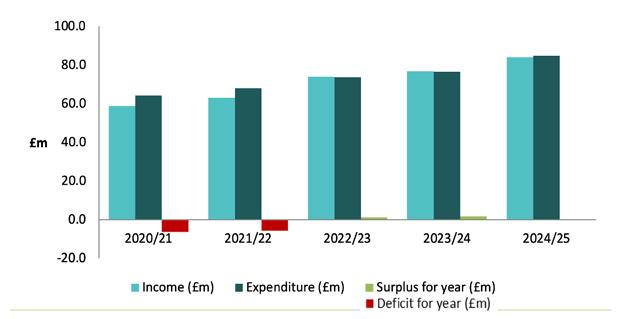
During the financial year 2024/25 income rose due to higher overall student numbers compared with the previous year whilst costs were higher through staffing costs and partnership franchise fees (increased partner student numbers).
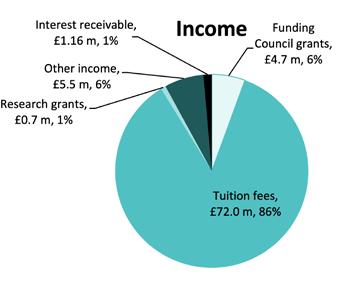
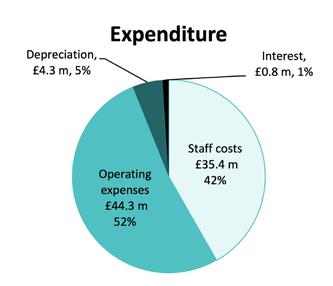
We recorded a surplus for the year of £0.4m (2023/24 – £0.9m) which was ahead of the small deficit approved by the Board of Governors.
Income and costs rose by 9% due to higher tuition fee receipts from on-campus and online students and higher partner student fees and higher staff and non-pay costs (primarily due to franchise fees payable).
Tangible fixed asset additions during the year amounted to £1.02m on equipment purchases including items for a new research-related project plus the annual renewal and updating of IT and equipment.
The University operated four subsidiary companies during the year: Falmouth Enterprises Limited, Falmouth Agency Limited, Falmouth Staffing Limited and Falmouth Ventures Ltd. In addition, the University owns 50% in Falmouth Exeter Plus, a jointly controlled entity with the University of Exeter. Any surpluses generated by the subsidiaries are transferred under deed of covenant. In the current year, the surpluses generated by these subsidiaries was £132k (2023/24 - £103k).
Cash flow from operating activities recorded a net inflow of £5.5m (2023/24 – inflow £4.8m). The overall net cash inflow was £3.7m (2023/24 – inflow £2.8m) which meant that cash held at the year-end increased to £30.8m (2023/24 – £27.1m).
In total, the face of the balance sheet shows that borrowings remain relatively modest although it should however be noted that the University guarantees 50% of the loans within Falmouth Exeter Plus which are funded by income from student residences. At the year end the value of this guarantee stood at £15m.
The Late Payment of Commercial Debts (Interest) Act 1998 requires Universities to make payments to suppliers within 30 days of either the provision of goods or services or the date on which the invoice was received. The target set by the Treasury for payment to suppliers within 30 days is 90%. During the year ended 31 July 2025, the University paid 87% of its invoices within 30 days. The University incurred no interest charges in respect of late payment for this period.
As part of the Board of Governor’s consideration of the appropriateness of adopting the going concern basis in preparing the annual report and financial statements, a range of scenarios have been reviewed. These consider student recruitment (particularly against a fixed UK undergraduate fee), income from online provision, partnerships and research and knowledge exchange.
Given that, at the time of approving the financial statements, recruitment for the coming year is known with much more certainty; numbers are in line with the forecasts and Business Plan approved by the Board. This Plan sees the University continue to generate cash on an annual basis.
As such, the Board considers that the University has adequate resources to continue in operational existence for the at least the next twelve months and it is appropriate to adopt the going concern basis in preparing the financial statements.
This statement applies to the financial year 2024/25 and the period up to the approval of the audited financial statements.
Falmouth University is a Higher Education Corporation created by statute and an exempt charity, with the Office for Students acting as its principal regulator.
The institution was established as a Higher Education Corporation on 1 April 1989 under the Education Reform Act 1988. The institution was incorporated as Falmouth School of Art and Design. On 10 December 2012, the Privy Council granted consent to change the name to Falmouth University.
The core charitable purpose of the University, as defined in the Charities Act 2011, is the advancement of education for the public benefit. Members of the University’s Board of Governors are the Trustees of the charity and are responsible for ensuring compliance with charity legislation.
In setting and reviewing the University’s strategic objectives, the Board of Governors paid and continue to have due regard to the Charity Commission’s guidance on public benefit and particularly upon its supplementary guidance on the advancement of education. The principal beneficiaries of the University’s services are our students and the public at large.

The University’s corporate governance framework is established through the Articles & Instrument of Government which define the powers and responsibilities of the Board of Governors, Academic Board and the Vice-Chancellor & Chief Executive. The Articles and Instrument of Government are published in full on the University’s webpage
The University is committed to demonstrating best practice in all aspects of corporate governance and conducts its business responsibly, transparently and in accordance with:
- Falmouth University’s Articles and Instrument of Government;
- the seven principles identified by the Committee on Standards in Public Life, the Nolan Principles: selflessness, integrity, objectivity, accountability, openness, honesty and leadership;
- the requirements of the Higher Education regulator, the Office for Students (inclusive of upholding the Public Interest Governance Principles);
- the Committee of University Chairs’ (CUC) Higher Education Code of Governance 2020 (‘Higher Education Code of Governance’); Higher Education Audit Committees Code of Practice 2020 (‘Higher Education Audit Committees Code’); and Higher Education Senior Staff Remuneration Code 2018 (‘Higher Education Remuneration Code’) – all of which have been formally adopted by the University;
- relevant Charity Commission guidance; and
- other sources of recommended practice, as in so far as applicable to the Higher Education sector.
In adopting the Higher Education Code of Governance, the University has regularly reviewed its governance arrangements and is satisfied that it complies with the provisions of the Code. The statement of compliance is published on the University’s webpage. There are robust systems in place to ensure compliance with regulatory and other legal obligations, including compliance with the Office for Students’ ongoing Conditions of Registration, which are overseen via the University’s Corporate Compliance Risk Register.
The external governance effectiveness reviews conducted by Halpin Partnership and AdvanceHE in 2024 and 2021 respectively each confirmed that the University demonstrated good governance against the provisions of the Higher Education Code of Governance, and good compliance with the Office for Students’ ongoing Conditions of Registration.
The Board of Governors (‘the Board’) is the University’s governing body, established in accordance with the Articles and Instrument of Government. The members of the Board are the trustees of the charity.
The Board’s responsibilities are set out in the Articles of Government, Statement of Primary Responsibilities and in directives from the Office for Students. Key responsibilities include determining the educational character and mission of the University, the establishment and monitoring of systems of control and accountability, ensuring that systems are in place for meeting the University’s legal and regulatory obligations, ensuring the solvency of the University, ensuring effective and efficient use of resources, and approving the annual budget and financial statements. The Board’s responsibilities are published in full in the Statement of Primary Responsibilities on the University’s webpage. A detailed statement on the Board’s responsibilities in respect of the preparation of the Annual Report and Financial Statements is provided on pages 35-36.
The membership of the Board of Governors is predominantly independent, and no individual or group dominates its decision-making process. The Board considers that each of its non-executive members is independent of management and free from any business or other relationship which could materially interfere with the exercise of their independent judgement, and there is clear separation between the roles of Chair and Vice-Chancellor & Chief Executive. Members of the Board of Governors do not receive remuneration for their service on the Board, but are entitled to claim reasonable expenses incurred in undertaking their duties as trustees. See note 7 for details of expenses.
Any new appointments to the Board are a matter for the consideration of the Board as a whole. Prior to the appointment as a Member of the Board of Governors an assessment is undertaken in respect of the nominee meeting the requirements of the Office for Students’ ‘fit and proper persons’ Public Interest Governance Principle, which is reassessed annually thereafter.
The composition of the Board of Governors is determined in accordance with the Instrument of Government, as follows: an independent Chair, a further ten Independent Members, the Vice-Chancellor, two elected representatives of the student body, one Independent Co-opted Member, and one representative each for the academic, professional services and technical staff bodies.
The Board made one new independent Board member appointment during the period (Dr T Leane), with a further two members appointed after the financial year-end but before the signing of the accounts. Within the period the Board approved an increase in student membership to two, strengthening student voice, as well as the establishment of the technical staff member role, increasing representation of this key staff constituency.
During the period, the Board of Governors approved a new Team Charter that encapsulates the objectives and ethos of the Board as well as providing clarity about the behaviours and standards of conduct expected of its Members. The Charter provides a strong foundation for a positive and impactful boardroom culture that supports the sustainable delivery of the institutional mission, the highest standards of governance, and the best possible outcomes for our students.
The Board of Governors formally meets six times per year with provision for extraordinary meetings as required. This was revised to fewer, more intensive meetings from 2025/26 during the period. The Board met seven times in 2024/25, plus two strategic away day sessions which explored topics including Research Degree Awarding Powers, the higher education policy landscape, and artificial intelligence in depth.
To assist in the effective discharge of its duties, the Board has four independently chaired sub-committees, each of which have clearly defined delegated responsibilities:
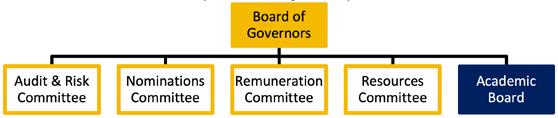
The formal meetings of the Board were supplemented by informal briefing and ‘Q&A’ sessions on relevant issues in-between Board meetings, attendance at University events, and an open invitation for all Independent Members to attend Academic Board.
The Board’s sub-committees and Academic Board each provide timely, regular reports to the Board, making recommendations as appropriate. The Terms of Reference of the Board’s Committees and Academic Board are published in full on the University’s webpage.
Audit & Risk Committee ( Terms of Reference) met three times during 2024/25. In November 2024, following an internal review of committee effectiveness, the title of the Committee was expanded from Audit Committee to more clearly express the Committee’s risk oversight and assurance remit. The Committee’s key responsibilities include:
• Agreeing the scope of internal and external audits and reviews, discussing with the auditors and with management any matters arising from the audits, and agreeing and overseeing appropriate action.
• Reviewing the draft annual report and financial statements prior to submission to the Board and monitoring external audit findings, compliance with statutory requirements, accounting standards and best practices for financial reporting.
• Monitoring the adequacy and effectiveness of the accounting, risk management, internal control and governance arrangements.
• The production of an annual report for the Board providing an opinion on the adequacy and effectiveness of the University’s arrangements for:
• risk management, internal control and governance;
• sustainability, economy, efficiency and effectiveness (value for money); and
• the management and quality assurance of data submitted to regulatory bodies.
Audit & Risk Committee operates in accordance with the Committee of University Chairs’ Higher Education Audit Committees Code of Practice, regulatory requirements and other sources of recommended practice, as applicable to the higher education sector. The membership of Audit & Risk Committee is independent by strong majority, and to avoid potential conflicts of interest the Chair of the Board is not a member of the Committee, nor is there any crossover in membership between Audit & Risk Committee and Resources Committee. The Vice-Chancellor & Chief Executive and Executive Director of Finance, Audit & Risk attended all meetings of the Committee, with processes in place to enable independent discussions between members and auditors without the presence of the University’s Executive or management teams.
Nominations Committee ( Terms of Reference) met twice during 2024/25. The Committee’s primary responsibilities include:
• Advising the Board on the appointment and re-appointment of Board members.
• Compilation and maintenance of a matrix of skills and experience required by the Board.
• Overseeing succession planning for, and recruitment of, Board members.
Further to the annual meeting, during the period the Committee formed the interview panels for two recruitment campaigns which resulted in the successful appointment of two new independent members of the Board (P Beaver, D Wei) and one independent co-opted member of Audit & Risk Committee (D Baker). Supplementary to the work of the Committee, the full Board regularly considers Board membership, vacancies, diversity.
Remuneration Committee ( Terms of Reference) met twice during 2024/25. Remuneration Committee’s primary responsibilities include:
• To provide independent oversight of senior staff remuneration and the University’s approach to reward and recognition.
• Making decisions on behalf of the Board on the remuneration of the Vice-Chancellor and other senior designated postholders.
Remuneration Committee operates in accordance with the Committee of University Chairs’ Higher Education Senior Staff Remuneration Code, regulatory requirements and other sources of recommended practice, as applicable to the Higher Education sector.
Further information about the work of Remuneration Committee and senior staff remuneration is provided in the Remuneration Annual Statement in note 7.
Resources Committee
Resources Committee ( Terms of Reference) was established in March 2025 and met twice during 2024/25. Resources Committee’s primary responsibilities include:
• To ensure the effective and efficient use of resources to deliver the approved Mission and long-term financial sustainability, through oversight of the University’s strategic business planning and investments.
• To review and recommend strategies and major new policy developments linked to finance, people and culture, and the physical and digital estate.
The University is committed to the continuous improvement and enhancement of its governance. In accordance with good practice and the Higher Education Code of Governance, the Board regularly reviews governance and board effectiveness, including that of its sub-committees. The University’s framework for reviewing effectiveness includes the following:
• External Board effectiveness reviews which take place at least every three years;
• In the years in-between the external reviews, internally conducted reviews of effectiveness;
• Annual appraisal of all Board members; and
• Regular 1:1 meetings between the Chair and Board members.
The most recent external review of effectiveness, undertaken by Halpin Partnership (‘Halpin’) reported in September 2024. The review included meeting observations, surveys and interviews with members, as well as an extensive documentation review, and an assessment against Halpin’s Governance Maturity Framework and Academic Assurance Maturity Framework. Outcomes were positive, with the report noting that:
“Our assessment identifies the University as one of the top-performing institutions among the 40+ governance reviews that Halpin Partnership (‘Halpin’) has conducted: when benchmarked against other institutions, Falmouth is in the upper top quartile. Falmouth should take pride in its current governance arrangements, which are commendable for their effectiveness and robustness.”
“The review indicates that Falmouth is already demonstrating good to leadingedge governance practices. In the face of considerable pressures within the higher education sector, Falmouth has effectively managed these challenges, reflecting a clear commitment to continually improving governance for the benefit of the University community.”
“Our evaluation focused on assessing Falmouth’s governance structures, processes and culture, aiming to identify opportunities for further improvement.” Halpin Governance Effectiveness Review
The report set out a suite of commendations and developmental recommendations to further strengthen governance and support leading practice. The Board approved the implementation plan for the recommendations in November 2024, which detailed separate action plans which were overseen by the Board of Governors, Academic Board, and Nominations Committee. The efficacy of the University’s response to the recommendations was assessed independently by Halpin in October 2025 via an impact review:
“This assessment shows that Falmouth has improved it’s performance across both frameworks. The Governance Maturity Framework shows improvement in 17 of the 20 areas. The Academic Assurance Maturity Framework shows improvement in 5 of the 7 areas. This demonstrates the impact of the implementation work undertaken and indicates that Falmouth is firmly Good to Leading-edge in its governance with many areas of Leading-edge practice.” Halpin Impact Review Report
Key changes included the establishment of Resources Committee, revisions to Board cadence and membership, academic assurance enhancements and website and transparency enhancements.
Newly appointed members participate in an individual induction programme, tailored to their specific needs and experience. In addition, all members are invited to attend conferences and events for Governors offered by organisations such as AdvanceHE, CUC, Uniac, and BDO.
All Board members have access to an internally developed Board App, launched in 2022/23, which provides easy access to key information, interactive dashboards on the University’s risks, compliance and strategic metrics, and professional development opportunities.
Within-meeting briefing sessions, and regular strategic deep-dive sessions bring in internal and external voices to support members’ understanding of the University, the external environment and key topics of interest. The University’s three Boards: the Board of Governors, Academic Board and University Executive Board come together at least annually for a joint Board strategic deep-dive session, in 2024/25 this took place in January 2025.
As part of the University’s commitment to good governance and conducting its affairs in a responsible and transparent way, all members of the Board and its Committees are required to exercise independent judgement, have due regard for the impact their personal and professional behaviour has on the University, its people, the environment, and the local community, and at all times put the University’s interests above their own.
This includes fully disclosing any actual, potential, or perceived conflicts of interests as they arise and, if necessary, abstaining from any involvement in the decision-making process, including withdrawing from a meeting. The University’s systems for managing any actual or perceived conflicts of interest are outlined in a published conflicts of interest policy. There were no related party transactions during the period.
The University maintains a full Register of Interests of Board Members which is reviewed by the Board three times a year. A summary of the individual interests of Members of the Board is published within the respective profiles on the University’s website.
Academic governance arrangements
Academic Board is the University’s senior academic authority, established in accordance with the Articles. Academic Board’s responsibilities include the quality and continuous improvement of the student academic experience, the quality and standards of the University’s awards, and approval of new editions and revisions to academic regulations and policy. Academic Board’s responsibilities are published in the Articles and Terms of Reference on the University’s website, alongside the profiles of its members and the minutes of meetings held during the period.
Academic Board is chaired by the Vice-Chancellor & Chief Executive and its membership includes the Deputy Vice-Chancellor, Pro Vice-Chancellor: Research & Knowledge Exchange, Deans of Faculty, one elected representative from each of the following groups: professoriate, academic staff, professional services staff, and technical staff, as well as the student governors (Students’ Union President and Vice-President) and other co-opted staff members. The work of Academic Board is supported by a range of specialist subcommittees, including Learning, Teaching & Quality Committee, Research & Knowledge Exchange Committee, and Research Integrity & Ethics Committee each with clearly described remits and delegated authorities.
Academic Board assists the Board of Governors in discharging its responsibility for ensuring that the University’s academic governance arrangements are effective. In addition to receiving reports of the Academic Board meetings, the Board of Governors also receives academic assurance reports relating to the student academic experience, student outcomes and the setting and maintenance of academic standards. There is intentional crossrepresentation on the membership of the Academic Board and the Board of Governors, including a formal Academic Board link independent member of the Board of Governors to help to enhance the links between the two Boards. All independent members observe an Academic Board meeting as part of their induction, with an open invitation to join Academic Board meetings throughout the year.
The University undertakes periodic reviews of the effectiveness of its academic governance arrangements, the most recent of which reported in September 2024. The last review was conducted independently by Halpin within the scope of the external review of governance effectiveness. Outcomes were positive, with the report noting that:
“Following a comprehensive review, it has been determined that the Academic Board is effectively fulfilling its designated responsibilities. The review has highlighted the Academic Board’s good approach to academic oversight, strategic decision making, and maintenance of high educational standards.”
“The academic governance supports the University’s higher education mission and strategic direction, by ensuring related policies and plans are coherent and consistently applied. Through collaboration with staff, students and external stakeholders, Falmouth develops, implements and communicates policies and procedures that maintain the institution’s academic standards.”
The report set out a suite of commendations and developmental recommendations to further strengthen academic governance and assurance, and to support leading practice, including strengthening the protocols by which the Board of Governors receives and tests assurance that academic governance is effective. The efficacy of the University’s response to the recommendations was assessed independently by Halpin in October 2025 via an impact review as noted on the previous page.
The Vice-Chancellor & Chief Executive (‘Vice-Chancellor’) is responsible to the Board of Governors for the organisation, direction and management of the University and the leadership of its staff, and is the Accountable Officer for the purposes of the Office for Students’ terms and conditions of funding. The Vice-Chancellor’s responsibilities are published in the Articles on the University’s website
The Vice-Chancellor chairs and is advised by University Executive Board, which comprises of: the Deputy Vice-Chancellor (Interim), Chief People Officer; Pro Vice-Chancellor; two Executive Directors; two Directors; Senior Head of Strategic Transformation and the Head of Governance Services (Secretary to the Board). The responsibilities of University Executive Board and the profiles of its members are published on the University’s website
University Executive Board (UEB), is the senior executive decision-making forum within the University. University Executive Board plays a crucial role in developing and implementing the University’s Strategy (Mission, Vision, Values and Annual Plan). This includes overseeing the effective management of the University’s resources, obligations and risks, as well as leading the development of a culture that supports delivery.
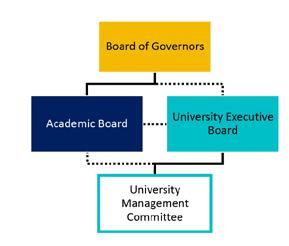
University Management Committee, a sub-committee of UEB, plays a key role in the operational implementation of the University’s strategy.
The interface between the Board of Governors, Academic Board, University Executive Board, and University Management Committee is shown in the diagram.
The Falmouth & Exeter Students’ Union (SU) represents students from Falmouth University and the University of Exeter (UoE), Cornwall Campus and provides advice and support and student voice representation, meaning that the student experience is understood and considered at every level of the University’s decision making.
Students are represented across the University’s governance meetings so that the student voice is heard, including at the Board of Governors and Academic Board. At the end of 2024/25 a Vice-President role was established for Falmouth University who has served alongside the President for Falmouth University since July 2024, strengthening representation.
Financially, and as an independent registered charity, the SU reports separately and the SU annual accounts are not consolidated into our figures within this report.
During the period, a new Chief Executive of the SU was appointed and strategic and constitutional review has been undertaken in partnership with students key University stakeholders. This will be approved and implemented during the 2025/26 year.
The Board of Governors (‘Board’) is responsible for maintaining a sound system of internal control that supports the achievement of the University’s strategic aims and objectives while safeguarding the public and other funds and assets for which it is responsible, and in accordance with the regulatory requirements of the Office for Students. The Board, both directly and through its Audit & Risk Committee, ensures that it uses public funds only for the purposes for which they were provided and that the University complies with terms and conditions of funding.
The system of internal control is designed to manage, rather than eliminate, the risk of failure to achieve the University’s aims and objectives. It can therefore only provide reasonable and not absolute assurance of effectiveness.
The system of internal control is based on an ongoing process designed to identify the principle risks to the achievement of the University’s aims and objectives, to evaluate the nature and extent of those risks, and to manage them efficiently, effectively, and economically. The system of internal control has been in place during the year ended 31 July 2025 and up to the date of approval of the financial statements, and accords with the guidance provided by the Office for Students.
The system of internal control is supported by a number of policies, procedures, processes and authorities that have been approved by the Board (either directly or through delegated responsibility to Audit & Risk Committee) to help to prevent and detect corruption, fraud, bribery and other irregularities. These include but are not limited to: Risk Management Policy; Delegation Framework; Anti-fraud Policy; Anti-money Laundering Policy; Anti-bribery Policy; Criminal Finances Act Policy; Conflicts of Interest Policy.
The following internal control processes are well established and have been in place during the period:
• A structured cycle of Board and committee meetings to consider the plans, strategic direction and performance of the University.
• The Board receives regular reports on key performance indicators and targets that measure financial and other performance. This includes the Annual Plan Metrics which are reviewed and re-approved annually by the Board.
• The University operates within a clear and dynamic risk management framework which identifies, evaluates and manages risks systematically across all service areas. A University-wide risk register is in place, designed to identify and prioritise the risks to the achievement of University’s strategic aims and compliance obligations, to evaluate the likelihood of those risks being realised and the impact should they be realised, and to manage them efficiently, effectively and economically.
• A designated member of the executive, the Executive Director of Finance, Audit & Risk, has responsibility for ensuring the effectiveness of the risk and internal control frameworks and associated reporting.
• Three times per year, the Audit & Risk Committee and Board considers the risks facing the University and the controls and mitigating actions that are in place to address them, with a deeper-dive horizon scanning exercise scheduled annually. The risk horizon scanning exercise considers internal and external developments as well as analysis of risk registers and risk management good practice across the sector.
• Audit & Risk Committee receives regular reports from the independent Internal Audit function, including any recommendations for improvement. Progress reports on the implementation of recommendations are monitored by University Executive Board as well as Audit & Risk Committee. These regular reports include an annual independent opinion on the adequacy and effectiveness of the University’s risk, internal control, and assurance framework. The work of the Internal Audit function is guided by the University’s strategic objectives and Strategic and Corporate Compliance Risk Registers, and is determined by the Audit & Risk Committee.
• The Board regularly receives periodic and annual financial reports which indicate financial performance against forecast.
• A clearly defined schedule of financial limits and authorities is in place, which is periodically reviewed and approved by the Board.
A proactive approach to the continuous improvement of the internal control framework has been demonstrated throughout the period.
During the period the Board approved the appointment of a new internal auditor following a competitive tender exercise. TIAA would succeed Uniac from 2025/26.
Summary of key risks
A summary of the top five strategic risks that could impact on the University’s ability to deliver our strategic objectives as at the year-end is shown below:
Strategic Risk Register
Cyber security
Student recruitment
Graduate outcomes
Achievement of Research Degree Awarding Powers
Student experience
The Corporate Compliance Risk Register sits alongside the Strategic Risk Register, enabling greater ownership, visibility and control of the University’s Corporate Compliance responsibilities. The top five risks at the year-end include:
Corporate Compliance Risk Register
OfS Conditions of Registration B
Student data
OfS Condition of Registration D
Equality Act 2010 - students
OfS Condition of Registration E
Effectiveness of the system of internal control
University Executive Board has undertaken its annual review of the effectiveness of internal control arrangements for the period. No significant internal control weaknesses or failures have been identified during the financial year or prior to the signing of the financial statements. This review is informed by:
• the work of the internal and external auditors and other external sources of assurance;
• comments made by the University’s external auditors in their management letters and other reports; and
• the work of the executive managers within the University who have responsibility for the development and maintenance of the internal control framework and ownership of the management of the principle risks.
The outcome of University Executive Board’s review of the effectiveness of the University’s internal control arrangements was presented alongside the Audit & Risk Committee Annual Report and the annual reports of the internal and external auditors, and has been reviewed and endorsed by the Audit & Risk Committee.
Based on the advice of the Audit & Risk Committee and the Vice-Chancellor & Chief Executive, the Board is of the opinion that the University has an adequate and effective framework for governance, risk management and internal control, and has fulfilled its statutory responsibility for the effective and efficient use of resources, the solvency of the institution and the safeguarding of its assets.
Approved by order of the members of the Board on 21 November 2025 and signed on its behalf by:
Helen Owers

Professor Emma Hunt Chair of the Board of Governors Vice-Chancellor & Chief Executive
The Board of Governors is responsible for preparing the Annual Report and the financial statements in accordance with the requirements of the Office for Students’ Terms and Conditions of Funding for Higher Education Institutions and Research England’s Terms and Conditions of Research England Grant and applicable law and regulations.
It is required to prepare the group and parent University financial statements in accordance with UK accounting standards and applicable law (UK Generally Accepted Accounting Practice), including FRS 102 The Financial Reporting Standard applicable in the UK and Republic of Ireland. The Terms and Conditions of Funding further require the financial statements to be prepared in accordance with the requirements of the Accounts Direction dated 25 October 2019 issued by the Office for Students (‘the Accounts Direction’) and the 2019 Statement of Recommended Practice – Accounting for Further and Higher Education.
The Board of Governors is required to prepare financial statements which give a true and fair view of the state of affairs of the group and of the parent University and of their income and expenditure, gains and losses and changes in reserves, and of the Group’s cash flows for that period. In preparing each of the group and parent University financial statements, the Board of Governors is required to:
• select suitable accounting policies and then apply them consistently;
• make judgements and estimates that are reasonable and prudent;
• state whether applicable UK accounting standards and the 2019 Statement of Recommended Practice – Accounting for Further and Higher Education have been followed, subject to any material departures disclosed and explained in the financial statements;
• assess the group and parent University’s ability to continue as a going concern, disclosing, as applicable, matters related to going concern; and
• use the going concern basis of accounting unless it either intends to liquidate the group or the parent University or to cease operations, or have no realistic alternative but to do so.
The Board of Governors is responsible for keeping adequate accounting records that are sufficient to show and explain the parent University’s transactions and disclose with reasonable accuracy at any time the financial position of the parent University. It is responsible for such internal control as it determines is necessary to enable the preparation of financial statements that are free from material misstatement, whether due to fraud or error, and has general responsibility for taking such steps as are reasonably open to it to safeguard the assets of the group and to prevent and detect fraud and other irregularities. The Board of Governors is also responsible for ensuring that:
• funds from whatever source administered by the Group or the University for specific purposes have been properly applied to those purposes and managed in accordance with relevant legislation;
• funds provided by the Office for Students, UK Research and Innovation (including Research England), the Education and Skills Funding Agency and the Department for Education have been applied in accordance with the terms and conditions attached to them.
• there are appropriate financial and management controls in place to safeguard public funds and funds from other sources; and
• securing the economical, efficient and effective management of the University’s resources and expenditure.
The Board of Governors is responsible for the maintenance and integrity of the corporate and financial information included on the University’s website. Legislation in the UK governing the preparation and dissemination of financial statements may differ from legislation in other jurisdictions.
Robyn Wyatt
Secretary to the Board of Governors
21 November 2025

We have audited the financial statements of Falmouth University (the ‘University’) and its subsidiaries (‘the Group’) for the year ended 31 July 2025 which comprise the Consolidated and University Statement of Comprehensive Income, the Consolidated and University Statement of Changes in Reserves, the Consolidated and University Statement of Financial Position, the Consolidated Statement Cash Flow Statement and notes to the financial statements, including a summary of significant accounting policies.
The financial reporting framework that has been applied in their preparation is applicable law and United Kingdom Accounting Standards, including FRS 102 “The Financial Reporting Standard applicable in the UK and Republic of Ireland” (United Kingdom Generally Accepted Accounting Practice) and the 2019 Statement of Recommended Practice: Accounting for Further and Higher Education.
In our opinion, the financial statements:
• give a true and fair view of the state of the Group’s and University’s affairs as at 31 July 2025 and of the Group and University’s income and expenditure, gains and losses, changes in reserves and the Group’s cash flows for the year then ended;
• have been properly prepared in accordance with United Kingdom Generally Accepted Accounting Practice.
• have been properly prepared in accordance with the requirements of the Office for Students’ Accounts Direction (OfS 2019.41)
We conducted our audit in accordance with International Standards on Auditing (UK) (ISAs (UK)) and applicable law. Our responsibilities under those standards are further described in the “Auditor’s responsibilities for the audit of the financial statements” section of our report. We are independent of the Group and the University in accordance with the ethical requirements that are relevant to our audit of the financial statements in the UK, including the FRC’s Ethical Standard, and we have fulfilled our other ethical responsibilities in accordance with these requirements. We believe that the audit evidence we have obtained is sufficient and appropriate to provide a basis for our opinion.
In auditing the financial statements, we have concluded that the Board of Governors’ use of the going concern basis of accounting in the preparation of the financial statements is appropriate.
Based on the work we have performed, we have not identified any material uncertainties relating to events or conditions that, individually or collectively, may cast significant doubt on the Group’s and the University’s ability to continue as a going concern for a period of at least twelve months from when the financial statements are authorised for issue.
Our responsibilities and the responsibilities of the Board of Governors’ with respect to going concern are described in the relevant sections of this report.
The other information comprises the information included in the Annual Report, other than the financial statements and our auditor’s report thereon. Our opinion on the financial statements does not cover the other information and, except to the extent otherwise explicitly stated in our report, we do not express any form of assurance conclusion thereon.
Our responsibility is to read the other information and, in doing so, consider whether the other information is materially inconsistent with the financial statements or our knowledge obtained in the course of the audit, or otherwise appears to be materially misstated. If we identify such material inconsistencies or apparent material misstatements, we are required to determine whether this gives rise to a material misstatement in the financial statements themselves. If, based on the work we have performed, we conclude that there is a material misstatement of this other information, we are required to report that fact.
We have nothing to report in this regard.
As explained more fully in the Statement of Responsibilities of the Board of Governors set out on pages 35-36, the Board of Governors are responsible for the preparation of the financial statements and for being satisfied that they give a true and fair view, and for such internal control as they determine is necessary to enable the preparation of financial statements that are free from material misstatement, whether due to fraud or error.
In preparing the financial statements, the Board of Governors are responsible for assessing the Group and University’s ability to continue as a going concern, disclosing, as applicable, matters related to going concern and using the going concern basis of accounting unless the Board of Governors either intend to liquidate the Group/University or to cease operations, or have no realistic alternative but to do so
Our objectives are to obtain reasonable assurance about whether the financial statements as a whole are free from material misstatement, whether due to fraud or error, and to issue an auditor’s report that includes our opinion. Reasonable assurance is a high level of assurance but is not a guarantee that an audit conducted in accordance with ISAs (UK) will always detect a material misstatement when it exists. Misstatements can arise from fraud or error and are considered material if, individually or in the aggregate, they could reasonably be expected to influence the economic decisions of users taken on the basis of the financial statements.
The extent to which our procedures are capable of detecting irregularities, including fraud is detailed below.
Irregularities, including fraud, are instances of non-compliance with laws and regulations. We design procedures in line with our responsibilities, outlined above, to detect material misstatements in respect of irregularities, including fraud.
Based on our understanding of the University/Group and its industry, we considered that non-compliance with the following laws and regulations might have a material effect on the financial statements: OfS requirements, UK tax legislation, pension legislation, employment regulation and health and safety regulation, anti-bribery, corruption and fraud and money laundering.
To help us identify instances of non-compliance with these laws and regulations, and in identifying and assessing the risks of material misstatement in respect to non-compliance, our procedures included, but were not limited to:
• Inquiring of management and, where appropriate, those charged with governance, as to whether the Group and the Univeristy is in compliance with laws and regulations, and discussing their policies and procedures regarding compliance with laws and regulations;
• Inspecting correspondence, if any, with relevant licensing or regulatory authorities;
• Communicating identified laws and regulations to the engagement team and remaining alert to any indications of non-compliance throughout our audit; and
• Considering the risk of acts by the Group and the University which were contrary to applicable laws and regulations, including fraud.
We also considered those laws and regulations that have a direct effect on the preparation of the financial statements, such as tax legislation, pension legislation, and the OfS Accounts Direction.
In addition, we evaluated the Board of Governors’ and management’s incentives and opportunities for fraudulent manipulation of the financial statements, including the risk of management override of controls, and determined that the principal risks related to posting manual journal entries to manipulate financial performance, management bias through judgements and assumptions in significant accounting estimates, in particular in relation to defined benefit pension Scheme Assets, bad debt provisions, Investment in Joint Venture, revenue recognition (which we pinpointed to the cut-off assertion in relation to research grants and other income) and significant one-off or unusual transactions.
Our audit procedures in relation to fraud included but were not limited to:
• Inquiring of management and, where appropriate, those charged with governance, as to whether the Group and the University is in compliance with laws and regulations, and discussing their policies and procedures regarding compliance with laws and regulations;
• Gaining an understanding of the internal controls established to mitigate risks related to fraud;
• Discussing amongst the engagement team the risks of fraud; and
• Addressing the risks of fraud through management override of controls by performing journal entry testing.
There are inherent limitations in the audit procedures described above and the primary responsibility for the prevention and detection of irregularities including fraud rests with management. As with any audit, there remained a risk of non-detection of irregularities, as these may involve collusion, forgery, intentional omissions, misrepresentations or the override of internal controls.
A further description of our responsibilities for the audit of the financial statements is located on the Financial Reporting Council’s website at www.frc.org.uk/ auditorsresponsibilities. This description forms part of our auditor’s report.
Opinion on other matters prescribed in the OfS Audit Code of Practice issued under the Further and Higher Education Act 1992
In our opinion, in all material respects:
• Funds from whatever source administered by the provider for specific purposes have been properly applied to those purposes and managed in accordance with relevant legislation
• Funds provided by OfS, UK Research and Innovation (including Research England), the Education and Skills Funding Agency/Department of Education have been applied in accordance with the relevant terms and conditions; and
• The requirements of the OfS’s accounts direction have been met.
Matters on which we are required to report by exception
In light of the knowledge and understanding of the Group and University and its environment obtained in the course of the audit, we have not identified material misstatements in the strategic report or the Board of Governors’ Report.
We have nothing to report in respect of the following matters in relation to which the OfS Audit Code of Practice requires us to report to you if, in our opinion:
• The provider’s grant and fee income, as disclosed in the notes to the accounts, is materially misstated; or
• The provider’s expenditure on access and participation activities, as disclosed in the accounts, has been materially misstated.
of
This report is made solely to the University’s members as a body in accordance with paragraph 13(2) of the University’s articles and section 124B of the Education Reform Act 1988. Our audit work has been undertaken so that we might state to the University’s members those matters we are required to state to them in an auditor’s report and for no other purpose. To the fullest extent permitted by law, we do not accept or assume responsibility to anyone other than the Group and University and the University’s members as a body for our audit work, for this report, or for the opinions we have formed.
Signed:

David Hoose (Senior Statutory Auditor) for and on behalf of Forvis Mazars LLP
Chartered Accountants and Statutory Auditor
8th Floor Assembly Building C Cheese Lane
Bristol
BS2 0JJ
Date: 1/12/2025
All income relates to continuing operations. The notes on pages 45 to 74 form an integral part of the financial statements.
The notes on pages 45 to 74 form an integral part of the financial statements.
The notes on pages 45 to 74 form an integral part of the financial statements.
The financial statements on pages 41 to 74 were approved by the Board of Governors on 21 November 2025 and signed on its behalf by:
Helen Owers Professor E Hunt Chair of Governors Vice-Chancellor & Chief Executive
Basis of preparation
These financial statements have been prepared in accordance with the Statement of Recommended Practice (SORP): Accounting for Further and Higher Education 2019 and in accordance with Financial Reporting Standard (FRS) 102. The University is a public benefit entity and therefore has applied the relevant public benefit requirement of FRS 102. The financial statements are prepared in accordance with the historical cost convention.
Judgements made by management, in the application of these accounting policies, that have significant effect on the financial statements and estimates with a significant risk of material adjustment in the next year, are discussed below.
The Group and parent University’s activities, together with the factors likely to affect its future development, performance and position, are set out in the Report of the Governing Body. The Report also describes the financial position of the Institution, its cash flows, liquidity position and borrowing facilities.
The financial statements have been prepared on a going concern basis which the Board of Governors considers to be appropriate for the following reasons.
The Board of Governors has prepared cash flow forecasts for a period of 12 months from the date of approval of these financial statements (the going concern period), which indicate that, taking account of severe but plausible downsides, the Group and parent University will have sufficient funds to meet their liabilities as they fall due. In reaching this conclusion, the Board of Governors has considered the following factors.
Scenarios modelled included the impact of modified delivery for an extended period, reductions in student enrolments, and even delays to the start of the academic year. The key input to forecasts are student enrolments and retention and these have been stress-tested. Mitigating actions which could be taken following a decline in student numbers include a reduction in staff and direct costs. Currently, no need for further borrowing is foreseen.
The Board of Governors believe the Group and parent University have sufficient funding in place and expect the parent University to be in compliance with its debt covenants even in severe but plausible downside scenarios.
Consequently, the Board of Governors is confident that the Group and parent University will have sufficient funds to continue to meet their liabilities as they fall due for at least 12 months from the date of approval of the financial statements and therefore have prepared the financial statements on a going concern basis.
The consolidated financial statements include the University and its subsidiary companies, Falmouth Enterprises Limited, Falmouth Staffing Limited, Falmouth Agency Limited and Falmouth Ventures Limited. Intra-group sales and profits are eliminated fully on consolidation.
The 50% holding in the FX Plus Group represents an interest on a long-term basis which is jointly controlled with another party. As such the arrangement is treated as a jointly controlled entity and is accounted for using the equity method.
The University’s policy is to consolidate the Students’ Union only if its operations are material and if the University, at such time, is exercising significant influence on Union policy. The University does not currently consolidate the Students’ Union on the basis that it does not exercise control.
The University makes estimates and assumptions concerning the future. The resulting accounting estimates will, by definition, seldom equal the related actual results. The estimates and assumptions that have a significant risk of causing a material adjustment to the carrying amounts of assets and liabilities within the next financial year are addressed below.
The annual depreciation charge for tangible assets is sensitive to changes in the estimated useful economic lives of the assets so these are re-assessed annually and amended when necessary to reflect current estimates. See note 11 for the carrying amount of the property, plant and equipment, and note 1 for the useful economic lives for each class of assets.
The University makes an estimate for the recoverable value of trade and other debtors. When assessing impairment of trade and other debtors, management considers factors including the current credit rating of the debtor, the ageing profile of debtors and historical experience. See note 13 for the net carrying amount of the debtors and associated impairment provision.
FRS102 requires that certain assumptions are made in order to determine the amount to be recorded for retirement benefit obligations and pension plan assets, in particular for defined benefit plans. These are mainly actuarial assumptions such as expected inflation rates, employee turnover, expected return on plan assets and discount rates. Substantial changes in the assumed development of any one of these variables may significantly change the University’s retirement benefit obligation and pension assets.
The University calculates provisions for enhanced pension payments using the 10 year gilt yield index. The relocation provision assumes that eligible staff will claim the maximum agreed sum.
Income from the sale of goods or services is credited to the Consolidated Statement of Comprehensive Income when the goods or services are supplied to the external customers or the terms of the contract have been satisfied.
Fee income is stated gross of any expenditure which is not a discount and credited to the Consolidated Statement of Comprehensive Income over the period in which students are studying. Where the amount of the tuition fee is reduced, by a discount for prompt payment, income receivable is shown net of the discount. Bursaries and scholarships are accounted for gross as expenditure and not deducted from income.
Investment income is credited to the Consolidated Statement of Comprehensive Income on a receivable basis.
Funds the University receives and disburses as paying agent on behalf of a funding body are excluded from the income and expenditure of the University where the University is exposed to minimal risk or enjoys minimal economic benefit related to the transaction.
Grant funding including funding council block grant, research grants from government sources and grants (including research grants) from non-government sources are recognised as income when the University is entitled to the income and performance related conditions have been met. Income received in advance of performance related conditions being met is recognised as deferred income within creditors on the balance sheet and released to income as the conditions are met.
Non exchange transactions without performance related conditions are donations and endowments. Donations and endowments with donor imposed restrictions are recognised in income when the University is entitled to the funds. Income is retained within the restricted reserve until such time that it is utilised in line with such restrictions at which point the income is released to general reserves through a reserve transfer.
Donations with no restrictions are recognised in income when the University is entitled to the funds.
Investment income and appreciation of endowments is recorded in income in the year in which it arises and as either restricted or unrestricted income according to the terms of the restriction applied to the individual endowment fund.
There are four main types of donations and endowments identified within reserves:
1. Restricted donations - the donor has specified that the donation must be used for a particular objective.
2. Unrestricted permanent endowments - the donor has specified that the fund is to be permanently invested to generate an income stream for the general benefit of the University.
3. Restricted expendable endowments - the donor has specified a particular objective other than the purchase or construction of tangible fixed assets, and the University has the power to use the capital.
4. Restricted permanent endowments - the donor has specified that the fund is to be permanently invested to generate an income stream to be applied to a particular objective.
Capital grants
Government capital grants are recognised in income over the expected useful life of the asset. Other capital grants are recognised in income when the University is entitled to the funds subject to any performance related conditions being met.
Pension schemes
Retirement benefits for the employees of the University are provided by the Teachers’ Pension Scheme (TPS) for academic staff and by the Cornwall Council (CC) Superannuation Scheme for non-academic staff. These are defined benefit schemes which are contracted out of the State Earnings Related Pension Scheme. CC is a funded scheme and is valued every three years by professionally qualified independent actuaries.
TPS is a multi-employer scheme for which it is not possible to identify the assets and liabilities to the University’s members due to the mutual nature of the scheme and therefore this scheme is accounted for as a defined contribution retirement benefit scheme.
A defined contribution plan is a post-employment benefit plan under which the University pays fixed contributions into a separate entity and will have no legal or constructive obligation to pay further amounts. Obligations for contributions to defined contribution pension plans are recognised as an expense in the income statement in the periods during which services are rendered by employees.
Defined Benefit Plan
Defined benefit plans are post-employment benefit plans other than defined contribution plans. Under defined benefit plans, the University’s obligation is to provide the agreed benefits to current and former employees, and actuarial risk (that benefits will cost more or less than expected) and investment risk (that returns on assets set aside to fund the benefits will differ from expectations) are borne, in substance, by the University. The Group should recognise a liability for its obligations under defined benefit plans net of plan assets. This net defined benefit liability is measured as the estimated amount of benefit that employees have earned in return for their service in the current and prior periods, discounted to determine its present value, less the fair value (at bid price) of plan assets. The calculation is performed by a qualified actuary using the projected unit credit method.
As the present value of the defined benefit obligation at the reporting date is less than the fair value of plan assets at that date, the plan has a notional surplus. As management do not consider that the University will be able to recover the surplus either through reduced contributions in the future or through refunds from the plan, the surplus has not been recognised in these financial statements in line with paragraph 28.22 of FRS102.
The actual cost of any enhanced on-going pension to a former member of staff is paid by the University annually. An estimate of the expected future cost of any enhancement to the on-going pension of a former member of staff is charged in full to the University’s income statement in the year that the member of staff retires. The provision is calculated based on the total capital cost with an allowance for future investment returns in excess of inflation.
The provision set up is shown in note 16 and will be released each year in line with payments made and changes in the assumptions.
Short term employment benefits such as salaries and compensated absences are recognised as an expense in the year in which the employees render service to the University. Any unused benefits are accrued and measured as the additional amount the University expects to pay as a result of the unused entitlement.
Termination benefits and loss of office are expensed at the earlier of when the Group can no longer withdraw the offer of those benefits and when the Group recognises costs for a restructuring.
The University has a five-year rolling long-term maintenance plan, which forms the basis of the on-going maintenance of the estate. Expenditure on long term maintenance which does not either enhance an asset beyond its original condition or increase its expected economic life; and expenditure on all routine corrective maintenance, is charged to the income statement as incurred.
Leases in which the University assumes substantially all the risks and rewards of ownership of the leased asset are classified as finance leases. Leased assets acquired by way of finance lease and the corresponding lease liabilities are initially recognised at an amount equal to the lower of their fair value and the present value of the minimum lease payments at inception of the lease.
Minimum lease payments are apportioned between the finance charge and the reduction of the outstanding liability. The finance charge is allocated to each period during the lease term so as to produce a constant periodic rate of interest on the remaining balance of the liability.
Costs in respect of operating leases are charged on a straight-line basis over the lease term. Any lease premiums or incentives are spread over the whole term of the lease including extension options.
Transactions denominated in foreign currencies are recorded at the rate of exchange ruling at the date of the transaction. Monetary assets and liabilities denominated in foreign currencies are translated into sterling at year-end rates. Resulting exchange differences are included in the Statement of Comprehensive Income for the financial year.
Fixed assets are stated at deemed cost less accumulated depreciation and accumulated impairment losses. Certain items of fixed assets that had been revalued to fair value on the date of transition to the 2019 FE HE SORP were measured on the basis of deemed cost, being the revalued amount at the date of that revaluation. The revaluation reserve was transferred to the income and expenditure reserve during a prior year as assets are no longer being revalued. A gain or loss on disposal of fixed assets is calculated as disposal proceeds less net book value brought forward at the date of disposal.
Land and buildings
Freehold land is not depreciated. Buildings are stated at cost and endowment assets are valued at market valuation on donation. Buildings and associated capital works are depreciated over their expected useful lives of 50 years (freehold) or the period of the lease (leasehold).
An impairment review of a fixed asset is carried out if events or changes in circumstance indicate that the carrying amount of the fixed asset may not be recoverable.
Finance costs on associated loans from third parties that are directly attributable to the purchase of land or the construction of buildings are capitalised during the construction period but, thereafter, are not capitalised as part of the costs of those assets but are shown as interest payable.
Buildings under construction are accounted for at cost, based on the value of architects’ certificates, contractor claims that are substantiated and other direct costs incurred to 31 July 2025. They are not depreciated until they are brought into use.
Fixtures, fittings & equipment
Equipment, including computers and software, costing less than de minimis threshold of £5,000 per individual item is recognised as expenditure. All other equipment is capitalised.
Capitalised equipment is stated at cost and depreciated over its expected useful life, as follows:
Computers and equipment - 4 years
Motor vehicles - 4 years
Musical instruments - 10 years
Depreciation methods, useful lives and residual values are reviewed at the date of preparation of each Balance Sheet.
Accounting for goodwill and intangible fixed assets
Goodwill arises on consolidation and is based on the difference between the fair value of the consideration given for the undertaking acquired and the fair value of its net assets at the date of acquisition. Goodwill is amortised over its estimated economic life. Impairment tests are carried out at the end of the first year and thereafter subject to normal periodic reviews for indications of impairment.
Investments
Non-current investments are included in the balance sheet at amortised cost less impairment.
Investments in jointly controlled entities, associates and subsidiaries are carried at cost less impairment in the University’s accounts.
Current asset investments are held at fair value with movements recognised in the Surplus or Deficit for the year.
Cash includes cash in hand, deposits repayable on demand and overdrafts. Deposits are repayable on demand if they are in practice available within 24 hours without penalty.
Cash equivalents are short term (i.e. less than 100 days notice), highly liquid investments that are readily convertible to known amounts of cash with insignificant risk of change in value.
Provisions are recognised when the University has a present legal or constructive obligation as a result of a past event, it is probable that a transfer of economic benefit will be required to settle the obligation and a reliable estimate can be made of the amount of the obligation. The amount recognised as a provision is discounted to present value where the time value of money is material. The discount rate used reflects current market assessments of the time value of money and reflects any risks specific to the liability.
A contingent liability arises from a past event that gives the University a possible obligation whose existence will only be confirmed by the occurrence or otherwise of uncertain future events not wholly within the control of the University. Contingent liabilities also arise in circumstances where a provision would otherwise be made but either it is not probable that an outflow of resources will be required or the amount of the obligation cannot be measured reliably.
A contingent asset arises where an event has taken place that gives the University a possible asset whose existence will only be confirmed by the occurrence or otherwise of uncertain future events not wholly within the control of the University.
Contingent assets and liabilities are not recognised in the Balance Sheet but are disclosed in the notes.
The University accounts for its share of jointly controlled entities using the equity method. The University accounts for its share of transactions from joint operations and jointly controlled assets in the Consolidated Statement of Comprehensive Income.
The University is an exempt charity within the meaning of Part 3 of the Charities Act 2011, and, as such, is a charity within the meaning of Section 506 (1) of the Income and Corporation Taxes Act 1988. It is therefore a charity within the meaning of Para 1 of schedule 6 to the Finance Act 2010 and accordingly, the University is potentially exempt from taxation in respect of income or capital gains received within categories covered by section 478-488 of the Corporation Tax Act 2010 (CTA 2010) or section 256 of the Taxation of Chargeable Gains Act 1992, to the extent that such income or gains are applied to exclusively charitable purposes.
The University receives no similar exemption in respect of Value Added Tax and falls under the partial exemption regime so that it can only recover a minor element of VAT charged on its inputs. Irrecoverable VAT on inputs is included in the costs of such inputs. Any irrecoverable VAT allocated to fixed assets is included in their cost.
The University’s subsidiaries are liable to Corporation Tax in the same way as any other commercial organisation.
Deferred tax is provided in full on timing differences which result in an obligation at the balance sheet date to pay more tax, or a right to pay less tax, at a future date, at rates expected to apply when they crystallise based on current rates and law. Timing differences arise from the inclusion of items of income and expenditure in taxation computations in periods different from those in which they are included in financial statements. Deferred tax assets are provided where they are more likely than not to be recovered. Deferred tax assets and liabilities are not discounted.
Reserves are classified as restricted or unrestricted. Restricted endowment reserves include balances which, through endowment to the University, are held as a permanently restricted fund which the University must hold in perpetuity.
Other restricted reserves include balances where the donor has designated a specific purpose and therefore the University is restricted in the use of these funds.
The revaluation reserve has been transferred to the income and expenditure reserve as assets are no longer being revalued.
The source of grant and fee income, included in notes 2 to 4 is as follows:
a) Remuneration Committee Membership and Terms of Reference
The Membership of Remuneration Committee is determined in the published Terms of Reference, the Vice-Chancellor & Chief Executive is not a Member of Remuneration Committee.
The Remuneration Committee has formally adopted the Higher Education Senior Staff Remuneration Code (2021) and this statement complies with the reporting requirements of the Code.
Postholders within the direct remit of Remuneration Committee for the 2024/25 pay decisions were the Vice-Chancellor & Chief Executive and Head of Governance Services (Secretary to the Board of Governors).
b) The competitive environment
Falmouth University is a specialist creative university, that harnesses the fusion of creativity and technology through its learning, teaching, research and knowledge exchange, as foundations for the future economy. With over 7,000 students, the University operates in the UK, EU and international student markets for undergraduate, Masters level and PhD programmes. The Second Edition of the University’s 2030 Strategy sets out the Mission, Vision and Values approved by the Board of Governors.
c) Remuneration Policy
Base pay is reviewed for each designated post-holder and this is considered in two distinct areas:
• Cost of Living: Consideration is given on whether any inflationary increase to base pay should be made to reflect cost of living pressures. In reaching this decision the committee consider a range of inflation indices, the trend of these over the year as well as considering the outcome of the annual New JNCHES pay negotiations. Any decision to apply a cost-of-living increase to base pay would be applied equally to all designated post-holders.
Regarding Cost of Living, the Remuneration Committee decided that, in line with national HE sector pay negotiations, a 3% cost of living increase was to be provided for Designated Post Holders for 2024-25. Furthermore, in line the national HE sector, an additional 2% cost of living increase was provided to Designated Post Holders as an interim pay uplift with effect from 1 February 2025.
• Individual base pay: Separately to the decision on cost of living, the committee will also consider individual base pay to see whether the remuneration for the role has become out of kilter with the market.
In order to undertake this analysis, data published by the Universities and Colleges Employers Association is used to benchmark across relevant groups of institutions in the Higher Education sector, specifically:
• All institutions (income £40m-£100m)
• Post-1992 institutions (income £40m-£100m)
• Rest of England (up to £100m income)
• Mean of the median for the above
• In addition to the above, Xpert HR comparative salary data for posts not focused on academic leadership
The committee also considers analysis of internal salary distributions, and considers any changes or developments to the role during the period that may justify an amendment to remuneration.
The Vice-Chancellor & Chief Executive’s remuneration, along with comparisons against the previous year, are shown in the table below:
The Remuneration Committee also note the requirement to consider and publish the pay multiple of the Vice-Chancellor & Chief Executive in comparison to the rest of the organisation.
It is noted that the calculation required by the Committee of University Chairs’ (CUC) Senior Staff Remuneration Code differs slightly from the calculation required by the Office for Students Accounts Directions and therefore for clarity each ratio is published below. Using the CUC directed calculation, the pay multiple of the Vice-Chancellor & Chief Executive and the median earnings of the institutions whole workforce is 5.36 (2023/24: 5.22).
Using the OfS directed calculation, the pay multiple of the Vice-Chancellor & Chief Executive and the median earnings of the institutions whole workforce is 5.36 (2023/24: 5.22).
Using the OfS directed calculation, the total remuneration multiple of the Vice-Chancellor & Chief Executive and the total remuneration earnings of the institutions whole workforce is 5.38 (2023/24: 5.18).
It is often helpful to the University for its staff to hold non-executive director or trustee roles, or undertake other external engagements. The University’s policy is that any such appointment is agreed in advance with the line manager, including any declaration of income to be received.
The Vice-Chancellor & Chief Executive holds the following external appointments:
Current directorships of:
• Falmouth Agency Ltd
• Falmouth Enterprises Ltd
• Falmouth Staffing Ltd
Whilst not formal appointments, the Vice-Chancellor & Chief Executive also sits on a number of Boards where this develops a wider network that is advantageous to the University:
Cornwall & Isles of Scilly Workforce & Skills Board
Cornwall & Isles of Scilly Economic Forum
Cornwall & Isles of Scilly Civic University Partnership Board
Cornwall & Isles of Scilly Prosperity Advisory Panel
Cornwall & Isles of Scilly Leadership Board
Cornwall Growth Board
GuildHE Council
Great South West Partnership Board
The All-Party Parlimentary University Group
Universities UK Specialist Institutions Forum
Universities UK Skills England Advisory Group
Universities UK Civic & Local Growth Network
Universities UK Membership Committee
Universities UK Students Experience, Education and Skills Network
Universities UK Funding & Regulation Network
Universities UK Research & Innovation Policy Network
Chair
Vice Chair
Member
Member
Member
Co-opted
Member
Member
Member
Member
Member
Member
Member
Member
Member
Member
Member
The University has a single scheme for payment of expenses that is applicable to all employees.
Basic salary of higher paid staff excluding Vice-Chancellor (excluding employer’s pension contributions):
staff numbers (FTEs)
The total amount of any compensation for loss of office payable by the University for the year ended 31 July 2025 was £690k and relates to 16 posts (£1,211k for 33 posts to 31 July 2024). These figures include statutory redundancy and voluntary severance payments.
Key management personnel are those persons having authority and responsibility for planning, directing and controlling the activities of the University. The University views its University Executive Group (UEB) as its key management personnel. This consists of following roles:
Vice-Chancellor & Chief Executive Officer
Deputy Vice-Chancellor (Interim))
Pro Vice-Chancellor (Research and Knowledge Exchange)
Chief People Officer
Executive Director of Estates Operations & Infrastructure
Executive Director of Finance, Audit & Risk
Director of Planning & Business Intelligence Services
Director of Marketing & Engagement
Senior Head of Strategic Transformation
Head of Governance Services (Secretary to the Board of Governors)
Staff costs includes compensation paid to key management personnel.
No governor has received any remuneration or waived payments from the group during the year (2024: none). The total expenses paid to or on behalf of five governors was £6,165 (2023/24: £3,896 paid to nine governors). This represents travel and subsistence expenses incurred in attending Board, committee meetings and charity events in their official capacity.
During the year the University undertook restructuring in the form of a voluntary severance scheme. The restructuring costs above relate to severance costs as well as payments in lieu of notice.
bank loans not wholly repayable within five
The
*£146k (2023/24: £172k) of these costs are already included in the overall staff costs figures included in the financial statements, see note 7.
The University’s Access and Participation plan can be found at the following link: https://www.falmouth.ac.uk/study/tuition-fees/undergraduate#access-and-participation
Net Book Value
Land and buildings have previously been revalued in accordance with the old basis of accounting (2007 SORP) and on transition to FRS 102. The valuations as at the date of transition have been taken as deemed cost.
Land and buildings were professionally valued on the basis of depreciated replacement cost by Alder King, Chartered Surveyors, Newham Road, Truro on 31 July 2014. Properties have been valued on the basis of depreciated replacement cost.
The University owns 100% of the issued share capital of the following companies:
Falmouth Enterprises Limited (FEL) (dormant) 2517317
Falmouth Ventures Limited (FVL) 10720916
Falmouth Agency Limited (FAL) 11105902
Falmouth Staffing Limited (FSL) 11578921
FVL has been set up to hold Launchpad activity. The accounts of FVL are unaudited as it has claimed exemption under s479A Companies Act 2006. The University has provided a guarantee in respect of all of the company’s outstanding liabilities at 31 July 2025.
The principal activity of FAL is the operation of an employment agency for student workers and the provision of services to businesses carried out on behalf of the University.
The principal activity of FSL is the provision of human resources for professional services and academic staff. The accounts of FSL are unaudited as it has claimed exemption under s479A Companies Act 2006. The University has provided a guarantee in respect of all of the company’s outstanding liabilities at 31 July 2025.
All of the above are companies registered in England and Wales
The University also owns 50% of Falmouth Exeter Plus (FX Plus); a company limited by guarantee which in turn owns 100% of the issued share capital (100 £1 Ordinary Shares) in Tremough Development Vehicle Ltd (TDV) and 100% of the issued share capital (2 £1 Ordinary Shares) in Cornwall Plus Limited. These jointly controlled entities with University of Exeter (UoE) have been established to provide the operational aspects (through FX Plus and Cornwall Plus) and construction (through TDV) of the Penryn campus.
The objects of FX Plus are to advance the education of the public by providing and assisting in the provision of higher education facilities in Cornwall.
In accordance with FRS 102, the Group is required to disclose its share of assets and liabilities in FX Plus. As at the year end these were as follows:
Interest in associates comprises:
Hertzian is a spin-out company mentored by the University. Shares in this company were gifted on incorporation. No value has been included in the financial statements on the basis that it is not material.
In August 2020 the University invested £0.5m for a 10% share in Waterbear Education Ltd. This company provides music education in Brighton with values that mirror those of the University.
All companies are registered in England and Wales and operate in the UK.
Deferred income includes grants receivable in respect of funding for construction costs of the buildings at Penryn. Funders include the Ministry of Housing, Communities and Local Government, and Cornwall Council.
at 1 August
Transferred from Income and expenditure
Utilised in the year
The enhanced pension provision represents an estimate of the expected future cost of enhancements to the pensions of qualifying staff. These have been negotiated on an individual basis with staff taking early retirement, or in two cases, have been inherited as part of contractual terms. The number of employees to which the pension relates was 15 at 31 July 2025. The provision is calculated based on the total capital cost with an allowance for future investment returns in excess of inflation.
Endowment assets relate to two Denis Mitchell sculptures and a Michael Finn painting donated to and held in the University at valuation.
Four paintings by Tom Cross were donated to the University for displaying in areas to be seen by students and visitors. No value has been recognised in the financial statements but this is estimated to be in the region of £24k for insurance purposes.
The University’s employees belong to two principal pension schemes, the Teachers’ Pensions Scheme (TPS) and the Cornwall Pension Fund. The total pension cost for the period was as follows: 31/7/25
CC Pension Scheme: Charge to the Income and expenditure account (note 7)
(note 7)
(note 16)
The Teachers’ Pension Scheme is accounted for as a defined contribution pension scheme on the basis that it is not possible for the scheme to separately identify the University’s share of the underlying assets and liabilities in the scheme on a consistent and reasonable basis. The Teachers’ Pension Scheme (TPS) is a statutory, contributory, defined benefit scheme. The regulations under which the TPS operates are the Teachers’ Pensions Regulations 1997, as amended. These regulations apply to teachers in schools and other educational establishments in England and Wales maintained by local authorities (LAs), to teachers in many independent and voluntary-aided schools, and to teachers and lecturers in establishments of further and higher education. Membership is automatic for full-time teachers or lecturers and from 1 January 2007 automatic too for teachers or lecturers in part-time employment following appointment or a change of contract. Teachers are able to opt out of the TPS.
Although teachers are employed by LAs and various other bodies, their retirement and other pension benefits, including annual increases payable under the Pensions (Increase) Acts are, as provided for in the Superannuation Act 1972, paid out of monies provided by Parliament. Under the unfunded TPS, teachers’ contributions on a ‘pay-as-you-go’ basis, and employers’ contributions, are credited to the Exchequer under arrangements governed by the above Act.
The Teachers’ Pensions Regulations require an annual account, the Teachers’ Pension Account, to be kept of receipts and expenditure (including the cost of pensions’ increases). From 1 April 2001, the account will be credited with a real rate of return (in excess of price increases and currently set at 3.5%), which is equivalent to assuming that the balance in the account is invested in notional investments that produce that real rate of return.
Not less than every four years, with a supporting interim valuation in-between, the Government Actuary (GA), using normal actuarial principles, conducts a formal actuarial review of the TPS. The aim of the review is to specify the level of future contributions.
Contributions are assessed in two parts. Firstly, a standard contribution is determined. This is the contribution, expressed as a percentage of the salary of a teacher / lecturer entering service, which would defray the cost of benefits payable in respect of that service. Secondly, a supplementary contribution is payable if, as a result of the actuarial investigation, it is found that accumulated liabilities of the Account for benefits to past and present teachers, are not fully covered by normal contributions to be paid in future and by the fund built up from past contributions.
The last valuation of the TPS was carried out as at 31 March 2020. The GA’s report revealed that the total liabilities of the Scheme (pensions currently in payment and the estimated cost of future benefits) amounted to £262,000m. The value of the assets (estimated future contributions together with the proceeds from the notional investments held at the valuation date) was £222,200m. A copy of the latest valuation report can be found buy following this link: teachers pensions 2024/10 valuation result
Employees pay tiered contribution rates ranging from 7.4% to 11.7% according to their salary band. Employer rates are 28.6% from 1 April 2024 (previously 23.68%).
The University is a member of the Cornwall Council Pension Scheme, a funded defined benefit scheme in the UK. The total contribution made for the year ended 31 July 2025 was £1,705k (2024: £1,845k) of which employer’s contributions totalled £1,356k (2024: £1,467k) and employees’ contributions totalled £349k (2024: £378k).
The actuarial valuation of the scheme at 31 March 2022 showed a deficit of £100m. Employers’ contribution rates during the year were 23.1% plus an annual lump sum of £166,000. Employees pay tiered contributions and these were between 5.5% and 12.5% (2024: 5.5% to 12.5%).
The following information is based upon a full actuarial valuation of the fund at 31 March 2022 rolled forward to 31 July 2025 by a qualified independent actuary. For this purpose the rate used to discount the liabilities is based on the rate of return of an AA rated corporate bond and the investments have been valued at bid value.
Actuarial assumptions
The major assumptions used by the actuary were:
An allowance is included for future retirements to elect to take 40% of the maximum additional tax-free cash up to HMRC limits for pre-April 2008 service and 60% of the maximum tax-free cash for post-April 2008 service.
The fair value of the scheme’s assets, which are not intended to be realised in the short term and may be subject to significant change before they are realised, and the present value of the scheme’s liabilities, which are derived from cash flow projections over long periods and thus inherently uncertain, were:
• As the present value of the defined benefit obligation at the reporting date is less than the fair value of plan assets at that date, the plan has a notional surplus. As management do not consider that the University will be able to recover the surplus either through reduced contributions in the future or through refunds from the plan, the surplus has not been recognised in these financial statements in line with paragraph 28.22 of FRS102.
The University employs a building block approach in determining the rate of return on fund assets. Historical markets are studied and assets with higher volatility are assumed to generate higher returns consistent with widely accepted capital market principles. The assumed rate of return on each asset class is set out within this note. The overall expected rate of return on assets is then derived by aggregating the expected rate of return for each asset class over the actual asset allocation for the Fund as at 31 July 2025.
Analysis of the amount charged to Income and Expenditure account
Analysis of pension finance costs
Amount recognised in other comprehensive income (OCI)
Asset and Liability Reconciliation
History of liabilities, assets and experience adjustments
22 Capital commitments
Amounts authorised are in respect of works on capital projects for the Penryn and Falmouth campuses less commitments to date. Funding for these projects will be from internally generated cash. Commitments contracted relate to the design work that had been awarded to contractors at the year end date.
The University guarantees 50% of FX Plus’ bank loans totalling £15m as at the year end (total loans are £30m). These term loans are repayable over various terms up to 39 years and £9.6m is at a fixed interest rate. The commitment that sits with Falmouth has an annual repayment requirement of £1.5m whilst the remainder rests with FX Plus and is met through the annual rental income which, for 2025/26, is projected to be £10m.
The University and UoE have undertaken to pass on sufficient funds (including specific grants) to the FX Plus group to enable it to meet its contractual commitments to deliver the campus buildings and student accommodation at Penryn and to enable the group to continue to trade.
Due to the nature of the University’s operations and the composition of the Board (with members being drawn from local, public and private sector organisations) it is inevitable that transactions will take place with organisations in which a Board member may have an interest. All transactions involving organisations in which a Board member may have an interest are conducted at arm’s length and in accordance with the University’s financial regulations and normal procurement procedures, which require individuals to declare any interest.
The University has taken advantage of the exemption under FRS 102 not to disclose transactions with subsidiaries that are 100% owned.
The University holds a 50% share of FX Plus, a company limited by guarantee, having no share capital and for which exempt charitable status has been obtained. FX Plus is a jointly controlled entity owned equally by the University and UoE.
FX Plus has been established to operate student and commercial services for the Penryn Campus under a shared services agreement. The University and UoE have continued to guarantee sums of £9.3m and £6.25m each to
Lloyds Bank Plc, in respect of the borrowings of £18.6m and £12.5m respectively to FX Plus. They have also guaranteed £10.25m each to Barclays Bank plc in respect of borrowings of £20.5m and £4m each to the European Investment Bank and Lloyds Bank plc in respect of borrowings of £8m.
Cornwall Plus Limited is a wholly owned subsidiary of FX Plus. It has been established to operate the commercial, non-charitable activities of the jointly controlled entity primarily relating to non-student letting of residences, non-academic conferences, external events and corporate hospitality for third parties.
TDV is a wholly owned subsidiary of FX Plus. It was established to provide the construction of the main campus for the Combined Universities in Cornwall project based at Penryn and is now dormant.
The FX Plus Group has capital commitments as follows:
Authorised but not committed
Commitments contracted at 31 July 2025 76 4
Amounts authorised are in respect of various projects at the Penryn campus less commitments to date. These projects will be fully funded by the two institutions.
Transactions between the University and FX Plus (which are all shown on an arms’ length basis) were as follows:
Balances due to and from the jointly controlled entity are shown in note 13 Debtors and note 14 Creditors – amounts due within one year.
The Students’ Union has not been consolidated in the University’s financial statements because the University does not exercise a significant influence over its operations. Grants were paid to the Students’ Union during the year as follows:
to 31/7/25
to 31/7/24
grant
In satisfaction of its obligations to facilitate students’ access to US federal financial aid, the University is required, by the US Department of Education, to present the following Supplemental Schedule in a prescribed format.
The amounts presented within the schedules have been:
• Prepared under the historical cost convention
• Prepared using United Kingdom generally accepted accounting practice, in accordance with Financial Reporting Standard 102 (FRS102) and the Statement of Recommended Practice: Accounting for Further and Higher Education (2019 edition);
• Presented in pounds sterling
The schedules set out how each amount disclosed has been extracted from the financial statements. As set out above, the accounting policies used in determining the amounts disclosed are not intended to and do not comply with the requirements of accounting principles generally accepted in the United States of America.
Descriptionsupplemental schedule Description- UK GAAP accounts
Primary reserve ratio
Expendable net assets
Net
Property, plant and equipmentpre-implementation
Property, plant and equipment- postimplementation without outstanding debt for original purchase
Construction in progress
Fixed assets consolidated net book value at 1 August 2019 less depreciation and disposals, excluding service concessions
11
Freehold land and buildings and equipment additions and transfers since 1 August 2019, excluding service concessions Note 11 (5,850) (5,850)
Assets in the course of construction Note 11
Note payable and line of credit for long-term purposes (both current and long term) and line of credit for Construction in progress Borrowings Note 15 9,204 10,013
Investment return appropriated for spending
Investments, net of annual spending gain (loss)
Pension-related charges other than net periodic pension costs
Other gains (losses)
Net income ratio Change in net assets without donor restrictions
operating revenue and other additions and sale of fixed assets, gains (losses)