issue Vi • Fall 2010
Speaking of Wholeness by cynthia travis
O
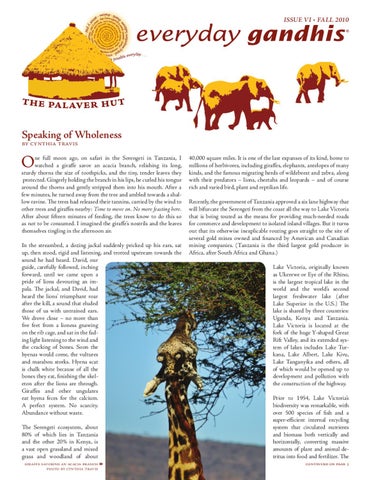
ne full moon ago, on safari in the Serengeti in Tanzania, I 40,000 square miles. It is one of the last expanses of its kind, home to watched a giraffe savor an acacia branch, relishing its long, millions of herbivores, including giraffes, elephants, antelopes of many sturdy thorns the size of toothpicks, and the tiny, tender leaves they kinds, and the famous migrating herds of wildebeest and zebra, along protected. Gingerly holding the branch in his lips, he curled his tongue with their predators – lions, cheetahs and leopards – and of course around the thorns and gently stripped them into his mouth. After a rich and varied bird, plant and reptilian life. few minutes, he turned away from the tree and ambled towards a shallow ravine. The trees had released their tannins, carried by the wind to Recently, the government of Tanzania approved a six lane highway that other trees and giraffes nearby: Time to move on. No more feasting here. will bifurcate the Serengeti from the coast all the way to Lake Victoria After about fifteen minutes of feeding, the trees know to do this so that is being touted as the means for providing much-needed roads as not to be consumed. I imagined the giraffe’s nostrils and the leaves for commerce and development to isolated inland villages. But it turns themselves tingling in the afternoon air. out that its otherwise inexplicable routing goes straight to the site of several gold mines owned and financed by American and Canadian In the streambed, a dozing jackal suddenly pricked up his ears, sat mining companies. (Tanzania is the third largest gold producer in up, then stood, rigid and listening, and trotted upstream towards the Africa, after South Africa and Ghana.) sound he had heard. David, our guide, carefully followed, inching Lake Victoria, originally known forward, until we came upon a as Ukerewe or Eye of the Rhino, pride of lions devouring an imis the largest tropical lake in the pala. The jackal, and David, had world and the world’s second heard the lions’ triumphant roar largest freshwater lake (after after the kill, a sound that eluded Lake Superior in the U.S.) The those of us with untrained ears. lake is shared by three countries: We drove close – no more than Uganda, Kenya and Tanzania. five feet from a lioness gnawing Lake Victoria is located at the on the rib cage, and sat in the fadfork of the huge Y-shaped Great ing light listening to the wind and Rift Valley, and its extended systhe cracking of bones. Soon the tem of lakes includes Lake Turhyenas would come, the vultures kana, Lake Albert, Lake Kivu, and marabou storks. Hyena scat Lake Tanganyika and others, all is chalk white because of all the of which would be opened up to bones they eat, finishing the skeldevelopment and pollution with eton after the lions are through. the construction of the highway. Giraffes and other ungulates eat hyena feces for the calcium. Prior to 1954, Lake Victoria’s A perfect system. No scarcity. biodiversity was remarkable, with Abundance without waste. over 500 species of fish and a super-efficient internal recycling The Serengeti ecosystem, about system that circulated nutrients 80% of which lies in Tanzania and biomass both vertically and and the other 20% in Kenya, is horizontally, converting massive a vast open grassland and mixed amounts of plant and animal degrass and woodland of about tritus into food and fertilizer. The giraffe savoring an acacia branch photo by cynthia travis
continued on page 3
The Palaver Hut • Issue Vi • fall 2010
In this issue...
Table of Contents Speaking of Wholeness by cynthia travis
1
We need stories of wholeness and possibility that will keep the world intact. It is time for humans to reclaim our place in global ecology.
everyday gandhis Mandate 5 To tend and offer stories that rekindle the experience of gratitude and humility necessary for right relationships between humans, nature and the sacred.
Taking Back the Commons: BP and the Ocean by carolyn raffensperger
6
In the Dreamtime by cynthia travis
8
The deep intuitive sense is that the ocean is a Commons—we all share it. Herons, whales, seaweed and humans.
Over the years, dreams have showed us where to focus our attention, what a community needs and what might be possible if we listen carefully.
eg Celebrates Liberia's Independence Day by william jacobs
10
Our journey to Sarkonadu is all about peace by lassana kanneh
13
Scholarships Our New Documentary Peace Archive
14 14 15
Now that Liberia’s image is becoming good again and the country is reclaiming its proper place among the nations of the world, everyone felt confident about getting on the road to Nimba to celebrate the new dawn of peace and stability.
It was apparent that something positive was happening from the sounds of traditional drumming and songs from the egp Culture Troupe.
2 • everyday gandhis • fall 2010
There are many kinds of wars and therefore many kinds of healing from war that are needed. When we speak of ex-combatants in Liberia, we are referring to the (now) men and women who fought or were refugees in the Liberian civil conflict of 1989-2003. Most of those people still struggle to feed their families, and to find hope. Most programs for ex-combatants focus on the young men, and on vocational training. Little has been done to assist with deeper healing and nothing much has been accomplished for the many women who were fighters or sex slaves. Many have turned to prostitution for lack of other means to get by, and it is said that many of their customers are NGO workers and sometimes UN Peacekeepers. Under the inspired and tireless leadership of eg staff members Bethelson, ‘Uncle Jake’, Mama, Hawa, and Master General, and of course of the ‘Big Six’ and Esther, themselves former fighters and refugees, we are working hard to reach as many ex-combatant youth as possible with the message that there is still reason for hope. In particular, Bethelson has made it his personal mission to go public with his own painstaking healing process in order to mentor others willing to heal by telling their story, making amends and reaching out to others. READ ABOUT the Peace Ambassadors soccer leagues that bring ex-combatants and their communities together for healing. Apart from providing a healthy outlet for tension and youthful energy, the soccer games are also joyful community gatherings. eg staff sits down with ex-combatants, elders, community leaders, farmers, and local government to listen and share stories, and to cultivate community leaders willing to work together for peace over the long run. Our focus is on border communities in Lofa and Nimba counties that feel discouraged and forgotten, to help them see that they nonetheless influence neighboring communities in the area and across the borders of Guinea, Sierra Leone and Ivory Coast, and can choose to use their own commitment to peace to influence for the good of all. You will read of the exciting scholarship program supporting ex-combatants and refugees willing to work hard in school, even if they are already in their 20’s and still in junior high or high school. You will see that we have added three young women to the scholarship ranks! And you will READ ABOUT our latest short film, Portrait of a Peacekeeper (20 min.) showcasing the legendary Col. Raza Malik of the first UN Peacekeepers to arrive in Voinjama, the beloved Pakistan Battalion. At a time when the role of UN Peacekeepers is often misunderstood or maligned, when skilled Muslim peacemakers are seldom seen in Western media and when Pakistan is increasingly associated continued on page 7
continued from cover
introduction of Nile Perch in the early 1950’s (for commercial fishing) devastated this delicately balanced system and resulted in the extinction of over 80% of its original endemic fish population – perhaps the largest vertebrate extinction in the 20th century. If the highway is built, towns along the lake and highway are expected to mushroom into cities with populations of several hundred thousand or even a few million within the next 20-30 years. Because the lake is fed by small amounts of rainfall in this delicate arid region, it is extremely shallow and cannot support human activity of these proportions. In a short time it would likely become a dustbowl. This model for ‘development’ is a recipe for disaster. Interrupted migrations are only the beginning of woes for the animals of the vast, delicate Serengeti ecosystem if the road goes through: The road will increase access for poachers and multiply road kill (already at over 200 animals per year within the ‘protection’ of the preserve) and will create vectors for invasions of new diseases and non-native plants and animals. Noise and light pollution will be more than an inconvenience: they will interrupt the animals’ and birds’ ability to hunt and navigate and will obscure mating calls and other communication. There will be smog, crime, litter, sprawl – the list is dirty, long, and predictable. Unless we act, a vast system in perfect balance will likely collapse within our lifetimes, and with it all its magnificent animals, plants, and birds. Its magic – the rhythms, colors, grandeur, and spectacular migrations will disappear, all because of greed and lack of foresight. As in the Niger Delta, marginalized villagers that have already been left behind in the rush towards Western-style progress are being promised the moon but are unlikely to benefit in proportion to the irreparable costs or the disproportionate enrichment of the distant owners of the gold mines. The internal combustion engine and modern forms of energy production and consumption are largely centrifugal, dissipating huge amounts of energy in the creation of friction, heat and noise as energy is pushed outward – hence the need for metal bands around early wagon wheels to keep them from flying apart. In contrast, Nature’s preferred means of locomotion is centripetal, moving from the outside toward the inside, in spirals, at increasing velocity, producing a consolidating, friction-reducing and therefore cooling effect. In Nature, extreme heat and violent force are used sparingly and for specific functions – to relieve pressure or to cleanse or decompose so that regeneration and rebalancing can occur. Everything to do with combustive engines is invasive, wasteful, complicated, noisy and expensive. Conversely, “Everything that is natural is silent, simple and cheap.”1 Planetary survival depends on our ability to rethink and restructure human activity in concert with natural systems.
The so-called Southern Route, a proposed alternative location for the highway that would skirt the southern periphery of the park, is being touted by conservationists as much preferable, although its impacts are also questionable, as is the notion of basing future development on fossil-fuel-dependent vehicular traffic in an age of dwindling and toxic oil. The proposed southern route will certainly be less terrible than the proposed Northern one, but in the panic to provide an alternative plan, no one is asking whether a road is needed at all or what kind of ‘development’ and ‘poverty reduction’ are intended, needed or possible in light of community needs and resources, climate change, water scarcity, and economic and political instability. It is imperative to resist the urge to assume that a road is needed and that it’s only a matter of where to put it. That assumption, and other Western assumptions about the nature of progress and its inevitability and therefore acceptable costs must instead be replaced with careful consideration of the needs of each individual community and how to meet them within a context of that community’s particular strengths and resources. It might then be possible to develop local initiatives in
serengeti elephant, photo by cynthia travis
partnership with those communities, keeping in mind the interplay of relationships between the people, the land, the animals, the trees, the water and the weather that is so delicately and perfectly maintained by the system as it is. We do not know and have not stopped to imagine the potential consequences for the rest of Africa or the world if the massive Serengeti collapses. It is reckless in the extreme to presume that Western ‘development’ is a panacea and a massive highway is the only way to get there, especially when paired with the coincidental proximity of gold mines and the Tanzanian president’s reputed ambitions for political and/or material gain. This is the time to vigorously apply the Precautionary Principle.2 The Serengeti (already designated by the U.N. as a World Heritage site) is a singular, irreplaceable part of our global continued on page 4
Alick Bartholomew, Hidden Nature: The Startling Insights of Viktor Shauberger, Floris Books, 2003, p. 90 The Precautionary Principle states that if an action or policy could cause harm to the public or the environment, the burden of proof of its safety lies with those wishing to take the action, and not on its potential victims after the fact.
1 2
everyday gandhis • fall 2010 • 3
continued from page 3
Commons that must be recognized and protected as such. Daring questions must be asked: Is mining right or necessary? Who benefits and who pays the ultimate costs? What price will Tanzania and Kenya pay if tourism to the Serengeti ecosystem is destroyed? Science is only now catching up to what indigenous peoples have always known: that the powerful elements previously locked beneath the Earth’s crust – oil, gold, uranium, and the rest – are crucial to maintaining the balance of the whole and therefore ought not be disturbed. That the way this functions is still a mystery does not negate its inherent truth. Instead, it invites respect, even awe, and careful study to understand how the overall system and its individual elements work. We need to cast ourselves far beyond the fragmented battles, however urgent, to save this or that endangered species, habitat or corner of the world. The future depends on our willingness to step into the broadest possible vision of relationship, possibility and wholeness so that we have a sense of where we are going and how we will get there: What would a world look like that is fully restored and thriving? What role does the Serengeti play in maintaining global eco-balance? Will life be possible at all without the Serengeti, the Amazon, the oceans and the ice caps? Which among them, or what combination of destruction, will be the last straw? Joseph Eagle Elk, a Lakota medicine man who lived 50 years ago, speaks of power and its use, and of the sacredness of fire. He explains how critical it was that people handled fire with gratitude, using it only when they really needed it, knowing that fire was both life giving and life destroying, and therefore requires a sacred relationship. He said that there had come a time when people forgot that fire was a gift and stopped being thankful, and so ‘the heart got hard.’ Most indigenous cultures say the same thing. In Eagle Elk’s words, “Whenever we forget we are part of life and that at the heart of life is relationship, whenever we lose touch with our place in the scheme of things, then we start to take it all for granted. We put ourselves in the front… and then we forget what we have been given. We become hard. We begin to destroy ourselves.” 3
4 • everyday gandhis • fall 2010
My Kenyan friend, peacebuilder and theater artist Babu Ayindo, speaks of the traditional understanding of conflict as being “a form of imbalance with fellow human beings, imbalance with nature, imbalance with the supernatural.” He told me “You know, right now I see the symbol of justice as being balancing scales. Even in most of Africa, we adopted the western justice system, with the emphasis on blame and punishment. But for my grandparents or any council of elders acting on the behalf of the community to resolve a conflict, the emphasis would be on the restoration of relationships, not just of relationships between human beings, but with nature and the supernatural.”4 Where do humans fit in the symbiotic Big Picture? Some scientists see human beings as a natural progression of Nature’s evolutionary reach toward refinement and complexity. Indigenous thinking, and perhaps the indigenous within each of us, recognizes the lived expression of sacred relationship as uniquely human. Gratitude and the myriad forms of making offerings (whether as tangible gifts, silent prayers or simply living with humility, awe and respect) affirm our connection with the sacred, feed the divine, and sustain a relationship of dialogue, beauty and reciprocity. Perhaps this is our ecological niche. Perhaps this is the correct understanding of ‘development’. Like the Serengeti sundered by a highway, modern Western culture divides our world into either/or, us and them, all or nothing, boom or bust. Progress is measured in terms of material gain. Modern narrative uses conflicts and crises to ‘drive’ the story. This way of seeing things, repeated over and over in the stories we tell ourselves, becomes the story we enact. We need stories of wholeness and possibility that will keep the world intact. It is time for humans to reclaim our place in global ecology. Like the tannins on the acacia, the earth is telling us, No More. Let us sit down together and listen. Cynthia Travis is the Founder & President of everyday gandhis. Gerald Mohatt & Joseph Eagle Elk, The Price of a Gift, a Lakota Healer’s Story, University of Nebraska Press, 2000, p. 133-134 Joseph Babu Ayindo interview conducted during Eastern Mennonite University Summer Peacebuilding Institute, 1999, www.everydaygandhis.org
3 4
OUR MANDATE To tend and offer stories that rekindle the experience of gratitude and humility necessary for right relationships between humans, nature and the sacred. OUR PRAYER With deep gratitude, everyday gandhis® offers stories of peacebuilding and restoration. We honor the sacred, the living, the ancestors, future beings and all of Creation. May the experience of receiving these stories be as healing as the process of telling them and being heard. May they awaken and sustain the peacemaker within us all. May they remind us we are inseparable from the Web of Life. May words and images of peace and restoration become the new reality of our time and times to come.
OUR PRACTICE • To recognize ourselves as the ancestors of the future • To entrust ourselves with the task of ensuring a habitable future for all beings • To dance with joy and gratitude between periphery and center; community and solitude; context and specifics; deep time and the present moment; motion and stillness • To actively appreciate and honor cultural richness • To be rigorous in meeting challenges and possibilities • To remember that healing and peacemaking are one and the same • To mirror and catalyze the wisdom of an individual or community to restore its intrinsically sustainable authentic nature. • To live in reciprocity with Earth’s intelligence such that our way of being is the offering we make in response. • To hold ourselves and each other accountable for being in alignment with these principles
OUR TOOLS • Recognizing, tracking and cultivating constant awareness of the fields of interlocking stories • Being in dialogue with the natural world • Appreciating the Wisdom of the Breakdown • Seeking and trusting guidance from dreams, divinations and synchronicities • Practicing the ways of Council • Experiencing unexpected encounters as signposts and sources of nourishment
OUR ACTIVITIES • Traditional mourning, healing and community reconciliation • Reforestation and sustainable agriculture • Collaboration with urban and rural youth and elders, veterans, writers, artists, peacebuilders, dreamers and healers • Dissemination of images and stories via film, photography, publications, internet and gatherings
male lion of the serengeti, photo by cynthia travis
everyday gandhis • fall 2010 • 5
Taking back the Commons: BP and the Ocean by carolyn raffensperger
“But a renaissance, a rebirth occurs not just because there is a rising of images and archetypal symbols. A renaissance happens because the soul is breached, the psyche unlocked, and a flood of new questions are released as to who we are and what we contain.” -Jean Houston “Only a crisis – actual or perceived – produces real change. When that crisis occurs, the actions that are taken depend on the ideas that are lying around. That, I believe, is our basic function: to develop alternatives to existing policies, to keep them alive and available until the politically impossible becomes politically inevitable.” -Milton Friedman 3
E
nvironmental law in the United States is predicated on a series of assumptions deeply embedded in free market doctrine. The spawn of this radical free market ideology are things like “privatization is the best and highest use of all property”; “government by and for corporations”; “fossil fuels are essential and their consequent pollution is necessary.” The BP oil disaster is a result of these assumptions. The regulators at the Mineral Management Service (MMS) presumed that privatization of the ocean’s oil was in the best interests of BP and therefore the country and so it moved to expedite drilling rather than protect the public. Recent news that the administration is considering opening the Gulf up for more drilling and ending the current moratorium makes clear how pervasive these assumptions really are. But the massive failure of both government to protect public interests and BP to be responsible for its mess didn’t sit well with the public. There was wall to wall outrage that BP acted as if it owned the ocean. BP refused an EPA order to use less toxic dispersants. It kept scientists and the public away from the site itself and refused to make data public. The public response has been vociferous, “BP does not own the ocean”. The deep intuitive sense is that the ocean is a Commons—we all share it. Herons, whales, seaweed and humans. We have a right with all of these other beings and humans to care for it, to share in its bounty. The commons are the foun-
dation of our economy. Without a healthy ocean, or local prairie or forest, without clean air and water, without the web of life, all of our dollars are worthless. The idea of the commons is an ancient one but has been lost in the private property free for all of the United States. There’s a good historical reason for the ascendancy of private property in the U.S.–when we broke away from the British monarchy, owning land was the basis for citizenship, the right to participate in government. This is so deeply embedded in our cultural DNA that publicly owned land is often seen by the right-wing as a Communist plot. But throughout our history we’ve also set aside public places such as town squares, national parks and shorelines or managed wildlife so anyone could get a hunting or fishing license. Accordingly, the law of the commons in the U.S. looks more like a crazy quilt than an organized, clear framework. A year ago, I along with two co-authors set out to change that. We wrote a paper that put forward a comprehensive law of the commons. The law of the commons is ripe in the Friedman sense of policies that are kept alive and vibrant until they are needed. Now that BP has demonstrated that the old idea of privatization of our shared resources is a big fail we can bring forward the robust alternative and fully implement policies that protect the commons. The corollary to the Commons is that government is the trustee (not the owner) of our shared wealth and must care for it on behalf of present and future generations. Tweaking MMS or any other environmental agency won’t suffice. All of these agencies must become active trustees and develop new policies and strategies that reflect their essential responsibility to protect and restore the commonwealth. The standard of care government must use to fulfill its responsibility as the trustee is the precautionary principle: “When an activity raises threats of harm, precautionary measures must be taken even if some cause and effect relationships have not been fully established scientifically.” This means our agencies must act on the best available information to prevent harm. The BP oil hemorrhage has demonstrated that cleaning up messes is far more costly than preventing them in the first place. Calls for the precautionary principle by scientists and those who love the Ocean have never been stronger or clearer. We will know whether agencies have met their standard of care by whether we turn over commons such as the Ocean, air, wildlife, freshwater and parks to future generations in better shape than we got them. The Gulf disaster was a breach of our soul. Ideas like the commons, the public trust responsibilities of government, and the precautionary principle are alive and available. It’s time to make them politically inevitable. Carolyn Raffensperger is an attorney and executive director of the Science and Environmental Health Network. She is a nationally known expert on the precautionary principle. (www.sehn.org)
6 • everyday gandhis • fall 2010 crane of tanzania, photo by akoi mawolo
continued from page 2
with rising terrorism, this portrait of Col. Raza is a refreshing and unexpected glimpse into the heart and mind of a man whose deep commitment to humanity and to peace stands out. In light of the wars being waged against the Earth herself, perhaps it is time to broaden our definition of ex-combatant, or maybe even combatant. Knowingly or not, willingly or not, all of us participate in the spoils of environmental assault. What kind of soul repair do we need to engage in? READ the call for Taking Back the Commons. Beloved colleague Carolyn Raffensperger, founding Director of SEHN (Science and Environmental Health Network, www.sehn.org) writes passionately of the soul repair that is needed and, we hope, possible, in response to the BP Gulf Oil Spill. You can substitute the name of any other devastated place in the world – the Niger Delta, the Amazon, or the Serengeti. Indeed, you will also READ ABOUT the shocking Serengeti Highway, a proposal to build a 6-lane highway across the Serengeti, a thinly disguised land grab to open this World Heritage Site to gold mining. In this issue WE ANNOUNCE the inauguration of our Peace Archives in celebration of Gandhi’s birthday, October 2. You will READ HOW the dreams weave our work for us and with us. Our next event is a gala opening, November 13th, at the Ayni Gallery, showcasing extraordinary photographs by our Future Guardians of Peace.
These are challenging times, heartbreaking and inspiring, calling us to peacemaking as never before. As always, stories show us the way. Cynthia Travis is the Founder & President of everyday gandhis.
mawhen making offerings, photo by andre lambertson
Our deepest gratitude and appreciation to our donors and supporters. • Alexandra Leslie & Tom Stone • Alice March • Amanda Foulger • Anna Laura Jansma • Andrew Soll • Ariel Dorfman • Anthony Johnson • Arnold & Joan Travis • Arthur & Vernie Ourieff • Barbara Baumann • Becky Murphy • Benjamin Faherer • Bonnie Lewis • C'est Cheese • Cal Asia Property • Catherine Weeks • Chandra Garber • Crushcakes Cupcakery • Dr. Christopher Fulton • Creston Shields • Cynthia Foster • Cynthia Jurs • Daniel DeSantiago
• Daniel Kane • David & Ayelet Cohen • Deena Metzger • Denice Goodheart • Duarte High School A.S.B. • Elaine Marshack • Erica Mann Ramis • Ezrha Jean-Black • Gayle Golden • Geoffrey & Elisabeth Bloomingdale • Georg Fick • Dr. Gloria Willingham • Good Search • Greg Metzger • Harriette Rossetto & Beit T'Shuvah • Isla Vista Food Co-op • Jacob Foko • Jah'Shams Abdul-Mu'min & SANBI (Success A New Beginning, Inc.) • Jay Levin • Jean Smith
• Jennifer & Victor Plana • Joe Kenney • Joyce Reed Rosenberg • Judith Perlstein • Kaaren Kitchell • Kalpana Kadaba • Kathy Weaver • Kim Gould • Laurie Levitt • Leah Shelleda • Lovebird Boutique and Jewelry Bar • Liana Soll • Margie L. Martin Bambeck • Mary Anne Amitin • Maryanne Galindo & SANBI (Success A New Beginning, Inc.) • Melinda Benedek • Michael Amitin • Michelle Gubbay • Nadine Le Gouguec • Nancy Willen • Robyn Bensinger
• Noel Sparks • Pam Bjork • Pamela & Scott Stroehmeir • Peter Fetterman & The Fetterman Gallery • Rabbi Mark Borovitz & Beit T'Shuvah • Saina Ziai • Sam Bachne • Santa Barbara Farmers’ Market • Sarah deHeras • Sherry Modell • Sheryl Lee • Steve Lovold • Susan Sundholm • Sybil W. Stoller • Teri Gabrielsen • Terri Martinlujan • Theresa Sanitate • Tina Kistler • Toni Leib • Ulli Bonnekamp • Vic Cox
everyday gandhis • fall 2010 • 7
In the Dreamtime by cynthia travis
I
n everyday gandhis, our work is formed and informed by dreams. Over the years, dreams have showed us where to focus our attention, what a community needs (including non-human communities) and what might be possible if we listen carefully.
Every so often, there is a cluster of dreams that are so miraculous in their connection and clarity that we must sit in amazement as we learn to take the dreams as the gifts that they are. When we allow ourselves to enter the dreams, or perhaps allow the dreams to enter us, we are transformed. When we are transformed, we can transform others by who we are and the way we live.
He said that ‘Thou shall not kill’ had a period that Spirit did not dictate. It should be more: Thou shall not kill hope. Thou shall not kill the future. Thou shall not kill the mother. Thou shall not kill the innocent OR the guilty. Thou shall not kill the beings that walk the earth. Thou shall not kill memory. Thou shall not kill paths. Thou shall not kill the rights and responsibilities of any living thing. Thou shall not kill the last of any thing. Thou shall not kill the light of a toddler's mind. Thou shall not kill faith. Thou shall not kill forgiveness. Thou shall not kill the voices of the injured. Thou shall not kill balance. Thou shall not kill the oddities. Thou shall not kill the elders, human or non human. Thou shall not kill the peacemakers, human or non human. Thou shall not kill creation.
twilight in the selous, photo by mohammed kamara
As we were assembling this issue of the newsletter, the following dream came to Ki'na DarkCloud, a beloved colleague in our circle whose father recently passed away. (The person named Carolyn in the dream refers to Carolyn Raffensperger, the author of the article on page six of this issue, Taking back the Commons). By way of introduction, Ki'na tells us: “My dad came to me after I had asked him what central theme of "religion" I should follow. The Arikara and the Diné (Native American tribes), the Irish and the Welsh, all have different belief systems. (All are part of her heritage.) It has been a bit confusing to find my place in these beliefs. I needed to know how to proceed in my every day walk in a sacred way that would honor all.” In the dream, he came to me and sat in the buffalo chair that Carolyn gave me and wrapped himself in the Mennonite quilt that I have. He told me that although he knew there was only one central commandment that Spirit had given - Do unto others as you would have them do unto you - there was one commandment that had lost words in translation: Thou shall not kill. He was strong with his words and his knowledge on this.
8 • everyday gandhis • fall 2010
He told me that he did not mean for me to become a vegetarian, that was not what he was saying. I had not been aware that I was wondering until he mentioned it. I knew that he was speaking of respect and killing in the same measure, a type of respect that we humans have long forgotten except in the dreams with ancestors. Every time he used the word ‘kill’ he thought in his own mind of the addition of a Thou shall respect... Thou shall respect hope. Thou shall respect the future. Thou shall respect the voices of the injured. On and on through his list. As I read this dream, I immediately thought of a complementary dream that came to Lawrie Hartt, another of our close colleagues, last June when we were at a Women’s Writing Retreat with Deena Metzger (‘Mama Deena’ to many Liberians. Lawrie has been to Liberia with us as well). See how the dreams seem to be talking to each other, as well as to us: We (in this council) have gathered by the ocean. We have made a line along the shore as far as the eye can see. Perhaps others join us or maybe we go on and on.
Deena says, “When things get really bad, this is what I do.” She kneels down, puts her hands and head on the sand like a Muslim in prayer, and says, “Our father who art in heaven.” The person next to her follows, “Our mother who art in earth,” then the next person, “Our grandmother who art in Ocean,” then the next, “Our brother who art in seagull,” then the next, “Our sister who art in sand,” then the next, “Our cousin who art in dolphin.” On down the line we go, a long wave, each of us kneeling, putting our hands and head on the sand and calling out until we have named everything we can see. Then we say together, “Hallowed be thy names.” Taken together, these two dreams form instructions for how to live. They show us ways to heal what we humans have done by reconnecting with the earth and with our deepest principles of integrity. They show us something about community, in the largest sense, and about this thing called ‘Soul Repair’ that we so often refer to in our work with ex-combatants. As I put the two first dreams together, I remembered a dream that came to our Liberian Youth Coordinator, Christian Bethelson, a few weeks ago. At first glance it seems unrelated to the first two dreams. After you consider it for a while, you see that it fits with them very precisely: I saw myself in a surgical operating room. Another guy is teaching me how to carry on the surgical operation. At first I am looking at him, watching, to see how he is doing the surgery. Then he gives me the surgical tools and instruments to do it myself. I have gloves, and all the attire of a surgeon. I begin to operate on people, my hands going through their organs. The most vivid one is the heart surgery we are doing. I am really into it, although I am not a doctor. I see blood on my hands, a person on a stretcher, as I am doing the surgery on their heart. To me, this dream suggests a new kind of 'blood on his hands', this time as a healer, not as someone involved in violence. He is not afraid to reach in and touch people's hearts. He has been given the tools he needs. He is with others and together they are doing this heart surgery. Uncle Jake added, "We all have some blood on our hands. Even when we kill chickens for major events or offerings. It's not a bad thing. Blood is to be
beach at monrovia, photo by cynthia travis
shared and can heal the whole community. In Africa, blood dreams are very good dreams, especially if blood comes out." Isn’t it interesting to consider all the ways, good and bad, that ‘we all have blood on our hands’? We are all responsible for the terrible violence being done to humans and animals, and to the earth herself, and we can all be healers, especially if we have the courage to reach in and touch people’s hearts. In everyday gandhis, we believe that dreams come to individuals on behalf of the community. These dreams are for you. Cynthia Travis is the Founder & President of everyday gandhis. forest ceremony, photo by andre lambertson
everyday gandhis • fall 2010 • 9
Report: everyday gandhis Celebrates Liberia's Independence Day william jacobs
everyday gandhis Celebrates Liberia’s 163rd Independence Day with Soccer Peace Games in Ganta, Nimba County
of African Unity, (now known as the African Union) by great African leaders including Kwame Nkrumah of Ghana, William V.S. Tubman of Liberia and Admed Sekou Toure of Guinea.
M
Now that Liberia’s image is becoming good again and the country is reclaiming its proper place among the nations of the world, everyone felt confident about getting on the road to Nimba to celebrate the new dawn of peace and stability. Many civil society groups and non-governmental organizations including everyday gandhis joined president Ellen Johnson-Sirleaf and her entourage in commemorating the Independence Day in Nimba, with some traveling the long road to Sanniquellie as early as Thursday, July 23.
onday, July 26, 2010 was Liberia’s 163rd Independence Day. The official national program for the day was held in Sanniquellie, the regional capital city of Nimba County. Founded by freed slaves from the United States of America, Liberia plunged into a destructive and divisive civil war in late 1989 that spanned 14 years. During the war, an testimated 250,000 Liberians died and more than 800,000 fled the country. Today, every peace-loving Liberian citizen, whether at home or abroad, is working to repair the damage and reunite the nation.
eg peace ambassadors’ girls with united sisters, photo by william jacobs
The fact that Sanniquellie was chosen as the venue for the 163rd Independence Day anniversary is an indication that Liberia’s re-unification is paramount to the citizens and current leadership of the war-ravaged country. It is also significant to Liberia’s process of rebuilding and healing that this year’s Independence Day celebration occurred in Nimba county, because it was here, on December 24, 1989, that the Liberian civil war erupted as a “small rebel incursion.” Nimba also happens to border Guinea and the Ivory Coast, two countries that have themselves gone through years of political and civil upheaval. Liberia is a country with a history that is unique and different from any other on the continent of Africa. When Liberia declared independence on July 26, 1847, all the countries on the African continent were still under harsh colonial rule. Independent Liberia was a haven for many Africans in those days. Sanniquellie also has historic significance because in 1958 it was the site of the first discussions concerning the formation of the Organization
10 • everyday gandhis • fall 2010
The eg team was ahead of the convoy by organizing special youth Soccer and Kickball for Peace Games to mark the celebration. eg’s Independence Day games were held simultaneously in Sarkonadu, in Lofa County and in Ganta, in Nimba County. Both communities are border towns that separate Liberia from Guinea and the Ivory Coast. Nimba/Ganta, especially, has serious problems with land disputes, ethnic and religious differences and tensions caused by the presence of many former fighters. eg has identified the border communities as important places for its youth program simply because of their vulnerability to mercenary recruitment, prostitution, drug addiction, and HIV and AIDS and also because of their ability to spread peace if we are successful. People from both countries commute daily across the borders doing various types of business. The staff of the Center for Justice and Peace Studies (CJPS), the youth organization hosting and collaborating with eg, met us on our arrival in Ganta on Thursday July 23 and filled our team in on the preparations that had been made.
The youth, both boys and girls from 16 to 24 years, were selected from various neighborhoods to make up the Peace Ambassadors FC (Football Club) teams. The people in the communities themselves selected the teams and players on the teams. These players come from different tribal and ethnic backgrounds.
are still shy and lack the confidence to open up to eg staff members. For many traumatized and marginalized people, it is a new experience to be invited to offer their story or be asked for their opinion. Just this first step is often a crucial one in rebuilding a battered soul.
Ex-combatants and other war-affected youth are often among those who join the Peace Ambassador teams. It is obvious that many of these young men and women did participate actively in the fighting. Former combatants are spread all over Liberia; in the communities where eg works, people are aware that individuals who committed atrocities during the war may sometimes still be subject to indictment. Which is why saying “I am an ex-combatant” is hard, in addition to the shame that some people still feel. We also sit in council with village elders and government leaders.
Although most of the youth we work with are former child soldiers, we try not to emphasize the term “ex-combatant”, since the war ended long ago and most people want to put it – and that title – behind them. In his contribution to the circle, Kelvin Togba, a gospel musician and member of the soccer team, said he provided support for a friend who was once going astray and that that friend is now doing well. Togba spoke about himself as someone who respects others and gets respect in return. Mark Varkum is a teen counselor who lost his father when he was quite young. He said he encourages his peers to be positive.
What we are doing now is to try to build trust among the young players so that they can begin to feel safe exploring their own pasts, including
As eg team members, our role during these discussions is mostly to listen to our hosts. Morris Turay, head of CJPS, referred to the eg Peace Am-
eg peace ambassadors’ boys with liam fc, photo by christian bethelson
their war histories. The hope is that as we continue to work the youth, their stories will naturally unfold, and what is difficult to share will gradually begin to be expressed. This sharing is part of the healing process of what we at eg call Soul Repair. Because of his own rigorous healing journey, Bethelson is now our primary role model for much of this process.
bassadors FC-Ganta as representatives of Nimba County. “Whatever negative thing you do, whatever positive thing you do, will reflect on the county and Ganta in particular,” he told the enthusiastic Ganta youth. One of the positive results of our work is that soccer and kickball team members and others are gaining an understanding of the importance of “fair play.” Some games used to end in confusion and fighting. Now, after a game, players from the opposing teams can hug one another and eat together without incident.
Some of the youth on the teams are themselves peer counselors. Others are not but are happy to be a part of eg’s program. In previous visits to Sarkonadu and Ganta, after explaining the essence of our program and our emphasis on volunteerism, youth were moved by our presentation and many said they wanted to become peace ambassadors.
The Soccer and Kickball Games
As part of our Independence Day activities in Ganta (where twice before we have hosted soccer and kickball games), we held a talking circle with members of the eg soccer and kickball teams (eg Peace Ambassadors Football Club). During the circle each of us talked about our life, and one good thing that we have done to help someone in our communities. This started very slowly as many of the young people, especially the girls,
“This is the only game that I have seen being played in this community without fighting”, an elderly man standing next to me observed during the girls’ kickball game. eg Peace Ambassadors’ girls, well attired in their green and yellow uniforms, engaged United Sisters earlier on July 26, 2010. Though the Peace Ambassadors girls lost to United Sisters 5-15, the game was dubbed the most peaceful girls’ game in recent times. continued on page 12
everyday gandhis • fall 2010 • 11
continued from page 11
In the second match in Ganta, Peace Ambassadors FC boys took on another Ganta team, Liam FC. The Ambassadors, in all yellow outfits, started the game with promise and quickly won the hearts of the spectators. Looking much more youthful than their opponents, the Ambassadors took control of the game soon after kickoff, exhibiting some spectacular skills in midfield and many times threatening their opponents’ vital areas. Midway into the first half, the Ambassadors’ number one goalkeeper sustained injury to his right hand when he collided with a striker for Liam FC, causing him to be replaced. This replacement changed the face of the game when, in the dying minutes of the first half, the Ambassadors’ number two goalkeeper bodily brought down a Liam FC striker in goal-bound attack. The goalkeeper was immediately redcarded (ejected), forcing the eg team to continue with only 10 players on the field against Liam’s 11. A free kick was taken that resulted in the first goal. It was followed by another quick goal, making it 2-0 before the end of first half. Despite being down by two goals, the Peace Ambassadors mounted pressure against Liam FC and got a consolation goal right at the stroke of time. The game ended 2-1 in favor of the visiting Liam FC.
12 • everyday gandhis • fall 2010
crowd that attended the peace games, photo by william jacobs
After the games both players and officials hugged and shook hands as a sign of fair play, togetherness and friendship. And as always, the youth and the people of Ganta asked for more. The challenges of the work are many. One is to get people to share their experiences as former combatants or as those affected by war. This goes along with storytelling. But getting people to talk about the grievous present-day problems of prostitution and drug abuse is almost impossible. However, we are confident that with time and as we begin to organize regular Healthy Relationships workshops in those communities, as well as Dream Circles and storytelling Fire Circles, people will eventually come out voluntarily to share their stories and find ways of healing together. The first step in peacebuilding is always listening closely in order to build relationships. These relationships become the foundation for togetherness, self-reflection, sharing stories and working together as full participants in rebuilding their lives and their communities. William Jacobs is the everyday gandhis Liberia Coordinator.
Report: Our journey to Sarkonadu is all about peace lassana kanneh
T
he delegates from everyday gandhis left Voinjama on Sunday evening for the nearly hour-long drive to Sarkonadu to celebrate Liberia’s 163rd Independence Day on Monday, July 26th. It was apparent that something positive was happening from the sounds of traditional drumming and songs from the egp Culture Troupe, and seeing the fortitude and momentum from both male and female players of the Bill Football Club, the everyday gandhis soccer club team in Voinjama. It was important for the egp team in Voinjama and the Bill Football Club, to get to Sarkonadu in order to merge for peace with the youth and its citizens for celebrating the National Independence Day of Liberia together as one.
During the arrival, the egp teams were embraced by the citizens and mostly the youth of Sarkonadu that evening. At the same time that night, there were dances arranged to get the youth excited about peace within and around Sarkonadu. Our lodging was waiting for us and food was provided. We were awakened the next morning by the crowing of a rooster and prepared for the 9 a.m. indoor program “Unification Brings In Peace”. The program started with an opening prayer in Arabic, the Al’Fatiah, and the everyday gandhis project’s Culture Troup singing traditional songs. The Town Chief and other members of Sarkonadu and delegates of everyday gandhis, including Voinjama Coordinator Lassana Kamara, all spoke on one theme – focusing on unifying the youth of Voinjama and Sarkonadu, who are miles apart. The soccer team leader of Sarkonadu said, “sport speaks one language”, where different people all work together with one objective in mind. Lassana Kamara told the gathering that the aim of everyday gandhis is to create and disseminate peace messages in Liberia, among its citizens, and around the world – and soccer can help do that. The program ended on the Sarkonadu sports pitch (field) where the Sarkonadu and the everyday gandhis’ Bill Football Club played a match with hundreds of spectators cheering them on. The female team of the Bill F.C. defeated the Sarkonadu female team, and the everyday gandhis’ male football team ended the game 2-0 against the male soccer team of Sarkonadu. Both goals came within the beginning 30 to 40 minutes of the first half. I sometimes put my recorder and notepad down to embrace other players, which I find is significant to do in my daily life. It was funny and serious to have myself playing the defense of Bill F.C., protecting against the soccer team of Sarkonadu for any goal, but to also bring in peace. The eg team in Voinjama and its soccer team left Sarkonadu after appreciating members of the town for completing their aim of a celebration to bring peace. We came back to Voinjama to celebrate peacefully the end of the 163rd Independence Day of Liberia, July 26th, 2010. This was another experience for us, the Future Guardians of Peace. Lassana Kanneh is a student at Rick's Institute and a member of the Future Guardians of Peace. girls from both teams share in fun after their game everyday gandhis’ peace ambassadors, photos by christian bethelson
everyday gandhis • fall 2010 • 13
Portrait of a Peacekeeper: Our New Documentary Portrait of a Peacekeeper is the latest film from everyday gandhis documenting the extraordinary efforts of men and women who seek to create and maintain peace. The 20-minute documentary short shows a ‘day in the life’ of legendary and beloved Col. Raza Malik of the Pakistani Battalion II, part of the United Nations Mission in Liberia (UNMIL) forces sent to Liberia in the wake of that country’s protracted and gruesome 14-year civil war. the future guardians of peace at school, taken by andre lambertson
Scholarships for War-Affected Youth and Adults
S
ince 2006, it has been our pleasure to support several students on scholarship. The first group we call the Big Six – the five former child soldiers and one former refugee who have been living together as brothers since 2005. They’ve come a long way: At first they shared a one-room shack in downtown Voinjama. In 2006 they came to live at the eg guesthouse, and now they are beginning their second year at Liberia’s prestigious Rick’s Institute. Four of these young men are in 11th grade and two are in 9th grade. Their ages range from 18-24. Now, we are proud to be adding two young women to the Rick’s Institute group, one a former fighter and the other the daughter of a former rebel general. Many of these scholarship students are also Future Guardians of Peace, using photography, soccer and mediation to build relationships and create peace in their community. Rick’s costs $1,600 per student per year, including room and board. We have also been supporting four young men who have been studying at Cuttington University, Liberia’s top private college. Two have graduated (one in Business, the other in Agriculture). We are planning for our first female Cuttington student to join their ranks in the spring. Cuttington costs $3,000 per student per year, including room and board. In Voinjama, two staff members, Mama Kaneh and Hawa Kamara, are attending adult literacy school. Adult literacy school costs $150 per student per year. We have two key educational goals this year: 1. Send children of eg staff and the eg Culture Troupe to school. Voinjama school fees average $500/child per year, including books and uniforms. 2. Offer adult literacy and computer training classes to all eg staff wishing to attend. Computer classes average $25-$50 per student per course. To meet these goals, eg staff is initiating several income generating activities, including guest house room rentals and a permaculture nursery.
We proudly announce the formation of a two-to-one Matching Fund that will go towards these training and education goals! Please join us in making sure eg staff and children receive the best education possible in order to sustain peace in Liberia! (Advanced permaculture and peacebuilding training will be offered in early 2011. Contact us if you wish to underwrite staff and community trainings in these areas.)
14 • everyday gandhis • fall 2010
col. raza, un peacekeeper, photo by andre lambertson
The film was shot in late 2004, only eight months after Raza’s arrival, when the ceasefire was still tenuous and the process of peace and democratization were in their infancy. We learn from Raza that Voinjama, the town they were assigned to in northwest Liberia, was considered at the time one of the most dangerous places in the world. In fact, the Nigerian forces assigned to Voinjama prior to Raza’s and Pakistan Battalion II’s arrival had refused to stay there. Raza gives a comprehensive overview of Voinjama’s unique position, both geographically and strategically, and its importance as a trend-setting hub for peacemaking in the country and in the larger sub region. We see him with lines of ex-combatants collecting their small cash payments in exchange for turning in their weapons. Raza explains how his men were able to forge respectful relationships with key rebel leaders, making it possible to accomplish the disarmament of over 15,000 ex-combatants without firing a single round. We see him interacting with the notorious rebel commander known as Master General, who became a key ally and energetic proponent of the peace and disarmament process.
Announcing the everyday gandhis Peace Archive We see Col. Raza among ex-combatants, children, aid workers and returning refugees. We accompany him on his visit to the UN medical clinic and to the returning refugee Transit Center as he explains how he works and also his philosophy on peacemaking and humanitarian aid. We learn how, as a military commander, he elicits the best from his men and the cooperation of the community. We hear his elation in describing how the decimated bird and animal population is gradually returning to pre-war levels. We see him distributing food and clothing to needy chil-
Stories of recrimination and reconciliation, of conflict and peacebuilding, of violations and amends, of devastation and renewal – between and among people, communities, nature and the sacred – are found at the heart of peacebuilding and restoration. This fall, everyday gandhis will launch a Peace Archive that seeks to restore and re-story this common heritage of peacebuilding by gathering, tending and disseminating stories of indigenous, innovative, and interdependent relationships of healing and restoration. This Peace Archive is envisioned as a repository of everyday wisdom and actions, as a resource of living traditions of peacebuilding and restoration, where Story is a medicine that can heal. These are stories told one to one or in small circles in Africa, in neighborhoods in the United States, and across the world wherever people are working to mirror and catalyze the wisdom of an individual or community (including the natural world) and restore its intrinsically sustainable authentic nature. The collection will include written material, interviews, video clips, and photographs from the archive of materials gathered in our work. They will be accessible on our website, on video and in print and via emails. Making these stories and images available is one way we seek to honor the sacred, the living, the ancestors, future beings and all of Creation. As we seek to apply our Mandate, our prayer is that the experience of gathering, receiving, accessing and passing on these stories and images will be as healing as the process of telling them and being heard. Our hope is that they will awaken and sustain the peacemaker within us all and remind us that we are inseparable from the Web of Life Please watch for email announcements from everyday gandhis about how and when these stories and images will be available.
dren and former fighters. He also speaks of the importance of women in Liberian society and in the peacemaking process. Most important, we hear how Raza holds himself and his men responsible to lead by personal example, such as the voluntary decision of his officers to fast one day a week in order to give their rations to hungry children in the community. We are currently entering this film into festivals around the world and hope that many people from all walks of life will hear this incredible man’s story of peace. Please visit our website to learn more and to watch the trailer. www.everydaygandhisfilms.com At a time when the role of UN Peacekeepers is often misunderstood or maligned, when skilled Muslim peacemakers are seldom seen in Western media and when Pakistan is increasingly associated with rising terrorism, this portrait of Col. Raza is a refreshing and unexpected glimpse into the heart and mind of a man whose extraordinary skill and deep commitment to humanity and peace are unique. women for peace in liberia, photo by andre lambertson
everyday gandhis • fall 2010 • 15
To:
everyday gandhis ph: 805.966.9300 • fax: 805.966.9301 • www.everydaygandhis.org everyday gandhis is a California 501(c) 3 non-profit corporation. All donations are tax-deductable as provided by law. ©2010 everyday gandhis project inc. All rights reserved. Design & Layout by Jesse Smith • www.ablacksmithdesigncompany.com • Printed on 100% post-consumer recycled paper •