issue XI • spring 2012
A World of Possibility by ana brush
T
here are moments in time when stories from all over the world intertwine in a unique way to create something new to share. This past December, I was fortunate to experience one of these moments on a trip to Kenya with seven of everyday gandhis’ Future Guardians of Peace and six of Liberia’s Ricks Institute staff and students.
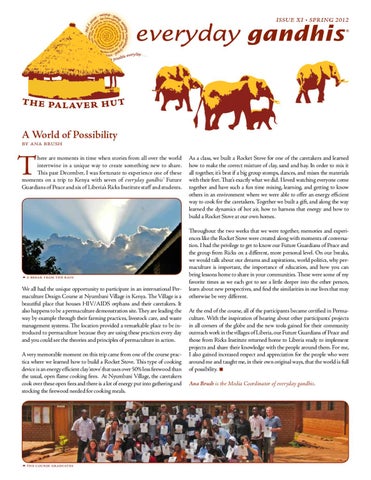
a break from the rain
We all had the unique opportunity to participate in an international Permaculture Design Course at Nyumbani Village in Kenya. The Village is a beautiful place that houses HIV/AIDS orphans and their caretakers. It also happens to be a permaculture demonstration site. They are leading the way by example through their farming practices, livestock care, and waste management systems. The location provided a remarkable place to be introduced to permaculture because they are using these practices every day and you could see the theories and principles of permaculture in action. A very memorable moment on this trip came from one of the course practica where we learned how to build a Rocket Stove. This type of cooking device is an energy efficient clay ‘stove’ that uses over 50% less firewood than the usual, open flame cooking fires. At Nyumbani Village, the caretakers cook over these open fires and there is a lot of energy put into gathering and stocking the firewood needed for cooking meals.
the course graduates
As a class, we built a Rocket Stove for one of the caretakers and learned how to make the correct mixture of clay, sand and hay. In order to mix it all together, it’s best if a big group stomps, dances, and mixes the materials with their feet. That’s exactly what we did. I loved watching everyone come together and have such a fun time mixing, learning, and getting to know others in an environment where we were able to offer an energy efficient way to cook for the caretakers. Together we built a gift, and along the way learned the dynamics of hot air, how to harness that energy and how to build a Rocket Stove at our own homes. Throughout the two weeks that we were together, memories and experiences like the Rocket Stove were created along with moments of conversation. I had the privilege to get to know our Future Guardians of Peace and the group from Ricks on a different, more personal level. On our breaks, we would talk about our dreams and aspirations, world politics, why permaculture is important, the importance of education, and how you can bring lessons home to share in your communities. These were some of my favorite times as we each got to see a little deeper into the other person, learn about new perspectives, and find the similarities in our lives that may otherwise be very different. At the end of the course, all of the participants became certified in Permaculture. With the inspiration of hearing about other participants’ projects in all corners of the globe and the new tools gained for their community outreach work in the villages of Liberia, our Future Guardians of Peace and those from Ricks Institute returned home to Liberia ready to implement projects and share their knowledge with the people around them. For me, I also gained increased respect and appreciation for the people who were around me and taught me, in their own original ways, that the world is full of possibility. Ana Brush is the Media Coordinator of everyday gandhis.
The Palaver Hut • Issue xI • spring 2012
Table of Contents A World of Possibility by ana brush
There are moments in time when stories from all over the world intertwine in a unique way to create something new to share.
Two Weeks in Permaculture by lassana kanneh
With the principles and ethics of Permaculture, we learned the effective ways to manage our local resources.
Permaculture is Key by varlee sheriff
I am hoping to share with my community how important it is to apply permaculture in our lives. This is the message to the world!
Importance of Permaculture by morris kamara
We, the Future Guardians of Peace, now have so many experiences to share with people from all over the world.
Change Through Travel by akoi mawolo
This trip motivated me to continue my education and earn my degree so that I can make a change in my community and also the world.
Documenting Permaculture by ezekiel mavolo
I have discovered one of my talents as a peacemaker and another as a cameraman.
Learning Permaculture by esther kpaku
I now understand from permaculture that we do not throw away waste, but instead we use it to feed something else in our system.
In This Issue
1 3 4 5 5 6 7
It has been some time since our last newsletter due to traveling and moves and we hope that 2012 has brought new possibilities, hope, and positive change for you and yours thus far. We had an amazing winter in Kenya with the Future Guardians learning about permaculture and for everyday gandhis in the U.S., there have been several changes including a move to a new office space and the coming release of our new documentary, The Fight to Forgive. Our updated contact information and updates about The Fight to Forgive can be found on the back cover. As Spring approaches, the stories of learning and growth that we created and gathered in Kenya this last December are shared with you in this special edition of our newsletter. It is an unexpected glimpse into the impact this course had on everyone who attended. We are excited to have the authors be members of the Future Guardians of Peace, some of whom we have heard from before and others who are new to the newsletter. As we continue into 2012, these lessons and experiences become increasingly important for people from all parts of the world and we hope that they touch and inspire you in a way that sparks you to action in your own unique way. - Ana Brush
nesting at nyumbani
2 • everyday gandhis • spring 2012
Two Weeks in Permaculture by lassana kanneh
O
ur journey for a two-week Permaculture Design Course to Nyumbani village, Kenya, East Africa this last December 2011 was another great experience for myself and the other people from Liberia. Some of us had never traveled on a plane before, but we were happily seated with lots of expectations and excitement. We finally arrived in Nairobi at 5:30 a.m. the day before the Permaculture course began. A three-hour bus ride later, we made it to Nyumbani Village. Nyumbani village is located in the northeastern part of Kenya in the Kitui district. It was founded to serve as an orphanage for children who had lost their parents due to HIV/AIDs. Over 850 kids now live there with about 90 caretakers who are mostly grandmothers and grandfathers. The word Nyumbani means, "HOME" in the local dialect of Kikamba. At the village we were warmly welcomed by the staff who had prepared us lunch at the Nyumbani Guest House. We were later assigned to our respective rooms for the next two weeks. The next morning we woke up as the sun was rising, had our breakfast and then toured Nyumbani Village. I learned from one of the participants from Kenya, Titus Muendo, about Kenya's history, population, the tribes, and the different areas that make up the country. We also learned about the livestock Nyumbani was raising for the village, the composting process for their fertilizers and worm farming. With the principles or ethics of Permaculture, we learned the effective ways to manage our local resources, how to make natural fertilizers for plants to grow without chemicals, and ways to spread, slow, and sink water to minimize erosion. We learned how to build a Rocket Stove, the different types of soil, how to make compost, what the different climates are and what microclimates are, the importance of waste, and so much more. In the course of the training, participants were able to share their comments and analysis on each topic introduced, and some people did presentations about the work they do. Varlee did a presentation about
lassana kanneh teaching
the Future Guardians of Peace and everyday gandhis. At the end of the course, participants were certified and motivated to come back to work with people in their community in order to spread the ideas of Permaculture in communities and around the world. It was so exciting for us, the group from Liberia, and others from different parts of the world including the United States, Canada, Australia, Tanzania, Uganda, Kenya, and Rwanda, to participate in this Permaculture Design Course. Lassana Kanneh is a Future Guardian of Peace with everyday gandhis and a sponsored student at Ricks Institute.
nyumbani village
everyday gandhis • spring 2012 • 3
Permaculure is Key by varlee sheriff
W
hen the opportunity was afforded us to go to Kenya, we were very excited. We all left Liberia on the 3rd of December 2011. As we reached Nairobi the next morning, we got on a bus and were taken to the place where the permaculture course would be held, Nyumbani Village, where more than eight hundred orphans live with elders who are their caretakers.
On the following day in the Village, the Permaculture Design Certification Course began with an introduction to Permaculture. Permaculture is the science that mimics nature in increased food production and the protection of the earth and everything in it that serves us. We continued with numerous topics for the first week and classes ran from Monday December 5 to Saturday December 17, from 8:30am to 9:30pm with some periods of break for tea and food. design plot for students’ project
On Sunday, the first day of the second week, we were due to rest. There was an option to stay at the Village or go out to a town nearby that is livelier than the Village. I chose to go out and did so with a number of others. The town of Kitui was very lively with commerce, students, workers and the list of urban life goes on. The Village in Kitui is very similar to life in Liberian towns. Students go to school, people attend church, and men and women go about their business. That was one of the great times for me on the trip. We were back at the Village in the evening and continued the course the next morning. As a requirement, all participants of this course were to create a design for a piece of land provided by Nyumbani Village as a Permaculture test site. We were made into five groups of nine members and each group was to make a design for the permaculture test site and present the design to the villagers on the day the training ended. From this date, one session out of five was given each day for group members to meet, plan, and draw out their design. By Saturday of the second week, the 17th of December, we had completed almost everything. Each group had to integrate their ideas into one design, calculate the materials needed and if they were available in the village, or nearby. We each learned to value and respect our other group members’ views about the design and make sure that everyone
contributed. This is what can make group work challenging, but I learned a lot about how to work with others and how to create a design. I feel that all of this is applicable in Liberia and I will be giving a speech on ‘Integration’ at Ricks Institute this March that will highlight lessons that I learned in Kenya. The presentations of design groups and the certification of participants were all that remained. On the next day, these were done, bringing us to the close of the training. We left the Village on that day. As we left the Village, we made a stop at the capital city, Nairobi. At the Six Eighty Hotel, we rested and had dinner together. We left Kenya the next morning and reached Liberia in the afternoon. Again we were back home. Everything really worked out according to the plans. The experience you get while traveling is one great thing I always enjoy whenever I leave home. It just feels good to go out to different places and see what life is like and how it is different from where you are. I enjoyed being among other people from different scopes of life; learning about Permaculture; the trainer and all those who assisted him; the villagers (people living in the Village); the participants of the course; and the fun of the course. The permaculture course improved my level of understanding and learning, making me to understand where I am, how far I can go and my constraints. It improved my level of association with others as we stayed together, learning and making and sharing fun. With all of these experiences, I am hoping to share with the community here how important it is to apply permaculture in our lives. As a matter of fact, those of us that attended the training from Liberia, especially we the students, have been given a design project for a plot of land. It is our hope that as we design this place and improvement comes, people will be encouraged to become part of the permaculture circle. This is the message to the world! Permaculture is the key to our locked problems.
rocket stove completed
4 • everyday gandhis • spring 2012
Varlee Sheriff is a Future Guardian of Peace with everyday gandhis and a sponsored student at Ricks Institute.
Importance of Permaculture
Change Through Travel
by morris kamara
W
e were met at the Nairobi International airport by Ana Brush and her father, International Permaculture teacher, Warren Brush, the day before our permaculture course began last December, 2011. We took a bus to Nyumbani Village and settled in for two weeks of learning about Permaculture. My favorite experiences and lessons from the permaculture course were learning about the bio-gas digester Nyumbani uses to make cooking gas from animal waste, another one was making the Rocket Stove that uses much less firewood than regular cooking fires, and seeing and tasting the milk from the herd of cows that feeds the entire village. The permaculture course is one of the most important courses I have ever done in my life. Before coming to everyday gandhis, I had no experience with a camera, community workshops, or traveling experience. Today, I can go into the community, talk to people about peacebuilding and I have traveled to Ghana and Kenya. We, the Future Guardians of Peace, now have so many experiences to share with people from all over the world. Permaculture is very important and in Liberia we don’t have permaculture farmers yet. The Government gives money to the representatives of counties as subsidies for the farmers, but every year we don’t have enough food in our country. Permaculture can help with this problem and can be shared through teaching courses for farmers so that they understand how they can use these ideas to improve their farms.
I want to take this time to extend my warmest greeting to all our supporters, especially the American team for the level of support we were shown on this trip. Morris Kamara is a Future Guardian of Peace with everyday gandhis and a sponsored student at Ricks Institute.
by akoi mawolo
I
n August 2008, I had the opportunity to travel to Tanzania on safari. It was the first time I travelled by plane in my life. After I returned from this trip, it was another three years before I traveled and this time it was to Ghana. My latest travels have been to Kenya. We, the Future Guardians of Peace and several members of Ricks Institute, a K-12 school in Monrovia, Liberia, went to Kenya to learn about Permaculture. During the two-week course, we learnt a lot about what permaculture is and how it can be used in homes and communities. To me, permaculture helps to produce food without the use of chemical substances. We were free to ask and answer questions during the course, which helped me to improve my speaking skills among international people and to better understand the teachings of the course. As part of the course, we were given group assignments from which individuals chose and presented on what they best understood. I presented a chicken tractor system that moves around the farm and fertilizes the soil for the crops to grow. It was difficult working with people in the group because we were all from different communities and countries with different accents, so sometimes it was hard to understand each other The trip brought a lot of positive changes to my educational and social growth. We were the only High School students among the 46 participants of the two-week course. Compared to my education, I met people that are well educated like Sam Duby who has a PhD in engineering and Victor Escobar who has a Master’s Degree in counseling, and so many others. This motivated me to continue my education and earn my degree so that I can make a change in my community and also the world. In my social life, it helped me to associate with many people from all over the world and I got to know some people who are very spiritual, which is important to me because I am a spiritual person as well. The most exciting time was when I went to church in Nyumbani village and I felt happy with the people in the church. Another thing that impressed me on the trip was that I traveled on my own, without my sponsor present, through the two weeks. It made me feel proud of myself because I know I can now travel on my own. Akoi Mawolo is a Future Guardian of Peace with everyday gandhis and a sponsored student at Ricks Institute.
morris kamara
lessons in energy
everyday gandhis • spring 2012 • 5
Documenting Permaculture by ezekiel mavolo
W
e, the Future Guardians of Peace, are seven people, five former child soldiers and two war-affected youth. I’m Ezekiel Mavolo, former child soldier from Liberia who is known as a Future Guardian of Peace. I have discovered one of my talents as a peacemaker and another as a cameraman. During the Permaculture course in Kenya at Nyumbani village, I came to use a video camera because I enjoy documenting what is happening around me.
tion of the nutrient by the plants. The fish are fed with worms, which the people of Nyumbani raise beneath the soil in special worm bins, and they use the water waste from the worms to give nutrient to the crops on the farm.
The Permaculture workshop in Kenya at Nyumbani village was so wonderful. Lassana Kanneh started the introduction circle for the course where everyone said his or her name, country and their reason for being at the course. During the introduction I realized that for the next two weeks I was going to be interacting with people from the US, Canada, France, Tanzania, Uganda, Kenya, Rwanda, Austria and Liberia as well. We were forty-three eager persons who wanted to acquire the knowledge of Permaculture. We had a tour around the village our first day to see the farm and livestock Nyumbani is cultivating for milk, food and income. The class was divided into two and my group went to the livestock area first. On our way, we stopped at the aquaculture system and I saw crops like onion, pepper, cabbage, and beans growing out of gravel without any soil added to it. These crops survive on the waste of the fish in water tubs below that is pumped into the growing beds. The system is built in a way that when the water is given nutrient (the fish waste), it goes to the crop and the same water goes back to the fish after the absorp-
ezekiel mavolo documenting kenya
Another new thing that I have never seen in my life was a Biogas Digester that uses animal waste to produce gas, which is sometimes used for cooking and to produce electricity for the guesthouse. According to Joseph Ntunyoi, the director of Sustainability at Nyumbani, the tanks produce gas that last for about two months. When the gas is finished from the waste in the tank, it comes out through a pipe and later is taken to the compost site and then used as fertilizer on the crops. On the second day of the workshop, I learned many things that Permaculture provides for the people and their environment. People cannot do Permaculture without caring for their community, region and even the entire world. I understand that when they say the environment, it means plants, animals and the climatic condition. I learned that deforestation can lead to a change in climate and as a result we find it difficult to grow enough food to feed the world population. This also tells me that there is a connection between plants and animals. On the third day I learned about three major things: health, earth and energy. We focused on mainly energy. The lecturer of the day was Dr. Sam Duby of Access: Energy who is working with Kenyans to reduce the cost of electricity. Together they have discovered new, affordable technologies such as scrap windmills and bio energy producers. Presently in Kenya, Access: Energy is providing electricity to homes with their scrap windmills for a small amount of money, and the payment is based on minimal installments. Sam Duby said that they are also finding different ways of producing electricity such as bio-energy to introduce it in West, North, and South Africa because wind is not as common in many areas. The idea of Dr. Sam Duby and his team will help Mama Africa to change from a dark world to a lit one.
bio gas digesters at the village
6 • everyday gandhis • spring 2012
Learning Permaculture by esther kpaku Another thing I learned is how to build a rocket stove. If Africans can be proud of themselves to have the use of this stove, it will help save the forests because it uses a very small amount of wood. Because the stove requires a very little amount of wood to cook, it means that people will not have to spend a lot of time gathering the wood. Minimizing the use of wood will also minimize the cutting down of our trees, which will help stabilize our climate, and animals and plants will live on earth happily. For me, the general understanding of Permaculture is to be able to produce food without the use of chemicals, and in doing that we need to use all of our waste and turn it into energy for something else. In other words, we need to make use of the waste that can decay, like manure and compost, to grow food or produce gas, like the Biogas Digester. Permaculture also helps us to manage our forest and wild life.
T
his was my first time to Kenya and I was so happy to be there. We arrived in Nairobi, the capital city, and waited until the bus came to take us to Nyumbani Village, where the Permaculture course was held. The first day we took a tour around the village and visited both the livestock site and the farm sites. I saw so many things on the farm that I have never before seen. I saw compost toilets where the waste is used for plants to grow and the timber forests at Nyumbani that are growing to be used in the future as a source of income and building materials for the children who live there.
Today in Liberia, our forests are cut down by many people to make charcoal and to build their farms. They do not plant a single tree to help regrow the forest. With the help of Permaculture we will be able to preserve our forest and show Liberians other ways to manage a forest so that people will be able to grow enough food on a very small scale of land and cut down only ten to fifteen trees a year for logs which will bring them income, but not deforest the area. Ezekiel Mavolo is a Future Guardian of Peace with everyday gandhis and a sponsored student at Ricks Institute.
the timber forest
I also learnt many good things about Permaculture, like how practicing permaculture takes care of our environment and us. Some of the lessons I acquired are how people can grow their own food on a very small piece of land without the use of chemicals. I now understand from permaculture that we do not throw away waste, but instead we use it to feed something else in our system. Everything is useful in permaculture. Permaculture helps us to protect our forest in which our animals live. It also helps us to maintain our climate. There are so many things that Permaculture can do. The experiences and lessons I have received I will make sure to share with my friends and family here in Liberia and as time goes by, my hope is that it will spread throughout the country.
nyumbani’s aquaculture system
Esther Kpaku is a Future Guardian of Peace with everyday gandhis and a sponsored student at Ricks Institute.
everyday gandhis • spring 2012 • 7
133 E. De La Guerra, #284 Santa Barbara, CA 93101
W
Our goal is to share these stories with a worldwide network of people, programs, and organizations that also work to build peace in a world increasingly filled with war. We believe that the film The Fight to Forgive and its accompanying photography exhibit Future Guardians of Peace will touch lives and inspire further teachings of The Fight to Forgive is the story of the healing journey of peace and reconciliation. If you are interested in hosting six young men from Liberia who were forced to either fight a screening, exhibit or event, please contact Ana Brush at as child soldiers or flee their country’s brutal civil war. Toana@everydaygandhis.org or call (805) 669-8137. day we know them as the Future Guardians of Peace. Having traded their weapons for cameras and soccer balls, the A new year, a new film, and a new way to inspire dialogue ex-combatants return to their villages as grassroots peace- about unique healing and peace. Join us in this journey of builders after years of trauma and isolation. By sharing transformation… their personal stories, their reflections, anguish and hopes, they The everyday gandhis team are transforming themselves and their communities. e are thrilled to share with you that everyday gandhis will be releasing our new documentary film, The Fight to Forgive, this April when it will begin an international screening tour promoting transformation, dialogue, and above all, hope.
To:
everyday gandhis ph: 805.669.8137 • www.everydaygandhis.org everyday gandhis is a California 501(c) 3 non-profit corporation. All donations are tax-deductable as provided by law. ©2012 everyday gandhis project inc. All rights reserved . Design & Layout by Jesse Smith • www.ablacksmith.com • Printed on 100% post- consumer recycled paper •