issue VIII • spring 2011
Stories of Struggle and Change by cynthia travis
L
ast fall, I encountered an extraordinary young woman from Santa Barbara City College named Anaïs Saint-André. Today, Anaïs is an intern with everyday gandhis! (Our own dear Ana Brush – everyday gandhis’ media coordinator, and Ian Amitin – everyday gandhis’ office manager and bookkeeper, also got their start at city college.) I would like to share the story of how we met, along with some of Anaïs’ own story. It is our hope that you will be inspired to write and share with us some of your own stories of struggle and change. It all started with the privilege of guest teaching a couple of sessions of Tina Kistler’s Intercultural Communications class at Santa Barbara City College. When everyday gandhis Liberia Youth Coordinators Christian Bethelson and William Jacobs were visiting Santa Barbara last spring, we spoke to those same classes. This time, Jake and Bethelson weren’t there to share their first-hand experiences of war and peacemaking, so, after a brief introduction, I opened the discussion to the students to hear what was on their minds. I wasn’t disappointed. In fact I was astonished. We began this way: I told the class that I’ve noticed that the places in the world that have suffered war and violence seem to have three things in common: 1) they are former colonies; 2) they are resourcerich; and, 3) they have complex, ancient and highly developed land-
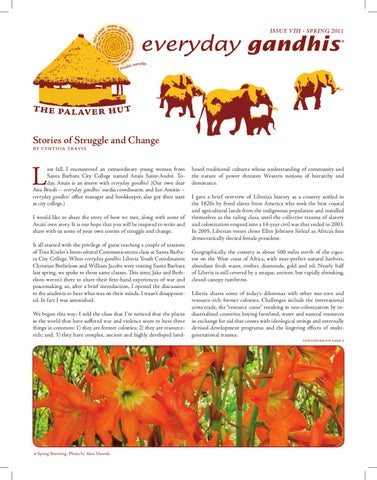
Spring flowering- Photo by Akoi Mawolo
based traditional cultures whose understanding of community and the nature of power threaten Western notions of hierarchy and dominance. I gave a brief overview of Liberia’s history as a country settled in the 1820s by freed slaves from America who took the best coastal and agricultural lands from the indigenous population and installed themselves as the ruling class, until the collective trauma of slavery and colonization erupted into a 14-year civil war that ended in 2003. In 2005, Liberian voters chose Ellen Johnson Sirleaf as Africa’s first democratically elected female president. Geographically, the country is about 500 miles north of the equator on the West coast of Africa, with near-perfect natural harbors, abundant fresh water, timber, diamonds, gold and oil. Nearly half of Liberia is still covered by a unique, ancient, but rapidly shrinking, closed-canopy rainforest. Liberia shares some of today’s dilemmas with other war-torn and resource-rich former colonies. Challenges include the international arms trade, the “resource curse” resulting in neo-colonization by industrialized countries buying farmland, water and natural resources in exchange for aid that comes with ideological strings and externally devised development programs; and the lingering effects of multigenerational trauma. continued on page 2
The Palaver Hut • Issue VIiI • spring 2011 Continued from cover
Table of Contents Stories of Struggle and Change
by cynthia travis Last fall, I met Anaïs, an extraordinary young woman from Santa Barbara City College. I would like to share the story of how we met, along with some of her story. We hope that Anaïs' story will inspire you to share with us some of your own stories of struggle and change.
Storytelling Builds a Web of Hope
an exploration of peacebuilding with john paul lederach In this piece, excerpted from material in the everyday gandhis Peace Archive, Lederach speaks about storytelling as a foundation for peacebuilding in seemingly hopeless situations of deep conflict.
Reflecting on the Past and Present
by lassana kanneh Today, in communities all around Liberia, we six boys and one girl are known as the “Future Guardians of Peace.” Despite being young adults, we enjoy being in high school at Ricks Institute and working to become future leaders through responding to communities positively and peacefully.
1 4 6
Permaculture Certification Course
taught by warren brush everyday gandhis, in partnership with Ricks Institute, Quailsprings Permaculture, and Surfers without Borders, will be hosting a two week intensive and transformative Permaculture Design Certification Course in Liberia this summer.
8
The students viewed a 10-minute trailer from our documentary film about everyday gandhis’ work with ex-combatants, particularly former child soldiers. Many of the ex-combatants are uniquely gifted as peacemakers, longing for a positive new identity, eager to resume their interrupted schooling, and desperate to make a Anaïs Saint-André Photo courtesy of Anaïs Saint-André positive contribution to their communities by sharing their stories, resolving conflicts and reaching out to help others like themselves. After the class moved their chairs and desks into a circle, we entered into the unique magic and safety of Council, a circle of deep listening and sharing from the heart. I have seldom seen a group move so skillfully into the spirit and the promise of Council, weighing their words with honest sincerity, each person speaking with succinct clarity of the dilemmas of modernity, mindful that our time was limited and that the circle would be diminished without the contribution of each person. One of the first to speak was a young man whose face was tense and pained. He said, simply, “Why should they [Bethelson and the excombatants] have another chance when the people they killed don’t get one?” His courage in asking that question made space for the whole circle to be in the discomfort and vibrancy of complex dilemmas that have no easy answers. The complexities include the fact that the United States is one of the world’s largest dealers of small arms, the type used in Liberia’s civil war. The U.S. (along with China, Europe and others) is in desperate need of Liberia’s natural resources – the very resources that allow us to consume and pollute many times more than our fair share. The development and aid programs we and others support (and sometimes impose) are not always in the best interests of those that receive our aid. If these programs fully succeeded (in this case) in lifting Liberians out of poverty, then the table at which we feast would be a lot more crowded and the voices challenging our supremacy a lot louder. In France and other European nations with former colonies around the world, many of their social problems arise with immigrants and refugees whose home countries were colonized and whose culture and identity were outlawed or co-opted.
Soon Anaïs spoke and after class we talked for another hour. We have continued the conversation. Her story, like so many others, is a living hologram of the many dilemmas of our times. Anaïs grew up in a working class neighborhood of Lyon, one of the biggest cities in France, with many West African immigrants. She was taught to respect all races and all cultures, but her childhood experiences were often at odds with those principles. She saw people openly cheating each other, and the welfare system, and didn’t understand their reluctance to learn the French language and culture. She was teased by the African immigrants in her neighborhood, and felt discriminated against. People assumed she was racist because she was white.
tion about apologies. I told her that given the burden that she and other French youth feel, I can understand her frustration that, to her mind, the apology was ‘late’. Nonetheless, a sincere apology is so powerful. I told her that we in the United States have yet to apologize for the massacre of Native Americans, or for slavery, or racism or using nuclear weapons. All of us alive today owe an apology to the earth and to future generations for the destruction we are causing. Our talk turned to South Africa’s Nelson Mandela and his ability to influence his prison guards, even without trying. Anaïs observed, “Mandela was compelling on the ‘good side’ but there are also people that are equally compelling ‘bad’ people.”
As a child, Anaïs couldn’t understand how people of African descent born in France felt no pride for France. But, she also felt ashamed for feeling resentful and afraid of Africans. She says now, “I know that people in Africa have different circumstances and cultures and personalities, but my experience of Africans in France was so traumatizing.” She says she understood their anger at white people and knows it was justified, but still got mad at the way she was treated. After class, as we continued speaking, Anaïs’ expression suddenly changed and she said, “But you know, my grandfather fought in Algeria.” (Between 1954 and 1962, an Algerian independence movement took up arms to overthrow French rule.) Little by little, a larger story emerged of other family members who had been pulled into war, and the effect their experiences had on the family.
Famille Pierrat – Photo courtesy of Anaïs Saint-André
Anaïs’ other grandfather worked in Germany during World War II, sent there by the French government to collaborate with the Nazis. She never knew whether he wanted to go or not, and he never spoke about it. During the Nazis’ occupation of France, Anaïs’s great-grandmother and her daughters – Anaïs’ grandmother and her grandmother’s sisters – were forced to take German soldiers into their house and serve them while the soldiers forced the women to live in the basement of the home. Anaïs’ great-grandfather was taken to a concentration camp. He survived with a tattooed number on his arm but would not, could not, talk about the experience either. Both her grandfathers were violent towards their wives and children. (This is typical of traumatized soldiers returning from war everywhere.)
Anaïs noticed that our conversations and the experience of telling her story helped her begin to learn and change, and she thought that if she came to intern with us it would help her continue her own healing process. The other day, she said, “I still have a little voice in my head sometimes that says, ‘Oh, he’s probably just like everybody else’. ” But, then she catches herself thinking those thoughts and works to change them. She says of herself, “I’m also someone who forgives easily. I try to analyze and see things from multiple angles. And I still have hope of finding nice people who will give back niceness, even though sometimes I’m not nice if I have the expectation of changing them or getting niceness.” She added, “It still hurts when you find people who aren’t nice. But you learn in the meantime.”
Reflecting on her own family’s experiences, Anaïs shrugged and said, “When it’s war, it’s war.” She says she thought for a long time about our conversation, about the examples of Bethelson and Jake and other ‘gandhis’ trying to find their way to peace.
“But you learn in the meantime”...
Then she went to France over Christmas vacation, and her boyfriend joined her for part of the time. Though her boyfriend tells her she has the right to be angry, Anaïs says she doesn’t feel that way anymore, that her anger has dissipated. But, she adds, she feels guilty about the French collaboration with the Nazis. Resistance was late. Every year in school from the ages of 11 to 18 she learned of the extent of the country’s collaboration with the Nazis. Anaïs pointed out that it wasn’t until 1995 that France acknowledged and apologized for its collaboration. This led us to a longer conversa-
We invite you to become part of this ongoing conversation. What are your experiences of “learning in the meantime”? Of working to change yourself; of struggling with these issues? What are your personal experiences with prejudice – your own prejudice or that of someone else? Tell us your story! Write to us on Facebook or Twitter, or at info@ everydaygandhis.org. Please note that comments posted on Facebook or Twitter will be public. Contacting us via email allows more space for you to write your story. If you write to us via email we may select excerpts and comments and contact you for permission to share them before doing so. Cynthia Travis is the Founder & President of everyday gandhis.
everyday gandhis • spring 2011 • 3
Storytelling Builds a Web of Hope
an exploration of peacebuilding with john paul lederach from the everyday gandhis peace archive Editor’s Note: John Paul Lederach is a leading theorist on the concept of conflict transformation. He has served as mediator, strategist and catalyst for peacebuilding and has advised governments, religious organizations, universities and community groups striving to reconcile societies torn apart by deep conflict and violence. In this piece, excerpted from material in the everyday gandhis Peace Archive, Lederach speaks about storytelling as a foundation for peacebuilding in seemingly hopeless situations of deep conflict. This material was compiled and edited by Danelia Wild from an interview everyday gandhis founder Cynthia Travis conducted with Lederach in 1999 at Eastern Mennonite University’s Summer Peacebuilding Institute.
J
ohn Paul Lederach says that if he were to rename the field of peace work he would rename it “hope-building because I’m convinced that the actual key to this work is how do you sustain people in hope in settings that appear absolutely hopeless…”
Lederach believes that peacebuilding involves a healing process that comes both from being able to tell one’s story and from having it received, heard — and held — respectfully. These activities create an experience of community built out of that kind of sharing. “It is the quality of what happened in the exchange of real lives, meaning and talking about what they faced, Lederach says. Suddenly participants “discover that there are people interested in who they are as a person and they have similar experiences. … in that, people talk about gaining a sense of hope. So there’s something about narrative and hope that’s linked.” Lederach points out that narrative and healing is often seen as “a kind of backwards look at things. If I can somehow carry what has been haunting me all these days and release it… I think the
Spectators at a soccer peace game in Voinjama– Photo by Andre Lambertson
most powerful aspect of it is that as it comes, it connects with others and it creates this web of hope.” When the participants have ‘real names’ and ‘real relationships’ that are genuine, what really happens in the story and in the storytelling is that people gain a sense of who they are and a sense of hope. “And it makes it possible for them to continue.” More than anything, it is the creation and sustaining of hope that makes possible the long, arduous work of peacebuilding. Not only hope for conflict resolution, which is the end of a painful and often violent situation — but hope for conflict transformation — that the underlying conditions that created the deep-seated conflict can be addressed and changed. Lederach says that he understood this metaphor for the first time when he learned that one of the Hebrew words for hope is actually “rope” and the intertwined strands that make it. He finds that image compelling. “That somehow in the connecting of stories, the holding together of stories, and the people that accompany those stories in relationships, there is a hope that is created that has a strength to it.” He says there is a component of release in telling one’s story. “… But I don’t think that’s psychologically nearly as powerful as the aspect of hope-building.” Part of the process of transforming conflict is the concept of “accompaniment” – being alongside, fully present and witnessing those who are struggling with and working to address deep-rooted conflicts. Lederach believes the peacebuilder needs to establish
everyday gandhis council in Voinjama – Photo by Andre Lambertson
relationships and accompaniment across all sides of a conflict, which means placing the building of long-term relationships at the center of everything one does. “Now when you take a perspective of working on these issues from the notion of relationship building, then you’re not after a kind of quick fix solution; you’re after how do you work with people over decades and even generations, committing yourself to standing alongside and being supportive of people, long-term, in the settings and realities that they have to face.” That, he says, is different than a“What’s your problem, we’ve got an answer for you” approach often carried by those who come from outside a community and seek to impose a “solution” on the participants in a deep rooted conflict that may extend back generations. Lederach also asserts that it’s important for everyone to acknowledge answers to the problems being faced are not going to come overnight. “… I’ve been running this little formula most people don’t like, but I keep saying it: that it probably takes about as long to get out of a conflict as it took to get into one. In other words, you have to think across decades and so much of what’s been present in our particular field, especially in the applications of conflict resolution more narrowly defined, is ‘what’s the issue?’ and ‘how do we solve the problem?’ and ‘how do we get out of it?’ ” Lederach says that there comes a point where, as part of conflict, people move away from each other. And in movement away from each other, metaphorically, their faces are pointed in opposite directions. “But there comes a point in the broader journey of reconciliation where a person turns and points their face back in the direction of everything that creates within them the greatest fear, maybe the greatest source of hatred, maybe the greatest source of bitterness, maybe the greatest source of a sense of injustice. … in essence, when they turn, they point their face back toward the conflict and back toward ‘the enemy’. ” As a mediator, “there is no formula or lever or activity that I can unleash that makes that turn possible. I don’t think it’s something that we control because I think it’s something that comes up within the people that are involved and at given points in time.” Lederach is a committed Mennonite Christian whose conciliation and peacebuilding work is deeply rooted in his tradition’s history of pacifism and non-violence. He points to major stories of reconciliation in the Old Testament and in the documents and texts of various major world religions to pinpoint an ironic time component in this process. “... rather consistently you will find that when there has been a deep division or deep injustice, the process of ‘the turn’ and movement back was played out across a generation” – a time span of at least 30 years. So in saying ‘time heals, the next question is how much time do you need to heal?” Lederach says “the turn” should not be conceptualized as the single moment in time when the face actually begins to move toward the other – sort of a metaphor for a small span of time.
“You can be done in a second. If I have a bad relationship with you, I could, in a moment in time, turn and say I want to try to rebuild this. … But what leads up to that and what follows it, if you can conceptualize it as a big U, [is] maybe something along the lines of 10, 15, 20 or 30 years.” Lederach thinks that acknowledging this long view can encourage those who work for peace to be more complex in their understanding of conflict and reconciliation, “which is why in settings like Northern Ireland or in Ghana or in Liberia, you cannot think about this in terms of projects of six months or one year...” “If you’re going to do it [peacebuilding], you have to think about working with people over a long period of time because those who are present, who have the vision and who can sustain the hope are the ones who will create the opportunities for even the most radical to make ‘the turn’. ” About John Paul Lederach John Paul Lederach is a professor of International Peacebuilding at the Kroc Institute for International Peace Studies at the University of Notre Dame in South Bend, Indiana. He is concurrently a Distinguished Scholar for the Conflict Transformation Program at Eastern Mennonite University in Virginia, where he founded the Conflict Transformation Program and the Institute for Peacebuilding. Lederach is also involved in conciliation work in Columbia, the Philippines, and Nepal, plus countries in Europe and East and West Africa. He has helped design and conduct training programs in 25 countries across five continents, including sessions attended by members of everyday gandhis and other peacebuilding colleagues from West Africa. He has authored, co-authored, and co-edited at least a dozen books, plus numerous articles, monographs, and scholarly papers. His books include: When Blood and Bones Cry Out: Journeys Through the Soundscape of Healing and Reconciliation, (University of Queensland Press, 2010), The Moral Imagination: The Art and Soul of Building Peace (Oxford University Press, 2005), The Journey Toward Reconciliation (Herald Press, 1999), Building Peace: Sustainable Reconciliation John Paul Lederach Photo courtesy of University of Notre Dame in Divided Societies (USIP, 1997), and Preparing for Peace: Confliction Transformation Across Cultures (Syracuse University Press, 1995). For more information on Lederach’s work, please visit the University of Notre Dame's website at http://69.5.8.7/people/directory/faculty/ john-paul-lederach Cynthia Travis is the founder and president of everyday gandhis. Danelia Wild is the Peace Archivist for everyday gandhis.
everyday gandhis • spring 2011 • 5
Reflecting on the Past and Present by lassana kanneh
In Liberia, we have a saying: “The downfall of a man is not the end of his life”. It means that no matter what difficulties a person has gone through, there will be other stages of life with new possibilities. During the Liberian civil war that ended in 2003, we child soldiers were physically abused and forced to take drugs. We were young and innocent before the war and did not know that drugs could have negative consequences. We were also indirectly abused after the war by people in the communities who did not want to talk or interact with us. Looking back, there were fingers pointed at us, and words were said that we were, and would remain, miserable ex-combatants; that there was nothing positive that could encourage and develop our minds after experiencing five years of war. The efforts of everyday gandhis, both the national and international staff, have helped us by transforming our negative lives into positive ones. everday gandhis has supported this transition to peace in Liberia by working with traditional elders, ex-combatants and war affected youth, having peaceful sacrifices and councils in the areas of Voinjama District, Lofa County and other places in the country. In addition, everyday gandhis has contributed through story-telling, helping us to attend school, providing funds and other basic needs to live, photography trainings, workshops, and dream circles. Since 2006, we have worked through storytelling and story writing, and through our work with photography, to build peaceful relationships with members of various communities in Liberia. We have
Black-Star Football Club – Photo by Lassana Kanneh
shared our photographs of joy and sorrow with our communities and our school friends. We have helped with workshops where we talk to school friends on the topics of ‘healthy relationships’, self-esteem, human rights, and other difficult and positive experiences we have had in our lives. In informal conversation forums, we hear comments, suggestions and dreams on the work of peace, and building friendly relationships with animals. We have also found that soccer games stimulate the minds of young people like us in working together and creating peace among ourselves as citizens of Liberia. Today, in communities all around Liberia, we six boys and one girl are known as the “Future Guardians of Peace.” Despite being young adults, we enjoy being in high school at Ricks Institute with friends, and working to become future leaders through responding to communities positively and peacefully. As part of our work as guardians, we organized a two-day Youth Soccer Peace Tournament in Voinjama, Lofa County, from January 8-9, 2011. The goal of the tournament was to bring together the youth in and around Voinjama to enable them to share their common feelings of peace through a series of games. As Future Guardians, we believe that sports develop the minds of people from different backgrounds to promote and help spread peace in our society. The tournament was by the youth, for the youth and about the youth. We used posters displayed in the area and radio announcements on
Radio- Kintoma to let the people of Voinjama and other parts of Lofa County know about the tournament. Six teams – two kickball teams and four football (soccer) teams – participated in the tournament: Bill Football Club football and kickball teams of Voinjama, under the umbrella of everyday gandhis; Sarkonnedu Football Club of Sarkonnedu Town, the Lee Football Club of Voinjama, and the Black-Star Football Clubs for both boys and girls, also from Voinjama. More than 500 spectators gathered to witness the opening match at the Voinjama sports pitch (field) between Bill Football Club and the Black Star Football Club. Mr. Lassana Kamara, everyday gandhis’ Voinjama coordinator, kicked off the events by appreciating the participation of all the teams and the youth of the area and appealing to everyone to enjoy a peaceful tournament. Bill Football Club beat the Black Star Football Club 2-0, with the game ending in penalty kicks. The next day, Lee Football Club was awarded 3 points because the Sarkonnedu Football Club was late for the match. Over 30 minutes was taken out of their playing time as well. The final score was 2 (plus 3 points)-0 in favor of Lee Football Club. Later the Future Guardians team welcomed the Sarkonnedu Football Club to the tournament. The next game was the kickball match between Bill Football Club girls and the girls of Black-Star Football Club. The girls of Bill Football Club beat the Black-Star team 16-11. The final soccer match was between the Lee Football Club boys and the boys of the Bill Football Club of everyday gandhis. The game ended in penalty kicks, 4-2, with the Lee Football Club winning the championship for tournament soccer and the girls of the Bill Football Club winning the honors in kickball.
Final match between Lee F.C. and Bill F.C. – Photo by Akoi Mawolo
Awards Ceremony – Photo by Lassana Kanneh
Mr. Kamara presented prizes to the teams for their participation and the championship teams received additional awards at the end of the two-day tournament. This tournament was fantastic and peaceful and entertained hundreds of spectators at the Voinjama sports ground. During the presentation of prizes, youth expressed appreciation to everyday gandhis and also made some recommendations. They urged everyday gandhis staff to create more opportunities and times to bring together the youth of Lofa County for such peaceful and fun activities. We, the Future Guardians of Peace, are very grateful to the almighty God for providing long life and for having this competition go well for the sake of peace among the youth of Liberia, especially in Lofa County. We appreciate that everyday gandhis provided the funds to have such a great program for us young people in Liberia. Lassana Kanneh is a member of the Future Guardians of Peace.
everyday gandhis • spring 2011 • 7
West African Permaculture Design Certification Course Ricks Institute Virginia, Liberia (near Monrovia) August 8th - 21st, 2011 International students (after May 8th, 2011) – $1150 International students (before May 8th, 2011) – $950 Local, low-income students – $250-$950 Includes meals, accommodation and instruction. It does not cover travel or transportation. There are limited scholarships for very low income Liberians only.
This two-week intensive and transformative certification course shares how to create sustainable homes and settlements using integrated design to efficiently attain stable, diverse and resilient human living systems that are productive and regenerative. This unique course integrates international participants with local students to create an expanded learning environment for all involved.
Course topics include: • Productive home and large scale food production
• Designing with natural systems
• Food forestry, agroforestry, broad acre strategies
• Appropriate technology including ecological building and energy efficiency
• Waste-to-nutrient cycling
• Bio-regional organization and governance
• Soil building for sustainable fertility
• Various hands-on practicums
• Water harvesting, storage and conservation strategies
• Aquaculture systems
• Simple greywater systems
• Designing for community health
www.peaceinpermaculture.org
program sponsors:
For registration and scholarship information, please email ana@everydaygandhis.org or call 805-966-9300
To:
everyday gandhis ph: 805.966.9300 • fax: 805.966.9301 • www.everydaygandhis.org everyday gandhis is a California 501(c) 3 non-profit corporation. All donations are tax-deductable as provided by law. ©2010 everyday gandhis project inc. All rights reserved. Design & Layout by Jesse Smith • www.ablacksmithdesigncompany.com • Printed on 100% post- consumer recycled paper •