ISSUE V • SUMMER 2010
everyday gandhis' Peace League by ana brush
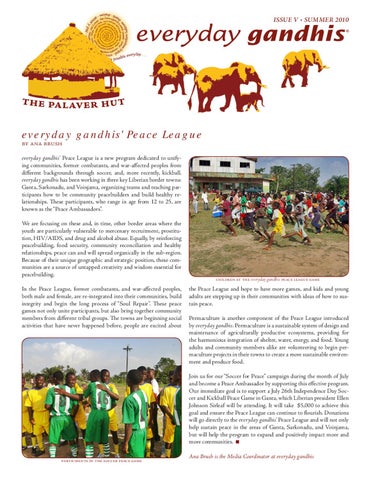
everyday gandhis’ Peace League is a new program dedicated to unifying communities, former combatants, and war-affected peoples from different backgrounds through soccer, and, more recently, kickball. everyday gandhis has been working in three key Liberian border towns: Ganta, Sarkonadu, and Voinjama, organizing teams and teaching participants how to be community peacebuilders and build healthy relationships. These participants, who range in age from 12 to 25, are known as the “Peace Ambassadors”. We are focusing on these and, in time, other border areas where the youth are particularly vulnerable to mercenary recruitment, prostitution, HIV/AIDS, and drug and alcohol abuse. Equally, by reinforcing peacebuilding, food security, community reconciliation and healthy relationships, peace can and will spread organically in the sub-region. Because of their unique geographic and strategic position, these communities are a source of untapped creativity and wisdom essential for peacebuilding. In the Peace League, former combatants, and war-affected peoples, both male and female, are re-integrated into their communities, build integrity and begin the long process of “Soul Repair”. These peace games not only unite participants, but also bring together community members from different tribal groups. The towns are beginning social activities that have never happened before, people are excited about
children at the everyday gandhis peace league game
the Peace League and hope to have more games, and kids and young adults are stepping up in their communities with ideas of how to sustain peace. Permaculture is another component of the Peace League introduced by everyday gandhis. Permaculture is a sustainable system of design and maintenance of agriculturally productive ecosystems, providing for the harmonious integration of shelter, water, energy, and food. Young adults and community members alike are volunteering to begin permaculture projects in their towns to create a more sustainable environment and produce food. Join us for our “Soccer for Peace” campaign during the month of July and become a Peace Ambassador by supporting this effective program. Our immediate goal is to support a July 26th Independence Day Soccer and Kickball Peace Game in Ganta, which Liberian president Ellen Johnson Sirleaf will be attending. It will take $5,000 to achieve this goal and ensure the Peace League can continue to flourish. Donations will go directly to the everyday gandhis’ Peace League and will not only help sustain peace in the areas of Ganta, Sarkonadu, and Voinjama, but will help the program to expand and positively impact more and more communities.
participants in the soccer peace game
Ana Brush is the Media Coordinator at everyday gandhis
THE PALAVER HUT • ISSUE V • SUMMER 2010
eg News Update... We have just said farewell to our beloved Liberian colleagues, William Jacobs – ‘Uncle Jake’ – and Christian Bethelson, who have concluded a brief visit to the U.S. While they were here, we discussed ways to improve our outreach to ex-combatants, both men and women, particularly in border areas, through our Peace Ambassadors soccer Peace League, our talking circles, our culture troupe, permaculture, and appreciation of elders. We also sat in Council with the Topanga Daré community, a circle of peacemakers in California who have received Jake and Bethelson several times over the years, listening to their stories and sharing some of their own, as we struggle together to understand how to become true peacemakers. Our goal in Liberia is to deepen and expand the work of ‘soul repair’ and restoration of the environment by reaching out to key border villages; by recognizing and nurturing the leadership capabilities of women; by increasing the numbers of young people on scholarship; and by seeing how the Liberia team can be as autonomous and selfsufficient as possible. In our extended California community, we seek to provide support and sanctuary for the Liberia team and to match their deep devotion to peacemaking with the necessary soulsearching and personal commitment on our part so that we may be true colleagues. While in Los Angeles, Jake and Bethelson spent time with friends Jah’Shams Abdul Mu’min and Maryanne Galindo and the community at SANBI (Success A New Beginning Inc.) in South Central L.A. SANBI also works with ex-combatant youth and non-traditional leaders and they've established a youth think-tank for the future. A beautiful collaboration is taking shape that we will share
Table of Contents everyday gandhis' Peace League by ana brush
· 1 ·
A new program dedicated to unifying communities, former combatants, and war-affected peoples from different backgrounds through soccer, and more recently kickball.
A Sustainable Equation: Community & Nature · 3 · by cynthia travis My experience over the past seven years working in Liberia is that development/aid agencies seldom consult their intended recipients as to what they know or need. Few aid agencies see their host/recipient communities as resourceful, resilient and wise.
Ganta - Sarkonadu Field Report by william jacobs & christian bethelson
· 4 ·
The essence is to reach out to young former combatants, both men and women, living particularly in the border areas without any hope or promise.
in more detail in our next newsletter. Jake and Bethelson also met with Greg Metzger, of Beit T’Shuvah, the innovative Jewish drug and alcohol treatment center, comparing notes and discussing ways to support those who are struggling to free themselves from substance abuse and criminal behavior. Here in Santa Barbara, we, too, are experiencing lots of changes. We said goodbye to our dear Jeremy Kovacevich, and hello to Ian Amitin, who is taking Jeremy’s place as office manager. Ian is already working with Media Coordinator Ana Brush to organize fundraisers for the Peace Ambassadors soccer Peace League. Ana and her partner, Jesse Smith, our endlessly talented graphic designer, are soon relocating to San Francisco, where they will continue as ‘virtual’ members of the eg team.
jake and bethelson in l.a. with jah' shams, maryanne, and danelia
2 • everyday gandhis • summer 2010
We have just completed Portrait of a Peacekeeper, a 20-minute documentary showing ‘a day in the life’ of legendary U.N. peacekeeper Col. Raza Malik of Pakistan. Our long-form documentary Future Guardians of Peace: from child soldiers to peacebuilders will be completed by the end of this year. Screenings for all our films are coming up in Los Angeles, Santa Barbara, and the Bay Area, along with an exhibit of photographs by our Future Guardians of Peace. In addition, the films are now available in Ghana and Liberia. continued on page 7
A Sustainable Equation: Community and Nature by cynthia travis
R
ecently the New Yorker published a profile of economist Esther Duflo of MIT’s ‘Poverty Lab’, a think tank and experimental social laboratory seeking to measure the effectiveness of aid programs in the so-called developing world (New Yorker magazine, May 17, 2010). To accomplish this, “…they subject social-policies ideas to randomized control trials, as one would use in testing a drug” in an effort to connect cause and effect, sending researchers into the field to interview people from communities intended to benefit from these aid and development schemes. Randomization “takes the guesswork, the wizardry, the technical prowess, the institution, out of finding out whether something makes a difference,”’ Duflo says. The problem is that her approach also takes the community and Nature out of the equation as well. Duflo’s assertions are both intriguing and dangerous: intriguing because there is a need to test the efficacy of policies and programs; dangerous because of her many untested assumptions about Western expertise and the needs of the poor. My experience over the past seven years working in Liberia is that development/aid agencies seldom consult their intended recipients as to what they know or need. Few aid agencies see their host/recipient communities as resourceful, resilient and wise. Few show appreciation of local wisdom and local knowledge systems or seek to create locally based solutions. Most see themselves as accountable primarily or exclusively to donors. Failed programs are abandoned, not corrected, without apology or redress. All of us, including influential ‘experts’ such as Duflo, Jeffrey Sachs and others, would do well to study what is intact, resilient, and healthy before jumping to conclusions about what needs fixing or what our role in the West might be. The article doesn’t mention how Duflo and her associates enter a community or select the people whose opinions they seek. The ascendancy of science with its zeal for quantifiable, cause-and-effect results renders traditional and earth-based knowledge systems invisible. A scientifically randomized approach creates its own reality, often at odds with complex societies in which people are related through tribes, ethnic groups, religion, gender, birth order, clans, chiefdoms, taboos, secret societies, trade, counties, districts, and intermarriage. In most rural,
everyday gandhis forest ceremony
earth-based societies, and among the urban poor, some people are prominent or accessible and others are often hidden. Outsiders and even locals who simply come in and ask questions can expect a variety of responses depending on the perception of trustworthiness or influence of the questioner, and perception of potential gain or detriment. It is dangerous to think that we can isolate symptoms of imbalance such as poverty, water shortages, crop failure, etc. and address them out of context. Environmental degradation is inseparable from relationship degradation, both of which began with colonization and continue to be exacerbated by industrialization, political manipulation and greed, particularly Western over-consumption and corporate influence. There are those that argue – and persuasively so, in light of the record - that the West has a vested interest in the failure of aid programs. It might be interesting to invite some of the world’s poor to design projects to ‘fix’ the West. Monocultures, including monocultural mind-sets, are not healthy or viable. In order to thrive, systems need to be based in principles of Nature, ie symbiosis, openness, flow of information, and interconnection resulting in mutual benefit, enhanced interconnection and diversity. Any other approach is destined to fail. We in the West have much to learn from people that have suffered at our hands yet remain willing to welcome us, and from people that are still connected to their ancestral lands, know their neighbors, and live modestly. Instead of viewing aid as a one-way transaction flowing from the over-consuming West to the so-called developing world, we need to explore ways to build relationships based on mutual respect, mutual benefit and mutual accountability. Cynthia Travis is the Founder & President of everyday gandhis. [An excerpt from this essay was published as a letter in The New Yorker magazine. The New Yorker article on Esther Dufalo and MIT’s Poverty Lab can be found at: http://www.newyorker.com/ reporting/2010/05/17/100517fa_fact_parker?printable=true]
community gathering in kuluka
everyday gandhis • summer 2010 • 3
Ganta - Sarkonadu Field Report by william jacobs and christian bethelson
T
he challenging “Borders and Edges Protection” and “Integrity and Soul Repair” activities currently being undertaken by eg’s Youth Coordinator, Christian Bethelson, and Liberia Coordinator, William Jacobs (‘Uncle Jake’), is starting to gain huge momentum in the targeted communities. The essence is to reach out to young former combatants, both men and women, living particularly in the border areas without any hope or promise. Bethelson, himself a former rebel general, is calling this initiative his “heart beat.”
community members attending the peace games
In Ganta, Nimba County, where we visited last year after returning from the states with the idea of these activities, the reception was warm and exceptional. From Ganta we went on to Sarkonadu in Lofa County on a follow-up visit to see what impact the workshops conducted there earlier by Bethelson had made on the youth in that community. There, we listened keenly as the people expressed their appreciation and asked that eg make regular visits to that part of Liberia. The team also toured the Voinjama community to see how the recent violent situation there affected the people. the ganta activity We were met by Morris Turay and Ruth Saye on our arrival in Ganta. The next day, youth representatives from separate neighborhoods gathered at the Center for Justice and Peace Studies office for the meeting. This is the center where Ruth and Morris work and deal with youths from diverse backgrounds. At that meeting, we explained what eg means by “Borders and Edges Protection” and “Integrity and Soul Repair”. Morris reminded the youth that eg and his organization are “peacebuilding organizations that are totally against riots”. As always, Bethelson spoke about his past as a soldier and former fighter, and urged the youths to take advantage of the opportunity that is coming to their community. On her part, Ruth narrated her experience with eg, telling the youth about the training that she took in permaculture. The youth were excited and heartedly embraced the idea of bringing the youth of Ganta together through sports and agricultural programs. Since the end of the 14-year civil war in Liberia, Nimba County still experiences its share of ethnic, religious and land disputes, even though this has not yet reached the level that led to violence in Voinjama this past spring. In most instances, it is young people who are
4 • everyday gandhis • summer 2010
used to perpetrate all the violent acts. Ganta and Guinea are near each other. It’s just a matter of crossing a small creek after the immigration officers have stamped commuters’ travel documents (passports) and lifting a tiny rope, which partitions Liberia and Guinea. These borders are often very busy with young men and women desperate to make a living in any ways that they find easy. Hence, everyone at the border is vulnerable either to prostitution or mercenary recruitments. What is obvious among some young people in Ganta, though, is that instead of allowing themselves to be conditioned and influenced to do things that are not good for their future, they want to work together and make their community free from acts of violence and prostitution as a means of survival. While it is true that the area is diversified in terms of social activities, many young people in Ganta want to avoid the act of living a carefree life. the games We were surprised to see the number of people that turned out at the peace games, which we had thought would attract just a few people. Two neighborhoods known to be archrivals when it comes to social activities in Ganta were brought together to participate in both the soccer and kickball games. Gbatu Quarter and LPMC (Liberia Produce Marketing Company) area were the teams selected to play for the day. From what we heard, in the LPMC community where the games were to be played, such programs always end in confusion. We were challenged and agreed to use the pitch (soccer field) in that very area. Bethelson and the youth woke up as early as they could and went to LPMC. They engaged some of the people in the hood that were already aware of the games and designed the field to get it ready for the main evening events. By 3 p.m. we were all there. The girls kickball game commenced at exactly 3:30 p.m. Bethelson took the whistle to referee the game. Before long, there was despondency at the other end of the field. Gbatu Quarters’ girls were not happy about the way Betheson was handling the game. Consequently, we agreed to replace Bethelson. A young woman took charge of the game, but she too had to be replaced after the LPMC team and their supporters were also dissatisfied. Morris, Ruth, and I ( Jake) jumped into the thick of affairs. We brought on another referee, a gentleman who ended the game peacefully. LPMC won with just a one-point margin.
youth discussion with bethelson
At 4:45 p.m., the boys’ game started. This was very peaceful. Usually, according to some community members, the men’s games would end without any incident, unless something really goes wrong. The boys are together more often than the girls, who are often attached to their mothers doing farming and household work assigned to them. The boys watch the European games most often and understand what “Fair Play” means in soccer games – that the referee controls the game and so his decision is final. This is the education we are seeking to pass on to our young ladies so that they too can learn to accept defeat when faced with one. The soccer game ended in favor of Gbatu Quarter, which won 2-1. peace ambassadors After the games, everyone assembled in front of an old factory building for refreshment. There was singing and a bit of counseling before presenting the soccer balls and pumps to the participating teams. To my surprise, the crowd remained attentive throughout. Morris and Ruth, supported by the staff from their office, joined us in what seemed like a “history making event in Ganta”, at least someone mentioned that and I heard the statement come from behind me. A name for the teams that would be selected to represent eg in Ganta was suggested as “Peace Ambassadors FC”. The teams would play in tournaments with other teams being put together by eg in Monrovia, Voinjama and Sarkonadu. sarkonadu Still restless, we ventured on the rough road to Sarkonadu where Bethelson and a team of eg staff had earlier conducted workshops for youth, including girls who are believed to be peddling and/or using drugs, and engaged in border prostitution. Like Nimba, where Ganta is situated, Sarkonadu borders Liberia and Guinea on the north. Sarkonadu has a population of about 5,730 inhabitants, but like every other community of Liberia today, youth below 18 years make up most of the population. meeting with the people and appreciating eg work Many NGOs have come in the community and gone without making any real impact on the lives of the people. They organize workshops and distribute fine white T-shirts, but that is all. Whether or not the people understand what they teach, NGOs just pack up and leave. But what makes eg a unique organization is its ability to stay in touch with the people in the communities that they work in. When the people of Sarkonadu saw us returning to their town, they were glad to tell us what impact our first visit had on their children. While the acts of prostitution and drug peddling may still be around in the area, they are not “shamefully” visible as it used to be. Those who may still be engaged in it are probably doing so in secret. Varfin Konneh, assistant youth leader of Sarkonadu, said the eg workshop has encouraged and motivated the youth to participate in communal work. Before, whenever the elders asked the boys to come and do general community work, some would give excuses that they were suffering from headache and the like. The leader appealed for our continuous presence in Sarkonadu and its surrounding villages where the habits of drugs use and prostitution continue unabated. “Even if Sarkonadu is free from all the bad behaviors, leaving its neighbors doing them would not help in the long term”, Varfee L. Sheriff noted in his remark. The people asked that we
maintain the Soccer Peace Games because that alone can unite the whole town. donation At the end of the meeting, our team presented soccer balls and pumps to the community to keep the momentum going. eg staff members Mama Kanneh and J. Lassana Kamara, presented the balls to Markavee Sheriff, chairlady of Sarkonadu, who respectfully turned them over to the coach of the town. Kamara urged the people of Sarkonadu to hold together because that’s the only way that they can reach out to other areas. Mama expressed concern about the young girls and asked for continued support for them. Earlier, Uncle “B” (Bethelson) introduced me and promised the youth and people that I, too, would come one day to continue what he started and give my “Healthy Relationships” lecture. In the end, the coach of the town assured us that as a dramatist himself, he would put together a drama and a song for eg to be used as a theme for our soccer games.
william jacobs speaking with the soccer peace league teams
meeting the lorma youth leader We then returned to Voinjama, where we decided to speak to some youth leaders about how people relate to one another after the unfortunate violent incident that took place there a few months ago. Aku Duo, the Lorma youth leader, welcomed us at his house. He told us that the youth were trying to put the broken pieces together. He said in order for them to achieve this, the youth needed to organize soccer games that he believes is a force that can re-unite them. Clearly, people in Voinjama are divided. There is an apparent lack of trust amongst the Lormas and Mandingoes. Nightlife and the energy that used to be visible in the community have all waned. For me, the problem is trust. Trust, which is lacking in every fabric of Liberian society, is the “core” of our problem. I often say that trust is like a mirror: once broken it’s hard to put the broken pieces back into its original form. For eg, there are lessons to be learned from all of this after working with the people of Lofa County for well over five years. conclusion Peacebuilding work is not as easy as some people would say. Peace itself comes from the heart to the surface. Transforming young people who have suffered horrendous effects of war and its resultant traumas is not a small thing. And now, our hope is that what we have started can bear fruits, so that together we can continue to make an impact on those impoverished communities that are asking us to work with them. William Jacobs is the everyday gandhis Liberia Coordinator. Christian Bethelson is the Liberia Youth Coordinator
everyday gandhis • summer 2010 • 5
FGP
everyday gandhis
marketplace  
DVD: The Dead Will Guide Us
teachings from liberia's civil war The story of how the dead and nature, particularly elephants, have brought the human and natural communities together for peacemaking and reconciliation.
T-Shirt
T-shirt designed by renowned artist America Martin. Printed on 100% organic cotton.
Photojournal
A compilation of essays and pictures from the Future Guardians of Peace safari in Tanzania, August 2008.
Postcards
A small collection of photographs taken by the Future Guardains of Peace from their first week of photography instruction up to their present day work. Share the beauty with friends and family.
Prints
High quality framed prints of the Future Guardians of Peace photographs, some of which have been on exhibit at the Corcoran gallery in Washington D.C. These stunning photos capture the beauty of life and healing through images of people, nature and communities. Perfect for the home or office.
Coming Soon... Future Guardians of Peace: from child soldiers to peacebuilders, our second documentary film featuring the Future Guardians of Peace and their incredible journey of healing. Please call our office at (805) 966-9300 or email us at info@everydaygandhis.org to purchase any of these items.
www.everydaygandhis.org/store
As always our deepest gratitude and appreciation to our donors and supporters.
eg News Update… continued from page 2
In other eg news, Managing Editor Danelia Wild is working with Ana and Jesse to launch our Peace Archives and Thursday Web Updates this fall. Warren Brush will travel to Liberia to usher in 2011 with a new cycle of permaculture trainings in border communities and in Monrovia. With your help, we will be sending members of our Liberia permaculture team to Kenya with Warren to work with a Masaai permaculturist as they all train to become trainers. Last but not least, I was gratified to have an excerpt of a letter to the editor published in The New Yorker magazine talking about our unique ways of working compared to conventional NGO’s. These stories are medicine. The gatherings are medicine. Those that once destroyed their communities and themselves can take the lead in restoring both. Nature still astounds us with her patient bounty in spite of human recklessness. We welcome your participation and we need your support – please join us in creating a vibrant future for all beings. Cythia Travis is the Founder & President of everyday gandhis.
• Alexandra Leslie & Tom Stone • Alice March • Amanda Foulger • Anna Laura Jansma • Andrew Soll • Ariel Dorfman • Anthony Johnson • Arnold & Joan Travis • Arthur & Vernie Ourieff • Barbara Baumann • Becky Murphy • Benjamin Faherer • Bonnie Lewis • C'est Cheese • Catherine Weeks • Chandra Garber • Dr. Christopher Fulton • Creston Shields • Cynthia Foster • Cynthia Jurs • Daniel DeSantiago • Daniel Kane • David & Ayelet Cohen • Deena Metzger • Denice Goodheart • Duarte High School A.S.B. • Elaine Marshack • Erica Mann Ramis • Ezrha Jean-Black • Gayle Golden • Geoffrey & Elisabeth Bloomingdale • Georg Fick • Dr. Gloria Willingham • Good Search • Greg Metzger • Harriette Rossetto & Beit T'Shuvah • Jacob Foko • Jah'Shams Abdul-Mu'min & SANBI (Success A New Beginning, Inc.)
• Jay Levin • Jean Smith • Jennifer & Victor Plana • Joe Kenney • Joyce Reed Rosenberg • Judith Perlstein • Kaaren Kitchell • Kalpana Kadaba • Kathy Weaver • Kim Gould • Laurie Levitt • Leah Shelleda • Liana Soll • Margie L. Martin Bambeck • Mary Anne Amitin • Maryanne Galindo & SANBI (Success A New Beginning, Inc.) • Melinda Benedek • Nadine Le Gouguec • Nancy Willen • Robyn Bensinger • Michelle Gubbay • Noel Sparks • Pam Bjork • Peter Fetterman & The Fetterman Gallery • Rabbi Mark Borovitz & Beit T'Shuvah • Saina Ziai • Sam Bachne • Sarah De Heras • Sherry Modell • Sheryl Lee • Steve Lovold • Susan Sundholm • Sybil W. Stoller • Teri Gabrielsen • Terri Martinlujan • Tina Kistler • Toni Leib • Ulli Bonnekamp • Vic Cox
jake and bethelson in council at the topanga daré
everyday gandhis • summer 2010 • 7
To:
everyday gandhis ph: 805.966.9300 • fax: 805.966.9301 • www.everydaygandhis.org everyday gandhis is a California 501(c) 3 non-profit corporation. All donations are tax-deductable as provided by law. ©2010 everyday gandhis project inc. All rights reserved. Design & Layout by Jesse Smith • www.ablacksmithdesigncompany.com • Printed on 100% post-consumer recycled paper •