issue IV • spring 2010
What is the Message of Violence? by cynthia travis
Background: About one month ago now, a woman was murdered in a village about two hours drive from Voinjama. Rumors spread like wildfire, resulting in violence in Voinjama. Buildings were burned, several people were injured and four people were killed. Ethnic and religious differences flared. The everyday gandhis compound in Voinjama became neutral ground and a place of refuge. Our team continues to work intensively to respond to the crisis.
sad relapse into violence in recent weeks. After a few heady years of peace, violence is bitter medicine, but medicine it must be if we want to call ourselves peacemakers. What do success and failure teach us? Of the two, failure is a much more reliable ally. As always, at everyday gandhis we seek the ‘wisdom of the breakdown’. What is the specific wisdom of this specific breakdown?
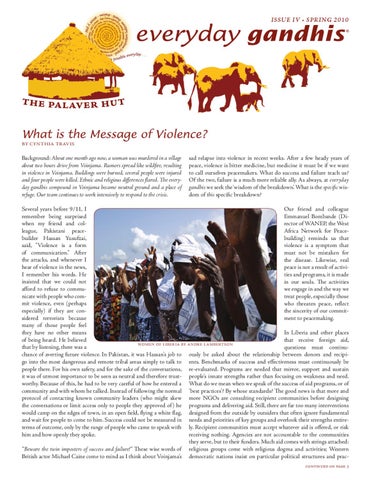
Several years before 9/11, I Our friend and colleague remember being surprised Emmanuel Bombande (Diwhen my friend and colrector of WANEP, the West league, Pakistani peaceAfrica Network for Peacebuilder Hassan Yusufzai, building) reminds us that said, "Violence is a form violence is a symptom that of communication." After must not be mistaken for the attacks, and whenever I the disease. Likewise, real hear of violence in the news, peace is not a result of activiI remember his words. He ties and programs, it is made insisted that we could not in our souls. The activities afford to refuse to commuwe engage in and the way we nicate with people who comtreat people, especially those mit violence, even (perhaps who threaten peace, reflect especially) if they are conthe sincerity of our commitsidered terrorists because ment to peacemaking. many of those people feel they have no other means In Liberia and other places of being heard. He believed that receive foreign aid, women of liberia by andre lambertson that by listening, there was a questions must continuchance of averting future violence. In Pakistan, it was Hassan's job to ously be asked about the relationship between donors and recipigo into the most dangerous and remote tribal areas simply to talk to ents. Benchmarks of success and effectiveness must continuously be people there. For his own safety, and for the sake of the conversations, re-evaluated. Programs are needed that mirror, support and sustain it was of utmost importance to be seen as neutral and therefore trust- people’s innate strengths rather than focusing on weakness and need. worthy. Because of this, he had to be very careful of how he entered a What do we mean when we speak of the success of aid programs, or of community and with whom he talked. Instead of following the normal ‘best practices’? By whose standards? The good news is that more and protocol of contacting known community leaders (who might skew more NGOs are consulting recipient communities before designing the conversations or limit access only to people they approved of ) he programs and delivering aid. Still, there are far too many interventions would camp on the edges of town, in an open field, flying a white flag, designed from the outside by outsiders that often ignore fundamental and wait for people to come to him. Success could not be measured in needs and priorities of key groups and overlook their strengths entireterms of outcome, only by the range of people who came to speak with ly. Recipient communities must accept whatever aid is offered, or risk him and how openly they spoke. receiving nothing. Agencies are not accountable to the communities they serve, but to their funders. Much aid comes with strings attached: “Beware the twin imposters of success and failure!” These wise words of religious groups come with religious dogma and activities; Western British actor Michael Caine come to mind as I think about Voinjama’s democratic nations insist on particular political structures and praccontinued on page 3
The Palaver Hut • Issue IV • spring 2010
eg News Update...
Table of Contents What is the Message of Violence? by cynthia travis
· 1 ·
Permaculture and the Art of Condolence by warren brush
· 5 ·
I Am Still YOUR Friend by ki'na darkcloud
· 7 ·
Creating High School Journalists by lassana kanneh
· 8 ·
The founder of everyday gandhis offers musings on multiple lenses for viewing and responding to the recent outbreak of violence in Voinjama, and ask what the message of violence might be.
Our Permaculture colleague, Warren Brush (www.quailsprings.org) writes about the practice of condoling the land along with the community in preparation for a future harvest of peace and plenty.
K’ina DarkCloud writes an uplifting and cautionary tale of love in the face of hatred.
e veryday gandhis’ first documentary film, The Dead Will Guide Us: teachings from Liberia’s civil war had its World Premiere at the Santa Barbara International Film Festival in February. The film had two scheduled screenings and the festival added a third showing. The Dead Will Guide Us is the story of how the dead and nature, particularly elephants, have brought the human and natural communities together for peacemaking and reconciliation. In November 2004, everyday gandhis supported Voinjama's first post-war traditional Mourning Feast. Over 5,000 people peacefully attended. A cow and several chickens were sacrificed, providing food for the entire town. During a traditional Mourning Feast the community comes together to settle their differences and, with drumming and dancing, conflicts are sent 'across the river' with the dead to their final resting place. By eating from the common bowl, people pledge to live in peace. continued on page 9
Lassana Kanneh, our student journalist and one of the Big Six (Future Guardians of Peace), writes about the journalism workshop he organized at his school, the esteemed Rick’s Institute.
The Voices of Elephants by deena metzger
· 10 ·
Earth Treasure Vase by cynthia jurs
· 13 ·
Sawubona (Hello) by jah'shams abdul-mu'min
· 16 ·
Our senior advisor, Deena Metzger, writes of how elephant stories, encounters and dreams seem to indicate that they seek to enter our consciousness in order to guide and heal us.
Cynthia Jurs reports on her recent pilgrimage to Voinjama to bury Africa’s first Earth Treasure Vase, an ancient Tibetan practice of seeding peace by burying consecrated clay vessels filled with offerings and prayers in places of danger and war.
Jah’Shams Abdul-Mu’min (CEO of SANBI, Success A New Beginning, Inc.) writes of the connection between traumatized ex-combatants and traumatized inner-city youth and the similarities and possibilities for mutual, collaborative healing. film reception by vic cox
2 • everyday gandhis • spring 2010
continued from cover
tices; companies and wealthy donor nations come with neo-colonial trade agreements that allow favorable terms for resource extraction or manufacturing in exchange for aid, jobs and minimal training. Can we assume that the recent violence in Voinjama is, at least in part, a reflection of the shortcomings of the aid design and delivery systems currently in place, even those that have been considered, until now, successful - including our own work at everyday gandhis? What can the recent violence teach us at everyday gandhis about where and how to focus our efforts, about where we have fallen short, and about the programs that are working but could be expanded and improved? For example, we know that the recent violence was triggered by rumors after a young woman was murdered in a village near Voinjama. There are many conflicting stories about the murder itself, and there is confusion about how the rumors got started, who spread them and why, and questions about why people reacted violently. Most investigations, especially legal ones, seek to get the facts straight and to assure that the rule of law prevails. Efforts are being made to discover root causes, key participants, patterns and particulars of damage, etc. in the buildings burned and looted, and the people injured or killed. What of the less obvious factors that contributed to the violence? Perhaps we at everyday gandhis can respond in innovative ways. Instead of looking at constellations of failure or need, let us look instead at areas of resilience. Why did certain people not get involved in the violence? What actions did some of them take to reduce or prevent the violence? As our friend and colleague, Malidoma Somé, says, when there is violence, we must look toward the edges, not the center. In Permaculture, edges are well known as the most fertile growing areas because they are where nutrients and species are found in profusion, reducing or eliminating harmful pests, drawing rain, and providing both more nutrient-rich soil and a richer mix of beneficial birds and insects. Crops grown along edges and borders are both more productive and more nutritious. I wonder how these principles are reflected in human border and edge communities and peacebuilding – how do we cultivate the untapped wisdom and creativity found in those areas and populations? What are the specific gifts found there and nowhere else? Our colleague, Dr. Ba Foday Suma, has long advocated strengthening border communities in volatile regions, instead of putting people in
women in the marketplace in voinjama by mohammed kamara refugee camps after an emergency overwhelms an area – in part because this is where surges of refugees occur anyway – but his ideas have fallen on deaf ears at the U.N. Let us look for unconventional, unexpected, sources of information. Borrowing from the wisdom of Early Warning conflict transformation techniques, we can ask: In the days prior to the riots, what were the market women noticing, selling, wearing, discussing, concerned about? What was happening along the nearby borders with Guinea and Sierra Leone, and along the borders between neighborhoods, districts and counties? What changes were noted in the behavior of animals, the calls of birds, the shapes and colors of the weather, the clouds, the moon? In particular, what was noticed in the behavior of the elephants? What conversations were happening among ex-combatants, prostitutes, long distance and cross-border truck drivers and vendors, at palm wine shops, at mechanics’ garages? What did hunters and fishermen notice? What were people dreaming? During peace times, how can eg staff work with communities and local government to gather and analyze this kind of information? We hear a lot about people who feel marginalized, particularly among the Mandingo ethnic group. We know that women feel marginalized, as do ex-combatants, both male and female. Who else feels left out? What, specifically, would make them feel more included? More important still, what creativity, talents, wisdom and energy remain untapped among those who feel they are on the outside looking in? In the struggle for daily survival, community life is an important vessel for receiving people’s individual gifts, and ‘cooking’ them so that they nourish the peace and wellbeing of that community, becoming the collective face of that community’s identity as well as the treasured offering that the community makes to the peace process. If the story in someone’s heart is one of feeling left out and unappreciated, unimportant to the community at large, then, even if it’s not altogether true, that story remains the song on their lips and its taste lingers on their tongue. Nigerian writer Chenua Achebe says that the story of the hunt will always glorify the hunter until that story is told by the lions. Liberia and the world desperately need for Liberia’s story of recovery from war to be told by the ordinary people who are living it, not by historians or foreigners. Voinjama, and Lofa County have made unique contributions to the story of Liberia’s healing from war. One of these was the miraculous Mourning Feast that happened in late 2004. In our search
bethelson with future guardians ezekiel & akoi
everyday gandhis • spring 2010 • 3
for traditional ways of peace-bringing, perhaps it is finally time to organize the fire circles we have long been promising. Let the stories of peace be told – the stories that include the spirits of the dead and the elephants, not only of the people. All have suffered and all have sacrificed for the sake of peace. Peacebuilding mentor John Paul Lederach offered the people of Northern Ireland an incalculable gift when he asked them to imagine that they were looking back from far in the future to tell the story of ‘How did The Troubles end?’ That challenge creates a bridge between the heart and the imagination, the individual and the collective, the future and the present. Let the people of Voinjama gather around their evening fires, on street corners and in palaver huts, and share the stories they will want to pass on to their grandchildren’s grandchildren about how they learned the ways of peacemaking. It has to be their story. It cannot be the story of this or that program or NGO. The story is a bridge and it is also a tool of empowerment because it calls each person, regardless of how important or insignificant they might feel, to find the contribution to peace that will make them, their ancestors, and their unborn relatives proud. By de-pathologizing violence, we can step away from reaction into observation. Danelia Wild, our friend and colleague here in the U.S., has been researching PTSD and its effects on communities, not just individuals. She maintains that a surge of violence can be seen as a community event, perhaps a community flashback to the trauma of war. She wonders what might have happened, in the extended moment of Korpu Kamara’s murder and the ensuing violence in Voinjama, that caused a sudden replication of events similar to what occurred during the war and a reaction as if the war were still happening, and what might happen if the community could respond in ways that heal the trauma and its triggers. We of everyday gandhis in the U.S. have not experienced civil war directly, although we have colleagues who are veterans and others who have suffered trauma of many kinds. Because of this, we must be very careful in how we understand recent events in Liberia, even though several of us have been to Liberia many times and feel deeply connected to our team members and to the community. The best we can offer is a neutral ear and a bit of material support. What else is possible from our position at the edge? Perhaps the disadvantage of being at a distance, of being ‘inside outsiders’, is also an advantage because it allows us to look
at recent events through multiple lenses. The lens of story is one. The lens of communal PTSD is another. The lens of focusing on the edges, not the center, is another. Restorative justice is a lens: What relationships and property need to be, or can be, put right, and by whom? The lens of traditional peacemaking asks what ritual and ceremonial work has been neglected, or can yet be done, that will nourish the peace sign by cynthia travis spirits and the spiritual life of the community. Danelia offers yet another astonishing lens to peer through by asking whether something happened the night of the murder, or perhaps long before, that separated people from their souls – as trauma can do – and whether this moment is an invitation to go back and see how to re-unite the people and their souls who suffered this. One of the tools we use at everyday gandhis U.S. (developed by Danelia Wild and Mama Deena Metzger) is something we call a ‘Star Map’. We brainstorm events, stories, moments, people, questions and connections and write them down or speak them in council to establish the field. Then we look for patterns, relationships, synchronicities and connections (often unexpected) and ‘map’ them by creating layered diagrams until a larger picture emerges. Once we establish what is in the field, we look at where there is energy around something, where it is alive. This is important because in peacebuilding and in situations where there are many urgent needs, it is easy to become overwhelmed or to take on too much. It is tempting to jump to conclusions, seize on answers, push for ‘fixes’ and rush to create programs. The Star Map process allows us to discern what is ‘ours’ and what is not, and what the priorities ought to be. We are learning that there are ideas and actions that ‘belong’ to the Liberia team, and others that are ‘ours’ here in the States. We seek to clarify what those effective, ‘alive’ areas of focus are for each team. Once we begin to see what is in the field, what is alive, and what is ‘ours’, we must determine what is the right action to take. Often, the most reliable criterion for right action is to look for the smallest possible gesture that will tap into community wisdom and free up creative energy such that people will know what needs to be done and how to do it, with little or no money and few outside resources. This is where intuition, council, dreams and divinations help us see together what cannot be seen by individuals alone, and cannot be determined by linear cause-and-effect thinking. These small gestures are simple, elegant, catalyzing, empowering, revealing and beautiful. They take our breath away - or bring it back in a calm sigh. These are the gestures that are as healing for the elephants as they are for humans; as healing for the future as for the past or the now; and as nourishing and uplifting for us here as for our beloveds in Liberia and beyond. Healing and peacemaking are the same. Healing is beautiful and reciprocal. Beauty and reciprocity are contagious. Cynthia Travis Founder & President everyday gandhis
everyday gandhis discussion circle
4 • everyday gandhis • spring 2010
Permaculture and the Art of Condolence by warren brush
“I can do no other than be reverent before everything that is called life. I can do no other than to have compassion for all that is called life. That is the beginning and the foundation of all ethics.” –Albert Schweitzer
T
he expression of our lives is governed by our ethics, whether consciously or in an act of amnesia. Ethics are a prism through which beliefs express themselves as actions. For example, if a prominent ethic stated, “I value money more than the environment,” my actions would likely be destructive to the environment. If I had the ethic, “My spiritual well-being is primary,” my actions would support spiritual purpose. I believe we are born with natural ethics embedded in our intuition that become imbued with social convention. War can cause people to drastically shift their ethics as a survival mechanism that accommodates human and environmental atrocities. This socially sanctioned shift allows for actions to occur that would otherwise be forbidden. The perpetual warfare of modern culture has compromised our natural ethics, whether we choose it or not, and as a result the natural world is being assaulted on every front by the direct consequences of war and commerce. If not condoled, the deep-seated grief caused by this and other tragedies leads to trauma and depression that, if unchecked, lead to further propagation of war in all its forms. Without condolence, grief can even solidify as cancers in our body and/or in our social fabric. The division between our ‘natural ethics’ and our ‘social ethics’ often leads to the inability to express the pain of our losses in healthy ways. Grief itself becomes tightly bound within us when we are faced with a tragedy and we do not have the time and community support to go deeply into the grieving journey. A hollow place is created within us that can either be bound by unexpressed grief or, conversely, become a deep well from which human creativity can quench its thirst. The ability to properly grieve as individuals and communities is rooted in the expression of the pain we feel from loss and then transforming that pain into beauty.
In our work in Liberia, we all recognized the need for the land to be condoled as an integral process necessary for human healing to take place. This meant reinstating an ethic that works with and supports indigenous cultural systems of human and land stewardship. Permaculture was the perfect solution as it begins with an ethic that binds together this worldwide grassroots movement that is changing the face of the earth, literally, to provide abundance, diversity, resilience and stability for people where they live and the ecologies on which we all depend. The Permaculture ethics are: • Care of the People • Care of the Earth • Fair-Share These simple ethics seem so natural, yet they are dissonant to Western conventions. Each of these distilled ethics can be seen as seeds that need to be hydrated so that their full power can be realized and better understood. Care of the People This anthropocentric ethic recognizes the mutual interdependence of all humans. It is based in taking responsibility not only for ourselves, but for our fellow humans. Our ancestors survived thanks to communal organization and shared work synergy that allowed humanity to prosper in unique and powerful ways. Until recently, our shelters and sacred houses were built in community; our food systems were designed, managed and harvested in collaboration; and our abundance and lack were shared. Permaculture’s ethic of Care of the People demands that we weave a rich human tapestry of sharing, caring, recognizing, celebrating and work synergy that includes condolence to metabolize our grief in community processes of ritual and ceremony. Each person carries, in the marrow of their bones, unique, inherent gifts that need to be fully realized both for the sake of the individual and for the benefit of the greater community. We are not independent from one another but reliant on the graces and pitfalls that we each contribute to the fabric that makes up our human family. We need one another, plain and simple! Care of the Earth This ethic recognizes that all the features and aspects of the earth have intrinsic value and worth and do not exist merely for human exploitation and destruction. We have a primary responsibility to be fully aware that every action we take, every breath, has a direct impact on the environment. The implications of our actions must be part of a greater design that ensures that the systems that sustain our actions are replenished and enhanced. To do this we have to dig deep into learning the stories of all that sustains us and then honor those stories with our actions in ways that bring positive impact to the greater whole. We need to know where the cotton in our jeans was grown, where and how the dyes were made and applied, what chemicals are used, where the manufacturing occurs, how it is transported, who was impacted and what places were mined in the process. For every product we buy or
liberian children exploring the natural world near voinjama
everyday gandhis • spring 2010 • 5
space for the world to come into us and shape our destinies. This hollow place will fill with grief. If left unexpressed, we will blindly attempt to fill this space with the emptiness of material things or unhealthy behaviors. The healthy expression of grief is vital to cultural development and maintenance and should be valued as important as the food we eat. We cannot solve grief…only express it!
warren brush teaching permaculture in liberia make, we must consider the future generations of all beings in all of our decision-making processes. The key to living an ethic of Earth Care lies deep in the folds of awareness and appropriate action. Fair Share We are stealing from our grandchildren to feed ourselves. Sadly, the legacy we are leaving to our children is a world that is more diminished than when it was left to us. So many youth today are voicing their disdain for an ethics system that worships economics as the ultimate indicator of success and abundance. Our children are and always have been our key indicators of a failing or successful cultural system. Endless economic growth, the dominant ethic of western society, cannot be maintained, as it does not recognize or hold itself accountable to the ecologies upon which it depends. The Fair Share ethic states that we must govern our own needs to take only that which is equitable to maintain our lives. Any abundance should be returned to the larger system through sharing, volunteerism, and/or nutrient enhancement. Fair Share acknowledges the nature of cycles and spirals that exist in us and in the world. Without an ethic of Fair Share, there can be no true, lasting land-based culture. Condolence and Grief The expression of grief is viewed as ugly and anti-social by most modern people and is often mistaken for anger, addiction, depression, oversensitivity, and/or withdrawal. Western culture seldom allows the time or resources necessary to really break down and enter into the process fully. Going deeply into the arduous journey of condolence in our modern world would likely cost your job, your home, possibly even your family. In most wars, people do not have time to properly bury their dead and grieve. They carry and compound those unprocessed wounds, sometimes indefinitely. The pain of war and the cumulative effects of grief on a human soul often lead a person into an irreconcilable place where the expression of violence against others and oneself seems the only way to make life tenable. Whether we have been through the atrocities of a war, have lost a loved one or are living a life that prevents the full expression of our inherent gifts, we all experience grief and need to express it. There is a hollow place inside each of us that needs time and
6 • everyday gandhis • spring 2010
Condolence is the process of helping grief metabolize into a life-giving force to create beauty from what was once pain. In indigenous cultures around the world, there are condolence rituals that allow for wailing and the breakdown of individuals in a way that is held and guided. In Liberia, everyday gandhis helped reinstate traditional community Mourning Feasts. At the first ceremony, over 5,000 people peacefully participated to grieve the dead from their recent civil war. Soon after, the expression of creativity began to revive in the forming of traditional culture troupes, elders’ councils, elaborate offerings to feed the natural world, and increased creative energy for resolving community conflicts. Healthy condolence processes are a prime example of how we can turn our problems into solutions. Grief is a human condition that can either feed the world’s beauty or ravage it, depending on how it is handled culturally. You cannot assuage grief, you have to go into it with complete trust and the support of your community. Condolence needs initiated people to strongly hold the space for the expression of grief in its entirety. Grief cannot be condoled on your own – it takes community rooted in authentic ritual and ceremony to see you through. As an elder in my life, Martin Prechtel, exclaims, “Grief and praise are expressed by the same muscle!” as seen when you laugh so hard you cry or you cry so hard you laugh. Our ability for praise and joy is inversely related to our ability to experience and transform grief. The ‘grief muscle’ needs tending and strengthening in life for us to be able to experience profound joy. Permaculture’s Role in Condolence Permaculture ethics support healthy community processes that lead to a culture that honors and embraces condolence. The abundant and perennial nature of Permaculture allows for learning from nature, discovering ritual and ceremony that are linked to the land, and tending to the needs of the people in direct and tangible ways. The integrated systems of Permaculture that work on natural principles, if embraced on a community wide scale, create enough local stability and resilience to allow for individuals to transmute grief into beauty for the entire community to benefit. Permaculture also teaches deep observation skills of nature that can and should be applied to how we observe and interact with the nature of people. Our ability to see the scars in both land and people is important to the healing process. Being able to connect people with their hands and hearts to the land in designs that are ecologically positive creates tangible spaces and experiences for healing to occur. Numerous studies document the benefits of healing gardens for at-risk youth, war veterans, institutional patients, and many others. Permaculture links the garden to a greater design for community health, allowing us to express our creativity to nourish the greater good. When we have a platform for true and valued contribution, our bodies and spirits heal. I have experienced and seen many people shed tears on the garden beds while working with their hands in the soil.
A well-designed Permaculture plan can lay the foundation for an individual, family or community to move toward living in integrity with each other and the land. The ethics that make Permaculture viable also support the cultural systems that give energy and space to healthy condolence practices to thrive in our communities. We must remember that we are deeply obligated to our children and grandchildren to metabolize our own grief and the grief of our generation so they do not have to carry those ghosts through their lifetimes. Begin today by evaluating the nature of your ethics and then take one step, your next best step, toward a life of equitability and grace. Warren Brush February 2010 Warren Brush is a certified Permaculture designer and educator as well as a mentor and storyteller. He has worked for over 20 years in inspiring people of all ages to discover, nurture and express their inherent gifts while living in a sustainable manner. He is co-founder of Quail Springs Learning Oasis & Permaculture Farm (a few of their offerings include: Permaculture Design Certification courses for Youth called Sustainable Vocations, PDC for Adults and Sustainable Aid Courses among many other offerings), Wilderness Youth Project, Mentoring for Peace, and Trees for Children. He works extensively in Permaculture education and sustainable systems design in North America and in Africa through his design firm, True Nature Design. He can be reached through email at w@quailsprings.org or by calling his office at 805-886-7239. www.quailsprings.org www.sustainablevocations.org www.mentoring4peace.com www.treesforchildren.org www.truenaturedesign.net
I Am Still YOUR Friend by ki’na darkcloud
T
his past Thanksgiving my husband and I went to my daughter's home. Our beloved granddaughter Nuesha was there, a four-and-ahalf-year-old who had lived with us from when she was four months until she was four. She is a wise old soul in a child's body. As the day went little nuesha by danelia wild on, with many tensions that come from having many people with differing views of the same situation in one space, we were all becoming edgy. There was a boy of five there, a child that my daughter sometimes babysits, who wanted a turn at a video game that Nuesha was playing. It was her turn; he had just had a turn, and she told him so. He shoved her away from the game, stomped on it, and told her, "I am not your friend anymore." The entire room went silent, the adults ready to tear this boy apart. I was ready to yank him away and shove him on a chair, ready to defend her. Her Papa, my husband, was looking at this boy with a snarl on his face. We were all in a place of ugliness, a child in our sights. Nuesha stood from where she had landed after being shoved and told him, "That's ok, I am still YOUR friend." She took his hand and they walked off together to sit at a table and look at a picture book. It was a lesson I will not forget in this lifetime. It was a refusal of war. It was peace restored without fanfare. It was amazing. One four-year-old took the ugliness out of the room with seven words and a picture book. In the time since then, I have had occasion to call on that memory. After finding out that a friend had seriously betrayed me, with intent, I wanted to go confront the woman and tell her all about herself. I wanted to "knock some sense" into her. Instead I repeated those seven words and found peace. I understood in that moment what Nuesha understood that day, war cannot live where it is not invited. The boy was tense, feeling like he didn't belong, tired, envious of a game that he could only play while he was there, watching people fawn over Nuesha and give her presents we had brought from home. She understood that and refused to let it make him an enemy. I have been listening to the ancestors, refusing to feel awkward about it. I have been calling on their wisdom and hoping for an end to war. I never knew that a four-year-old could show me what they have been saying all along. Now I do and my life is more about seeing others in a more loving light and looking at all my relations as gifts from the Creator. War cannot live where it is not invited. Ki'na DarkCloud
applying permaculture
Ki'na DarkCloud is a Native American woman who is a dreamer, dream consultant and everyday gandhis colleague.
everyday gandhis • spring 2010 • 7
Creating High School Journalists by lassana kanneh
Journey to my career After my birth, I got into struggles among many people, friends, neighbors, classmates, and schoolmates for several years. There were a lot of difficulties I experienced because of financial support in Monrovia during the 1990s, while I was with my mother. A lack of food caused me to leave my home and go out to find food in order to sustain my life and because of my lack of needs, I was intimidated and joined the National Patriotic Front (NPFL). I later found myself in the Northeastern part of Liberia, Voinjama, Lofa County, wondering if I could re-build my self-image. The idea that came to mind was through listening to my own big and bright ideas, making my thinking a habit, then that habit became a life style and the life style, I believe, is leading me to have a crown deserving honorable self worth. Before moving to Ricks Institute, Liberia (the land of transformation, learning, and great culture), I worked at my former school, Voinjama Free Pentecostal Mission School, Lofa County, as student editor and chief-reporter for the department of Mass Communication. Here, I was able through hard work, to go out and find resources by interviewing the local people and journalists and sharing their experiences and difficulties. This enabled me to compare and contrast ideas that keep directing me as I go through high school. With the experience I had with other journalists, I was able to compile notes on high school journalism called Information on Journalism from 2008 to 2009. This process took me many days, moving from place to place under sunshine, rain, even moonlight, meeting friends who have different abilities and ideas than me, believing that I can learn from them through conversations. One such friend is Alexander Sonnie, a great friend of mine, now a graduate of Voinjama Free Pentecostal Mission School, who once served as press director while I was serving as chief-reporter. Now at Ricks Institute, one of the best schools in Liberia, I'm glad and very excited to become part of the larger family of this noble institution. When I came to Ricks I had to gain enough strength and
workshop on high school journalism by mohammed kamara
8 • everyday gandhis • spring 2010
workshop participants by mohammed kamara courage in the midst of people from different backgrounds. However, I worked hard, meeting and talking with friends who were members of the Press Club, about how we could best cooperate in shaping our skills and abilities. Today, I'm proud to be among them as a student journalist. We've just held our first workshop, which was fantastic. My career has just begun. Media Workshop for Students February 6, 2010 Introduction The Dragon News Network (DNN) is a campus-based news organization run solely by students. In other words, it is a students' Press Club. The Dragon News Network gathers news around the campus and the environs of Ricks Institute, and blends this with national news. The news is proofread and edited by students, and it is then submitted by the coordinator, who is an instructor, before it is sent out for printing. The news is read to the Ricks community every Friday during Assembly The need for a workshop For the academic year 2009/2010, the administration of Ricks introduced a new academic program in the school where students are required to take THREE quizzes and FOUR assignments for each subject. If we consider only the four major subject areas (Math,Language Arts, Science, and Social Studies/History) it means that students will be taking 12 quizzes and 16 assignments for every period (six weeks). Gathering news on time was always a problem. This was a big challenge for the students in the Press Club. In addition, new students came to form part of the Press Club. For the first time students began using a recorder to conduct interviews, and also to do live interviews with teachers, students, and guests during news presentations. All of these presented challenges to the students and young journalists like me ; thus the need for a workshop to highlight those areas that needed improvement, and to learn new ideas about journalism.
The Workshop The workshop was conducted on Saturday, February 6, 2010, and lasted for three hours - from 11 a.m. to 2 p.m. The materials for the workshop were provided by Ricks Institute administration, while the pamphlet used was written by me, a student journalist of the 10th grade class. The presenters were all students from grades 9 to 12. We were able to highlight those areas we have lassana kanneh by mohammed k. weaknesses in, and other areas we have strengths in. Our coordinator, Mr. Edmond Ponga, also passed on responsibility to the 10th and 11th graders because the 12th graders were preparing for their national exam to leave the school for university. Conclusion We have resolved to have regular workshops here at Ricks Institute, especially as our seniors are no longer with us. We as student journalists also hope that more materials will be made available for our work so that we will improve our skills and abilities as young journalists from both the school and other international partners. We are anticipating that one day you will come and visit us here at Ricks Institute to see what we are doing. I extend my gratitude to our photographer Mohammed Kamara for the great effort he applied. Both of us contributed the amount of $500 Liberian dollars to have refreshment for participants of the workshop. And many thanks to all my beloved brothers who contributed their own prayers towards the beginning and end of this process (THE BIG SIX, Future Guardians of Peace). With best love, care and regard, Lassana Kanneh Future Guardian of Peace everyday gandhis Ricks Institute Virginia, Liberia
continued from page 2
eg News Update... Guests traveled from Los Angeles to be with our Santa Barbara supporters for a special reception at the warm and welcoming home of Ethan and Erin Boehme the night before the premiere. Everyone had the opportunity to mingle, meet someone new, and learn a little bit more about the work of everyday gandhis. The trailer for our next documentary, “Future Guardians of Peace: from child soldiers to peacebuilders,” was shown and discussed by guests and director-producer and co-writer Cynthia Travis, editor Vincent Stenerson and Cinematographer Ulli Bonnekamp. It was a special celebration of the story of peacebuilding in Liberia and the resilience of her people on the eve of the film’s initial public showing. On Sunday, Feb. 7, 2010, the 290-seat Victoria Hall Theatre in Santa Barbara was close to a full house for the World Premiere of our film. The enthusiastic audience gave the film a tremendous round of applause at the end. Cynthia Travis and William Saa (the narrator and co-writer of the film) took to the stage for a question and answer session following the premiere. The next two screenings were equally successful with a fantastic turnout and a great audience response to the film. The third screening, at the Lobero Theatre, was a surprise addition to the schedule. This was our first film festival experience. It was a wonderful opportunity for everyday gandhis to be seen and heard by the Santa Barbara community as well as by those visiting, and the festival was the perworld premiere by vic cox fect stage to begin our documentary premieres. We are hoping there will be many more to come and that the messages of peace told by everyday gandhis will be heard by an ever increasing audience. Our deep thanks go to all those who helped make this film a reality and to those in the film itself who allowed their stories to be shared. A special thanks as well to our donors for the reception: C’est Cheese, Alexandra Leslie and Tom Stone, and The Santa Barbara Farmer’s Market. Ana Brush Media Coordinator everyday gandhis www.everydaygandhisfilms.com. We have recently been notified that The Dead Will Guide Us has been accepted into the Swansea Bay International Film Festival, the International Film Festival of Thailand, the Heart of England International Film Festival, the International Film Festival of Ireland, and the International Film Festival of South Africa.
discussions on journalism by mohammed kamara
everyday gandhis • spring 2010 • 9
The Voices of Elephants by deena metzger
J
ohn O’Neal, actor, director and founder of the Free Southern Theater that accompanied the Freedom Riders in their quest for civil rights, says the following in his play, Don't Start Me to Talking or I'll Tell Everything I Know: Sayings From the Life and Writings of Junebug Jabbo Jones: “I’m going to tell you what I’m going to tell you. Then I’m going to tell you. Then I’m going to tell you what I done told you.” This is what it takes, he knows, for us to hear. The elephants first came to me in 1999. I was so sure I understood what they were saying, I wrote about it and then I acted on it and went to meet them. On Epiphany, in the year 2000, the elephant we now call The Ambassador and a small group of us met in Botswana. Then I met the Ambassador again, and then again, and then there were other elephant encounters. I speak of these events repeatedly because they are such extraordinary events that we cannot, even 10 years after that first experience, claim to understand them within the ordinary reality in which we live day to day. The advent of the patriarch, the Ambassador, the circumstances of his arrival, his appearance, again, to my husband and myself in the summer of 2001, were events so compelling, demanding and humbling that a small delegation of the wide ranging everyday gandhis team from North America, Liberia and Southern Africa traveled to Chobe Game Reserve in Botswana to document, if we could, the reality of the Ambassador. The Ambassador came again, and introduced us to his family, entwining his trunk with his mate’s, and acknowledging their two young calves.i Witnessed and photographed, he then astonished us by engaging in ritual contact, literally “throwing us a bone.” We caught it. It must be noted here that it was an ancestor bone, an elephant thighbone. Thus he called us into a sacred event of the highest order, offering us a mandate whose nature we cannot entirely understand yet and shaking the entire foundation of our thinking about the true nature of the world. We did not know how to meet this event; we continue to ponder it actively. Accordingly, however, Cynthia Travis and I took the Future Guardians of Peace – five ex-combatants and one former child refugee and other members of the everyday gandhis peacebuilding team on safari to Tanzania. Another reason we went on this safari with the ex-combatants is that the appearance of an elephant and her calf during the Liberian civil war caused the LURD rebel Minister of Defense, known as Master General, now on our peacebuilding team, to tell his 36,000 soldiers to lay down their arms because elephants are a sign of peace.ii The indigenous wisdom tradition of Liberia, as in much of Africa and many parts of the world, is based upon being guided by dreams, divination, signs and unusual events, such as the appearance of these elephants. “The war is over,” Master General said. He considered this a message or commandment from Spirit that he could not refuse The young men and woman who came with us on safari had never seen an elephant in the wild. Though elephants are native to Liberia, the
10 • everyday gandhis • spring 2010
calling the elephants by esther kpaku war had destroyed their habitat and they were hunted for food. The elephants who survived had gone into exile in Guinea. That is another but related story of how the elephants in Liberia, as elsewhere, exiled themselves during the war and returned when it was safe … or so they hoped. While waiting for the Future Guardians of Peace to join us in Tanzania, we spent a few days on safari at the Ruaha game reserve. We hoped but could not ‘expect’ the elephants to meet us as they had in the past. But they did. The elephant we call Spirit Sister came to me, Cynthia Travis, her son and his fiancé in the Ruaha. The one we called the Delegate came later in the Selous reserve. We name them thus because of the undeniable intentionality with which they met us. Though quite a young elephant, six or seven years old, Spirit Sister left her mother and approached us as we were parked above a watering hole. Alternately, she drank water and sprayed us for twenty minutes or longer. Then she, her mother and two other siblings climbed up the embankment, the mother trumpeting insistently, causing us to stop and wait alongside them as her twin brother approached from the bush. We were all so close they could have stroked us with their trunks as these introductions were being made. Later, we met the Delegate, a bull elephant, in the Selous reserve. Some hours after engaging in ritual activity of invitation, we came upon him in the forest. Solemnly and carefully, he advanced on our open trucks, his tusks almost grazing the rails and our arms. We all recognized him as a delegate from the animal world coming to meet his counterparts, the young, healing future guardians of peace. This encounter is documented with photographs and text by the young people in Tanzania Safari.iii Since the advent of the Ambassador, we have received many dreams, testimonies and re-countings of personal experiences and associations with elephants. Shortly after being in Chobe and receiving the ancestor bone from the Ambassador, we gathered in Santa Barbara for the eg annual meeting and were astonished at the threshold of the meeting
by the remarkable article in the New York Times Magazine by Charles Siebert, “An Elephant Crackup?”
Although we didn’t seek psychological meaning, leaving that to psychotherapy, we still stopped after being satisfied about meaning.
We immediately understood that the stresses that elephants and excombatants and child soldiers suffer are the same, that their anguish, its symptoms and consequences are the same, and that the ways of healing are the same and equally valuable for all beings and the restoration of the earth.
This spring I wrote to the members of the dream class that I teach as follows:
After reading Siebert’s article, I contacted Gay Bradshaw, whose work was the foundation of Siebert’s article, and brought her into our circle of consciousness. Her remarkable book, Elephants at the Edge, which details the similarities between elephant suffering, behavior and healing, and human suffering, behavior and healing, was published in 2009. This incomplete chronicle does not, however, bring us closer to comprehending the reality that elephants have literally come to us. Writing an op-ed for a newspaper in Assam, India, after elephants had taken over the runway at a military airport, interrupting border skirmishes, I suggested that we may have been ‘contacted’ by elephants making a broad sweep, offering up a universal SOS, to see who would respond. I like this idea because it removes the human recipient from being special and honors the elephant as the originator of the energy of connection. Each time the Ambassador has come to meet us, he has demonstrated will and intention. A daunting idea but perhaps a necessary one, especially for these difficult times in human history when we are traveling so quickly away from our original interconnections with all life and all beings. Now, additionally, we are being called to consider the plethora of dreams regarding elephants that are emerging in our far-flung community. We have communicated some of them and we are being guided by the dreams and the patterns they are weaving according to the deepest held principles and understanding of many of us associated with everyday gandhis – that Nature and mysteries beyond our understanding are urgently seeking to work in collaboration with human beings for the sake of peace, healing and the restoration of the natural world. Ki’na DarkCloud, Cynthia Travis, Elenna Rubin Goodman, Lawrie Hartt, Christian Bethelson and others connected with everyday gandhis have had significant, even startling, dreams about elephants that have called us to a deeper consideration of the issues confronting us. Ki’na DarkCloud dreamed a young female elephant who was dying of thirst because she couldn’t drink from water holes bloodied by war. A man pitied the little one and pledged to bring her water while her elephant mother took on the care of the man’s son. Cynthia dreamed that Bethelson was heading a phalanx of humans meeting a similar phalanx of elephants coming to each other to make peace. Another dream from J. Flomo Sawo, formerly part of the eg team, described elephants carrying delegates to a peace conference between tribes when the roads were obstructed by heavy rains. As dreams teach us the mysteries of peacemaking to which everyday gandhis is devoted, we are increasingly aware of the appearance of elephants signaling peace. For many, many years, I have honored the dream life, have lived my life accordingly, have written novels and a play that emerged from dreams given to me in the night. Every workshop that I lead starts with dream telling. However, in the past, we looked to see what the dreams mean.
This circle seeks to restore the deep ethics and spiritual development of all dream cultures. Together we will re-enter the dreamtime, explore the dreams sent to us for the sake of community and the future according to the old, old ways and new vision. In the past, dreams served to reveal the soul’s path, to protect individuals and communities, to alert people to future events, to teach people how to live in the heart, to link people and communities over time and space, and to reveal the true nature of reality. We hope to be able to revive such dreaming skills and use them to bind community and communities together. Finally, we will learn what it means to live by dream as individuals and as a community. This morning, I responded to three elephant dreams, one from Ki’na DarkCloud whose Dream of Guardianship has been published in the Palaver Hut II.iv The second dream is from Ki’na’s brother, Ti’an DarkCloud, a traditional Native American man living on the Navajo Reservation who never has thought about or dreamed of elephants. The third is from Patti Sheinman, new to our circle, who contacted me and came to Topanga for Daré mentoring after reading about my connection with the Ambassador. She dreamed the dream in Topanga. Ti’an DarkCloud’s dream: “There were four bull elephants coming into a village where there were men with guns. Each elephant got in front of a man and turned to the side so that the men could not see whom to shoot. Then the men tried to hit the elephants with the guns because it was illegal to shoot them. The elephants made the men mount them after setting down their guns. They took the men away from the village to where the other bull elephants stayed when they went crazy. It was a place where they could get away from all the input of hate.” Ki’na DarkCloud’s dream: “The same night as Ti’an’s dream, I dreamed that a family of elephants, including the aunties, were on a long walk trying to find a place to keep their brain injured loved ones. The brains had been injured from the repeated sound of gunfire and they were wailing from grief. The sounds were very similar in the elephant's minds.” [We have to note that too many soldiers from Iraq are now suffering similar brain injuries and trauma from gunfire and explosives. DM] “An old female, a true grandmother, walked with the injured and made a chuffing sound that was soothing. I found myself following them and
elephant greeting by mohammed k.
everyday gandhis • spring 2010 • 11
able pain of knowing who we have become and how the animals are suffering from almost every movement we make.
elephants of tanzania by akoi mawolo looking for my mother. An auntie began to walk with me so that I would not be alone and outside of the family. We came into a place with pools of water and abundant foliage to eat. The healthiest of the family led the brain injured to the food and water and waited patiently for them to get their fill. Only after the injured had fed did the rest of the family feed. Then the healthy members encircled the injured and laid down around them so they would know they were safe. Patti Sheinman’s dream: "I'm in Haiti, a few days after the 2010 earthquake, standing on a mountainside, crying as I look at the mass graves. As I look from afar, I see elephants coming toward the graves. They stop at the graves and with their trunks begin to cover them with leaves and brush until the graves are covered with their offerings." I don’t know what these dreams are really calling us to become though they are calling us to something, and we are to give up the lead and self-congratulation. Also we can’t explain the dreams away by thinking they come out of our own concerns, no matter how deep our concerns are. These dreams are not of our own creation; they are not from our unconscious or from the collective unconscious, unless you fully include elephant conscious and unconscious in the sacred collective. These dreams are not from ‘us’ alone. I don’t claim to understand fully how these dreams are from the elephants themselves, though receiving them as such requires us to undergo a total change of consciousness and live accordingly. I hold these dreams as sacred. I am humbled before them. I see where we are being taken — as long as we don’t lead. A billboard in Botswana outside of Chobe shows a procession of elephants following the elephant Matriarch who says “Follow Our Lead.” I am staying in ‘not knowing’ and also trying to follow her lead. The dreams indicate that despite ourselves the elephants take us on their backs, transport us, and surround us because we are violent, crazy and brain damaged. Despite ourselves the elephants come and help us bury our dead in the profound and beautiful ways they bury their dead. They help us remember what we have forgotten. Following their lead helps me deal with the unbear-
12 • everyday gandhis • spring 2010
As I wrote this note to my students, I understood something I had not understood before: We are the hate-filled, violent and maddened, the brain injured, and still we are being surrounded by the elephants, we are being transported in order to engage in peacemaking. Thus they, the elephants, are healing us. The way they are healing us is through the dreams! We are the mad ones. And we can be healed. We are brain injured and they are trying to take care of us. The very act of dreaming the elephants is placing us within the circle of their dreaming, their being, their healing. “I’m going to tell you what I’m going to tell you. Then I’m going to tell you. Then I’m going to tell you what I done told you.” The elephants told us what they were going to tell us. Then they told it to us. Now they are telling us again what they have told us. Again and again, until we understand. When I had almost finished writing this essay, I dreamed that I saw a small elephant walking down the boulevard in the San Fernando Valley. I tried to catch up to her, but she was far quicker than I. She had a familiar bounce, and she was smiling, satisfied that she was pulling a fast one on me. She lived on the land of a woman whose last name was Ruachitta. I repeated the name again and again in the dream so I would remember it when I awakened. Cynthia and I had gone to the Ruaha in Tanzania. And ruach means wind, breath and spirit in Hebrew. I began writing about the elephants and dreaming and dreamtime and Spirit Sister came. Now I hear their call: We will gather all the dreams and elephant experiences that have come to all of us. We will make their circle of healing accessible to all, so that we can be immersed in their healing activities so we can heal. We will do this even if we cannot yet understand what they are saying to us and how we are being led. When we heal, we change, we transform. To immerse ourselves in such healing will be to experience, and later, identify the transformation. In immediate response, I am initiating a project, Healing Voices – Dreamtime - The Elephants, under the auspices of my non-profit organization, Mandlovuv. If you have dreamed the elephants or experienced their influence, if they have come to you in any way, please write to me at deenametzger@deenametzger.com [Needless to say, if you have had healing dreams from other non-domesticated animals, from animals in the wild, do send those dreams as well.] We will gather these sacred moments and experiences and bring them together, as we are guided, as we seek to understand the true nature of the world and its creatures and follow their lead. Deena Metzger Writer, storyteller, healer and Senior Advisor to everyday gandhis www.deenametzger.com I I have written about this encounter in my book From Grief Into Vision: A Council, Hand to Hand, and in previous editions of the everyday gandhis newsletters. II The understanding of the role of elephants in peacebuilding in Liberia is documented in the everyday gandhis film, The Dead Will Guide Us, that premiered at the Santa Barbara International Film Festival on February 7, 2010. III everyday gandhis. “Tanzania Safari: Future Guardians of Peace”. 2009. IV Palaver Hut, Issue II, Fall 2009 V Mandlovu is committed to the exploration, revitalization and preservation of indigenous wisdom and medicine traditions as paths to planetary healing and peacemaking on behalf of all beings. Mandlovu is an African Ndebele word for elephant, and also is the name for the Great Mother. In addition, Mandlovu describes elephant consciousness – the spiritual group mind that arises spontaneously from the individual intelligences of all its members.
Africa’s First Earth Treasure Vase Goes To Liberia by cynthia jurs
The Earth Treasure Vase Global Healing Project (a program of the nonprofit Alliance for the Earth) is a rediscovered ancient Tibetan tradition to bring healing and protection to the Earth by filling consecrated clay vessels with prayers and offerings, making pilgrimages to places in the world where healing and protection are needed, and ceremonially burying the Earth Treasure Vases in collaboration with local indigenous elders, young activists and community members.
O
ur visit began with Uncle Jake's hosting and care taking of us, meeting the much delayed plane at midnight and overseeing every aspect of our time in Liberia as the true bodhisattva that he is. He was joined by Christian Bethelson, whose extraordinary presence and commitment makes him a man I am so moved to know. We spent quality time with both of them in Monrovia along with Bill Saa, who was nothing short of wonderful whenever he was around. I was sorry not to have been able to get to know the Future Guardians of Peace better, but at least we met when they arrived in time to participate in the Earth Treasure Vase ceremony. I dearly loved and felt such a connection to Mahwen, to Mama Kaneh and Hawa Kamara, and to Esther Kpaku (also a Future Guardian of Peace) who used my still camera throughout to photograph everything. They are all such incredible women. I only wish I had more time to just be with them. I did have some personal time with Mahwen Gayflor, both for a divination at her house and one precious afternoon sitting on the porch out back talking before Lassana Kamara came and scooped me up for yet another meeting with yet another group of interested members of the community to hear about the Earth Treasure Vase! Farbalee, Tarnue and Ayouba also all struck deep chords with me. Robert Zoma served very well as a primary translator and was gracious and helpful in every way. Mamadee Kamara was also kind and loving in his dedicated presence for everything we did. I am sure I am leaving others out who also deserve mention. Kamara worked very hard to facilitate many meetings and organize all the elders, dignitaries, officials and visitors from Guinea and Sierra Leone. There was great care taken to include everyone so that there were
earth treasure vase ceremony
traditional elders by cynthia jurs no mysteries or misunderstandings around the Earth Treasure Vase, and great care also taken to do things formally and properly. I was welcomed numerous times with lengthy introductions and explanations of why I was there, then formal acceptance and gifts (calabash with white cloth, kola nuts and silver dollar, old iron "money", white chickens, straw divining mat...) and those wonderful handshakes - first by the extended Voinjama community, then by the everyday gandhis staff, and later by various other groups of Chiefs, traditional elders, officials, women, youth, the visitors from Guinea and Sierra Leone. Each one of these was a formal meeting in which the story was told and retold, allowing for everyone to become a part of the process. The best sessions were with the women one day and the youth the next and in each we had more time and more of a group sharing in which I invited them to talk about their personal prayers for the region and the land and their communities, going around the circle holding a small crystal I then offered into the vase at the closing ceremony. We had a wooden box made to bury the vase in that included going to a blacksmith to attach some old copper on the inside lid of the box to conduct the energy of the prayers out into the earth as is traditional. This provided an opportunity for me to make an offering to a blacksmith as Mahwen had indicated I should do in her divination. At the meeting with all the youth (which unfortunately happened before the boys arrived), I suggested they decorate the box, which they did with gusto by drawing and writing messages on all four sides, top and bottom, inside and out. Even some of the elders got into the action. One evening early on, Mahwen and her women did a dance performance (the wonderful culture troupe performed on another night and then all together again and more for the final ceremony) to invite the ancestors and ask for their blessing and guidance around the Earth Treasure Vase. The ancestor of the late Paramount Chief came and told them that the work I was bringing was very important. He said they should take what we were doing seriously and that the ancestors were very happy about it. I found it interesting that it was the late Paramount Chief who communicated this because it turned out that after much conferring amongst all the elders about the burial location, the site that was chosen was the village of the current Paramount Chief. It seemed
everyday gandhis • spring 2010 • 13
that all members of the community were very engaged by the Earth Treasure Vase, and all in favor. The morning of the final ceremony began with the gathering of all the guests and dignitaries for the slaughter of a sheep. I sat in the circle and talked with Honorable Jallabah, who also came when we met with all the women. I was particularly struck watching Master General who crouched in etv burial location by cynthia jurs the center of the large circle holding the sheep, stroking and petting it, talking to it and kissing it, the entire time as everyone gathered and then prayed. Jake and I noticed two large eagles circling over the compound as we prepared to go to the big hall in town for the ceremony. We took it as a good omen. There must have been more than 400 people at the final ceremony. All the officials (though unfortunately the Superintendant of Lofa County had to be elsewhere), the Chiefs, Honorable Jallabah, the three representatives from Guinea and two from Sierra Leone, members of everyday gandhis, many women, many children, all the ex-combatants, culture troupe, etc. It was a huge circle inside of a big empty hall (with challenging acoustics) and it was thrilling. There was singing and welcoming by Kamara and Bill. I had set up the vase and box on a mat like Mahwen's that I had been gifted, with a cal abash full of dried flowers I had brought from home and another filled with leaves from a plant gathered in Mali known for its properties of healing and protection from all negativity. I had many pouches and bags of other offerings, my bell and sage, etc. I spoke about the Earth Treasure Vase project and the practice of praying for peace as we practice it, incorporating the ancient Tibetan Earth Treasure Vase tradition. The guided meditation that followed was challenging because it had to be translated into three languages. The circle was very large and the people were very attentive
and respectful during the long translations and ceremony. After the meditation I took the vase from the center and opened it up, put a few offerings in it, including the double terminated crystal I have carried with me everywhere for 30-plus years that we had used with the women and youth to receive their prayers. Then the vase made its way around the entire circle. Everyone there held the vase and prayed for peace and healing and only those who had already held it left the circle and everyone returned at the end. It was beautiful to see Master General accompanying the vase the entire way around the gigantic circle, overseeing it, protecting it, making sure it was passed with care and attention, handing it to the next person himself if it was a far reach, and maintaining his concentration on it throughout. He seemed to know just what to do without my saying anything. It took a very long time for the vase to travel all the way around the circle, passing from hand to hand. When the vase got back to me, I was told to seal it on my own while the drumming and dancing got underway. Bethelson came to my side to help along with the Paramount Chief and others who were nearby. We melted wax over the cork and then placed the silks and ties over and around the vase. The Chief helped to melt the gold sealing wax on the ties and stamp it officially closed. The dancing was fully underway and Bethelson among many others gave a hilarious performance, the excitement building. People began to gather around the sealed vase. We paused to take some photos, and then it was time to put it into the box. Mahwen came forward to help me at this point and then there was a wild crush around the vase as it went into the box. I had a red scarf from eg senior advisor Deena Metzger and three white katas (Tibetan ceremonial gift scarves) to wrap around the vase and many bags of herbs, flowers, rice and other things to pack around it. With each new bag of offerings it seemed a hundred hands desperately reached in to get some and throw into the box or be given a pinch to offer - I wished I had had a lot more to share. When we used up every last bit, the box lid (with a sheet of copper inside) was closed, the little padlock secured by Mawhen, and the key deposited securely in her pocket.
etv burial ceremony by cynthia jurs
14 • everyday gandhis • spring 2010
It was done. Everyone scooped up the box and we all began to dance with the box held high and much enjoyment all around. We danced to the singing and drumming for quite a while until we all made our way outside and continued until we got to the vehicles. We loaded up and went back to the compound for lunch. Many visitors came to the compound and we made plates of nuts, cheese and crackers and offered water as it was so hot. Around 4 pm the small group selected by Kamara gathered to go bury the vase. The site had been decided upon collectively – I had not been involved in that process. Everyone seemed happy and clear about the location – the village of the Paramount Chief, Bessa Talawoyan, who had given land for the Cultural Heritage Center. As the shadows grew long, we drove to the outskirts of Voinjama district and arrived at the little village of the Talawoyan family. We were greeted by the Chief 's wife and extended family who told us there had been a bird singing in the Kola tree all day so they knew visitors were coming although they did not know anything about the Earth Treasure Vase. Kamara and the men explained why we were there and then we marched up to the Kola tree in the center of the little village. They marked a spot at its roots and the young men got picks and shovels and immediately began to dig. The hole needed to be quite deep and fairly wide and roots needed to be cut to get down deep but I was told the roots of the Kola tree are hardy and strong. Suddenly Master General arrived on his motorbike, having followed us on his own, and began to oversee the digging of the hole, making sure they kept going deeper and did it really right. Finally the land was ready to receive the vase and the Chief began to lower it into the hole. Just as it was almost in, the Master General stopped him and made us turn the box so that the lock and front of the vase inside was facing east towards the rising sun. I was so happy he had noticed this detail as it is a Tibetan tradition, but by this point I had long ago stepped aside and it was in their hands. So the vase was buried at sunset facing east under the roots of the Kola Nut Tree in Talawoyan Village, Voinjama District, Lofa County, Liberia on December 21, 2009. The burial committee asked if there were any special instructions once it was buried. I told them normally it is buried in a place no one would know, but in this case I was happy that so many members of the
participants of earth treasure vase ceremony community had become involved and hoped that the location would become a place of refuge and pilgrimage to remember the prayers for peace and strengthen the collective intention that those prayers take root and grow strong, bearing much fruit in the years ahead. I told them the vase should not be stepped on and that the actual burial spot should be protected. Someone suggested putting a cement cover over it and I said no, that it would be better if the land and roots could breathe and wondered if instead a bench could be constructed all the way around the tree that would incorporate the vase somehow. We also discussed the idea of the everyday gandhis permaculture team working the earth around the tree and proposed bench to develop a little peace garden and gathering place. That night there was a goodbye ceremony with the everyday gandhis staff and we were gifted with gorgeous traditional robes and said our reluctant goodbyes. The last day in Monrovia, Harper Karmon and I filmed interviews with Jake (who cried), Bethelson and Bill. As I said goodbye to Bethelson, he told me "Cynthia, you never would have come here if not for the vase. Now that vase is buried in this land and we HAVE to maintain the peace. I will not let us forget. We will return often to that place and remember the prayers for peace that we made. I will do this - you can count on me." I was crying as I had so many times throughout our time together. It was hard to leave. Of course there is much more to share but this is at least a small part of the story of the Liberian Earth Treasure Vase, offered to you now with ongoing prayers for peace in Liberia and the entire West African region, as well as great gratitude to be able to have met and worked with members of everyday gandhis in Liberia whom I will never forget. Thank you with all my heart! Dormowa Cynthia www.EarthTreasureVase.org
ezekiel with the earth treasure vase
everyday gandhis • spring 2010 • 15
Sawubona/Marhaba/Salaam/Namaste/Halo (Hello) by jah'shams abdul-mu'min
S
ince meeting everyday ghandis leaders Uncle Jake (William Jacobs) and (Christian) Bethelson, I have shared elements of their story and talked with many here in my community in South Central Los Angeles about Liberia. In our conversations, we recognize the multiple similarities in people’s ability to heal from trauma and move towards reconciliation and prosperity. During Bethelson’s time in Los Angeles, he visited with me and a group of youth at SANBI and painted a vivid picture of how he continues to find his resiliency in serving the people of Liberia. His is an incredible story. When I share Bethelson’s tale of his journey to everyday gandhis, people will tell me a story about someone they know whose life is similar. It is often a story about a former gang member (a child solider) or an OG—“original gangster” (a general/captain) who gets out of the gang life (war), and how that person has changed himself, and is now dedicated to helping others and stopping youth from joining gangs. It’s often a story about people committing themselves to starting a voluntary crusade to listen to youth, to give them a place to go when things are bad (or not bad), provide them with education and training opportunities, and support their healing from trauma.
jake and bethelson's visit to sanbi of working with the peace-builders of Liberia. The HTCR initiative highlights individual and community resiliency by acknowledging stories that promote healing, love, forgiveness, compassion, and reconciliation.
The conversation inevitably turns to the factors which have brought children into asociety that would allow them to be marginalized, abducted and socialized in brute violence and trauma. The pull of gangs and war is strong because there are so few options for many young people. The situation becomes exacerbated when they can't get an education and they don’t have money or access to jobs or other resources. With the world economy moving slowly, violence is likely to increase in the absence of community-based efforts to support youth.
Success A New Beginning (SANBI), the nonprofit that I co-direct with Maryanne Galindo, has launched this local initiative to focus on how those most impacted by violence and trauma shape their future by building community capacity for healing work, and become engaged in training and skills development, by and for Non-Traditional Leaders, youth, and their families.
So, the question is how do we expand our hearts? What can the people living here in South Central Los Angeles do to support our youth and the youth of Liberia?
The HTCR initiative embraces partnerships with individuals, nonprofit organizations, private businesses professionals and practitioners who are actively guiding people through a learning and education process that promotes emotional, mental, physical, spiritual and cultural well-being though healing, sharing, caring, and reconciliation.
One answer to the question is to forge a deeper relationship with the peace-builders of everyday gandhis. We are talking about expanding our hearts by enhancing the momentum of our local initiative Healing Trauma and Community Reconciliation (HTCR) to include a vision
SANBI and the people we work with believe that unresolved emotional trauma blocks people’s capacity and ability to be effective and live productive lives. Acknowledging the existence of trauma and supporting a process of healing trauma is an extremely important contribution to community healing. SANBI is moving forward with its efforts to document and disseminate stories of healing and resiliency. As we build our capacity to sustain this initiative, we look forward to working with everyday gandhis, Uncle Jake, and Bethelson to strengthen our relationships. There are resources to be shared and we envision many opportunities to cross-teach, share stories, and bring a deeper awareness of the power of healing, love, forgiveness, compassion and reconciliation. Jah'Shams Abdul-Mu'min
jah'shams and bethelson
16 • everyday gandhis • spring 2010
Jah'Shams Abdul-Mu’min is CEO of SANBI (Success A New Beginning, Inc.), a non-profit organization that works with Non-Traditional Leaders of all ages, cultures, creeds and identities. One current project is to collect 1,000 healing stories from elders in the community.
Films
everyday gandhis
The Future Guardians of Peace from child soldiers to peacebuilders
F
ollowing dreams that came to elders and diviners in Liberia and also to some of us here in the U.S., Liberian and American peacebuilders from everyday gandhis have been working since 2004 in the volatile and strategic border community of Voinjama, NW Liberia, supporting traditional, indigenous peacebuilding and community reconciliation. In 2005, former rebel commander Christian Bethelson, desperate to feed his family, was on his way to a neighboring country to seek work as a mercenary when his vehicle became stuck in the mud alongside ours. Through interacting with everyday gandhis staff, Bethelson began his own healing journey, eventually becoming a full time peacebuilder himself. It was Bethelson that brought his former child soldiers Akoi, Morris, Ezekiel, Mohammed, Lassana and Varlee to our compound to begin rebuilding their shattered lives. We have been intimately involved in the healing stories of Bethelson and these remarkable young people for over film still: safari photography lesson three years, providing school fees, medical care, housing, counseling, training, and travel. It has changed all our lives and brought joy beyond telling. Thus, the film is an outgrowth of deep and far-reaching relationships that exist outside the film project and will continue long after the film is completed. Award-winning photojournalist Andre Lambertson has been documenting our work from the beginning. His passion for at-risk youth and his extraordinary gift as an instructor have been a perfect fit for establishing deep trust and camaraderie with these budding young peacebuilders. Photography has been a natural tool for building relationships in the community and to ignite their own buried sense of joy and beauty as they also explore more painful emotions and chart their journey of recovery. Their beautiful photographs can be seen on the blog http://everydaygandhis.org/fieldnotes/, and in several everyday gandhis publications. Taking photographs also prompts storytelling
and sharing of trauma and experience, promoting healing: with still and video cameras the Future Guardians of Peace are beginning to generate narratives of trauma and healing that are used in the documentary and that serve film still: marketplace goods to exorcise some of the pain for themselves and others like them. This painstaking work of ‘soul repair’ ripples out into the community, and into the wider project of rebuilding a war torn land and traumatized people. One can’t help but wonder what hidden gifts of peacemaking lie in the hearts of the tens of thousands of ex-combatants like them, the potential Future Guardians of Peace in Liberia and beyond. To date, the majority of our work has been privately funded, with public contributions playing an increasing role. Through grants and public events, we are seeking support for final filming and post production. We have a 10-minute trailer and a 75-minute rough cut and will complete the film this year. The program seeks to create a ‘multiplying’ effect in spreading the healing process to other potential peacemakers through talking circles, workshops, and soccer peace games. Several small groups – including local college students, professional photographers, veterans, permaculture designers and mentoring groups from South Central Los Angeles – will travel to Liberia work with ex-combatants in Liberia to explore mutual healing. America Martin, a young and well-known young artist out of LA, has already donated a T-shirt design for the program and will be coming to Liberia to work specifically with young women ex-combatants in hands-on fabric art and murals. We will be traveling on safari with the kids to game preserves in East Africa to visit healing programs for traumatized elephants and child soldiers in Uganda and South Africa. Cynthia Travis Director & Producer www.everdaygandhisfilms.com
film still: fish for sale
everyday gandhis • spring 2010 • 17
marketplace everyday gandhis
DVD: The Dead Will Guide Us
teachings from liberia's civil war The story of how the dead and nature, particularly elephants, have brought the human and natural communities together for peacemaking and reconciliation.
T-Shirt
T-shirt designed by renowned artist America Martin. Printed on 100% organic cotton.
Photojournal
A compilation of essays and pictures from the Future Guardians of Peace safari in Tanzania, August 2008.
Postcards
A small collection of photographs taken by the Future Guardains of Peace from their first week of photography instruction up to their present day work. Share the beauty with friends and family.
Prints
High quality framed prints of the Future Guardians of Peace photographs, some of which have been on exhibit at the Corcoran gallery in Washington D.C. These stunning photos capture the beauty of life and healing through images of people, nature and communities. Perfect for the home or office.
Coming Soon... Future Guardians of Peace: from child soldiers to peacebuilders, our second documentary film featuring the Future Guardians of Peace and their incredible journey of healing. Please call our office at (805) 966-9300 or email us at info@everydaygandhis.org to purchase any of these items.
www.everydaygandhis.org/store
As always our deepest gratitude and appreciation to our donors and supporters.
Cultivating Integrity The First Step in Becoming a Future Guardian of Peace.
Announcing everyday gandhis’ New Program For Former Child Soldiers, War-Affected Youth And Their Former Commanders In conflict prevention as in permaculture, borders and edges (including marginalized people at the ‘edge’ of society) are both the most vulnerable and the most potentially fertile areas in which to work. • 250,000 child soldiers active in the world today (UN estimates) • 53,000 Liberian ex-combatants, not counting those in exile • Over 2,000 ex-combatants in Voinjama alone • Voinjama: within walking distance to Guinea and Sierra Leone • Former combatants are vulnerable to mercenary recruitment, crime, drug addiction, HIV-AIDS, and unresolved trauma. • Female ex-combatants, many with small children, face distinct challenges of their own, including sexual trauma, STD’s, stigmatization, and lack of education or sources of income. Cultivating Integrity is a new 5-year program designed to build a presence for peace in Voinjama and along the borders of Liberia, Guinea and Sierra Leone that will prevent conflict, restore and protect the natural world, provide skills and tools for self-reliance, and radiate peace throughout the sub-region. The program will help war-affected youth by: • Supporting ‘soul repair’ and trauma healing through dialogue with former commanders, former enemies and other veterans • Reconnecting with Nature, traditional culture and elder mentors • Training war-affected youth in peacebuilding, permaculture, ecological restoration, and environmental protection • Training and employing ex-combatants as nonviolent peacekeepers • Creating a cross-border, community-based early warning conflict prevention network
You are invited to become part of this story! With your support we will raise $150,000 for the first three years of the project.
• Alexandra Leslie & Tom Stone • Alice March • Amanda Foulger • Anna Laura Jansma • Andrew Soll • Ariel Dorfman • Anthony Johnson • Arnold & Joan Travis • Arthur & Vernie Ourieff • Barbara Baumann • Becky Murphy • Benjamin Faherer • Bonnie Lewis • C'est Cheese • Catherine Weeks • Chandra Garber • Dr. Christopher Fulton • Creston Shields • Cynthia Foster • Cynthia Jurs • Daniel DeSantiago • Daniel Kane • David & Ayelet Cohen • Deena Metzger • Denice Goodheart • Duarte High School A.S.B. • Elaine Marshack • Erica Mann Ramis • Ezrha Jean-Black • Gayle Golden • Geoffrey & Elisabeth Bloomingdale • Georg Fick • Dr. Gloria Willingham • Good Search • Greg Metzger • Harriette Rossetto & Beit T'Shuvah • Jacob Foko • Jah'Shams Abdul-Mu'min & SANBI (Success A New Beginning, Inc.)
• Jay Levin • Jean Smith • Jennifer & Victor Plana • Joe Kenney • Joyce Reed Rosenberg • Judith Perlstein • Kaaren Kitchell • Kalpana Kadaba • Kathy Weaver • Kim Gould • Laurie Levitt • Leah Shelleda • Liana Soll • Margie L. Martin Bambeck • Maryanne Galindo & SANBI (Success A New Beginning, Inc.) • Melinda Benedek • Nadine Le Gouguec • Nancy Willen • Robyn Bensinger • Michelle Gubbay • Noel Sparks • Pam Bjork • Peter Fetterman & The Fetterman Gallery • Rabbi Mark Borovitz & Beit T'Shuvah • Saina Ziai • Sam Bachne • Sarah De Heras • Sherry Modell • Sheryl Lee • Steve Lovold • Susan Sundholm • Sybil W. Stoller • Teri Gabrielsen • Terri Martinlujan • Tina Kistler • Toni Leib • Ulli Bonnekamp • Vic Cox
To:
everyday gandhis ph: 805.966.9300 • fax: 805.966.9301 • www.everydaygandhis.org everyday gandhis is a California 501(c) 3 non-profit corporation. All donations are tax-deductable as provided by law. ©2010 everyday gandhis project inc. All rights reserved. Design & Layout by Jesse Smith • www.ablacksmithdesigncompany.com • Printed on 100% post-consumer recycled paper •