Roots and Circuits: Rethinking Wood Innovation Across the Danube Region We spoke with Dr. Ivan Ambroš, CEO of the Croatian Competence Centre Ltd., about DRWO4.0, a transnational effort supporting small wood and forestry companies across the Danube Region in their transition to Industry 4.0. Through pilot environments that unite clusters, universities and local enterprises, the project brings digital transformation closer to rural economies. Across the Danube Region, the forest-based economy carries both legacy and potential. Oak forests stretch for miles, but the small companies that depend on them, from family-run sawmills to local carpenters and traditional workshops, are often left behind by the pace of digital change. While large manufacturers can afford to modernise, most small and micro enterprises still rely on inherited tools, outdated machinery, and intuition instead of data. DRWO4.0 steps into this gap. Rather than speaking of Industry 4.0 as an abstract policy term, the project translates it into something tangible, a set of concrete actions that small wood and forestry companies can understand, test, and adopt.
Turning policy into practice Led by Croatia’s Competence Centre for Research and Development, DRWO4.0 brings together clusters, universities, and innovation agencies from across eleven countries in the Danube Region. Their shared goal is to build a transnational model for digital transformation in the forest-based sector, one that can be applied, modified, and replicated long after the project ends. At its core lies a simple but ambitious idea: to connect the entire value chain, from the
tree in the forest to the finished product, and to show that the forest economy can be both high-tech and deeply rooted in place. The project’s approach is deliberately hands-on. Instead of large-scale strategies, it creates Pilot Environments, collaborative spaces where companies, researchers, and consultants test solutions together, from energy-efficient mechatronics to non-destructive testing of wood, lean production, and digital design. The goal is not to overwhelm small companies with complexity, but to help them see where they stand, what they could improve, and how to take those first steps without major investment. “We work in regions that are rich in natural resources but poor in economic opportunity,” says Dr. Ambroš. “In these small communities, you will often find workshops that have been run by the same families for generations. They are hardworking people who know their craft, but they rarely have time or money to think about innovation. When we speak about Industry 4.0, we cannot come up with complicated language or expensive tools. We have to show them practical steps that make sense in their everyday work. Sometimes it starts with something as simple as reducing energy use,
introducing basic software, or reorganising the production flow. Our role is to meet them where they are and make sure that digitalisation becomes an opportunity, not a burden. Large firms can afford consultants and advanced systems, but we are here to make that journey possible for micro, small and medium companies.”
Local roots, shared learning Each Pilot Environment functions like a living laboratory. Rather than a static framework, it is a place where local realities shape the pace of innovation. The Danube Region is too diverse for a single formula, so the project unfolds through three interconnected hubs: South, East, and West. In the southern group, partners from Croatia, Hungary, Serbia, and Bosnia and Herzegovina work with local clusters to test how small sawmills and wood processors can digitalise the simplest parts of their operations and save energy in production. The eastern group, which includes Romania, Bulgaria, Moldova, and Ukraine, focuses on skills and readiness. Many companies here are still at the very beginning of their digital journey, and the emphasis is on awareness and gradual transition. In the western group, where partners from Slovenia, Austria, and
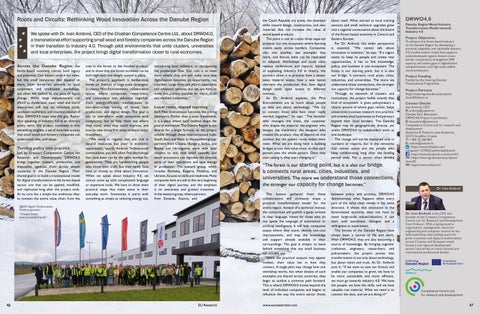
BJELIN Ogulin Transformation Model preparation: “Cheaper, better, environmentally friendly”
46
EU Research
the Czech Republic are active, the attention shifts toward design, construction, and new materials that can increase the value of wood-based products. The point is not to create three separate projects, but one ecosystem where learning travels easily across borders. Companies visit one another, see examples that work, and discuss what can be replicated or adapted. Workshops and study visits replace conferences and reports. Instead of explaining Industry 4.0 in theory, the partners show it in practice: how a sensor saves material waste, how a new layout shortens the production line, how digital design tools open access to different markets. As Dr. Ambroš explains, the Pilot Environments are as much about people as they are about technology. “We try to connect those who have never really worked together,” he says. “The forester who manages the trees, the carpenter who shapes the material, the engineer who designs the machinery, the designer who creates the product, they all depend on one another, but the system rarely makes them meet. What we are doing here is building bridges across that value chain, so that each person sees the whole picture. Once they start seeing it, they start changing it.”
about itself. What started as local training sessions and small technical upgrades grew into a regional conversation about the future of the forest-based economy in Central and Eastern Europe. For Dr. Ambroš, this wider perspective is essential. “We cannot talk about innovation in isolation,” he says. “If a region wants to keep its people and create new opportunities, it has to link knowledge, policy, and business in one ecosystem. The forest is our starting point, but it is also our bridge. It connects rural areas, cities, industries, and universities. The more we understand those connections, the stronger our capacity for change becomes.” Through its network of clusters and institutions, the project builds exactly that kind of ecosystem. It gives policymakers a clearer picture of where gaps remain, helps universities translate research into practice, and enables small businesses to find partners beyond their local borders. The Danube Region may be geographically diverse, yet within DRWO4.0 its stakeholders work as one landscape. The change will not be measured only in numbers or reports, but in the networks that remain active and the people who keep collaborating long after the funding period ends. For a sector often divided
“The forest is our starting point, but it is also our bridge. It connects rural areas, cities, industries, and universities. The more we understand those connections, the stronger our capacity for change becomes.” The lessons gathered from these collaborations will ultimately shape a practical transformation model for the entire region. Instead of a technical manual, the consortium will publish a guide written in clear language, meant for those who do not speak the language of automation or artificial intelligence. It will help companies assess where they stand, identify low-cost improvements, and map the knowledge and support already available in their surroundings. The goal is simple: to leave behind something that any small business can actually use. While the practical outputs may appear modest, their value lies in how they connect. A single pilot may change how one workshop works, but when dozens of such examples are shared across countries, they begin to outline a common path forward. This is where DRWO4.0 moves beyond the level of individual companies and begins to influence the way the entire sector thinks
www.euresearcher.com
between policy and practice, DRWO4.0 demonstrates what happens when every part of the value chain moves in the same direction. It shows that innovation in the forest-based economy does not have to mean large-scale industrialisation; it can start with awareness, dialogue, and a willingness to experiment. The forests of the Danube Region have always been a source of life and work. With DRWO4.0, they are also becoming a source of knowledge. By bringing together craftsmen, engineers, researchers, and policymakers, the project proves that transformation is not only about technology, but about vision and trust. As Dr. Ambroš puts it, “If we want to save our forests and enable our companies to grow, we have to be more sustainable and more efficient, we must go towards industry 4.0. We have the people, we have the skills, and we have valuable raw material. What we need is to connect the dots, and we are doing it!”
DRWO4.0 Danube Region Wood Industry Transformation Model towards Industry 4.0
Project Objectives
To enhance the forest-based industry of the Danube Region by developing a practical, adaptable, and replicable Industry 4.0 transformation model that supports underdeveloped regions, fosters crossborder cooperation, strengthens SME capacity, and closes gaps in digitalisation, competitiveness, and high-value-added wood production.
Project Funding
Funded by the Interreg Danube Transnational Programme.
Project Partners
https://interreg-danube.eu/projects/ drwo40/about-us
Contact Details
Ivan Ambroš, CEO E: ambros@cekom.hr Danijela Šarić Bartolović, DRWO4.0 Project Coordinator, E: bartolovic@cekom.hr Competence Centre Ltd. for research and development Ambarine 8, Poslovna zona Ambarine, 32273 Gradište, Croatia T: +385 32 200 867 E: cekom@cekom.hr : https://www.linkedin.com/ company/11279622/admin/dashboard/ : https://www.facebook.com/drwo4.0 W: https://interreg-danube.eu/projects/ drwo40 W: https://www.cekom.hr/
Dr. Ivan Ambroš
Dr. Ivan Ambroš is the CEO and founder of the Croatian Competence Centre Ltd. for Research and Development from Vinkovci. With a background in organisation, management, electrical engineering and computer science he has held leadership roles leading teams for green transition and digital transformation across Croatian and European wood, forestry and regional development sectors and serves on many national and international professional bodies.
47