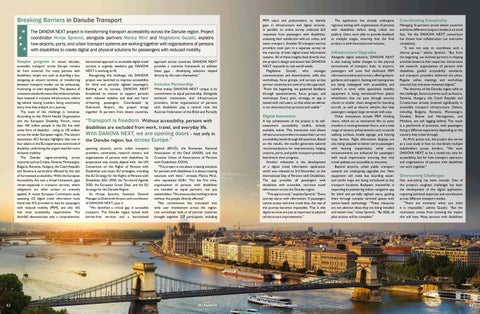
Breaking Barriers in Danube Transport The DANOVA NEXT project is transforming transport accessibility across the Danube region. Project coordinator Hrvoje Spremić, alongside partners Marica Mirić and Magdalena Guzalić, explains how airports, ports, and urban transport systems are working together with organisations of persons with disabilities to create digital and physical solutions for passengers with reduced mobility. Despite progress in recent decades, accessible transport across Europe remains far from universal. For many persons with disabilities, simple acts such as boarding a bus, navigating an airport terminal, or transferring between transport modes can be exhausting, frustrating, or even impossible. The absence of consistent standards means that while some hubs have invested in inclusive infrastructure, others lag behind, leaving travelers facing uncertainty every time they embark on a journey. The scale of the challenge is immense. According to the World Health Organization and the European Disability Forum, more than 100 million people in the EU live with some form of disability - rising to 135 million across the wider European region. The airport association ACI Europe highlights that one in four adults in the EU experiences some kind of disability, underlining the urgent need for more inclusive mobility. The Danube region-stretching across countries such as Croatia, Slovenia, Montenegro, Bulgaria, Romania, Hungary, the Czech Republic and Slovakia-is particularly affected by this lack of harmonised accessibility. While the European Accessibility Act sets a broad framework, gaps remain-especially in transport services, where obligations are often unclear or unevenly applied. A recent European Commission study assessing 125 digital travel information tools found that 41% provided no data for passengers with reduced mobility (PRM), and only 16% met most accessibility requirements. This shortfall demonstrates why a comprehensive,
62
harmonised approach to accessible digital travel services is urgently needed-a gap DANOVA NEXT is working to fill. Recognising this challenge, the DANOVA project was launched to improve accessibility for blind and partially sighted passengers. Building on its success, DANOVA NEXT broadened its mission to support persons with reduced mobility and deaf and hardof-hearing passengers. Coordinated by Dubrovnik Airport, the project brings together 16 partners from eleven countries,
approach across countries. DANOVA NEXT provides a common framework to address these gaps - developing solutions shaped directly by the users themselves.”
Inclusive Partnership What makes DANOVA NEXT unique is its commitment to equal partnership. Alongside technical institutions and infrastructure providers, three organisations of persons with disabilities play a central role: the Austrian Federation of the Blind and Partially
“Transport is freedom. Without accessibility, persons with disabilities are excluded from work, travel, and everyday life. With DANOVA NEXT, we are opening doors - not only in the Danube region, but across Europe.” spanning airports, ports, urban transport providers, universities, research centers, and organisations of persons with disabilities. Its preparation was closely aligned with the UN Convention on the Rights of Persons with Disabilities and major EU strategies, including the EU Strategy for the Rights of Persons with Disabilities 2021–2030, the Territorial Agenda 2030, the European Green Deal, and the EU Strategy for the Danube Region. As Hrvoje Spremić, Assistant General Manager at Dubrovnik Airport and coordinator of DANOVA NEXT, puts it: “We identified a critical gap in accessible transport. The Danube region lacked both barrier-free services and a harmonised
Sighted (BSVÖ), the Romanian National Association of the Deaf (ANSR), and the Croatian Union of Associations of Persons with Disabilities (SOIH). “This project is not about creating solutions for persons with disabilities-it is about creating solutions with them,” stresses Marica Mirić, who represents SOIH. “For the first time, organisations of persons with disabilities are included as equal partners, not just stakeholders. This ensures that nothing is done without the people directly affected.” That commitment has translated into wide user involvement across the region. Live workshops held in all partner countries brought together 227 participants, including
EU Research
PRM users and policymakers, to identify gaps in infrastructure and digital services. In parallel, an online survey collected 623 responses from passengers with disabilities, assessing their satisfaction with air, urban, and water transport. Another 55 transport service providers took part in a separate survey on the maturity of their digital travel information systems. All of these insights feed directly into the project’s design and ensure that DANOVA NEXT responds to real-world needs. Magdalena Guzalić, who manages communication and dissemination, adds that workshops, focus groups, and surveys across partner countries are central to this approach: “From the beginning, we gathered feedback through questionnaires, focus groups, and workshops. Every pilot, strategy, or app is tested with real users, so that what we deliver is not theoretical but practical and usable.”
Digital Innovation A key achievement of the project is its selfassessment accessibility toolkit, already available online. This interactive tool allows infrastructure providers to assess their current accessibility levels through 60 questions. Based on the results, the toolkit generates tailored recommendations for improvements, helping airports, ports, and public transport providers benchmark their progress. Another milestone is the development of a digital travel information application, which was released on 3rd December, on the International Day of Persons with Disabilities. The app provides all passengers with disabilities with accessible, real-time travel information across the Danube region. “This app is crucial,” explains Spremić. “Every journey starts with information. If passengers cannot access real-time travel data, the rest of the journey becomes impossible. That is why digital services are just as important as physical infrastructure improvements.”
www.euresearcher.com
The application has already undergone rigorous testing with organisations of persons with disabilities before being rolled out publicly. Users were able to provide feedback at multiple stages, ensuring that the final product is both functional and inclusive.
Infrastructure Upgrades Alongside digital solutions, DANOVA NEXT is also making visible changes to the physical environment of transport hubs. In airports, passengers will soon find dedicated PRM information totems and corners, offering clearer guidance and support. Seating and resting areas are being redesigned with accessibility and comfort in mind, while specialised mobility equipment is being introduced-from plastic wheelchairs that can pass through security checks to smaller chairs designed for boarding aircraft, as well as electric vehicles that help passengers navigate large terminals with ease. Other innovations include PRM climbing chairs, which act as mechanical lifts to assist travelers in moving between floors, and a wide range of sensory enhancements such as tactile walking surfaces, braille signage, and hearing loop devices. Flight information displays are also being adapted to better serve passengers with hearing impairments, while voice announcements are enhanced for passengers with visual impairments ensuring that vital travel updates are accessible to everyone. Beyond airports, urban public transport systems are undergoing upgrades too. New equipment will make bus boarding easier, and tactile maps are being introduced at key transport locations. Budapest, meanwhile, is expanding its pioneering indoor navigation app for blind and partially sighted users, guiding them through complex terminal spaces with sensor-based technology. “These measures are not abstract ideas-they are being installed and tested now,” notes Spremić. “By 2026, all pilot actions will be complete.”
Coordinating Complexity Managing 16 partners across eleven countries and three different transport modes is no small feat. Yet the DANOVA NEXT consortium has shown how collaboration can overcome complexity. “It was not easy to coordinate such a diverse group,” admits Spremić. “But from the beginning, we involved partners in shaping activities based on their expertise. Universities led research, organisations of persons with disabilities guided accessibility standards, and transport providers delivered the pilots. Regular online meetings and workshops ensured that everyone remained aligned.” The diversity of the Danube region adds to the challenge. Some countries-such as Austria, Slovenia, Hungary, the Czech Republic and Croatia-have already invested significantly in accessible transport infrastructure. Others, including Bulgaria, Romania, Montenegro, Slovakia, Bosnia and Herzegovina, and Moldova, are still lagging behind. The result is a patchwork of provision, with passengers facing a different experience depending on the country they travel through. As Mirić points out, the project also serves as a case study in how to coordinate multiple stakeholders across borders. “We want DANOVA NEXT to be a model-not only for accessibility, but for how transport operators and organisations of persons with disabilities can work together.”
Overcoming Challenges Not everything has been smooth. One of the project’s toughest challenges has been the development of the digital application, requiring technical expertise and coordination across different transport modes. “There are moments when you think it is impossible,” admits Guzalić. “But the motivation comes from knowing the impact this will have. Many persons with disabilities
63
DANOVA NEXT
“We are not just delivering outputs; we are building a movement,” says Spremić. “Even after the project ends, the network will continue, and the app can be expanded with new partners.” Marica Mirić echoes this long-term vision: “Accessibility is finally on the agenda. We are showing that inclusive transport is possiblephysically and digitally. And we are proving that the best solutions come when persons with disabilities are at the centre of decision-making.”
Smart Transport Network for the accessibility of Passengers with disabilities and reduced mobility in the Danube Region through innovative services
Project Objectives
DANOVA NEXT aims to improve transport accessibility across the Danube Region by addressing gaps in services and digital inclusion for persons with disabilities. Through innovative pilot actions, a Smart Transport Network, and accessible digital travel tools, the project promotes barrier-free mobility in air, water, and urban transport, reducing inequalities and fostering regional integration.
A Model for Europe
Project Funding
DANOVA NEXT is an Interreg Danube Region Programme project co-funded by the European Union. The content of this paper reflects the opinion of their authors and does not in any way represent opinions of the European Union.
Project Partners
The project consortium consists of 16 partners and 2 associated partners: 5 airports (Dubrovnik, Sarajevo, Airports of Montenegro, Budapest, State Enterprise Chisinau airport), 2 seaports (Pula and Kotor), 3 urban public transports (Municipality of Maribor, Public transport Company of Bratislava and Czech Smart City Cluster), 3 technical partners (Romanian National Association of the Deaf, Austrian Federation of the Blind and Partially Sighted, Croatian Union of Associations of Persons with Disabilities), 3 research partners (University of Maribor,Vienna University of Economics and Business, Bulgarian Association for Transfer of Technology and Innovation - BATTI) and 2 associated partners (Ombudsman for persons with disabilities Croatia and the Ministry of Transport and Maritime Affairs of Montenegro)
Contact Details
Communication Manager The Croatian Union of Associations of Persons with Disabilities (SOIH) Savska cesta 3, 10000 Zagreb, Croatia T: +00385 9166 04673 E: soih@soih.hr W: https://interreg-danube.eu/projects/danova-next
Marica Mirić, Magdalena Guzalić, and Hrvoje Spremić (left to right)
Marica Mirić is the President of SOIH and a Transport Engineer. She has extensive experience in disability rights advocacy and leads numerous national and EU projects and initiatives promoting accessibility and social inclusion, serving as Project Coordinator for SOIH on the DANOVA NEXT project. Magdalena Guzalić is a Senior Associate at SOIH. She holds a Master’s degree in Social Policy and works on projects promoting accessibility, inclusion, and equal opportunities for persons with disabilities, serving as Project Assistant on the DANOVA NEXT project. Hrvoje Spremić is Assistant General Manager at Dubrovnik Airport Ltd. He is responsible for the preparation, implementation and management of EU-funded projects, and also conducts internal audits.
64
currently avoid travel altogether because it is simply too difficult. If we can make the system easier, we change lives.” Another challenge lies in the diversity of infrastructure across the Danube region. Some countries have more advanced accessibility standards than others, making harmonisation complex. However, this diversity also makes the project more valuable: it provides a blueprint for cooperation across different levels of readiness.
Looking Ahead DANOVA NEXT is scheduled to conclude in mid-2026, with pilot actions finalised by early that year. The coming months will focus on testing solutions with users, refining the application, and disseminating results through transnational labs and communication campaigns. Perhaps the most significant legacy will be the creation of a Smart Transport Network for PRM accessibility. All partners have signed commitments to remain part of this network after the project ends, ensuring sustainability and inviting new institutions to join. By pooling data and expertise, the network will allow ongoing harmonisation and support the longterm vision of a truly inclusive transport system.
With its combination of infrastructure upgrades, digital innovation, and inclusive governance, DANOVA NEXT is more than a regional initiative-it is a model for how Europe can rethink mobility in the 21st century. The project demonstrates that accessibility is not simply a technical fix or a box-ticking exercise, but a fundamental human right that must be embedded into the very fabric of transport systems. By involving organisations of persons with disabilities as equal partners, DANOVA NEXT has shown how inclusive governance can lead to practical solutions that truly meet users’ needs. The self-assessment toolkit and digital travel information app offer scalable models that could be adopted well beyond the Danube, while the physical improvements to airports, ports, and urban transport highlight what is possible when infrastructure providers commit to change. The ambition is clear: to ensure that accessible mobility is not the exception, but the rule. Replication packages developed by the consortium are designed to make adoption easier for other regions, providing a roadmap for policymakers, transport operators, and civic organisations who wish to follow in their footsteps. As Guzalić concludes “Transport is freedom. Without accessibility, persons with disabilities are excluded from work, travel, and everyday life. With DANOVA NEXT, we are opening doors-not only in the Danube region, but across Europe.”
EU Research