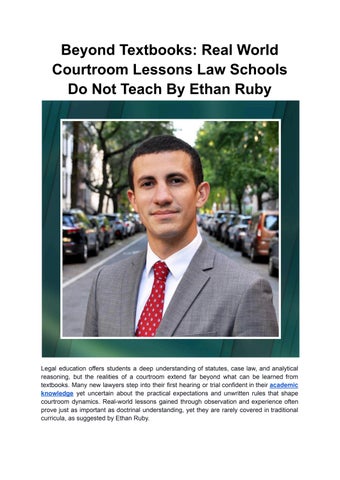
Beyond Textbooks: Real World Courtroom Lessons Law Schools
Do Not Teach By
Ethan Ruby

Legal education offers students a deep understanding of statutes, case law, and analytical reasoning, but the realities of a courtroom extend far beyond what can be learned from textbooks Many new lawyers step into their first hearing or trial confident in their academic knowledge yet uncertain about the practical expectations and unwritten rules that shape courtroom dynamics Real-world lessons gained through observation and experience often prove just as important as doctrinal understanding, yet they are rarely covered in traditional curricula, as suggested by Ethan Ruby
One essential lesson involves courtroom etiquette and communication While law schools teach persuasive writing and oral advocacy, they seldom address how subtle shifts in tone, posture, or timing can influence a judge’s perception. Lawyers must understand when to speak, when to pause, and how to maintain professionalism even during tense exchanges The ability to read the room and respond appropriately can elevate an argument in ways that pure logic cannot.
Time management and adaptability also play major roles Court schedules can shift without warning, and attorneys must be prepared to adjust to delays, last-minute changes, or unexpected rulings. New lawyers often discover that cases move quickly and that judges expect concise, well-organized presentations Learning to prepare thoroughly yet remain flexible is a skill best developed through hands-on practice
Another important aspect involves interacting with clients under pressure Law schools focus on legal issues, but real clients often arrive with fear, frustration, or confusion Lawyers must balance empathy with clear communication while realistically managing expectations Guiding clients through complex proceedings requires patience and emotional intelligence, qualities that grow stronger with real-world exposure
Unpredictability is another hallmark of courtroom practice. Witnesses may testify differently than expected, opposing counsel may shift strategy, and judges may ask questions that challenge carefully crafted arguments Lawyers must stay composed and think quickly This ability to pivot cannot be mastered through reading alone; it emerges through repeated experience.
These lessons highlight the value of internships, clinics, and mentorship in shaping capable advocates By moving beyond textbooks and engaging directly with courtroom practice, aspiring lawyers gain the insight and confidence needed to succeed in the profession and serve clients effectively