9 minute read
Ensuring Safety On the Florida Coasts: New Florida Laws and the Evolution of the State's Building Code Aim to Keep Residents Safe

BY JOE VANHOOSE, MANAGING EDITOR
In March, Palm Beach County officials ordered the owner of the aging Ambassador Palm Beach Hotel and Residences to take appropriate steps and make emergency repairs to protect occupants of the building, noting that the building had deteriorated to the point of becoming a “lifesafety issue.”
The Ambassador, built in 1947 and later expanded, was scrutinized in 2024 when a state-mandated structural engineering report showed much of the building’s structure, including its balconies, common areas and parking deck, were in poor condition.
In the months since, temporary repairs have been made, the building will be unoccupied this fall, and the Ambassador will soon be razed for a new building to go up in its place.
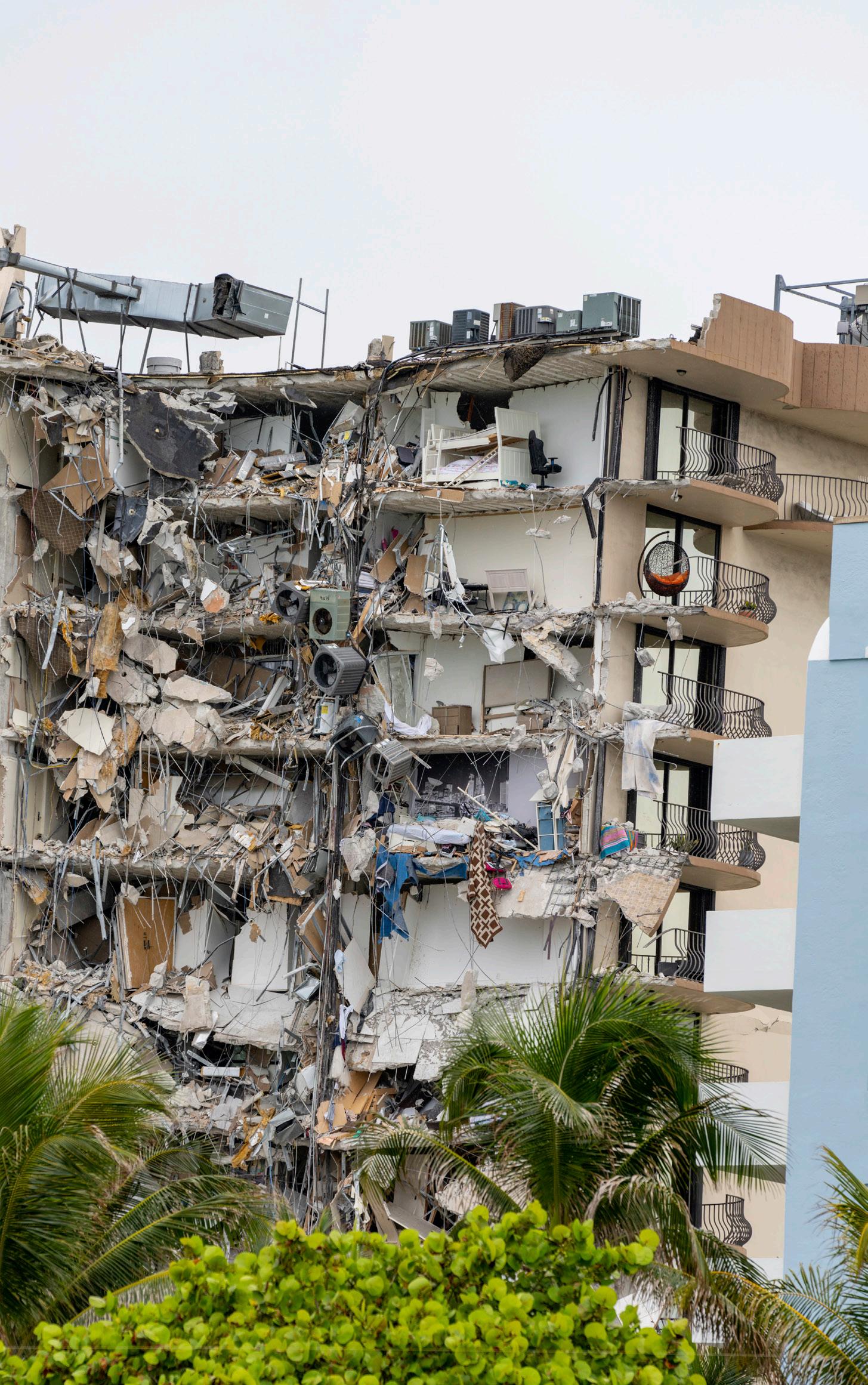
Many older condo and co-op buildings along Florida’s coastline have had to address exterior conditions because of their age and the battering they take in their beach environment. The work is mandated by a state law that aims to ensure the integrity of multi-family buildings in the wake of the deadly 2021 collapse of a beachfront condo in the town of Surfside in Miami-Dade County.
The work across the state has proven to be extensive for structural engineers and costly for many condo associations and owners. The condo safety law passed in 2022 has now been updated with new laws passed this summer, but safety remains the top priority.
Responding To Tragedy
After the Champlain Towers collapse in 2021 in Surfside, the Surfside Working Group was assembled to make consensus recommendations about how to ensure building safety. Together, engineers and building industry professionals from Florida Engineering Society (FES), American Council of Engineering Companies of Florida (ACEC Florida), American Society of Civil Engineers (ASCE), Florida Structural Engineers Association (FSEA), American Institute of Architects (AIA), Building Officials Association of Florida (BOAF) and International Concrete Repair Institute (ICRI), developed steps the building industry in Florida needed to take to prevent another collapse.
The work group’s consensus recommendations became the basis for Florida’s Condo Inspection law passed in 2022.
“The concern was that condos were degrading with no requirements to fix them,” said FSEA board member and past president David Fusco. “The reasoning for the new law was to make sure Champlain Towers doesn’t happen again.”
Passed in 2022, SB-4D provided building safety inspection requirements for condominium and cooperative association buildings, increased the rights of unit owners and prospective unit owners to access information regarding the condition of such buildings, and revised the requirements for associations to fund reserves for continued maintenance and repairs.
Additionally, the law required condominium and cooperative association buildings to have a “milestone inspection” of the structures’ integrity by an architect or engineer when a building reaches 25 years of age within 3 miles of coastline or 30 years of age if located inland. Initially, if a milestone inspection was required and the building’s certificate of occupancy was issued before 1992, the building’s initial milestone inspection was required to be performed before the end of 2024.
“For structural engineers, it’s an avenue of work that is important, and it’s keeping our profession very busy,” Fusco said. “When you couple (the new requirements) with other stuff in Florida like the growth we’ve seen over the last four years, there are a lot of new buildings.”
The condo owners the 2022 law was meant to protect are faced with more issues now. Values on properties have dropped from their pandemic peak, and now many associations need to raise funds to complete milestone inspections and fix problems if necessary.
— DAVID FUSCO FSEA board member and past President
Condo Laws Evolve
The condo owners the 2022 law was meant to protect are faced with more issues now. Values on properties have dropped from their pandemic peak, and now many associations need to raise funds to complete milestone inspections and fix problems if necessary.
An economics study by TD Bank Group in May showed that condo sales in Florida were down by more than a quarter from their 2018-19 level and 13% year over year, while median prices also continue to trail lower, having fallen about 8% from their peak. There are now close to 80,000 condos and townhomes for sale across the state – a number that’s up by about 20,000 or 35% from a year ago.
In June, Gov. Ron DeSantis signed HB 913 into law, making an overhaul of Florida's condominium-safety regulations with a focus on easing the financial burden on condo owners while maintaining key safety requirements.
HB 913 passed unanimously in both chambers of the Legislature in April. The new law extends the deadline for structural integrity reserve studies by one year and allows for a temporary pause in reserve funding for up to two years after a milestone inspection.
"There were a lot of folks that had a lot of concerns about how some of these assessments were being done, whether people could even afford to even stay in their units," DeSantis said at the signing.
He also signed HB 393, revising the My Safe Florida Condo Pilot Program to enhance its effectiveness in improving condominium safety, hardening the buildings, and reducing insurance premiums.
“Florida’s history with hurricanes and extreme weather underscores the urgent need for robust mitigation measures to protect residents and property,” said State Rep. Vicki Lopez (District 113) in her filing of HB 393.
The law limits eligibility to condominiums three stories or higher and ensures the program prioritizes buildings with significant structural and safety considerations. Lowering the grant approval threshold to a 75% supermajority vote empowers communities to access critical funding while maintaining fairness.
“These revisions collectively streamline the program, improve accessibility and prioritize impactful safety enhancements,” Lopez said. “With these updates, Florida can better protect its residents and build more resilient communities in the face of natural disasters.”
Bill Hughes, research director for the Kelley A. Bergstrom Real Estate Center at the University of Florida, believes the next challenges in light of the new laws will be the execution of the requirements, monitoring compliance and enforcing the rules – not small challenges, he said. Still, he believes the new laws are a good step forward.
“Most people do not participate in the policy making process until new rules are passed,” Hughes said. “Once (SB-4D) happened, many people were affected and became involved in policy review. Deadlines were too short, definitions were vague, and confusion was unanticipated.”
Resource limitations are at the heart of this challenge, Hughes said. Monitoring these recommendations is difficult enough. Added to the resource concerns is a list of unintended consequences that always follow new policy.
“Finding and compensating enough skilled people to accurately review and understand the structural safety of highrise buildings is an impossible task, particularly in just a few years,” Hughes said. “The new rules will produce a tremendous number of very complex reports and recommendations that did not exist prior to passing laws.”
Updating The Florida Building Code
Condos, hotels and all coastal buildings face persistent threats from hurricanes. The ways engineers have designed buildings in coastal zones has changed dramatically as well. The American Society of Civil Engineers (ASCE) has a standard for flood design called ASCE 24.
In Florida, the newest iteration of the Florida Building Code (FBC) will be adopted in 2026 and has much more stringent requirements in the velocity zones – coastal zones with expected wave action.
“In my time designing in Florida, the biggest changes I’ve seen are dealing with structures in coastal zones because a storm like (Hurricane) Helene only emphasizes the importance of elevating your structures, and Ian was the same way,” Fusco said. “Helene and Ian were big surge makers.”
Success in Florida’s building code can be seen in Port Charlotte, which was devastated by Hurricane Charley in 2004 and saw many structures rebuilt at a higher level in compliance with the 2002 FBC.
When Hurricane Ian struck the area in 2022, the results of those rebuilds stood out.
“Port Charlotte performed pretty well against Ian because it was decimated by Charley,” Fusco said. “They rebuilt to better standards than what Fort Myers Beach was built to some 50 years ago, and you can see that many structures in Fort Myers Beach collapsed.”
A study by the Insurance Institute for Business & Home Safety (IBHS) of Port Charlotte afterward concluded that the “modern Florida Building Code (FBC) and its system of adoption and enforcement have nearly eliminated structural damage. The structural performance for buildings built under the modern FBC was a resounding success, with only one building built under the modern FBC with any visible structural damage.”
The FBC is considered by IBHS over its last two cycles to be one of the best code systems to foster wind- and flood-resistant construction practices in the U.S. Hurricane Ian was the most significant test of the system of protections offered by the modern FBC and its enforcement since Charley, the agency notes.
IBHS used aerial imagery from NOAA and EagleView, along with street level imagery from the National Science Foundation’s Structural Extreme Events Reconnaissance (StEER) teams, to investigate the performance of residential and commercial construction in Hurricane Ian. Of the 230 multifamily structures assessed in the study, 57 were built under the modern FBC. None had any visible structural damage.
The next FBC update is due in 2026, and Fusco says the process of developing a new idea to implement into the code can take about six years. While Fusco doesn’t anticipate big changes, there can always be amendments made to existing code if a life safety issue is found.
Updates to the code come from “responding to events that have happened and trying to improve,” Fusco said. “As storms come through and structures get elevated in response, eventually, we’ll have more resilient structures.”