Prime
'New vacancies tend to be fixed term , until further notice and parttime They are often combined with other occupations and depn ved of any safegua1ds of continuity, let alone of permanence . Tile catchword is flexibility , and this increasingly fashionable notion stands for a game of hire and fire with very few rules attaciJed, but wit/1 power to ciJange the rules unilaterally while the game is still being played'
Zygmunt Bauman , 'Work , consumerism and the new poor.'
Within our contemporary society emp loyment can be another way in which duty as consumer is fLIIfilled Through their aesthetic criteria, job s play many varying roles in shaping our identities The experience -seeking nature of culture Is reinforced through employment by the increased structuring of jobs to coincide with the demands of the economy upon capitalist industry Shortterm and temporary contracts along with the threat of outsourcing give rise to impermanent and insecure emp loyment for workers whose flexibility is a prerequisite . Leading to fewer rights , less benefits and diminishing employer responsibility and resulting in a cheaper, more expendable , ultimately loyalty free workforce
lt is commonplace for artists to work on a freelance basis Although without the same market co nstrain ts that are placed upon commercial business, the cultural sector is a highly compe titi ve arena with fewer job opportunities than there are artists and limited amounts of public funding availab le. Therefore in order to support themselv es wh 1le continu in g to make art some artists take jobs within other industries - sometimes tho se with fast turnovers, few prospects and minimal wages The effect of dealing with their economic realities has resulted in some artists becoming concerned with shrink in g the gap between work-life and art-life As Ute Meta Bauer states in her text 'Education , Information , Entertainment',
'More and mo1e activities devoted to "eaming a living " are becoming inco1porated into current fo1ms of art practice, as artists grow weary of neglecting their everyday realities .... '
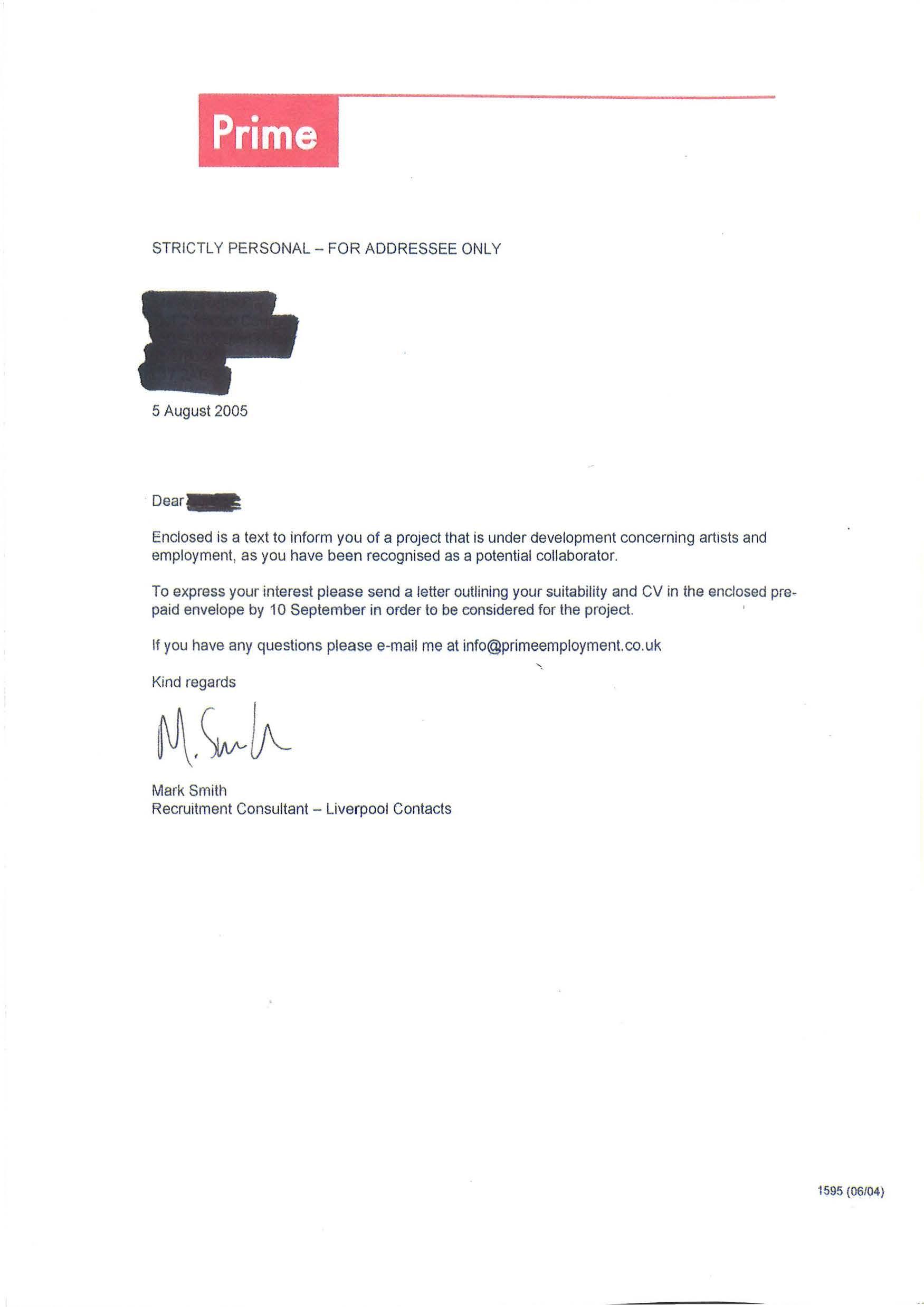
PRIME is any number of placements into work situations in order to examine the notion of parttime work and its relationship to the contemporary artist. Initi ally, PR IM E will collaborate with a numb er of artist associates towards gaining them paid employment. This emp loym ent mus t be part-time and ongoing - each placement la sting for a minimum of one month and continu ing until the associate decides to terminate At no time during the placement must the emp loy er be made aware of PRIME . In return, each associate will receive a commissioning fee alongside the wage paid by the placement company The fee is to cover work done outside of placement hours towards developing an outcome. The outcome will take the form that the associate sees fit and is subject to negotiation with PRIME
A publication do cumen ting the project will contain a series of commissioned texts that critically investigate the issues raised The texts will be initiated in consideration of t11e following th emes:
Mirroring Reality. Misusing Work and Wasting Time . Employee in Residence Roles and Identities Me In c. and McJobs
Prime is an organisation set up to exp lore the relationship that individual s have to the jobs that they do. 'Part-time' is Primes' first project and involv ed commiss ioning 3 artists to ga in paid emp loym ent within indu stries that they id entified in order to inv estigate the notion of part-time work and its relationship to the contemporary artist. Each placement had to la st for a minimum of one month and at no time during the placement was the emp loyer to be made aware of the project. Mimicking the working day of many art ists, the time outside of emp loyment hours was used to make art- in this instance in response to the job. Alongside the wage paid by their emp loyer, each artist received a commissioning fee for an outcome that was subject to negotiation with Prime . By initi ating alternat iv es to the 'artist residency' the aim of 'Part-t im e' was to draw attent ion to how dealing with economic realities has resulted in some artists shr inkin g the gap between art and work. This pub li cation holds excerpts from that process, and conta in s three commissioned essays that investigate the issues ra ised.
Steven Renshaw, Director, Prime
Contributors
Stephen Edgell is a Professor of Soc iol ogy at the University of Sa lford and the author of severa l books, most recently 'The Socio lo gy of Work: Continuity and Change in Paid and Unpaid Work', London: Sage, 2005; 'Veblen in Perspect iv e: His Life and Thought', New York: M.E.Sharpe, 2001.
Ellie Harrison graduated with first class honours from BA Fine Art at Nottingham Trent University in 2001. She went on to study for a postgraduate diploma in Fin e Art at Goldsm ith s College, graduating in 2003 . Elli e Harrison liv es in Nottingham and is parttime lecturer in Fine Art at Nottingham Trent University. www.ellieharrison.com
Elizabeth Kearney is an art ist based in Liverpool.
Steven Renshaw is an artist. After 18 months working part-time for Barclays he has been working in L iv erpoo l as director of Prime, an art technician and a part-time lecturer.
Joanna Spitzner is an artist and assistant professor in Time Arts at Syracuse University, NY. Recent projects includ e the Joanna Spitzner Foundation, an organization that gives grants to artists that are funded by wage job s that she works. www.jsfoundation.org
Kymberley Ward graduated from Chelsea Schoo l of Art in June 2006. She has subsequent ly divided her time between writing, building stud walls, pouring pints and attempting to f in d enough time to continue her art practice. Her interest in the reality of modern labour runs from the everyday to the infinite, often via s lap st ick and the absurd. She lives and works in London.
Kymberley Ward
Tonight , I will stay up all night A sense of urgency and the impending deadline keeps me going If I were to work out the hourly rate for this projec t, I would be horrified - I am being paid a one - off fee for my production ; and yet th e hours slip by uncounted. Having worked all day, I would never countenance a night shift did I not feel a se nse of personal responsibility to the task . In this way, I am the perfect worker. Although artistic production and labour are not typically considered in the sa me light, a discourse has arisen which points to possible simi larities between the two Whilst context driven art has sought to deal with the economic and social issues inherent in modern art practice, there seem to be other simi la rities in both efforts of production which are fundamental to understanding the constructed, creative self within time and within organisation . The artist can , without much imagination, be see n as an entrepreneur who responds to perceived market needs Art training teache s artists to have an agi lity and adaptability of response to their s urroundings , and art ists are more than likely to be self-motivated, aware of their competition and often operating with their own trademark style. But is the envis ionin g of the artist as a model for the new, engaged, flexible worker partially sighted? The temporal and functional flexibility that makes art practice responsive to the culture that surrounds it seems to be the sa me flexibility that the business world seeks to promot e . Through query how e ver, we may find the model to be a better guidance tool than concrete example In it s appropriat ion of the world of part-time work , Prime provides examples of the creative, responsive entrepreneur, a nd the more common reality of the set , repet itiv e tasks performed by the poorly paid, part-time worker. In doing so , Prime highlights the disparity between much cultural commentary on the new, flexibl e worker and the reality of today's workplace . lt sets up justifiable paralle ls between the business model entrepreneur and the modern artist, whilst at the same t i me criticising thi s parallel by undermining it with reality
The level of dedication that artists often app ly to their work could be see n as the archetype for all workers. I b e lieve in my product, and I am willing to go to great lengths to see that I achieve my aim. For many, art is a vocation rather than a job , and as s uch artists can feel a heightened sense of personal responsibility. How could business seek to manufacture this dedication? Would it be by transferring a notion of responsibil ity to the worker? By forcing the handshake betwe e n imp osed production and selfactualisation? Self-actual isat ion has always been linked to productivity, though. That business would use this link to increase profit is inevitable, and indicates cap italism 's ability to turn soc ia l phenomena to its own mean s
'The idea of an individual human life as 'a n enterprise of the se lf' suggests that no matter what circumstance may have dealt a person, he or s he remain s always continuously engaged (even if technically 'unemployed') in th at one e nterpri se , and that it is part of the continuous business of living . .. ' (Du Gay, 1996:156)
The capitalist ideal : that through hard work , the individual can make what they want of themselves. If the se lf is an ongoing project to be worked on , one is put in a po s ition of contro l - There is hope for my future because I can change in this w ay - and of slavery - I am constantly examining my own deficiencies The modern self is expected to be
pro-active, always self- analyzing and developing; this is true of both the artist and the worker. An int ernal beauracracy is expected , where rational questions are posed and suggestions for improV ements are made, carried through and then monitored. Unproductive per iods are often accompanied by a feeling of wastefulness or guilt; and in this way, an obligation to produce is inherent in an 'enterprise of the self' . ' autobiography - particu lar ly in the broad sense of an interpretive self history produced by the individual concerned, whether written down or not- is actually at the core of se lf identity in modern social life ' (Giddens, 1991 :76)
Narrative histories, the expression of which is the C.V., show the progression of the individual through time. One's projection of onese lf in the world comes to be dominated by the spin involved in building a coherent, marketable life story. Via the gaze of others (and in the language of job appraisals) present , negative circumstances are turned into positive life lessons which have bettered the individu al in the long run. This id ea of the unified self is at odds with the multiplicity of roles expected in modern lifestyles , which we understand to be a fragmentation of the self The discussion that part-time work forces the individual to inhabit various, often conflicting roles reaffirms a Western belief in this non - contrad ictory, continuous self I tell myself that being a Bar Tender or Waitress is not 'rea lly me '; but if I spend hours and hours pulling pints or serving food, never being myself, then who exactly am I being? Prime forces its collaborators to inh abit multiple, somet im es conf li ct in g roles Above board, the job description reads as: artist , temporary part-time worker, researcher and investigator. In practice, the feeling that you do not fill a role entirely, or that you do not have enough belief in your role, can leave one feeling fraudulent , like an impostor- which is where Prime intentionally places its workers. For the artist/worker, this scenario raises questions of authenticity, of which se lf is the most 'true'. Whilst in each role, the individua l expresses a part of the se lf; there is a belief that not al l of the selves can be authentic Deleuze (1968) uses the idea of masks to exp lain his ideas on id entity constructed by repetition . The mask does not cover an original identity, in fact it disguises nothing Each mask that an individual puts on constitutes a partial identity In addition, each mask both forms and is connected to every other mask . In this way , masks are simulacra; they can never be traced back to one beginning. In one sense, id ent ity becomes unified in an enterprise of the se lf, in another; identity is fragmented by swapp ing ro les or 'multi -tasking .' The oscillation between the idea of a constant narrative and that of fluctuating masks could be a difference in socio logi ca l arguments, or it could be an indication of increased demands placed on the worker. What seems to be pertinent to both is a transferal of responsibility from the emp loy er to the (often temporary) employee. Whether this comes in the form of bearing responsibility for a life voc at ion of constant improvement, or for accepting responsibility for the performance of minute tasks; we are left to wonder how far this notion stretches, and to whose benefit.
A fundamental sh ift in the new workplace is the diversification of time from a standard pattern to the irr egu lar and individual. We think of time in the work place as being ruled by indu str ia l capitalism, the clock rules the mach in e, to which the human body is an appendage. This lin ear, quantative time of the workplace is measured and regularised. As soon as time is measured it becomes scarce, which of course makes it valuable . So now time equa ls value, equa ls money - and time becomes a commodity. There are other exper ien ces of time in the workplace, however. The qualitative , subject iv e time of social engagement, determined by the rhythms of the peop le present. This version
of time is cyclical and event based, it arises through social practice , through implicit rules of behaviour The modern organisation has a much greater empathy towards the rhythm of social time than industrial capitalism did, growth in the female workforce has enabled working hours to be organised around family duties. On a macro level, we see that a great deal of the service industry revolves around leisure time. If we zoom in, we see that the idea of social time is used by business to create a friendly atmosphere, and therefore a returning trade. As long as it is not too busy, I am actively encouraged by my boss to chat to the customers, to connect with them. Optimistically, we see a recognition of the worker as an individual. Cynically, we can point to the continual commandeering of the social by the economic.
We have a recurrent joke at work. Whenever someone looks like they are working too hard or feeling stressed, their workmate will say to them: 'Five - Seventy an hour.' This is meant as a reminder- you should exert the amount of effort that is a communally agreed equivalent to the wage . Effort then, has a boundary that is monitored by social engagement. Although there is agility to the singular, decision - making in solitary practice can also be more difficult. I don't know when to stop, how to decide what the 'right' amount of work is . For the artist/entrepreneur, the guideline will often rest on strength of feeling, a dedication to the cause. In this instance, the individual has to weigh up the competing elements of perceived reputation, quality of work, available time , and financial reimbursement. The problem in the eyes of business is that the singular can act impudently, with initiative, whereas state forms have to preserve themselves to a certain extent in order to perpetuate and to make rules for those existing within their boundaries. Acting tactically in the workplace can take on many forms, the underlying concern being one of self- interest. One example of this is the practice of 'la perruque' - where workers understand and play with the reading of the body at work in order to win something back for themselves (De Certeau, 1984 ) Another would be the redirection of stock for the workers purpose. Yet another would be operating in the elasticity of space or time between an employer's knowledge of practice and the reality of practice. How effective is this resistance however, when it follows the outlines of the system?
'The war machine answers to other rules. We are not saying they are better of course, only that they animate a fundamental indiscipline of the warrior, a question of hierarchy, perpetual blackmail by abandonment and betrayal and a very volatile sense of honour, all of which, once again, impedes the formation of the state.' (Deleuze & Guttari, 1987:395)
Deleuze and Guttari's war machine, which stands in opposition to state organisation, can be compared to the singular tactics which exist in exteriority to the state. There is a level of speed and secrecy to these tactics that cannot be copied by business as they operate in response to the strictures of business
'The state has no war machine of its own - it can only appropriate one in the form of a military institution, one that will continually cause it problems.' (Deleuze & Guttari, 1987 :391)
So as business takes on the form of a rhizome, a network, 'the war machine' which lies outside what business can hope to be - but nevertheless tries to be , is the response of the singular. lt is actually flexible , not an imitation of flexibility
The idea of networking - treating social encounters as business, is often regarded as crass; from differing points of view it either capitalises on social time or reveals a
non-philanthropic basis to human relationships Everyday interaction - relationships, meetings, gossip - create rhythms and connections ' naturally' which are used in the production of capital. If I have a personal connection to you , you may feel an obligation to complete the task I have set; an obligation which supersedes the purely financial, and this sense of duty helps to shape the informal, verbal contracts around which much of the art world operates The tension between the social and the economic is nothing new, both create and are created by the other, what appears as new is the frequency and diversification of the exchange Networking is a prime example of what Du Gay terms the 're - imagination of the social as a form of the economic' (1996: 156) and a prevalent concern of contemporary art practice is how artists can reclaim the economic as a form of the social. The crack that appears in the discourse of the artistas-entrepreneur runs along this line, the line that separates what can be turned into profit from the economically unprofitable. There is a value in non-productive time, time spent gazing at a flashing cursor, which capitalism does not recognise; there is also the value of achievement realised through struggle. Both of these values can be found in art practice.
In itself, Prime darts and slips between the social and the economic, between art and labour Art uses everyday work as its basis, to generate the production of ideas which are then paid for by Prime; the whole operation revolves within the knowledge economy. Prime simultaneously places its actors in positions of artistic creativity and routine work, setting up conditions that emulate the day -to - day experiences of many artists , but also revealing itself as an artifice, a game. The Prime temp becomes a mystery shopper; the unknown employee of the company, acting like a customer to gain insight into the service of other staff. In addition to this it connects that mystery shopper with an individual reason, a higher purpose for their task The temp stands to gain financially (in hourly wages and by one - off payment from Prime) and artistically. By impersonating business, Prime achieves, in one sense, what business strives for - a responsive, connected worker. But in this impersonation, Prime also draws our attention to the inevitable separation of the individual from the aim of their employer- holding thought 'above' for one 's own purpose For agents involved in Prime, this is two-fold Prime capitalises on the knowledge and ideas that arise through labour practice, it makes them both economically and artistically viable; agents then have to respond tactically to Prime itself as their employer. We could say that Prime allows a dangerous conceit - by utilising the idea of the artist as permanently 'on call' , or of the worker's ' self' as resource to be turned into profit, Prime not only recognises , but also takes part in the struggle between the economic and the social. ' the knowledge economy is more an event in economic theory and political rhetoric than a description of current conditions stemming from a deterministic historical process.' (Stapleton, 2002 :141)
The discourse on creativity, which awards the individual a pseudo -freedom, is being engineered by business and questioned by cultural commentary. I am a freelance entrepreneur, I have self-direction. Whilst we can understand this as a reaction against former modes of capitalism which credited the individual with little self-direction; we can also see that the discourse is self- serving . Capitalism realised the economic value of the creative, singular input; discourse that agrees with the archetype of the artistas - entrepreneur validates it. Undoubtedly, there is an agreement of form between the self aware, agile, responsive artist and the subjectivity required by the idealised new