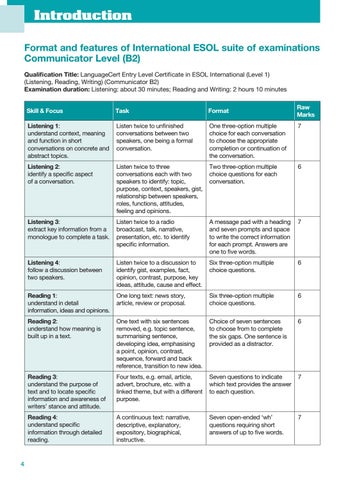
Introduction Format and features of International ESOL suite of examinations Communicator Level (B2) Qualification Title: LanguageCert Entry Level Certificate in ESOL International (Level 1) (Listening, Reading, Writing) (Communicator B2) Examination duration: Listening: about 30 minutes; Reading and Writing: 2 hours 10 minutes
4
Raw Marks
Skill & Focus
Task
Format
Listening 1: understand context, meaning and function in short conversations on concrete and abstract topics.
Listen twice to unfinished conversations between two speakers, one being a formal conversation.
One three-option multiple choice for each conversation to choose the appropriate completion or continuation of the conversation.
7
Listening 2: identify a specific aspect of a conversation.
Listen twice to three conversations each with two speakers to identify: topic, purpose, context, speakers, gist, relationship between speakers, roles, functions, attitudes, feeling and opinions.
Two three-option multiple choice questions for each conversation.
6
Listening 3: extract key information from a monologue to complete a task.
Listen twice to a radio broadcast, talk, narrative, presentation, etc. to identify specific information.
A message pad with a heading and seven prompts and space to write the correct information for each prompt. Answers are one to five words.
7
Listening 4: follow a discussion between two speakers.
Listen twice to a discussion to identify gist, examples, fact, opinion, contrast, purpose, key ideas, attitude, cause and effect.
Six three-option multiple choice questions.
6
Reading 1: understand in detail information, ideas and opinions.
One long text: news story, article, review or proposal.
Six three-option multiple choice questions.
6
Reading 2: understand how meaning is built up in a text.
One text with six sentences removed, e.g. topic sentence, summarising sentence, developing idea, emphasising a point, opinion, contrast, sequence, forward and back reference, transition to new idea.
Choice of seven sentences to choose from to complete the six gaps. One sentence is provided as a distractor.
6
Reading 3: understand the purpose of text and to locate specific information and awareness of writers’ stance and attitude.
Four texts, e.g. email, article, advert, brochure, etc. with a linked theme, but with a different purpose.
Seven questions to indicate which text provides the answer to each question.
7
Reading 4: understand specific information through detailed reading.
A continuous text: narrative, descriptive, explanatory, expository, biographical, instructive.
Seven open-ended ‘wh’ questions requiring short answers of up to five words.
7