2
Flash on Skills
A
B
Self-esteem Before you read
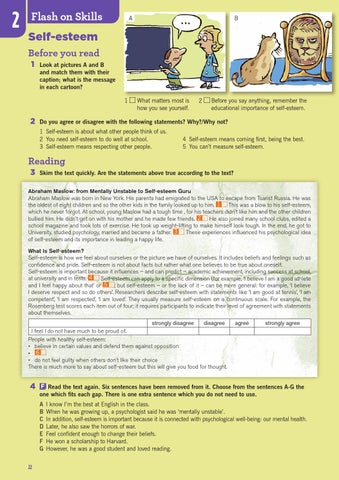
1 Look at pictures A and B and match them with their caption; what is the message in each cartoon? 1
What matters most is how you see yourself.
2
Before you say anything, remember the educational importance of self-esteem.
2 Do you agree or disagree with the following statements? Why?/Why not?
1 Self-esteem is about what other people think of us. 2 You need self-esteem to do well at school. 3 Self-esteem means respecting other people.
4 Self-esteem means coming first, being the best. 5 You can’t measure self-esteem.
Reading
3 Skim the text quickly. Are the statements above true according to the text? Abraham Maslow: from Mentally Unstable to Self-esteem Guru Abraham Maslow was born in New York. His parents had emigrated to the USA to escape from Tsarist Russia. He was the oldest of eight children and so the other kids in the family looked up to him. 1 This was a blow to his self-esteem, which he never forgot. At school, young Maslow had a tough time , for his teachers didn’t like him and the other children bullied him. He didn’t get on with his mother and he made few friends. 2 He also joined many school clubs, edited a school magazine and took lots of exercise. He took up weight-lifting to make himself look tough. In the end, he got to University, studied psychology, married and became a father. 3 These experiences influenced his psychological idea of self-esteem and its importance in leading a happy life. What Is Self-esteem? Self-esteem is how we feel about ourselves or the picture we have of ourselves. It includes beliefs and feelings such as confidence and pride. Self-esteem is not about facts but rather what one believes to be true about oneself. Self-esteem is important because it influences – and can predict – academic achievement, including success at school, at university and in tests. 4 Self-esteem can apply to a specific dimension (for example, ‘I believe I am a good athlete and I feel happy about that’ or 5 ; but self-esteem – or the lack of it – can be more general: for example, ‘I believe I deserve respect and so do others’. Researchers describe self-esteem with statements like ‘I am good at tennis’, ‘I am competent’, ‘I am respected’, ‘I am loved’. They usually measure self-esteem on a continuous scale. For example, the Rosenberg test scores each item out of four; it requires participants to indicate their level of agreement with statements about themselves. strongly disagree
disagree
agree
strongly agree
I feel I do not have much to be proud of. People with healthy self-esteem: • believe in certain values and defend them against opposition • 6 • do not feel guilty when others don’t like their choice There is much more to say about self-esteem but this will give you food for thought.
4 F
Read the text again. Six sentences have been removed from it. Choose from the sentences A-G the one which fits each gap. There is one extra sentence which you do not need to use.
A I know I’m the best at English in the class. B When he was growing up, a psychologist said he was ‘mentally unstable’. C In addition, self-esteem is important because it is connected with psychological well-being: our mental health. D Later, he also saw the horrors of war. E Feel confident enough to change their beliefs. F He won a scholarship to Harvard. G However, he was a good student and loved reading. 22