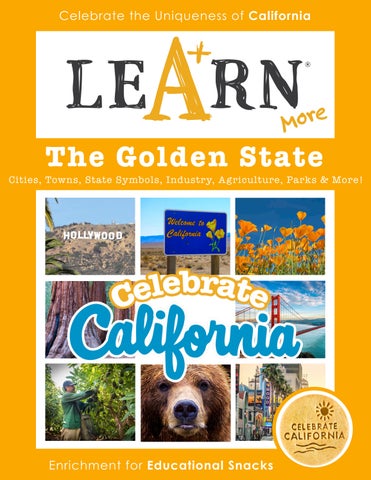
Celebrate the Uniqueness of California
The Golden State
Cities, Towns, State Symbols, Industry, Agriculture, Parks & More!
Enrichment for Educational Snacks
Big Cities:
Los Angeles San Diego San Jose San Francisco Fresno Sacramento Long Beach Oakland Bakerf ield Anaheim Stockton Riverside San Bernardino
Small Towns: Solvang Julian Ojai Mendocino
State Symbols: Grizzly Bear Golden Poppy Valley Quail Coast Redwood Giant Sequoia Surf ing Avocados
Industry: Hollywood Silicon Valley
Agriculture:
Dairy Tomatoes Rice Grapes Oranges Strawberries Dates Garlic Olives Finger Limes Pomeg ranates
Landmarks: Golden Gate Bridge Griff ith Observatory Big Sur Santa Monica Pier
Parks: Yosemite National Park Redwood National & State Parks Sequoia National Park Death Valley National Park Joshua Tree National Park
Culture:
Skateboarding Skiing/Snowboarding Hiking
Big Cities
BIG CITY
Los Angeles Los Angeles is the LARGEST city in California with a population of over 3.8 million people.
Los Angeles gets around
Los Angeles has many nicknames, including “L.A.,” “City of Angels” & “La La Land.” Los Angeles is the 2nd LARGEST city in the U.S.
284 days of sun each year, making it one of the sunniest cities in the U.S.!
Most of the palm trees in L.A. are not native to the area. Hollywood is a neighborhood of L.A. famous for its TV & movie production. LA Unified is the largest school district in California with over 429,000 students.
BIG CITY
San Diego San Diego is the 2nd largest city in California with a population of over 1.3 million people. San Diego has a strong naval & military presence.
San Diego was founded in 1769 making it one of the oldest cities in California. San Diego over 70 miles of coastline!
San Diego is only 20 miles away from Mexico!
The worldfamous San Diego Zoo is home to over 12,000 animals! San Diego County is one of the largest avocado-growing regions in the U.S. Gray whales migrate along the coast of San Diego. San Diego Unified has over 121,000 students.
BIG CITY
San Jose San Jose is the 3rd largest city in California with a population of over 969,000 people. San Jose is known as the “Capital of Silicon Valley” – the center of the tech world! San Jose was the first capital city of California when California became a state in 1850.
The first ever radio station in the U.S. started in San Jose in 1909. San Jose has one of the most diverse There are over 60 miles populations of biking trails in San Jose. in the U.S. San Jose is home to 200+ parks. San Jose Unified has around 25,000 students.
BIG CITY
San Francisco San Francisco is the 4th largest city in California with a population of over 808,000 people. San Francisco is home to the iconic Golden Gate Bridge.
San Francisco is a dogloving city with over 30 dog parks!
San Francisco experiences a lot of fog, earning it the nickname “Fog City.” San Francisco is known for its hilly streets one of the main reasons cable cars became so popular!
San Francisco is only 7 miles by 7 miles. San Francisco Unified has over 50,000 students.
BIG CITY
Fresno Fresno is the 5th largest city in California with a population of over 545,000 people.
Fresno is the largest inland city in California. In 1872,
Fresno was founded as a railroad station.
Fresno County is one of the TOP agricultural producers in the world.
Over 300 different crops are grown in Fresno County. “Raisin Capital of the World” Fresno is often described as being a big city but with a small-town feel. Fresno hosts an annual state fair called the “Big Fresno Fair.” Fresno Unified School District has around 73,000 students.
CAPITAL CITY
Sacramento Sacramento is the 6th largest city in California with a population of over 526,000 people. Sacramento was named California’s first permanent capital in 1854.
The California State Fair has been held in Sacrament o for over 150 years.
Surrounded by farms, Sacramento is known as America’s Farm-to-Fork Capital.
Sacramento is home to the California State Library.
Sacramento City Unified has around 40,000 students.
BIG CITY
Long Beach Long Beach is the 7th largest city in California with a population of over 449,000 people.
The Port of Long Beach is one of the
BUSIEST
shipping ports in the U.S.
Long Beach is home to around five miles of sandy shoreline. The Queen Mary – a famous retired ocean liner is one of the most popular attractions in Long Beach. Long Beach was originally named Wilmore City. Long Beach is a common resting point for birds during migration season. Long Beach Unified has over 64,000 students.
BIG CITY
Oakland Oakland is the 8th largest city in California with a population of over 436,000 people.
Oakland was the end point of the first railroad to go across the U.S.
Oakland got its name because the area was originally a forest of coastal live oak trees. Oakland is home to Lake Merritt – the first designated wildlife refuge in the U.S., established in 1870.
“Brightside of the Bay”
Lake Merritt is a tidal lagoon, not a lake, because it has salty water.
Oakland became a city of California on May 4, 1852. Oakland Unified has over 34,000 students.
BIG CITY
Bakersfield Bakersfield is the 9th largest city in California with a population of over 417,000 people. Bakersfield is famous for the Bakersfield Sound – a style of country music that was created here. Bakersfield was founded in 1856 & then became a city of California in 1873.
The Bakersfield Sound earned the city the nickname “Nashville West.” Around 80% of ALL carrots grown in the U.S. are grown in Bakersfield. Bakersfield is surrounded by farms & desert land. Bakersfield City Schools has around 30,000 students.
BIG CITY
Anaheim Anaheim is the 10th largest city in California with a population of over 344,000 people.
Anaheim is most known for being home to Disneyland.
Anaheim first became famous for its grape vineyards & later on for its orange groves.
Anaheim became an official city of California in 1870.
Mito, Japan is Anaheim, California's sister-city.
The Santa Ana River Trail runs through Anaheim & has over 40 miles of bike paths.
“City of Kindness” Anaheim ESD has around 15,000 students.
BIG CITY
Stockton Stockton is the 11th largest city in California with a population of over 324,000 people. Stockton was founded in 1849 during California’s Gold Rush. Stockton has a long history of growing asparagus & hosts an annual Asparagus Festival!
Stockton’s Deepwater Channel is one of the only inland ports in California.
The San “All-America City” Joaquin River runs through Stockton was named Stockton. after U.S. Navy Officer Robert F. Stockton. Stockton Unified has over 35,000 students.
BIG CITY
Riverside Riverside is the 12th largest city in California with a population of over 323,000 people. Riverside is the birthplace of California’s citrus industry.
Riverside was named after its location along the Santa Ana River.
The FIRST navel orange tree in California was planted in Riverside in the 1870s! Riverside is home to the California Citrus State Historic Park.
Riverside became an official city of California in 1883.
Riverside USD has over 40,000 students.
BIG CITY
San Bernardino San Bernardino is the 18th largest city in CA with a population of over 224,000 people. San Bernardino is surrounded by the San Bernardino Mountains.
The San Bernardino Mountains are known for their snowcovered peaks in the winter.
The worldfamous
Route 66
runs right through San Bernardino.
San Bernardino became an official city of California in 1854. Each year, San Bernardino hosts the National Orange Show Festival. San Bernardino is a part of the Inland Empire region. San Bernardino USD has over 44,000 students.
Small Towns
SMALL TOWN
Solvang Solvang is a small town in California with a population of around 6,000 people. Solvang is commonly known as the “Danish Capital of America.”
Over one million people visit Solvang every year.
The buildings in Solvang look just like the ones you would see in Denmark.
Many visitors tour the town on horse drawn carriages.
Solvang is home to five Danish windmills. Solvang was founded in 1911. Solvang is famous for ‘Aebleskivers’ - little round Danish pancakes. Solvang School has under 600 students.
SMALL TOWN
Julian
Julian is a small town in California with a population of around 1,500 people.
Julian was founded in 1970 after a gold rush in the Cuyamaca Mountains.
Julian is most famous for its apple orchards & “Julian apple pie.” The mountain climate in Julian is ideal for growing apples. Julian hosts an annual
Apple Days Festival. Julian is a “Dark Sky Community” – a great location for star gazing. Julian is designated as a California Historic Landmark. Julian USD has around 450 students.
SMALL TOWN
Ojai
Ojai is a small town in California with a population of around 7,500 people. Ojai is well known for its citrus, specifically their Pixie tangerines.
Ojai is home to many familyowned farms. Ojai was officially incorporated as a city of California in 1921.
The entire downtown of Ojai was rebuilt in Spanish Colonial Revival style after a fire in 1917.
Ojai sunsets create the “Pink Moment” – when the Topatopa mountains glow pink. Ojai is a popular destination for wellness, art & nature. Ojai Unified School District has around 2,000 students.
SMALL TOWN
Mendocino Mendocino is a small town in California with a population of under 1,000 people. Mendocino sits along Pacific Ocean cliffs & is surrounded by giant redwood forests. Mendocino was founded in 1850 as a logging town.
The sunsets over the Pacific Ocean are one of Mendocino’s biggest attraction.
Gray whales migrate past Mendocino twice a year! Mendocino is only about one square mile in size. Mendocino USD has under 500 students.
Mendocino is known for its historic lighthouses.
State Symbols
STATE ANIMAL
Grizzly Bear The grizzly bear is the official state animal of California. The grizzly bear became California’s official state animal in 1953. Adult male grizzly bears weigh an average of 400 - 600 pounds while female grizzly bears weigh an average of 250 - 350 pounds.
A grizzly bear’s claws can grow up to 4 inches long.
Grizzly bears can swim!
Grizzly bears are omnivores, eating mostly plants, berries, fish and small mammals.
Grizzly bears have a distinct shoulder hump that gives them extra strength Grizzly bears for digging can run up to 35 and running. miles per hour! Grizzly bears hibernate during the colder months.
STATE FLOWER
Golden Poppy The golden poppy is the official state flower of California. The golden poppy became California’s official state flower in 1903. The golden poppy has many Golden poppies close their nicknames: petals at night but reopen “California them in the morning sunshine. Poppy,” “Flame Golden poppies Flower,” and prefer sunny and “Cup of Gold.” dry weather.
Bees are the main pollinators for golden poppies. Golden poppies grow to be around 12-18 inches tall. Antelope Valley California Poppy Reserve is home to the LARGEST golden poppy field in the state.
Golden poppies are grown all over California from hillsides to highways.
APRIL 6 is California Poppy Day!
STATE BIRD
Valley Quail The valley quail is the official state bird of California.
Valley quail rarely fly… they mostly walk or run.
The valley quail became the official state bird of California in 1931.
Valley quail are known for their “topknot” - the curled feathers on top of their heads!
Valley quail live in groups of 10 to 200 quail called “coveys.” Valley quail chicks can walk immediately after hatching! Valley quail make a call that sounds like
“CHI-CA-GO!” Valley quail can lay up to 28 eggs in a single nest! Valley quail eat seeds, berries and small insects.
STATE TREE
Coast Redwood The coast redwood is one of the two official state trees of California. The coast redwood became an official state tree of California in 1937. Coast redwoods are the TALLEST trees in the world! The oldest known coast redwood tree is estimated to be over 2,200 years old. Coast redwoods are grown along the Pacific coast. Redwoods link their roots with other nearby trees to stay strong and stable.
The tallest known coast redwood is over 379 feet tall – that is taller than the Statue of Liberty!
Visit Redwood National & State Parks! Coast redwoods are resistant to fires because of their very thick bark.
STATE TREE
Giant Sequoia The giant sequoia is one of the two official state trees of California.
Giant sequoia trees are the
LARGEST trees by volume in the world!
The giant sequoia became an official state tree of California in 1953. A giant sequoia tree’s bark can be up to 2 FEET thick.
Giant sequoia trees thrive in snowy winters & dry summers. Giant sequoia trees are native to California's Sierra Nevada mountains.
Visit Sequoia National Park! Giant sequoia tree roots can spread out over an entire acre! Giant sequoia trees can live for over 3,000 years.
STATE SPORT
Surfing Surfing is the official state sport of California.
Huntington Beach, Malibu & Santa Cruz are California’s most famous surfing spots.
Surfing became California’s official state sport in 2018. Huntington Beach is nicknamed “Surf City USA.”
The U.S. Open of Surfing – the largest surf contest in the world is held in Huntington Beach, California every year.
Santa Cruz is often called the “Birthplace of Mainland Surfing.” Surfing is both a sport & a lifestyle.
“HANG LOOSE”
Surfing became popular in California in the early 1900s.
Wetsuits were invented in California in the 1950s. California has 800+ miles of beaches where surfers can catch waves all year long!
STATE FRUIT
Avocado Avocados are the official state fruit of California. Avocados became the official state fruit of California in 2013. There are around California is home 3,000 California to 50,000 acres+ of avocado growers. avocado orchards.
90% of all avocados grown in the U.S. are grown in California!
Avocado trees can grow to be 30 to 60 feet tall. Avocados trees can take anywhere from 3 to 15 years to start producing fruit.
Hass avocados are the most common variety of avocado grown in California. Most California avocados are grown in Southern California.
Industry
FILM INDUSTRY
Hollywood Hollywood is known as the “movie capital of the world.” Hollywood is a neighborhood of Los Angeles, California. The Academy Awards (Oscars) are held in Hollywood every year to celebrate the best movies & the people who made them. Hollywood’s very first movie studio was built in 1911 . Hundreds of movies are made in California every year…far more than any other state in the U.S. California is home to the Academy Museum of Motion Pictures. California’s film industry employs hundreds of thousands of people – actors, costume designers, camera crews, set builders & more!
TECH INDUSTRY
Silicon Valley Silicon Valley is known as the “technology capital of the world.”
“Silicon chips” (also called microchips or computer chips) were FIRST made in California’s Bay area which is how Silicon Valley got its name.
Silicon Valley is located in California’s Bay Area. Silicon chips are like the brains of electronics. Before the technology boom, Silicon Valley was filled fruit orchards. “The Valley of Heart’s Delight”
MANY famous tech companies were started in Silicon Valley. Smartphones, laptops & tablets were all invented and/or improved in Silicon Valley. The name “Silicon Valley” was first used in the 1970s.
Agriculture
CALIFORNIA
Dairy
California is the largest dairy producing state in the U.S. The majority of California’s dairy comes from the San Joaquin Valley region. California is home to over 1,000 dairy farms & 1.7 MILLION dairy cows. Holstein cows are the ones with unique black & white spots! Most California dairy farms are family-owned. In addition to milk, California is also the #1 producer of other dairy products including butter & ice cream.
The average California dairy cow produces around 8 gallons of milk per day.
Milk is California’s official state beverage!
Holstein cows are the most popular dairy cow breed in California.
CALIFORNIA
Tomatoes California produces 95% of all processing tomatoes in the U.S. Processing tomatoes are the ones used to make ketchup, juice, sauces, etc.
During peak tomato season, California farmers harvest around TWO BILLION pounds of tomatoes per week.
California processing tomatoes are grown in many regions throughout the state. Processing tomatoes are usually harvested mechanically. Around 33% of U.S. fresh-market tomatoes are grown in California. Tomatoes can go from being harvested to fully processed in 6 hours! California tomatoes grow best during the hot and dry summer months.
CALIFORNIA
Rice
California produces around 20% of all the rice grown in the U.S. Nearly all of the California’s rice is gown in Sacramento Valley.
Sacramento Valley’s flat land & warm weather make it a perfect location for rice farming. California rice is planted in the spring & harvested in the fall.
California has over 500,000 acres of rice fields. California rice farmers produce around five billion pounds of rice per year!
After harvest, California’s flooded rice fields provide winter habitats for birds. Most of the rice grown in California is medium-grain, commonly used for sushi! California rice farming began 100+ years ago.
CALIFORNIA
Grapes
California is the largest producer of grapes in the U.S. - growing 99% of all table grapes.
Grapes have been grown in California for 200+ years.
The majority of California’s table grapes are grown in San Joaquin Valley. Around
1.8 BILLION pounds of table grapes are grown in California each year.
California is home to
800,000+ acres of grape vineyards.
California grows
over 80 varieties of table grapes.
Thompson Seedless are the most widely grown variety of table grape in California.
Most California grape vineyards are family-owned & operated. California grapes are harvested by hand.
CALIFORNIA
Oranges California grows 85% of all U.S. fresh-market oranges. Fresh-market oranges are oranges grown to be eaten whole, NOT processed for juice. Oranges are California California’s #1 is known for citrus crop. its Navel & Valencia California varieties of oranges are oranges. mostly grown in the Central California’s Valley & “citrus Southern California. boom” started in 1873 with navel oranges. Orange trees can live for over 50 years!
California’s climate makes their oranges extra sweet. California's first navel orange trees were planted in Riverside, CA.
CALIFORNIA
Strawberries California produces nearly 90% of all strawberries grown in the U.S. Monterey, Santa Barbara & Ventura are California’s top strawberry producing counties. 1.5+ BILLION pounds of strawberries are grown in California each year. California strawberries are harvested by hand.
California is home to around 42,000 acres of strawberry fields. California strawberries are grown in many regions, making them available year-round.
One of the largest annual strawberry festivals is hosted in Watsonville, California. California’s cool, coastal climates are ideal for growing strawberries. Most of California’s strawberry fields are owned by family farms.
CALIFORNIA
Dates
California is the heart of the U.S. date industry growing over 90% of all Medjool dates. Coachella Valley is where almost all of California’s dates are grown. California Date palms, the trees that grow dates, were grows 4 first planted in California in the late 1800s. major kinds of dates: Medjool, Deglet Noor, Medjool Barhi & dates are Zahidi. the most popular & There are known as 200+ varieties the “King of dates grown of Dates.” worldwide! The National Date Festival is hosted every year in Indio, CA. One date palm can grow up to 10,000 dates per season! California dates are harvested in the fall.
CALIFORNIA
Garlic
About 90% of all commercially grown garlic in the U.S. comes from California!
Most of California’s garlic fields are found in the western part of the San Joaquin Valley.
Gilroy, California is nicknamed the “Garlic Capital of the World.” California celebrates garlic every year with the Gilroy Garlic Festival! Two main types of garlic: hardneck and softneck.
The majority of garlic gown in California is softneck.
Garlic grows
underground!
Garlic has been grown in California for hundreds of years. California garlic is often processed into powder, flakes, oils & minced garlic. California harvests around 400 million pounds of garlic every year!
CALIFORNIA
Olives
California produces around 95% of all olives grown in the U.S. Around 75% of the olives grown in California are processed into olive oil. The warm, sunny climate of California’s
The other 25% of the olives grown in California are table olives – olives grown to be eaten. Hundreds of family farms make up California’s olive industry.
inland valleys is ideal for growing olives.
Olives are a type of fruit!
As olives ripen, they change colors from green à yellow-green à purple à black. Olive branches symbolize peace.
California grows a wide variety of table olives including: Manzanillo, Sevillano, Mission and many more!
CALIFORNIA
Finger Limes California is the only state in the U.S. that grows finger limes on a commercial scale. Finger limes are a type of citrus fruit native to Australia. Most of California’s finger limes are grown Finger limes are in the Central Valley. about the size of a human finger (2 - 3 inches) hence the name! Finger limes are filled with tiny lime juice pearls.
“Citrus Caviar”
Finger limes taste similar to conventional limes with a tart, citrusy flavor. Shanley Farms was the FIRST commercial finger lime farm in the U.S. Shanley Farms is also the LARGEST finger lime farm in the U.S. with over 10,000 finger lime trees!
CALIFORNIA
Pomegranates California grows 95% of all pomegranates grown in the U.S.
California pomegranates are in season from September January.
The majority of California’s pomegranates are grown in the San Joaquin Valley.
California is home to around 50,000 acres of pomegranate orchards.
“NATURE’S JEWEL”
Pomegranates grow well in California’s hot, dry summers & mild winters.
Wonderful pomegranates are the most commercially grown pomegranate in California. Pomegranate trees can grow to be 12 - 20 feet tall.
Landmarks
Golden Gate Bridge The Golden Gate Bridge is a suspension bridge that connects San Francisco to Marin County. The Golden Gate Bridge is a suspension bridge held up by cables between towers. The Golden The bridge Gate Bridge was named opened in after the strait 1937 after that runs four years of beneath it – construction. the Golden Gate Strait. The bridge is 1.7 miles long. The Golden Gate Bridge has six car lanes & two sidewalks. Painters work year-round to touch up areas of the bridge & protect the steel from rust. Over 10 million people visit the Golden Gate Bridge every year. Each day, over 100,000 vehicles drive across the Golden Gate Bridge.
Griffith Observatory The Griffith Observatory is a worldfamous observatory & planetarium.
The money to build the Observatory was donated by Griffith J. Griffith.
An observatory is a place that uses telescopes to see & learn about space.
The Griffith Observatory has put on over 100,000 planetarium shows.
The Griffith Observatory opened in 19 3 5.
All visitors can enter the Observatory enter for FREE! The Observatory is a Los Angeles HistoricCultural Monument.
The Griffith Observatory does ONLY livenarrated planetarium shows.
The Observatory is located on Mount Hollywood, in Griffith Park, Los Angeles.
Big Sur Big Sur is a region in central California famous for its rugged coastline. Big Sur is known for its steep cliffs, towering redwoods & misty coastal views. Bixby Creek Bridge is an iconic landmark of Big Sur. Big Sur stretches 90 miles along the coast.
Highway 1 runs along Big Sur & is considered on the of the most scenic drives in the world. There are no big cities in Big Sur, only small towns & nature.
Big Sur is a part of Los Padres National Forest & many state parks. Big Sur was named for its location, “El Sur Grande” (“The Big South”). Big Sur is located between Carmelby-the-Sea & San Simeon, California.
Santa Monica Pier The Santa Monica Pier is a famous, historic pier located in Santa Monica. The Santa Monica Pier first opened in 1909, making it over 100 years old!
Pacific Park is the popular amusement park located on Santa Monica Pier.
The Santa Monica Pier marks the official end of the historic ROUTE 66.
The Santa Monica Pier is open 365 days a year! MILLIONS of people visit the Santa Monica Pier every year!
The Santa Monica Pier is the ONLY pier with a Ferris wheel along the west coast.
Parks
Yosemite
NATIONAL PARK
Yosemite National Park is famous for its cliffs, waterfalls & giant sequoia trees.
Around 4 MILLION people visit Yosemite each year.
Yosemite was established as a national park in 1890.
The giant granite cliffs Yosemite is known for are El Capitan & Half Dome.
Over 1,450 plant species grow in Yosemite. Mule deer are the most commonly seen large animals Yosemite is home to in Yosemite. 750 miles of hiking trails. Yosemite Falls is one the LARGEST waterfalls in the U.S. at 2,425 feet!
Redwood
NATIONAL & STATE PARKS Redwood National & State Parks serve to preserve & protect coast redwood trees.
Redwood National & State Parks together protect nearly half of the remaining coast redwood trees in the world.
Redwood National Park was established in 1968, decades after the Redwood State Parks. There are 3 redwood state parks: Prairie Creek, Del Norte Coast & Jedediah Smith.
Many movies have been filmed in Redwood National & State Parks! The tallest known coast redwood tree is located in Redwood National Park.
Redwood National & State Parks cover over 130,000 acres of land.
Sequoia
NATIONAL PARK Sequoia National Park serves to preserve & protect giant sequoia trees.
Over 315 animal species live in Sequioa National Park.
Sequoia National Park was established is the 2nd oldest national park in the U.S. Sequoia National Park was established in 1890.
Sequoia National Park has 800+ miles of hiking trails. The 'Tunnel Log’ is a fallen giant sequoia tree in the park that visitors can drive through!
Mount Whitney, the tallest mountain in the continental U.S. is located in Sequoia National Park.
Death Valley NATIONAL PARK
Death Valley National Park known for being the hottest & driest national park in the U.S. Death Valley National Park is the LARGEST national park in the continental U.S. Death Valley Death Valley became an National Park is official national over 3.4 million park in 1994. acres in size. The hottest temperature recorded in Death Valley Badwater National Park Basin, was 134◦F. located in Death Valley National Park is the lowest point Death Valley in the U.S. National Park gets almost NO RAIN. There are sand dunes in Death Valley National Park that are over 680 feet tall.
Joshua Tree NATIONAL PARK
Joshua Tree National Park is known for its unique Joshua trees & rock formations.
Joshua trees can grow up to 40 feet tall & live for hundreds of years.
Joshua Tree was a national monument before becoming a national park in 1994.
Joshua trees are a type of yucca plant.
Joshua Tree National Park’s famous rock formations are very popular for rock climbing. Joshua Tree National Park covers around 800,000 acres of land.
There are two deserts within Joshua Tree National Park - the Mojave Desert & the Colorado Desert.
Culture
Skateboarding Skateboarding was started in California in the 1950s. Los Angeles & Santa Monica are known as the birthplace of modern skateboarding. Skateboarding was invented by surfers who wanted something to do when waves were flat.
“Asphalt surfers” The Z-Boys (Zephyr Skate Team) we the first professional skateboarders.
California is home to over 100 skateparks – more than any other state in the U.S.
Venice Beach Skatepark is one of the most famous skateparks in the world. Skateboarding is a BIG part of California’s culture & identity. Millions of people skateboard. Skateboarding became an Olympic sport in 2021. Don’t forget to wear a helmet!
Skiing/Snowboarding California is known for having some of the best ski & snowboard destinations in the U.S.
The Sierra Nevada Mountains, Lake Tahoe & Mammoth Mountain are California's most famous ski & snowboard locations. Mammoth Mountain is the LARGEST ski resort in California.
California is home to over 30 ski & snowboard resorts.
Truckee is California’s “snowiest ski town” & gets 200 - 400 inches of snow/year!
“Shredding the gnar”
California’s ski & snowboard season can last from fall all the way into early summer! California hosted the Winter Olympics in 1960 in Palisades Tahoe.
Hiking California is home to over 18,000 miles of hiking trails. California’s hiking trails range from short nature walks to multi-day adventures. California Some of has the California’s largest statemost famous park system hiking trails: in the U.S. Pacific Crest with over 280 Trail, John state parks. Muir Trail, Mist Trail, Half Dome Trail, Mount Whitney Trail.
Hiking is a great way to see wildlife in their natural habitat. California has 16,000+ different hiking trails.
The Pacific Crest Trail (PCT) is the longest hiking trail in California. California’s national parks are world-famous for their scenic hikes.
Helping kids eat right, do well in school & be proud of where they are from.