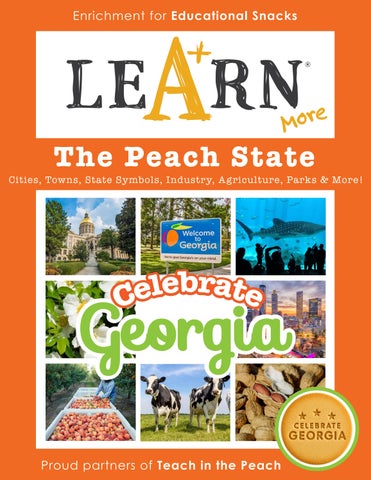
Enrichment for Educational Snacks
The Peach State
Cities, Towns, State Symbols, Industry, Agriculture, Parks & More!
Proud partners of Teach in the Peach
A message from State School Superintendent Richard Woods: Every day in classrooms across Georgia, teachers help shape the future. Behind every graduate, business owner, first responder, engineer, artist, and community leader is a teacher who believed in a student, encouraged them to keep learning, and helped them discover what they could achieve. That is why the Georgia Department of Education is committed to making Georgia the #1 State for Teachers to Teach. Through Teach in the Peach, we are working to recruit, support, and celebrate great teachers while inspiring the next generation of educators. Whether you‘re a student thinking about your future, a college student preparing to teach, or someone considering a new career, Georgia offers more than one way to become a teacher. Great teachers do more than prepare students for graduation — they prepare them for life. They help students build the knowledge, skills, and confidence to follow their dreams, whether that means continuing their education, serving in the military, joining the workforce, or starting a business. As Georgia continues its work to become the Top State for Talent, supporting teachers helps build a stronger future for every community. We're excited to partner with Educational Snacks to spotlight our Teach in the Peach initiative. I hope you'll visit www.teachinthepeach.org to learn more about teaching in Georgia. Together, we can help every Georgia student learn, grow, and succeed with the support of excellent teachers. Sincerely,
Richard Woods State School Superintendent Georgia Department of Education
Superintendent Woods with several of Georgia’s Teach in the Peach ambassadors — classroom teachers who work to amplify educator voices and support local and regional recruitment efforts.
Meet some of Georgia’s rockstar teachers! #WhyITeachInThePeach
Big Cities: Atlanta Augusta Columbus Macon Savannah Athens
Industry: Film Aerospace Education
Agriculture:
Dahlonega Helen Alma
Peaches Corn Blueberries Watermelon Soybeans Dairy
Counties:
Landmarks:
Fulton Gwinnett Cobb Dekalb Cherokee Clayton Forsyth Henry
Stone Mountain Chattahoochee River Lake Lanier
Small Towns:
State Symbols: White-Tailed Deer Brown Thrasher Cherokee Rose Live Oak Gopher Tortoise Largemouth Bass Honeybee Peach Vidalia Onion
Parks: Amicalola Falls State Park Okefenokee Swamp Providence Canyon State Park Tallulah Gorge State Park Cumberland Island National Seashore
Food & Culture:
Civil Rights Sweet Tea Soul Food Brunswick Stew White Water Raf ting Hip-Hop
Big Cities
CAPITAL CITY
Atlanta
Atlanta is the LARGEST city Georgia with a population of over 520,000 people. Atlanta was founded in 1837 as a railroad town & Atlanta is then became the capital city of Georgia in 1868.
home to one of the LARGEST aquariums in the world!
The HartsfieldJackson Atlanta International Airport is the
Peachtree St.
WORLD’S BUSIEST AIRPORT.
“City in a Forest” Atlanta Public Schools has over 49,000 students. Dr. Martin Luther King Jr. was born in Atlanta, Georgia.
BIG CITY
Augusta Augusta is the 2nd largest city in Georgia with a population of over 200,000 people. Augusta was established in 1736, making it one of the oldest cities in Georgia. Augusta is known for hosting
Augusta was named in honor of
The Masters Tournament
Princess Augusta of Wales.
- one of the most famous golf tournaments in the world!
Richmond County School System has over 29,000 students.
“Garden City of the South”
Augusta served as Georgia’s capital city from 1785 1795.
BIG CITY
Columbus Columbus is the 3rd largest city in Georgia with a population of over 200,000 people.
Columbus has one of the longest
urban white-water rafting courses in the world!
Columbus is known for their white water rafting along the Chattahoochee River. Columbus is home to the Chatahoochee RiverWalk, a 22-mile path for walking & biking along the river.
Columbus sits on the fall line, where rivers drop from hills to flatter land. Columbus was established in 1828.
Columbus has over nine historic districts.
The Muscogee County School District has over 30,000 students.
BIG CITY
Macon Macon is the 4th largest city in Georgia with a population of over 157,000 people. Due to its centralized location, Macon is known as the “Heart of Georgia.” Macon was built along the
Macon hosts a famous Cherry Blossom Festival every spring.
Ocmulgee River.
Macon was established in 1823.
“Wop-bop-a-loo-bop” Bibb County School District has over 21,000 students. Macon is home to 10 historic districts.
Many famous musicians are from Macon, making the city known for its music history.
BIG CITY
Savannah Savannah is the 5th largest city in Georgia with a population of over 148,000 people. Savannah is known for its live oak
Savannah was founded in 1733 making it the first & oldest city in Georgia!
trees found throughout the city.
Forsyth Park is the largest park in Savannah & known for its iconic fountain.
One of the best art schools in the country is located in Savannah.
“Hostess City of the South”
Savannah-Chatham County Public School System has over 35,000 students. Savannah’s Historic District is one of the largest in the U.S. Savannah was the first capital city of Georgia.
BIG CITY
Athens Athens is the 6th largest city in Georgia with a population of over 129,000 people. Athens is known as the birthplace of public higher education in America.
Athens is a lively college town known for their school spirit & community pride.
Athens is home to the University of Georgia, the nation’s first statechartered public university. Clarke County School District has over 12,000 students. Athens, Georgia was named after Athens, Greece to reflect its focus on education.
Small Towns
SMALL TOWN
Dahlonega Dahlonega is a small town in Georgia with a population of around 7,000 people.
Downtown Dahlonega is on the National Register of Historic Places.
Dahlonega is famous for being the site of the FIRST major gold rush in the U.S.
The Dahlonega gold rush occurred in 1829.
Dahlonega became a city in 1833.
Dahlonega was a part of the Cherokee Nation. Dahlonega is located in the foothills of the Blue Ridge Mountains. Lumpkin County Schools has around 5,000 students.
Dahlonega hosts a “Gold Rush Days” festival every year to celebrate its history.
SMALL TOWN
Helen
Helen is a small town in Georgia with a population of around 600 people.
Helen is famous for looking like a Bavarian village from southern Germany.
Helen is located along the Chattahoochee River, surrounded by the Blue Ridge Mountains.
Helen is famous for looking like a Bavarian village from southern Germany.
Füssen, Germany is Helen’s sister city.
Helen is home to many sweets and ice cream shops. Helen covers only about 2 square miles.
MILLIONS of people visit Georgia every year!
White County School District has around 4,500 students.
SMALL TOWN
Alma
Alma is a small town in Georgia with a population of around 3,400 people.
Alma was founded in 1900 but became an official city of Georgia in 1906.
Alma, Georgia is proudly known as “Georgia's Blueberry Capital.” Every year in June, Alma hosts a blueberry festival.
Alma is the county seat of Bacon County.
Alma is about 6.2 square miles in size.
Alma’s train station is listed on the National Register of Historic Places.
Goldwasser Park is one of the most popular parks in Alma. Bacon County School District has around 2,100 students.
Counties
Fulton County Fulton County is the most populated county in Georgia & home to 15 cities.
Over 1,000,000 people live in Fulton County.
The world’s busiest airport, the HartsfieldJackson Atlanta International Airport (ATL) sits partially in Fulton County.
Atlanta is the largest city in Fulton County & also the capital city of Georgia. Fulton County is a major hub for Georgia’s film industry.
“Y’allywood”
Fulton County is home to over 300 parks & green spaces. 70 MILES
Fulton County stretches over 70 miles from top to bottom.
Fulton County Schools has over 88,000 students.
Gwinnett County Gwinnett County is 2nd most populated county in Georgia & home to 16 cities. Peachtree Corners is the largest city in Gwinnett County, Georgia.
Gwinnett County was founded in 1818.
Gwinnett County is known for its innovation & technology industry. Gwinnett County was named after Button Gwinnett.
Gwinnett County is home to over 50 parks & green spaces.
“Vibrantly Connected” Button Gwinnett was 1 of Georgia’s 3 signers of the Declaration of Independence. Gwinnett County Public Schools is the LARGEST school district in Georgia.
Cobb County Cobb County is 3rd most populated county in Georgia & home to 6 cities.
Marietta, Georgia is most known for its historic downtown square.
Marietta is the largest city in Cobb County, Georgia. Cobb County is home to Georgia’s Major League Baseball team. Cobb County was named after Georgia judge & U.S. senator, Thomas Willis Cobb.
Kennesaw Mountain is the highest point in Cobb County at 1,808 feet. Cobb County was founded in 1832.
Cobb County is home to some of the most popular dog parks in metro Atlanta. Cobb County School District has over 106,000 students.
Dekalb County Dekalb County is 4th most populated county in Georgia & home to 12 cities.
Dekalb County was founded in 1822.
Brookhaven is the largest city entirely in Dekalb County, Georgia.
Stone Mountain, one of Georgia’s most famous landmarks, is located in DeKalb County.
Being home to the CDC (Center for Disease Control), Dekalb County is known for its strong focus on science & public health.
Many visitors take a Skyride cable car to the top of Stone Mountain to see amazing views. Dekalb County School District has over 91,000 students.
Cherokee County Cherokee County is 6th most populated county in Georgia & home to 6 cities.
Woodstock began as just a railroad stop. Cherokee County was established in 1831.
The Etowah River flows through Cherokee County.
Woodstock is the largest city in Cherokee County, Georgia.
Cherokee County has a strong connection to Georgia’s Native American history & is named after the Cherokee Nation. Cherokee County has historic marble quarries.
Cherokee County is home to Gibbs Gardens, famous for its seasonal flower blooms. Cherokee County School District has over 42,000 students.
Clayton County Clayton County is 7th most populated county in Georgia & home to 7 cities.
Clayton County was founded in 1858.
Forest Park is the largest city in Clayton County, Georgia.
The world’s busiest airport, the HartsfieldJackson Atlanta International Airport (ATL) sits mostly in Clayton County.
Clayton County was was named after U.S. Congressman, Augustin Smith Clayton.
Clayton County is home to the Atlanta State Farmers Market.
The Atlanta State Farmers Market is one of the largest outdoor produce markets in the U.S. Clayton County Public Schools has over 50,000 students.
Forsyth County Forsyth County is 8th most populated county in Georgia & home to only 1 city. Cumming, Georgia is the only city in Forsyth County. Gold was discovered nearby Forsyth County in 1829, which brought many settlers to the area. Forsyth County was named after former Governor of Georgia, John Forsyth.
LAKE
Forsyth County is known for Lake Lanier, Georgia’s LARGEST lake. Forsyth County is home to the Sawnee Mountain Preserve. Forsyth County was established Forsyth County covers in 1831. around 247 square miles. Forsyth County School District has over 54,000 students.
Henry County Henry County is 9th most populated county in Georgia & home to 4 cities. Stockbridge is the largest city in Henry County, Georgia. The Henry County Courthouse, built in the late 1890s is on the National Register of Historic Places. Henry County’s original land was used to form 8 other counties in Georgia.
Henry County is home to the
Atlanta Motor Speedway, a very large & famous racecar track.
Henry County was established on May 15, 1821.
“Mother Of Counties” Henry County Schools has over 44,000 students.
State Symbols
STATE MAMMAL
White-Tailed Deer White-tailed deer are the official state mammal of Georgia. The white-tailed deer became the official state mammal of Georgia in 2015. White-tailed deer are very athletic; they can run up to 40 miles per hour & jump up to 10 feet high. A whitetailed deer’s favorite foods include acorns, berries & leaves.
Only male deer grow antlers. White-tailed deer are found in nearly every state in the U.S.
Male deer = “Buck” Female deer = “Doe” Baby deer = “Fawn” White-tailed deer hooves leave a heart-shaped print called a track.
STATE BIRD
Brown Thrasher The Brown Thrasher is the official state bird of Georgia. The Brown Thrasher became the official state bird of Georgia in 1935. Brown Thrashers are a type of songbird & are known to sing over 1,000 different songs. The name “Brown Thrashers” came from their habit of thrashing through leaves to find food.
Brown Thrashers prefer walking or hopping over flying. Brown Thrashers are known for being early risers & singing before sunrise. Brown Thrashers eat mostly seeds, berries & small insects.
Brown Thrashers have unique, bright yellow eyes. Brown Thrashers are one of the
LOUDEST backyard songbirds.
In Georgia, Brown Thrashers stay year-round, even through the winter!
STATE FLOWER
Cherokee Rose The Cherokee Rose is the official state flower of Georgia. The Cherokee Rose became the official state flower of Georgia in 1916. Cherokee Roses grow on vine-like shrubs that can climb & reach up to 20 feet long! Cherokee Roses were named after the Cherokee Nation, one of the largest Native American tribes in the Southeast. The Cherokee Rose is a symbol of resilience,
Cherokee Roses have five white petals.
hope and remembrance.
Cherokee Roses bloom only once a year. In Georgia, Cherokee Roses bloom in March & April. Cherokee Roses prefer to grow in warm, sunny places. Cherokee Roses can also be found in Georgia, Florida, Alabama, North Carolina & South Carolina.
STATE TREE
Live Oak The Live Oak is the official state tree of Georgia. The Live Oak became the official state tree of Georgia in 1937. Live Oak tree branches commonly grow wider than the tree is tall. Live Oak trees can grow to be 40 - 80 feet tall.
“OAK ALLEYS”
Live Oak trees can live for hundreds of years.
Live Oaks are great habitat trees, providing homes for insects, birds & small animals.
Live Oak trees stay green all year, which is why they are called “live” oak trees.
STATE REPTILE
Gopher Tortoise The gopher tortoise is the official state reptile of Georgia. The gopher tortoise became the official state reptile of Georgia in 1989. Gopher tortoises move very slow… only about 0.3 miles per hour! Gopher tortoises got their name because they dig deep burrows, just like gophers. Gopher tortoises are herbivores, meaning they only eat plants like grasses, flowers, fruits & leaves. Gopher tortoises can live for 50 80 years!
In Georgia, most gopher tortoises are found in the southern part of the state.
The burrows dug by gopher tortoises can be up to 40 feet long & 10 feet deep!
STATE FISH
Largemouth Bass The largemouth bass is the official state fish of Georgia. The largemouth bass became the official state fish of Georgia in 1970. Largemouth bass can “Jumping the lure.” weigh over 20 pounds.
Largemouth bass have great eyesight. Largemouth bass can swim up to speeds of 12 miles per hour.
Largemouth bass are a part of the sunshine fish family.
Like their name suggests, largemouth bass are known for their big, wide mouths.
Largemouth bass are the most popular sport fish in Georgia.
Largemouth bass can grow to be up to 2 feet long.
STATE INSECT
Honeybee The honeybee is the official state insect of Georgia. The honeybee became the official state insect of Georgia in 1975. Like their name suggests, honeybees are known for making honey from flower nectar. One beehive can make 60 100 pounds of honey per year. A beehive is home to a colony of honeybees. Every colony of honeybees has only one QUEEN bee.
Honeybees can fly up to 15 miles per hour.
Honeybees live in very large families called colonies that can have up to 60,000 bees.
Honeybees help pollinate many Georgia crops like watermelon, blueberries, peaches & more! Honeybees are one of the MOST IMPORTANT insects for Earth’s ecosystem.
STATE FRUIT
Peach
Peaches are the official state fruit of Georgia. Georgia grows over
130 million pounds of peaches each year. Peach, Macon, Crawford & Taylor are Georgia’s main peach growing counties.
Georgia is nicknamed the “Peach State.”
Georgia peaches are known for being super sweet & juicy. Over 40 different varieties of peaches are grown in Georgia. Every summer, Fort Valley, GA hosts the
Georgia Peach Festival.
Peaches have been grown in Georgia for 300+ years. Georgia peaches are in peak season from June - July.
STATE VEGETABLE
Vidalia Onion The Vidalia onion is the official state vegetable of Georgia. The Vidalia onion became the official state vegetable of Georgia in 1990. Vidalia onions are known for being super sweet!
Vidalia onions were first grown near Vidalia, GA.
Vidalia onions are planted in the fall & harvested in the spring.
Vidalia onion seeds are very small - the size of grains of sand.
Vidalia, GA hosts an annual Vidalia Onion Festival.
To be considered a Vidalia onion, the onions MUST be grown in a specific 20county region in Georgia.
“AMERICA’S SWEET ONION”
Industry
Film
INDUSTRY Georgia is often referred to as the “Hollywood of the South.”
Georgia is home to
Tyler Perry Studios, one of the largest film studios in the U.S.
Georgia is one of the top filmmaking states in the U.S. with Atlanta as its main hub. Many superhero movies have been filmed in Georgia.
The “Georgia Film Office,” was founded in 1973 to help bring movie & TV productions to the state. The Georgia
Georgia’s film industry continues to grow every year.
peach logo appears in the credits of movies that were filmed in Georgia.
Georgia’s film industry supports thousands of jobs statewide.
Aerospace INDUSTRY
Georgia is widely known around the world for its aerospace industry. Aerospace products are Georgia’s #1 export. 800+ aerospace companies are headquartered in Georgia. Georgia is home to the
WORLD’s BUSIEST AIRPORT with an average of 2,700 flights every day.
Georgia’s aerospace industry designs, builds & maintains aircraft & aerospace technology. Georgia’s Aerospace industry jobs aerospace include engineers, mechanics, industry technicians, pilots, researchers, supports manufacturers & more!
hundreds of thousands of jobs statewide.
Education INDUSTRY
Georgia's education industry is made up of over 120,000 incredible teachers.
There are many kinds of teachers, each helping students discover new skills, talents, & interests.
Education is one of the most important ways communities prepare children for the future.
“Great futures start with great teachers!” Education is one of the largest professions in the United States. Georgia celebrates new educators during its annual Statewide Educator Signing Day.
We
Georgia teachers!
Teach in the Peach is a GaDOE initiative to help make Georgia the #1 state for teachers to teach!
Agriculture
GEORGIA
Peaches Peaches are the official state fruit of Georgia. Georgia grows over
130 million pounds of peaches each year. Peach, Macon, Crawford & Taylor are Georgia’s main peach growing counties.
Georgia is nicknamed the “Peach State.”
Georgia peaches are known for being super sweet & juicy. Over 40 different varieties of peaches are grown in Georgia. Every summer, Fort Valley, GA hosts the
Georgia Peach Festival.
Peaches have been grown in Georgia for 300+ years. Georgia peaches are in peak season from June - July.
GEORGIA
Corn
Corn is the third most widely grown crop in Georgia. The majority of corn grown in Georgia is field corn.
Sweet corn is grown for human consumption. Georgia sweet corn is grown at a much smaller scale than field corn.
Field corn (also called Corn is dent corn) considered is mainly a used for vegetable, animal feed. fruit AND a grain!
Georgia’s corn is usually harvested from late summer into early fall. Corn is the
number 1 field crop in America.
Georgia farmers harvest on average over 55
million bushels of corn per year.
Most of Georgia's corn is grown in the southern part of the state.
GEORGIA
Blueberries Georgia is the 3rd largest blueberry producing state in the U.S.
Alma, GA is the “Blueberry
Georgia harvests over 130 million pounds of blueberries each year. Most of the blueberries grown in Georgia are grown in the southern part of the state. Georgia blueberry season runs from April through July.
Capital of Georgia.”
Bacon County, GA hosts an annual blueberry festival. Georgia blueberries are pollinated mainly by honeybees.
Georgia is home to around 18,000 acres of blueberry farms.
Rabbiteye blueberries are the most common type of blueberry grown in Georgia.
GEORGIA
Watermelon Georgia is the 3rd largest watermelon producing state in the U.S. Cordele, Georgia is known as the
“Watermelon Capital of the World.” Seedless watermelon are the most popular variety Cordele, of watermelon GA hosts a grown in watermelon Georgia. festival every summer.
Georgia watermelons take around 3 months to grow from seed to fruit.
Georgia produces about 650 million pounds of watermelon each year. Most of Georgia’s watermelons are grown in the southern & central part of the state.
GEORGIA
Soybeans Soybeans are a major crop in Georgia & grown throughout much of the state.
Most soybeans grown in Georgia are field soybeans.
Georgia is home to hundreds of thousands of acres of soybeans.
Field soybeans are grown to be processed into foods, animal feed & other products. One acre of soybeans can produce over 82,000 crayons!
“Miracle Bean”
Soybeans are a type of legume, which means they grow in pods.
Georgia soybeans are planted in the spring and harvested in the fall. Each soybean pod has 2 to 4 beans inside. Soybeans that are eaten fresh are called edamame.
GEOGRIA
Dairy Georgia produces around 227 MILLION gallons of milk per year. Macon, Brooks and Sumter are Georgia’s leading dairy counties. Georgia is home to 73 dairy farms & around 85,000 dairy cows. Holstein cows are the ones with unique black & white spots! Most Georgia dairy farms are family-owned. Georgia dairy farmers recycle byproducts such as citrus pulp, brewers’ grain and whole cottonseed that are consumed by the cows.
Most of Georgia’s dairy farms are in the central & southern part of the state.
The average Georgia dairy cow produces 6-8 gallons of milk per day.
Holstein cows are the most popular dairy cow breed in Georgia.
Landmarks
Stone Mountain Stone Mountain is is the LARGEST exposed piece of granite in the world. Stone Mountain is located in DeKalb County just east of Atlanta.
Crystals of quartz & feldspar can be found in Stone Mountain’s granite.
Visitors can take a Skyride cable car ride to the top of Stone Mountain.
Every fall, Stone Mountain Park hosts the Yellow
Daisy Festival.
Stone Mountain Park is home to over 15 miles of nature trails to explore. Stone Mountain Park covers about 3,200 acres of forests, lakes, & trails.
Chattahoochee River The Chattahoochee River is a major river in the southeastern U.S. The Chattahoochee River is about 430 miles long & flows southwest through Georgia. The river starts in the
Blue Ridge Mountains in northern Georgia & flows all the way out to the Gulf of Mexico.
Trout fishing is very popular on the Chatahoochee River. This river is a major source of
drinking water for Many people go tubing millions of and/or white-water rafting on people in the Chattahoochee River. Georgia. The name “Chattahoochee” comes from a Native American word meaning “painted rocks.”
Lake Lanier Lake Lanier is the largest lake located entirely within the state of Georgia
Lake Lanier has over 100 small islands scattered across it. Lake Lanier was created in the mid-1950s.
Lake Lanier is a man-made lake that was created when the Buford Dam was built.
Boating & sailing is very popular on Lake Lanier. Lake Lanier provides
drinking water to millions of Lake Lanier has nearly people in 700 miles of shoreline. Atlanta area. Lake Lanier covers about 38,000 acres of water. Lake Lanier is home to many kinds of fish, making it a popular destination for fishing.
Parks
Amicalola Falls STATE PARK
Amicalola Falls State Park is known having the tallest waterfall in Georgia.
Amicalola Falls drops around 729 feet!
Amicalola Falls is considered as on of “Georgia’s Seven Natural Wonders.” Amicalola Falls State Park is a part of the
Blue Ridge Mountain region in North Georgia.
Amicalola Falls State Park covers 800+ acres of forests, trails, & waterfalls.
This park offers guided hikes & educational tours. Amicalola Falls State Park was established in 1940. Amicalola comes from a Cherokee word meaning “tumbling waters.”
Amicalola Falls State Park has a trail with hundreds of stairs that leads to the top of the falls.
Providence Canyon STATE PARK
Providence Canyon State Park is famous for its bright, multi-colored canyons.
This park protects a series of 16 canyons. The deepest canyons in Providence Canyon State Park are about 150 feet deep!
Providence Canyon State Park is nicknamed “Georgia's Little Grand Canyon.” Providence Canyon’s walls are made up of layered soil & minerals that give them their red, orange, pink & purple colors.
Providence Canyon State Park was officially established in 1971. Providence Canyon State Park has over 10 miles of hiking trails. Providence Canyon State Park is home to a rare flower called the plumleaf azalea.
Tallulah Gorge STATE PARK
Tallulah Gorge State Park is famous for its deep canyon (gorge) & waterfalls.
The Tallulah Gorge was carved by the Tallulah River over millions of years.
The Tallulah Gorge is one of the deepest canyons east of the Mississippi River. Tallulah Gorge State Park is home to six major waterfalls.
Tallulah Gorge became a state park in 1922.
The Tallulah Gorge reaches nearly 1,000 feet at its deepest points. The park is known for their “Bridge in the Air,” a suspension bridge 80 feet above the river.
Tallulah Gorge State Park is home to many kinds of wildlife, including black bears, river otters, deer, hawks, snakes & more!
Cumberland Island NATIONAL SEASHORE
Cumberland Island is Geogia’s largest barrier island stretching for 18 miles. Cumberland Island is famous for its wild horses that roam freely on the island. Cumberland Island is protected as a
National Seashore
Cumberland Island is only accessible by ferry boat.
meaning its beaches, wildlife & natural beauty are preserved.
Cumberland Island is home to over 50 miles of hiking trails. 2 MILES 8 MILES
Cars are not allowed on the island, so most visitors explore by hiking, biking, or horseback riding.
Okefenokee Swamp The Okefenokee Swamp is one of the largest freshwater wetlands in the U.S. The swamp is made up of shallow blackwater, peat beds, cypress forests & grassy ‘prairies.’
Most of the Okefenokee Swamp flows into the Suwannee River.
The swamp supports over 1,000 species of plants & animals.
The Okefenokee Swamp covers around 700 square miles. This swamp is one of the bestpreserved wetlands in the U.S. An estimated 15,000 American alligators live in the Okefenokee Swamp. The Okefenokee National Wildlife Refuge was established in 1937 by President Franklin D. Roosevelt.
“Land of the Trembling Earth”
Food & Culture
Civil Rights Georgia played a major role in the Civil Rights Movement in the 1950s & 1960s. Civil rights are about equality, fairness & justice for ALL people. Because of its important role, Atlanta, Georgia is widely known as the "Cradle of the Civil Rights Movement.” Martin Luther King Jr., one of the most important & influential leaders in the Civil Rights Movement was born & raised in Atlanta, Georgia. The Ebenezer Baptist Church in Atlanta, Georgia is where Martin Luther King Jr. preached his messages of equality & peace. Many peaceful protests, marches & sit-ins were held in Georgia during the Civil Rights Movement. Atlanta was a major meeting place where civil rights leaders planned peaceful actions.
Sweet Tea Sweet tea is very popular in Georgia & often referred to Georgia’s “unofficial” state drink. Most Georgia sweet tea is made with black tea & sugar.
The use of black tea gives Georgia sweet tea its amber color.
“LIQUID SUNSHINE”
Sweet tea is widely recognized as a symbol of Southern hospitality. Sweet tea is one of the most commonly ordered drinks in restaurants across Georgia. Sweet tea originated in the “American South” in the 1800s. Adding sugar to the tea before it cools is a key step in making sweet tea.
Soul Food Soul food plays a special and important part of Georgia’s culture.
Many soul food recipes are passed down through families for generations. Soul food is known for being rich, flavorful & hearty.
Soul food is a traditional style of cooking that originated from African American culture. Fried chicken and mac & cheese are very popular soul food dishes. Soul food traditions are strongly rooted in family, community & shared meals. Georgia soul food often features locally grown produce like collard greens, sweet corn, sweet potatoes & peaches.
A lot of LOVE goes into cooking soul food.
Brunswick Stew Brunswick stew is one of Georgia’s most famous southern dishes.
Brunswick stew has been a Georgia favorite for
over 100 years.
Brunswick stew is said to have gotten its name from the coastal city of Brunswick, Georgia. Brunswick stew is most commonly made with meat, vegetables & a tomato-based sauce. Corn, lima beans, tomatoes & onions are some of the most popular vegetables used in Brunswick stew. Brunswick stew is known for being thick & hearty.
Brunswick stew is known for being so thick that a spoon can stand straight up in the pot. Brunswick stew is cooked slowly for many hours.
Delicious!
White Water Rafting White water rafting is a popular activity in Georgia with its many fast-moving rivers. The Chattooga River is Georgia’s most famous white water rafting river. The Chattooga River is located in northeast Georgia, along the border between Georgia & South Carolina.
White water rafting is an activity where people maneuver through white water river rapids on inflatable rafts. White water rafting trips in Georgia are most common in the spring, summer & early fall.
White water rafting requires teamwork!
Georgia’s Chattahoochee River has one of the longest
“Forward Paddle!” urban white water rafting “Backward Paddle!” courses in the world.
Hip-Hop Atlanta, Georgia has played a major role in the shaping hip-hop music & culture.
Hip-Hop gained its popularity in Atlanta in the 1990s.
Hip-hop is a type of music & culture that includes rapping, DJing, dancing, art & more!
Georgia’s rich hip-hop history continues to
inspire new generations of artists. Atlanta is home to many famous music producers, earning it the nickname of a “producer city.”
Hip-hop music from Atlanta often mixes rap with soul & funk influences. Hip-hop encourages creativity & self-expression.
“Sout
h ern S wagg
er”
Word Search
Celebrate
Savannah
White-Tailed Deer
Largemouth Bass
Atlanta
Athens
Brown Thrasher
Honeybee
Augusta
Dahlonega
Cherokee Rose
Peach
Columbus
Helen
Live Oak
Vidalia Onion
Macon
Alma
Gopher Tortoise
Georgia
Making Georgia the #1 State for Teachers to Teach
Great Futures Start with Great Teachers Every day, teachers help students discover new ideas, solve problems, build confidence, and dream big. Their work reaches far beyond the classroom, helping create stronger communities, and a stronger Georgia.
A Career With Purpose Teaching is more than a job it’s a chance to make a difference in someone’s life every single day.
A Place for Every Journey Whether you're a student thinking about your future or an adult ready for a new career, there is more than one way to become a teacher in Georgia. Teach in the Peach can help you find the path that’s right for you.
Ready to learn more? Visit TeachInThePeach.org to explore teaching careers, discover pathways into the profession, and see why we're making Georgia the #1 State for Teachers to Teach.
Making Georgia the #1 State for Teachers to Teach
Growing Together Teaching is a career full of opportunities. You can continue learning, become a leader, support other teachers, and make an even greater impact over time.
Supported in Georgia Georgia is investing in teachers through competitive pay, strong benefits, retirement plans, grants, loan forgiveness opportunities, and other resources that help educators succeed.
Making a Difference Think about a teacher who encouraged you, believed in you, or helped you discover something new. Every teacher has the opportunity to make that kind of difference for the next generation.
Ready to learn more? Visit TeachInThePeach.org to explore teaching careers, discover pathways into the profession, and see why we're making Georgia the #1 State for Teachers to Teach.
Helping kids eat right, do well in school & be proud of where they are from.