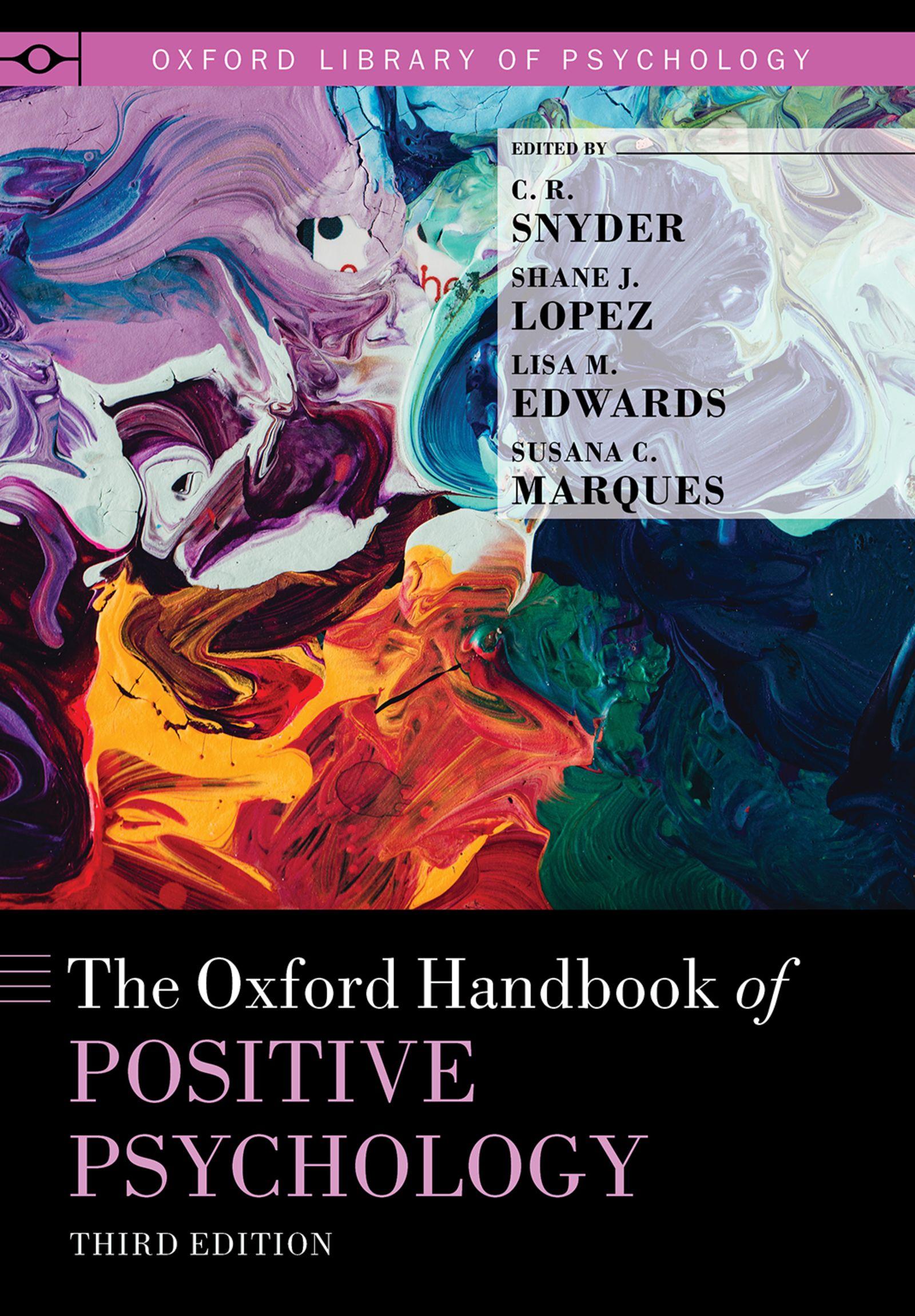
Edited by C. R. Snyder, Shane J. Lopez, Lisa M. Edwards, and Susana C. Marques
Oxford University Press is a department of the University of Oxford. It furthers the University’s objective of excellence in research, scholarship, and education by publishing worldwide. Oxford is a registered trade mark of Oxford University Press in the UK and certain other countries.
Published in the United States of America by Oxford University Press 198 Madison Avenue, New York, NY 10016, United States of America.
All rights reserved. No part of this publication may be reproduced, stored in a retrieval system, or transmitted, in any form or by any means, without the prior permission in writing of Oxford University Press, or as expressly permitted by law, by license, or under terms agreed with the appropriate reproduction rights organization. Inquiries concerning reproduction outside the scope of the above should be sent to the Rights Department, Oxford University Press, at the address above.
You must not circulate this work in any other form and you must impose this same condition on any acquirer.
Library of Congress Cataloging-in-Publication Data
Names: Snyder, C. R., editor. | Lopez, Shane J., editor.
Title: The Oxford handbook of positive psychology / edited by C. R. Snyder, Shane J. Lopez, Lisa M. Edwards, Susana C. Marques.
Description: Third Edition. | New York : Oxford University Press, 2021. | Revised edition of Oxford handbook of positive psychology. |
Identifiers: LCCN 2020027350 (print) | LCCN 2020027351 (ebook) | ISBN 9780199396511 (hardback) | ISBN 9780199396535 (ebook)
LC record available at https://lccn.loc.gov/2020027350
LC ebook record available at https://lccn.loc.gov/2020027351
9 8 7 6 5 4 3 2 1 Printed by Sheridan Books, Inc., United States of America
SHORT CONTENTS
About the editors xiii
Contributors xv
Foreword xxi
Memoriam: Remembering C. R. Snyder: A Humble Legacy of Hope xxv
Memoriam: Remembering Shane J. Lopez: A Legacy of Spreading Hope xxvii
Preface xxix
Chapters 1–974
Index 975
CONTENTS
About the editors xiii
Contributors xv
Foreword xxi
Memoriam: Remembering C. R. Snyder: A Humble Legacy of Hope xxv
Memoriam: Remembering Shane J. Lopez: A Legacy of Spreading Hope xxvii
Preface: xxix
Lisa M. Edwards
Part 1 • Major Developments in Positive Psychology 1
1. Strengthening Positive Psychology 3
Matthew W. Gallagher, Shane J. Lopez
2. Speculation, Conceptualization, or Evidence? A History of Positive Psychology 8
Christina A. Downey, Reggie E. Henderson
3. Positive Emotions 18
Michele M. Tugade, Hillary C. Devlin, Barbara L. Fredrickson
4. Classifying and Measuring Strengths of Character 33
Nansook Park
5. Applications of Positive Psychology 43
Alex M. Wood, Adam T. Davidson, P. Alex Linley, John Maltby, Susan Harrington, Stephen Joseph
6. Positive Psychology within a Cultural Context 59
Jennifer Teramoto Pedrotti, Lisa M. Edwards, Shane J. Lopez
Part 2 • Positive Psychology Perspectives on Human Behavior 71
7. Stopping the “Madness”: Positive Psychology and Deconstructing the Illness Ideology and the DSM 73
James E. Maddux
8. Widening the Diagnostic Focus: A Case for Including Human Strengths and Environmental Resources 88
Beatrice A. Wright, Shane J. Lopez, Jeana L. Magyar
9. Better Together: The Sciences and the Humanities in the Quest for Human Flourishing 108
James O. Pawelski, Louis Tay
10. Mental Health: Multiple Perspectives for an Evolving Concept 125
Antonella Delle Fave, Luca Negri
11. Capturing the Complexity and Dynamics of Positive Human Health: Conceptual and Methodological Considerations 141
Jonathan Rush, Anthony D. Ong, Scott M. Hofer, John L. Horn
Part 3 • Positive Psychology across the Lifespan 151
12. Positive Psychology of Infancy and Early Childhood: Chapter in the Handbook of Positive Psychology 153
John K. Coffey
13. Resilience in Development 171
J. J. Cutuli, Janette E. Herbers, Ann S. Masten, Marie-Gabrielle J. Reed
14. Positive Psychology for Children and Adolescents: Development, Prevention, and Promotion 189
Jason Van Allen, Keri J. Brown Kirschman, Paige L. Seegan, Rebecca J. Johnson
15. Positive Youth Development: Relational Developmental Systems
Approaches to Thriving from Childhood to Early Adulthood 207
Kristina Schmid Callina, Megan Kiely Mueller, Christopher M. Napolitano, Jacqueline V. Lerner, Richard M. Lerner
16. Positive Aging from a Lifespan Perspective 224
Jeanne Nakamura, Thomas Chan
17. Territories of Positive Life Span Development: Wisdom and Sehnsucht (Life Longings) 238
Susanne Scheibe, Ute Kunzmann
Part 4 • Emotional Approaches 253
18. Subjective Well-Being: The Science of Happiness and Life Satisfaction 255
Shigehiro Oishi, Ed Diener, Richard E. Lucas
19. Happiness in Nations: Pursuit of Greater Happiness for a Greater Number of Citizens 265
Ruut Veenhoven
20. The Experience of Flow: Theory and Research 279
Jeanne Nakamura, Mihaly Csikszentmihalyi
21. Positive Affectivity: The Disposition to Experience Pleasurable Emotional States 297
Kristin Naragon-Gainey, David Watson
22. The Social Construction of Self-Esteem 309
John P. Hewitt
23. Coping through Emotional Approach: The Utility of Processing and Expressing Emotions in Response to Stress 319
Patricia I. Moreno, Joshua F. Wiley, Annette L. Stanton
24. Thriving on Emotional Intelligence? Bridging Research and Practice 340
Paulo Nuno Lopes
Part 5 • Cognitive Approaches 355
25. Creativity 357
Dean Keith Simonton
26. The Role of Personal Control in Adaptive Functioning 368
Suzanne C. Thompson
27. Well-Being: Mindfulness versus Positive Evaluation 379
Ellen J. Langer, Christelle T. Ngnoumen
28. Optimism 396
Maria G. Mens, Michael F. Scheier, Charles S. Carver
29. Optimistic Explanatory Style 413
Christopher Peterson, Tracy A. Steen
30. Hope Theory 425
Kevin L. Rand, Kaitlin K. Touza
31. Self-Efficacy: The Power of Believing You Can 443
James E. Maddux, Evan M. Kleiman
32. The Important Role of Problem Solving Appraisal in Creating a Positive Life Across Cultural Contexts 453
P. Paul Heppner, Dong-Gwi Lee, Lu Tian
33. Self-Determination 471
Michael L. Wehmeyer, Karrie A. Shogren, Todd D. Little, Nicole Adams
34. Curiosity and Interest: The Benefits of Thriving on Novelty and Challenge 482
Paul J. Silvia, Todd B. Kashdan
35. Courage 493
Cynthia L. S. Pury, Alice M. Brawley Newlin, Emily A. Burnett, Shane J. Lopez
Part 6 • Interpersonal Approaches 505
36. Compassion 507
Eric J. Cassell
37. Attachment Theory as a Relational Framework for Positive Psychology 519
Mario Mikulincer, Phillip R. Shaver
38. Understanding Empathy: Current State and Future Research Challenges 533
Changming Duan, Kristen Sager
39. Forgiveness 551
Jo-Ann Tsang, Stephen R. Martin
40. Progress in the Science of Gratitude 571
Philip C. Watkins, Duncan McCurrach
41. Love 586
Clyde Hendrick, Susan S. Hendrick
42. Positive Processes in Close Relationships 599
Shelly L. Gable, Natalya C. Maisel
43. Intergenerational Solidarity: Dualities in the Evolution of a Paradigm 611
Merril Silverstein
Part 7 • Self-Based Approaches 621
44. What’s Positive About Self-Verification? 623
Rebecca J. North, William B. Swann Jr.
45. Reality Negotiation 635
Matthew W. Gallagher
46. Humility: A Qualitative Review 643
Everett L. Worthington Jr., Lillian Goldstein, Brianne Hammock, Brandon J. Griffin, Rachel C. Garthe, Caroline Lavelock, Don E. Davis, Joshua N. Hook, Daryl R. Van Tongeren
Part 8 • Biological Approaches 657
47. Toward a Biology of Social Support 659
Emily D. Hooker, Peggy M. Zoccola, Sally S. Dickerson
48. New Perspectives On the Role of the Heart in Positive Emotions, Intuition, and Social Coherence 669
Rollin McCraty, Robert A. Rees
49. Building Emotional Stability and Mental Capacity: The Toughness Model 687
Richard A. Dienstbier, Lisa M. PytlikZillig
50. The Associations Between Positive Affect and Health: Findings and Future Directions 703
John Hunter, Marie Cross, Sarah Pressman
51. Neurogenetics of Resilience 718
Adam Anderson, Hans Melo
52. Neural Connectivity of the Creative Mind 734
Psyche Loui, Setareh O’Brien, Samuel Sontag
53. Neural and Physiological Mechanisms of Altruism and Empathy 754
Stephanie D. Preston
Part 9 • Positive Institutions 773
54. Family-Centered Positive Psychology: A Framework for Research-Based Practices 775
Susan M. Sheridan, Amanda Moen, Sonya Bhatia
55. School as a Positive Learning and Working Environment 788
Claudia Harzer, Marco Weber, E. Scott Huebner
56. Positive Psychology on Campus 807
Laurie A. Schreiner, Eileen Hulme
57. Positive Workplaces 820
Fred Luthans, Carolyn M. Youssef-Morgan
58. Positive Institutions: Organizations, Laws, and Policies 832
Peter H. Huang, Anne M. Brafford, Debra S. Austin, Martha Knudson
59. Psychotherapy, Counseling, and Coaching: Different Alternatives for Promoting Psychological Well-Being 852
Chiara Ruini, Susana C. Marques
Part 10 • Specific Coping Approaches 861
60. Meditation and Positive Psychology 863
Shauna L. Shapiro, Hooria Jazaieri, Sarah de Sousa
61. Spirituality: The Search for the Sacred 878
Kenneth I. Pargament, Annette Mahoney
62. Personal Narratives, Expressive Writing, and Well being 892
Margarita Tarragona
63. Benefit-Finding 907
Suzanne C. Lechner
64. Pathways to Growth Following Trauma and Loss 919
Christopher G. Davis, Janessa E. Porter
65. Happiness and Resilience Following Physical Disability 928
Dana S. Dunn, Gitendra Uswatte, Timothy R. Elliott
Part 11 • Toward Better Lives 943
66. The Promise of Fostering Greater Happiness 945
Julia K. Boehm, Peter M. Ruberton, Sonja Lyubomirsky
67. Meaning in Life: A Unified Model 959
Michael F. Steger
68. The Future of Positive Psychology: A Bright Outlook 968
Rhea L. Owens
Index 975
ABOUT THE EDITORS
C. R. Snyder was a professor of psychology and the M. Erik Wright Distinguished Professor of Clinical Psychology in the Department of Psychology at the University of Kansas, Lawrence. His theories pertained to how people react to personal feedback, the human need for uniqueness, the ubiquitous drive to excuse transgressions, and the hope motive. Throughout his career, he received 27 teaching awards at the university, state, and national levels and 31 research awards, including the 2002 Balfour Jeffrey Award for Research Achievement in Humanities and Social Science and the 2001 Guilford Press Award for Pioneering Scholarly Contributions in Clinical/Social/Personality Psychology. He passed away in 2006.
Shane J. Lopez was senior scientist in residence at Gallup and research director for the Clifton Strengths Institute. He published and edited numerous books throughout his career, including Positive Psychology: The Scientific and Practical Explorations of Human Strengths, The Oxford Handbook of Positive Psychology, Positive Psychological Assessment: A Handbook of Models and Measures, Positive Psychology: Exploring the Best in People, The Encyclopedia of Positive Psychology, and The Psychology of Courage: Modern Research on an Ancient Virtue. He was a fellow of the American Psychological Association and the International Positive Psychology Association. He passed away in 2016.
Lisa M. Edwards is full professor in the Counselor Education and Counseling Psychology Department at Marquette University in Milwaukee, Wisconsin. She received her master’s and doctoral degrees in counseling psychology at the University of Kansas and completed a research postdoctoral fellowship at the University of Notre Dame. A licensed psychologist with expertise in multiculturalism and positive psychology, Edwards currently teaches, conducts research, mentors graduate students, and directs the master’s programs in her department. Edwards has written numerous articles, chapters, and books about the intersection of positive psychology and culture, and her current research focuses on the perinatal mental health among Latinx mothers.
Susana C. Marques is a researcher at the University of Oxford, England. Much of her research focuses on key psychosocial resources and how they can be used to help individuals, groups and organizations flourish.
She previously earned her doctoral degree at Porto University, Portugal, where she coordinated the subject of positive psychology; supervised master, doctoral, and postdoctoral researchers; and worked as a full member of the Center of Psychology. Marques has written numerous articles, chapters, and books concerning positive psychology, especially focused on hope.
Nicole Adams
CONTRIBUTORS
Texas Tech University
Lubbock, Texas
Adam Anderson
Cornell University
Ithaca, New York
Debra S. Austin
Sturm College of Law
University of Denver
Sonya Bhatia
Nebraska Center for Research on Children, Youth, Families, and Schools
University of Nebraska–Lincoln
Lincoln, Nebraska
Julia K. Boehm
Department of Psychology
Chapman University
Orange, California
Anne M. Brafford
Claremont Graduate University
Alice M. Brawley Newlin
Clemson University
Clemson, South Carolina
Keri J. Brown Kirschman
University of Dayton Dayton, Ohio
Emily A. Burnett
Clemson University
Clemson, South Carolina
Kristina Schmid Callina
Tufts University
Medford, Massachusetts
Charles S. Carver
University of Miami
Coral Gables, Florida
Eric J. Cassell
Weill Medical College of Cornell University
New York, New York
Thomas Chan
California State University, Northridge Northridge, California
John K. Coffey
Sewanee: The University of the South Sewanee, TN
Marie Cross
University of California, Irvine
Irvine, California
Mihaly Csikszentmihalyi
Claremont Graduate University
Claremont, California
J. J. Cutuli
Nemours Children’s Health System. Wilmington, Delaware
Adam T. Davidson
The Department of Psychological and Behavioural Science
The London School of Economics and Political Sciences
Christopher G. Davis
Carleton University Ottawa, Ontario, Canada
Don E. Davis
Georgia State University
Atlanta, Georgia
Antonella Delle Fave
Department of Pathophysiology and Transplantation
University of Milan Milan, Italy
Sarah de Sousa
Department of Counseling Psychology
Santa Clara University
Santa Clara, California
Hillary C. Devlin
Dr. Hillary Devlin Psychological Services, PLLC, New York, NY
Sally S. Dickerson
Ohio University
Athens, Ohio
Ed Diener
University of Utah and University of Virginia
The Gallup Organization
Richard A. Dienstbier
Department of Psychology University of Nebraska
Christina A. Downey
Indiana University Kokomo Kokomo, Indiana
Changming Duan University of Kansas Lawrence, Kansas
Dana S. Dunn
Moravian College Bethlehem, Pennsylvania
Lisa M. Edwards
Marquette University
Timothy R. Elliott
Texas A&M University College Station, Texas
Barbara L. Fredrickson
University of North Carolina at Chapel Hill
Chapel Hill, North Carolina
Shelly L. Gable
University of California, Santa Barbara
Santa Barbara, California
Matthew W. Gallagher University of Houston Houston, Texas
Rachel C. Garthe
School of Social Work
University of Illinois-Champaign-Urbana
Lillian Goldstein
Virginia Commonwealth University Richmond, Virginia
Brandon J. Griffin
Assistant Professor, University of Arkansas for Medical Sciences
Staff Psychologist, Central Arkansas VA Health Care System
Brianne Hammock
Independent Scholar
Susan Harrington
School of Psychology
University of Leicester
Claudia Harzer
University of Greifswald Greifswald, Germany
Reggie E. Henderson
Indiana University Kokomo Kokomo, Indiana
Clyde Hendrick
Texas Tech University
Susan S. Hendrick
Texas Tech University
P. Paul Heppner
Department of Educational, School and Counseling Psychology University of Missouri
Janette E. Herbers
Villanova University Villanova, Pennsylvania
John P. Hewitt
Department of Sociology
University of Massachusetts Amherst
Scott M. Hofer
University of Victoria Victoria, British Columbia, Canada
Joshua N. Hook
University of North Texas Denton, Texas
Emily D. Hooker
University of California, Irvine Irvine, California
John L. Horn
University of Southern California
Los Angeles, California
Peter H. Huang University of Colorado Law School
E. Scott Huebner
University of South Carolina Columbia, South Carolina
Eileen Hulme
Azusa Pacific University Azusa, California
John Hunter
University of California, Irvine
Irvine, California
Hooria Jazaieri
Department of Management & Entrepreneurship
Leavey School of Business, Santa Clara University
Santa Clara, CA
Rebecca J. Johnson
Children’s Mercy Kansas City
University of Missouri Kansas City School of Medicine
Kansas City, MO
Stephen Joseph
School of Education
Nottingham, UK
Todd B. Kashdan
George Mason University
Fairfax, Virginia
Evan M. Kleiman
Rutgers University
New Brunswick, NJ
Martha Knudson
Executive Director Utah State Bar Well-Being Committee for the Legal ProfessionSalt Lake City, Utah
Ute Kunzmann
University of Leipzig
Leipzig, Germany
Ellen J. Langer
Harvard University
Cambridge, Massachusetts
Caroline Lavelock
University of Illinois-Chicago
Chicago, Illinois
Suzanne C. Lechner
Independent Scholar
Parkland, Florida
Dong-Gwi Lee
Department of Psychology
Yonsei University
Seoul, South Korea
Jacqueline V. Lerner
Boston College
Newton, Massachusetts
Richard M. Lerner
Tufts University
Medford, Massachusetts
P. Alex Linley
Centre for Applied Positive Psychology
Coventry, UK
Todd D. Little
Texas Tech University
Lubbock, Texas
Paulo Nuno Lopes
Católica Lisbon School of Business and Economics
Catholic University of Portugal
Lisbon, Portugal
Shane J. Lopez
Clifton Strengths Institute/Gallup and University of Kansas
Lawrence, Kansas
Psyche Loui
Northeastern University
Boston, MA, USA
Richard E. Lucas
Department of Psychology
Michigan State University
Fred Luthans
Department of Management University of Nebraska-Lincoln Lincoln, NE
Sonja Lyubomirsky
Department of Psychology
University of California, Riverside Riverside, California
James E. Maddux Department of Psychology
George Mason University
Jeana L. Magyar Department of Psychology
University of Wisconsin-Stevens Point
Annette Mahoney
Department of Psychology
Bowling Green State University
Bowling Green, Ohio
Natalya C. Maisel
Institute for Research in the Social Sciences
Stanford University
Stanford, California
John Maltby
Department of Neuroscience, Physchology, and Behaviour
University of Leicester
Susana C. Marques
Faculty of Psychology and Educational Sciences
Porto University
Porto, Portugal
Stephen R. Martin
Baylor University
Waco, Texas
Ann S. Masten
University of Minnesota, Twin Cities
Minneapolis, Minnesota
Rollin McCraty
HeartMath Research Center
Boulder Creek, CA
Duncan McCurrach
Eastern Washington University
Cheney, Washington
Hans Melo
Menton AI
Toronto, Ontario, Canada
Maria G. Mens
Carnegie Mellon University
Pittsburgh, Pennsylvania
Mario Mikulincer
Baruch Ivcher School of Psychology
Interdisciplinary Center Herzliya
Herzliya, Israel
Amanda Moen
Kennedy Krieger Institute
Baltimore, Maryland
Patricia I. Moreno
Northwestern University Feinberg School of Medicine
Chicago, Illinois
Megan Kiely Mueller
Tufts University
Medford, Massachusetts
Jeanne Nakamura
Claremont Graduate University
Claremont, California
Christopher M. Napolitano
University of Zurich
Zurich, Switzerland
Kristin Naragon-Gainey
School of Psychological Science
University of Western Australia
Crawley, Western Australia
Luca Negri
Department of Pathophysiology and Transplantation
University of Milan
Milan, Italy
Christelle T. Ngnoumen
Harvard University
Cambridge, Massachusetts
Rebecca J. North
Huston-Tillotson University
Austin, TX
Setareh O’Brien
Clark University
Worcester, Massachusetts
Shigehiro Oishi
Department of Psychology
University of Virginia
Anthony D. Ong
Cornell University
Ithaca, New York
Rhea L. Owens
Department of Psychology
University of Minnesota Duluth
Kenneth I. Pargament
Department of Psychology
Bowling Green State University
Bowling Green, Ohio
Nansook Park
Department of Psychology
University of Michigan
Ann Arbor, Michigan
James O. Pawelski
University of Pennsylvania
Philadelphia, Pennsylvania
Jennifer Teramoto Pedrotti
California Polytechnic State University
San Luis Obispo, CA
Christopher Peterson
Carleton University
Ottowa, Ontario, Canada
Janessa E. Porter
Carleton University
Ottowa, Ontario, Canada
Sarah Pressman
University of California, Irvine
Irvine, California
Stephanie D. Preston
University of Michigan
Ann Arbor, Michigan
Cynthia L. S. Pury
Clemson University
Clemson, South Carolina
Lisa M. PytlikZillig
University of Nebraska Public Policy Center
Social and Behavioral Sciences Research Consortium
Department of Psychology
University of Nebraska-Lincoln
Kevin L. Rand
Indiana University–Purdue University Indianapolis Indianapolis, Indiana
Marie-Gabrielle J. Reed
Private Practice, Reed Clinical and Forensic Services Minneapolis, Minnesota
Robert A. Rees
Graduate Theological Union Berkeley, CA
Peter M. Ruberton
Department of Psychology
The Pennsylvania State University University Park, PA
Chiara Ruini
Department of Psychology University of Bologna Bologna, Italy
Jonathan Rush University of Victoria Victoria, British Columbia, Canada
Kristen Sager University of Kansas Lawrence, Kansas
Susanne Scheibe University of Groningen Groningen, Netherlands
Michael F. Scheier
Carnegie Mellon University Pittsburgh, Pennsylvania
Laurie A. Schreiner Azusa Pacific University Azusa, California
Paige L. Seegan
Texas Tech University Lubbock, Texas
Shauna L. Shapiro
Department of Counseling Psychology
Santa Clara University
Santa Clara, California
Phillip R. Shaver
Department of Psychology University of California Davis Davis, CA, USA
Susan M. Sheridan
Nebraska Center for Research on Children, Youth, Families, and Schools University of Nebraska–Lincoln Lincoln, Nebraska
Karrie A. Shogren University of Kansas Lawrence, Kansas
Merril Silverstein
Aging Studies Institute, Department of Sociology, Department of Human Development and Family Science
Syracuse University Syracuse, New York
Paul J. Silvia
University of North Carolina at Greensboro Greensboro, North Carolina
Dean Keith Simonton University of California, Davis Davis, California
Samuel Sontag Wesleyan University
Middletown, Connecticut
Annette L. Stanton University of California, Los Angeles Los Angeles, California
Tracy A. Steen
Charles O’Brien Center for Addiction Treatment University of Pennsylvania
Michael F. Steger
Colorado State University
Fort Collins, Colorado and North-West University
Vanderbijlpark, South Africa
William B. Swann Jr.
The University of Texas at Austin
Austin, Texas
Margarita Tarragona
ITAM Institute of Well-being Studies. Instituto Tecnológico Autónomo de México Mexico City
Kaitlin K. Touza
University of Washington School of Medicine
Seattle, Washington
Louis Tay
Purdue University
West Lafayette, Indiana
Suzanne C. Thompson
Pomona College
Claremont, California
Lu Tian
University of Northern Colorado
Jo-Ann Tsang
Baylor University
Waco, Texas
Michele M. Tugade
Vassar College
Poughkeepsie, New York
Gitendra Uswatte
University of Alabama at Birmingham Birmingham, Alabama
Jason Van Allen
Texas Tech University
Lubbock, Texas
Daryl R. Van Tongeren
Hope College
Holland, Michigan
Ruut Veenhoven
Erasmus University Rotterdam
Rotterdam, Netherlands and North-West University
Vanderbijlpark, South Africa
Philip C. Watkins
Eastern Washington University
Cheney, Washington
David Watson
Department of Psychology
University of Notre Dame
Marco Weber
University of Greifswald
Greifswald, Germany
Michael L. Wehmeyer
University of Kansas
Lawrence, Kansas
Joshua F. Wiley
University of California, Los Angeles
Los Angeles, California
Alex M. Wood
London School of Economics and Political Science
London, England
Everett L. Worthington Jr.
Virginia Commonwealth University
Richmond, Virginia
Beatrice A. Wright
University of Kansas
Carolyn M. Youssef-Morgan
College of Business
Bellevue University
Bellevue, Nebraska
Peggy M. Zoccola
Ohio University
Athens, Ohio
FOREWORD
Oxford Handbook of Positive Psychology (3rd edition)
Every now and then, life drops into my lap a wonderful surprise. I took my first psychology course in the fall of 1973 at age 19 at the University of Richmond (while still a math major), never imagining in my wildest dreams that 43 years later it would be my honor and privilege to welcome you to the third edition of the Oxford Handbook of Positive Psychology. First published in 2002, just two years after the field was officially launched in a special edition of the American Psychologist, the OHPP quickly became the standard reference in the thennascent field and has remained so ever since. Given the stature of this book, I was both surprised and flattered by the invitation, and I am grateful to the editors for this opportunity.
How well is positive psychology doing 16 years after its launching? To use two terms so often used in positive psychology research, it is thriving and flourishing. Christopher Peterson noted in his foreword to the second edition (2009) that positive psychology “will rise or fall on the science on which it is based.” This volume provides ample evidence that the science is sound.
Peterson noted in his foreword that a Google search for “positive psychology” at that time resulted in just over 551,000 hits. I did a new search and got over 9.4 million hits (searches in several other languages resulted in mostly English results). A Google popularity contest may not be the best way to gauge the impact of positive psychology on science and society, but it certainly attests to the growing awareness of and interest in the field.
More important, perhaps, a Google Scholar search for “positive psychology” resulted in almost 2.8 million hits. Out of curiosity, I entered a few more key “positive” and “negative” terms into Google Scholar. “Well-being” (3.56 million) and “happiness” (1.55 million) combined to resoundingly beat both “depression” (3.65 million) and “anxiety” (3.09 million). “Love” beat “hate” more than three-to-one (3.65 million to 1.030 million),
an encouraging sign at a time when the news seems to reflect the opposite ratio.
In addition, Amazon.com search for books on “positive psychology” “happiness,” and “well-being” resulted in over 1270 books for each term (with considerable overlap among the titles).
Finally, a ten-minute Google search for “positive psychology journals” revealed a plethora of publication outlets, including Journal of Positive Psychology, Middle East Journal of Positive Psychology, Indian Journal of Positive Psychology, Journal of Positive Behavioral Interventions, European Journal of Applied Positive Psychology, International Journal of Applied Positive Psychology, International Journal of Existential Positive Psychology, Psychology of Well-Being, British Journal of Well-Being, International Journal of WellBeing, Applied Psychology: Health and Well-Being, Journal of Student Well-Being, Social Inquiry into Well-Being, Journal of Happiness Studies, Journal of Happiness and Well-Being, International Journal for Happiness and Development, International Journal of Qualitative Studies on Health and Well-Being, Quality of Life Research, Applied Research in Quality of Life, Health and Quality of Life Outcomes. I’m sure a few more have been created since I did this search.
We cannot, of course, compare any of these data with nonexistent data from 2009, but clearly “what makes life most worth living” (Peterson, 2009, p. xxiii) is a topic of considerable interest to researchers, scholars, and writers—and not just psychologists but also sociologists, economists, philosophers, political scientists, educators, and others.
Economists and policy makers, for example, have become increasingly concerned with measures of quality of life and life satisfaction in addition to the traditional measure of standard of living—a purely monetary metric. In 2000, Edward Diener proposed an index for measuring a nation’s happiness. At the time, this idea might have been a novel one in the western world, but the notion of “gross national happiness” actually originated in Bhutan in 1972 and is now incorporated in that government’s economic and development planning. Well-being
also has made its way into the constitutions of several nations, including Japan, South Korea, Ecuador, and Bolivia. The United Nations released its first World Happiness Report in 2011. In 2013, Santa Monica, California became the first city in the United States to officially make its citizens’ well-being a priority by launching its Well-Being Project, an example of a growing interest in social and collective endeavors to enhance well-being in communities, as advocated in the work of Isaac Prilleltensky and Vasti Roodt, among others.
In the field of education, a “well-being university” movement is well underway. My university recently incorporated into its ten-year plan the goal of creating “a model well-being university where students, faculty, and staff are building a life of vitality, purpose, and resilience.” Similar efforts are underway at Tecmilenio University in Mexico, the University of Wollongong in Australia, the University of Lisbon in Portugal, and probably other places that I am not yet aware of. The first international symposium on the well-being university was held in Portugal in 2016 with participants from universities in nine countries. The first major edited work on well-being in higher education appeared in late 2016 (Harward, 2016). I view this movement as a welcome return to the classic notion of a “liberal” education—one that prepares students not just for the world of work but also for responsible citizenship.
It is worth reiterating that while positive psychology is concerned with enhancing happiness and well-being, it is not simply about looking at the “bright side” of everything or always “seeing the glass as half full.” It is also not about ignoring pathology, pain, suffering, and evil. It is, however, about actively searching for the many aspects of life that we can appreciate, value, enjoy, and savor and about helping people who might not be pathological, pained, suffering, or evil make their lives better.
The road to greater well-being is not always an easy one. Contrary to what seems to be an increasingly popular point of view (at least in the United States), the goal of helping people strive for greater well-being should not be misconstrued as a misguided effort to shield people, especially young people, from adversity and from ideas they might find unpalatable or even disturbing. Instead, it requires helping them to look reality squarely in the face and to even welcome adversity and differences of opinion as opportunities for growth. Well-being cannot be had without resilience, and one cannot develop resilience if one is shielded from hardship;
one must be exposed to it and learn to overcome it. If positive psychology is to be concerned with helping people find meaning and purpose in life, then we must not forget that finding meaning and purpose is sometimes a struggle and is often the result of struggle, and not the result of taking the path of least resistance. As Sir John Templeton said in his foreword to the first edition of this book in 2002, positive psychology is “the study and understanding of the power of the human spirit to benefit from life’s challenges” (2002).
Over twenty-five years ago I noticed a small, framed poster in the office of my dental hygienist that said (without attribution) “There is more to life than increasing its speed.” When I got home that day, I put that quote on an index card and taped it to the cabinet door over my kitchen sink, where it remains to this day. (I later learned that its author is Mahatma Gandhi.) To me, this book and the field of positive psychology are about helping people stop speeding through life and pay more attention to what really matters and to “what makes life most worth living.”
Chris Peterson ended his foreword to the second edition on a somber note by acknowledging the passing of Rick Snyder, co-editor of the first and second editions of this book, and I must do the same. Not only has Chris left us since the second edition, but just a week after I received the invitation to write this foreword, I received the news that Shane Lopez, co-editor of all three editions, had unexpectedly passed away. This means that three of positive psychology’s most important pioneers and advocates are no longer with us. In addition, my major advisor in graduate school, social psychologist Ronald Rogers, passed away three years ago at the relatively young age of 69. Ron started me on a research career and encouraged me to pursue my interest in the integration of social, clinical, and health psychology and therefore had me doing positive psychology before the term was coined. Rick also opened some important doors for me over the years, including convincing Guilford Publications to make me the editor of the Journal of Social and Clinical Psychology.
All four left us much too soon, but they also left us with an invaluable legacy of contributions to psychology. Chris ended his foreword expressing his gratitude to Rick, and I end mine by expressing my gratitude to Chris, Shane, Rick, and Ron.
James E. Maddux Center for the Advancement of Well-Being George Mason University
Harward, D. (Ed.). (2016). Well-being and higher education: A strategy for change and the realization of education’s greater purposes. Washington, DC: Association of American Colleges and Universities.
Helliwell, J., Layard, R.; Sachs, J. (April 2, 2012). “World Happiness Report” Columbia University Earth Institute. (Retrieved 2016-08-10)
Peterson, C. (2009). Foreword. Oxford handbook of positive psychology (2nd ed.). New York: Oxford University Press. Templeton, J. (2002). Foreword. Oxford handbook of positive psychology. New York: Oxford University Press.
Foreword
MEMORIAM
REMEMBERING C. R. SNYDER: A HUMBLE LEGACY OF HOPE
C. R. Snyder was a professor of psychology and the M. Erik Wright Distinguished Professor of Clinical Psychology in the Department of Psychology at the University of Kansas (KU), Lawrence. Dr. Snyder passed away on January 17, 2006. The event was held on the beautiful campus of the University of Kansas, Rick’s professional home for 34 years. In fact, the hall where we gathered stood only a few thousand feet from both Rick’s academic home, Fraser Hall, and his beloved family home, a beautiful white colonial where he and his wife, Becky, welcomed friends, students, and colleagues. Stories about Rick’s professional, personal, and downright hilarious exploits flowed between family, friends, students, and colleagues. We were a crowd sharing funny memories, giggling through sobs, and honoring Rick for his public and private contributions to psychology, society, and our lives. In this remembrance of my dear mentor and friend, I attempt to explain how one uncommonly good man tirelessly worked to help many others become the uncommonly good people he foresaw that they could be. Rick Snyder had an uncanny talent for emotionally connecting with people through short, sincere interactions that could easily have become nothing more than small talk. Friends say he developed this skill out of necessity because, as the son of a salesman, his family moved nearly every year during his childhood and adolescence. In his adulthood, Rick’s gift for emotional connections brought him warm relationships through which he seemed to happily do more giving than taking. His years of loving generosity for his family, colleagues, and students often left a transformative legacy. Indeed, Rick had a knack for giving what we needed, when we needed it. In my case, Rick took me under his wing the summer before my job at KU officially started. He treated me as an equal, and he never let me allow self-doubts to get in the way of my success as a professor. He often saw possibilities before I did, and he shared opportunities that both excited and daunted me. This was Rick’s way, and it’s a story I’ve heard repeatedly from his many mentees and colleagues.
Visiting with his other mentees at the memorial service made me realize that dozens of people had benefited similarly from what Rick called the “lifetime guarantee” on his mentoring. And as recent graduate Jennifer Cheavens reminded us, although we may have thought this guarantee would be fulfilled through personal visits, over the phone, and through e-mail notes, Rick’s passing did not nullify the warranty. It simply means that Rick’s positive influence will extend in ways we had not had to consider. We carry within us his teachings, to guide us in our efforts to live up to the example he set for us, to help us actually be the people he said he saw inside each of us. Indeed, his teachings make his guarantee good across our lifetimes.
The memorial service was moving and appropriately understated, as Rick was no fan of pomp or piety. Perhaps this is why he continually tried to teach the importance of having fun and the quiet dignity of maintaining our humility. Rick loved to say, “If you can’t laugh at yourself, you have missed the biggest joke of all.” He practiced what he preached; he laughed at his own gaffs just about daily. Through his own, quirky behavior, Rick made it safe to say, “I don’t know” and “I messed up,” and of course, he never let me take myself too seriously. Most importantly, he made me laugh, all the time. Whether Rick was dive-bombing me during a research meeting with one of the model planes in his office or he was breaking campus rules and a few laws by driving my wife’s scooter across hallowed ground and squealing, “Wheeee!” as he did it, that lovely man cracked me up.
During the memorial, colleagues remembered Rick as both King Midas and a working stiff. Both descriptions are apt. One of my favorite memories captures both facets of Rick. In 2000, along with several other leading contemporaries in positive psychology, Rick appeared on a 2-hour Good Morning America special dedicated to sharing the social science of the good life. Rick chose to conduct a live experiment to demonstrate hope theory in action. So, on national network television, Rick had three