The moral rights of the authors have been asserted
First published in 2019
All rights reserved No part of this publication may be reproduced, stored in a retrieval system, or transmitted, in any form or by any means, without the prior permission in writing of Oxford University Press, or as expressly permitted by law, by licence or under terms agreed with the appropriate reprographics rights organization Enquiries concerning reproduction outside the scope of the above should be sent to the Rights Department, Oxford University Press, at the address above
You must not circulate this work in any other form and you must impose this same condition on any acquirer
British Library Cataloguing in Publication Data
Data available
978-0-19-842705-6
1 3 5 7 9 10 8 6 4 2
Paper used in the production of this book is a natural, recyclable product made from wood grown in sustainable forests The manufacturing process conforms to the environmental regulations of the country of origin
Printed in Italy by L E G O SpA
Acknowledgements
The author would like to thank the following authors for contributions to digital resources:
Paul Belcher
Ingrid Delange
Suzanne Doering
Ben Donaldson
Panayiotis Economopoulos
Tom Edinburgh
Jim Fensom
Jane Forrest
Peter Gray
Tony Halsey
David Harris
Georgios Ioannadis
Blas Kolic
Julija Markeviciute
Vilda Markeviciute
Martin Noon
Dane Rogers
Daniel Wilson-Nunn
Tom Wolstenholme
The publisher and authors would like to thank the following for permission to use photographs and other copyright material:
The IB Diploma Programme Course Companions are designed to support students throughout their twoyear Diploma Programme. They will help students gain an understanding of what is expected from their subject studies while presenting content in a way that illustrates the purpose and aims of the IB They reect the philosophy and approach of the IB and encourage a deep understanding of each subject by making connections to wider issues and providing opportunities for critical thinking
The books mirror the IB philosophy of viewing the curriculum in terms of a whole-course approach and include support for international mindedness, the IB learner prole and the IB Diploma Programme core requirements, theory of knowledge, the extended essay and creativity, activity, service (CAS)
IB mission statement
The International Baccalaureate aims to develop inquiring, knowledgable and caring young people who help to create a better and more peaceful world through intercultural understanding and respect. To this end the IB works with schools, governments and international organisations to develop challenging programmes of international education and rigorous assessment
These programmes encourage students across the world to become active, compassionate, and lifelong learners who understand that other people, with their dierences, can also be right
The IB learner prole
The aim of all IB programmes is to develop internationally minded people who, recognising their common humanity and shared guardianship of the planet, help to create a better and more peaceful world. IB learners strive to be:
Inquirers They develop their natural curiosity. They acquire the skills necessary to conduct inquiry and research and show independence in learning. They actively enjoy learning and this love of learning will be sustained throughout their lives.
Knowledgeable They explore concepts, ideas, and issues that have local and global signicance In so
doing, they acquire in-depth knowledge and develop understanding across a broad and balanced range of disciplines
Thinkers They exercise initiative in applying thinking skills critically and creatively to recognise and approach complex problems, and make reasoned, ethical decisions
Communicators They understand and express ideas and information condently and creatively in more than one language and in a variety of modes of communication They work eectively and willingly in collaboration with others
Principled They act with integrity and honesty, with a strong sense of fairness, justice, and respect for the dignity of the individual, groups, and communities. They take responsibility for their own actions and the consequences that accompany them.
Open-minded They understand and appreciate their own cultures and personal histories, and are open to the perspectives, values, and traditions of other individuals and communities. They are accustomed to seeking and evaluating a range of points of view, and are willing to grow from the experience.
Caring They show empathy, compassion, and respect towards the needs and feelings of others. They have a personal commitment to service, and act to make a positive dierence to the lives of others and to the environment.
Risk-takers They approach unfamiliar situations and uncertainty with courage and forethought, and have the independence of spirit to explore new roles, ideas, and strategies They are brave and articulate in defending their beliefs
Balanced They understand the importance of intellectual, physical, and emotional balance to achieve personal well-being for themselves and others
Reective They give thoughtful consideration to their own learning and experience They are able to assess and understand their strengths and limitations in order to support their learning and professional development
How to use your enhanced online course book ...............................................ix
1 Measuring space: accuracy and
1 1 Representing numbers exactly and approximately
1 2 Angles and triangles
1.3 Three dimensional geometry....................
4 Modelling constant rates of change:
2 Representing and describing data: descriptive
2.1 Collecting and organizing data .................46
9 Modelling with matrices: storing and analysing data 372
9.1 Introduction to matrices and matrix operations ................................................ 374
9 2 Matrix multiplication and Properties 377
9 3 Solving systems of equations using matrices 383
9.4 Transformations of the plane..................391
9.5 Representing systems ........................... 402
9.6 Representing steady state systems..... 406
9.7 Eigenvalues and eigenvectors................ 413 Chapter review ................................................. 422
Modelling and investigation activity...............424
10 Analyzing rates of change: dierential calculus
10.1 Limits and derivatives ........................... 428
10.2 Dierentiation: further rules and techniques ............................................... 442
10.3 Applications and higher derivatives ......455 Chapter review ..................................................467
Modelling and investigation activity...............470
11 Approximating irregular spaces: integration and dierential equations 472 11.1 Finding approximate areas for irregular regions
12
13 Representing multiple outcomes:
13 3 Modelling the number of successes in a xed interval 587
13 4 Modelling measurements that are distributed randomly .......................... 593
13.5 Mean and variance of transformed or combined random variables ............... 601 13.6 Distributions of combined random variables ............................................... 604 Chapter review 616 Modelling and investigation activity 620
14 Testing for validity: Spearman’s, hypothesis testing and χ2 test for independence
14 1 Spearman’s rank correlation Coecient 625
14.2 Hypothesis testing for the binomial probability, the Poisson mean and the product moment correlation coecient .............................................629
14.3 Testing for the mean of a normal distribution 638
14 4 χ2 test for independence 650 14 5 χ2 goodness-of-t test 657
14.6 Choice, validity and interpretation of tests ...................................................670 Chapter review .............................................. 684 Modelling and investigation activity........... 688
15 Optimizing complex networks: graph theory
15 5 Graph theory for weighted graphs: the travelling salesman problem
Modelling and investigation activity...............734
16 Exploration
Practice exam paper 1
Practice exam paper
graphs 699
15 3 Graph theory for weighted graphs: the minimum spanning tree .................... 708
15.4 Graph theory for weighted graphs: the Chinese postman problem................... 714
Digital contents
Digital content overview
Click on this icon here to see a list of all the digital resources in your enhanced online course book. To learn more about the dierent digital resource types included in each of the chapters and how to get the most out of your enhanced online course book, go to page ix.
Syllabus coverage
This book covers all the content of the Mathematics: applications and interpretation HL course Click on this icon here for a document showing you the syllabus statements covered in each chapter
Practice exam papers
Click on this icon here for an additional set of practice exam papers.
Worked solutions
Click on this icon here for worked solutions for all the questions in the book
Introduction
The new IB diploma mathematics courses have been designed to support the evolution in mathematics pedagogy and encourage teachers to develop students’ conceptual understanding using the content and skills of mathematics, in order to promote deep learning The new syllabus provides suggestions of conceptual understandings for teachers to use when designing unit plans and overall, the goal is to foster more depth, as opposed to breadth, of understanding of mathematics
What is teaching for conceptual understanding in mathematics?
Traditional mathematics learning has often focused on rote memorization of facts and algorithms, with little attention paid to understanding the underlying concepts in mathematics. As a consequence, many learners have not been exposed to the beauty and creativity of mathematics which, inherently, is a network of interconnected conceptual relationships.
Teaching for conceptual understanding is a framework for learning mathematics that frames the factual content and skills; lower order thinking, with disciplinary and non-disciplinary concepts and statements of conceptual understanding promoting higher order thinking Concepts represent powerful, organizing ideas that are not locked in a particular place, time or situation In this model, the development of intellect is achieved by creating a synergy between the factual, lower levels of thinking and the conceptual higher levels of thinking Facts and skills are used as a foundation to build deep conceptual understanding through inquiry
The IB Approaches to Teaching and Learning (ATLs) include teaching focused on conceptual understanding and using inquiry-based approaches These books provide a structured inquiry-based approach in which learners can develop an understanding of the purpose of what they are learning by asking the questions: why or how? Due to this sense of purpose, which is always situated within a context, research shows that learners are more motivated and supported to construct their
own conceptual understandings and develop higher levels of thinking as they relate facts, skills and topics.
The DP mathematics courses identify twelve possible fundamental concepts which relate to the ve mathematical topic areas, and that teachers can use to develop connections across the mathematics and wider curriculum:
Approximation
Change
Equivalence
Generalization
Modelling Patterns Quantity
Relationships
Representation
Space Systems
Validity
Each chapter explores two of these concepts, which are reected in the chapter titles and also listed at the start of the chapter.
The DP syllabus states the essential understandings for each topic, and suggests some concept-specic conceptual understandings relevant to the topic content For this series of books, we have identied important topical understandings that link to these and underpin the syllabus, and created investigations that enable students to develop this understanding These investigations, which are a key element of every chapter, include factual and conceptual questions to prompt students to develop and articulate these topical conceptual understandings for themselves
A tenet of teaching for conceptual understanding in mathematics is that the teacher does not tell the student what the topical understandings are at any stage of the learning process, but provides investigations that guide students to discover these for themselves The teacher notes on the ebook provide additional support for teachers new to this approach
A concept-based mathematics framework gives students opportunities to think more deeply and critically, and develop skills necessary for the 21st century and future success.
Jennifer Chang Wathall
Gives students the opportunity to reect on what they have learned and deepen their understanding.
In every chapter, investigations provide inquiry activities and factual and conceptual questions that enable students to construct and communicate their own conceptual understanding in their own words The key to concept-based teaching and learning, the investigations allow students to develop a deep conceptual understanding Each investigation has full supporting teacher notes on the enhanced online course book
Every chapter starts with a question that students can begin to think about from the start, and answer more fully as the chapter progresses. The developing inquiry skills boxes prompt them to think of their own inquiry topics and use the mathematics they are learning to investigate them further.
The modelling and investigation activities are open-ended activities that use mathematics in a range of engaging contexts and to develop students’ mathematical toolkit and build the skills they need for the IA They appear at the end of each chapter
The chapters in this book have been written to provide logical progression through the content, but you may prefer to use them in a dierent order, to match your own scheme of work. The Mathematics: applications and interpretation Standard and Higher Level books follow a similar chapter order, to make teaching easier when you have SL and HL students in the same class. Moreover, where possible, SL and HL chapters start with the same inquiry questions, contain similar investigations and share some questions in the chapter reviews and mixed reviews – just as the HL exams will include some of the same questions as the SL paper.
TOK and International-mindedness are integrated into all the chapters
How to use your enhanced online course book
Throughout the book you will nd the following icons. By clicking on these in your enhanced online course book you can access the associated activity or document
Prior learning
Clicking on the icon next to the ‘‘Before you start” section in each chapter takes you to one or more worksheets containing short explanations, examples and practice exercises on topics that you should know before starting, or links to other chapters in the book to revise the prior learning you need
Additional exercises
The icon by the last exercise at the end of each section of a chapter takes you to additional exercises for more practice, with questions at the same diculty levels as those in the book
Animated worked examples
This icon leads you to an animated worked example, explaining how the solution is derived step-by-step, while also pointing out common errors and how to avoid them.
Click on the icon on the page to launch the animation. The animated worked example will appear in a second screen.
Click here for a transcript of the audio track
Things to remember and extra tips will appear here.
Graphical display calculator support
Supporting you to make the most of your TI-Nspire CX, TI-84+ C Silver Edition or Casio fx-CG50 graphical display calculator (GDC), this icon takes you to stepby-step instructions for using technology to solve specic examples in the book
Click on the icon for the menu and then select your GDC model.
Data sets
Access a spreadsheet containing a data set relevant to the text associated with this icon.
Teacher notes
This icon appears at the beginning of each chapter and opens a set of comprehensive teaching notes for the investigations, reection questions, TOK items, and the modelling and investigation activities in the chapter.
Assessment opportunities
This Mathematics: applications and interpretation enhanced online course book is designed to prepare you for your assessments by giving you a wide range of practice In addition to the activities you will nd in this book, further practice and support are available on the enhanced online course book
End of chapter tests and mixed review exercises
This icon appears twice in each chapter: rst, next to the “Chapter summary” section and then next to the “Chapter review” heading.
Click here for an end-of-chapter summative assessment test, designed to be completed in one hour
Each chapter in the printed book ends with a “Chapter review”, a summative assessment of the facts and skills learned in the chapter, including problem-solving and exam-style questions
Click here for the mixed review, a summative assessment consisting of exercises and exam-style questions, testing the topics you have covered so far.
Exam-style questions
The number of darker bars shows the diculty of the question (one dark bar = easy; three dark bars = dicult)
Plenty of exam practice questions, in Paper 1 (P1) or Paper 2 (P2) style Each question in this section has a mark scheme in the worked solutions document found on the enhanced online course book, which will help you see how marks are awarded
Exam practice exercises provide exam style questions for Papers 1, 2, and 3 on topics from all the preceding chapters. Click on the icon for the exam practice found at the end of chapters 3, 7, 11, and 15 in this book.
Introduction to Paper 3
The new HL exams will have three papers, and Paper 3 will have just two extended response problem-solving questions This introduction, on page 136, explains the new Paper 3 format, and gives an example of a Paper 3 question, with notes and guidance on how to interpret and answer it
There are more Paper 3 questions in the exam practice exercises on the Enhanced Online Course Book, at the end of Chapters 3, 7, 11, and 15.
Answers and worked solutions
Answers to the book questions
Concise answer to all the questions in this book can be found on page 765.
Worked solutions
Worked solutions for all questions in the book can be accessed by clicking the icon found on the Contents page or the rst page of the Answers section
Answers and worked solutions for the digital resources
Answers, worked solutions and mark schemes (where applicable) for the additional exercises, end-of-chapter tests and mixed reviews are included with the questions themselves
1 Measuring space: accuracy and geometry
In this chapter you will approximate and calculate measures of angles, distances, areas and volumes in two and three dimensions You will determine how these tools are used in astronomy to measure the distance to nearby stars, in cartography to measure distances between landmarks, and in navigation to determine the course of ships and aircrafts In addition, you will explore other applications in surveying, architecture, disaster assessment and biology
How can the distance to a nearby star be measured?
How could you nd the height of a mountain peak?
Concepts
■ Space
■ Quantity
Microconcepts
■ Rounding
■ Percentage error
■ Standard form
■ Operations with rational exponents
■ Right triangles: Sine, cosine, tangent ratios
■ Angles of elevation and depression
■ Bearings
■ Non-right triangles: Sine rule and cosine rule
■ Circles: Length of arc, area of sector
■ Volume and surface area of 3D gures
■ Angle between line and plane
How does a sailor calculate the distance to the coast?
How would you decide which shape and size make a cell more ecient in passing materials in and out of its membrane?
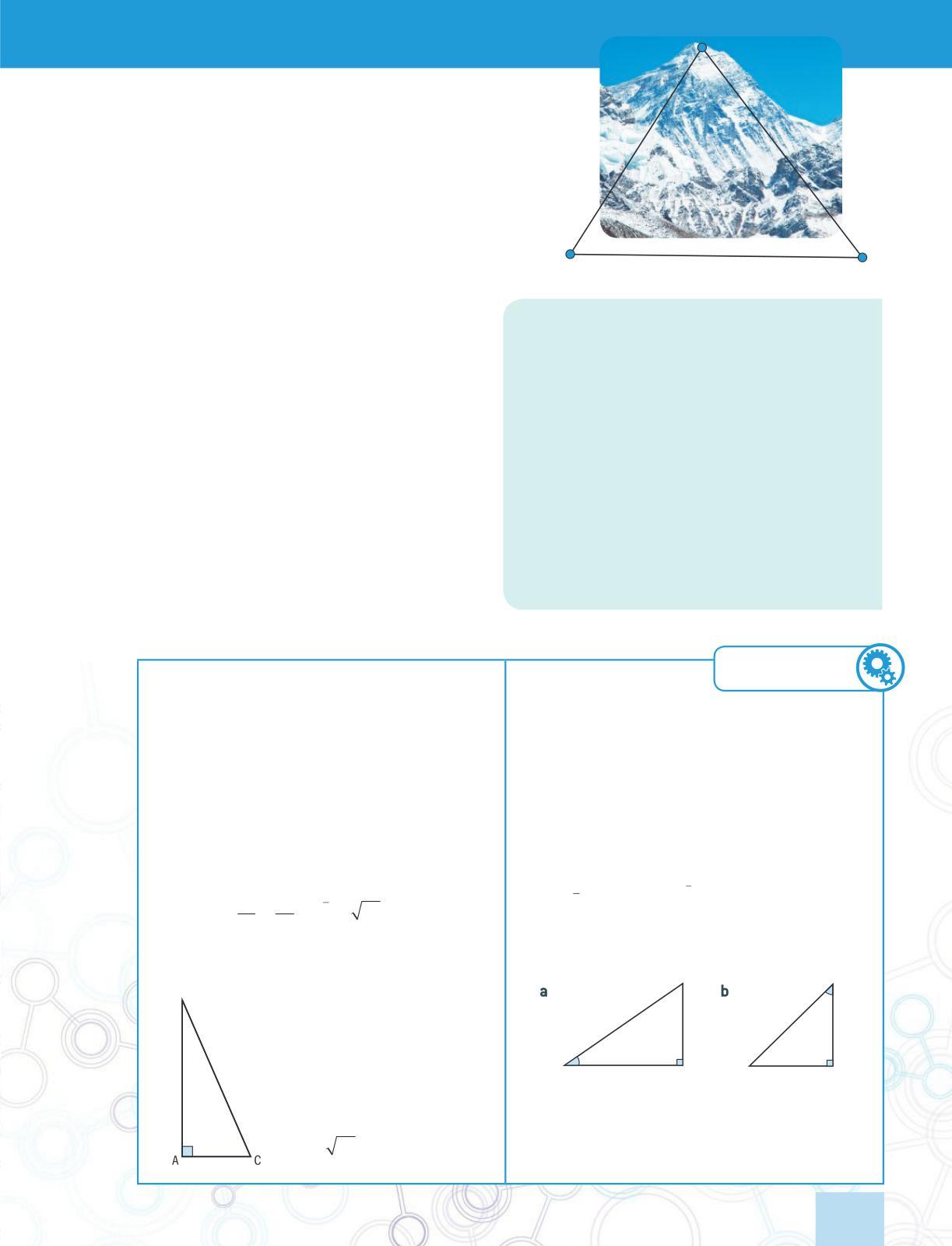
In 1856 The Great Trigonometric Survey of India measured the height of Mount Everest, known in Napali as Sagarmatha and in Tibetan as Chomolungma. The surveyors measured the distance between two points at sea level and then measured the angles between the top of the mountain and each point
The summit of Mount Everest is labeled E, the two points A and B are roughly at sea level and are 33 km apart.
If E ˆ = 90°, what would be the maximum possible height of Mount Everest?
Think about and then write down your own intuitive answer to each question. Discuss your answer with a friend then share your ideas with your class.
• Why do you think it took so long to determine the elevation of Mount Everest?
• Why do you think surveyors prefer to measure angles, but not lengths of sides?
• What assumptions are made?
Before you start
You should know how to:
1 Round to signicant gures and decimal places.
eg Write the number 80.426579 to:
a 2 decimal places
b 3 signicant gures.
a 80.43 b 80.4
2 Evaluate integer and rational exponents.
eg 3 4 = 1 3 1 81 4 , 16 16 4 1 2 = =
3 Use properties of triangles, including Pythagoras’ theorem 2 cm 5 cm B
eg Find the length of AB in this triangle.
AB2 = BC2 – AC2
AB2 = 52 – 22
AB2 = 21
AB = 21 = 4 58 cm (3 s f )
Developing inquiry skills
Write down any similar inquiry questions you might ask if you were asked to nd the height of tree, the distance between two towns or the distance between two stars.
What questions might you need to ask in these scenarios which dier from the scenario where you are estimating the height of Mount Everest?
Think about the questions in this opening problem and answer any you can As you work through the chapter, you will gain mathematical knowledge and skills that will help you to answer them all
Skills check
Click here for help with this skills check
1 Write down each number rounded to:
a 2 decimal places
b 3 signicant gures.
i 0 6942 ii 28 706
iii 77 984561
2 Evaluate a 2 3 b 27 1 3
3 In each of these right triangles, nd the length of side x
1.1 Representing numbers exactly and approximately
In mathematics and in everyday life, we frequently encounter numbers that have been measured or estimated In this section you will investigate how we can quantify uncertainty in the numbers and calculations we use throughout this course.
Investigation 1
Margaret Hamilton worked for NASA as the lead developer for Apollo ight software. The photo here shows her in 1969, standing next to the books of navigation software code that she and her team produced for the Apollo mission that rst sent humans to the Moon
1 Estimate the height of the books of code stacked together, as shown in the image. What assumptions are you making?
2 Estimate the number of pages of code for the Apollo mission How would you go about making this estimation? What assumptions are you making?
3 Factual What is an estimate? What is estimation? How would you go about estimating? How can comparing measures help you estimate?
4 Conceptual Why are estimations useful?
Recall that we can specify accuracy using signicant gures (digits) The digits that can be determined accurately are called signicant gures. Thus, a scale that could only register up to the hundredths of a gram mass until 99 99 g, could only measure up to 4 gures of accuracy (4 signicant gures).
In your IA or on specic exam questions, you may need to choose an appropriate degree of accuracy When performing operations on measurements, round answers to the same number of signicant gures as the least accurate measurement This is illustrated in the example below.
Example 1
EXAM HINT
Write your nal answers as exact values or rounded to at least 3 s f , unless otherwise instructed Round only your nal answer and not any intermediate calculations
A component of an aircraft wing is being designed in the shape of a right triangle. One of the legs must measure 17 cm and the hypotenuse must measure 97 1 cm, as shown in the diagram.
a Find the height of the triangle, rounding your answer to the given degree of accuracy
i To 4 d p (decimal places) ii To 2 s f
b Find the area of the material (in cm 2) necessary to manufacture the component to an appropriate degree of accuracy.
c Show that intermediate rounding to 2 s f leads to an inaccurate answer
a i 95.6003 cm
ii 96 cm
Use Pythagoras to nd the height of the triangle: 2 2 97.1 17 95.60026151
If the question did not specify a level of accuracy, we would round to 3 s f : 95 6 cm
b A bh
1 2 1 2 17 95 60026151
= 812 602
= 810 cm2 (2 s.f.)
c A 1 2 17 96 816
= 820 cm2 (2 s f )
≠ 810 cm2
Exercise 1A
1 A restaurant is remodelling and replacing its circular tables with square tables They want the new tables to have the same area as the old ones The circumference of the circular tables is measured to be 4.1 m. Find the side length of the new square tables i to an appropriate degree of accuracy ii to 3 s f
Bounds and error
Use the most accurate value (store or copy/ paste with technology) when calculating You could also write down your work as A 1 2 17 95 6 Do not use this to calculate!
Round area to 2 s.f. because the least accurate measurement, 17 cm, has 2 s f
This shows why rounding intermediate answers should be avoided in all calculations
2 The heights of 10 koalas, measured to the nearest cm, are: 81, 73, 71, 80, 76, 84, 73, 88, 91, 75.
Find the mean (average) height of the koalas to an appropriate degree of accuracy
Suppose you nd the weight of a bag of coffee as 541 5 g, accurate to the nearest 0.1 g. Then the exact weight w of the bag could be anywhere in the interval 541 45 g ≤ w < 541 55 g, as all of these values would round to 514.5 g.
If a measurement M is accurate to a particular unit u, then its exact value V lies in the interval M 0 5u ≤ V < M + 0 5u
The endpoints of this interval are called the lower and upper bounds. Upper and lower bounds provide one way to quantify the uncertainty of a measurement when the exact value is unknown.
How does the perception of the language being used distort our understanding?
Example 2
A state park is created on a triangular area between roads. The triangular area is measured to have a base length of 3.1 km and corresponding height of 4 2 km The measurement tool is accurate to the nearest tenth of a kilometre. Find the upper bound to the area of the park.
3 1 + 0 05 = 3 15 km
4 2 + 0 05 = 4 25 km
Area of park 1 2 3 15 4 25
Area of park < 6 69 km2 (3 s f )
The upper and lower bounds for the base length will be
3 1 0 05 ≤ b < 3 1 + 0 05
3 05 ≤ b < 3 15 and for the height
4.2 0.05 ≤ h < 4.2 + 0.05
4.15 ≤ h < 4.25
Using the area of triangle and upper bounds.
Area of a triangle base height 1 2
Since measurements are approximate there is always error in the measurement results A measurement error is the dierence between the exact value (VE) and the approximate value (VA), ie:
Measurement error = VA VE
Investigation 2
Tomi and Massimo measured the length of a yardstick and the length of a foot and obtained 92.44 cm for the length of a yard and 31.48 cm for the length of a foot.
1 Given that the exact values of 1 yard is 91 44 cm and 1 foot is 30 48 cm, nd the measurement error in the two measurements obtained by Tomi and Massimo.
Tomi thinks that the two measurements were equally inaccurate Massimo thinks that one of the two measurements is more accurate than the other.
2 Who do you agree with: Tomi or Massimo? Explain why.
Massimo decides to nd the magnitude of the error as a percentage of the measured length
3 Write down the measuring error in the length of one yard as a fraction of the exact length of the yard. Give your answer as percentage.
4 Write down the measuring error in the length of one foot as a fraction of the exact length of one foot Give your answer as percentage
5 Conceptual In what ways is expressing measuring errors as a percentage of the measured length helpful?
6 Conceptual How can measurement errors be compared?
When the exact value of a quantity is known, the error of a measured (approximate) value can be found as a percentage of the exact value:
Percentage error formula
Percentage error 100% A E E V V V , where VA is the approximate (or measurement) value and VE is the exact value.
Example 3
The fraction 22 7 is often used as an approximation of π.
a Find the percentage error of this approximation.
b Find the least accurate decimal approximation of π needed to approximate π within 0 001% of the true value
a Percentage error = 22 7 100 % = 0 0402% (3 s f ) b VA 0.00001
3 14156 ≤ VA ≤ 3 14162 So VA = 3.1416 will approximate π to within 0.001%
Note the absolute value creates a positive value. Translating 0.001% to a decimal
|x| ≤ C means C ≤ x ≤ C Keep values exact until the last step, then evaluate π with technology. Write enough digits of the upper and lower bounds to see where they differ.
TOK
In many cases, our measurements and calculations include errors Very often courts rely on interpretations of forensic data and invite experts to courtrooms to give their opinion If the percentage error of a certain DNA testing or drug testing to be found as 0 0526, can we be certain the person in question is guilty? What would be considered as an acceptable error rate especially when the stakes are so high?
Exercise 1B
1 Find the range of possible values for the following measurements, which were rounded to the indicated degrees of accuracy:
a 24 mm (nearest mm)
b 3 2 m (tenth of a metre)
c 1 75 kg (0 01 kg)
d 1400 g (3 s.f.)
2 In 1856, Andrew Waugh announced Mount Everest as 8840 m high, after several years of calculations based on observations made by the Great Trigonometric Survey. More recent surveys conrmed the height at 8848 m.
a Assuming the more recent survey is an exact value, calculate the percentage error made in the earlier survey
b If the more recent survey was accurate to the nearest metre, nd the range of possible values for the exact height of Mount Everest.
3 Two lab groups in a Physics class measure the times for a ball to fall 1 metre and record the times in the following tables
a Find the average of all the measure ments for each group.
Using the laws of Physics the true value for the time of the fall is 0 452 seconds given air resistance can be ignored.
b Calculate the percentage error for each set of data.
c Based on your calculations, comment on the uncertainty of the results of each group.
4 With 72 million bicycles, correct to the nearest million, Japan is at the top of the list of countries with most bicycles per capita On average, Japanese people travel about 2 km, correct to the nearest km, on their bicycles each day Calculate the upper bound for total distance travelled by all the bicycles in Japan per year.
5 To determine if a business is making enough prot the following formula is used P s c s =where P is relative prot, S is sales income and C is costs. If a company has $340 000 worth of sales and $230 000 as costs, each correct to 2 signicant gures, calculate the maximum and minimum relative prot to an appropriate degree of accuracy
6 The temperature today in Chicago is 50 °F. Being used to Celsius, Tommaso wants to convert the °F to °C to know what to wear outside. But instead of using the standard
conversion formula °C = 5 9 32 F he uses his grandmother’s rule that is easier, but gives an approximate value: “Subtract 32° from the value in °F and multiply the result by 0.5”.
a Calculate the actual and an approximate temperature value in °C using the standard formula and Tommaso’s grandmother’s rule.
b Calculate the percentage error of the approximate temperature value, in °C
Exponents and standard form
7 A factory produces circular slabs for use in construction They guarantee that all slabs produced will have an area within 0 2% of the “target” of 163 m2.
a Find the range of values for the radius that will ensure all slabs produced are within this range.
b Determine how accurately the radius must be measured during production to ensure that it will fall within this range.
Exponents can make representing numbers and performing calculations easier and more exact. In particular, when dealing with very large of very small numbers, such as in astronomy, macroeconomics, or chemistry, standard form (or scientic notation) can be more efcient
Recall that a number can be written in the standard form a × 10k with coecient 1 ≤ a < 10 and exponent k ∈ℤ
Investigation 3
1 The three countries with the largest populations in 2017 were: India: 1.34 billion USA: 3.24 × 10⁸ China: 1 409 517 397
a Convert all numbers to standard form Round to 3 s f as needed
b Explain how you can easily order these numbers from smallest to largest when they are converted to standard form
Gross Domestic Product (GDP) measures the total value of goods and services produced by a country and is one way to measure the wealth of countries. The GDP per capita (per person) of three countries for 2017 is given in the table below
To nd the total GDP of each country, multiply GDP per capita by population First you will investigate how to multiply numbers in standard form by hand.
Continued on next page 1 .1
Where did numbers come from?
2 Complete the examples below using technology: x y xy
(a) 3 × 10⁵ 2 × 10⁹
(b) 8 × 101 1 × 10⁴
(c) 2 × 10 3 4 × 10¹⁷
(d) 5 × 10⁶ 3 × 10¹²
(e) 4 × 10⁵ 9 × 10 7
3 How can you nd the product (b × 10m)(c × 10n) in the form a × 10k where 1 ≤ a < 10 and k is an integer? Make sure your process is consistent with all ve examples above.
4 How does your process for multiplication relate to the law of exponents, xp × xq = x p+q?
5 Now estimate and calculate the GDP of each country.
a Write each GDP per capita in standard form.
b Estimate the GDP of each country, without use of technology. Round your numbers as needed
c Use your GDC to calculate the GDP of each country.
d Compare your estimates with the calculations. Was the magnitude (power of 10) of your estimate correct?
6 Conceptual How does standard form help with calculations?
Numbers in standard form can be multiplied or divided following rules for exponents:
(
× 10
)(c × 10
) = bc ×
HINT
Recall that you can enter numbers on your GDC in standard form: 3.4 × 10⁷ is usually entered as 3 4 E 7 Make sure that you translate this calculator notation back to proper standard form when transferring answers from technology.
TOK
What might be the ethical implications of rounding numbers?
and
After performing the operation, ensure your answer is given in the form a × 10p , where 0 ≤ a < 10 by adjusting the exponent as needed
Example 4
Light travels at a speed of 3 108 m/s. The Earth is approximately 150 million kilometres from the Sun Estimate the time, in seconds, that light takes to travel from the Sun to the Earth
Since distance = speed × time,
Convert the distance to metres in standard form:
150 million km = 1.50 × 10⁸ km = 1.50 × 10¹¹ m
Divide coefcients and subtract exponents
Note that technology could also be used to divide.
A negative exponent represents a reciprocal power:
x x n n = 1
A rational exponent represents a power of a root:
x x x p q
In particular, x x 1 2 =
The following rules of exponents hold for a > 0 and m, n∈ℚ am × an = am +n (am)n = amn
a a a m n m n
While we will frequently use technology to approximate values for rational exponents in this course, exact values allow us to calculate more precisely and to use rules of exponents
Example 5
a Find the surface area of a cube with volume 50 cm3 i exactly ii approximately.
b i Find a general formula for the surface area of a cube with volume V cm3
ii Hence, determine the volume needed for a surface area of 1000 cm2
a V =
b
1 .1
HINT
You should be able to evaluate exponents and roots by hand or with technology, such as:
V = 2150 cm3(3 s.f.)
Solve for the side length (s). Substitute into the surface area formula.
Apply the rule (am)n = amn
Evaluate with technology
Generalizing 50 to V
Isolate V by dividing by six and then raising both sides to the reciprocal power. The exponent on
Example 6
A stuffed animal company nds that each store can sell stuffed bears for a price of p x = 240 , where x represents the population of the city in which the store operates, in thousands. Research also shows that the weekly quantity q of stuffed bears that will be sold can be found with the formula q x = 0 9 3 4 The total weekly revenue of a store is the product of its price and quantity sold.
a Determine an expression for the price in the form axm, where a∈ℝ and m∈ℚ
b Determine store revenue in the form axm, where a∈ℝ and m∈ℚ
c If the company wants to open a store that will make at least $1500 per week, determine the smallest population of city they should consider.
Multiply price by quantity. Multiply coefcients and add the exponents.
Isolate x
“Undo” the 1 4 exponent by raising both sides to the 4th power
The city should have a population of at least 2 330 000.
Interpret the solution; x is measured in thousands.
Exercise 1C
1 For each operation, i estimate a value for the answer without technology, ii nd the exact value using technology Express all answers in the form a × 10k where 1 ≤ a < 10 and k ∈ ℤ.
a (1 08 × 10 3)(9 2 × 10⁷) b
2 Calculate each expression using technology to 3 s.f. Express all answers in the form
a × 10n where 1 ≤ a < 10 and k ∈ℤ
a (2 35 × 10 6)(4 × 101)
b 7 1 10 8 5 10 6 2
c 4 3 p (5 × 10 7)3 d
HINT
Remember to put brackets around numbers in standard form when you perform operations on them
3 Simplify each expression and write your solution
i without negative exponents
ii in the form abc, where a, b, and c are values or variables.
4 There are initially 120 bacteria in a Petri dish and the population doubles approximately every hour, which can be represented by the formula B = 120 × 2t where B is the number of bacteria and t is the time in hours since the bacteria began growing.
a Find B when t = 1, t = 3 2 , and t = 2
b Comment on what your answers tell you about the growth of the bacteria What is the meaning of the value obtained when t = 3 2
5 The half life of iodine 131 is approximately 8 days, which means the mass of a sample of iodine decays by half every 8 days. The amount remaining can be calculated using the formula I t 1600 2 8 , where t is the time in days since the beginning of the sample.
a Write down this formula without negative exponents
b Find the amount of material remaining after 4 days as an exact and approximate value
6 The image of a speck of dust in an electron microscope is 1 2 × 102 mm wide The image
1.2 Angles and triangles
Trigonometric ratios in a right triangle
is 5 × 10² times larger than the actual size. Determine the width of the actual speck of dust
7 The Earth’s mass is 5 97 × 1024 kg and Mercury’s mass is 3.29 × 10²³ kg. How many times more massive is the Earth than Mercury?
8 The Earth’s surface area is approximately 5.1 × 10⁸ km2 (2 s.f.) and its population is 7.6 × 10⁹ (2 s.f.). Population density is the number of people per square kilometre Determine the population density of the Earth assuming all the surface area is habitable by humans.
About 30% of the Earth’s surface is land, including Antarctica. Determine the population density of the earth assuming that all the land is habitable, but not the oceans
The ratios of the sides of a right-angled triangle are called trigonometric ratios The three most common trigonometric ratios are the sine (sin), cosine (cos), and tangent (tan) These are dened for acute angle A in the rightangled triangle below:
sin (Â) = Opposite Hypotenuse
cos (Â) = Adjacent Hypotenuse
tan (Â) = Opposite Adjacent
Hypotenuse
In the denitions above, “opposite” refers to the length of the side opposite angle Â, “adjacent” refers to the length of the side adjacent to angle Â, and “hypotenuse” refers to the length of the hypotenuse (the side opposite the right angle). Opposite
Reect What are trigonometric ratios?
HINT
Some people use the mnemonic SOH-CAHTOA, pronounced “soh-kuh-toh-uh”, to help them remember the denitions of sine, cosine, and tangent
Internationalmindedness
Diagrams of Pythagoras’ theorem occur in early Chinese and Indian manuscripts The earliest references to trigonometry are in Indian mathematics 1 . 2
Example 7
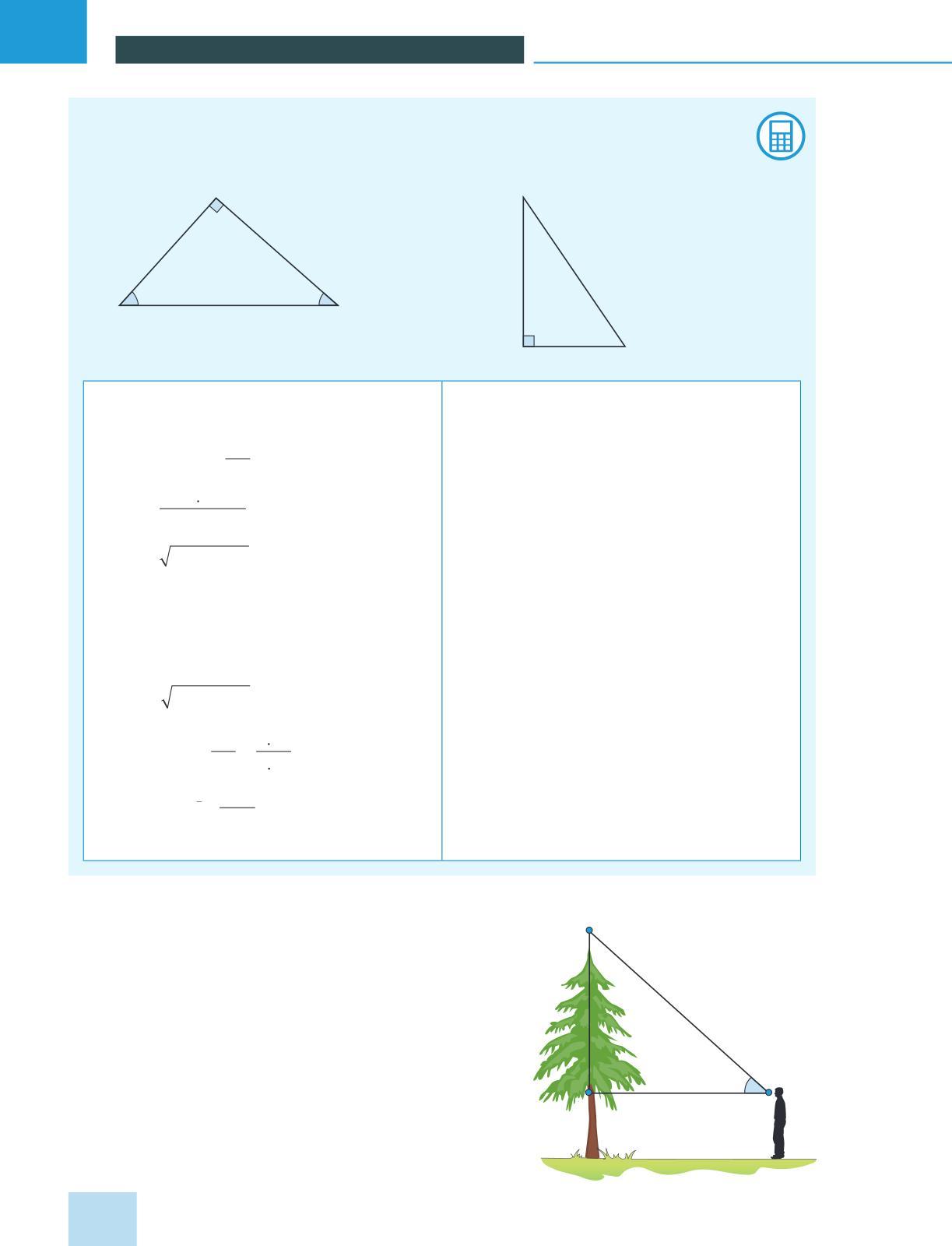
For each triangle, solve for the unknown angles and sides.
a In ΔABC:
b In ΔPQR:
[BC] is adjacent to angle C ˆ , use the cosine ratio to nd hypotenuse AC. Ensure technology is set to degree mode Round answers to 3 s.f.
Use Pythagoras’ theorem to nd AB.
Use the exact value of AC stored in your calculator (not the rounded value) when performing your calculations. Use Pythagoras’ theorem to nd RQ.
When solving for an unknown angle, determine a trig ratio with two known sides (use exact lengths when possible). PR is opposite side to PQ ˆ R and PQ is adjacent, so choose tangent
Then use an inverse trig function, in this case tan 1(x), to nd the angle.
Angles of elevation and depression
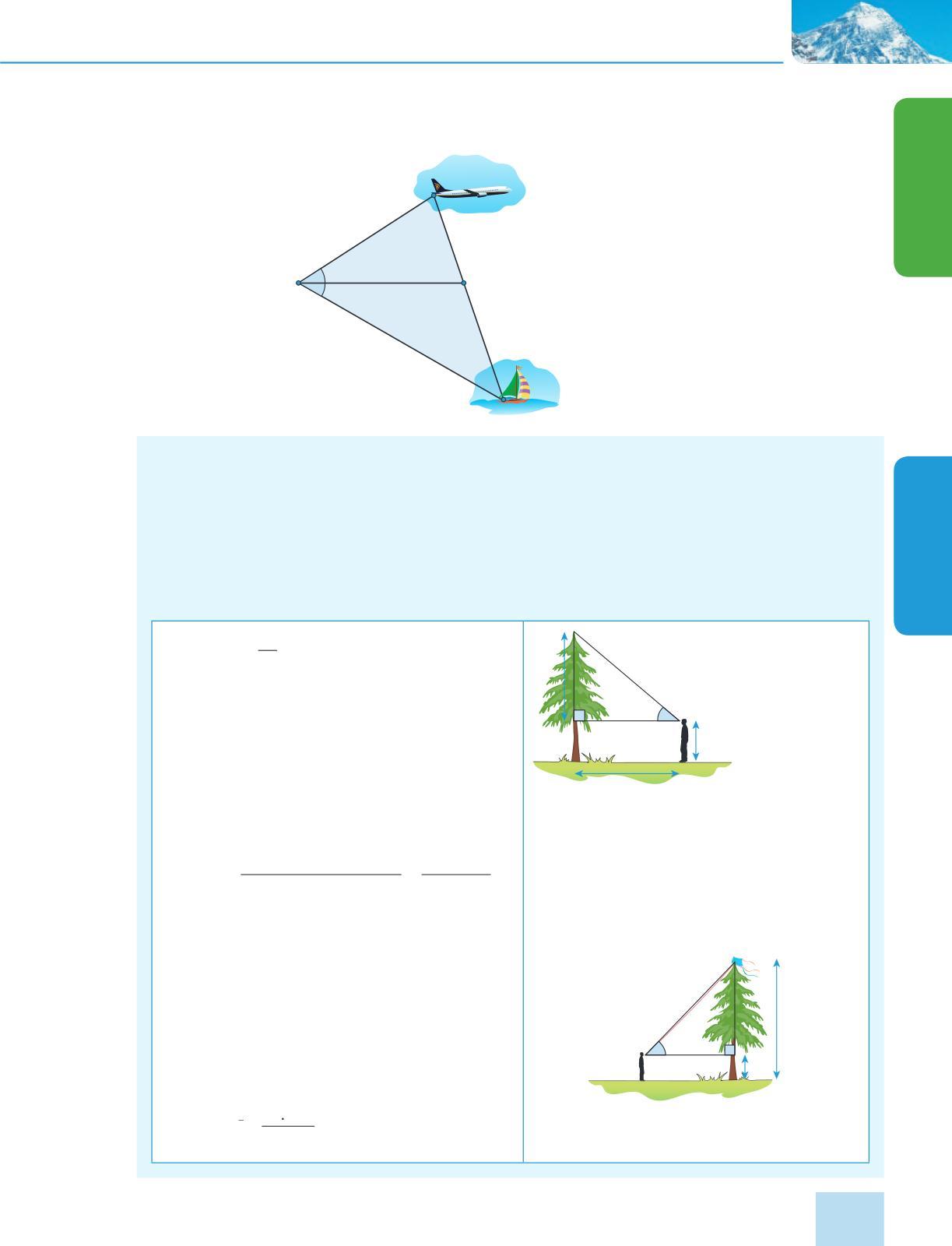
Suppose an observer is standing in front of a tree, with their eyes at point A as shown in the diagram Angle BÂC is formed when the observer looks up at the top of the tree. This angle is called an angle of elevation above the horizontal line at eye level (AB)
Similarly, when the object of sight falls below the horizontal at the eye level, an angle of depression is formed, as shown in the diagram
Observer
Example 8
Emma stands 15 m away from a tree. She measures the angle of elevation to the top of the tree as 40° and her height to eye level as 142 cm.
a Find the height of the tree.
b Frank, whose height is 1 8 m to eye level, is standing on the other side of the tree. His kite is stuck at the very top of the tree. He knows the length of the kite string is 16 m. What is the angle of elevation as Frank looks up at his kite?
a tan 40 15 h
h = 15tan 40°
15 m
Add Emma’s height to eye level.
Subtract Frank’s height from the height of the tree to nd the opposite side length Use the sine ratio as opposite and hypotenuse lengths are known.