CONTRIBUTORS
Eva Bauer
Technical University of Munich, TUM School of Life Sciences Weihenstephan, Plant Breeding, Freising, Germany
Alison R. Bentley
The John Bingham Laboratory, NIAB, Cambridge, United Kingdom
Hans-Joachim Braun
Centro Internacional de Mejoramiento de Maiz y Trigo (CIMMYT), El Batan, Texcoco, Mexico
Susanne Dreisigacker
Centro Internacional de Mejoramiento de Maiz y Trigo (CIMMYT), El Batan; International Maize and Wheat Improvement Center, Texcoco, Mexico
Tzion Fahima
Institute of Evolution; Department of Evolutionary and Environmental Biology, University of Haifa, Haifa, Israel
Andrii Fatiukha
Institute of Evolution; Department of Evolutionary and Environmental Biology, University of Haifa, Haifa, Israel
Matthias Frisch
Institute of Agronomy and Plant Breeding II, Justus Liebig University, Giessen, Germany
Martin W. Ganal
TraitGenetics GmbH, Gatersleben, Germany
Laura-Jayne Gardiner
Earlham Institute, Norwich, United Kingdom
Antje Habekuss
Institute for Resistance Research and Stress Tolerance, Julius Kühn-Institute (JKI), Quedlinburg, Germany
Anthony Hall
Earlham Institute; School of Biological Sciences, University of East Anglia, Norwich, United Kingdom
M. Asyraf Md. Hatta
John Innes Centre, Norwich Research Park, Norwich, United Kingdom; Faculty of Agriculture, Universiti Putra Malaysia, Serdang, Malaysia
Ben Hayes
Queensland Alliance for Agriculture and Food Innovation, The University of Queensland, St Lucia, Queensland, Australia
Eva Herzog
Institute of Agronomy and Plant Breeding II, Justus Liebig University, Giessen, Germany
Lee T. Hickey
Queensland Alliance for Agriculture and Food Innovation, The University of Queensland, St Lucia, Queensland, Australia
Yukoh Hiei
Plant Innovation Center, Japan Tobacco Inc., Iwata, Japan
Anja Hohmeyer
TraitGenetics GmbH, Gatersleben, Germany
Lin Huang
Institute of Evolution; Department of Evolutionary and Environmental Biology, University of Haifa, Haifa, Israel; Triticeae Research Institute, Sichuan Agricultural University, Chengdu, China
Yuji Ishida
Plant Innovation Center, Japan Tobacco Inc., Iwata, Japan
Ryan Joynson
Earlham Institute, Norwich, United Kingdom
Tamar Kis-Papo
Institute of Evolution, University of Haifa, Haifa, Israel
Valentina Klymiuk
Institute of Evolution; Department of Evolutionary and Environmental Biology, University of Haifa, Haifa, Israel
Toshihiko Komari
Plant Innovation Center, Japan Tobacco Inc., Iwata, Japan
Doris Kopahnke
Institute for Resistance Research and Stress Tolerance, Julius Kühn-Institute (JKI), Quedlinburg, Germany
Viktor Korzun
KWS SAAT SE, Einbeck, Germany
Tamar Krugman
Institute of Evolution, University of Haifa, Haifa, Israel
Jochen Kumlehn
Leibniz Institute of Plant Genetics and Crop Plant Research (IPK), Gatersleben, Germany
Thomas Miedaner
University of Hohenheim, State Plant Breeding Institute, Stuttgart, Germany
Frank Ordon
Institute for Resistance Research and Stress Tolerance, Julius Kühn-Institute (JKI), Quedlinburg, Germany
Dragan Perovic
Institute for Resistance Research and Stress Tolerance, Julius Kühn-Institute (JKI), Quedlinburg, Germany
Jörg Plieske
TraitGenetics GmbH, Gatersleben, Germany
Andreas Polley
TraitGenetics GmbH, Gatersleben, Germany
M. Timothy Rabanus-Wallace
Leibniz Institute of Plant Genetics and Crop Plant Research (IPK), Gatersleben, Germany
Marion S. Röder
Leibniz-Institute of Plant Genetics and Crop Plant Research, Gatersleben, Germany
Miguel Sanchez-Garcia
International Center for the Agriculture Research in the Dry Areas (ICARDA), Rabat, Morocco
Carolina Sansaloni
Centro Internacional de Mejoramiento de Maiz y Trigo (CIMMYT), El Batan, Texcoco, Mexico
Yehoshua Saranga
The Robert H. Smith Faculty of Agriculture Food and Environment, The Hebrew University of Jerusalem, Rehovot, Israel
Patrick Schweizer
Leibniz Institut für Pflanzengenetik und Kulturpflanzenforschung (IPK Gatersleben), Stadt
Seeland, Germany
Deepmala Sehgal
Centro Internacional de Mejoramiento de Maiz y Trigo (CIMMYT), El Batan, Texcoco, Mexico
Albrecht Serfling
Institute for Resistance Research and Stress Tolerance, Julius Kühn-Institute (JKI), Quedlinburg, Germany
Ravi P. Singh
Centro Internacional de Mejoramiento de Maiz y Trigo (CIMMYT), El Batan, Texcoco, Mexico
Mark E. Sorrells
Plant Breeding and Genetics, Cornell University, Ithaca, NY, United States
Nils Stein
Leibniz Institute of Plant Genetics and Crop Plant Research (IPK), Gatersleben, Germany
Burkhard Steuernagel
John Innes Centre, Norwich Research Park, Norwich, United Kingdom
Sivakumar Sukumaran
International Maize and Wheat Improvement Center, Texcoco, Mexico
Jin Sun
Plant Breeding and Genetics, Cornell University, Ithaca, NY, United States
Daniel W. Sweeney
Plant Breeding and Genetics, Cornell University, Ithaca, NY, United States
Ella Taagen
Plant Breeding and Genetics, Cornell University, Ithaca, NY, United States
Kai P. Voss-Fels
Queensland Alliance for Agriculture and Food Innovation, The University of Queensland, St Lucia, Queensland, Australia
Amy Watson
Queensland Alliance for Agriculture and Food Innovation, The University of Queensland, St Lucia, Queensland, Australia
Zhen-zhen Wei
Institute of Evolution; Department of Evolutionary and Environmental Biology, University of Haifa, Haifa, Israel
Brande B.H. Wulff
John Innes Centre, Norwich Research Park, Norwich, United Kingdom
Tobias Würschum
State Plant Breeding Institute, University of Hohenheim, Stuttgart, Germany
Another random document with no related content on Scribd:
of atomic weights. For instance, since the carbonates of barium, strontium, and lead crystallize in the same form, the oxides of these metals must have analogous formulas. From such considerations Berzelius was able to make several improvements in his atomic weight table of 1826.
Mitscherlich was the first to observe two forms of sulphur crystals, and from this and other cases of dimorphism or of polymorphism it became evident that analogous compounds were not necessarily always isomorphous, a circumstance which has restricted the application of the law to some extent.
Besides its application in fixing analogous formulas, the law of isomorphism has come to be of much practical use in the understanding and simplification of the formulas for minerals, for these natural crystals very often contain several isomorphous compounds in varying proportions, and an understanding of this “isomorphous replacement,” as it is called, makes it possible to deduce simple general formulas for them.
In some cases isomorphism takes place to a greater or less extent between substances which are not chemically similar, and this brings about a variation in composition which at times has caused confusion. For instance, the mineral pyrrhotite has a composition which usually varies between Fe7S8 and Fe11S12, and both these formulas have been assigned to it. It was recently shown by Allen, Crenshaw and Johnston in the Journal (33, 169, 1912) that this is a case where the compound FeS is capable of taking up various amounts of sulphur isomorphously.
The idea of solid solution was advanced by van’t Hoff to explain the crystallization of mixtures, including cases of evident isomorphism. This view has been widely accepted, and it has been particularly useful in cases where isomorphism is not evident. Solid solution between metals has been found to be exceedingly common, many alloys being of this character. A case of this kind was observed by Cooke and described in the Journal (20, 222, 1855). He prepared two well-crystallized compounds of zinc and antimony to which he gave the formulas Zn3Sb and Zn2Sb, but he observed that excellent crystals of each could be obtained which varied largely in composition from these formulas. As the two compounds were dissimilar in their formulas and crystalline forms, Cooke assumed
that isomorphism was impossible and concluded “that it is due to an actual perturbation of the law of definite proportions, produced by the influence of mass.” We should now regard this as a case of solid solution.
A Lack of Confidence in Avogadro’s Principle.—One reason why chemists were so slow in arriving at the correct atomic weights and formulas was a partial loss of confidence in Avogadro’s principle. About 1826 the young French chemist Dumas devised an excellent method for the determination of vapor densities at high temperatures, and his results and those of others showed some discrepancies in the expected densities. For example, the vapor density of sulphur was found to be about three times too great, that of phosphorus twice too great, that of mercury vapor and that of ammonium chloride only about half large enough to correspond to the values expected from analogy and other considerations. Thus, one volume of oxygen with two volumes of hydrogen make two volumes of steam, but only one third of a volume of sulphur vapor was found to unite with two volumes of hydrogen to make two volumes of hydrogen sulphide. Berzelius saw clearly that the results pointed to the existence of such molecules as S6, P4, and Hg1, but it was not generally realized in those days that Avogadro’s rule is fundamentally reliable, and Berzelius himself appears to have lost confidence in it on account of these complications, for he did not apply Avogadro’s principle to decisions about atomic weights, except in the cases of substances gaseous at ordinary temperatures.
Electro-chemical Theories.—The observation was made by Nicholson and Carlisle in 1800 that water was decomposed into its constituent gases by the electric current. Then in 1803 Berzelius and Hisinger found that salts were decomposed into their bases and acids by the same agency, and in 1807 Davy isolated potassium, sodium, and other metals afterwards, by a similar decomposition. Since those early times a vast amount of attention has been paid to the relation of electricity to chemical changes, a relation that is evidently of great importance from the fact that while electric currents decompose chemical compounds, these currents, on the other hand, are produced by chemical reactions.
Berzelius was particularly prominent in this direction, and in 1819 he published an elaborate electro-chemical theory. He believed that
atoms were electrically polarized, and that this was the cause of their combination with one another. He extended this idea to groups of atoms, particularly to oxides, and regarded these groups as positive or negative, according to the excess of positive or negative electricity derived from their constituent atoms and remaining free. He thus arrived at his dualistic theory of chemical compounds, which attained great prominence and prevailed for a long time in chemical theory. According to this idea, each compound was supposed to be made up of a positive and a negative atom or group of atoms. For example, the formulas for potassium nitrate, calcium carbonate, and sulphuric acid corresponded to K2O.N2O5, CaO.CO2 and H2O.SO3 where we now write KNO3, CaCO3 and H2SO4, and the theory was extended to embrace organic compounds also.
The eminent English chemist and physicist Faraday announced the important law of electro-chemical equivalents in 1834. This law shows that the quantities of elements set free by the passage of a given quantity of electricity through their solutions correspond to the chemical equivalents of those elements. Faraday made a table of the equivalents of a number of elements, regarding them important in connection with atomic weights, but at that time no sharp distinction was usually made between equivalents and atomic weights, and it was not fully realized that one atom of a given element may be the electrical equivalent of several atoms of another.
Faraday’s law, which is still regarded as fundamentally exact, has been of much practical use in the measurement of electric currents and in calculations connected with electro-chemical processes. In discussing his experiments, Faraday made use of several new terms, such as “electrolyte” for a substance which conducts electricity when in solution, and is thus “electrolyzed,” “electrode,” “anode,” and “cathode,” terms that have come into general use, and finally “ions” for the particles that were supposed to “wander” towards the electrodes to be set free there.
This term “ion” remained in comparative obscurity for more than half a century, when it was brought into great prominence among chemists by Arrhenius in connection with the ionic theory.
Cannizzaro’s Ideas.—Up to about 1869 chaos reigned among the formulas used by different chemists. Various compound radicals and numerous type-formulas were employed, dualistic and unitary
formulas of several kinds were in use, but the worst feature of the situation was the fact that more than one system of atomic weights was in vogue, so that water might be written
HO, H̶O, or H20
and similar discrepancies might appear in nearly all formulas containing elements of different valencies. In 1858, however, an article by the Italian chemist Cannizzaro appeared in which the outlines of a course in chemical philosophy were presented. This acquired wide circulation in the form of a pamphlet at a chemical convention somewhat later, and it dealt so clearly and ably with Avogadro’s principle, Dulong and Petit’s law, and other points in connection with formulas that it led to a rapid and almost universal reform among those who were using unsatisfactory formulas.
At about this time also the dualistic formulas of Berzelius were generally abandoned, and hydrogen came to be regarded as the characteristic element of all acids. For instance, CaO.SO3, called “sulphate of lime,” came to be written CaSO4 and was called “calcium sulphate,” and while it had been shown as early as 1815 by Davy that “iodic acid,” I2O5, showed no acid reaction until it was combined with water, the accumulation of similar facts led to the formulation of sulphuric acid as H2SO4 instead of SO3 or H2O.SO3, and that of other “oxygen acids” in a similar way. As a necessary consequence of this view of acids, the bases came to be regarded as compounds of the “hydroxyl” group, OH. Therefore the formula for caustic soda came to be written NaOH instead of Na2O.H2O, and so on.
The Periodic System of the Elements.—The periodicity of the elements in connection with their atomic weights was roughly grasped by Newlands in England, who announced his “law of octaves” in 1863. This was at the time when the atomic weights were being modified and their numerical relations properly shown. The subject was worked out more fully by L. Meyer in Germany a little later, but it was most clearly and elaborately presented by the Russian chemist Mendeléeff in 1869.
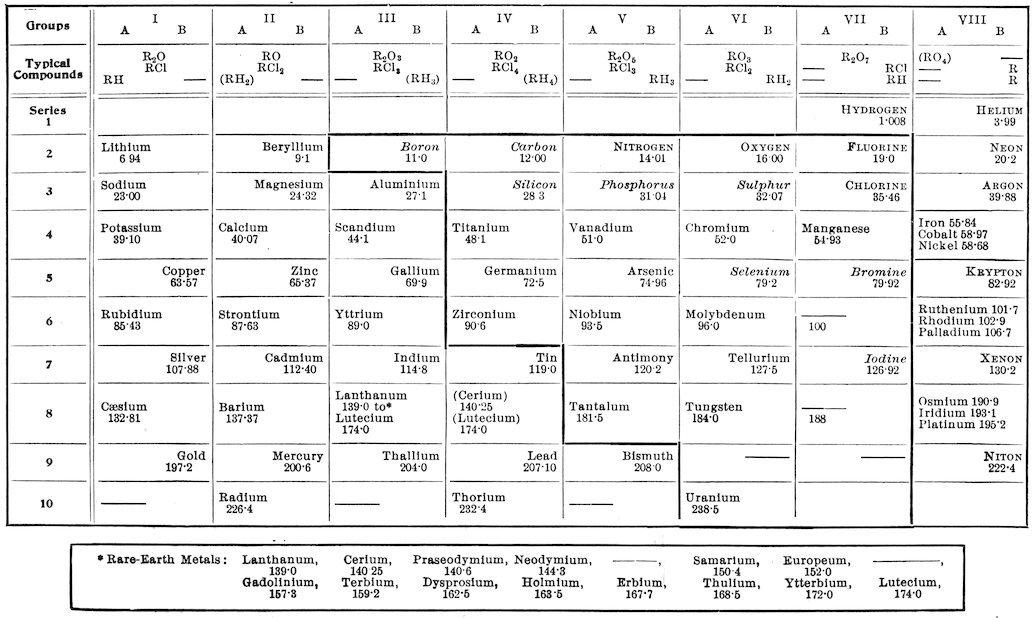
In order that this subject may be explained to some extent Mendeléeff’s table is given here, with the addition of the recently discovered elements and some other modifications.
N. Distinctions in printing: G . Other non-metallic elements, metallic elements. The heavy line encloses approximately the acid-forming elements.
In this table the elements arranged in the order of their atomic weights fall into eight groups where the known oxides progress regularly, with the exception of two or three elements, from R2O in Group I to R2O7 in Group VII, while in Group VIII two oxides (of ruthenium and osmium) are known which carry the progression to RO4.
It was pointed out by Mendeléeff that, with the exception of series 1 and 2 at the top of the table, the alternate members of the groups show particularly close relationships. These subordinate groups, marked A and B, in most cases show remarkable analogies and gradations in their properties, for example, in the alkali-metals from lithium to cæsium, and in the halogens from fluorine to iodine. The two divisions of a group do not usually show very close relations to each other, except in their valency, and they even display, in several instances, opposite gradations in chemical activity in the order of their atomic weights. For instance, cæsium stands at the electro-
positive end, while gold stands at the electro-negative end of its subordinate group. The difference between the two divisions is very great in Groups VI and VII, but it is extreme in Group VIII, where heavy metals are on one side and inactive gases on the other. Many authorities separate these gases into a “Group O” by themselves at the left-hand side of the table, but this does not change their relative positions, and the plan may be objected to on the ground that many vacant places are thus left in the groups VIII and O.
The periodic law has been useful in rectifying certain atomic weights. At the outset Mendeléeff was obliged to change beryllium from 14·5 (assuming Be2O3) to 9 (assuming BeO), and later the atomic weights of indium and uranium were changed to make them fit the system. All of these changes have been confirmed by physical means.
Mendeléeff found a number of vacant places in his table, and was thus able to render further service to chemical science by predicting the properties of undiscovered elements, and his predictions were very closely confirmed by the later discovery of scandium, gallium, and germanium. The table indicates that there are still two undiscovered elements below manganese and probably two more among the rare-earth metals. The interesting observation has just recently been made by Soddy that the products of radioactive disintegration appear to pass in a symmetrical way through positions in the periodic system, giving off a helium molecule at alternate transformations until the place of lead is reached. It appears, therefore, that the five vacant places in the table above bismuth are probably occupied by these evanescent elements, and it is to be noticed that all of the elements that have been placed in this region of high atomic weights are radioactive.
There are some inconsistencies in the periodic system. The increments in the atomic weights are irregular, and there are three cases, argon and potassium, cobalt and nickel, and tellurium and iodine, where a higher atomic weight is placed before a lower one in order to bring these elements into their undoubtedly proper places. There is a peculiarity also in the heavy-metal division of Group VIII, where three similar elements occur in each of three places, and where the usual periodicity appears to be suspended, or nearly so, in comparison with most of the other elements. However, there seems
to be a still more remarkable case of this kind in Group III, where fourteen metals of the rare earths have been placed. They are astonishingly similar in their chemical properties, hence it seems necessary to assume that periodicity is suspended here throughout the wide range of atomic weights from 139 to 174, where no elements save these have been found.
Several other interesting features of the table may be pointed out. The chlorides and hydrides, as indicated by the “typical compounds,” show a regular progression in both directions towards Group IV. (Where the type-formulas do not apply, as far as is known, to more than one or two elements, they have been placed in parentheses in the table given here.) It is a striking fact that the acid-forming elements occur together in a definite part of the table, and that the gases and other non-metallic elements, except the inactive gases of Group VIII, occur in the same region.
Atomic Numbers.—As the result of a spectroscopic study of the wave lengths or frequencies of the X-rays produced when cathode rays strike upon anticathodes composed of different elements, Moseley in 1914 discovered that whole numbers in a simple series can be attributed to the atoms. These atomic numbers are: 1 for hydrogen, 2 for helium, 3 for lithium, 4 for beryllium, and so on, in the order in which the elements occur in Mendeléeff’s periodic table, and in the cases of argon and potassium, cobalt and nickel, and tellurium and iodine, they follow the correct chemical order, while the atomic weights do not. They appear to indicate, therefore, an even more fundamental relation between the atoms than that shown by the atomic weights.
These numbers are now available for every element up to lead, and they are particularly interesting in indicating, on account of missing numbers, the existence of two undiscovered elements in the manganese group, and two more among the rare-earth metals, in confirmation of the vacant places below lead in Mendeléeff’s table.
The Isolation of Elements.—In the year 1818 about 53 elements were recognized, and since that time about 30 more have been discovered, but the elements already known comprised the more common ones, and nearly all of those which have been commercially important. A few of them, including beryllium, aluminium, silicon,
magnesium, and fluorine, were then known only in their compounds, as they had not yet been isolated in the free condition.
Berzelius in 1823 prepared silicon, a non-metallic element resembling carbon in many respects. This element has recently been prepared on a rather large scale in electric furnaces at Niagara Falls, and has been used for certain purposes in the form of castings.
Wöhler created much sensation in 1827 by isolating aluminium and finding it to be a very light, strong and malleable metal, stable in the air, and of a silver-white color. For a long time this metal was a comparative rarity, being prepared by the reduction of aluminium chloride with metallic sodium; but about 25 years ago Hall, an American, devised a method of preparing it by electrolyzing aluminium oxide dissolved in fused cryolite. This process reduced the cost of aluminium to such an extent that it has now come into common use.
Wöhler and Bussy prepared beryllium in 1828, and Liebig and Bussy did the same service for magnesium in 1830. The latter metal has come to be of much practical importance, both as a very powerful reducing agent in chemical operations, and as an ingredient of flashlight powders and of mixtures used for fireworks. It is also used in making certain light alloys.
After almost innumerable attempts to isolate fluorine, during a period of nearly a century, this was finally accomplished in 1886 by Moissan in France by the electrolysis of anhydrous hydrogen fluoride. The free fluorine proved to be a gas of extraordinary chemical activity, decomposing water at once with the formation of hydrogen fluoride and ozonized oxygen. This fact explains the failure of many previous attempts to prepare it in the presence of water.
Early Discoveries of New Elements.—The remarkable activity of chemical research at the beginning of our period is illustrated by the fact that three new elements were discovered in 1817. In that year Berzelius had discovered selenium, Arfvedson, working in Berzelius’s laboratory had discovered the important alkali-metal lithium, and Stromeyer had discovered cadmium.
In 1826 Ballard in France discovered bromine in the mother-liquor from the crystallization of common salt from sea water. Bromine proved to be an unusually interesting element, being the only non-
metallic one that is liquid at ordinary temperatures, and being strikingly intermediate in its properties between chlorine and iodine. It has been obtained in large quantities from brines, and is produced extensively in the United States. The elementary substance and its compounds have found important applications in chemical operations, while the bromides have been found valuable in medicine and silver bromide is very extensively used in photography.
In 1828 Berzelius discovered thorium. The oxide of this metal has recently been employed extensively as the principal constituent of incandescent gas-mantles, and the element has acquired particular importance from the fact that, like uranium, it is radioactive, decomposing spontaneously into other elements.
Vanadium had been encountered as early as 1801 by Del Rio, who named it “erythronium,” but a little later it was thought to be identical with chromium and was lost sight of for a while. In 1830, however, it was re-discovered by, and received its present name from Sefström in Sweden. Berzelius immediately made an extensive study of vanadium compounds, but he gave them incorrect formulas and derived an incorrect atomic weight for the element, because he mistook a lower oxide for the element itself. Roscoe in England in 1867 isolated vanadium for the first time, found the right atomic weight, and gave correct formulas to its compounds. Vanadium is particularly interesting from the fact that it displays several valencies in its compounds, many of which are highly colored. It has found important use as an ingredient in very small proportions in certain “special steels” to which it imparts a high degree of resistance to rupture by repeated shocks.
Columbium was discovered early in the nineteenth century in the mineral columbite from Connecticut by Hatchett, an Englishman, who did not, however, obtain the pure oxide. It was afterwards obtained by Rose who named it niobium. Both names for the element are in use, but the former has priority. Attention was called to this fact by an article in the Journal by Connell, an Englishman (18, 392, 1854).
The Platinum Group of Metals.—In 1854 a new member of the platinum group of metals, ruthenium, was discovered by Claus. Platinum had been discovered about the middle of the eighteenth century, while its other rarer associates, iridium, osmium, palladium,
and rhodium, had been recognized in the very early years of the nineteenth century. It was during the latter period that platinum ware began to be employed to a considerable extent in chemical operations, and this use was greatly extended as time went on. The discovery was made by Phillips in 1831 that finely divided platinum by contact would bring about the combination of sulphur dioxide with atmospheric oxygen, and this application during the past 20 years has become enormously important in the sulphuric acid industry, while other important applications of platinum as a “catalytic agent” have also been made. Wolcott Gibbs and Carey Lea have contributed perhaps more than any other recent chemists to a knowledge of the platinum metals. Carey Lea (38, 81, 248, 1864) dealt chiefly with the separation of the metals from each other, while Gibbs’s work (31, 63, 1861; 34, 341, 1862) included investigations of many of the compounds.
It may be mentioned that while platinum and its associates were formerly known only in the uncombined condition in nature, the arsenide sperrylite, PtAs2, was described by the late S. L. Penfield, and the senior writer of this chapter, in articles published in the Journal (37, 67, 71, 1889).
Applications of the Spectroscope.—The discovery in certain mineral waters of the rare alkali-metals rubidium and cæsium by Bunsen and Kirchoff in 1861 was in consequence of the application of spectroscopy by these same scientists a short time previously to the identification of elements imparting colors to the flame. Since that time the employment of the spectroscope for chemical purposes has been much extended, as it has been used in the examination of light from electric sparks and arcs, as well as from Geissler tube discharges and from colored solutions.
The metals rubidium and cæsium are interesting in being closely analogous to potassium and in standing at the extreme electropositive end of the series of known metals. It should be noticed here that Johnson and Allen of our Sheffield Laboratory, having obtained a good supply of rubidium and cæsium material from the lepidolite of Hebron, Maine, made some important researches upon these elements, accounts of which were published in the Journal (34, 367, 1862; 35, 94, 1863). They established the atomic weight of cæsium, thus correcting Bunsen’s determination which was unsatisfactory on
account of the small quantity and impurity of his material. Pollucite, a mineral rich in cæsium, which had been found in very small amount on the Island of Elba, has more recently been obtained in large quantities—hundreds of pounds—at Paris, Maine, and its vicinity. This American pollucite was first analyzed and identified by the senior writer of this article (41, 213, 1891), and later (43, 17, 1892 et seq.) the results of many investigations on cæsium and rubidium compounds, in which the junior writer played an important part, carried out in Sheffield Laboratory, were published in the Journal.
The application of the spectroscope led to the discovery of thallium in 1861 by Crookes of England, and to that of indium in 1863 by Reich and Richter in Germany. Both of these metals are extremely rare, but they are of considerable theoretical interest. Thallium is particularly remarkable in showing resemblances in its different compounds to several groups of metals.
The spectroscope was employed again in connection with the discovery of gallium in 1875 by Boisbaudran. It is in the same periodic group as thallium and indium, and it has a remarkably low melting point, just above ordinary room-temperature. It has been among the rarest of the rare elements, but within two or three years a source of it has been found in the United States in certain residues from the refining of commercial zinc. The recent issues of the Journal (41, 351, 1916; 42, 389, 1916) show that Browning and Uhler of Yale have availed themselves of this new material in order to make important chemical and physical researches upon this metal.
Germanium.—The discovery of germanium in the mineral argyrodite in 1886 by Winkler revealed a curious metal which gives a white sulphide that may be easily mistaken for sulphur and which is volatilized completely when its hydrochloric acid solution is evaporated, so that it is evasive in analytical operations. This element had been predicted with much accuracy by Mendeléeff, and it is rather closely related to tin.
A few years after the discovery of germanium, Penfield published in the Journal (46, 107, 1893; 47, 451, 1894) some analyses of argyrodite, correcting the formula given by Winkler to the mineral; also he described canfieldite, an analogous mineral from Bolivia, in which a large part of the germanium was replaced by tin.
The Rare Earths.—Before the year 1818 two rare earths, the oxides of yttrium and cerium, were known in an impure condition. Since that time about fourteen others have been discovered as associates of the first two. The rare earths are peculiar from the fact that many of them are always found mixed together in the minerals containing them, and also from the circumstance that most of them are remarkably similar in their chemical reactions and consequently exceedingly difficult to separate from each other. In many cases multitudes of fractional precipitations or crystallizations are needed to obtain pure salts of a number of these metals. The solutions of the salts of several of these elements give characteristic absorption bands when examined spectroscopically by the use of transmitted light.
No important practical application has been found for any of these earthy oxides, except that about one per cent of cerium oxide is mixed with thorium oxide in incandescent gas-mantles in order to obtain greatly increased luminosity.
The Inactive Gases.—As long ago as 1785, Cavendish, that remarkable Englishman who first weighed the world and first discovered the composition of water, actually obtained a little argon in a pure condition by sparking atmospheric nitrogen with oxygen converting it into nitric acid (another discovery of his) and absorbing the excess of oxygen. The volume of this residual gas as estimated by him corresponds very closely to the volume of argon in the atmosphere, as now known.
It was more than a century later, in 1894, that Rayleigh and Ramsay discovered argon in the air. Lord Rayleigh had found that atmospheric nitrogen was about one-half per cent heavier than chemical nitrogen, a fact which led to the investigation. It was only necessary to repeat Cavendish’s experiment on a large scale, or to absorb oxygen with hot copper and nitrogen with hot magnesium, in order to obtain argon. The gas attracted much attention, both on account of having but a single atom in its molecule, and particularly because it failed to enter into chemical combination of any kind. This gas has been used of late for filling the bulbs of incandescent electric lamps in cases where a gas pressure without chemical action is desired.
In 1890 and 1891, Hillebrand published in the Journal (40, 384, 1890: 42, 390, 1891) a series of analyses of the mineral uraninite and
reported in some samples of the mineral as much as 2·5 per cent of an inactive gas. Hillebrand examined the gas spectroscopically but, just missing an important discovery, he detected only the spectrum lines of nitrogen. Ramsay, in searching for argon in some sort of natural combination, and doubtless remembering Hillebrand’s work, heated some cleveite, a variety of uraninite, and obtained, not argon, but a new gas. This gave a yellow spectrum-line corresponding to a line previously observed in the light of the sun’s corona and attributed to an element in the sun called helium. Helium, therefore, in 1895 had been found on the earth. This gas is a constant constituent of uranium minerals, as it is produced by the breaking down of radioactive elements. It has been found in very small quantity in the atmosphere, and is the most difficult of all known gases to liquefy, as its boiling point, as shown by Onnes in 1908, is only 4° above the absolute zero. It has not yet been solidified.
In 1898 Ramsay and Travers, by the use of ingenious methods of fractional distillation and absorption by charcoal, obtained three other much rarer inactive gases from the atmosphere which they called neon, krypton and xenon.
The inactive gases are all colorless, and as they form no chemical compounds they are characterized by their densities, which give their atomic weights, by their boiling points, and by their characteristic Geissler-tube spectra.
The gaseous radium emanation, or niton, belongs also to the inactive group, and it was also collected and studied by Ramsay who was compelled to work with only 0·0001 cc. of it, as the volume obtained by heating radium salts is very small. It is an evanescent element, disappearing within a few days on account of radioactive disintegration. Meanwhile it glows brilliantly when liquefied and cooled to the temperature of liquid air. It has an atomic weight of 222, four units below that of radium, and the difference is considered as due to the loss by radium of an atom of helium in passing into the emanation.
The Radioactive Elements.—The discovery of radium in 1898 by Madame Curie, and the study of that and other radioactive elements has produced a profound effect upon chemical theory. It was found that the two elements of the highest atomic weights, uranium and thorium, are always spontaneously decomposing into other elements
at a fixed rate of speed which can be controlled by no artificial means, and that the elements resulting from these decompositions likewise undergo spontaneous changes into still other elements at greatly varying rates of speed, forming in each case a remarkable series of temporary elements. These transformations are accompanied by the emission at enormous velocities of three kinds of rays, one variety of which has been shown to consist of helium atoms. The greater number of the elements formed in these transformations have not as yet been obtained in a pure condition, and they are known only in connection with their radioactivity, volatility, etc.; but radium and niton, two of these products, have been obtained in a pure condition, so that their atomic weights and their places in the periodic system have been fixed.
We owe much of our knowledge of the radioactive transformations to the researches of Rutherford and of Soddy, and of their coworkers, but one of the important products of the transformation of uranium, an element which he called ionium, was characterized by Boltwood of Yale (25, 365, 1908).
Radium and niton, apart from their radioactive properties, resemble barium and the inert gases of the atmosphere, respectively. The rates at which their progenitors produce them, and the rates at which they themselves decompose, bring about a state of equilibrium after a time. Therefore a given amount of uranium, which decomposes exceedingly slowly, can yield even after thousands of years only a very small proportional quantity of undecomposed radium, one-half of which disappears in about 2500 years, because the amount decomposed must eventually be equal to the amount produced. The first conclusive evidence that radium is a product of the decomposition of uranium was given by Boltwood in the Journal (18, 97, 1904). He found that all uranium minerals contain radium; and the amount of radium present is always proportional to the amount of uranium, which shows the genetic relation between the two.
In the case of niton, which is produced by radium, and is called also the radium emanation, the rate of decay is rapid, so that if the gas is expelled from radium by heating, equilibrium is reached after a few days, with the accumulation of the largest possible amount of niton.
The conclusion has been reached by Rutherford and others that the final product besides helium, in the radioactive transformations, is lead, or at least an element or elements resembling lead to such a degree that no separation of them by chemical means is possible. Atomic weight determinations by Richards and others have shown that specimens of lead found in radioactive minerals give distinctly different atomic weights from that of ordinary lead. This fact has led to the view that possibly the atoms of the elements are not all of the same weight, but vary within certain limits—a view that is contrary to previous conclusions derived from the uniformity in atomic weights obtained with material from many different sources.
The results of the investigations upon radioactivity have led to modified views in regard to the stability of the elements in general. There has been little or no proof obtained that any artificial transmutation of the elements is possible, but the spontaneous transformation of the radioactive elements brings forward the possibility that other elements are changing imperceptibly, and that a state of evolution exists among them. All of the radioactive changes that we know proceed from higher to lower atomic weights, and we are entirely ignorant of the process by which uranium and thorium must have been produced originally.
Since radioactive changes have been found to be accompanied by the release of vast amounts of energy, compared with which the energy of chemical reactions is trivial, a new aspect in regard to the structure of atoms has arisen,—they must be complex in structure, the seats of enormous energy.
The determination of the amount of radium in the earth’s crust has indicated that the heat produced by it is amply sufficient to supply the loss of heat due to radiation, and this source of heat is regarded by many as the cause of volcanic action. The sun’s radiant heat also has been supposed to be supplied by radioactive action, so that the older views regarding the limitation of the age of the earth and the solar system on account of loss of heat have been considerably modified by our knowledge of radioactivity.
Physical Chemistry.
The application of physical methods as aids to chemical science began in early times, and some of these, such as the determinations of gas and vapor densities, specific heats, and crystalline forms have been mentioned already in this article. Within recent times physical chemistry has greatly developed and a few of its important achievements will now be described.
Molecular Weight Determinations.—Gas and vapor densities in connection with Avogadro’s principle, formed the only basis for molecular weight determinations until comparatively recent times. The early methods of Gay-Lussac and Dumas for vapor density were supplemented in 1868 by the method of Hofmann, whereby vapors were measured under diminished pressure over mercury. In 1878 Victor Meyer introduced a simpler method depending upon the displacement of air or other gas by the vapor in a heated tube. As refractory tubes, such as those of porcelain or even iridium, could be used in this method, molecular weights at extremely high temperatures were determined with interesting results. For instance, it was found that iodine vapor, which shows the molecule I2 at lower temperatures, gradually becomes monatomic with rise in temperature, that sulphur vapor dissociates from S8 to S2 under similar conditions, and that most of the metals, including silver, have monatomic vapors.
In 1883 and later it was pointed out by Raoult that the molecular weights of substances could be found from the freezing points of their solutions, but this method was complicated from the fact that salts, strong acids and strong bases behaved quite differently from other substances in this respect, and allowances had to be made for the types of substances used. The complication was afterwards explained by the ionization theory of Arrhenius. Better apparatus for this method was soon devised by Beckmann, who introduced also a method depending upon the boiling points of solutions, and these two methods are still the standard ones for determining molecular
weights in solution. They are very extensively employed by organic chemists.
It has been found that the majority of substances when dissolved have the same molecular weight as in the gaseous condition, provided that they can be volatilized at comparable temperatures. For instance, sulphur in solution has the formula S8, iodine is I2 and the metals are monatomic.
Van’t Hoff’s Law and Arrhenius’s Theory of Ions.—Modern views on solutions date largely from 1886, when van’t Hoff called attention to the relations existing between the osmotic pressure exerted by dissolved substances and gas pressure.
Pfeffer, a botanist, was the first to measure osmotic pressure (1877). Basing his conclusions chiefly upon Pfeffer’s determinations, van’t Hoff formulated a new and highly important law, which may be stated as follows: The osmotic pressure exerted by a substance in solution is equal to the gas pressure that the substance would exert if it were a gas at the same temperature and the same volume. Further investigations have fully established the fact that molecules in dilute solution obey the simple laws of gases.
It was pointed out by van’t Hoff that salts, strong acids and strong bases showed marked exceptions to his law in exerting much greater osmotic pressures than those calculated for them.
The next year in 1887, Arrhenius explained this abnormal behavior of salts, strong acids and strong bases by assuming that they dissociate spontaneously into ions when they dissolve, and that these more numerous particles act like molecules in producing osmotic pressure. He showed that these exceptional substances all conduct electricity in solution, while those conforming with van’t Hoff’s law do not, and according to his theory the ions become positively or negatively charged when they are formed, and these charged ions conduct the current. For example a molecule of sodium chloride was supposed to give the two ions Na+ and Cl, thus exerting twice as much osmotic pressure as a single molecule.
Determinations of osmotic pressure or related values, such as depression of the freezing point and of electric conductivity, indicated that ionization could not be regarded as complete in any case except in exceedingly dilute solutions, and that the extent of
ionization varied with different substances. The fact that osmotic pressures and electric conductivities gave closely agreeing results in regard to the extent of ionization in various cases, is the strongest evidence in support of the theory.
It was difficult at first for many chemists to believe that atoms, such as those of sodium and chlorine, and groups such as NH4 and SO4 could exist independently in solution, even though electrically charged. However, the theory rapidly gained ground and is now accepted by nearly every chemist as a satisfactory explanation of many facts.
During recent years, many investigations relating to osmotic pressure and ionization have been carried out in the United States, but only the work of Morse, A. A. Noyes, and the late H. C. Jones can be merely alluded to here. It should be mentioned that the eminent author of the ionic hypothesis gave the Silliman Memorial course of lectures at Yale in 1911 on Theories of Solution.
Colloidal Solutions.—Graham, an English chemist, in 1861 was the first to make a distinction between substances forming true solutions, which he called crystalloids, and those of a gummy nature resembling glue, which in solution do not diffuse readily through parchment membranes, as crystalloids do, and which he called colloids. The separation of colloids by means of parchment was called dialysis, and this process has come into extensive use in preparing pure colloidal solutions. Slow diffusion is now regarded as characteristic of colloids rather than their gummy condition.
Colloidal solutions occupy an intermediate position between true solutions and suspensions, resembling one or the other according to the kind of colloid and the fineness of division. By preparing filters with pores of varying degrees of fineness, Bechold has been able to separate colloids from each other in accordance with the size of their particles. It has also been possible to prepare different solutions of a colloid varying gradually from one in which the particles were undoubtedly in suspension to one which had many of the properties of a true solution.
Beginning in 1889, Carey Lea described in the Journal (37, 476, 1889 et seq.) a variety of methods for preparing colloidal solutions of the metals, consisting in general of treating solutions of metallic salts
with mild reducing agents. His work on colloidal silver was particularly extensive and interesting. Solutions of this kind have recently yielded some extremely interesting results by means of the ultra-microscope, an apparatus devised by Zsigmondy and Siedentopf. A very intense beam of light is passed through the solution and observed at right angles with a powerful microscope. Under these conditions, particles much too small to be seen by other means, reveal their presence by reflected light. It has been possible in a very dilute solution of known strength to count the particles and thus to calculate their size. The smallest colloidal particles measured in this way were of gold and were shown to have approximately ten times the diameter, or 1000 times the volume, attributed to ordinary molecules. It is of interest that the particles appear in rapid motion corresponding to the well-known Brownian movement.
The chemistry of colloids has now assumed such importance that it may be considered as a separate branch of the science. It has its own technical journal and deals largely with the chemistry of organic products. All living matter is built up of colloids, and hæmoglobin, starch, proteins, rubber and milk are examples of colloidal substances or solutions. Among inorganic substances, many sulphides, silicic acid, and the amorphous hydroxides, like ferric hydroxide, frequently act as colloids.
Law of Mass Action.—Berthollet about the beginning of the last century was the first chemist to study the effect of mass, or more correctly, the concentration of substances on chemical action. His views summarized by himself are as follows: “The chemical activity of a substance depends upon the force of its affinity and upon the mass which is present in a given volume.” The development of this idea, which is fundamentally correct, was greatly hindered by the fact that Berthollet drew the incorrect conclusion that the composition of chemical compounds depended upon the masses of the substances combining to produce them, a conclusion in direct contradiction to the law of definite proportions, and since this view was soon disproved by Proust and others, Berthollet’s law in its other applications received no immediate attention. Mitchell, however, pointed out in the Journal (16, 234, 1829) the importance of Berthollet’s work, and Heinrich Rose in 1842 again called attention to the effect of mass, mentioning as one illustration the effect of
water and carbonic acid in decomposing the very stable natural silicates. Somewhat later several other chemists made important contributions to the question of the influence of concentration upon chemical action, but it was the Norwegians, Guldberg and Waage, who first formulated the law of mass action in 1867.
This law has been of enormous importance in chemical theory, since it explains a great many facts upon a mathematical basis. It applies particularly to equilibrium in reversible reactions, where it states that the product of the concentrations on the one side of a simple reversible equation bears a constant relation to the products of the concentrations on the other side, provided that the temperature remains constant. In cases of this kind where two gases or vapors react with two solids, the latter if always in excess may be regarded as constant in concentration, and the law takes on a simpler aspect in applying only to the concentrations of the gaseous substances. For example, in the reversible reaction
3Fe + 4H2O ⇄ Fe3O4 + 4H2, which takes place at rather high temperatures, a definite mixture of steam and hydrogen at a definite temperature will cause the reaction to proceed with equal rapidity in both directions, thus maintaining a state of equilibrium, provided that both iron and the oxide are present in excess. If, however, the relative concentrations of the hydrogen and steam are changed, or even if the temperature is changed, the reaction will proceed faster in one direction than in the other until equilibrium is again attained.
The principle of mass action also explains why it is sometimes possible for a reversible reaction to become complete in either direction. For instance, in connection with the reaction that has just been considered, if steam is passed over heated iron and if hydrogen is passed over the heated oxide, the gaseous product in each case is gradually carried away, and the reaction continually proceeds faster in one direction than in the other until it is complete, according to the equations
3Fe + 4H2O → 3Fe3O4 + 4H2, and
Fe3O4 + 4H2 → 3Fe + 4H2O.
Many other well-known and important facts, both chemical and physical, depend upon this law. It explains the circumstance that a vapor-pressure is not dependent upon the amount of the liquid that is present; it also explains the constant dissociation pressure of calcium carbonate at a given temperature, irrespective of the amounts of carbonate and oxide present; in connection with the ionic theory, it furnishes the reason for the variable solubility of salts due to the presence of electrolytes containing ions in common; and it elucidates Henry’s law which states that the solubilities of gases are proportional to their pressures.
Ostwald, more than any other chemist, has been instrumental in making general applications of this law, and he made particularly extensive use of it in connection with analytical chemistry in a book upon this subject which he published.
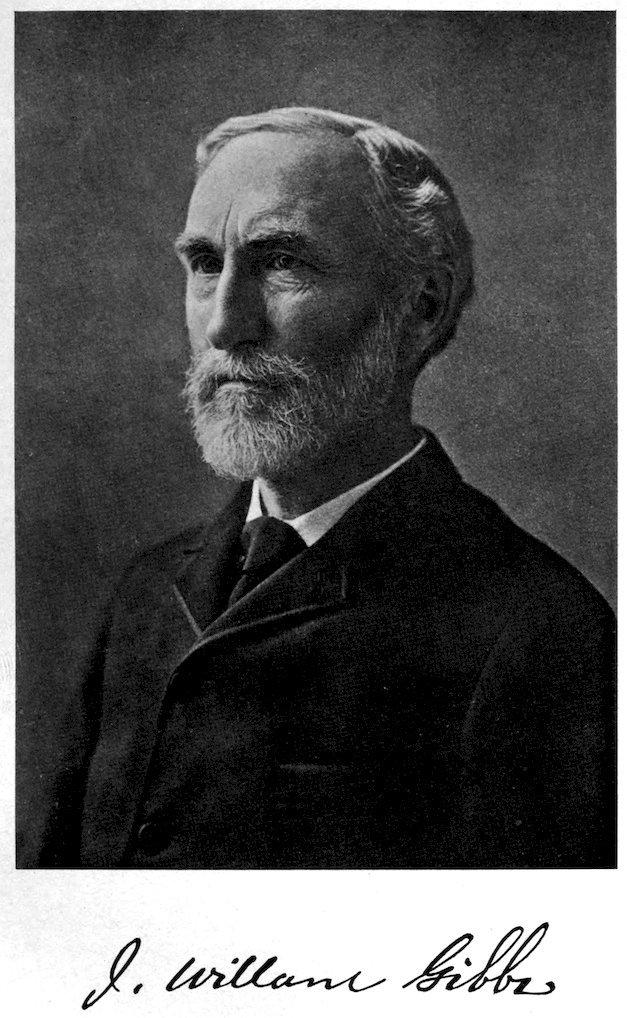
The Phase Rule.—In 1876 Willard Gibbs of Yale published a paper in the Proceedings of the Connecticut Academy of Science on the “Equilibrium of Heterogeneous Substances,” and two years later he published an abstract of the article in the Journal (16, 441, 1878). He had discovered a new law of nature of momentous importance and wide application which is called the “Phase-Rule” and is expressed by a very simple formula.
The application of this great discovery to chemical theory was delayed for ten years, partly, perhaps, because it was not sufficiently brought to the attention of chemists, but largely it appears because it was not at first understood, since its presentation was entirely mathematical.
It was Rooseboom, a Dutch chemist, who first applied the phaserule. It soon attracted profound attention, and the name of Willard Gibbs attained world-wide fame among chemists. When Nernst, who is perhaps the most eminent physical chemist of the present time, was delivering the Silliman Memorial Lectures at Yale a few years ago, he took occasion to place a wreath on the grave of Willard Gibbs in recognition of his achievements.
To understand the rule, it is necessary to define the three terms, introduced by Gibbs, phase, degrees of freedom and component.
By the first term, is meant the parts of any system of substances which are mechanically separable. For instance, water in contact
with its vapor has two phases, while a solution of salt and water is composed of but one. The degrees of freedom are the number of physical conditions, including pressure, temperature and concentration, which can be varied independently in a system without destroying a phase. The exact definition of a component is not so simple, but in general, the components of a system are the integral parts of which it is composed. Any system made up of the compound H2O, for instance, whether as ice, water or vapor, contains but one component, while a solution of salt and water contains two. Letting P, F, and C stand for the three terms, the phase-rule is simply
= C + 2 − P
that is, the number of degrees of freedom in a system in equilibrium equals the number of components, plus two, minus the number of phases. The rule can be easily understood by means of a simple illustration. In a system composed of ice, water and water vapor, there are three phases and one component and therefore
= 1 + 2 − 3 = 0
Such a system has no degrees of freedom. This means that no physical condition, pressure or temperature can be varied without destroying a phase, so that such a system can only exist in equilibrium at one fixed temperature, with a fixed value for its vaporpressure.
F
F
For instance, if the system is heated above the fixed temperature, ice disappears and if the pressure is raised, vapor is condensed. If this same system of water alone contains but two phases, for instance, liquid and vapor, F = 1 + 2 − 2 = 1, or there is one degree of freedom. In such a system, one physical condition such as temperature can be varied independently, but only one, without destroying a phase. For instance, the temperature may be raised or lowered, but for every value of temperature there is a corresponding value for the vapor-pressure. One is a function of the other. If both values are varied independently, one phase will disappear, either
vapor condensing entirely to water or the reverse. Finally if the system consists of one phase only, as water vapor, F = 2, or the system is divariant, which means that at any given temperature it is possible for vapor to exist at varying pressures.
The illustration which has been given relates to physical equilibrium, but the rule is applicable to cases involving chemical changes as well. In comparing the phase-rule with the law of mass action, it will be noticed that both have to do with equilibrium. The great advantage of the former is that it is entirely independent of the molecular condition of the substances in the different phases. For instance, it makes no difference so far as the application of the rule is concerned, whether a substance in solution is dissociated, undissociated or combined with the solvent. In any case, the solution constitutes one phase. On the other hand, the rule is purely qualitative, giving information only as to whether a given change in conditions is possible. The law of mass action is a quantitative expression so that when the value of the constant is once known, the change can be calculated which takes place in the entire system if the concentration of one substance is varied. The law, however, requires a knowledge of the molecular condition of the reacting substances, which may be uncertain or unknown, and chiefly on this account it has, like the phase-rule, often only a qualitative significance.
The phase rule has served as a most valuable means of classifying systems in equilibrium and as a guide in determining the possible conditions under which such systems can exist. As illustrations of its practical application, van’t Hoff used it as an underlying principle in his investigations on the conditions under which salt deposits have been formed in nature, and Rooseboom was able by its means to explain the very complicated relations existing in the alloys of iron and carbon which form the various grades of wrought iron, steel and cast iron.
Thermochemistry.—This branch of chemistry has to do with heat evolved or absorbed in chemical reactions. It is important chiefly because in many cases it furnishes the only measure we have of the energy changes involved in reactions. To a great extent, it dates from the discovery by Hess in 1840 of a fundamental law which states that the heat evolved in a reaction is the same whether it takes place in one or in several stages. This law has made it possible to calculate the
heat values of a large number of reactions which cannot be determined by direct experiment.
Thermochemistry has been developed by a comparatively few men who have contributed a surprisingly large number of results. Favre and Silbermann, beginning shortly after 1850, improved the apparatus for calorimetric determinations, which is called the calorimeter, and published many results. At about the same time Julius Thomsen, and in 1873 Berthelot, began their remarkable series of publications which continued until recently. Thomsen’s investigations were published in 1882 in 4 volumes. It is probably safe to say that the greater part of the data of thermochemistry was obtained by these two investigators. The bomb calorimeter, an apparatus for determining heat values by direct combustion, was developed by Berthelot. The recent work of Mixter at Yale, published in the Journal, and of Richards at Harvard should be mentioned particularly. Mixter’s work in this field began in 1901 (12, 347). Using an improved bomb calorimeter, he has developed a method of determining the heats of formation of oxides by combustion with sodium peroxide. By this same method as well as by direct combustion in oxygen, he has obtained results which appear to equal or excel in accuracy any which have ever been obtained in his field of work. Richards’s work has consisted largely of improvements in apparatus. He developed the so-called adiabatic calorimeter which practically eliminates one of the chief errors in thermal work caused by the heating or cooling effect of the surroundings. This modification is being generally adopted where extremely accurate work is required.