No part of this publication may be reproduced or transmitted in any form or by any means, electronic or mechanical, including photocopying, recording, or any information storage and retrieval system, without permission in writing from the publisher. Details on how to seek permission, further information about the Publisher’s permissions policies and our arrangements with organizations such as the Copyright Clearance Center and the Copyright Licensing Agency, can be found at our website: www.elsevier.com/ permissions.
This book and the individual contributions contained in it are protected under copyright by the Publisher (other than as may be noted herein).
Notices
Knowledge and best practice in this field are constantly changing. As new research and experience broaden our understanding, changes in research methods, professional practices, or medical treatment may become necessary.
Practitioners and researchers must always rely on their own experience and knowledge in evaluating and using any information, methods, compounds, or experiments described herein. In using such information or methods they should be mindful of their own safety and the safety of others, including parties for whom they have a professional responsibility.
To the fullest extent of the law, neither the Publisher nor the authors, contributors, or editors, assume any liability for any injury and/or damage to persons or property as a matter of products liability, negligence or otherwise, or from any use or operation of any methods, products, instructions, or ideas contained in the material herein.
Library of Congress Cataloging-in-Publication Data
A catalog record for this book is available from the Library of Congress
British Library Cataloguing-in-Publication Data
A catalogue record for this book is available from the British Library
ISBN 978-0-12-821955-3
For information on all Academic Press publications visit our website at https://www.elsevier.com/books-and-journals
Publisher: Candice G. Janco
Acquisitions Editor: Maria Convey
Editorial Project Manager: Allison Hill
Production Project Manager: Joy Christel Neumarin Honest Thangiah
Cover Designer: Greg Harris
Typeset by SPi Global, India
Foreword
I am very happy to write this foreword to this book on a topic which is in serious consideration in the industry to its possible apparition.
The book starts with the basic concept of nanoparticles and fluids containing the same termed as nanofluids. The methods of synthesizing nanomaterials and suspending/dispersing in appropriate fluids have been elaborated, starting from lab scale to industrial scale. The challenges in scale-up and subsequent stabilization of nanofluids, i.e., preventing agglomeration and losing the benefit of specific nanomaterial properties, have been well elaborated. Various methods of stabilization of nanofluids and techniques used are well described.
The book then writes to address the properties of nanofluids and the measuring techniques and devices used to assess these properties. Section C is very useful to a researcher trying to understand the science behind these properties and elaborating answers to questions such as how and why. The ambiguities observed in the results are explained using plausible scientific reasoning.
Finally, all the information collected, collated, and discussed in Sections A, B, and C has been effectively put to use in Section D, the application section, which will be useful to practitioners and users of nanofluids. Although most of the nanofluids are used in heat transfer applications involving energy transfer, emphasis is also on catalytic and separation processes involving mass transfer and tribological applications involving momentum transfer. The link and correspondence between the three, i.e., heat, mass, and momentum, have been well elaborated. Many obvious queries and questions have been well addressed.
All in all, this is an outstanding book and will be useful equally to a student, researcher, and practicing engineer involved in the study of nanomaterials and their handling and usage. Addition of safety issues encountered during the handling and usage of nanomaterials is welcome as it is a neglected area and has not received sufficient attention.
I would like to compliment Dr. Bharat Bhanvase and his coauthor Divya Barai on these significant efforts which have resulted in this excellent treatise.
With my best wishes to the authors and the readers of the book.
Aniruddha B. Pandit Institute of Chemical Technology,
Mumbai, India
1 Introduction to nanofluids
1.1 Introduction
The fact that separates us from other living beings is the desire or need for a better life. Achieving this objective in every step has gained paramount importance as far as self-development is concerned. Unfortunately, this act also leads to a compromise between livability of oneself and that of others. During the fulfillment of one’s unique and unprecedented desires, there is a lot that the environment is forced to give up. The unparalleled demand not only of the requisites of life like food, shelter, and clothing but also of opulence into one’s life gives rise to high aspirations and greater magnitudes of expenditure of energy in order to fulfill it. Regardless of the fact that energy sources currently being exploited are vulnerable to depletion, there is a rising demand every year by the ever-increasing population. This makes energy crisis to be one of the biggest challenges that the human race is facing today. Exploiting the nonrenewable energy sources recklessly for several reasons is a threat to living beings alive today and tomorrow in a way that they contribute to global warming and consequently climate change. Alternatives to these fossil fuel-derived energy sources are bound to be discovered in order to achieve a livable environment in the future and to preserve the habitat for generations to come. An effort to increase efficiency of these energy sources, what we call energy conservation, also contributes much to sustainable development.
Nanotechnology, as a rising field of science, is being embraced by various other fields of science, which are in existence since time immemorial due to its beneficial effects (Benelmekki, 2015). This has caused it to intertwine with several major branches through tremendous research activities. In the view of energy conservation, nanotechnology has dived deep into the ocean of engineering. Derived from this, are huge amounts of applications of nanotechnology in various branches of engineering as well. The nanomaterials and the related material science then come into picture. Along with this, a lot of advancement in the techniques of analyzing these materials at the nanoscale has also led mankind to a higher level of engineered synthesis of these materials. Hybrid materials at the nanometer scale, widely known as nanocomposite, are one of its examples.
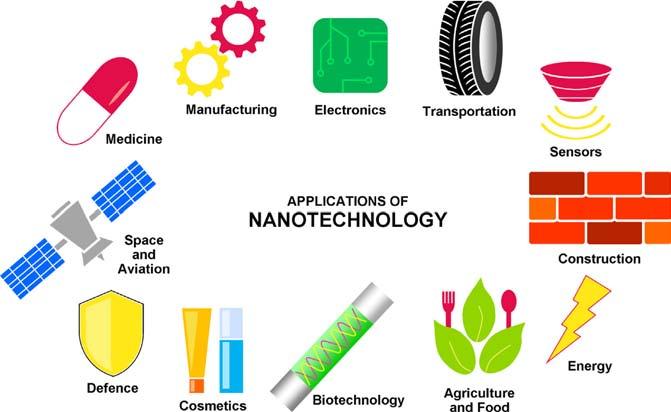
Such engineered nanomaterials and their use in further downstream materials have enhanced the quality of products being manufactured for high performance. Applications of nanomaterials, due to their outstanding optical and electrical properties, mainly lie in the field of electronics. These include applications right from printed circuit boards to touch-controlled display screens of electronic devices. Also, their stimulus to external conditions has made their application possible in sensors for sensing various chemicals present in the environment. Nanomaterials, being able to selectively absorb the light of certain wavelengths, can also act as filters that block
certain wavelengths to travel ahead. The use of nanomaterials in cosmetics is one of the traditional applications that exploit this property. High strength of the materials at nanoscales imparts high-wear properties, enabling their application in various sections of transportation. This includes the use of carbon nanoparticles in tires and selfhealing anticorrosive coatings in paint. Not only this, the lightweight of nanomaterials also leads its way to the application in materials used for spacecraft manufacturing. Along with this, nanomaterials have been used in construction industry as additives in concrete for imparting high-strength properties. The high ratios of strength to weight of nanomaterials have inspired research and application of such materials by military for defense in various ways.
Taking a look at the applications of nanotechnology in medicine, we find the need of controlled release of drugs at the targeted site has boosted the research to search for nanoscale drug carriers that are compatible with the drug, its injection passage, and effective at the same time. Thus, various kinds of nanocarriers embedded with distinctive classes of drugs have been investigated, release mechanisms of which are certainly governed by one or the other from a set of factors. In the same way, encapsulation of nutrients required by crops and their timely release has also tied up agriculture with nanotechnology. Encapsulation of flavors and aromas has always been a requirement of the food industry, which, now in collaboration with nanotechnology, has witnessed a tremendous advancement due to the development of unique nanoencapsulants. A study related to plant nanobionics has shown how the carbon nanotubes can help augment the photosynthesis activity in a plant, probably giving rise to the possibility of synthesis of a material that would enhance the process of light energy harvesting (Giraldo et al., 2014). Nanomaterials having being used in various sections of biotechnology have also given birth to a field known as nanobiotechnology. All these applications have enhanced the life of human beings by not only increasing the effectiveness of processes but also by promoting the overall sustainable development. Fig. 1.1 depicts many applications of nanotechnology in various fields in human life.
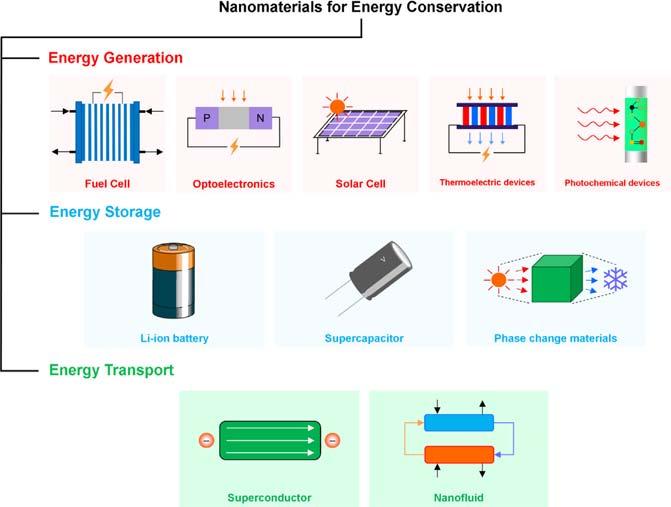
Nanomaterials have found wide applications especially in energy generation, energy storage, and energy transport. Their superior nanolevel properties lead all these processes to achieve the ultimate goal of energy conservation.
Fuel cells, being used in some systems, involve use of platinum-based electrocatalysts that are most efficient cathode materials for the oxygen reduction reaction, but prove to be extremely expensive and unaffordable to common people. Possible cheap alternatives, obviously to the platinum-based materials, have been developed in an attempt to lower down the cost of the electrocatalysts used in these environment-friendly, yet expensive energy generation devices. These mostly involve the use of carbon-based nanomaterials either as cathode or as cathode supports. Similarly, carbon nanotubes find applications in optoelectronic systems like photodiodes. Efficiency of solar cells is also found to be increasing when nanoparticle-based materials are used. Further, they help in enhancing the solar irradiation absorption capacity of the cell. Cost-effective thermoelectric materials have also been prepared for efficient heat to electricity conversion in thermoelectric devices. Conversion of light energy into chemical energy is one of the processes taught to us by nature in the form of photosynthesis taking place in the plants. This phenomenon can be mimicked so as
Applications of nanotechnology in various fields.
to develop machines or devices that can perform the same operation in order to serve many purposes. Nanomaterials also find applications in such processes that also prove to be environment-friendly and efficient but still need further research. Li-ion battery has been a boon to energy storage and compatible with almost every battery-powered device. The capacity of a battery is its most important factor that can be increased by modifying its electrode materials by incorporating nanostructures. In the same way, the accumulation capacity of electric charge by a supercapacitor can be also augmented by the use of nanomaterials. For this, graphene-based materials have been mostly used. The efficiency of the phase-change materials (PCMs) that are one of the finest thermal energy storage materials ever found depends upon several thermophysical properties that can also be enhanced by the use of nanomaterials. Nanomaterials are increasingly also finding applications for energy transport systems, of which superconductors are one of those that exploit electrical and physical properties. Scientists have been preparing nanowires that have outstanding superconducting properties and that can be woven into nanosized sheets for practical application. Nanomaterials mixed in fluids, specially designed to transfer heat energy and commonly known as nanofluids, also come under the same section. Various applications of nanomaterials in energy sector are depicted in Fig. 1.2
Nanofluids, since a couple of decades, have been one of the best alternatives ever found to conserve energy against conventional heat transfer fluids. They are fluids containing particles having size in the range of nanometers, uniformly distributed throughout the medium that is usually called as the base fluid. Thus, these solids when dispersed into the base fluid form a pseudohomogeneous dispersion that has distinctive properties than those of the base fluid itself. It is by virtue of these nanoparticles, that the nanofluid possesses amazing properties useful for various kinds of applications. Termed back in 1995, at the Argonne National Laboratory in Lemont, Illinois,
Fig. 1.1
Fig. 1.2 Applications of nanomaterials for energy conservation.
United States, by Choi and Eastman (1995), it is based on the fact how solids with their high thermal conductive property help augment thermal transport properties of the fluids in which they are dispersed (Maxwell, 1954). It is since this breakthrough in research that the nanotechnology took over major portion of convective heat transfer engineering and extended the study of thermal transport along with the flow of matter at nanoscale. Various kinds of nanomaterials have been investigated for their probable application in nanofluids.
1.2 Colloids and nanofluids
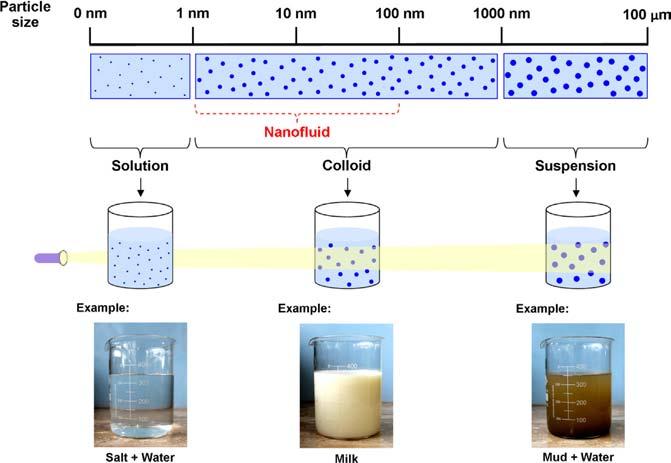
Mixtures of two or more substances are named distinctively and specifically according to their physical appearance or behavior. Unlike a solution, dispersions named as suspensions and colloids are kinds of mixtures that consist of two or more phases. These are classifiable by a phenomenon called as the Tyndall effect that is caused due to the scattering of light in a mixture containing another phase that consists of solid particles. Various types of dispersions of solid particles into liquid medium are graphically depicted in Fig. 1.3
One of the factors that determine the type of mixture is the size of the solute particles of the dispersed phase mixed into the solvent medium or the continuous phase. Solutions are those in which the solute is fully dissolved in the solvent and cannot be separated by mechanical means. In contrast to this, a suspension is a mixture of solid
Fig. 1.3 Types of dispersions of solid particles into liquid medium.
and liquid where the solids are coarser and tend to sediment easily, thus providing effortless separation of both the phases. Colloids, on the contrary, are substances that behave as heterogeneous mixtures, whether they exist in any of the solute-solvent phase combinations, are nevertheless inseparable by common mechanical means. Common kinds of colloids, we are mainly interested in, are those having liquid as their dispersion medium. They can be further classified as foams, emulsions, and sols depending upon whether the respective solute phase is a gas, liquid, or solid. Nanoparticles for nanofluid applications suggest a class of solid particles usually having size not more than 100 nm and so nanofluids can be considered as colloids of the lower particle size range.
1.3 Scope
The ability of a physical system to do work is quantified by the energy available with it. This energy can be extracted from many sources available on earth for multiple purposes. The major sectors consuming energy in many countries are residential, commercial, industrial, and transportation, among which industries are the largest energy consumers representing energy-intensive sector of the whole world. According to the surveys, the largest energy-consuming countries, obviously the countries with the highest population are China, India, and the United States (BP Statistical Review of World Energy 2019, n.d.). The United States recorded an industrial energy consumption of about 32% of the total energy consumed by the four major sectors mentioned
earlier in half of the year 2019 (Monthly Energy Review—Table 2.1, 2019). In 2018, India recorded its industrial sector to be the maximum energy-intensive sector consuming about 58% of the total energy consumption in the whole country (Energy Statistics, 2018).
Being energy efficient is not equal to saving the energy. In fact, saving energy can help accumulate more for near future but being energy efficient and developing energy-efficient processes can lead us to a better tomorrow forever. The European Union 2030 climate and energy framework makes a commitment of 32.5% improvement in energy efficiency as one of the three key targets to achieve smart, sustainable, and inclusive growth (2030 Climate & Energy Framework, n.d.). Following these, are further targets for 2050 (Climate Change Act 2008, 2008). Similarly, many countries have come forward collectively to set targets for sustainable development by becoming energy efficient in order to provide livable environment in the future. China holds a record of being the “Energy Efficiency Champion” due to remarkably having being taking efforts toward number of factors contributing to energy security and economic development (Voita, 2018).
Energy required or consumed can be in any form, although the most important of it is the heat energy. Thermodynamics defines heat transfer as the transfer or movement of heat across the system boundary when there is a temperature difference between the surroundings and the system. It can also take place within the system if there exists a difference in temperature at a location than the other. The temperature difference is the driving force that causes heat flow from high temperature to low temperature by either conduction, convection, or radiation. Heat, thus flowing, certifies the flow of energy and is said to be in transit. Occurring naturally, but a need in modern life, heat transfer has found applications in most of our daily practices. Heat transfer is an unsurpassed concern, be it industrial, domestic, occurring at small-scale or in humongous magnitudes.
A process can be said to be energy efficient when the amount of energy delivered to it is almost consumed and which has comparatively less wastage of energy. This can be achieved by improving the ways of transfer of energy. Here, as we are dealing with heat, transfer of heat from one place to another can be augmented in order to improve efficiency of heat transfer processes, be it at a microscale or at a large industrial scale. Typically, according to the laws of thermodynamics and engineering, the amount of surface area available determines the amount of heat transfer. One can surely augment heat transfer by increasing the heat transfer area. But, this primary goal of augmenting quantity of heat transfer is always governed by additional cost requirements. Nevertheless, surface modifications and complex geometrical designs have always been the top-notch remedies for the enhancement of heat transfer. Along with modifications in the processes or the process equipment, modifications in the utilities also prove as an effective way of achieving this goal.
Heat transfer fluid, although sounding as a sophisticated concept and a high-level terminology derived from industrial field, is a very common and simple term used for fluids that serve as a medium for the transfer of heat. The most common and widely used among them are air and water, the latter being of higher importance in many processes due to higher thermal conductivity. Apart from water, a lot more kinds of fluids
come into picture when the needs become diverse, or rather when thermal properties do not remain to be the only criterion. In the view of the ordinary, rather poor thermal conductivities of these normal fluids, one chooses to modify, engineer, and thus improve the quality of these fluids by one or the other way. Nanofluids, serving the basic purpose of improved heat transfer, then prove to be good alternatives.
1.4 Classification of nanofluids
Nanofluids are a mixture of nanosized materials and liquids and so their behavior depends on the behavior of both of its components. There are many ways of classifying these kinds of fluids based on various factors that go as follows.
1.4.1
Based on type of nanomaterial
There are various types of nanomaterials that have been used by various researchers to prepare a nanofluid. It may depend on the application, cost, toxicity, and even availability of the materials. It is a well-known fact that materials behave differently at tiny sizes because of the increased domination of various forces over them. Since the nanotechnological advancement in the synthesis of nanoparticles of distinctive materials, there have been loads of complex as well as simple processes that are used for the synthesis of unique nanomaterials. Nanomaterials can be of different shapes like spherical, tubular, cubic, ellipsoidal, rod-like, flower-like, fiber-like, leaf-like of varying size and composed of different materials. Typically, they are classified according to their nanosized dimensions as one-dimensional, two-dimensional, and three-dimensional. The physical appearance of the nanoparticles may depend on their material, structural organization, process of synthesis, and other nanoscale physical properties. Basically, the synthesis process is divided into top-down and bottom-up and is the most common classification ever made to become very eminent among nanotechnologists. For the basic knowledge of the readers, we define bottom-up methods as those that involve chemical methods for the synthesis of nanoparticles from chemical precursors and top-down methods as those that involve breaking-down of larger components of the material to smaller size. Various types of nanoparticles for application in nanofluids have been prepared by scientists working all around the world.
1.4.1.1 Pure metal-based
Metal nanoparticles are found to have very distinct properties from their bulk counterparts. A common method for the synthesis of metal nanoparticles, known as the chemical reduction method, involving use of a particular metal precursor and a reducing agent is a bottom-up method (Yonezawa, 2018). Controlled reaction conditions can be beneficial to achieve desired size of the particles. There has also been an increasing interest in developing “green” synthesis methods for metal nanoparticles in order to avoid the usage of hazardous chemicals (Makarov et al., 2014). Due to the reduction in size of metal to nanoscale, substantial amount of atoms gather on the surface
(Burda et al., 2005). This increases the surface energy of the material that is beneficial to most of its properties (Asghari et al., 2016). Several researchers have used metallic nanomaterials for the preparation of nanofluids. It has also been claimed that metal-based nanofluids exhibit better thermal properties than nonmetallic nanomaterial-based nanofluids (Kumar et al., 2019).
The very first study on nanofluids undertaken by Choi and Eastman (1995) depicted superior thermal properties of nanofluids containing copper nanoparticles. Different methods including bottom-up as well as top-down have been used for synthesizing metal nanoparticles for nanofluid applications, some of which have been given in Table 1.1. Among the metals, copper, gold, and silver are found to be abundantly studied due to the inherent thermal properties. Metal nanoparticles have been paid large attention by researchers working in the field of nanofluids.
1.4.1.2
Metal oxide-based
Oxides of metals are less prone to atmospheric oxidation than their pure counterparts. Thus, they are a better choice as far as their chemical stability is concerned (Suganthi and Rajan, 2017). Presence of oxygen surely decreases the thermal conductivity of metal oxides than the pure metals, but at the same time, it also decreases their density, which again makes them a better choice for nanofluid applications so as to achieve a stable nanofluid (Kwak and Kim, 2005). Also, aggregation of the metal oxide particles can be decreased by modifying certain nanofluid preparation methods or addition of dispersants, thus affecting their stability (Zhang et al., 2008). Metal oxide nanofluids are also found to have adhered over by a liquid layer that helps augment thermal conductivity of the base fluid (Suganthi et al., 2013; Suganthi and Rajan, 2017). Among various metal oxides used for nanofluid preparation, oxides of aluminum, copper, and zinc are largely studied for thermal property enhancement of the base fluids. Details about some studies on various metal oxide-based nanofluids are given in Table 1.1
1.4.1.3 Carbide-based
Ceramic materials are often known for their environmentally friendly nature. Among various ceramic materials, few materials have higher thermal conductivity, are chemically stable, and provide high surface area making them more favorable for heat transfer applications (Senthilkumar et al., 2018). The carbide materials are resistant to oxidation that makes them chemically very stable (Singh et al., 2009). Also, there are very less studies done on carbide nanomaterial-based nanofluids among which studies on silicon carbide-based nanofluids are relatively more. Silicon carbide nanoparticles are found to possess high stability with very small agglomeration or settling of particles (Yu et al., 2009). All these properties make them very suitable for nanofluid applications in industrial heating and cooling or air-conditioning systems (Senthilkumar et al., 2018). It is also one of the observations that the power required for pumping silicon carbide-based nanofluids is lesser than that required for metal oxide-based nanofluids (Yu et al., 2009). Details about some studies on various carbide-based nanofluids are given in Table 1.1.
Chemical reduction method, electroexploded wire technique, lipophilic modification process 10–60 nm
of
Silver Silver nitrate, silver wire, silver metal plate
Chemical reduction method, phase transfer method followed by chemical reduction method, pulse laser ablation technique
Microwave-assisted chemical precipitation method, chemical reduction method, electrical explosion of wires in liquid technique, multipulse laser ablation in liquids
5.8–15.2 nm
Water, kerosene, toluene, and decahydronaphthalene
Water, synthetic heat transfer oil (Therminol VP-1, Dowtherm A)
Bhanushali et al. (2017), Choi and Eastman (1995), Khoshvaght-Aliabadi and Hormozi (2015), Li et al. (2011), and Wilk et al. (2017)
Chen et al. (2017b), GómezVillarejo et al. (2017), Soltaninejad et al. (2013), and Wang et al. (2013)
4–118.9 nm
Water and ethanol
Zinc Zinc metal
Metal vapor condensation method 30–42 nm
Iron Iron carbonyl Chemical vapor condensation process 10–98 nm
Nickel Nickel nitrate hexahydrate
Modified sol-gel auto combustion technique 5 nm
Table 1.1 Summary of various nanofluids based on the type of materials. Continued
Ghosh et al. (2012), Godson et al. (2010), Iyahraja and Rajadurai (2015), Maddah et al. (2013), Park et al. (2011), and Phuoc et al. (2007)
Water Hussein et al. (2017) and Sonage and Mohanan (2015a,b)
Water and ethylene glycol
Water
Hemmat Esfe et al. (2015) and Hong et al. (2005, 2006)
Reena Mary et al. (2011)
Table 1.1 Continued
Nanoparticle Source/precursor Synthesis route
Avg. size of nanoparticle Base fluid Reference
Chromium – – 20 nm Water, ethylene glycol, and ethanol
Elango et al. (2015), Radkar et al. (2019), Singh et al. (2012, 2013), and Suganthi et al. (2014)
Elango et al. (2015), Guan et al. (2014), and Sundar et al. (2013)
Elango et al. (2015), Mukesh Kumar et al. (2013), Sohel et al. (2014), and Srinivas and Venu Vinod (2016)
Parashar et al. (2014)
Elango et al. (2015)
Parashar et al. (2014)
Another random document with no related content on Scribd:
EXPANSION AS A PROCESS
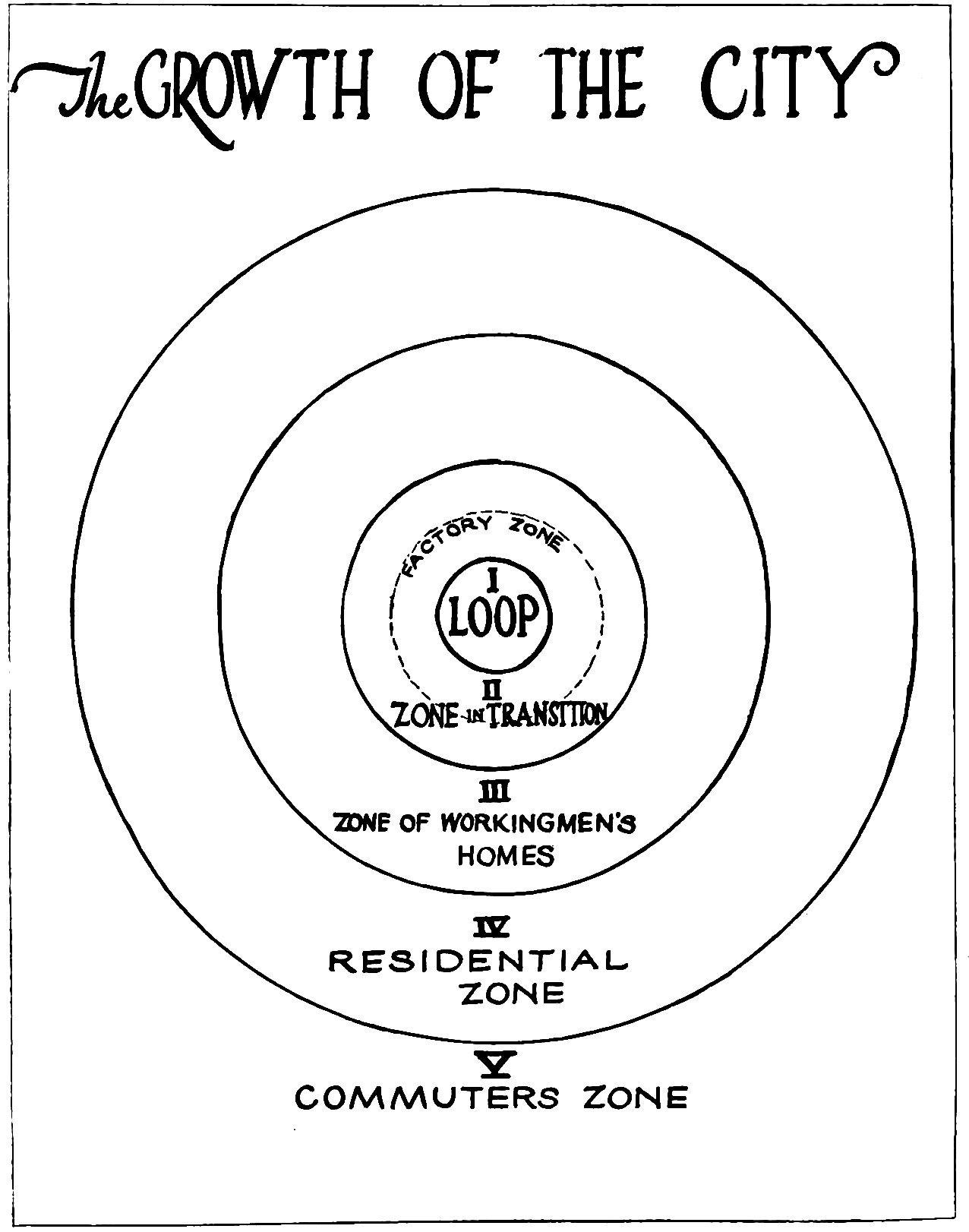
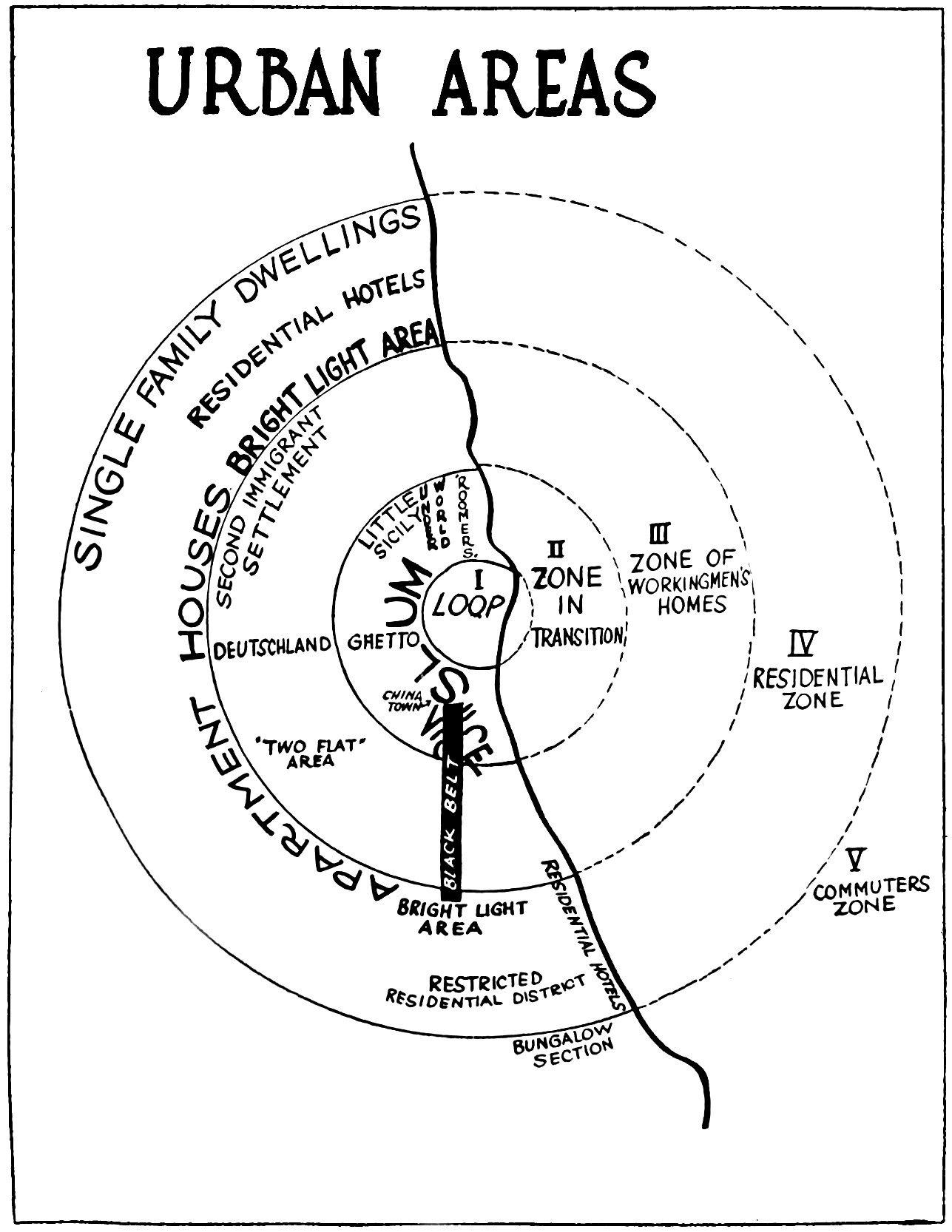
No study of expansion as a process has yet been made, although the materials for such a study and intimations of different aspects of the process are contained in city planning, zoning, and regional surveys. The typical processes of the expansion of the city can best be illustrated, perhaps, by a series of concentric circles, which may be numbered to designate both the successive zones of urban extension and the types of areas differentiated in the process of expansion.
This chart represents an ideal construction of the tendencies of any town or city to expand radially from its central business district —on the map “The Loop” (I). Encircling the downtown area there is normally an area in transition, which is being invaded by business and light manufacture (II). A third area (III) is inhabited by the workers in industries who have escaped from the area of deterioration (II) but who desire to live within easy access of their work. Beyond this zone is the “residential area” (IV) of high-class apartment buildings or of exclusive “restricted” districts of single family dwellings. Still farther, out beyond the city limits, is the commuters’ zone (V)—suburban areas, or satellite cities—within a thirty- to sixty-minute ride of the central business district.
This chart brings out clearly the main fact of expansion, namely, the tendency of each inner zone to extend its area by the invasion of the next outer zone. This aspect of expansion may be called succession, a process which has been studied in detail in plant ecology. If this chart is applied to Chicago, all four of these zones were in its early history included in the circumference of the inner zone, the present business district. The present boundaries of the area of deterioration were not many years ago those of the zone now inhabited by independent wage-earners, and within the memories of thousands of Chicagoans contained the residences of the “best families.” It hardly needs to be added that neither Chicago nor any other city fits perfectly into this ideal scheme. Complications are introduced by the lake front, the Chicago River, railroad lines,
historical factors in the location of industry, the relative degree of the resistance of communities to invasion, etc.
CHART I
The GROWTH OF THE CITY
Besides extension and succession, the general process of expansion in urban growth involves the antagonistic and yet
complementary processes of concentration and decentralization. In all cities there is the natural tendency for local and outside transportation to converge in the central business district. In the downtown section of every large city we expect to find the department stores, the skyscraper office buildings, the railroad stations, the great hotels, the theaters, the art museum, and the city hall. Quite naturally, almost inevitably, the economic, cultural, and political life centers here. The relation of centralization to the other processes of city life may be roughly gauged by the fact that over half a million people daily enter and leave Chicago’s “loop.” More recently sub-business centers have grown up in outlying zones. These “satellite loops” do not, it seems, represent the “hoped for” revival of the neighborhood, but rather a telescoping of several local communities into a larger economic unity. The Chicago of yesterday, an agglomeration of country towns and immigrant colonies, is undergoing a process of reorganization into a centralized decentralized system of local communities coalescing into subbusiness areas visibly or invisibly dominated by the central business district. The actual processes of what may be called centralized decentralization are now being studied in the development of the chain store, which is only one illustration of the change in the basis of the urban organization.[20]
Expansion, as we have seen, deals with the physical growth of the city, and with the extension of the technical services that have made city life not only livable, but comfortable, even luxurious. Certain of these basic necessities of urban life are possible only through a tremendous development of communal existence. Three millions of people in Chicago are dependent upon one unified water system, one giant gas company, and one huge electric light plant. Yet, like most of the other aspects of our communal urban life, this economic co-operation is an example of co-operation without a shred of what the “spirit of co-operation” is commonly thought to signify. The great public utilities are a part of the mechanization of life in great cities, and have little or no other meaning for social organization.
Yet the processes of expansion, and especially the rate of expansion, may be studied not only in the physical growth and business development, but also in the consequent changes in the
social organization and in personality types. How far is the growth of the city, in its physical and technical aspects, matched by a natural but adequate readjustment in the social organization? What, for a city, is a normal rate of expansion, a rate of expansion with which controlled changes in the social organization might successfully keep pace?
SOCIAL ORGANIZATION AND DISORGANIZATION AS PROCESSES OF METABOLISM
These questions may best be answered, perhaps, by thinking of urban growth as a resultant of organization and disorganization analogous to the anabolic and katabolic processes of metabolism in the body. In what way are individuals incorporated into the life of a city? By what process does a person become an organic part of his society? The natural process of acquiring culture is by birth. A person is born into a family already adjusted to a social environment—in this case the modern city. The natural rate of increase of population most favorable for assimilation may then be taken as the excess of the birth-rate over the death-rate, but is this the normal rate of city growth? Certainly, modern cities have increased and are increasing in population at a far higher rate. However, the natural rate of growth may be used to measure the disturbances of metabolism caused by any excessive increase, as those which followed the great influx of southern Negroes into northern cities since the war. In a similar way all cities show deviations in composition by age and sex from a standard population such as that of Sweden, unaffected in recent years by any great emigration or immigration. Here again, marked variations, as any great excess of males over females, or of females over males, or in the proportion of children, or of grown men or women, are symptomatic of abnormalities in social metabolism.
Normally the processes of disorganization and organization may be thought of as in reciprocal relationship to each other, and as cooperating in a moving equilibrium of social order toward an end vaguely or definitely regarded as progressive. So far as disorganization points to reorganization and makes for more efficient adjustment, disorganization must be conceived not as pathological, but as normal. Disorganization as preliminary to reorganization of attitudes and conduct is almost invariably the lot of the newcomer to the city, and the discarding of the habitual, and often of what has been to him the moral, is not infrequently
accompanied by sharp mental conflict and sense of personal loss. Oftener, perhaps, the change gives sooner or later a feeling of emancipation and an urge toward new goals.
URBAN AREAS
CHART II
In the expansion of the city a process of distribution takes place which sifts and sorts and relocates individuals and groups by residence and occupation. The resulting differentiation of the cosmopolitan American city into areas is typically all from one pattern, with only interesting minor modifications. Within the central business district or on an adjoining street is the “main stem” of “hobohemia,” the teeming Rialto of the homeless migratory man of the Middle West.[21] In the zone of deterioration encircling the central business section are always to be found the so-called “slums” and “bad lands,” with their submerged regions of poverty, degradation, and disease, and their underworlds of crime and vice. Within a deteriorating area are rooming-house districts, the purgatory of “lost souls.” Near by is the Latin Quarter, where creative and rebellious spirits resort. The slums are also crowded to overflowing with immigrant colonies—the Ghetto, Little Sicily, Greektown, Chinatown—fascinatingly combining old world heritages and American adaptations. Wedging out from here is the Black Belt, with its free and disorderly life. The area of deterioration, while essentially one of decay, of stationary or declining population, is also one of regeneration, as witness the mission, the settlement, the artists’ colony, radical centers—all obsessed with the vision of a new and better world.
The next zone is also inhabited predominatingly by factory and shop workers, but skilled and thrifty. This is an area of second immigrant settlement, generally of the second generation. It is the region of escape from the slum, the Deutschland of the aspiring Ghetto family. For Deutschland (literally “Germany”) is the name given, half in envy, half in derision, to that region beyond the Ghetto where successful neighbors appear to be imitating German Jewish standards of living. But the inhabitant of this area in turn looks to the “Promised Land” beyond, to its residential hotels, its apartmenthouse region, its “satellite loops,” and its “bright light” areas.
This differentiation into natural economic and cultural groupings gives form and character to the city. For segregation offers the group, and thereby the individuals who compose the group, a place and a rôle in the total organization of city life. Segregation limits development in certain directions, but releases it in others.
These areas tend to accentuate certain traits, to attract and develop their kind of individuals, and so to become further differentiated.
The division of labor in the city likewise illustrates disorganization, reorganization, and increasing differentiation. The immigrant from rural communities in Europe and America seldom brings with him economic skill of any great value in our industrial, commercial, or professional life. Yet interesting occupational selection has taken place by nationality, explainable more by racial temperament or circumstance than by old-world economic background, as Irish policemen, Greek ice-cream parlors, Chinese laundries, Negro porters, Belgian janitors, etc.
The facts that in Chicago one million (996,589) individuals gainfully employed reported 509 occupations, and that over 1,000 men and women in Who’s Who gave 116 different vocations, give some notion of how in the city the minute differentiation of occupation “analyzes and sifts the population, separating and classifying the diverse elements.”[22] These figures also afford some intimation of the complexity and complication of the modern industrial mechanism and the intricate segregation and isolation of divergent economic groups. Interrelated with this economic division of labor is a corresponding division into social classes and into cultural and recreational groups. From this multiplicity of groups, with their different patterns of life, the person finds his congenial social world and—what is not feasible in the narrow confines of a village—may move and live in widely separated, and perchance conflicting, worlds. Personal disorganization may be but the failure to harmonize the canons of conduct of two divergent groups.
If the phenomena of expansion and metabolism indicate that a moderate degree of disorganization may and does facilitate social organization, they indicate as well that rapid urban expansion is accompanied by excessive increases in disease, crime, disorder, vice, insanity, and suicide, rough indexes of social disorganization. But what are the indexes of the causes, rather than of the effects, of the disordered social metabolism of the city? The excess of the actual over the natural increase of population has already been suggested as a criterion. The significance of this increase consists in the immigration into a metropolitan city like New York and Chicago of tens of thousands of persons annually. Their invasion of the city has
the effect of a tidal wave inundating first the immigrant colonies, the ports of first entry, dislodging thousands of inhabitants who overflow into the next zone, and so on and on until the momentum of the wave has spent its force on the last urban zone. The whole effect is to speed up expansion, to speed up industry, to speed up the “junking” process in the area of deterioration (II). These internal movements of the population become the more significant for study. What movement is going on in the city, and how may this movement be measured? It is easier, of course, to classify movement within the city than to measure it. There is the movement from residence to residence, change of occupation, labor turnover, movement to and from work, movement for recreation and adventure. This leads to the question: What is the significant aspect of movement for the study of the changes in city life? The answer to this question leads directly to the important distinction between movement and mobility.
MOBILITY AS THE PULSE OF THE COMMUNITY
Movement, per se, is not an evidence of change or of growth. In fact, movement may be a fixed and unchanging order of motion, designed to control a constant situation, as in routine movement. Movement that is significant for growth implies a change of movement in response to a new stimulus or situation. Change of movement of this type is called mobility. Movement of the nature of routine finds its typical expression in work. Change of movement, or mobility, is characteristically expressed in adventure. The great city, with its “bright lights,” its emporiums of novelties and bargains, its palaces of amusement, its underworld of vice and crime, its risks of life and property from accident, robbery, and homicide, has become the region of the most intense degree of adventure and danger, excitement and thrill.
Mobility, it is evident, involves change, new experience, stimulation. Stimulation induces a response of the person to those objects in his environment which afford expression for his wishes. For the person, as for the physical organism, stimulation is essential to growth. Response to stimulation is wholesome so long as it is a correlated integral reaction of the entire personality. When the reaction is segmental, that is, detached from, and uncontrolled by, the organization of personality, it tends to become disorganizing or pathological. That is why stimulation for the sake of stimulation, as in the restless pursuit of pleasure, partakes of the nature of vice.
The mobility of city life, with its increase in the number and intensity of stimulations, tends inevitably to confuse and to demoralize the person. For an essential element in the mores and in personal morality is consistency, consistency of the type that is natural in the social control of the primary group. Where mobility is the greatest, and where in consequence primary controls break down completely, as in the zone of deterioration in the modern city, there develop areas of demoralization, of promiscuity, and of vice.
In our studies of the city it is found that areas of mobility are also the regions in which are found juvenile delinquency, boys’ gangs, crime, poverty, wife desertion, divorce, abandoned infants, vice.
These concrete situations show why mobility is perhaps the best index of the state of metabolism of the city. Mobility may be thought of in more than a fanciful sense, as the “pulse of the community.” Like the pulse of the human body, it is a process which reflects and is indicative of all the changes that are taking place in the community, and which is susceptible of analysis into elements which may be stated numerically.
The elements entering into mobility may be classified under two main heads: (1) the state of mutability of the person, and (2) the number and kind of contacts or stimulations in his environment. The mutability of city populations varies with sex and age composition, the degree of detachment of the person from the family and from other groups. All these factors may be expressed numerically. The new stimulations to which a population responds can be measured in terms of change of movement or of increasing contacts. Statistics on the movement of urban population may only measure routine, but an increase at a higher ratio than the increase of population measures mobility. In 1860 the horse-car lines of New York City carried about 50,000,000 passengers; in 1890 the trolley-cars (and a few surviving horse-cars) transported about 500,000,000; in 1921, the elevated, subway, surface, and electric and steam suburban lines carried a total of more than 2,500,000,000 passengers.[23] In Chicago the total annual rides per capita on the surface and elevated lines were 164 in 1890; 215 in 1900; 320 in 1910; and 338 in 1921. In addition, the rides per capita on steam and electric suburban lines almost doubled between 1916 (23) and 1921 (41), and the increasing use of the automobile must not be overlooked.[24] For example, the number of automobiles in Illinois increased from 131,140 in 1915 to 833,920 in 1923.[25]
Mobility may be measured not only by these changes of movement, but also by increase of contacts. While the increase of population of Chicago in 1912–22 was less than 25 per cent (23.6 per cent), the increase of letters delivered to Chicagoans was double that (49.6 per cent)—(from 693,084,196 to 1,038,007,854).[26] In 1912
New York had 8.8 telephones; in 1922, 16.9 per 100 inhabitants. Boston had, in 1912, 10.1 telephones; ten years later, 19.5 telephones per 100 inhabitants. In the same decade the figures for Chicago increased from 12.3 to 21.6 per 100 population.[27] But increase of the use of the telephone is probably more significant than increase in the number of telephones. The number of telephone calls in Chicago increased from 606,131,928 in 1914 to 944,010,586 in 1922,[28] an increase of 55.7 per cent, while the population increased only 13.4 per cent.
Land values, since they reflect movement, afford one of the most sensitive indexes of mobility. The highest land values in Chicago are at the point of greatest mobility in the city, at the corner of State and Madison streets, in the Loop. A traffic count showed that at the rush period 31,000 people an hour, or 210,000 men and women in sixteen and one-half hours, passed the southwest corner. For over ten years land values in the Loop have been stationary, but in the same time they have doubled, quadrupled, and even sextupled in the strategic corners of the “satellite loops,”[29] an accurate index of the changes which have occurred. Our investigations so far seem to indicate that variations in land values, especially where correlated with differences in rents, offer perhaps the best single measure of mobility, and so of all the changes taking place in the expansion and growth of the city.
In general outline, I have attempted to present the point of view and methods of investigation which the department of sociology is employing in its studies in the growth of the city, namely, to describe urban expansion in terms of extension, succession, and concentration; to determine how expansion disturbs metabolism when disorganization is in excess of organization; and, finally, to define mobility and to propose it as a measure both of expansion and metabolism, susceptible to precise quantitative formulation, so that it may be regarded almost literally as the pulse of the community. In a way, this statement might serve as an introduction to any one of five or six research projects under way in the department.[30] The project, however, in which I am directly engaged is an attempt to apply these methods of investigation to a cross-section of the city—to put this area, as it were, under the microscope, and so to study in more detail and with greater control and precision the processes
which have been described here in the large. For this purpose the West Side Jewish community has been selected. This community includes the so-called “Ghetto,” or area of first settlement, and Lawndale, the so-called “Deutschland,” or area of second settlement. This area has certain obvious advantages for this study, from the standpoint of expansion, metabolism, and mobility. It exemplifies the tendency to expansion radially from the business center of the city. It is now relatively a homogeneous cultural group. Lawndale is itself an area in flux, with the tide of migrants still flowing in from the Ghetto and a constant egress to more desirable regions of the residential zone. In this area, too, it is also possible to study how the expected outcome of this high rate of mobility in social and personal disorganization is counteracted in large measure by the efficient communal organization of the Jewish community.
E W. B
CHAPTER III
THE
ECOLOGICAL APPROACH
TO THE STUDY OF THE HUMAN COMMUNITY
The young sciences of plant and animal ecology have become fairly well established. Their respective fields are apparently quite well defined, and a set of concepts for analysis is becoming rather generally accepted. The subject of human ecology, however, is still practically an unsurveyed field, that is, so far as a systematic and scientific approach is concerned. To be sure, hosts of studies have been made which touch the field of human ecology in one or another of its varied aspects, but there has developed no science of human ecology which is comparable in precision of observation or in method of analysis with the recent sciences of plant and animal ecology.
I. THE RELATION OF
HUMAN ECOLOGY
TO PLANT AND ANIMAL ECOLOGY
Ecology has been defined as “that phase of biology that considers plants and animals as they exist in nature, and studies their interdependence, and the relation of each kind and individual to its environment.”[31] This definition is not sufficiently comprehensive to include all the elements that logically fall within the range of human ecology. In the absence of any precedent let us tentatively define human ecology as a study of the spatial and temporal[32] relations of human beings as affected by the selective, distributive, and accommodative forces of the environment. Human ecology is fundamentally interested in the effect of position, [33] in both time and space, upon human institutions and human behavior. “Society is made up of individuals spatially separated, territorially distributed, and capable of independent locomotion.”[34] These spatial relationships of human beings are the products of competition and selection, and are continuously in process of change as new factors enter to disturb the competitive relations or to facilitate mobility. Human institutions and human nature itself become accommodated to certain spatial relationships of human beings. As these spatial relationships change, the physical basis of social relations is altered, thereby producing social and political problems.
A great deal has been written about the biological, economic, and social aspects of competition and selection, but little attention has been given to the distributive and spatial aspects of these processes. The plant ecologist is aware of the effect of the struggle for space, food, and light upon the nature of a plant formation, but the sociologist has failed to recognize that the same processes of competition and accommodation are at work determining the size and ecological organization of the human community.
The essential difference between the plant and animal organism is that the animal has the power of locomotion which enables it to gather nutriment from a wider environment, but, in addition to the
power to move in space, the human animal has the ability to contrive and adapt the environment to his needs. In a word, the human community differs from the plant community in the two dominant characteristics of mobility and purpose, that is, in the power to select a habitat and in the ability to control or modify the conditions of the habitat. On first consideration this might seem to indicate that human ecology could have nothing in common with plant ecology where the processes of association and adjustment result from natural unmodifiable reactions, but closer examination and investigation make it obvious that human communities are not so much the products of artifact or design as many hero-worshipers suppose.[35]
The human community has its inception in the traits of human nature and the needs of human beings. Man is a gregarious animal: he cannot live alone; he is relatively weak and needs not only the company of other human associates but shelter and protection from the elements as well. Brunhes says there are three essentials to the inception of the human community: the house, the road, and water. [36] Food may be transported more easily than shelter or water; the latter two therefore constitute, even under the most nomadic conditions, the essential elements in giving a location and a spatial fixity to human relations.[37] This is exemplified under our present régime of automobile tourist life, where water and shelter become the determining factors in the location of the camp.
The size and stability of the human community is however a function of the food supply and of the rôle played in the wider ecological process of production and distribution of commodities. When man makes his living from hunting or fishing, the community is small and of but temporary duration; when agriculture becomes the chief source of sustenance, the community is still small but assumes a more permanent character; when trade and commerce develop, larger communities arise at points of break in conveyance, that is, at the mouths of rivers, junctions of streams, at waterfalls, and shallows where streams are forded. As new forms of transportation arise, new points of concentration occur and old points become accentuated or reduced. Again, as goods for trade are made in communities, still other points of concentration come into
existence, determined largely by sources of power and raw material. [38]
II. ECOLOGICAL CLASSIFICATION OF COMMUNITIES
From the standpoint of ecology, communities may be divided into four general types: first, the primary service community, such as the agricultural town, the fishing, mining, or lumbering community which serves as the first step in the distributive process of the outgoing basic commodity and as the last stage in the distributive process of the product finished for consumption. The size of such communities depends entirely upon the nature and form of utilization of the extractive industry concerned, together with the extent of the surrounding trade area. The community responds in size to any element that affects the productivity of the economic base or the extent of the area from which it draws its sustenance. But, in any event, so long as such a community does not assume any other function in the larger ecological process, it cannot grow in population beyond a few thousand inhabitants.
The next type of community is the one that fulfils the secondary function in the distributive process of commodities. It collects the basic materials from the surrounding primary communities and distributes them in the wider markets of the world. On the other hand, it redistributes the products coming from other parts of the world to the primary service communities for final consumption. This is commonly called the commercial community; it may, however, combine other functions as well. The size of this type of community depends upon the extent of its distributive functions. It may vary from a small wholesale town in the center of an agricultural plain to that of a great port city whose hinterland extends halfway across the continent. Growth depends upon the comparative advantages of the site location.
The third type of community is the industrial town. It serves as the locus for the manufacturing of commodities. In addition it may combine the functions of the primary service and the commercial types. It may have its local trade area and it may also be the distributing center for the surrounding hinterland. The type is
characterized merely by the relative dominance of industry over the other forms of service. There is practically no limit to the size to which an industrial community may develop. Growth is dependent upon the scope and market organization of the particular industries which happen to be located within its boundaries. Industrial communities are of two general types: first, those that have diversified and multiple industries organized on a local sale of products, and, second, those that are dominated by one or two highly developed industries organized on a national or world-sale of products.
The fourth type of community is one which is lacking in a specific economic base. It draws its economic sustenance from other parts of the world, and may serve no function in the production or distribution of commodities. Such communities are exemplified in our recreational resorts, political and educational centers, communities of defense, penal or charitable colonies. From the standpoint of growth or decline such communities are not subject to the same laws that govern the development of towns that play a part in the larger productive and distributive processes.[39] They are much more subject to the vicissitudes of human fancies and decrees than are the basic types of human communities. Of course, any community may and usually does have accretions added to its population as a result of such service. It may, for instance, be the seat of a university, of a state prison, or it may be a recreational resort for at least certain seasons of the year.
III. DETERMINING ECOLOGICAL FACTORS IN
THE GROWTH OR DECLINE OF COMMUNITY
The human community tends to develop in cyclic fashion. Under a given state of natural resources and in a given condition of the arts the community tends to increase in size and structure until it reaches the point of population adjustment to the economic base. In an agricultural community, under present conditions of production and transportation, the point of maximum population seldom exceeds 5,000.[40] The point of maximum development may be termed the point of culmination or climax, to use the term of the plant ecologist. [41] The community tends to remain in this condition of balance between population and resources until some new element enters to disturb the status quo, such as the introduction of a new system of communication, a new type of industry, or a different form of utilization of the existing economic base. Whatever the innovation may be that disturbs the equilibrium of the community, there is a tendency toward a new cycle of adjustment. This may act in either a positive or negative manner. It may serve as a release to the community, making for another cycle of growth and differentiation, or it may have a retractive influence, necessitating emigration and readjustment to a more circumscribed base.
In earlier conditions of life, population was kept down to the community balance by variations in the death-rate, or, as in the case of Greek cities, the surplus population emigrated in groups to establish new colonies—offshoots of the mother-city. Under modern conditions of communication and transportation, population adjustment is maintained by a ceaseless process of individual migrations. As a result of the dynamic conditions prevailing throughout the civilized world during the last fifty years, many communities have passed through swift successive cycles of growth or decline, the determining factors being changes in forms and routes of transportation and communication and the rise of new industries.
Some advantage in transportation is the most fundamental and most important of the causes determining the location of a distributing center. It may almost be said to be the only cause for the formation of such centers. For some reason or reasons a particular place is more conveniently and cheaply reached by many people than any surrounding point; and, as a result, they naturally exchange commodities there. The country store is located at the crossing of roads. There also is the village. In a mountain country the market town is at the junction of two, or, still better, of three valleys. Another favorite location is the end of a mountain pass, or a gap that is a thoroughfare between two valleys. If rivers are difficult to cross, settlements will spring up at the safest ferries or fords. In a level plain, a town will be near its center, and a focus of roads or railroads in such a plain, fertile and populous, will almost surely make a city.[42]
It is the railroad and the steamship that determine where a new business shall be developed, quite as often as the government policy. The grant of special rates and privileges to shippers is nowadays the most efficient kind of protection.
It is this quickening and cheapening of transportation that has given such stimulus in the present day to the growth of large cities. It enables them to draw cheap food from a far larger territory and it causes business to locate where the widest business connection is to be had, rather than where the goods or raw materials are most easily produced. And the perfection of the means of communication, the post-office and the telegraph, intensifies the same result.[43]
The entire net increase of the population of 1870 to 1890 in Illinois, Wisconsin, Iowa, and Minnesota was in cities and towns possessing competitive rates, while those having non-competitive rates decreased in population, and in Iowa it is the general belief that the absence of large cities is due to the earlier policy of the railways giving Chicago discriminating rates.[44]
The advent of the trolley line and more recently of the automobile has produced still further disturbing elements in the growth of human communities. Their effect has been chiefly to modify the life of the small town or village, causing the decline of some and the sudden growth of others. The introduction of these two forms of transportation, more particularly of the automobile, has been the most potent force in our recent American history in affecting redistribution of our population and in the disorganization of our rural and small-town institutions which grew up on the basis of a horse-and-vehicle type of mobility.[45]
The evolution of new types of industry is another feature that becomes a determining factor in the redistribution of the country’s population. As we review our census reports we see the emergence each decade of one or more important industries; first, the textile
industry causing concentrations of population in the eastern states, then the development of the iron and steel industry with its center of operations gradually shifting farther and farther west, and more recently the advent of the automobile and oil industries making for enormous concentration of population in certain states of the Union, also the motion picture industry with its concentrated center in southern California. The emergence of a new industry has a farreaching effect in disturbing the status quo of communal life. Competition soon forces the new industry to concentrate its productive enterprises in one or two communities; these communities then serve as great magnets drawing to themselves the appropriate population elements from communities far and near.
IV. THE EFFECT OF ECOLOGICAL CHANGES ON THE SOCIAL ORGANIZATION
OF COMMUNITY
Population migrations resulting from such sudden pulls as are the outcomes of unusual forms of release in community growth may cause an expansion in the community’s development far beyond the natural culmination point of its cyclic development, resulting in a crisis situation, a sudden relapse, disorganization, or even panic. Socalled “boom towns” are towns that have experienced herd movements of population beyond the natural point of culmination.
On the other hand, a community which has reached the point of culmination and which has experienced no form of release is likely to settle into a condition of stagnation. Its natural surplus of population is forced to emigrate. This type of emigration tends to occasion folkdepletion in the parent community. The younger and more enterprising population elements respond most sensitively to the absence of opportunities in their home town. This is particularly true when the community has but a single economic base, such as agriculture, lumbering, mining. Reformers try in vain to induce the young people to remain on the farms or in their native villages, little realizing that they are working in opposition to the general principles of the ecological order.
Again, when a community starts to decline in population due to a weakening of the economic base, disorganization and social unrest follow.[46] Competition becomes keener within the community, and the weaker elements either are forced into a lower economic level or are compelled to withdraw from the community entirely. There are, of course, periodic and temporary fluctuations in the economic balance, due either to circumstances which affect the entire economic order or to the vicissitudes of the particular industry from which the community draws its sustenance. These temporary fluctuations, however, while important from the standpoint of social well-being, do not comprise the basic determinants of community development.
The introduction of an innovating element into the adjustment of a community may be designated as the initial stage of an invasion which may make for a complete change in the structure and organization of the community. The introduction of a new mode of transportation, for instance, may transform the economic organization of a community and make for a change in population type.
Thus the Harlem Railroad transformed Quaker Hill from a community of diversified farming, producing, manufacturing, selling, consuming, sufficient unto itself, into a locality of specialized farming. Its market had been Poughkeepsie, twenty-eight miles away, over high hills and indifferent roads. Its metropolis became New York, sixty-two miles away by rail and four to eight miles by wagonroad.
With the railroad’s coming, the isolated homogeneous community scattered. The sons of the Quakers emigrated. Laborers from Ireland and other European lands, even negroes from Virginia, took their places. New Yorkers became residents on the Hill, which became the farthest terminus of suburban travel.[47]
The establishment of a new industry, especially if it displaces the previous economic base, may also make for a more or less complete change of population without greatly modifying the size of the community. This condition is exemplified in many of the small towns of the state of Washington which have changed from lumbering to agriculture or from one type of agriculture to another. In many cases few of the previous inhabitants remained after the invasion of the new economic base.
As a community increases in size, however, it becomes better able to accommodate itself to invasions and to sudden changes in number of inhabitants. The city tends to become the reservoir into which the surplus population drains from the smaller communities round about.
V. ECOLOGICAL PROCESSES DETERMINING THE INTERNAL
STRUCTURE OF COMMUNITY
In the process of community growth there is a development from the simple to the complex, from the general to the specialized; first to increasing centralization and later to a decentralization process. In the small town or village the primary universal needs are satisfied by a few general stores and a few simple institutions such as church, school, and home. As the community increases in size specialization takes place both in the type of service provided and in the location of the place of service. The sequence of development may be somewhat as follows: first the grocery store, sometimes carrying a few of the more staple dry goods, then the restaurant, poolroom, barber shop, drug store, dry-goods store, and later bank, haberdashery, millinery, and other specialized lines of service.[48]
The axial or skeletal structure of a community is determined by the course of the first routes of travel and traffic.[49] Houses and shops are constructed near the road, usually parallel with it. The road may be a trail, public highway, railroad, river, or ocean harbor, but, in any case, the community usually starts in parallel relation to the first main highway. With the accumulation of population and utilities the community takes form, first along one side of the highway and later on both sides. The point of junction or crossing of two main highways, as a rule, serves as the initial center of the community.
As the community grows there is not merely a multiplication of houses and roads but a process of differentiation and segregation takes place as well. Residences and institutions spread out in centrifugal fashion from the central point of the community, while business concentrates more and more around the spot of highest land values. Each cyclic increase of population is accompanied by greater differentiation in both service and location. There is a struggle among utilities for the vantage-points of position. This makes for increasing value of land and increasing height of buildings
at the geographic center of the community. As competition for advantageous sites becomes keener with the growth of population, the first and economically weaker types of utilities are forced out to less accessible and lower-priced areas. By the time the community has reached a population of about ten or twelve thousand, a fairly well-differentiated structure is attained. The central part is a clearly defined business area with the bank, the drugstore, the department store, and the hotel holding the sites of highest land value. Industries and factories usually comprise independent formations within the city, grouping around railroad tracks and routes of water traffic. Residence sections become established, segregated into two or more types, depending upon the economic and racial composition of the population.
The structural growth of community takes place in successional sequence not unlike the successional stages in the development of the plant formation. Certain specialized forms of utilities and uses do not appear in the human community until a certain stage of development has been attained, just as the beech or pine forest is preceded by successional dominance of other plant species. And just as in plant communities successions are the products of invasion, so also in the human community the formations, segregations, and associations that appear constitute the outcome of a series of invasions.[50]
There are many kinds of intra-community invasions, but in general they may be grouped into two main classes: those resulting in change in use of land, and those which introduce merely change in type of occupant. By the former is meant change from one general use to another, such as of a residential area into a business area or of a business into an industrial district. The latter embraces all changes of type within a particular use area, such as the changes which constantly take place in the racial and economic complexion of residence neighborhoods, or of the type of service utility within a business section. Invasions produce successional stages of different qualitative significance, that is, the economic character of the district may rise or fall as the result of certain types of invasion. This qualitative aspect is reflected in the fluctuations of land or rental values.
The conditions which initiate invasions are legion. The following are some of the more important: (1) changes in forms and routes of transportation;[51] (2) obsolescence resulting from physical deterioration or from changes in use or fashion; (3) the erection of important public or private structures, buildings, bridges, institutions, which have either attractive or repellent significance; (4) the introduction of new types of industry, or even a change in the organization of existing industries; (5) changes in the economic base which make for redistribution of income, thus necessitating change of residence; (6) real estate promotion creating sudden demands for special location sites, etc.
Invasions may be classified according to stage of development into (a) initial stage, (b) secondary or developmental stage, (c) climax. The initial stage of an invasion has to do with the point of entry, the resistance or inducement offered the invader by the prior inhabitants of the area, the effect upon land values and rentals. The invasion, of course, may be into an unoccupied territory or into territory with various degrees of occupancy. The resistance to invasion depends upon the type of the invader together with the degree of solidarity of the present occupants. The undesirable invader, whether in population type or in use form, usually makes entry (that is, within an area already completely occupied) at the point of greatest mobility. It is a common observation that foreign races and other undesirable invaders, with few exceptions, take up residence near the business center of the community or at other points of high mobility and low resistance. Once established they gradually push their way out along business or transportation thoroughfares to the periphery of the community.
The commencement of an invasion tends to be reflected in changes in land value. If the invasion is one of change in use the value of the land generally advances and the value of the building declines. This condition furnishes the basis for disorganization. The normal improvements and repairs are, as a rule, omitted, and the owner is placed under the economic urge of renting his property to parasitic and transitory services which may be economically strong but socially disreputable and therefore able and obliged to pay higher rentals than the legitimate utilities can afford. It is a well-known fact
that the vices under the surveillance of the police usually segregate in such transitional areas.[52]
During the course of development of an invasion into a new area, either of use or type, there takes place a process of displacement and selection determined by the character of the invader and of the area invaded. The early stages are usually marked by keenness of competition which frequently manifests itself in outward clashes. Business failures are common in such areas and the rules of competition are violated. As the process continues, competition forces associational groupings. Utilities making similar or complementary demands of the area tend to group in close proximity to one another, giving rise to subformations with definite service functions. Such associations as amusement areas, retail districts, market sections, financial sections, and automobile rows are examples of this tendency.
The climax stage is reached in the invasion process, once the dominant type of ecological organization emerges which is able to withstand the intrusions of other forms of invasion. For example, in the development of a residential district, when it is not controlled in advance by building restrictions, the early stages of growth are usually marked by wide variations in the type and value of buildings constructed. But, in the process of development, a uniform cost type of structure tends to dominate, gradually eliminating all other types that vary widely from the norm, so that it is customary to find a considerable degree of economic homogeneity in all established residential districts. The same process operates in areas devoted to business uses, competition segregates utilities of similar economic strength into areas of corresponding land values, and at the same time forces into close proximity those particular forms of service which profit from mutual association such as financial establishments or automobile display-rooms. Once a dominant use becomes established within an area, competition becomes less ruthless among the associational units, rules of control emerge, and invasion of a different use is for a time obstructed.
The general effect of the continuous processes of invasions and accommodations is to give to the developed community well-defined areas, each having its own peculiar selective and cultural characteristics. Such units of communal life may be termed “natural
areas,”[53] or formations, to use the term of the plant ecologist. In any case, these areas of selection and function may comprise many subformations or associations which become part of the organic structure of the district or of the community as a whole. It has been suggested that these natural areas or formations may be defined in terms of land values,[54] the point of highest land value representing the center or head of the formation (not necessarily the geographic center but the economic or cultural center), while the points of lowest land value represent the periphery of the formation or boundary line between two adjacent formations.
Each formation or ecological organization within a community serves as a selective or magnetic force attracting to itself appropriate population elements and repelling incongruous units, thus making for biological and cultural subdivisions of a city’s population. Everyone knows how racial and linguistic colonies develop in all of our large cities, but the age and sex segregations which take place are not quite so obvious to common perception. In the city of Seattle, which has in general a sex composition of 113 males to 100 females, the downtown district, comprising an area inscribed by a radius of half a mile or so, has from 300 to 500 males to every 100 females. But in the outlying districts of the city, except in one or two industrial sections, these ratios are reversed. Females predominate in numbers over males in all the residential neighborhoods and in the suburbs of the city. This same condition is true with regard to the age distribution of population. The school census shows an absolute decline in the number of children of school age in the central districts of the city although the total population for this area has shown an increase for each decade. It is obvious, then, that the settler type of population, the married couples with children, withdraw from the center of the city while the more mobile and less responsible adults herd together in the hotel and apartment regions near the heart of the community.
This process of population-sifting produces not only increasing mobility with approach from the periphery to the center of the formation, but also different cultural areas representing different mores, attitudes, and degrees of civic interest. The neighborhoods in which the settler type of population resides, with their preponderance of women and children, serve as the custodians of the
stabilizing and repressive mores. It is in the Seattle neighborhoods, especially those on the hill-tops, that the conservative, law-abiding, civic-minded population elements dwell. The downtown section and the valleys, which are usually industrial sites, are populated by a class of people who are not only more mobile but whose mores and attitudes, as tested by voting habits, are more vagrant and radical.