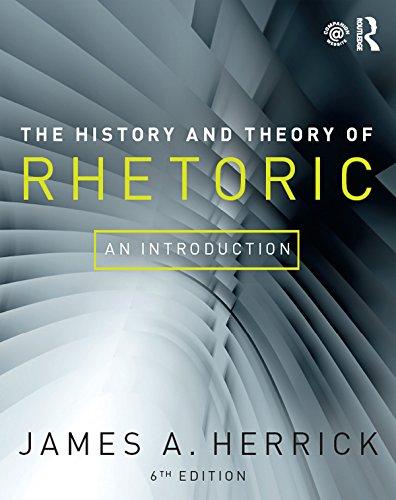
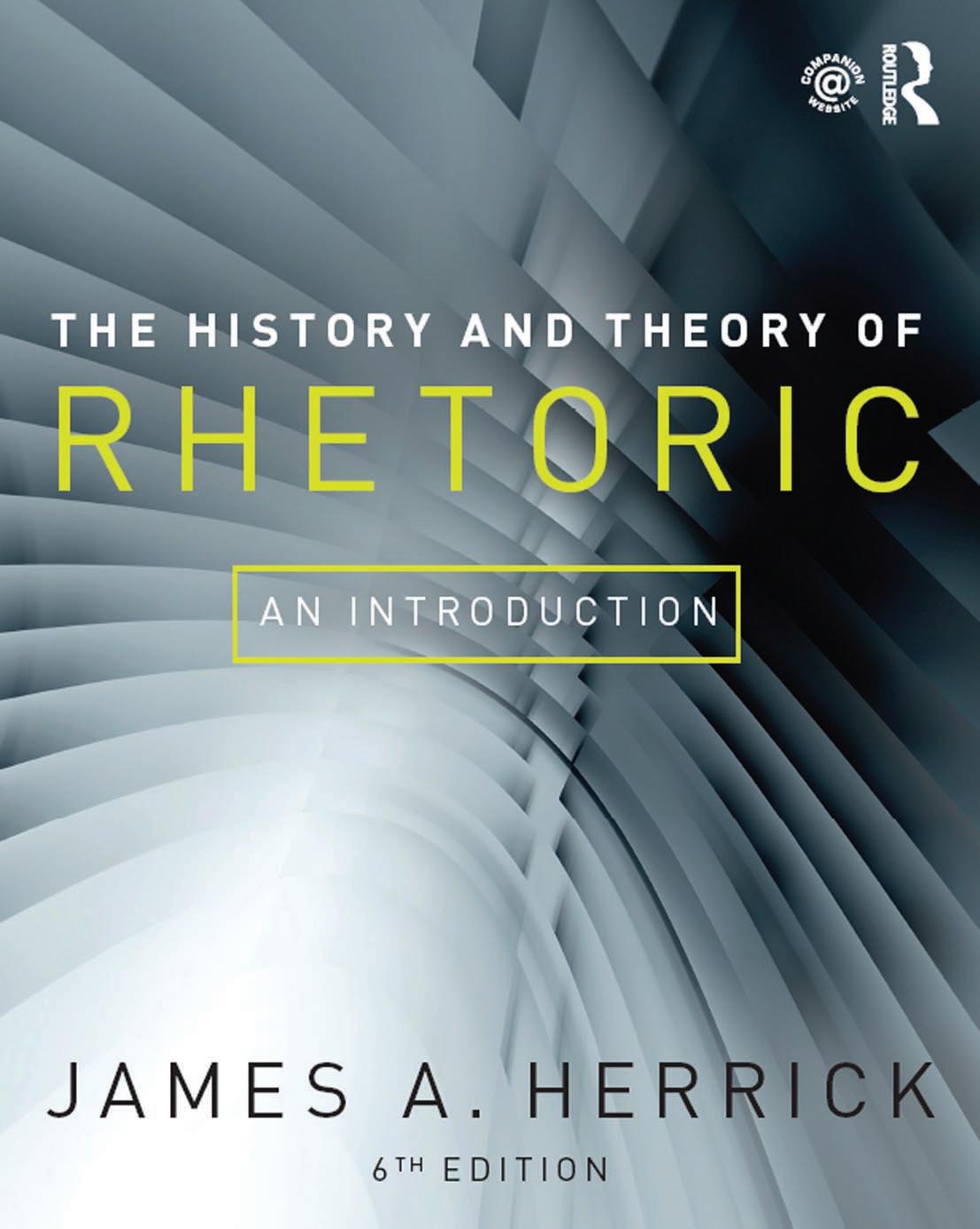
By tracing the traditional progression of rhetoric from the Greek Sophists to contemporary theorists, The History and Theory of Rhetoric illustrates how persuasive public discourse performs essential social functions and shapes our daily worlds. Students gain a conceptual framework for evaluating and practicing persuasive writing and speaking in a wide range of settings and in various written and visual media. This new 6th edition includes greater attention to non-Western studies, as well as contemporary developments such as the rhetoric of science, feminist rhetoric, the rhetoric of display, and comparative rhetoric. Known for its clear writing style and contemporary examples throughout, The History and Theory of Rhetoric emphasizes the relevance of rhetoric to today’s students.
James A. Herrick is Guy Vander Jagt Professor of Communication at Hope College, USA. His publications include Argumentation: Understanding and Shaping Arguments, 6th edition (2017) and Visions of Technological Transcendence: Human Enhancement and the Rhetoric of the Future (2017).
The History and Theory of Rhetoric
An Introduction
James A. Herrick
Sixth edition published 2018 by Routledge
711 Third Avenue, New York, NY 10017
and by Routledge
2 Park Square, Milton Park, Abingdon, Oxon, OX14 4RN
The right of James A. Herrick to be identified as author of this work has been asserted by him in accordance with sections 77 and 78 of the Copyright, Designs and Patents Act 1988.
All rights reserved. No part of this book may be reprinted or reproduced or utilised in any form or by any electronic, mechanical, or other means, now known or hereafter invented, including photocopying and recording, or in any information storage or retrieval system, without permission in writing from the publishers.
Trademark notice: Product or corporate names may be trademarks or registered trademarks, and are used only for identification and explanation without intent to infringe.
First published by Pearson Education, Inc. 2005 Fifth edition published by Pearson Education, Inc. 2013
Library of Congress Cataloguing in Publication Data
Names: Herrick, James A., author.
Title: The history and theory of rhetoric: an introduction / James Herrick. Description: 6th edition. | Abingdon, Oxon ; New York : Routledge, 2018. | Includes bibliographical references and index.
Identifiers: LCCN 2017008894| ISBN 9781138223660 (hardback) | ISBN 9781138223677 (pbk.) | ISBN 9781315404141 (ebk.)
Chinese Sophists and the Intrigues of the Warring States 285
Jian, Shui, Pien, and the Traveling Persuaders 286
Averroes and the Aristotelian Tradition: Arabic Rhetoric in the Twelfth Century 286
Re-visioning the Greek Tradition 288
Conclusion 288
Questions for Review 289
Questions for Discussion 290
Terms 291
Preface
M Y goal in the 6th edition of The History and Theory of Rhetoric, as in previous editions, is to provide students with an engaging and accessible survey of the history of rhetoric as it has developed in the Western world. This text also equips students with a conceptual framework for evaluating and practicing persuasive writing and speaking in a wide range of settings and in various written and visual media.
Each chapter introduces readers to influential theories of rhetoric advanced by some of history’s greatest thinkers. Through encountering the rhetorical tradition, students are better prepared to understand and participate in the wide array of persuasive symbolic practices that mark our social and private lives. The principles and developments discussed here should assist students to recognize and evaluate rhetorical qualities in a wide range of texts, including the growing digital world.
NEW TO THIS EDITION
In this edition, I have paid more attention to reorganizing and rewriting several chapters for greater clarity and accessibility. I trust the writing is clear and the material, though occasionally technical, is easily comprehensible. I have also eliminated discussions of several topics that seemed no longer current. The presentation of material has been streamlined throughout; I hope you will find the result to be a more vivid picture of the history of rhetoric.
The coverage of the rhetoric of science, the rhetorical theory of Kenneth Burke, the rhetoric of narration, comparative rhetoric, and feminist rhetorics has been expanded in the sixth edition. In recognition of our ever-changing rhetorical contexts, I have added a new discussion of materialist approaches to rhetoric, and the complex networks of influence of which humans are only one component. This new theoretical perspective expands the traditional notion of rhetorical activity as the domain strictly of human agents.
The sixth edition features a new section on Muslim rhetorical theory of the medieval period, emphasizing the crucial role played by scholars such as Ibn Rushd (Averroes) in
interpreting and preserving classical rhetorical theories. I have also added material on efforts to encourage literacy in the Middle Ages, and the impact of these efforts on an audience of women rhetoricians and readers. Where new discussions are introduced, they are accompanied by questions for discussion that should help students think through the implications for their own perspectives on rhetoric.
OVERVIEW OF CHAPTERS
Here are some of the features of individual chapters. Chapter 1 presents several defining characteristics of rhetorical discourse, as well as discussing the social functions of the art of rhetoric. I have also sought to emphasize the tensions and ambiguities that always attend efforts to define rhetoric. The question of definition is rendered more nuanced and interesting with the recognition of visual rhetoric as an important aspect of human symbolic activity. With this foundation in place, the balance of the text is organized historically.
Chapter 2 considers the Sophists as early teachers, practitioners, and theorists of rhetoric. I have tried to clarify the ways in which these experimental and controversial rhetoricians shaped, not just the history of rhetoric, but also our understanding of the symbolic nature of human existence. While I do address the controversy the Greek Sophists generated, their role as thinkers who achieved considerable insight into rhetoric’s nature and power is also emphasized. I have tried to reflect in this treatment that the Sophists do not all belong to a single school of thought regarding rhetoric, but vary in their approaches to and uses of the art.
Chapter 2 also addresses the historically occluded issue of women’s voices in ancient Greek rhetoric. I have expanded the treatment of Greek women, and of the conception or rhetoric itself, by discussing women as poets (Sappho in particular), as a public voice in the Spartan marketplace, and Aspasia as a rhetorical innovator.
Chapter 3 considers Plato’s famous—and also controversial—criticism of the Sophistic approach to rhetoric in the dialogue Gorgias, as well as the philosopher’s musings about a possible true art of rhetoric in the dialogue Phaedrus. New material has been added that sheds light on Plato’s insistence on an account—a logos—from the Sophists concerning “the nature of” their art. The question of whether Plato has left us a fair assessment of the Sophists is also considered, as is Plato’s own role as rhetorical theorist.
Chapter 4 explores Aristotle’s highly influential theory advanced in his Rhetoric. This chapter discusses in detail Aristotle’s affirmative answer to the question of whether rhetoric qualifies as a techne or true art. The notions of the enthymeme, artistic proofs, and topics of argumentation are all reviewed. While Aristotle’s interest in deliberative oratory is well-known, epideicticor ceremonial oratory is also presented as central to his rhetoric.
Chapter 5 completes the discussion of the classical period by considering Roman adaptations of Greek rhetoric to a new social setting, and striking differences between the Roman and Greek conceptions of the citizen. Recent scholarship has provided a clearer view of the theory and practice of rhetoric in Rome. Key components in the rhetorical
theory of Cicero, including his famous canons of rhetoric and his concern for the preparation of the orator-leader, remain focal points of this chapter, as do Roman attention to judicial oratory and argument. The contributions of Quintilian and Longinus to rhetorical thought are explored, as is the close relationship between rhetoric and citizenship in ancient Rome.
Chapter 6 considers the theories and uses of rhetoric that characterized the era of Church dominance running approximately from the fifth through the fourteenth centuries. St. Augustine’s rapprochement between the Greco-Roman rhetoric, he knew so well, and the educational needs of the Christian church are discussed. Other leading medieval rhetorical theorists such as Martianus Capella and Boethius are also covered. In addition, the chapter examines the rhetorical arts that developed in the later Middle Ages, including preaching, letter writing, and poetry. Figures that represent these rhetorical arts, such as the skilled letter writer Catherine of Siena, are introduced. Material concerning education in the Middle Ages has been augmented to emphasize the considerable effort to expand literacy in Europe during this period. The corresponding rise of a female reading public is addressed, as well as the rise of writers addressing that audience such as Marie de France.
Renaissance rhetorical theory, particularly the contributions of the Italian Humanists, remains the focus of Chapter 7 in this new edition. However, the chapter has been substantially restructured for greater clarity. The period’s intense interest in classical texts and languages, and the Renaissance’s fascination with rhetoric generally, are seen as forces that produced an era of extraordinary influence for rhetoric in European education, and that led to remarkable insights on the part of rhetorical theorists. New material has been added on rhetoric’s role in shaping conceptions of social decorum during the period.
The entry of women into the history of rhetoric in a substantial fashion during the Renaissance is outlined, as is women’s increased access to education, audiences, and the means of communication. In addition, the tension between the contemplative and active life is discussed, as is rhetoric’s role in the rise of commercial European cities, and its close relationship to the Renaissance fascination with magic. The emergence of new models—particularly a conversational approach to rhetoric—is also noted, as is rhetoric’s struggle with dialectic and a scientific style of writing late in the period.
Chapter 8 focuses on mid-seventeenth through early nineteenth-century rhetorical theory. The chapter discusses the intriguing Italian theorist Giambattista Vico, a writer who saw rhetoric and myth as foundational to civilization, and assigned rhetoric a central role in the emergence of human thought. A new section has been added on Vico’s highly influential treatment of myth and narrative as crucial to the formation of civilization. The chapter then moves on to consider writers of the Scottish Enlightenment, including George Campbell, Lord Kames, and Hugh Blair, who turned rhetoric in a more personal direction and away from classical conceptions of oratory. English rhetorical theorists, including the elocutionist Thomas Sheridan and traditionalist Richard Whately, are also considered who revived some elements of the classical model. The chapter opens and closes with two women writers—Margaret Cavendish and Maria Edgeworth—whose rhetorical efforts stood largely outside, and as a challenge to, the mainstream of the Enlightenment rhetorical tradition.
Another random document with no related content on Scribd:
"And don't I want you to be happy? You know I'd do anything in the world for you! Don't you, now? I'd promise faithful never to touch a drop of anything again, if that would make it all right."
"You wouldn't keep your promise?"
"I swear I would."
"James, you are not to speak so! And it's no use. You promised me—faithfully—that you would stick to work, the next that came in your way; and you threw it up the first thing."
"I'll stick to it yet,—as soon as I get something to do."
Suddenly Plunkett turned into the street, and crossed over a little way in front of them. Marigold at once called,— "Father!"
"You shut up!" said Todd, not too civilly.
"Father!" repeated Marigold, and he stopped.
"Eh; it's you, is it?" said Plunkett. He did not think much of seeing the two together, merely supposing that they had just met, and Todd remarked,—
"Fine day!"
"Father, James has walked with me all the way from the Common,—from half over the Common. I did not want him. I've let him do it before, and I was wrong; and I told him not to-day, and he would come."
"Well, why not?" said Todd sulkily.
Plunkett looked from the one to the other.
"I told him I would tell you, and now I have," said Marigold. Then she went indoors, leaving the two together.
Plunkett presently followed, to find her alone in the little kitchen.
"What's all this?" he demanded.
"Father, I thought I ought to speak about it. Mother said once you wouldn't be pleased . . . And I wouldn't listen . . . But Mrs. Heavitree's been talking . . . And—I thought—I ought—" Marigold's voice failed.
"An idle fellow like that! You've too much sense to care for him!"
Plunkett stared, as Marigold burst into tears.
"Eh? You don't mean for to say you like Todd?"
"He's been nice to me,—and I do like him," sobbed Marigold. "But Mrs. Heavitree says—says he's not—"
"Not the sort to make a girl happy? No, I should think not. He's smooth-spoken, and when you've said that, you've said all. I wouldn't see you marry Todd,—not for anything you could name! I told him he'd best make himself scarce, and he said it was all a mistake,—he'd no notion of marrying nobody."
"Oh!" Marigold's cheeks flamed.
"That isn't how he's talked to you, oh?"
"I should think not! Father, I did think he was one that would speak true."
"Well, the best thing you can do is to see no more of him," said Plunkett decisively. "There's no sort o' dependence to be put on Todd. He's not fit for you, and you're a deal too good for him. And what's more, you'll never marry him with my will. So the sooner you can forget him, the better. I've said enough to stop his looking in here, again, in a hurry. And I'm sure you'd need be grateful to Mrs. Heavitree, for the trouble she's taken."
Marigold's thoughts reverted to the beginning of her Vicarage conversation. "There's something else too,—" she said, "something you'll be glad of. Mrs. Heavitree said I'd best not speak to mother, but I might to you." Then she told Plunkett about the doctor who was to arrive at the Vicarage, and about Mrs. Heavitree's kind intentions.
RESENTMENT at Todd's declaration that "it was all a mistake," and that "he hadn't meant to marry nobody," gave Marigold a good deal of help in casting aside overmuch thought of him. Had he been grieved and disappointed only, she would have been grieved too; and he might have retained his power over her; but now Marigold's womanly self-respect was up in arms.
Some girls seem to have no womanly self-respect at all, but Marigold happily was not deficient in this direction. If Todd counted it "all a mistake" that he had wanted to marry her, she would let nobody suppose that she wanted him. If Todd did not care for her, then she would not care for him.
Of course in a measure she did care; though to her surprise, by no means so much as she would have expected. Todd had managed to win her liking, but not to stir her feelings deeply. That might have come later, had the affair been allowed to go on. At present it was mainly a question of gratified vanity, and of escape from home troubles. Wounded vanity was the best possible antidote to the former; and as for the latter, home troubles had lessened.
Marigold found her time and thoughts much occupied with her stepmother; so much, that for hours together she often forgot Todd's very existence—a sure proof that her affections were not profoundly engaged.
Mrs. Plunkett suffered much, and was weighed down by anxious depression, as well as weakness. But from the day when she allowed herself to speak out to Marigold, there was an extraordinary cessation of the extreme irritability. She reverted suddenly to her old self; the kind and amiable
self, which they had known for three months only. She no longer struggled to keep up, or to do work for which she was utterly unfit.
Marigold might arrange matters as she chose, and Mrs. Plunkett offered no opposition. It was easy now to be gentle and kind to one so passive; and love, no longer receiving a slap in the face at every other step, sprang into being, with a promise of rapid growth.
"I'm sure I can't think how ever it was you seemed so different, Marigold, till these last few days," Mrs. Plunkett said musingly one afternoon.
She had not come down till the middle of the day, and was suffering a good deal; but her face, though yellow and drawn, had lost much of its acidity. "Why, nothing I could do pleased you, and yet you're as good to me now—"
"Mother! Why, nothing I could do pleased you," broke from the surprised Marigold.
Mrs. Plunkett cast a puzzled glance backward.
"I'm sure I don't know," she said. "I know I used to feel so dreadful bad, I didn't know how to drag through the days; and I could have flown out at anybody. The day we went to the beasts' show—oh, dear! Part of the time I could get along; and then the pain came on, till it turned me sick, and I didn't half know what I was about, and the thought of going home all alone—oh dear me!"
"Mother, if you only had told! We thought you were just cross and vexed about something," said Marigold, tears in her eyes.
"I wasn't. I thought it as nice as could be of you to ask me to go—and if only I could have kep' on!—But it did seem hard, when I felt so awfully ill, to have all of you thinking of nothing but them snakes. And the pain was so bad."
"Oh, mother, if you only had told me!"
"Well, I see now that I had ought to—but I didn't feel as if I could. I thought you'd dislike me more than ever. I know you better now, Marigold!"
"Somebody outside. There's the bell, mother!"
And when Marigold opened the front door, she found Mrs. Heavitree, with a grave middle-aged gentleman, whom she at once guessed to be the expected Dr. Wilton.
"Mrs. Plunkett in, Marigold? I have come with my brother to pay her a little visit. Say only that," added Mrs. Heavitree softly.
Marigold obeyed with a grateful look, and the four were soon chatting pleasantly. Mrs. Plunkett was somewhat flustered, but also pleased. The doctor at first talked to Marigold; then he made his way to a seat by Mrs. Plunkett, and drew her into conversation.
"Marigold, I want to speak to you in another room," said Mrs. Heavitree, rising. "My brother will wait here."
Dr. Wilton made a gesture of assent, and Mrs. Plunkett showed no disapproval. She did not know him yet to be a doctor; but his kind manner won confidence immediately, and already she had begun to talk almost freely about herself and Marigold.
"That is well," Mrs. Heavitree said, when they were in the next room. "My brother will manage all the rest."
The interview was a long one; much longer than Marigold would have expected. Mrs. Plunkett's raised tones came from time to time through the door; while Dr. Wilton's low-voiced answers were inaudible.
At length, after what seemed to Marigold an interminable time, the door opened; Dr. Wilton could be heard to say "Good-bye," and with a quiet step, he entered.
"Well?" Mrs. Heavitree asked.
"Not so bad as you have all feared," he said. "It is—not cancer."
"Oh!" Marigold clasped her hands.
"A severe case of tumour, and it must be removed. But, once removed, she may enjoy good health. I should have little fear of its return."
"Then the former opinion was a mistake," said Mrs. Heavitree.
"Yes."
"You don't know who she went to see?"
"She told me. Not a medical man at all, in fact. A passing quack—nothing more. Extraordinary how people will take the opinion of anybody and everybody on such a question!"
"Will she submit to the operation?" asked Mrs. Heavitree, and Marigold's face asked the same question
eloquently.
"At first she said not. I reasoned the matter with her. Some measure of risk must exist, of course, in such a case; but there is every probability that she would bear it well, and would enjoy excellent health afterwards. If she goes on in her present state, life cannot be lengthened many months. A year or two at most."
"And she gave in?"
"Entirely. She will, of course, go to the hospital. I shall see her again before I leave; and I have promised that you and her daughter will make all arrangements."
"I don't know how to thank you, sir," said Marigold, with difficulty. "It is so very very kind!"
The doctor smiled as he went off, and Marigold hastened to her stepmother. She found Mrs. Plunkett sobbing.
"Not as I mind. 'Tain't that!" said Mrs. Plunkett. "It's the relief. I never knowed what a weight it was on me, till now it's gone. Why, I feel as if anything else was nothing almost! I did say I'd never go to a hospital, and be in the hands of all them doctors. But if they're like Dr. Wilton, I'm sure I won't mind. He is kind! I never saw a kinder person, not in all my life. And understands like as if he'd got it himself. Oh, dear me! To think it isn't that, after all; and to think I may be quite well again. Yes, I'd bear some'at to get strong as I used to be. And he says he thinks I ought. It ain't but little risk, he says; and t'other way, if nothing is done, it means death. He don't think I'd ought to throw away my life, if there's a good chance of saving it. And I said I'd do what he thought right."
"Oh, mother, I can't tell you how glad I am."
"Well, I do believe you are," said Mrs. Plunkett. "I do believe you won't be sorry if I get well. A while back I'd have thought you wouldn't have been best pleased—not any of you. But it's different now. And I don't mean to get back into cross ways, nor to vex your father, nor to have things all in a mess, no more. It is nice, the house being kep' tidy, as you do now; and I'll see and go on with it."
"I'm sure you will," said Marigold affectionately. "And you'll let me be a help to you?"
"You ain't going to marry that Todd?"
"No! Never!" said Marigold, with firmness. Only the evening before, she had herself seen Todd reeling down the street in a tipsy condition—a shameful sight! He had shouted rudely after Marigold. And with burning cheeks she had thought, "That is the man I would have married!" No, never! Never! If her mind had not been already made up, this would have settled the matter.
"I'm glad. He wouldn't have made you a good husband —I know that! And you're too young—ever so much too young. When I come home, I'll like to have you with me—." She paused, and added, "If I ever do come home."
"Mother, Dr. Wilton didn't seem afraid."
"No; he said he wasn't, and he thought it was the right thing to do. But he said he couldn't be sure. People don't always get through—only he'd great hopes I should."
"And then you know, we shall be praying for you," said Marigold softly. "Narcissus and me, and I'm sure Mrs. Heavitree will."
"Yes, I know that," said Mrs. Plunkett. "I like to think it. And I want you to read to me every day till I go. The doctor says I'm to be in the hospital in a week or two. He don't want it put off long. And I'm frightened when I think of that. I want to learn how to trust that I shall be taken care of all through—and then I shan't be so afraid."
Marigold did read every day, as Mrs. Plunkett wished; and sometimes in her simple way, she would speak about the great kindness and love of God, and about the living presence of Christ in days of trouble. Mrs. Plunkett would drink in such words with positive thirst, feeling her need of help. Mr. Heavitree also came in two or three times, and his visits "gave her a sort of lift," she said afterwards. One way or another comfort seemed to be sent, just when it was most needed; and as the day drew near, when she would have to leave home, her dread distinctly lessened. She actually went at last with a smile on her face; and Marigold's first visit to the hospital, two days later, found her the cheerier of the two.
Then came days of suspense for others, gradually lightening as the operation proved to be a successful one. Weeks of tardy recovery followed, not lacking drawbacks, but on the whole satisfactory, and the doctors gave every hope of a complete and permanent restoration.
Nearly three months of absence drew at length to an end, and Mrs. Plunkett returned home, not yet strong, but no longer a sufferer.
"It's like beginning a new life," she said.
Marigold had decorated the little parlour with flowers, and had prepared quite a festive meal, in honour of her arrival; and Narcissus had been spared from the Vicarage
for several hours. Mrs. Plunkett seemed quiet and dreamy, as if a little bewildered with the change from a hospital ward; but the old acidity of expression had given place to a look of steady happiness.
"It's like beginning a new life," she repeated. "And I hope it's going to be new—some ways. I hope I ain't going back to old ways. I've had a deal of time to think, lying there."
"Dare say you won't be none the worse," suggested Plunkett.
"No," she said. "I hope I shan't, nor the girls neither. I'd like to be a better friend to them than I was before I left; and a better wife to you. And most of all, I'd like to serve God truer. I thought I was going to leave you all; and now He's put me back into life; and I'd like to make a good use of my time. That's what I want."
"Ain't a bad wish, neither," said her husband; while Narcissus looked with touched and wondering eyes towards the speaker, and Marigold murmured:
"That's what I want, too."
LORIMER AND GILLIES, PRINTERS, EDINBURGH.
*** END OF THE PROJECT
GUTENBERG EBOOK MARIGOLD'S DECISION
***
Updated editions will replace the previous one—the old editions will be renamed.
Creating the works from print editions not protected by U.S. copyright law means that no one owns a United States copyright in these works, so the Foundation (and you!) can copy and distribute it in the United States without permission and without paying copyright royalties. Special rules, set forth in the General Terms of Use part of this license, apply to copying and distributing Project Gutenberg™ electronic works to protect the PROJECT GUTENBERG™ concept and trademark. Project Gutenberg is a registered trademark, and may not be used if you charge for an eBook, except by following the terms of the trademark license, including paying royalties for use of the Project Gutenberg trademark. If you do not charge anything for copies of this eBook, complying with the trademark license is very easy. You may use this eBook for nearly any purpose such as creation of derivative works, reports, performances and research. Project Gutenberg eBooks may be modified and printed and given away—you may do practically ANYTHING in the United States with eBooks not protected by U.S. copyright law. Redistribution is subject to the trademark license, especially commercial redistribution.
START: FULL LICENSE
THE FULL PROJECT GUTENBERG LICENSE
PLEASE READ THIS BEFORE YOU DISTRIBUTE OR USE THIS WORK
To protect the Project Gutenberg™ mission of promoting the free distribution of electronic works, by using or distributing this work (or any other work associated in any way with the phrase “Project Gutenberg”), you agree to comply with all the terms of the Full Project Gutenberg™ License available with this file or online at www.gutenberg.org/license.
Section 1. General Terms of Use and Redistributing Project Gutenberg™ electronic works
1.A. By reading or using any part of this Project Gutenberg™ electronic work, you indicate that you have read, understand, agree to and accept all the terms of this license and intellectual property (trademark/copyright) agreement. If you do not agree to abide by all the terms of this agreement, you must cease using and return or destroy all copies of Project Gutenberg™ electronic works in your possession. If you paid a fee for obtaining a copy of or access to a Project Gutenberg™ electronic work and you do not agree to be bound by the terms of this agreement, you may obtain a refund from the person or entity to whom you paid the fee as set forth in paragraph 1.E.8.
1.B. “Project Gutenberg” is a registered trademark. It may only be used on or associated in any way with an electronic work by people who agree to be bound by the terms of this agreement. There are a few things that you can do with most Project Gutenberg™ electronic works even without complying with the full terms of this agreement. See paragraph 1.C below. There are a lot of things you can do with Project Gutenberg™ electronic works if you follow the terms of this agreement and help preserve free future access to Project Gutenberg™ electronic works. See paragraph 1.E below.
1.C. The Project Gutenberg Literary Archive Foundation (“the Foundation” or PGLAF), owns a compilation copyright in the collection of Project Gutenberg™ electronic works. Nearly all the individual works in the collection are in the public domain in the United States. If an individual work is unprotected by copyright law in the United States and you are located in the United States, we do not claim a right to prevent you from copying, distributing, performing, displaying or creating derivative works based on the work as long as all references to Project Gutenberg are removed. Of course, we hope that you will support the Project Gutenberg™ mission of promoting free access to electronic works by freely sharing Project Gutenberg™ works in compliance with the terms of this agreement for keeping the Project Gutenberg™ name associated with the work. You can easily comply with the terms of this agreement by keeping this work in the same format with its attached full Project Gutenberg™ License when you share it without charge with others.
1.D. The copyright laws of the place where you are located also govern what you can do with this work. Copyright laws in most countries are in a constant state of change. If you are outside the United States, check the laws of your country in addition to the terms of this agreement before downloading, copying, displaying, performing, distributing or creating derivative works based on this work or any other Project Gutenberg™ work. The Foundation makes no representations concerning the copyright status of any work in any country other than the United States.
1.E. Unless you have removed all references to Project Gutenberg:
1.E.1. The following sentence, with active links to, or other immediate access to, the full Project Gutenberg™ License must appear prominently whenever any copy of a Project Gutenberg™ work (any work on which the phrase “Project Gutenberg” appears, or with which the phrase “Project Gutenberg” is associated) is accessed, displayed, performed, viewed, copied or distributed:
This eBook is for the use of anyone anywhere in the United States and most other parts of the world at no cost and with almost no restrictions whatsoever. You may copy it, give it away or re-use it under the terms of the Project Gutenberg License included with this eBook or online at www.gutenberg.org. If you are not located in the United States, you will have to check the laws of the country where you are located before using this eBook.
1.E.2. If an individual Project Gutenberg™ electronic work is derived from texts not protected by U.S. copyright law (does not contain a notice indicating that it is posted with permission of the copyright holder), the work can be copied and distributed to anyone in the United States without paying any fees or charges. If you are redistributing or providing access to a work with the phrase “Project Gutenberg” associated with or appearing on the work, you must comply either with the requirements of paragraphs 1.E.1 through 1.E.7 or obtain permission for the use of the work and the Project Gutenberg™ trademark as set forth in paragraphs 1.E.8 or 1.E.9.
1.E.3. If an individual Project Gutenberg™ electronic work is posted with the permission of the copyright holder, your use and distribution must comply with both paragraphs 1.E.1 through 1.E.7 and any additional terms imposed by the copyright holder. Additional terms will be linked to the Project Gutenberg™ License for all works posted with the permission of the copyright holder found at the beginning of this work.
1.E.4. Do not unlink or detach or remove the full Project Gutenberg™ License terms from this work, or any files containing a part of this work or any other work associated with Project Gutenberg™.
1.E.5. Do not copy, display, perform, distribute or redistribute this electronic work, or any part of this electronic work, without prominently displaying the sentence set forth in paragraph 1.E.1
with active links or immediate access to the full terms of the Project Gutenberg™ License.
1.E.6. You may convert to and distribute this work in any binary, compressed, marked up, nonproprietary or proprietary form, including any word processing or hypertext form. However, if you provide access to or distribute copies of a Project Gutenberg™ work in a format other than “Plain Vanilla ASCII” or other format used in the official version posted on the official Project Gutenberg™ website (www.gutenberg.org), you must, at no additional cost, fee or expense to the user, provide a copy, a means of exporting a copy, or a means of obtaining a copy upon request, of the work in its original “Plain Vanilla ASCII” or other form. Any alternate format must include the full Project Gutenberg™ License as specified in paragraph 1.E.1.
1.E.7. Do not charge a fee for access to, viewing, displaying, performing, copying or distributing any Project Gutenberg™ works unless you comply with paragraph 1.E.8 or 1.E.9.
1.E.8. You may charge a reasonable fee for copies of or providing access to or distributing Project Gutenberg™ electronic works provided that:
• You pay a royalty fee of 20% of the gross profits you derive from the use of Project Gutenberg™ works calculated using the method you already use to calculate your applicable taxes. The fee is owed to the owner of the Project Gutenberg™ trademark, but he has agreed to donate royalties under this paragraph to the Project Gutenberg Literary Archive Foundation. Royalty payments must be paid within 60 days following each date on which you prepare (or are legally required to prepare) your periodic tax returns. Royalty payments should be clearly marked as such and sent to the Project Gutenberg Literary Archive Foundation at the address specified in Section 4, “Information
about donations to the Project Gutenberg Literary Archive Foundation.”
• You provide a full refund of any money paid by a user who notifies you in writing (or by e-mail) within 30 days of receipt that s/he does not agree to the terms of the full Project Gutenberg™ License. You must require such a user to return or destroy all copies of the works possessed in a physical medium and discontinue all use of and all access to other copies of Project Gutenberg™ works.
• You provide, in accordance with paragraph 1.F.3, a full refund of any money paid for a work or a replacement copy, if a defect in the electronic work is discovered and reported to you within 90 days of receipt of the work.
• You comply with all other terms of this agreement for free distribution of Project Gutenberg™ works.
1.E.9. If you wish to charge a fee or distribute a Project Gutenberg™ electronic work or group of works on different terms than are set forth in this agreement, you must obtain permission in writing from the Project Gutenberg Literary Archive Foundation, the manager of the Project Gutenberg™ trademark. Contact the Foundation as set forth in Section 3 below.
1.F.
1.F.1. Project Gutenberg volunteers and employees expend considerable effort to identify, do copyright research on, transcribe and proofread works not protected by U.S. copyright law in creating the Project Gutenberg™ collection. Despite these efforts, Project Gutenberg™ electronic works, and the medium on which they may be stored, may contain “Defects,” such as, but not limited to, incomplete, inaccurate or corrupt data, transcription errors, a copyright or other intellectual property infringement, a defective or
damaged disk or other medium, a computer virus, or computer codes that damage or cannot be read by your equipment.
1.F.2. LIMITED WARRANTY, DISCLAIMER OF DAMAGES - Except for the “Right of Replacement or Refund” described in paragraph 1.F.3, the Project Gutenberg Literary Archive Foundation, the owner of the Project Gutenberg™ trademark, and any other party distributing a Project Gutenberg™ electronic work under this agreement, disclaim all liability to you for damages, costs and expenses, including legal fees. YOU AGREE THAT YOU HAVE NO REMEDIES FOR NEGLIGENCE, STRICT LIABILITY, BREACH OF WARRANTY OR BREACH OF CONTRACT EXCEPT THOSE PROVIDED IN PARAGRAPH
1.F.3. YOU AGREE THAT THE FOUNDATION, THE TRADEMARK OWNER, AND ANY DISTRIBUTOR UNDER THIS AGREEMENT WILL NOT BE LIABLE TO YOU FOR ACTUAL, DIRECT, INDIRECT, CONSEQUENTIAL, PUNITIVE OR INCIDENTAL DAMAGES EVEN IF YOU GIVE NOTICE OF THE POSSIBILITY OF SUCH DAMAGE.
1.F.3. LIMITED RIGHT OF REPLACEMENT OR REFUND - If you discover a defect in this electronic work within 90 days of receiving it, you can receive a refund of the money (if any) you paid for it by sending a written explanation to the person you received the work from. If you received the work on a physical medium, you must return the medium with your written explanation. The person or entity that provided you with the defective work may elect to provide a replacement copy in lieu of a refund. If you received the work electronically, the person or entity providing it to you may choose to give you a second opportunity to receive the work electronically in lieu of a refund. If the second copy is also defective, you may demand a refund in writing without further opportunities to fix the problem.
1.F.4. Except for the limited right of replacement or refund set forth in paragraph 1.F.3, this work is provided to you ‘AS-IS’, WITH NO OTHER WARRANTIES OF ANY KIND, EXPRESS OR IMPLIED,
INCLUDING BUT NOT LIMITED TO WARRANTIES OF MERCHANTABILITY OR FITNESS FOR ANY PURPOSE.
1.F.5. Some states do not allow disclaimers of certain implied warranties or the exclusion or limitation of certain types of damages. If any disclaimer or limitation set forth in this agreement violates the law of the state applicable to this agreement, the agreement shall be interpreted to make the maximum disclaimer or limitation permitted by the applicable state law. The invalidity or unenforceability of any provision of this agreement shall not void the remaining provisions.
1.F.6. INDEMNITY - You agree to indemnify and hold the Foundation, the trademark owner, any agent or employee of the Foundation, anyone providing copies of Project Gutenberg™ electronic works in accordance with this agreement, and any volunteers associated with the production, promotion and distribution of Project Gutenberg™ electronic works, harmless from all liability, costs and expenses, including legal fees, that arise directly or indirectly from any of the following which you do or cause to occur: (a) distribution of this or any Project Gutenberg™ work, (b) alteration, modification, or additions or deletions to any Project Gutenberg™ work, and (c) any Defect you cause.
Section 2. Information about the Mission of Project Gutenberg™
Project Gutenberg™ is synonymous with the free distribution of electronic works in formats readable by the widest variety of computers including obsolete, old, middle-aged and new computers. It exists because of the efforts of hundreds of volunteers and donations from people in all walks of life.
Volunteers and financial support to provide volunteers with the assistance they need are critical to reaching Project Gutenberg™’s goals and ensuring that the Project Gutenberg™ collection will
remain freely available for generations to come. In 2001, the Project Gutenberg Literary Archive Foundation was created to provide a secure and permanent future for Project Gutenberg™ and future generations. To learn more about the Project Gutenberg Literary Archive Foundation and how your efforts and donations can help, see Sections 3 and 4 and the Foundation information page at www.gutenberg.org.
Section 3. Information about the Project Gutenberg Literary Archive Foundation
The Project Gutenberg Literary Archive Foundation is a non-profit 501(c)(3) educational corporation organized under the laws of the state of Mississippi and granted tax exempt status by the Internal Revenue Service. The Foundation’s EIN or federal tax identification number is 64-6221541. Contributions to the Project Gutenberg Literary Archive Foundation are tax deductible to the full extent permitted by U.S. federal laws and your state’s laws.
The Foundation’s business office is located at 809 North 1500 West, Salt Lake City, UT 84116, (801) 596-1887. Email contact links and up to date contact information can be found at the Foundation’s website and official page at www.gutenberg.org/contact
Section 4. Information about Donations to the Project Gutenberg Literary Archive Foundation
Project Gutenberg™ depends upon and cannot survive without widespread public support and donations to carry out its mission of increasing the number of public domain and licensed works that can be freely distributed in machine-readable form accessible by the widest array of equipment including outdated equipment. Many
small donations ($1 to $5,000) are particularly important to maintaining tax exempt status with the IRS.
The Foundation is committed to complying with the laws regulating charities and charitable donations in all 50 states of the United States. Compliance requirements are not uniform and it takes a considerable effort, much paperwork and many fees to meet and keep up with these requirements. We do not solicit donations in locations where we have not received written confirmation of compliance. To SEND DONATIONS or determine the status of compliance for any particular state visit www.gutenberg.org/donate.
While we cannot and do not solicit contributions from states where we have not met the solicitation requirements, we know of no prohibition against accepting unsolicited donations from donors in such states who approach us with offers to donate.
International donations are gratefully accepted, but we cannot make any statements concerning tax treatment of donations received from outside the United States. U.S. laws alone swamp our small staff.
Please check the Project Gutenberg web pages for current donation methods and addresses. Donations are accepted in a number of other ways including checks, online payments and credit card donations. To donate, please visit: www.gutenberg.org/donate.
Section 5. General Information About Project Gutenberg™ electronic works
Professor Michael S. Hart was the originator of the Project Gutenberg™ concept of a library of electronic works that could be freely shared with anyone. For forty years, he produced and distributed Project Gutenberg™ eBooks with only a loose network of volunteer support.
Project Gutenberg™ eBooks are often created from several printed editions, all of which are confirmed as not protected by copyright in the U.S. unless a copyright notice is included. Thus, we do not necessarily keep eBooks in compliance with any particular paper edition.
Most people start at our website which has the main PG search facility: www.gutenberg.org.
This website includes information about Project Gutenberg™, including how to make donations to the Project Gutenberg Literary Archive Foundation, how to help produce our new eBooks, and how to subscribe to our email newsletter to hear about new eBooks.