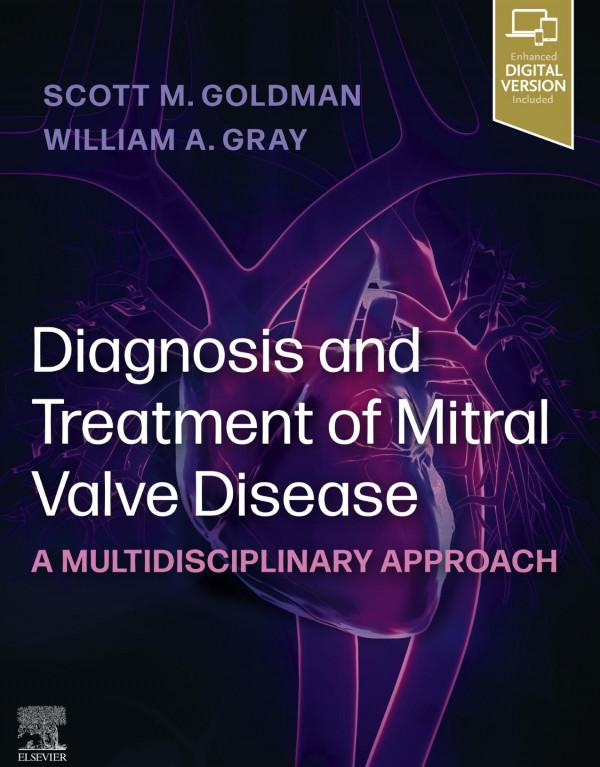
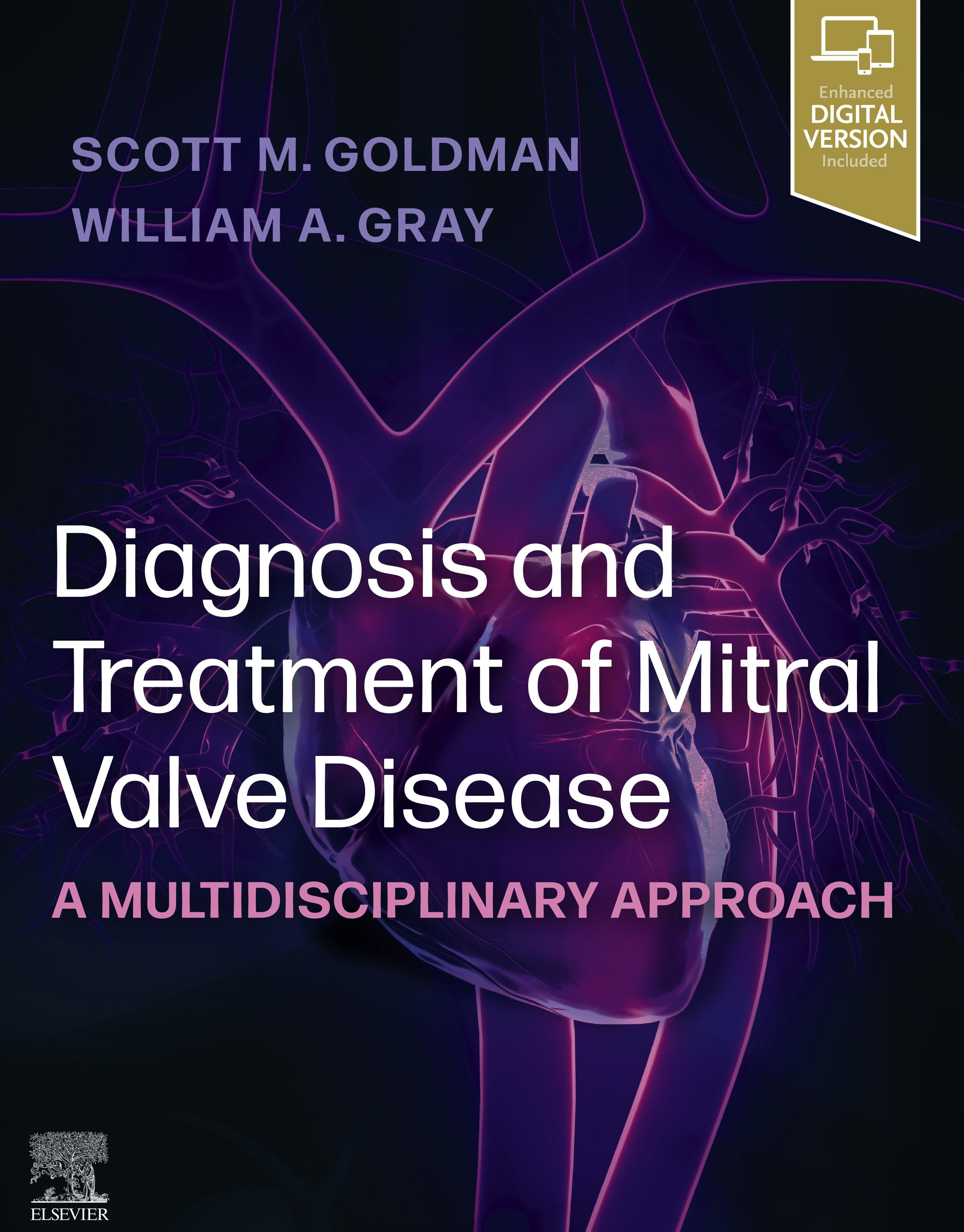
Diagnosis and Treatment of Mitral Valve Disease
A MULTIDISCIPLINARY APPROACH
EDITORS
SCOTT M. GOLDMAN
Director, Structural Heart Program
Lankenau Heart Institute; Professor of Surgery
omas Je erson University
Wynnewood, Pennsylvania United States
WILLIAM A. GRAY
Chief of Cardiovascular Division
Lankenau Medical Center and Lankenau Institute of Medical Research
Wynnewood, Pennsylvania United States
Elsevier
1600 John F. Kennedy Blvd.
Ste 1800 Philadelphia, PA 19103-2899
DIAGNOSIS AND TREATMENT OF MITRAL VALVE DISEASE: A MULTIDISCIPLINARY APPROACH ISBN: 978-0-323824781
Copyright © 2023 by Elsevier Inc. All rights reserved.
No part of this publication may be reproduced or transmitted in any form or by any means, electronic or mechanical, including photocopying, recording, or any information storage and retrieval system, without permission in writing from the publisher. Details on how to seek permission, further information about the Publisher’s permissions policies and our arrangements with organizations such as the Copyright Clearance Center and the Copyright Licensing Agency, can be found at our website: www.elsevier.com/permissions
This book and the individual contributions contained in it are protected under copyright by the Publisher (other than as may be noted herein).
Notice
Practitioners and researchers must always rely on their own experience and knowledge in evaluating and using any information, methods, compounds or experiments described herein. Because of rapid advances in the medical sciences, in particular, independent verification of diagnoses and drug dosages should be made. To the fullest extent of the law, no responsibility is assumed by Elsevier, authors, editors, or contributors for any injury and/or damage to persons or property as a matter of products liability, negligence or otherwise, or from any use or operation of any methods, products, instructions, or ideas contained in the material herein.
Content Strategist: Jessica L. McCool
Content Development Specialist: Anne E. Snyder
Publishing Services Manager: Shereen Jameel
Project Manager: Gayathri S
Design Direction: Brian Salisbury
Sandra V. Abramson, MD, FACC, FASE
Director
Cardiovascular Imaging Center
Lankenau Medical Center
Wynnewood, Pennsylvania; Clinical Assistant Professor Sidney Kimmel Medical College Philadelphia, Pennsylvania United States
Michael A. Acker, MD
Chief, Division of Cardiovascular Surgery Director, Penn Medicine Heart and Vascular Center
Hospital of the University of Pennsylvania Philadelphia, Pennsylvania United States
Tariq Ahmad, MD
Interventional Cardiology
Geisinger Wyoming Valley Medical Center
Wilkes-Barre, Pennsylvania United States
Gorav Ailawadi, MD, MBA Professor and Chair Department of Cardiac Surgery University of Michigan
Ann Arbor, Michigan
United States
Saif Anwaruddin, MD Director, Interventional Cardiology St. Vincent’s Hospital
Tenet Healthcare Worcester, Massachusetts United States
Pavan Atluri, MD
Associate Professor of Surgery Division of Cardiovascular Surgery University of Pennsylvania Philadelphia, Pennsylvania United States
Shaylyn C. Bennett, MD, MS Department of Cardiovascular Surgery Nationwide Children’s Hospital Columbus, Ohio
United States
Philipp Blanke, MD
Department of Radiology
St. Paul’s Hospital
Vancouver, British Columbia Canada
Daniel J.P. Burns, MD, MPhil
Staff Surgeon Department of Thoracic and Cardiovascular Surgery
Cleveland Clinic
Cleveland, Ohio
United States
Andrew Chatfield, MBChB Centre for Heart Valve Innovation
St. Paul’s Hospital
University of British Columbia Vancouver, British Columbia Canada
Chunguang Chen, MD, FACC Director, Cardiovascular Imaging Deborah Heart and Lung Center
Browns Mills, New Jersey
United States
Roxanne DeStefano, BS Structural Heart Therapy Consultant Philadelphia, Pennsylvania
United States
Steven M. Domsky, MD Director, Cardiac ICU Cardiology
Lankenau Medical Center
Wynnewood, Pennsylvania
United States
Amber M. Edwards, MD
Surgeon Department of Cardiac Surgery
St. Thomas Health
Nashville, Tennessee
United States
Douglas B. Esberg, MD
Director, Cardiac Electrophysiology Lab Lankenau Medical Center
Wynnewood, Pennsylvania
United States
Clarence M. Findley, MD, PhD
Baylor Scott & White The Heart Hospital Plano, Texas
United States
A. Marc Gillinov, MD
Department of Thoracic and Cardiovascular Surgery
Heart and Vascular Institute
Cleveland Clinic
Cleveland, Ohio
United States
Eric M. Gnall, DO
Director of ECMO/Acute Mechanical Circulatory Support
Main Line Health
Wynnewood, Pennsylvania
United States
Scott M. Goldman, MD
Director, Structural Heart Program
Lankenau Heart Institute; Professor of Surgery
Thomas Jefferson University
Wynnewood, Pennsylvania
United States
William A. Gray, MD
Chief of Cardiovascular Division
Lankenau Medical Center and Lankenau Institute of Medical Research
Wynnewood, Pennsylvania
United States
Lee Hafen, MD
Baylor Scott & White The Heart Hospital Plano, Texas
United States
Rebecca T. Hahn, MD, FACC Professor of Medicine
Columbia University
Irving Medical Center; Director, Interventional Echocardiography
New York Presbyterian Hospital
New York, New York
United States
Rim Halaby, MD
Division of Cardiology
Hospital of the University of Pennsylvania Philadelphia, Pennsylvania
United States
Jason J. Han, MD
Division of Cardiovascular Surgery
University of Pennsylvania Philadelphia, Pennsylvania
United States
W. Clark Hargrove III, MD
Clinical Professor of Surgery
Division of Cardiovascular Surgery
University of Pennsylvania
Philadelphia, Pennsylvania
United States
Lisa Hathaway Stella, MPH
Executive Director
Interventional Cardiology
Columbia University Irving Medical Center
New York, New York
United States
Katie M. Hawthorne, MD, FACC
Cardiology
Lankenau Medical Center
Lankenau Heart Institute
Wynnewood, Pennsylvania;
Clinical Assistant Professor of Medicine
Sidney Kimmel Medical College
Thomas Jefferson University
Woodbury, New Jersey
United States
Mark R. Helmers, MD
Division of Cardiovascular Surgery
University of Pennsylvania Philadelphia, Pennsylvania
United States
Howard C. Herrmann, MD
John W. Bryfogle Jr. Professor of Cardiovascular Medicine
Division of Cardiovascular Medicine
Perelman School of Medicine of the University of Pennsylvania Health System Director for Interventional Cardiology
Hospital of the University of Pennsylvania
Philadelphia, Pennsylvania
United States
Benjamin I. Horn, DO
Fellow, Cardiology
Lankenau Medical Center
Wynnewood, Pennsylvania
United States
Michael Ibrahim, MBBS, PhD
Assistant Professor of Surgery
Associate Director, Penn Mitral Program
Division of Cardiovascular Surgery
University of Pennsylvania Philadelphia, Pennsylvania
United States
Manju Bengaluru Jayanna, MD, MS
Cardiovascular Diseases Fellow
Lankenau Medical Center
Wynnewood, Pennsylvania
United States
Justin Johannesen, MD
Cardiology Fellow
Cardiology
Rutgers Robert Wood Johnson Medical School
New Brunswick, New Jersey
United States
Samir R. Kapadia, MD, FACC
Chairman, Department of Cardiovascular Medicine
Cleveland Clinic Foundation
Cleveland, Ohio
United States
Elina Khasanova, MD
Clinical Fellow
Radiology
Center for Heart Lung Innovation
St. Paul’s Hospital
Vancouver, British Columbia Canada
Konstantinos P. Koulogiannis, MD
Associate Director, Cardiovascular Core Lab Department of Cardiovascular Medicine
Morristown Medical Center
Gagnon Cardiovascular Institute
Morristown, New Jersey
United States
Jonathon Leipsic, MD, FRCPC, FSCCT
Vice Chairman Department of Radiology University of British Columbia Vancouver, British Columbia Canada
Leo Marcoff, MD
Director of Interventional Echocardiography Department of Cardiovascular Medicine
Morristown Medical Center
Morristown, New Jersey
United States
Gwyneth McNeill, DO Fellow, Cardiology
Main Line Health
Wynnewood, Pennsylvania
United States
Sehrish Memon, MD
Structural Heart Fellow
Cardiovascular and Structural Heart Disease
Lankenau Medical Center and Lankenau Institute of Medical Research
Wynnewood, Pennsylvania
United States
Ryan A. Moore, MD, MS
Research Fellow
Cleveland Clinic Foundation
Cleveland, Ohio
United States
Vinayak Nagaraja, MBBS, MS, MMed (Clin Epi), FRACP, FCSANZ, FACC Division of Interventional Cardiology Department of Cardiovascular Medicine
Cleveland Clinic Foundation
Cleveland, Ohio
United States
Wally Omar, MD Fellow, Interventional Cardiology
Beth Israel Deaconess Medical Center
Boston, Massachusetts
United States
Yinn Shaung Ooi, MD Fellow, Cardiology Lankenau Medical Center
Philadelphia, Pennsylvania
United States
Gosta B. Pettersson, MD, PhD Vice Chairman and Professor Department of Thoracic and Cardiovascular Surgery
Cleveland Clinic
Cleveland, Ohio
United States
Duane Pinto, MD, MPH
Associate Professor of Medicine
Harvard Medical School; Director, Cardiac Catheterization Laboratory
Beth Israel Deaconess Medical Center
Boston, Massachusetts
United States
Michel Pompeu Sá, MD, PhD
Cardiovascular Surgeon Research Assistant Professor Lankenau Institute for Medical Research
Wynnewood, Pennsylvania
United States
Nicolas H. Pope, MD
Assistant Professor
Division of Cardiothoracic Surgery
Medical University of South Carolina
Charleston, South Carolina
United States
Basel Ramlawi, MD, FACS, FACC System Chief
Cardiothoracic Surgery
Lankenau Heart Institute
Wynnewood, Pennsylvania
United States
Carrie Redick, RN, MSN
Director, Interventional Cardiology and Structural Heart
Atlantic Health System
Morristown, New Jersey
United States
Evelio Rodriguez, MD
Chief, Cardiac Surgery
Co-Director of Cardiovascular Service Line
Department of Cardiac Sciences
Ascension Saint Thomas Nashville, Tennessee
Adjunct Associate Clinical Professor of Medical Education
University of Tennessee Health Science Center
Memphis, Tennessee United States
K. Marco Rodriguez
Main Line Health Volunteer Research Assistant Lankenau Medical Center
Wynnewood, Pennsylvania United States
Roberto Rodriguez, MD, MS
System Surgical Director, Structural Heart Program
Cardiothoracic Surgery
Lankenau Medical Center
Wynnewood, Pennsylvania; Associate Professor of Surgery Thomas Jefferson University Philadelphia, Pennsylvania United States
Zach Rozenbaum, MD Department of Cardiology Lankenau Medical Center
Wynnewood, Pennsylvania United States; Faculty of Medicine
Tel Aviv University
Tel Aviv, Israel
Mark J. Russo, MD Chief
Division of Cardiac Surgery Director
Structural Heart Disease
Associate Professor of Surgery
Rutgers Robert Wood Johnson Medical School
New Brunswick, New Jersey United States
Vishal N. Shah, DO Department of Cardiothoracic Surgery
University of Nebraska Medical Center Omaha, Nebraska United States
Serge Sicouri, MD
Director, Cardiac Surgery Research
Lankenau Institute for Medical Research
Wynnewood, Pennsylvania United States
Robert L. Smith II, MD
Baylor Scott & White The Heart Hospital Plano, Texas United States
Benjamin Smood, MD
Resident Physician
Division of Cardiovascular Surgery University of Pennsylvania Philadelphia, Pennsylvania United States
John J. Squiers, MD
Postdoctoral Research Fellow Department of Cardiothoracic Surgery
Baylor Scott & White The Heart Hospital Plano, Texas;
Joint Thoracic/General Surgery Resident Department of Surgery
Baylor University Medical Center
Dallas, Texas United States
Molly Szerlip, MD
Baylor Scott & White The Heart Hospital Plano, Texas
United States
Chidinma Tiko-Okoye, MD, MPH Resident Department of Surgery
Lankenau Medical Center
Wynnewood, Pennsylvania United States
Per Wierup, MD, PhD
Staff Surgeon Heart and Vascular Institute
Cleveland Clinic Foundation Cleveland, Ohio
United States
The modern era of interventional treatment of mitral valve disease has seen great strides, beginning in 1948. Just think, prior to June 1948, the only accepted treatment for mitral valve disease was medical therapy. But all that would change in Philadelphia, PA, on June 10, 1948, when Charles P. Bailey performed a successful surgical mitral commissurotomy, after which the patient did well for more than 35 years. Also in that same year, Dwight Harken in Boston, MA, began a successful series of that procedure which paved the way for the procedure to be performed safely and effectively. The modern era of interventional treatment of mitral valve disease had arrived! In September of 1960, Albert Starr successfully implanted an artificial heart valve in the mitral position in a patient with mitral stenosis who had undergone two failed attempts at commissurotomy. Percutaneous mitral balloon valvuloplasty (MBV) was introduced in 1984 by Inoue, who developed the procedure as a logical extension of surgical closed commissurotomy.
We believe the time is right to assemble a contributed volume to help guide physicians who seek proficiency in the most modern treatment of mitral valve disease. The volume is not intended as the definitive tome on the subject of mitral valve disease and its treatments, but, rather, a curated volume of those topics that our collective experience has proven most valuable for the success of the physician and the excellence of patient outcomes.
Our aim is that the curated topic areas will help physicians assemble a plan before they undertake any interventional treatment of a patient with mitral valve disease. Not just a plan for which treatment would be the most appropriate for that patient, but a plan for the exact steps in that intervention. This is
similar to a “flight plan” in aviation: The pilot does not just plan on when to leave and where to go. The planning involves pre-checking the airplane, planning the route, determining the fuel load required, knowing the weather en route and, alternative airports in case of bad weather, knowing the type of flight (visual or instrument), and planning the proper altitude. Similarly, our experience has shown us that a high degree of preparation prior to arriving in the operating room or catheterization laboratory—a plan—is likely to improve outcomes and procedural efficiency.
The volume includes contributions from a varied team of specialists: surgeons, heart failure specialists, interventional cardiologists, and imaging cardiologists—perhaps the keystone of the team. We are grateful for their contributions and willingness to impart their knowledge so that the next generation of interventional mitral valve specialists can improve their craft and patient outcomes. Key to the efficient functioning of this team is that each member has a depth of knowledge that includes all of these specialties. That is, it is just as important for the imager to understand surgical and transcatheter techniques and capabilities as it is for the surgeon and interventional cardiologist to be able to interpret both diagnostic imaging and imaging required to treat the mitral valve.
We hope this volume helps new mitral valve program teams gain the knowledge needed for a successful start; and, for established programs, to improve, advance, and thrive.
Scott M. Goldman, MD
William A. Gray, MD Lankenau Heart Institute
The knowledge necessary to effectively practice clinical medicine is growing exponentially. This is particularly true in the area of valvular heart disease as we are witnessing transformational advancements in the epidemiology, diagnosis, assessment, and management of patients with heart valve disease. The scope of information required to deliver optimal or best clinical practice is demanding a “super-subspecialization” focus on individual heart valves. This is particularly true in mitral valve disease, which is the most common type of valvular heart disease with diverse etiologies and anatomic variants, and with rapidly evolving assessment and management strategies being introduced into clinical practice on a seemingly constant basis. To coalesce the evolving expertise necessary in all areas of clinical care, it is critical that dedicated mitral valve specialists, including general and heart failure cardiologists, imaging experts, structural interventional cardiologists, cardiac surgeons specializing in valvular heart disease, midlevel providers, and researchers be assembled into effective multidisciplinary heart teams. Thus, the multispecialty mitral valve team becomes the vehicle to ensure and render optimal patient care.
The team at the Lankenau Heart Institute headed by Scott Goldman, an expert mitral valve surgeon, and Bill Gray, an equally expert mitral structural interventionalist, embody the quintessential leadership and clinical care structure to deliver optimal mitral valve management in their institution. Fortunately for us, they have assembled their collective experiences and learnings into this work entitled Diagnosis and Treatment of Mitral Valve Disease. This comprehensive yet easily readable compendium serves as a “how to do it” resource for any
center wishing to embrace best practices in the management of patients with mitral valve disease in the modern era. In addition to sharing their own expertise, Drs. Goldman and Gray have recruited an impressive cadre of world thought leaders to share their knowledge and experience in the 29 chapters arranged in 6 sections. These chapters provide the latest evidence on the pathogenesis, pathophysiology, clinical findings, imaging techniques and medical, surgical, and transcatheter therapy options for patients with mitral valve disease. They also give us practical information as to how to assemble these specialists into a well-functioning multidisciplinary team.
The term “center of excellence” is an oft used term to define centers that provide best-in-class care worthy of a reference center, but not infrequently the actual care delivered falls short of the designation. For centers that truly embrace and desire excellence in mitral valve disease management, this comprehensive resource should serve as the default manual of how to truly achieve the desired lofty status.
As close professional colleagues of Drs. Goldman and Gray, we consider it a privilege to introduce this work to the clinical community caring for patients with mitral valve disease. We are proud of the expert mitral valve care delivered to patients by the Lankenau team and feel fortunate that they have assembled their collective experiences to share with the rest of us in this superb reference manual.
Martin B. Leon, MD
Michael J. Mack, MD
We are fortunate to have begun our medical careers as the modern era of interventional treatment of mitral valve disease had already begun. Learning from those who pioneered new surgical procedures and interventions, we sought to move the field in a direction that would advance the field and improve patient outcomes.
We are hopeful that this contributed volume, Diagnosis and Treatment of Mitral Valve Disease: A Multidisciplinary Approach, will help a new generation of surgeons and cardiologists advance the field, establishing their own successful programs, contributing to research in the field, and advancing improved patient outcomes. We have drawn on the expert advice of today’s thought leaders, who have made significant contributions to the understanding and betterment of the field. We are certain that these contributions will help those seeking to start new programs or improve existing programs. Our heartfelt thanks to all who have contributed to this volume:
Sandra V. Abramson, Michael A. Acker, Tariq Ahmad, Gorav Ailawadi, Saif Anwaruddin, Pavan Atluri, Manju Bengaluru Jayanna, Shaylyn C. Bennett, Philipp Blanke, Daniel J.P. Burns, Andrew Chatfield, Chunguang Chen, Roxanne DeStefano, Steven M. Domsky, Amber M. Edwards, Douglas B. Esberg, Clarence M. Findley, A. Marc Gillinov, Eric M. Gnall, Lee Hafen, Rebecca T. Hahn, Rim Halaby, Jason J. Han, W. Clark Hargrove III, Lisa Hathaway, Katie M. Hawthorne, Mark R. Helmers, Howard C. Herrmann, Benjamin I. Horn, Michael Ibrahim, Justin Johannesen, Samir R. Kapadia, Elina Khasanova, Konstantinos P. Koulogiannis, Jonathon Leipsic, Leo Marcoff, Gwyneth McNeill, Sehrish Memon, Ryan A. Moore, Vinayak Nagaraja, Wally Omar, Yinn Shaung Ooi, Gosta B. Pettersson, Duane Pinto, Michel Pompeu Sá, Nicolas H. Pope, Basel Ramlawi, Carrie Redick, Evelio Rodriguez, K. Marco Rodriguez, Roberto Rodriguez, Zach Rozenbaum, Mark J. Russo, Vishal N. Shah, Serge Sicouri, Robert L. Smith II, Benjamin Smood, John J. Squiers, Molly Szerlip, Chidinma Tiko-Okoye, and Per Wierup.
We also feel fortunate to be publishing the volume with the world-class science and medical publisher, Elsevier, whose team saw the importance of the work and carried it through to completion. First, we thank Jessica L. McCool, who recognized the importance of contributing to new works in a still-emerging field and signed the volume to the Elsevier portfolio. We thank Anne E. Snyder, who deftly assumed editorial responsibility after the volume was underway and made certain that the volume was developed in a consistent, high-quality manner. Gayathri S, our production project manager, deserves a special thanks for her attention to detail and for ensuring that all contributions were reviewed by contributors and readied for production.
Finally, we thank Main Line Heart Institute, whose focus on providing the best patient care, outcomes, and options has supported our work and research.
Scott M. Goldman, MD
William A. Gray, MD
Another random document with no related content on Scribd:
I watched the services over television while my chief editors visited me one by one unaware of what had happened, ignoring the presence of the guards. It was assumed that I was too shocked by grief to go to the office. Needless to say, I did not mention to any of them what had happened. At first I had thought it best to expose Paul as a murderer and a fraud but, on second thought (the second thought which followed all too swiftly upon the first, as Paul had no doubt assumed it would), I did not want to risk the ruin of our work. Instead, I decided to wait, to study Paul’s destruction, an event which I had grimly vowed would take place as soon as possible. He could not now get rid of either Iris or me in the near future and all we needed, I was sure, was but a week or two. I was convinced of this though I had no specific plan. Iris had more influence, more prestige in the Establishment than Paul, and I figured, correctly as later events corroborated, that Cave’s death would enhance her position. As for myself, I was not without influence.
I kept my lines of communication clear the next few days during what was, virtually, a house-arrest. The editors came to me regularly and I continued to compose editorials. The explanation for my confinement to my room was, according to a bulletin signed by Stokharin, a mild heart condition. Everyone was most kind. I was amused when I first heard of the diagnosis: one of Stokharin’s pellets in my food and death would be ascribed to coronary occlusion, the result of the strain attendant upon Cave’s death. I had less time than I thought. I made plans.
Paul’s funeral oration was competent though less than inspiring. The Chief Resident of Dallas, one of the great new figures of the Establishment, made an even finer speech over the corpse. I listened attentively, judging from what was said and what was not said the wind’s direction: it was quite obvious that Cavesway was to be the heart of the doctrine. Death was to be embraced with passion; life was the criminal; death the better reality; consciousness was an evil which, in death’s oblivion, met its true fate ... man’s one perfect virtuous act was the sacrifice of his own consciousness to the
pure nothing from which, by grim accident, it had come, a malignancy in creation. The Chief Resident of Dallas was most eloquent, and chilling.
Even sequestered in my room, I caught some of the excitement which circled the globe like a lightning storm. Thirty-five hundred suicides were reported within forty-eight hours of Cave’s death. The statisticians lost count of the number of people who fought to get inside the building to see Cave in death. From my window, however, I could see that Park Avenue had been roped off for a dozen blocks. People, like ants, swarmed toward the gates of the tower.
I sent messages to Iris but received none, nor, for that matter, did I have any assurance that she had got mine. Paul’s adventures I followed on television and from the reports of my editors who visited me regularly, despite Stokharin’s orders.
On the third day, I was allowed to go to my office: Paul having decided that it would be thought odd if I were to die so soon after Cave and, too, he was no doubt relieved to discover that I had not revealed to my friends what actually had happened. Having established the fact of my weak heart, my death could be engineered most plausibly at any time.
I did not see him face to face until the fourth day, when John Cave’s ashes were to be distributed over the United States. Stokharin, Paul and I sat in the back seat of a limousine at the head of a motorcade which, beginning at the tower, terminated at the airport where the jet-plane which would sprinkle the ashes over New York, Seattle, Chicago and Los Angeles was waiting, along with a vast crowd and the President of the United States, an official Christian but known to incline, as Presidents do, toward the majority.... Cavites were the majority and had been for almost two years.
I was startled to find Paul and Stokharin in the same automobile. It had been my understanding that we were to travel separately in the
motorcade. They were most cordial.
“Sorry to hear you’ve been sick, Gene,” Paul grinned ingenuously. “⁗Mustn’t strain the old ticker.”
“I’m sure the good doctor will be able to cure me,” I said cheerfully. They both laughed loudly; then the car pulled away from the tower and drove down Park Avenue at the head of a long procession. Crowds lined the street as we drove slowly by. They were curiously still, as though they hardly knew how to react: this was a funeral yet Cavesway was glorious. Some cheered; most simply stared and pointed at our car, recognizing Paul. I suddenly realized why they were so interested in this particular car: on the floor, at Paul’s feet, was what looked like a large flower pot covered with gold foil.
“Are those the ashes?”
Paul nodded. “Did an extra quick job, too, I’m glad to say. We didn’t want any slip up.”
“Where’s Iris?”
“I was going to ask youthat.” Paul looked at me sharply. “She disappeared yesterday and it’s very embarrassing for all of us, very inconsiderate too: she knew I especially wanted her at the ceremony. She knows that everyone will expect to see her.”
“I think she took the idea of Cavesway most illogically,” said Stokharin, his usual sang-froid had returned, his breakdown forgotten. “She should be grateful to us for making all this possible, despite Cave’s weakness.”
I ignored Stokharin. I looked at Paul who was beaming at the crowd, acknowledging their waves with nods of his head. “What will you do now?”
“You heard the ceremony?”
“Yes.”
“Well, just that. Cavesway has become universal. Even the economists in Washington have privately thanked us for what we’re doing to reduce the population. There’s a theory that by numerous voluntary deaths wars might decrease since ... or so the proposition goes ... they are nature’s way of checking population.”
“Perhaps you’re right.” I assumed a troubled expression as I made the first move of my counteroffensive.
Paul looked away from the crowd to regard me briefly, shrewdly. “You don’t think I trust you, do you?”
I shrugged, “Why not? I can’t change Cavesway now.”
Paul grunted. I could see that he did not believe this spurious volteface; nevertheless, an end to my active opposition would force him to revise his plans; this would, I hoped, give me the time I needed. I pressed on: “I think we can compromise. Short of rigging my death which would cause suspicion, you must continue to put up with me for a while. You’ve nothing to fear from me since you control the Establishment and since the one weapon I have against you I will not use.”
“You mean....”
“My having witnessed the murder of Cave. If I had wanted to I could have revealed this before the cremation. An autopsy would certainly have ruined everything for you.”
“Why didn’t you?” I could see that Paul was genuinely interested in my motives.
“Because it would have meant the end of the work. I saw no reason to avenge Cave at such a cost: you must remember he was not a god to me, any more than you are.”
This twist of a blunt knife had the calculated effect: “What a cold devil you are!” said Paul, almost admiringly. “I wish I could believe you.”
“There’s no reason not to. I was opposed to the principle of suicide. It is now firmly established. We must go on from there.”
“Then tell me where Iris is.”
“I haven’t any idea. As you know, I’ve been trying to get in touch with her for days; your people intercepted everything. How didshe manage to get away?”
“One of the guards let her out. I thought he was one of our boys but it seems she worked on him and he left with her. I’ve alerted all the Centers; so far no one’s seen her.”
Just before Grand Central Station, the crowd began to roar with excitement and Paul held up the jar of ashes which glittered in his hands; the crowd went wild and tried to break through the police lines. The cortege drove a bit faster and Paul set the ashes down; he looked triumphant but tired, as though he’d not slept in a month: one eyelid, I saw, was twitching with fatigue.
“When are we to have a directors’ meeting?” I asked as we crossed the bridge which spanned the Hudson. “We’re still legally a company. We must elect a new board chairman.”
“As soon as we find Iris,” said Paul. “I think we should all be there, don’t you? Two to two.”
“Perhaps three to one on the main things,” I said, allowing this to penetrate, aware that his quick mind would study all the possibilities
and arrive at a position so subtle and unexpected as to be of use to me if I, in turn, were quick enough to seize my opportunity.
At the airport, a detachment of airborne troops were drawn up before a festooned reviewing stand. Near by the Marine Band played incongruous marches while in the center of the stand, surrounded by cameras and dignitaries, stood the smiling President of the United States.
2
The next day while I was examining the various accounts of the last ceremony, the chief editor came into my office, his face blazing with excitement: “Iris Mortimer!” was all he could say.
“Iris? Where?”
“Dallas.” He exploded the name in exhalation; then he told me: word had come from our office there that Iris had, a few hours before, denounced Paul for having ignored Cave’s last wishes to be embalmed and that, as a result of this and other infidelities to Cavesword, she, as ranking director and with the full concurrence of the Chief Resident of Dallas, was calling a Council of Residents to be held the following week at Dallas to determine the future course of the Establishment.
I almost laughed aloud with pleasure. I had not believed she would show such vigor and daring. I had feared that she might choose to vanish into obscurity, her life ended with Cave ... even at my most optimistic, I had not dreamed she would act with such realism, exploiting a rivalry between Paul and the Chief Resident of Dallas, the premier member of the Council of Residents, a group that, until now, had existed for purely ceremonial reasons, exerting no influence upon the administration of the Establishment which, while
Cave lived, was by Paul directed. Now with one stroke Iris had undermined Paul by going directly to the Establishment.
I moved swiftly. The Journalwas at that moment going to press. I scribbled a brief announcement of the coming Council of Residents, naming Iris as Cave’s spiritual heir and custodian of the Establishment. By telephone, I ordered a box to be cut out of the first page. I had not acted a moment too soon for a few minutes after my telephone call to the compositor, Paul came to my office, furious. He slammed the door behind him. We were alone for the first time in weeks.
“You knew this was going to happen.”
“I wish I had.”
He paced the floor quickly, eyes shining. “I’ve sent out an order countermanding Iris. I’ve also removed the Resident at Dallas. I’m still in charge of the Establishment. I control the funds and I’ve told every damned Resident in this country that if he goes to Dallas I’ll cut off his Center without a penny.”
“It won’t work.” I smiled amiably at Paul. “Your only hold over the Establishment is legal. You are the vice president of the corporation and now, at least for the interim, you’re in charge. Fine. But since you’ve become so devoted to the letter of the law you can’t act without consulting your directors and two of them will be in Dallas, reorganizing.”
He cursed me for some minutes: then abruptly he stopped. “You won’t go to Dallas. You’re going to be here for the directors’ meeting which cuts off every Resident who attends that circus without a penny. We own the damned Centers; we can appoint whom we like. You’re going to help ratify my new appointments.”
I pressed the buzzer in my chair: a secretary came in. I told her to get me a reservation on the next plane to Dallas; then, before she
had closed the door behind her, I was halfway through it. I turned to look back at Paul who stood now quite alone in the office. “You had better come too,” I said. “It’s all over.”
The new Establishment was many months in the making. The Council of seven hundred Residents from all parts of the world sat in general session once a week and in various committees the rest of the time. Iris was everywhere at once, advising, encouraging, proposing. We had adjoining suites in the huge white marble Center which had now become (and was to remain) the capitol of the Cavite Establishment.
The Residents were an extraordinary crew, ranging from zealous maniacs to urbane, thoughtful men. None had been in the least disturbed by Paul’s threats and with Iris and myself as chief stockholders (Clarissa had turned her voting shares over to Iris, I discovered), we dissolved the old company and a new organization was fashioned, one governed by the Council of Residents who, in turn, chose an heir to Cave and an administrative assistant to direct the affairs of the Establishment. Iris was unanimously appointed Guardian of Cavesword while the Chief Resident of Dallas undertook Paul’s old administrative duties. From a constitutional point of view the Council was in perfect agreement, accepting Iris’s guidance without demur.
I, myself, was something of a hero for having committed the Journal at a crucial moment to the Dallas synod. I was made an honorary Resident (Dubuque, Iowa, was given me as a titular Center) and appointed to the Executive Committee which was composed of Iris, Dallas, two elected Residents and myself.
We worked harmoniously for some weeks. Each day we would issue bulletins to the news-services which had congregated in the city, reporting our progress zealously, devotedly.
Paul arrived in the second week. He came secretly and unannounced. I have no idea what it was that he said to Iris or what she said to him; all I know is that a few hours after their meeting in the Center, he took Cavesway of his own free will and to my astonishment.
I hadn’t believed it possible, I said, when Iris told me, shortly after the Center announced the presence of Paul Himmell among the dead for that week (regular lists were published of those who had used the Center’s facilities to take Cavesway); in fact, so quietly was it handled that very little was made of it in the press which did not even report the event until ten days after it had taken place.
“We may have misunderstood Paul,” Iris was serene. Her figure had become in the last year thick and maternal while her hair was streaked with premature white. We were alone in the Committee Room, waiting for our fellow committeemen who were not due for another half hour. The August sun shone gold upon the mahogany table, illuminating warmly, like a Byzantine mosaic, the painting of Cave which hung behind her chair.
“He really did do it himself?” I looked at her suspiciously. She smiled softly, with amusement.
“He was persuaded,” she said. “But he did it himself, of his own free will.”
“Not forced?”
“I swear not. He was more sincere than I’d ever thought. He believed in Cavesway.” How naturally she said that word which she had so desperately tried to keep from ever existing. We had not once alone referred to the murder of Cave, both acting, for different
reasons, as though his death had been, as the world now thought, his own doing.
“You had really planned to go away?” I asked.
She looked at me, suddenly alert, impersonal: “That’s all finished, Gene. We must keep on in the present. I never think now of anything but Cavesword and Cavesway. It does no good to think of what might have been.”
And that was the most we were ever to say to one another about the crisis in our lives. We talked of the present; we made plans. Stokharin had disappeared at the same time Paul flew to Dallas and we both decided it was wisest to forget him: certainly he would not trouble us again. There was no talk of vengeance.
The committee members, important and proud, joined us and we took up the day’s problem which was, by some irony, the standardization of facilities for Cavesway in the different Centers. Quietly, without raising our voices, in a most good-humored way, we broke neatly in half on Cavesway. I and one other Resident objected to the emphasis on death. Dallas and the fourth member were in favor of expanding the facilities, both physically and psychologically, until every Cavite at the moment when he felt his social usefulness ebbing could take Cavesway. We argued reasonably with one another until it became apparent that there was no possible ground for compromise.
It was put to a vote and Iris broke the tie by endorsing Cavesway.
This morning as I finished the above lines I suffered a mild stroke ... a particularly unusual one since I did not become, as far as I know, unconscious. I was rereading my somewhat telescoped account of
the Council of Dallas when, without warning, the blow fell; a capillary burst in my brain and I felt as though I were losing my mind in one last fantastic burst of images. The pain was negligible, no worse than a headache, but the sensation of letting go one’s conscious mind, one’s control was terrifying. I tried to move from my work-table, to call for help, but I was too weak. For one long giddy moment I thought: I am dying; this is the way it is and, even in my anguish, I was curious, waiting for that approach of winged darkness which years ago I once experienced when I fainted and which I have always since imagined to be like death’s swift entrance.
But then my body recovered from the assault: the wall was breached, the enemy is in the city but the citadel is still intact and yet I live.
Weakly I got up, poured myself a jigger of brandy and then, having drunk it all at once, fell across my bed and slept and did not dream, which is a rare blessing in these feverish last days.
I was awakened by the sensation of being watched. I opened my eyes and saw above me, looking like a bronze figure of Anubis, Jessup who said, “I’m sorry ... didn’t mean to disturb you. Your door was open and I....”
“Perfectly all right,” I said, as smoothly as I could, drugged with sleep. I pulled myself up against the pillows. “Excuse me for not getting up but I’m still a little weak from my illness.”
“I wanted to see you,” said Jessup, sitting down in the chair which I indicated beside the bed. “I hope you don’t mind my barging in like this.”
“Not at all. How do you find Luxor?” I wanted to delay as long as possible the questions which I was quite sure he would want to ask me, questions concerning my identity.
“The people are not so fixed in error as we’d been warned. There’s a great curiosity about Cavesword.” His eyes had been taking in the details of the room with some interest; to my horror I recalled that I had left the manuscript of my work on the table instead of hiding it as usual in the washstand. He saw it. “Your ... memoirs?” He looked at me with a polite interest which I was sure disguised foreknowledge.
“A record of my excavations,” I said, in a voice which descended the scale to a whisper. “I do it for my own amusement, to pass the time.”
“I should enjoy reading it.”
“You exaggerate, in your kindness,” I said, pushing myself higher on the bed, preparing if necessary for a sudden spring.
“Not at all. If it is about Egypt, I should read it. There are no contemporary accounts of this country ... by one of us.”
“I’m afraid the details of findings in the valley yonder,” I gestured toward Libya and the last acres of the kings, “won’t be of much use to you. I avoid all mention of people less than two millennia dead.”
“Even so.” But Jessup did not pursue the subject. I relaxed a little.
“I must tell you,” he said suddenly, “that I was suspicious of you.”
Now I thought, now it comes; then I was amused: right at the end they arrive, when it was too late for them, or for me. “What form did your suspicions take?” My fear left me in one last flurry, like a bird departing in a cold wind for another latitude, leaving the branch which held it all summer through to wither in the snow.
“I thought you might be the one we have so often heard of ... in legend, that is: the enemy of Cave.”
“Which enemy?”
“The nameless one or at least we know a part of his name if lutherist is derived from it.”
“What made you suspect me?”
“Because were I an enemy of Cave and were I forced to disappear, I should come to just such a town in just such a country as this.”
“Perfectly logical,” I agreed. “But there are many towns in the Arab League, in Asia too. Why suppose one old man to be this mythical villain?”
Jessup smiled. “Intuition, I’m afraid. A terrible admission from one who has been trained in the logic of Cavesword. It seemedexactly right. You’re the right age, the right nationality ... in any case, I telephoned Dallas about you.”
I took this calmly. “You talked to the Chief Resident himself?”
“Of course not.” Jessup was surprised at my suggestion. “One just doesn’t call the Chief Resident like that. Only the senior Residents evertalk to him personally. No, I talked to an old friend of mine who is one or the five principal assistants to the Historian General. We were in school together and his specialty is the deviationists of the early days.”
“And what did you learn from this scholar?”
Jessup gave me a most charming smile. “Nothing at all. There was no such person as I thought existed, as a number of people thought existed. It was all a legend ... a perfectly natural one for gossip to invent. There was a good deal of trouble at the beginning, especially over Cavesway. There was even a minority at Dallas which refused to accept the principle of Cavesway without which of course there could be no Establishment. According to the stories one heard as
recently as my university days, ten years ago, the original lutherist had led the opposition to Iris, in the Council and out. For a time it looked as though the Establishment might be broken in two (this, you must remember since you were contemporary to it; fortunately, our Historical Office has tended more and more to view it in the long perspective and popular works on Cave now make no reference to it); in any case, there was an open break and the minority was soon absorbed by the majority.”
“Painlessly?” I mocked him. Could he be telling the truth? or was this a trap?
Jessup shrugged. “These things are never without pain. It is said that an attempt was made on our mother Iris’s life during the ceremony of Cave’s ashes. We still continue it, you know.”
“Continue what?”
“The symbolic gathering of the ashes. But of course you know the origin of all that. There was a grave misinterpretation of Cave’s last wishes. His ashes were scattered over the United States when it was his wish to be embalmed and preserved. Iris, each year, traveled to the four cities over which the ashes had been distributed and she collected a bit of dust in each city to symbolize her obedience to Cavesword in all things. At Seattle, during this annual ceremony, a group of lutherists tried to assassinate her.”
“I remember,” I said. I had had no hand in that dark episode but it provided the Establishment with the excuse they needed. My partisans were thrown in prison all over the country. The government, which by then was entirely Cavite, handed several thousand over to the Centers where they were indoctrinated, ending the heresy for good. Iris herself had secretly arranged for my escape ... but Jessup could know nothing of this.
“Of course you know these things, perhaps even better than I since you were alive then. Forgive me. I have got into the bad Residential
habit of explaining the obvious. An occupational disease.” He was disarming. “The point I’m trying to make is that my suspicions of you were unworthy and unfounded since there was no leader of the lutherists to escape; all involved responded nicely to indoctrination and that was the end of it. The story I heard in school was a popular one. The sort that often evolves ... like Lucifer and the old Christian God, for instance ... for white there must be black, that kind of thing. Except that Cave never had a major antagonist, other than in legend.”
“I see. Tell me, then, if there was no real leader to the lutherists, how did they come by their name?”
His answer was prompt. “Martin Luther. My friend in the H.O. told me this morning over the telephone. Someone tried to make an analogy, that’s all, and the name stuck though, as a rule, the use of any words or concepts derived from the dead religions is frowned upon. You know the story of Martin Luther? It seems that he....”
“I know the story of Martin Luther,” I answered, more sharply than I intended.
“Now I’ve tired you.” Jessup was sympathetic. He got to his feet. “I just wanted to tell you about my suspicions, that’s all; I thought it might amuse you and perhaps bring us closer together for I’d very much like to be your friend, not only for the help you can give me up here but also because of your memories of the old days when Cave and Iris, his mother, still lived.”
“Iris was at least five years younger than Cave.”
“Everyone knows that, my friend. She was his spiritualmother, as she is ours. 'From the dark womb of unbeing we emerge in the awful light of consciousness from which the only virtuous escape is Cavesway.’ I quote from Iris’s last testament. It was found among her papers after her death.”
“Did shetake Cavesway?”
Jessup frowned. “It is said that she died of pneumonia but had death notcome upon her unexpectedly it was well known that she would have taken Cavesway. There has been considerable debate over this at Dallas. I hear from highly placed people that before many years have passed they will promulgate a new interpretation, applying only to Iris, which will establish that intent and fact are the same, that though she died of pneumonia she intendedto take Cavesway and, therefore, took Cavesway in spirit and therefore in fact.”
“A most inspiring definition.”
“It is beautifully clear, though perhaps difficult for an untrained mind. Can I read your memoir?” His eyes strayed curiously to the table.
“When it’s finished,” I said. “It’s almost done now. In a few days perhaps; I should be most curious to see how it strikes you.”
“Well, I won’t take up any more of your time. I hope you’ll let me come to see you.”
“Nothing could give me more pleasure.” And then, with a pat on my shoulder and a kind suggestion that should I choose Cavesway he would be willing to administer the latest drug, Jessup departed.
I remained very still for some minutes, holding my breath for long intervals, trying to die. Then, in a sudden rage, I hurled my pillow across the room and beat the mattress with my fists: it was over. All was at an end except my own miserable life which will soon enough be gone. My name erased; my work subverted; all that I most detested regnant in the world. I could have wept had there been one tear left in me. Now there is nothing I can do but finish this narrative ... for its own sake since it will be thought, I know, the
ravings of a mad man when Jessup reads it, as he surely will after I am dead.
I have tried now for several hours to describe my last meeting with Iris but I find that my memory is at last seriously impaired, the result, no doubt, of that tiny vein which broke this morning in my brain. It all seems a jumble. I think there were several years in which I was in opposition. I think that I had considerable support and I am almost sure that, until the attempted assassination of Iris at Seattle, I was close to dominating the Council of Residents. The idiotic attempt on her life, however, ruined everything. She knew of course that I had had nothing to do with it but she was a resolute leader and she took this opportunity to annihilate my party. I believe we met for the last time in a garden. A garden very like the one where we first met in California. No, on the banks of the Hudson ... I must reread what I have written to refresh my memory. It is all beginning to fade rapidly.
In any case, we met in a garden in the late autumn when all the trees were bare. She was white-haired then, though neither of us was much over forty.
I believe that she wept a little: for we were the last who had been close to Cave, heirs both though now adversaries, she victrix and I vanquished. I never loved her more than at that last moment; of this I am sure. We talked of possible places of exile. She had arranged for my passage on a ship to Alexandria under the name of Richard Hudson (yes, she who erased my name, in her compassion, gave me a new one). She did not want, however, to know where I intended to go from there.
“It would be a temptation to the others,” she said. I remember that one sentence and I do remember the appearance of the garden though its location I have quite forgotten: there was a high wall all around it and the smell of moldering leaves was acrid. From the mouth of a satyr no water fell in a mossy pool.
Ah yes! the question and the answer. That’s it of course. The key. I had nearly lost it. Before I left, I asked her what it was that Cave had said to her when he was dying, the words the rest of us had not heard. At first she hesitated but then, secure in her power and confident of her own course, she told me: “He said: 'Gene was right.’” I remember looking at her with shock, waiting for her to continue, to make some apology for the monstrousness of her deeds, for her reckless falsification of Cave’s life and death. But she said no more: there was, I suppose, no explanation she might have made. We parted without farewells, without more words.
I left the gray garden which had become bitter cold during our conversation. I left America that same day and my real life ended.
There’s more to it than this but I cannot get it straight in my mind. Something has happened to my memory. I wonder if perhaps I have not dreamed all this: a long nightmare drawing to its bitter close in this dry ruin of an older world.
It is late now. I still live though I am exhausted and indifferent to everything except that violent living sun whose morning light has just this moment begun to strike upon the western hills across the river: all that is left, all that ever was, the red fire.
I shall not take Cavesway even though I die in pain and confusion. Anubis must wait for me in the valley until the last and, even then, I shall struggle in his arms for I know now that life, mylife was more valuable than I knew, more significant and virtuous than the other’s was in her bleak victory.
Though my memory is going from me rapidly, the meaning is clear and unmistakable and I see the pattern whole at last, marked in giant strokes upon the air: I was he whom the world awaited. I was that figure, that messiah whose work might have been the world’s delight, and liberation. But the villain death once more undid me and to himbelongs the moment’s triumph. Yet life continues, though I do
not. Time bends upon itself. The morning breaks. Now I will stop for it is day.
1947 to November, 1953: Barrytown, N. Y.
*** END OF THE PROJECT GUTENBERG EBOOK MESSIAH ***
Updated editions will replace the previous one—the old editions will be renamed.
Creating the works from print editions not protected by U.S. copyright law means that no one owns a United States copyright in these works, so the Foundation (and you!) can copy and distribute it in the United States without permission and without paying copyright royalties. Special rules, set forth in the General Terms of Use part of this license, apply to copying and distributing Project Gutenberg™ electronic works to protect the PROJECT GUTENBERG™ concept and trademark. Project Gutenberg is a registered trademark, and may not be used if you charge for an eBook, except by following the terms of the trademark license, including paying royalties for use of the Project Gutenberg trademark. If you do not charge anything for copies of this eBook, complying with the trademark license is very easy. You may use this eBook for nearly any purpose such as creation of derivative works, reports, performances and research. Project Gutenberg eBooks may be modified and printed and given away—you may do practically ANYTHING in the United States with eBooks not protected by U.S. copyright law. Redistribution is subject to the trademark license, especially commercial redistribution.
START: FULL LICENSE