Brave new workplace: designing productive, healthy, and safe organizations julian barling download p
Visit to download the full and correct content document: https://ebookmass.com/product/brave-new-workplace-designing-productive-healthy-a nd-safe-organizations-julian-barling-2/
More products digital (pdf, epub, mobi) instant download maybe you interests ...
Brave New Workplace: Designing Productive, Healthy, and Safe Organizations Julian Barling
Oxford University Press is a department of the University of Oxford. It furthers the University’s objective of excellence in research, scholarship, and education by publishing worldwide. Oxford is a registered trade mark of Oxford University Press in the UK and certain other countries.
Published in the United States of America by Oxford University Press 198 Madison Avenue, New York, NY 10016, United States of America.
All rights reserved. No part of this publication may be reproduced, stored in a retrieval system, or transmitted, in any form or by any means, without the prior permission in writing of Oxford University Press, or as expressly permitted by law, by license, or under terms agreed with the appropriate reproduction rights organization. Inquiries concerning reproduction outside the scope of the above should be sent to the Rights Department, Oxford University Press, at the address above.
You must not circulate this work in any other form and you must impose this same condition on any acquirer.
Library of Congress Cataloging-in-Publication Data
Names: Barling, Julian, author.
Title: Brave new workplace : designing productive, healthy, and safe organizations / Julian Barling.
Description: New York, NY : Oxford University Press, 2023. | Includes bibliographical references and index.
ISBN 9780190648107 (hardback) | ISBN 9780190648121 (epub) | ISBN 9780197672686
Subjects: LCSH: Quality of work life. | Work—Social conditions. | Multiculturalism. | COVID-19 Pandemic, 2020—Social conditions. Classification: LCC HD6955 .B345 2023 (print) | LCC HD6955 (ebook) | DDC 306.3/6—dc23/eng/20220805
LC record available at https://lccn.loc.gov/2022028852
LC ebook record available at https://lccn.loc.gov/2022028853
DOI: 10.1093/oso/9780190648107.001.0001
Acknowledgments
Abbreviations
Brave
Toward productive, healthy, and safe workplaces
Acknowledgments
One of the real delights of writing a sole-authored book is nearing the end and realizing that I could never have finished this by myself! So many people helped in so many ways, all of whom left me with a feeling of awe and deep gratitude. Writing a sole-authored book also offers the opportunity to publicly thank those who mean so much to me.
As any psychologist will tell you, what happens early on helps to set the stage for what happens many decades later. I was indeed fortunate to encounter three people who made a real difference to me in my high-school and university years. Hughie Wilson may have been my Latin teacher, but what he really taught me was that learning is fun, that there was so much more to be learned than what appeared in the rigid and limited school curriculum, and that it was OK to demand more of myself. Alma Hannon mentored me throughout fourteen wonderful years, first when I was a student and then a faculty member at Wits University. Alma taught me through her actions that it was not just OK to challenge orthodox thinking— but that social and scientific progress depended on all of us doing so. Jack (“Prof”) Mann, my PhD supervisor and the long-time head of the Psychology Department at Wits, taught me the importance of thinking, speaking, and writing clearly and logically, as well as always being open to alternative, rival hypotheses. I know that without their presence and influence, my life would have been very different.
My role as an academic has enabled me to form the most wonderful personal and work relationships that flourish to this day. I was truly lucky to meet Dan O’Leary, Clive Fullagar, Steve Bluen, Bill Cooper, Ilona Kryl, Ruediger Trimpop, and Kevin Kelloway in the 1980s, and Mike Frone, Peter Bamberger, Mike O’Leary, Kate Dupré,
and Nick Turner in the 1990s. I am indeed fortunate to have colleagues like Jana Raver, Christopher Miners, Nicole Robitaille, and Matthias Spitzmuller. I still miss the wonderful times I had with Rick Iverson, who died far too young. You have all helped me love everything I do.
Ever since I joined the Smith School of Business almost forty years ago, I consider myself blessed in having been able to supervise, and learn from, the most amazing graduate students. This offered me innumerable opportunities for discussions about productive, healthy, and safe work in both our formal weekly research group meetings, and countless one-on-one discussions. A huge thank-you to all the graduate students who have worked with me in the Smith School of Business: Amy Akers, Kara Arnold, Mark Beauchamp, Alyson Byrne, Stacie Byrne, Erica Carleton, Jennifer Carson Marr, Amy Christie, Anika Cloutier, Julie Comtois, Marie-Sophie Desaulniers, Inez Dekker, Heather Dezan, Angela Dionisi, Kate Dupré, Cecilia Elving, Milena Guberinic, Sandy Hershcovis, Kristy Holmes, Colette Hoption, Michelle Innes, Amanda Jane, Karen Lawson, Manon LeBlanc, Catherine Loughlin, Rebecca Lys, Morrie Mendelson, Erin Reid, Jennifer Robertson, Kate Rowbotham, Niro Sivanathan, Cindy Suurd Ralph, Melissa Trivisonno, Kelsey Tulloch, Nick Turner, Julie Weatherhead, Alysha Williams, Barry Wright, and Anthea Zacharatos.
I am so grateful that Alyssa Grocutt, Shani Pupco, Michaela Scanlon, and Kaylee Somerville are working with me toward their graduate degrees. Thank you for the countless discussions about productive, healthy, and safe work, and the world at large. A special thank-you to Alyssa, Shani, and Michaela for reading and commenting on multiple chapters, and to Kaylee for her invaluable comments on the entire manuscript.
I eagerly look forward to many more years of research (and hanging out) with Alyson Byrne, Erica Carleton, Anika Cloutier, Kate Dupré, Mike Frone, Kevin Kelloway, Cindy Suurd Ralph, Melissa Trivisonno, Nick Turner, and Julie Weatherhead.
I am lucky to be surrounded by the most wonderful people at work. Annette Lilly has supported me in everything I do for twentyfive years, far longer than I deserve. Judith Russell manages to smile
calmly every time I enter her office and makes me feel as if I really was welcome. Lisa Rodrigues answers every single one of my questions, as if I have never asked that exact same question many times before. Amy Marshall keeps my spirits up. Liane Wintle has accepted that I will never really learn PowerPoint, and continually covers up my skills deficits. Amber Wallace and April Wallace are wonderful colleagues, and patiently redirect my emails when I get them mixed up yet again. And without Jie Niu, the manuscript for this book would literally never have been submitted.
I have had the luxury of researching productive, healthy, and safe work for more than four decades. None of this could ever happened without considerable financial support from the Borden Chair of Leadership, the Monieson Centre, the Social Sciences and Humanities Research Council of Canada, and the Smith School of Business at Queen’s University.
Kyle Wallace and Andrew Swain, from our school’s IT helpdesk: thank you for suppressing the eye-rolls whenever I walk through your door.
A special thanks to Tony Sanfilippo, Suzanne Shephard, and Martin Korzeniowski for keeping me moving forward.
I count myself as lucky to have had Abby Gross of Oxford University Press in my corner throughout the writing of this book. This is the second time I have worked with Abby.* Abby understood that sometimes life gets in the way of progress on the book, and her patience and support helped ensure that this project came to fruition.
Last, to my family, I will be brief. Not because there is nothing to say; there is certainly more than enough to say! But Niro Sivanathan reminds us, in a wonderful TED talk, that brevity is key to others remembering what you really want to say; clutter just detracts from your core message.†,‡ So, to my wife, Janice, my children, Seth and Monique, and their partners, Steven and Stephanie: thank you for the joy you bring me, and the way in which you each, in your own different ways, strive to make the world a better place for all.
* Abby also served as the editor of my earlier book from Oxford University Press, The science of leadership: Lessons from research for organizational leaders (2014).
† Sivanathan, N. The counterintuitive way to be more persuasive. TED Talk video. Accessed August 11, 2022. https://www.ted.com/talks/niro sivanathan the counterintuitive way to be more persuasive?language=en
‡ Let’s be honest: only an academic would have references in the Acknowledgments section!
Abbreviations
BIPOC Black, indigenous, and other people of color
BLM Black Lives Matter
BLS Bureau of Labor Statistics
CLT charismatic leadership tactic (or behavior)
CSB US Chemical Safety and Hazard Investigation Board
CSR corporate social responsibility
EAP employee assistance program
EQ emotional intelligence
FDR Franklin Delano Roosevelt
FTE full-time employee
HBDI Hermann Brain Dominance Inventory
HBR Harvard Business Review
HPWS high-performance work system
ILO International Labor Organization
MBTI Myers-Briggs Personality Inventory
MLB Major League Baseball
NBA National Basketball Association
NSC National Safety Council
OCB organizational citizenship behaviors
OSHA Occupational Safety and Health Administration (the government agency responsible for worker health and safety)
PPE personal protective equipment
PTSD posttraumatic stress disorder
RODI return-on-development investment
TMGT too much of a good thing
UGC user-generated content
WFH work from home
1
Brave new workplace
Brave new work! If that has a familiar ring, it is no doubt because of Aldous Huxley’s Bravenewworld.1 Published in 1932, Huxley’s classic novel depicted a dystopian society based on the principles upon which Henry Ford’s assembly line was built: efficiency, mass production, conformity, predictability, and mass consumerism. Brave newworkplacecould not be more different. At its essence, Bravenew workplace presents an optimistic picture of work that is productive, healthy, and safe. And each of the words, brave, new, workplace, conveys something very different about this perspective on work.
Brave: Moving toward productive, healthy, and safe work is not for the faint-hearted. Not because doing so involves enormous actions and interventions that border on the impossible. On the contrary, we see throughout the book that the scope of the changes that need to be made are manageable and, in some cases, surprisingly small. Instead, what requires bravery on the part of management is consciously choosing to step away from the status quo and doing things differently. We know that organizations like to benchmark their practices to those of their competitors. What I offer in this book instead is the opportunity to base those workplace practices on the best available evidence from organizational research, in some cases, decades of organizational research. Reiterating Peter Drucker’s wise words, “You can either take action or you can hang back and hope for a miracle. Miracles are great, but they are so unpredictable.”2 To this I add that they are also altogether too infrequent as a strategy for organizational success!
New: Some people would have us believe that there is nothing about work today that is new, as seen in the title of Sarah Kessler’s 2017 article, “We’ve been worrying about the end of work for 500
years.”3 But then the world was turned upside down by the COVID-19 pandemic in 2020 and 2021, changing … well, time will tell what will change. Brave newworkplaceis not a book prophesying exactly how work and society will change in the near or mid-term future. By and large, doing so amid great social upheaval must surely result in predictions that are premature at best and simply wrong at worst. But consistent with Fareed Zakaria’s observation that major events such as the Great Depression, World War II, or the attacks of 9/11 caused some of the most momentous social changes of the last century,4 it is safe to say that work and workplaces will change. What we cannot yet know is the direction, pace, or extent of those changes. What we do know is that what people seek from their work, namely high-quality leadership, job autonomy, a sense of belonging, being treated fairly, opportunities for growth and development, meaningful work, and safe work, is unlikely to change. Understanding and recognizing these basic human needs will enable organizations to confront new challenges and build productive, healthy, and safe work.
Work: There are countless books, talks, webinars, and the like that advocate changing aspects of individuals to improve our work lives and productivity: EQ,5 growth mindset,6 lean in,7 mindfulness,8 resilience,9 … the list goes on. The underlying premise of these techniques is that workplaces will become more productive if we can just make people psychologically stronger. Alternatively, approaches such as EAPs wait for individuals to be harmed in some way, and then offer some form of counseling or support to treat the problems after they emerge.10 Taking this a step further, I have always wondered about the wisdom and morality of offering people such help, and then sending them back to the same, unchanged workplace. Sir Michael Marmot highlights the inherent foolishness in this approach. He opens his book The healthgap: The challenge of an unequalworldby asking, “Why treat people and send them back to the conditions that made them sick?” (2015, 1).11 Why would we expect to see any lasting change?
In sharp contrast, Brave new workplace takes you down a very different path that is consistent with the core tenets of primary prevention initiatives. The core goal is to give people access to the kind of workplaces and working conditions that will help them thrive and succeed, and prevent work-related stress and suffering from emerging in the first place. Perhaps no one has articulated this approach better than Christina Maslach. Commenting on the problem of burnout, among other things, she reminds us that “if you’re really going to try and make a dent in the problem and get to a better place, you’re going to have to not just focus on the people and fix them, you have to focus on the job conditions and fix those as well.”12
Toward productive, healthy, and safe workplaces
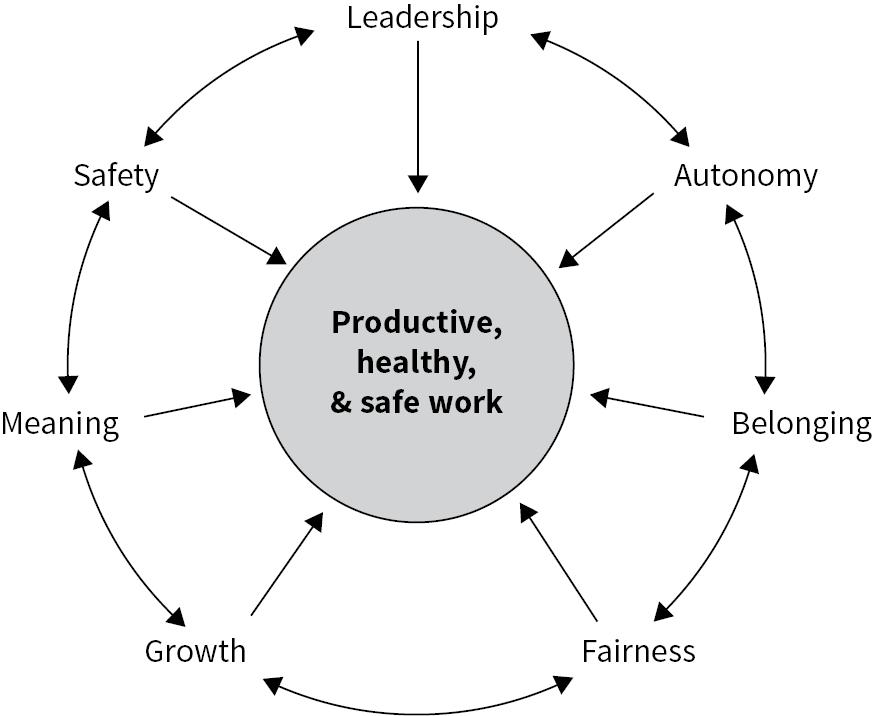
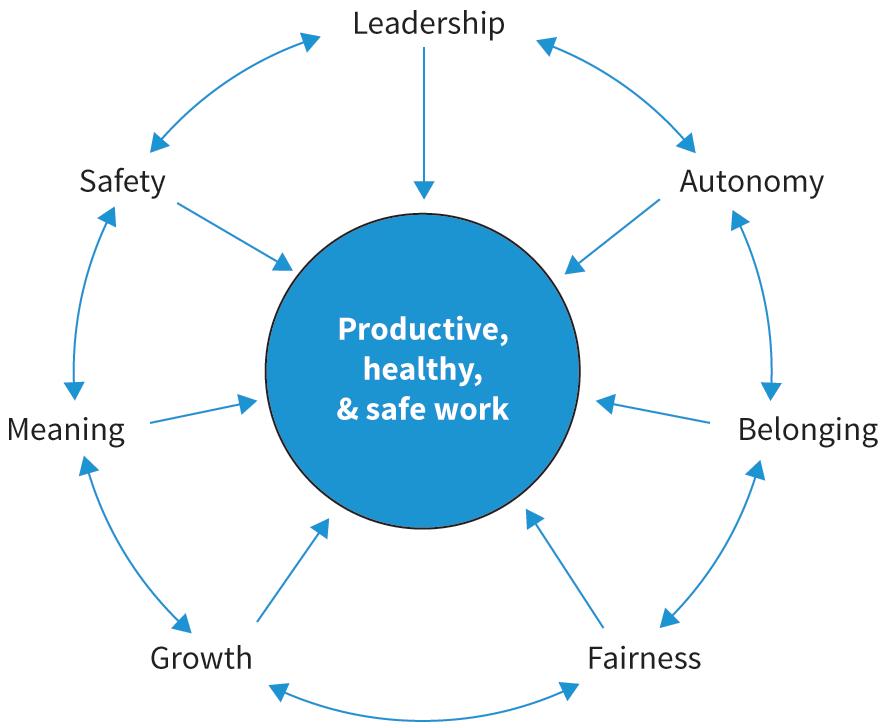
All that being said, perhaps the most important decision is the first decision to do what you can to build a productive, healthy, and safe workplace. In the immortal words of Peter Drucker, “You can either take action or you can hang back and hope for a miracle.” And, alas, he reminds us, “Miracles are great, but they are so unpredictable.” Seven distinct but interrelated work characteristics trigger productive, healthy, and safe work. These characteristics are depicted in Figure 1.1, and they are high-quality leadership, job autonomy, a sense of belonging, fairness, growth and development, meaningful work, and safe work.
Fig. 1.1 The seven work characteristics of a productive, healthy, and safe workplace
Two assumptions are fundamental to this approach to productive, healthy, and safe workplaces. First, as Christina Maslach reminds us, productive, healthy, and safe work is realized by creating optimal work environments in which people can flourish, not by making people more resilient so that they can withstand damaging and destructive workplaces. Second, optimal work environments are composed of high-quality leadership, autonomy, a sense of belonging, fairness, opportunities for growth and development, meaningful work, and safe work.
Having said that, an important word of caution. Organizations do not need to implement all seven characteristics to change the way
people view their work environments. On the contrary, a fundamental assumption of this approach is that small changes are enough to create productive, healthy, and safe workplaces. This is evident throughout the book, but most notably in two different sections in each chapter. First, each chapter showcases an intervention that exemplifies how the smallthings we choose to do create meaningful change in the long term. Second, while it may seem odd, each chapter also examines whether you can have too much of each characteristic. As examples, we will consider whether work can enable so much autonomy, or be so meaningful, that it backfires on employees and organizations.
Accepting that organizations do not need to implement all seven characteristics, where would you start if you wanted to move toward a productive, healthy, and safe workplace? The answer is anywhere, and there are two reasons for this. First, there is simply no research suggesting that any of the seven characteristics is more effective than the others. Thus, decisions as to where to start can be guided by local realities, which include current strengths and weaknesses of the organization and its leaders, as well as any particular resource considerations. Second, employees actively and continuously scan their workplaces and evaluate management actions (and inactions) accordingly.13 Employees then respond positively irrespective of whether management introduces initiatives to enhance high-quality leadership, autonomy, belonging, fairness, growth and development, meaningful work, or safe work.
Another important assumption is that the seven characteristics are interrelated rather than stand-alone best practices. For example, granting employees more autonomy in their work can be beneficial. However, doing so without first providing them with the training (an essential aspect of growth and development) would not only be pointless but also one of the most dangerous things you could do in your organization. Similarly, providing employees with training is a waste of scarce resources if they do not also have autonomy to use the skills they learned. Accordingly, changes to meaningfully integrated “bundles,” that is, interdependent characteristics such as autonomy and growth, would likely bring the greatest benefits to
organizations and their members. On the contrary, trying to change all seven characteristics would overwhelm employees, resulting in less productive, healthy, and safe workplaces.
Last, the characteristics that lead to productive workplaces, as one example, could also lead to healthy and safe workplaces. This runs counter to the assumption in many organizations that they have a choice: either a productive or a healthy/safe workplace. Many organizations believe that the factors that lead to productivity (e.g., compensation) do not affect safety, and that factors that result in employee well-being (e.g., EAP programs, vacation) have no effect on productivity. Despite being widespread, this assumption is not supported in reality. For example, granting employees autonomy enhances well-being and work attitudes (see Chapter 3),14 offering training improves commitment to the company (see Chapter 6),15 and performance-based pay (negatively) affects safety (see Chapter 8).16
An evidence-based approach to productive, healthy, and safe workplaces
Think about the last time you visited your family doctor. My guess is that you assumed that whatever tests they ordered, diagnoses they made, or treatments they prescribed were based on the best and most current scientific knowledge available. If that is the case, you may be horrified to learn that this is not necessarily so. Earlier estimates suggested that about 15 percent of medical decisions follow the most recent medical or scientific knowledge.17 And this was despite the fact that David Sackett and his colleagues at McMaster University in Canada had earlier developed what they called “evidence-based medicine,” which they defined as “the conscientious, explicit, and judicious use of current best evidence in making decisions about the care of individual patients.”18 Since then, numerous other professions such as policing,19 education,20 and firefighting21 have followed suit.
The field of management has fared no better than medicine. In fact, some estimates suggest that only about 1 percent of HR
managers deliberately use research-based knowledge to guide their everyday workplace decisions.22 Whatever the many reasons for this situation,23 the consequences for organizational functioning are potentially disastrous: for example, organizations continue to adapt forced ranking systems in performance management, use stock options for compensation and motivation, and benchmark against other organizations—despite considerable evidence showing that such techniques are ineffective at best and harmful in more situations than we might care to acknowledge.24
Thus, a major goal of this book is to bring findings from the enormous body of management research to current and aspiring organizational leaders and management professionals in a way that can help guide their everyday decisions and behaviors. Invoking Sackett and colleagues’ definition of evidence-based medicine, my goal is that this book helps management bring the “the conscientious, explicit, and judicious use of current best evidence in making decisions about healthy, safe and productive work,” one step closer. In doing so, this is not another how-to book offering easy and prescriptive linear solutions to complex problems. Instead, the essence of this evidence-based approach acknowledges and respects the intelligence, experience, integrity, ingenuity, and flexibility of organizational leaders and managers who want to make their workplaces more productive, healthy, and safe for all.*
While adopting an evidence-based approach, it is tempting just to focus on the latest scientific advances. Nonetheless, we will not allow society’s fascination with the most recent scientific research to obscure decades-old “classics” from which invaluable lessons can still be drawn. This approach will also remind us that the knowledge about how to make work productive, healthy, and safe has been with us for decades.
Taking an evidentiary approach also means that some topics that you might have expected to see in this book are given short shrift. For example, even though the Myers-Briggs Type Indicator (the MBTI) is extensively used in organizations around the world, it is barely mentioned again. The reason for this is that despite its
enormous popularity, there is simply no credible evidence that it enhances the practice of management in any way.25 Also, despite widespread concern that employees belonging to different so-called generations (e.g., baby boomers, Gen-X millennials) behave differently in organizations, there is simply no evidence that these categorizations mean anything or that people in these supposed categories have different needs at work.26
Similarly, having seen the model of productive, healthy, and safe work in Figure 1.1, you might already be asking—but what about compensation? Without delving into decades of research, we can say that with the exception of people who have to work for abysmal wages, † evidence does not support the notion that compensation is directly or meaningfully tied to productive, healthy, and safe work. Several sources support this idea. First, in their groundbreaking research, the Gallup organization identified twelve factors that contribute to a great workplace—but found no role for compensation! ‡ Second, in his fascinating Harvard Business Review article, “Six dangerous myths about pay,” Jeffrey Pfeffer concludes that one of the biggest myths about pay is that people are primarily motivated by money. The reality, Pfeffer reminds us, is that “people do work for money, but they work even more for meaning in their lives. In fact, they work to have fun. Companies that ignore this fact are essentially bribing their employees and will pay the price in a lack of loyalty and commitment” (112).27 An even harsher reminder comes from Ed Lawler. Lawler illuminates some reasons why compensation typically fails to yield its hoped-for benefits: “Many organizations end up using an enormous amount of time to allocate small amounts of money to individuals based on an uncertain assessment of performance in the hope that performance will improve … [I]t is a kind of corporate fantasy … that takes time, effort and resources but has few … positive outcomes” (210–211).28,§
Ideas about productive, healthy, and safe workplaces go back almost a century
My journey of learning about productive, healthy, and safe work began decades ago when I was an undergraduate studying what was then called industrial psychology. My time working as a researcher in the gold mines in South Africa while I completed my master’s degree heightened my curiosity. My research focused on the application of Maslow’s theory of motivation in an apartheid-riddled, dangerous work environment in 1975. Since then, I have been privileged to learn about productive, healthy, and safe workplaces from many different sources: Research I have conducted, roles I have held such as chair of the Ontario Advisory Council on Health and Safety and the editor of the Journal of Occupational Health Psychology, students I have encountered in executive MBA courses and executive education programs, involvement with many organizations, and innumerable discussions with wonderful colleagues and graduate students. Part of what I learned is that new ideas have appeared almost every decade over the past hundred years, many of which still guide our thinking about productive, healthy, and safe work today as you will see throughout the book. Allow me to introduce you to some of the ideas and the people behind them.29
The immense contribution of Marie Jahoda started with the publication Marienthal: The sociography of an unemployed community.30 This groundbreaking book presented findings from her research on the effects of unemployment in the Austrian town of Marienthal.** Marienthal had thrived economically and socially for decades but was hit by massive unemployment in 1929. Based on what she learned from her many interviews with unemployed workers, Jahoda developed a theory of the psychological meaning of both employment and unemployment. Jahoda’s theory was influential for at least two reasons. First, Jahoda posited that it is not simply the presence or absence of employment or unemployment that affects people. Instead, it is the quality of the employment and/or unemployment experience that is critical. Second, Jahoda showed
that employment has both manifest and latent functions. The manifest function of employment is to provide sufficient financial resources. The latent function of employment is to provide the time structure, social contact, collective purpose, status, and activity that are essential for psychological well-being and mental health. Remarkably, Jahoda herself was active fifty-five years later, as is evident from her review of the effects of economic recessions on psychological well-being in 1988.31 How influential is Jahoda’s work? Well, her notion of unemployment and employment guided research on the effects of unemployment in the 1970s, 1980s, and 1990s in the United States, United Kingdom, and Australia, and I would also venture to say that Jahoda may be the second most famous social scientist of the 20th century. After all, how many other social scientists could boast of having a rock band named after them? Well, the eclectic rock band Nojahoda32 took their name from Jahoda’s work on mental health (saying that they had an absence of mental health).††
The 1940s saw the initial publication of Maslow’s theory of selfactualization,33 after which Maslow continued developing his theory until his death in 1970. It took about ten years for organizational theorists to question whether Maslow’s theory could be useful in industry, even though initially this was of no interest to Maslow. Intrigued by this interest, Maslow took a sabbatical in 1962 and worked at Non-Linear Systems, a technology company in California. Whilst at Non-Linear Systems, he kept a daily diary that was published as Eupsychian management: A journal in 1965,34 a book that Peter Drucker later said was “by far Maslow’s best book.”35 Eighty years later, discussions about motivation in organizations are still guided by Maslow’s hierarchy of needs. In fact, his theory is so well known that the mere mention of his hierarchy of needs probably has you visualizing a pyramid with his five needs, starting at physiological needs and extending through to the pinnacle, the need for self-actualization. If you can visualize his model, this is one of several other ironies about Maslow’s theory. Possibly because it is so widely known, it has also suffered from widespread misinterpretation.
As but one example, Maslow himself never created a pyramid to depict the hierarchy of needs—what Todd Bridgman and colleagues refer to as “management studies’ most famous symbol.”36 An even bigger irony is the fact that despite the attention it has received, very little research was conducted investigating the application of Maslow’s theory within organizations. Of the research that was conducted, the results were disappointing at best.
Nonetheless, Maslow’s theory is critical for thinking about brave new work. A core assumption that underpinned his entire theory was that only psychologically healthy individuals (which he equated with self-actualized individuals) would reach their full potential and be capable of high performance. In addition, while research findings have not been kind to the usefulness of self-actualization within organizational settings, ‡‡ other needs in the hierarchy such as the need for safety and security and a sense of belonging are foundational to understanding productive, healthy, and safe work. How influential is Maslow’s theory? It still influences management thinking, and has also been applied in other areas such as education, child development, and clinical psychology. In fact, I would suggest that Maslow is the most widely known psychologist of the 20th century. Yes, Marie Jahoda had a rock band named after her. But do you know of any other psychologist who had a hotel named in their honor? The Maslow Hotel in Sandton, South Africa, was named after Maslow to reflect the hotel’s mission of catering to the well-being of its guests.37
As we enter the 1950s, production methods in coal mining in England were changing. Until then, coal mining involved doing a unified, whole task in which skilled mineworkers were granted autonomy over their work. But no more. To improve productivity, work was becoming ever more mechanized with miners only performing small fractions of the whole job. In addition, workers were now more isolated from each other, though they did work in small interdependent groups. Psychiatrist Eric Trist and Ken Bamforth, a former coal miner with eighteen years of experience, soon noticed that high levels of anxiety, anger, and depression were coupled with
major disruptions in social-support systems.38 Trist and Bamforth concluded (1951, 41) that it was “difficult to see how these problems can be solved effectively without restoring responsible autonomy to primary groups within the system and ensuring that each of these groups has a satisfying sub-whole as its work task and some scope for flexibility in work pace.” This realization would affect how theorists and practitioners (largely in the United Kingdom and Europe) thought about work in general, and autonomy more specifically, for decades.
Focusing on the individual job rather than the entire social system as Trist and Bamforth had done, Frederick Herzberg was responsible for one of the most widely known developments in organizational thinking in the 20th century.39 This was most likely due to his classic Harvard Business Review article in 1968, “One more time: How do you motivate employees?” In pre-internet times, people would gain access to HBR articles by purchasing a hard copy. In reprinting his article in 1987 to mark the journal’s sixty-fifth birthday, the editors of HBR noted that in the twenty years since its publication in 1968, Herzberg’s article had sold 1.2 million copies,§§ three hundred thousand more than the next most popular article. Based primarily on semistructured interviews with about two hundred engineers and accountants in the United States, Herzberg insisted in this article that work motivation and performance can only be enhanced by enriching people’s jobs,*** which involves granting people responsibility for their own work, allowing them to use their skills, providing challenge, and recognition. In turn, enriched jobs provide opportunities for psychological growth and development.
Evaluating the impact of Herzberg’s ideas is complicated. Herzberg insisted that benefits and compensation do not affect motivation and performance. Yet as we have already seen, organizations around the world remain fixated on compensation in the hope of influencing motivation. Despite this, even though Herzberg was never an organizational scientist and did not explain why enriched jobs would result in higher motivation and performance levels, others took up the mantle, ensuring his enduring indirect influence. Eight years after the publication of Herzberg’s HBRarticle, Richard Hackman and Greg
Oldham systematized many of Herzberg’s ideas with the publication of their job-characteristics model.40 Their model explains how facets that Herzberg had identified as critical for job enrichment influence the psychological experience of work, and that it is the psychological experience that affects work motivation and performance. Hackman and Oldham’s ideas spurred considerable research over the next several decades, with very encouraging results. Many of the central ideas in their model (e.g., autonomy, task identity and significance, feedback, and meaningful work) feature prominently as antecedents of productive, healthy, and safe work.†††
Starting in the late 1970s, two different groups of researchers drew attention to the importance of feeling in control of your work. Working together, Robert Karasek, an architect by training, and Töres Theorell, a clinical and research cardiologist, initially developed the “demand-control” model, which at its core is a model of healthy work.41 They proposed that unduly demanding work need not result in negative personal effects if employees enjoy some control over their work, such as the ability to refuse additional work with no fear of repercussions.‡‡‡ Working separately at first, Sir Michael Marmot, an epidemiologist, initiated a massive study of the working conditions of 17,500 UK civil servants. Now known as the “Whitehall” studies, this research continues today and clarifies why social class is positively associated with life expectancy and negatively associated with early mortality. Essentially, ever-increasing levels of social status influence longevity by giving people access to resources, most critically, autonomy and social control.42 These ideas apply equally in organizations, and explain a seemingly counterintuitive phenomenon. Many CEOs and top-level executives justify their enormous salary packages as reasonable compensation for the long hours, stressors, and challenges they face on the job. Yet studies consistently show that life expectancy is much higher in executives than blue-collar workers, with the difference sometimes reaching ten years.43
Last, starting in the 1980s and moving into the 1990s, Peter Warr developed his “vitamin model” to explain how many work characteristics (e.g., opportunities for control and interpersonal
contact, physical safety) influence mental health.44 Warr suggested that we should think of work characteristics as vitamins. Some vitamins have linear effects on physical health; for example, the more vitamin C or E you take, the better your health. In contrast, small doses of vitamin A and D are beneficial, but very large doses can be toxic. In the same way, high doses of some work characteristics such as autonomy may cause stress or anxiety, and a “one-size-fits-all” model of work characteristics would not be appropriate. If Warr is correct, two practical implications follow. First, in cases where workplace characteristics parallel vitamin A or D, implementing small changes might not only be the most efficient strategy but also the only productive, healthy, and safe strategy. Second, questions about whichworkplace changes should be made need to be supplemented with how much change would be optimal. Warr’s ideas will guide us as we consider whether each of the seven work characteristics can be “Too Much of a Good Thing” (TMGT) in some circumstances.
Organization of the book
The next seven chapters appear in the following sequence. We start with leadership (Chapter 2), but not because leadership is the most effective of all the characteristics leading to productive, healthy, and safe work. Indeed, I know of no compelling evidence to suggest that this is the case. Instead, the story starts with leadership because someone in the organization has to decide to move toward productive, healthy, and safe work, and that takes real leadership. Autonomy (Chapter 3), belonging (Chapter 4), fairness (Chapter 5), growth (Chapter 6), meaningful work (Chapter 7), and safety (Chapter 8) all follow in alphabetical order, again to emphasize that each of the seven characteristics has an equal place in the model. To enhance the consistency and readability of the book, the chapters largely follow the same sequence.§§§
Each chapter opens with comments and observations about the nature of the particular characteristic.
We then examine the attitudinal, performance, and well-being benefits that emerge when organizations get it right.
We follow with an evaluation of what happens to work attitudes, work performance, and employee well-being when organizations get it wrong.
We then consider how it is that the work characteristic exert their positive or negative effects.
Large bodies of research show how gender and culture influence each of the seven work characteristics, and we examine the role of gender and culture in each chapter.
Following the idea that small changes make a big difference in the long term, we consider what is often referred to as the TMGT phenomenon in the organizational sciences—whether it is possible to have “too much of a good thing” with respect to any of the seven different work characteristics.
Each chapter also describes an example of an intervention that was implemented and rigorously evaluated; the goal in doing so is to demonstrate that implementing each of the work characteristics is doable. Before going any further, a clarification on what is meant by an “intervention” is warranted. No, we are not referring to the kinds of family interventions you might see on TV where people intervene when other family members are descending into a bad place, often due to an addiction. The kind of interventions that will be described involve a carefully planned process in which one group in the organization receives a new program (e.g., leadership training). Conclusions as to whether the program worked are based on a comparison with a separate group that has not (yet) received the program, with measurements on the outcome of interest taken after the program is delivered, often several weeks or months later.
Each of the seven characteristics raises unique issues for productive, healthy, and safe work. For example, what is the implication of autonomy (Chapter 3) for whether and how
• organizations should implement electronic performance monitoring? Similarly, knowing what we do about meaningful work (Chapter 7) raises questions about “dirty work.” Finally, data about the relative risk of unsafe work for different demographic groups make the consideration of young workers crucial (Chapter 8).
Last, I end each chapter with a section entitled “In case you are not yet convinced” in which I solidify the arguments made in the chapter, sometimes by reiterating what was said, other times by introducing additional information.
I look forward to meeting up with you again in Chapter 9, where we consider some remaining challenges as we move toward productive, healthy, and safe work. In the meantime, my hope is that as you move through the book, you come to appreciate what it takes to build productive, healthy, and safe workplaces, and the many benefits that employees and their organizations enjoy from highquality leadership, a sense of autonomy, belonging, fairness, opportunities for growth and development, meaningful work, and safe work. Last, and by no means least, I anticipate that by the end of the book, you will know that productive, healthy, and safe workplaces are well within reach.
* At the same time, it is important to note that each chapter represents a sample of existing research on the topic. Given the sheer amount of research that has been conducted, this book is not meant to be an exhaustive (and exhausting) review of all the available research on the topic. Instead, what is reflected in each chapter are the findings most able to guide management decisions and behaviors.
† Given that the US federal minimum wage is $7.25 per hour, and the number of people engaged in gig work is increasing, the number of people affected in the United States is rising.
‡ In contrast, as will be seen later, no fewer than three of their twelve factors were directly related to growth and development!
§ Nonetheless, aspects of compensation that are implicated in issues such as fairness or financial insecurity will be woven into relevant chapters.
‡ ‡ One practical reason for this is the very nature of self-actualization, which Maslow described so: “A musician must make music, an artist must paint, a poet
must write, if he is to be ultimately happy. What a man can be, he must be.” While probably true (as we will see in Chapter 7), a question that is often raised is, what happens if you find yourself in an organization that does not need musicians, painters, artists, or poets?
§§ And the number of people who read the article would have been even greater, as the 1.2 million does not include those who shared the copy they had bought, or who read it in the journal.
*** Herzberg also referred to job enrichment as vertical job loading.
††† Notably, Hackman and Oldham also saw no need to include compensation in their model.
‡‡‡ Karasek and Theorell subsequently extended the model to include the role of support as a way in which people could cope with overdemanding work.
** In her obituary for Marie Jahoda, Rhoda Unger (2001) notes that this book was initially published without naming the three authors because the publisher feared that the authors’ Jewish names would attract negative attention. Despite this precautionary step, “most of the copies of the first edition were burned because of its authors’ origins” (Unger, 2001, 1040).
†† Read on to find out who might be the most famous social scientist of the 20th century, and why.
§§§ The one exception to this consistent structure/sequence is the chapter on safety. The reason for this is that there is a considerable body of research investigating what happens when safety is an issue at work, but precious little that I know of directly investigating the attitudinal, performance, and well-being benefits of getting it all right. Relatedly, there is no research investigating whether high levels of safety can have negative effects (i.e., the TMGT phenomenon). Accordingly, those sections do not appear in Chapter 8.
2 Leadership
Please help others rise. Greatness comes not from aposition, but from helping build the future. We have an obligation to pull others up.
Indra Nooyi, former President and CEO, Pepsico, Inc
The story about brave new workplaces necessarily starts with leadership, and not because leadership is more effective than autonomy, belonging, growth, fairness, meaningfulness, or safety. Indeed, despite my involvement in organizational and leadership research for several decades, I have yet to see compelling evidence showing that leadership is any more effective than any of the other characteristics. Then why start with leadership?
Because the brave new workplaces of the future literally must start with high-quality leadership. As we will see, autonomy, belonging, fairness, and the other characteristics are integral to a productive, healthy, and safe workplace, but someone must commit to introduce and integrate these characteristics into the fabric of the organization. As organizations around the world emerge from the pandemic, it will be courageous leaders who create the conditions that empower their employees and prepare their organizations for productive, healthy, and safe work.
The nature of leadership
The leadership literature is overflowing with different theories and approaches. Ambidextrous leadership! Authentic leadership! Charismatic leadership! Ethical leadership! Leadership-member exchange theory! Servant leadership! Transformational leadership! There are simply so many leadership theories competing for our