Ancient and medieval thought on greek enclitics stephanie roussou download pdf
Ancient and Medieval Thought on Greek Enclitics Stephanie Roussou
Visit to download the full and correct content document: https://ebookmass.com/product/ancient-and-medieval-thought-on-greek-enclitics-step hanie-roussou-2/
More products digital (pdf, epub, mobi) instant download maybe you interests ...
Great Clarendon Street, Oxford, OX2 6DP, United Kingdom
Oxford University Press is a department of the University of Oxford. It furthers the University’s objective of excellence in research, scholarship, and education by publishing worldwide. Oxford is a registered trade mark of Oxford University Press in the UK and in certain other countries
The moral rights of the authors have been asserted
First Edition published in 2023
All rights reserved. No part of this publication may be reproduced, stored in a retrieval system, or transmitted, in any form or by any means, without the prior permission in writing of Oxford University Press, or as expressly permitted by law, by licence or under terms agreed with the appropriate reprographics rights organization. Enquiries concerning reproduction outside the scope of the above should be sent to the Rights Department, Oxford University Press, at the address above
You must not circulate this work in any other form and you must impose this same condition on any acquirer
Published in the United States of America by Oxford University Press
198 Madison Avenue, New York, NY 10016, United States of America
British Library Cataloguing in Publication Data
Data available
Library of Congress Control Number: 2022944289
ISBN 978–0–19–287167–1
ebook ISBN 978–0–19–269959–6
DOI: 10.1093/oso/9780192871671.001.0001
Printed and bound by CPI Group (UK) Ltd, Croydon, CR0 4YY
Links to third party websites are provided by Oxford in good faith and for information only. Oxford disclaims any responsibility for the materials contained in any third party website referenced in this work.
Forourteachers
Preface
This book has its origins in a discussion between the two authors about a passage of Greek, which took us on a remarkable journey through ancient and medieval texts on Greek enclitics via accent marks on papyri and in medieval manuscripts. The textual problem we originally set out to solve turned out to have an answer known already to Aldus Manutius, but in the meantime apparently disparate sources of information on enclitic accents had started coming together in a surprising way. We found further exploration irresistible, and this book is the result.
A compelling intellectual quest does not write a book by itself, however, and we have numerous individuals and institutions to thank for much help, encouragement, and support. Stephanie Roussou was able to work intensively on her side of this project in 2017, thanks to funding from the John Fell OUP Research Fund, the Lorne Thyssen Research Fund for Ancient World Topics at Wolfson College, and the A. G. Leventis Foundation, as well as a three-week Research Scholarship from the Fondation Hardt. Philomen Probert was able to work intensively on her side during two periods of sabbatical leave, generously granted by the Faculties of Classics and Linguistics at the University of Oxford in 2015 and 2019. She was fortunate in being able to spend both periods of leave at the University of Leiden, as an academic visitor in 2015 and as a Spinoza Visiting Scholar in 2019. She would like to thank Ineke Sluiter, everyone in the Classics Department, and the University Library for providing ideal conditions and wonderful discussions. Both authors have benefitted from a Fellowship granted to Stephanie by Harvard University’s Center for Hellenic Studies, which enabled us both to spend two productive weeks at the Center in 2017.
We have benefitted from numerous opportunities to present and discuss aspects of our work on enclitics. In this connection Philomen gave talks to the panel on Greek and Latin Linguistics at the Annual Meeting of the Society for Classical Studies (San Francisco, 2016), the Workshop on Ancient Grammar held at the University of Cologne (2017), and the Philological Society (2019). Stephanie spoke at the event ‘From Homer to Modern Greek: diachronic approaches to Greek language’ hosted by the Society for the Promotion of Education and Learning and the Center for Hellenic Studies (Athens, 2017). We gave joint talks in Oxford to the Comparative Philology Seminar and to the Ancient World Cluster at Wolfson College (2017). We would like to thank the
organizers and participants in all these events for their insights and useful discussion.
The new editions of the texts presented in Chapter 2, prepared primarily by Stephanie, could not have been produced without digital images supplied to us by the Biblioteca Apostolica Vaticana, the Biblioteca Casanatense, the Biblioteca Comunale Augusta, the Biblioteca Comunale di Palermo, the Biblioteca Medicea Laurenziana, the Biblioteca Nacional de España, the Bibliothèque Nationale de France, the Biblioteca Nazionale Marciana, the Biblioteca Nazionale di Napoli, the Biblioteca Nazionale Universitaria di Torino, the Biblioteca Riccardiana di Firenze, the Biblioteca Statale di Cremona, Cambridge University Library, the Kongelige Bibliotek København, the Real Biblioteca del Monasterio de San Lorenzo de El Escorial, the State Historical Museum of Russia, the Vědecká knihovna v Olomouci, and the Veneranda Biblioteca Ambrosiana. We are further grateful to several of these and more libraries for digital images which we did not need to request, because the libraries had already made them available to everybody. And we are grateful for permission for Philomen to examine manuscripts in person at the Biblioteca Medicea Laurenziana and the ΣπουδαστήριονΒυζαντινής και
and for Stephanie to examine manuscripts in person at the Bibliothèque Nationale de France. The librarians of the ΣπουδαστήριονΒυζαντινήςκαιΝεοελληνικήςΦιλολογίαςwere kind enough also to put us in touch with Gina Zavakou, whom we would like to thank for informative discussion of codex Atheniensis 25. At a workshop on Herodian, held in Oxford in June 2010, Nigel Wilson drew our attention to the text on enclitics in codex Laurentianus Plut. 58.24 and generously suggested that Stephanie might work on it further; this significant discovery (subsequently made independently by Chiara Telesca: see section 2.1.1) provides a particularly early witness to the treatise that we present in section 2.1. On top of this, Nigel has read the critical editions and given us the benefit of expert advice. Stephanie would further like to thank her co-author for inspiring her to persevere in the face of a seemingly impossible web of textual traditions.
Chapter 3 of this book, on the accent of ἐστί(ν) or ἔστι(ν), originated as an independent project of Philomen’s; it was inspired by those scholars who had written to her asking where they should print the accent on particular instances of ἘΣΤΙ(Ν), and not least by Graham Shipley. Lesley Brown provided further inspiration for work on this topic, by initiating valuable discussion of the semantics of verbs ‘to be’ at an ideal moment. Also in this connection, Sandra Paoli responded with characteristic kindness and helpfulness to questions on the typology of extra-clausal elements, as did Paul Elbourne and Marta Abrusán to questions on the semantics of existential sentences; Nigel Wilson pointed Philomen in the direction of Serbian; and Ana Kotarcic gave her generous help with Serbian questions. The participants in the 2010 workshop on Herodian
provided valuable feedback on a talk resulting from an early stage of this work. But the questions attached to the accent of ἘΣΤΙ(Ν) behaved like the heads of the Hydra, and by the time we started to collaborate Philomen had all but despaired of answering them. She would like to thank her co-author for providing renewed inspiration and the perfect context to grapple with all this again, and for improving the textual foundations for this work.
Chapter 4, on sequences of enclitics, is the result of extensive brainstorming between both authors. In its final form the chapter is due mainly to Philomen, but Stephanie collected most of the papyrological data discussed in section 4.3.
Eleanor Dickey, Maria Giovanna Sandri, Jesse Lundquist, Dieter Gunkel, Jan Kwapisz, Helena Teleżyńska, and two anonymous readers have read the whole book and been generous with encouragement and advice. We owe special thanks to Eleanor for lengthy discussions and keen observations on the manuscript traditions of texts on enclitics, at an early stage of our work, and to Maria Giovanna for keen observations at a later stage and for alerting us to at least eleven manuscripts that we would otherwise have missed. Maria Giovanna has also been kind enough to share work of hers with us in advance of publication.
It was hardly to be taken for granted that a publisher would share our enthusiasm for ancient and medieval thought on Greek enclitics. We would like to thank Charlotte Loveridge, Vicki Sunter, Clare Jones, and the Delegates of Oxford University Press for their warm encouragement and support of this project, Louise Larchbourne for her meticulous copy-editing of such a complex manuscript, and Tim Beck for expert proof-reading.
We would like to thank our families, friends, and colleagues for their friendship and support. This book is dedicated to all our teachers, with gratitude and in hopes that some of what follows might meet with their approval. For the rest, the responsibility lies with us alone.
S.R. P.P.
ThessalonikiandOxford May2022
Contents
Generalabbreviations
Abbreviationsusedinthecriticalapparatus
SymbolsusedinpresentingGreektextsandtranslations
Ancientauthorsandworks,witheditionsused
1 Introduction
2 Ancient and medieval sources
2.1 Onenclitics1
2.1.1 Sources and stemma
2.1.1.1 Evidence for family ψ
2.1.1.2 Evidence for family j
2.1.1.3 Evidence for family δ
2.1.1.4 Evidence for sub-family σ (with further subgroup t)
2.1.1.5 Evidence for sub-family ϕ(with further subgroups υ and τ)
2.1.1.6 Evidence for sub-family ξ
2.1.1.7 Possible evidence that Ra is contaminated with sub-family ξ
2.1.2 Previous editions
2.1.3 Onenclitics1: text and translation
2.2 Onenclitics2
2.2.1 Sources and stemma
2.2.1.1 Evidence for families μ and q
2.2.1.2 Evidence for sub-families η and ε
2.2.1.3 Evidence that Σis contaminated with Ald.
2.2.2 Previous editions
2.2.3 Onenclitics2: text and translation
2.3 Onenclitics3
2.3.1 Sources and stemma
2.3.1.1 Evidence for family d
2.3.1.2 Evidence for family b (with sub-families σ and ϕ)
2.3.1.3 Evidence for family ξ
2.3.2 Previous editions
2.3.3 Onenclitics3: text and translation
2.4 Charax
2.4.1 Sources and stemma
2.4.1.1 Evidence for family w1 (with sub-family x)
2.4.1.2 Evidence for family w2 (with sub-families y2 and y1)
2.4.1.3 Evidence for family s (with sub-families a and ρ)
2.4.1.4 Evidence that V and c are contaminated with N
2.4.2 Previous editions
2.4.3 Charax: text and translation
2.5 AboutἘΣΤΙΝ
2.5.1 Sources and stemma
2.5.1.1 Evidence for families α, ϕ, ξ, and m
2.5.2 Previous editions
2.5.3 AboutἘΣΤΙΝ: text and translation
2.6 Onenclitics4
2.6.1 Sources and stemma
2.6.1.1 Evidence for families βand i
2.6.2 Previous editions
2.6.3 Onenclitics4: text and translation
2.7 Ideas reflected in the Byzantine treatises
2.7.1 Ancient terminology and thought on Greek accents
2.7.2 The natural accent of an enclitic
2.7.3 Accenting a word followed by an enclitic: the main doctrines
2.7.4 Metaphors for enclitic behaviour
2.7.5 Differences of opinion on sequences of the type ἘΝΘΑΜΟΙ
2.8 Earlier stages of the tradition
2.8.1 Ancient thought on Greek accents: general features and the ‘lulling rule’
2.8.2 The natural accent of an enclitic
2.8.3 Accenting a word followed by an enclitic: the main doctrines
2.8.4 Metaphors
2.9 Conclusions
3 The accent of ἘΣΤΙ
3.1 Introduction
4
3.2 Ancient support for the ‘initial and quasi-initial’ view
3.3 Ancient support for the ‘existential’ view
3.4 Preliminary conclusions
3.5 The linguistic plausibility of both ancient traditions being partly right
3.5.1 The linguistic plausibility of ἔστιin initial and quasi-initial position
3.5.2 The linguistic plausibility of ἔστιas existential, contrastive, and emphatic
3.5.3 Serbian again: the linguistic plausibility of ἔστιin initial and quasiinitial position andwhen existential, contrastive, or emphatic
3.6 Conclusion
4.1 Introduction
4.2 Grammatical texts
Accenting sequences of enclitics
4.2.1 The traditional view
4.2.2 The traditional view with an exception for ΠΟΥ, ΠΗ(Ι), ΠΩΣ, ΠΩ, and perhaps others
4.2.3 The traditional rule with an exception for pyrrhic and iambic sequences
4.2.4 The three ancient systems: incompatible and yet compatible
4.2.5 Homeric scholia on sequences of enclitics
4.2.6 The grammatical tradition: conclusion and a remaining puzzle
4.3 Accented papyri
4.4 Venetus A
4.5 Conclusions and some further questions
5 Conclusions
Appendix A: Sequences of enclitics in Venetus A
Appendix B: Sequences of enclitics in Venetus B
References
Concordances
Indexlocorum
Indexverborum
Subjectindex
Machine-readable versions of Tables 4.2, Ap.1, Ap.2, and Ap.3 are available at https://dx.doi.org/10.5281/zenodo.7534838, https://dx.doi.org/10.5281/zenodo.7535149, https://dx.3doi.org/10.5281/zenodo 7535718, and https://dx.doi.org/10.5281/zenodo 7535843 respectively
General abbreviations
For abbreviations of ancient authors’ names, collections of texts, and titles of series of texts, see Ancientauthorsandworks,witheditionsused(p. xviii).
LSJ H. G. Liddell, R. Scott, H. S. Jones, R. McKenzie, P. G. W. Glare, and A. A. Thompson, A Greek-English Lexicon, 9th edn with revised supplement (Oxford 1996).
Martini-Bassi E. Martini and D. Bassi, Catalogus codicum graecorumBibliothecaeAmbrosianae(Milan 1906). PatrologiaGraecaJ.-P. Migne (ed.), Patrologiaecursuscompletus, seriesgraeca(Paris 1857–66).
P.Flor G. Vitelli and D Comparetti, Papiri greco-egizii pubblicati dallaR.AccademiadeiLincei,i: PapiriFiorentini(Milan 1906–15).
P.Giss. i O. Eger, E. Kornemann, and P. M. Meyer, Griechische Papyri im Museum des oberhessischen Geschichtsvereins zu Giessen(Leipzig 1910–12).
P.Lond.Lit.H. J. M. Milne, CatalogueoftheLiterary Papyriinthe BritishMuseum(London 1927).
P.Oxy. B. P. Grenfell, A. S. Hunt, et al., TheOxyrhynchus Papyri (London 1898– ).
P.ParisA.-J. Letronne, W. Brunet de Presle, and E. Egger, Notices ettextesdespapyrus duMuséeduLouvre etdelaBibliothèque Impériale (Notices et Extraits de manuscrits de la Bibliothèque Impériale et autres bibliothèques, 18.2) (Paris 1865).
P.Schub W Schubart (ed.), GriechischeliterarischePapyri(Berlin 1950).
Rev.Ég.Revued’Égyptologie(Paris 1933– ).
TLGThesaurusLinguaeGraecae<www.tlg.uci.edu>.
UPZ U. Wilcken, Urkunden der Ptolemäerzeit (ältere Funde) (Berlin 1927–57).
Abbreviations used in the critical apparatus
add. addidit (has added)
coll. collato,collatis (by comparison with)
fr. fragmentum (fragment)
i.l. inlinea (on the line)
i.m. inmargine (in the margin)
i.t. intextu (in the text)
n.l. nonliquet (it is not clear)
om. omisit,omiserunt(has/have omitted)
s.l. supralineam (above the line)
Symbols used in presenting Greek texts and translations
{ } Used in presenting Greek texts, to indicate portions of text considered spurious.
⟨ ⟩ Used in presenting Greek texts, to indicate editorial additions.
( ) Used in presenting Greek texts, and in translations of those texts, to indicate a parenthetical remark belonging to the text itself
[ ] Used in translations of texts, to indicate clarifications not present in the original. On the rarer occasions where square brackets are used in the quotation of a text preserved on papyrus, they indicate lost letters.
ΤΙΣUpper-case letters are used to quote Greek words and phrases in a way that is neutral as regards their accentuation.
Ancient authors and works, with editions used
Series are indicated as follows: B = Collection des universités de France publiée sous la patronage de l’Association Guillaume Budé; CCSG = Corpus Christianorum, Series Graeca; GG = Grammatici Graeci; L = Loeb Classical Library; OCT = Scriptorum Classicorum Bibliotheca Oxoniensis; T = Bibliotheca Scriptorum Graecorum et Romanorum Teubneriana. Spurious works and works of uncertain authorship are alphabetized under the name of the author to whom they are traditionally attributed. Well-known authors and works are not generally listed here if they are mentioned in the book only to identify a quotation in a grammatical text, or an example from a cited papyrus or printed edition.
Ap. Dysc., Adv L. Dumarty, ApolloniusDyscole:TraitédesAdverbes.Paris 2021.
Ap. Dysc., Conj. C. Dalimier, ApolloniusDyscole:Traitédesconjonctions. Paris 2001.
Ap. Dysc., Constr . J. Lallot, ApolloniusDyscole,Delaconstruction(syntaxe). Paris 1997.
Ap. Dysc., Pron. P. Brandenburg, ApolloniosDyskolos:ÜberdasPronomen. Munich 2005.
Pseudo-Arcadius
Aristarchus, fr.…Schironi
S. Roussou, Pseudo-Arcadius’EpitomeofHerodian’sDe prosodia catholica. Oxford 2018.
F. Schironi, IframmentidiAristarcodiSamotracianeglietimologici bizantini. Göttingen 2004.
Aristophanes N. G. Wilson (OCT) 2007.
Bacchylides H. Maehler, Bacchylides:carminacumfragmentis, 11th edn. Munich 2003.
Callimachus, Aetia A. Harder, Callimachus:Aetia.Oxford 2012.
Callimachus, fr.…Pfeiffer
R. Pfeiffer, Callimachus. Oxford 1949–53.
Choeroboscus, Th. A. Hilgard, TheodosiiAlexandrinicanones: GeorgiChoeroboscischolia: SophroniiPatriarchaeAlexandriniexcerpta(GG IV.i–ii). Leipzig 1889–94, vol. i, p. 103–vol. ii, p. 371.
Demosthenes M. R. Dilts (OCT) 2002–9.
Dio Chrysostom J. von Arnim, DionisPrusaensisquemvocantChrysostomumquae exstantomnia. Berlin 1893–6.
Dionysius of Halicarnassus, Decompositioneuerborum
G. Aujac and M. Lebel (B) 1981.
(Ps.)-Dionysius Thrax, Supplement Περὶπροσῳδιῶν
G. Uhlig, DionysiiThracisArsGrammatica(GG I.i). Leipzig 1883, pp 105–14.
Et.Gud.…Sturz F. W. Sturz, EtymologicumGraecaelinguaeGudianum. Leipzig 1818.
Et.Gud.…de Stefani E. L. de Stefani, EtymologicumGudianumquodvocatur. Leipzig 1909–20.
Ep.Hom.alph.
A. R. Dyck, EpimerismiHomericiquiordinealphabeticotraditisunt, in A. R. Dyck, EpimerismiHomerici, ii, pp. 1–822. Berlin 1995.
EtymologicumMagnum T. Gaisford, EtymologicumMagnum.Oxford 1848.
EtymologicumParvum R. Pintaudi, EtymologicumParvumquodvocatur. Milan 1973.
EtymologicumSymeonis For lemmata beginning with Γ–Ε: D. Baldi, EtymologicumSymeonis(Γ–Ε)(CCSG, 79). Turnhout 2013.
Eustathius, InIliadem M. van der Valk, Eustathiiarchiepiscopithessalonicensiscommentariiad HomeriIliadempertinentes. Leiden 1971–87.
Eustathius, InOdysseam G. Stallbaum, Eustathiiarchiepiscopithessalonicensiscommentariiad HomeriOdysseam,adfidemexempliRomaniediti. Leipzig 1825–6.
Gregory of Corinth, Περὶ
D. Donnet, LetraitéΠερὶσυντάξεωςλόγουdeGrégoiredeCorinthe. Brussels 1967.
Gregory Nazianzen, Carmina A. Tuilier, G. Bady, and J. Bernardi (B) 2004–.
Hermas, Pastor See PastorHermae
Hesiod F. Solmsen, R. Merkelbach, and M. L. West (OCT) 1990.
Hesychius K. Latte, P. A. Hansen, and I. C. Cunningham, HesychiiAlexandrini Lexicon, volumes i (2nd edn), ii (2nd edn), iii, iv. Berlin 2005–20.
Homer See Il.and Od.
Il. Iliad, M. L. West (T) 1998–2000.
John Philoponus, Praecepta Tonica G. A. Xenis, IohannesAlexandrinus:PraeceptaTonica. Berlin 2015.
LexiconΑἱμωδεῖν
A. R. Dyck, LexiconΑΙΜΩΔΕΙΝquodvocaturseuveriusΕΤΥΜΟΛΟΓΙΑΙ ΔΙΑΦΟΡΟΙ, in A. R. Dyck, EpimerismiHomerici, ii, pp. 825–1034. Berlin 1995.
[Longinus], Desublimitate D. A. Russell (OCT) 1968.
Menander F. H. Sandbach (OCT) 1990.
New Testament
E. Nestle, E. Nestle, B. Aland, K. Aland, J. Karavidopoulos, C. M. Martini, and B. M. Metzger, NovumTestamentumGraece, 28th revised edn, 5th corrected printing. Stuttgart 2016.
Od. Odyssey, M. L. West (T) 2017.
PastorHermae
M. Whittaker, DieapostolischenVäter, i: DerHirtdesHermas, 2nd edn. Berlin 1967.
Photius, Lexicon C. Theodoridis, PhotiiPatriarchaeLexicon. Berlin 1982–.
Plato, Phaedo
Plato, Republic
E. A. Duke et al. (OCT), vol. i, 1995.
S. R. Slings (OCT) 2003.
Quintilian, Inst. For Inst.1.4–8 (the only portion cited in this book): W. Ax, QuintiliansGrammatik(Inst. orat. 1,4–8).Berlin 2011.
Sch. D. Thr.
Sch. Il.
A. Hilgard, ScholiainDionysiiThracisArtemgrammaticam(GG I.iii). Leipzig 1901.
H. Erbse, ScholiagraecainHomeriIliadem(ScholiaVetera).Berlin 1969–88.
Sch. Od. For Books 1–10:
F. Pontani, ScholiagraecainOdysseam. Rome 2007–. For Books 11–24: W. Dindorf, ScholiagraecainHomeriOdysseam.Oxford 1855.
Scholia vetera in Eur. E. Schwartz, ScholiainEuripidem. Berlin 1887–91. Sophocles, fr.…Radt
Sophronius, Excerptae Charace
Thucydides
Vergil
Συναγωγὴλέξεωνχρησίμων
S. Radt, TragicorumGraecorumfragmenta, iv, corrected and expanded edn. Göttingen 1999.
A. Hilgard, TheodosiiAlexandrinicanones: GeorgiChoeroboscischolia: SophroniiPatriarchaeAlexandriniexcerpta, ii (GG IV.ii), pp. 373–434. Leipzig 1894
H. S. Jones (OCT) 1942.
R. A. B. Mynors (OCT) 1969.
I. C. Cunningham, Synagoge:Συναγωγὴλέξεωνχρησίμων. Berlin 2003.
Introduction
Generations of classicists have learned that an enclitic is a special word with no accent of its own, or alternatively a special word with a propensity to throw its accent back onto the preceding word. Either way, there is a list of enclitics to learn, and a set of principles governing the ways in which an enclitic affects the accent of the preceding word. A basic lesson on enclitics might look something like this:1
A basic lesson on enclitics
1. The following words are enclitics:
• The indefinite τις, with its inflected forms τινά, τι, τινός/του, τινί/ τῳ; τινέ, τινοῖν; τινές, τινάς, τινά, τινῶν, τισί.
• The indefinite adverbs πω ‘up to this time’, πῃ ‘somehow’, που ‘somewhere’, ποι ‘to somewhere’, πως ‘somehow’, ποτέ ‘at some time’, ποθέν‘from somewhere’, and ποθί‘somewhere’.
• The unemphatic oblique personal pronoun forms με, μου, μοι; σε, σου, σοι; ἑ, οὑ, οἱ; μιν, νιν, σϕε/σϕεάς/σϕας/σϕᾱς, σϕεά, σϕεων, σϕι(ν), σϕισί(ν), σϕωέ, and σϕωΐν.
• The present indicative forms of εἰμί‘I am’ and ϕημί‘I say’, except for the second persons singular εἶand ϕῄς.
2. How to accent an ordinary word followed by an enclitic:
• If the ordinary word is oxytone (i.e. has an acute on its final syllable), it keeps the acute on its final syllable. The enclitic has no accent: πατήρτις, πατήρπου, πατρίτινι, πατήρϕησιν.
• If the ordinary word is perispomenon (i.e. has a circumflex on its final syllable), it keeps the circumflex on its final syllable. The enclitic again has no accent: πῦρ τι, ϕιλῶ σε, καλῶςπως, καλοῦ
• If the ordinary word is proparoxytone (i.e. has an acute on its antepenultimate syllable) or properispomenon (i.e. has a circumflex on its penultimate syllable), it keeps its usual accent and acquires an additional acute accent on its final syllable. The enclitic again has no accent: ἔλαβέτις, ἄνθρωπόςτις, ἄνθρωποίτινες, οἶκόςτις, οἶκοίτινων.
• If the ordinary word is paroxytone (i.e. has an acute on its penultimate syllable), it simply keeps its usual accent before the enclitic. If the enclitic is monosyllabic, it again has no accent. If the enclitic is disyllabic, it will have an acute on its final syllable (which may turn into a grave in connected speech), or a circumflex in the case of τινῶνor τινοῖν: λέγετι, λέγωτι,
μεγάλατινά, μεγάλοιεἰσί, παίδοιντινοῖν.
So far so good, but it becomes clear sooner or later that our lesson does not cover all the finer points. For example, what happens if an enclitic is elided, or if the word before the enclitic is elided? Or if more than one enclitic occurs in a sequence? Some words are enclitic only some of the time, like σε (or σέ), σου (or σοῦ), and ἐστί(or ἔστι): when was the enclitic form used, and when was it the non-enclitic or ‘orthotonic’ form? Some editors print ἔνθάτεrather than ἔνθα τε,2 or ἄρά σϕιν rather than ἄρα σϕιν,3 or κῆρυξ τις rather than κῆρύξ τις:4 what’s all that about?
To see where all these modern practices come from, we need to delve into the surviving ancient and medieval discussions of Greek enclitics. This book is a study of those discussions, and has two complementary aims. The first is to improve our grasp of the ideas that ancient and medieval scholars pass down to us on Greek enclitics. The second is to show how a close look at these ancient and medieval sources yields new answers to two questions concerning the facts of the ancient Greek language itself: (i) When is the enclitic ἐστίused and when do we have non-enclitic ἔστι? (ii) What accentuation rule applied when two or more enclitics followed one another?
Chapter 2 firstly provides new editions and translations of the most extensive ancient and medieval texts on Greek enclitics that survive. Secondly, this chapter draws out the main doctrines and the conceptual apparatus and metaphors which were used to think and talk about enclitic accents, and considers the antiquity of these ideas within the Greek grammatical tradition. Chapter 3 turns to the question of ἐστί(ν) versus ἔστι(ν), and Chapter 4 to sequences of consecutive enclitics. A brief concluding chapter draws together the most important themes to emerge from the book.
Before we proceed, a word about the scope of the term ‘enclitic’ is in order. Recent linguistic work on ancient Greek enclitics tends to explore their syntactic
behaviour at least as much as their accentual effects, and some scholars extend the term ‘enclitic’ (or with fewer implications ‘clitic’) to items whose syntactic behaviour resembles that of the items traditionally considered enclitics, regardless of whether they exhibit the accentual behaviour that makes them enclitics from an ancient or medieval point of view.5 But this book centres on ancient and medieval thought. For our purposes, therefore, Greek ‘enclitics’ will be the items that our ancient and medieval sources recognize as enclitics, on the basis of shared accentual effects: the items that classicists traditionally call ‘enclitics’.
In keeping with its focus on ancient and medieval thought, this book will also have much more to say about the accentual effects associated with enclitics than about their syntactic behaviour: accentuation was what most interested ancient and medieval scholars about enclitics as a category.6 Syntax will enter the discussion in Chapter 3, in connection with the distribution of enclitic ἐστί(ν) and non-enclitic ἔστι(ν)—but for reasons to be explained there, the available evidence allows us to advance our understanding of the syntactic facts in at best a modest and partial way. Chapter 4, on sequences of enclitics, will have nothing to say about the syntactic principles prompting enclitics to occur consecutively in the first place, and in certain orders but not others. What this chapter does is to put forward a new proposal as to how exactly sequences of two or more enclitics were accented.
1 Our basic lesson is a slightly adapted version of the textbook presentation in Probert (2003: 142–3, 147–8).
2 So West (1998–2000) at Il.2.594, 4.247, and 5.305, while Monro and Allen (1920) print ἔνθατε
3 So West (1998–2000) at Il.5.592, while Monro and Allen (1920) print ἄρασϕιν
4 So Smyth (1922) and Bowen (2013) at Aeschylus, Suppl.727, while Page (1972) prints κῆρύξτις. Yet another option, κήρυξτις, is taken by West (1990), but what is at stake here is the quantity of the υ in ΚΗΡΥΞ rather than the principles governing the accentuation of words followed by enclitics; on this question, see Chapter 4, n. 96.
5 For a clear account of the similarities and differences between (a) the Greek enclitics that ancient sources recognize and (b) other items displaying similar syntactic behaviour, see Goldstein (2016: 10, 49–60).
6 For discussion of the famously limited role of syntax in the Greek grammatical tradition, see Swiggers and Wouters (2003), and other contributions to the same volume.
Ancient and medieval sources
When we want to know what ancient scholars thought on questions of accentuation, we normally start by asking ourselves what Herodian said. Living in Rome in the second century AD, Herodian was the son of Apollonius Dyscolus and an enormously prolific and influential writer on Greek prosody. Unfortunately, almost none of his works survive in anything like their original state,1 and the difficulties are especially severe when it comes to his thought on enclitics. At this point, readers may object that two accounts of enclitic accents appear in Pseudo-Arcadius’ epitome of Herodian’s Περὶκαθολικῆςπροσῳδίας‘On prosody in general’, one of our most important sources for the content of this massive lost work. We will indeed be considering (and re-editing) these accounts of enclitic accents, but they cannot be considered an original part of PseudoArcadius’ epitome of Herodian; we shall return to this topic further on (section 2.1).
The most complete surviving accounts of the accentual effects of enclitics comprise a series of short treatises whose history is difficult to unravel, including the two (or three, depending how one counts them: see section 2.1) that find their way into the text of Pseudo-Arcadius. All these treatises circulated in the Renaissance, sometimes under the names of well-known grammarians (Herodian, John Charax, Choeroboscus, John Tzetzes) and sometimes without ascription to any particular author, and for the most part they are preserved in manuscripts dating to the fifteenth century and later. However, important witnesses to medieval stages of the tradition comprise a tenth-century manuscript of the treatise we call AboutἘΣΤΙΝ(see section 2.5.1, on manuscript Sa); a quotation from AboutἘΣΤΙΝin the twelfth-century author Eustathius (see section 2.5.1, on passage (2.1)); and a twelfth-century copy of the treatise we call On enclitics 1, recently discovered by Nigel Wilson and independently by Chiara Telesca (see section 2.1.1, on manuscript M).
In this chapter we first provide new editions and translations of the treatises in question (sections 2.1–2.6). Section 2.7 then draws out the main doctrines to emerge from these texts, and section 2.8 considers how far we can trace these doctrines back in time. For this purpose, scattered comments on enclitics in the
surviving works of Apollonius Dyscolus will be particularly helpful, together with Homeric scholia likely to derive from the work of Herodian.
Our editions of short treatises on enclitics comprise the first full critical editions of these texts,2 and take into account all the witnesses that we have been able to discover. A first challenge has been to locate these witnesses: in catalogues of manuscript collections, copies of what have traditionally been considered unremarkable grammatical texts often lurk under uninformative headings such as ‘grammatica varia’. Despite our best efforts, there will inevitably be witnesses we have missed.
A second challenge has been quite how many distinct treatises on enclitics to recognize. On the one hand, if we consider our treatises in relation to one another, all of them contain abundant echoes of one another and/or of a shared stock of material, so that none can be said to exist in isolation from the others. On the other hand, there is significant variation internal to the tradition of each treatise too: these texts were deliberately revised in transmission, as scholars and teachers inserted their own favourite examples, provided additional explanations, removed material they considered redundant, and so on. We consider there to be six recognizably different treatises whose text can sensibly be reconstructed (for precedents for this decision, see 2.1.2, 2.2.2, 2.3.2, 2.4.2, 2.5.2, and 2.6.2): no two of these stand in a clear stemmatic relationship to one another, such that they could be derived from a common archetype as a single treatise. On the other hand, decisions to print more than one recension of a treatise could have been made in some instances. For example, the text of About ἘΣΤΙΝ is significantly revised by the archetype of one family of manuscripts (our m), and the decision not to print m’s version as a separate recension is a purely practical one: the alterations made by m are visible in the critical apparatus, and this is likely to be sufficient for most purposes (see also section 2.5.1.1, Table 2.37). For each treatise we aim to reconstruct a text close to the archetype of the copies that survive, but lightly cleaned up where we or other scholars—including copyists of manuscripts—can offer corrections or emendations with a clear basis in the transmitted text.
To avoid unhelpfully overloading our apparatus, where a sub-family of manuscripts descends from a hyparchetype whose reading can be confidently reconstructed, we generally report the reconstructed reading of the hyparchetype (using our siglum for that hyparchetype) rather than the readings of the individual manuscripts within it. In such cases the siglum for the hyparchetype should not be taken to represent the unanimous reading of all the manuscripts in the sub-family; we ignore individual variations that clearly do not go back to the hyparchetype. Sigla are presented in the order in which they appear on our stemma for the relevant text, from left to right.
We do not record minor differences in accents, breathings, iota subscript, elision, οὐ/οὐκ/οὐχ and the like, and the use of movable ν; we make an exception for accents that are actually under discussion, but only where there is room for doubt about what accent was actually intended. We have not standardized post-classical syntax when this is supported by the manuscript tradition. Where first-person singular verb forms such as scripsi appear in the apparatus, the understood subject is Stephanie Roussou.
The third volume of Bekker’s Anecdota Graeca (Bekker 1821: 1142–58) includes an edition of the texts that we present in sections 2.1, 2.2, 2.4, 2.5, and 2.6, and does not always clarify whether readings come from manuscripts or are conjectures. We have not systematically reported all of these, especially where they resemble readings that we find in manuscripts.
Where our treatises provide literary or invented examples to illustrate a point, in our translations we use underlining to draw attention to the words most pertinent to the point in question. In some instances these comprise the whole example, but in others they comprise a small portion of a longer example. At On enclitics1, §f, for instance, we underline the words δέσϕισινin the example
δέσϕισινἥνδανεβουλή: for the point that ΣΦΙΣΙΝcan be enclitic, these are the crucial words.
2.1 Onenclitics1
The treatise we call On enclitics 1 provides a systematic treatment of enclitic accents, organized around two main topics: which word forms are enclitic, and under what circumstances do enclitics ‘throw back’ their accents? The work is best known as a section on enclitics appearing in Pseudo-Arcadius’ epitome of Herodian’s Περὶκαθολικῆςπροσῳδίας(most recently printed by Roussou 2018a: 302–8), where it is preceded by a version of the text we call On enclitics 3 (Roussou 2018a: 299–302; see section 2.3) and followed by a version of the text we call AboutἘΣΤΙΝ(Roussou 2018a: 308; see section 2.5). In the manuscripts of Pseudo-Arcadius the transition between On enclitics 1 and About ἘΣΤΙΝ is made seamlessly, so that we appear to have two treatises altogether rather than three. But it is unclear why an epitome of Herodian’s work should contain two sections on enclitics, especially as they overlap substantially in content: like all our treatises on enclitics, they belong to a complex tradition drawing on a common stock of material (cf. section 2.8). Moreover, in Pseudo-Arcadius all this material on enclitics is appended to a book (Book 15) which is otherwise about the accents of oblique cases and of dual and plural forms. The table of contents which we are lucky enough to have for Pseudo-Arcadius’ work (Roussou 2018a: 113–14) announces that Book 15 will deal with oblique cases and grammatical
numbers, and says nothing about a treatment of enclitics at this point in the work. On all these grounds, the material on enclitics appears to be an intrusion into Book 15 of Pseudo-Arcadius.3 In addition to all this, all the treatises on enclitics found in Pseudo-Arcadius are well-attested outside the manuscript tradition of Pseudo-Arcadius: they were evidently pre-existing treatises that somebody thought it worthwhile to insert into the text of Pseudo-Arcadius.
Donnet (1967) recognized that one manuscript—our C—that does not transmit a text of Pseudo-Arcadius has a version of our enclitics treatise attributed to John Tzetzes, as do two further manuscripts whose copies of the text are derived from the one in C (see section 2.1.1, on family δ). Donnet saw that C’s copy belongs to a different branch of the tradition from the one in PseudoArcadius and is closer to an Aldine version that we call Ald.2, which attributes the text to Αἴλιος (i.e. Aelius Herodian). Since Donnet took the version that appears in Pseudo-Arcadius to derive from Herodian’s Περὶκαθολικῆςπροσῳδίας, like Pseudo-Arcadius’ epitome as a whole, he suggested that the different and in some respects fuller text in C and Ald.2 derives from Herodian’s work independently of Pseudo-Arcadius’ epitome (Donnet 1967: 21–2). Given the evidence that the sections on enclitics in Pseudo-Arcadius comprise an intrusion into that text, we reserve judgement on the relationship between our text (or any version thereof) and any work of Herodian’s. We also reserve judgement on any involvement that John Tzetzes might have had at any stage of the tradition: like Herodian, John Tzetzes was a famous scholar to whom a grammatical work might come to be attributed.
The edition we present is based on all the witnesses known to us, including but not limited to the manuscripts of Pseudo-Arcadius and those witnesses discussed by Donnet.
2.1.1 Sources and stemma
On enclitics 1 is transmitted in the following manuscripts and early printed books, listed here according to the main families and sub-families that we posit:4
Family j
M (12th cent.): Florence, Biblioteca Medicea Laurenziana, Laurentianus Plut. 58.24, folios 4v–6v. As mentioned by Roussou (2018a: 28), this copy was recently discovered by Nigel Wilson. It has since been discovered independently by Telesca (2021), and is a significantly early witness to the text. The text is incomplete owing to the loss of one or more leaves after folio 6: it breaks off just before ἡ λέξις in §q. On the basis of the
handwriting, Nigel Wilson has identified the scribe as an extremely active copyist of the twelfth century called Ioannikios.5
Π(15th cent.): Florence, Biblioteca Medicea Laurenziana, Laurentianus Plut. 57.24, folio 150v. This manuscript has a version of the text which is both abbreviated and truncated; it breaks off at the end of §j.
Family δ
C (14th cent.):6 Florence, Biblioteca Medicea Laurenziana, Laurentianus Plut. 55.7, folios 307v–308v,7 copied by a scribe named Νικόλαος.
Ald.2 (1496): The Aldine Thesaurus: Cornu copiae et Horti Adonidis (for further details, see the bibliography under Aldus 1496), folios 232r–234v. (In addition to this copy of the treatise we call On enclitics 1, this early printed book contains a copy of another version of the text, for which see under Ald.1 later in this list. We call the two versions Ald.1 and Ald.2, after the order of their appearance in the book.)
Cremona, Biblioteca Governativa, Cremonensis Graecus 160 (15th cent.), folio 103r, copied by Isidorus of Kiev. This is a copy of C. 8
Vatican City, Biblioteca Apostolica Vaticana, Vaticanus Ottobonianus Graecus 384 (16th cent.), folios 306v–309v, copied by Konstantinos Mesobotes. This too is a copy of C. 9 Rome, Biblioteca Casanatense, Casanatensis 1710 (16th cent.), folios 81r–86v, copied by Petros Hypsilas. This is a copy of Ald.2. (The same manuscript contains a copy of Ald.1, for which see later in this list).
Manuscript Q
Q (late 13th cent.): Venice, Biblioteca Nazionale Marciana, Marcianus Gr. Z. 512 = coll. 678, folios 53r–53v. This manuscript contains a highly abbreviated version of the text.
Family ψ, sub-family σ
Gv (15th cent.): Vatican City, Biblioteca Apostolica Vaticana, Vaticanus Graecus 1405, folios 227r–228r, copied by Scipione Forteguerri.
Gw (15th cent.): Wolfenbüttel, Herzog August Bibliothek, Guelferbytanus Gud. Gr. 20, folios 122v–123r.
G (15th–16th cent.): Cambridge, University Library, Cantabrigiensis Dd XI 70 = 696, folios 11r–12v, copied by Demetrius Moschus.
Gr (15th cent.): Vatican City, Biblioteca Apostolica Vaticana, Vaticanus Graecus 1356, folios 85r–87v.
Ald.1 (1496): The Aldine Thesaurus: Cornu copiae et Horti Adonidis (for further details, see the bibliography under Aldus 1496), folios 231r–232r. In addition to this version of the treatise Onenclitics1, this early printed book contains a second version which we take to belong to family χ (our Ald.2).
Copies of the text derived from Ald.1 appear in further early printed books10 including the work listed in the bibliography as Curio (1522) (at quire Θ, folio vi r–v), and the following works whose copies derive from Curio (1522): de Gourmont (1523) (at folios 9r–9v, in the fourth of five sequences of folio numbers this book contains); Froben (1524) (at quire V, folios 6v–7r); Aldus (1524) (at quire M, folios vii verso–viii recto, i.e. folios 95v–96r in the second of two series of folio numbers this book contains); Sessa and de Ravanis (1525) (at quire G, folio iii recto). The two sixteenth-century manuscripts listed next contain further copies derived from printed books.
Rome, Biblioteca Casanatense, Casanatensis 1710 (16th cent.), folios 79r–81r, copied by Petros Hypsilas. This is a copy of Ald.1. (The same manuscript contains a copy of Ald.2, for which see the entry earlier in this list.)
Turin, Biblioteca Nazionale Universitaria, Taurinensis B VI 8 = Zuretti 10 (16th cent.), folios 6b–8a. This is a copy of the text in Aldus (1524).
Family ψ, sub-family ϕ
A1 (15th cent.): Milan, Biblioteca Ambrosiana, Ambrosianus D 30 sup. = Martini-Bassi 225, folios 63r–66r. (This manuscript contains two versions of the treatise: see A2 later in this list.)
T2 (15th cent.): Madrid, Biblioteca Nacional de España, Matritensis 4635 = de Andrés 92 (previously N 114), folios 125v–127v. (This manuscript contains two versions of the treatise: see T1 later in this list.)
A2 (15th cent.): Milan, Biblioteca Ambrosiana, Ambrosianus D 30 sup. = Martini-Bassi 225, folios 66v–67v. This copy of the treatise breaks off in §l, just before αἱ δὲ λοιπαί. (This manuscript contains two versions of the treatise: see A1, earlier in this list.)
T1 (15th cent.): Madrid, Biblioteca Nacional de España, Matritensis 4635 = de Andrés 92 (previously N 114), folio 123r–v. This copy of the treatise breaks off in §l, just before αἱ δὲ λοιπαί. (This manuscript contains two versions of the treatise: see T2, earlier in this list.)
Ra (1488): Madrid, Biblioteca Nacional de España, Matritensis 4689 = de Andrés 139 (previously N 56), folio 198r–v, copied by Konstantinos Laskaris. This copy of the treatise breaks off part-way through §j.
Family ψ, sub-family ξ: manuscripts of Pseudo-Arcadius
R (15th cent.): Madrid, Biblioteca Nacional de España, Matritensis 4575 = de Andrés 32 (previously N 38), folios 42r–44r, copied by Konstantinos Laskaris in Messina (see Roussou 2018a: 83–4).
F (1495): Oxford, Bodleian Library, Baroccianus 179, folios 47r–49r, copied by Leon Chalkiopoulos in Messina (see Roussou 2018a: 84–5).
K (15th cent.): Copenhagen, Det Kongelige Bibliotek, Hauniensis regius GKS 1965 4°, pp. 148–54, copied by Urbano Bolzanio (also known as Urbano Dalle Fosse or Urbano da Belluno). This copy of the text is derived from the copy in R (cf. Roussou 2018a: 85). Roussou (2018a: 99) suggests that the scribe of manuscript K consulted the source of our R, and not only R itself but the doubts of Pontani (2019) are well taken, and none of the instances of potential contamination concern the treatises on enclitics transmitted as part of Pseudo-Arcadius. For these reasons, we exclude K from our apparatus.
Δ (16th cent.): Paris, Bibliothèque Nationale de France, Parisinus Graecus 2603, folios 52r–54r (see Roussou 2018a: 85). This copy of the text is derived from the copy in R (cf. Roussou 2018a: 91–8 and just below under Z).
Z (16th cent.): Paris, Bibliothèque Nationale de France, Parisinus Graecus 2102, folios 194v–200r, copied by Jacob Diassorinus (see Roussou 2018a: 86). Up until now this copy of the text was thought to share a common hyparchetype with Δ (see Roussou 2018a: 87–8, 100 with further bibliography). In an article in preparation, however, Maria Giovanna Sandri argues convincingly that it is derived from the copy in Δ. We mention Z in our apparatus for two good conjectures.
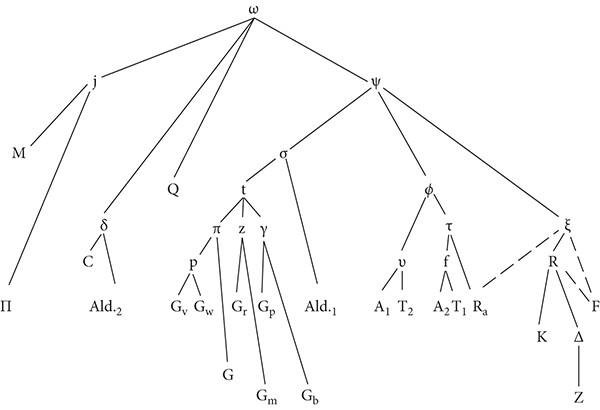
We reconstruct the stemma for Onenclitics1as shown in Figure 2.1.
Fig. 2.1 Stemma for Onenclitics1
The subsections that follow explain the reasoning behind the most important points of this stemma (but not the reasoning behind the hyparchetypes π, p, z, γ, f, ν, or λ, which are of little significance for the reconstruction of the text).
2.1.1.1 Evidence for family ψ
We consider many of the witnesses to Onenclitics1to share the hyparchetype we call ψ. In essence (but see what follows), the evidence for this hyparchetype consists of a series of readings which cannot be classified as clear errors, but which are unique to the sub-families we place under ψ. These readings are shown in Table 2.1.
Table
2.1 Evidence for family ψ
Reading(s) of the sub-families we place under ψ(or those that transmit the relevant passage)
§a, note h: σϕξomit the phrase found in jδ
§b, note e: στξomit the word found in jδ
(υ omits the whole paragraph.)
Reading(s) of family j (comprising M and where relevant Π), family δ(comprising C and Ald.2), and the highly abbreviated text of Q where this is available
§c, note e: ἄνθρωπός(οἷονἄνθρωπός
σT1) τιςἤκουσάτινοςσυT1ξ
(A2 lacks examples at this point.)
§c, note r: τὸνδὲκατὰϕύσιντόνον
ἔχοντασξ
§d, note e: τούτου(οὗτ) τὸδεύτερον
ϕῇςἀνέγκλιτοντξ
(υ omits this sentence entirely, as does σ, the latter as part of a larger omission.)
§f, note m_ καὶτὰπληθυντικὰσυξ
(τ has an innovation of its own: καὶἐπὶ τῶνπληθυντικῶνὁμοίως.)
§g, note i: παράλογοςυξ
(σ and τ omit the relevant sentence as part of larger omissions.)
§h, note y: υξomit the phrase found in Mδ
(σ and τ have larger omissions at this point.)
§i, note v: ἦλθέποθιυξ
(σ omits this and the following examples, and τ has a larger omission at this point.)
§l, note l: βαρύνεταιυξ
(σ omits this word as part of a larger omission, and the text of τ breaks off before this point.)
§m, note f: ὁμοίωςυξ
(σ omits the relevant phrase, and the text of τ breaks off before this point.)
οἶκός(οἷονοἶκόςAld.2) τιςἔμαθόντινος(τινες δ) Mδ
(Πlacks examples at this point.)
τὸνκατὰϕύσινδὲτόνονἔχονταM Ald.2: τὰκατὰϕύσινC
(Πreworks the whole sentence, with a result that does not include this phrase.)
(These readings diverge from one another, but none has the sequence ϕῇςἀνέγκλιτονfound in τξ.)
καὶαἱπληθυντικαὶM: καὶαἱπληθυντικαὶδὲδ
(Πomits this phrase as part of a large omission.)
παραλόγωςMδ
(Πomits this word as part of a large omission.)
ταῦτακαὶ(καὶdeest in Ald.2) περὶἀντωνυμιῶνMδ
(Πomits this phrase as part of a large omission.)
ἦλθένποθενMδ
(Πomits this phrase as part of a larger omission.)
βαρύτονοςΜδQ
(The text of Πbreaks off before this point.)
ὁμοίωνMδ
(The text of Πbreaks off before this point.)
Since none of the ψ-family readings shown here can be classified as a clear error, one might ask whether these readings could go back to the archetype rather than to our hyparchetype ψ. Before we tackle this question, it is worth observing that there is also a series of readings unique to the witnesses we place outside ψ. Once again none of these amounts to a clear error, but we ought to consider whether these shared readings could point to a hyparchetype common to the ‘non-ψ’ portions of the tradition: family j, consisting of M and (where relevant) Π; family δ, consisting of C and Ald.2; and on the rare