Where can buy Essentials of dyslexia assessment and intervention 1st edition ebook with cheap price
Essentials of Dyslexia Assessment and Intervention 1st Edition
Visit to download the full and correct content document: https://ebookmass.com/product/essentials-of-dyslexia-assessment-and-intervention-1 st-edition/
More products digital (pdf, epub, mobi) instant download maybe you interests ...
Essentials of WAIS-IV Assessment (Essentials of Psychological Assessment Book 96) 2nd Edition – Ebook PDF Version
Published by John Wiley & Sons, Inc., Hoboken, New Jersey.
Published simultaneously in Canada.
No part of this publication may be reproduced, stored in a retrieval system, or transmitted in any form or by any means, electronic, mechanical, photocopying, recording, scanning, or otherwise, except as permitted under Section 107 or 108 of the 1976 United States Copyright Act, without either the prior written permission of the Publisher, or authorization through payment of the appropriate per-copy fee to the Copyright Clearance Center, Inc., 222 Rosewood Drive, Danvers, MA 01923, (978) 750-8400, fax (978) 646-8600, or on the web at www.copyright.com. Requests to the Publisher for permission should be addressed to the Permissions Department, John Wiley & Sons, Inc., 111 River Street, Hoboken, NJ 07030, (201) 748-6011, fax (201) 748-6008.
Limit of Liability/Disclaimer of Warranty: While the publisher and author have used their best efforts in preparing this book, they make no representations or warranties with respect to the accuracy or completeness of the contents of this book and specifically disclaim any implied warranties of merchantability or fitness for a particular purpose. No warranty may be created or extended by sales representatives or written sales materials. The advice and strategies contained herein may not be suitable for your situation. You should consult with a professional where appropriate. Neither the publisher nor author shall be liable for any loss of profit or any other commercial damages, including but not limited to special, incidental, consequential, or other damages.
This publication is designed to provide accurate and authoritative information in regard to the subject matter covered. It is sold with the understanding that the publisher is not engaged in rendering professional services. If legal, accounting, medical, psychological or any other expert assistance is required, the services of a competent professional person should be sought.
Designations used by companies to distinguish their products are often claimed as trademarks. In all instances where John Wiley & Sons, Inc. is aware of a claim, the product names appear in initial capital or all capital letters. Readers, however, should contact the appropriate companies for more complete information regarding trademarks and registration.
For general information on our other products and services please contact our Customer Care Department within the U.S. at (800) 762-2974, outside the United States at (317) 572-3993 or fax (317) 572-4002.
Wiley also publishes its books in a variety of electronic formats. Some content that appears in print may not be available in electronic books. For more information about Wiley products, visit our website at www.wiley.com.
Library of Congress Cataloging-in-Publication Data:
Mather, Nancy.
Essentials of dyslexia assessment and intervention / Nancy Mather and Barbara J. Wendling. p. ; cm. — (Essentials of psychological assessment series)
Includes bibliographical references and index.
ISBN 978-0-470-92760-1 (pbk. :alk. paper)
ISBN 978-1-118-15265-2 (ebk)
ISBN 978-1-118-15266-9 (ebk)
ISBN 978-1-118-15264-5 (ebk)
1. Dyslexia. I. Wendling, Barbara J. II. Title. III. Series: Essentials of psychological assessment series.
[DNLM: 1. Dyslexia. WL 340.6]
RC394.W6M38 2012 616.85'53—dc23 2011019563
Printed in the United States of America 10 9 8 7 6 5 4 3 2 1
I dedicate this book to my wonderful nieces and nephew: Kristen, Nancy, Charlie, Joanna, and Emily. You are the best!!!
—Aunt Nancy
In loving memory of my father and in honor of my mother. Thank you for giving me life!
—Barbara
There are many poor readers among very bright children, who, because they are poor readers, are considered less keen than their class-mates. This book should really be dedicated to the thousands of bright children thus misjudged.
—Stanger & Donohue, 1937, p. 43
Puckett and Blanche O’Bannon
SERIES PREFACE
In the Essentials of Psychological Assessment series, we have attempted to provide the reader with books that will deliver key practical information in the most efficient and accessible style. The series features instruments in a variety of domains, such as cognition, personality, education, and neuropsychology. For the experienced clinician, books in the series will offer a concise yet thorough way to master utilization of the continuously evolving supply of new and revised instruments, as well as a convenient method for keeping up to date on the tried-and-true measures. The novice will find here a prioritized assembly of all the information and techniques that must be at one’s fingertips to begin the complicated process of individual psychological diagnosis.
Wherever feasible, visual shortcuts to highlight key points are utilized alongside systematic, step-by-step guidelines. Chapters are focused and succinct. Topics are targeted for an easy understanding of the essentials of administration, scoring, interpretation, and clinical application. Theory and research are continually woven into the fabric of each book, but always to enhance clinical inference, never to sidetrack or overwhelm. We have long been advocates of “intelligent” testing—the notion that a profile of test scores is meaningless unless it is brought to life by the clinical observations and astute detective work of knowledgeable examiners. Test profiles must be used to make a difference in the child’s or adult’s life, or why bother to test? We want this series to help our readers become the best intelligent testers they can be.
Essentials of Dyslexia: Assessment and Intervention is designed for assessment professionals, educators, and parents who are interested in understanding, assessing, and helping individuals who have dyslexia. This new Essentials book meets the demands of current educational reforms. Instead of focusing on the use and interpretation of assessment instruments, the focus is squarely upon the most common type of learning disability: dyslexia. In order to diagnose a disability, one must first understand the nature of the disability. The authors of Essentials
of Dyslexia: Assessment and Intervention, world-renowned intervention experts Nancy Mather and Barbara Wendling have created a readable resource that makes current research accessible to a variety of audiences. A glossary is included to assist readers who may be unfamiliar with some of the terms.
Each chapter focuses on a different aspect of dyslexia, beginning with helping the reader to understand what dyslexia really is. Subsequent chapters deal with the history of the disorder; research related to the brain, genetics, and environment; assessment of the cognitive and linguistic correlates of dyslexia; assessment and instruction of reading and spelling skills; technology applications; and dyslexia in other languages. In addition to all of the instructional strategies contained within the chapters, a detailed appendix includes summaries of evidence-based commercial programs for the treatment of dyslexia. This book demonstrates how targeted assessments resulting in an accurate diagnosis can lead to the most appropriate interventions for the many students who struggle to learn to read and spell.
Alan S. Kaufman, PhD, and Nadeen L. Kaufman, EdD, Series Editors Yale University School of Medicine
ACKNOWLEDGMENTS
We are deeply grateful to Drs. Bennett and Sally Shaywitz for their willingness to contribute to a chapter in this book. In addition, Dr. Bennett Shaywitz provided us with a helpful critique of the genetics chapter. Martha Youman was an essential contributor to our preparation of this book: writing one chapter, contributing to another, reviewing others, and creating several figures. We would also like to thank Drs. Kathleen Puckett and Blanche O’Bannon for their timely chapter on technology. Throughout the preparation of this book, Dr. Robert Colligan provided us with many current research articles related to dyslexia for which we were very appreciative. We also want to thank Ron Hockman, C. Wilson Anderson, Jr., and Stephanie Bieberly for their contributions of informal assessment measures. We sincerely appreciate the willingness of all contributors to write descriptions of evidence-based interventions for the Appendix. We are indebted to Marquita Flemming, Senior Editor, and Sherry Wasserman, Senior Editorial Assistant from John Wiley & Sons, Inc. for their support and guidance during the development and production of this book. Leigh Camp, Production Editor, guided us skillfully through the final stages of preparation. Finally, we express our deepest gratitude to Drs. Alan and Nadeen Kaufman for their leadership and vision that led to the creation of the Essentials series and for their interest in and support of this project.
Chapter One
UNDERSTANDING DYSLEXIA
In the first half of this century the story of dyslexia has been one of decline and fall; in the second half it has culminated in a spectacular rise. From being a rather dubious term, dyslexia has blossomed into a glamorous topic; and rightly so, for with a prevalence of around 5% the condition is remarkably common.
—Frith, 1999, p. 192
WHAT IS DYSLEXIA?
Steven, a second-grade student, knows only four letters of the alphabet. His teachers have tried to help him memorize letters and their sounds, but he always seems to forget what he has learned the next day. Lately, he has started to say that he is dumb and that’s the reason he can’t learn to read and spell.
Maria is in middle school. She is often confused by letters that have similar sounds, such as spelling every as efry. These subtle sound confusions are also apparent in her speech when she pronounces certain multisyllabic words, saying “puh-si-fic” when she means to say “specific.” She sometimes confuses words that have similar sounds. Even though she has a good vocabulary, she may say “that book really memorized me” when she really meant “mesmerized.” At times, she avoids saying certain words because she is unsure about their pronunciation.
Jeff is a junior in high school. He recently took the SATs and only finished half of each section. He said he knew how to do the rest of the questions, but he didn’t have enough time to attempt them. He wonders why his peers seem to always have plenty of time when reading takes him so long.
Mr. Brogan has just attended his fifth-grade son’s Individualized Education Program (IEP) meeting at the local elementary school. His son, Matthew, is
having great difficulty learning to read and spell. Even though he has an adapted spelling list, Matthew still forgets how to spell the words when the weekly spelling test is given. He spells words just the way they sound, not the way they look, such as spelling they as thay. When Mr. Brogan hears Matthew’s fifth-grade teacher, the special education teacher, and the school psychologist describing his son’s severe reading and spelling difficulties, he immediately thinks: “That was just like me.”
What do these four people who struggle with certain aspects of literacy have in common? They all have dyslexia. Although this seems to be an accurate label to explain difficulty in learning to read and spell, confusion exists regarding what having dyslexia actually means.
WHAT DYSLEXIA IS AND IS NOT
What is dyslexia? This simple question is asked every day by both parents and teachers as they struggle to understand why a child is not learning to read with ease. It is a question asked by Matthew who wonders why reading and spelling are so difficult. It is also a question asked by older students like Jeff as they attempt to determine why reading is so effortful and why they read so much more slowly than their peers. Although Mr. Brogan was well aware that he had always struggled with reading, when he hears the description of Matthew’s difficulties and that the school team thinks that Matthew has dyslexia, he realizes that he too has dyslexia that was never diagnosed. He now understands the reasons why he never reads for pleasure and why the stack of books that others have suggested he read sits undisturbed by his bedside.
Over the last century, researchers who are concerned with the diagnosis and treatment of dyslexia have attempted to answer the following three questions (Tunmer & Greaney, 2010, p. 229):
1. What is it?
2. What causes it?
3. What can be done about it?
The goal of this book is to attempt to answer these three questions in a straightforward way so that dyslexia can be easily understood by educational professionals and parents alike, as well as by individuals who have dyslexia. Although we do not yet have conclusive answers to the questions above, fortunately, over the last century, researchers, medical professionals, and practitioners have learned a lot about dyslexia, as well as how this disorder affects reading and spelling development.
DON’T FORGET
Dyslexia is a neurobiological disorder that affects the development of both decoding (written word pronunciation) and encoding (spelling).
The word dyslexia comes from the Greek words δυσ- dys- (“impaired”) and lexis (“word”). Although numerous definitions exist, dyslexia can be most simply defined as a neurobiological disorder that causes a marked impairment in the development of basic reading and spelling skills. More specifically, dyslexia is manifested in deficiencies in word-level reading skills; it affects decoding (pronouncing printed words) and encoding (spelling words; Vellutino & Fletcher, 2007). Thus, dyslexia is a complex cognitive disorder of neurobiological origin that affects the development of literacy (Shastry, 2007; Vellutino & Fletcher, 2007).
Both parents and professionals are often confused regarding the difference between a specific learning disability (SLD) and dyslexia. They often wonder if a student is diagnosed with an SLD in reading, does this mean that he has dyslexia? The answer to this question is: Maybe. Essentially, SLD is a broader category that encompasses several different types of disorders, including dyslexia, the most common and carefully studied type of SLD (Shastry, 2007). In addition, the terms dyslexia, specific developmental dyslexia, specific reading disability, and reading disability are often used interchangeably to describe this neurodevelopmental disorder (DeFries, Singer, Foch, & Lewitter, 1978; Vellutino & Fletcher, 2007).
In some school districts, school psychologists and special and general educators do not use the word dyslexia when describing students with severe reading disabilities. In fact, the term dyslexia has fallen in and out of popularity from the early 1930s (Rooney, 1995). Many states do not use the word dyslexia in their state regulations, whereas a few, such as Texas, have specific laws that must be adhered to regarding both assessment and service delivery to school children with dyslexia. As of 2011, 12 states have specific statewide dyslexia laws: California, Colorado, Hawaii, Kentucky, Louisiana, Mississippi, New Jersey, New Mexico, Ohio, Texas, Virginia, and Washington. Four additional states have dyslexia laws working through the legislative process: Arkansas, Kansas, Oklahoma, and Wisconsin. Although South Dakota does not have a dyslexia law at this time, it has developed a statewide dyslexia handbook.
In the coming years, we are likely to see the term “dyslexia” being used more often. A reason that it may become more commonplace is that the proposed text revisions for the Diagnostic and Statistical Manual of Mental Disorders, Fifth Edition (DSM-5), the guidelines of the American Psychiatric Association that are widely used by psychologists and mental health professionals, have suggested that the
RapidReference1.1
DSM-5 Rationales for Proposed Recommendation to Change Reading Disorder to Dyslexia
The name change would:
• be consistent with international use.
• provide better alignment with the requirements for SLD identification under the reauthorization of the Individuals with Disabilities Improvement Act of 2004 (IDEA 2004) that no longer require the documentation of a discrepancy between intellectual ability and achievement. (The proposed revision would not require a discrepancy between measurements of intellectual ability and academic performance, which was required for Reading Disorder in DSM-IV.)
• focus on the accuracy and fluency of reading, and not on disorders in reading comprehension. (Problems in reading comprehension alone would be viewed as stemming from oral language comprehension problems, and would not meet the criteria for dyslexia.)
term reading disorder should be replaced by dyslexia. Rapid Reference 1.1 reviews the major rationales for this suggested change in terminology.
SUBTYPES OF READING PROBLEMS AND DYSLEXIA
Not all types of reading problems are considered to be dyslexia. Gough and Tunmer (1986) developed a model that they called the simple view of reading (SVR). This model has two major components: decoding (reading words) (D) and oral language or listening comprehension (LC), which results in this simple equation: Reading Comprehension (RC) = D × LC. This equation suggests that reading performance is influenced by both word recognition skill (D) and listening comprehension or the ability to understand what is being read orally (LC). Aaron, Joshi, and Quatroche (2008) have modified the formula slightly to RC = WR × LC, where RC is reading comprehension, WR = word recognition, and LC = Listening Comprehension. The only difference in this modification is that word recognition (WR) replaces decoding (D).
The SVR model then predicts that three different types of poor readers exist: (1) those who can understand the text when it is read aloud, but have trouble reading the words (dyslexia); (2) those who can read words accurately but do not comprehend what they read (poor comprehenders); and (3) those who have trouble with both (mixed reading disability). Readers with mixed reading
disability often have oral language impairments or limited access to linguistic and experiential opportunities during their preschool years (Tunmer & Greaney, 2010). Although many poor readers have poor comprehension or a mixed disability that requires interventions directed toward improving both oral language and reading, the focus of the book is on readers with dyslexia who have listening comprehension and verbal abilities that are often higher than their word reading and spelling skills.
Throughout the century, varying subtypes of dyslexia have been described. In the 1930s, Orton described both word blindness (trouble remembering word images) and word deafness (trouble with word sounds; Orton, 1937). Currently, the most common subtypes of dyslexia identified by research include phonological, surface, and deep. Other terms used to describe dyslexia subtypes include auditory (dysphonetic) or visual (dyseidetic; Boder, 1971; Johnson & Myklebust, 1967), that are similar to phonological and surface dyslexia, respectively.
In the 1970s, the theory of a dual route model of reading was proposed. This theory specified that two interactive, yet distinctive pathways exist: a direct, lexical route for automatic recognition of high-frequency words and an indirect, sublexical phonological decoding route for pronunciation of unfamiliar words (Coltheart, 1978, 2007). A weakness in either pathway could affect the development of reading skills and result in two different subtypes of dyslexia: phonological dyslexia (i.e., difficulty with nonword reading) and surface dyslexia (i.e., difficulty with irregular word reading; Castles & Coltheart, 1993; Coltheart, 2007). An individual with phonological dyslexia experiences trouble with phonological awareness tasks and applying phonics, whereas an individual with surface dyslexia is able to read phonically regular nonwords but experiences greater difficulty with exception words or words with an irregular element that do not have regular, predictable grapheme–phoneme correspondences (e.g., once). The two critical indicators of surface dyslexia are the (1) regularization of the spellings of words with irregular elements (e.g., they as thay) and (2) poorer performance reading irregular words than phonically regular words. Although a difference between nonword reading and irregular word reading and spelling is insufficient to identify different subtypes, these differences in performance may be indicative of different etiologies of dyslexia.
Impairments in nonword reading can range from mild to a complete
DON’T FORGET
A difference between the ability to read and spell nonwords and the ability to read and spell irregular words may have clinical significance and be indicative of different subtypes of dyslexia.
inability to read nonwords. Deep dyslexia is a term that has been used to describe a severe impairment in nonword reading. Deep dyslexia is accompanied by other types of word reading errors, including: semantic errors (e.g., gate is read as fence), visual errors (e.g., house is read as horse), and derivational errors (e.g., mountain is read as mountainous; Coltheart, Patterson, & Marshall, 1980). Deep dyslexia is often described as an acquired reading disorder due to stroke or other brain injury. These individuals seem unable to use letter-sound relationships to decode words. They have difficulty reading function words (e.g., as, the, so), infrequent words, and nonwords, and make semantic substitutions and morphological errors (Rastle, Tyler, & Marslen-Wilson, 2006). Individuals with phonological dyslexia often exhibit symptoms of deep dyslexia, leading some researchers to state that both types of dyslexia are simply different points on a continuum of severity (Crisp, Howard, & Lambon Ralph, 2011; Crisp & Lambon Ralph, 2006; Freidman, 1996).
DON’T FORGET
Dyslexia is not a primary problem in reading comprehension, but rather a problem in reading and spelling words.
CHARACTERISTICS OF DYSLEXIA
As with SLD, in order to understand dyslexia, a key aspect is explaining what it is not (Tunmer & Greaney, 2010). Although the clinical features of dyslexia can overlap with other disorders, such as attention deficit hyperactivity disorder (ADHD) and specific language impairment (SLI), dyslexia is a distinct disorder that has specific characteristics. With dyslexia, the primary problem is with written language, not spoken language (Pennington, Peterson, & McGrath, 2009). Not all individuals with dyslexia, however, will have all the symptoms and characteristics. Rapid Reference 1.2 provides a list of conditions that may coexist but would not be considered to be defining features of dyslexia.
Rapid Reference 1.3 provides an overview of the most common characteristics of dyslexia. Some of these characteristics are most likely to be present in young children (e.g., trouble rhyming words), whereas others are more apparent in secondary students and adults (e.g., a slow reading rate or poor spelling). The earliest warning signs of dyslexia are sometimes noted in the child’s spoken language, although sometimes oral language development is perfectly normal. As the individual ages, warning signs are noted in the slowness of reading and spelling development. In addition, students with deficient word reading skills often avoid reading, and as a result, they spend less time practicing reading (Tunmer & Greaney, 2010).
What Dyslexia Is Not
RapidReference1.2
A pervasive oral language impairment.
A primary problem in attention or behavior.
A primary problem in reading comprehension or written expression.
Low motivation or limited effort.
Poor vision or hearing.
Primary emotional or behavioral problems.
Autism.
Childhood schizophrenia.
Limited intelligence.
Related to ethnic background or family income.
A result of poor teaching or limited educational opportunity.
RapidReference1.3
What Dyslexia Is: Symptoms and Characteristics
Difficulty learning to rhyme words.
Difficulty learning the letter names and letter sounds of the alphabet.
Confusions of letters and words with similar visual appearance (e.g., b and d and was and saw).
Confusions of letters with similar sounds (e.g., /f/ and /v/).*
Reversals and transpositions of letters and words that persist past the age of 7 (e.g., p and q, and on and no).
Trouble arranging letters in the correct order when spelling.
Difficulty retaining the visual representation of irregular words for reading and spelling (e.g., once).
Spelling the same word in different ways on the same page (e.g., wuns, wunce, for once).
Spelling words the way they sound rather than the way they look (e.g., sed for said).
Difficulty pronouncing some multisyllabic words correctly (e.g., multiblication).
Slow word perception that affects reading rate and fluency.
*Note when a letter is enclosed between two forward slashes / / it refers to the letter sound, not the letter name.
In addition to these characteristics, many individuals with dyslexia have strengths in areas that are not affected by the disorder (e.g., math, science), and their oral language and listening comprehension abilities are often higher than their reading and spelling skills. The individual with dyslexia typically has adequate achievement in areas where reading skills are not of primary importance (Betts, 1936). One central concept of dyslexia is that it is unexpected in relationship to the person’s other abilities. Thus, dyslexia is often associated with underachievement in reading, rather than low reading achievement per se. One would expect that the person would be reading at a higher level when considering her other abilities. Although this concept of unexpected underachievement has been the central defining feature of dyslexia (Tunmer & Greaney, 2010), Tø´nnessen (1997) points out that it is really our lack of knowledge that makes the underachievement “unexpected” because we have not gained enough insight into the causes of dyslexia. In other words, if we had a better understanding of the underlying causes of dyslexia, an individual’s difficulties with reading and spelling would be expected. Research has indicated that intelligence does not predict reading for individuals with dyslexia even though it is a reasonable predictor for individuals without reading impairments (Ferrer, Shaywitz, Holahan, Marchione, & Shaywitz, 2010). This is because many individuals with dyslexia have average or even superior intellectual abilities. Individuals with any level of intelligence may have dyslexia. Thus, an intellectually gifted law student may have dyslexia that results in a compromised reading rate, as may an individual with a mild intellectual disability who struggles to learn to read even basic sight words. Because dyslexia is a neurobiological disorder, it can occur in an individual with any level of intelligence or in combination with other disabilities, such as vision and hearing impairments or attention deficit hyperactivity disorder. Although some definitions have suggested that dyslexia only occurs in individuals with average or above intelligence, this assertion is not true. No one ever claims that articulation or motor problems can only occur in children with average or above intelligence because it is understood that most disabilities occur across the full range of intellectual functioning. However, for children with severe intellectual disabilities, learning to read may be secondary to developing life skills, such as communication, self care, and community living skills, as these adaptive abilities are central to the individual obtaining independence and self sufficiency.
CAUTION
Individuals with dyslexia may show any combination of characteristics shown in Rapid Reference 1.3; however, most individuals will not exhibit all of these characteristics.
Some children with dyslexia are identified in first grade, whereas other individuals are not diagnosed until they enter college, or even when entering an advanced graduate degree program. This is particularly true of students who have advanced verbal abilities. It is not unusual to find a medical student who could navigate through high school and college with only mild difficulty, but then becomes overwhelmed and not able to manage the heavy reading demands of medical school (Voeller, 2004). Some individuals with dyslexia are never identified at all, and as adults they attempt to negotiate their lives so that little reading and writing are involved.
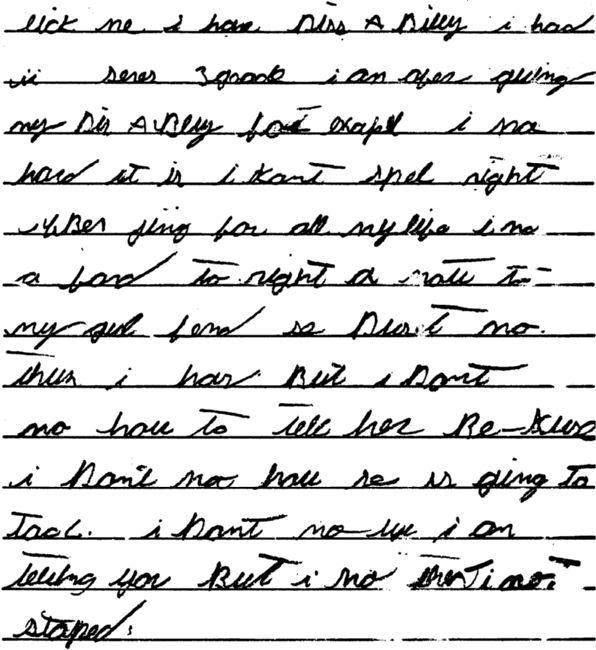
Some students do not receive any early intervention, and their difficulties with reading and writing continue into their secondary years. Figure 1.1 presents a writing sample from David, a ninth-grade student, along with a translation that attempts to preserve the intent of his message as he accidentally omitted several words when writing the sample. His assignment was straightforward. During the first week of school, David’s English teacher had asked the students to write something about themselves that they would like her to know. David wrote the following paragraph regarding the impact of having a disability that has affected his spelling development. Although he knows that he is not “stupid,” he is reluctant to tell his girlfriend about his disability.
PREVALENCE OF DYSLEXIA
Estimates of the prevalence of dyslexia vary and are influenced by how dyslexia is defined and identified. Earlier in the century, Betts (1936) estimated that between 8% and 15% of children have varying degrees of reading disability, with about 4% of the school population being diagnosed as word blind, an earlier term that was used to describe dyslexia. More recent estimates suggest that 5% to 8% of the school-age population is the most accurate estimate of individuals who have dyslexia (e.g., DeFries et al., 1978; Muter & Snowling, 2009; Sireteanu, Goertz, Bachert, & Wandert, 2005). Some estimates, however, are higher, ranging from 5% to 20% of the school-age population having dyslexia and up to 40% of the entire U.S. population experiencing some type of reading difficulty (Shaywitz, 2003; S. E. Shaywitz & Shaywitz, 2001). In addition, nearly 80% of children who are in special education diagnosed with learning disabilities are
CAUTION
Although early intervention is critical for individuals with dyslexia, it is important to keep in mind that intervention can be effective at any age.
Figure 1.1 David’s Note to His Ninth-Grade Teacher
Translation: Like me, I have a disability. I’ve had it since third grade. I’m often quitting because of my disability. For example, I know how hard it is. I can’t spell right. I’ve been trying for all my life. I know I’m afraid to write a note to my girl friend. She doesn’t know that I have it but I don’t know how to tell her because I don’t know how she is going to act. I don’t know why I am telling you but I know that I’m not stupid.
there because of reading problems. As with any disorder, the symptoms can range from mild to severe, and the impact of the disorder is influenced by the environment and appropriate early intervention and treatment.
DEFINITIONS OF DYSLEXIA
Even though researchers have been studying dyslexia for over one hundred years, there is still not a strong consensus regarding a clear, useful definition (Tø´nnessen, 1997). Although numerous professional organizations around the
RapidReference1.4
IDA Definition of Dyslexia
Dyslexia is a specific learning disability that is neurological in origin. It is characterized by difficulties with accurate and/or fluent word recognition and by poor spelling and decoding abilities. These difficulties typically result from a deficit in the phonological component of language that is often unexpected in relation to other cognitive abilities and the provision of effective classroom instruction. Secondary consequences may include problems in reading comprehension and reduced reading experience that can impede growth of vocabulary and background knowledge. (Adopted by the IDA Board, November 2002. This definition is also used by the National Institutes of Child Health and Human Development [NICHD; 2002].)
world have attempted to develop a definition of dyslexia, no universally accepted definition exists. Recently, the International Dyslexia Association (IDA; formerly called the Orton Dyslexia Society) Research Committee, a group composed of investigators and representatives from advocacy groups, and the National Institute of Child Health and Human Development (NICHD) proposed a revised definition of dyslexia. Rapid Reference 1.4 presents this definition. More recently, the Professional Standards and Practices Committee of the International Dyslexia Association (IDA) has provided a set of standards to guide the preparation, certification, and professional development of reading teachers. Rapid Reference 1.5 presents the explanation provided of dyslexia within these practice standards.
RapidReference1.5
Explanation of Dyslexia in the IDA 2010 Professional Standards
Dyslexia is a language-based disorder of learning to read and write originating from a core or basic problem with phonological processing intrinsic to the individual. Its primary symptoms are inaccurate and/or slow printed word recognition and poor spelling—problems that in turn affect reading fluency and comprehension and written expression. Other types of reading disabilities include specific difficulties with reading comprehension and/or speed of processing (reading fluency). These problems may exist in relative isolation or may overlap extensively in individuals with reading difficulties (Moats et al., 2010, p. 3).
Rapid Reference 1.6 provides several examples of other definitions of dyslexia from around the world. Although the emphasis is on phonological processing in the IDA definition and explanation, other cognitive abilities are mentioned as well in other definitions (e.g., British and Ireland Dyslexia Associations). Some of the terminology (e.g., phonological awareness, rapid automatized naming) may not be familiar to all readers at this point, but these terms are explained and discussed in more detail in later chapters and are also listed in the Glossary of this book.
RapidReference1.6
Examples of Dyslexia Definitions
National
Institute of Neurological Disorders and Stroke
Dyslexia is a brain-based type of learning disability that specifically impairs a person’s ability to read. These individuals typically read at levels significantly lower than expected despite having normal intelligence. Although the disorder varies from person to person, common characteristics among people with dyslexia are difficulty with spelling, phonological processing (the manipulation of sounds), and/ or rapid visual-verbal responding. In adults, dyslexia usually occurs after a brain injury or in the context of dementia. It can also be inherited in some families, and recent studies have identified a number of genes that may predispose an individual to developing dyslexia.
British Dyslexia Association
Dyslexia is a specific learning difficulty that mainly affects the development of literacy and language related skills. It is likely to be present at birth and to be lifelong in its effects. It is characterised by difficulties with phonological processing, rapid naming, working memory, processing speed, and the automatic development of skills that may not match up to an individual’s other cognitive abilities.
Dyslexia Association of Ireland
Dyslexia is manifested in a continuum of specific learning difficulties related to the acquisition of basic skills in reading, spelling and/or writing, such difficulties being unexplained in relation to an individual’s other abilities and educational experiences. Dyslexia can be described at the neurological, cognitive, and behavioural levels. It is typically characterised by inefficient information processing, including difficulties in phonological processing, working memory, rapid naming and automaticity of basic skills. Difficulties in organisation, sequencing, and motor skills may also be present.
Spanish Federation of Dyslexia
Dyslexia is a difficulty in distinguishing and memorizing letters or groups of letters, the order and rhythm of letter order to form words, and poor structure of phrases, which affects both reading and writing.
Dyslexia Association of Singapore
Dyslexia is a neurologically based specific learning difficulty that is characterised by difficulties in one or more of reading, spelling and writing. Accompanying weaknesses may be identified in areas of language acquisition, phonological processing, working memory, and sequencing. Some factors that are associated with, but do not cause, dyslexia are poor motivation, impaired attention, and academic frustration. The extent to which dyslexia is apparent in a particular language is affected by the quantity and quality of exposure to that language and other languages. Dyslexics are likely to have greater difficulty with languages that have more complicated orthographic, phonological, and/or grammatical systems.
Hong Kong Dyslexia Association
Dyslexia is a specific learning difficulty related to mastering and using written language. Dyslexic learners typically have difficulties in reading, writing, and spelling. Dyslexia may be caused by a combination of phonological, visual and auditory processing deficits. It is often unexpected when compared with a child’s general ability and is not due to lack of intelligence or lack of opportunity to learn.
Health Council of the Netherlands, Working Definition
Dyslexia is present when the automatization of word identification (reading) and/ or word spelling does not develop or does so very incompletely or with great difficulty. The term automatization refers to the establishment of an automatic process. A process of this kind is characterized by a high level of speed and accuracy. It is carried out unconsciously, makes minimal demands on attention, and is difficult to suppress, ignore, or influence. The working definition used means that dyslexia is characterized in practice by a severe retardation in reading and spelling that is persistent and resists the usual teaching methods and remedial efforts. Upon examination, it will be accompanied by very slow and/or inaccurate and easily disturbed word identification and/or word spelling.
Kuwait Dyslexia Association
Dyslexia is a learning disability that manifests primarily as a difficulty with written language, particularly with reading and spelling. It is separate and distinct from reading difficulties resulting from other causes, such as a non-neurological deficiency with vision or hearing, or from poor or inadequate reading instruction.
Many of these definitions contain similar components. All of these definitions describe dyslexia as a learning disability or neurological disorder that affects the development of reading skill. Most attempt to describe the two key symptoms of dyslexia: (1) poor reading and spelling ability that is unexpected in relationship to other abilities, and (2) a lack of automaticity and ease with reading and spelling words. Although problems in comprehension may result from the poor decoding, dyslexia is not primarily a problem in reading comprehension. Several of the definitions attempt to specify the causes or correlates of dyslexia, such as poor phonological awareness or slow rapid naming, whereas others describe the limited response to treatment as a symptom.
MISCONCEPTIONS ABOUT DYSLEXIA
It is likely that the variations in definitions of dyslexia, as well as the use and misuse of the term, contribute to existing misconceptions. One common misconception is that people with dyslexia cannot read at all. As with most disorders, dyslexia occurs on a continuum, and the severity level is a matter of degree—from mild to severe. Most individuals with dyslexia can learn to read, but typically continue to have impairments in rate and fluency, as well as relatively poor spelling. It is critically important that educators, parents, and the individuals with dyslexia be aware of the common misconceptions about dyslexia so that they can understand the true nature of the disorder. Several of these misconceptions are presented in Rapid Reference 1.7 accompanied by a factual counterpoint.
CONCLUSION
Although a universal definition of dyslexia has yet to be developed, researchers and scientists from around the world have reached an increasing consensus regarding the characteristics and symptoms of this disorder, as well as how dyslexia affects reading and spelling development. Despite the fact that dyslexia is a lifelong condition and certain accommodations may always be needed in educational and vocational settings, the prognosis is good for individuals who receive intensive, systematic interventions.
Unless a parent or teacher has personally experienced the pain and academic stress caused by dyslexia, it is hard to understand the impact of this disorder on self-esteem and school and vocational performance (Voeller, 2004). It is critical that both parents and educational professionals understand the plight of the child with dyslexia. Over a century ago, Hinshelwood (1902) observed: “It is evident that it is a matter of the highest importance to recognise as early as
RapidReference1.7
Common Misconceptions About Dyslexia
• People with dyslexia cannot read.
• Most do learn to read at some level, although their rate is often slow.
• Individuals with high intellectual ability cannot have dyslexia.
• Intelligence does not predict dyslexia: Many highly intelligent people have dyslexia.
• Dyslexia is seeing things backwards.
• Dyslexia is much more complex than seeing letters and numbers backwards.
• Dyslexia is a rare disorder.
• Approximately 5% to 8% of the population has mild to severe dyslexia.
• Dyslexia cannot be diagnosed until at least third grade.
• At-risk symptoms for dyslexia may be identified in individuals as young as five years of age.
• Children will outgrow dyslexia.
• Dyslexia is a lifelong disorder, but intervention can reduce the impact.
• More boys than girls have dyslexia.
• Present estimates indicate that the prevalence rate for boys is only slightly higher than for girls.
• All struggling readers have dyslexia.
• Many other reasons than dyslexia may cause reading problems such as low intellectual ability, poor oral language, attentional problems, poor instruction, and lack of opportunity.
• Young children who reverse letters (e.g., b for d ) have dyslexia.
• Beginning writers often reverse letters but most will master these lettersound correspondences with practice. In addition, while letter reversals are often associated with dyslexia, not all individuals with dyslexia will reverse letters.
• The type of instruction employed can cause dyslexia.
• While the quality of instruction makes a difference in how readily a child learns to read, the use of a certain reading approach does not cause dyslexia. Dyslexia is a neurobiological disorder that is not caused by ineffective instruction.
possible the true nature of this defect, when it is met with in a child. It may prevent much waste of valuable time and may save the child from suffering and cruel treatment. . . . The sooner the true nature of the defect is recognised, the better are the chances of the child’s improvement” (p. 10).
The purpose of this book is to increase understanding of dyslexia, both the causes and treatments. In the following chapters, the historic influences, the role of the brain and genetics, the relationship of dyslexia to other disorders, the cognitive, linguistic, and academic factors that are part of an assessment for dyslexia, descriptions of the most efficacious treatment approaches including advances in technology, dyslexia in English Language Learners, and dyslexia in the schools, will be explained.
STEST YOURSELF
S1. The terms dyslexia and specific reading disability are used to describe a neurodevelopmental disorder that primarily affects the development of
a. decoding (word reading).
b. reading comprehension.
c. encoding (spelling).
d. written expression.
e. all of the above.
f. both a and c.
2. Although many definitions of dyslexia have been proposed, a universally accepted definition does not exist. True or False?
3. The focus of the most recent definition of dyslexia by IDA (2002) indicates that dyslexia is characterized primarily by
a. poor attention.
b. poor phonological awareness.
c. slow rapid automatized naming.
d. all of the above.
4. The concept of unexpected underachievement suggests that the person’s a. academic areas are all high or low.
b. other abilities are lower than predicted by the individual’s reading.
c. other abilities are often higher than the individual’s reading skills.
d. reading skills are lower than expected for the individual’s age or grade.
5. Some individuals are not diagnosed with dyslexia until reading demands become unmanageable. True or False?
6. Individuals with dyslexia can have any level of intelligence. True or False?
7. Gough and Tunmer’s (1986) simple view of reading suggests that reading comprehension (RC) is the product of
a. decoding × linguistic or listening comprehension (D × LC).
b. decoding × reading comprehension (D × RC).
c. phonological awareness × decoding (PA × D).
d. listening comprehension × reading comprehension (LC × RC).
8. The effects of dyslexia can be reduced by a. time—children will outgrow it.
b. proper instruction.
c. nothing—it cannot be cured.
d. early identification.
e. both b and d.
9. Although prevalence ranges vary, about what percent of the school-age population is estimated to have dyslexia?
a. Less than 1%
b. More than 25%
c. Between 5% and 8%
d. Over 40%
10. All individuals who struggle with reading have dyslexia. True or False?
Every child would read if it were in his power to do so.
—Betts, 1936, p. 5
As noted by Betts in 1936, all children want to learn to read; for some, however, learning to read is a daunting task that requires years of carefully crafted interventions. Physicians and educators have attempted to understand for well over a century why reading is so difficult for some individuals, and most importantly, what can be done to resolve these difficulties. Dyslexia is often described as the most common learning disability. In fact, reading is the primary problem for approximately 80% of the individuals identified as having learning disabilities (U.S. Department of Education, 2006). Although some people think that learning disability is a new category, the conceptual foundations of learning disability are nearly as longstanding as many of the other disability categories, and the roots can be traced back to at least the early 1800s (Hallahan & Mercer, 2002; Wiederholt, 1974). In fact, the systematic investigation of learning disabilities began around 1800 with Gall’s examination of adults who had lost the capacity to speak (Hammill, 1993). Interestingly, many of the conclusions that were drawn in the late 1800s regarding the existence and persistence of this disorder are still pertinent today.
Initially, dyslexia was considered to be one of the aphasias, which included losses to some aspects of language including reading and writing. It was first referred to as word blindness, a label selected to describe individuals who were not physically blind, but seemed to have limited ability to recall the visual images of words necessary for reading and spelling. The individual could actually see the letters and words, but could not pronounce the words or interpret their meanings when reading. Over the next few decades of the 1920s and 1930s, the term word blindness would be replaced by dyslexia, developmental dyslexia, or specific reading disability. In this chapter we begin with a brief review of the earliest descriptions