Adam Smith’s System: A Re-Interpretation Inspired by Smith's Lectures on Rhetoric, Game Theory, and Conjectural History 1st ed. 2022 Edition Andreas Ortmann
Oxford University Press is a department of the University of Oxford. It furthers the University’s objective of excellence in research, scholarship, and education by publishing worldwide. Oxford is a registered trade mark of Oxford University Press in the UK and certain other countries.
Published in the United States of America by Oxford University Press 198 Madison Avenue, New York, NY 10016, United States of America.
All rights reserved. No part of this publication may be reproduced, stored in a retrieval system, or transmitted, in any form or by any means, without the prior permission in writing of Oxford University Press, or as expressly permitted by law, by license, or under terms agreed with the appropriate reproduction rights organization. Inquiries concerning reproduction outside the scope of the above should be sent to the Rights Department, Oxford University Press, at the address above.
You must not circulate this work in any other form and you must impose this same condition on any acquirer.
Library of Congress Cataloging-in-Publication Data
Names: Ployd, Adam, author.
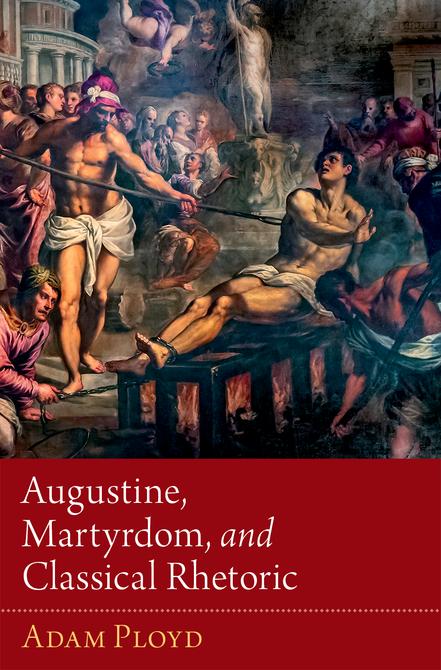
Title: Augustine, martyrdom, and classical rhetoric / Adam Ployd. Description: New York, NY : Oxford University Press, 2023. | Includes bibliographical references and index.
Identifiers: LCCN 2022061051 (print) | LCCN 2022061052 (ebook) | ISBN 9780190914141 (hardback) | ISBN 9780190914165 (epub) | ISBN 9780190914158 | ISBN 9780190914172
LC record available at https://lccn.loc.gov/2022061051
LC ebook record available at https://lccn.loc.gov/2022061052
DOI: 10.1093/oso/9780190914141.001.0001
Printed by Integrated Books International, United States of America
In loving memory of Christopher Riddle Ployd, whose memory provides examples of many virtues and just the right number of vices
Acknowledgments
This book began as a short communication at the International Patristics Conference at Oxford in 2015. Since that brief paper, this project has been supported by a host of colleagues, students, and friends. My memory is too feeble to remember them all. But I would be remiss not to name those who do come to mind, with sincerest apologies to those I neglect.
First and foremost, I give thanks for the loving support of my wife, Diane Kenaston, and for the inspiration of our son, Isaac, who came into this world midway through completion of this project. Both have provided the laughter and encouragement needed to keep going on a book that all too often seemed like it would never materialize.
At the top of the list of the many patristics and early Christianity scholars who have strengthened this work, I must name my doktorvater, Lewis Ayres, who repeatedly advised me not to let go of what he assured me was a promising project. Many other colleagues offered advice, read drafts, or otherwise served as conversation partners along the way. These include, in no particular order, Diane Fruchtman, Emily Cain, Anthony Dupont, J. Patout Burns, Elizabeth Castelli, David Hunter, Ian McFarland, Brian Gronewoller, Michael Cameron, Rafał Toczko, and so many more.
This work arose within particular institutional contexts, without whose support it would not have been completed. I therefore express my fulsome gratitude to the faculty, staff, and students of Eden Theological Seminary in St. Louis and of Wesley House, Cambridge.
Portions of chapters 1 and 4 previously appeared as “Non poena sed causa: Augustine’s Anti-Donatist Rhetoric of Martyrdom,” Augustinian Studies 49 (2018): 25–44 and “For Their Own Good: Augustine and the Rhetoric of Beneficial Persecution,” in Heirs of Roman Persecution: Studies on a Christian and Para-Christian Discourse in Late Antiquity, edited by Eric Fournier (London: Routledge, 2019), 95–111. Part of chapter 3 previously appeared as “Augustine, Martyrdom, and the Exemplary Rhetoric of History,” Journal of Early Christian Studies 28 (2020): 423–41. An earlier version of chapter 5 previously appeared as “Augustine’s Martyrs as Ideal Christian Rhetors,” Augustiniana 71 (2021): 27–43. I am grateful to the respective publishers for permission to include revised versions of these texts in this book.
Abbreviations
CCSL Corpus Christianorum. Series Latina
Chadwick Henry Chadwick, trans., Confessions
CSEL Corpus Scriptorum Ecclesiasticorum Latinorum
LCL Loeb Classical Library
MA Miscellanea Agostiniana
O’Donnell J. J. O’Donnell, ed., Augustine: Confessions
OOSA Sancti Ambrosii Mediolanensis Episcopi Opera Omnia
PL Patrologiae Cursus Completus, Series Latina
PLS Supplement to the Patrologiae Cursus Completus, Series Latina
RB Revue Bénédictine
SE Sacris Erudiri
SPM Stromata Patristica et Mediaevalia
WSA The Works of Saint Augustine
For titles of specific works of Augustine and others, see the bibliography.
Introduction
“The blood of the martyrs is the seed of the church.” Tertullian never said that. He did say, “The blood of Christians is seed.” But this common misquotation is not far off from what he meant. Tertullian had in mind the ironically persuasive effect that persecution supposedly had on Christianity’s numerical increase:
Whenever we are mown down by you, we grow even more numerous. The blood of Christians is seed! Many of your own people encourage enduring pain and death, like Cicero in the Tusculans, or Seneca in his Chances, or Diogenes, or Pyrrhus, or Callinicus; and yet their words do not find as many disciples as the deeds of Christians do. That obstinacy itself, which you condemn, is the teacher. For who, contemplating it, is not roused to investigate what lies at the heart of it? Who, when he has investigated, does not assent [to Christianity]? And when he has assented, who does not long to suffer that he might obtain the full grace of God, that he might procure from God complete forgiveness, by the compensation of his blood?1
Martyrdom performs a rhetorical function for Tertullian. Just as treasured “pagan” authors seek to persuade their readers to brave endurance with words—that is, with literary rhetoric—so the actions of the martyrs accomplish the same thing, exhorting others, by the eloquence of their endurance unto death, to examine what could inspire such heroic commitment. Having responded to martyrdom’s wooing, as it were, the explorer themself becomes an adherent to the doctrines of the church to the extent that they too might give their blood to share in God’s forgiving grace.
While Tertullian depicts the martyrs and their martyrdoms as rhetorically efficacious, it is Tertullian himself who is doing the rhetorical work, at least
1 Tertullian, apol. 50 (CCSL 1:171). Unless otherwise noted, all translations are my own. Blake Leyerle has placed the famous phrase, “the blood of Christians is seed,” within the context of Jewish ritual understandings of blood, an appreciation that further expands the rhetorical scope of this image. See Leyerle, “Blood Is Seed,” Journal of Religion 81 (2001): 26–48.
from an historical perspective. He is the one who constructs the martyrs as persuasive. Whether or not he accurately represents the growth of the church vis-à-vis persecution, the argument questions not only the legitimacy of persecution but also its efficacy. The martyrs are his rhetorical tools whose significance he can craft with skill. In this case, they become, in their persuasive power, agents of God’s providence, subverting the powers of this world for the building up of God’s church. In a theological sense, then, God is the rhetor, “speaking” the martyrs’ deaths for the sake of persuasion, conversion, and, by these means, salvation.
At one level, in this book I argue that Augustine does the same thing that Tertullian does. For both of them, the martyrs are rhetorical, both in the sense that the martyrs are the subject of rhetorical skill and in the sense that the martyrs are themselves depicted as persuasive. Further, both Tertullian and Augustine do so for particular theological ends.
But that level of analysis is only the starting place for this study. The heart of my argument lies in how Augustine accomplishes this goal and what his particular theological ends are, especially in a postpersecution context.
To allude once more to Tertullian,2 martyrs are not born; they are constructed and, when necessary, reconstructed. Martyrs and martyrdom are not static categories or events, but culturally powerful artifacts and tools of communal memory and social persuasion. Over the last few decades, scholars of early Christian martyrdom have come to emphasize the way in which martyr accounts reflect efforts to shape identity and ideology within and between Christian communities.3 By now it is de rigueur to describe early Christian martyr discourse as “rhetorical,” signaling that texts and (for some) their authors are doing more than merely reporting facts; they are interpreting facts, sometimes creating them, and always deploying them to accomplish some persuasive end.
This rhetorical turn in martyr studies, though firmly established, still leaves much work to be done in understanding the mechanics and significance of martyr rhetoric in late antique Christianity. Much (though not
2 Tertullian, apol. 18: “Christians are made, not born.”
3 E.g., Candida Moss, The Myth of Persecution: How Early Christians Invented a Story of Martyrdom (New York: HarperCollins, 2013); Moss, The Other Christs: Imitating Jesus in Ancient Christian Ideologies of Martyrdom (New York: Oxford University Press, 2010); Elizabeth Castelli, Martyrdom and Memory: Early Christian Culture Making (New York: Columbia University Press, 2004); Lucy Grig, Making Martyrs in Late Antiquity (London: Bristol Classical Press, 2004). On theorizing the concept of “martyrdom” from an interdisciplinary perspective, see Michaela DeSoucey, Jo-Ellen Pozner, Corey Fields, Kerry Dobransky, and Gary Alan Fine, “Memory and Sacrifice: An Embodied Theory of Martyrdom,” Cultural Sociology 2 (2008): 99–121.
all4) of the rhetorical analysis provided so far uses categories derived from modern theorists, and fruitfully so. But, having identified the rhetorical nature of these texts and of the larger discourse on martyrdom, more analysis is also needed that draws upon the rhetorical theory and practice of the late antique world if we are to perceive how the cultural tools available to early Christian authors are actively deployed for various ends. Moreover, there is need for theologians to engage more robustly with these historiographical developments.
In this study, I seek to fill these lacunae by examining the work of Augustine.5 Augustine is an appropriate source for at least two reasons. First, his treatises, letters, and especially sermons are filled with discussions of martyrs and martyrdom. Whether he is preaching on a particular saint’s feast day or reflecting on his mother’s practices within the cult of the martyrs, Augustine has the martyrs ever on the tips of both his tongue and his pen. Because martyrdom is a perennial theme for the bishop of Hippo, he provides a rich well from which to draw on the subject.6
4 See, e.g., the discussion of ἔκφρασις in Diane Fruchtman, “Living in a Martyrial World: Living Martyrs and the Creation of Martyrial Consciousness in the Late Antique Latin West” (PhD diss., Indiana University, 2014); and the analysis of encomium and panegyric in Pauline Allen et al., “Let Us Die That We May Live”: Greek Homilies on Christian Martyrs from Asia Minor, Palestine and Syria (c. AD 350–AD 450) (London: Routledge, 2003).
5 For the status quaestionis on martyrdom in Augustine, see Anthony Dupont, “Augustine’s Homiletic Definition of Martyrdom: The Centrality of the Martyr’s Grace in His Anti-Donatist and Anti-Pelagian Sermones ad Populum,” in Christian Martyrdom in Late Antiquity (300–450 AD): History and Discourse, Tradition and Religious Identity, ed. Peter Gemeinhardt and Johan Leemans (Berlin: DeGruyter, 2012), 155–78, esp. 155–61.
6 Oddly, this book is the first monograph on Augustine and martyrdom in English. This is not to say that the topic has gone unexamined. Numerous shorter studies exist, as suggested above. In addition to Dupont, “Augustine’s Homiletic Definition of Martyrdom,” see Dupont, Preacher of Grace: A Critical Reappraisal of Augustine’s Doctrine of Grace in His Sermones ad Populum on Liturgical Feasts and during the Donatist Controversy (Leiden: Brill, 2014), 137–59; Collin Garbarino, “Augustine, Donatists, and Martyrdom,” in An Age of Saints? Power, Conflict, and Dissent in Early Medieval Christianity, ed. Peeter Sarris, Matthew Dal Santo, and Phil Booth (Leiden: Brill, 2011), 49–61; Dupont, “Imitatio Christi, Imitatio Stephani: Augustine’s Thinking on Martyrdom Based on His Sermones on the Protomartyr Stephen,” Augustiniana 56 (2006): 29–61; Tarcisius van Bavel, “The Cult of Martyrs in St. Augustine: Theology versus Popular Religion?,” in Martyrium in Multidisciplinary Perspective, ed. Mathijs Lamberigts and Peter van Deun (Leuven: Peeters, 1995), 351–56; Jan den Boeft, “‘Martyres sunt, sed homines fuerunt’: Augustine on Martyrdom,” in Fructus Centesimus: Mélanges offerts à Gereard J. M. Bartelink à l’occasion de son soixante-cinquième anniversaire, ed. A. A. R. Bastiaensen, A. Hilhorst, and C. H. Kneepkens (Turnhout: Brepols, 1989), 115–24; C. P. Mayer, “ ‘Attende Stephanum conservum tuum’ (Serm. 317, 2, 3). Sinn und Wert der Märtyrerverehrung nach den Stephanuspredigten Augustins,” in Fructus Centesimus, 217–37; A. A. R. Bastiaensen, “Quelques observations sur la terminologie du martyre chez saint Augustin,” in Signum Pietatis: Festgabe für Cornelius Petrus Mayer OSA zum 60. Geburtstag, ed. Adolar Zumkeller (Würzburg: Augustinus-Verlag, 1989), 201–16; M. Pellegrino, “Chiesa e martirio in Sant’Aogostino,” in Richerche Patristiche 1 (Torino, 1982), 507–633; M. Pelligrino, “Christo e il martire nel pensiero di Sant’Agostino,” in Richerche Patristiche 1, 633–68; A.-M. La Bonnardière, “Les Enarrationes in Psalmos prêchées par saint Augustin à l’occasion de fêtes de martyrs,” Recherches Augustiniennes et Patristiques 7 (1971): 73–104; Cyrille Lambot, “Les sermons de saint Augustin pour les fetes de
Second, Augustine, prior to his conversion to Catholic Christianity, was a professional rhetor, selling his skill to student and emperor alike. Later he deployed the full range of his craft not only in preaching but also in his literary output. He wrestled with the morality of rhetoric and created an influential Christian vision of the art. Few late antique Christian figures would be as fruitful a source for investigating what it means to call martyr discourse rhetorical. Indeed, my argument draws on a newer way of reading Augustine’s rhetoric, for only now are scholars beginning to take notice of the argumentative aspects of his rhetoric, and not just the stylistic.7
I argue that Augustine’s martyr discourse may be considered rhetorical in three ways. First, Augustine develops and deploys his understanding of martyrs,” Analecta Bollandiana 67 (1949): 249–66. The closest thing we have to a monograph study in English is Elena Martin, “Sanctae Famulae Dei: Towards a Reading of Augustine’s Female Martyrs” (PhD thesis, Durham University, 2009). Even outside of English, monographic treatments are hard to come by. See esp. Guy Lapointe, La celebration des martyrs en Afrique d’après les sermons de saint Augustin (Montreal, 1972). For a more specific focus, see Wojciech Lazewski, “La Sentenza Agostiniana Martyrem Facit Non Poena Sed Causa” (PhD diss., Pontificia Universitas Lateranensis, 1987). One oft-repeated theme in the literature that I will not engage, but which is worth acknowledging here, is the periodization of Augustine’s martyr texts. I accept the traditional threefold delineation: 309–401 (in which he battled cultic excesses), 401–15 (a period defined by Donatist concerns and therefore more constructive engagement with martyrdom), and 415–30 (a more enthusiastic period of martyr promotion following the discovery of the relics of the proto-martyr Stephen). On this periodization, see Victor Saxer, Morts, martyrs, reliques en Afrique chrétienne aux premiers siècles. Les témoignages de Tertullien, Cyprien et Augusttine à l’archéologie africaine. Theologie historique 55 (Paris: Beauchesne, 1980), 124; van Bavel, “The Cult of the Martyrs,” 351–61; and Dupont, “Augustine’s Homiletic Definition of Martyrdom,” 157 n.7. My lack of discussion of this periodization comes from my agreement with van Bavel, “The Cult of the Martyrs,” 361: “The conclusion of this paper is that after his conversion Augustine never repudiated the cult of the martyrs, but that new facts and experiences were at the origin of some changes, while his theological insights remained essentially the same. What he always refuted were the—in his eyes—theologically wrong interpretations of the cult of the martyrs.”
7 See esp. Rafał Toczko, Crimen Obicere: Forensic Rhetoric and Augustine’s Anti-Donatist Correspondence. Forschungen zur Kirchen- und Dogmengeschichte 120 (Göttingen: Vandenhoeck & Ruprecht Verlag, 2020). Although Henri-Irenée Marrou, Saint Augustin et la fin de la culture antique, 4th ed. (Paris: Éditions E. de Boccard, 1958) remains important for Augustine’s engagement with late antique grammatical and rhetorical culture, several recent works have rehabilitated our appreciation for the way these liberal arts shaped Augustine’s scriptural interpretation and theology. See esp. Michael Cameron, Christ Meets Me Everywhere: Augustine’s Early Figurative Exegesis (New York: Oxford, 2012); Robert Dodaro, “Language Matters: Augustine’s Use of Literary Decorum in Theological Argument,” Augustinian Studies 45, no. 1 (2014): 1–28; Lewis Ayres, “Into the Poem of the Universe: Exempla, Conversion, and Church in Augustine’s Confessiones,” Zeitschrift für antikes Christentum 13 (2009): 263–81; Dodaro, “Literary Decorum in Scriptural Exegesis: Augustine of Hippo, Epistula 138,” in L’esegi di Padri Latini, Dalle origini a Gregorio Magno (Rome: Institutum Patristicum Augustinianum, 2000), 1:159–74; Dodaro, “Quid deceat videre (Cicero, Orator 70): Literary Propriety and Doctrinal Orthodoxy in Augustine of Hippo,” in Orthodoxie, christianisme, histoire, ed. Susanna Elm et al. (Rome: École Française de Rome, 2000), 57–81; Dodaro, “The Theologian as Grammarian: Literary Decorum in Augustine’s Defense of Orthodox Discourse,” Studia Patristica 38 (2001): 70–83.
martyrdom within particular rhetorical contexts. This is the weakest and most general sense of “rhetorical” that will appear in this study, falling short of, yet providing the necessary context for, the more technical analyses that make up the heart of the book. Chapter 1 establishes these cultural contexts, emphasizing the development of martyr discourse within North Africa up to and including the Donatist controversy and Augustine’s personal encounter with the practices associated with the cult. This chapter further looks at two polemical contexts—the Manichaean and Pelagian controversies—that are not typically associated with martyrdom. By highlighting these unusual polemical contexts, I emphasize the ubiquity of martyr rhetoric within Augustine’s larger theological oeuvre.
The second way in which Augustine’s martyr discourse may be considered rhetorical is that he uses techniques of classical rhetorical argumentation to construct his martyrs and to create their theological significance. Here I am not primarily referring to techniques of ornamentation or style, although these will occasionally appear. Rather, I mean those techniques more associated with the category of inventio and to some degree dispositio. To this end, Chapter 2 takes up the tool of exempla to elucidate Augustine’s most common use of martyrs, that is, as models for spiritual imitation. This theme is accentuated by examining a particular construction of exempla, a method I call “nominal etymology” whereby the names of the martyrs become the keys to their exemplary significance.
Chapter 3 remains in the realm of exempla, now understood within the context of Roman historiography. Here I demonstrate that Augustine’s use of the martyrs as exemplary Christians serves to construct a Christian historiography that rejects the Roman penchant for narratives of decline. The chapter concludes with Augustine’s depiction of the martyrs as beautiful, despite, or indeed because of, their grotesque sufferings. His use of rhetorical antithesis not only highlights the contrast between the martyrs and the beauty of this world but also reflects his understanding of God’s providential ordering of history in which the martyrs take part.
Chapter 4 turns to the field of forensic rhetoric and Augustine’s conflict with the Donatists. Here I argue that Augustine’s famous slogan, that it is the cause not the punishment that makes a martyr, is best understood within the realm of legal issue theory as an issue of definition. The second half of this chapter turns from the issue of definition to an issue of quality. Taken together, these two issues point to the ever-present legal context within which the Donatist controversy took place, all parties jockeying for imperial
favor or legitimacy, often with claims to martyrdom at the center of such contestation.
The third and final way in which I claim Augustine’s martyr discourse may be considered rhetorical is that, in his depiction, the martyrs themselves are ideal Christian rhetors. I tackle this claim in Chapter 5, tracing the GrecoRoman tradition of the ideal rhetor alongside Augustine’s Christianization of the theme to show how his martyrs embody it. As ideal rhetors, however, Augustine’s martyrs play another significant role, that is, as the ideal Christian statesmen. While it is well known that martyrs would reign with Christ after their deaths, as ideal rhetor-statesmen Augustine’s martyrs, though not holding temporal power, operate as agents of Christ working to establish the city of God within this world. Thus, Augustine imbues the martyrs with their own rhetorical power, or, rather, he identifies the way in which they are Christ’s rhetors, exhorting all to leave behind the things of this world and cling to those of heaven, to become citizens of the city of God whose virtues they model. On the one hand, this approach is merely an extension of Augustine’s own rhetorical agency. On the other, it suggests a deeper meaning for a bishop who believed his own oratorical skill to be in the service of salvific, divine persuasion.
My argument does not rest only in the rhetorical world. There is also a theological angle to this study. The central theme that will soon become apparent is the way in which Augustine uses the martyrs to reorient the spiritual vision of his readers and hearers. Or, we may more accurately say, it is the way in which Augustine believes that Christ uses the martyrs to direct the vision of all Christians toward the things of true value. At the most basic level, this means leading the faithful to concern themselves with heavenly goods instead of earthly, just as the martyrs are depicted as having done. But delving deeper, we see that the martyrs are more than mere moral exemplars. They are also key figures within the history of the city of God. Inasmuch as they are moral exemplars, they inspire faithful vigilance in a time of perceived peace, reminding the faithful that any period of history is ripe for spiritual persecution. Thus, the martyrs hold a key place within the economy of salvation as they both reveal the divine ordering of history and bridge the divide between the epoch-defining sacrifice of Christ and the seemingly triumphant period of Christian empire. It is in this last context, that of Augustine himself, that Christ uses the martyrs as ideal rhetors and statesmen of the city of God. Within this ultimate role, Augustine’s martyrs bring us back around to their original role, as exemplars and exhorters, promoting true piety as the true
good of the divine city. But in the end, we will see that this exemplary role is part of Christ’s larger work of salvation in history. Indeed, for Augustine, the rhetorical tools that he deploys to construct the meaning of martyrdom are only echoes of the divine work of persuasion that God performs through the martyrs’ words, deeds, and memories.
Let us begin, then, by defining the contexts within which these rhetorical and theological moves occur.
1
The Context of the Martyrs
Introduction
Augustine’s rhetoric of martyrdom does not arise in a void. He is not constructing a theory of martyrdom removed from the contexts of his polemics and ministry. Rather than an abstract vision of martyrdom, Augustine’s rhetoric is grounded in the reality of conflicts within and without his Christian community. To appreciate the more technical aspects of his rhetoric, then, we must first analyze the rhetorical contexts for his efforts. Such is the goal of this chapter.
By “rhetorical contexts” I refer to a more general understanding of rhetoric than I will use for the rest of the book. I consider a rhetorical context to be any context in which the ideas or practices associated with martyrs carry cultural power, making martyrdom the object or means of contestation or construction. I do not mean by the phrase that the contexts are themselves rhetorically constructed—though of course many of them are. Nor do I mean that classical rhetoric is necessarily deployed within those contexts—though of course it often is. My use of the phrase “rhetorical context” represents a simpler, more basic understanding of sociocultural or intellectual contexts in which the meaning of martyrdom or the figures of the martyrs are constructed and contested and, for our purposes, in which Augustine is engaged.
I pursue these rhetorical contexts in four phases. First, I examine the most practical context for martyr discourse: the cult of the martyrs in North Africa. Beginning in the late second century, I trace the significance of martyrdom up to Augustine, concluding with his own engagement with the cult as depicted in the Confessions. Next, I examine the most trenchant context for Augustine’s martyr rhetoric, that is, the Donatist controversy, a conflict originating in Diocletian’s persecution and manifesting in contestation over which communion can claim to be the “church of the martyrs.” The final two phases look to Augustine’s polemics against the Manichaeans and the Pelagians at the beginning and end of his career, respectively, two contexts
that do not deal extensively with martyrdom but which both illustrate the ubiquity of its discursive presence.
The Cult of the Martyrs in North Africa
Although cults of the martyrs were widely observed in one form or another throughout the late antique Christian world, the African church has a strong claim to a unique proclivity.1 Augustine’s rhetoric of martyrdom grows in discursive soil fertilized by over two centuries of persecution memory and hero veneration. Although martyrs and martyrdom appear within Augustine’s brief Italian context, as I will discuss later in this chapter, we must begin in North Africa in order to understand the quotidian concern for the topic that shaped his earliest experience of Christianity along with his later ministerial context.
The earliest text we have preserved from Christian North Africa is a martyrdom account, the Acts of the Scillitan Martyrs. The text purports to recount the trial of twelve Numidian Christians. They explicitly reject the empire of this world in favor of allegiance to God, proudly and defiantly proclaiming, “I am a Christian.” After their death sentence is passed, they offer thanks to God. The author then explains that they were “crowned with martyrdom” and “reign” with the Trinity forever, imagery that will become standard in future martyr discourse.2 The Scillitan martyrs were still honored with feast days in Augustine’s time.3
Similar language is used to describe the deaths of Perpetua, Felicitas, and their fellow Christians a generation later. In the Passion of Perpetua and Felicitas, a first-hand account from the former woman that is edited with an introduction and conclusion by another hand, we find the same unbending affirmation of Christian identity.4 Perpetua points to a pitcher, asks if it can be called anything else, and, upon being told “no,” proclaims, “Neither can I be called anything other than a Christian.”5 In dreams, Perpetua envisions
1 See Candida Moss, “Martyr Veneration in Late Antique North Africa,” in The Donatist Controversy and Contexts, ed. Richard Miles (Liverpool: Liverpool University Press, 2016), 54–69.
2 Scil. 13–17; Fabio Ruggiero, ed., Atti Dei Martiri Scilitani: Introduzione, Testo, Traduzione, Testimonianze e Commento (Roma: Atti Della Accademia Nazionale Dei Lincei, 1991), 73–74.
3 See esp. s 299D–F.
4 See Joyce E. Salisbury, Perpetua’s Passion: The Death and Memory of a Young Roman Woman (New York: Routledge, 1997).
5 Perp. 3; L. Stephanie Cobb, ed., The Passion of Perpetua and Felicitas in Late Antiquity (Oakland: University of California Press, 2021), 22–24.
martyrdom as climbing a ladder to heaven by crushing the serpent under her foot and demonstrates the power of confessors and martyrs to intercede for the dead.6 Most important for the present study, the editor of the text describes this account as containing “examples for the edification of the people” and evincing “other virtues of the Spirit.”7 I will have much to say later about the significance of examples and virtue. For now, it is enough to note that Perpetua and Felicitas also continue to receive veneration in Augustine’s day.8
Perpetua’s contemporary, Tertullian, allows the historian and theologian to move beyond Acta and Passiones to encounter explicit reflection on and polemics about martyrs and martyrdom.9 Tertullian discusses the nature and significance of martyrdom repeatedly in his works, even changing his mind regarding the legitimacy of flight during persecution.10 A representative text is his Antidote to the Scorpion’s Sting, written against the Valentinian accusation that martyrdom was contrary to the will of the true God. Tertullian argues that martyrdom is in fact a good commanded by God: “The goodness of the very thing, that is, of martyrdom, will prove that God wills it because nothing can be good unless the good one wills it. I contend that martyrdom is good to the very same God by whom idolatry is forbidden and punished. For martyrdom struggles against and is contrary to idolatry. And it is not possible for something to struggle against and be contrary to evil unless it is good.”11 And, most famously, he declares that “the blood of Christians is seed,”12 often glossed as “the blood of the martyrs is the seed of the church.” Tertullian thus represents the beginning of explicit theological reflection on martyrs and martyrdom, its ubiquity in his writings representing the theme’s early role within North African Christian self-understanding.
As significant as Tertullian is as a witness to North African theologies of martyrdom, on this topic and in this region no figure looms so large as that of Cyprian of Carthage.13 As bishop, Cyprian struggled to guide his flock
6 Perp. 4, 7–8.
7 Perp. 1; Cobb, The Passion of Perpetua, 22.
8 See s. 280–82.
9 See Saxer, Morts, martyrs, reliques, 73–83.
10 Compare his position in the early texts pat. 13.6 and ux. 1.3.4 with that of the later fug. 4. See Ruth Sutcliffe, “To Flee or Not to Flee: Matthew 10:23 and Third-Century Flight in Persecution,” Scrinium 14 (2018): 133–60.
11 Tertullian, scorp. 5.3 (CCSL 2:1077).
12 Tertullian, apol. 50 (CCSL 1:171).
13 The most important work on Cyprian remains J. Patout Burns, Cyprian the Bishop, Routledge Early Church Monographs (New York: Routledge, 2002). See also, Saxer, Morts, martyrs, reliques, 104–8.
through the Decian and Valerian persecutions of the 250s. Cyprian himself would lose his head under Valerius and become the paradigmatic martyrbishop of the African church, but before he earned his crown, he wrestled with the vexing practical problems that arise when the spiritual authority of martyrs meets the reality of human frailty. What was to be done with those Christians who lapsed during the persecution, failing to confess Christ in one way or another while their coreligionists suffered exile, torture, and even death? Could such apostasy be forgiven by the church, or must the lapsed remain penitential outside of the church until their death?14 This question is complicated when confessors, bearing the authority of soon-to-be martyrs, promise to secure the forgiveness of Christ for those who have lapsed. As the church divided into laxist and rigorist factions, Cyprian roped the martyrs into his rhetorical defense of the unity of the church.
Cyprian had to curb the practice of appealing to the authority of the confessors and recent martyrs while not seeming to undermine the honor due to them. His On the Fallen walks this rhetorical tightrope by playing upon the pious virtue martyrs necessarily possessed:
Let no one, most beloved brothers, defame the dignity of the martyrs. Let no one demolish their glories and their crowns. Let the strength of their uncorrupted faith remain unharmed. The one whose faith and hope and strength and glory are all in Christ cannot say or do anything against Christ. Therefore, these [martyrs] who have done the commands of God are not able to be the authorities by which bishops act against the commands of God.15
Instead of openly contesting the martyrs’ authority to absolve apostates of their sins, Cyprian suggests that laxist bishops who appeal to such martyrial authority in reconciling apostates without a period of penance are acting in a way inconsistent with the faith and righteousness of the martyrs. Similarly, Cyprian appeals to Matt 10:32–33 where Christ affirms that he will not only confess to the Father on behalf of those who confess him but also deny those who deny him. Cyprian uses the North African church’s commitment to the first half of this verse—the reward promised to confessors and martyrs—to uphold what he sees as the necessary consequence of the second half, that
14 See esp. the exchange preserved in Cyprian, ep. 55.
15 Cyprian, laps. 20 (CCSL 3:232–33).
those who denied Christ cannot be readmitted to the church without performing penance.16 Cyprian thus appeals to his community’s reverence for martyrs in order to undermine what he fears are practical abuses of that reverence in the administration of ecclesial boundaries.
In his other major treatise, On the Unity of the Church, Cyprian further circumscribes the authority of martyrdom, this time in the context of schism and competing ecclesial communions associated with Felicissimus in Carthage and Novatian in Rome, the former representing a laxist approach to readmission of the fallen and the latter a rigorist one.17 In order to deny the legitimacy of their communions, Cyprian must also deny their claim to have true martyrs:
Such persons [who gather not in Cyprian’s church but in the competing communions of Novatian or Felicissimus] will not have this stain washed away by blood, even if they were killed for confessing the name [of Christ].
The crime of discord is serious and inexpiable, and it is not cleansed by suffering. It is not possible for one who is not in the church to be a martyr.18
As Augustine does over a century later, Cyprian is working to delimit the scope of martyrdom by denying his opponents’ claim to the title. The identity of the North African church is so tied to the martyrs that Cyprian cannot allow a competing communion to claim any of them. Cyprian, therefore, represents the practical significance of martyrdom within North African Christianity as well as the rhetorical power that the martyrs carried. Indeed, Cyprian himself will become the martyr whose authority both Augustine and his opponents will claim as support for their ecclesiological positions.
Cyprian’s conflicts represent clear precedents for Augustine’s struggles with the Donatists.19 Not only did Cyprian’s own legacy serve as contested
16 Cyprian, laps. 20.
17 On the two versions of unit. eccl. and the contexts for each, see Karl Shuve, “Cyprian of Carthage’s Writings from the Rebaptism Controversy: Two Revisionary Proposals Reconsidered,” Journal of Theological Studies 61 (2010): 627–43; Burns, Cyprian the Bishop, 93–95. The portion quoted is identical in both versions.
18 Cyprian, unit. eccl. 14 (CCSL 3:259). On the significance of this position, see Allen Brent, “Cyprian’s Reconstruction of the Martyr Tradition,” Journal of Ecclesiastical History 53, no. 2 (2002): 251–63.
19 On the role of martyrdom in the Donatist conflict, see Brent Shaw, Sacred Violence: African Christians and Sectarian Hatred in the Age of Augustine (Cambridge: Cambridge University Press, 2011); Maureen Tilley, Donatist Martyr Stories: The Church in Conflict in Roman North Africa (Liverpool: Liverpool University Press, 1996); Anthony Dupont, “Augustine’s Homiletic Definition of Martyrdom: The Centrality of the Martyr’s Grace in his Anti-Donatist and Anti-Pelagian Sermones ad Populum,” in Christian Martyrdom in Late Antiquity (300–450 AD): History and Discourse,
ground for the competing communions,20 but also his struggle to define the limits of a martyr’s legitimacy and authority anticipate the way the Donatists will paint themselves as the church of the martyrs and the way Augustine will work to subvert that claim. Augustine himself preserves some of the Donatists’ own discourse on martyrdom. For instance, the Donatist bishop Petilian turns the accusation of rebaptism into a discussion of Donatist suffering at the hands of the Catholics: “Blush! Blush, persecutors! You make martyrs who are like Christ; after the true baptism of water, a baptism of blood bathes them.”21 This is the same bishop who declares at the Conference of Carthage in 411, “With us is found the true Catholic Church, that which suffers persecution, not that which inflicts it.”22
The Donatists even cultivated their own martyr traditions in an effort to shape their particular ecclesial identity. While some of these martyr stories are set during the Diocletianic persecutions or earlier (including a Donatist version of Cyprian’s own passion), others take place in more recent contexts, most notably during the repressions carried out under the imperial notary Macarius from 346 to 348.23 In the Passion of Isaac and Maximian, the author identifies the devil as the agent of the Macarian decrees, who “again ordered an agreement of sacrilegious unity established by torture to be celebrated.”24 In the same account, when Isaac is brought before the proconsul, he heroically exclaims, “Traditores, come! Preserve your mad unity!”25 Here we see
Tradition and Religious Identity, ed. Peter Gemeinhardt and Johan Leemans (Berlin: DeGruyter, 2012), 161–66; Collin Garbarino, “Augustine, Donatists, and Martyrdom,” in An Age of Saints? Power, Conflict, and Dissent in Early Medieval Christianity, ed. Peter Sarris, Matthew Dal Santo, and Phil Booth (Leiden: Brill, 2011), 49–61; Alan Dearn, “Donatist Martyrs, Stories, and Attitudes,” in The Donatist Schism, ed. Richard Miles, 70–100.
20 On Cyprian’s legacy in the Donatist controversy, see Matthew Alan Gaumer, Augustine’s Cyprian: Authority in Roman Africa (Leiden: Brill, 2016); Gaumer, “Dealing with the Donatist Church: Augustine of Hippo’s Nuanced Claim to the Authority of Cyprian of Carthage,” in Cyprian of Carthage: Studies in His Life, Language, and Thought, ed. Henk Bakker, Paul van Geest, and Hans van Loon (Leuven: Peeters, 2010), 181–202; J. Patout Burns, “Appropriating Augustine Appropriating Cyprian,” Augustinian Studies 36, no. 1 (2005): 113–37.
21 Quoted in c. litt. Pet. 2.23.51 (CSEL 52:50).
22 conl. Carth. 3.22 (CCSL 149A:184).
23 In 347, in an effort to establish ecclesial peace in North Africa, the emperor Constans dispatched Macarius, aided by another representative, Paul, to bring the Donatists into Catholic unity. When Donatists protested the efforts, several of them, including a bishop, were imprisoned, were tortured, and either died in prison or were executed. For recent discussions of these events, see Noel Lenski, “Imperial Legislation and the Donatist Controversy: From Constantine to Honorius,” in The Donatist Schism, ed. Richard Miles, 176–77; and Shaw, Sacred Violence, 162–71.
24 pass. Isaac 3 (TU 134:261–62). For more on pass. Isaac and its context, see Alan Dearn, “Donatist Martyrs, Stories, and Attitudes,” in The Donatist Schism, ed. Richard Miles, 80–86; and Tilley, Donatist Martyr Stories, 61–62.
25 pass. Isaac 6 (TU 134:165).
the rhetorical power of martyrdom. For all the lofty talk of the good of unity on the Catholic side, the portrayal of heroic martyrdom within these texts turns such unity into demonic blasphemy. The author further heightens this contrast: A large group amasses to honor the titular martyrs. The proconsul has them drowned in the sea. But the sea itself gathers the dead bodies “into one” and washes them all upon the shore, where the living members “rejoiced at the arrival of the temples of Christ.”26 True ecclesial unity, the text suggests, is unity with the martyrs, not a false unity with those who create martyrs through the use of imperial coercion. God uses the sea to create this true martyrial unity between the living and the dead; the devil works through the so-called Catholics and their imperial power to establish a sacrilegious imitation.
It is within this context of entrenched martyr veneration and intercommunal contestation that Augustine was born, was raised, and served as priest and bishop. But what did Augustine himself make of this aspect of North African Christianity? While future chapters will offer more nuanced answers to this question, I turn now to Augustine’s discussion of the cult of the martyrs in the Confessions and in his early letters.
The Cult of the Martyrs in
Augustine
Confessions 6.2.2
Augustine’s most famous account of the cult of the martyrs involves his mother, Monica. In Confessions 6, he recounts how, having followed him to Milan, she began to practice her piety in the way to which she was accustomed.27 Allow me to quote the relevant passage at length:
In accordance with my mother’s custom in Africa, she had taken to the memorial shrines of the saints cakes and bread and wine, and was forbidden by the janitor. When she knew that the bishop [Ambrose] was responsible for the prohibition, she accepted it in so devout and docile a manner that
26 pass. Isaac 15–16 (TU 134: 273–74).
27 On Augustine’s relationship to the cult of the martyrs, see the classic study by Johannes Quasten, “Die Reform des Martyrerkultes durch Augustinus,” Theologie und Glaube 25 (1933): 318–31. See also Saxer, Morts, martyrs, reliques, 170–280; Tarcisius van Bavel, “The Cult of the Martyrs in St. Augustine: Theology Versus Popular Religion?,” in Martyrium in Multidisciplinary Perspective, ed. Mathijs Lamberigts and Peter Van Deun (Leuven: Peeters, 1995), 351–61.
I myself was amazed how easy it was for her to find fault with her own custom rather than to dispute this ban. Her spirit was not obsessed by excessive drinking, and no love of wine stimulated her into opposing the truth. . . . After bringing her basket of ceremonial food which she would first taste and then share round the company, she used to present not more than one tiny glass of wine diluted to suit her very sober palate. She would take a sip as an act of respect. If there were many memorial shrines of the dead which were to be honored in that way, it was one and the same cup which she carried about and presented at each place. The wine was not merely drenched with water but also quite tepid; the share she gave to those present was only small sips. Her quest was for devotion, not pleasure. When she learned that the famous preacher and religious leader had ordered that no such offerings were to be made, even by those who acted soberly, to avert any pretext for intoxication being given to drinkers and because the ceremonies were like meals to propitiate the departed spirits and similar to heather superstition, she happily abstained. Instead of a basket full of the fruits of the earth, she learned to bring a heart full of purer vows to the memorials of the martyrs. She would give what she could to the needy; and then the communion of the Lord body was celebrated at the shrines of the martyrs who in imitation of the Lord’s passion were sacrificed and crowned.28
An entire monograph could be written on this single passage. I will limit myself to a brief series of observations. First, Augustine’s description of his mother’s behavior and that of Christians like her gives us a picture of the practices associated with the cult of the martyrs. Central to these practices is the celebration of feasts with the martyrs at their shrines. These feasts included cakes and wine, and Augustine suggests the dangers of excess in his insistence upon his mother’s moderation as well as in Ambrose’s concern to avoid opportunity for inebriation. His mother’s moderation also alludes to the reality of excessive indulgence among other participants.
28 conf. 6.2.2 (O’Donnell, 58–59; trans. Chadwick, 91–92). For summaries of these meals and their significance, see Paula Rose, “Refrigerium,” in Augustinus-Lexikon 4, ed. C. P. Mayer (Basel: Schwabe, 2018), 1104–7; Robin Jensen, “Dining with the Dead: From Mensa to the Altar in Christian Late Antiquity,” in Commemorating the Dead: Texts and Artifacts in Context: Studies of Roman, Jewish, and Christian Burials, ed. Laurie Brink and Deborah Green (Berlin: DeGruyter, 2008), 107–43. For the development of Augustine’s thoughts on these refrigeria, see Rose, “Augustine’s Reassessment of the Commemoration Meal: Quod quidem a christianis melioribus non fit,” in Rituals in Early Christianity: New Perspectives on Tradition and Transformation, ed. Nienke M. Vos and Albert C. Geljon (Leiden: Brill, 2021).
Second, Augustine’s emphasis on his mother’s willingness to submit to Ambrose’s prohibition precisely because it was Ambrose implies the relative intransigence of the participants of the martyr cults in North Africa (again, as Augustine is depicting them). If it takes a bishop as preeminent as Ambrose to make Augustine’s saintly mother refrain from such a beloved form of piety, what must we think of those she had left back home? Of course, we can confidently speculate that Augustine’s purpose in this passage is not just to relate a story about his mother but to promote her as the ideal participant in the cult of the martyrs. When she does celebrate meals at the martyr shrines, she is a model of moderation and temperance. And when she is prevented from doing so by a bishop, she readily obeys, perhaps as Augustine wishes others would when their bishop tries to govern the practices of commemoration that attend to the Christian heroes.
Finally, in Monica’s postchastisement behavior, we have an example of what Augustine may want commemoration of the martyrs to look like. The memorial feasts are replaced by the ecclesially controlled eucharist. Instead of giving to the dead, Monica gives to the poor, a practice Augustine urges in other texts seeking to reform martyr devotion.29 And her offerings to the martyrs become offerings of solemn vows. Augustine also suggests one reason this alternative might have been so important for him: celebrating meals with the martyrs resembles too closely “pagan” rituals of honoring the dead. Ambrose, in Augustine’s voice, may be thinking of the parentalia in which families brought offerings of food and wine to the ancestral tombs.30 Thus, the question of such practices is a question of drawing a clear dividing line between Christian and “pagan,” of cultivating a Christian identity delineated by its ritual practices.
ep. 22
Before he wrote the Confessions, however, Augustine was already expressing similar concerns about the cult of the martyrs. Sometime between 391 and 393, while still a priest, he writes to Aurelius, bishop of Carthage, urging him to curb the excesses of the cultic practices. The themes we saw in brief in
29 See ep. 22.1.6.
30 On parentalia, see Mary Beard et al., Religions of Rome: A History (Cambridge: Cambridge University Press, 1998), 50.
Augustine’s account of his mother we now see elaborated and expanded, providing a fuller picture of cultic practices and of Augustine’s objections. Augustine laments that, of the three pairs of vices referenced in Rom 13:13–14 (feasting and drunkenness, fornication and impurity, and strife and jealousy), the church seems concerned only with the second set. Indeed, they are “considered so great a crime that no one is thought worthy, not only of ecclesiastical ministry but even of the communion of the sacraments.”31 The first pair, however, seems not just tolerated but encouraged “not only on the solemn days in honor of the blessed martyrs, but even daily.”32 Augustine thus suggests that the commemoration of the martyrs is a routine event, not limited by the establishment of a liturgical calendar but guided, presumably, by the devotional desires of the laity. Augustine expresses his disgust for these practices:
Who, seeing not with carnal eyes, does not see that this is something to be grieved? This vileness, were it only shameful and not also sacrilegious, we might consider something to be endured with whatever strength of tolerance we have. . . . At least let this disgrace be kept away from the tombs of the saints’ bodies, from the places for the sacraments, from houses of prayer. For who dares prohibit in private what is often named the honor of the martyrs in holy places.33
The rhetorical context begins to take shape. The shrines, the relics, and the churches dedicated to the martyrs are not merely the physical location of veneration; they are spaces of contestation, places, both conceptual and physical, in which the power of the bishops comes into conflict with the practices of popular piety.
Augustine next proposes a way forward: “The pestilence of this evil is such that it cannot, so it seems to me, be utterly healed without the authority of a council.”34 Here we have the purpose of Augustine’s letter. His concern about the excesses of the martyr feasts leads him to request a full-scale council, something that Aurelius as bishop of Carthage can call. Yet this is not the only avenue Augustine considers: “If the treatment must begin from one church, just as it seems audacious to try to change what the church of Carthage holds,